PARALLEL AND DISTRIBUTED
COMPUTING
J COMPONENT
PRAFUL MITTAL
20BCE1577
Distributed Real Time System Project
Task scheduling and resource allocation in cloud computing using a heuristic approach
WORK FLOW OF THE PROJECT
INTRODUCTION
Cloud computing is an accelerating technology in the field of distributed computing.
Cloud computing can be used in applications that include storing data, data analytics
and IoT applications. Cloud computing is a technology that has changed traditional ways
in which services are deployed by enterprises or individuals. It provides different types of
services to registered users as web services so that the users do not need to invest in
computing infrastructure. Cloud computing provides services such as IaaS (Infrastructure
as a Service), PaaS (Platform as a Service), and SaaS (Software as a Service). In each
type of service, the users are expected to submit the requests to the service provider
through the medium of the Internet. The service provider is responsible for managing the
resources to fulfil the requests generated by users. Service Providers employ scheduling
algorithms to schedule the incoming request (tasks) and to manage their computing
resources efficiently.
Task scheduling and resource management permit providers to maximize revenue
and the utilization of resources up to their limits.Because cloud computing is the
technology that delivers services through the medium of the Internet, service users
must submit their requests online. Because each service has a number of users, a
number of requests (tasks) may be generated at a time. Systems that do not
employ scheduling may feature longer waiting periods for tasks moreover, some
short-term tasks may terminate, due to the waiting period. At the time of
scheduling, the scheduler needs to consider a number of constraints, including the
nature of the task, the size of the task, the task execution time, the availability of
resources, the task queue, and the load on the resources. Task scheduling is one
of the core issues in cloud computing. Proper task scheduling may result in the
efficient utilization of resources. The major advantage of cloud computing is that it
promotes proper utilization of resources.
THE MAJOR WORK COVERED IN THE PROJECTS ARE
1.The analytic hierarchy process is modified to rank scientific tasks.
2. To manage the resources given bandwidth constraints and the load on the virtual machine,
the proposed system incorporates a version of the existing BATS algorithm that has been
modified by introducing BAR system optimization.
3. Bipartite graphs are utilized to map tasks to appropriate virtual machines once the condition
is satisfied.
4. A pre-emption methodology gives us the status of the virtual machine, and a modified divide-
and-conquer methodology has been proposed to aggregate the results after tasks pre-emption
5. The proposed solution is experimentally investigated using the CloudSim simulator.
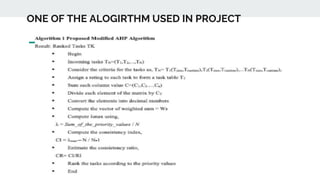
ONE OF THE ALOGIRTHM USED IN PROJECT
SUMMARY
In the study I have proposed a heuristic algorithm that performs task
scheduling and allocates resources efficiently in cloud computing
environments. I have used real Cyber shake and Epigenomics scientific
workflows as input tasks for the system. After this I have compared with
frameworks described by other researchers known as with respect to the
turn around time and the response time of a process. With the help of that
I find out their algorithm has brought better results in terms of those
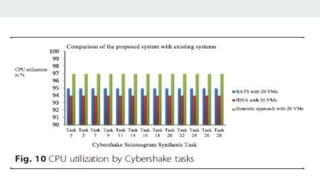
parameters itself. In terms of the research utilization the proposed
heuristic approach efficiently allocates resources with high utility. I have
obtained the maximum utilization result for computing resources such as
CPU, memory, and bandwidth. Most existing systems consider only two
resources, CPU, and memory, inevaluating their performance, the
proposed system adds bandwidth as a resource.
construction management.pptx

construction management.pptx

  • 1.
    PARALLEL AND DISTRIBUTED COMPUTING JCOMPONENT PRAFUL MITTAL 20BCE1577
  • 2.
    Distributed Real TimeSystem Project Task scheduling and resource allocation in cloud computing using a heuristic approach WORK FLOW OF THE PROJECT
  • 3.
    INTRODUCTION Cloud computing isan accelerating technology in the field of distributed computing. Cloud computing can be used in applications that include storing data, data analytics and IoT applications. Cloud computing is a technology that has changed traditional ways in which services are deployed by enterprises or individuals. It provides different types of services to registered users as web services so that the users do not need to invest in computing infrastructure. Cloud computing provides services such as IaaS (Infrastructure as a Service), PaaS (Platform as a Service), and SaaS (Software as a Service). In each type of service, the users are expected to submit the requests to the service provider through the medium of the Internet. The service provider is responsible for managing the resources to fulfil the requests generated by users. Service Providers employ scheduling algorithms to schedule the incoming request (tasks) and to manage their computing resources efficiently.
  • 4.
    Task scheduling andresource management permit providers to maximize revenue and the utilization of resources up to their limits.Because cloud computing is the technology that delivers services through the medium of the Internet, service users must submit their requests online. Because each service has a number of users, a number of requests (tasks) may be generated at a time. Systems that do not employ scheduling may feature longer waiting periods for tasks moreover, some short-term tasks may terminate, due to the waiting period. At the time of scheduling, the scheduler needs to consider a number of constraints, including the nature of the task, the size of the task, the task execution time, the availability of resources, the task queue, and the load on the resources. Task scheduling is one of the core issues in cloud computing. Proper task scheduling may result in the efficient utilization of resources. The major advantage of cloud computing is that it promotes proper utilization of resources.
  • 5.
    THE MAJOR WORKCOVERED IN THE PROJECTS ARE 1.The analytic hierarchy process is modified to rank scientific tasks. 2. To manage the resources given bandwidth constraints and the load on the virtual machine, the proposed system incorporates a version of the existing BATS algorithm that has been modified by introducing BAR system optimization. 3. Bipartite graphs are utilized to map tasks to appropriate virtual machines once the condition is satisfied. 4. A pre-emption methodology gives us the status of the virtual machine, and a modified divide- and-conquer methodology has been proposed to aggregate the results after tasks pre-emption 5. The proposed solution is experimentally investigated using the CloudSim simulator.
  • 6.
    ONE OF THEALOGIRTHM USED IN PROJECT
  • 7.
    SUMMARY In the studyI have proposed a heuristic algorithm that performs task scheduling and allocates resources efficiently in cloud computing environments. I have used real Cyber shake and Epigenomics scientific workflows as input tasks for the system. After this I have compared with frameworks described by other researchers known as with respect to the turn around time and the response time of a process. With the help of that I find out their algorithm has brought better results in terms of those parameters itself. In terms of the research utilization the proposed heuristic approach efficiently allocates resources with high utility. I have obtained the maximum utilization result for computing resources such as CPU, memory, and bandwidth. Most existing systems consider only two resources, CPU, and memory, inevaluating their performance, the proposed system adds bandwidth as a resource.