ACEEE International Journal on Communication, Vol 1, No. 1, Jan 2010


        A High Speed Pipelined Dynamic Circuit
      Implementation Using Modified TSPC Logic
       Design Style With Improved Performance
                                               Abhijit Asati and Chandrashekhar2
                             1
                             Birla Institute of Technology and Science, EEE Group, Pilani, India
                                                Email: abhijitmicro@gmail.com
                    2
                      Central Electronics Engineering Research Institute, IC Design Group, Pilani, India
                                                 Email: chandra@ceeri.ernet.in


Abstract— The high-speed dynamic True Single Phase                             clock skew problem and increases the speed [1], [2],
Clock (TSPC) logic design style offer fully pipelined logic                 [8]. The TSPC Logic style shows a robust cell
circuits using only one clock signal, which makes clock                     characteristic and therefore the standard cell
distribution simple and compact. The conversion of simple                   implementation is possible. The TSPC-cell consists of
logic gates to pipelined TSPC logic gates increases transistor
count since standard cell implementation for a logic function
                                                                            one N-block and one P-block each driven by single clock
uses both N-block as well as P-block to remove transparency                 signal (φ) [1], [2], [5], [7]. In standard TSPC logic style
between pipelined stages, despite the fact that logic                       the implementation of simple gates like AND, OR, XOR
functions are only implemented with N-block. In this paper                  increases the transistor count since each logic cell
we present a technique in which a TSPC logic cell are                       implementation use both N-block together with P-block
implemented both as cell_N and cell_P cells, where each cell                to remove transparency between the pipelined stages,
block is performing a logic function along with only one                    while logic function is implemented only with N-block
type latching operation. Such an implementation allows a                    [3], [5]; therefore it makes the P-block redundant, since it
systematic approach for converting un-pipelined circuits to
                                                                            perform no logic function other than latching. Although
fully pipelined circuits. The alternate cell_N and cell_P
behaves as dynamic register and removes transparency                        logic merging is possible [1], [2] in standard TSPC cell
between pipelined stages. The appropriate numbers of                        by implementing logic functions with both the N-block
dynamic registers are used to equalize stage delays for all                 and P-block, but such a logic merging is inefficient, since
paths and to remove transparency between pipelined stages.                  in practical cases inputs to a gate may appear after
The modified TSPC implementation shows almost 40% to                        different cycle delays, which may not allow effective
50% reduction in transistor counts and almost 50%                           logic merging. The implementation complexity also
reduction in clock cycles as compared to worst-case                         increases due to reduced freedom for logic merging; since
standard TSPC implementation. The worst-case standard                       it requires the careful and tedious mapping of logic
TSPC implementation assumes that no logic merging is
                                                                            functions with both the blocks. The worst-case standard
possible with P-block, since input to any cell appears after
different cycle delays. The modified TSPC logic circuit                     TSPC logic implementation assumes that each cell logic
implementation preserves all the advantages of standard                     function is implemented with N-block only, while P-
TSPC logic implementation and in addition offers the                        block do not implement any logic but provide dynamic
reduced circuit complexity due to reduced transistor count                  latching to avoid the transparency between pipelined
per logic cell. The proposed logic design style reduces layout              stages (i.e. no logic merging possible). Furthermore, the
area and average power consumption as compared to the                       pipelined circuit requires the stage registers (REG) to
standard TSPC pipelined circuit implementation.                             equalize the stage delays for all paths, which are
Index Terms—TSPC, dynamic, pipelined, high speed,                           implemented as one LATCH_N and LATCH_P in
transistor count, circuit complexity
                                                                            cascade. In standard TSPC logic cells if logic merging is
                                                                            not efficient, it increases pipelined stages that need the
                       I. INTRODUCTION                                      extra register operation, which increases the transistor
   Conventional static CMOS circuit implementation                          count [3], [6]. In this paper we present a technique in
cannot fulfill the requirements of high throughput                          which a TSPC logic cells are implemented as cell_N and
pipelined digital designs therefore dynamic logic circuits                  cell_P, where each cell is performing a logic function
can be used to speed-up digital designs. The high-speed                     along with only one type latching operation (either N-
dynamic True Single Phase Clock (TSPC) logic design                         latch or P-latch). The transparency between the pipelined
style offer fully pipelined logic circuits using only one                   stages can be removed by alternate cell_N and cell_P
clock signal, which makes clock distribution simple and                     assignment. Since each cell performs a logic operation
compact [1], [2], [8]. The simple clock distribution of the                 along with latching, such an implementation will reduce
TSPC circuits reduces the layout area for clock lines, no                   the number of redundant transistors due to efficient
                                                                            merging of logic.
  Footnotes: 8-point Times New Roman font; copyright credit, project
number, corresponding author, etc.                                             The circuit complexity gets reduced due to decrease in
                                                                            transistor count per logic cell. Since each cell performs
                                                                            the logic function, therefore the burden of stage register
                                                                            operations to equalize the stage delays for all paths gets

                                                                       24
© 2010 ACEEE
DOI: 01.ijcom.01.01.06
ACEEE International Journal on Communication, Vol 1, No. 1, Jan 2010


reduced by almost 50% as compared to worst-case
standard TSPC logic implementation. The proposed
technique reduces the latency and increases the
throughput of digital pipelined circuit implementation
since the number of clock cycle gets reduced by almost
50%. The proposed logic design style offers advantages
like pipelining, low average power, low latency and high
throughput. A 3-bit pipelined adder is designed using
modified TSPC logic style and compared with standard
TSPC       logic     circuit   implementation.    Logic
implementation using the proposed logic design style is
described in Section II; circuit implementation is
discussed in Section III. Section IV shows the
comparison between standard TSPC and modified TSPC
and section V concludes the paper.

                    II.           LOGIC IMPLEMENTATION
   The proposed modified TSPC implementation allows
                                                                                                              (a) AND_N
the flexibility of implementing logic function with both
N-block as well as with P-block, hence converting the
simpler logic cells to pipelined logic cells shows large
reduction in the transistor count as compared to standard
TSPC logic design style. The simple logic cells like
AND, OR, XOR can be designed using both N-block
logic cell as well as P-block logic cell, thus the logic cells
produced for AND function will be AND_N & AND_P;
OR, XOR in similar way produces OR_N & OR_P,
XOR_N & XOR_P respectively. A simple AND2 gate
can be implemented in two different ways (AND2_N and
AND2_P) as shown in Figure 1. The operations of
AND_N and AND2_P are shown in table I. REG can be
split into LATCH_N and LATCH_P. The latching can be
performed by these two latches are shown in Figure 2.
These latches are used to equalize cycle delays, since the
alternate LATCH_N and LATCH_P form a dynamic                                                                  (b) AND_P
register REG [4]. Table II explains operation of both the
latches. For a pipelined circuit implementation the cell-N
and cell-P must be kept one after other in cascaded                                      TABLE II. OPERATIONS OF LATCH_N AND LATCH_P
manner with appropriate latching to equalize stage delays
for all paths as explained in section III. The operation of
                                                                                                          OPERATION OF LATCH_N
cell_N/cell_P and LATCH_N/LATCH_P are summarized
in table III.
                                                                                     A            φ            Y             Comment
                                                                                 0            1            0         N1 is weak ON
TABLE I.            OPERATION OF AND_N AND OPERATION OF AND_P
                                                                                 1            1            1         P1 strong ON
                                                                                 0            0            Latch     Dynamic latch
                          OPERATION OF AND_N                                     1            0            Latch     Dynamic latch

       A      B               φ      Y          Comments                                                  OPERATION OF LATCH_P
   0        0             0        0       Dynamic evaluation
   0        1             0        0       Dynamic evaluation
   1        0             0        0       Dynamic evaluation                            A            φ         Y              Comment
   1        1             0        1       Dynamic evaluation                        0            0         0          N2 is strong ON
   X        X             1        Latch   Dynamic latch                             1            0         1          P2 weak ON
                                                                                     0            1         Latch      Dynamic latch
                          OPERATION OF AND_P                                         1            1         Latch      Dynamic latch

       A        B             φ        Y        Comments
   0        0             1        0       Dynamic evaluation
   0        1             1        0       Dynamic evaluation


                                                                    25

© 2010 ACEEE
DOI: 01.ijcom.01.01.06
ACEEE International Journal on Communication, Vol 1, No. 1, Jan 2010


                  TABLE III. SUMMARY OF OPERATION                  therefore requires almost double transistor and 6-clock
                                                                   cycle delay for any applied input. The comparison of
           Cell Type          φ=1               φ=0                transistor counts in two different implementations is
          cell_N/       Dynamic         Dynamic
          LATCH_N        evaluation     latch                      shown in table IV. Both the circuit implementations were
          cell_P/       Dynamic         Dynamic                    verified using transistor level simulator (T-spice) from
          LATCH_P       latch
                                              P1
                                        evaluation                 Tanner Research Incorporation utilizing parameters of 0.5
                                                                   μm technology. The simulation result shows correct
                                                                   pipelined circuit behavior. The supply voltage VDD was
                                                                   kept at 3.3V.
                                             N1

                                                                                                       φ
                                                                        A                                                      S
                                                                                             XOR2_N
                                                                        B                                             XOR2_P
                                                                                                       φ
                                                                      Cin
                                                                                             LATCH_N                     φ

                                                                                             AND2_N                   OR3_P
                                             P2                                                    φ
                         LATCH_N                                                                                               Co
                                                                                             AND2_N
                                                                                                                         φ
                                                                                                   φ
                                            N2
                                                                                             AND2_N

                                                                                                   φ
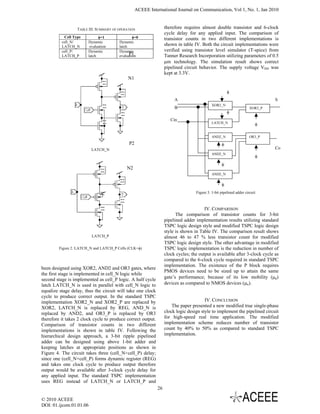
                                                                                   Figure 3. 1-bit pipelined adder circuit


                                                                                        IV. COMPARISON
                                                                         The comparison of transistor counts for 3-bit
                                                                   pipelined adder implementation results utilizing standard
              III. CIRCUIT IMPLEMENTATION                          TSPC logic design style and modified TSPC logic design
                                                                   style is shown in Table IV. The comparison result shows
  The 1-bit pipelined adder circuit shown in Figure 3 has
                         LATCH_P                                   almost 46 to 47 % less transistor count for modified
                                                                   TSPC logic design style. The other advantage in modified
         Figure 2. LATCH_N and LATCH_P Cells (CLK=φ)               TSPC logic implementation is the reduction in number of
                                                                   clock cycles; the output is available after 3-clock cycle as
                                                                   compared to the 6-clock cycle required in standard TSPC
                                                                   implementation. The existence of the P block requires
been designed using XOR2, AND2 and OR3 gates, where
                                                                   PMOS devices need to be sized up to attain the same
the first stage is implemented in cell_N logic while
second stage is implemented as cell_P logic. A half cycle          gate’s performance; because of its low mobility (μp)
latch LATCH_N is used in parallel with cell_N logic to             devices as compared to NMOS devices (μn).
equalize stage delay, thus the circuit will take one clock
cycle to produce correct output. In the standard TSPC
implementation XOR2_N and XOR2_P are replaced by                                        IV. CONCLUSION
XOR2, LATCH_N is replaced by REG, AND_N is                             The paper presented a new modified true single-phase
replaced by AND2, and OR3_P is replaced by OR3                     clock logic design style to implement the pipelined circuit
therefore it takes 2 clock cycle to produce correct output.        for high-speed real time application. The modified
Comparison of transistor counts in two different                   implementation scheme reduces number of transistor
implementations is shown in table IV. Following the                count by 40% to 50% as compared to standard TSPC
hierarchical design approach, a 3-bit ripple pipelined             implementation.
adder can be designed using above 1-bit adder and
keeping latches at appropriate positions as shown in
Figure 4. The circuit takes three (cell_N+cell_P) delay;
since one (cell_N+cell_P) forms dynamic register (REG)
and takes one clock cycle to produce output therefore
output would be available after 3-clock cycle delay for
any applied input. The standard TSPC implementation
uses REG instead of LATCH_N or LATCH_P and
                                                              26

© 2010 ACEEE
DOI: 01.ijcom.01.01.06
ACEEE International Journal on Communication, Vol 1, No. 1, Jan 2010


                  B0          A0                         B1               A1                         B2                 A2
                                            φ                                            φ
                                                                                                                                         φ
    Ci              FA                           LATCH_N              LATCH_N                   LATCH_N             LATCH_N
              S          CO
                                                                                         φ
                                        φ                                                                                                φ
                                                 LATCH_P              LATCH_P                   LATCH_P             LATCH_P
                                   φ
             LATCH_N
                                                                                                                                         φ
                                                               FA                               LATCH_N             LATCH_N
                                   φ                    S            CO
              LATCH_P                                                                φ
                                                                                                                                         φ
                                                                                                                    LATCH_P
                                                                     φ                          LATCH_P
                                   φ             LATCH_N                             φ
             LATCH_N
                                                                                                                                     φ
                                                                     φ                                        FA
                                   φ             LATCH_P                                                  S        CO
              LATCH_P


              S0                                            S1                                       S2                 C2

                                                      Figure 4. 3-bit pipelined adder circuit


                                                      TABLE IV. COMPARISON TABLE
                               standard TSPC                                        Modified TSPC
               Cell       No of          No. of        Sub                 Cell Type     No of       No. of                  Sub
                                      transistor in    Total                             cells    transistor in              Total
               Type       cells
                                        each cell                                                   each cell
               XOR2           6            19           114          XOR2_N/XOR2_P         6           13                    78
               AND2           9            13           117          AND2_N/AND2_P          9           7                    63
                OR3           3            14           42            OR3_N/ OR3_P         3            8                    24
               REG            21           11           231         LATCH_N/LATCH_P        21           5                    105


   The proposed logic style offers almost 50% reduction                   [3] Pareira, J.A. Michell, and J.M Solana “ Fully pipelined
in the number of clock cycle therefore the pipelined logic                    TSPC Barrel shifter for High-Speed Applications,” IEEE J.
circuit can be designed to offer reduced latency and                          Solid-State Circuits, Vol. 30, pp. 686-690, June 1996.
                                                                          [4] Jiren Yuan and Christer Svensson, “High-speed CMOS
increased throughput as compared to standard TSPC
                                                                              Circuit Technique,” IEEE J. Solid-State Circuits, Vol. 24,
circuit implementation. The proposed modified TSPC                            pp. 62-69, February 1989.
logic design style is best suited for converting un-                      [5] S. Flügel, F. Grassert, M. Grothmann, M. Haase, P.
pipelined circuits to fully pipelined circuits with effective                 Nimsch,H. Ploog, D. Timmermann, A. Wassatsch “A
logic merging. The circuit complexity reduces due to                          Design Flow for 12.8 GBit/s Triple DES using Dynamic
reduced number of transistors per logic cell. The                             Logic and Standard Synthesis Tools,” SNUG Europe-2001.
proposed logic style implementation offers compact                        [6] Johnny Pihl “Design Automation with the TSPC Circuit
layout area and the reduced average power consumption                         Technique: A High-Performance Wave Digital Filter,”
for pipelined circuit implementations. Use of single clock                    IEEE Transactions on very large scale integration (VLSI)
                                                                              Systems, VOL. 8, NO. 4, pp. 456-459, August 2000
makes clock distribution simple and compact.
                                                                          [7] Yuan ji-ren, Ingemar Karlsson, Christer Svensson, “A True
                                                                              Single-Phase-Clock Dynamic CMOS Circuit Technique,”
                         REFERENCES                                           IEEE J. Solid-State Circuits, Vol. SC-22, NO. 5, pp. 899-
[1] Jan M. Rabaey, Anantha Chandrakasan, Borivose Nikolic,                    901, October 1987.
    “Digital Integrated Circuits,” Second Edition Prentice–Hall           [8] Seokjin Kim and Ramalingam Sridhar “Buffered Single-
    of India Private Limited, 2004.                                           phase Clocked Logic for High-speed CMOS Pipelined
[2] S.M. kang, Yusuf Leblebici, “CMOS Digital integrated                      Circuits,” 1997 IEEE International Symposium on Circuits
    Circuits, Analysis and Design,” Third edition McGrawhill,                 and Systems, pp.1901-1903, June 9-12,1997, Hong Kong
    2003.


                                                                     27

© 2010 ACEEE
DOI: 01.ijcom.01.01.06

A High Speed Pipelined Dynamic Circuit Implementation Using Modified TSPC Logic Design Style With Improved Performance

  • 1.
    ACEEE International Journalon Communication, Vol 1, No. 1, Jan 2010 A High Speed Pipelined Dynamic Circuit Implementation Using Modified TSPC Logic Design Style With Improved Performance Abhijit Asati and Chandrashekhar2 1 Birla Institute of Technology and Science, EEE Group, Pilani, India Email: abhijitmicro@gmail.com 2 Central Electronics Engineering Research Institute, IC Design Group, Pilani, India Email: chandra@ceeri.ernet.in Abstract— The high-speed dynamic True Single Phase clock skew problem and increases the speed [1], [2], Clock (TSPC) logic design style offer fully pipelined logic [8]. The TSPC Logic style shows a robust cell circuits using only one clock signal, which makes clock characteristic and therefore the standard cell distribution simple and compact. The conversion of simple implementation is possible. The TSPC-cell consists of logic gates to pipelined TSPC logic gates increases transistor count since standard cell implementation for a logic function one N-block and one P-block each driven by single clock uses both N-block as well as P-block to remove transparency signal (φ) [1], [2], [5], [7]. In standard TSPC logic style between pipelined stages, despite the fact that logic the implementation of simple gates like AND, OR, XOR functions are only implemented with N-block. In this paper increases the transistor count since each logic cell we present a technique in which a TSPC logic cell are implementation use both N-block together with P-block implemented both as cell_N and cell_P cells, where each cell to remove transparency between the pipelined stages, block is performing a logic function along with only one while logic function is implemented only with N-block type latching operation. Such an implementation allows a [3], [5]; therefore it makes the P-block redundant, since it systematic approach for converting un-pipelined circuits to perform no logic function other than latching. Although fully pipelined circuits. The alternate cell_N and cell_P behaves as dynamic register and removes transparency logic merging is possible [1], [2] in standard TSPC cell between pipelined stages. The appropriate numbers of by implementing logic functions with both the N-block dynamic registers are used to equalize stage delays for all and P-block, but such a logic merging is inefficient, since paths and to remove transparency between pipelined stages. in practical cases inputs to a gate may appear after The modified TSPC implementation shows almost 40% to different cycle delays, which may not allow effective 50% reduction in transistor counts and almost 50% logic merging. The implementation complexity also reduction in clock cycles as compared to worst-case increases due to reduced freedom for logic merging; since standard TSPC implementation. The worst-case standard it requires the careful and tedious mapping of logic TSPC implementation assumes that no logic merging is functions with both the blocks. The worst-case standard possible with P-block, since input to any cell appears after different cycle delays. The modified TSPC logic circuit TSPC logic implementation assumes that each cell logic implementation preserves all the advantages of standard function is implemented with N-block only, while P- TSPC logic implementation and in addition offers the block do not implement any logic but provide dynamic reduced circuit complexity due to reduced transistor count latching to avoid the transparency between pipelined per logic cell. The proposed logic design style reduces layout stages (i.e. no logic merging possible). Furthermore, the area and average power consumption as compared to the pipelined circuit requires the stage registers (REG) to standard TSPC pipelined circuit implementation. equalize the stage delays for all paths, which are Index Terms—TSPC, dynamic, pipelined, high speed, implemented as one LATCH_N and LATCH_P in transistor count, circuit complexity cascade. In standard TSPC logic cells if logic merging is not efficient, it increases pipelined stages that need the I. INTRODUCTION extra register operation, which increases the transistor Conventional static CMOS circuit implementation count [3], [6]. In this paper we present a technique in cannot fulfill the requirements of high throughput which a TSPC logic cells are implemented as cell_N and pipelined digital designs therefore dynamic logic circuits cell_P, where each cell is performing a logic function can be used to speed-up digital designs. The high-speed along with only one type latching operation (either N- dynamic True Single Phase Clock (TSPC) logic design latch or P-latch). The transparency between the pipelined style offer fully pipelined logic circuits using only one stages can be removed by alternate cell_N and cell_P clock signal, which makes clock distribution simple and assignment. Since each cell performs a logic operation compact [1], [2], [8]. The simple clock distribution of the along with latching, such an implementation will reduce TSPC circuits reduces the layout area for clock lines, no the number of redundant transistors due to efficient merging of logic. Footnotes: 8-point Times New Roman font; copyright credit, project number, corresponding author, etc. The circuit complexity gets reduced due to decrease in transistor count per logic cell. Since each cell performs the logic function, therefore the burden of stage register operations to equalize the stage delays for all paths gets 24 © 2010 ACEEE DOI: 01.ijcom.01.01.06
  • 2.
    ACEEE International Journalon Communication, Vol 1, No. 1, Jan 2010 reduced by almost 50% as compared to worst-case standard TSPC logic implementation. The proposed technique reduces the latency and increases the throughput of digital pipelined circuit implementation since the number of clock cycle gets reduced by almost 50%. The proposed logic design style offers advantages like pipelining, low average power, low latency and high throughput. A 3-bit pipelined adder is designed using modified TSPC logic style and compared with standard TSPC logic circuit implementation. Logic implementation using the proposed logic design style is described in Section II; circuit implementation is discussed in Section III. Section IV shows the comparison between standard TSPC and modified TSPC and section V concludes the paper. II. LOGIC IMPLEMENTATION The proposed modified TSPC implementation allows (a) AND_N the flexibility of implementing logic function with both N-block as well as with P-block, hence converting the simpler logic cells to pipelined logic cells shows large reduction in the transistor count as compared to standard TSPC logic design style. The simple logic cells like AND, OR, XOR can be designed using both N-block logic cell as well as P-block logic cell, thus the logic cells produced for AND function will be AND_N & AND_P; OR, XOR in similar way produces OR_N & OR_P, XOR_N & XOR_P respectively. A simple AND2 gate can be implemented in two different ways (AND2_N and AND2_P) as shown in Figure 1. The operations of AND_N and AND2_P are shown in table I. REG can be split into LATCH_N and LATCH_P. The latching can be performed by these two latches are shown in Figure 2. These latches are used to equalize cycle delays, since the alternate LATCH_N and LATCH_P form a dynamic (b) AND_P register REG [4]. Table II explains operation of both the latches. For a pipelined circuit implementation the cell-N and cell-P must be kept one after other in cascaded TABLE II. OPERATIONS OF LATCH_N AND LATCH_P manner with appropriate latching to equalize stage delays for all paths as explained in section III. The operation of OPERATION OF LATCH_N cell_N/cell_P and LATCH_N/LATCH_P are summarized in table III. A φ Y Comment 0 1 0 N1 is weak ON TABLE I. OPERATION OF AND_N AND OPERATION OF AND_P 1 1 1 P1 strong ON 0 0 Latch Dynamic latch OPERATION OF AND_N 1 0 Latch Dynamic latch A B φ Y Comments OPERATION OF LATCH_P 0 0 0 0 Dynamic evaluation 0 1 0 0 Dynamic evaluation 1 0 0 0 Dynamic evaluation A φ Y Comment 1 1 0 1 Dynamic evaluation 0 0 0 N2 is strong ON X X 1 Latch Dynamic latch 1 0 1 P2 weak ON 0 1 Latch Dynamic latch OPERATION OF AND_P 1 1 Latch Dynamic latch A B φ Y Comments 0 0 1 0 Dynamic evaluation 0 1 1 0 Dynamic evaluation 25 © 2010 ACEEE DOI: 01.ijcom.01.01.06
  • 3.
    ACEEE International Journalon Communication, Vol 1, No. 1, Jan 2010 TABLE III. SUMMARY OF OPERATION therefore requires almost double transistor and 6-clock cycle delay for any applied input. The comparison of Cell Type φ=1 φ=0 transistor counts in two different implementations is cell_N/ Dynamic Dynamic LATCH_N evaluation latch shown in table IV. Both the circuit implementations were cell_P/ Dynamic Dynamic verified using transistor level simulator (T-spice) from LATCH_P latch P1 evaluation Tanner Research Incorporation utilizing parameters of 0.5 μm technology. The simulation result shows correct pipelined circuit behavior. The supply voltage VDD was kept at 3.3V. N1 φ A S XOR2_N B XOR2_P φ Cin LATCH_N φ AND2_N OR3_P P2 φ LATCH_N Co AND2_N φ φ N2 AND2_N φ Figure 3. 1-bit pipelined adder circuit IV. COMPARISON The comparison of transistor counts for 3-bit pipelined adder implementation results utilizing standard III. CIRCUIT IMPLEMENTATION TSPC logic design style and modified TSPC logic design style is shown in Table IV. The comparison result shows The 1-bit pipelined adder circuit shown in Figure 3 has LATCH_P almost 46 to 47 % less transistor count for modified TSPC logic design style. The other advantage in modified Figure 2. LATCH_N and LATCH_P Cells (CLK=φ) TSPC logic implementation is the reduction in number of clock cycles; the output is available after 3-clock cycle as compared to the 6-clock cycle required in standard TSPC implementation. The existence of the P block requires been designed using XOR2, AND2 and OR3 gates, where PMOS devices need to be sized up to attain the same the first stage is implemented in cell_N logic while second stage is implemented as cell_P logic. A half cycle gate’s performance; because of its low mobility (μp) latch LATCH_N is used in parallel with cell_N logic to devices as compared to NMOS devices (μn). equalize stage delay, thus the circuit will take one clock cycle to produce correct output. In the standard TSPC implementation XOR2_N and XOR2_P are replaced by IV. CONCLUSION XOR2, LATCH_N is replaced by REG, AND_N is The paper presented a new modified true single-phase replaced by AND2, and OR3_P is replaced by OR3 clock logic design style to implement the pipelined circuit therefore it takes 2 clock cycle to produce correct output. for high-speed real time application. The modified Comparison of transistor counts in two different implementation scheme reduces number of transistor implementations is shown in table IV. Following the count by 40% to 50% as compared to standard TSPC hierarchical design approach, a 3-bit ripple pipelined implementation. adder can be designed using above 1-bit adder and keeping latches at appropriate positions as shown in Figure 4. The circuit takes three (cell_N+cell_P) delay; since one (cell_N+cell_P) forms dynamic register (REG) and takes one clock cycle to produce output therefore output would be available after 3-clock cycle delay for any applied input. The standard TSPC implementation uses REG instead of LATCH_N or LATCH_P and 26 © 2010 ACEEE DOI: 01.ijcom.01.01.06
  • 4.
    ACEEE International Journalon Communication, Vol 1, No. 1, Jan 2010 B0 A0 B1 A1 B2 A2 φ φ φ Ci FA LATCH_N LATCH_N LATCH_N LATCH_N S CO φ φ φ LATCH_P LATCH_P LATCH_P LATCH_P φ LATCH_N φ FA LATCH_N LATCH_N φ S CO LATCH_P φ φ LATCH_P φ LATCH_P φ LATCH_N φ LATCH_N φ φ FA φ LATCH_P S CO LATCH_P S0 S1 S2 C2 Figure 4. 3-bit pipelined adder circuit TABLE IV. COMPARISON TABLE standard TSPC Modified TSPC Cell No of No. of Sub Cell Type No of No. of Sub transistor in Total cells transistor in Total Type cells each cell each cell XOR2 6 19 114 XOR2_N/XOR2_P 6 13 78 AND2 9 13 117 AND2_N/AND2_P 9 7 63 OR3 3 14 42 OR3_N/ OR3_P 3 8 24 REG 21 11 231 LATCH_N/LATCH_P 21 5 105 The proposed logic style offers almost 50% reduction [3] Pareira, J.A. Michell, and J.M Solana “ Fully pipelined in the number of clock cycle therefore the pipelined logic TSPC Barrel shifter for High-Speed Applications,” IEEE J. circuit can be designed to offer reduced latency and Solid-State Circuits, Vol. 30, pp. 686-690, June 1996. [4] Jiren Yuan and Christer Svensson, “High-speed CMOS increased throughput as compared to standard TSPC Circuit Technique,” IEEE J. Solid-State Circuits, Vol. 24, circuit implementation. The proposed modified TSPC pp. 62-69, February 1989. logic design style is best suited for converting un- [5] S. Flügel, F. Grassert, M. Grothmann, M. Haase, P. pipelined circuits to fully pipelined circuits with effective Nimsch,H. Ploog, D. Timmermann, A. Wassatsch “A logic merging. The circuit complexity reduces due to Design Flow for 12.8 GBit/s Triple DES using Dynamic reduced number of transistors per logic cell. The Logic and Standard Synthesis Tools,” SNUG Europe-2001. proposed logic style implementation offers compact [6] Johnny Pihl “Design Automation with the TSPC Circuit layout area and the reduced average power consumption Technique: A High-Performance Wave Digital Filter,” for pipelined circuit implementations. Use of single clock IEEE Transactions on very large scale integration (VLSI) Systems, VOL. 8, NO. 4, pp. 456-459, August 2000 makes clock distribution simple and compact. [7] Yuan ji-ren, Ingemar Karlsson, Christer Svensson, “A True Single-Phase-Clock Dynamic CMOS Circuit Technique,” REFERENCES IEEE J. Solid-State Circuits, Vol. SC-22, NO. 5, pp. 899- [1] Jan M. Rabaey, Anantha Chandrakasan, Borivose Nikolic, 901, October 1987. “Digital Integrated Circuits,” Second Edition Prentice–Hall [8] Seokjin Kim and Ramalingam Sridhar “Buffered Single- of India Private Limited, 2004. phase Clocked Logic for High-speed CMOS Pipelined [2] S.M. kang, Yusuf Leblebici, “CMOS Digital integrated Circuits,” 1997 IEEE International Symposium on Circuits Circuits, Analysis and Design,” Third edition McGrawhill, and Systems, pp.1901-1903, June 9-12,1997, Hong Kong 2003. 27 © 2010 ACEEE DOI: 01.ijcom.01.01.06