





Objectives & Aims Of This CPD Presentation
1 – Fan Selection
- What situations require fume extraction systems
- What information is needed to correctly select a fan?
2 – Specification Standards
- How standards influence selection
- Understanding how Current Legislation relates to fume extraction systems
3 – Fan Control
- Methods & Importance of Control
- Understand Contact & Variable air volume systems
4 – Fan Installation
– Recognise the importance of correct installation
An Introduction To Fume Extraction: Fan Selection
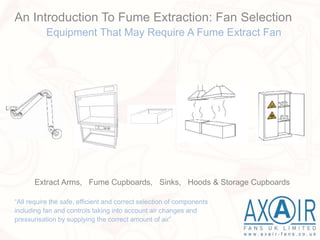
Equipment That May Require A Fume Extract Fan
“All require the safe, efficient and correct selection of components
including fan and controls taking into account air changes and
pressurisation by supplying the correct amount of air”
Extract Arms, Fume Cupboards, Sinks, Hoods & Storage Cupboards
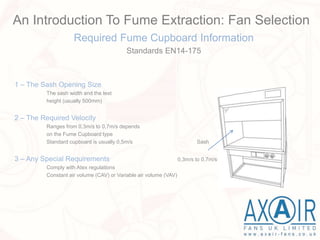
Required Fume Cupboard Information
Standards EN14-175
1 – The Sash Opening Size
The sash width and the test
height (usually 500mm)
2 – The Required Velocity
Ranges from 0,3m/s to 0,7m/s depends
on the Fume Cupboard type
Standard cupboard is usually 0,5m/s Sash
3 – Any Special Requirements 0,3m/s to 0,7m/s
Comply with Atex regulations
Constant air volume (CAV) or Variable air volume (VAV)
An Introduction To Fume Extraction: Fan Selection
For LEV equipment
you should refer to the
manufacturers recommended
air velocity or air volumes.
An Introduction To Fume Extraction: Fan Selection
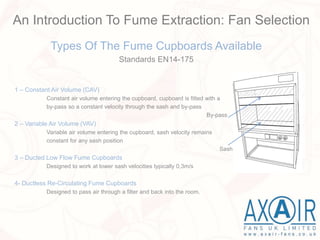
Types Of The Fume Cupboards Available
Standards EN14-175
1 – Constant Air Volume (CAV)
Constant air volume entering the cupboard, cupboard is fitted with a
by-pass so a constant velocity through the sash and by-pass
By-pass
2 – Variable Air Volume (VAV)
Variable air volume entering the cupboard, sash velocity remains
constant for any sash position
Sash
3 – Ducted Low Flow Fume Cupboards
Designed to work at lower sash velocities typically 0,3m/s
4- Ductless Re-Circulating Fume Cupboards
Designed to pass air through a filter and back into the room.
An Introduction To Fume Extraction: Fan Selection
Information Required For The Ductwork system
EN14-175 & DW standards
1 – Select The Duct Diameter
In duct velocity should be between 5,5m/s to 7,5m/s.
This is to keep the noise level down
2 – What Is In The Duct Run
Length of the duct run. How many Fume Cupboards
or other equipment are in the system. How many bends
or other fittings such as tees etc
3 – Calculate The System’s Resistance
Each item in the system has a resistance. Bends, tees, straight duct run
and the discharge. The Fume Cupboard has approximately 60Pascals
resistance, bends, tees, other fittings and straight duct can be seen on the
next two slides.
An Introduction To Fume Extraction: Fan Selection
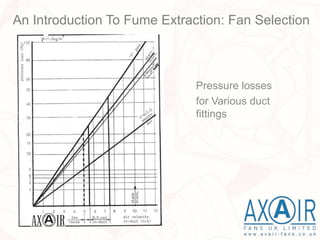
Pressure losses
for Various duct
fittings
An Introduction To Fume Extraction: Fan Selection
System pressure
losses in straight
sections
An Introduction To Fume Extraction: Fan Selection
Ductwork Installation
Standards EN 14175 and The DW standards
1 - Duct work material shall be self supporting and PVC, Polypropylene or Stainless
Steel depending on the application
2 - Discharge stack shall finish the required height above the building (3m). The
discharge size should give a velocity of 10m/s
3 – The system is to ensure Containment / Protection Mode through the Fume
Cupboard
An Introduction To Fume Extraction: Fan Selection
Fume Cupboard - Example Fan Selection
1 – Fume Cupboard, (1,8 nominal 1,5 actual
width with 0,5m/s velocity)
Airflow , Sash width 1,5m x 0,5m
(test height) x 0,5m/s (velocity)
= 0,375m³/s (1350m³/h).
2 – Duct work, 2 bends 90°, 1 Fume Cupboard,
10m straight duct (diameter to be specified).
Resistance, Fume Cupboard 60Pascals,
induct velocity (5,5 to 7,5m/s) 7,5m/s Ø250
(top of the range) 2Pascals per metre 20Pascals
in total, 7,5m/s through a 90°Bend 12Pascals per
bend 24Pascals total,
3 – Discharge, 10m/s velocity 0,375m³/s at 10m/s is Ø225 discharge size 60Pascals in total
4 – Total resistance 60Pa + 20Pa + 24Pa + 60Pa =164Pascals at 1350m³/h
5 – Fan would usually be a 4pole.
An Introduction To Fume Extraction: Fan Selection
LEV - Example Fan Selection
1 – LEV equipment use manufacturer’s recommended air velocity or air volume.
2 – Duct work velocities may vary depending the equipment used.
3 – Discharge, 10m/s
Fans for these applications can usually be 2pole speed
to overcome higher pressures.
An Introduction To Fume Extraction: Fan Selection
Review Information Required
1 - You now have the airflow (m³/h)
2 - You now have the system resistance (Pa)
3 - Using a fan curve you can select a fan allowing a the required margin in
performance. Many specifications will show how much margin is required.
4 – Decide the fan pedestal and electrical supply required.
You should now have enough information to select the best fan
An Introduction To Fume Extraction: Fan Selection
European Fume Cupboard Standards
EN14-175
Part 1: Vocabulary in 7 languages
Part 2: Safety and performances requirements
Part 3: Type test methods
Part 4: On site test methods
Part 5: Recommendations for installation and maintenance
Part 6: Variable air volume fume cupboards
Ductwork
Duct work shall be installed to meet EN14175 and DW series of standards
An Introduction To Fume Extraction: Standards
Polypropylene Fan
1 – Scroll moulded UV treated recyclable polypropylene
2 – Centrifugal impeller in moulded polypropylene electronically balanced to ISO
1940
3 – Direct drive units fitted with IP55 motors. Available in single phase and
three phase. Complete with outdoor box pedestal in polypropylene
or indoor pedestal in dipped galvanized.
4 – Fans available as none Atex rated or Zone 2 rated.
5 – Performance based on tests conducted in accordance with AMCA 210-85
and ISO 5801
An Introduction To Fume Extraction: Standards
Understanding CAV & VAV System Control
1 - Constant Air Volume System
The fan will have a starter with on/off buttons. This must be fitted
with an overload relay to help protect the fan motor for overloading. A
damper will then need to be fitted to allow the required duty to be achieved.
2 - Variable Air Volume System
The fan will be controlled using an inverter speed controller as part of the
fume cupboard control system or mounted separately. This will allow the
duty to be achieve and help save energy. As the sash is opened and
closed the fan speed will change to keep the sash velocity set a the
commissioning of the cupboard.
An Introduction To Fume Extraction: Control Your Fan
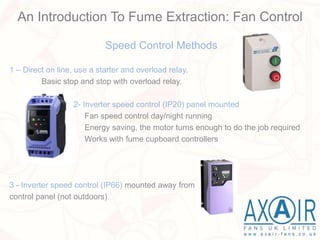
Speed Control Methods
1 – Direct on line, use a starter and overload relay.
Basic stop and stop with overload relay.
2- Inverter speed control (IP20) panel mounted
Fan speed control day/night running
Energy saving, the motor turns enough to do the job required
Works with fume cupboard controllers
3 - Inverter speed control (IP66) mounted away from
control panel (not outdoors)
An Introduction To Fume Extraction: Fan Control
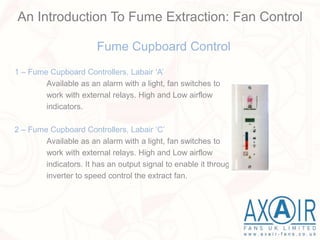
Fume Cupboard Control
1 – Fume Cupboard Controllers, Labair ‘A’
Available as an alarm with a light, fan switches to
work with external relays. High and Low airflow
indicators.
2 – Fume Cupboard Controllers, Labair ‘C’
Available as an alarm with a light, fan switches to
work with external relays. High and Low airflow
indicators. It has an output signal to enable it through an
inverter to speed control the extract fan.
An Introduction To Fume Extraction: Fan Control
Fume Cupboard Control
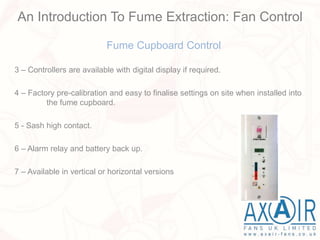
3 – Controllers are available with digital display if required.
4 – Factory pre-calibration and easy to finalise settings on site when installed into
the fume cupboard.
5 - Sash high contact.
6 – Alarm relay and battery back up.
7 – Available in vertical or horizontal versions
An Introduction To Fume Extraction: Fan Control
Installation
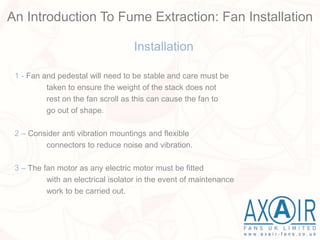
1 - Fan and pedestal will need to be stable and care must be
taken to ensure the weight of the stack does not
rest on the fan scroll as this can cause the fan to
go out of shape.
2 – Consider anti vibration mountings and flexible
connectors to reduce noise and vibration.
3 – The fan motor as any electric motor must be fitted
with an electrical isolator in the event of maintenance
work to be carried out.
An Introduction To Fume Extraction: Fan Installation
Installation
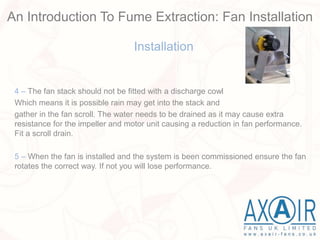
4 – The fan stack should not be fitted with a discharge cowl
Which means it is possible rain may get into the stack and
gather in the fan scroll. The water needs to be drained as it may cause extra
resistance for the impeller and motor unit causing a reduction in fan performance.
Fit a scroll drain.
5 – When the fan is installed and the system is been commissioned ensure the fan
rotates the correct way. If not you will lose performance.
An Introduction To Fume Extraction: Fan Installation
Installation
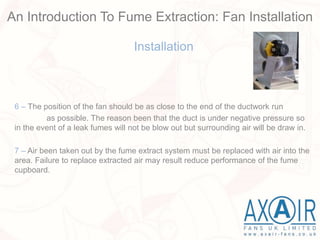
6 – The position of the fan should be as close to the end of the ductwork run
as possible. The reason been that the duct is under negative pressure so
in the event of a leak fumes will not be blow out but surrounding air will be draw in.
7 – Air been taken out by the fume extract system must be replaced with air into the
area. Failure to replace extracted air may result reduce performance of the fume
cupboard.
An Introduction To Fume Extraction: Fan Installation
Summary – We Have…
1 – Applied fume extraction to different types of equipment including
Hoods, Sinks, Fume Cupboards & LEV
2 - Applied relevant & current standards to fume extraction systems
3 - How to Correctly select fans to suit the LEV/Fume Cupboard with
the required ductwork
4 - Understood the need for Control within a fume extraction system
5 - Recognise the importance of correct and safe fan installation within
the extraction system.
An Introduction To Fume Extraction

A Guide To Fume Extraction Systems & Components

  • 2.
    Objectives & AimsOf This CPD Presentation 1 – Fan Selection - What situations require fume extraction systems - What information is needed to correctly select a fan? 2 – Specification Standards - How standards influence selection - Understanding how Current Legislation relates to fume extraction systems 3 – Fan Control - Methods & Importance of Control - Understand Contact & Variable air volume systems 4 – Fan Installation – Recognise the importance of correct installation
  • 3.
    An Introduction ToFume Extraction: Fan Selection Equipment That May Require A Fume Extract Fan “All require the safe, efficient and correct selection of components including fan and controls taking into account air changes and pressurisation by supplying the correct amount of air” Extract Arms, Fume Cupboards, Sinks, Hoods & Storage Cupboards
  • 4.
    Required Fume CupboardInformation Standards EN14-175 1 – The Sash Opening Size The sash width and the test height (usually 500mm) 2 – The Required Velocity Ranges from 0,3m/s to 0,7m/s depends on the Fume Cupboard type Standard cupboard is usually 0,5m/s Sash 3 – Any Special Requirements 0,3m/s to 0,7m/s Comply with Atex regulations Constant air volume (CAV) or Variable air volume (VAV) An Introduction To Fume Extraction: Fan Selection
  • 5.
    For LEV equipment youshould refer to the manufacturers recommended air velocity or air volumes. An Introduction To Fume Extraction: Fan Selection
  • 6.
    Types Of TheFume Cupboards Available Standards EN14-175 1 – Constant Air Volume (CAV) Constant air volume entering the cupboard, cupboard is fitted with a by-pass so a constant velocity through the sash and by-pass By-pass 2 – Variable Air Volume (VAV) Variable air volume entering the cupboard, sash velocity remains constant for any sash position Sash 3 – Ducted Low Flow Fume Cupboards Designed to work at lower sash velocities typically 0,3m/s 4- Ductless Re-Circulating Fume Cupboards Designed to pass air through a filter and back into the room. An Introduction To Fume Extraction: Fan Selection
  • 7.
    Information Required ForThe Ductwork system EN14-175 & DW standards 1 – Select The Duct Diameter In duct velocity should be between 5,5m/s to 7,5m/s. This is to keep the noise level down 2 – What Is In The Duct Run Length of the duct run. How many Fume Cupboards or other equipment are in the system. How many bends or other fittings such as tees etc 3 – Calculate The System’s Resistance Each item in the system has a resistance. Bends, tees, straight duct run and the discharge. The Fume Cupboard has approximately 60Pascals resistance, bends, tees, other fittings and straight duct can be seen on the next two slides. An Introduction To Fume Extraction: Fan Selection
  • 8.
    Pressure losses for Variousduct fittings An Introduction To Fume Extraction: Fan Selection
  • 9.
    System pressure losses instraight sections An Introduction To Fume Extraction: Fan Selection
  • 10.
    Ductwork Installation Standards EN14175 and The DW standards 1 - Duct work material shall be self supporting and PVC, Polypropylene or Stainless Steel depending on the application 2 - Discharge stack shall finish the required height above the building (3m). The discharge size should give a velocity of 10m/s 3 – The system is to ensure Containment / Protection Mode through the Fume Cupboard An Introduction To Fume Extraction: Fan Selection
  • 11.
    Fume Cupboard -Example Fan Selection 1 – Fume Cupboard, (1,8 nominal 1,5 actual width with 0,5m/s velocity) Airflow , Sash width 1,5m x 0,5m (test height) x 0,5m/s (velocity) = 0,375m³/s (1350m³/h). 2 – Duct work, 2 bends 90°, 1 Fume Cupboard, 10m straight duct (diameter to be specified). Resistance, Fume Cupboard 60Pascals, induct velocity (5,5 to 7,5m/s) 7,5m/s Ø250 (top of the range) 2Pascals per metre 20Pascals in total, 7,5m/s through a 90°Bend 12Pascals per bend 24Pascals total, 3 – Discharge, 10m/s velocity 0,375m³/s at 10m/s is Ø225 discharge size 60Pascals in total 4 – Total resistance 60Pa + 20Pa + 24Pa + 60Pa =164Pascals at 1350m³/h 5 – Fan would usually be a 4pole. An Introduction To Fume Extraction: Fan Selection
  • 12.
    LEV - ExampleFan Selection 1 – LEV equipment use manufacturer’s recommended air velocity or air volume. 2 – Duct work velocities may vary depending the equipment used. 3 – Discharge, 10m/s Fans for these applications can usually be 2pole speed to overcome higher pressures. An Introduction To Fume Extraction: Fan Selection
  • 13.
    Review Information Required 1- You now have the airflow (m³/h) 2 - You now have the system resistance (Pa) 3 - Using a fan curve you can select a fan allowing a the required margin in performance. Many specifications will show how much margin is required. 4 – Decide the fan pedestal and electrical supply required. You should now have enough information to select the best fan An Introduction To Fume Extraction: Fan Selection
  • 14.
    European Fume CupboardStandards EN14-175 Part 1: Vocabulary in 7 languages Part 2: Safety and performances requirements Part 3: Type test methods Part 4: On site test methods Part 5: Recommendations for installation and maintenance Part 6: Variable air volume fume cupboards Ductwork Duct work shall be installed to meet EN14175 and DW series of standards An Introduction To Fume Extraction: Standards
  • 15.
    Polypropylene Fan 1 –Scroll moulded UV treated recyclable polypropylene 2 – Centrifugal impeller in moulded polypropylene electronically balanced to ISO 1940 3 – Direct drive units fitted with IP55 motors. Available in single phase and three phase. Complete with outdoor box pedestal in polypropylene or indoor pedestal in dipped galvanized. 4 – Fans available as none Atex rated or Zone 2 rated. 5 – Performance based on tests conducted in accordance with AMCA 210-85 and ISO 5801 An Introduction To Fume Extraction: Standards
  • 16.
    Understanding CAV &VAV System Control 1 - Constant Air Volume System The fan will have a starter with on/off buttons. This must be fitted with an overload relay to help protect the fan motor for overloading. A damper will then need to be fitted to allow the required duty to be achieved. 2 - Variable Air Volume System The fan will be controlled using an inverter speed controller as part of the fume cupboard control system or mounted separately. This will allow the duty to be achieve and help save energy. As the sash is opened and closed the fan speed will change to keep the sash velocity set a the commissioning of the cupboard. An Introduction To Fume Extraction: Control Your Fan
  • 17.
    Speed Control Methods 1– Direct on line, use a starter and overload relay. Basic stop and stop with overload relay. 2- Inverter speed control (IP20) panel mounted Fan speed control day/night running Energy saving, the motor turns enough to do the job required Works with fume cupboard controllers 3 - Inverter speed control (IP66) mounted away from control panel (not outdoors) An Introduction To Fume Extraction: Fan Control
  • 18.
    Fume Cupboard Control 1– Fume Cupboard Controllers, Labair ‘A’ Available as an alarm with a light, fan switches to work with external relays. High and Low airflow indicators. 2 – Fume Cupboard Controllers, Labair ‘C’ Available as an alarm with a light, fan switches to work with external relays. High and Low airflow indicators. It has an output signal to enable it through an inverter to speed control the extract fan. An Introduction To Fume Extraction: Fan Control
  • 19.
    Fume Cupboard Control 3– Controllers are available with digital display if required. 4 – Factory pre-calibration and easy to finalise settings on site when installed into the fume cupboard. 5 - Sash high contact. 6 – Alarm relay and battery back up. 7 – Available in vertical or horizontal versions An Introduction To Fume Extraction: Fan Control
  • 20.
    Installation 1 - Fanand pedestal will need to be stable and care must be taken to ensure the weight of the stack does not rest on the fan scroll as this can cause the fan to go out of shape. 2 – Consider anti vibration mountings and flexible connectors to reduce noise and vibration. 3 – The fan motor as any electric motor must be fitted with an electrical isolator in the event of maintenance work to be carried out. An Introduction To Fume Extraction: Fan Installation
  • 21.
    Installation 4 – Thefan stack should not be fitted with a discharge cowl Which means it is possible rain may get into the stack and gather in the fan scroll. The water needs to be drained as it may cause extra resistance for the impeller and motor unit causing a reduction in fan performance. Fit a scroll drain. 5 – When the fan is installed and the system is been commissioned ensure the fan rotates the correct way. If not you will lose performance. An Introduction To Fume Extraction: Fan Installation
  • 22.
    Installation 6 – Theposition of the fan should be as close to the end of the ductwork run as possible. The reason been that the duct is under negative pressure so in the event of a leak fumes will not be blow out but surrounding air will be draw in. 7 – Air been taken out by the fume extract system must be replaced with air into the area. Failure to replace extracted air may result reduce performance of the fume cupboard. An Introduction To Fume Extraction: Fan Installation
  • 23.
    Summary – WeHave… 1 – Applied fume extraction to different types of equipment including Hoods, Sinks, Fume Cupboards & LEV 2 - Applied relevant & current standards to fume extraction systems 3 - How to Correctly select fans to suit the LEV/Fume Cupboard with the required ductwork 4 - Understood the need for Control within a fume extraction system 5 - Recognise the importance of correct and safe fan installation within the extraction system. An Introduction To Fume Extraction