Gas Turbine TheoryGas Turbine Theory
and Constructionand Construction
IntroductionIntroduction
• Comprehend the thermodynamic
processes occurring in a gas turbine
• Comprehend the basic components of gas
turbine engines and their basic operation
• Comprehend the support systems
associated with gas turbine engines
BackgroundBackground
• Aircraft turbojet/turbofan engines are precursors
to gas turbines
• Installed for propulsion in:
• FFG’s
• DD’s
• DDG’s
• CG’s
• M-1 tanks
• Also used for electrical generation & auxiliary
applications
Brayton CycleBrayton Cycle
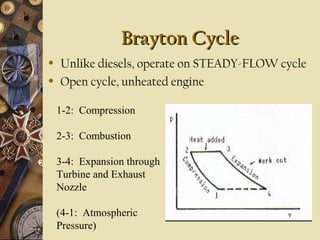
• Unlike diesels, operate on STEADY-FLOW cycle
• Open cycle, unheated engine
1-2: Compression
2-3: Combustion
3-4: Expansion through
Turbine and Exhaust
Nozzle
(4-1: Atmospheric
Pressure)
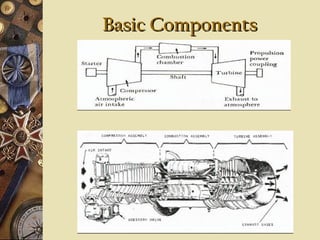
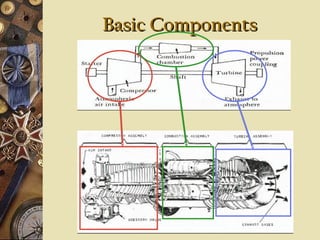
Basic ComponentsBasic Components
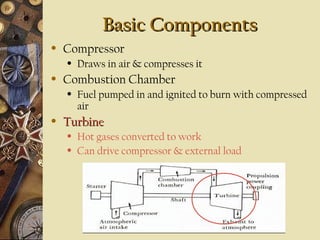
• CompressorCompressor
• Draws in air & compresses it
• Combustion Chamber
• Fuel pumped in and ignited to burn with compressed
air
• Turbine
• Hot gases converted to work
• Can drive compressor & external load
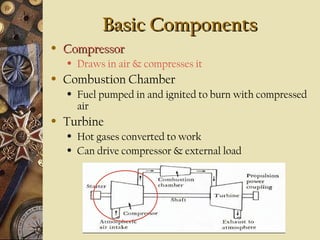
Basic ComponentsBasic Components
• Compressor
• Draws in air & compresses it
• Combustion ChamberCombustion Chamber
• Fuel pumped in and ignited to burn with compressed
air
• Turbine
• Hot gases converted to work
• Can drive compressor & external load
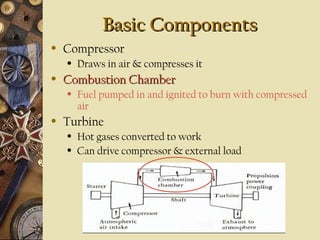
Basic ComponentsBasic Components
• Compressor
• Draws in air & compresses it
• Combustion Chamber
• Fuel pumped in and ignited to burn with compressed
air
• TurbineTurbine
• Hot gases converted to work
• Can drive compressor & external load
CompressorCompressor
• Supplies high pressure air for combustion
process
• Compressor types
• Radial/centrifugal flow compressor
• Axial flow compressor
CompressorCompressor
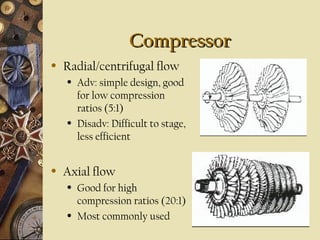
• Radial/centrifugal flow
• Adv: simple design, good
for low compression
ratios (5:1)
• Disadv: Difficult to stage,
less efficient
• Axial flow
• Good for high
compression ratios (20:1)
• Most commonly used
CompressorCompressor
• Controlling Load on Compressor
• To ensure maximum efficiency and allow for
flexibility, compressor can be split into HP &
LP sections
• Vane control: inlet vanes/nozzle angles can be
varied to control air flow
• Compressor Stall
• Interruption of air flow due to turbulence
Use of Compressed AirUse of Compressed Air
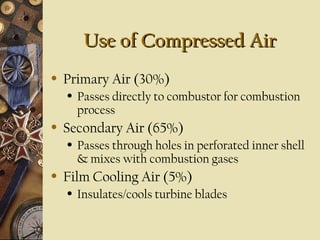
• Primary Air (30%)
• Passes directly to combustor for combustion
process
• Secondary Air (65%)
• Passes through holes in perforated inner shell
& mixes with combustion gases
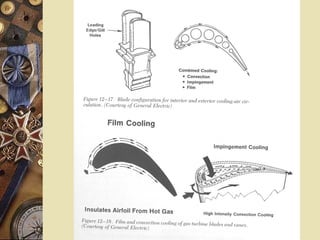
• Film Cooling Air (5%)
• Insulates/cools turbine blades
Blade CoolingBlade Cooling
Combustion ChambersCombustion Chambers
• Where air & fuel are mixed, ignited, and
burned
• Spark plugs used to ignite fuel
• Types
• Can: for small, centrifugal compressors
• Annular: for larger, axial compressors (LM
2500)
• Can-annular: rarely used
TurbinesTurbines
• Consists of one or more stages designed to
develop rotational energy
• Uses sets of nozzles & blades
• Single shaft
• Power coupling on same shaft as turbine
• Same shaft drives rotor of compressor and
power components
TurbinesTurbines
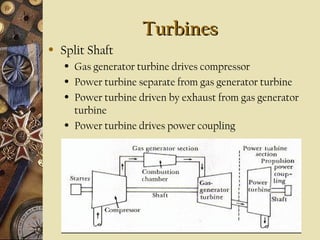
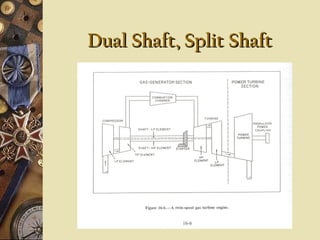
• Split Shaft
• Gas generator turbine drives compressor
• Power turbine separate from gas generator turbine
• Power turbine driven by exhaust from gas generator
turbine
• Power turbine drives power coupling
Dual Shaft, Split ShaftDual Shaft, Split Shaft
Gas Turbine SystemsGas Turbine Systems
• Air System
• Air intakes are located high up & multiple
filters
• Exhaust discharged out stacks
• Fuel System
• Uses either DFM or JP-5
• Lubrication System
• Supply bearings and gears with oil
Gas Turbine AccessoryGas Turbine Accessory
SystemsSystems
• Starting System
• To get compressor initially rotated, HP air
used (can use electrical also)
• Once at certain RPM, fuel injected and spark
ignited
• Power Transmission System
• Reduction gears used to transfer torque
• With split shaft, turbines can run @ different
speeds
GTG vs SteamGTG vs Steam
• For the same hP,
• Weight reduction of 70%
• Simpler (less maintenance, fewer
components)
• Reduced manning – automated control
• Quicker response time
• Modular replacement
Engine Power TransferEngine Power Transfer
• Turbojet
• Thrust provided by reaction against expansion of
exhaust gases
• Turbofan
• Thrust provided by reaction against expansion of
large volumes of air
• Marine systems
• Thrust provided by turbine
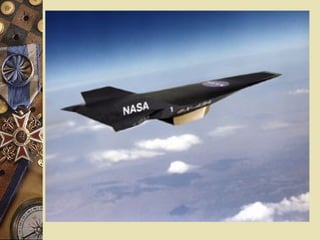
• SCRAMjet/RAMjet
What’s ImportantWhat’s Important
• Block Diagram of Split-Shaft GTG system
• Types of Compression and characteristics
• Major difference between aviation and
marine GTs
Questions?Questions?

Lesson 09 Gas Turbines Senatorlibya

  • 1.
    Gas Turbine TheoryGasTurbine Theory and Constructionand Construction
  • 2.
    IntroductionIntroduction • Comprehend thethermodynamic processes occurring in a gas turbine • Comprehend the basic components of gas turbine engines and their basic operation • Comprehend the support systems associated with gas turbine engines
  • 3.
    BackgroundBackground • Aircraft turbojet/turbofanengines are precursors to gas turbines • Installed for propulsion in: • FFG’s • DD’s • DDG’s • CG’s • M-1 tanks • Also used for electrical generation & auxiliary applications
  • 4.
    Brayton CycleBrayton Cycle •Unlike diesels, operate on STEADY-FLOW cycle • Open cycle, unheated engine 1-2: Compression 2-3: Combustion 3-4: Expansion through Turbine and Exhaust Nozzle (4-1: Atmospheric Pressure)
  • 5.
  • 6.
  • 7.
    Basic ComponentsBasic Components •CompressorCompressor • Draws in air & compresses it • Combustion Chamber • Fuel pumped in and ignited to burn with compressed air • Turbine • Hot gases converted to work • Can drive compressor & external load
  • 8.
    Basic ComponentsBasic Components •Compressor • Draws in air & compresses it • Combustion ChamberCombustion Chamber • Fuel pumped in and ignited to burn with compressed air • Turbine • Hot gases converted to work • Can drive compressor & external load
  • 9.
    Basic ComponentsBasic Components •Compressor • Draws in air & compresses it • Combustion Chamber • Fuel pumped in and ignited to burn with compressed air • TurbineTurbine • Hot gases converted to work • Can drive compressor & external load
  • 10.
    CompressorCompressor • Supplies highpressure air for combustion process • Compressor types • Radial/centrifugal flow compressor • Axial flow compressor
  • 11.
    CompressorCompressor • Radial/centrifugal flow •Adv: simple design, good for low compression ratios (5:1) • Disadv: Difficult to stage, less efficient • Axial flow • Good for high compression ratios (20:1) • Most commonly used
  • 12.
    CompressorCompressor • Controlling Loadon Compressor • To ensure maximum efficiency and allow for flexibility, compressor can be split into HP & LP sections • Vane control: inlet vanes/nozzle angles can be varied to control air flow • Compressor Stall • Interruption of air flow due to turbulence
  • 13.
    Use of CompressedAirUse of Compressed Air • Primary Air (30%) • Passes directly to combustor for combustion process • Secondary Air (65%) • Passes through holes in perforated inner shell & mixes with combustion gases • Film Cooling Air (5%) • Insulates/cools turbine blades
  • 14.
  • 15.
    Combustion ChambersCombustion Chambers •Where air & fuel are mixed, ignited, and burned • Spark plugs used to ignite fuel • Types • Can: for small, centrifugal compressors • Annular: for larger, axial compressors (LM 2500) • Can-annular: rarely used
  • 16.
    TurbinesTurbines • Consists ofone or more stages designed to develop rotational energy • Uses sets of nozzles & blades • Single shaft • Power coupling on same shaft as turbine • Same shaft drives rotor of compressor and power components
  • 17.
    TurbinesTurbines • Split Shaft •Gas generator turbine drives compressor • Power turbine separate from gas generator turbine • Power turbine driven by exhaust from gas generator turbine • Power turbine drives power coupling
  • 18.
    Dual Shaft, SplitShaftDual Shaft, Split Shaft
  • 19.
    Gas Turbine SystemsGasTurbine Systems • Air System • Air intakes are located high up & multiple filters • Exhaust discharged out stacks • Fuel System • Uses either DFM or JP-5 • Lubrication System • Supply bearings and gears with oil
  • 20.
    Gas Turbine AccessoryGasTurbine Accessory SystemsSystems • Starting System • To get compressor initially rotated, HP air used (can use electrical also) • Once at certain RPM, fuel injected and spark ignited • Power Transmission System • Reduction gears used to transfer torque • With split shaft, turbines can run @ different speeds
  • 21.
    GTG vs SteamGTGvs Steam • For the same hP, • Weight reduction of 70% • Simpler (less maintenance, fewer components) • Reduced manning – automated control • Quicker response time • Modular replacement
  • 22.
    Engine Power TransferEnginePower Transfer • Turbojet • Thrust provided by reaction against expansion of exhaust gases • Turbofan • Thrust provided by reaction against expansion of large volumes of air • Marine systems • Thrust provided by turbine • SCRAMjet/RAMjet
  • 24.
    What’s ImportantWhat’s Important •Block Diagram of Split-Shaft GTG system • Types of Compression and characteristics • Major difference between aviation and marine GTs
  • 25.