INTERNAL BALLISTICS
Ryan Begley
What is Internal Ballistics?
◻ Ballistics is the science of launching projectiles
using propellant or gunpowder
◻ Internal Ballistics is the science of what goes on
inside of the gun
1. Lock time, the time from sear release until the
primer is struck
2. Ignition time, the time from when the primer is
struck until the projectile starts to move
3. Barrel time, the time from when the projectile
starts to move until it exits the barrel.
History of Ballistics
◻ Ballistics began with the invention of the first
muzzle loading cannons in the 1200’s A.D.
◻ The first handheld guns were muzzle loading
rifles and were developed in the 1400’s
◻ The first guns were smoothbores
Beginning of Internal Ballistics
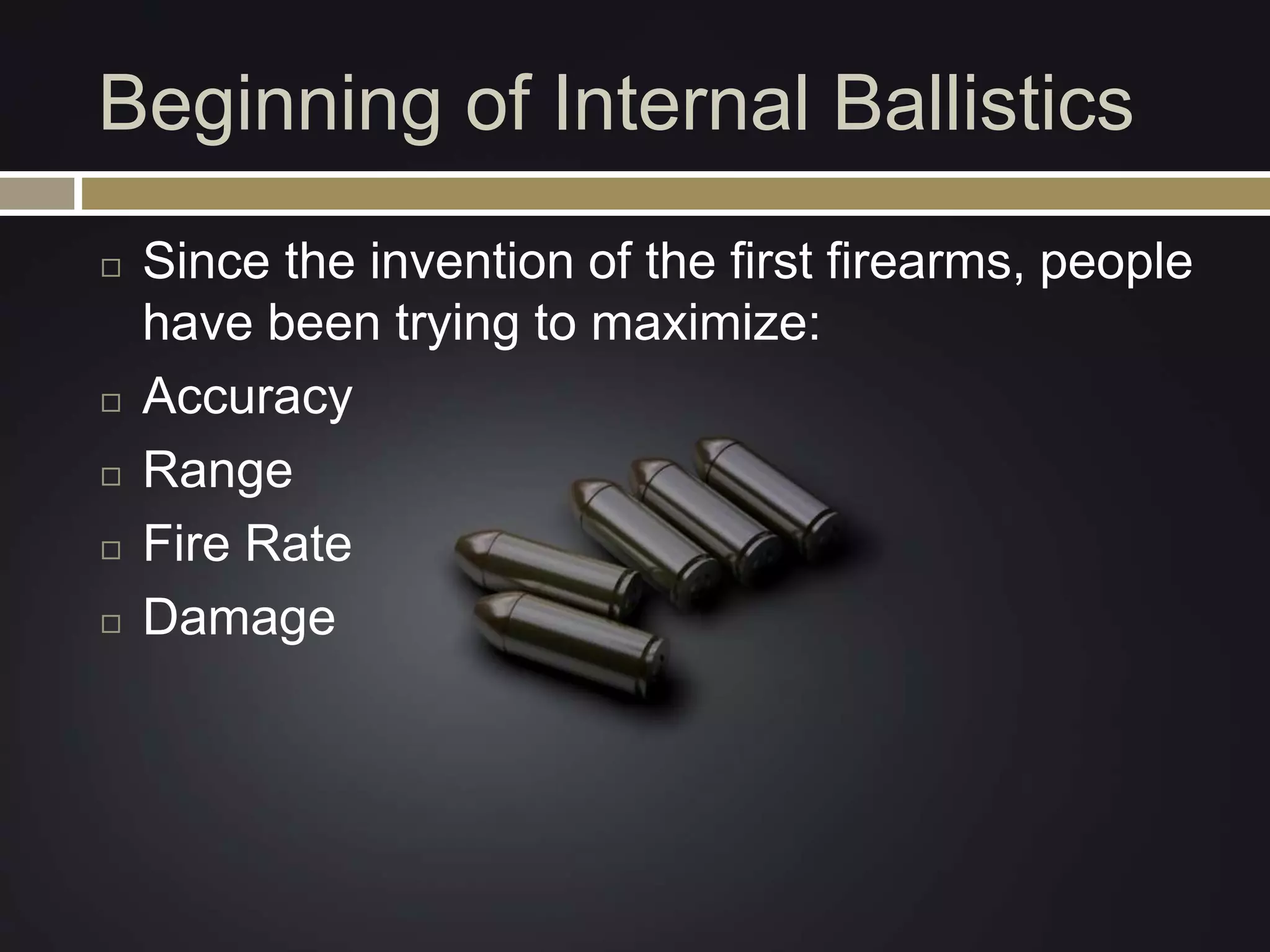
◻ Since the invention of the first firearms, people
have been trying to maximize:
◻ Accuracy
◻ Range
◻ Fire Rate
◻ Damage
Parts of a Working Firearm
Parts of A Semi-Automatic Pistol
CZ (Česká Zbrojovka) 75B 9mm Pistol
Rimfire cartridge on the left Centerfire cartridge on the right
Cartridges
Propellants and Burn Rates
◻ Fast burn rates
◻ Inconsistent
◻ unstable
◻ Slower burn rates
◻ Increased velocity
◻ Consistent
◻ Different shapes of
grains for different
surface areas
Black Powder Modern Smokeless Powder
Burn Rate Equation
◻ where BR is Burn Rate
◻ β and α are found empirically with experiments
◻ ζ (zeta) is the burn augmentation factor that
accounts for energy from grain fracture and
inconsistent grain burning
◻ υ is the projectile velocity
Bore Size
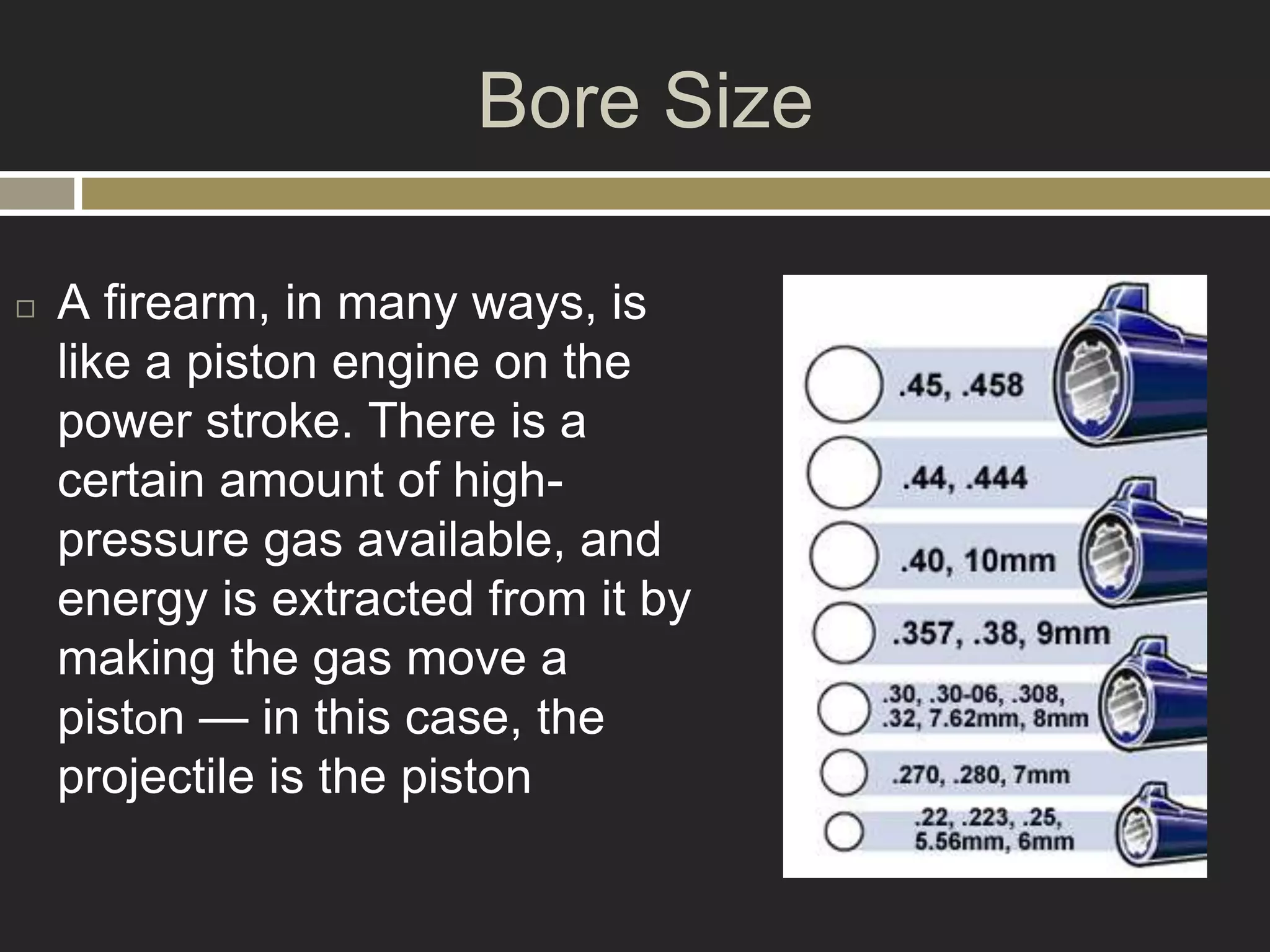
◻ A firearm, in many ways, is
like a piston engine on the
power stroke. There is a
certain amount of high-
pressure gas available, and
energy is extracted from it by
making the gas move a
piston — in this case, the
projectile is the piston
Bullet Size
◻ The caliber of the gun is usually the diameter of the bore
◻ Most guns are maximized for length, based on the velocity of the
normal projectile weight
◻ 120 calibers
Loading Density
◻ Ratio of the weight of the powder charge to the
capacity of the powder chamber
◻ Measured in grains
◻ More fully the powder charge fills the case the
more consistent and accurate the load will be
Chamber Pressure
Pressure is measured
with Strain Gauge
Barrel Length
◻ Measured from the face of the muzzle to the base of the
seated bullet
◻ Barrel length determines muzzle velocity
◻ Velocity increases with barrel length up to a certain length
dependent on bullet size and propellant
◻ Typical barrel lengths:
18-24 inches for rifles
2-8 inches for handguns
Velocity Range
Vel change
per inch
0-2000 5-10
2000-2500 10-20
2500-3000 20-30
3000-3500 30-40
Rifling
What Happens when the Trigger is pulled?
http://www.youtube.com/watch?v=AqMzUsTTFnA
Firearm Identification
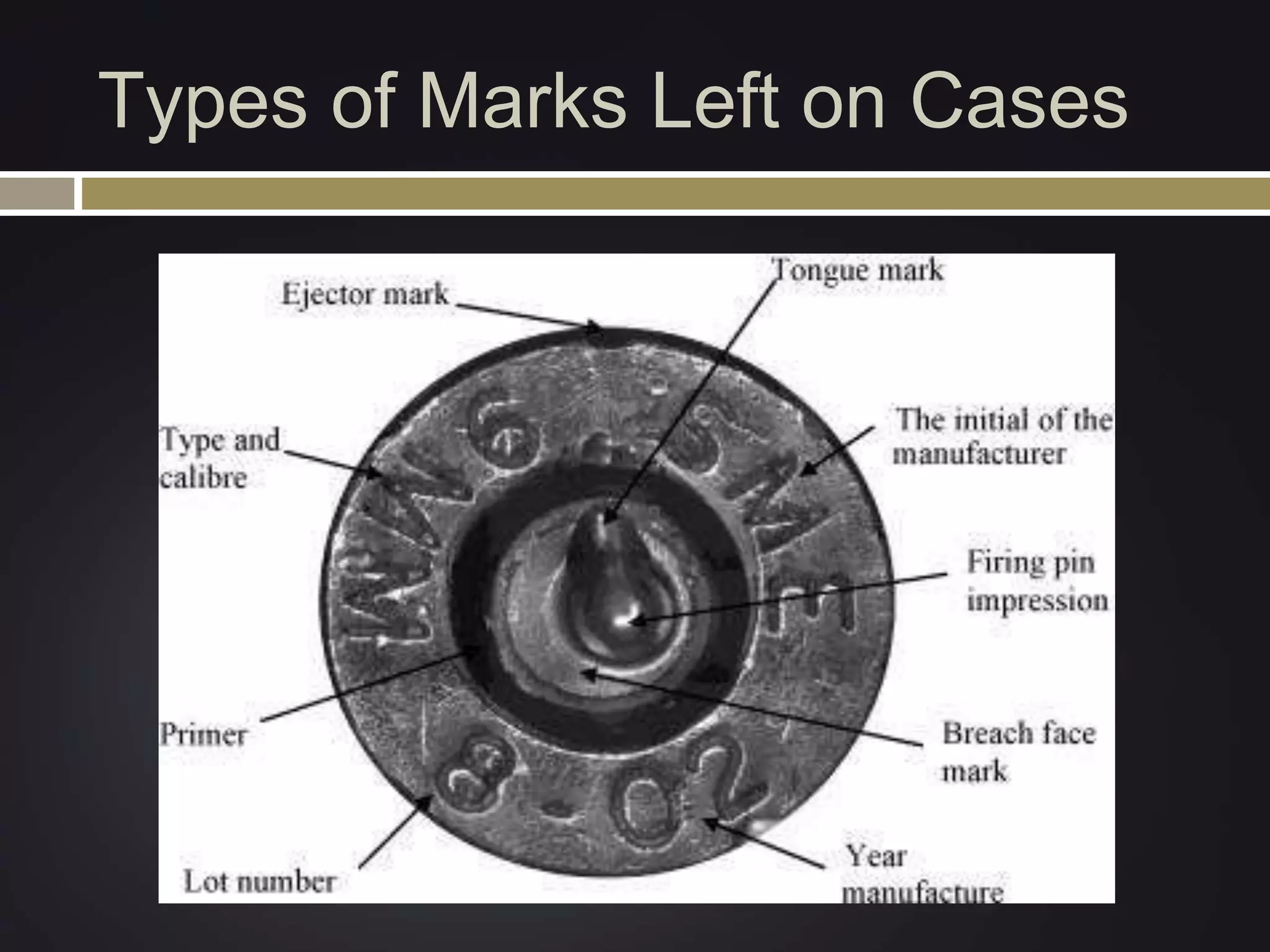
The Extractor, Extracting Pin, Breechbolt, and Firing Pin all leave
distinguishable marks on the empty cases
Types of Marks Left on Cases
Resources
1. Allen, CTD. "Interior Ballistics." The Shooters Log. Cheaper
Than Dirt, 24 Aug. 2012. Web. 28 Feb. 2013.
2. "Ballistics." AuthorSTREAM. N.p., n.d. Web. 28 Feb. 2013.
3. "FirearmsID.com- An Introduction to Forensic Firearm
Identification." FirearmsID.com. N.p., n.d. Web. 28 Feb. 2013.
4. "Hornady." Internal Ballistics. Hornady Manufacturing, 2013.
Web. 28 Feb. 2013.
5. Klatt, Edward C. "FIREARMS TUTORIAL." FIREARMS
TUTORIAL. University of Utah, n.d. Web. 28 Feb. 2013.
6. Schaefer, J. C. "A (Very) Short Course in Internal Ballistics."
Internal Ballistics. J. C. Schaefer, 28 July 2012. Web. 28 Feb.
2013.
7. "Internal Ballistics." Wikipedia. Wikimedia Foundation, 20 Apr.
2013. Web. 21 Apr. 2013.

Internal Ballistics_Ryan Begley.pptx (1)

  • 1.
  • 2.
    What is InternalBallistics? ◻ Ballistics is the science of launching projectiles using propellant or gunpowder ◻ Internal Ballistics is the science of what goes on inside of the gun 1. Lock time, the time from sear release until the primer is struck 2. Ignition time, the time from when the primer is struck until the projectile starts to move 3. Barrel time, the time from when the projectile starts to move until it exits the barrel.
  • 3.
    History of Ballistics ◻Ballistics began with the invention of the first muzzle loading cannons in the 1200’s A.D. ◻ The first handheld guns were muzzle loading rifles and were developed in the 1400’s ◻ The first guns were smoothbores
  • 4.
    Beginning of InternalBallistics ◻ Since the invention of the first firearms, people have been trying to maximize: ◻ Accuracy ◻ Range ◻ Fire Rate ◻ Damage
  • 5.
    Parts of aWorking Firearm
  • 6.
    Parts of ASemi-Automatic Pistol CZ (Česká Zbrojovka) 75B 9mm Pistol
  • 7.
    Rimfire cartridge onthe left Centerfire cartridge on the right Cartridges
  • 8.
    Propellants and BurnRates ◻ Fast burn rates ◻ Inconsistent ◻ unstable ◻ Slower burn rates ◻ Increased velocity ◻ Consistent ◻ Different shapes of grains for different surface areas Black Powder Modern Smokeless Powder
  • 9.
    Burn Rate Equation ◻where BR is Burn Rate ◻ β and α are found empirically with experiments ◻ ζ (zeta) is the burn augmentation factor that accounts for energy from grain fracture and inconsistent grain burning ◻ υ is the projectile velocity
  • 10.
    Bore Size ◻ Afirearm, in many ways, is like a piston engine on the power stroke. There is a certain amount of high- pressure gas available, and energy is extracted from it by making the gas move a piston — in this case, the projectile is the piston
  • 11.
    Bullet Size ◻ Thecaliber of the gun is usually the diameter of the bore ◻ Most guns are maximized for length, based on the velocity of the normal projectile weight ◻ 120 calibers
  • 12.
    Loading Density ◻ Ratioof the weight of the powder charge to the capacity of the powder chamber ◻ Measured in grains ◻ More fully the powder charge fills the case the more consistent and accurate the load will be
  • 13.
    Chamber Pressure Pressure ismeasured with Strain Gauge
  • 14.
    Barrel Length ◻ Measuredfrom the face of the muzzle to the base of the seated bullet ◻ Barrel length determines muzzle velocity ◻ Velocity increases with barrel length up to a certain length dependent on bullet size and propellant ◻ Typical barrel lengths: 18-24 inches for rifles 2-8 inches for handguns Velocity Range Vel change per inch 0-2000 5-10 2000-2500 10-20 2500-3000 20-30 3000-3500 30-40
  • 15.
  • 16.
    What Happens whenthe Trigger is pulled? http://www.youtube.com/watch?v=AqMzUsTTFnA
  • 17.
    Firearm Identification The Extractor,Extracting Pin, Breechbolt, and Firing Pin all leave distinguishable marks on the empty cases
  • 18.
    Types of MarksLeft on Cases
  • 19.
    Resources 1. Allen, CTD."Interior Ballistics." The Shooters Log. Cheaper Than Dirt, 24 Aug. 2012. Web. 28 Feb. 2013. 2. "Ballistics." AuthorSTREAM. N.p., n.d. Web. 28 Feb. 2013. 3. "FirearmsID.com- An Introduction to Forensic Firearm Identification." FirearmsID.com. N.p., n.d. Web. 28 Feb. 2013. 4. "Hornady." Internal Ballistics. Hornady Manufacturing, 2013. Web. 28 Feb. 2013. 5. Klatt, Edward C. "FIREARMS TUTORIAL." FIREARMS TUTORIAL. University of Utah, n.d. Web. 28 Feb. 2013. 6. Schaefer, J. C. "A (Very) Short Course in Internal Ballistics." Internal Ballistics. J. C. Schaefer, 28 July 2012. Web. 28 Feb. 2013. 7. "Internal Ballistics." Wikipedia. Wikimedia Foundation, 20 Apr. 2013. Web. 21 Apr. 2013.