EMS
By
Abhiram Nannapaneni
Shalini Kandimalla
EMS Overview:
• What is EMS?
• Ems Delivery Modes
• EMS Server and Administration tool
• Message Models
• Queues Vs Topics
• Create Queue and Topics
• EMS Shared Connection
• Queue Sender
• Queue Receiver
• Topic Publisher
• Topic Subscriber
EMS:
Enterprise Message Service (EMS) is a specification
about sending and receiving messages between two
or more applications.
EMS is an extension to JMS.
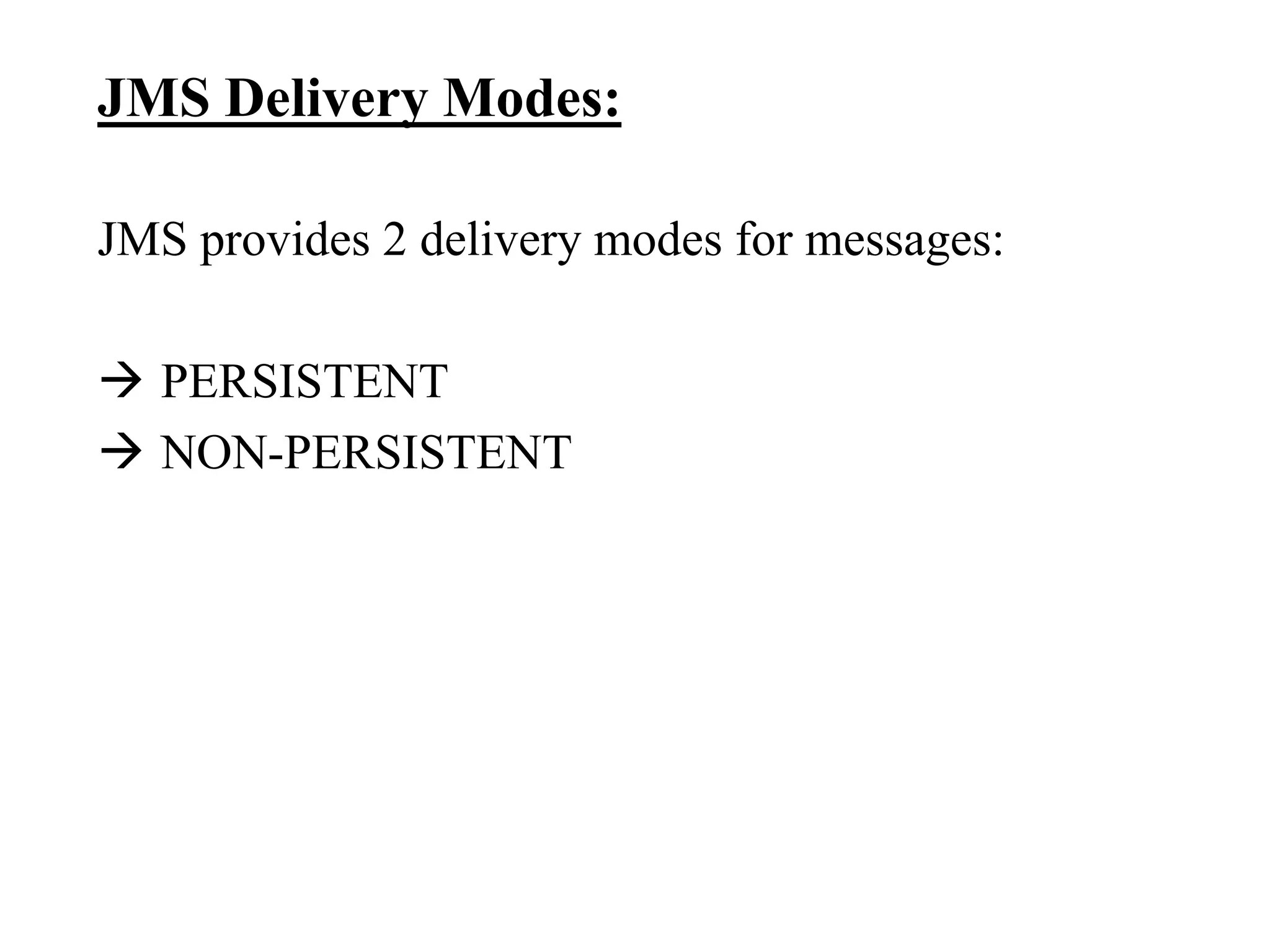
JMS Delivery Modes:
JMS provides 2 delivery modes for messages:
 PERSISTENT
 NON-PERSISTENT
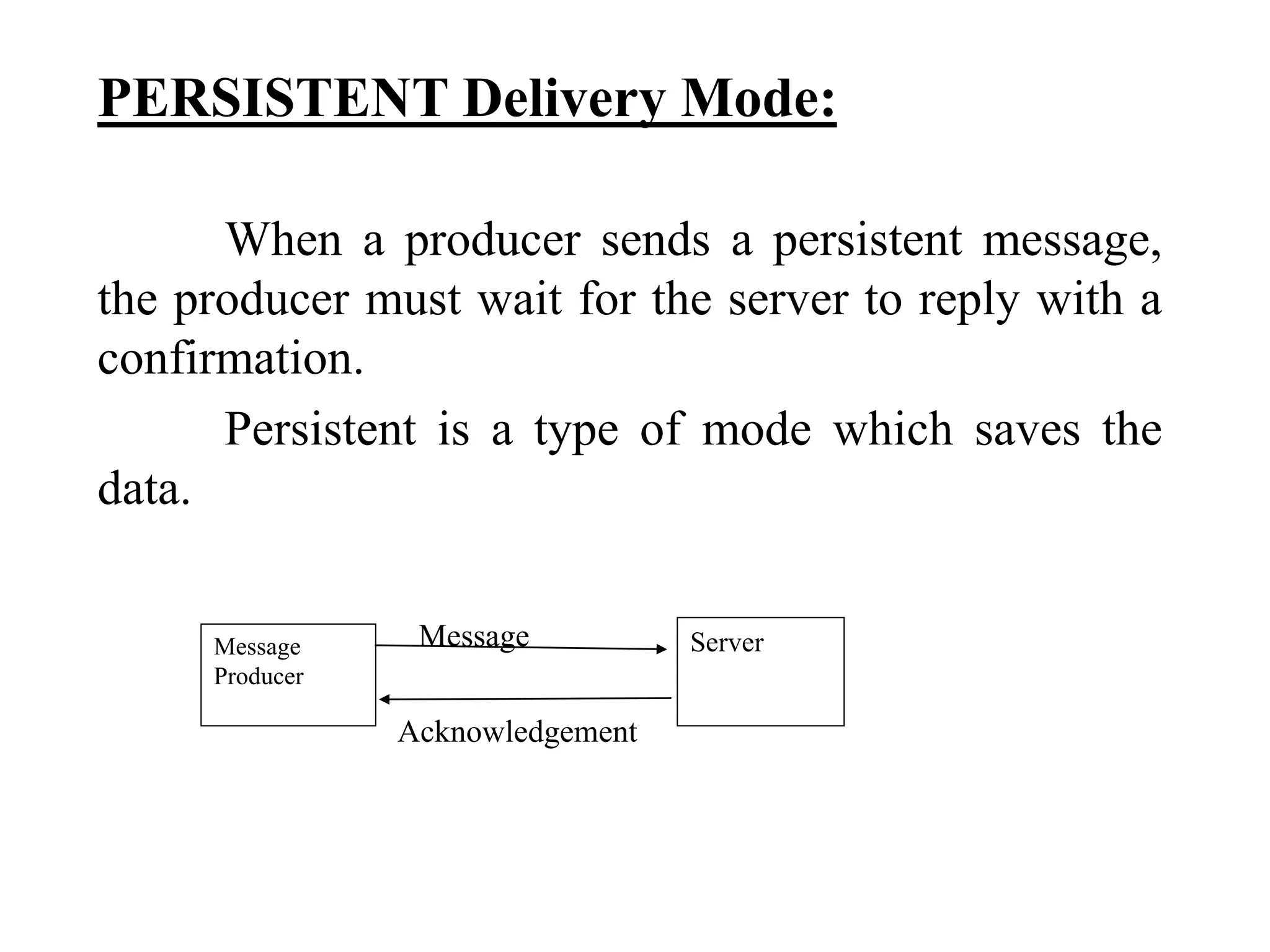
PERSISTENT Delivery Mode:
When a producer sends a persistent message,
the producer must wait for the server to reply with a
confirmation.
Persistent is a type of mode which saves the
data.
Message
Acknowledgement
Message
Producer
Server
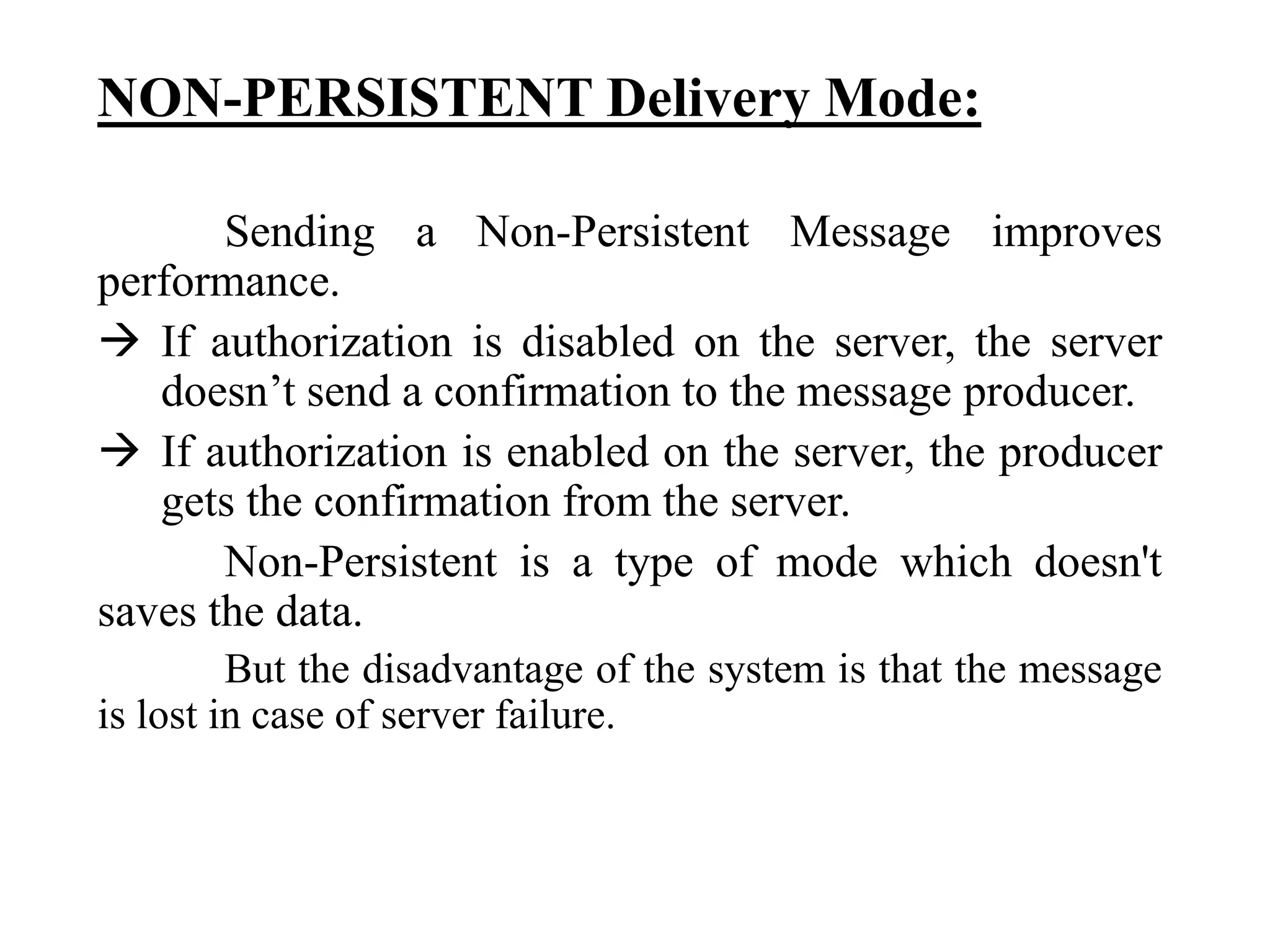
NON-PERSISTENT Delivery Mode:
Sending a Non-Persistent Message improves
performance.
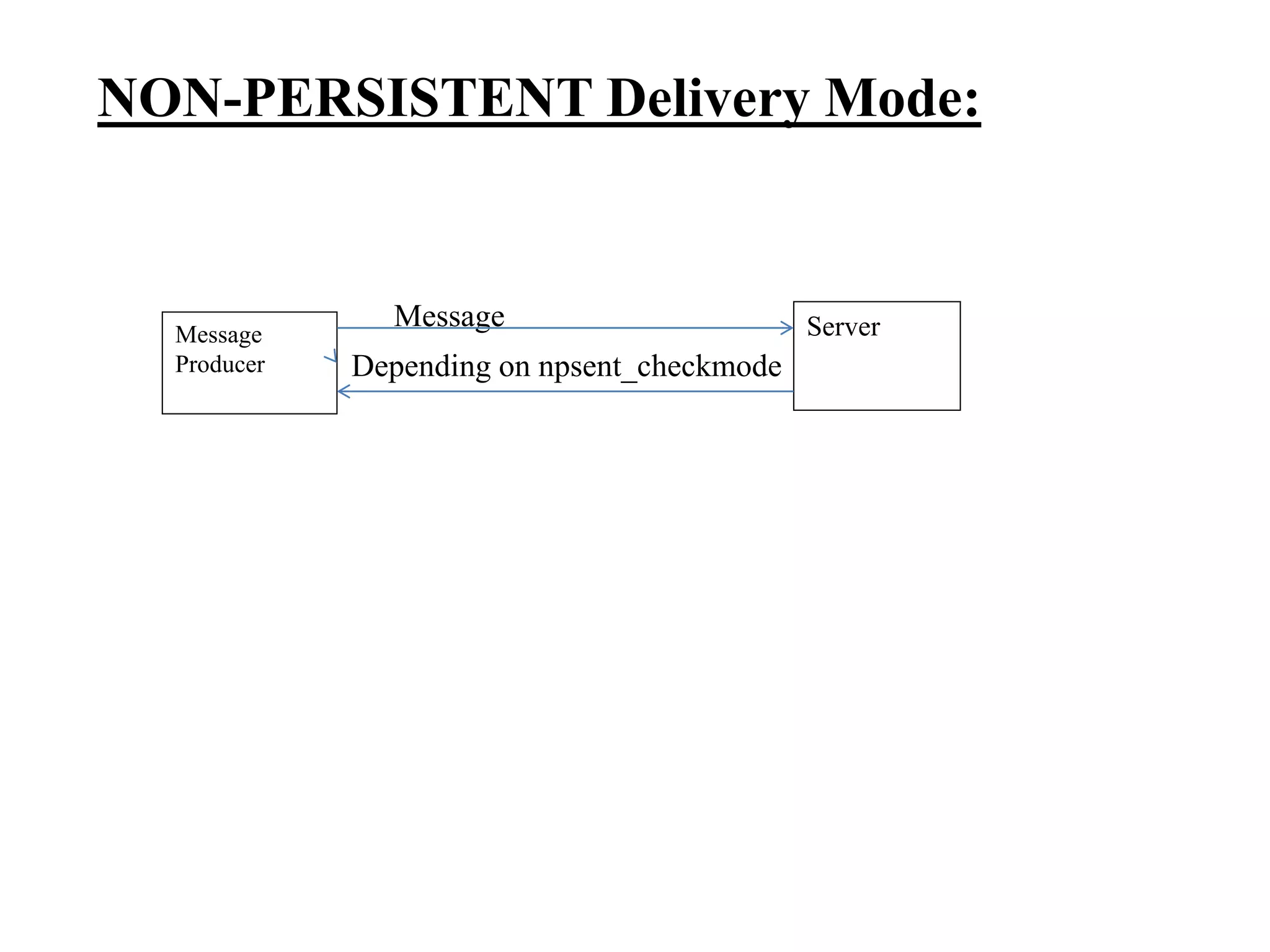
 If authorization is disabled on the server, the server
doesn’t send a confirmation to the message producer.
 If authorization is enabled on the server, the producer
gets the confirmation from the server.
Non-Persistent is a type of mode which doesn't
saves the data.
But the disadvantage of the system is that the message
is lost in case of server failure.
NON-PERSISTENT Delivery Mode:
Message
Depending on npsent_checkmode
Message
Producer
Server
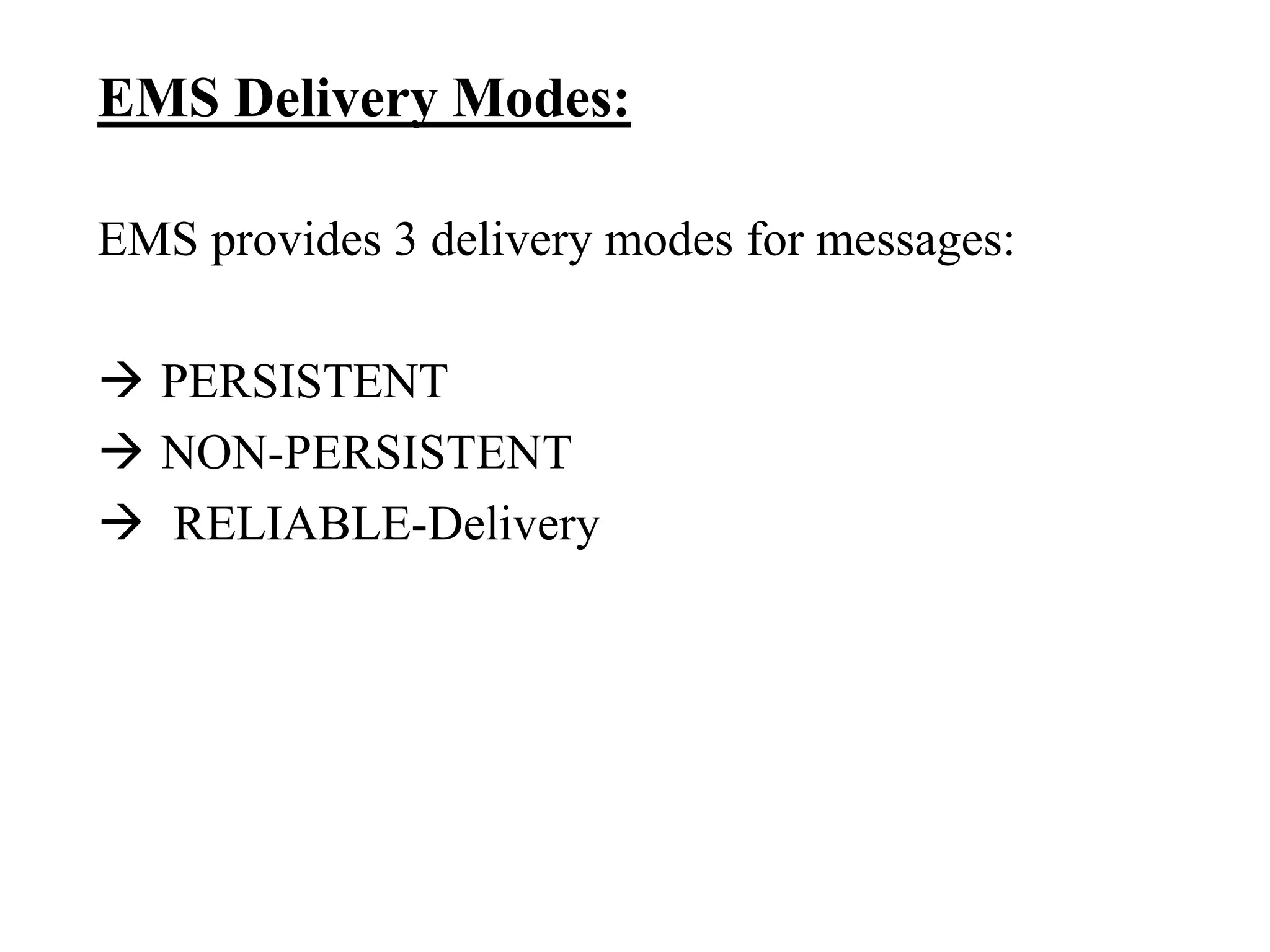
EMS Delivery Modes:
EMS provides 3 delivery modes for messages:
 PERSISTENT
 NON-PERSISTENT
 RELIABLE-Delivery
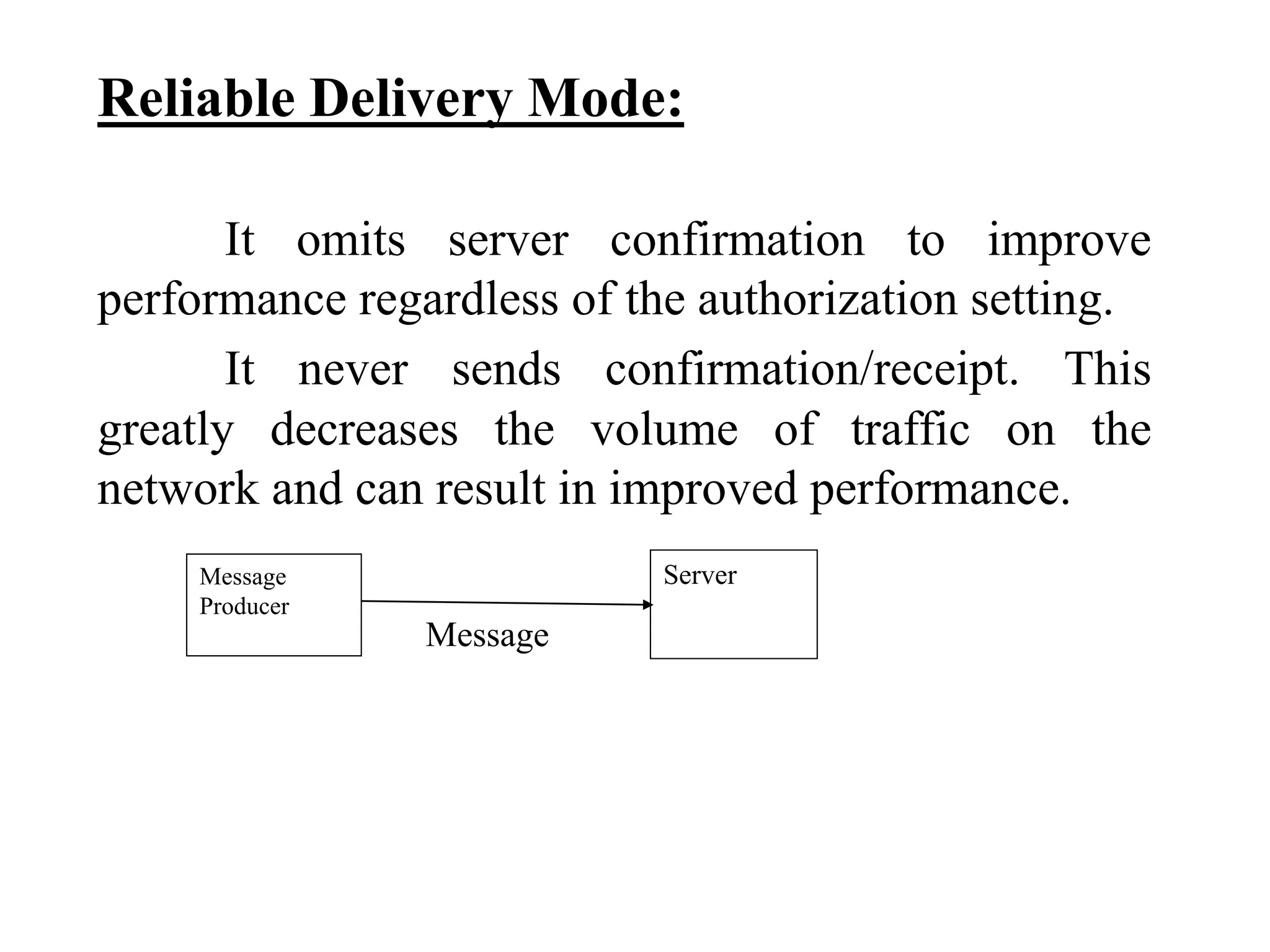
Reliable Delivery Mode:
It omits server confirmation to improve
performance regardless of the authorization setting.
It never sends confirmation/receipt. This
greatly decreases the volume of traffic on the
network and can result in improved performance.
Message
Message
Producer
Server
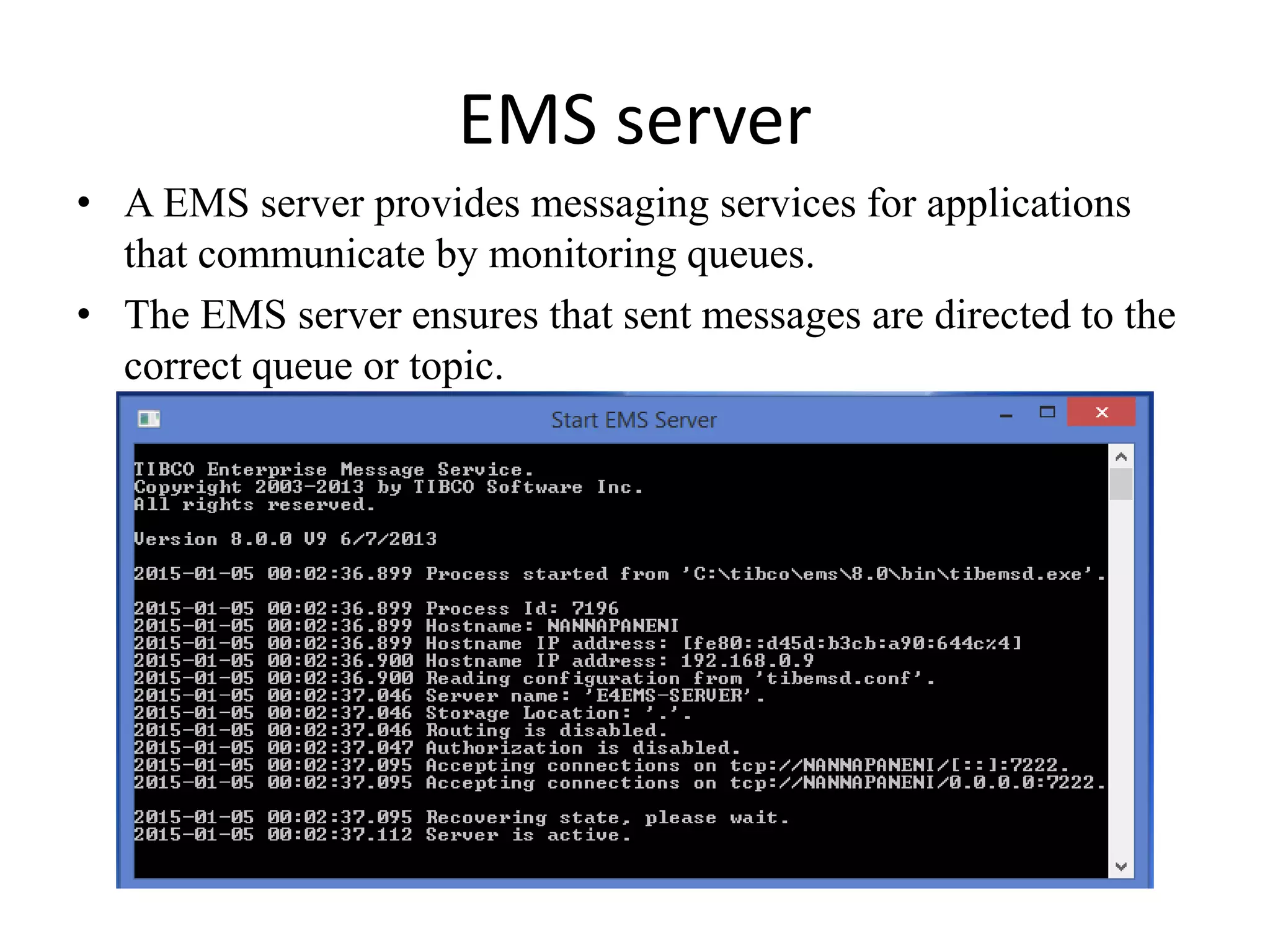
EMS server
• A EMS server provides messaging services for applications
that communicate by monitoring queues.
• The EMS server ensures that sent messages are directed to the
correct queue or topic.
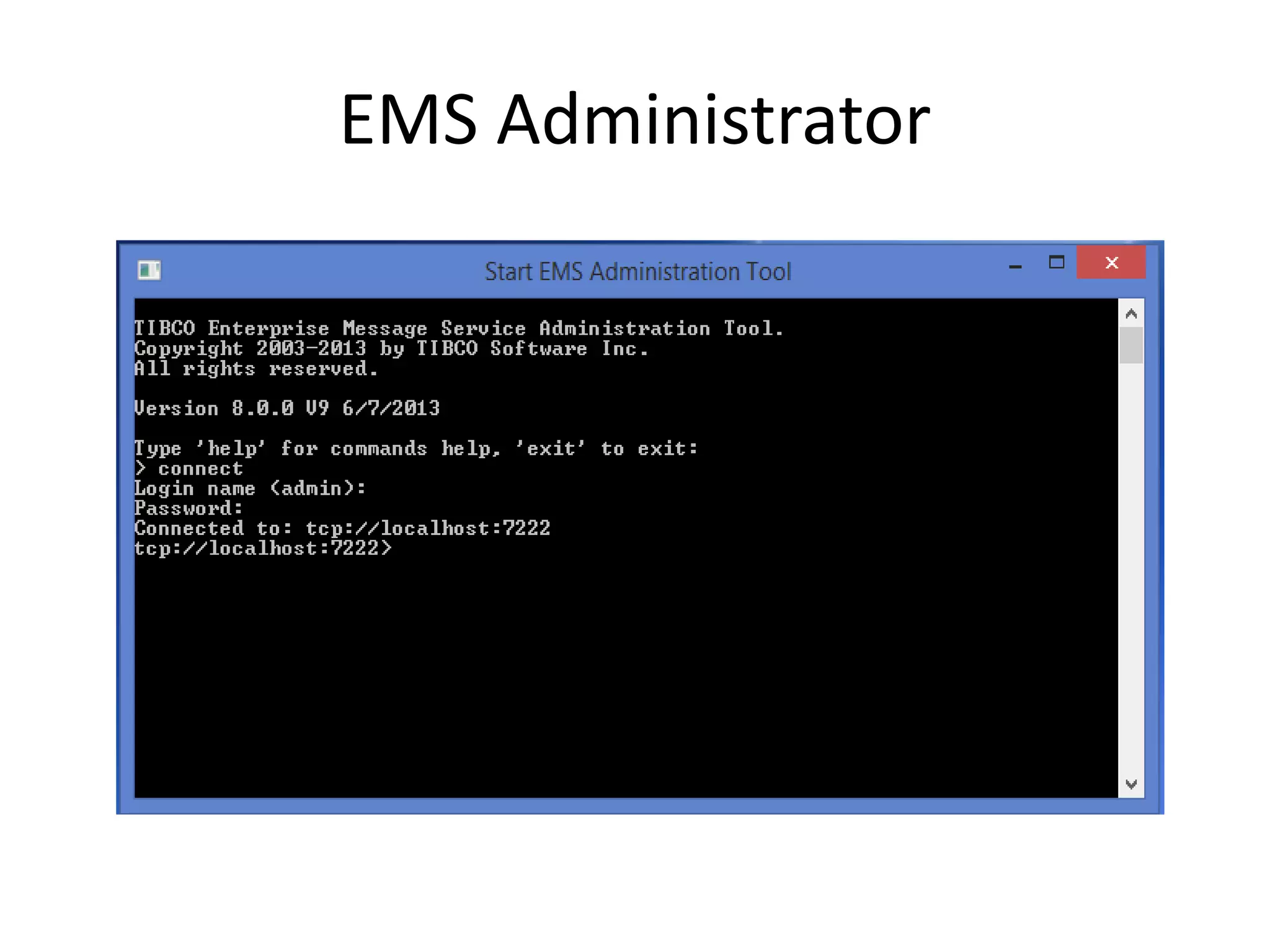
EMS Administrator
EMS Message Models:
Point-to-Point: For Point to point , we use
destinations called Queues.
Publish Subscribe: For Publish subscribe, we use
destinations called topics.
Different types of destinations:
• Static Destination: created by the users, administrators
and API.
• Dynamic Destination: created by the BW process.
• Temporary Destination: created for the request-reply
purpose.
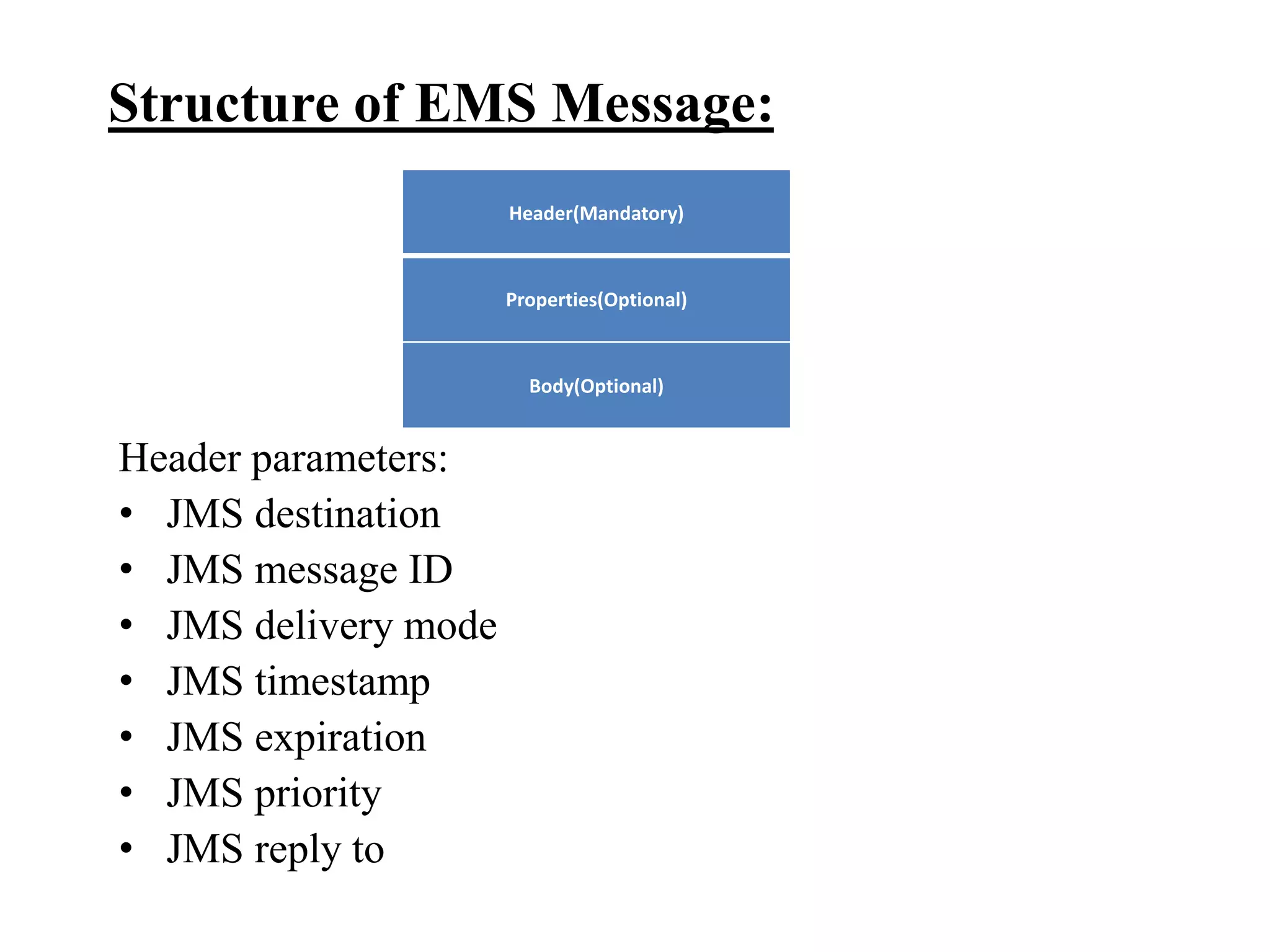
Structure of EMS Message:
Header parameters:
• JMS destination
• JMS message ID
• JMS delivery mode
• JMS timestamp
• JMS expiration
• JMS priority
• JMS reply to
Header(Mandatory)
Properties(Optional)
Body(Optional)
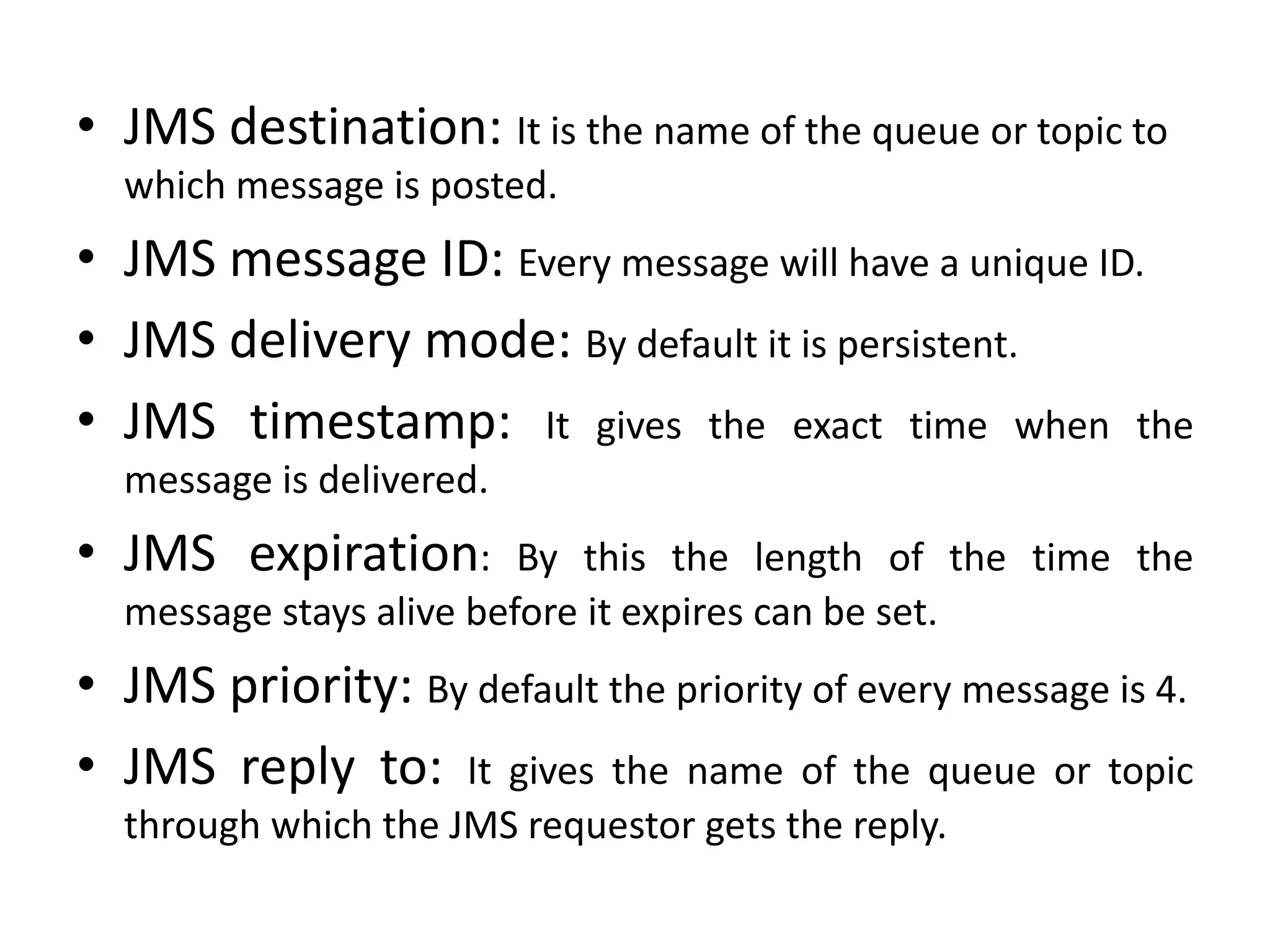
• JMS destination: It is the name of the queue or topic to
which message is posted.
• JMS message ID: Every message will have a unique ID.
• JMS delivery mode: By default it is persistent.
• JMS timestamp: It gives the exact time when the
message is delivered.
• JMS expiration: By this the length of the time the
message stays alive before it expires can be set.
• JMS priority: By default the priority of every message is 4.
• JMS reply to: It gives the name of the queue or topic
through which the JMS requestor gets the reply.
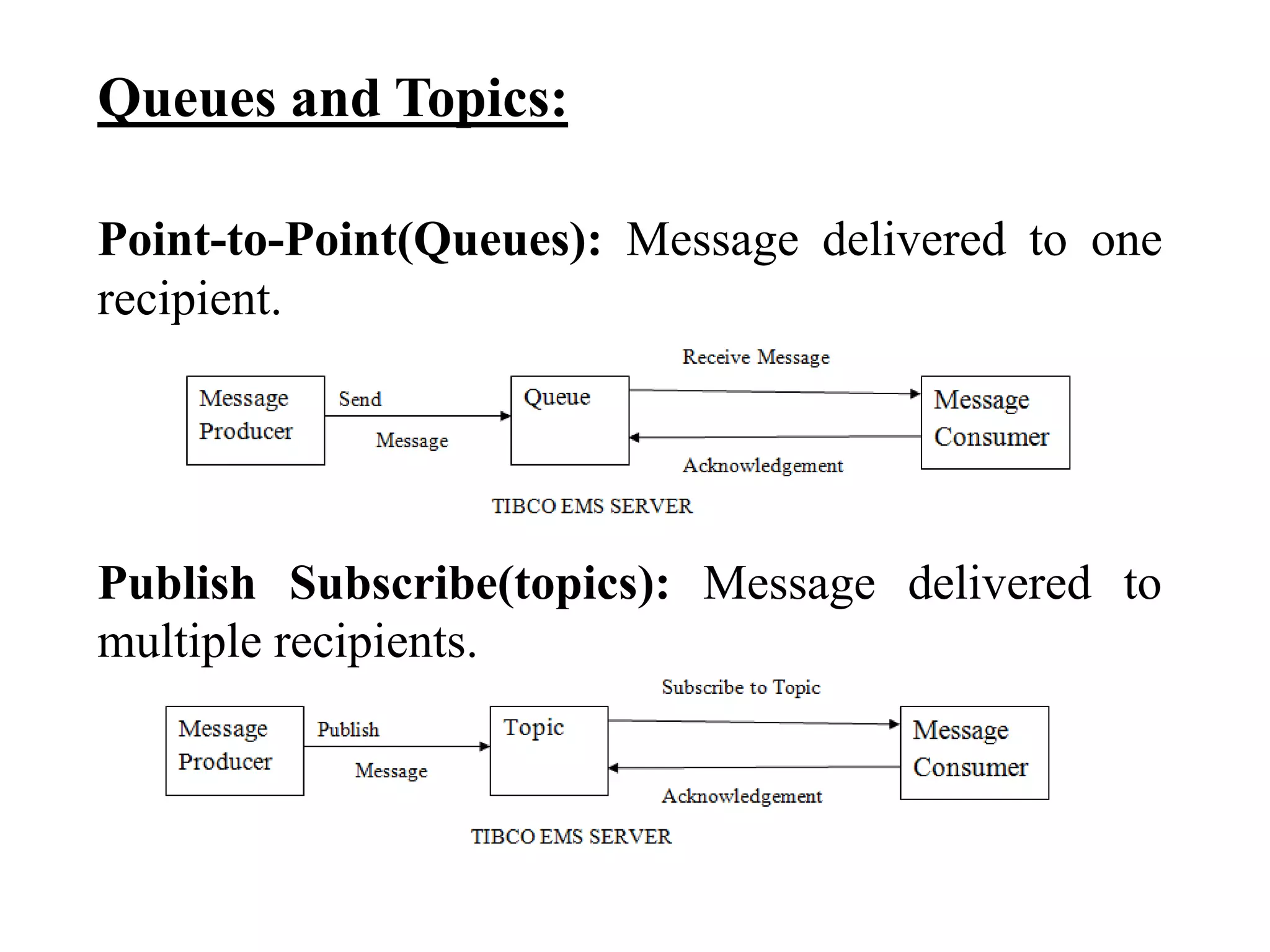
Queues and Topics:
Point-to-Point(Queues): Message delivered to one
recipient.
Publish Subscribe(topics): Message delivered to
multiple recipients.
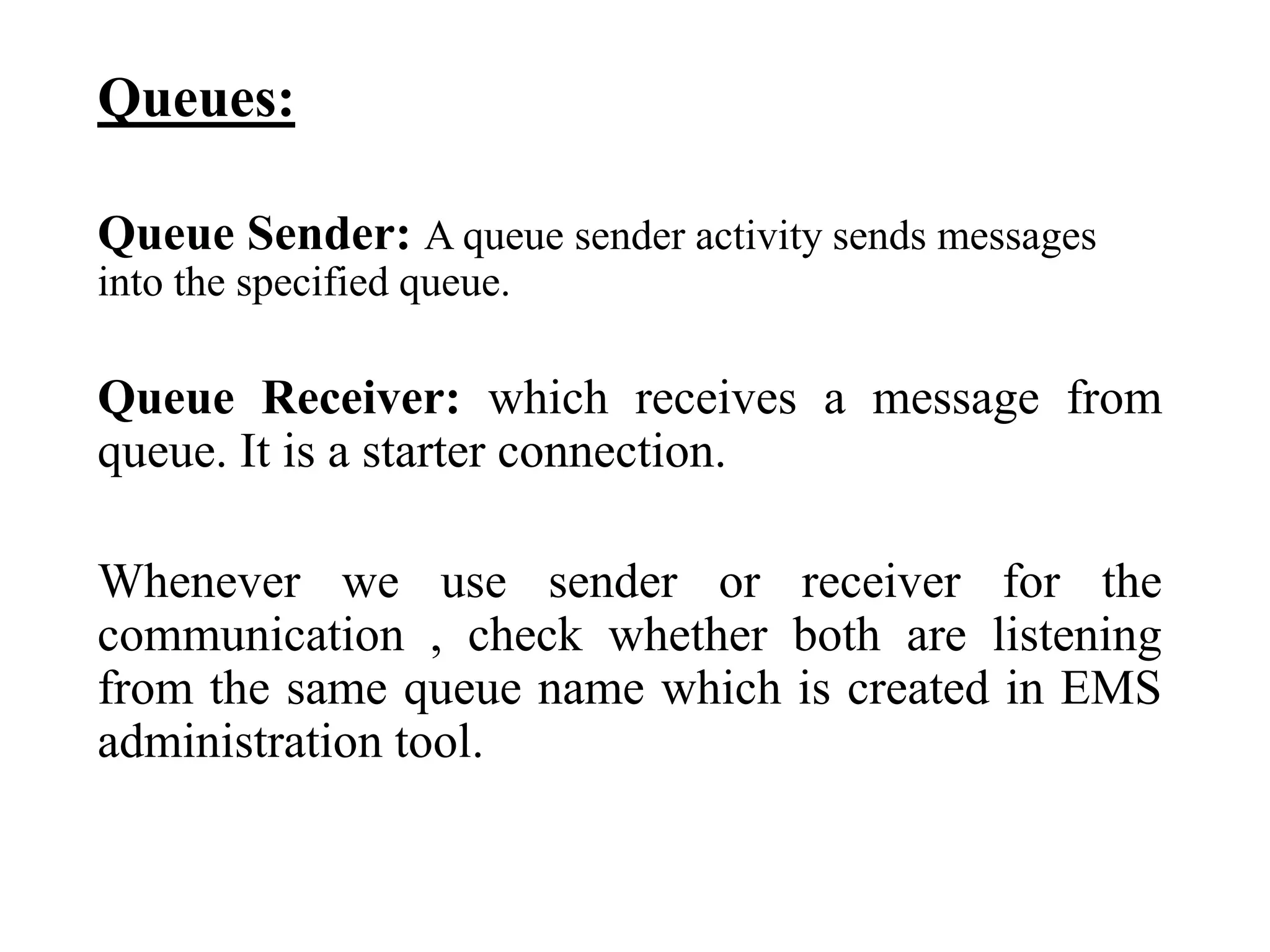
Queues:
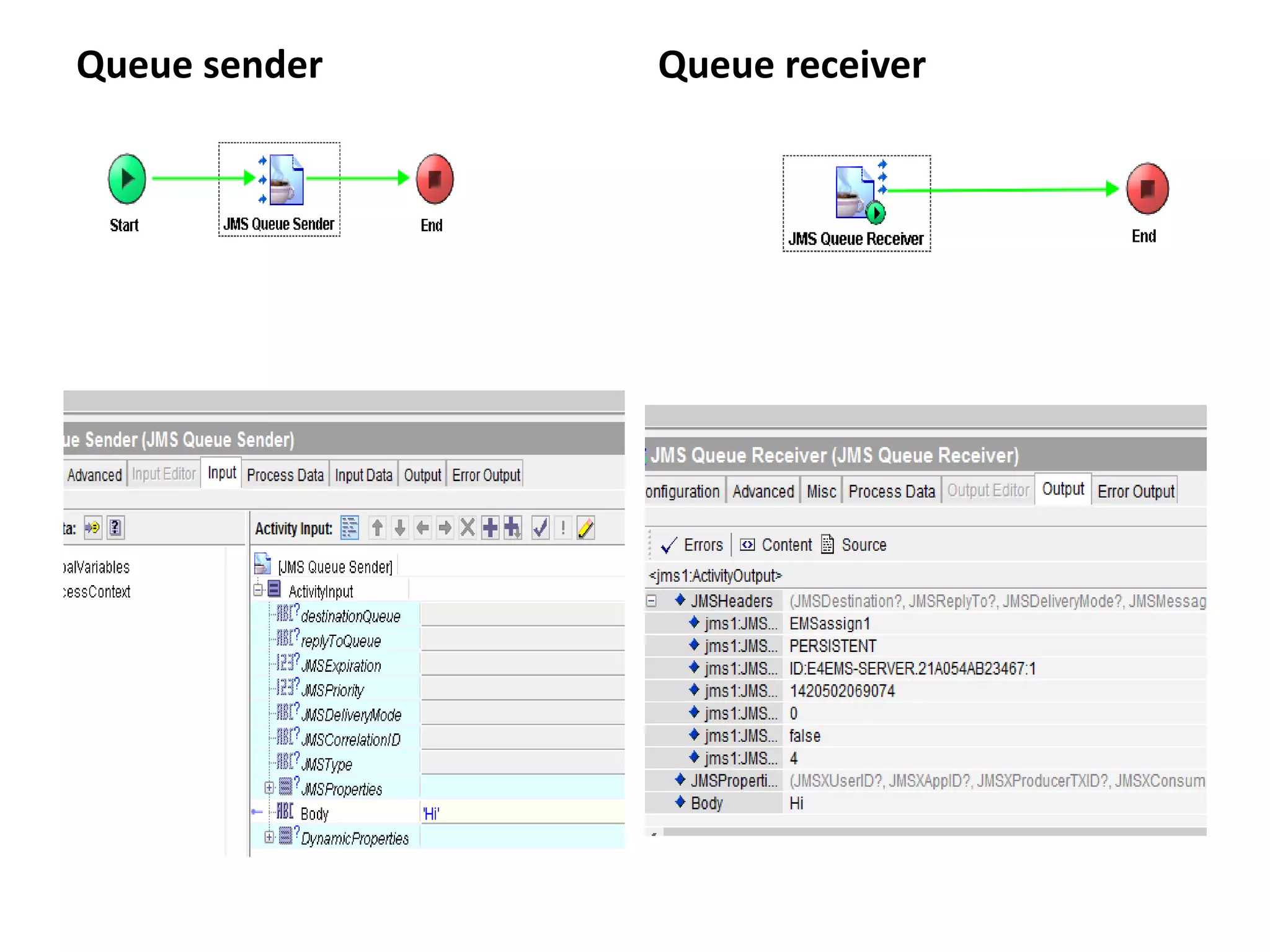
Queue Sender: A queue sender activity sends messages
into the specified queue.
Queue Receiver: which receives a message from
queue. It is a starter connection.
Whenever we use sender or receiver for the
communication , check whether both are listening
from the same queue name which is created in EMS
administration tool.
Queue sender Queue receiver
Queues:
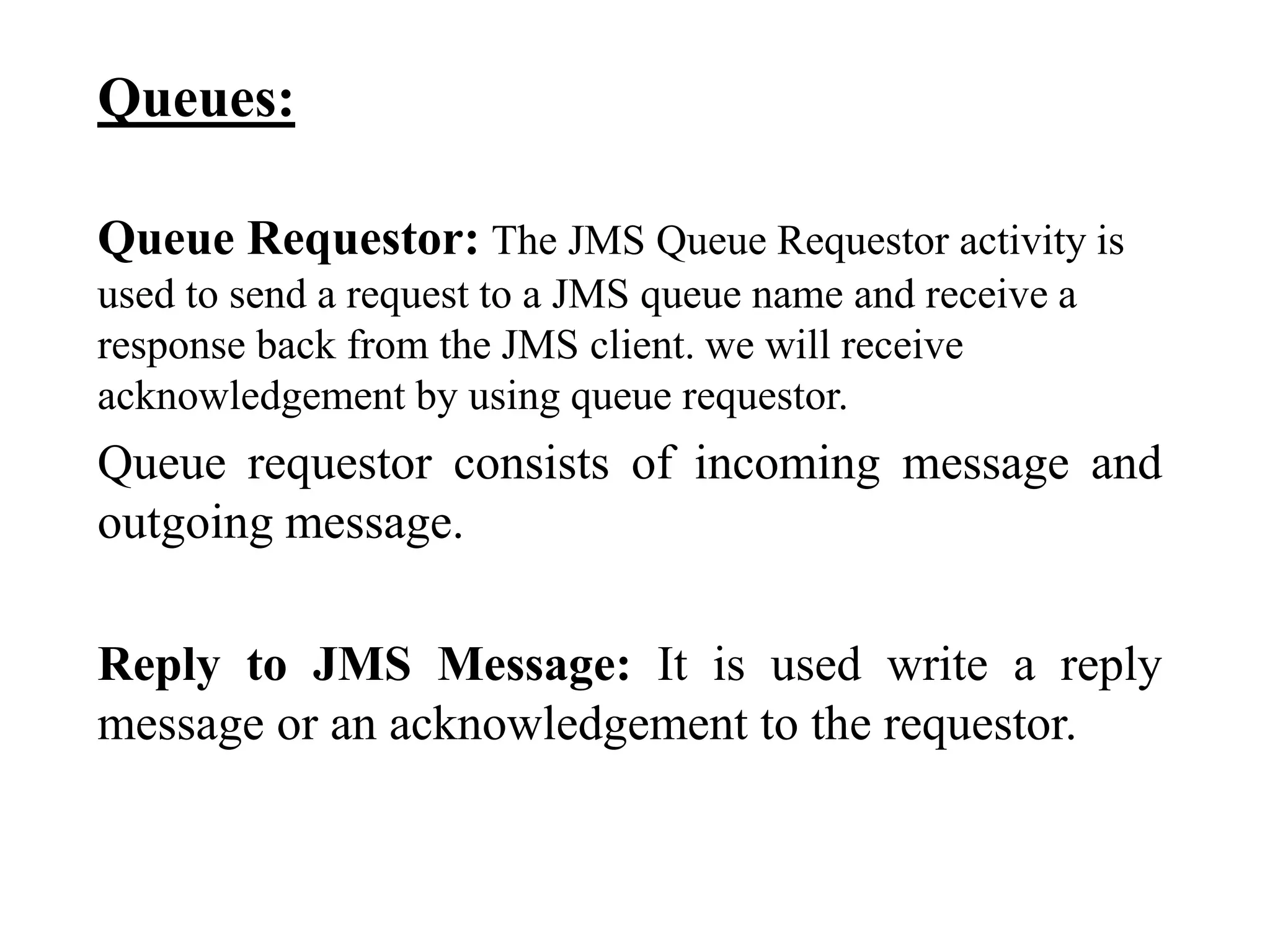
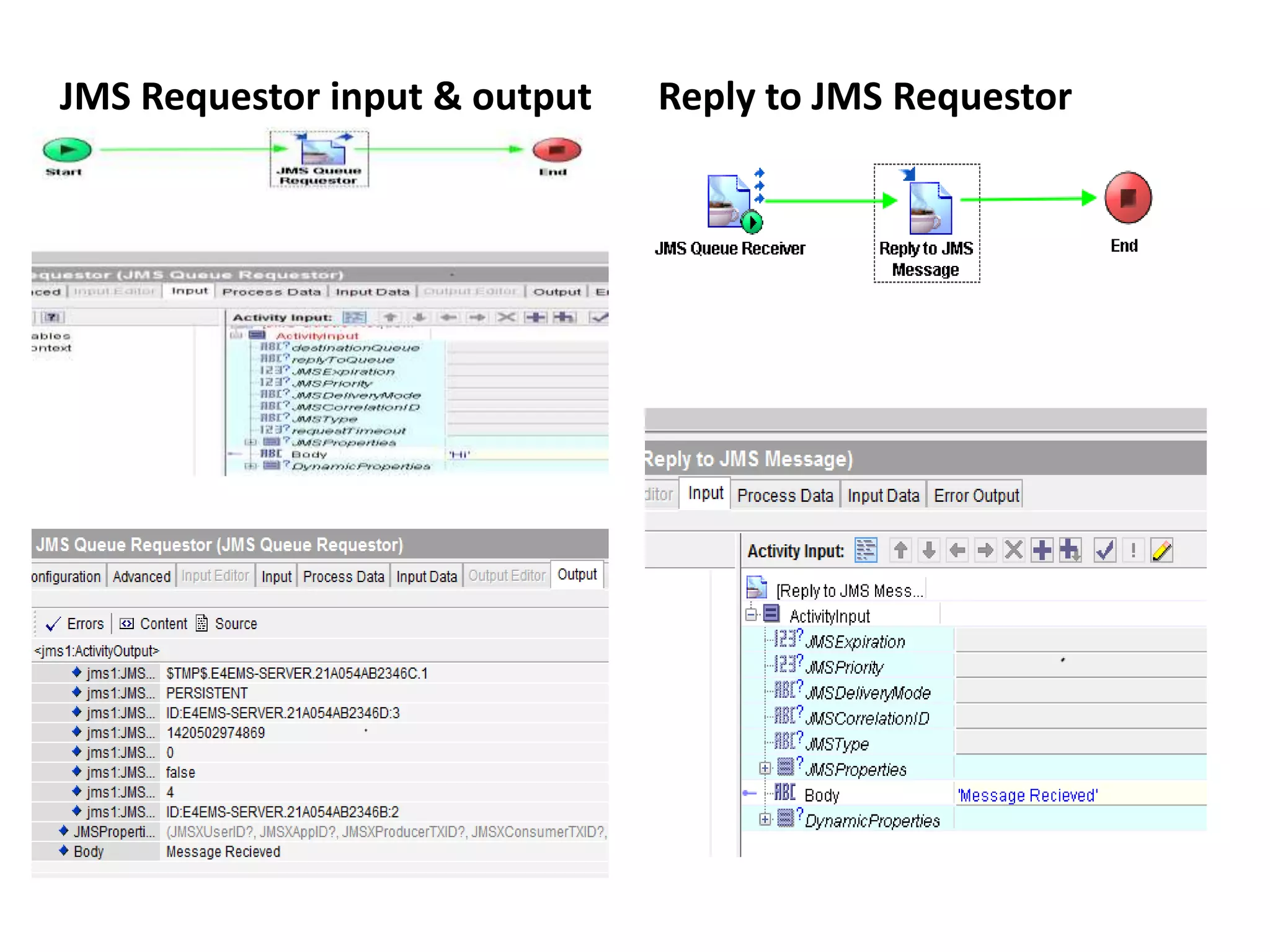
Queue Requestor: The JMS Queue Requestor activity is
used to send a request to a JMS queue name and receive a
response back from the JMS client. we will receive
acknowledgement by using queue requestor.
Queue requestor consists of incoming message and
outgoing message.
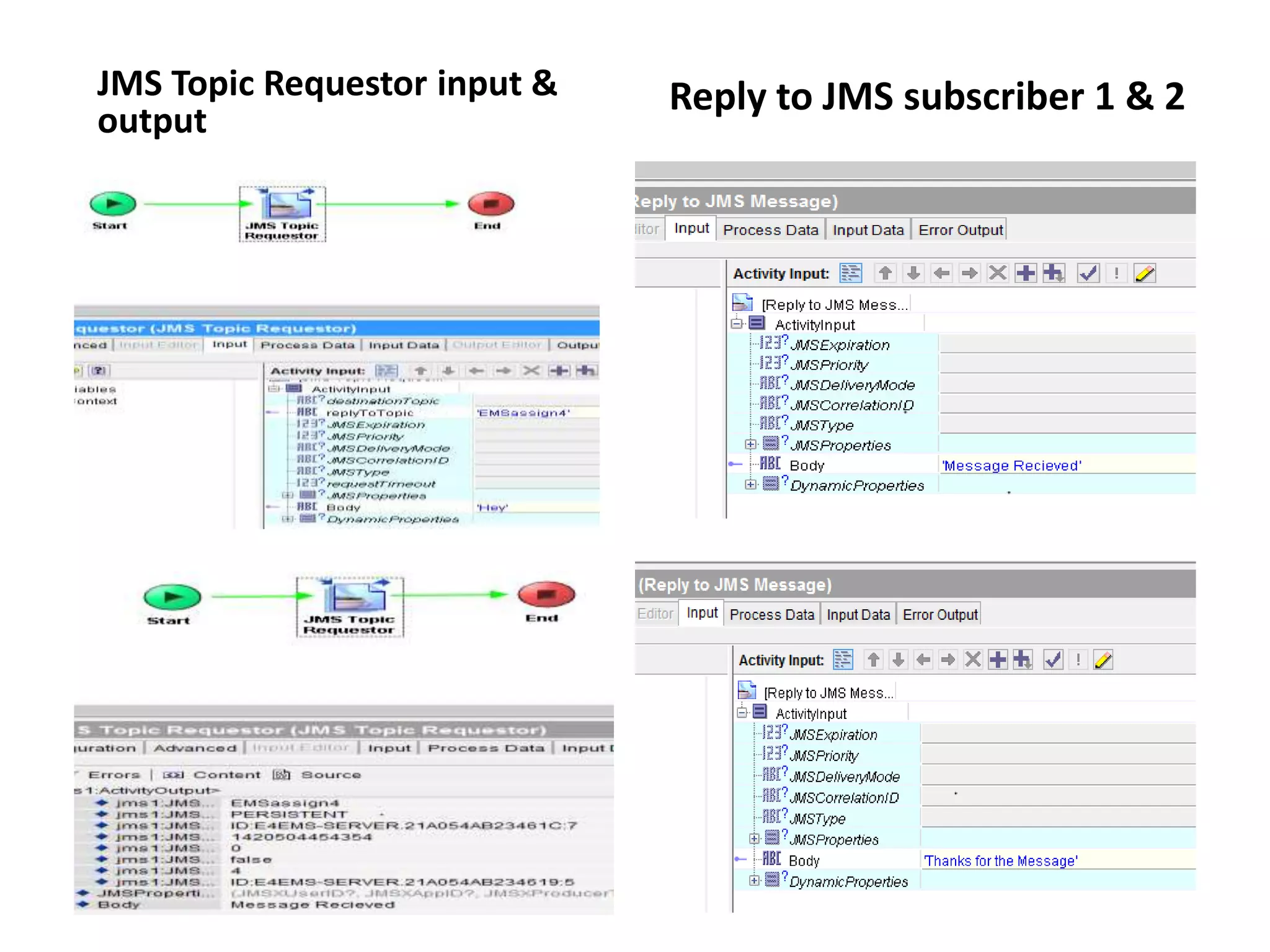
Reply to JMS Message: It is used write a reply
message or an acknowledgement to the requestor.
Reply to JMS RequestorJMS Requestor input & output
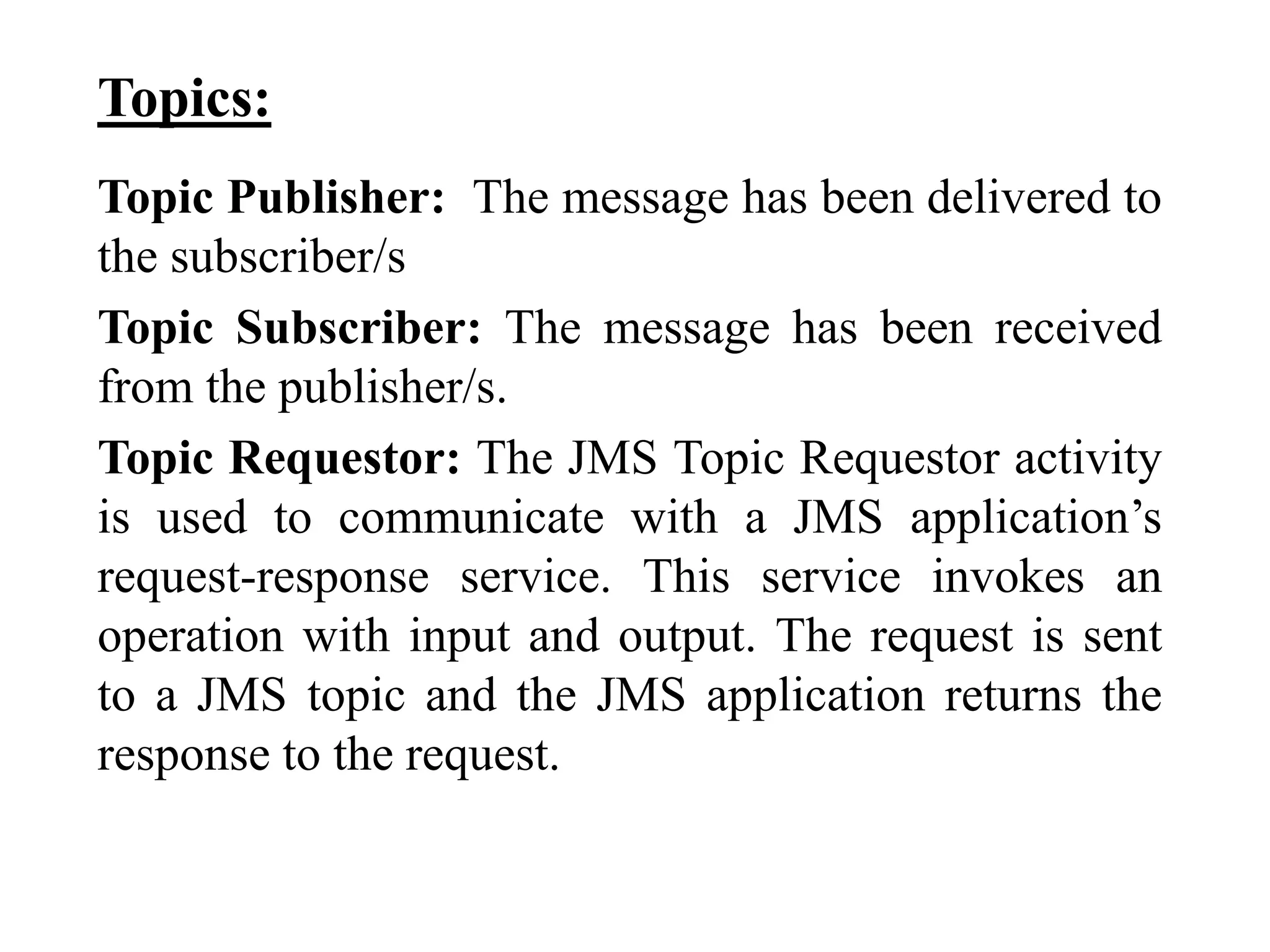
Topics:
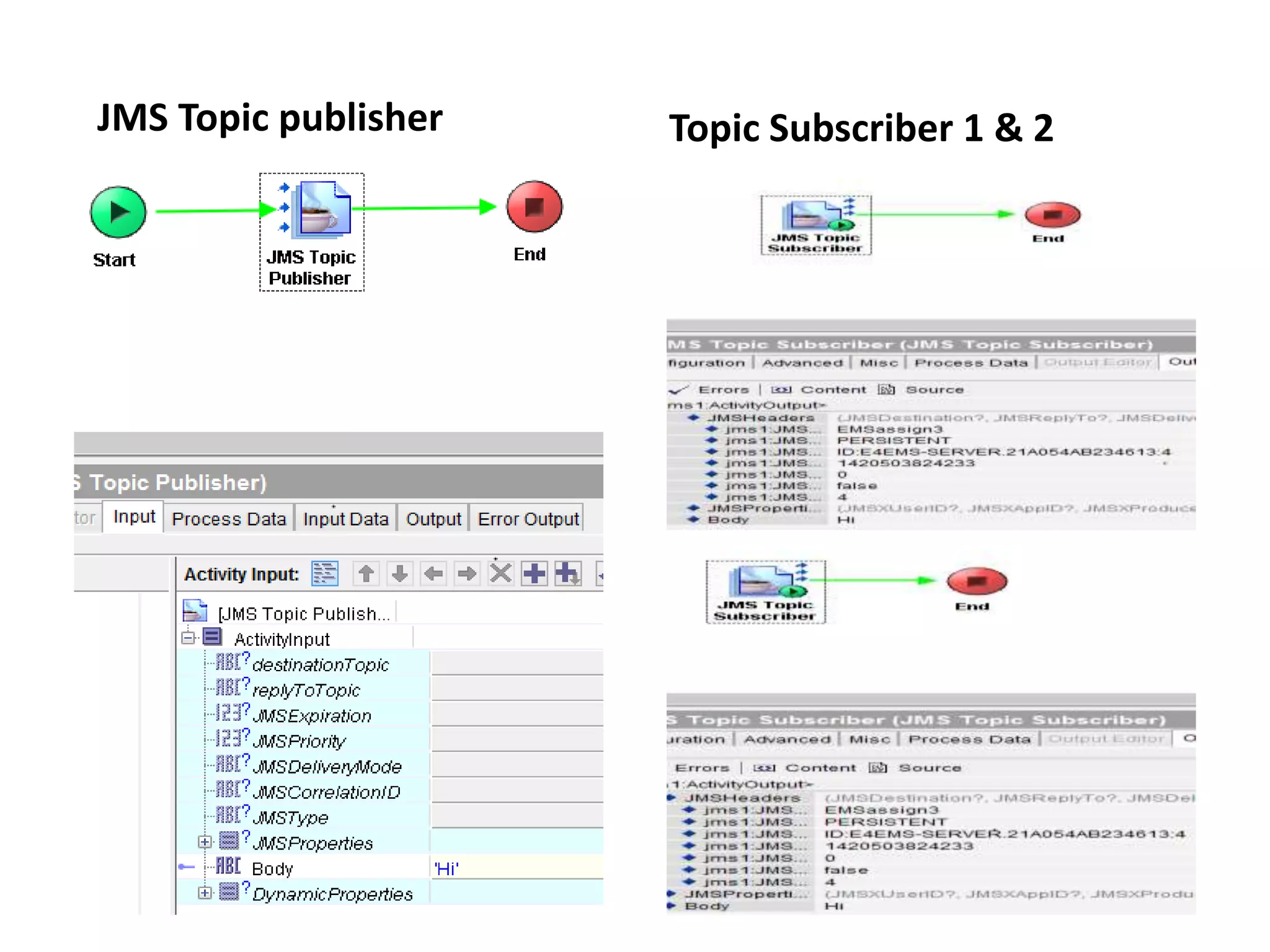
Topic Publisher: The message has been delivered to
the subscriber/s
Topic Subscriber: The message has been received
from the publisher/s.
Topic Requestor: The JMS Topic Requestor activity
is used to communicate with a JMS application’s
request-response service. This service invokes an
operation with input and output. The request is sent
to a JMS topic and the JMS application returns the
response to the request.
Topic Subscriber 1 & 2JMS Topic publisher
Reply to JMS subscriber 1 & 2JMS Topic Requestor input &
output
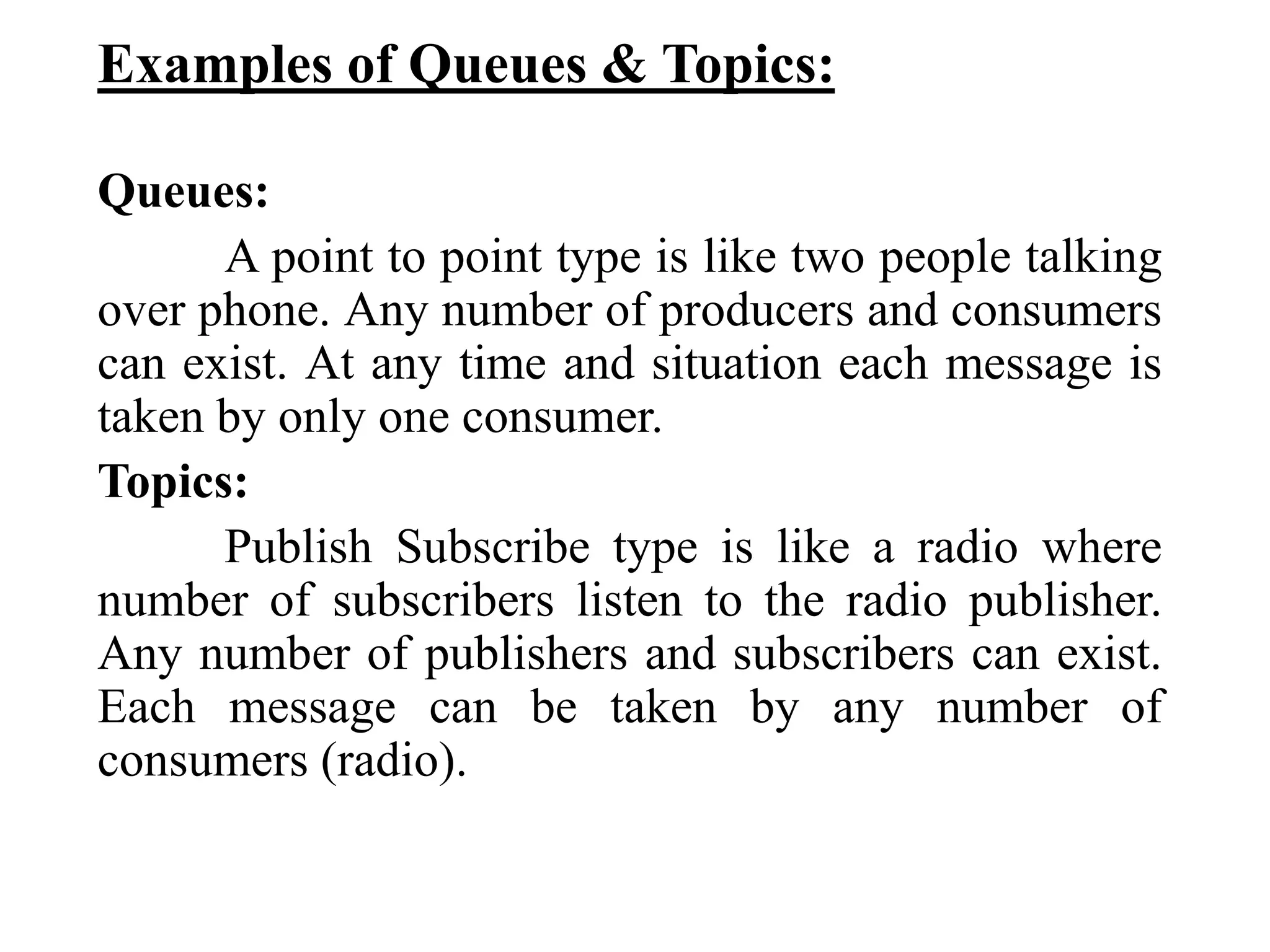
Examples of Queues & Topics:
Queues:
A point to point type is like two people talking
over phone. Any number of producers and consumers
can exist. At any time and situation each message is
taken by only one consumer.
Topics:
Publish Subscribe type is like a radio where
number of subscribers listen to the radio publisher.
Any number of publishers and subscribers can exist.
Each message can be taken by any number of
consumers (radio).
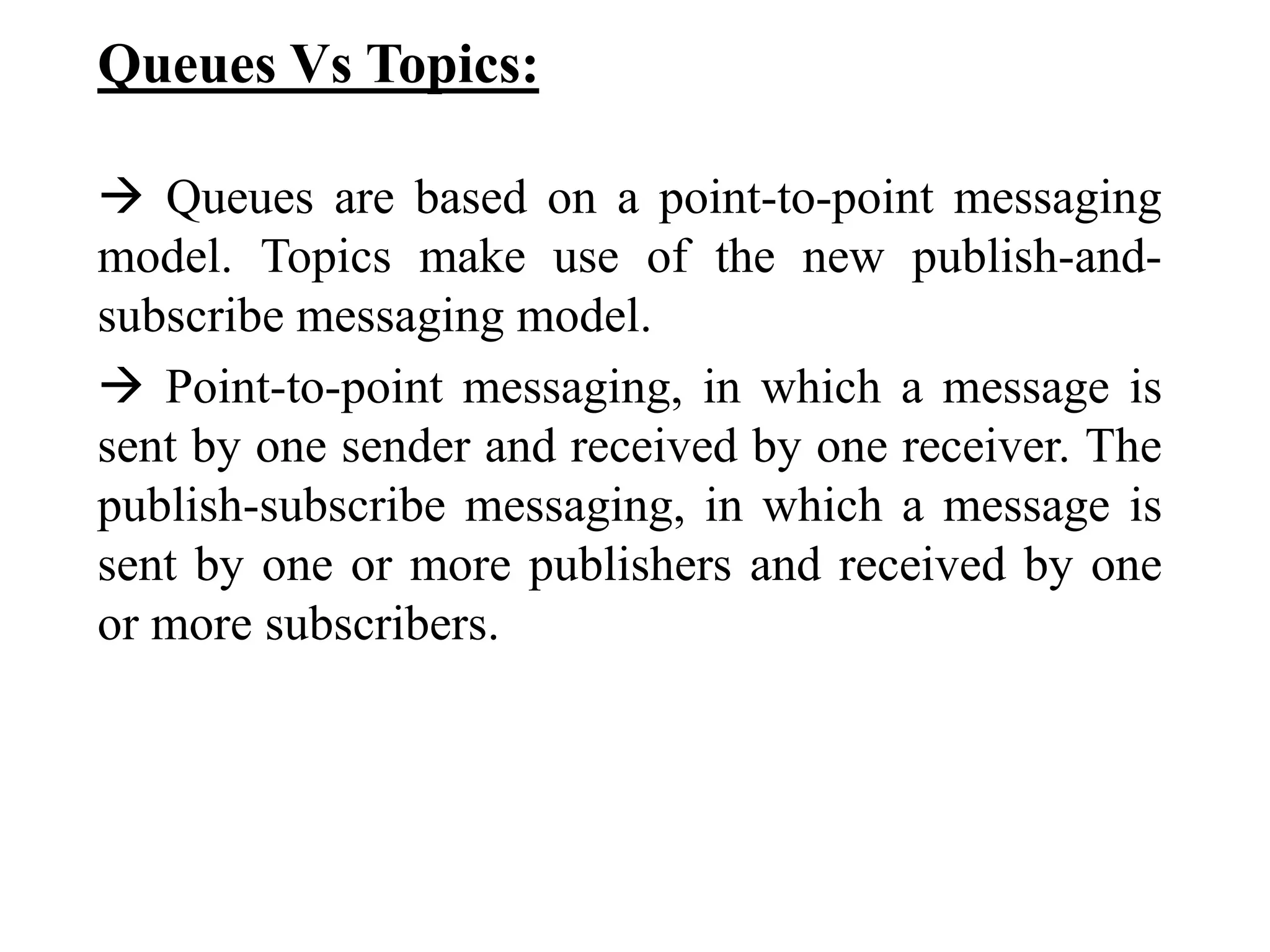
Queues Vs Topics:
 Queues are based on a point-to-point messaging
model. Topics make use of the new publish-and-
subscribe messaging model.
 Point-to-point messaging, in which a message is
sent by one sender and received by one receiver. The
publish-subscribe messaging, in which a message is
sent by one or more publishers and received by one
or more subscribers.
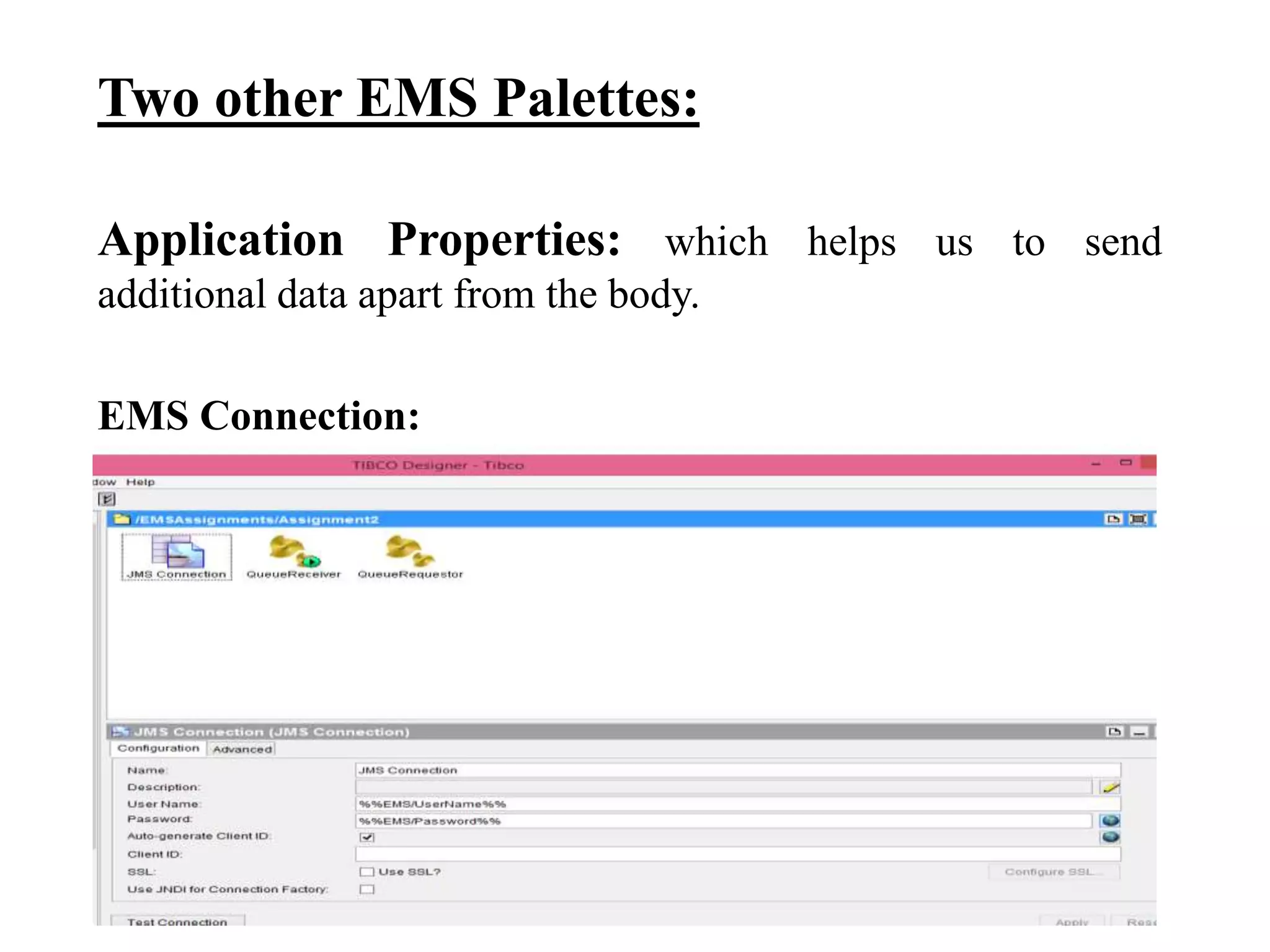
Two other EMS Palettes:
Application Properties: which helps us to send
additional data apart from the body.
EMS Connection:
EMS Acknowledgement Modes:
To restrict Acknowledgement in EMS, the different types of
acknowledgement modes are:
• Auto
• Client
• Dups_ok
• No_ack
• Explciit
• Explicit_client_dups_ok
• Transitional
• Local transitional.
End of EMS Overview
Thank You!

A detailed Tibco EMS presentation

  • 1.
  • 2.
    EMS Overview: • Whatis EMS? • Ems Delivery Modes • EMS Server and Administration tool • Message Models • Queues Vs Topics • Create Queue and Topics • EMS Shared Connection • Queue Sender • Queue Receiver • Topic Publisher • Topic Subscriber
  • 3.
    EMS: Enterprise Message Service(EMS) is a specification about sending and receiving messages between two or more applications. EMS is an extension to JMS.
  • 4.
    JMS Delivery Modes: JMSprovides 2 delivery modes for messages:  PERSISTENT  NON-PERSISTENT
  • 5.
    PERSISTENT Delivery Mode: Whena producer sends a persistent message, the producer must wait for the server to reply with a confirmation. Persistent is a type of mode which saves the data. Message Acknowledgement Message Producer Server
  • 6.
    NON-PERSISTENT Delivery Mode: Sendinga Non-Persistent Message improves performance.  If authorization is disabled on the server, the server doesn’t send a confirmation to the message producer.  If authorization is enabled on the server, the producer gets the confirmation from the server. Non-Persistent is a type of mode which doesn't saves the data. But the disadvantage of the system is that the message is lost in case of server failure.
  • 7.
    NON-PERSISTENT Delivery Mode: Message Dependingon npsent_checkmode Message Producer Server
  • 8.
    EMS Delivery Modes: EMSprovides 3 delivery modes for messages:  PERSISTENT  NON-PERSISTENT  RELIABLE-Delivery
  • 9.
    Reliable Delivery Mode: Itomits server confirmation to improve performance regardless of the authorization setting. It never sends confirmation/receipt. This greatly decreases the volume of traffic on the network and can result in improved performance. Message Message Producer Server
  • 10.
    EMS server • AEMS server provides messaging services for applications that communicate by monitoring queues. • The EMS server ensures that sent messages are directed to the correct queue or topic.
  • 11.
  • 12.
    EMS Message Models: Point-to-Point:For Point to point , we use destinations called Queues. Publish Subscribe: For Publish subscribe, we use destinations called topics.
  • 13.
    Different types ofdestinations: • Static Destination: created by the users, administrators and API. • Dynamic Destination: created by the BW process. • Temporary Destination: created for the request-reply purpose.
  • 14.
    Structure of EMSMessage: Header parameters: • JMS destination • JMS message ID • JMS delivery mode • JMS timestamp • JMS expiration • JMS priority • JMS reply to Header(Mandatory) Properties(Optional) Body(Optional)
  • 15.
    • JMS destination:It is the name of the queue or topic to which message is posted. • JMS message ID: Every message will have a unique ID. • JMS delivery mode: By default it is persistent. • JMS timestamp: It gives the exact time when the message is delivered. • JMS expiration: By this the length of the time the message stays alive before it expires can be set. • JMS priority: By default the priority of every message is 4. • JMS reply to: It gives the name of the queue or topic through which the JMS requestor gets the reply.
  • 16.
    Queues and Topics: Point-to-Point(Queues):Message delivered to one recipient. Publish Subscribe(topics): Message delivered to multiple recipients.
  • 17.
    Queues: Queue Sender: Aqueue sender activity sends messages into the specified queue. Queue Receiver: which receives a message from queue. It is a starter connection. Whenever we use sender or receiver for the communication , check whether both are listening from the same queue name which is created in EMS administration tool.
  • 18.
  • 19.
    Queues: Queue Requestor: TheJMS Queue Requestor activity is used to send a request to a JMS queue name and receive a response back from the JMS client. we will receive acknowledgement by using queue requestor. Queue requestor consists of incoming message and outgoing message. Reply to JMS Message: It is used write a reply message or an acknowledgement to the requestor.
  • 20.
    Reply to JMSRequestorJMS Requestor input & output
  • 21.
    Topics: Topic Publisher: Themessage has been delivered to the subscriber/s Topic Subscriber: The message has been received from the publisher/s. Topic Requestor: The JMS Topic Requestor activity is used to communicate with a JMS application’s request-response service. This service invokes an operation with input and output. The request is sent to a JMS topic and the JMS application returns the response to the request.
  • 22.
    Topic Subscriber 1& 2JMS Topic publisher
  • 23.
    Reply to JMSsubscriber 1 & 2JMS Topic Requestor input & output
  • 24.
    Examples of Queues& Topics: Queues: A point to point type is like two people talking over phone. Any number of producers and consumers can exist. At any time and situation each message is taken by only one consumer. Topics: Publish Subscribe type is like a radio where number of subscribers listen to the radio publisher. Any number of publishers and subscribers can exist. Each message can be taken by any number of consumers (radio).
  • 25.
    Queues Vs Topics: Queues are based on a point-to-point messaging model. Topics make use of the new publish-and- subscribe messaging model.  Point-to-point messaging, in which a message is sent by one sender and received by one receiver. The publish-subscribe messaging, in which a message is sent by one or more publishers and received by one or more subscribers.
  • 26.
    Two other EMSPalettes: Application Properties: which helps us to send additional data apart from the body. EMS Connection:
  • 27.
    EMS Acknowledgement Modes: Torestrict Acknowledgement in EMS, the different types of acknowledgement modes are: • Auto • Client • Dups_ok • No_ack • Explciit • Explicit_client_dups_ok • Transitional • Local transitional.
  • 28.
    End of EMSOverview Thank You!