RabbitMQ Introduction
Scope of this presentation
 In Scope
◦ Brief history of Rabbit MQ
◦ Brief introduction of Rabbit MQ
components
◦ Messaging Flow in Rabbit MQ
◦ Example of sending and receiving
messages to/from RabbitMQ
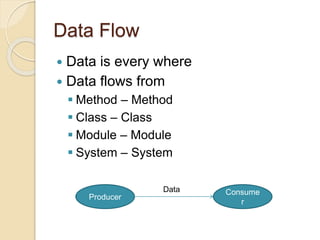
Data Flow
 Data is every where
 Data flows from
 Method – Method
 Class – Class
 Module – Module
 System – System
Producer
Data Consume
r
Why Messaging systems
 Loose coupling between modules
 Queuing data for later delivery
 Asynchronous processing
 Reliable load balancing
Rabbit MQ
 Rabbit Technologies started as a joint
venture between LShift and
CohesiveFT in 2007
 acquired in April 2010 by
SpringSource, a division of VMWare.
 Became part of GoPivotal in May 2013
 Client Libraries available for all major
languages
RabbitMQ Introduction
 RabbitMQ is open source Messaging
Broker software
 Message Oriented Middleware
 Server written in Erlang
 Implements AMQP
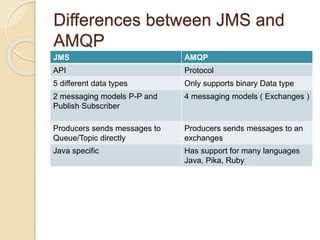
Differences between JMS and
AMQP
JMS AMQP
API Protocol
5 different data types Only supports binary Data type
2 messaging models P-P and
Publish Subscriber
4 messaging models ( Exchanges )
Producers sends messages to
Queue/Topic directly
Producers sends messages to an
exchanges
Java specific Has support for many languages
Java, Pika, Ruby
Java Client API
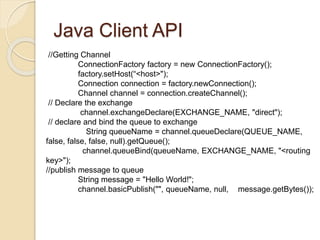
//Getting Channel
ConnectionFactory factory = new ConnectionFactory();
factory.setHost(“<host>");
Connection connection = factory.newConnection();
Channel channel = connection.createChannel();
// Declare the exchange
channel.exchangeDeclare(EXCHANGE_NAME, "direct");
// declare and bind the queue to exchange
String queueName = channel.queueDeclare(QUEUE_NAME,
false, false, false, null).getQueue();
channel.queueBind(queueName, EXCHANGE_NAME, "<routing
key>");
//publish message to queue
String message = "Hello World!";
channel.basicPublish("", queueName, null, message.getBytes());
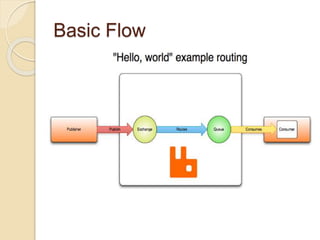
Basic Flow
Binding and Routing Key
 Bindings: Each Queue should bind with
an Exchange with a routing key
 Routing key : String of characters
 Exchange Type decides strategy for
routing messages to bounded queues
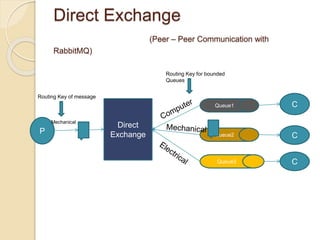
◦ Direct exchange : matches routing key of
message exactly with the routing key of
queues specified at the time of binding
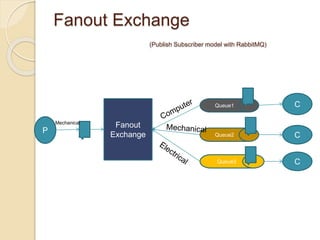
◦ Fanout exchange : ignores the routing key
and sends a copy of message to every
bounded queue
Exchange
 Default
◦ Direct exchange with no name
◦ Routing key equals QueueName
 Direct
◦ Messages would only be routed when there is queue
bonded with Routing Key
 Fanout
◦ Messages would be routed to all queues bounded
irrespective of routing key
 Topic
◦ We can use regular expressions for routing key
 Header
◦ Least used
◦ Matches against header properties instead of routing key
Direct Exchange
(Peer – Peer Communication with
RabbitMQ)
P
Direct
Exchange
Mechanical
Queue1
Queue2
Queue3
C
C
C
Routing Key for bounded
Queues
Routing Key of message
Fanout Exchange
(Publish Subscriber model with RabbitMQ)
P
Fanout
Exchange
Mechanical
Queue1
Queue2
Queue3
C
C
C
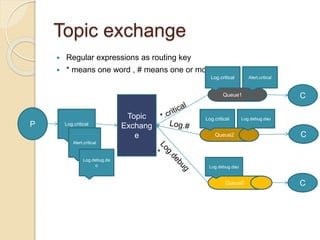
Topic exchange
 Regular expressions as routing key
 * means one word , # means one or more word
P
Topic
Exchang
e
Log.critical
Queue1
Queue2
Queue3
C
C
C
Alert.critical
Log.debug.da
o
Alert.critical
Log.critical Log.debug.dao
Log.critical
Log.debug.dao
Code Samples (Git
repository)
 https://github.com/ShirishkumarBari/L
earnRabbitMQ
References
 https://www.rabbitmq.com/
 https://en.wikipedia.org/wiki/RabbitMQ
 http://www.levvel.io/blog-post/rabbitmq-an
introduction/
 https://dzone.com/

Rabbit MQ introduction

  • 1.
  • 2.
    Scope of thispresentation  In Scope ◦ Brief history of Rabbit MQ ◦ Brief introduction of Rabbit MQ components ◦ Messaging Flow in Rabbit MQ ◦ Example of sending and receiving messages to/from RabbitMQ
  • 3.
    Data Flow  Datais every where  Data flows from  Method – Method  Class – Class  Module – Module  System – System Producer Data Consume r
  • 4.
    Why Messaging systems Loose coupling between modules  Queuing data for later delivery  Asynchronous processing  Reliable load balancing
  • 5.
    Rabbit MQ  RabbitTechnologies started as a joint venture between LShift and CohesiveFT in 2007  acquired in April 2010 by SpringSource, a division of VMWare.  Became part of GoPivotal in May 2013  Client Libraries available for all major languages
  • 6.
    RabbitMQ Introduction  RabbitMQis open source Messaging Broker software  Message Oriented Middleware  Server written in Erlang  Implements AMQP
  • 7.
    Differences between JMSand AMQP JMS AMQP API Protocol 5 different data types Only supports binary Data type 2 messaging models P-P and Publish Subscriber 4 messaging models ( Exchanges ) Producers sends messages to Queue/Topic directly Producers sends messages to an exchanges Java specific Has support for many languages Java, Pika, Ruby
  • 8.
    Java Client API //GettingChannel ConnectionFactory factory = new ConnectionFactory(); factory.setHost(“<host>"); Connection connection = factory.newConnection(); Channel channel = connection.createChannel(); // Declare the exchange channel.exchangeDeclare(EXCHANGE_NAME, "direct"); // declare and bind the queue to exchange String queueName = channel.queueDeclare(QUEUE_NAME, false, false, false, null).getQueue(); channel.queueBind(queueName, EXCHANGE_NAME, "<routing key>"); //publish message to queue String message = "Hello World!"; channel.basicPublish("", queueName, null, message.getBytes());
  • 9.
  • 10.
    Binding and RoutingKey  Bindings: Each Queue should bind with an Exchange with a routing key  Routing key : String of characters  Exchange Type decides strategy for routing messages to bounded queues ◦ Direct exchange : matches routing key of message exactly with the routing key of queues specified at the time of binding ◦ Fanout exchange : ignores the routing key and sends a copy of message to every bounded queue
  • 11.
    Exchange  Default ◦ Directexchange with no name ◦ Routing key equals QueueName  Direct ◦ Messages would only be routed when there is queue bonded with Routing Key  Fanout ◦ Messages would be routed to all queues bounded irrespective of routing key  Topic ◦ We can use regular expressions for routing key  Header ◦ Least used ◦ Matches against header properties instead of routing key
  • 12.
    Direct Exchange (Peer –Peer Communication with RabbitMQ) P Direct Exchange Mechanical Queue1 Queue2 Queue3 C C C Routing Key for bounded Queues Routing Key of message
  • 13.
    Fanout Exchange (Publish Subscribermodel with RabbitMQ) P Fanout Exchange Mechanical Queue1 Queue2 Queue3 C C C
  • 14.
    Topic exchange  Regularexpressions as routing key  * means one word , # means one or more word P Topic Exchang e Log.critical Queue1 Queue2 Queue3 C C C Alert.critical Log.debug.da o Alert.critical Log.critical Log.debug.dao Log.critical Log.debug.dao
  • 15.
    Code Samples (Git repository) https://github.com/ShirishkumarBari/L earnRabbitMQ
  • 16.
    References  https://www.rabbitmq.com/  https://en.wikipedia.org/wiki/RabbitMQ http://www.levvel.io/blog-post/rabbitmq-an introduction/  https://dzone.com/