A Contained Atmosphere

 If a mainly carbon dioxide atmosphere is provided to a kidney bean plant,
will its growth be affected? 


                         Ryan Henderson
Rationale
• I enjoy growing plants

• I enjoy learning about combustion

• Botany is and interest of mine as a future job 
  field
Research
                     Topics
• The Various Parts of a Plant

• Photosynthesis - the Light and Dark Reactions

• Combustion
Hypothesis
If a kidney bean plant is exposed to a mainly carbon 
dioxide atmosphere over the course of one week and six 
days, then it will grow faster than a plant of the same 
species under normal circumstances for the same period 
of time.  
Materials
• Dried organic beans (Bag)   •Aluminum foil (sheet)
• Outdoor soil                •Measuring cup
• Tub Ware Dishes (Entrée     •Disposable plastic gloves 
  size)                       (pairs) 
                              •Eye dropper 
• Sheets of Paper             •Plant support beams
• Ruler                       •A computer (with 
• Lighter                     Microsoft Excel)
• Scissors                    •A Source of Tap Water 
• Straw                       (e.g. faucet)
                              •Paper towels
• Pencil                      •Manual (Crank) Drill
• Tape (roll)
Procedure
• Pre-experiment bean germination
   – Wet 2 paper towels and put them on the tops of two lids of the 
      15 Tub Ware dishes
   – Take 15 red kidney beans out of the bag of mixed beans and 
      place them on the paper towels and sprinkle a drop of water on 
      each with the tear
• Using the measuring cup, place 2.5 deciliters (250 milliliters) of soil 
  into the bottom of all 15 of the plastic dishes
•  At the end of the 1st  day, plant 5 beans in the soil in the 5 plastic 
  dishes
   – With gloved hands, make an indentation in the soil in the plastic 
      container and press each seed deep into the soil (2.5- 5 
      centimeters)
Procedure
   – Cover the seed with soil
   – Water the seed- sprinkling around each of the buried beans
   – Place 1 support rod next to each planted bean-but not too close to 
      the seed
• Repeat step 3 twice so that there are now 15 potted beans; place 5 of 
  them onto the table to the side with lid off to not be tampered with 
  for two more weeks except to be watered once a day-these are the 
  “control group” plant
• Use the manual drill to put a hole about 1-2 millimeters wide in the 
  top-right corner of the 10 remaining plastic dishes (the other plants- 
  not the control group plants) 
   – **Note: When using the drill, put the object that is to be drilled 
      on a hard backing surface, and wear gloves when handling 
      machinery that is sharp**  
Procedure
• Put 5 of the straws through holes in the tops
• Affix the straws into place with  large amounts of  tape, then 
  cap off with tape
• Place  the 5  plastic containers with straws to the side- 
  continue to water them (through the straws with the eye 
  droppers) but make no additional changes to them
• Make 5 cylinders of aluminum foil (approximately 5 
  centimeters in diameter) for the remaining 5 plants 
  and  place in the soil in a corner far away from the planted 
  beans and press it into the soil
• Take the pieces of paper and measure out 5 squares with 
  lengths and widths of 10 centimeters
Procedure
• Cut  out the squares
• Place each of the measured pieces of paper in each of 
  the 5 remaining plant containers into the center of the tin 
  foil.
• Light the paper and close the lid as fast as possible-the 
  straw needs to be through the lid of the plastic dish 
  enters the soil at a diagonal angle
   – **Make sure that the containers with burning flames 
     is a least four meters away from any object that is 
     flammable in the environment**  
• Make sure that there is a fire extinguisher somewhere 
  nearby **within 5 meters of the area of 
  experimentation**
Procedure
• Observe the burning to make sure the plant is not threatened by 
  the flames
   – A.     Water all plants with the measuring cup (and sometimes 
     the tear dropper) every 4 days at 6:00 PM  with 100 milliliters 
     of tap water for 1 week and 5 days- water the plant with the 
     straw-top with the tear dropper to make sure that all of the 
     water gets to the plant through the straw.
Procedure
• At the end of 1 week and 6 days, take all of the plants out of the 
  soil.
• Measure the plants’ length with a ruler from the longest 
  downward root to the end of the tallest leaf or bean shell and 
  record in Microsoft Excel
   –  **Note: Be careful with the plants after cutting them- they 
      will not be fully developed so they may be fragile. **
• Average recorded data and organize into presentable format that 
  compares the 15 plants’ growths over 1 week and 6 days using 
  Microsoft Excel and Microsoft PowerPoint and the differences 
  between the heights
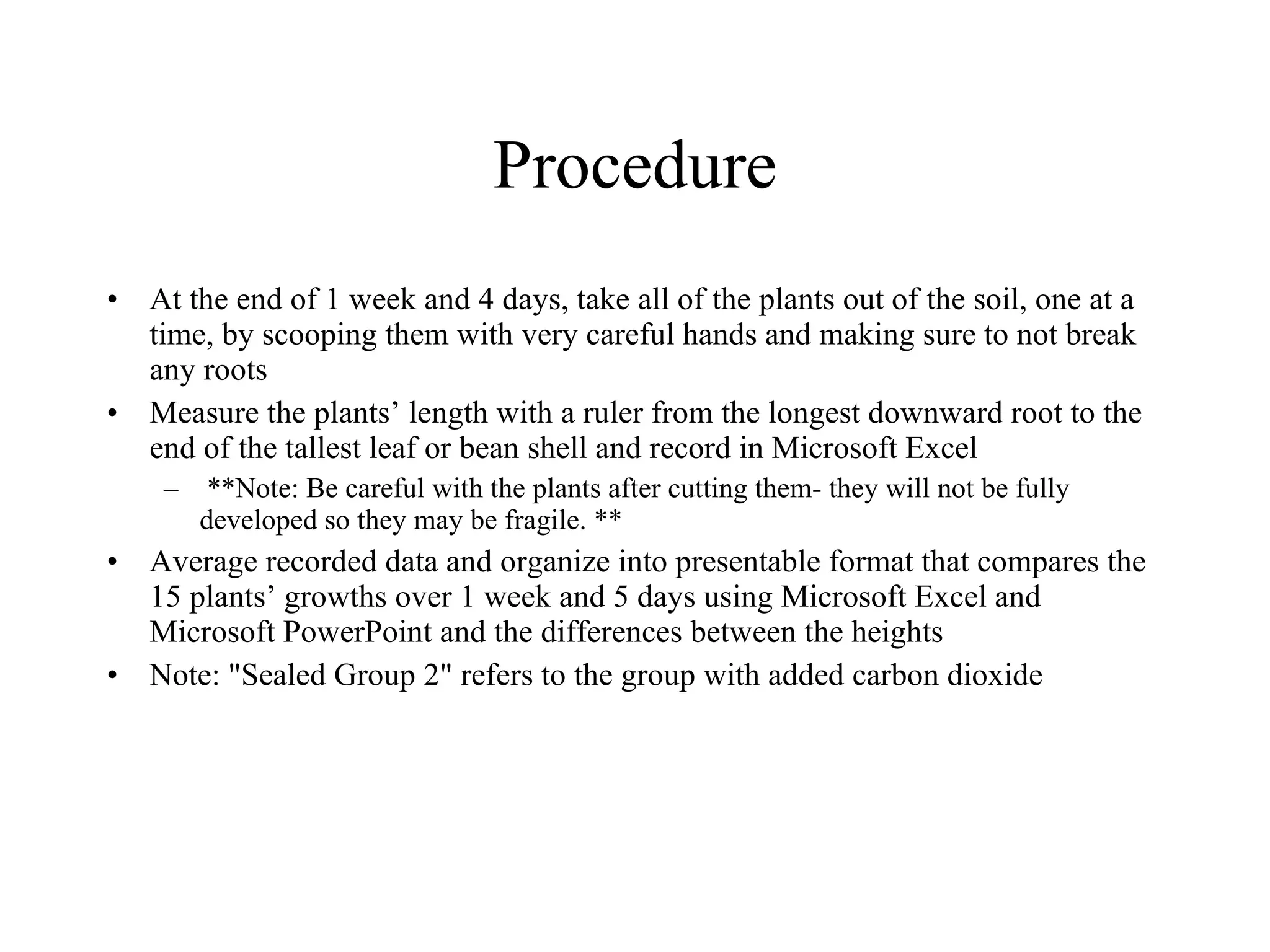
Images of the Experiment


Step 5: Materials       Step 3: Materials, 
to make holes in        including growing 
the tops of the         rods and beans
containers


 Steps 9 and 16: 
                        Step 5: A hole 
 Six finished 
                        made by the 
 plants
                        manual drill
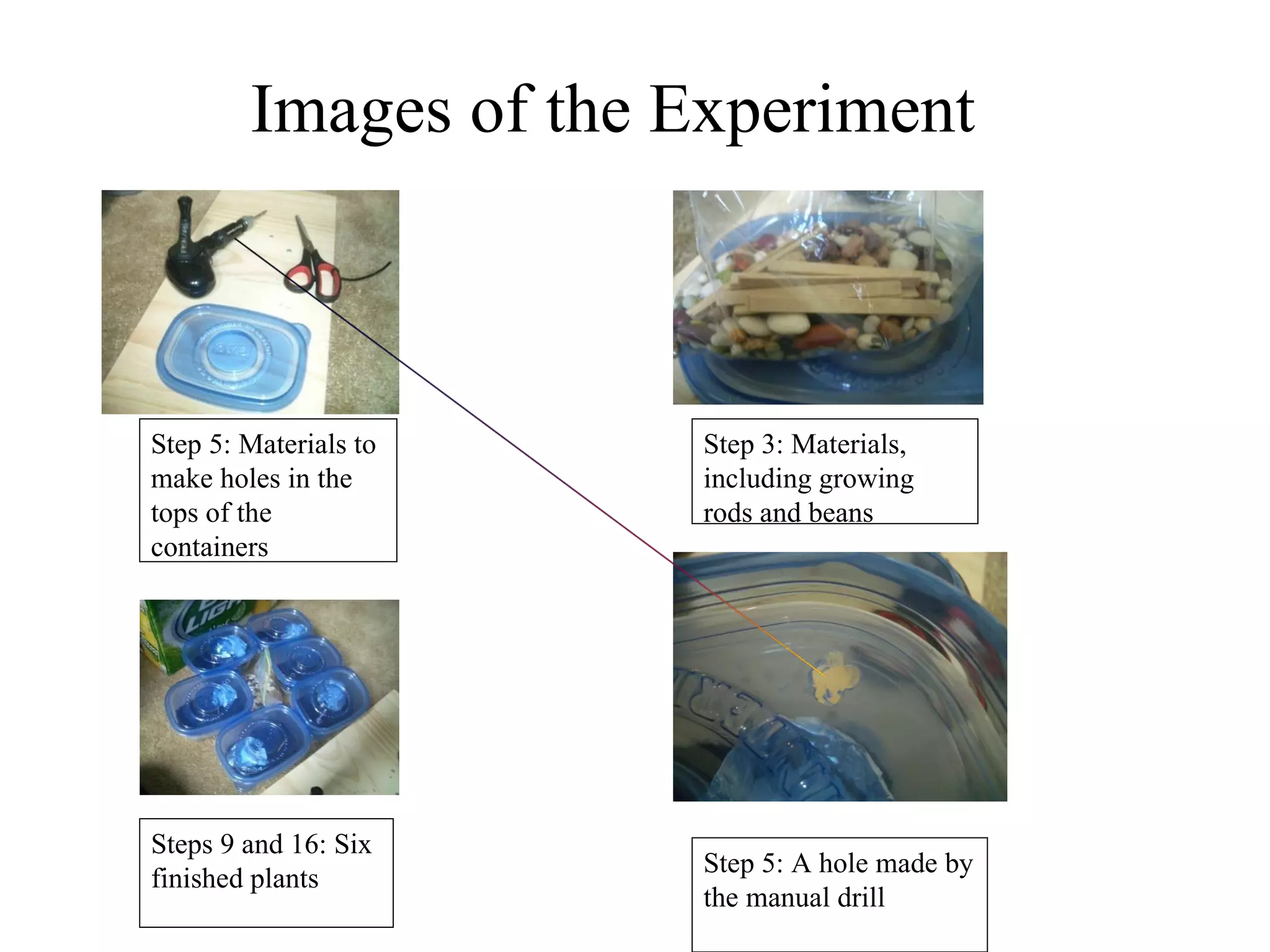
Pictures


   Step 3: A                             Step 1: Beans 
   completely set up                     in "Pre-
   Control Group                         Germination" 
   Plant                                 Stage


                                        Step 18: Roots of 
Step 18 Plant B of Sealed 
                                        Plant B of Group 2
Group 1
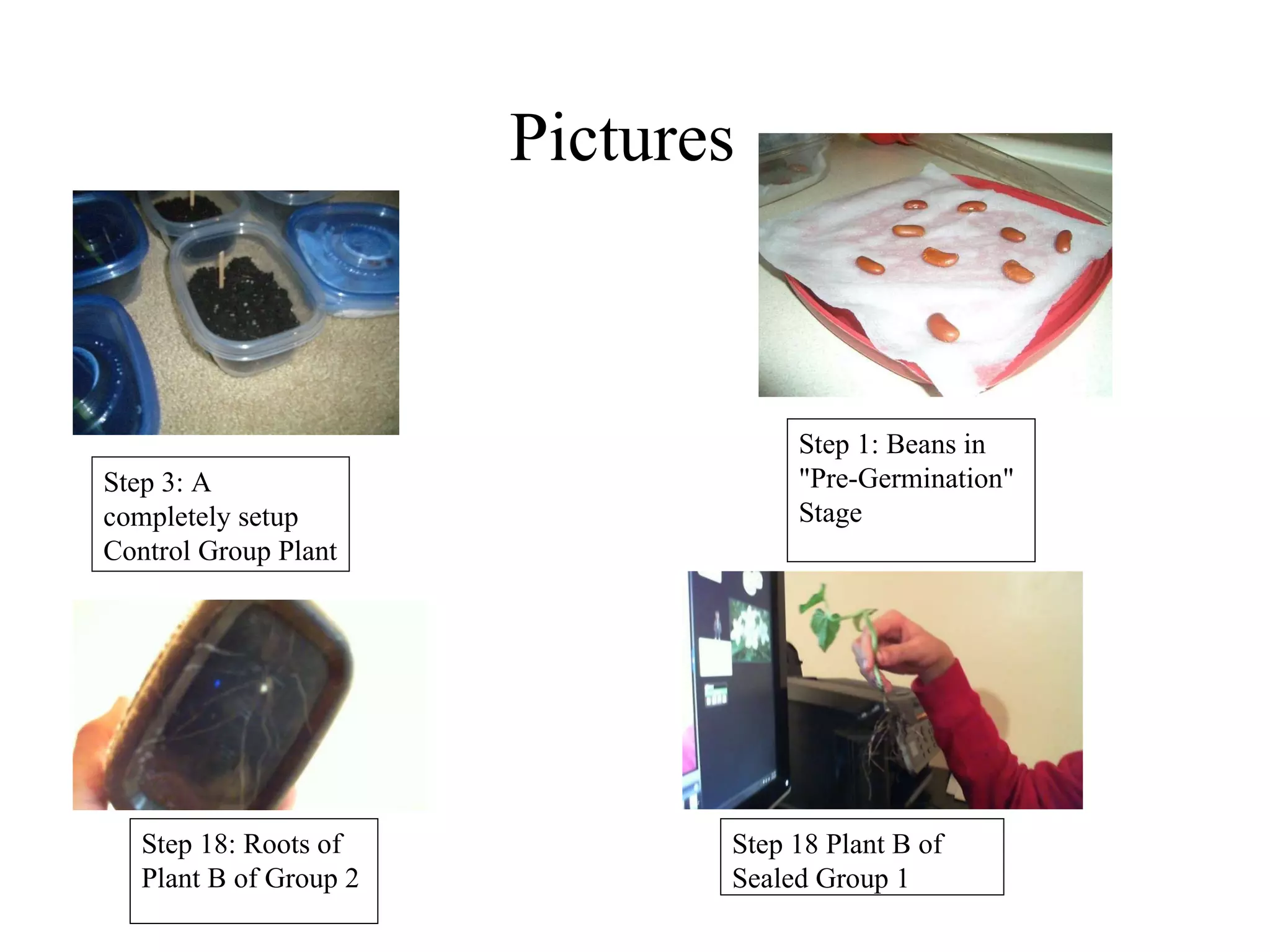
Pictures


Step 18:                Step 18:
Plant C of the          Plant A of the
Sealed Group            Sealed Group
2                       2
Data: Control Group (in centimeters)


     Plant A    Plant B       Plant C    Plant D       Plant E
           13             2       13.5             2             9
Data: Sealed Group 1 


Plant A Plant B Plant C Plant D Plant E Average
    3.5    23.5     20        0      0      9.4
Data: Sealed Group 2


Plant A Plant B Plant C Plant D Plant E Average
   21.5    26.4    23.2       0      0    14.22
Data: Averages


Control Group Sealed Group 1 Sealed Group 2
  Average        Average        Average
           7.9           9.4          14.22
Conclusion: Data and Summary

 he experiment, “A Contained Atmosphere,” reached 
 its conclusion on January 14, 2012. 


 fter the preparations at the beginning of the 
 experiment, it was very uneventful. 


     After the plants were measured, the subject group 
 with the greatest growths and average growth were 
 from Sealed Group 2. 
Conclusion: Controls
• This experiment was valid due to the following 
  controlled variables:
• Soil Source: All soil was of the same brand
• Water Source: All water came from the same tap 
  and was evenly distributed
• Soil Amount: Each plant was in the same amount 
  of soil
Conclusion: Anomalies
• This experiment was valid even though there were several 
flaws, including: 
   -overwatering 
   -equal sunlight availability to all of the plants
   - All of the plastic dishes were the same brand model
Conclusion: Future Improvements
•    In the future, I could use heat lamps to more evenly 
distribute solar energy to the plants

•    Also, more accurate measuring devices could have 
been used to evenly distribute water

•The plants’ mass could have been measured as well as 
their height 
Future
•  This experiment could possibly help greenhouse 
  operators grow their plants faster.

• This experiment’s data could improve existing 
  space air-purifying rooms
Thank you for your time. 
Are there any questions?

A contained atmosphere ppt