PUBLIC
A CMOS 79GHz PMCW Radar SoC
Jan Craninckx
Abstract
▪ High-performance, small form factor millimeter-wave radar systems are
key enablers for the new smart society. Application for automotive
driver assistance and even autonomous cars is obvious, but also many
other systems like vital signs monitoring, gesture recognition, self-guided
drones, etc are envisioned.
▪ The research presented in this talk investigates the use of nanoscale
CMOS technology for 79GHz radar systems, which will be a key
enabler to open up this market for cost-effective high-volume
production, and allows integration of large digital processing in the same
System-on-Chip. A new concept of phase-modulated radar detection is
also introduced that blends perfectly with the integration capabilities of
CMOS.
2
Why mmWave radars?
mmWave Sensors are Extremely Robust
snow & rain smoke
fog
dust
heat
lighting dirt
noise &
vibration
4
mmWave Sensors are Fully Sealed and Invisibly Mounted
perfect aesthetics
discreet monitoring
privacy
5
Radar
evolution
fixed
mobile
automotive today
79 GHz radar SoC module
140 GHz antenna-on-chip systems?
yesterday
tomorrow
6
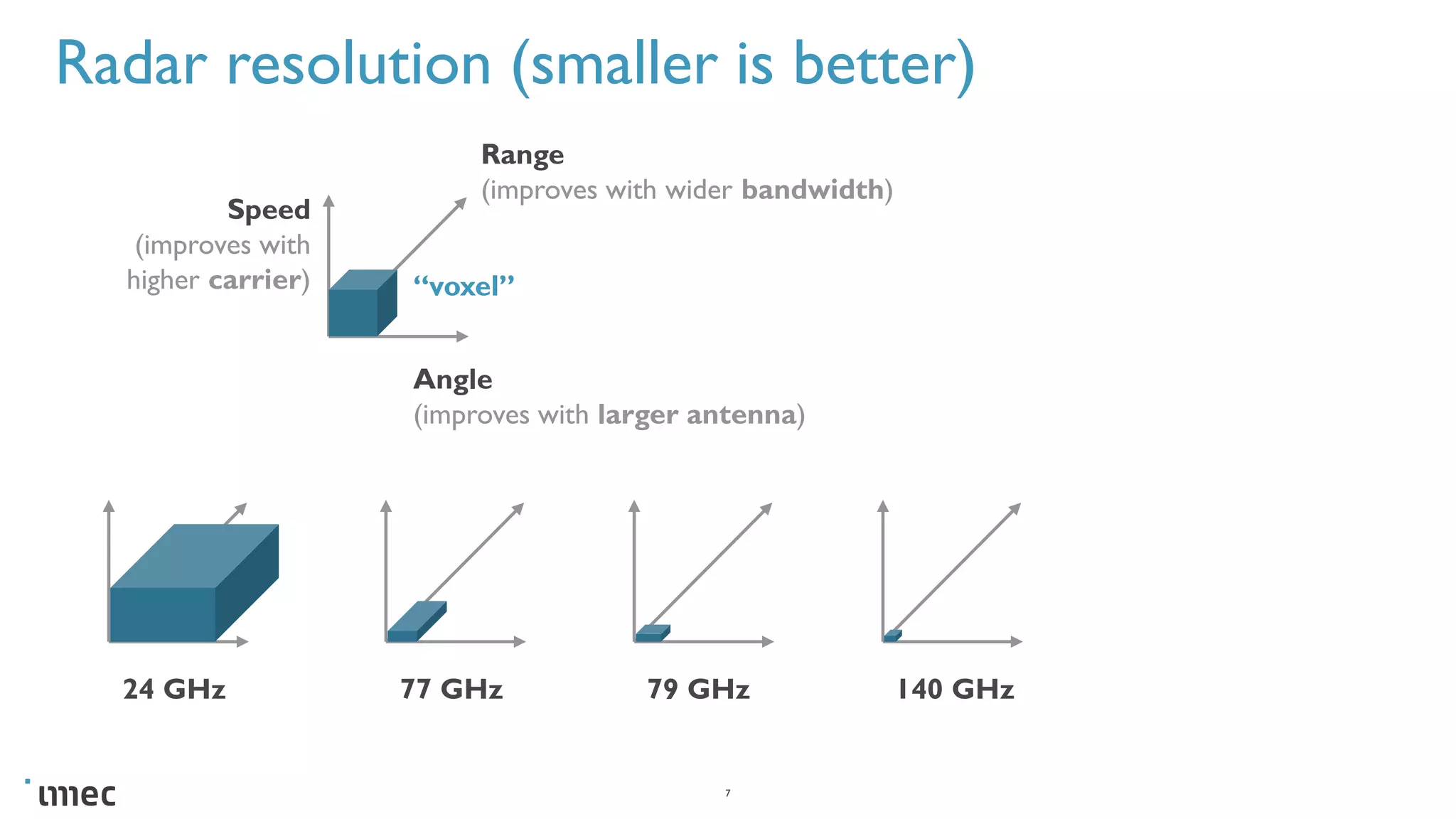
Speed
(improves with
higher carrier)
Angle
(improves with larger antenna)
Range
(improves with wider bandwidth)
Radar resolution (smaller is better)
“voxel”
24 GHz 77 GHz 79 GHz 140 GHz
7
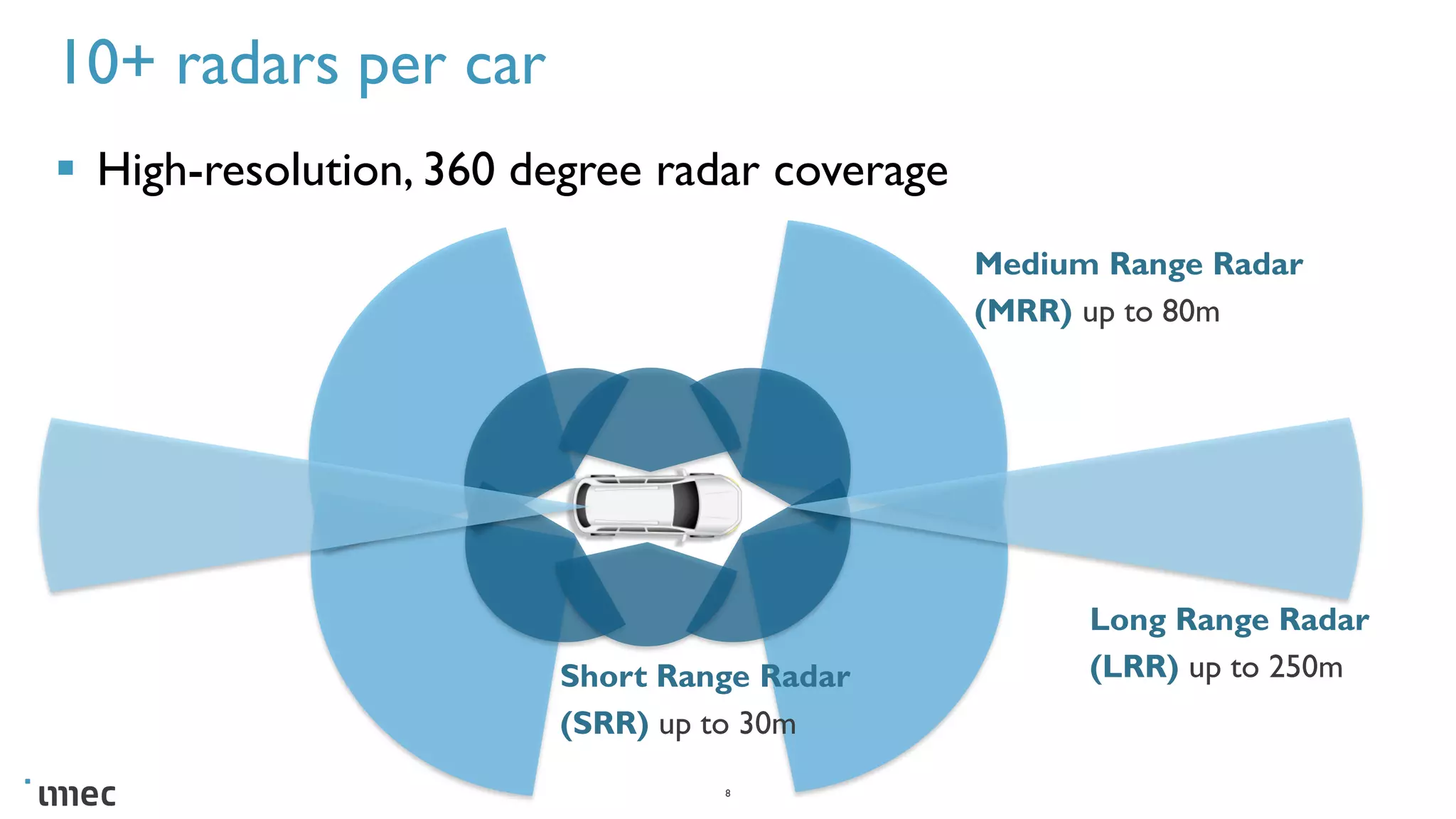
10+ radars per car
▪ High-resolution, 360 degree radar coverage
Medium Range Radar
(MRR) up to 80m
Short Range Radar
(SRR) up to 30m
Long Range Radar
(LRR) up to 250m
8
79 GHz PMCW Radar System
New Paradigm: mmWave CMOS Radar-on-Chip
leveraging standard foundry technology
high resolution – low power – low cost – small size
10
Waveform Possibilities
11
HPF LPF
TX
RX
(spillover
cancellation,
RMIN limit)
(RMAX limit)
PA
LNA
Fast chirp
Fast-time
FFT
Slow-time
FFT
ADC
Range-
Doppler
map
In-phase
mixer Range
processing
FMCW
Doppler
processing
LPF ADC
TX
RX
PA
LNA
Binary sequence
LO
Correlator
bank
Slow-time
FFT
Bi-phase
mod
Range-
Doppler
map
I,Q
Quadrature
mixer
PMCW
Range
processing
Doppler
processing
VCO/PLL
High Level Comparison: PMCW vs FMCW
12
PMCW FMCW
Ambiguity function, sidelobes +
Sensitivity to phase noise, flicker noise +
ADC resolution +
ADC speed / IF bandwidth +++
PSD +
Sensitivity to interference +/-
TX orthogonality for MIMO +
Communications capability ++
Industrial acceptance +++
easier market entry / limited IP and patents ++
PMCW Radar Operating Principle
Target
Distance D
79 GHz LO
m Correlations (multiplication and integration)
∫
∫
∫
∫
∫
0
0
0
0
G * m
∫0
∫0
m Tchip
Tchip
Target at
D = (4 * Tchip * C) / 2
C = speed of light in air
G = Path Loss
TX
RX
2 Gbps
13
... andTX-to-RX Spillover
Target
79 GHz LO
m Correlations (multiplication and integration)
∫
∫
∫
∫
∫
S * m
0
0
0
G * m
∫0
∫0
m Tchip
Tchip
Target at
D = (4 * Tchip * C) / 2
C = speed of light in air
G = Path Loss
TX
RX
TX-to-RX
spillover
Spillover produces a large
response for 0 delay
2 Gbps
14
Range Bins c
R
T
2

Time / Doppler
PMCW Radar System
Radar IC
Accumulations
 improve SNR
FFTs
 determine the frequency
shift of every range bin  the
speed of the object found on
that range bin (Doppler)
Also improves SNR
Correlations with delayed
version of the PN sequence 
Determine the delay T  the
position R
15
System
design
IC
design
Module
& antennas
Validation &
demonstration
System design, Implementation andVerification
16
System design
17
Matlab chain
PMCW Radar-on-Chip: SISO Block Diagram
Lc parallel
Integrate Lc
pulses
Accumulate
M pulses
PRN code
ADC N-point DFT
Lc parallel paths Lc parallel Lc parallel
CFAR
detection
-
DoA
estimation
-
Tracking
S
PRN code
antennas
RF
ADCs
High-speed digital front-end Reconfigurable digital baseband
TC  Range resolution
LC  Ambiguous range
M  Ambiguous speed
N  Speed resolution
18
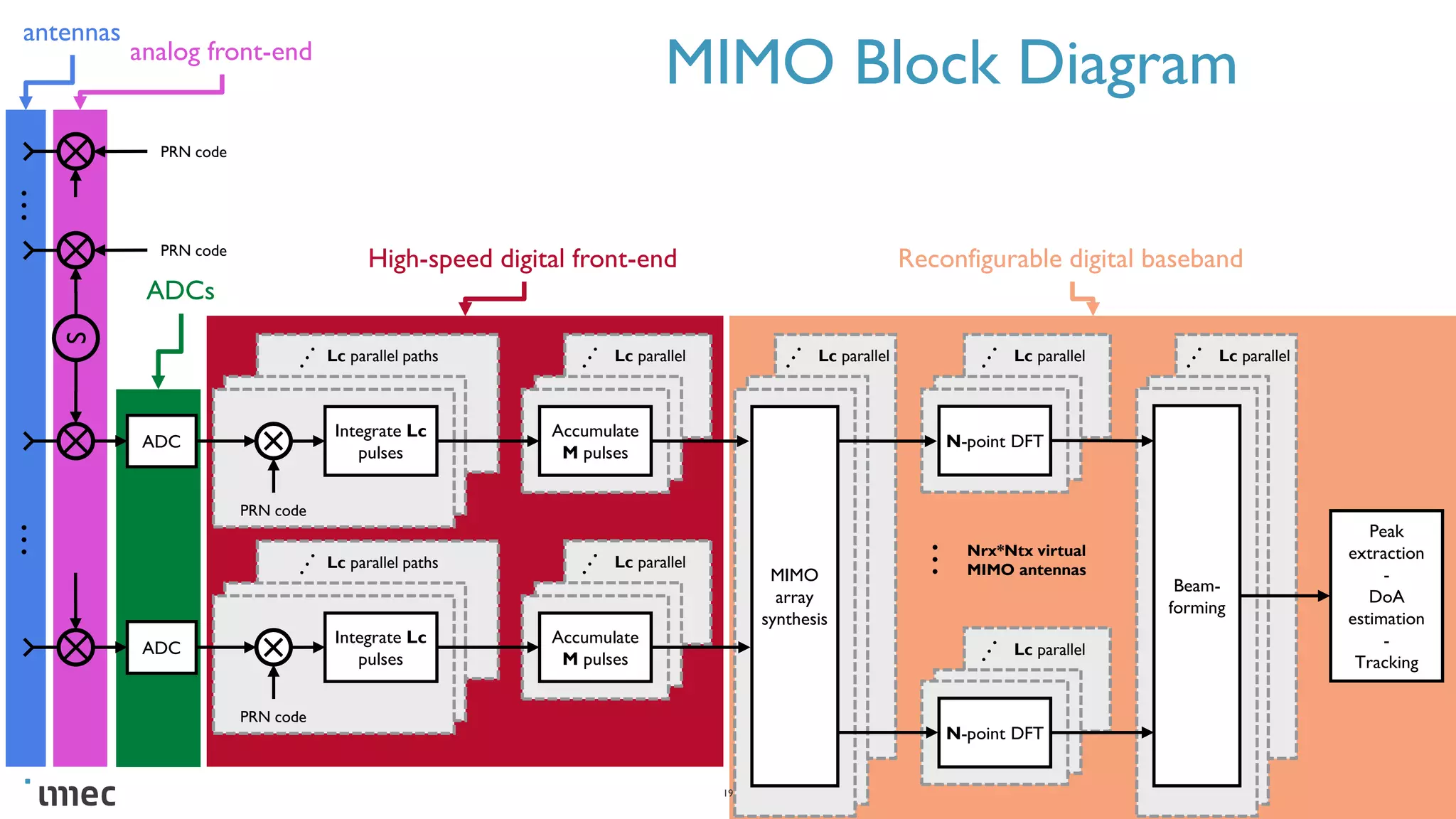
MIMO Block Diagram
Lc parallel
Lc parallel
Lc parallel
Lc parallel paths
Integrate Lc
pulses
Accumulate
M pulses
PRN code
ADC
Integrate Lc
pulses
Accumulate
M pulses
N-point DFT
PRN code
ADC
Beam-
forming
...
N-point DFT
MIMO
array
synthesis
Lc parallel paths Lc parallel Lc parallel
...
Nrx*Ntx virtual
MIMO antennasLc parallel
Peak
extraction
-
DoA
estimation
-
Tracking
S
PRN code
...
PRN code
antennas
analog front-end
ADCs
High-speed digital front-end Reconfigurable digital baseband
19
IC – Module - Platform
IC module platform
integrated circuit
containing the core
functionality
carrier containing antennas
and mounted ICs,
similar form factor to product
carrier containing module, components
and connectors, complemented with
computation component (PC, FPGA or
similar) for demonstration
20
SOC Implementation
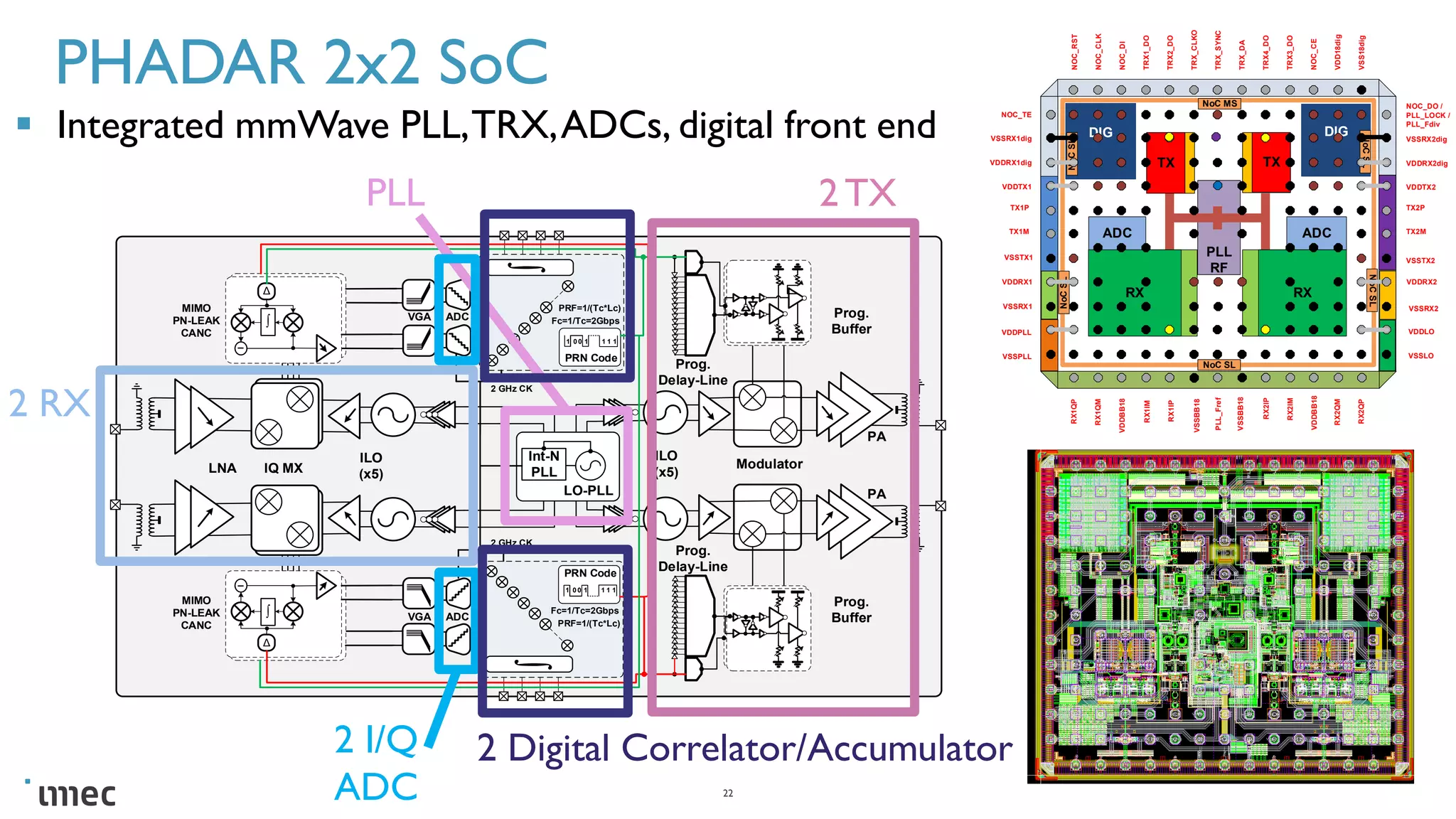
PHADAR 2x2 SoC
▪ Integrated mmWave PLL,TRX,ADCs, digital front end
∫
Δ
IQ MXLNA
ILO
(x5)
MIMO
PN-LEAK
CANC
∫
Δ
MIMO
PN-LEAK
CANC
ILO
(x5)
Modulator
PA
Prog.
Buffer
Prog.
Delay-Line
PA
Prog.
Buffer
Prog.
Delay-Line
Int-N
PLL
LO-PLL
PRF=1/(Tc*Lc)
Fc=1/Tc=2Gbps
∫
1 0 0 1 1 1 1
PRN Code
PRF=1/(Tc*Lc)
Fc=1/Tc=2Gbps
∫
1 0 0 1 1 1 1
PRN Code
2 GHz CK
2 GHz CK
VGA ADC
VGA ADC
PLL
RF
NoC MS
ADC
DIGDIG
RX RX
TXTXTX
RXRX
TX
RX1IP
RX1QM
RX1IM
RX1QP
NOC_DO /
PLL_LOCK /
PLL_Fdiv
NOC_DI
NOC_TE
NOC_RST
NOC_CLK
PLL_Fref
VDDRX1dig
VDDBB18
VSSBB18
NOC_CE
ADC
VDDBB18
TRX1_DO
VDD18dig
TRX2_DO
VDDTX2VDDTX1
VDDLOVDDPLL
VSSTX1 VSSTX2
VSSRX2
VDDRX2
TRX_CLKO
VSS18dig
VSSPLL VSSLO
VSSRX1
VDDRX1
RX2QP
RX2IM
RX2QM
RX2IPTRX4_DO
TRX3_DO
VDDRX2dig
VSSRX1dig
NoCSL
NoCSL
NoCSL
NoCSL
NoC SL
TRX_DA
VSSRX2dig
TRX_SYNC
TX1P
TX1M
TX2P
TX2M
VSSBB18
2 RX
PLL 2TX
2 I/Q
ADC
2 Digital Correlator/Accumulator
22
LO Architecture: 5x ILO
▪ A 5th Subharmonic, Inverter-Based Injection Locked Oscillator
▪ Avoid frequency distribution at 79GHz across the IC
▪ Frequency multiplication
▪ Harmonic based multipliers
▪ Wide functional range, but less damping at ω0/N
▪ Injection locked oscillators
▪ Oscillator must be locked
▪ 3X or 5X?
▪ 3X locks easier, but PLL @26.333 GHz
▪ 5X is only 15.8GHz PLL and frequency distribution
▪ Needs lots of 5th order distortion generation
▪ Inverters!
23
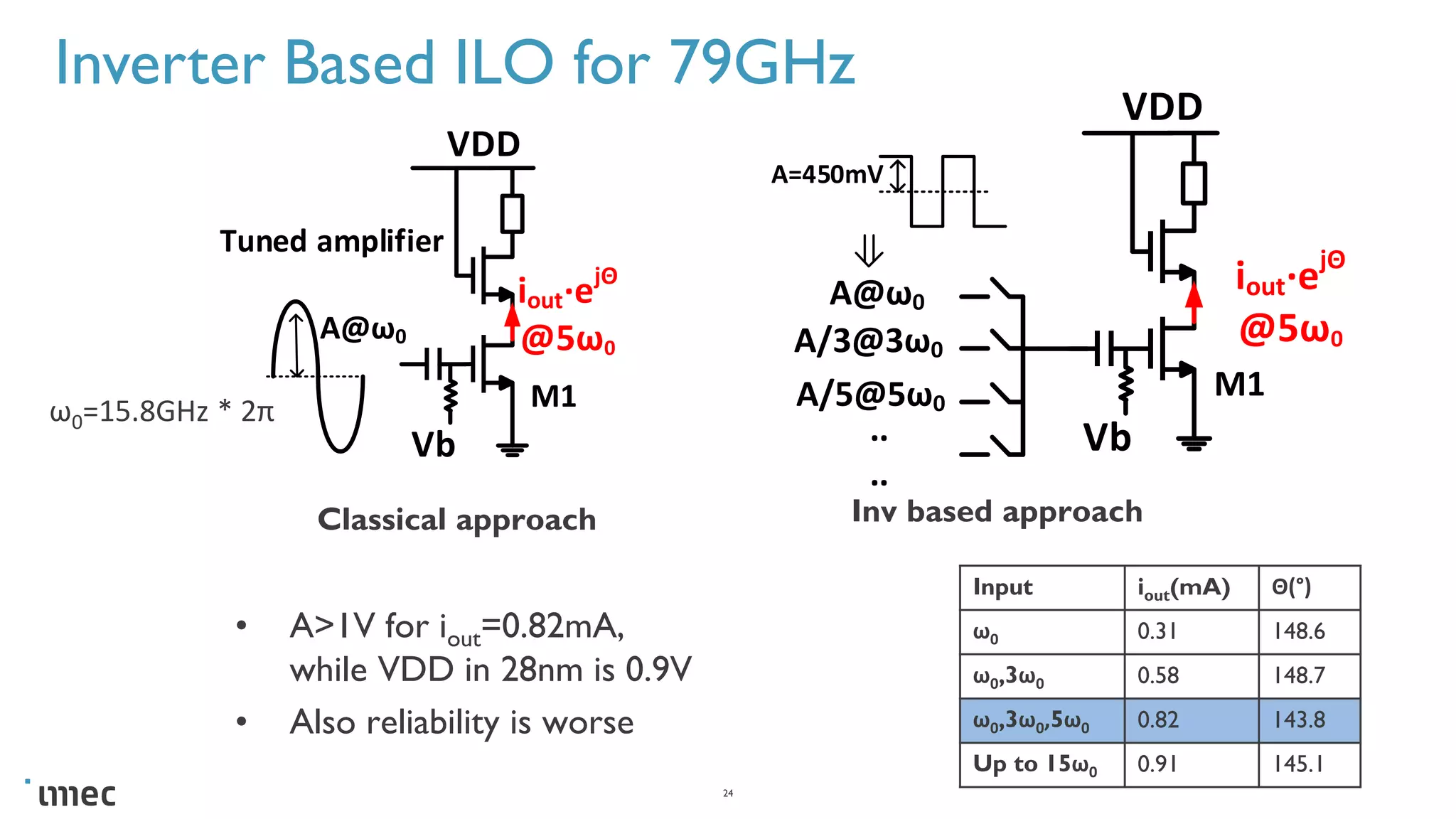
Inverter Based ILO for 79GHz
Vb
VDD
A@ω0
A/3@3ω0
A/5@5ω0
..
..
M1
A=450mV
iout∙ejΘ
@5ω0
Input iout(mA) Θ(°)
ω0 0.31 148.6
ω0,3ω0 0.58 148.7
ω0,3ω0,5ω0 0.82 143.8
Up to 15ω0 0.91 145.1
• A>1V for iout=0.82mA,
while VDD in 28nm is 0.9V
• Also reliability is worse
Classical approach Inv based approach
Vb
VDD
Tuned amplifier
M1
iout∙ejΘ
@5ω0
A@ω0
ω0=15.8GHz * 2π
24
Implementation
▪ Inverter chain
▪ WP/WN ratio is adjusted to have
50-50 duty cycle.
▪ Oscillator core
▪ VDC2 used to enhance self
resonance
2 2 3
20K
12um
9um
16um
13.5um
Lmos=35nm
3
VDCVDC VDC2
Vinj+
Vinj-
VCO+ VCO-
M1 M2
[3:0]
M1:M2=5:1
Qind=15 Qvar=8.5~20
Slice 25
Measurements
26
0 5 10 15
74
76
78
80
82
84
Varactor bits
OscillationFrequency(GHz)
79 ± 2GHz
8GHz Free-running Tuning Range
70 72 74 76 78 80 82 84
-7
-6
-5
-4
-3
-2
-1
Frequency (GHz)
InputPower(dBm)
VDC2=0.55 V
VDC2=0 V
10GHz Locking Tange
10
4
10
6
10
8
-140
-130
-120
-110
-100
-90
-80
-70
-60
Offset Frequency (Hz)
PhaseNoise(dBc/Hz)
SMR40@15.8GHz
ILO@79GHz
14dB±1dB
Locked Phase Noise
I+
I-
Q+
Q-
Cartesian combiner
Combiner
LP
F
Div/8
25MHz
To Dig/ADC
PFD/C
P
Div/N
(79)
Ibias,I Ibias,Q
2-stage PPF
Subsamplig
PLL
Tx_ILO
Rx_QILO Rx_QILO
Tx_ILO
SS-
PD
Gm
CP-PLL
15.8GHz VCO
Combiner
TX
In-Phase
ILOs
Integer-N PLL
VCO @
15.8 GHz
15.8 GHz distribution
PLL and LO Distribution
Poly-phase
filters
generate
quadrature
RX
QILOs
PPF for
quadrature
phase shifters
27
Antenna Path Details
Sub-harmonic Injection Locked Oscillators
multiply the PLL frequency by 5
Digital Core
TransmitterRX Front-End
Analog BB and
ADCs
TX-to-RX Spillover
cancellation
Transmitter side-lobe
suppression
28
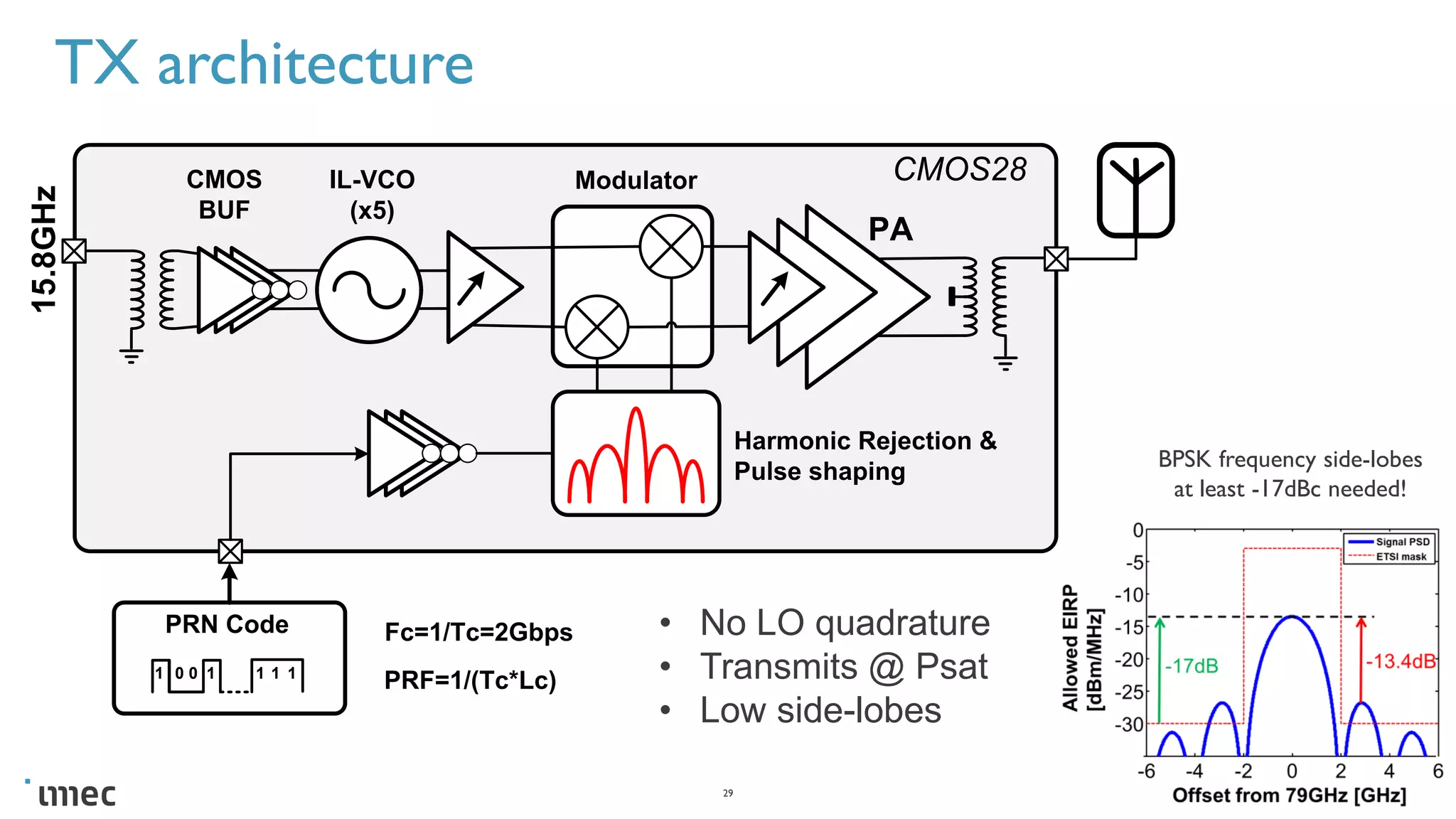
TX architecture
1 0 0 1 1 1 1
PRF=1/(Tc*Lc)
PRN Code Fc=1/Tc=2Gbps
CMOS
BUF
IL-VCO
(x5)
Modulator
PA
Harmonic Rejection &
Pulse shaping
15.8GHz
CMOS28
• No LO quadrature
• Transmits @ Psat
• Low side-lobes
BPSK frequency side-lobes
at least -17dBc needed!
29
79GHz Phase-Modulator
1 0 0 1 0 1 .. Lc
PRN Code
generator
79GHz
LO
79 8177 GHz
Linear BB
X
Non-linear LO
Linear LO
X
Non-linear BB
79GHz
LO
PRN Code
generator
1 0 0 1 0 1 .. Lc
• Lower 79GHz swing
• More power efficient
79GHz
LO
PRN Code
generator
1 0 0 1 0 1 .. Lc
79 8177 GHz
30
TX Sidelobe Reduction by Harmonic Rejection
79GHz
LO
PRN Code
generator
Σ
ΔDelay
Tc/3
1
1
1 0 0 1 0 1 .. Lc
Tc=1/Fc
79 8177 GHz
Most effective side-lobe
rejection @ lowest cost
31
79GHz Modulator and PA: Schematic Detail
VDD
VSMX
0
180
60
240VDD
LOp
LOm
MPA
MPA
CnPA
VDD
CnPA
VGPA
3-stage PA
Gain
Tuner Balun
HR3
Mixer
Prog. Buffer
BBin Prog.
Delay-Line
BBin
0°
60°
180°
240°
MMX
32
VGA
VDD
RL
RS
ADC
Buffer
Output
Buffer
To IO
Pads
ADCs
VBIAS
Mixer
LO+ LO-LO-
VDD
VDD
k
I and Q
k
VDD
VBIAS
k
7bits
Vout
VDD
Vin
VB
Vin
Vin
Vout
Receiver Implementation
Gilbert cell
mixer
2dB Gain
2-stage LNA
18dB Gain
VGA stage
≈ 3 → 10.5 dB
in 7 steps
ADC driver
≈-2dB gain
33
RX Spillover Cancellation
LNA OUT
VDD
VDD
Mix
OUT
Correlation
(multiplication with the TX sequence and integration)
Mixer
LO+ LO-LO-
C
C
R
R
BB
WP
WM
BB
BB BB
C2C2
BB
BB
BB Weighted copy of BB injected at the
mixer outputs to cancel the spillover
In steady state the mixer output is uncorrelated with the TX BB sequence:
the spillover is cancelled!
Digital Core Block Diagram
▪ Digital core generates the sequence and performs correlation and
accumulation of the ADC samples
m’[k]
D<6:0>
(from ADC)
To TX
Out
interface
Correlator (Lc) Accumulator (M)
CK gen
CK (1.975 GHz)
Data Out
I and Q
CK CK/4
CK/<prog>
18 29
7
1
1+1
Clock Out
Data Available
TRX Sync
Other antenna path35
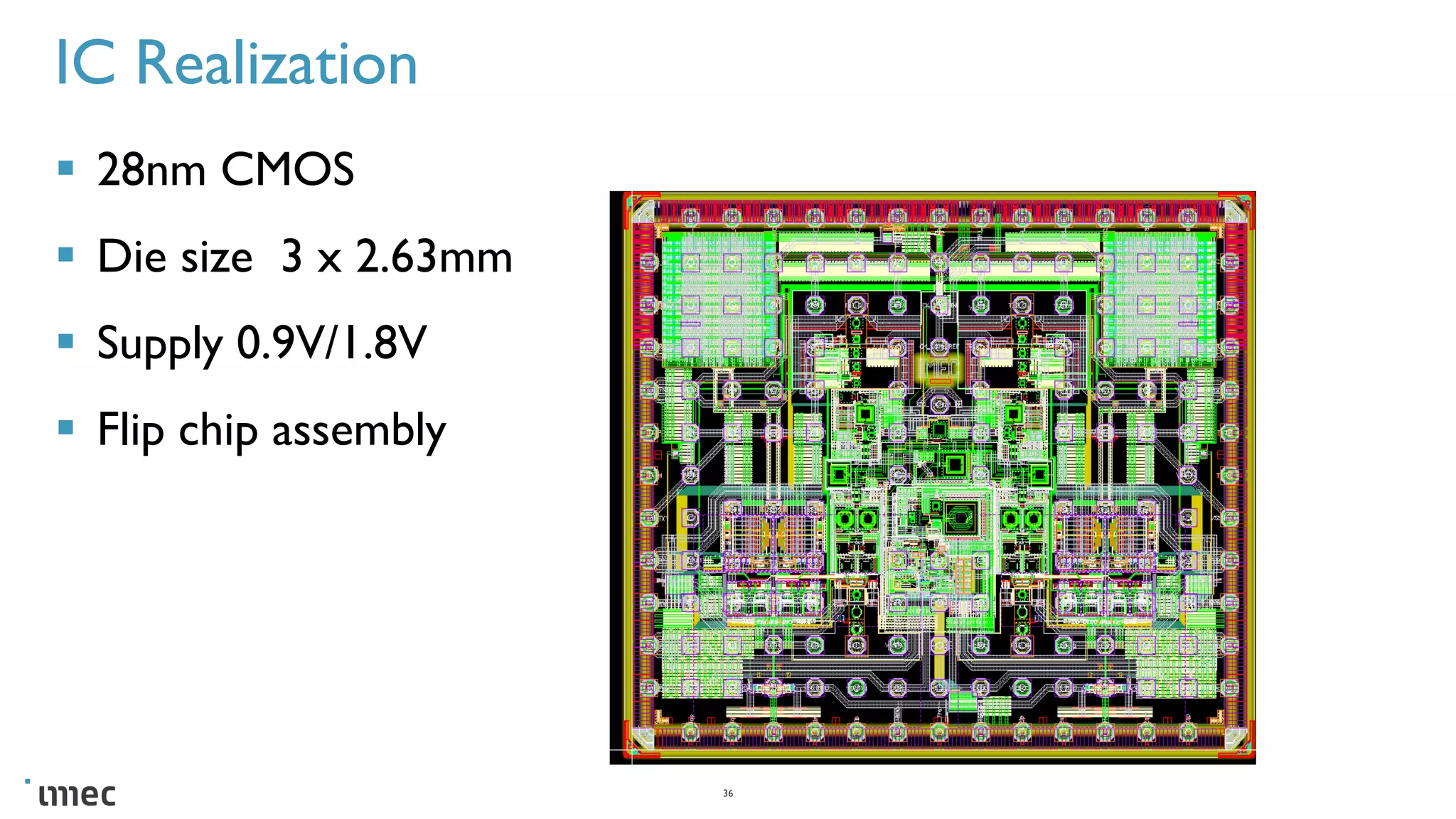
IC Realization
▪ 28nm CMOS
▪ Die size 3 x 2.63mm
▪ Supply 0.9V/1.8V
▪ Flip chip assembly
36
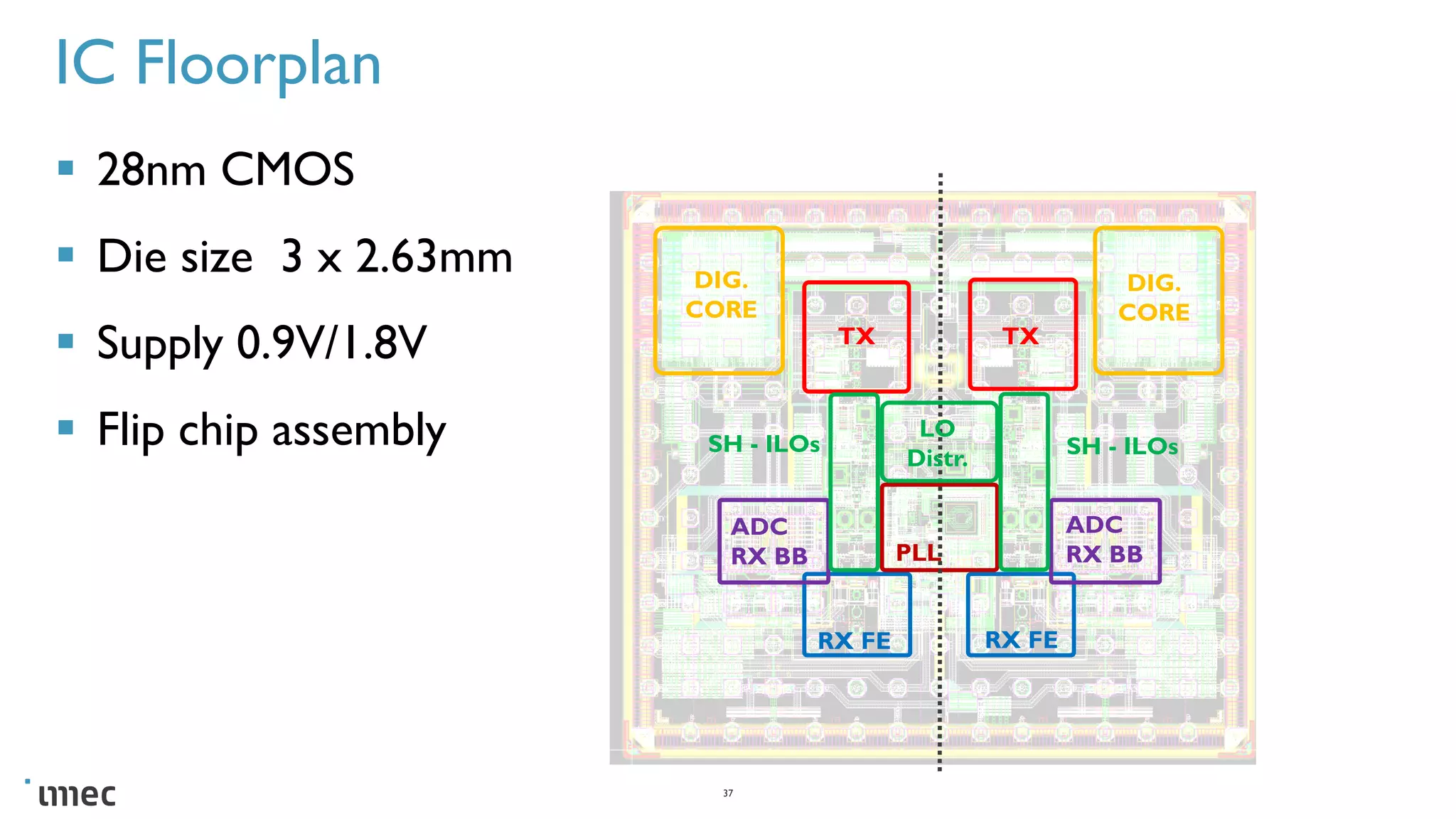
IC Floorplan
▪ 28nm CMOS
▪ Die size 3 x 2.63mm
▪ Supply 0.9V/1.8V
▪ Flip chip assembly
PLL
RX FE RX FE
ADC
RX BB
ADC
RX BB
TX TX
DIG.
CORE
DIG.
CORE
SH - ILOs SH - ILOs
LO
Distr.
37
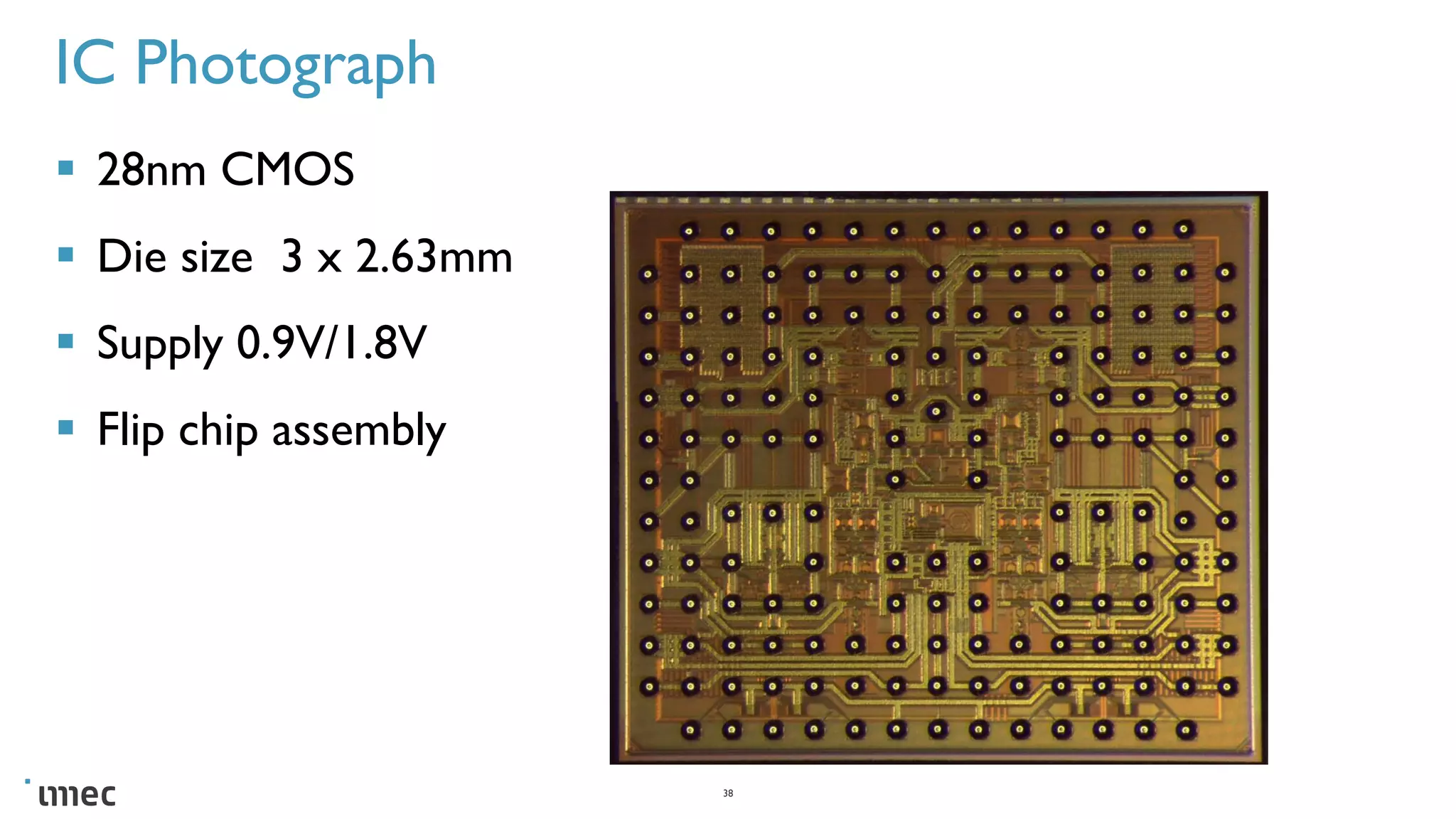
IC Photograph
▪ 28nm CMOS
▪ Die size 3 x 2.63mm
▪ Supply 0.9V/1.8V
▪ Flip chip assembly
38
PLL Measurements
▪ 25 MHz reference
▪ 16GHz VCO
▪ VCO only Phase Noise
-116 dBc/Hz @ 10 MHz
▪ 2GHz VCO tuning range
corresponding to 78 to
88 GHz at TX output
▪ 79GHz ILO
▪ -107dBc/Hz @ 10 MHz
CP-PLL = Charge Pump PLL SS-PLL = Sub-Sampling PLL
Measured at 79 GHz with R&S FS-Z90 and FSU and Agilent E5052 Signal Analyzer
39
A
EXTM IX ERef -17 dBm
EXT
1 GHz/Center 80 GHz Span 10 GHz
3DB
RBW 3 MHz
VBW 10 MHz
SWT 60 ms
2 AP
CLRWR
1 AP
VIEW
-110
-100
-90
-80
-70
-60
-50
-40
-30
-20
1
Marker 1 [T1 ]
-48.05 dBm
79.839743590 GHz
Date: 15.DEC.2015 15:19:49
Transmitter Measurements
▪ Pout > 10dBm
▪ 4 GHz BW
4 GHz BW
BPSK
SideLobe Supp
Measured with SAGE E band WR12 horn antenna, R&S FS-Z90 and FSU
40
Receiver Measurements
▪ NF < 12dB @ 1 GHz
▪ Including module input
transition
▪ More than 30dB gain
control in VGA
▪ BW > 1 GHz
Measured with NOISE COM 5112 and R&S FSU on a dedicated module with GSG pads instead of antennas
Base Band Analog output before the ADC measured
41
Indoor Antenna Module and Evaluation Board
2 dies on the
back of the
module
Antennas on the
front
Panasonic MegTron6® 42
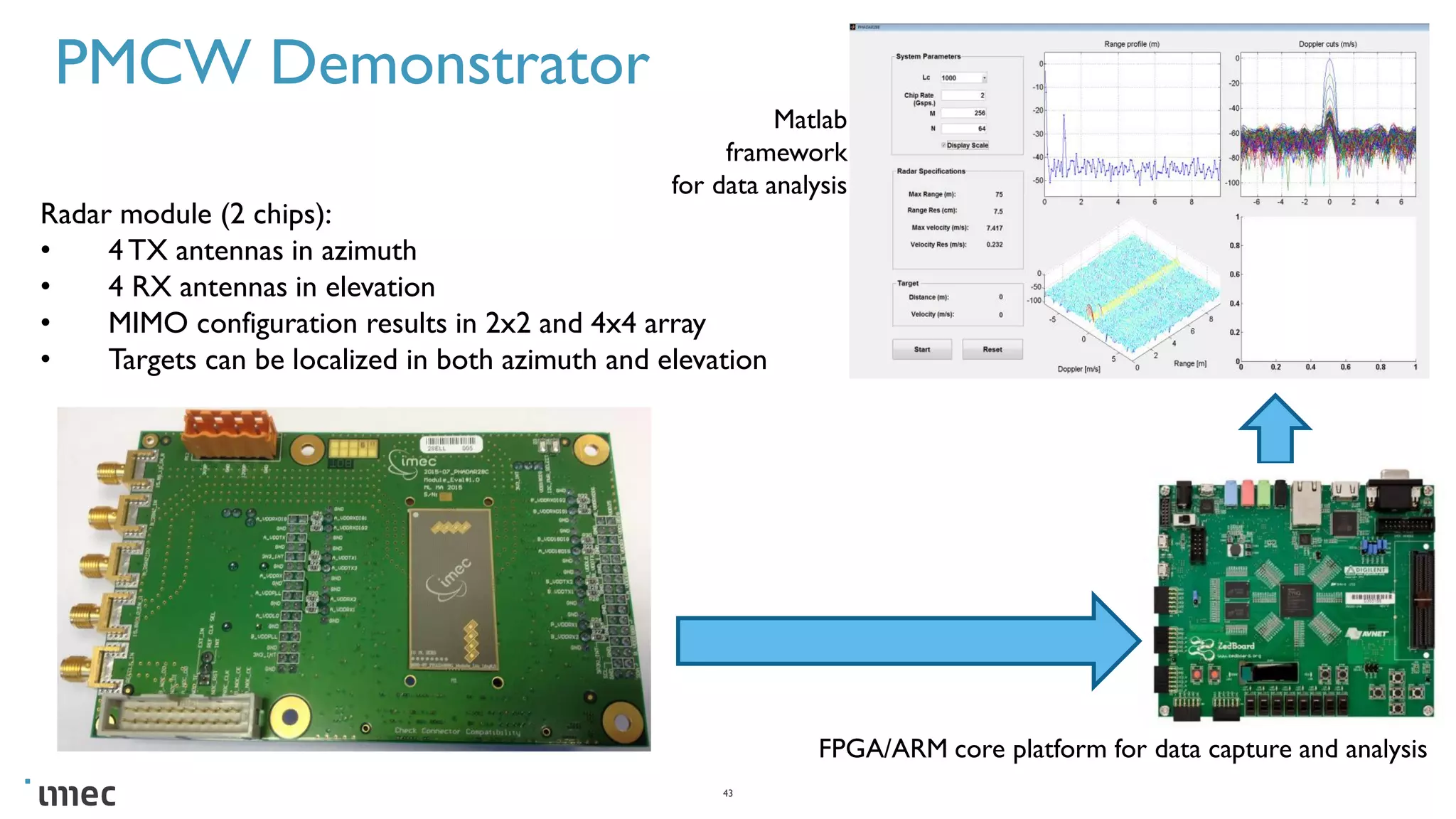
PMCW Demonstrator
Matlab
framework
for data analysis
FPGA/ARM core platform for data capture and analysis
Radar module (2 chips):
• 4TX antennas in azimuth
• 4 RX antennas in elevation
• MIMO configuration results in 2x2 and 4x4 array
• Targets can be localized in both azimuth and elevation
43
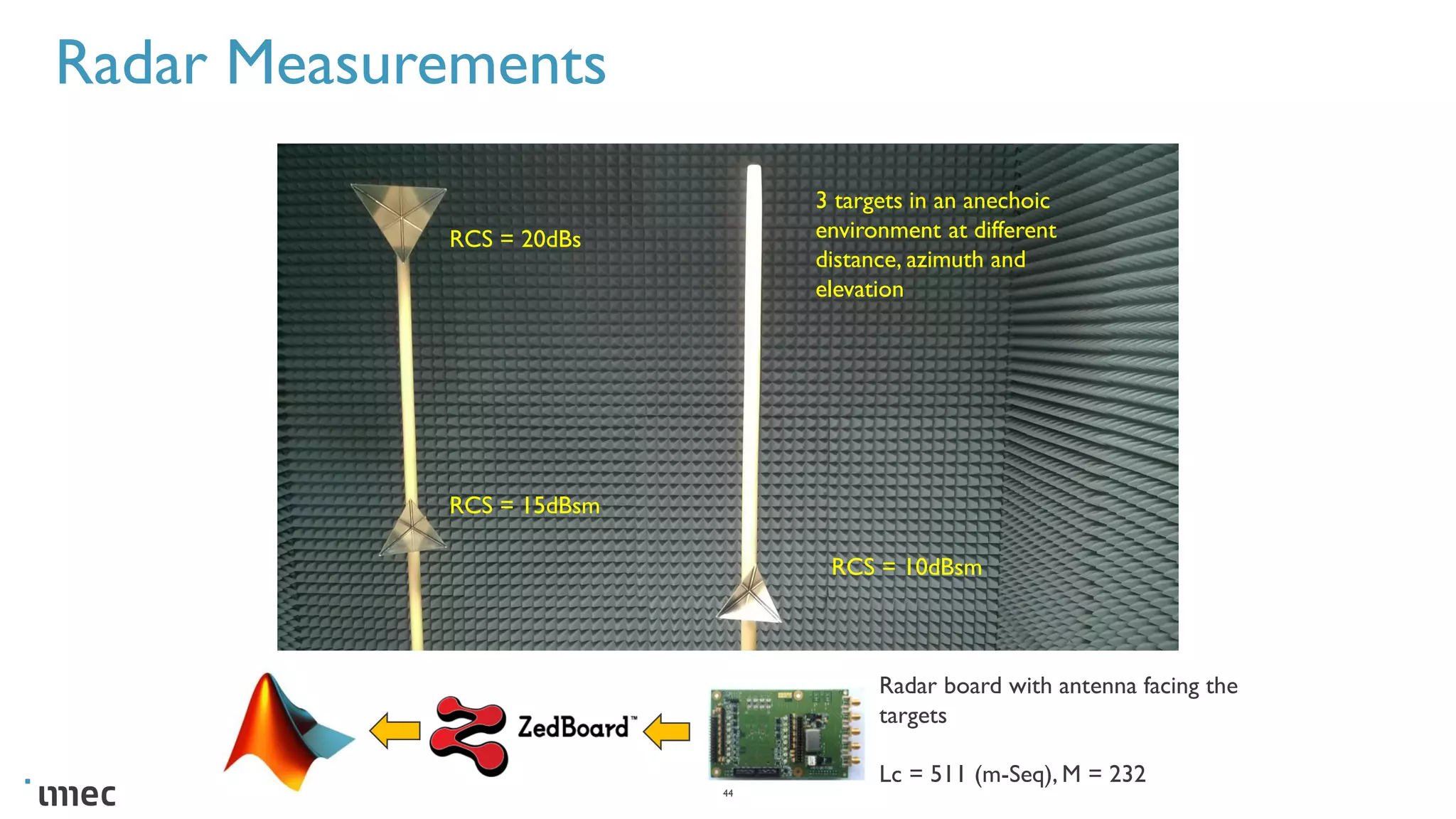
Radar Measurements
3 targets in an anechoic
environment at different
distance, azimuth and
elevation
RCS = 20dBs
RCS = 15dBsm
RCS = 10dBsm
Radar board with antenna facing the
targets
Lc = 511 (m-Seq), M = 232
44
Range & Speed Measurements
45
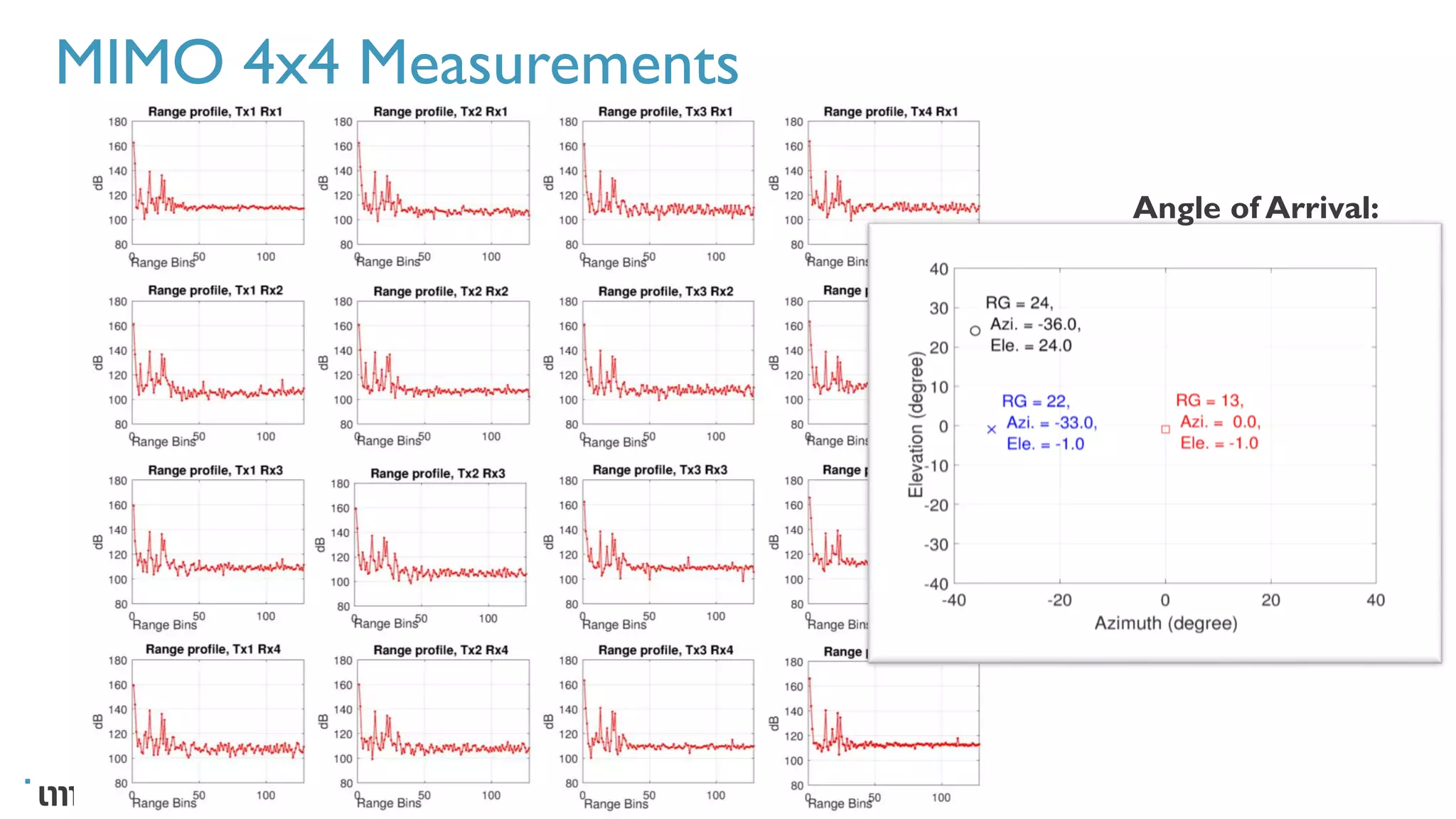
MIMO 4x4 Measurements
46
Angle of Arrival:
Conclusions
▪ CMOS Radar SoCs area key building block for next-generation (self-
driving) cars
▪ And smart homes, buildings, things, etc.
▪ PMCW radar system is a feasible alternative for current FMCW
architectures
▪ Major advantage for large-scale radar imagers
▪ IMEC PMCW radar SoCs prototypes show functionality
▪ And are used by partner companies in various application experiments
▪ The future is still to come; we haven’t seen the last innovation in radars
yet ☺
47
PUBLIC

A CMOS 79GHz PMCW radar SOC

  • 1.
    PUBLIC A CMOS 79GHzPMCW Radar SoC Jan Craninckx
  • 2.
    Abstract ▪ High-performance, smallform factor millimeter-wave radar systems are key enablers for the new smart society. Application for automotive driver assistance and even autonomous cars is obvious, but also many other systems like vital signs monitoring, gesture recognition, self-guided drones, etc are envisioned. ▪ The research presented in this talk investigates the use of nanoscale CMOS technology for 79GHz radar systems, which will be a key enabler to open up this market for cost-effective high-volume production, and allows integration of large digital processing in the same System-on-Chip. A new concept of phase-modulated radar detection is also introduced that blends perfectly with the integration capabilities of CMOS. 2
  • 3.
  • 4.
    mmWave Sensors areExtremely Robust snow & rain smoke fog dust heat lighting dirt noise & vibration 4
  • 5.
    mmWave Sensors areFully Sealed and Invisibly Mounted perfect aesthetics discreet monitoring privacy 5
  • 6.
    Radar evolution fixed mobile automotive today 79 GHzradar SoC module 140 GHz antenna-on-chip systems? yesterday tomorrow 6
  • 7.
    Speed (improves with higher carrier) Angle (improveswith larger antenna) Range (improves with wider bandwidth) Radar resolution (smaller is better) “voxel” 24 GHz 77 GHz 79 GHz 140 GHz 7
  • 8.
    10+ radars percar ▪ High-resolution, 360 degree radar coverage Medium Range Radar (MRR) up to 80m Short Range Radar (SRR) up to 30m Long Range Radar (LRR) up to 250m 8
  • 9.
    79 GHz PMCWRadar System
  • 10.
    New Paradigm: mmWaveCMOS Radar-on-Chip leveraging standard foundry technology high resolution – low power – low cost – small size 10
  • 11.
    Waveform Possibilities 11 HPF LPF TX RX (spillover cancellation, RMINlimit) (RMAX limit) PA LNA Fast chirp Fast-time FFT Slow-time FFT ADC Range- Doppler map In-phase mixer Range processing FMCW Doppler processing LPF ADC TX RX PA LNA Binary sequence LO Correlator bank Slow-time FFT Bi-phase mod Range- Doppler map I,Q Quadrature mixer PMCW Range processing Doppler processing VCO/PLL
  • 12.
    High Level Comparison:PMCW vs FMCW 12 PMCW FMCW Ambiguity function, sidelobes + Sensitivity to phase noise, flicker noise + ADC resolution + ADC speed / IF bandwidth +++ PSD + Sensitivity to interference +/- TX orthogonality for MIMO + Communications capability ++ Industrial acceptance +++ easier market entry / limited IP and patents ++
  • 13.
    PMCW Radar OperatingPrinciple Target Distance D 79 GHz LO m Correlations (multiplication and integration) ∫ ∫ ∫ ∫ ∫ 0 0 0 0 G * m ∫0 ∫0 m Tchip Tchip Target at D = (4 * Tchip * C) / 2 C = speed of light in air G = Path Loss TX RX 2 Gbps 13
  • 14.
    ... andTX-to-RX Spillover Target 79GHz LO m Correlations (multiplication and integration) ∫ ∫ ∫ ∫ ∫ S * m 0 0 0 G * m ∫0 ∫0 m Tchip Tchip Target at D = (4 * Tchip * C) / 2 C = speed of light in air G = Path Loss TX RX TX-to-RX spillover Spillover produces a large response for 0 delay 2 Gbps 14
  • 15.
    Range Bins c R T 2  Time/ Doppler PMCW Radar System Radar IC Accumulations  improve SNR FFTs  determine the frequency shift of every range bin  the speed of the object found on that range bin (Doppler) Also improves SNR Correlations with delayed version of the PN sequence  Determine the delay T  the position R 15
  • 16.
  • 17.
  • 18.
    PMCW Radar-on-Chip: SISOBlock Diagram Lc parallel Integrate Lc pulses Accumulate M pulses PRN code ADC N-point DFT Lc parallel paths Lc parallel Lc parallel CFAR detection - DoA estimation - Tracking S PRN code antennas RF ADCs High-speed digital front-end Reconfigurable digital baseband TC  Range resolution LC  Ambiguous range M  Ambiguous speed N  Speed resolution 18
  • 19.
    MIMO Block Diagram Lcparallel Lc parallel Lc parallel Lc parallel paths Integrate Lc pulses Accumulate M pulses PRN code ADC Integrate Lc pulses Accumulate M pulses N-point DFT PRN code ADC Beam- forming ... N-point DFT MIMO array synthesis Lc parallel paths Lc parallel Lc parallel ... Nrx*Ntx virtual MIMO antennasLc parallel Peak extraction - DoA estimation - Tracking S PRN code ... PRN code antennas analog front-end ADCs High-speed digital front-end Reconfigurable digital baseband 19
  • 20.
    IC – Module- Platform IC module platform integrated circuit containing the core functionality carrier containing antennas and mounted ICs, similar form factor to product carrier containing module, components and connectors, complemented with computation component (PC, FPGA or similar) for demonstration 20
  • 21.
  • 22.
    PHADAR 2x2 SoC ▪Integrated mmWave PLL,TRX,ADCs, digital front end ∫ Δ IQ MXLNA ILO (x5) MIMO PN-LEAK CANC ∫ Δ MIMO PN-LEAK CANC ILO (x5) Modulator PA Prog. Buffer Prog. Delay-Line PA Prog. Buffer Prog. Delay-Line Int-N PLL LO-PLL PRF=1/(Tc*Lc) Fc=1/Tc=2Gbps ∫ 1 0 0 1 1 1 1 PRN Code PRF=1/(Tc*Lc) Fc=1/Tc=2Gbps ∫ 1 0 0 1 1 1 1 PRN Code 2 GHz CK 2 GHz CK VGA ADC VGA ADC PLL RF NoC MS ADC DIGDIG RX RX TXTXTX RXRX TX RX1IP RX1QM RX1IM RX1QP NOC_DO / PLL_LOCK / PLL_Fdiv NOC_DI NOC_TE NOC_RST NOC_CLK PLL_Fref VDDRX1dig VDDBB18 VSSBB18 NOC_CE ADC VDDBB18 TRX1_DO VDD18dig TRX2_DO VDDTX2VDDTX1 VDDLOVDDPLL VSSTX1 VSSTX2 VSSRX2 VDDRX2 TRX_CLKO VSS18dig VSSPLL VSSLO VSSRX1 VDDRX1 RX2QP RX2IM RX2QM RX2IPTRX4_DO TRX3_DO VDDRX2dig VSSRX1dig NoCSL NoCSL NoCSL NoCSL NoC SL TRX_DA VSSRX2dig TRX_SYNC TX1P TX1M TX2P TX2M VSSBB18 2 RX PLL 2TX 2 I/Q ADC 2 Digital Correlator/Accumulator 22
  • 23.
    LO Architecture: 5xILO ▪ A 5th Subharmonic, Inverter-Based Injection Locked Oscillator ▪ Avoid frequency distribution at 79GHz across the IC ▪ Frequency multiplication ▪ Harmonic based multipliers ▪ Wide functional range, but less damping at ω0/N ▪ Injection locked oscillators ▪ Oscillator must be locked ▪ 3X or 5X? ▪ 3X locks easier, but PLL @26.333 GHz ▪ 5X is only 15.8GHz PLL and frequency distribution ▪ Needs lots of 5th order distortion generation ▪ Inverters! 23
  • 24.
    Inverter Based ILOfor 79GHz Vb VDD A@ω0 A/3@3ω0 A/5@5ω0 .. .. M1 A=450mV iout∙ejΘ @5ω0 Input iout(mA) Θ(°) ω0 0.31 148.6 ω0,3ω0 0.58 148.7 ω0,3ω0,5ω0 0.82 143.8 Up to 15ω0 0.91 145.1 • A>1V for iout=0.82mA, while VDD in 28nm is 0.9V • Also reliability is worse Classical approach Inv based approach Vb VDD Tuned amplifier M1 iout∙ejΘ @5ω0 A@ω0 ω0=15.8GHz * 2π 24
  • 25.
    Implementation ▪ Inverter chain ▪WP/WN ratio is adjusted to have 50-50 duty cycle. ▪ Oscillator core ▪ VDC2 used to enhance self resonance 2 2 3 20K 12um 9um 16um 13.5um Lmos=35nm 3 VDCVDC VDC2 Vinj+ Vinj- VCO+ VCO- M1 M2 [3:0] M1:M2=5:1 Qind=15 Qvar=8.5~20 Slice 25
  • 26.
    Measurements 26 0 5 1015 74 76 78 80 82 84 Varactor bits OscillationFrequency(GHz) 79 ± 2GHz 8GHz Free-running Tuning Range 70 72 74 76 78 80 82 84 -7 -6 -5 -4 -3 -2 -1 Frequency (GHz) InputPower(dBm) VDC2=0.55 V VDC2=0 V 10GHz Locking Tange 10 4 10 6 10 8 -140 -130 -120 -110 -100 -90 -80 -70 -60 Offset Frequency (Hz) PhaseNoise(dBc/Hz) SMR40@15.8GHz ILO@79GHz 14dB±1dB Locked Phase Noise
  • 27.
    I+ I- Q+ Q- Cartesian combiner Combiner LP F Div/8 25MHz To Dig/ADC PFD/C P Div/N (79) Ibias,IIbias,Q 2-stage PPF Subsamplig PLL Tx_ILO Rx_QILO Rx_QILO Tx_ILO SS- PD Gm CP-PLL 15.8GHz VCO Combiner TX In-Phase ILOs Integer-N PLL VCO @ 15.8 GHz 15.8 GHz distribution PLL and LO Distribution Poly-phase filters generate quadrature RX QILOs PPF for quadrature phase shifters 27
  • 28.
    Antenna Path Details Sub-harmonicInjection Locked Oscillators multiply the PLL frequency by 5 Digital Core TransmitterRX Front-End Analog BB and ADCs TX-to-RX Spillover cancellation Transmitter side-lobe suppression 28
  • 29.
    TX architecture 1 00 1 1 1 1 PRF=1/(Tc*Lc) PRN Code Fc=1/Tc=2Gbps CMOS BUF IL-VCO (x5) Modulator PA Harmonic Rejection & Pulse shaping 15.8GHz CMOS28 • No LO quadrature • Transmits @ Psat • Low side-lobes BPSK frequency side-lobes at least -17dBc needed! 29
  • 30.
    79GHz Phase-Modulator 1 00 1 0 1 .. Lc PRN Code generator 79GHz LO 79 8177 GHz Linear BB X Non-linear LO Linear LO X Non-linear BB 79GHz LO PRN Code generator 1 0 0 1 0 1 .. Lc • Lower 79GHz swing • More power efficient 79GHz LO PRN Code generator 1 0 0 1 0 1 .. Lc 79 8177 GHz 30
  • 31.
    TX Sidelobe Reductionby Harmonic Rejection 79GHz LO PRN Code generator Σ ΔDelay Tc/3 1 1 1 0 0 1 0 1 .. Lc Tc=1/Fc 79 8177 GHz Most effective side-lobe rejection @ lowest cost 31
  • 32.
    79GHz Modulator andPA: Schematic Detail VDD VSMX 0 180 60 240VDD LOp LOm MPA MPA CnPA VDD CnPA VGPA 3-stage PA Gain Tuner Balun HR3 Mixer Prog. Buffer BBin Prog. Delay-Line BBin 0° 60° 180° 240° MMX 32
  • 33.
    VGA VDD RL RS ADC Buffer Output Buffer To IO Pads ADCs VBIAS Mixer LO+ LO-LO- VDD VDD k Iand Q k VDD VBIAS k 7bits Vout VDD Vin VB Vin Vin Vout Receiver Implementation Gilbert cell mixer 2dB Gain 2-stage LNA 18dB Gain VGA stage ≈ 3 → 10.5 dB in 7 steps ADC driver ≈-2dB gain 33
  • 34.
    RX Spillover Cancellation LNAOUT VDD VDD Mix OUT Correlation (multiplication with the TX sequence and integration) Mixer LO+ LO-LO- C C R R BB WP WM BB BB BB C2C2 BB BB BB Weighted copy of BB injected at the mixer outputs to cancel the spillover In steady state the mixer output is uncorrelated with the TX BB sequence: the spillover is cancelled!
  • 35.
    Digital Core BlockDiagram ▪ Digital core generates the sequence and performs correlation and accumulation of the ADC samples m’[k] D<6:0> (from ADC) To TX Out interface Correlator (Lc) Accumulator (M) CK gen CK (1.975 GHz) Data Out I and Q CK CK/4 CK/<prog> 18 29 7 1 1+1 Clock Out Data Available TRX Sync Other antenna path35
  • 36.
    IC Realization ▪ 28nmCMOS ▪ Die size 3 x 2.63mm ▪ Supply 0.9V/1.8V ▪ Flip chip assembly 36
  • 37.
    IC Floorplan ▪ 28nmCMOS ▪ Die size 3 x 2.63mm ▪ Supply 0.9V/1.8V ▪ Flip chip assembly PLL RX FE RX FE ADC RX BB ADC RX BB TX TX DIG. CORE DIG. CORE SH - ILOs SH - ILOs LO Distr. 37
  • 38.
    IC Photograph ▪ 28nmCMOS ▪ Die size 3 x 2.63mm ▪ Supply 0.9V/1.8V ▪ Flip chip assembly 38
  • 39.
    PLL Measurements ▪ 25MHz reference ▪ 16GHz VCO ▪ VCO only Phase Noise -116 dBc/Hz @ 10 MHz ▪ 2GHz VCO tuning range corresponding to 78 to 88 GHz at TX output ▪ 79GHz ILO ▪ -107dBc/Hz @ 10 MHz CP-PLL = Charge Pump PLL SS-PLL = Sub-Sampling PLL Measured at 79 GHz with R&S FS-Z90 and FSU and Agilent E5052 Signal Analyzer 39
  • 40.
    A EXTM IX ERef-17 dBm EXT 1 GHz/Center 80 GHz Span 10 GHz 3DB RBW 3 MHz VBW 10 MHz SWT 60 ms 2 AP CLRWR 1 AP VIEW -110 -100 -90 -80 -70 -60 -50 -40 -30 -20 1 Marker 1 [T1 ] -48.05 dBm 79.839743590 GHz Date: 15.DEC.2015 15:19:49 Transmitter Measurements ▪ Pout > 10dBm ▪ 4 GHz BW 4 GHz BW BPSK SideLobe Supp Measured with SAGE E band WR12 horn antenna, R&S FS-Z90 and FSU 40
  • 41.
    Receiver Measurements ▪ NF< 12dB @ 1 GHz ▪ Including module input transition ▪ More than 30dB gain control in VGA ▪ BW > 1 GHz Measured with NOISE COM 5112 and R&S FSU on a dedicated module with GSG pads instead of antennas Base Band Analog output before the ADC measured 41
  • 42.
    Indoor Antenna Moduleand Evaluation Board 2 dies on the back of the module Antennas on the front Panasonic MegTron6® 42
  • 43.
    PMCW Demonstrator Matlab framework for dataanalysis FPGA/ARM core platform for data capture and analysis Radar module (2 chips): • 4TX antennas in azimuth • 4 RX antennas in elevation • MIMO configuration results in 2x2 and 4x4 array • Targets can be localized in both azimuth and elevation 43
  • 44.
    Radar Measurements 3 targetsin an anechoic environment at different distance, azimuth and elevation RCS = 20dBs RCS = 15dBsm RCS = 10dBsm Radar board with antenna facing the targets Lc = 511 (m-Seq), M = 232 44
  • 45.
    Range & SpeedMeasurements 45
  • 46.
  • 47.
    Conclusions ▪ CMOS RadarSoCs area key building block for next-generation (self- driving) cars ▪ And smart homes, buildings, things, etc. ▪ PMCW radar system is a feasible alternative for current FMCW architectures ▪ Major advantage for large-scale radar imagers ▪ IMEC PMCW radar SoCs prototypes show functionality ▪ And are used by partner companies in various application experiments ▪ The future is still to come; we haven’t seen the last innovation in radars yet ☺ 47
  • 48.