01
By definition, Managed service providers (MSPs) of 2022 should offer businesses a
broad range of IT services. They are supposed to understand the technology and how it
works and make it work for your business. But is it the ground reality? From our
interactions with VPs, heads, and CIOs of the world, we see a sharp contrast to what an
MSP should be doing. With most IT service providers offering Microsoft 365, mainly
advertising the same USPs, there is a clear gap in perception between an MSP and an
actual MSP. MSPs in 2022 are just resellers – reselling cloud and other services and
promising it will all work together but delivering a patchwork of frustration.
We interviewed our customers, partners, and their competitors and found that most MSPs
offer the same services with different packaging. Whether these services are Azure virtual
desktops, Citrix Virtual Apps and desktops, or Microsoft 365, most MSPs offer these services
in some shape or form. The biggest irony is that these MSPs are unique by being “your
outsourced IT department” or perhaps by attempting to focus on a critical area like a cloud
or cyber security. But aren’t these MSPs no more than break-fix service providers?
Yes, the stats say that the demand for managed service providers has grown exponentially.
Some estimates say that 90% of Fortune 1000 companies use MSPs to provide at least part
of their IT infrastructures or services. The current market was valued at $152.02 billion in
2020 and is projected to reach $274 billion by 2025. Covid-19 has also sped up the
onboarding of MSPs by many businesses that were traditionally slow to embrace this
concept. These companies are looking for trusted business partners in MSPs under pressure
to catch up and become more effective and efficient. However, it's not uncommon for
companies to find that their MSP no longer fits the bill. What was working for a business
may not be working significantly if the business has grown or changed.
02
What Is A Managed Service Provider?
BREAK OUT QUOTE: According to the definition of Gartner — “A managed service provider
(MSP) delivers services, such as network, application, infrastructure, and security, via
ongoing and regular support and active administration on customers’ premises, in their
MSP’s data center (hosting), or a third-party data center.” — Gartner1
.
A Managed Service Provider gives your IT systems ongoing maintenance and management,
virus protection and control, day-to-day management of hardware and software, disaster
recovery, operational efficiency, and end-user support. MSP provides you with the
technology solution you need to take your business to the next level. They help your
business move forward into the digital age with maximum stability and control, allowing you
to scale your company without inflated IT costs.
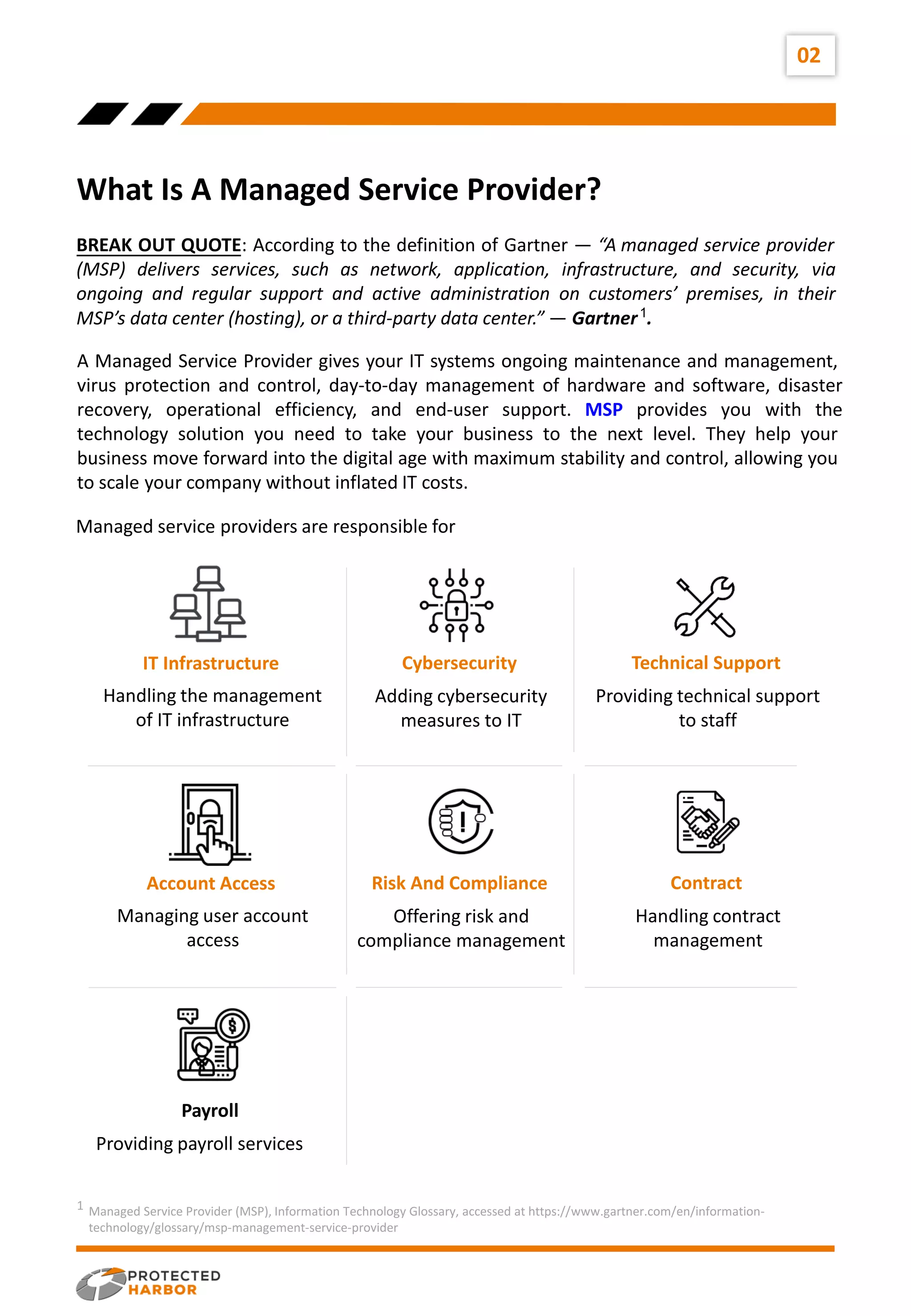
Managed service providers are responsible for
IT Infrastructure
Handling the management
of IT infrastructure
Cybersecurity
Adding cybersecurity
measures to IT
Technical Support
Providing technical support
to staff
Account Access
Managing user account
access
Risk And Compliance
Offering risk and
compliance management
Contract
Handling contract
management
Payroll
Providing payroll services
Managed Service Provider (MSP), Information Technology Glossary, accessed at https://www.gartner.com/en/information-
technology/glossary/msp-management-service-provider
1
Managed service providers are responsible for meeting the objectives of an organization.
There is no one-size-fits-all solution for every business, so MPSs offer a menu of services to
meet the IT needs of each organization. The engagement typically starts with an assessment
to discover the current technical environment, areas that need improvement, and
opportunities to support businesses.
03
How Do MSPs Work?
Help desk support, monitoring, security training, ongoing maintenance, and reporting are
delivered based on a Service Level Agreement. It sets the parameters for what you require
or expect from your managed service provider. The parameters include performance targets,
response times, security guarantees, and balancing the needs with your budget.
1
According to Mordor Research, the MSP market will likely grow by $274 billion by 2026 due
to the increased adoption of the model. The percentage of organizations using managed
service providers for managing their IT requirements increased from 25% to 38% in 2021.
Furthermore, the pandemic caused a surge in demand for cloud-based solutions and an
increased drive to speed up digital transformations. 54% of MSPs reported a rise in cloud
management revenue in 2020, and 65% increased their income from cybersecurity services,
according to a survey by Kaseva.
Working with an MSP can be an excellent option for businesses that outsource all or part of
their IT support needs. Among all this glory, most MSPs are just resellers packaging low-end
services leveraging low-cost labor. However, actual MSPs provide one-step-ahead benefits
to your organization, such as increased flexibility, heightened security, scalability,
predictable IT expenditure, etc. They focus on delivering unheard of and unbelievable up
time and durability and making technology stable and easy to use again.
Current State Of MSP Market
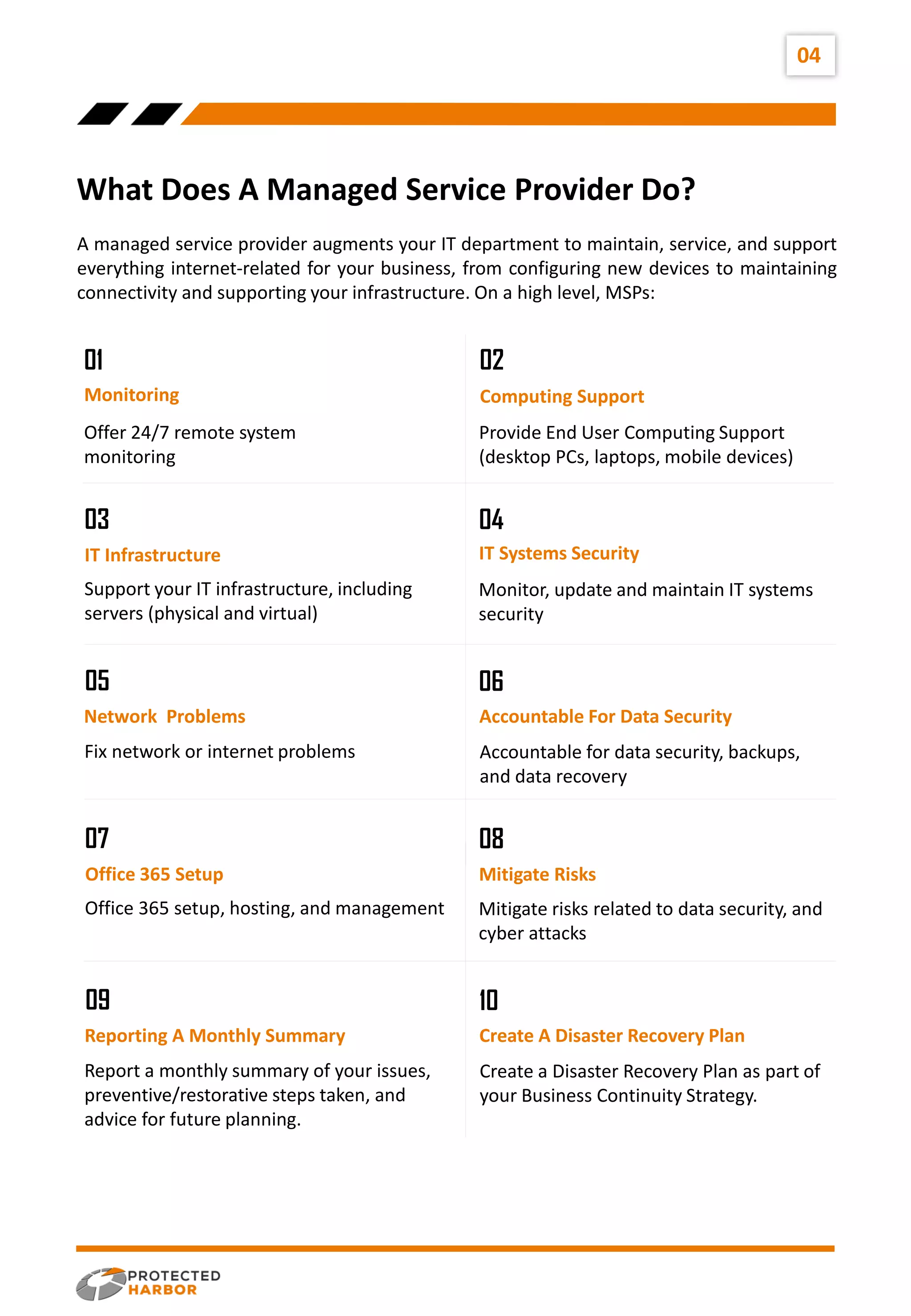
A managed service provider augments your IT department to maintain, service, and support
everything internet-related for your business, from configuring new devices to maintaining
connectivity and supporting your infrastructure. On a high level, MSPs:
04
What Does A Managed Service Provider Do?
IT Infrastructure IT Systems Security
Monitoring
Offer 24/7 remote system
monitoring
Computing Support
Provide End User Computing Support
(desktop PCs, laptops, mobile devices)
Support your IT infrastructure, including
servers (physical and virtual)
01 02
03
Monitor, update and maintain IT systems
security
04
Accountable for data security, backups,
and data recovery
06
Fix network or internet problems
05
Network Problems Accountable For Data Security
Office 365 Setup Mitigate Risks
Office 365 setup, hosting, and management
07
Mitigate risks related to data security, and
cyber attacks
08
Create a Disaster Recovery Plan as part of
your Business Continuity Strategy.
10
Report a monthly summary of your issues,
preventive/restorative steps taken, and
advice for future planning.
09
Reporting A Monthly Summary Create A Disaster Recovery Plan
An MSP ensures that you and your employees have access to the internet, communicate
with each other, manage data transfers and maintain one or more websites. An MSP keeps
your IT up-to-date, essential to marketing your products or services, driving sales and
support for your customers, and completing back-end administrative tasks related to
inventory, data analysis, etc. Partnering with the right MSP means more security, service,
productivity, and love from your user community.
05
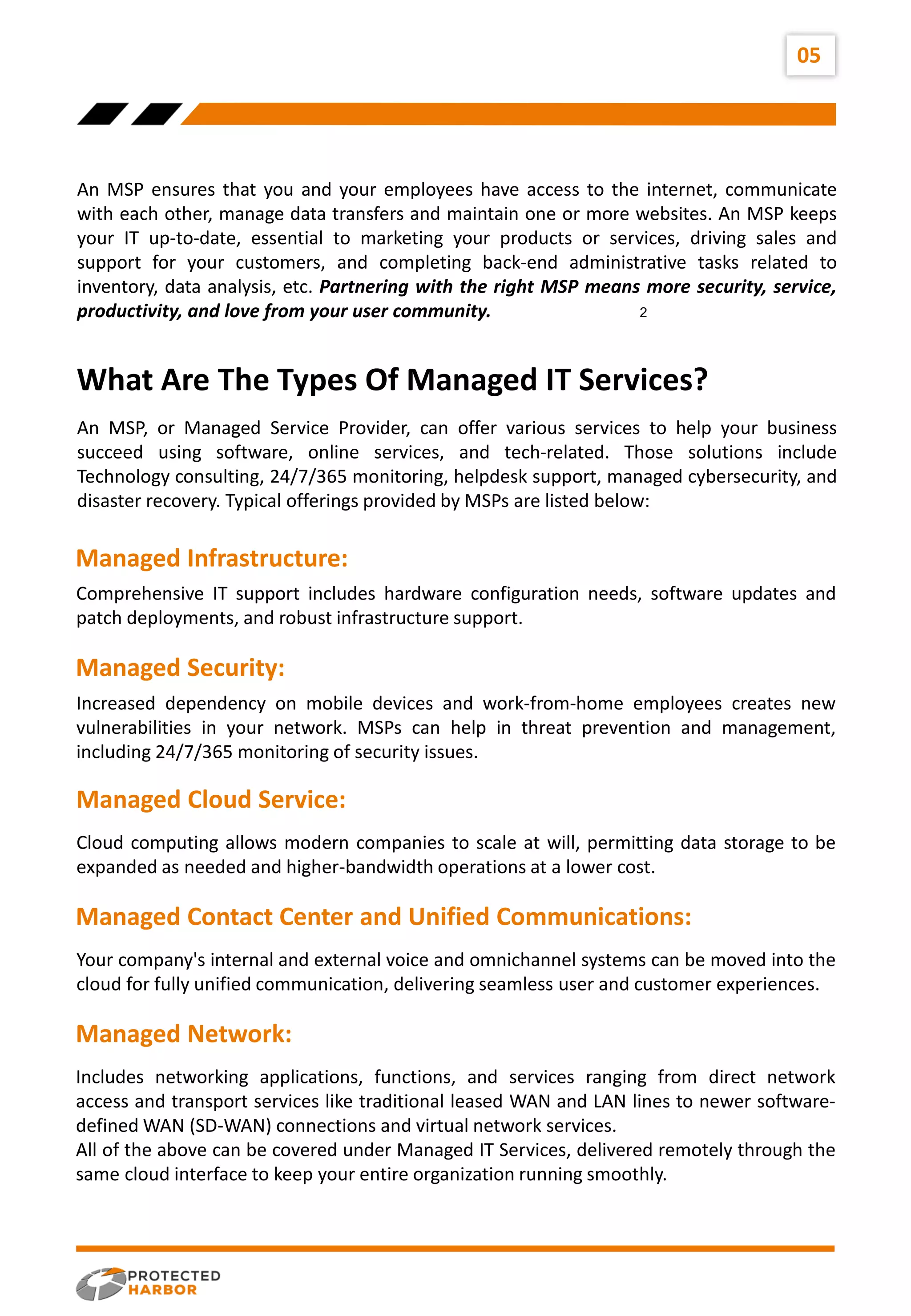
An MSP, or Managed Service Provider, can offer various services to help your business
succeed using software, online services, and tech-related. Those solutions include
Technology consulting, 24/7/365 monitoring, helpdesk support, managed cybersecurity, and
disaster recovery. Typical offerings provided by MSPs are listed below:
2
Comprehensive IT support includes hardware configuration needs, software updates and
patch deployments, and robust infrastructure support.
Increased dependency on mobile devices and work-from-home employees creates new
vulnerabilities in your network. MSPs can help in threat prevention and management,
including 24/7/365 monitoring of security issues.
What Are The Types Of Managed IT Services?
Managed Infrastructure:
Managed Security:
Cloud computing allows modern companies to scale at will, permitting data storage to be
expanded as needed and higher-bandwidth operations at a lower cost.
Managed Cloud Service:
Your company's internal and external voice and omnichannel systems can be moved into the
cloud for fully unified communication, delivering seamless user and customer experiences.
Managed Contact Center and Unified Communications:
Includes networking applications, functions, and services ranging from direct network
access and transport services like traditional leased WAN and LAN lines to newer software-
defined WAN (SD-WAN) connections and virtual network services.
All of the above can be covered under Managed IT Services, delivered remotely through the
same cloud interface to keep your entire organization running smoothly.
Managed Network:
Traditionally, MSPs gained acceptance as companies tried to cut IT support and
maintenance costs. Managing IT for a decent-sized business requires varying skill sets, in-
house technical staff costs, hiring costs, tools/training costs, and other benefits provided
to permanent employees like insurance. An MSP, on the other hand, is cost-effective and
efficient.
06
Why Should You Hire An MSP?
Plus, their price is predictable. High-quality Managed IT Service Providers charge a flat
monthly rate for proactive monitoring and maintenance of your workstations, servers, and IT
infrastructure. Moreover, a proper IT managed service provider aims to minimize IT
downtime by preventing issues before they happen.
1
An IT service provider can also help you determine where you’re wasting money in “Nice-To-
Haves or outdated systems” For example, if you’re using an outdated Wi-Fi router, increasing
your network's bandwidth won’t provide you the expected result. Working with an IT service
provider will equip you with the latest trends and tech expertise. You can make well-
informed decisions and find ways to cut costs and boost your team’s productivity.
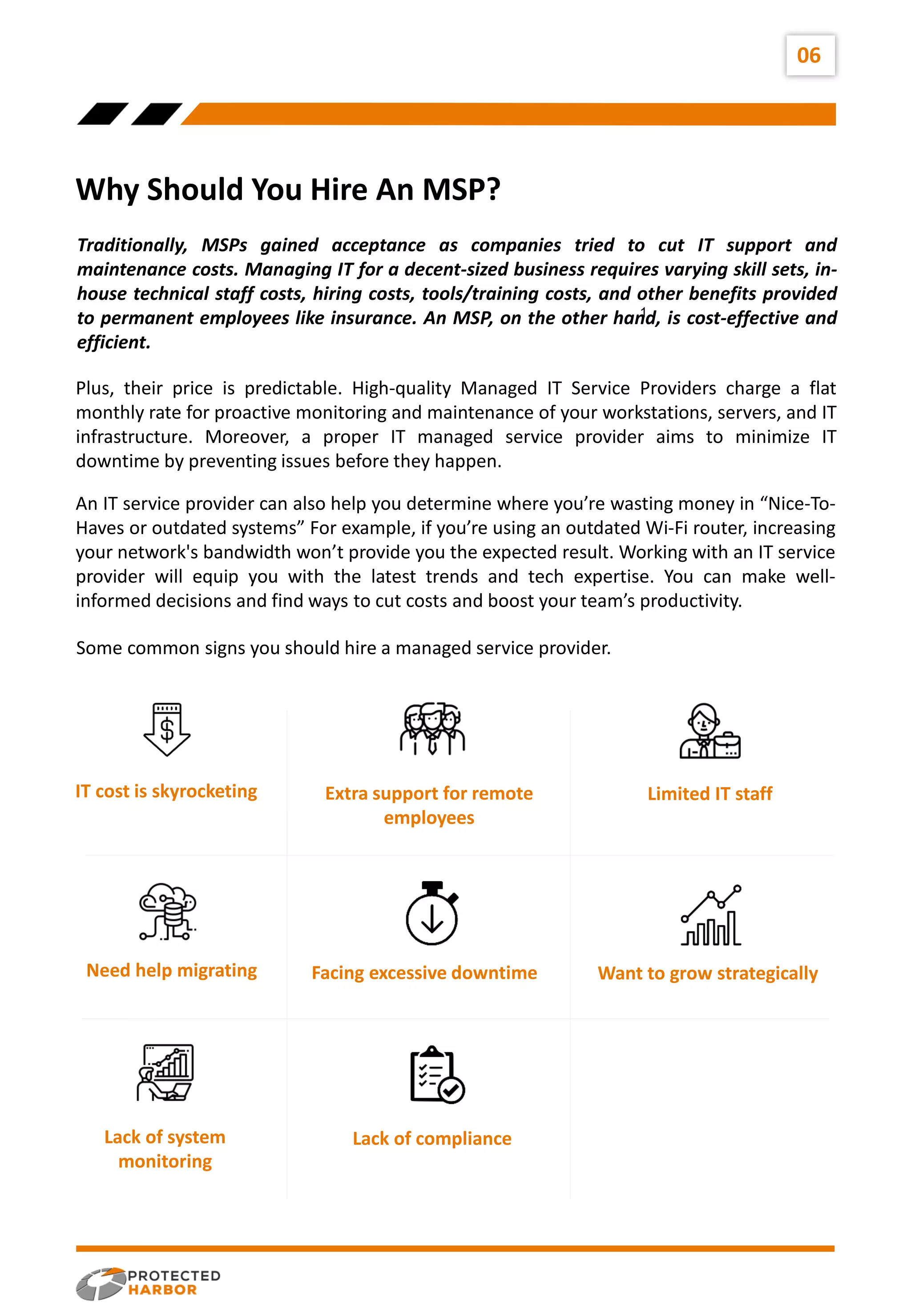
Some common signs you should hire a managed service provider.
IT cost is skyrocketing Extra support for remote
employees
Limited IT staff
Need help migrating Facing excessive downtime Want to grow strategically
Lack of system
monitoring
Lack of compliance
07
How Much Do Managed Service Providers Charge?
Finally, you’ll never have to worry about falling behind regarding your regulatory or
legislative compliance with managed services. MSPs keep you updated with compliance
laws, regulations, and procedures and thus avoid potential fines.
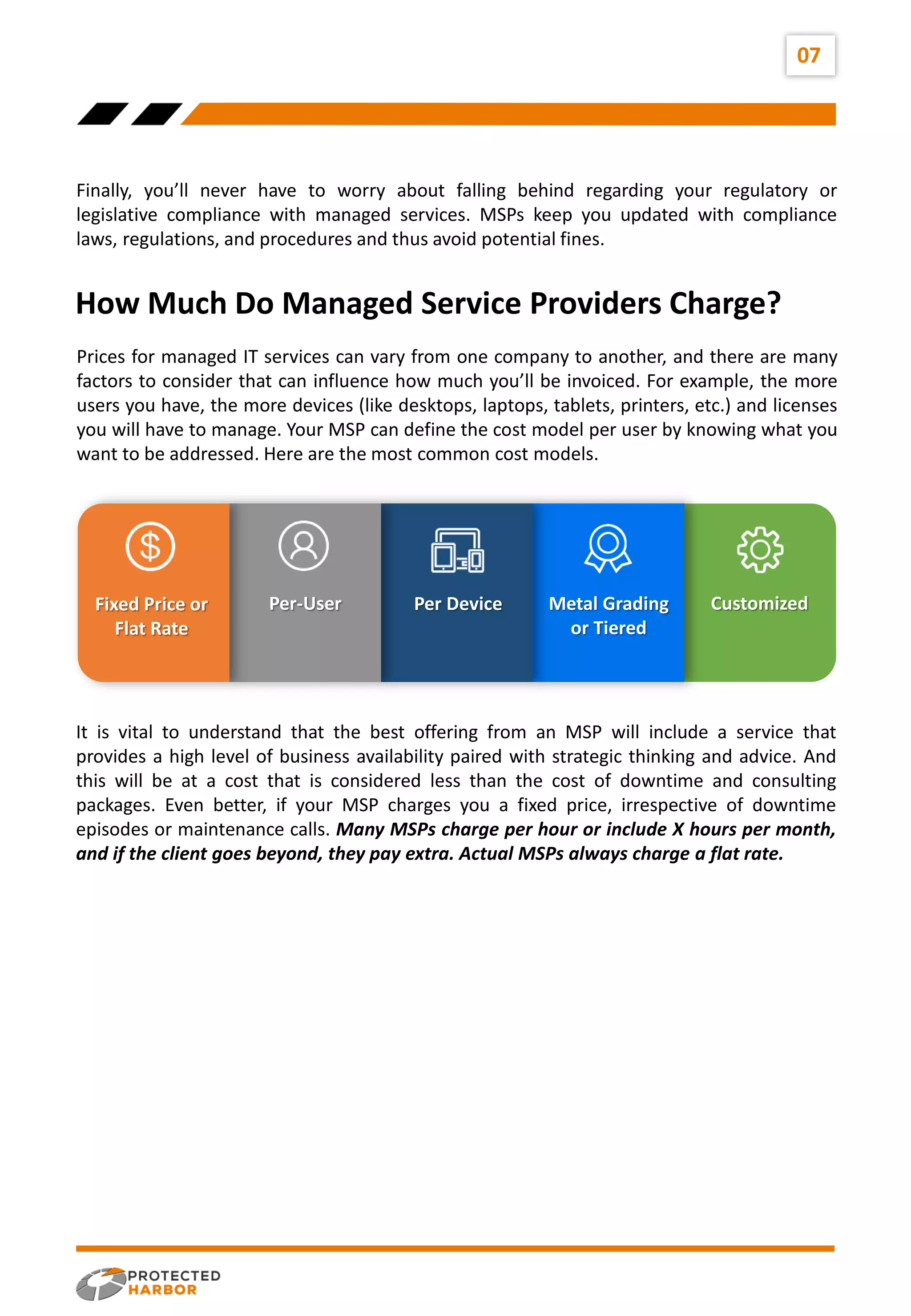
Prices for managed IT services can vary from one company to another, and there are many
factors to consider that can influence how much you’ll be invoiced. For example, the more
users you have, the more devices (like desktops, laptops, tablets, printers, etc.) and licenses
you will have to manage. Your MSP can define the cost model per user by knowing what you
want to be addressed. Here are the most common cost models.
Per Device Metal Grading
or Tiered
Customized
Fixed Price or
Flat Rate
Per-User
It is vital to understand that the best offering from an MSP will include a service that
provides a high level of business availability paired with strategic thinking and advice. And
this will be at a cost that is considered less than the cost of downtime and consulting
packages. Even better, if your MSP charges you a fixed price, irrespective of downtime
episodes or maintenance calls. Many MSPs charge per hour or include X hours per month,
and if the client goes beyond, they pay extra. Actual MSPs always charge a flat rate.
Break-fix Mindset: The Biggest Problem Of MSPs
The first thing you must ask yourself is, “What do you want from your MSP?” If your answer
is to provide a break-fix IT shop, you are probably paying too much for too little work. An IT
repair shop just around your street can also do the same. Then why MSPs?
Well, I am not trying to undermine the break-fix services. Managing IT infrastructure is a
complex and time-consuming activity. And, break-fix is an integral part of your tech support
team (in-house or outsourced). The universal truth is that Technology Breaks! And, even
with the most reliable tech landscape, you mustn’t forget that your users are human!
Employees will find challenges switching on their computers or even printing documents. So,
support technicians are critical to ensuring the seamless functioning of your hardware and
software. But, does an MSP fit in this support model only as a problem-fixer?
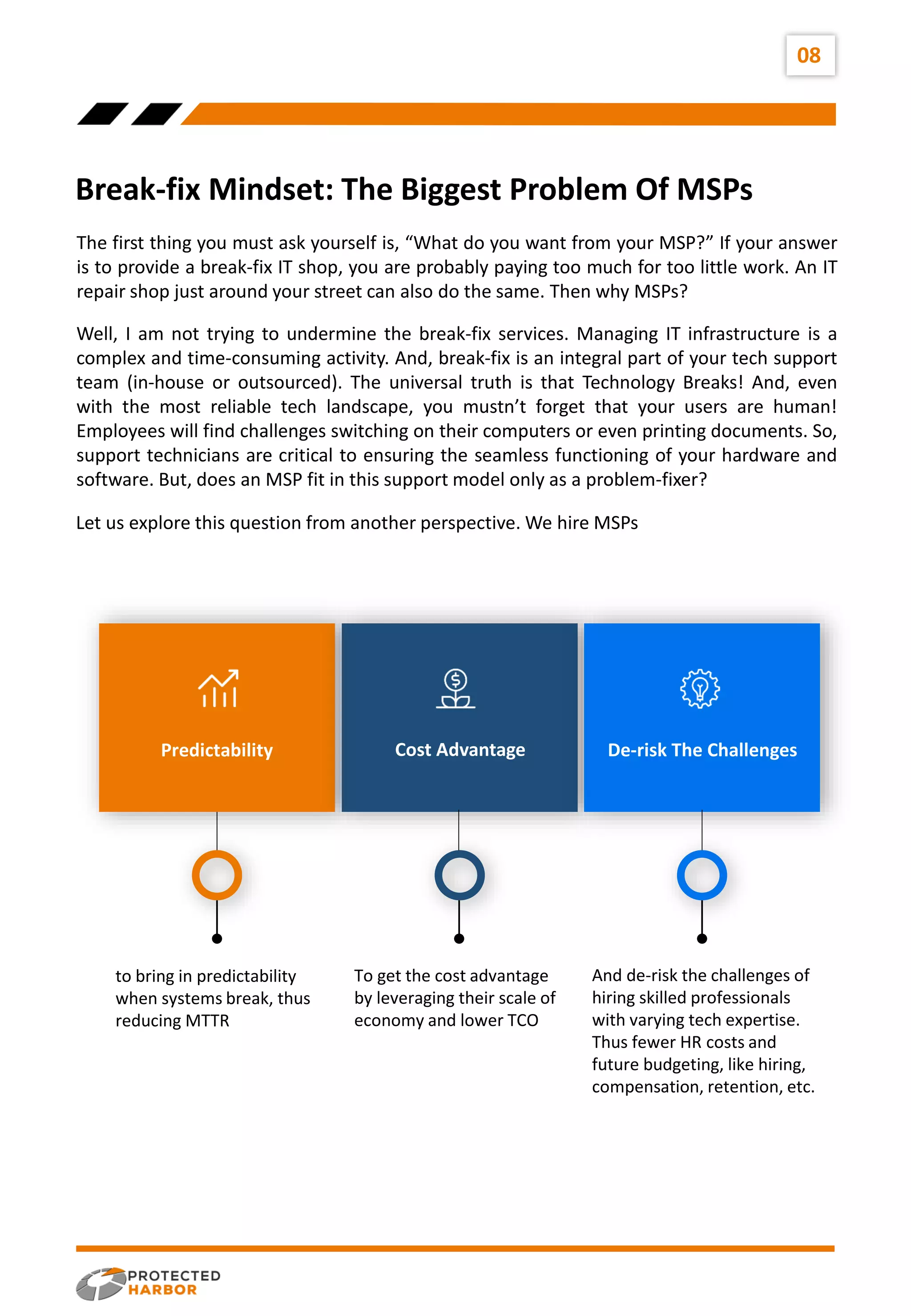
Let us explore this question from another perspective. We hire MSPs
08
to bring in predictability
when systems break, thus
reducing MTTR
Predictability
To get the cost advantage
by leveraging their scale of
economy and lower TCO
Cost Advantage
And de-risk the challenges of
hiring skilled professionals
with varying tech expertise.
Thus fewer HR costs and
future budgeting, like hiring,
compensation, retention, etc.
De-risk The Challenges
09
While all these reasons focus on businesses to help operational efficiency, where are the
users here? Technology is the foundational layer of business operation, and it exists for your
users — not the other way round. Every business personnel is tied to technology, from
customer support to the revenue-generating teams.
When MSPs have their skin in your game, they will brace any impact during unprecedented
times and help you navigate the escalation game. Rather than acting as a technician, the
actual MSP will partner with your users to elevate the service levels of your technology
department. Predictable service delivery, proactive monitoring, lower downtime, faster
resolution, adopting best practices, and safeguarding against future threats make your MSP
the real hero of your success.
Doesn’t it make sense to think about your employee and customer experience while crafting
a top-notch IT support delivery? An MSP’s SLA starts when a user reports a problem. But,
the fact is, the user’s tasks (his KPIs) are halted — from the same ‘moment.’ These users are
the reason for the very existence of technology and hence the MSPs. However, these users
are missing when defining the criteria to onboard MSPs. Strange!
The biggest irony is that users will always blame the tech department. If you can’t fix the
issue, the support personnel sucks! If you can fix it but took the entire day to find the root
cause and apply the patches, the technology team is again at fault. But, if you beat all the
odds and fix the issue within a quick 30-min resolution time, they will acknowledge your fast
service. Except for this time, they’ll blame you for not preventing it. So, technology will
surely break at some point — maybe today or in ten days. And, IT will always be on the firing
line.
However, MSPs should be your first checkpoint that focuses more on preventive
recommendations rather than betting on your good fortune in your technical affairs. These
MSPs must play a leading role in fostering strong relationships with your user community.
Your MSP should be more than a band-aid to fix problems and not just a PC repair shop.
They must be the dependable go-to team you can trust in your IT infrastructure monitoring
and management.
Other Challenges Of Outsourcing To Managed Service
Providers?
10
MSP-related challenges can drastically reduce your technological effectiveness. And the
success of your MSP depends on trust, honesty, and transparency in your approach and
activities. Remember, it's a collective responsibility, and understanding each other's
perspective maximizes the ROI. Adopting a partnership approach, these service providers
will work closely with you to understand your business and provide strategic thinking
aligning technology with the business plans. Below highlighted are a few challenges and
how to mitigate them.
Take your MSP's opinion about your hardware and software condition. You might consider
your tech landscape state-of-art, which might not be the case in reality. If your MSPs think
there is much work to be done to harmonize between equipment and software stack, sit
with them and be on the same page. Understand how much work is required to maintain
your infrastructure and set clear expectations.
State Of Hardware And Software
Ride
The MSP and the customer are typically bound by a contract with a standardized service
level agreement that defines the expectations and quality metrics of the delivered services.
SLAs Vs. Expectations
Once defined and agreed upon, expect your MSP to stick to it. After all, that’s what you are
paying for. If you feel there needs to be a revision, revisit your contract. Just because your
MSP could help you out faster last time doesn’t mean they’re doing a lousy job by sticking to
the SLA this time.
Your operating model takes a new form as your MSP’s contract starts. Your expectation with
the incoming vendor will be they adapt to your working culture. However, there can be
several areas where your operations need an overhaul. Your MSP can present valuable
inputs to your business, to which you might be blindfolded. You must be open to an
effective governance structure that flows both ways. Take time to meet with your MSP at an
operational, tactical, and strategic level and exchange feedback.
360-degree Feedback
11
A Gap In Insurance Liability
vision
Due to outsourcing-related exposures, you may have to purchase extra layers of insurance
protection. Insurance ramifications while negotiating contracts with your MSP can be
significant. The best practice is to understand the insurance mentioned in the agreement
and compare them with your company’s insurance cover. Any gaps hidden in fine prints can
fail to recover losses from an offshore MSP’s insurance.
Once MSP takes over, you lose the ability to respond to changes rapidly because there’s an
additional layer of processes and people to work through. Thus, resulting in a perception of
losing control. However, such a change is good. It’s structured and systematic, provides
empirical evidence for improvements, reduces tap-on-the-shoulder culture, and optimizes
your cost by eliminating ad hoc urgent service requests.
Perception Of Losing Control
MSP’s operating model is a paradigm shift from reactive to proactive support. This means
one KPI for an MSP must be to ensure your IT doesn’t fail while ensuring optimal
performance. So, beyond keeping your IT lights on, MSPs that stand out provide good
business value for their job. Here are a few differentiators of modern MSPs.
How do leading MSPs differentiate themselves from the rest?
Advanced security offerings
Ninth Annual Cost of Cybercrime Study, Accenture, March 2019 accessed at https://www.accenture.com/us-
en/insights/security/cost-cybercrime-study
2
Cyber-attacks are mainstream, particularly for small to medium-sized businesses. Threats
are more frequent, targeted, and a lot more complex. According to a report by Accenture —
Cost of Cybercrime Study — around 43% of cyber-attacks are aimed at small businesses,
and only 14% are prepared to defend themselves. A quality MSP company should ensure
that you are safe from online threats rather than waiting for the disaster. Instead of dealing
with cyber attackers or ransom calls as they come, a good MSP can target vulnerabilities in
advance and shut them down before it becomes a problem. Yes, some attacks can
penetrate even the best of systems. However, having robust threat prevention in place will
de-risk the threat of an unexpected event. Your MSP must offer a comprehensive plan that
can prevent even sophisticated threats.
2
12
Internal
Factors
External
Factors
Cloud Services And Automation
Modern MSPs are switching to cloud-native solutions and automation levers to improve the
quality of their services. Cloud solutions provide scalability and on-demand disaster
recovery to their clients. Automation brings efficiency with lower dependency on humans,
thus reducing manual errors or discrepancies.
Best IT service companies focus on innovation, which can benefit their customers. These
companies know the importance of tracking the latest industry trends. With their help, you
can utilize digital technologies to get ahead of competitors. Best MSPs are not stuck with
their approach and technology and update their offerings based on trends, geography, and
industry. For example, new forms of cybercrime develop every year. A company that focuses
on innovation will know how to safeguard you from further attacks.
Innovation
Leading MSPs consult and advise on the best technologies or tools. They help build a
customized program based on your business goals and strategic vision, manage the
program's implementation, and run daily operation and maintenance of those critical
functions. MSPs must keep up to speed with the latest developments and develop new
services to deliver value to their customers.
Value Creation
CX has already been the buzzword for the last half a decade. The concept was initially driven
by big consulting firms and is now necessary for IT customers. As modern users prefer being
at the center of things, they expect self-service via knowledge forums, chatbots, and service
catalogs, i.e., omnichannel communication. A managed service provider for the helpdesk
supports these areas to improve your NPS and CSAT. Your in-house team can focus on the
strategic aspects of improving tech adoption.
Customer Experience (CX)
The disruption caused by the pandemic demonstrated that adaptability and resilience —
from both MSPs and their customers — are essential to survive. As companies adopt a
hybrid working culture, MSPs must shift their operating model to suit the situation. E.g.,
MSPs need to equip their employees and their clients with the right tools to support remote
working remotely.
Adaptability and Resilience
13
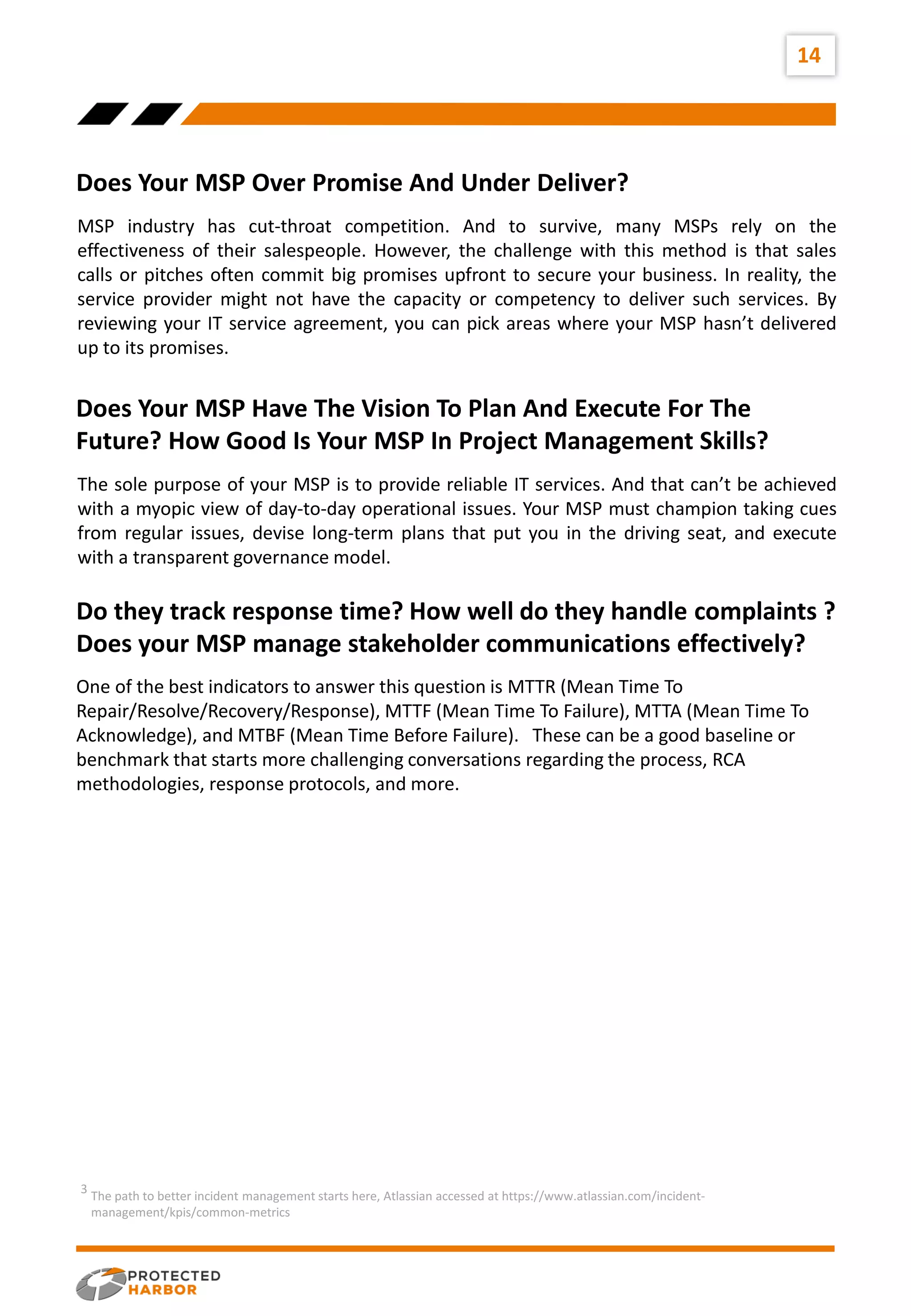
Red Flags: It's time to switch your IT Managed Service Provider
Technical hiccups happen regardless of your business's size, niche, or geography. And
outsourcing your IT infrastructure services to an MSP provides you with a dedicated team
that can take care of all such issues. This team is always on alert to address any issues,
getting you back up and running as soon as possible. You hire MSPs to fix your problems and
reduce your downtime.
But fixing issues and keeping it running are slightly different things, though. If you find your
MSP fixing the same issue numerous times, you're probably with the wrong MSP. Actual
MSPs must be less product-focused and more focused on solving client problems. In
addition to billable hours, your MSP should track the uptime of your systems.
Sometimes with specialized services, like those an MSP provides, it can be hard to assess
how well they perform their job. But the bottom line is that outsourcing your IT to a
managed service provider (MSP) is supposed to make your life easier. If it doesn’t,
something has gone wrong. There are subtle signs that your MSP is no longer the right fit for
you. A few questions to introspect are:
How often has it happened that your MSP doesn't even know there
are issues until you tell them? Do you consider your MSP as an on-
demand IT service provider?
The answer to this question is about strategic fitment. Do you consider your MSP a
transactional partner or partner to work with you? It’s not enough that your MSP is fixing IT
issues that arise. They should proactively assess hardware and software needs and security
practices bi-annual or quarterly. And this can be even outside their written contract (scope
of work). Proactive maintenance makes all the difference when it comes to IT management.
14
Does Your MSP Over Promise And Under Deliver?
Does Your MSP Have The Vision To Plan And Execute For The
Future? How Good Is Your MSP In Project Management Skills?
MSP industry has cut-throat competition. And to survive, many MSPs rely on the
effectiveness of their salespeople. However, the challenge with this method is that sales
calls or pitches often commit big promises upfront to secure your business. In reality, the
service provider might not have the capacity or competency to deliver such services. By
reviewing your IT service agreement, you can pick areas where your MSP hasn’t delivered
up to its promises.
The sole purpose of your MSP is to provide reliable IT services. And that can’t be achieved
with a myopic view of day-to-day operational issues. Your MSP must champion taking cues
from regular issues, devise long-term plans that put you in the driving seat, and execute
with a transparent governance model.
Do they track response time? How well do they handle complaints ?
Does your MSP manage stakeholder communications effectively?
One of the best indicators to answer this question is MTTR (Mean Time To
Repair/Resolve/Recovery/Response), MTTF (Mean Time To Failure), MTTA (Mean Time To
Acknowledge), and MTBF (Mean Time Before Failure). These can be a good baseline or
benchmark that starts more challenging conversations regarding the process, RCA
methodologies, response protocols, and more.
The path to better incident management starts here, Atlassian accessed at https://www.atlassian.com/incident-
management/kpis/common-metrics
3
15
How Well Does Your MSP Align With Your Organization’s Culture?
Do They Own Your Issues? Do They Consider Your Users As Their
‘Own’ Users? Do They Track CSAT?
Can you ring your MSP at 2 AM and be assured that someone will be working on the ground
to resolve a critical business issue. Does your MSP empathize with you in a significant
outage and work tirelessly to bring back the system? Does your MSP think about the
solution first or bring the contractual scope of work in every discussion? How well does your
MSP resonate with your user community, values, and vision?
If answers to the above questions are No, is your service provider an MSP then? Yes, an MSP
is responsible for a specific set of technologies for an agreed-upon subscription cost. But, if
your MSP only does time and materials on a break-fix basis, they aren't an MSP. You mustn't
forget that an MSP is a Managed Service Provider. The effectiveness of managed services
lies in their simplicity. They augment your competency rather than you shifting your
operational complexities. Actual MSPs think beyond their scope, which benefits your entire
landscape.
What To Look For In An MSP? Mention Some Qualities
Here are some of the rates for a managed service provider.
02
04
07 08
Offer advanced services Offer round-the-clock support
Take a shared approach to managed
services
Provide a flexible service model
Shared Approach Flexible Service
Advanced Services 24/7 Support
Strategic Relationship
Time Zones
Support multiple time zones Solid strategic relationship with your
cloud provider
Back Up Plan
Remote Monitoring
Leverage remote monitoring for proactive
maintenance
Robust backup and disaster recovery
plan
Legal Team
Business Contact
A dedicated, reliable, and single point of
contact for your business
Work with your legal team to address
compliance issues
16
How Do I Choose A Managed Service Provider?
What should you look for in a Managed IT Services provider? This is a severe technology
investment. Many fly-by-night companies offer managed IT that don't have the track record,
experience, or bandwidth to adequately serve your organization's needs. Review each
vendor you consider with the following criteria to ensure you make a wise choice.
Flexible, Scalable Plans:
What type of plan does the service provider offer? If they are complicated and have a lot of
fine print, chances are you'll be getting charged for a lot of stuff you don't need, or else
you'll find yourself in crisis only to learn that certain services aren't included in your service
plan.
Look for a simple, easy-to-understand billing agreement with transparency around what is
and isn't included. If you're unclear about anything in the contract, seek advice from experts
before signing. Avoid companies that want to lock you into a multi-year agreement but are
reluctant to convey their responsibilities. Are they playing a leading role in continuous
improvement and staying up to date with changing technology and data compliance
regulations, are they playing a leading role?
Robust Customer Support:
You usually need it right away when you need customer support. You don't have time to
wait until business hours begin in a different part of the world or try and explain a complex
problem to a chatbot that can only deliver answers from a preprogrammed FAQ. Ask what
kind of support is promised, when and how it will be given, and what your options are in an
emergency.
17
Uptime is critical to your company. If your organization isn't accessible to your customer
base, you aren't making money. A service level agreement (SLA) will promise a certain
uptime, typically well over 99%, and a response time during outages within a specific time
frame. If the Managed Services provider fails to meet these obligations, they will typically be
subject to a penalty (often a free service period to make up for their breach of service.)
MSPs offer long-term cost-saving. Hiring an MSP optimizes your staff productivity, reduces
downtime, and enables you to leverage their economies of scale. MSP ensures your
organization runs more smoothly and effectively, maximizing revenues and cutting the costs
associated with unexpected downtime.
Your existing team will have extra time to deliver other tasks more passionate about and
more closely aligned with your core business objective, leading to higher productivity levels.
Since your employees will focus on what they know best instead of constantly battling IT
issues, efficiency also increases, making everyone in your company feel more valuable.
Service Level Agreements:
What Are The Benefits MSP Promises To Bring To Your
Organization?
1. Cost
2. More Time
The right MSP offers a unique opportunity to tap into people specializing in their niche
technology. They are more likely to stay updated with skill trends than your IT team, which is
overwhelmed trying to keep the entire system up. When you hire specialists for certain
aspects of your system, you will drive efficiencies in that area. You also tap into expertise
and knowledge of the new-age technology, skills that can be difficult to acquire in a
competitive landscape.
3. Skilled Engineers
With an IT-Managed Services provider, you can obtain 24-hour support that scales up and
down according to your needs, supporting your business goals and facilitating growth. Your
lead time to onboard new skill sets in your IT team drastically reduces.
4. Scale
18
The benefit of outsourcing the parts of IT to a managed service is to free up valuable time
for you to focus on leveraging your data for growth. An MSP can take over the time-
consuming tasks and help your team outsmart, outwork and outlast your competition. Even
if you outsource a chunk of your requirements, you do not precisely lose control. MSPs
enable your IT team to have the opportunity to create more strategic value with your
company's vision.
5. Vision
One of the top reasons a company should hire MSPs is their security expertise and ability to
stay on top of trends. MSPs ensure security is constantly updated to deter new threats.
Moreover, an MSP won't sustain the competitive landscape if they don’t understand the
importance of safety and implement every possible measure to keep your systems and data
safe.
6. Security
And, like all relationships, you need to review your engagement to guarantee value for your
money critically. Modern businesses leverage technology to stay competitive. So, your MSP
must remain at the top of their game to keep your technology reliable. And we often hear
from businesses working with their current provider for years but are too nervous about
finding an alternative partner. Changing providers come with a perception of a complicated
process that involves days of IT downtime and business disruption. Surprisingly or not,
switching your MSP can be a cakewalk when you find the right partner.
A Managed IT Service delivers outsourced support, maintenance, and monitoring of your
critical infrastructure and end-users. They augment you with the right expertise, including
proactive device management to minimize future issues and reactive support when you
need it most. Whether a more significant server issue or minor user issue, MSP supports
your staff wherever they are using your technology. Also, MSPs can facilitate shifts and
thrive in the post-COVID world by embracing innovation, flexibility, and agility.
CONCLUSION
19
20
If you are unsure of your MSP, we will audit and discover
your potential areas of improvement.
We start every engagement with a discovery process to identify your business goals, risk
areas, and technological priorities. We then create a strategic plan that is mapped to your
business goals and provide ongoing monitoring and measurement to track the success of
our solution. Protected Harbor’s team of engineers, consultants, and certified technicians
work with you to implement the best-fit technology to meet your organizational goals. You
benefit from working with one trusted partner who understands your unique organizational
goals.
Protected Harbor manages your IT infrastructure from soup to nuts. We've covered you
from email to teleconferencing, website hosting, cloud storage, computer repair, etc. We
stay on top of your technological demands daily, keeping the lights on and providing
strategic guidance to higher-ups.
Protected Harbor offers customized IT solutions to businesses looking to scale their
technology, and we're on a mission to give you the best customer service possible. We are
constantly innovating to ensure you have the best experience with our products. As one of
our customers, you can expect excellent service, quick response times, and an eager team
to help. We are not your average MSP. We are engineers, software developers, analysts,
designers, and lifelong learners. We offer a tailored approach to managed services designed
to meet each client’s unique needs.
21
About Protected Harbor
Protected Harbor is a trusted IT management and technology durability partner
for companies across the US. We take responsibility for the technology and applications
that keep your business moving forward.
With over 15 years of service and a 99.99%
uptime record, our team is fully committed to
creating, maintaining, and managing the
highest quality application operations
environment experiences. Your uptime is our
focus. Our 90+ Net Promoter Score and 95%
client retention rate back up our claim of
being a go-to provider for companies looking
to improve their technology.
Protected Harbor provides a range of I.T. support, infrastructure management, and
application durability support for businesses looking to scale their technology. We are the IT
vendor of choice for companies looking to get the most out of their technology at the lowest
possible cost, regardless of location and cloud provider. From infrastructure design to cloud
migration, including security, storage, connectivity, remediation, monitoring, etc. Protected
Harbor offers a full range of data center solutions backed by our 24/7/365 support team
dedicated to exceptional customer service.
Protected Harbor provides the best application operations environment experience,
and we're on a mission to provide you with the best customer experience. We are
constantly innovating to ensure you have the best experience with our products.
Every service is customized. No one-client solution is the same. Whether building
infrastructure from scratch, upgrading older systems, or improving application uptime and
employee productivity, Protected Harbor can help. We are experts at designing, securing,
managing, and optimizing the infrastructure that runs your critical business applications. As
one of our customers, you can expect excellent service, quick response times, and a team
eager to help.

What MSPs Can and Cant Do For You in 2022 Whitepaper by Protected Harbor

  • 2.
    01 By definition, Managedservice providers (MSPs) of 2022 should offer businesses a broad range of IT services. They are supposed to understand the technology and how it works and make it work for your business. But is it the ground reality? From our interactions with VPs, heads, and CIOs of the world, we see a sharp contrast to what an MSP should be doing. With most IT service providers offering Microsoft 365, mainly advertising the same USPs, there is a clear gap in perception between an MSP and an actual MSP. MSPs in 2022 are just resellers – reselling cloud and other services and promising it will all work together but delivering a patchwork of frustration. We interviewed our customers, partners, and their competitors and found that most MSPs offer the same services with different packaging. Whether these services are Azure virtual desktops, Citrix Virtual Apps and desktops, or Microsoft 365, most MSPs offer these services in some shape or form. The biggest irony is that these MSPs are unique by being “your outsourced IT department” or perhaps by attempting to focus on a critical area like a cloud or cyber security. But aren’t these MSPs no more than break-fix service providers? Yes, the stats say that the demand for managed service providers has grown exponentially. Some estimates say that 90% of Fortune 1000 companies use MSPs to provide at least part of their IT infrastructures or services. The current market was valued at $152.02 billion in 2020 and is projected to reach $274 billion by 2025. Covid-19 has also sped up the onboarding of MSPs by many businesses that were traditionally slow to embrace this concept. These companies are looking for trusted business partners in MSPs under pressure to catch up and become more effective and efficient. However, it's not uncommon for companies to find that their MSP no longer fits the bill. What was working for a business may not be working significantly if the business has grown or changed.
  • 3.
    02 What Is AManaged Service Provider? BREAK OUT QUOTE: According to the definition of Gartner — “A managed service provider (MSP) delivers services, such as network, application, infrastructure, and security, via ongoing and regular support and active administration on customers’ premises, in their MSP’s data center (hosting), or a third-party data center.” — Gartner1 . A Managed Service Provider gives your IT systems ongoing maintenance and management, virus protection and control, day-to-day management of hardware and software, disaster recovery, operational efficiency, and end-user support. MSP provides you with the technology solution you need to take your business to the next level. They help your business move forward into the digital age with maximum stability and control, allowing you to scale your company without inflated IT costs. Managed service providers are responsible for IT Infrastructure Handling the management of IT infrastructure Cybersecurity Adding cybersecurity measures to IT Technical Support Providing technical support to staff Account Access Managing user account access Risk And Compliance Offering risk and compliance management Contract Handling contract management Payroll Providing payroll services Managed Service Provider (MSP), Information Technology Glossary, accessed at https://www.gartner.com/en/information- technology/glossary/msp-management-service-provider 1
  • 4.
    Managed service providersare responsible for meeting the objectives of an organization. There is no one-size-fits-all solution for every business, so MPSs offer a menu of services to meet the IT needs of each organization. The engagement typically starts with an assessment to discover the current technical environment, areas that need improvement, and opportunities to support businesses. 03 How Do MSPs Work? Help desk support, monitoring, security training, ongoing maintenance, and reporting are delivered based on a Service Level Agreement. It sets the parameters for what you require or expect from your managed service provider. The parameters include performance targets, response times, security guarantees, and balancing the needs with your budget. 1 According to Mordor Research, the MSP market will likely grow by $274 billion by 2026 due to the increased adoption of the model. The percentage of organizations using managed service providers for managing their IT requirements increased from 25% to 38% in 2021. Furthermore, the pandemic caused a surge in demand for cloud-based solutions and an increased drive to speed up digital transformations. 54% of MSPs reported a rise in cloud management revenue in 2020, and 65% increased their income from cybersecurity services, according to a survey by Kaseva. Working with an MSP can be an excellent option for businesses that outsource all or part of their IT support needs. Among all this glory, most MSPs are just resellers packaging low-end services leveraging low-cost labor. However, actual MSPs provide one-step-ahead benefits to your organization, such as increased flexibility, heightened security, scalability, predictable IT expenditure, etc. They focus on delivering unheard of and unbelievable up time and durability and making technology stable and easy to use again. Current State Of MSP Market
  • 5.
    A managed serviceprovider augments your IT department to maintain, service, and support everything internet-related for your business, from configuring new devices to maintaining connectivity and supporting your infrastructure. On a high level, MSPs: 04 What Does A Managed Service Provider Do? IT Infrastructure IT Systems Security Monitoring Offer 24/7 remote system monitoring Computing Support Provide End User Computing Support (desktop PCs, laptops, mobile devices) Support your IT infrastructure, including servers (physical and virtual) 01 02 03 Monitor, update and maintain IT systems security 04 Accountable for data security, backups, and data recovery 06 Fix network or internet problems 05 Network Problems Accountable For Data Security Office 365 Setup Mitigate Risks Office 365 setup, hosting, and management 07 Mitigate risks related to data security, and cyber attacks 08 Create a Disaster Recovery Plan as part of your Business Continuity Strategy. 10 Report a monthly summary of your issues, preventive/restorative steps taken, and advice for future planning. 09 Reporting A Monthly Summary Create A Disaster Recovery Plan
  • 6.
    An MSP ensuresthat you and your employees have access to the internet, communicate with each other, manage data transfers and maintain one or more websites. An MSP keeps your IT up-to-date, essential to marketing your products or services, driving sales and support for your customers, and completing back-end administrative tasks related to inventory, data analysis, etc. Partnering with the right MSP means more security, service, productivity, and love from your user community. 05 An MSP, or Managed Service Provider, can offer various services to help your business succeed using software, online services, and tech-related. Those solutions include Technology consulting, 24/7/365 monitoring, helpdesk support, managed cybersecurity, and disaster recovery. Typical offerings provided by MSPs are listed below: 2 Comprehensive IT support includes hardware configuration needs, software updates and patch deployments, and robust infrastructure support. Increased dependency on mobile devices and work-from-home employees creates new vulnerabilities in your network. MSPs can help in threat prevention and management, including 24/7/365 monitoring of security issues. What Are The Types Of Managed IT Services? Managed Infrastructure: Managed Security: Cloud computing allows modern companies to scale at will, permitting data storage to be expanded as needed and higher-bandwidth operations at a lower cost. Managed Cloud Service: Your company's internal and external voice and omnichannel systems can be moved into the cloud for fully unified communication, delivering seamless user and customer experiences. Managed Contact Center and Unified Communications: Includes networking applications, functions, and services ranging from direct network access and transport services like traditional leased WAN and LAN lines to newer software- defined WAN (SD-WAN) connections and virtual network services. All of the above can be covered under Managed IT Services, delivered remotely through the same cloud interface to keep your entire organization running smoothly. Managed Network:
  • 7.
    Traditionally, MSPs gainedacceptance as companies tried to cut IT support and maintenance costs. Managing IT for a decent-sized business requires varying skill sets, in- house technical staff costs, hiring costs, tools/training costs, and other benefits provided to permanent employees like insurance. An MSP, on the other hand, is cost-effective and efficient. 06 Why Should You Hire An MSP? Plus, their price is predictable. High-quality Managed IT Service Providers charge a flat monthly rate for proactive monitoring and maintenance of your workstations, servers, and IT infrastructure. Moreover, a proper IT managed service provider aims to minimize IT downtime by preventing issues before they happen. 1 An IT service provider can also help you determine where you’re wasting money in “Nice-To- Haves or outdated systems” For example, if you’re using an outdated Wi-Fi router, increasing your network's bandwidth won’t provide you the expected result. Working with an IT service provider will equip you with the latest trends and tech expertise. You can make well- informed decisions and find ways to cut costs and boost your team’s productivity. Some common signs you should hire a managed service provider. IT cost is skyrocketing Extra support for remote employees Limited IT staff Need help migrating Facing excessive downtime Want to grow strategically Lack of system monitoring Lack of compliance
  • 8.
    07 How Much DoManaged Service Providers Charge? Finally, you’ll never have to worry about falling behind regarding your regulatory or legislative compliance with managed services. MSPs keep you updated with compliance laws, regulations, and procedures and thus avoid potential fines. Prices for managed IT services can vary from one company to another, and there are many factors to consider that can influence how much you’ll be invoiced. For example, the more users you have, the more devices (like desktops, laptops, tablets, printers, etc.) and licenses you will have to manage. Your MSP can define the cost model per user by knowing what you want to be addressed. Here are the most common cost models. Per Device Metal Grading or Tiered Customized Fixed Price or Flat Rate Per-User It is vital to understand that the best offering from an MSP will include a service that provides a high level of business availability paired with strategic thinking and advice. And this will be at a cost that is considered less than the cost of downtime and consulting packages. Even better, if your MSP charges you a fixed price, irrespective of downtime episodes or maintenance calls. Many MSPs charge per hour or include X hours per month, and if the client goes beyond, they pay extra. Actual MSPs always charge a flat rate.
  • 9.
    Break-fix Mindset: TheBiggest Problem Of MSPs The first thing you must ask yourself is, “What do you want from your MSP?” If your answer is to provide a break-fix IT shop, you are probably paying too much for too little work. An IT repair shop just around your street can also do the same. Then why MSPs? Well, I am not trying to undermine the break-fix services. Managing IT infrastructure is a complex and time-consuming activity. And, break-fix is an integral part of your tech support team (in-house or outsourced). The universal truth is that Technology Breaks! And, even with the most reliable tech landscape, you mustn’t forget that your users are human! Employees will find challenges switching on their computers or even printing documents. So, support technicians are critical to ensuring the seamless functioning of your hardware and software. But, does an MSP fit in this support model only as a problem-fixer? Let us explore this question from another perspective. We hire MSPs 08 to bring in predictability when systems break, thus reducing MTTR Predictability To get the cost advantage by leveraging their scale of economy and lower TCO Cost Advantage And de-risk the challenges of hiring skilled professionals with varying tech expertise. Thus fewer HR costs and future budgeting, like hiring, compensation, retention, etc. De-risk The Challenges
  • 10.
    09 While all thesereasons focus on businesses to help operational efficiency, where are the users here? Technology is the foundational layer of business operation, and it exists for your users — not the other way round. Every business personnel is tied to technology, from customer support to the revenue-generating teams. When MSPs have their skin in your game, they will brace any impact during unprecedented times and help you navigate the escalation game. Rather than acting as a technician, the actual MSP will partner with your users to elevate the service levels of your technology department. Predictable service delivery, proactive monitoring, lower downtime, faster resolution, adopting best practices, and safeguarding against future threats make your MSP the real hero of your success. Doesn’t it make sense to think about your employee and customer experience while crafting a top-notch IT support delivery? An MSP’s SLA starts when a user reports a problem. But, the fact is, the user’s tasks (his KPIs) are halted — from the same ‘moment.’ These users are the reason for the very existence of technology and hence the MSPs. However, these users are missing when defining the criteria to onboard MSPs. Strange! The biggest irony is that users will always blame the tech department. If you can’t fix the issue, the support personnel sucks! If you can fix it but took the entire day to find the root cause and apply the patches, the technology team is again at fault. But, if you beat all the odds and fix the issue within a quick 30-min resolution time, they will acknowledge your fast service. Except for this time, they’ll blame you for not preventing it. So, technology will surely break at some point — maybe today or in ten days. And, IT will always be on the firing line. However, MSPs should be your first checkpoint that focuses more on preventive recommendations rather than betting on your good fortune in your technical affairs. These MSPs must play a leading role in fostering strong relationships with your user community. Your MSP should be more than a band-aid to fix problems and not just a PC repair shop. They must be the dependable go-to team you can trust in your IT infrastructure monitoring and management.
  • 11.
    Other Challenges OfOutsourcing To Managed Service Providers? 10 MSP-related challenges can drastically reduce your technological effectiveness. And the success of your MSP depends on trust, honesty, and transparency in your approach and activities. Remember, it's a collective responsibility, and understanding each other's perspective maximizes the ROI. Adopting a partnership approach, these service providers will work closely with you to understand your business and provide strategic thinking aligning technology with the business plans. Below highlighted are a few challenges and how to mitigate them. Take your MSP's opinion about your hardware and software condition. You might consider your tech landscape state-of-art, which might not be the case in reality. If your MSPs think there is much work to be done to harmonize between equipment and software stack, sit with them and be on the same page. Understand how much work is required to maintain your infrastructure and set clear expectations. State Of Hardware And Software Ride The MSP and the customer are typically bound by a contract with a standardized service level agreement that defines the expectations and quality metrics of the delivered services. SLAs Vs. Expectations Once defined and agreed upon, expect your MSP to stick to it. After all, that’s what you are paying for. If you feel there needs to be a revision, revisit your contract. Just because your MSP could help you out faster last time doesn’t mean they’re doing a lousy job by sticking to the SLA this time. Your operating model takes a new form as your MSP’s contract starts. Your expectation with the incoming vendor will be they adapt to your working culture. However, there can be several areas where your operations need an overhaul. Your MSP can present valuable inputs to your business, to which you might be blindfolded. You must be open to an effective governance structure that flows both ways. Take time to meet with your MSP at an operational, tactical, and strategic level and exchange feedback. 360-degree Feedback
  • 12.
    11 A Gap InInsurance Liability vision Due to outsourcing-related exposures, you may have to purchase extra layers of insurance protection. Insurance ramifications while negotiating contracts with your MSP can be significant. The best practice is to understand the insurance mentioned in the agreement and compare them with your company’s insurance cover. Any gaps hidden in fine prints can fail to recover losses from an offshore MSP’s insurance. Once MSP takes over, you lose the ability to respond to changes rapidly because there’s an additional layer of processes and people to work through. Thus, resulting in a perception of losing control. However, such a change is good. It’s structured and systematic, provides empirical evidence for improvements, reduces tap-on-the-shoulder culture, and optimizes your cost by eliminating ad hoc urgent service requests. Perception Of Losing Control MSP’s operating model is a paradigm shift from reactive to proactive support. This means one KPI for an MSP must be to ensure your IT doesn’t fail while ensuring optimal performance. So, beyond keeping your IT lights on, MSPs that stand out provide good business value for their job. Here are a few differentiators of modern MSPs. How do leading MSPs differentiate themselves from the rest? Advanced security offerings Ninth Annual Cost of Cybercrime Study, Accenture, March 2019 accessed at https://www.accenture.com/us- en/insights/security/cost-cybercrime-study 2 Cyber-attacks are mainstream, particularly for small to medium-sized businesses. Threats are more frequent, targeted, and a lot more complex. According to a report by Accenture — Cost of Cybercrime Study — around 43% of cyber-attacks are aimed at small businesses, and only 14% are prepared to defend themselves. A quality MSP company should ensure that you are safe from online threats rather than waiting for the disaster. Instead of dealing with cyber attackers or ransom calls as they come, a good MSP can target vulnerabilities in advance and shut them down before it becomes a problem. Yes, some attacks can penetrate even the best of systems. However, having robust threat prevention in place will de-risk the threat of an unexpected event. Your MSP must offer a comprehensive plan that can prevent even sophisticated threats. 2
  • 13.
    12 Internal Factors External Factors Cloud Services AndAutomation Modern MSPs are switching to cloud-native solutions and automation levers to improve the quality of their services. Cloud solutions provide scalability and on-demand disaster recovery to their clients. Automation brings efficiency with lower dependency on humans, thus reducing manual errors or discrepancies. Best IT service companies focus on innovation, which can benefit their customers. These companies know the importance of tracking the latest industry trends. With their help, you can utilize digital technologies to get ahead of competitors. Best MSPs are not stuck with their approach and technology and update their offerings based on trends, geography, and industry. For example, new forms of cybercrime develop every year. A company that focuses on innovation will know how to safeguard you from further attacks. Innovation Leading MSPs consult and advise on the best technologies or tools. They help build a customized program based on your business goals and strategic vision, manage the program's implementation, and run daily operation and maintenance of those critical functions. MSPs must keep up to speed with the latest developments and develop new services to deliver value to their customers. Value Creation CX has already been the buzzword for the last half a decade. The concept was initially driven by big consulting firms and is now necessary for IT customers. As modern users prefer being at the center of things, they expect self-service via knowledge forums, chatbots, and service catalogs, i.e., omnichannel communication. A managed service provider for the helpdesk supports these areas to improve your NPS and CSAT. Your in-house team can focus on the strategic aspects of improving tech adoption. Customer Experience (CX) The disruption caused by the pandemic demonstrated that adaptability and resilience — from both MSPs and their customers — are essential to survive. As companies adopt a hybrid working culture, MSPs must shift their operating model to suit the situation. E.g., MSPs need to equip their employees and their clients with the right tools to support remote working remotely. Adaptability and Resilience
  • 14.
    13 Red Flags: It'stime to switch your IT Managed Service Provider Technical hiccups happen regardless of your business's size, niche, or geography. And outsourcing your IT infrastructure services to an MSP provides you with a dedicated team that can take care of all such issues. This team is always on alert to address any issues, getting you back up and running as soon as possible. You hire MSPs to fix your problems and reduce your downtime. But fixing issues and keeping it running are slightly different things, though. If you find your MSP fixing the same issue numerous times, you're probably with the wrong MSP. Actual MSPs must be less product-focused and more focused on solving client problems. In addition to billable hours, your MSP should track the uptime of your systems. Sometimes with specialized services, like those an MSP provides, it can be hard to assess how well they perform their job. But the bottom line is that outsourcing your IT to a managed service provider (MSP) is supposed to make your life easier. If it doesn’t, something has gone wrong. There are subtle signs that your MSP is no longer the right fit for you. A few questions to introspect are: How often has it happened that your MSP doesn't even know there are issues until you tell them? Do you consider your MSP as an on- demand IT service provider? The answer to this question is about strategic fitment. Do you consider your MSP a transactional partner or partner to work with you? It’s not enough that your MSP is fixing IT issues that arise. They should proactively assess hardware and software needs and security practices bi-annual or quarterly. And this can be even outside their written contract (scope of work). Proactive maintenance makes all the difference when it comes to IT management.
  • 15.
    14 Does Your MSPOver Promise And Under Deliver? Does Your MSP Have The Vision To Plan And Execute For The Future? How Good Is Your MSP In Project Management Skills? MSP industry has cut-throat competition. And to survive, many MSPs rely on the effectiveness of their salespeople. However, the challenge with this method is that sales calls or pitches often commit big promises upfront to secure your business. In reality, the service provider might not have the capacity or competency to deliver such services. By reviewing your IT service agreement, you can pick areas where your MSP hasn’t delivered up to its promises. The sole purpose of your MSP is to provide reliable IT services. And that can’t be achieved with a myopic view of day-to-day operational issues. Your MSP must champion taking cues from regular issues, devise long-term plans that put you in the driving seat, and execute with a transparent governance model. Do they track response time? How well do they handle complaints ? Does your MSP manage stakeholder communications effectively? One of the best indicators to answer this question is MTTR (Mean Time To Repair/Resolve/Recovery/Response), MTTF (Mean Time To Failure), MTTA (Mean Time To Acknowledge), and MTBF (Mean Time Before Failure). These can be a good baseline or benchmark that starts more challenging conversations regarding the process, RCA methodologies, response protocols, and more. The path to better incident management starts here, Atlassian accessed at https://www.atlassian.com/incident- management/kpis/common-metrics 3
  • 16.
    15 How Well DoesYour MSP Align With Your Organization’s Culture? Do They Own Your Issues? Do They Consider Your Users As Their ‘Own’ Users? Do They Track CSAT? Can you ring your MSP at 2 AM and be assured that someone will be working on the ground to resolve a critical business issue. Does your MSP empathize with you in a significant outage and work tirelessly to bring back the system? Does your MSP think about the solution first or bring the contractual scope of work in every discussion? How well does your MSP resonate with your user community, values, and vision? If answers to the above questions are No, is your service provider an MSP then? Yes, an MSP is responsible for a specific set of technologies for an agreed-upon subscription cost. But, if your MSP only does time and materials on a break-fix basis, they aren't an MSP. You mustn't forget that an MSP is a Managed Service Provider. The effectiveness of managed services lies in their simplicity. They augment your competency rather than you shifting your operational complexities. Actual MSPs think beyond their scope, which benefits your entire landscape. What To Look For In An MSP? Mention Some Qualities Here are some of the rates for a managed service provider. 02 04 07 08 Offer advanced services Offer round-the-clock support Take a shared approach to managed services Provide a flexible service model Shared Approach Flexible Service Advanced Services 24/7 Support Strategic Relationship Time Zones Support multiple time zones Solid strategic relationship with your cloud provider Back Up Plan Remote Monitoring Leverage remote monitoring for proactive maintenance Robust backup and disaster recovery plan Legal Team Business Contact A dedicated, reliable, and single point of contact for your business Work with your legal team to address compliance issues
  • 17.
    16 How Do IChoose A Managed Service Provider? What should you look for in a Managed IT Services provider? This is a severe technology investment. Many fly-by-night companies offer managed IT that don't have the track record, experience, or bandwidth to adequately serve your organization's needs. Review each vendor you consider with the following criteria to ensure you make a wise choice. Flexible, Scalable Plans: What type of plan does the service provider offer? If they are complicated and have a lot of fine print, chances are you'll be getting charged for a lot of stuff you don't need, or else you'll find yourself in crisis only to learn that certain services aren't included in your service plan. Look for a simple, easy-to-understand billing agreement with transparency around what is and isn't included. If you're unclear about anything in the contract, seek advice from experts before signing. Avoid companies that want to lock you into a multi-year agreement but are reluctant to convey their responsibilities. Are they playing a leading role in continuous improvement and staying up to date with changing technology and data compliance regulations, are they playing a leading role? Robust Customer Support: You usually need it right away when you need customer support. You don't have time to wait until business hours begin in a different part of the world or try and explain a complex problem to a chatbot that can only deliver answers from a preprogrammed FAQ. Ask what kind of support is promised, when and how it will be given, and what your options are in an emergency.
  • 18.
    17 Uptime is criticalto your company. If your organization isn't accessible to your customer base, you aren't making money. A service level agreement (SLA) will promise a certain uptime, typically well over 99%, and a response time during outages within a specific time frame. If the Managed Services provider fails to meet these obligations, they will typically be subject to a penalty (often a free service period to make up for their breach of service.) MSPs offer long-term cost-saving. Hiring an MSP optimizes your staff productivity, reduces downtime, and enables you to leverage their economies of scale. MSP ensures your organization runs more smoothly and effectively, maximizing revenues and cutting the costs associated with unexpected downtime. Your existing team will have extra time to deliver other tasks more passionate about and more closely aligned with your core business objective, leading to higher productivity levels. Since your employees will focus on what they know best instead of constantly battling IT issues, efficiency also increases, making everyone in your company feel more valuable. Service Level Agreements: What Are The Benefits MSP Promises To Bring To Your Organization? 1. Cost 2. More Time The right MSP offers a unique opportunity to tap into people specializing in their niche technology. They are more likely to stay updated with skill trends than your IT team, which is overwhelmed trying to keep the entire system up. When you hire specialists for certain aspects of your system, you will drive efficiencies in that area. You also tap into expertise and knowledge of the new-age technology, skills that can be difficult to acquire in a competitive landscape. 3. Skilled Engineers With an IT-Managed Services provider, you can obtain 24-hour support that scales up and down according to your needs, supporting your business goals and facilitating growth. Your lead time to onboard new skill sets in your IT team drastically reduces. 4. Scale
  • 19.
    18 The benefit ofoutsourcing the parts of IT to a managed service is to free up valuable time for you to focus on leveraging your data for growth. An MSP can take over the time- consuming tasks and help your team outsmart, outwork and outlast your competition. Even if you outsource a chunk of your requirements, you do not precisely lose control. MSPs enable your IT team to have the opportunity to create more strategic value with your company's vision. 5. Vision One of the top reasons a company should hire MSPs is their security expertise and ability to stay on top of trends. MSPs ensure security is constantly updated to deter new threats. Moreover, an MSP won't sustain the competitive landscape if they don’t understand the importance of safety and implement every possible measure to keep your systems and data safe. 6. Security
  • 20.
    And, like allrelationships, you need to review your engagement to guarantee value for your money critically. Modern businesses leverage technology to stay competitive. So, your MSP must remain at the top of their game to keep your technology reliable. And we often hear from businesses working with their current provider for years but are too nervous about finding an alternative partner. Changing providers come with a perception of a complicated process that involves days of IT downtime and business disruption. Surprisingly or not, switching your MSP can be a cakewalk when you find the right partner. A Managed IT Service delivers outsourced support, maintenance, and monitoring of your critical infrastructure and end-users. They augment you with the right expertise, including proactive device management to minimize future issues and reactive support when you need it most. Whether a more significant server issue or minor user issue, MSP supports your staff wherever they are using your technology. Also, MSPs can facilitate shifts and thrive in the post-COVID world by embracing innovation, flexibility, and agility. CONCLUSION 19
  • 21.
    20 If you areunsure of your MSP, we will audit and discover your potential areas of improvement. We start every engagement with a discovery process to identify your business goals, risk areas, and technological priorities. We then create a strategic plan that is mapped to your business goals and provide ongoing monitoring and measurement to track the success of our solution. Protected Harbor’s team of engineers, consultants, and certified technicians work with you to implement the best-fit technology to meet your organizational goals. You benefit from working with one trusted partner who understands your unique organizational goals. Protected Harbor manages your IT infrastructure from soup to nuts. We've covered you from email to teleconferencing, website hosting, cloud storage, computer repair, etc. We stay on top of your technological demands daily, keeping the lights on and providing strategic guidance to higher-ups. Protected Harbor offers customized IT solutions to businesses looking to scale their technology, and we're on a mission to give you the best customer service possible. We are constantly innovating to ensure you have the best experience with our products. As one of our customers, you can expect excellent service, quick response times, and an eager team to help. We are not your average MSP. We are engineers, software developers, analysts, designers, and lifelong learners. We offer a tailored approach to managed services designed to meet each client’s unique needs.
  • 22.
    21 About Protected Harbor ProtectedHarbor is a trusted IT management and technology durability partner for companies across the US. We take responsibility for the technology and applications that keep your business moving forward. With over 15 years of service and a 99.99% uptime record, our team is fully committed to creating, maintaining, and managing the highest quality application operations environment experiences. Your uptime is our focus. Our 90+ Net Promoter Score and 95% client retention rate back up our claim of being a go-to provider for companies looking to improve their technology. Protected Harbor provides a range of I.T. support, infrastructure management, and application durability support for businesses looking to scale their technology. We are the IT vendor of choice for companies looking to get the most out of their technology at the lowest possible cost, regardless of location and cloud provider. From infrastructure design to cloud migration, including security, storage, connectivity, remediation, monitoring, etc. Protected Harbor offers a full range of data center solutions backed by our 24/7/365 support team dedicated to exceptional customer service. Protected Harbor provides the best application operations environment experience, and we're on a mission to provide you with the best customer experience. We are constantly innovating to ensure you have the best experience with our products. Every service is customized. No one-client solution is the same. Whether building infrastructure from scratch, upgrading older systems, or improving application uptime and employee productivity, Protected Harbor can help. We are experts at designing, securing, managing, and optimizing the infrastructure that runs your critical business applications. As one of our customers, you can expect excellent service, quick response times, and a team eager to help.