A Basic Cellular System
Connected to PSTN
By
Amit & V Thathrathrayan
Subject:- Optical and Wireless communication
Subject code:- 21EC72
Conventional Mobile Telephone Systems
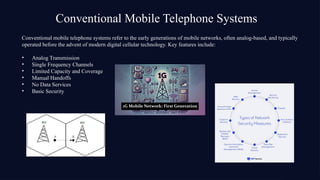
Conventional mobile telephone systems refer to the early generations of mobile networks, often analog-based, and typically
operated before the advent of modern digital cellular technology. Key features include:
• Analog Transmission
• Single Frequency Channels
• Limited Capacity and Coverage
• Manual Handoffs
• No Data Services
• Basic Security
• Motivation for Cellular Mobile Communication Systems
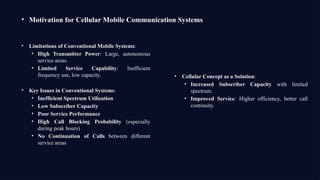
• Limitations of Conventional Mobile Systems:
• High Transmitter Power: Large, autonomous
service areas.
• Limited Service Capability: Inefficient
frequency use, low capacity.
• Key Issues in Conventional Systems:
• Inefficient Spectrum Utilization
• Low Subscriber Capacity
• Poor Service Performance
• High Call Blocking Probability (especially
during peak hours)
• No Continuation of Calls between different
service areas
• Cellular Concept as a Solution:
• Increased Subscriber Capacity with limited
spectrum.
• Improved Service: Higher efficiency, better call
continuity.
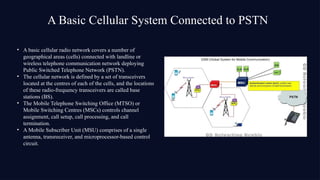
A Basic Cellular System Connected to PSTN
• A basic cellular radio network covers a number of
geographical areas (cells) connected with landline or
wireless telephone communication network deploying
Public Switched Telephone Network (PSTN).
• The cellular network is defined by a set of transceivers
located at the centres of each of the cells, and the locations
of these radio-frequency transceivers are called base
stations (BS).
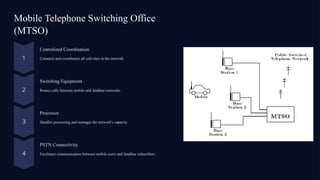
• The Mobile Telephone Switching Office (MTSO) or
Mobile Switching Centres (MSCs) controls channel
assignment, call setup, call processing, and call
termination.
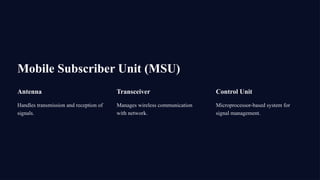
• A Mobile Subscriber Unit (MSU) comprises of a single
antenna, transreceiver, and microprocessor-based control
circuit.
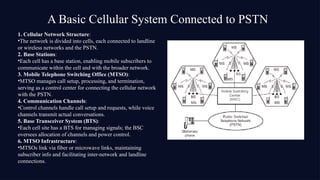
1. Cellular Network Structure:
•The network is divided into cells, each connected to landline
or wireless networks and the PSTN.
2. Base Stations:
•Each cell has a base station, enabling mobile subscribers to
communicate within the cell and with the broader network.
3. Mobile Telephone Switching Office (MTSO):
•MTSO manages call setup, processing, and termination,
serving as a control center for connecting the cellular network
with the PSTN.
4. Communication Channels:
•Control channels handle call setup and requests, while voice
channels transmit actual conversations.
5. Base Transceiver System (BTS):
•Each cell site has a BTS for managing signals; the BSC
oversees allocation of channels and power control.
6. MTSO Infrastructure:
•MTSOs link via fiber or microwave links, maintaining
subscriber info and facilitating inter-network and landline
connections.
A Basic Cellular System Connected to PSTN
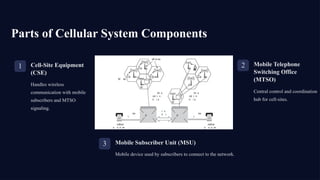
Parts of Cellular System Components
1 Cell-Site Equipment
(CSE)
Handles wireless
communication with mobile
subscribers and MTSO
signaling.
2 Mobile Telephone
Switching Office
(MTSO)
Central control and coordination
hub for cell-sites.
3 Mobile Subscriber Unit (MSU)
Mobile device used by subscribers to connect to the network.
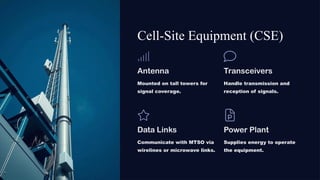
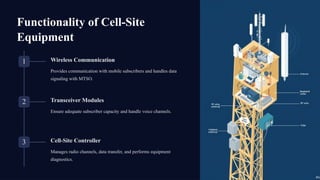
Cell-Site Equipment (CSE)
Antenna
Mounted on tall towers for
signal coverage.
Transceivers
Handle transmission and
reception of signals.
Data Links
Communicate with MTSO via
wirelines or microwave links.
Power Plant
Supplies energy to operate
the equipment.
Functionality of Cell-Site
Equipment
1 Wireless Communication
Provides communication with mobile subscribers and handles data
signaling with MTSO.
2 Transceiver Modules
Ensure adequate subscriber capacity and handle voice channels.
3 Cell-Site Controller
Manages radio channels, data transfer, and performs equipment
diagnostics.
Cell-Site Antenna and Design Considerations
Antenna Types
Can be omnidirectional,
directional, or custom-shaped for
specific coverage needs.
Antenna Gain
Enhances transmitted power for
improved signal strength.
Antenna Tilting
Reduces interference and enhances
signal coverage in specific areas.
Antenna Height
Impacts the coverage area and
shape of the cell.
Mobile Telephone Switching Office
(MTSO)
Centralized Coordination
Connects and coordinates all cell-sites in the network.
Switching Equipment
Routes calls between mobile and landline networks.
Processor
Handles processing and manages the network's capacity.
PSTN Connectivity
Facilitates communication between mobile users and landline subscribers.
MTSO Functions and
Communication Links
Call Processing Routes calls between mobile
and landline networks
Subscriber Management Manages mobile subscriber
data and billing
Data Communication Uses X.25 protocol for data
links between cell-sites and
MTSO
High-Speed Transmission Utilizes microwave radio
links or T-carriers for data
transmission
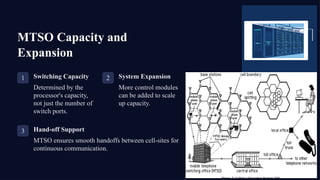
MTSO Capacity and
Expansion
1 Switching Capacity
Determined by the
processor's capacity,
not just the number of
switch ports.
2 System Expansion
More control modules
can be added to scale
up capacity.
3 Hand-off Support
MTSO ensures smooth handoffs between cell-sites for
continuous communication.
Cellular System
Components
Exploring key elements of mobile communication infrastructure.
Mobile Subscriber Unit (MSU)
Antenna
Handles transmission and reception of
signals.
Transceiver
Manages wireless communication
with network.
Control Unit
Microprocessor-based system for
signal management.
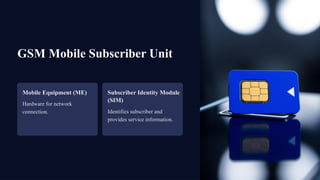
GSM Mobile Subscriber Unit
Mobile Equipment (ME)
Hardware for network
connection.
Subscriber Identity Module
(SIM)
Identifies subscriber and
provides service information.
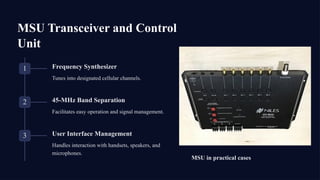
MSU Transceiver and Control
Unit
1 Frequency Synthesizer
Tunes into designated cellular channels.
2 45-MHz Band Separation
Facilitates easy operation and signal management.
3 User Interface Management
Handles interaction with handsets, speakers, and
microphones.
MSU in practical cases
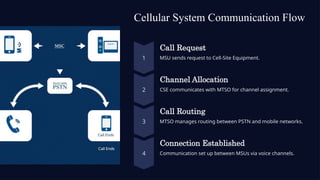
Cellular System Communication Flow
Call Request
MSU sends request to Cell-Site Equipment.
Channel Allocation
CSE communicates with MTSO for channel assignment.
Call Routing
MTSO manages routing between PSTN and mobile networks.
Connection Established
Communication set up between MSUs via voice channels.
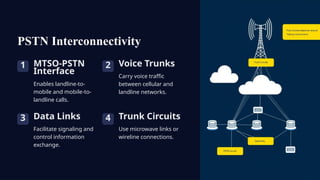
PSTN Interconnectivity
1 MTSO-PSTN
Interface
Enables landline-to-
mobile and mobile-to-
landline calls.
2 Voice Trunks
Carry voice traffic
between cellular and
landline networks.
3 Data Links
Facilitate signaling and
control information
exchange.
4 Trunk Circuits
Use microwave links or
wireline connections.
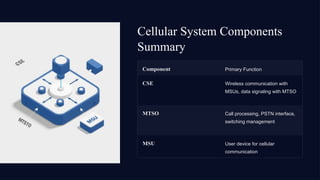
Cellular System Components
Summary
Component Primary Function
CSE Wireless communication with
MSUs, data signaling with MTSO
MTSO Call processing, PSTN interface,
switching management
MSU User device for cellular
communication
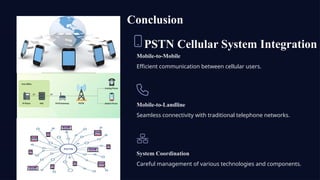
PSTN Cellular System Integration
Mobile-to-Mobile
Efficient communication between cellular users.
Mobile-to-Landline
Seamless connectivity with traditional telephone networks.
System Coordination
Careful management of various technologies and components.
Conclusion
THANK YOU

A-Basic-Cellular-System-Connected-to-PSTN

  • 1.
    A Basic CellularSystem Connected to PSTN By Amit & V Thathrathrayan Subject:- Optical and Wireless communication Subject code:- 21EC72
  • 2.
    Conventional Mobile TelephoneSystems Conventional mobile telephone systems refer to the early generations of mobile networks, often analog-based, and typically operated before the advent of modern digital cellular technology. Key features include: • Analog Transmission • Single Frequency Channels • Limited Capacity and Coverage • Manual Handoffs • No Data Services • Basic Security
  • 3.
    • Motivation forCellular Mobile Communication Systems • Limitations of Conventional Mobile Systems: • High Transmitter Power: Large, autonomous service areas. • Limited Service Capability: Inefficient frequency use, low capacity. • Key Issues in Conventional Systems: • Inefficient Spectrum Utilization • Low Subscriber Capacity • Poor Service Performance • High Call Blocking Probability (especially during peak hours) • No Continuation of Calls between different service areas • Cellular Concept as a Solution: • Increased Subscriber Capacity with limited spectrum. • Improved Service: Higher efficiency, better call continuity.
  • 4.
    A Basic CellularSystem Connected to PSTN • A basic cellular radio network covers a number of geographical areas (cells) connected with landline or wireless telephone communication network deploying Public Switched Telephone Network (PSTN). • The cellular network is defined by a set of transceivers located at the centres of each of the cells, and the locations of these radio-frequency transceivers are called base stations (BS). • The Mobile Telephone Switching Office (MTSO) or Mobile Switching Centres (MSCs) controls channel assignment, call setup, call processing, and call termination. • A Mobile Subscriber Unit (MSU) comprises of a single antenna, transreceiver, and microprocessor-based control circuit.
  • 5.
    1. Cellular NetworkStructure: •The network is divided into cells, each connected to landline or wireless networks and the PSTN. 2. Base Stations: •Each cell has a base station, enabling mobile subscribers to communicate within the cell and with the broader network. 3. Mobile Telephone Switching Office (MTSO): •MTSO manages call setup, processing, and termination, serving as a control center for connecting the cellular network with the PSTN. 4. Communication Channels: •Control channels handle call setup and requests, while voice channels transmit actual conversations. 5. Base Transceiver System (BTS): •Each cell site has a BTS for managing signals; the BSC oversees allocation of channels and power control. 6. MTSO Infrastructure: •MTSOs link via fiber or microwave links, maintaining subscriber info and facilitating inter-network and landline connections. A Basic Cellular System Connected to PSTN
  • 6.
    Parts of CellularSystem Components 1 Cell-Site Equipment (CSE) Handles wireless communication with mobile subscribers and MTSO signaling. 2 Mobile Telephone Switching Office (MTSO) Central control and coordination hub for cell-sites. 3 Mobile Subscriber Unit (MSU) Mobile device used by subscribers to connect to the network.
  • 7.
    Cell-Site Equipment (CSE) Antenna Mountedon tall towers for signal coverage. Transceivers Handle transmission and reception of signals. Data Links Communicate with MTSO via wirelines or microwave links. Power Plant Supplies energy to operate the equipment.
  • 8.
    Functionality of Cell-Site Equipment 1Wireless Communication Provides communication with mobile subscribers and handles data signaling with MTSO. 2 Transceiver Modules Ensure adequate subscriber capacity and handle voice channels. 3 Cell-Site Controller Manages radio channels, data transfer, and performs equipment diagnostics.
  • 9.
    Cell-Site Antenna andDesign Considerations Antenna Types Can be omnidirectional, directional, or custom-shaped for specific coverage needs. Antenna Gain Enhances transmitted power for improved signal strength. Antenna Tilting Reduces interference and enhances signal coverage in specific areas. Antenna Height Impacts the coverage area and shape of the cell.
  • 10.
    Mobile Telephone SwitchingOffice (MTSO) Centralized Coordination Connects and coordinates all cell-sites in the network. Switching Equipment Routes calls between mobile and landline networks. Processor Handles processing and manages the network's capacity. PSTN Connectivity Facilitates communication between mobile users and landline subscribers.
  • 11.
    MTSO Functions and CommunicationLinks Call Processing Routes calls between mobile and landline networks Subscriber Management Manages mobile subscriber data and billing Data Communication Uses X.25 protocol for data links between cell-sites and MTSO High-Speed Transmission Utilizes microwave radio links or T-carriers for data transmission
  • 12.
    MTSO Capacity and Expansion 1Switching Capacity Determined by the processor's capacity, not just the number of switch ports. 2 System Expansion More control modules can be added to scale up capacity. 3 Hand-off Support MTSO ensures smooth handoffs between cell-sites for continuous communication.
  • 13.
    Cellular System Components Exploring keyelements of mobile communication infrastructure.
  • 14.
    Mobile Subscriber Unit(MSU) Antenna Handles transmission and reception of signals. Transceiver Manages wireless communication with network. Control Unit Microprocessor-based system for signal management.
  • 15.
    GSM Mobile SubscriberUnit Mobile Equipment (ME) Hardware for network connection. Subscriber Identity Module (SIM) Identifies subscriber and provides service information.
  • 16.
    MSU Transceiver andControl Unit 1 Frequency Synthesizer Tunes into designated cellular channels. 2 45-MHz Band Separation Facilitates easy operation and signal management. 3 User Interface Management Handles interaction with handsets, speakers, and microphones. MSU in practical cases
  • 17.
    Cellular System CommunicationFlow Call Request MSU sends request to Cell-Site Equipment. Channel Allocation CSE communicates with MTSO for channel assignment. Call Routing MTSO manages routing between PSTN and mobile networks. Connection Established Communication set up between MSUs via voice channels.
  • 18.
    PSTN Interconnectivity 1 MTSO-PSTN Interface Enableslandline-to- mobile and mobile-to- landline calls. 2 Voice Trunks Carry voice traffic between cellular and landline networks. 3 Data Links Facilitate signaling and control information exchange. 4 Trunk Circuits Use microwave links or wireline connections.
  • 19.
    Cellular System Components Summary ComponentPrimary Function CSE Wireless communication with MSUs, data signaling with MTSO MTSO Call processing, PSTN interface, switching management MSU User device for cellular communication
  • 20.
    PSTN Cellular SystemIntegration Mobile-to-Mobile Efficient communication between cellular users. Mobile-to-Landline Seamless connectivity with traditional telephone networks. System Coordination Careful management of various technologies and components. Conclusion
  • 21.