Key Account Management
Presentation Question: 12
Selling Strategies and Practices


                                   Presented by :
                                   Karl Campbell
Overview
   Objectives
   Definition
   Basic Elements of Key Account
    Management
   Nature of the Job
   Nature of the Selling task
   Skills and Competences
   Level of Qualification
   Conclusion
   References
   Summary of Article
   Article Review
Objectives
   Define key terms
   Identify elements of KAM
   To explain and increase awareness of
    what key account is
   Identify the skills required for Key
    account management
   Make aware the nature of the job of key
    account manager
   Distinguish between key account
    management and sales engineers
Definitions
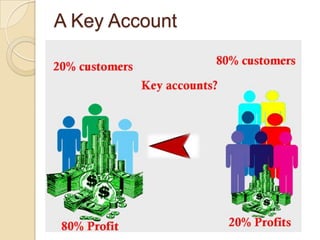
   What is a Key Account?
    ◦ “A customer in a business to business market
      identified by a selling company as being of
      strategic importance” (Millman&Wilson, 1995)


 Any customer that is considered prestige
  or have a high sales potential
 The 20% of a firms customers that provide
  80% profits
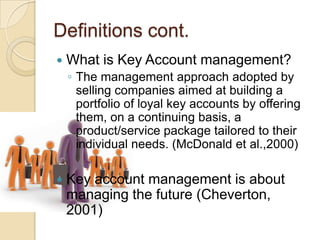
Definitions cont.
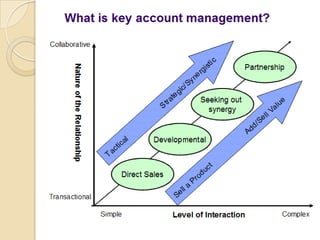
   What is Key Account management?
    ◦ The management approach adopted by
      selling companies aimed at building a
      portfolio of loyal key accounts by offering
      them, on a continuing basis, a
      product/service package tailored to their
      individual needs. (McDonald et al.,2000)

   Key account management is about
    managing the future (Cheverton,
    2001)
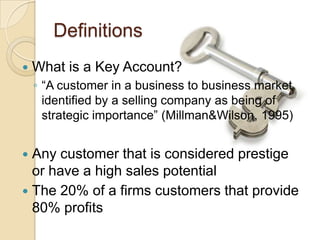
A Key Account
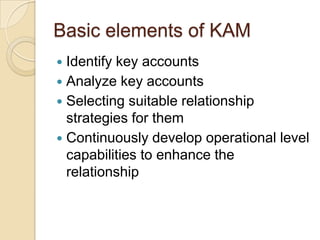
Basic elements of KAM
 Identify key accounts
 Analyze key accounts
 Selecting suitable relationship
  strategies for them
 Continuously develop operational level
  capabilities to enhance the
  relationship
Nature of the Job
   They are tasked with making the clients
    happy by providing good quality service
    ◦ Eg. For a company providing services like
      telephones, communications or even supplies
      all their printing requirements and needs. The
      key account manager has to ensure that his
      company provides up to scratch and functional
      hardware
 Become PR agents to gather information
 Become a “Charmer”
    ◦ Charm your way through your contacts so that
      you don‟t get easily dislodged by your
Nature of the Job cont.
   Be very close to contact persons and
    decision makers of the accounts you
    are assigned.
    ◦ Knowing their birthdays and anniversaries
      if possible, and recognizing those dates.
Nature of the Selling Task
 Key accounts must be treated better
  than the average
 Skew allocations of resources more to
  key accounts
 Have to ensure quality and individual
  service every time
 Need to be successful at their task or
  else lose a portion of profits
Skills and Competences of
    KAM
 Strong communications skills
 Excellent selling skills
 Ability to motivate and lead
 Good negotiation and customer service
  skills
 Analytical skills
 Intrapreneurial ability
 Good presentation skills
 Good understanding of the industry
 Good organization skills (Royds, Muchira)
Level of Qualification
• Associate's degree or a bachelor's degree
   Business Administration or Bachelor of Arts


• Sometimes have a Master's of Business
  Administration

• Most employers prefer candidates with
  three to five years experience in a business-
  related position.
Conclusion
   A key account manager handles the
    most important accounts in an
    organization. These are considered
    important because of their profitability
    and strategic significance. You have to
    possess several skills and
    competences to perform the job of a
    key account manager and have a
    certain level of qualification to hold the
    position.
References
   Cheverton, P.(2001) Strategic Customer
        Alliances. London: Pitman.
   McDonald et al. (2000) Key Customers. How to
        Manage them properly. Oxford
   Millman, T. & Wilson, K.(1995) From Key
        Account Selling to Key Account
        Management. Journal of Marketing Practice
   Royds, T. (2007) Key Account Management: The
    role of the Sales Manager
   Muchira, M.( n.d) Job Description for Key Account
        Manager retrived from
        http://www.ehow.com/about_6576220_job-
        description-key-account-      manager.
   Fulcher, L.(2010) Why Key Account Management
    and        Recession were made for each other
Article Summary : Why key account
     management and Recession were made for each
     other
   According to Laura Fulcher a key account is not just the biggest
    account but should also be the one with the most potential. She stated
    it was obvious that it was harder to find a customer than to keep one,
    and what is much less understood is the difference between active
    customer account management and just „looking after your customer‟.
    One of the first myths when talking about key account management is
    the Hunter/Farmer paradigm which means that getting new business
    focused around new customers and all that is required for the existing
    ones is effective farming. She highlighted that a tool used to expose
    this approach is wallet share analysis which is how we establish the
    difference between what customers spend with us as opposed to the
    completion and in getting sales people to think this way converts from
    the need for farming to hunting within the account.
   Evidence according to the writer shows that as times get difficult
    buyers become more hesitant, that is staying with what they know
    which makes it harder to gain new business. However if sales people
    have a key account approach to their most prestige customers the
    potential for increased sales is considerable. The word potential is
    important in that a large, low potential account requires very different
Article Review
   The article:
    ◦ Defined who a key account is
    ◦ Identified the need for a key account
      approach in sales
    ◦ Briefly identified the relationship between
      economy and buying behavior
    ◦ Concisely explained the concept of
      potential as it relates to a sales account
   The article confirmed prior definitions
    of key account and its importance to
    sales people/businesses and has
    further cemented this to knowledge

Karl campbell selling

  • 1.
    Key Account Management PresentationQuestion: 12 Selling Strategies and Practices Presented by : Karl Campbell
  • 2.
    Overview  Objectives  Definition  Basic Elements of Key Account Management  Nature of the Job  Nature of the Selling task  Skills and Competences  Level of Qualification  Conclusion  References  Summary of Article  Article Review
  • 3.
    Objectives  Define key terms  Identify elements of KAM  To explain and increase awareness of what key account is  Identify the skills required for Key account management  Make aware the nature of the job of key account manager  Distinguish between key account management and sales engineers
  • 4.
    Definitions  What is a Key Account? ◦ “A customer in a business to business market identified by a selling company as being of strategic importance” (Millman&Wilson, 1995)  Any customer that is considered prestige or have a high sales potential  The 20% of a firms customers that provide 80% profits
  • 5.
    Definitions cont.  What is Key Account management? ◦ The management approach adopted by selling companies aimed at building a portfolio of loyal key accounts by offering them, on a continuing basis, a product/service package tailored to their individual needs. (McDonald et al.,2000)  Key account management is about managing the future (Cheverton, 2001)
  • 7.
  • 8.
    Basic elements ofKAM  Identify key accounts  Analyze key accounts  Selecting suitable relationship strategies for them  Continuously develop operational level capabilities to enhance the relationship
  • 9.
    Nature of theJob  They are tasked with making the clients happy by providing good quality service ◦ Eg. For a company providing services like telephones, communications or even supplies all their printing requirements and needs. The key account manager has to ensure that his company provides up to scratch and functional hardware  Become PR agents to gather information  Become a “Charmer” ◦ Charm your way through your contacts so that you don‟t get easily dislodged by your
  • 10.
    Nature of theJob cont.  Be very close to contact persons and decision makers of the accounts you are assigned. ◦ Knowing their birthdays and anniversaries if possible, and recognizing those dates.
  • 11.
    Nature of theSelling Task  Key accounts must be treated better than the average  Skew allocations of resources more to key accounts  Have to ensure quality and individual service every time  Need to be successful at their task or else lose a portion of profits
  • 12.
    Skills and Competencesof KAM  Strong communications skills  Excellent selling skills  Ability to motivate and lead  Good negotiation and customer service skills  Analytical skills  Intrapreneurial ability  Good presentation skills  Good understanding of the industry  Good organization skills (Royds, Muchira)
  • 13.
    Level of Qualification •Associate's degree or a bachelor's degree  Business Administration or Bachelor of Arts • Sometimes have a Master's of Business Administration • Most employers prefer candidates with three to five years experience in a business- related position.
  • 14.
    Conclusion  A key account manager handles the most important accounts in an organization. These are considered important because of their profitability and strategic significance. You have to possess several skills and competences to perform the job of a key account manager and have a certain level of qualification to hold the position.
  • 15.
    References  Cheverton, P.(2001) Strategic Customer Alliances. London: Pitman.  McDonald et al. (2000) Key Customers. How to Manage them properly. Oxford  Millman, T. & Wilson, K.(1995) From Key Account Selling to Key Account Management. Journal of Marketing Practice  Royds, T. (2007) Key Account Management: The role of the Sales Manager  Muchira, M.( n.d) Job Description for Key Account Manager retrived from http://www.ehow.com/about_6576220_job- description-key-account- manager.  Fulcher, L.(2010) Why Key Account Management and Recession were made for each other
  • 16.
    Article Summary :Why key account management and Recession were made for each other  According to Laura Fulcher a key account is not just the biggest account but should also be the one with the most potential. She stated it was obvious that it was harder to find a customer than to keep one, and what is much less understood is the difference between active customer account management and just „looking after your customer‟. One of the first myths when talking about key account management is the Hunter/Farmer paradigm which means that getting new business focused around new customers and all that is required for the existing ones is effective farming. She highlighted that a tool used to expose this approach is wallet share analysis which is how we establish the difference between what customers spend with us as opposed to the completion and in getting sales people to think this way converts from the need for farming to hunting within the account.  Evidence according to the writer shows that as times get difficult buyers become more hesitant, that is staying with what they know which makes it harder to gain new business. However if sales people have a key account approach to their most prestige customers the potential for increased sales is considerable. The word potential is important in that a large, low potential account requires very different
  • 17.
    Article Review  The article: ◦ Defined who a key account is ◦ Identified the need for a key account approach in sales ◦ Briefly identified the relationship between economy and buying behavior ◦ Concisely explained the concept of potential as it relates to a sales account  The article confirmed prior definitions of key account and its importance to sales people/businesses and has further cemented this to knowledge