KAM
KEY ACCOUNT MANAGEMENT
Formal definition
A systematic approach to managing and
growing a named set of an organization's
most important customers to maximize
mutual value and achieve mutually beneficial
goals.
What is an account?
• B2B sales always involves bulk amount.
• Products are used as an input for an
organization or purchased for reselling.
• Every client is an account
• But every account is not a key account.
• Every business entity that a firm
engages with is an account.
• Some accounts might be more
attractive due to their size or financial
attractiveness.
• KAM is not a CRM.
• In B2B relationship matters more than
in B2C, hence understanding the clients
and building a good rapport is necessary.
• KAM is to ensure the long-term
development and retention of strategic
customers.
• FOCUS: Results, Relationship, Trust
CRM VS KAM
• CRM solutions are strongly
focused on managing the
sales process. Capturing
key metrics, CRM solutions
can pinpoint accurately
where leads are in the
sales pipeline. Thus, sales
teams can take
appropriate action to
convert leads into sales.
This heavy focus on
managing sales
opportunities and acquiring
new clients is CRM’s
strength.
• KAM solutions, focus
strongly on building solid
relationships with existing
high-priority clients.
Rather than thinking of
clients merely as
“opportunities”, KAM
solutions encourage a more
holistic approach.
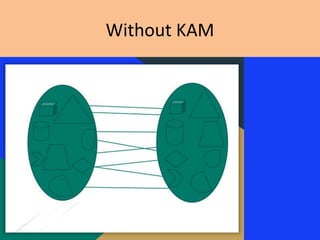
Without KAM
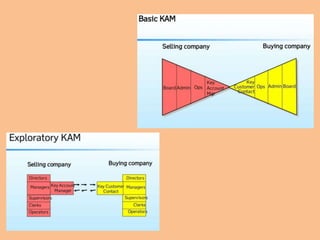
• Hence building a single point of contact
with the help of KAM
• But are all accounts(clients) profitable?
Or can they be our key accounts?
• Certainly no
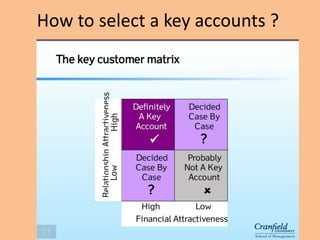
How to select a key accounts ?
• KAM is based on Pareto’s rule:
80 % of your profit will come from 20%
of your accounts.
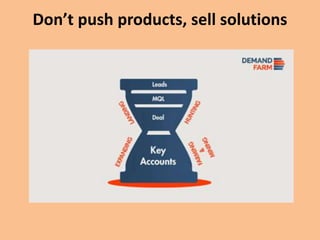
Marketing generates thousands of leads &
passes on the qualified leads to sales
who in turn win deals. So far so good.
But for B2B companies who offer
multiple solutions with long term
engagements with their customers,
winning the first deal is only the
beginning. You then farm and mine those
key accounts for more revenues.
Basically, you LAND and then EXPAND.
Don’t push products, sell solutions
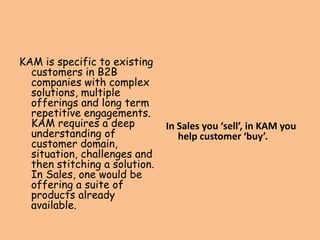
KAM is specific to existing
customers in B2B
companies with complex
solutions, multiple
offerings and long term
repetitive engagements.
KAM requires a deep
understanding of
customer domain,
situation, challenges and
then stitching a solution.
In Sales, one would be
offering a suite of
products already
available.
In Sales you ‘sell’, in KAM you
help customer ‘buy’.

Key Account Management

  • 1.
  • 2.
    Formal definition A systematicapproach to managing and growing a named set of an organization's most important customers to maximize mutual value and achieve mutually beneficial goals.
  • 3.
    What is anaccount? • B2B sales always involves bulk amount. • Products are used as an input for an organization or purchased for reselling. • Every client is an account • But every account is not a key account.
  • 4.
    • Every businessentity that a firm engages with is an account. • Some accounts might be more attractive due to their size or financial attractiveness.
  • 5.
    • KAM isnot a CRM. • In B2B relationship matters more than in B2C, hence understanding the clients and building a good rapport is necessary. • KAM is to ensure the long-term development and retention of strategic customers. • FOCUS: Results, Relationship, Trust
  • 6.
    CRM VS KAM •CRM solutions are strongly focused on managing the sales process. Capturing key metrics, CRM solutions can pinpoint accurately where leads are in the sales pipeline. Thus, sales teams can take appropriate action to convert leads into sales. This heavy focus on managing sales opportunities and acquiring new clients is CRM’s strength. • KAM solutions, focus strongly on building solid relationships with existing high-priority clients. Rather than thinking of clients merely as “opportunities”, KAM solutions encourage a more holistic approach.
  • 7.
  • 9.
    • Hence buildinga single point of contact with the help of KAM • But are all accounts(clients) profitable? Or can they be our key accounts? • Certainly no
  • 10.
    How to selecta key accounts ?
  • 11.
    • KAM isbased on Pareto’s rule: 80 % of your profit will come from 20% of your accounts.
  • 12.
    Marketing generates thousandsof leads & passes on the qualified leads to sales who in turn win deals. So far so good. But for B2B companies who offer multiple solutions with long term engagements with their customers, winning the first deal is only the beginning. You then farm and mine those key accounts for more revenues. Basically, you LAND and then EXPAND.
  • 13.
    Don’t push products,sell solutions
  • 14.
    KAM is specificto existing customers in B2B companies with complex solutions, multiple offerings and long term repetitive engagements. KAM requires a deep understanding of customer domain, situation, challenges and then stitching a solution. In Sales, one would be offering a suite of products already available. In Sales you ‘sell’, in KAM you help customer ‘buy’.