Leadership Development getting to the core
Brutal Reality the world is becoming more & more complex it is getting more connected & more fragmented at the same time change is happening at an ever-increasing rate this change is causing increased volatility (risk)
More Reality Good management will keep an organization on an even keel, but it is leadership that will guide it along its journey.
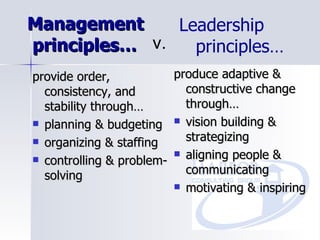
Management  principles… provide order, consistency, and stability through… planning & budgeting organizing & staffing controlling & problem-solving produce adaptive & constructive change through… vision building & strategizing aligning people & communicating motivating & inspiring Leadership   principles… v.
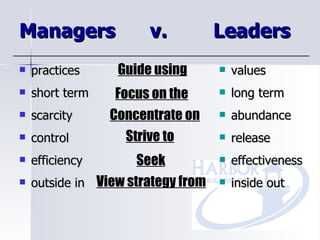
Managers  v.  Leaders practices short term scarcity control efficiency outside in values long term abundance release effectiveness inside out Guide using View strategy from Concentrate on Strive to Seek Focus on the
Leadership Nucleus To be a leader, a person needs to… be going somewhere, and have people willing to go along.
Leadership Nucleus Therefore, a leader’s ultimate responsibility is to… Complete the mission (reach the goal), and See to the welfare of the followers
Leadership Nucleus The ultimate measure of a leader is…  how well does that person deliver results  through others , and how much the followers are becoming healthier, wiser, freer, more autonomous & more likely to become leaders themselves
Leadership Nucleus The ultimate skills related to mission  visualize the desired future strategize how to get there engage the right people, and formalize (facilitate) action plans needed to carry out the strategies delegate & empower for results
Leadership Nucleus The ultimate skills related to people recruiting motivating inspiring aligning communicating mentoring
Developing Leaders To be effective, “leader development” needs to be more than a program -- it  must be an integral part of the culture reflecting the “core ideology & envisioned future” of the organization, and being a key element of the HR, organizational planning, and organizational performance systems and processes

Leadership Development

  • 1.
  • 2.
    Brutal Reality theworld is becoming more & more complex it is getting more connected & more fragmented at the same time change is happening at an ever-increasing rate this change is causing increased volatility (risk)
  • 3.
    More Reality Goodmanagement will keep an organization on an even keel, but it is leadership that will guide it along its journey.
  • 4.
    Management principles…provide order, consistency, and stability through… planning & budgeting organizing & staffing controlling & problem-solving produce adaptive & constructive change through… vision building & strategizing aligning people & communicating motivating & inspiring Leadership principles… v.
  • 5.
    Managers v. Leaders practices short term scarcity control efficiency outside in values long term abundance release effectiveness inside out Guide using View strategy from Concentrate on Strive to Seek Focus on the
  • 6.
    Leadership Nucleus Tobe a leader, a person needs to… be going somewhere, and have people willing to go along.
  • 7.
    Leadership Nucleus Therefore,a leader’s ultimate responsibility is to… Complete the mission (reach the goal), and See to the welfare of the followers
  • 8.
    Leadership Nucleus Theultimate measure of a leader is… how well does that person deliver results through others , and how much the followers are becoming healthier, wiser, freer, more autonomous & more likely to become leaders themselves
  • 9.
    Leadership Nucleus Theultimate skills related to mission visualize the desired future strategize how to get there engage the right people, and formalize (facilitate) action plans needed to carry out the strategies delegate & empower for results
  • 10.
    Leadership Nucleus Theultimate skills related to people recruiting motivating inspiring aligning communicating mentoring
  • 11.
    Developing Leaders Tobe effective, “leader development” needs to be more than a program -- it must be an integral part of the culture reflecting the “core ideology & envisioned future” of the organization, and being a key element of the HR, organizational planning, and organizational performance systems and processes