Deployment Approach From  Initialization to Self Sufficiency
Six Sigma Described Quantification and Categorization of Deployment Results Fundamentals of Initialization and Infrastructure Development Process Management and Six Sigma The Path to Self Sufficiency Agenda Overview
It is the philosophy of breakthrough  level improvements, that every process can and should be repeatedly evaluated and significantly improved In terms of time required, resources used, quality performance, costs and other aspects relevant to the process. All leading to increased customer satisfaction, market share, revenue, profits, and ultimately shareholder value. Six Sigma Described
It is an enterprise wide strategy that effectively develops a capability and a desire within individuals to: To effectively manage process activities and  performance To solve business and quality problems To improve decision-making To improve the overall performance of the enterprise Six Sigma Described
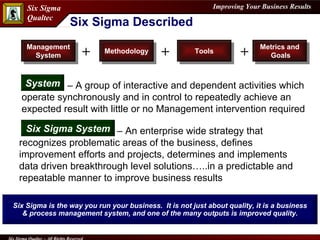
Management System Methodology Metrics and  Goals Tools + + + Six Sigma Described Six Sigma is the way you run your business.  It is not just about quality, it is a business & process management system, and one of the many outputs is improved quality.   –  A group of interactive and dependent activities which operate synchronously and in control to repeatedly achieve an expected result with little or no Management intervention required System –  An enterprise wide strategy that recognizes problematic areas of the business, defines improvement efforts and projects, determines and implements data driven breakthrough level solutions…..in a predictable and repeatable manner to improve business results Six Sigma System
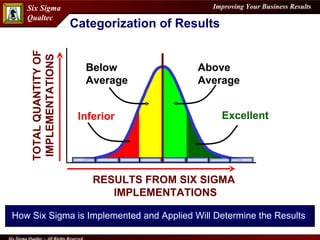
RESULTS FROM SIX SIGMA  IMPLEMENTATIONS Inferior Below Average Above Average Excellent TOTAL QUANTITY OF IMPLEMENTATIONS How Six Sigma is Implemented and Applied Will Determine the Results  Categorization of Results
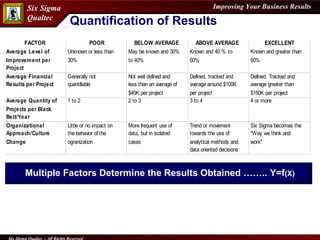
Quantification of Results Multiple Factors Determine the Results Obtained …….. Y=f (X)
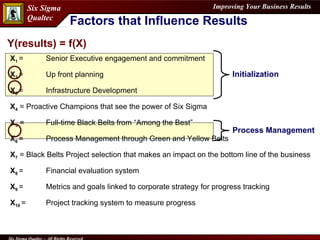
Factors that Influence Results X 1   = Senior Executive engagement and commitment X 2   = Up front planning X 3   = Infrastructure Development X 4  = Proactive Champions that see the power of Six Sigma  X 5  = Full-time Black Belts from “Among the Best” X 6   = Process Management through Green and Yellow Belts  X 7  = Black Belts Project selection that makes an impact on the bottom line of the business  X 8   = Financial evaluation system X 9   = Metrics and goals linked to corporate strategy for progress tracking X 10   = Project tracking system to measure progress Y(results) = f(X)   Process Management Initialization
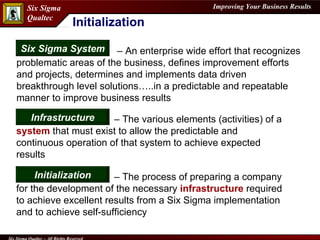
Initialization   –  An enterprise wide effort that recognizes problematic areas of the business, defines improvement efforts and projects, determines and implements data driven breakthrough level solutions…..in a predictable and repeatable manner to improve business results Six Sigma System –  The process of preparing a company for the development of the necessary  infrastructure  required to achieve excellent results from a Six Sigma implementation and to achieve self-sufficiency  Initialization –  The various elements (activities) of a  system  that must exist to allow the predictable and continuous operation of that system to achieve expected results Infrastructure
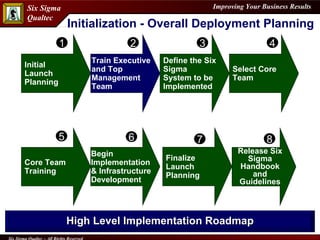
Initialization - Overall Deployment Planning 1 6 5 4 3 2 7 8 Initial Launch  Planning Train Executive and Top  Management  Team Define the Six Sigma System to be Implemented Begin Implementation & Infrastructure Development Finalize Launch  Planning Core Team  Training Select Core  Team High Level Implementation Roadmap Release Six Sigma Handbook and Guidelines
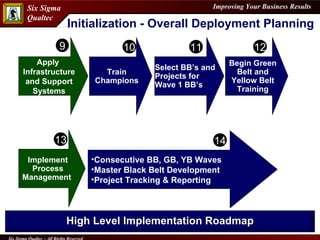
Select BB’s and Projects for Wave 1 BB’s Begin Green Belt and Yellow Belt Training Implement Process Management  12 11 10 9 13 Train Champions High Level Implementation Roadmap Consecutive BB, GB, YB Waves Master Black Belt Development Project Tracking & Reporting 14 Apply  Infrastructure and Support Systems Initialization - Overall Deployment Planning
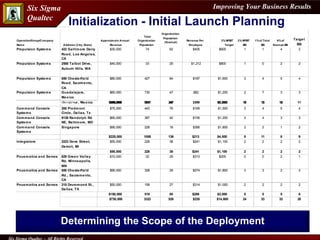
Determining the Scope of the Deployment Initialization -  Initial Launch Planning
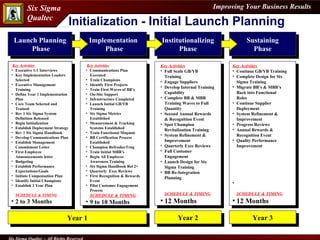
Initialization -  Initial Launch Planning Launch Planning Phase Key Activities Executive 1:1 Interviews Key Implementation Leaders Selected Executive Management Training Define Year 1 Implementation Plan Core Team Selected and Trained Rev 1 Six Sigma System Definition Released Begin Initialization Establish Deployment Strategy Rev 1 Six Sigma Handbook Develop Communications Plan Establish Management Commitment Letter First Employee Announcements letter Budgeting Establish Performance Expectations/Goals Initiate Compensation Plan Identify Initial Champions Establish 3 Year Plan  SCHEDULE & TIMING 2 to 3 Months Implementation Phase Key Activities Communications Plan Executed Train Champions Identify First Projects Train First Waves of BB’s On-Site Support Infrastructure Completed Launch Initial GB/YB Training Six Sigma Metrics Established Measurement & Tracking Systems Established Train Functional Mngmnt BB Certification Process Established Champion RefresherTrng Train Initial MBB’s Begin All Employee Awareness Training Six Sigma Handbook Rel 2+ Quarterly  Exec Reviews First Recognition & Rewards Event Pilot Customer Engagement Process SCHEDULE & TIMING 9 to 10 Months Institutionalizing Phase Key Activities Full Scale GB/YB Training Engage Suppliers Develop Internal Training Capability Complete BB & MBB Training Waves to Full Quantity  Second Annual Rewards & Recognition Event Spot Champion Revitalization Training System Refinement & Improvement  Quarterly Exec Reviews Full Customer Engagement Launch Design for Six Sigma Training BB Re-Integration Planning SCHEDULE & TIMING 12 Months Sustaining Phase Key Activities Continue GB/YB Training Complete Design for Six Sigma Training Migrate BB’s & MBB’s Back into Functional Roles Continue Supplier Deployment System Refinement & Improvement  Progress Reviews Annual Rewards & Recognition Event Quality Performance Improvement SCHEDULE & TIMING 12 Months Year 1 Year 2 Year 3
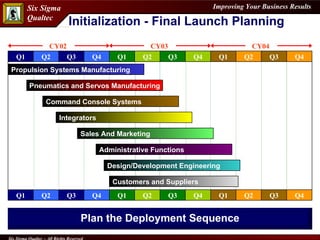
Propulsion Systems Manufacturing  Pneumatics and Servos Manufacturing Command Console Systems  Integrators Sales And Marketing Customers and Suppliers Design/Development Engineering Administrative Functions Initialization - Final Launch Planning Plan the Deployment Sequence Q1 Q2 Q3 Q4 Q1 Q2 Q3 Q4 Q1 Q2 Q3 Q4 Q1 Q2 Q3 Q4 Q1 Q2 Q3 Q4 Q1 Q2 Q3 Q4 CY02 CY03 CY04
1 Year Detail Planning for All Needed Events Initialization - Final Launch Planning
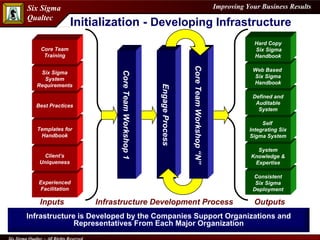
Initialization -  Developing Infrastructure  Infrastructure is Developed by the Companies Support Organizations and Representatives From Each Major Organization Engage Process Core Team Workshop 1 Infrastructure Development Process Outputs  Consistent Six Sigma Deployment System Knowledge & Expertise Self  Integrating Six Sigma System Defined and Auditable System Web Based  Six Sigma Handbook Hard Copy Six Sigma Handbook Core Team Workshop “N” Experienced Facilitation Client’s Uniqueness Templates for Handbook Best Practices Six Sigma System Requirements Inputs Core Team Training
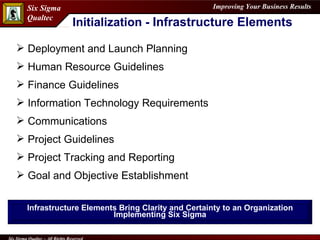
Deployment and Launch Planning  Human Resource Guidelines  Finance Guidelines  Information Technology Requirements  Communications Project Guidelines  Project Tracking and Reporting  Goal and Objective Establishment  Initialization -  Infrastructure Elements Infrastructure Elements Bring Clarity and Certainty to an Organization Implementing Six Sigma
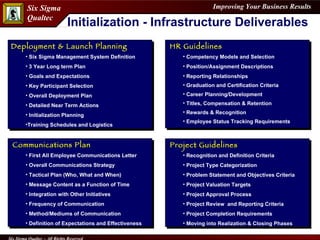
HR Guidelines Competency Models and Selection Position/Assignment Descriptions Reporting Relationships Graduation and Certification Criteria Career Planning/Development Titles, Compensation & Retention Rewards & Recognition Employee Status Tracking Requirements Deployment & Launch Planning Six Sigma Management System Definition 3 Year Long term Plan Goals and Expectations  Key Participant Selection Overall Deployment Plan Detailed Near Term Actions Initialization Planning Training Schedules and Logistics Communications Plan First All Employee Communications Letter Overall Communications Strategy Tactical Plan (Who, What and When)  Message Content as a Function of Time Integration with Other Initiatives Frequency of Communication Method/Mediums of Communication Definition of Expectations and Effectiveness Project Guidelines Recognition and Definition Criteria Project Type Categorization Problem Statement and Objectives Criteria Project Valuation Targets Project Approval Process Project Review  and Reporting Criteria Project Completion Requirements Moving into Realization & Closing Phases Initialization - Infrastructure Deliverables
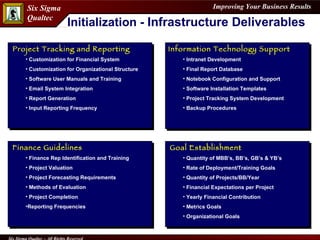
Project Tracking and Reporting Customization for Financial System Customization for Organizational Structure Software User Manuals and Training Email System Integration  Report Generation Input Reporting Frequency  Information Technology Support Intranet Development Final Report Database Notebook Configuration and Support Software Installation Templates Project Tracking System Development Backup Procedures Finance Guidelines Finance Rep Identification and Training Project Valuation  Project Forecasting Requirements Methods of Evaluation Project Completion Reporting Frequencies Goal Establishment Quantity of MBB’s, BB’s, GB’s & YB’s Rate of Deployment/Training Goals Quantity of Projects/BB/Year Financial Expectations per Project Yearly Financial Contribution Metrics Goals Organizational Goals Initialization -  Infrastructure Deliverables
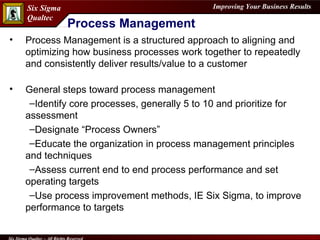
Process Management Process Management is a structured approach to aligning and optimizing how business processes work together to repeatedly and consistently deliver results/value to a customer General steps toward process management Identify core processes, generally 5 to 10 and prioritize for assessment Designate “Process Owners” Educate the organization in process management principles and techniques Assess current end to end process performance and set operating targets Use process improvement methods, IE Six Sigma, to improve performance to targets
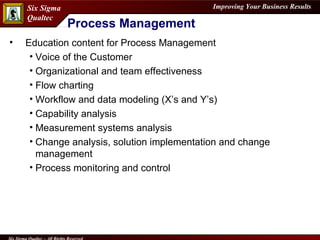
Process Management Education content for Process Management Voice of the Customer Organizational and team effectiveness Flow charting Workflow and data modeling (X’s and Y’s) Capability analysis Measurement systems analysis Change analysis, solution implementation and change management Process monitoring and control
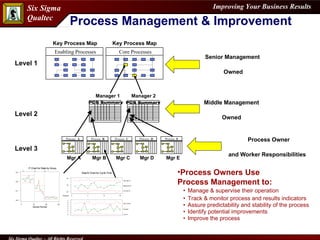
Level 1 Mgr A Mgr B Mgr C Mgr D Mgr E PCS Summary Manager 1 Manager 2 Senior Management  Owned PCS Summary Key Process Map Enabling Processes  Key Process Map Core Processes  Level 2 Level 3 Middle Management  Owned  Process Owner and Worker Responsibilities  • Manage & supervise their operation • Track & monitor process and results indicators • Assure predictability and stability of the process • Identify potential improvements • Improve the process Process Owners Use Process Management to: Process Management & Improvement Process A Process B Process C Process D Process E
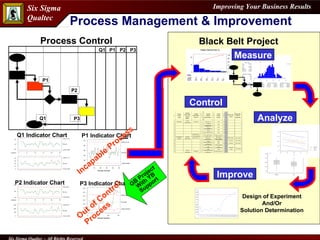
Process Management & Improvement P1 P2 P3 Q1 Q1 Indicator Chart P1 Indicator Chart P2 Indicator Chart P3 Indicator Chart Process Control Incapable Process Out of Control Process GB Project With YB Support Q1 P1 P2 P3 Measure Analyze Improve Design of Experiment And/Or Solution Determination Control Black Belt Project
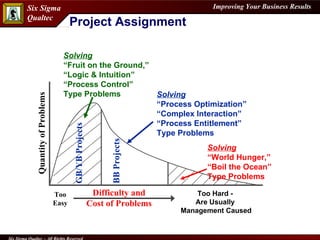
Project Assignment Difficulty and Cost of Problems Quantity of Problems BB Projects Too Hard - Are Usually Management Caused Too Easy Solving “World Hunger,” “ Boil the Ocean” Type Problems Solving   “ Fruit on the Ground,” “ Logic & Intuition” “ Process Control”  Type Problems Solving   “ Process Optimization” “ Complex Interaction” “ Process Entitlement” Type Problems GB/YB Projects
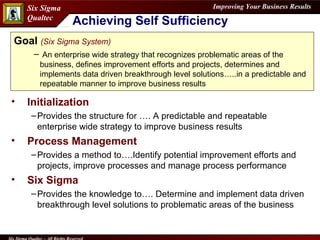
Goal   (Six Sigma System) An enterprise wide strategy that recognizes problematic areas of the business, defines improvement efforts and projects, determines and implements data driven breakthrough level solutions…..in a predictable and repeatable manner to improve business results Achieving Self Sufficiency Initialization Provides the structure for …. A  predictable and repeatable enterprise wide strategy to improve business results Process Management   Provides a method to….Identify potential improvement efforts and projects, improve processes and manage process performance Six Sigma Provides the knowledge to…. Determine and implement data driven breakthrough level solutions to problematic areas of the business
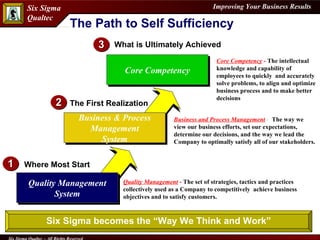
Business & Process Management System Quality Management System Quality Management  -   The set of strategies, tactics and practices collectively used as a Company to competitively  achieve business objectives and to satisfy customers. Where Most Start The First Realization Business and Process Management  -   The way we  view our business efforts, set our expectations, determine our decisions, and the way we lead the Company to optimally satisfy all of our stakeholders. Core Competency What is Ultimately Achieved Core Competency  -   The intellectual knowledge and capability of employees to quickly  and accurately solve problems, to align and optimize business process and to make better decisions  The Path to Self Sufficiency 1 2 3 Six Sigma becomes the “Way We Think and Work”

Lc Presentation

  • 1.
    Deployment Approach From Initialization to Self Sufficiency
  • 2.
    Six Sigma DescribedQuantification and Categorization of Deployment Results Fundamentals of Initialization and Infrastructure Development Process Management and Six Sigma The Path to Self Sufficiency Agenda Overview
  • 3.
    It is thephilosophy of breakthrough level improvements, that every process can and should be repeatedly evaluated and significantly improved In terms of time required, resources used, quality performance, costs and other aspects relevant to the process. All leading to increased customer satisfaction, market share, revenue, profits, and ultimately shareholder value. Six Sigma Described
  • 4.
    It is anenterprise wide strategy that effectively develops a capability and a desire within individuals to: To effectively manage process activities and performance To solve business and quality problems To improve decision-making To improve the overall performance of the enterprise Six Sigma Described
  • 5.
    Management System MethodologyMetrics and Goals Tools + + + Six Sigma Described Six Sigma is the way you run your business. It is not just about quality, it is a business & process management system, and one of the many outputs is improved quality. – A group of interactive and dependent activities which operate synchronously and in control to repeatedly achieve an expected result with little or no Management intervention required System – An enterprise wide strategy that recognizes problematic areas of the business, defines improvement efforts and projects, determines and implements data driven breakthrough level solutions…..in a predictable and repeatable manner to improve business results Six Sigma System
  • 6.
    RESULTS FROM SIXSIGMA IMPLEMENTATIONS Inferior Below Average Above Average Excellent TOTAL QUANTITY OF IMPLEMENTATIONS How Six Sigma is Implemented and Applied Will Determine the Results Categorization of Results
  • 7.
    Quantification of ResultsMultiple Factors Determine the Results Obtained …….. Y=f (X)
  • 8.
    Factors that InfluenceResults X 1 = Senior Executive engagement and commitment X 2 = Up front planning X 3 = Infrastructure Development X 4 = Proactive Champions that see the power of Six Sigma X 5 = Full-time Black Belts from “Among the Best” X 6 = Process Management through Green and Yellow Belts X 7 = Black Belts Project selection that makes an impact on the bottom line of the business X 8 = Financial evaluation system X 9 = Metrics and goals linked to corporate strategy for progress tracking X 10 = Project tracking system to measure progress Y(results) = f(X) Process Management Initialization
  • 9.
    Initialization – An enterprise wide effort that recognizes problematic areas of the business, defines improvement efforts and projects, determines and implements data driven breakthrough level solutions…..in a predictable and repeatable manner to improve business results Six Sigma System – The process of preparing a company for the development of the necessary infrastructure required to achieve excellent results from a Six Sigma implementation and to achieve self-sufficiency Initialization – The various elements (activities) of a system that must exist to allow the predictable and continuous operation of that system to achieve expected results Infrastructure
  • 10.
    Initialization - OverallDeployment Planning 1 6 5 4 3 2 7 8 Initial Launch Planning Train Executive and Top Management Team Define the Six Sigma System to be Implemented Begin Implementation & Infrastructure Development Finalize Launch Planning Core Team Training Select Core Team High Level Implementation Roadmap Release Six Sigma Handbook and Guidelines
  • 11.
    Select BB’s andProjects for Wave 1 BB’s Begin Green Belt and Yellow Belt Training Implement Process Management 12 11 10 9 13 Train Champions High Level Implementation Roadmap Consecutive BB, GB, YB Waves Master Black Belt Development Project Tracking & Reporting 14 Apply Infrastructure and Support Systems Initialization - Overall Deployment Planning
  • 12.
    Determining the Scopeof the Deployment Initialization - Initial Launch Planning
  • 13.
    Initialization - Initial Launch Planning Launch Planning Phase Key Activities Executive 1:1 Interviews Key Implementation Leaders Selected Executive Management Training Define Year 1 Implementation Plan Core Team Selected and Trained Rev 1 Six Sigma System Definition Released Begin Initialization Establish Deployment Strategy Rev 1 Six Sigma Handbook Develop Communications Plan Establish Management Commitment Letter First Employee Announcements letter Budgeting Establish Performance Expectations/Goals Initiate Compensation Plan Identify Initial Champions Establish 3 Year Plan SCHEDULE & TIMING 2 to 3 Months Implementation Phase Key Activities Communications Plan Executed Train Champions Identify First Projects Train First Waves of BB’s On-Site Support Infrastructure Completed Launch Initial GB/YB Training Six Sigma Metrics Established Measurement & Tracking Systems Established Train Functional Mngmnt BB Certification Process Established Champion RefresherTrng Train Initial MBB’s Begin All Employee Awareness Training Six Sigma Handbook Rel 2+ Quarterly Exec Reviews First Recognition & Rewards Event Pilot Customer Engagement Process SCHEDULE & TIMING 9 to 10 Months Institutionalizing Phase Key Activities Full Scale GB/YB Training Engage Suppliers Develop Internal Training Capability Complete BB & MBB Training Waves to Full Quantity Second Annual Rewards & Recognition Event Spot Champion Revitalization Training System Refinement & Improvement Quarterly Exec Reviews Full Customer Engagement Launch Design for Six Sigma Training BB Re-Integration Planning SCHEDULE & TIMING 12 Months Sustaining Phase Key Activities Continue GB/YB Training Complete Design for Six Sigma Training Migrate BB’s & MBB’s Back into Functional Roles Continue Supplier Deployment System Refinement & Improvement Progress Reviews Annual Rewards & Recognition Event Quality Performance Improvement SCHEDULE & TIMING 12 Months Year 1 Year 2 Year 3
  • 14.
    Propulsion Systems Manufacturing Pneumatics and Servos Manufacturing Command Console Systems Integrators Sales And Marketing Customers and Suppliers Design/Development Engineering Administrative Functions Initialization - Final Launch Planning Plan the Deployment Sequence Q1 Q2 Q3 Q4 Q1 Q2 Q3 Q4 Q1 Q2 Q3 Q4 Q1 Q2 Q3 Q4 Q1 Q2 Q3 Q4 Q1 Q2 Q3 Q4 CY02 CY03 CY04
  • 15.
    1 Year DetailPlanning for All Needed Events Initialization - Final Launch Planning
  • 16.
    Initialization - Developing Infrastructure Infrastructure is Developed by the Companies Support Organizations and Representatives From Each Major Organization Engage Process Core Team Workshop 1 Infrastructure Development Process Outputs Consistent Six Sigma Deployment System Knowledge & Expertise Self Integrating Six Sigma System Defined and Auditable System Web Based Six Sigma Handbook Hard Copy Six Sigma Handbook Core Team Workshop “N” Experienced Facilitation Client’s Uniqueness Templates for Handbook Best Practices Six Sigma System Requirements Inputs Core Team Training
  • 17.
    Deployment and LaunchPlanning Human Resource Guidelines Finance Guidelines Information Technology Requirements Communications Project Guidelines Project Tracking and Reporting Goal and Objective Establishment Initialization - Infrastructure Elements Infrastructure Elements Bring Clarity and Certainty to an Organization Implementing Six Sigma
  • 18.
    HR Guidelines CompetencyModels and Selection Position/Assignment Descriptions Reporting Relationships Graduation and Certification Criteria Career Planning/Development Titles, Compensation & Retention Rewards & Recognition Employee Status Tracking Requirements Deployment & Launch Planning Six Sigma Management System Definition 3 Year Long term Plan Goals and Expectations Key Participant Selection Overall Deployment Plan Detailed Near Term Actions Initialization Planning Training Schedules and Logistics Communications Plan First All Employee Communications Letter Overall Communications Strategy Tactical Plan (Who, What and When) Message Content as a Function of Time Integration with Other Initiatives Frequency of Communication Method/Mediums of Communication Definition of Expectations and Effectiveness Project Guidelines Recognition and Definition Criteria Project Type Categorization Problem Statement and Objectives Criteria Project Valuation Targets Project Approval Process Project Review and Reporting Criteria Project Completion Requirements Moving into Realization & Closing Phases Initialization - Infrastructure Deliverables
  • 19.
    Project Tracking andReporting Customization for Financial System Customization for Organizational Structure Software User Manuals and Training Email System Integration Report Generation Input Reporting Frequency Information Technology Support Intranet Development Final Report Database Notebook Configuration and Support Software Installation Templates Project Tracking System Development Backup Procedures Finance Guidelines Finance Rep Identification and Training Project Valuation Project Forecasting Requirements Methods of Evaluation Project Completion Reporting Frequencies Goal Establishment Quantity of MBB’s, BB’s, GB’s & YB’s Rate of Deployment/Training Goals Quantity of Projects/BB/Year Financial Expectations per Project Yearly Financial Contribution Metrics Goals Organizational Goals Initialization - Infrastructure Deliverables
  • 20.
    Process Management ProcessManagement is a structured approach to aligning and optimizing how business processes work together to repeatedly and consistently deliver results/value to a customer General steps toward process management Identify core processes, generally 5 to 10 and prioritize for assessment Designate “Process Owners” Educate the organization in process management principles and techniques Assess current end to end process performance and set operating targets Use process improvement methods, IE Six Sigma, to improve performance to targets
  • 21.
    Process Management Educationcontent for Process Management Voice of the Customer Organizational and team effectiveness Flow charting Workflow and data modeling (X’s and Y’s) Capability analysis Measurement systems analysis Change analysis, solution implementation and change management Process monitoring and control
  • 22.
    Level 1 MgrA Mgr B Mgr C Mgr D Mgr E PCS Summary Manager 1 Manager 2 Senior Management Owned PCS Summary Key Process Map Enabling Processes Key Process Map Core Processes Level 2 Level 3 Middle Management Owned Process Owner and Worker Responsibilities • Manage & supervise their operation • Track & monitor process and results indicators • Assure predictability and stability of the process • Identify potential improvements • Improve the process Process Owners Use Process Management to: Process Management & Improvement Process A Process B Process C Process D Process E
  • 23.
    Process Management &Improvement P1 P2 P3 Q1 Q1 Indicator Chart P1 Indicator Chart P2 Indicator Chart P3 Indicator Chart Process Control Incapable Process Out of Control Process GB Project With YB Support Q1 P1 P2 P3 Measure Analyze Improve Design of Experiment And/Or Solution Determination Control Black Belt Project
  • 24.
    Project Assignment Difficultyand Cost of Problems Quantity of Problems BB Projects Too Hard - Are Usually Management Caused Too Easy Solving “World Hunger,” “ Boil the Ocean” Type Problems Solving “ Fruit on the Ground,” “ Logic & Intuition” “ Process Control” Type Problems Solving “ Process Optimization” “ Complex Interaction” “ Process Entitlement” Type Problems GB/YB Projects
  • 25.
    Goal (Six Sigma System) An enterprise wide strategy that recognizes problematic areas of the business, defines improvement efforts and projects, determines and implements data driven breakthrough level solutions…..in a predictable and repeatable manner to improve business results Achieving Self Sufficiency Initialization Provides the structure for …. A predictable and repeatable enterprise wide strategy to improve business results Process Management Provides a method to….Identify potential improvement efforts and projects, improve processes and manage process performance Six Sigma Provides the knowledge to…. Determine and implement data driven breakthrough level solutions to problematic areas of the business
  • 26.
    Business & ProcessManagement System Quality Management System Quality Management - The set of strategies, tactics and practices collectively used as a Company to competitively achieve business objectives and to satisfy customers. Where Most Start The First Realization Business and Process Management - The way we view our business efforts, set our expectations, determine our decisions, and the way we lead the Company to optimally satisfy all of our stakeholders. Core Competency What is Ultimately Achieved Core Competency - The intellectual knowledge and capability of employees to quickly and accurately solve problems, to align and optimize business process and to make better decisions The Path to Self Sufficiency 1 2 3 Six Sigma becomes the “Way We Think and Work”