By Tommy “Mack” McEldowney Tommy Mack Organization 520.846.8037 www.tmackorg.com ©2011 Tommy Mack Organization. All rights reserved
EFFECTIVE DELEGATION The higher an owner or employee progresses in an organization, the greater their area of responsibilities.  At some point the scope of responsibility becomes larger than one person can handle.  One must delegate authority and responsibilities to others in order to continue to properly perform and to meet the needs of the business. Two major benefits of delegation are to distribute the work and to develop subordinates.  Tommy Mack Organization 520.846.8037 www.tmackorg.com ©2011 Tommy Mack Organization. All rights reserved
PRINCIPLES OF DELEGATION   The process of identifying elements that can be delegated to others in the organization can be achieved with the following classifications: “ A” items --  a few duties are the most important and cannot be delegated or only you can perform them.  “ B” items -- some duties are important but not critical and may be or could be delegated.  “ C” items -- a great number of duties are necessary to the business but of lesser importance; these should be delegated.  Tommy Mack Organization 520.846.8037 www.tmackorg.com ©2011 Tommy Mack Organization. All rights reserved
KEEPING CONTROL When you manage through others, it is essential that you keep control by holding subordinates accountable for their actions. Strike a balance. Do not get so close that you are looking over their shoulder. Do not become so far removed that you do not know what is going on. Get feedback to keep yourself informed through reports or meetings.  Reports provide timely information at the right time.  Meetings permit dialog on activities, accomplishments, and problems -- an important part of the communications process. Tommy Mack Organization 520.846.8037 www.tmackorg.com ©2011 Tommy Mack Organization. All rights reserved
RULES FOR DELEGATION Make sure subordinates clearly understand the task.  Have subordinates describe what it is they think you want them to accomplish. Make sure the employee has the skill, talent, and ability to perform the job.  Don’t delegate a job destined to result in failure or frustration. Allow the subordinate latitude in how the job should performed.  Your way is not the only way. Provide  all  the resources necessary to perform the job.  Make sure that you provide help in getting the job accomplished. Tommy Mack Organization 520.846.8037 www.tmackorg.com ©2011 Tommy Mack Organization. All rights reserved
EVERYONE WINS Make a habit of the following: Delegate not only the menial, unimportant jobs but also the significant ones.  Employees will see this as a vote of confidence. Remain accessible.  Always provide a “safety net” for the subordinate.  Be  available as necessary, but do not engage in  over-the-shoulder surveillance. When the job is performed well, praise the subordinate. Tommy Mack Organization 520.846.8037 www.tmackorg.com ©2011 Tommy Mack Organization. All rights reserved
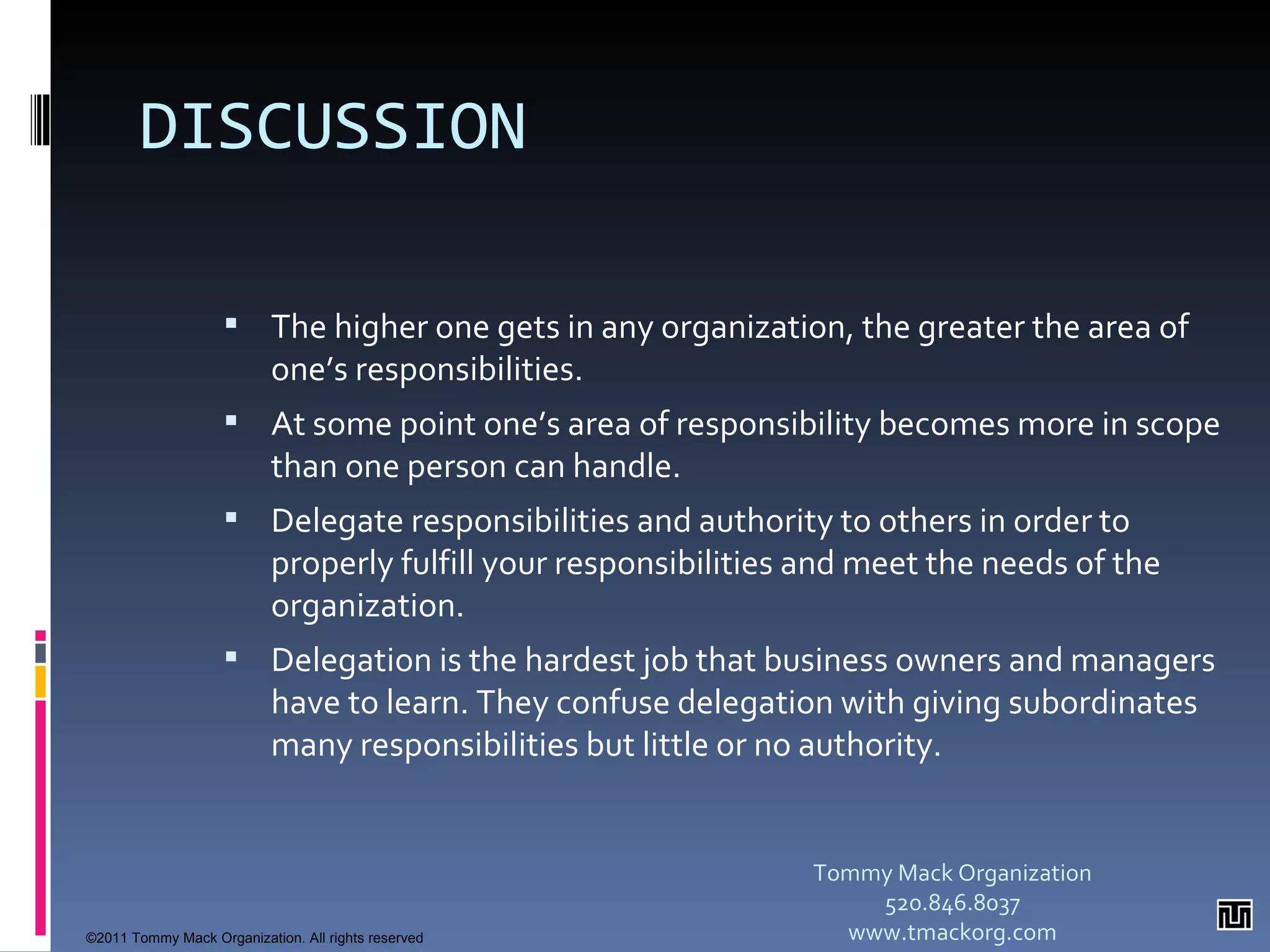
DISCUSSION The higher one gets in any organization, the greater the area of one’s responsibilities.  At some point one’s area of responsibility becomes more in scope than one person can handle.  Delegate responsibilities and authority to others in order to properly fulfill your responsibilities and meet the needs of the organization. Delegation is the hardest job that business owners and managers have to learn. They confuse delegation with giving subordinates many responsibilities but little or no authority. Tommy Mack Organization 520.846.8037 www.tmackorg.com ©2011 Tommy Mack Organization. All rights reserved
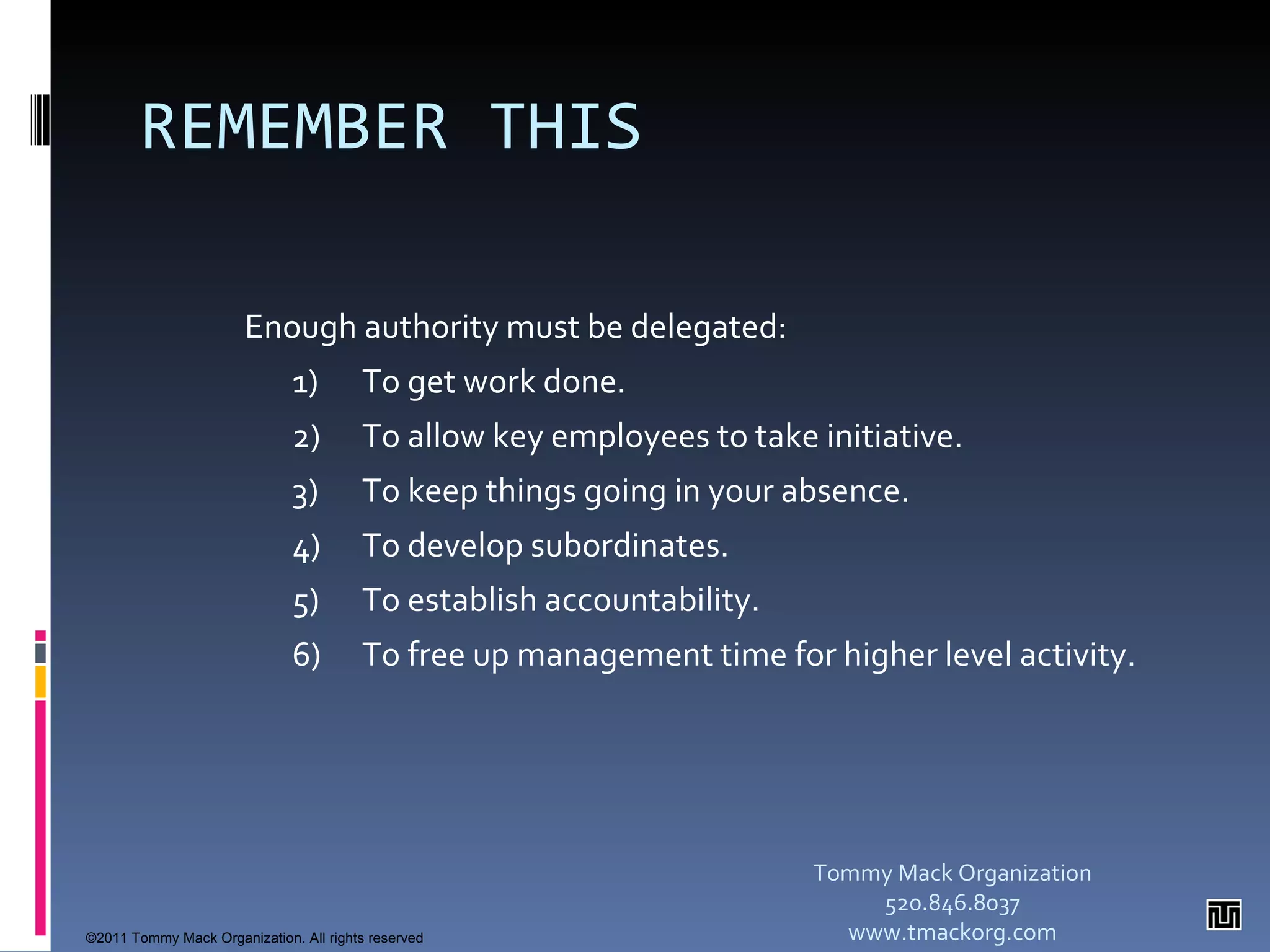
REMEMBER THIS Enough authority must be delegated: 1) To get work done. 2)  To allow key employees to take initiative. 3)  To keep things going in your absence. 4) To develop subordinates. 5) To establish accountability. 6) To free up management time for higher level activity.  Tommy Mack Organization 520.846.8037 www.tmackorg.com ©2011 Tommy Mack Organization. All rights reserved
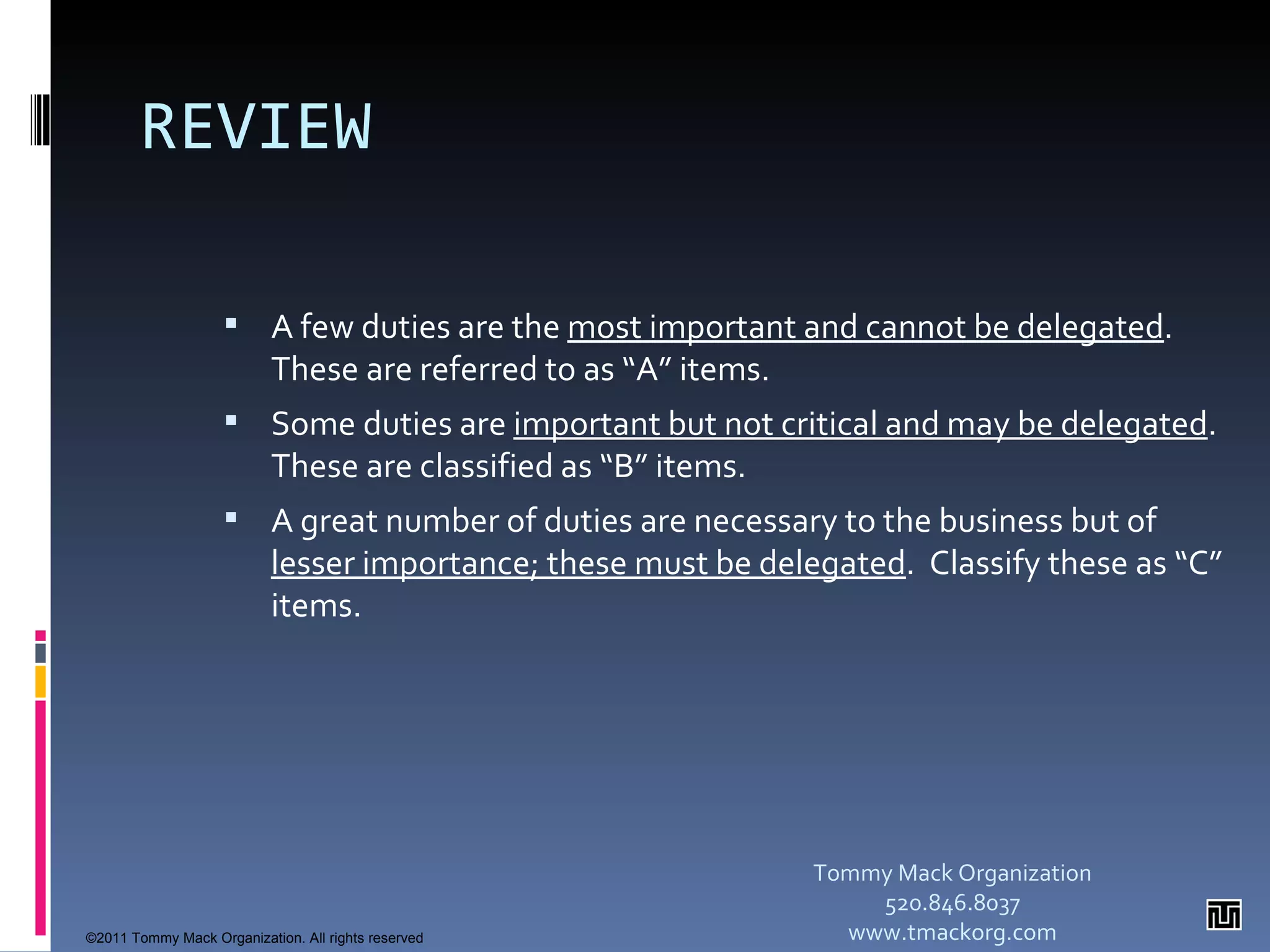
REVIEW A few duties are the  most important and cannot be delegated .  These are referred to as “A” items. Some duties are  important but not critical and may be delegated .  These are classified as “B” items. A great number of duties are necessary to the business but of  lesser importance; these must be delegated .  Classify these as “C” items. Tommy Mack Organization 520.846.8037 www.tmackorg.com ©2011 Tommy Mack Organization. All rights reserved

Effective Delegation

  • 1.
    By Tommy “Mack”McEldowney Tommy Mack Organization 520.846.8037 www.tmackorg.com ©2011 Tommy Mack Organization. All rights reserved
  • 2.
    EFFECTIVE DELEGATION Thehigher an owner or employee progresses in an organization, the greater their area of responsibilities. At some point the scope of responsibility becomes larger than one person can handle. One must delegate authority and responsibilities to others in order to continue to properly perform and to meet the needs of the business. Two major benefits of delegation are to distribute the work and to develop subordinates. Tommy Mack Organization 520.846.8037 www.tmackorg.com ©2011 Tommy Mack Organization. All rights reserved
  • 3.
    PRINCIPLES OF DELEGATION The process of identifying elements that can be delegated to others in the organization can be achieved with the following classifications: “ A” items -- a few duties are the most important and cannot be delegated or only you can perform them. “ B” items -- some duties are important but not critical and may be or could be delegated. “ C” items -- a great number of duties are necessary to the business but of lesser importance; these should be delegated. Tommy Mack Organization 520.846.8037 www.tmackorg.com ©2011 Tommy Mack Organization. All rights reserved
  • 4.
    KEEPING CONTROL Whenyou manage through others, it is essential that you keep control by holding subordinates accountable for their actions. Strike a balance. Do not get so close that you are looking over their shoulder. Do not become so far removed that you do not know what is going on. Get feedback to keep yourself informed through reports or meetings. Reports provide timely information at the right time. Meetings permit dialog on activities, accomplishments, and problems -- an important part of the communications process. Tommy Mack Organization 520.846.8037 www.tmackorg.com ©2011 Tommy Mack Organization. All rights reserved
  • 5.
    RULES FOR DELEGATIONMake sure subordinates clearly understand the task. Have subordinates describe what it is they think you want them to accomplish. Make sure the employee has the skill, talent, and ability to perform the job. Don’t delegate a job destined to result in failure or frustration. Allow the subordinate latitude in how the job should performed. Your way is not the only way. Provide all the resources necessary to perform the job. Make sure that you provide help in getting the job accomplished. Tommy Mack Organization 520.846.8037 www.tmackorg.com ©2011 Tommy Mack Organization. All rights reserved
  • 6.
    EVERYONE WINS Makea habit of the following: Delegate not only the menial, unimportant jobs but also the significant ones. Employees will see this as a vote of confidence. Remain accessible. Always provide a “safety net” for the subordinate. Be available as necessary, but do not engage in over-the-shoulder surveillance. When the job is performed well, praise the subordinate. Tommy Mack Organization 520.846.8037 www.tmackorg.com ©2011 Tommy Mack Organization. All rights reserved
  • 7.
    DISCUSSION The higherone gets in any organization, the greater the area of one’s responsibilities. At some point one’s area of responsibility becomes more in scope than one person can handle. Delegate responsibilities and authority to others in order to properly fulfill your responsibilities and meet the needs of the organization. Delegation is the hardest job that business owners and managers have to learn. They confuse delegation with giving subordinates many responsibilities but little or no authority. Tommy Mack Organization 520.846.8037 www.tmackorg.com ©2011 Tommy Mack Organization. All rights reserved
  • 8.
    REMEMBER THIS Enoughauthority must be delegated: 1) To get work done. 2) To allow key employees to take initiative. 3) To keep things going in your absence. 4) To develop subordinates. 5) To establish accountability. 6) To free up management time for higher level activity. Tommy Mack Organization 520.846.8037 www.tmackorg.com ©2011 Tommy Mack Organization. All rights reserved
  • 9.
    REVIEW A fewduties are the most important and cannot be delegated . These are referred to as “A” items. Some duties are important but not critical and may be delegated . These are classified as “B” items. A great number of duties are necessary to the business but of lesser importance; these must be delegated . Classify these as “C” items. Tommy Mack Organization 520.846.8037 www.tmackorg.com ©2011 Tommy Mack Organization. All rights reserved