Cognisis Ltd  6 Ox Row  Market Square  Salisbury  Wiltshire  SP1 1EU Delivering competitive advantage through people How to identify latent talent & acquire top performers for your organisation occupational psychology  |  outsourced HR solutions
Delivering competitive advantage through people Cognisis provide  occupational psychology services  and  outsourced HR solutions  which deliver bottom line business performance. Our service enables our clients to employ, retain and motivate the very best people. Talented people are a decisive source of competitive advantage and their acquisition, effort and single-mindedness is a critical driver of business performance. We release competitive advantage by ensuring that our clients have the right people, with the right skills in the right roles. occupational psychology  |  outsourced HR solutions
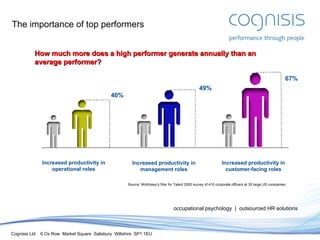
The importance of top performers How much more does a high performer generate annually than an average performer? Source: McKinsey’s War for Talent 2000 survey of 410 corporate officers at 35 large US companies occupational psychology  |  outsourced HR solutions 40% 49% 67% Increased productivity in operational roles Increased productivity in management roles Increased productivity in customer-facing roles
Developing a high-performance business Our service provides workforce performance strategies that go beyond mere cost reduction, to have a greater positive impact on the company’s overall business and financial performance. Our support may be especially effective during the current economic climate: Reduce direct costs by objectively identifying essential employees Mitigate the effect of redundancy through developmental counselling and outplacement guidance Maximise workforce productivity through motivation assessments Lower overheads through job analysis Align latent talent with business objectives through skills inventory Cognisis provide expert consulting services which combine well validated psychometric techniques with practical HR solutions. occupational psychology  |  outsourced HR solutions Cognisis provide expert consulting services which combine applied occupational psychology with HR solutions driven by the commercial imperative Our techniques are concentrated on the efficient application of efforts to reach company goals and are designed to transform the performance of your workforce.
Creating a high-performance workforce Our approach begins with a focus on the necessary competencies and capabilities to meet strategic goals.  This focus is achieved at three levels:  Individual performance , because companies with well-trained, knowledgeable and flexible employees operate more efficiently, seize market opportunities more readily and weather economic downturns more effectively. Workforce performance , because a company must focus on providing their workforces, especially their most strategic ones, with the resources and tools they need to perform effectively. Enterprise performance , because organizations must more effectively align their people with their business strategy.  occupational psychology  |  outsourced HR solutions A high-performance business starts with a high-performance workforce Cognisis helps organisations substantially increase their productivity by ensuring that they have the right people, with the right skills in the right roles.
Partners & accreditations occupational psychology  |  outsourced HR solutions Cognisis is Solutions Partner with SHL Limited and a founder member of the SHL Premium Partner network. Cognisis consultants are fully qualified and registered with the British Psychological Society (BPS Levels A & B) to administer, interpret and feedback all psychometric profiling instruments and aptitude tests.
What people are saying about us occupational psychology  |  outsourced HR solutions "Cognisis have provided an extremely professional and keenly objective means of finding the right person for my customer facing positions. I have used the psychometric profiling tools Cognisis provide and received much more than a computer generated report. Cognisis take time to support you with interpretations of their findings providing advice on possible strategies to find out more, making the interview process a much more rewarding experience. I would have no hesitation in recommending Cognisis and their services to any manager wanting to recruit effective people in these difficult times." David O'Connor General Manager Tintometer Limited "Cognisis has recently been working with the Club, providing professional advice on the application of psychometric tools to help the Club achieve its commercial goals. Cognisis takes a pragmatic approach ensuring their advice fits the needs of our organisation." Sarah Curry, HR Manager, Watford Football Club "Cognisis has provided verbal and numerical reasoning tests and full psychometric profiling and feedback for a number of recruitment campaigns. On each occasion, I and the managers involved, have found Cognisis to be both professional and client-focussed. The testing services were provided to the highest possible professional standards. We have used the psychometric profiling most widely and I know that our managers have found their input and guidance extremely useful. The feedback provided for candidates was also very well-received. I am happy to recommend their services to future clients.“ Kate Bromfield, Recruitment & Retention Officer, Salisbury District Council
What people are saying about us occupational psychology  |  outsourced HR solutions "Cognisis have provided cost-effective and valuable HR advice.  Their advice is both practical and timely. We are happy to rely on their support for our business." Katie Memory, Managing Director, Memory Opticians "Cognisis are knowledgeable and willing to share their knowledge and experience in order to assist others in achieving their potential" Dr Leslie Thurogood Perform Abu Dhabi, United Arab Emirates "A rare combination: high thinkers AND goal achievers" Howard Thompson, Head of Contracts, Inmarsat
Case study occupational psychology  |  outsourced HR solutions How can you identify tomorrow’s leaders for your business? Client: UK – Dental insurance provider Industry: Medical insurance Project: Succession management planning for Head of Departments Objectives: Re-structuring of Head Office organisation to meet strategic objectives for growth Process: Assessment of the incumbent management team in order to objectively identify the existing inventory of skill sets held within the senior managers.  Job analysis of the proposed new function structure was conducted, together with a definition of essential competencies for each role.  Individual psychometric assessments were conducted and validated by one-to-one interviews.  Competency based appraisals then provided sound foundations for the development, promotion and redeployment of staff. Assessment tools & instruments employed: SHL Occupational Personality Questionnaire - ipsative version (OPQ32i) Advanced Managerial Tests: Verbal & Numerical Reasoning (VMG2 & NMG2) Management Judgement Scenarios Motivation Questionnaire (MQ) Corporate Culture Questionnaire (CCQ) Results: Through consultative feedback both to the Board and the individual managers, a new organisational structure was established, together with appropriate redeployment and recruitment of staff.  Termination of contracts were kept to an absolute minimum.  The methodology employed enabled the organisation to unlock each individual’s full potential and to direct their energies more constructively.  The new structure provided sufficient flexibility and responsiveness to enable the organisation to capitalise upon rapid sales opportunities and to achieve their budgeted growth.
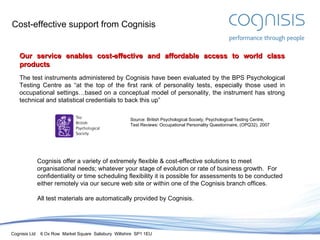
Cost-effective support from Cognisis Our service enables cost-effective and affordable access to world class products The test instruments administered by Cognisis have been evaluated by the BPS Psychological Testing Centre as “at the top of the first rank of personality tests, especially those used in occupational settings…based on a conceptual model of personality, the instrument has strong technical and statistical credentials to back this up” Cognisis offer a variety of extremely flexible & cost-effective solutions to meet organisational needs; whatever your stage of evolution or rate of business growth.  For confidentiality or time scheduling flexibility it is possible for assessments to be conducted either remotely via our secure web site or within one of the Cognisis branch offices. All test materials are automatically provided by Cognisis. Source: British Psychological Society, Psychological Testing Centre, Test Reviews: Occupational Personality Questionnaire, (OPQ32), 2007
Psychometric assessments are powerful tools used by organisations for the selection, development and management of people. Tests can be used in a variety of different ways: to enhance the decision making process in assessment for selection and promotion as an aid to management in areas such as motivation and team building to identify development needs, as a basis for employee counselling, as well as in organisational areas such as management of change or succession planning Psychometric tests provide additional relevant information over and above that obtained from more traditional assessment methods. For instance, tests aid recruitment processes by ensuring that all candidates are treated fairly and measured against a common yardstick. Tests can be used to challenge stereotyped judgements made by interviewers and often enable a more objective analysis to take place than is possible by interviewing alone. Benefits of psychometric techniques Research has shown that well-constructed psychometric tests are the single most effective predictor of job performance occupational psychology  |  outsourced HR solutions
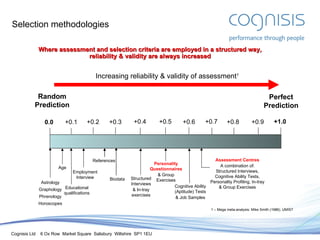
Selection methodologies Where assessment and selection criteria are employed in a structured way, reliability & validity are always increased Increasing reliability & validity of assessment 1 0.0 +0.1 +0.2 +0.3 +0.4 +0.5 +0.6 +0.7 +0.8 +0.9 +1.0 Random Prediction Perfect Prediction Age References Biodata Personality Questionnaires & Group Exercises Structured Interviews & In-tray exercises Cognitive Ability (Aptitude) Tests & Job Samples Astrology Graphology Phrenology Horoscopes Assessment Centres A combination of: Structured Interviews, Cognitive Ability Tests, Personality Profiling, In-tray & Group Exercises 1 – Mega meta-analysis: Mike Smith (1986), UMIST Educational qualifications Employment Interview
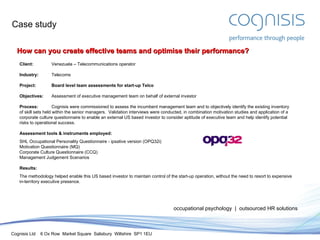
Case study occupational psychology  |  outsourced HR solutions How can you create effective teams and optimise their performance? Client: Venezuela – Telecommunications operator Industry: Telecoms Project:  Board level team assessments for start-up Telco Objectives: Assessment of executive management team on behalf of external investor Process: Cognisis were commissioned to assess the incumbent management team and to objectively identify the existing inventory of skill sets held within the senior managers.  Validation interviews were conducted, in combination motivation studies and application of a corporate culture questionnaire to enable an external US based investor to consider aptitude of executive team and help identify potential risks to operational success. Assessment tools & instruments employed: SHL Occupational Personality Questionnaire - ipsative version (OPQ32i) Motivation Questionnaire (MQ) Corporate Culture Questionnaire (CCQ) Management Judgement Scenarios Results: The methodology helped enable this US based investor to maintain control of the start-up operation, without the need to resort to expensive in-territory executive presence.
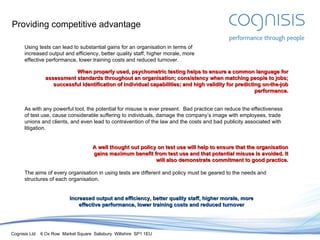
Providing competitive advantage Using tests can lead to substantial gains for an organisation in terms of increased output and efficiency, better quality staff, higher morale, more effective performance, lower training costs and reduced turnover. When properly used, psychometric testing helps to ensure a common language for assessment standards throughout an organisation; consistency when matching people to jobs; successful identification of individual capabilities; and high validity for predicting on-the-job performance. As with any powerful tool, the potential for misuse is ever present.  Bad practice can reduce the effectiveness of test use, cause considerable suffering to individuals, damage the company’s image with employees, trade unions and clients, and even lead to contravention of the law and the costs and bad publicity associated with litigation. A well thought out policy on test use will help to ensure that the organisation gains maximum benefit from test use and that potential misuse is avoided. It will also demonstrate commitment to good practice. The aims of every organisation in using tests are different and policy must be geared to the needs and structures of each organisation. Increased output and efficiency, better quality staff, higher morale, more effective performance, lower training costs and reduced turnover
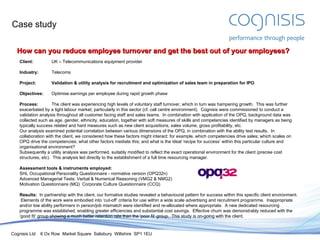
Case study How can you reduce employee turnover and get the best out of your employees? Client: UK – Telecommunications equipment provider Industry: Telecoms Project: Validation & utility analysis for recruitment and optimization of sales team in preparation for IPO Objectives: Optimise earnings per employee during rapid growth phase Process: The client was experiencing high levels of voluntary staff turnover, which in turn was hampering growth.  This was further exacerbated by a tight labour market; particularly in this sector (cf. call centre environment).  Cognisis were commissioned to conduct a validation analysis throughout all customer facing staff and sales teams.  In combination with application of the OPQ, background data was collected such as age, gender, ethnicity, education, together with soft measures of skills and competencies identified by managers as being typically success related and hard measures such as new client acquisitions, sales volume, gross profitability, etc. Our analysis examined potential correlation between various dimensions of the OPQ, in combination with the ability test results.  In collaboration with the client, we considered how these factors might interact: for example, which competencies drive sales; which scales on OPQ drive the competencies; what other factors mediate this; and what is the ideal ‘recipe for success’ within this particular culture and organisational environment? Subsequently a utility analysis was performed, suitably modified to reflect the exact operational environment for the client (precise cost structures, etc).  This analysis led directly to the establishment of a full time resourcing manager. Assessment tools & instruments employed: SHL Occupational Personality Questionnaire - normative version (OPQ32n) Advanced Managerial Tests: Verbal & Numerical Reasoning (VMG2 & NMG2) Motivation Questionnaire (MQ)  Corporate Culture Questionnaire (CCQ) Results:  In partnership with the client, our formative studies revealed a behavioural pattern for success within this specific client environment.  Elements of the work were embodied into ‘cut-off’ criteria for use within a wide scale advertising and recruitment programme.  Inappropriate and/or low ability performers in person/job mismatch were identified and re-allocated where appropriate.  A new dedicated resourcing programme was established, enabling greater efficiencies and substantial cost savings.  Effective churn was demonstrably reduced with the ‘good fit’ group showing a much better retention rate than the ‘poor fit’ group.  This study is on-going with the client.
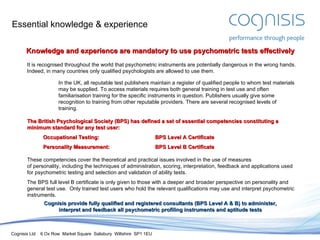
Essential knowledge & experience Knowledge and experience are mandatory to use psychometric tests effectively It is recognised throughout the world that psychometric instruments are potentially dangerous in the wrong hands. Indeed, in many countries only qualified psychologists are allowed to use them. In the UK, all reputable test publishers maintain a register of qualified people to whom test materials may be supplied. To access materials requires both general training in test use and often familiarisation training for the specific instruments in question. Publishers usually give some recognition to training from other reputable providers. There are several recognised levels of training. The British Psychological Society (BPS) has defined a set of essential competencies constituting a minimum standard for any test user: Occupational Testing: BPS Level A Certificate Personality Measurement: BPS Level B Certificate These competencies cover the theoretical and practical issues involved in the use of measures of personality, including the techniques of administration, scoring, interpretation, feedback and applications used for psychometric testing and selection and validation of ability tests.  The BPS full level B certificate is only given to those with a deeper and broader perspective on personality and general test use.  Only trained test users who hold the relevant qualifications may use and interpret psychometric instruments. Cognisis provide fully qualified and registered consultants (BPS Level A & B) to administer, interpret and feedback all psychometric profiling instruments and aptitude  test s
Case study occupational psychology  |  outsourced HR solutions How can you recruit and develop successful sales people? Client: UK – Environmental water analysis Industry: Environmental research & test product design Project: Recruitment of a new Business Development Manager Objectives: To recruit a technically competent manager from an R&D environment with the inherent potential to operate in an effective business development role.  Traditionally, individuals with industry specific technical knowledge experience difficulties making the transition into what is considered to a traditional ‘sales’ role.  The objective was to identify those personality traits which would enable a successful initial fit, allowing for subsequent growth potential. Process: Following an initial Job Analysis and the identification of core competencies essential for success in the role, operationally critical personal characteristics were identified.  This allowed an ‘atypical’ candidate profile to be identified for the role; which was then correctly re-categorised as being technical sales support and relationship marketing, rather than a stereotypical direct sales function. Application of an OPQ, together with a balanced battery of test instruments provided an in-depth insight into the comparative personality traits and inherent abilities of a candidate shortlist.  A competency based structured interview was designed, including systematic scoring centred around consistent lines of questioning.  This process enabled a fair and effective discrimination between the various candidates, focusing upon talent rather than subjective opinion. Assessment tools & instruments employed: SHL Occupational Personality Questionnaire - ipsative version (OPQ32i) Advanced Managerial Tests: Verbal & Numerical Reasoning (VMG2 & NMG2) Brainstorm Fastrack Results:  By focusing upon those facets of the role considered to be critical for overall tactical success, a highly competent and technically gifted individual was recruited for a customer-facing role.
When should tests be used? Tests may be used for selection (either for short listing or final decisions), placement or promotion decisions, development, team building, counselling, out-placement and organisational development. In each case, the situation must be evaluated to see whether test use would be appropriate and valid to help achieve the desired objectives There are some occasions where it is not usually appropriate to use tests. For instance, it is unlikely that test results would be suitable for making redundancy decisions, since direct information on job performance should be available (however tests can be valuable in making redeployment decisions or in outplacement counselling).  Similarly, an organisation may want to restrict the use of some tests to counselling or development applications. Tests are best used in decision making, in conjunction with other relevant information.  In a promotion decision, test results may be integrated with interview performance, track record and managers’ recommendations to provide the best information about individual suitability.  Use of a single test result alone should be avoided whenever possible. Consideration must be given to where test results fit into a procedure. Tests may be used for short listing from a large pool of applicants, to suggest areas to be explored during an interview, or as a final check on the suitability of a chosen candidate.
Case study How can you recruit better employees? Client: UK - Local Government Industry: Public sector Project:  Assessment selection centre - Head of Environmental Services Objectives: To identify and acquire the most appropriate talent for a new strategic appointment within a politically sensitive arena.  Emphasis was given to the strategic priorities and tactical objectives of the organisation; particularly innovation & change management, delivery of customer facing services and overall performance improvement. Process: Following an initial Job Analysis and the identification of core competencies essential for success in the role, operationally critical personal characteristics were identified: for example, strong leadership skills to inspire, motivate and persuade others (ensuring successful implementation of new ideas and execution of plans); significant personal ambition (potential for Chief Executive); high levels of personal energy (vigour) & passion (competitive); potentially less conventional and more independent minded than most senior managers working within the Public sector; outspoken where necessary. Cognisis were then commissioned to design and implement an Assessment Selection Centre to objectively identify the best person for this role. Assessment tools & instruments employed: SHL Occupational Personality Questionnaire - ipsative version (OPQ32i) Advanced Managerial Tests: Verbal & Numerical Reasoning (VMG2 & NMG2) Management Judgement Scenarios In-Tray Exercise (Denford Council & Bruger-Kent Finance) Group Exercises (Royal Borough of Thamesbridge & Midhampton District Health Authority) Results: Cognisis helped establish a more accurate and systematic understanding of the specific needs of the role and through competency analysis helped build a profile of what the ’ideal’ candidate would look like and the capabilities that they would require. Outcome:  A new senior executive was identified and successfully hired.  The individual remains in post and has since demonstrated an impressive execution of strategic objectives.
Test validation & application Whenever tests are used, it is vital that there is a match between the skills and characteristics measured and the job or organisational demands. This is particularly important when selection or promotion decisions are based on test results Objective job analysis is the best way to determine the skills required for a particular job.  These skills are then matched to appropriate tests.  In large scale testing procedures, it may be appropriate to perform criterion related validation studies before test implementation. All psychometric tests used must be clearly relevant to the given purpose.  Detailed job descriptions and person specifications based on objective job analysis must be prepared prior to the choice of tests for any selection or promotion procedures.  Cognisis will help with this as an integrated part of their service. Tests may be used for selection, development and counselling purposes Occupational tests have consistently been shown to be better predictors of job success than unstructured interviews
Cognisis range of services Cognisis provide fully qualified and registered consultants in order to administer psychometric profiling  questionnaires , evaluate results  and provide verbal or written feedback; either a s part of regular candidate assessment and selection process of prospective external candidates, or for profile evaluation of existing members of staff, to assist with their personal development planning. Testing may be required for a variety of functional positions, obviously at times spread throughout the year. A full range of narrative interpreted reports can be provided by Cognisis to suit both your application and needs. All necessary test materials are provided by Cognisis. Tests are typically conducted on client premises during normal working hours.  Alternatively, for confidentiality or time scheduling flexibility it is possible for assessments to be conducted either remotely via our secure web site or within one of the Cognisis branch offices. The following slides describe the variety of psychometric profiling instruments typically provided by Cognisis. Feedback is typically provided to an  interviewing or line manager, or quite often to a  member of the Human Resources team
Candidate selection centres Comprehensive Range of Instruments Cognisis administer a comprehensive range of instruments & structured exercises within their candidate selection centres: Occupational Personality Questionnaires Cognitive Ability (Aptitude) Tests Management Judgement Scenarios Strategic, Tactical & Operational Management Exercises (In-Trays) The instruments & exercises are integrated within sessions typically spread over the course of a full day.
Candidate selection centres Occupational Personality Questionnaires OPQ 32  ( ipsative version ) - Candidate Selection & Assessment OPQ 32 (normative version) - Staff Development The OPQ 32 measures someone’s preferred style of behaviour at work – OPQs are an ideal way of understanding the way people are likely to behave at work and can supply you with very valuable information. It is a very detailed personality questionnaire and measures 32 dimensions of personality that relate to success factors in today’s world of work. It is intended for use in the recruitment and development of professional and managerial roles as comprehensive reports can be generated from the scores. A full range of narrative interpreted reports are available. All test materials are provided by Cognisis. Cognitive Ability (Aptitude) Tests Cognisis also administer a wide range of ability tests, suitable for differing levels within an organisation.  Ability profiles can be produced based upon the following tests: Verbal and numerical tests designed to measure high level verbal and numeric skills suitable for  Senior Managers and Directors Verbal and numerical tests designed to assess the reasoning skills of  Middle Managers, Senior Managers, Professional staff and Graduates Verbal, numerical and diagrammatic reasoning tests designed to measure the skills of  A Level school leavers, Supervisors, Junior managers and Management Trainees
Candidate selection centres Management Judgement Scenarios Increasingly managerial judgement is seen as an important skill for individuals in organisations, regardless of whether they have the formal job title of 'manager'. The Scenarios test assesses Managerial Judgement - an individual's ability to evaluate 'real-life' managerial situations and decide on appropriate and effective ways of handling them. It assesses an individual's current level of judgement, but it can also be used to provide feedback on how to improve performance in this area. Scenarios rates candidates on their overall Managerial Judgement – which is broken down into  Managing Objectives ,  People Management  and  Reputation Management . Scenarios presents a succession of managerial scenarios and associated responses.  Individuals are asked to evaluate each of the possible responses given for their effectiveness in dealing with the situation.  It is these evaluations that are then scored against a set of ideal answers to provide as assessment of Managerial Judgement. These tests make it possible to assess candidates not only on their overall level of judgement, but also on how effective their judgement is when dealing with different kinds of organisational issues
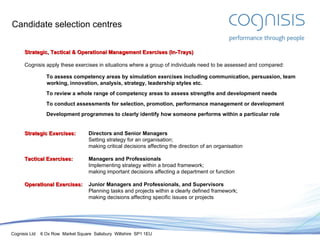
Candidate selection centres Strategic, Tactical & Operational Management Exercises (In-Trays) Cognisis apply these exercises in situations where a group of individuals need to be assessed and compared: To assess competency areas by simulation exercises including communication, persuasion, team working, innovation, analysis, strategy, leadership styles etc. To review a whole range of competency areas to assess strengths and development needs To conduct assessments for selection, promotion, performance management or development Development programmes to clearly identify how someone performs within a particular role Strategic Exercises: Directors and Senior Managers Setting strategy for an organisation; making critical decisions affecting the direction of an organisation Tactical Exercises: Managers and Professionals Implementing strategy within a broad framework; making important decisions affecting a department or function Operational Exercises: Junior Managers and Professionals, and Supervisors Planning tasks and projects within a clearly defined framework;  making decisions affecting specific issues or projects
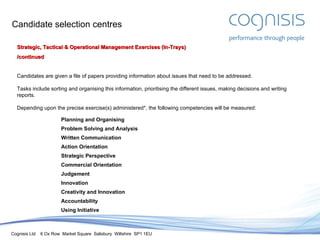
Candidate selection centres Strategic, Tactical & Operational Management Exercises (In-Trays) /continued Candidates are given a file of papers providing information about issues that need to be addressed. Tasks include sorting and organising this information, prioritising the different issues, making decisions and writing reports. Depending upon the precise exercise(s) administered*, the following competencies will be measured: Planning and Organising Problem Solving and Analysis Written Communication Action Orientation Strategic Perspective Commercial Orientation Judgement Innovation Creativity and Innovation Accountability Using Initiative
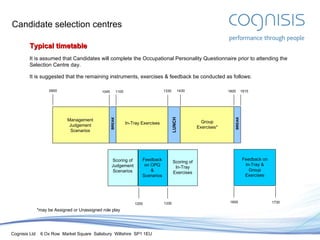
Candidate selection centres Typical timetable It is assumed that Candidates will complete the Occupational Personality Questionnaire prior to attending the Selection Centre day. It is suggested that the remaining instruments, exercises & feedback be conducted as follows: 0900 LUNCH Group Exercises* Management Judgement Scenarios Feedback on OPQ & Scenarios 1045 Scoring of Judgement Scenarios 1200 In-Tray Exercises 1330 1430 1100 *may be Assigned or Unassigned role play 1600 1615 Scoring of In-Tray Exercises BREAK 1330 BREAK Feedback on In-Tray & Group Exercises 1600 1730

Cognisis - Performance Through People

  • 1.
    Cognisis Ltd 6 Ox Row Market Square Salisbury Wiltshire SP1 1EU Delivering competitive advantage through people How to identify latent talent & acquire top performers for your organisation occupational psychology | outsourced HR solutions
  • 2.
    Delivering competitive advantagethrough people Cognisis provide occupational psychology services and outsourced HR solutions which deliver bottom line business performance. Our service enables our clients to employ, retain and motivate the very best people. Talented people are a decisive source of competitive advantage and their acquisition, effort and single-mindedness is a critical driver of business performance. We release competitive advantage by ensuring that our clients have the right people, with the right skills in the right roles. occupational psychology | outsourced HR solutions
  • 3.
    The importance oftop performers How much more does a high performer generate annually than an average performer? Source: McKinsey’s War for Talent 2000 survey of 410 corporate officers at 35 large US companies occupational psychology | outsourced HR solutions 40% 49% 67% Increased productivity in operational roles Increased productivity in management roles Increased productivity in customer-facing roles
  • 4.
    Developing a high-performancebusiness Our service provides workforce performance strategies that go beyond mere cost reduction, to have a greater positive impact on the company’s overall business and financial performance. Our support may be especially effective during the current economic climate: Reduce direct costs by objectively identifying essential employees Mitigate the effect of redundancy through developmental counselling and outplacement guidance Maximise workforce productivity through motivation assessments Lower overheads through job analysis Align latent talent with business objectives through skills inventory Cognisis provide expert consulting services which combine well validated psychometric techniques with practical HR solutions. occupational psychology | outsourced HR solutions Cognisis provide expert consulting services which combine applied occupational psychology with HR solutions driven by the commercial imperative Our techniques are concentrated on the efficient application of efforts to reach company goals and are designed to transform the performance of your workforce.
  • 5.
    Creating a high-performanceworkforce Our approach begins with a focus on the necessary competencies and capabilities to meet strategic goals. This focus is achieved at three levels: Individual performance , because companies with well-trained, knowledgeable and flexible employees operate more efficiently, seize market opportunities more readily and weather economic downturns more effectively. Workforce performance , because a company must focus on providing their workforces, especially their most strategic ones, with the resources and tools they need to perform effectively. Enterprise performance , because organizations must more effectively align their people with their business strategy. occupational psychology | outsourced HR solutions A high-performance business starts with a high-performance workforce Cognisis helps organisations substantially increase their productivity by ensuring that they have the right people, with the right skills in the right roles.
  • 6.
    Partners & accreditationsoccupational psychology | outsourced HR solutions Cognisis is Solutions Partner with SHL Limited and a founder member of the SHL Premium Partner network. Cognisis consultants are fully qualified and registered with the British Psychological Society (BPS Levels A & B) to administer, interpret and feedback all psychometric profiling instruments and aptitude tests.
  • 7.
    What people aresaying about us occupational psychology | outsourced HR solutions "Cognisis have provided an extremely professional and keenly objective means of finding the right person for my customer facing positions. I have used the psychometric profiling tools Cognisis provide and received much more than a computer generated report. Cognisis take time to support you with interpretations of their findings providing advice on possible strategies to find out more, making the interview process a much more rewarding experience. I would have no hesitation in recommending Cognisis and their services to any manager wanting to recruit effective people in these difficult times." David O'Connor General Manager Tintometer Limited "Cognisis has recently been working with the Club, providing professional advice on the application of psychometric tools to help the Club achieve its commercial goals. Cognisis takes a pragmatic approach ensuring their advice fits the needs of our organisation." Sarah Curry, HR Manager, Watford Football Club "Cognisis has provided verbal and numerical reasoning tests and full psychometric profiling and feedback for a number of recruitment campaigns. On each occasion, I and the managers involved, have found Cognisis to be both professional and client-focussed. The testing services were provided to the highest possible professional standards. We have used the psychometric profiling most widely and I know that our managers have found their input and guidance extremely useful. The feedback provided for candidates was also very well-received. I am happy to recommend their services to future clients.“ Kate Bromfield, Recruitment & Retention Officer, Salisbury District Council
  • 8.
    What people aresaying about us occupational psychology | outsourced HR solutions "Cognisis have provided cost-effective and valuable HR advice.  Their advice is both practical and timely. We are happy to rely on their support for our business." Katie Memory, Managing Director, Memory Opticians "Cognisis are knowledgeable and willing to share their knowledge and experience in order to assist others in achieving their potential" Dr Leslie Thurogood Perform Abu Dhabi, United Arab Emirates "A rare combination: high thinkers AND goal achievers" Howard Thompson, Head of Contracts, Inmarsat
  • 9.
    Case study occupationalpsychology | outsourced HR solutions How can you identify tomorrow’s leaders for your business? Client: UK – Dental insurance provider Industry: Medical insurance Project: Succession management planning for Head of Departments Objectives: Re-structuring of Head Office organisation to meet strategic objectives for growth Process: Assessment of the incumbent management team in order to objectively identify the existing inventory of skill sets held within the senior managers. Job analysis of the proposed new function structure was conducted, together with a definition of essential competencies for each role. Individual psychometric assessments were conducted and validated by one-to-one interviews. Competency based appraisals then provided sound foundations for the development, promotion and redeployment of staff. Assessment tools & instruments employed: SHL Occupational Personality Questionnaire - ipsative version (OPQ32i) Advanced Managerial Tests: Verbal & Numerical Reasoning (VMG2 & NMG2) Management Judgement Scenarios Motivation Questionnaire (MQ) Corporate Culture Questionnaire (CCQ) Results: Through consultative feedback both to the Board and the individual managers, a new organisational structure was established, together with appropriate redeployment and recruitment of staff. Termination of contracts were kept to an absolute minimum. The methodology employed enabled the organisation to unlock each individual’s full potential and to direct their energies more constructively. The new structure provided sufficient flexibility and responsiveness to enable the organisation to capitalise upon rapid sales opportunities and to achieve their budgeted growth.
  • 10.
    Cost-effective support fromCognisis Our service enables cost-effective and affordable access to world class products The test instruments administered by Cognisis have been evaluated by the BPS Psychological Testing Centre as “at the top of the first rank of personality tests, especially those used in occupational settings…based on a conceptual model of personality, the instrument has strong technical and statistical credentials to back this up” Cognisis offer a variety of extremely flexible & cost-effective solutions to meet organisational needs; whatever your stage of evolution or rate of business growth. For confidentiality or time scheduling flexibility it is possible for assessments to be conducted either remotely via our secure web site or within one of the Cognisis branch offices. All test materials are automatically provided by Cognisis. Source: British Psychological Society, Psychological Testing Centre, Test Reviews: Occupational Personality Questionnaire, (OPQ32), 2007
  • 11.
    Psychometric assessments arepowerful tools used by organisations for the selection, development and management of people. Tests can be used in a variety of different ways: to enhance the decision making process in assessment for selection and promotion as an aid to management in areas such as motivation and team building to identify development needs, as a basis for employee counselling, as well as in organisational areas such as management of change or succession planning Psychometric tests provide additional relevant information over and above that obtained from more traditional assessment methods. For instance, tests aid recruitment processes by ensuring that all candidates are treated fairly and measured against a common yardstick. Tests can be used to challenge stereotyped judgements made by interviewers and often enable a more objective analysis to take place than is possible by interviewing alone. Benefits of psychometric techniques Research has shown that well-constructed psychometric tests are the single most effective predictor of job performance occupational psychology | outsourced HR solutions
  • 12.
    Selection methodologies Whereassessment and selection criteria are employed in a structured way, reliability & validity are always increased Increasing reliability & validity of assessment 1 0.0 +0.1 +0.2 +0.3 +0.4 +0.5 +0.6 +0.7 +0.8 +0.9 +1.0 Random Prediction Perfect Prediction Age References Biodata Personality Questionnaires & Group Exercises Structured Interviews & In-tray exercises Cognitive Ability (Aptitude) Tests & Job Samples Astrology Graphology Phrenology Horoscopes Assessment Centres A combination of: Structured Interviews, Cognitive Ability Tests, Personality Profiling, In-tray & Group Exercises 1 – Mega meta-analysis: Mike Smith (1986), UMIST Educational qualifications Employment Interview
  • 13.
    Case study occupationalpsychology | outsourced HR solutions How can you create effective teams and optimise their performance? Client: Venezuela – Telecommunications operator Industry: Telecoms Project: Board level team assessments for start-up Telco Objectives: Assessment of executive management team on behalf of external investor Process: Cognisis were commissioned to assess the incumbent management team and to objectively identify the existing inventory of skill sets held within the senior managers. Validation interviews were conducted, in combination motivation studies and application of a corporate culture questionnaire to enable an external US based investor to consider aptitude of executive team and help identify potential risks to operational success. Assessment tools & instruments employed: SHL Occupational Personality Questionnaire - ipsative version (OPQ32i) Motivation Questionnaire (MQ) Corporate Culture Questionnaire (CCQ) Management Judgement Scenarios Results: The methodology helped enable this US based investor to maintain control of the start-up operation, without the need to resort to expensive in-territory executive presence.
  • 14.
    Providing competitive advantageUsing tests can lead to substantial gains for an organisation in terms of increased output and efficiency, better quality staff, higher morale, more effective performance, lower training costs and reduced turnover. When properly used, psychometric testing helps to ensure a common language for assessment standards throughout an organisation; consistency when matching people to jobs; successful identification of individual capabilities; and high validity for predicting on-the-job performance. As with any powerful tool, the potential for misuse is ever present. Bad practice can reduce the effectiveness of test use, cause considerable suffering to individuals, damage the company’s image with employees, trade unions and clients, and even lead to contravention of the law and the costs and bad publicity associated with litigation. A well thought out policy on test use will help to ensure that the organisation gains maximum benefit from test use and that potential misuse is avoided. It will also demonstrate commitment to good practice. The aims of every organisation in using tests are different and policy must be geared to the needs and structures of each organisation. Increased output and efficiency, better quality staff, higher morale, more effective performance, lower training costs and reduced turnover
  • 15.
    Case study Howcan you reduce employee turnover and get the best out of your employees? Client: UK – Telecommunications equipment provider Industry: Telecoms Project: Validation & utility analysis for recruitment and optimization of sales team in preparation for IPO Objectives: Optimise earnings per employee during rapid growth phase Process: The client was experiencing high levels of voluntary staff turnover, which in turn was hampering growth. This was further exacerbated by a tight labour market; particularly in this sector (cf. call centre environment). Cognisis were commissioned to conduct a validation analysis throughout all customer facing staff and sales teams. In combination with application of the OPQ, background data was collected such as age, gender, ethnicity, education, together with soft measures of skills and competencies identified by managers as being typically success related and hard measures such as new client acquisitions, sales volume, gross profitability, etc. Our analysis examined potential correlation between various dimensions of the OPQ, in combination with the ability test results. In collaboration with the client, we considered how these factors might interact: for example, which competencies drive sales; which scales on OPQ drive the competencies; what other factors mediate this; and what is the ideal ‘recipe for success’ within this particular culture and organisational environment? Subsequently a utility analysis was performed, suitably modified to reflect the exact operational environment for the client (precise cost structures, etc). This analysis led directly to the establishment of a full time resourcing manager. Assessment tools & instruments employed: SHL Occupational Personality Questionnaire - normative version (OPQ32n) Advanced Managerial Tests: Verbal & Numerical Reasoning (VMG2 & NMG2) Motivation Questionnaire (MQ) Corporate Culture Questionnaire (CCQ) Results: In partnership with the client, our formative studies revealed a behavioural pattern for success within this specific client environment. Elements of the work were embodied into ‘cut-off’ criteria for use within a wide scale advertising and recruitment programme. Inappropriate and/or low ability performers in person/job mismatch were identified and re-allocated where appropriate. A new dedicated resourcing programme was established, enabling greater efficiencies and substantial cost savings. Effective churn was demonstrably reduced with the ‘good fit’ group showing a much better retention rate than the ‘poor fit’ group. This study is on-going with the client.
  • 16.
    Essential knowledge &experience Knowledge and experience are mandatory to use psychometric tests effectively It is recognised throughout the world that psychometric instruments are potentially dangerous in the wrong hands. Indeed, in many countries only qualified psychologists are allowed to use them. In the UK, all reputable test publishers maintain a register of qualified people to whom test materials may be supplied. To access materials requires both general training in test use and often familiarisation training for the specific instruments in question. Publishers usually give some recognition to training from other reputable providers. There are several recognised levels of training. The British Psychological Society (BPS) has defined a set of essential competencies constituting a minimum standard for any test user: Occupational Testing: BPS Level A Certificate Personality Measurement: BPS Level B Certificate These competencies cover the theoretical and practical issues involved in the use of measures of personality, including the techniques of administration, scoring, interpretation, feedback and applications used for psychometric testing and selection and validation of ability tests. The BPS full level B certificate is only given to those with a deeper and broader perspective on personality and general test use. Only trained test users who hold the relevant qualifications may use and interpret psychometric instruments. Cognisis provide fully qualified and registered consultants (BPS Level A & B) to administer, interpret and feedback all psychometric profiling instruments and aptitude test s
  • 17.
    Case study occupationalpsychology | outsourced HR solutions How can you recruit and develop successful sales people? Client: UK – Environmental water analysis Industry: Environmental research & test product design Project: Recruitment of a new Business Development Manager Objectives: To recruit a technically competent manager from an R&D environment with the inherent potential to operate in an effective business development role. Traditionally, individuals with industry specific technical knowledge experience difficulties making the transition into what is considered to a traditional ‘sales’ role. The objective was to identify those personality traits which would enable a successful initial fit, allowing for subsequent growth potential. Process: Following an initial Job Analysis and the identification of core competencies essential for success in the role, operationally critical personal characteristics were identified. This allowed an ‘atypical’ candidate profile to be identified for the role; which was then correctly re-categorised as being technical sales support and relationship marketing, rather than a stereotypical direct sales function. Application of an OPQ, together with a balanced battery of test instruments provided an in-depth insight into the comparative personality traits and inherent abilities of a candidate shortlist. A competency based structured interview was designed, including systematic scoring centred around consistent lines of questioning. This process enabled a fair and effective discrimination between the various candidates, focusing upon talent rather than subjective opinion. Assessment tools & instruments employed: SHL Occupational Personality Questionnaire - ipsative version (OPQ32i) Advanced Managerial Tests: Verbal & Numerical Reasoning (VMG2 & NMG2) Brainstorm Fastrack Results: By focusing upon those facets of the role considered to be critical for overall tactical success, a highly competent and technically gifted individual was recruited for a customer-facing role.
  • 18.
    When should testsbe used? Tests may be used for selection (either for short listing or final decisions), placement or promotion decisions, development, team building, counselling, out-placement and organisational development. In each case, the situation must be evaluated to see whether test use would be appropriate and valid to help achieve the desired objectives There are some occasions where it is not usually appropriate to use tests. For instance, it is unlikely that test results would be suitable for making redundancy decisions, since direct information on job performance should be available (however tests can be valuable in making redeployment decisions or in outplacement counselling). Similarly, an organisation may want to restrict the use of some tests to counselling or development applications. Tests are best used in decision making, in conjunction with other relevant information. In a promotion decision, test results may be integrated with interview performance, track record and managers’ recommendations to provide the best information about individual suitability. Use of a single test result alone should be avoided whenever possible. Consideration must be given to where test results fit into a procedure. Tests may be used for short listing from a large pool of applicants, to suggest areas to be explored during an interview, or as a final check on the suitability of a chosen candidate.
  • 19.
    Case study Howcan you recruit better employees? Client: UK - Local Government Industry: Public sector Project: Assessment selection centre - Head of Environmental Services Objectives: To identify and acquire the most appropriate talent for a new strategic appointment within a politically sensitive arena. Emphasis was given to the strategic priorities and tactical objectives of the organisation; particularly innovation & change management, delivery of customer facing services and overall performance improvement. Process: Following an initial Job Analysis and the identification of core competencies essential for success in the role, operationally critical personal characteristics were identified: for example, strong leadership skills to inspire, motivate and persuade others (ensuring successful implementation of new ideas and execution of plans); significant personal ambition (potential for Chief Executive); high levels of personal energy (vigour) & passion (competitive); potentially less conventional and more independent minded than most senior managers working within the Public sector; outspoken where necessary. Cognisis were then commissioned to design and implement an Assessment Selection Centre to objectively identify the best person for this role. Assessment tools & instruments employed: SHL Occupational Personality Questionnaire - ipsative version (OPQ32i) Advanced Managerial Tests: Verbal & Numerical Reasoning (VMG2 & NMG2) Management Judgement Scenarios In-Tray Exercise (Denford Council & Bruger-Kent Finance) Group Exercises (Royal Borough of Thamesbridge & Midhampton District Health Authority) Results: Cognisis helped establish a more accurate and systematic understanding of the specific needs of the role and through competency analysis helped build a profile of what the ’ideal’ candidate would look like and the capabilities that they would require. Outcome: A new senior executive was identified and successfully hired. The individual remains in post and has since demonstrated an impressive execution of strategic objectives.
  • 20.
    Test validation &application Whenever tests are used, it is vital that there is a match between the skills and characteristics measured and the job or organisational demands. This is particularly important when selection or promotion decisions are based on test results Objective job analysis is the best way to determine the skills required for a particular job. These skills are then matched to appropriate tests. In large scale testing procedures, it may be appropriate to perform criterion related validation studies before test implementation. All psychometric tests used must be clearly relevant to the given purpose. Detailed job descriptions and person specifications based on objective job analysis must be prepared prior to the choice of tests for any selection or promotion procedures. Cognisis will help with this as an integrated part of their service. Tests may be used for selection, development and counselling purposes Occupational tests have consistently been shown to be better predictors of job success than unstructured interviews
  • 21.
    Cognisis range ofservices Cognisis provide fully qualified and registered consultants in order to administer psychometric profiling questionnaires , evaluate results and provide verbal or written feedback; either a s part of regular candidate assessment and selection process of prospective external candidates, or for profile evaluation of existing members of staff, to assist with their personal development planning. Testing may be required for a variety of functional positions, obviously at times spread throughout the year. A full range of narrative interpreted reports can be provided by Cognisis to suit both your application and needs. All necessary test materials are provided by Cognisis. Tests are typically conducted on client premises during normal working hours. Alternatively, for confidentiality or time scheduling flexibility it is possible for assessments to be conducted either remotely via our secure web site or within one of the Cognisis branch offices. The following slides describe the variety of psychometric profiling instruments typically provided by Cognisis. Feedback is typically provided to an interviewing or line manager, or quite often to a member of the Human Resources team
  • 22.
    Candidate selection centresComprehensive Range of Instruments Cognisis administer a comprehensive range of instruments & structured exercises within their candidate selection centres: Occupational Personality Questionnaires Cognitive Ability (Aptitude) Tests Management Judgement Scenarios Strategic, Tactical & Operational Management Exercises (In-Trays) The instruments & exercises are integrated within sessions typically spread over the course of a full day.
  • 23.
    Candidate selection centresOccupational Personality Questionnaires OPQ 32 ( ipsative version ) - Candidate Selection & Assessment OPQ 32 (normative version) - Staff Development The OPQ 32 measures someone’s preferred style of behaviour at work – OPQs are an ideal way of understanding the way people are likely to behave at work and can supply you with very valuable information. It is a very detailed personality questionnaire and measures 32 dimensions of personality that relate to success factors in today’s world of work. It is intended for use in the recruitment and development of professional and managerial roles as comprehensive reports can be generated from the scores. A full range of narrative interpreted reports are available. All test materials are provided by Cognisis. Cognitive Ability (Aptitude) Tests Cognisis also administer a wide range of ability tests, suitable for differing levels within an organisation. Ability profiles can be produced based upon the following tests: Verbal and numerical tests designed to measure high level verbal and numeric skills suitable for Senior Managers and Directors Verbal and numerical tests designed to assess the reasoning skills of Middle Managers, Senior Managers, Professional staff and Graduates Verbal, numerical and diagrammatic reasoning tests designed to measure the skills of A Level school leavers, Supervisors, Junior managers and Management Trainees
  • 24.
    Candidate selection centresManagement Judgement Scenarios Increasingly managerial judgement is seen as an important skill for individuals in organisations, regardless of whether they have the formal job title of 'manager'. The Scenarios test assesses Managerial Judgement - an individual's ability to evaluate 'real-life' managerial situations and decide on appropriate and effective ways of handling them. It assesses an individual's current level of judgement, but it can also be used to provide feedback on how to improve performance in this area. Scenarios rates candidates on their overall Managerial Judgement – which is broken down into Managing Objectives , People Management and Reputation Management . Scenarios presents a succession of managerial scenarios and associated responses. Individuals are asked to evaluate each of the possible responses given for their effectiveness in dealing with the situation. It is these evaluations that are then scored against a set of ideal answers to provide as assessment of Managerial Judgement. These tests make it possible to assess candidates not only on their overall level of judgement, but also on how effective their judgement is when dealing with different kinds of organisational issues
  • 25.
    Candidate selection centresStrategic, Tactical & Operational Management Exercises (In-Trays) Cognisis apply these exercises in situations where a group of individuals need to be assessed and compared: To assess competency areas by simulation exercises including communication, persuasion, team working, innovation, analysis, strategy, leadership styles etc. To review a whole range of competency areas to assess strengths and development needs To conduct assessments for selection, promotion, performance management or development Development programmes to clearly identify how someone performs within a particular role Strategic Exercises: Directors and Senior Managers Setting strategy for an organisation; making critical decisions affecting the direction of an organisation Tactical Exercises: Managers and Professionals Implementing strategy within a broad framework; making important decisions affecting a department or function Operational Exercises: Junior Managers and Professionals, and Supervisors Planning tasks and projects within a clearly defined framework; making decisions affecting specific issues or projects
  • 26.
    Candidate selection centresStrategic, Tactical & Operational Management Exercises (In-Trays) /continued Candidates are given a file of papers providing information about issues that need to be addressed. Tasks include sorting and organising this information, prioritising the different issues, making decisions and writing reports. Depending upon the precise exercise(s) administered*, the following competencies will be measured: Planning and Organising Problem Solving and Analysis Written Communication Action Orientation Strategic Perspective Commercial Orientation Judgement Innovation Creativity and Innovation Accountability Using Initiative
  • 27.
    Candidate selection centresTypical timetable It is assumed that Candidates will complete the Occupational Personality Questionnaire prior to attending the Selection Centre day. It is suggested that the remaining instruments, exercises & feedback be conducted as follows: 0900 LUNCH Group Exercises* Management Judgement Scenarios Feedback on OPQ & Scenarios 1045 Scoring of Judgement Scenarios 1200 In-Tray Exercises 1330 1430 1100 *may be Assigned or Unassigned role play 1600 1615 Scoring of In-Tray Exercises BREAK 1330 BREAK Feedback on In-Tray & Group Exercises 1600 1730