Unit-2:
PSYCHOLOGICAL TESTS: Aptitudeand
personality assessment, suggestions for
improvement. Leadership Skills:
Concepts of leadership, leadership
styles, insights from great leaders
B.Sc. Degree In Hospitality & Hotel Administration
BHA108
EMPLOYABILITY SKILLS
National Council for Hotel Management
And Catering Technology
Noida
(NCHMCT)
And
Jawaharlal Nehru University
(JNU)
Disclaimer: This
presentation is for
educational purposes
only and may not be
copied, reproduced,
or distributed without
prior permission.
2.
20/06/2025 Employability Skills/Bonophool Banerjee 2
Employability Skills:
Psychological Tests
"Psychological tests offer a tantalizing promise: the
ability to peek behind the curtain and see the real
person behind the polished resume and rehearsed
interview responses."
BB Bonophool Banerjee
3.
20/06/2025 Employability Skills/Bonophool Banerjee 3
Psychological
Tests
Psychological tests, including aptitude
and personality assessments, serve as
vital instruments in shaping
employability skills and career
development.
These assessments offer valuable
insights into an individual’s cognitive
abilities, personality traits, and areas
for improvement, enabling both
individuals and employers to make
informed decisions about career
paths, job suitability, and professional
growth strategies.
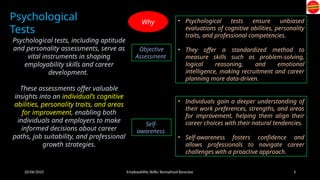
Objective
Assessment
• Psychological tests ensure unbiased
evaluations of cognitive abilities, personality
traits, and professional competencies.
• They offer a standardized method to
measure skills such as problem-solving,
logical reasoning, and emotional
intelligence, making recruitment and career
planning more data-driven.
Self-
awareness
• Individuals gain a deeper understanding of
their work preferences, strengths, and areas
for improvement, helping them align their
career choices with their natural tendencies.
• Self-awareness fosters confidence and
allows professionals to navigate career
challenges with a proactive approach.
Why
4.
20/06/2025 Employability Skills/Bonophool Banerjee 4
Psychological
Tests
Psychological tests, including aptitude
and personality assessments, serve as
vital instruments in shaping
employability skills and career
development.
These assessments offer valuable
insights into an individual’s cognitive
abilities, personality traits, and areas
for improvement, enabling both
individuals and employers to make
informed decisions about career
paths, job suitability, and professional
growth strategies.
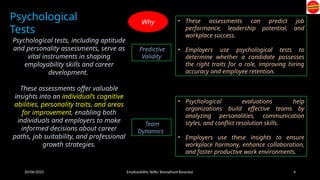
Predictive
Validity
• These assessments can predict job
performance, leadership potential, and
workplace success.
• Employers use psychological tests to
determine whether a candidate possesses
the right traits for a role, improving hiring
accuracy and employee retention.
Team
Dynamics
• Psychological evaluations help
organizations build effective teams by
analyzing personalities, communication
styles, and conflict resolution skills.
• Employers use these insights to ensure
workplace harmony, enhance collaboration,
and foster productive work environments.
Why
5.
20/06/2025 Employability Skills/Bonophool Banerjee 5
Types of Psychological Tests That Enhance
Employability
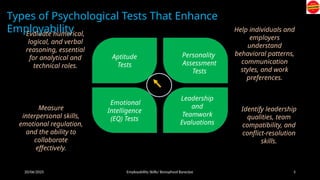
Personality
Assessment
Tests
Aptitude
Tests
Leadership
and
Teamwork
Evaluations
Emotional
Intelligence
(EQ) Tests
Evaluate numerical,
logical, and verbal
reasoning, essential
for analytical and
technical roles.
Help individuals and
employers
understand
behavioral patterns,
communication
styles, and work
preferences.
Identify leadership
qualities, team
compatibility, and
conflict-resolution
skills.
Measure
interpersonal skills,
emotional regulation,
and the ability to
collaborate
effectively.
6.
20/06/2025 Employability Skills/Bonophool Banerjee 6
Aptitude Assessment
Aptitude tests are designed to
measure specific abilities and
cognitive skills relevant to job
performance.
These assessments evaluate an
individual's logical reasoning,
numerical proficiency, verbal
ability, spatial awareness, and
problem-solving capabilities,
helping predict their suitability
for various roles and fields.
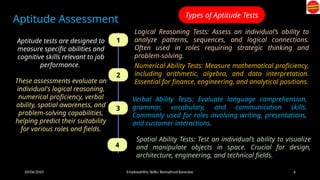
Types of Aptitude Tests
1
2
3
4
Logical Reasoning Tests: Assess an individual’s ability to
analyze patterns, sequences, and logical connections.
Often used in roles requiring strategic thinking and
problem-solving.
Numerical Ability Tests: Measure mathematical proficiency,
including arithmetic, algebra, and data interpretation.
Essential for finance, engineering, and analytical positions.
Verbal Ability Tests: Evaluate language comprehension,
grammar, vocabulary, and communication skills.
Commonly used for roles involving writing, presentations,
and customer interactions.
Spatial Ability Tests: Test an individual’s ability to visualize
and manipulate objects in space. Crucial for design,
architecture, engineering, and technical fields.
7.
20/06/2025 Employability Skills/Bonophool Banerjee 7
Aptitude Assessment
Aptitude tests are designed to
measure specific abilities and
cognitive skills relevant to job
performance.
These assessments evaluate an
individual's logical reasoning,
numerical proficiency, verbal
ability, spatial awareness, and
problem-solving capabilities,
helping predict their suitability
for various roles and fields.
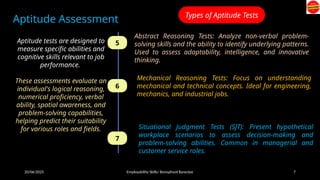
Types of Aptitude Tests
5
6
7
Abstract Reasoning Tests: Analyze non-verbal problem-
solving skills and the ability to identify underlying patterns.
Used to assess adaptability, intelligence, and innovative
thinking.
Mechanical Reasoning Tests: Focus on understanding
mechanical and technical concepts. Ideal for engineering,
mechanics, and industrial jobs.
Situational Judgment Tests (SJT): Present hypothetical
workplace scenarios to assess decision-making and
problem-solving abilities. Common in managerial and
customer service roles.
8.
20/06/2025 Employability Skills/Bonophool Banerjee 8
Personality
Assessment
Personality assessment is a method
used to evaluate and measure an
individual's personality traits,
characteristics, and behavioral
patterns.
It helps in understanding a person's
strengths, weaknesses, motivations,
and how they interact with others.
These assessments are widely used in
psychology, human resource
management, career counseling, and
personal development.
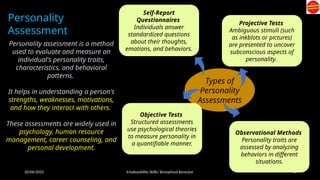
Types of
Personality
Assessments
Self-Report
Questionnaires
Individuals answer
standardized questions
about their thoughts,
emotions, and behaviors.
Projective Tests
Ambiguous stimuli (such
as inkblots or pictures)
are presented to uncover
subconscious aspects of
personality.
Observational Methods
Personality traits are
assessed by analyzing
behaviors in different
situations.
Objective Tests
Structured assessments
use psychological theories
to measure personality in
a quantifiable manner.
9.
20/06/2025 Employability Skills/Bonophool Banerjee 9
Popular Personality
Assessment Tools
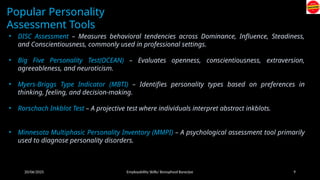
• DISC Assessment – Measures behavioral tendencies across Dominance, Influence, Steadiness,
and Conscientiousness, commonly used in professional settings.
• Big Five Personality Test(OCEAN) – Evaluates openness, conscientiousness, extraversion,
agreeableness, and neuroticism.
• Myers-Briggs Type Indicator (MBTI) – Identifies personality types based on preferences in
thinking, feeling, and decision-making.
• Rorschach Inkblot Test – A projective test where individuals interpret abstract inkblots.
• Minnesota Multiphasic Personality Inventory (MMPI) – A psychological assessment tool primarily
used to diagnose personality disorders.
10.
20/06/2025 Employability Skills/Bonophool Banerjee 10
Suggestions for Improvement
Improving personality assessments and
their applications requires a thoughtful
approach that integrates self-reflection,
feedback, emotional intelligence (EQ),
and behavioral training.
Self-Reflection & Feedback for Improvement
Personalized Awareness – Encouraging individuals to
actively reflect on assessment results rather than just
taking them at face value can lead to better self-
understanding.
Continuous Feedback Loops – Incorporating peer,
mentor, or coach feedback alongside assessment results
helps refine behaviors.
Actionable Insights – Instead of static personality
labels, assessments should provide real-world
recommendations tailored to improvement areas.
Adaptability & Growth – Encouraging periodic
reassessment ensures individuals track their personal
development and adjust behaviors over time.
Developing Emotional Intelligence (EQ)
Recognizing Emotions – Personality assessments should
include tools to help individuals identify emotional
triggers and regulate responses.
Strengthening Empathy – Enhancing self-awareness
allows people to understand others better, improving
communication and relationships.
Encouraging Social Skills – Training based on
assessment results can focus on active listening, conflict
resolution, and emotional balance.
Enhancing Decision-Making – Using assessment
insights to refine problem-solving skills based on
emotional intelligence can lead to better leadership and
teamwork.
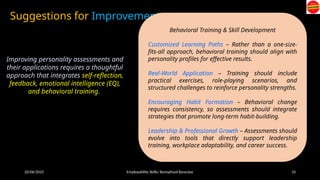
Behavioral Training & Skill Development
Customized Learning Paths – Rather than a one-size-
fits-all approach, behavioral training should align with
personality profiles for effective results.
Real-World Application – Training should include
practical exercises, role-playing scenarios, and
structured challenges to reinforce personality strengths.
Encouraging Habit Formation – Behavioral change
requires consistency, so assessments should integrate
strategies that promote long-term habit-building.
Leadership & Professional Growth – Assessments should
evolve into tools that directly support leadership
training, workplace adaptability, and career success.
11.
20/06/2025 Employability Skills/Bonophool Banerjee 11
Implementing the
Improvements
• Use interactive assessments that encourage active
participation rather than passive responses.
• Combine self-reflection, EQ insights, and behavioral training
into action-oriented development programs.
• Ensure cultural sensitivity and inclusivity in assessments for
better global applicability.
• Provide structured feedback mechanisms with clear growth-
oriented recommendations.
12.
20/06/2025 Employability Skills/Bonophool Banerjee
12
Thank
You
Bonophool Banerjee
bonophool22@gmail.com
You Tube Channel:
Hospitality Education PPT
CONTACT