Choices Family Education Services Helping families learn to have success
Our Beginnings Started in 1993  Choices assisted families and facilities working with persons with Developmental disabilities to manage behaviour problems. Choices assisted programs working with the DD population to evaluate their programs for compliance with state and federal regulations. Choices conducted parenting education training.
Our growth In 1996 choices increased its activities to include Intensive In-home family therapy. This included household maintenance, budgeting, mentoring and psychotherapy.
Our Expansion In 1999 Choices increased its staff to offering more work with the youth.  We began a mentoring program serving the youth of families that were not being served by county agencies. This program was privately funded.
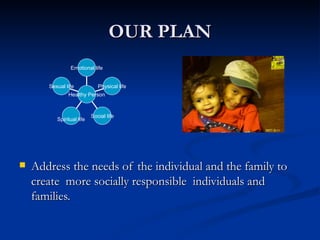
OUR PLAN Address the needs of the individual and the family to create  more socially responsible  individuals and families. Sexual life Spiritual life Social life Physical life Emotional life Healthy Person
First the person Choices offers Individual Counseling Helping the person to be HEALTHY in all relationships confronting them Developing strengths Encouraging the person to see the choices confronting them and to make new and appropriate choices Helping to evaluate their decisions Assisting the person to find their place in their world
Second the Family Choices offers: Parenting education training Marriage enrichment training Marriage and Family therapy Pre-marital counseling In-Home Counseling/ psychotherapy Financial Counseling and Education Future planning counseling
Family Challenges There are many areas of life affecting the family.  There are many decisions families need to make  but often are not prepared to address. More times than not these issues are not addressed simply because they do not have knowledge of the issue until it is forced on them;  it is then they experience  SHOCK !!!!!!!
EXAMPLES Health insurance Life Insurance Wills Trust Retirement College savings Budgeting
EXAMPLES Unemployment Illness Legal issues Academic issues Support
Problem These issues confront families of every social and economic situation.  For the most part, families of means are made aware of these issues and are better prepared to address them. Many middle class families often don’t consider these issues until at the last moment they are confronted with making a decision.  Others simply don’t believe they need to worry about it at this point in their lives.  Some don’t know that they can afford to do it.
AT RISK FAMILIES Changing At Risk Family situations is best accomplished in the changing of beliefs and changing behaviours. All families with hope are successful. Feeling stuck is merely a state of mind, a belief that is mistaken.
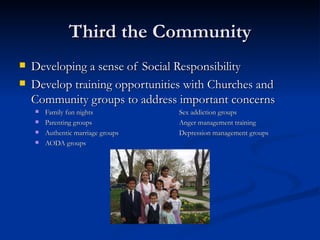
Third the Community Developing a sense of Social Responsibility Develop training opportunities with Churches and Community groups to address important concerns Family fun nights Sex addiction groups Parenting groups Anger management training Authentic marriage groups Depression management groups AODA groups
We Do This By Addressing Social and Community Concerns Working to develop Cooperative relationships with various community groups and institutions  in order to assist  others in becoming independent
Problems Today’s teens struggling with depression more than those of yesterday. Drug and alcohol abuse has become a more prevalent coping skill being used by teens.  Some develop eating disorders, self mutilate or use sexual activity  to feel good or to cope.  Many are merely oppositionally defiant.  Believing they should be allowed to do whatever it is they feel they want to do. ADHD and Bi Polar disorders are also condition which seem to be a challenge for parents today as well as in the schools and community.  Doctors are prescribing medications more frequently for many of these conditions. Worse yet  is  the cost  of getting the help needed to correct some of these problems!!
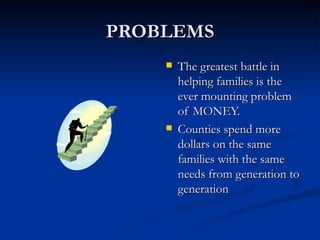
PROBLEMS The greatest battle in helping families is the ever mounting problem of MONEY. Counties spend more dollars on the same families with the same needs from generation to generation
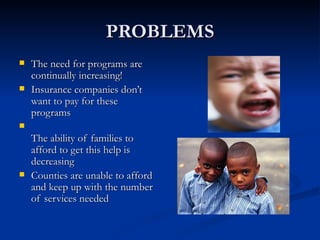
PROBLEMS The need for programs are continually increasing! Insurance companies don’t want to pay for these programs The ability of families to afford to get this help is decreasing Counties are unable to afford and keep up with the number of services needed
OUR GOAL To create an environment  which will offer people the opportunity to see their choices and develop the strengths and tools  needed to meet the challenges that confront them.
ADOLESCENT TREATMENT Helping troubled young people to become successful members in the home and in Society Manage emotional turmoil. Develop coping skills. Learn to learn. Understand obedience. Demonstrate the value of cooperation. Develop and improve their social consciousness.
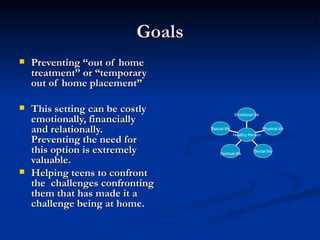
Goals Preventing “out of home treatment” or “temporary out of home placement” This setting can be costly emotionally, financially and relationally. Preventing the need for this option is extremely valuable. Helping teens to confront the  challenges confronting them that has made it a challenge being at home. Sexual life Spiritual life Social life Physical life Emotional life Healthy Person
Mentoring This has become a very popular word in the past five years. In the past it may have been described as the activities of one person to assist another person to perform an activity better.  They were a teacher. “ Mentor” served as a Teacher and Overseer to the son of Odysseus in the story The Odyssey.
One Solution Jesus had disciples with whom He taught how they were to live and confront the challenges of life. Socrates taught his disciples how to challenge their world Our mentors step in to be guides, teachers, overseers, and coaches to those that need direction.
Goals Increase positive academic performance Decrease negative legal interactions Build and strengthen families Create a more cooperative community of people
Is and Is Not It is not just to have fun It is not to be a glorified babysitter It is not done in an office It is done in a variety of settings It offers direction, guidance and encouragement It is Goal oriented
Beneficiaries We offer mentoring to youth that need to learn new and more appropriate methods of dealing with life challenges Parents that need to learn to manage their household differently. Youth in need of opportunities to develop relationships with role models
INTENSIVE IN HOME Choices has for several years taken therapy into the natural setting, the home.  We work with the family on what ever the need is to encourage and sustain beneficial change.  This includes services such as: Shopping skills training  Cleaning or household maintenance education, Cooking  or Meal planning training Counseling Learning alternative discipline methods Conflict resolution skills
Intensive Marital Training Choices has sponsored a weekend training for couples.  The goal of this weekend is to teach couples how to practice loving behaviours,  learn cooperation, learn communication skills and rekindle their love for one another.
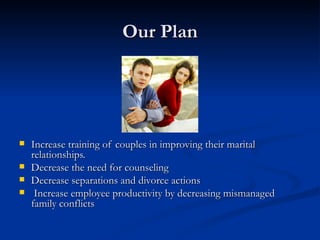
Our Plan Increase training of couples in improving their marital relationships. Decrease the need for counseling Decrease separations and divorce actions Increase employee productivity by decreasing mismanaged family conflicts
Family Restoration The Adoption Assistance and Child Welfare Act of 1980 called for the  REUNIFICATION  of children in foster care with their biological parents   whenever possible . Prevention is just one focus counties are challenged with to find solutions.
A Problem  A Solution There are many programs aimed at preserving intact families; however there are few programs designed to reunify families (Ahart, Bruer, Rutsch, schmidt, and Zaro 1992) Families in these situations require services to ensure  and prevent reabuse and foster care reentry.
The intensive family reunification program attempts to resolve the conditions that led to placement and improve the chances that children will remain their homes without the fear of further maltreatment.
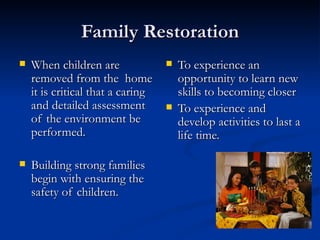
Family Restoration When children are removed from the  home it is critical that a caring and detailed assessment of the environment be performed. Building strong families begin with ensuring the safety of children. To experience an opportunity to learn new skills to becoming closer To experience and develop activities to last a life time.
Choices Family Education Services Looking to strengthen and build families Working to strengthen our society Creating a community of caring individuals
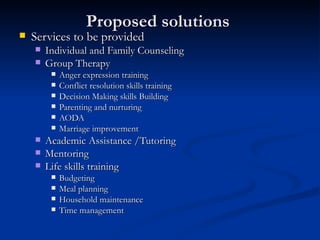
Proposed solutions  Services to be provided Individual and Family Counseling Group Therapy  Anger expression training Conflict resolution skills training Decision Making skills Building Parenting and nurturing AODA  Marriage improvement Academic Assistance /Tutoring Mentoring Life skills training Budgeting Meal planning Household maintenance  Time management
What to expect Specific Measurable Objectives and Goal. Time lines based on complexity of case and team determined goals.
What to expect Regular communication Progress Reports Interaction record Observed client responses Objective interpretation of client responses Family interaction observations
Cost The real cost is measured in the lives that are affected by our failure to be available or willing to try approaches that are outside of the box.  Success can be measured not in the work we do but in the value it adds to the lives of those we serve. In the long run It cost more to do little or nothing.
Elimination of waste Many programs offered seem to take a tremendous amount of time, money and people power. It is our position that we are effective when we can reduce these time consuming problems
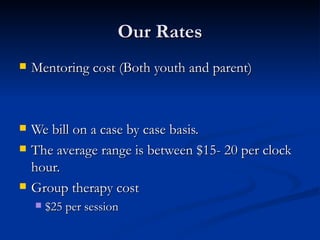
Our Rates Mentoring cost (Both youth and parent) We bill on a case by case basis. The average range is between $15- 20 per clock hour. Group therapy cost $25 per session
Choices Family Education Services of WI, llc For more information write or call:  Choices Family Education Services PO Box 915 Sheboygan, WI 53082-0915 Telephone: 920-254-5523 Email: choices@choicesfes.com

Cfes Intro

  • 1.
    Choices Family EducationServices Helping families learn to have success
  • 2.
    Our Beginnings Startedin 1993 Choices assisted families and facilities working with persons with Developmental disabilities to manage behaviour problems. Choices assisted programs working with the DD population to evaluate their programs for compliance with state and federal regulations. Choices conducted parenting education training.
  • 3.
    Our growth In1996 choices increased its activities to include Intensive In-home family therapy. This included household maintenance, budgeting, mentoring and psychotherapy.
  • 4.
    Our Expansion In1999 Choices increased its staff to offering more work with the youth. We began a mentoring program serving the youth of families that were not being served by county agencies. This program was privately funded.
  • 5.
    OUR PLAN Addressthe needs of the individual and the family to create more socially responsible individuals and families. Sexual life Spiritual life Social life Physical life Emotional life Healthy Person
  • 6.
    First the personChoices offers Individual Counseling Helping the person to be HEALTHY in all relationships confronting them Developing strengths Encouraging the person to see the choices confronting them and to make new and appropriate choices Helping to evaluate their decisions Assisting the person to find their place in their world
  • 7.
    Second the FamilyChoices offers: Parenting education training Marriage enrichment training Marriage and Family therapy Pre-marital counseling In-Home Counseling/ psychotherapy Financial Counseling and Education Future planning counseling
  • 8.
    Family Challenges Thereare many areas of life affecting the family. There are many decisions families need to make but often are not prepared to address. More times than not these issues are not addressed simply because they do not have knowledge of the issue until it is forced on them; it is then they experience SHOCK !!!!!!!
  • 9.
    EXAMPLES Health insuranceLife Insurance Wills Trust Retirement College savings Budgeting
  • 10.
    EXAMPLES Unemployment IllnessLegal issues Academic issues Support
  • 11.
    Problem These issuesconfront families of every social and economic situation. For the most part, families of means are made aware of these issues and are better prepared to address them. Many middle class families often don’t consider these issues until at the last moment they are confronted with making a decision. Others simply don’t believe they need to worry about it at this point in their lives. Some don’t know that they can afford to do it.
  • 12.
    AT RISK FAMILIESChanging At Risk Family situations is best accomplished in the changing of beliefs and changing behaviours. All families with hope are successful. Feeling stuck is merely a state of mind, a belief that is mistaken.
  • 13.
    Third the CommunityDeveloping a sense of Social Responsibility Develop training opportunities with Churches and Community groups to address important concerns Family fun nights Sex addiction groups Parenting groups Anger management training Authentic marriage groups Depression management groups AODA groups
  • 14.
    We Do ThisBy Addressing Social and Community Concerns Working to develop Cooperative relationships with various community groups and institutions in order to assist others in becoming independent
  • 15.
    Problems Today’s teensstruggling with depression more than those of yesterday. Drug and alcohol abuse has become a more prevalent coping skill being used by teens. Some develop eating disorders, self mutilate or use sexual activity to feel good or to cope. Many are merely oppositionally defiant. Believing they should be allowed to do whatever it is they feel they want to do. ADHD and Bi Polar disorders are also condition which seem to be a challenge for parents today as well as in the schools and community. Doctors are prescribing medications more frequently for many of these conditions. Worse yet is the cost of getting the help needed to correct some of these problems!!
  • 16.
    PROBLEMS The greatestbattle in helping families is the ever mounting problem of MONEY. Counties spend more dollars on the same families with the same needs from generation to generation
  • 17.
    PROBLEMS The needfor programs are continually increasing! Insurance companies don’t want to pay for these programs The ability of families to afford to get this help is decreasing Counties are unable to afford and keep up with the number of services needed
  • 18.
    OUR GOAL Tocreate an environment which will offer people the opportunity to see their choices and develop the strengths and tools needed to meet the challenges that confront them.
  • 19.
    ADOLESCENT TREATMENT Helpingtroubled young people to become successful members in the home and in Society Manage emotional turmoil. Develop coping skills. Learn to learn. Understand obedience. Demonstrate the value of cooperation. Develop and improve their social consciousness.
  • 20.
    Goals Preventing “outof home treatment” or “temporary out of home placement” This setting can be costly emotionally, financially and relationally. Preventing the need for this option is extremely valuable. Helping teens to confront the challenges confronting them that has made it a challenge being at home. Sexual life Spiritual life Social life Physical life Emotional life Healthy Person
  • 21.
    Mentoring This hasbecome a very popular word in the past five years. In the past it may have been described as the activities of one person to assist another person to perform an activity better. They were a teacher. “ Mentor” served as a Teacher and Overseer to the son of Odysseus in the story The Odyssey.
  • 22.
    One Solution Jesushad disciples with whom He taught how they were to live and confront the challenges of life. Socrates taught his disciples how to challenge their world Our mentors step in to be guides, teachers, overseers, and coaches to those that need direction.
  • 23.
    Goals Increase positiveacademic performance Decrease negative legal interactions Build and strengthen families Create a more cooperative community of people
  • 24.
    Is and IsNot It is not just to have fun It is not to be a glorified babysitter It is not done in an office It is done in a variety of settings It offers direction, guidance and encouragement It is Goal oriented
  • 25.
    Beneficiaries We offermentoring to youth that need to learn new and more appropriate methods of dealing with life challenges Parents that need to learn to manage their household differently. Youth in need of opportunities to develop relationships with role models
  • 26.
    INTENSIVE IN HOMEChoices has for several years taken therapy into the natural setting, the home. We work with the family on what ever the need is to encourage and sustain beneficial change. This includes services such as: Shopping skills training Cleaning or household maintenance education, Cooking or Meal planning training Counseling Learning alternative discipline methods Conflict resolution skills
  • 27.
    Intensive Marital TrainingChoices has sponsored a weekend training for couples. The goal of this weekend is to teach couples how to practice loving behaviours, learn cooperation, learn communication skills and rekindle their love for one another.
  • 28.
    Our Plan Increasetraining of couples in improving their marital relationships. Decrease the need for counseling Decrease separations and divorce actions Increase employee productivity by decreasing mismanaged family conflicts
  • 29.
    Family Restoration TheAdoption Assistance and Child Welfare Act of 1980 called for the REUNIFICATION of children in foster care with their biological parents whenever possible . Prevention is just one focus counties are challenged with to find solutions.
  • 30.
    A Problem A Solution There are many programs aimed at preserving intact families; however there are few programs designed to reunify families (Ahart, Bruer, Rutsch, schmidt, and Zaro 1992) Families in these situations require services to ensure and prevent reabuse and foster care reentry.
  • 31.
    The intensive familyreunification program attempts to resolve the conditions that led to placement and improve the chances that children will remain their homes without the fear of further maltreatment.
  • 32.
    Family Restoration Whenchildren are removed from the home it is critical that a caring and detailed assessment of the environment be performed. Building strong families begin with ensuring the safety of children. To experience an opportunity to learn new skills to becoming closer To experience and develop activities to last a life time.
  • 33.
    Choices Family EducationServices Looking to strengthen and build families Working to strengthen our society Creating a community of caring individuals
  • 34.
    Proposed solutions Services to be provided Individual and Family Counseling Group Therapy Anger expression training Conflict resolution skills training Decision Making skills Building Parenting and nurturing AODA Marriage improvement Academic Assistance /Tutoring Mentoring Life skills training Budgeting Meal planning Household maintenance Time management
  • 35.
    What to expectSpecific Measurable Objectives and Goal. Time lines based on complexity of case and team determined goals.
  • 36.
    What to expectRegular communication Progress Reports Interaction record Observed client responses Objective interpretation of client responses Family interaction observations
  • 37.
    Cost The realcost is measured in the lives that are affected by our failure to be available or willing to try approaches that are outside of the box. Success can be measured not in the work we do but in the value it adds to the lives of those we serve. In the long run It cost more to do little or nothing.
  • 38.
    Elimination of wasteMany programs offered seem to take a tremendous amount of time, money and people power. It is our position that we are effective when we can reduce these time consuming problems
  • 39.
    Our Rates Mentoringcost (Both youth and parent) We bill on a case by case basis. The average range is between $15- 20 per clock hour. Group therapy cost $25 per session
  • 40.
    Choices Family EducationServices of WI, llc For more information write or call: Choices Family Education Services PO Box 915 Sheboygan, WI 53082-0915 Telephone: 920-254-5523 Email: choices@choicesfes.com