DEVELOPING
POSITIVE RELATIONSHIPS
Presented by
Carlotta Stephens
WILLING TO WORK AT HAVING A GOOD
RELATIONSHIP?
Blanchard (2002) states that the first step toward
creating a happy, healthy relationship are your own
willingness to work at it. Many couples leave it until
their relationship has started to fall apart before
they consider doing anything about the difficulties
they have. The best time to learn relationship skills
is at the start of the relationship. That way you can
spend the rest of your relationship putting into
practice what you've learnt - which means you'll
probably avoid major relationship difficulties further
down the track.
GOOD RELATIONSHIPS ARE GOOD FOR YOU
 People in devoted relationships are more likely to feel happier and
satisfied with their lives and less likely to have mental or physical
health problems or to do things that are bad for their health.
 People in supportive, loving relationships help each other practically
as well as emotionally. Supportive partners share the good times and
help each other through the tough ones.
 Freifield (2013) asserts that one of the most profound experiences
we can have in our lives is the connection we have with other human
beings. Positive and supportive relationships will help us to feel
healthier, happier, and more satisfied with our lives.
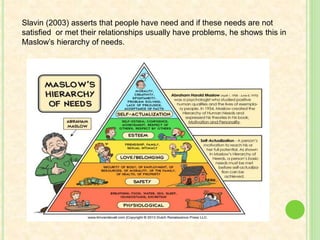
Slavin (2003) asserts that people have need and if these needs are not
satisfied or met their relationships usually have problems, he shows this in
Maslow’s hierarchy of needs.
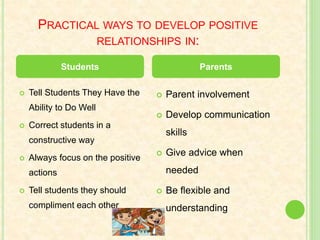
PRACTICAL WAYS TO DEVELOP POSITIVE
RELATIONSHIPS IN:
Students
 Tell Students They Have the
Ability to Do Well
 Correct students in a
constructive way
 Always focus on the positive
actions
 Tell students they should
compliment each other
Parents
 Parent involvement
 Develop communication
skills
 Give advice when
needed
 Be flexible and
understanding
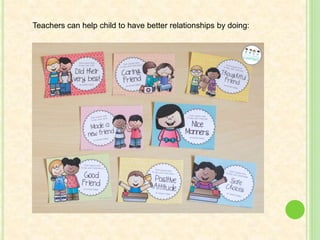
Teachers can help child to have better relationships by doing:
PRACTICAL WAYS TO DEVELOP POSITIVE
RELATIONSHIPS IN:
Teachers
o Show a genuine interest in others
o Avoid stereotyping and prejudice
o Strive to resolve conflicts in a positive manner
o Develop respect and trust within relationships
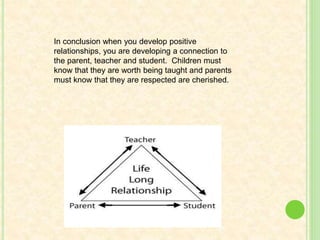
In conclusion when you develop positive
relationships, you are developing a connection to
the parent, teacher and student. Children must
know that they are worth being taught and parents
must know that they are respected are cherished.
REFERENCES
 Blanchard, K. (2002). Whale done: the power of
positive relationships. Free press, USA
 Friefield, L. (2013)Eight tips for developing positive
relationships
 Slavin, R., (2003) Educational psychology – theory
practice, Adlyn and bacon, &th edition
 www.realationships.prg.au
 www.aptv.org

Edte 330 asgnm 1

  • 1.
  • 2.
    WILLING TO WORKAT HAVING A GOOD RELATIONSHIP? Blanchard (2002) states that the first step toward creating a happy, healthy relationship are your own willingness to work at it. Many couples leave it until their relationship has started to fall apart before they consider doing anything about the difficulties they have. The best time to learn relationship skills is at the start of the relationship. That way you can spend the rest of your relationship putting into practice what you've learnt - which means you'll probably avoid major relationship difficulties further down the track.
  • 3.
    GOOD RELATIONSHIPS AREGOOD FOR YOU  People in devoted relationships are more likely to feel happier and satisfied with their lives and less likely to have mental or physical health problems or to do things that are bad for their health.  People in supportive, loving relationships help each other practically as well as emotionally. Supportive partners share the good times and help each other through the tough ones.  Freifield (2013) asserts that one of the most profound experiences we can have in our lives is the connection we have with other human beings. Positive and supportive relationships will help us to feel healthier, happier, and more satisfied with our lives.
  • 4.
    Slavin (2003) assertsthat people have need and if these needs are not satisfied or met their relationships usually have problems, he shows this in Maslow’s hierarchy of needs.
  • 5.
    PRACTICAL WAYS TODEVELOP POSITIVE RELATIONSHIPS IN: Students  Tell Students They Have the Ability to Do Well  Correct students in a constructive way  Always focus on the positive actions  Tell students they should compliment each other Parents  Parent involvement  Develop communication skills  Give advice when needed  Be flexible and understanding
  • 6.
    Teachers can helpchild to have better relationships by doing:
  • 7.
    PRACTICAL WAYS TODEVELOP POSITIVE RELATIONSHIPS IN: Teachers o Show a genuine interest in others o Avoid stereotyping and prejudice o Strive to resolve conflicts in a positive manner o Develop respect and trust within relationships
  • 8.
    In conclusion whenyou develop positive relationships, you are developing a connection to the parent, teacher and student. Children must know that they are worth being taught and parents must know that they are respected are cherished.
  • 9.
    REFERENCES  Blanchard, K.(2002). Whale done: the power of positive relationships. Free press, USA  Friefield, L. (2013)Eight tips for developing positive relationships  Slavin, R., (2003) Educational psychology – theory practice, Adlyn and bacon, &th edition  www.realationships.prg.au  www.aptv.org