Youth Mediation Practitioner:
Norwich Family Intervention Project
A dedicated service for 14 to 18 year
old alongside their caregivers
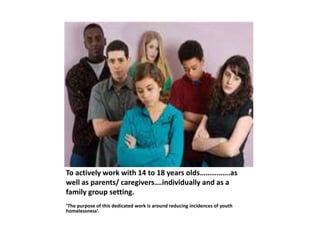
To actively work with 14 to 18 years olds…………….as
well as parents/ caregivers….individually and as a
family group setting.
‘The purpose of this dedicated work is around reducing incidences of youth
homelessness’.
Repairing family relationships is the ultimate key
This can be achieved through practical and emotional support using mediation and
restorative approaches.
Taking away the ‘labels’ that can often be attached to individuals. Regardless of
race, gender, disability and belief….my aims and objectives are to empower all,
have a fairness and equality within the family setting and in the wider community.
Building effective relationships and
communication
Tailored support to move toward having less
arguments, improving self-esteem and having a
greater willingness to accept responsibility for
actions and behaviours. Understanding one
another and unravelling the overwhelming family
conflict.
Filtering through the ‘Positional’
stuff in order to establish the
‘interest’
There is more to a young person than just a ‘naughty’, ‘unruly’ ,
‘abusive’, ‘angry’ and all of the other ‘words’ that young people
carry around with them.
With careful support our aim is to support families to understand
frustration, what causes conflict, inner anxieties, triggers around
conflict……
….in order to move to move forward!!
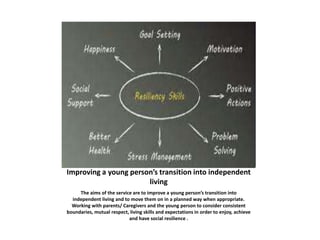
Improving a young person’s transition into independent
living
The aims of the service are to improve a young person’s transition into
independent living and to move them on in a planned way when appropriate.
Working with parents/ Caregivers and the young person to consider consistent
boundaries, mutual respect, living skills and expectations in order to enjoy, achieve
and have social resilience .
Working in a restorative family approach works
It is important to promote and work toward a more restorative approach when working
with young people and their care-givers.
Restorative principles underpin a variety of different practice models and techniques
including: Respect, Responsibility, Reflection, working ‘with’, Giving everyone an equal
voice, having a fair and consistent process, honesty, inclusive, empowering.
Finding regular family time and moving away from
negative and judgemental perspectives.
Supporting a young person and their care-givers around having a mutual
understanding of one another, including the difficulties of being a teenager as well
as the responsibility and constraints of being a parent. To find some mutual
common-ground in which to listen, find regular time, have fun and to work on
striving toward a mutual trust.
Enabling parents to reflect, adopt a calmer approach even in stressful
circumstances and to move away from blame, shame and further disempowering
the young person, acting as a ‘positive’ role model to promote emotional , physical
development as well as managing self regulation.
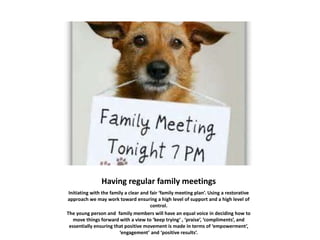
Having regular family meetings
Initiating with the family a clear and fair ‘family meeting plan’. Using a restorative
approach we may work toward ensuring a high level of support and a high level of
control.
The young person and family members will have an equal voice in deciding how to
move things forward with a view to ‘keep trying’ , ‘praise’, ‘compliments’, and
essentially ensuring that positive movement is made in terms of ‘empowerment’,
‘engagement’ and ‘positive results’.
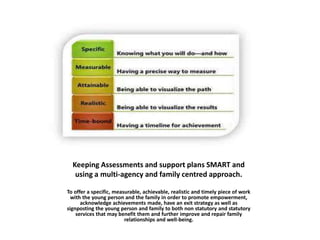
Keeping Assessments and support plans SMART and
using a multi-agency and family centred approach.
To offer a specific, measurable, achievable, realistic and timely piece of work
with the young person and the family in order to promote empowerment,
acknowledge achievements made, have an exit strategy as well as
signposting the young person and family to both non statutory and statutory
services that may benefit them and further improve and repair family
relationships and well-being.
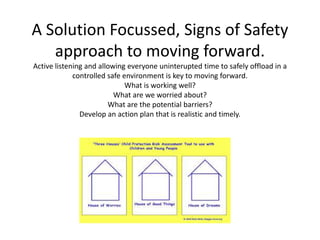
A Solution Focussed, Signs of Safety
approach to moving forward.
Active listening and allowing everyone uninterupted time to safely offload in a
controlled safe environment is key to moving forward.
What is working well?
What are we worried about?
What are the potential barriers?
Develop an action plan that is realistic and timely.
I welcome all relevant discussions
regarding potential referrals to my
service.
Essential criteria:
14 to 18 years of age.
At risk of Homelessness
Phil Sherwood:Youth Mediation Practitioner
Norwich FIP
Norwich City Council
Tel: 01603 213593
phillipsherwood@norwich.gov.uk

Presentation1YMP

  • 1.
    Youth Mediation Practitioner: NorwichFamily Intervention Project A dedicated service for 14 to 18 year old alongside their caregivers
  • 2.
    To actively workwith 14 to 18 years olds…………….as well as parents/ caregivers….individually and as a family group setting. ‘The purpose of this dedicated work is around reducing incidences of youth homelessness’.
  • 3.
    Repairing family relationshipsis the ultimate key This can be achieved through practical and emotional support using mediation and restorative approaches. Taking away the ‘labels’ that can often be attached to individuals. Regardless of race, gender, disability and belief….my aims and objectives are to empower all, have a fairness and equality within the family setting and in the wider community.
  • 4.
    Building effective relationshipsand communication Tailored support to move toward having less arguments, improving self-esteem and having a greater willingness to accept responsibility for actions and behaviours. Understanding one another and unravelling the overwhelming family conflict.
  • 5.
    Filtering through the‘Positional’ stuff in order to establish the ‘interest’ There is more to a young person than just a ‘naughty’, ‘unruly’ , ‘abusive’, ‘angry’ and all of the other ‘words’ that young people carry around with them. With careful support our aim is to support families to understand frustration, what causes conflict, inner anxieties, triggers around conflict…… ….in order to move to move forward!!
  • 6.
    Improving a youngperson’s transition into independent living The aims of the service are to improve a young person’s transition into independent living and to move them on in a planned way when appropriate. Working with parents/ Caregivers and the young person to consider consistent boundaries, mutual respect, living skills and expectations in order to enjoy, achieve and have social resilience .
  • 7.
    Working in arestorative family approach works It is important to promote and work toward a more restorative approach when working with young people and their care-givers. Restorative principles underpin a variety of different practice models and techniques including: Respect, Responsibility, Reflection, working ‘with’, Giving everyone an equal voice, having a fair and consistent process, honesty, inclusive, empowering.
  • 8.
    Finding regular familytime and moving away from negative and judgemental perspectives. Supporting a young person and their care-givers around having a mutual understanding of one another, including the difficulties of being a teenager as well as the responsibility and constraints of being a parent. To find some mutual common-ground in which to listen, find regular time, have fun and to work on striving toward a mutual trust. Enabling parents to reflect, adopt a calmer approach even in stressful circumstances and to move away from blame, shame and further disempowering the young person, acting as a ‘positive’ role model to promote emotional , physical development as well as managing self regulation.
  • 9.
    Having regular familymeetings Initiating with the family a clear and fair ‘family meeting plan’. Using a restorative approach we may work toward ensuring a high level of support and a high level of control. The young person and family members will have an equal voice in deciding how to move things forward with a view to ‘keep trying’ , ‘praise’, ‘compliments’, and essentially ensuring that positive movement is made in terms of ‘empowerment’, ‘engagement’ and ‘positive results’.
  • 10.
    Keeping Assessments andsupport plans SMART and using a multi-agency and family centred approach. To offer a specific, measurable, achievable, realistic and timely piece of work with the young person and the family in order to promote empowerment, acknowledge achievements made, have an exit strategy as well as signposting the young person and family to both non statutory and statutory services that may benefit them and further improve and repair family relationships and well-being.
  • 11.
    A Solution Focussed,Signs of Safety approach to moving forward. Active listening and allowing everyone uninterupted time to safely offload in a controlled safe environment is key to moving forward. What is working well? What are we worried about? What are the potential barriers? Develop an action plan that is realistic and timely.
  • 12.
    I welcome allrelevant discussions regarding potential referrals to my service. Essential criteria: 14 to 18 years of age. At risk of Homelessness Phil Sherwood:Youth Mediation Practitioner Norwich FIP Norwich City Council Tel: 01603 213593 phillipsherwood@norwich.gov.uk