APPLIED CONTROL SYSTEMS  Anti-collision System for Shiploaders
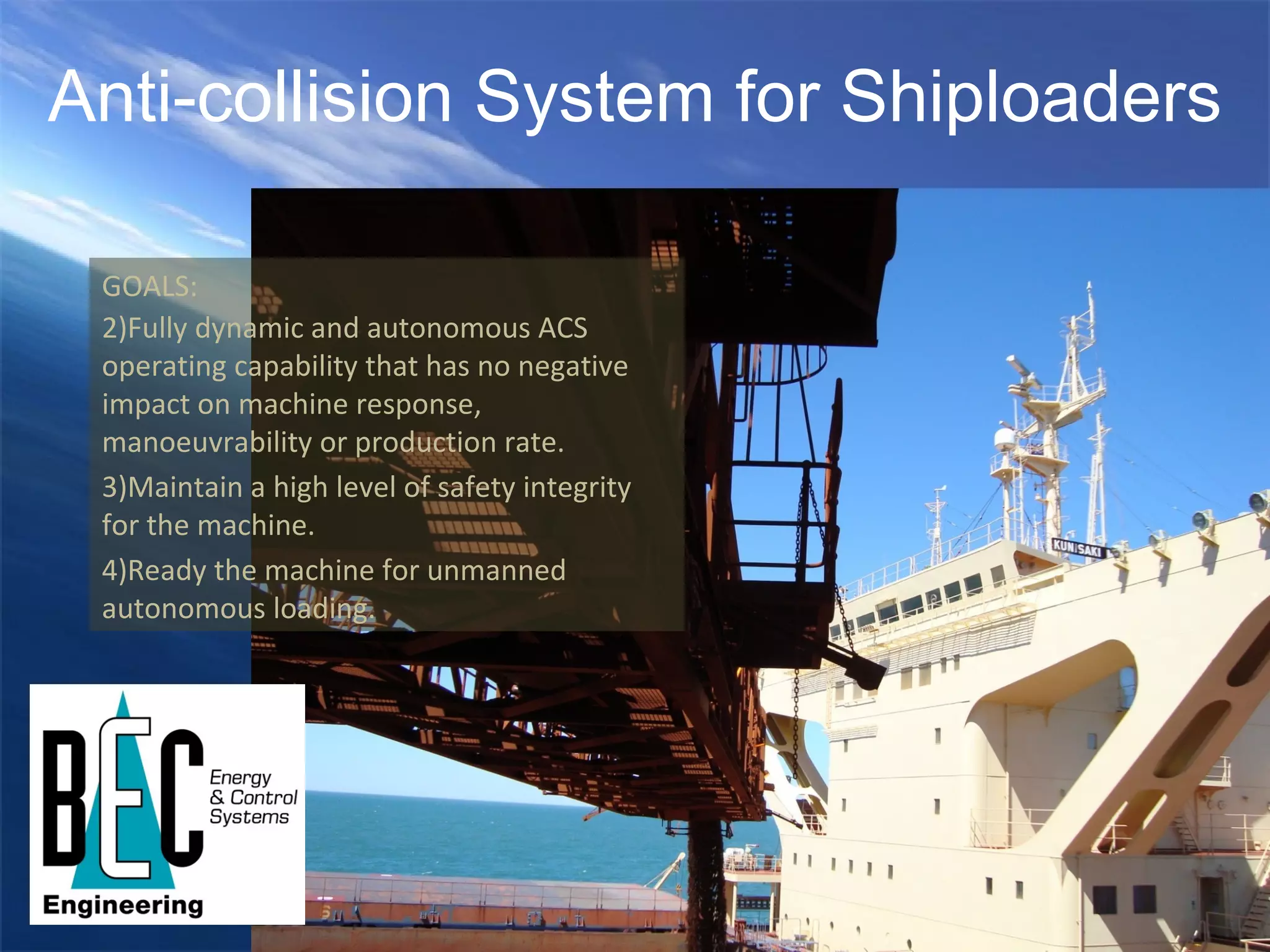
Anti-collision System for Shiploaders GOALS: Fully dynamic and autonomous ACS operating capability that has no negative impact on machine response, manoeuvrability or production rate. Maintain a high level of safety integrity for the machine. Ready the machine for unmanned autonomous loading.
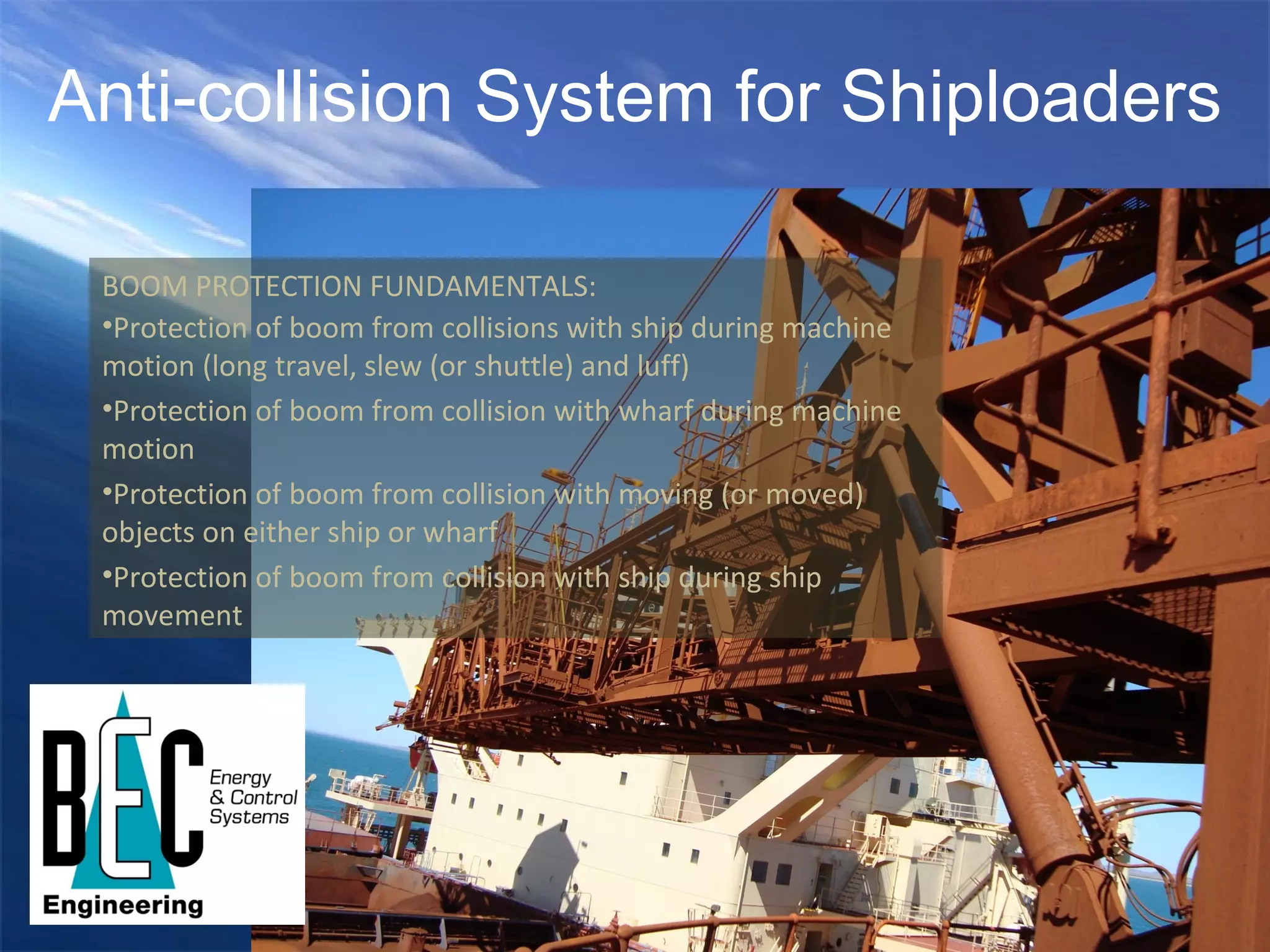
Anti-collision System for Shiploaders BOOM PROTECTION FUNDAMENTALS: Protection of boom from collisions with ship during machine motion (long travel, slew (or shuttle) and luff) Protection of boom from collision with wharf during machine motion Protection of boom from collision with moving (or moved) objects on either ship or wharf Protection of boom from collision with ship during ship movement
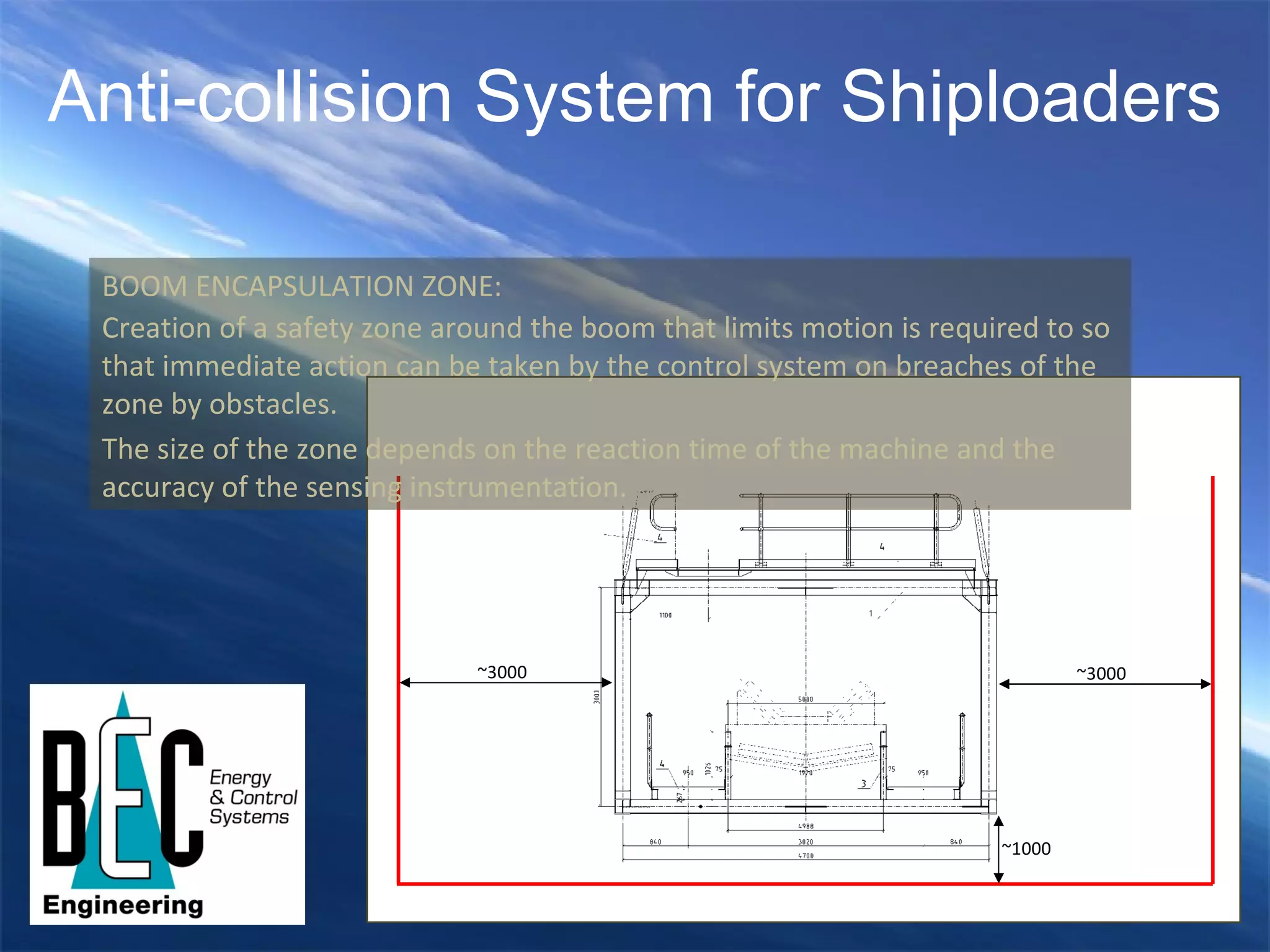
Anti-collision System for Shiploaders BOOM ENCAPSULATION ZONE: Creation of a safety zone around the boom that limits motion is required to so that immediate action can be taken by the control system on breaches of the zone by obstacles. The size of the zone depends on the reaction time of the machine and the accuracy of the sensing instrumentation. ~3000 ~3000 ~1000
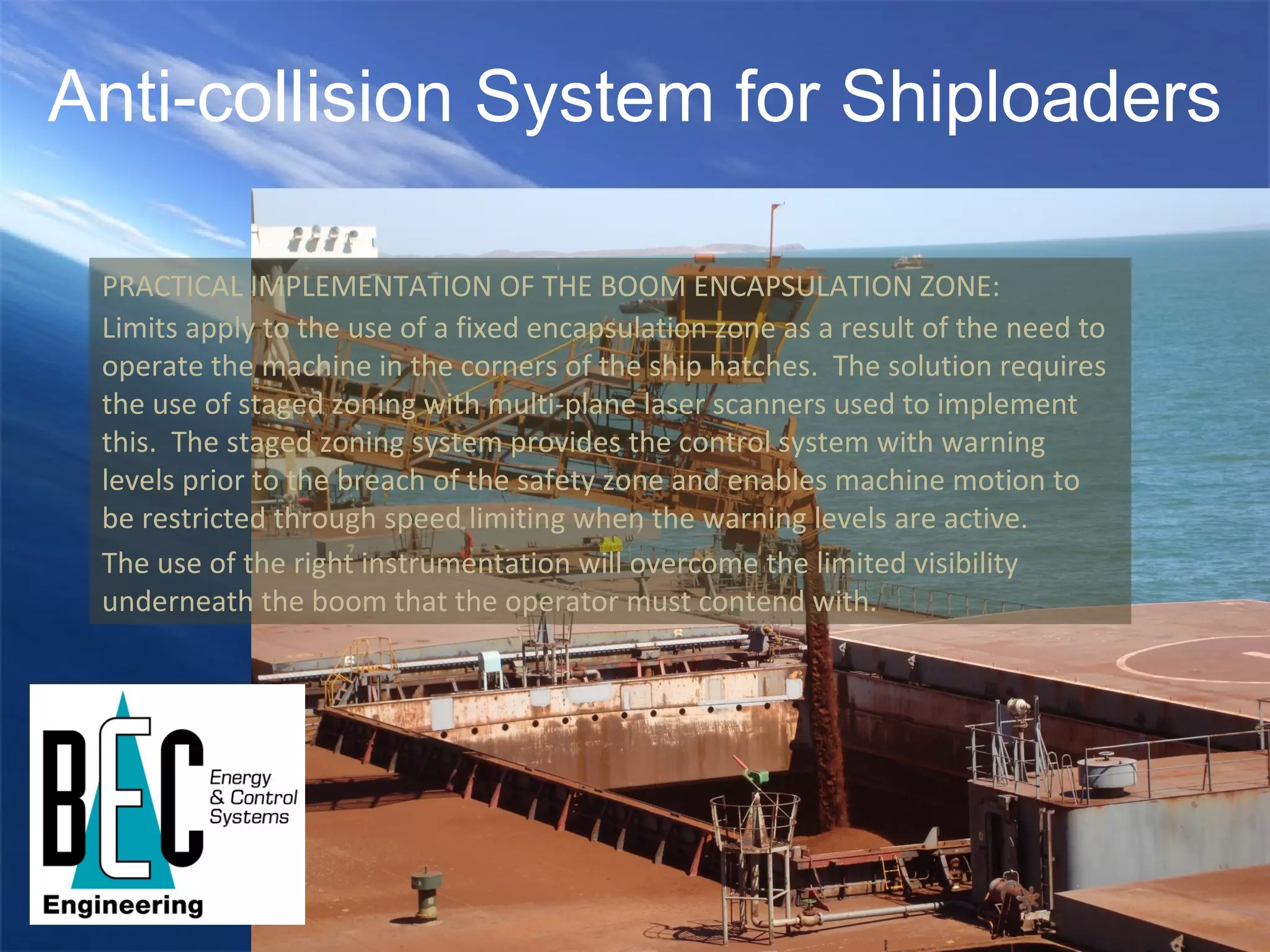
Anti-collision System for Shiploaders PRACTICAL IMPLEMENTATION OF THE BOOM ENCAPSULATION ZONE: Limits apply to the use of a fixed encapsulation zone as a result of the need to operate the machine in the corners of the ship hatches.  The solution requires the use of staged zoning with multi-plane laser scanners used to implement this.  The staged zoning system provides the control system with warning levels prior to the breach of the safety zone and enables machine motion to be restricted through speed limiting when the warning levels are active. The use of the right instrumentation will overcome the limited visibility underneath the boom that the operator must contend with.
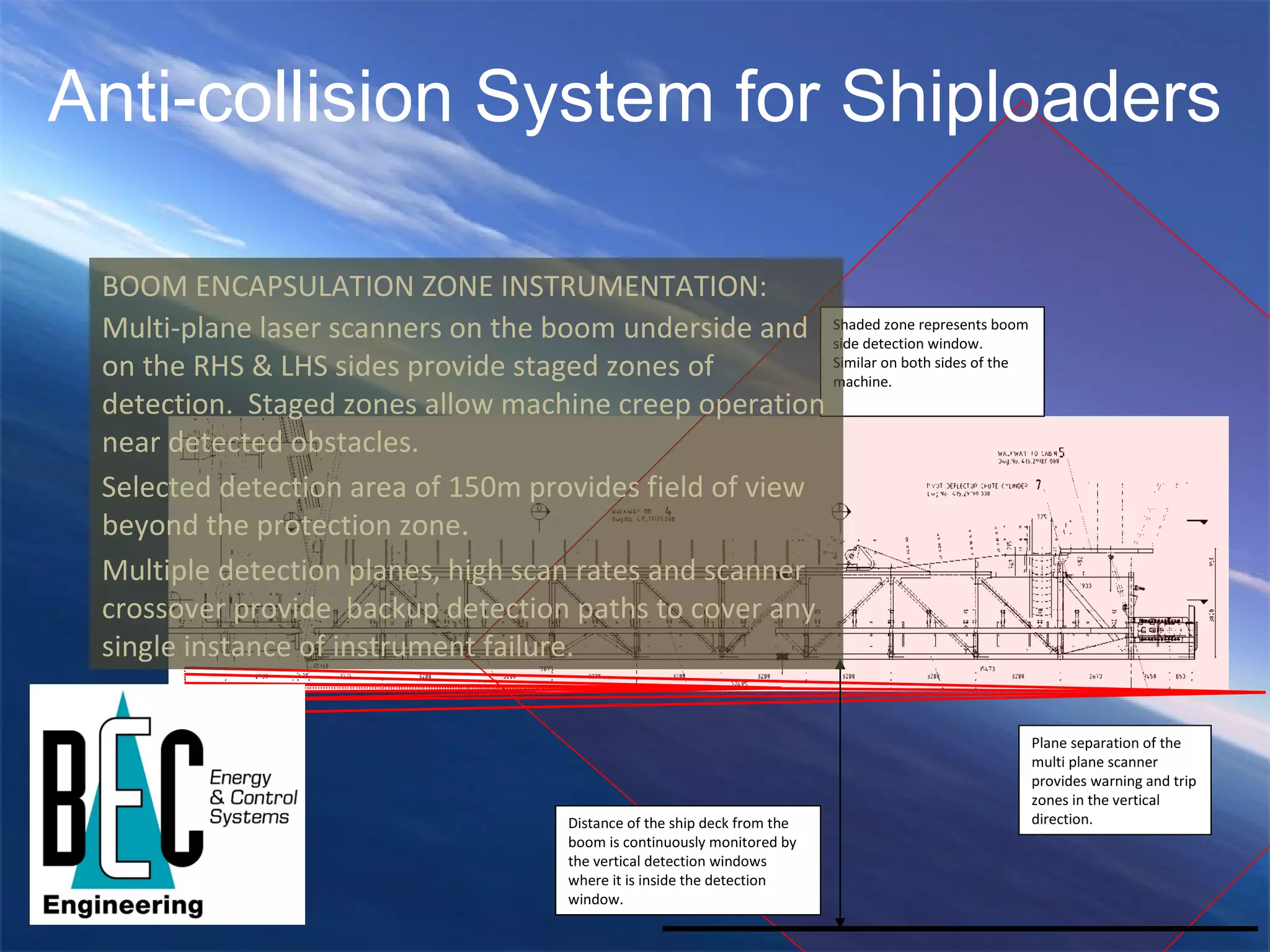
Anti-collision System for Shiploaders BOOM ENCAPSULATION ZONE INSTRUMENTATION: Multi-plane laser scanners on the boom underside and on the RHS & LHS sides provide staged zones of detection.  Staged zones allow machine creep operation near detected obstacles. Selected detection area of 150m provides field of view beyond the protection zone. Multiple detection planes, high scan rates and scanner crossover provide  backup detection paths to cover any single instance of instrument failure. Shaded zone represents boom side detection window.  Similar on both sides of the machine. Distance of the ship deck from the boom is continuously monitored by the vertical detection windows where it is inside the detection window. Plane separation of the multi plane scanner provides warning and trip zones in the vertical direction.
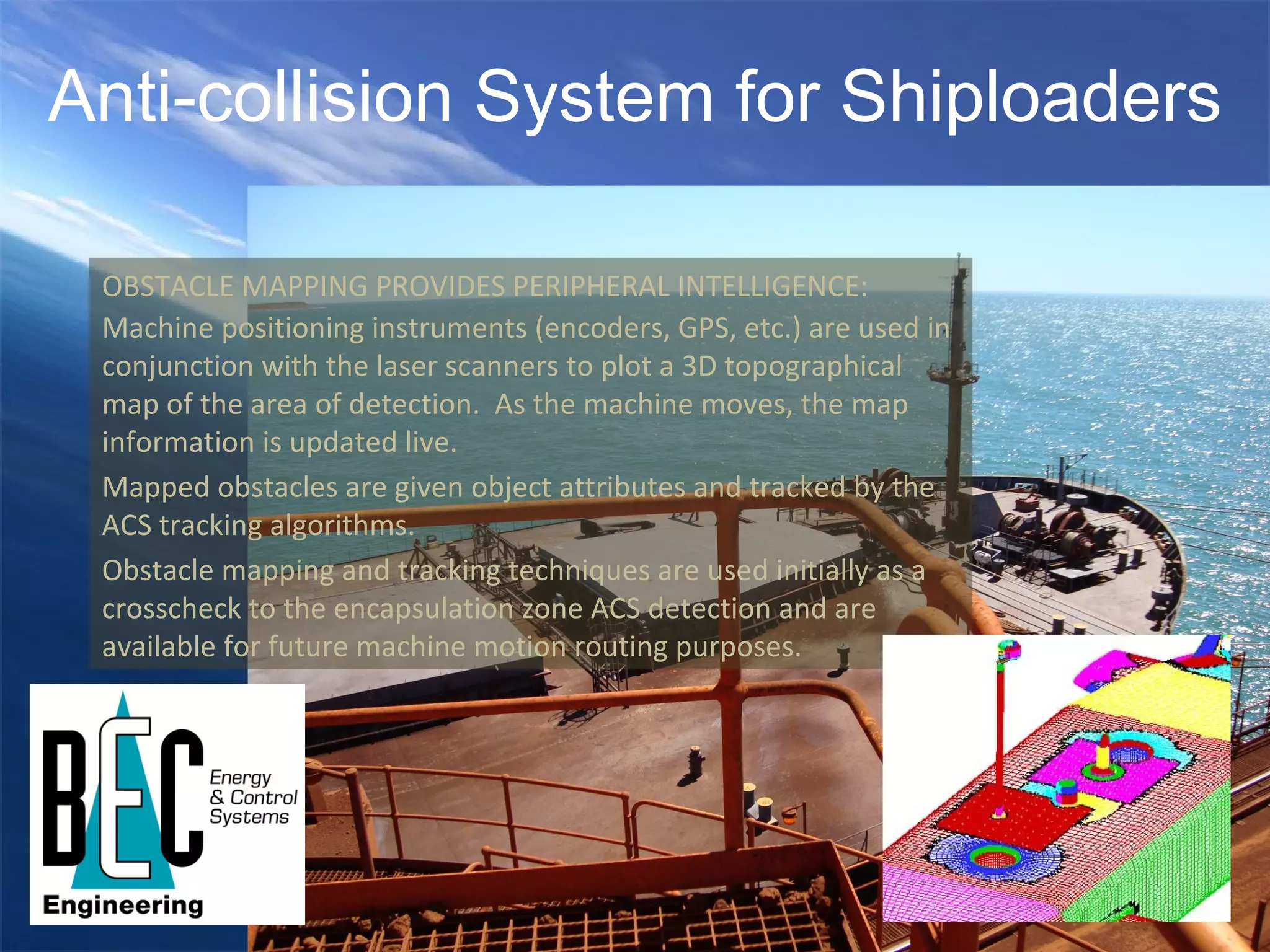
Anti-collision System for Shiploaders OBSTACLE MAPPING PROVIDES PERIPHERAL INTELLIGENCE: Machine positioning instruments (encoders, GPS, etc.) are used in conjunction with the laser scanners to plot a 3D topographical map of the area of detection.  As the machine moves, the map information is updated live. Mapped obstacles are given object attributes and tracked by the ACS tracking algorithms. Obstacle mapping and tracking techniques are used initially as a crosscheck to the encapsulation zone ACS detection and are available for future machine motion routing purposes.
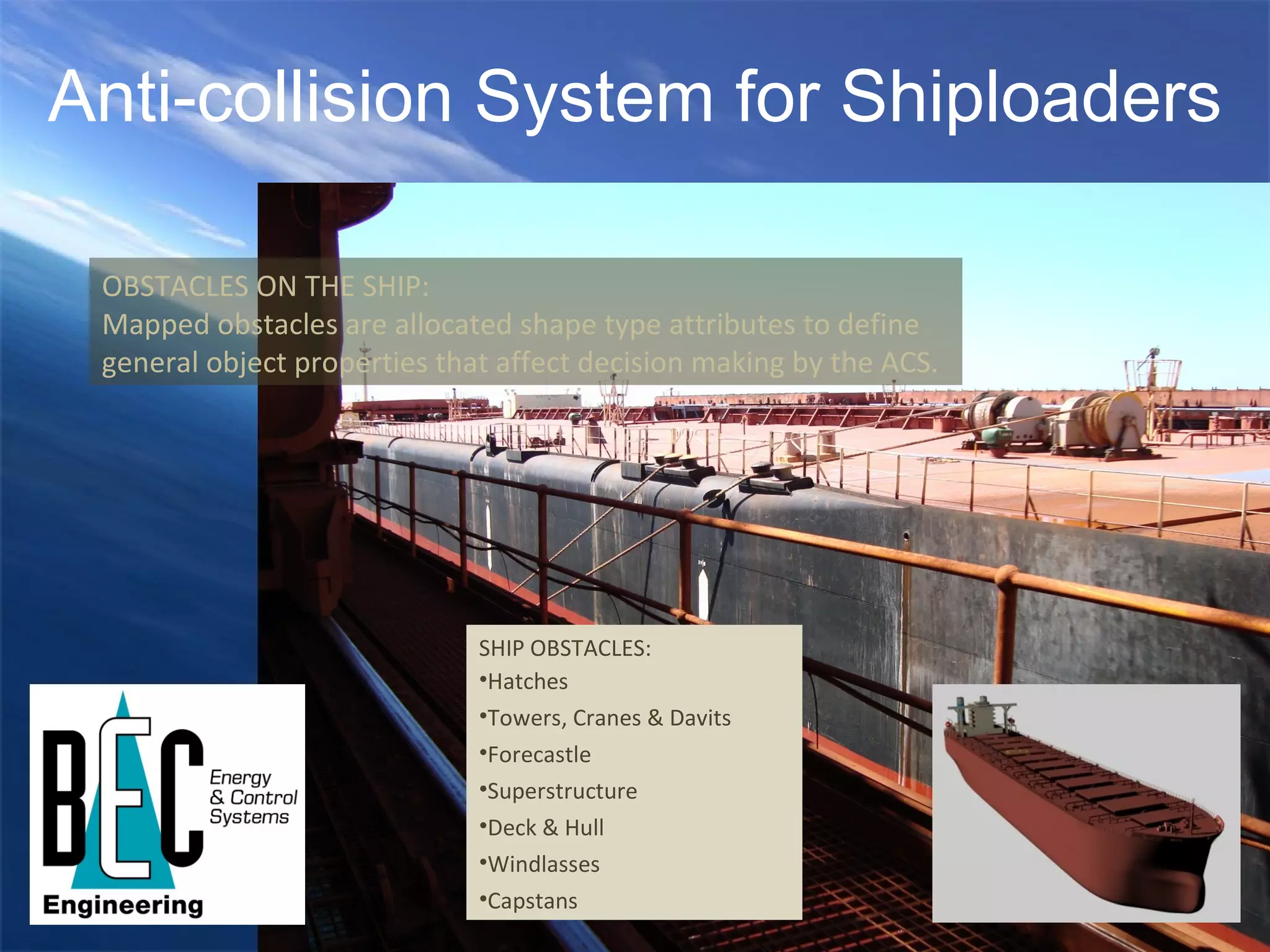
Anti-collision System for Shiploaders OBSTACLES ON THE SHIP: Mapped obstacles are allocated shape type attributes to define general object properties that affect decision making by the ACS.  SHIP OBSTACLES: Hatches Towers, Cranes & Davits Forecastle Superstructure Deck & Hull Windlasses Capstans
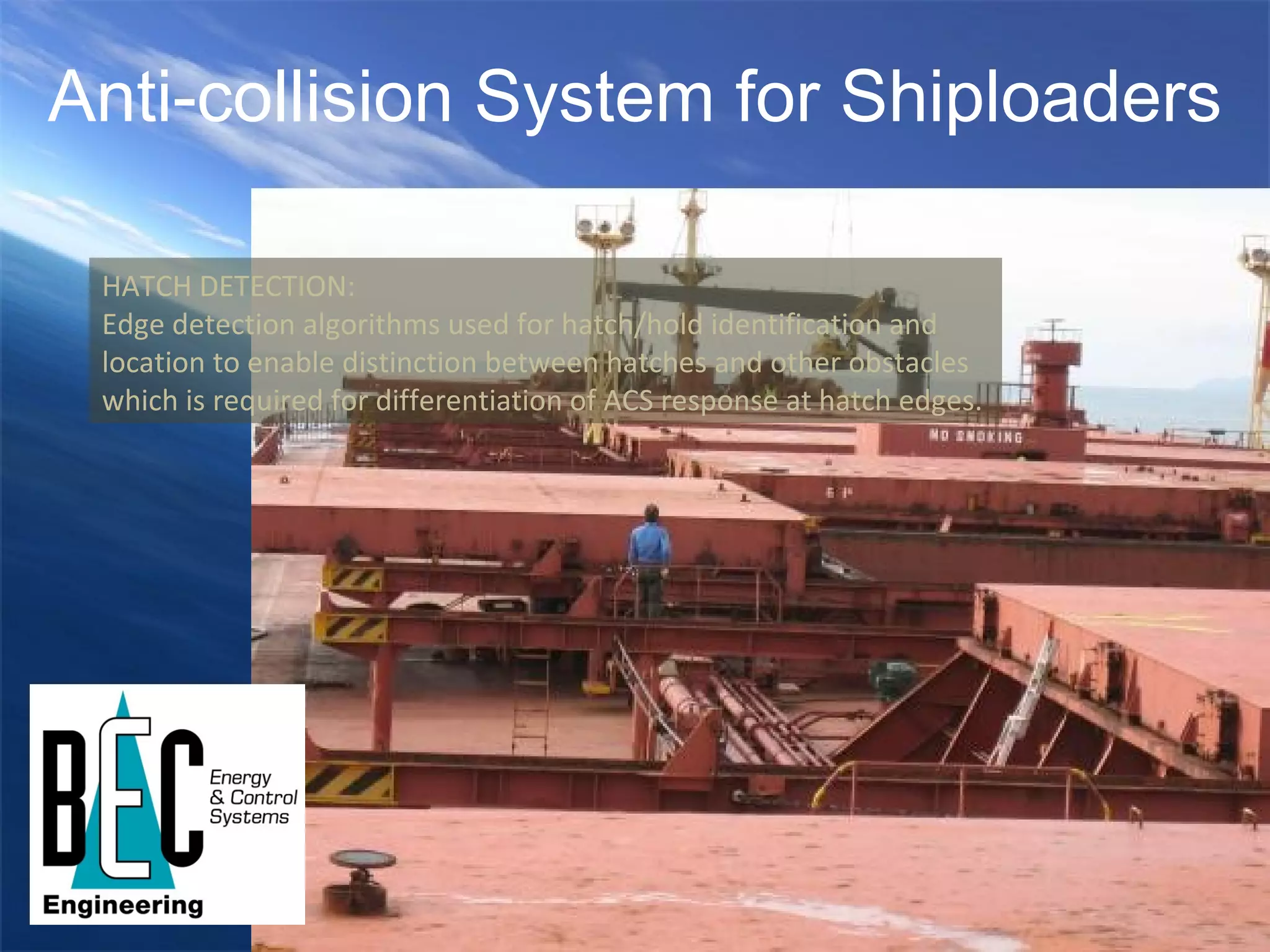
Anti-collision System for Shiploaders HATCH DETECTION: Edge detection algorithms used for hatch/hold identification and location to enable distinction between hatches and other obstacles which is required for differentiation of ACS response at hatch edges.
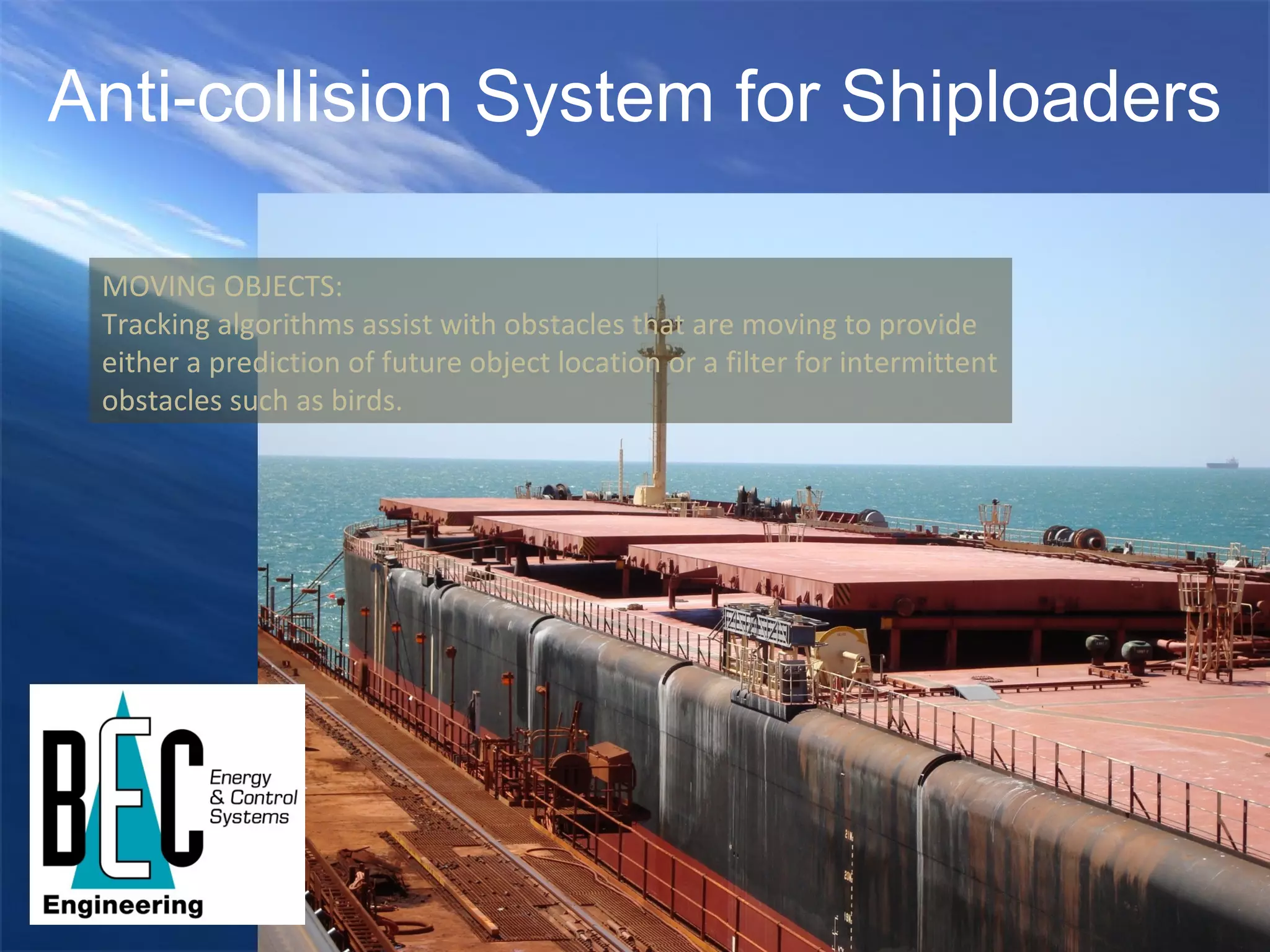
Anti-collision System for Shiploaders MOVING OBJECTS: Tracking algorithms assist with obstacles that are moving to provide either a prediction of future object location or a filter for intermittent obstacles such as birds.
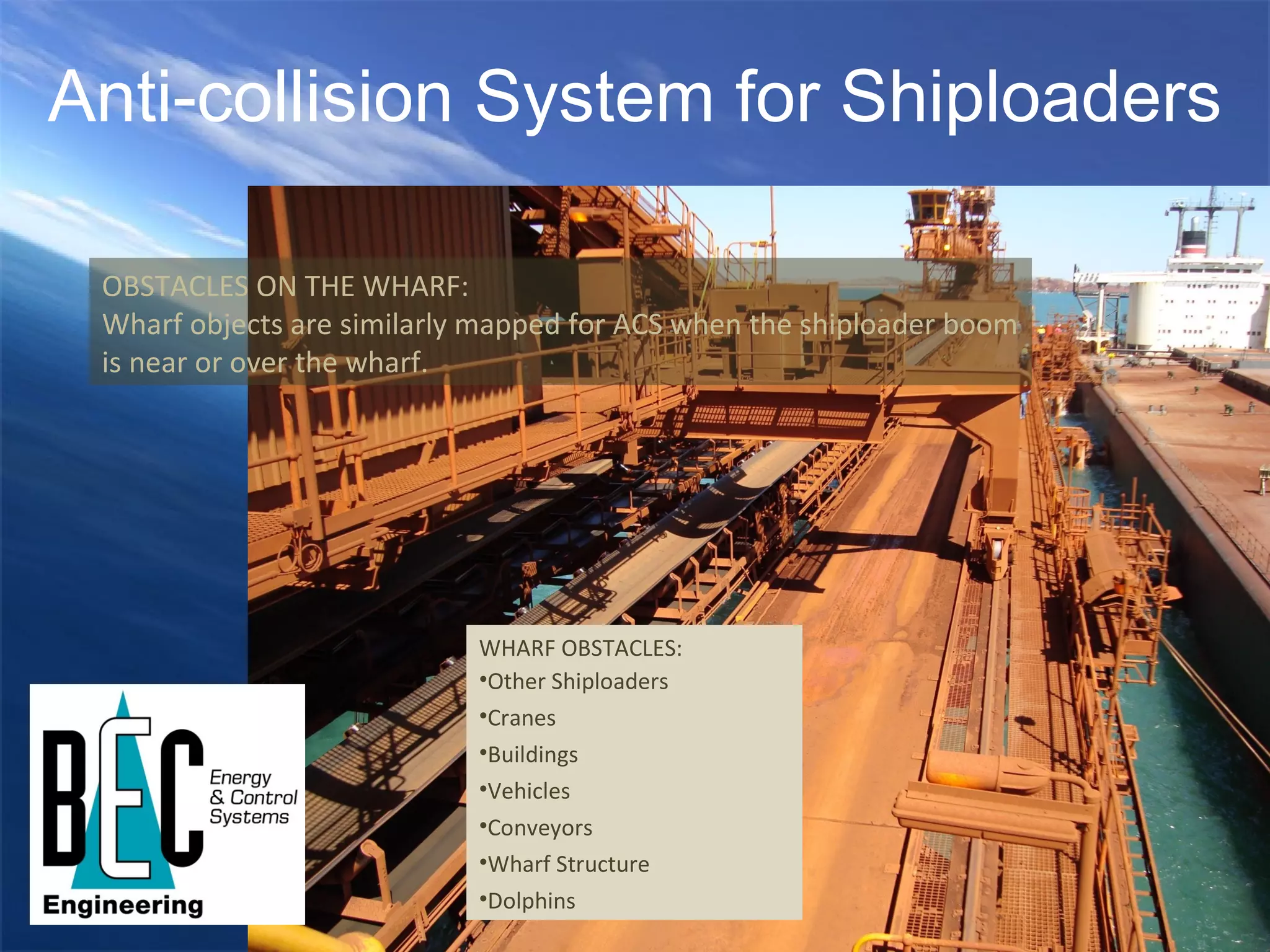
Anti-collision System for Shiploaders OBSTACLES ON THE WHARF: Wharf objects are similarly mapped for ACS when the shiploader boom is near or over the wharf. WHARF OBSTACLES: Other Shiploaders Cranes Buildings Vehicles Conveyors Wharf Structure Dolphins
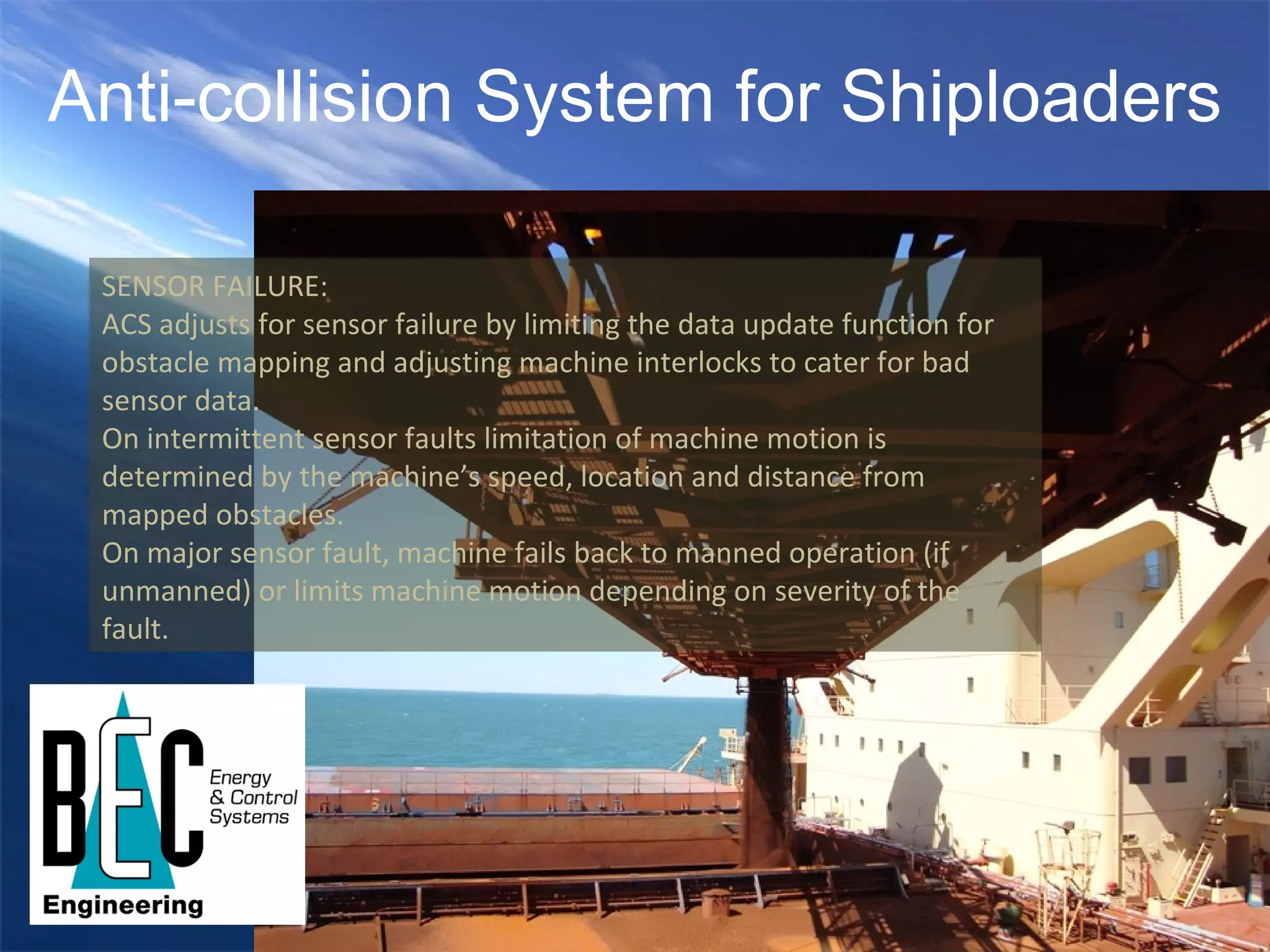
Anti-collision System for Shiploaders SENSOR FAILURE: ACS adjusts for sensor failure by limiting the data update function for obstacle mapping and adjusting machine interlocks to cater for bad sensor data. On intermittent sensor faults limitation of machine motion is determined by the machine’s speed, location and distance from mapped obstacles. On major sensor fault, machine fails back to manned operation (if unmanned) or limits machine motion depending on severity of the fault.
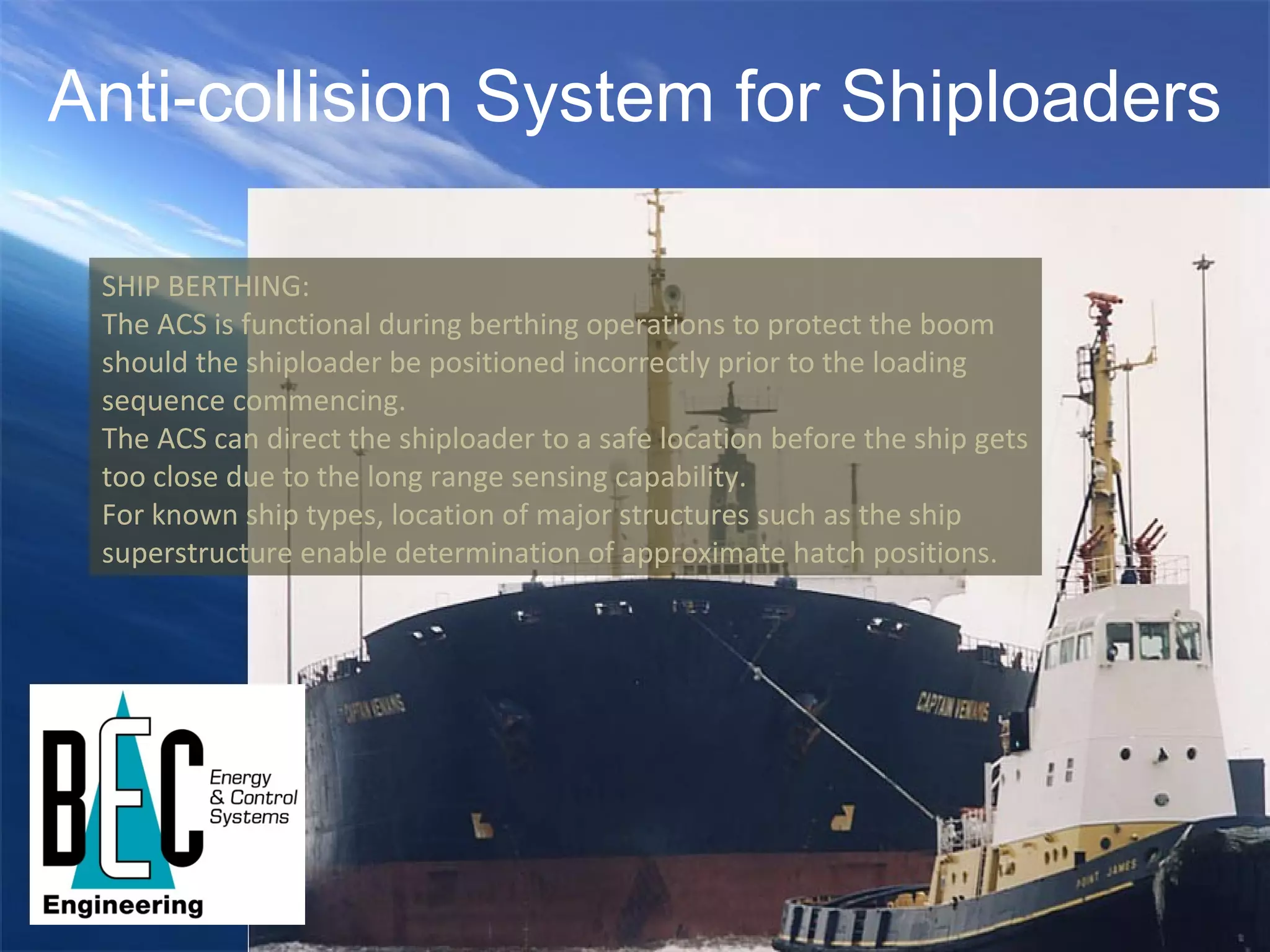
Anti-collision System for Shiploaders SHIP BERTHING: The ACS is functional during berthing operations to protect the boom  should the shiploader be positioned incorrectly prior to the loading sequence commencing. The ACS can direct the shiploader to a safe location before the ship gets too close due to the long range sensing capability. For known ship types, location of major structures such as the ship superstructure enable determination of approximate hatch positions.
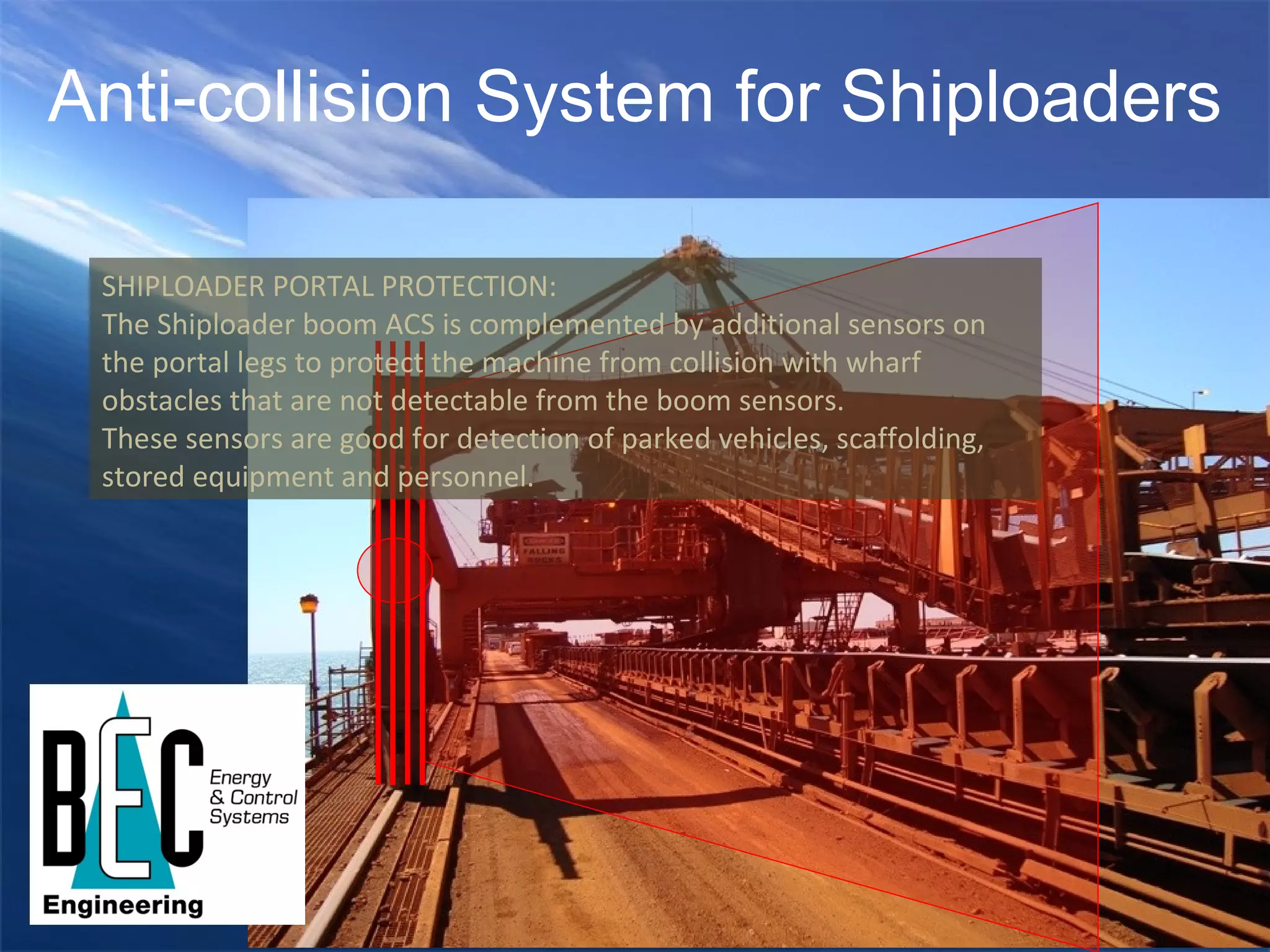
Anti-collision System for Shiploaders SHIPLOADER PORTAL PROTECTION: The Shiploader boom ACS is complemented by additional sensors on the portal legs to protect the machine from collision with wharf obstacles that are not detectable from the boom sensors. These sensors are good for detection of parked vehicles, scaffolding, stored equipment and personnel.
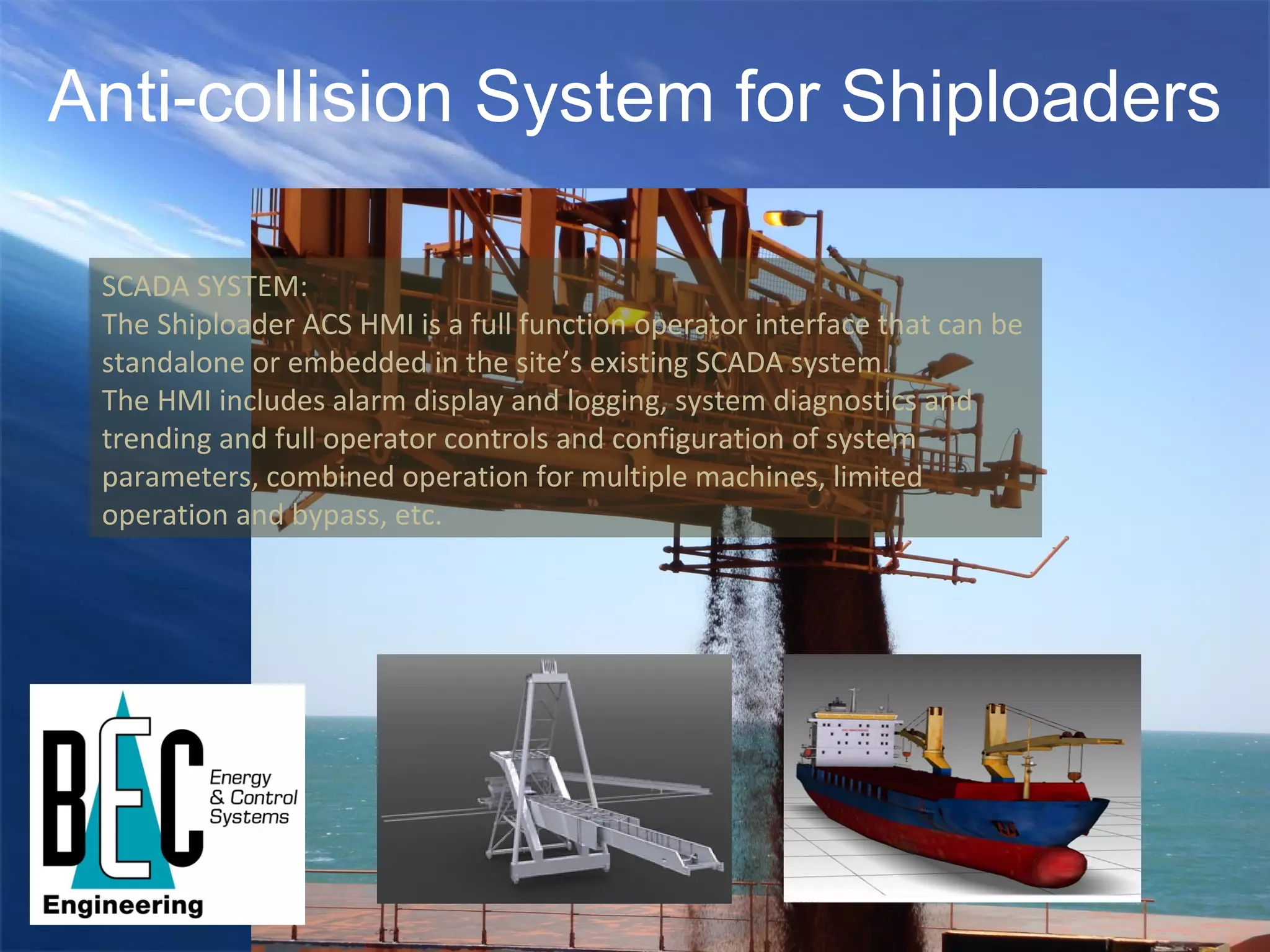
Anti-collision System for Shiploaders SCADA SYSTEM: The Shiploader ACS HMI is a full function operator interface that can be standalone or embedded in the site’s existing SCADA system.  The HMI includes alarm display and logging, system diagnostics and trending and full operator controls and configuration of system parameters, combined operation for multiple machines, limited operation and bypass, etc.

Applied Control Systems Shiploader Acs

  • 1.
    APPLIED CONTROL SYSTEMS Anti-collision System for Shiploaders
  • 2.
    Anti-collision System forShiploaders GOALS: Fully dynamic and autonomous ACS operating capability that has no negative impact on machine response, manoeuvrability or production rate. Maintain a high level of safety integrity for the machine. Ready the machine for unmanned autonomous loading.
  • 3.
    Anti-collision System forShiploaders BOOM PROTECTION FUNDAMENTALS: Protection of boom from collisions with ship during machine motion (long travel, slew (or shuttle) and luff) Protection of boom from collision with wharf during machine motion Protection of boom from collision with moving (or moved) objects on either ship or wharf Protection of boom from collision with ship during ship movement
  • 4.
    Anti-collision System forShiploaders BOOM ENCAPSULATION ZONE: Creation of a safety zone around the boom that limits motion is required to so that immediate action can be taken by the control system on breaches of the zone by obstacles. The size of the zone depends on the reaction time of the machine and the accuracy of the sensing instrumentation. ~3000 ~3000 ~1000
  • 5.
    Anti-collision System forShiploaders PRACTICAL IMPLEMENTATION OF THE BOOM ENCAPSULATION ZONE: Limits apply to the use of a fixed encapsulation zone as a result of the need to operate the machine in the corners of the ship hatches. The solution requires the use of staged zoning with multi-plane laser scanners used to implement this. The staged zoning system provides the control system with warning levels prior to the breach of the safety zone and enables machine motion to be restricted through speed limiting when the warning levels are active. The use of the right instrumentation will overcome the limited visibility underneath the boom that the operator must contend with.
  • 6.
    Anti-collision System forShiploaders BOOM ENCAPSULATION ZONE INSTRUMENTATION: Multi-plane laser scanners on the boom underside and on the RHS & LHS sides provide staged zones of detection. Staged zones allow machine creep operation near detected obstacles. Selected detection area of 150m provides field of view beyond the protection zone. Multiple detection planes, high scan rates and scanner crossover provide backup detection paths to cover any single instance of instrument failure. Shaded zone represents boom side detection window. Similar on both sides of the machine. Distance of the ship deck from the boom is continuously monitored by the vertical detection windows where it is inside the detection window. Plane separation of the multi plane scanner provides warning and trip zones in the vertical direction.
  • 7.
    Anti-collision System forShiploaders OBSTACLE MAPPING PROVIDES PERIPHERAL INTELLIGENCE: Machine positioning instruments (encoders, GPS, etc.) are used in conjunction with the laser scanners to plot a 3D topographical map of the area of detection. As the machine moves, the map information is updated live. Mapped obstacles are given object attributes and tracked by the ACS tracking algorithms. Obstacle mapping and tracking techniques are used initially as a crosscheck to the encapsulation zone ACS detection and are available for future machine motion routing purposes.
  • 8.
    Anti-collision System forShiploaders OBSTACLES ON THE SHIP: Mapped obstacles are allocated shape type attributes to define general object properties that affect decision making by the ACS. SHIP OBSTACLES: Hatches Towers, Cranes & Davits Forecastle Superstructure Deck & Hull Windlasses Capstans
  • 9.
    Anti-collision System forShiploaders HATCH DETECTION: Edge detection algorithms used for hatch/hold identification and location to enable distinction between hatches and other obstacles which is required for differentiation of ACS response at hatch edges.
  • 10.
    Anti-collision System forShiploaders MOVING OBJECTS: Tracking algorithms assist with obstacles that are moving to provide either a prediction of future object location or a filter for intermittent obstacles such as birds.
  • 11.
    Anti-collision System forShiploaders OBSTACLES ON THE WHARF: Wharf objects are similarly mapped for ACS when the shiploader boom is near or over the wharf. WHARF OBSTACLES: Other Shiploaders Cranes Buildings Vehicles Conveyors Wharf Structure Dolphins
  • 12.
    Anti-collision System forShiploaders SENSOR FAILURE: ACS adjusts for sensor failure by limiting the data update function for obstacle mapping and adjusting machine interlocks to cater for bad sensor data. On intermittent sensor faults limitation of machine motion is determined by the machine’s speed, location and distance from mapped obstacles. On major sensor fault, machine fails back to manned operation (if unmanned) or limits machine motion depending on severity of the fault.
  • 13.
    Anti-collision System forShiploaders SHIP BERTHING: The ACS is functional during berthing operations to protect the boom should the shiploader be positioned incorrectly prior to the loading sequence commencing. The ACS can direct the shiploader to a safe location before the ship gets too close due to the long range sensing capability. For known ship types, location of major structures such as the ship superstructure enable determination of approximate hatch positions.
  • 14.
    Anti-collision System forShiploaders SHIPLOADER PORTAL PROTECTION: The Shiploader boom ACS is complemented by additional sensors on the portal legs to protect the machine from collision with wharf obstacles that are not detectable from the boom sensors. These sensors are good for detection of parked vehicles, scaffolding, stored equipment and personnel.
  • 15.
    Anti-collision System forShiploaders SCADA SYSTEM: The Shiploader ACS HMI is a full function operator interface that can be standalone or embedded in the site’s existing SCADA system. The HMI includes alarm display and logging, system diagnostics and trending and full operator controls and configuration of system parameters, combined operation for multiple machines, limited operation and bypass, etc.