Prepared by :
Prajwal Regmi (surkhet , Nepal)
IAAS

 It is true that achievements, to some extent, have been
made in the development of physical and social
infrastructure through the implementation of preceding
plans, and particularly, the growth rate of non-agriculture
sector has increased as a result of policies adopted in the
Eighth Plan.
 However, it is also true that desirable progress has not so
far been achieved in alleviating the problem of rampant
poverty and unemployment in the country.
 Therefore, with the aim of accelerating the process of
national development, the Ninth Plan has adopted
poverty alleviation as its main objective so as to lessen
poverty confronting the whole nation. In doing so, a
consistency will be maintained with the development
concept of the 20-year perspective planning.
Objective :

Following strategies was adopted to achieve the objective of poverty alleviation:
 Integrated development of agriculture and forestry sectors and high, sustainable
and poverty alleviation-oriented economic growth with a focus on those sectors.
 Acceleration of industrial development process through the advancement of such
sectors as agriculture, water resources, industry, tourism, and transportation on the
basis of comparative advantage and competitive capability.
 Reduction of economic and social inequality existing among various sectors and
communities especially through the means of agriculture and social sector
programmes.
 Lessening the dependence on external aid through extensive mobilization and
optimal utilization of natural, human, and economic resources available in the
country.
 Recognizing cooperatives as a powerful instrument for the development and
expansion of economic sectors such as agriculture, industry, trade, etc.
 Streamlining the development and expansion of modern sectors through liberal,
market-oriented economic policies while stressing the active role of the
government in developing and building rural sector. Recognizing the fact that a
single set of policies cannot resolve basic problems of the organized modern sector
as well as the unorganized, backward rural sector in the dual-structure Nepalese
economy.
Strategy :

 Enabling the local institutions to take leadership in rural
development through decentralization.
 Placing special priority on the development of backward
regions so that the people in those regions will enjoy the
benefits of economic programmes.
 Developing human resources for sustainable and high
economic growth through the extensive expansion of
social sectors, especially education and health, and
bringing the backward sections of society into the
mainstream of development.
 Expanding education and family planning programmes
through gradual reduction in the population growth rate
and promote ion of social awareness.

 Making economic growth rate high and broad-based with further consolidating the
economic reform process.
 Developing agriculture sector through implementing the Agriculture Perspective
Plan (APP), considering the fact that majority of the people rely on agriculture for
livelihood.
 Increasing agricultural productivity with guaranteeing the safety of landownership,
accessing landless farmers to the land, extending land-ownership, and alleviating
poverty through the promotion of economic growth and employment by
establishing, developing and expanding agro-based industries.
 Empowering economically and socially the backward and downtrodden castes and
communities through decentralization, local development and human resource
development. People's participation will be made instrumental in this process.
 Expanding income-oriented employment opportunities through outreaching the
fruits of programmes effected in agriculture, cottage and small industries and
tourism sectors.
 Implementing in an integrated way the employment promotion programmes run by
the government, private, banking and non-government sectors as well as local
institutions.
Policy and
Implementation Strategy

 Enabling the growing human resources to become entrepreneurial, self-
employed and employable getting employed through human resource
development and extensive expansion of entrepreneurial and skill-oriented
training programmes. Such programmes will be made a main instrument
for poverty alleviation. In this process, services including technical
assistance, consultancy and the credit-flow will be extensively made
available in villages.
 Reducing inequality of income and poverty by investing more in sectors
that will give greater return within shorter period, that are employment-
oriented, and that will contribute to equitable distribution of development
benefits from such sectors as agriculture, small and cottage industries,
tourism, and transportation.
 Expanding export trade through diversifying foreign trade on the basis of
comparative advantage and competitive capability. Necessary legal and
institutional infrastructure will be developed in order to set a competitive
climate.
 Developing and expanding economic and social infrastructure for
increasing production and the productivity of economy.

 Agriculture and Forestry
 Water Resources
 Human Resource and Social Development
 Industrialization, Tourism Development and
International Trade
 Physical Infrastructure
Priority

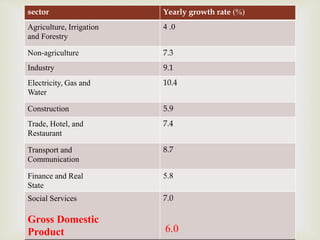
Attaining high economic growth rate is imperative with respect to
achieving the goal of Attaining high economic growth rate is imperative
with respect to achieving the goal of poverty alleviation enshrined in the
Ninth Plan, and it has to be ensured that the economy can sustain the
growth target. In keeping with this fact, the target of an average 6 percent
annual growth of gross domestic product at factor cost has been set in the
Ninth Plan. With the attainment of this target, poverty will be reduced,
physical infrastructure will be developed, and it will be possible to
channel more resources to social services sector due to the broadening of
the revenue base. Poverty alleviation enshrined in the Ninth Plan,
and it has to be ensured that the economy can sustain the growth
target. In keeping with this fact, the target of an average 6 percent
annual growth of gross domestic product at factor cost has been
set in the Ninth Plan. With the attainment of this target, poverty
will be reduced, physical infrastructure will be developed, and it
will be possible to channel more resources to social services sector
due to the broadening of the revenue base.
1. Economic Growth Rate, Total Investment
and Sectorial Allocations

sector Yearly growth rate (%)
Agriculture, Irrigation
and Forestry
4 .0
Non-agriculture 7.3
Industry 9.1
Electricity, Gas and
Water
10.4
Construction 5.9
Trade, Hotel, and
Restaurant
7.4
Transport and
Communication
8.7
Finance and Real
State
5.8
Social Services
Gross Domestic
Product
7.0
6.0

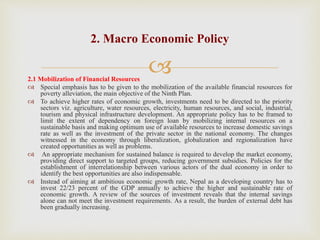
2.1 Mobilization of Financial Resources
 Special emphasis has to be given to the mobilization of the available financial resources for
poverty alleviation, the main objective of the Ninth Plan.
 To achieve higher rates of economic growth, investments need to be directed to the priority
sectors viz. agriculture, water resources, electricity, human resources, and social, industrial,
tourism and physical infrastructure development. An appropriate policy has to be framed to
limit the extent of dependency on foreign loan by mobilizing internal resources on a
sustainable basis and making optimum use of available resources to increase domestic savings
rate as well as the investment of the private sector in the national economy. The changes
witnessed in the economy through liberalization, globalization and regionalization have
created opportunities as well as problems.
 An appropriate mechanism for sustained balance is required to develop the market economy,
providing direct support to targeted groups, reducing government subsidies. Policies for the
establishment of interrelationship between various actors of the dual economy in order to
identify the best opportunities are also indispensable.
 Instead of aiming at ambitious economic growth rate, Nepal as a developing country has to
invest 22/23 percent of the GDP annually to achieve the higher and sustainable rate of
economic growth. A review of the sources of investment reveals that the internal savings
alone can not meet the investment requirements. As a result, the burden of external debt has
been gradually increasing.
2. Macro Economic Policy

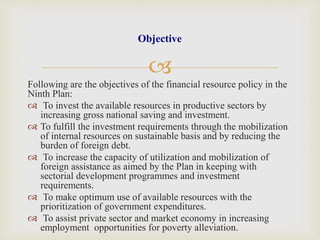
Following are the objectives of the financial resource policy in the
Ninth Plan:
 To invest the available resources in productive sectors by
increasing gross national saving and investment.
 To fulfill the investment requirements through the mobilization
of internal resources on sustainable basis and by reducing the
burden of foreign debt.
 To increase the capacity of utilization and mobilization of
foreign assistance as aimed by the Plan in keeping with
sectorial development programmes and investment
requirements.
 To make optimum use of available resources with the
prioritization of government expenditures.
 To assist private sector and market economy in increasing
employment opportunities for poverty alleviation.
Objective

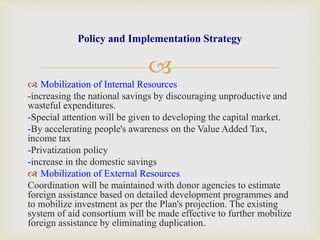
 Mobilization of Internal Resources
-increasing the national savings by discouraging unproductive and
wasteful expenditures.
-Special attention will be given to developing the capital market.
-By accelerating people's awareness on the Value Added Tax,
income tax
-Privatization policy
-increase in the domestic savings
 Mobilization of External Resources
Coordination will be maintained with donor agencies to estimate
foreign assistance based on detailed development programmes and
to mobilize investment as per the Plan's projection. The existing
system of aid consortium will be made effective to further mobilize
foreign assistance by eliminating duplication.
Policy and Implementation Strategy

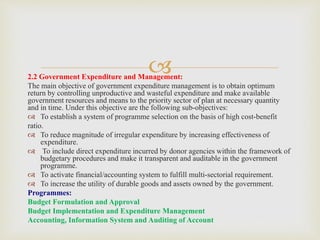
2.2 Government Expenditure and Management:
The main objective of government expenditure management is to obtain optimum
return by controlling unproductive and wasteful expenditure and make available
government resources and means to the priority sector of plan at necessary quantity
and in time. Under this objective are the following sub-objectives:
 To establish a system of programme selection on the basis of high cost-benefit
ratio.
 To reduce magnitude of irregular expenditure by increasing effectiveness of
expenditure.
 To include direct expenditure incurred by donor agencies within the framework of
budgetary procedures and make it transparent and auditable in the government
programme.
 To activate financial/accounting system to fulfill multi-sectorial requirement.
 To increase the utility of durable goods and assets owned by the government.
Programmes:
Budget Formulation and Approval
Budget Implementation and Expenditure Management
Accounting, Information System and Auditing of Account

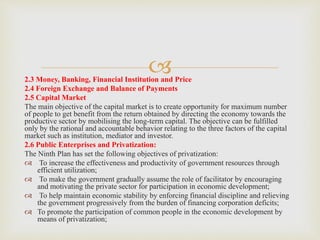
2.3 Money, Banking, Financial Institution and Price
2.4 Foreign Exchange and Balance of Payments
2.5 Capital Market
The main objective of the capital market is to create opportunity for maximum number
of people to get benefit from the return obtained by directing the economy towards the
productive sector by mobilising the long-term capital. The objective can be fulfilled
only by the rational and accountable behavior relating to the three factors of the capital
market such as institution, mediator and investor.
2.6 Public Enterprises and Privatization:
The Ninth Plan has set the following objectives of privatization:
 To increase the effectiveness and productivity of government resources through
efficient utilization;
 To make the government gradually assume the role of facilitator by encouraging
and motivating the private sector for participation in economic development;
 To help maintain economic stability by enforcing financial discipline and relieving
the government progressively from the burden of financing corporation deficits;
 To promote the participation of common people in the economic development by
means of privatization;

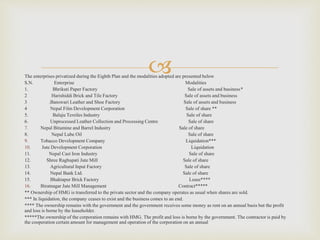
The enterprises privatized during the Eighth Plan and the modalities adopted are presented below
S.N. Enterprise Modalities
1. Bhrikuti Paper Factory Sale of assets and business*
2 Harishiddi Brick and Tile Factory Sale of assets and business
3 .Banswari Leather and Shoe Factory Sale of assets and business
4 Nepal Film Development Corporation Sale of share **
5. Balaju Textiles Industry Sale of share
6. Unprocessed Leather Collection and Processing Centre Sale of share
7. Nepal Bitumine and Barrel Industry Sale of share
8. Nepal Lube Oil Sale of share
9. Tobacco Development Company Liquidation***
10. Jute Development Corporation Liquidation
11. Nepal Cast Iron Industry Sale of share
12. Shree Raghupati Jute Mill Sale of share
13. Agricultural Input Factory Sale of share
14. Nepal Bank Ltd. Sale of share
15. Bhaktapur Brick Factory Lease****
16. Biratnagar Jute Mill Management Contract*****
** Ownership of HMG is transferred to the private sector and the company operates as usual when shares are sold.
*** In liquidation, the company ceases to exist and the business comes to an end.
**** The ownership remains with the government and the government receives some money as rent on an annual basis but the profit
and loss is borne by the leaseholder.
*****The ownership of the corporation remains with HMG. The profit and loss is borne by the government. The contractor is paid by
the cooperation certain amount for management and operation of the corporation on an annual

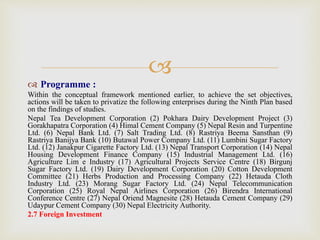
 Programme :
Within the conceptual framework mentioned earlier, to achieve the set objectives,
actions will be taken to privatize the following enterprises during the Ninth Plan based
on the findings of studies.
Nepal Tea Development Corporation (2) Pokhara Dairy Development Project (3)
Gorakhapatra Corporation (4) Himal Cement Company (5) Nepal Resin and Turpentine
Ltd. (6) Nepal Bank Ltd. (7) Salt Trading Ltd. (8) Rastriya Beema Sansthan (9)
Rastriya Banijya Bank (10) Butawal Power Company Ltd. (11) Lumbini Sugar Factory
Ltd. (12) Janakpur Cigarette Factory Ltd. (13) Nepal Transport Corporation (14) Nepal
Housing Development Finance Company (15) Industrial Management Ltd. (16)
Agriculture Lim e Industry (17) Agricultural Projects Service Centre (18) Birgunj
Sugar Factory Ltd. (19) Dairy Development Corporation (20) Cotton Development
Committee (21) Herbs Production and Processing Company (22) Hetauda Cloth
Industry Ltd. (23) Morang Sugar Factory Ltd. (24) Nepal Telecommunication
Corporation (25) Royal Nepal Airlines Corporation (26) Birendra International
Conference Centre (27) Nepal Oriend Magnesite (28) Hetauda Cement Company (29)
Udaypur Cement Company (30) Nepal Electricity Authority.
2.7 Foreign Investment

3.1 Poverty Alleviation:
 When the Eighth Plan commenced it was estimated that 49 percent of the
population lived below the absolute poverty line. An objective to bring
down the same to 42 percent was set in the Plan.
 At last year ,Based on this, the size of population living below the poverty
line has been found 42 percent. Of this, 24.9 percent is the poor and 17.1
percent is estimated to be ultra poor.
Objectives of Ninth Plan
 To gradually raise the living standard of the people below the poverty-
line by reducing the pressure of poverty.
 To launch special area and various targeted programmes to uplift the
living standard of ultra-poor household which is without any means of
production as well as income.
 To socially and economically empower the backward, deprived and weak
communities.
 To reduce the concentration of existing poverty in backward and remote
areas by developing physical, social and economic infrastructure.
3. Poverty Alleviation and Employment
Promotion

The existing size of the population, i.e. 42 percent living below the poverty line, would
be reduced by 10 percent and brought down to 32 percent. In order to achieve this
objective, following strategies would be adopted:
 During the Ninth Plan, all development activities under all the sectors of economy
would be directed towards poverty alleviation. For this, it is highly essential to
achieve high economic growth. The agriculture sector would play the lead role in
poverty alleviation. Besides this, emphasis would be laid on massive employment
generation in industry, tourism, public works, transport and service sectors.
Likewise, in order to mobilize people's participation and create self-employment,
social and economic infrastructure would be built and arrangement would be made
for required productive resource and skill development.
 In addition to attempting to achieve high economic growth, special emphasis
would be given to render primary health, educational and drinking water facilities
to improve the socio-economic condition of the deprived and weak communities
living in the backward and remote areas. Structural changes would be introduced
in on-going, targeted programmes which would be implemented in an effective
manner.
 Experience has belied the notion that the fruit of development automatically
trickles down to the lowest group of the society. As such, special attention would
be paid to equitable distribution of the fruits of development.
 The people falling below the poverty line have been categorized into two groups
via, the poor and the ultra-poor. Alleviating poverty would be attempted as per the
categorization. The impact of the overall strategies would be rendered
complementary to each other as well as coordinated and integrated.
Strategy

 Attempts would be made to generate employment and income and raise
the living standard of the poor group, which constitute 24.9 percent. This
would be done through sectorial programmes and assimilating them into
the open market system.
 To the ultra-poor, who make up 17.1 percent, banking services and
institutional assistance from development programmes would be extended
at the local level. Besides this, backward groups and communities and
women would be brought into the mainstream of socio -economic
development by means of social mobilization and empowerment.
Households, which fall in above category, would be identified, their
access to productive resources would be increased. The government
would extend direct assistance in mobilizing those resources. Sectorial
and targeted programmes would also be implemented to this effect.
 In order to alleviate poverty in the rural areas, emphasis would be laid
upon agriculture, agro-based industries, agro-trade, community and rural
tourism and rural infrastructure development programmed.
 Employment and income opportunities would be expanded through
expansion of skill development training and micro-credit.

For poverty alleviation, employment generative, multi-sectoral, high growth-yielding,sectoral and targeted
programmes which give direct benefit to the poor community would be implemented.
Sector-wise Programmes:
Employment generation;
 In the agricultural sector, appropriate irrigation and other facilities would be expanded to increase
productivity and create additional employment and to especially cater to the needs of small farmers.
 Generation of nonagricultural employment opportunities will be increased through building
infrastructure for development of rural and micro cottage industries, easy credit, technical assistance,
marketing facilities and information flow.
 Self-employment opportunities will be created through extensive training, credit and technical
assistance by involving the rural people, especially the women folk,
 In the rural areas. Programme like "food for work" would be launched throughout the country for
infrastructural development and employment generation.
 While supplying food-grain under this programme, stress would be given to procuring food-grain
within the
 country. In this regard, priority would be given to purchasing locally available food grain. In the
course of transporting food-grain, employment generation at the local level would be encouraged.
Illiterate and unskilled workers and labourers would be given training as per the market demand in
order to make them fit for employment. Highly employment-generative techniques and processes
would be adopted in all kinds of construction and infrastructural development activities. Various
other activities would be carried out for employment generation.
Programmes

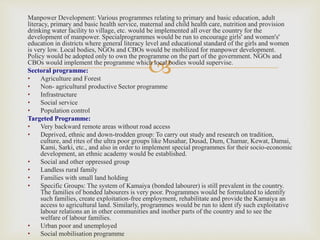
Manpower Development: Various programmes relating to primary and basic education, adult
literacy, primary and basic health service, maternal and child health care, nutrition and provision
drinking water facility to village, etc. would be implemented all over the country for the
development of manpower. Specialprogrammes would be run to encourage girls' and women's'
education in districts where general literacy level and educational standard of the girls and women
is very low. Local bodies, NGOs and CBOs would be mobilized for manpower development.
Policy would be adopted only to own the programme on the part of the government. NGOs and
CBOs would implement the programme which local bodies would supervise.
Sectoral programme:
• Agriculture and Forest
• Non- agricultural productive Sector programme
• Infrastructure
• Social service
• Population control
Targeted Programme:
• Very backward remote areas without road access
• Deprived, ethnic and down-trodden group: To carry out study and research on tradition,
culture, and rites of the ultra poor groups like Musahar, Dusad, Dum, Chamar, Kewat, Damai,
Kami, Sarki, etc., and also in order to implement special programmes for their socio-economic
development, an ethnic academy would be established.
• Social and other oppressed group
• Landless rural family
• Families with small land holding
• Specific Groups: The system of Kamaiya (bonded labourer) is still prevalent in the country.
The families of bonded labourers is very poor. Programmes would be formulated to identify
such families, create exploitation-free employment, rehabilitate and provide the Kamaiya an
access to agricultural land. Similarly, programmes would be run to ident ify such exploitative
labour relations an in other communities and inother parts of the country and to see the
welfare of labour families.
• Urban poor and unemployed
• Social mobilisation programme

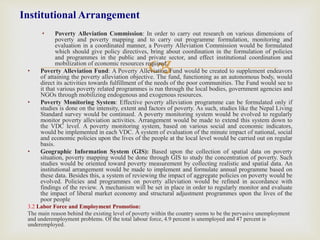
• Poverty Alleviation Commission: In order to carry out research on various dimensions of
poverty and poverty mapping and to carry out programme formulation, monitoring and
evaluation in a coordinated manner, a Poverty Alleviation Commission would be formulated
which should give policy directives, bring about coordination in the formulation of policies
and programmes in the public and private sector, and effect institutional coordination and
mobilization of economic resources required.
• Poverty Alleviation Fund: A Poverty Alleviation Fund would be created to supplement endeavors
of attaining the poverty alleviation objective. The fund, functioning as an autonomous body, would
direct its activities towards fulfillment of the needs of the poor communities. The Fund would see to
it that various poverty related programmes is run through the local bodies, government agencies and
NGOs through mobilizing endogenous and exogenous resources.
• Poverty Monitoring System: Effective poverty alleviation programme can be formulated only if
studies is done on the intensity, extent and factors of poverty. As such, studies like the Nepal Living
Standard survey would be continued. A poverty monitoring system would be evolved to regularly
monitor poverty alleviation activities. Arrangement would be made to extend this system down to
the VDC level. A poverty monitoring system, based on various social and economic indicators,
would be implemented in each VDC. A system of evaluation of the minute impact of national, social
and economic policies upon the lives of the people at the local level would be carried out on regular
basis.
• Geographic Information System (GIS): Based upon the collection of spatial data on poverty
situation, poverty mapping would be done through GIS to study the concentration of poverty. Such
studies would be oriented toward poverty measurement by collecting realistic and spatial data. An
institutional arrangement would be made to implement and formulate annual programme based on
these data. Besides this, a system of reviewing the impact of aggregate policies on poverty would be
evolved. Policies and programmes on poverty alleviation would be refined in accordance with
findings of the review. A mechanism will be set in place in order to regularly monitor and evaluate
the impact of liberal market economy and structural adjustment programmes upon the lives of the
poor people
3.2 Labor Force and Employment Promotion:
The main reason behind the existing level of poverty within the country seems to be the pervasive unemployment
and underemployment problems. Of the total labour force, 4.9 percent is unemployed and 47 percent is
underemployed.
Institutional Arrangement

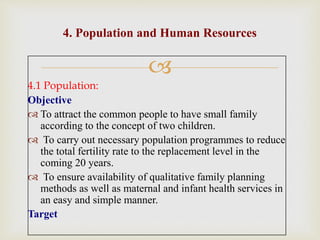
4.1 Population:
Objective
 To attract the common people to have small family
according to the concept of two children.
 To carry out necessary population programmes to reduce
the total fertility rate to the replacement level in the
coming 20 years.
 To ensure availability of qualitative family planning
methods as well as maternal and infant health services in
an easy and simple manner.
Target
4. Population and Human Resources

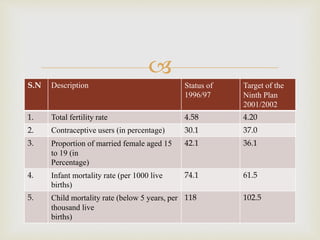
S.N Description Status of
1996/97
Target of the
Ninth Plan
2001/2002
1. Total fertility rate 4.58 4.20
2. Contraceptive users (in percentage) 30.1 37.0
3. Proportion of married female aged 15
to 19 (in
Percentage)
42.1 36.1
4. Infant mortality rate (per 1000 live
births)
74.1 61.5
5. Child mortality rate (below 5 years, per
thousand live
births)
118 102.5

Programme
Formulation of Population Perspective: The population of Nepal is estimated to
exceed 32 million on the basis of different studies. Since population is
multidimensional and multi sectoral subject, it is essential to have a long-term vision
on population management by strengthening and integrating sectors related to it as a
necessity to launch new programmes to achieve the goal of reducing total fertility to
replacement level. To fulfill these objectives, a perspective plan on population will be
formulated and implemented during the period of this plan.
Special Programme for Adolescent and Youths: The number of adolescent and youth
is high in Nepal because of high fertility rate. Therefore, taking into consideration that
the principal actor for the growth of population will be the adolescent and youths aged
below 25 years up to coming 20-25 years, special programmes will be launched in the
Ninth Plan focusing on them.
Marriageable Age: programmes which assist to raise awareness towards this as well
as increase the minimum age for marriage of female and male. Moreover, priority will
also be given to programme which enhances spacing to delay the conception of first
child after marriage in order to lower the speed of population.
Family Planning Services:
Information, Education and Communication (IEC):
Vital Registration System:
Population and Reproductive Health Education in Women Education and
Employment:
Strengthening Monitoring and Evaluation Systems:

Human development are the ultimate objective of any development. Economic development is only a
means to human development. Likewise, human resource is and important means for the economic
development of the country. Human resource is the knowledge, skill, efficiency as well as physical and
mental to perform inherent in the citizens of the country. Human resource is a means to human
development as well as an aspect of human development too.
Programme
Education and Training
To increase government investment to provide basic education and to increase opportunities in
vocational training.
To increase the investment capability in this sector, the participation of the guardians, local bodies and
the private sectors will be encouraged in the management of education and training.
The government sector will create a favorable environment for coordination, monitoring, evaluation and
development. The responsibility of the management of the school will be gradually transferred to local
bodies.
 Special programmes will be launched to eliminate prevailing gender, regional, class and community
discriminations.
Health, Nutrition and Sanitation:
• To enhance the investment capability regarding these sectors, the consumer groups, non-
governmental organizations and local bodies will be included in the programme formulation and
implementation process.
• The programme will be launched to provide financial and other assistance to nongovernmental
organizations or local bodies if they is delivering or planning to deliver health services.
 Several programmes concerning child welfare and rehabilitation will be carried out through
government and non-government organizations to eliminate child labour and exploitation.
 Rural roads will be constructed by using labour intensive technology through consumer groups.
 An environment will be created to provide new professional skills to the farmers emphasareing on
4.2.Human Resources Development

Programme
Women Development Programme: WDP has been
implemented with an objective of uplifting socio-economic
status of deprived women since 1983.
Remote Area Development Programme(RADP):
Local Development Training Programme
Population Education Programme
Monastery Development and Management Programme
5. Regional and Local Development

Objective
For achieving the targets set by the Agricultural Perspective Plan in the area
of production, food security, employment and income growth, the objectives
of the Ninth Plan in agricultural sector are as follows:
 To contribute to poverty alleviation by increasing productivity of
resources and inputs and by generating opportunities s of employment
through speeding up of the economic growth of the agricultural sector.
 To minimize impact on environment by amalgamating the utilization of
external production inputs and the natural resources in agriculture sector.
 To strengthen the foundation of agro-based industry and industrialization
through diversification and commercialization of agriculture.
 To develop leadership of women in the production programmed by
involving them in the agricultural development and by increasing their
participation.
 To improve the situation of nutrition of the people by increasing the
production of the food grains and nutritious food in order to promote food
security.
Agriculture

The strategies identified in the APP like green revolution based on improved
technology, adequate utilization of available infrastructure, comparative advantage,
large scale public participation and women involvement and programme
implementation based on the selected priority, are the strategies adopted by this
plan.
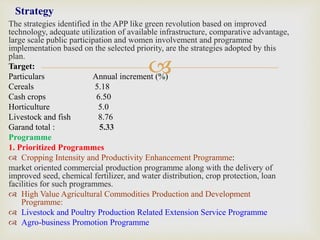
Target:
Particulars Annual increment (%)
Cereals 5.18
Cash crops 6.50
Horticulture 5.0
Livestock and fish 8.76
Garand total : 5.33
Programme
1. Prioritized Programmes
 Cropping Intensity and Productivity Enhancement Programme:
market oriented commercial production programme along with the delivery of
improved seed, chemical fertilizer, and water distribution, crop protection, loan
facilities for such programmes.
 High Value Agricultural Commodities Production and Development
Programme:
 Livestock and Poultry Production Related Extension Service Programme
 Agro-business Promotion Programme
Strategy

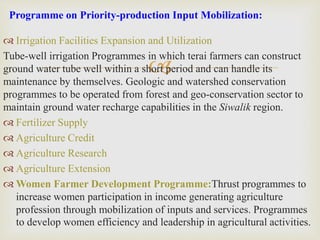
 Irrigation Facilities Expansion and Utilization
Tube-well irrigation Programmes in which terai farmers can construct
ground water tube well within a short period and can handle its
maintenance by themselves. Geologic and watershed conservation
programmes to be operated from forest and geo-conservation sector to
maintain ground water recharge capabilities in the Siwalik region.
 Fertilizer Supply
 Agriculture Credit
 Agriculture Research
 Agriculture Extension
 Women Farmer Development Programme:Thrust programmes to
increase women participation in income generating agriculture
profession through mobilization of inputs and services. Programmes
to develop women efficiency and leadership in agricultural activities.
Programme on Priority-production Input Mobilization:

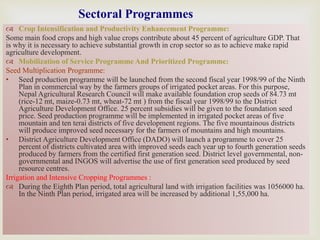
 Crop Intensification and Productivity Enhancement Programme:
Some main food crops and high value crops contribute about 45 percent of agriculture GDP. That
is why it is necessary to achieve substantial growth in crop sector so as to achieve make rapid
agriculture development.
 Mobilization of Service Programme And Prioritized Programme:
Seed Multiplication Programme:
• Seed production programme will be launched from the second fiscal year 1998/99 of the Ninth
Plan in commercial way by the farmers groups of irrigated pocket areas. For this purpose,
Nepal Agricultural Research Council will make available foundation crop seeds of 84.73 mt
(rice-12 mt, maize-0.73 mt, wheat-72 mt ) from the fiscal year 1998/99 to the District
Agriculture Development Office. 25 percent subsidies will be given to the foundation seed
price. Seed production programme will be implemented in irrigated pocket areas of five
mountain and ten terai districts of five development regions. The five mountainous districts
will produce improved seed necessary for the farmers of mountains and high mountains.
• District Agriculture Development Office (DADO) will launch a programme to cover 25
percent of districts cultivated area with improved seeds each year up to fourth generation seeds
produced by farmers from the certified first generation seed. District level governmental, non-
governmental and INGOS will advertise the use of first generation seed produced by seed
resource centres.
Irrigation and Intensive Cropping Programmes :
 During the Eighth Plan period, total agricultural land with irrigation facilities was 1056000 ha.
In the Ninth Plan period, irrigated area will be increased by additional 1,55,000 ha.
Sectoral Programmes

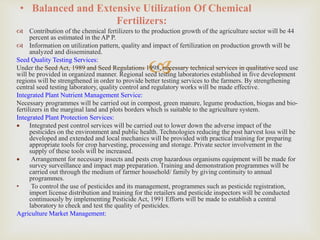
 Contribution of the chemical fertilizers to the production growth of the agriculture sector will be 44
percent as estimated in the AP P.
 Information on utilization pattern, quality and impact of fertilization on production growth will be
analyzed and disseminated.
Seed Quality Testing Services:
Under the Seed Act, 1989 and Seed Regulations 1998, necessary technical services in qualitative seed use
will be provided in organized manner. Regional seed testing laboratories established in five development
regions will be strengthened in order to provide better testing services to the farmers. By strengthening
central seed testing laboratory, quality control and regulatory works will be made effective.
Integrated Plant Nutrient Management Service:
Necessary programmes will be carried out in compost, green manure, legume production, biogas and bio-
fertilizers in the marginal land and plots borders which is suitable to the agriculture system.
Integrated Plant Protection Services:
 Integrated pest control services will be carried out to lower down the adverse impact of the
pesticides on the environment and public health. Technologies reducing the post harvest loss will be
developed and extended and local mechanics will be provided with practical training for preparing
appropriate tools for crop harvesting, processing and storage. Private sector involvement in the
supply of these tools will be increased.
 Arrangement for necessary insects and pests crop hazardous organisms equipment will be made for
survey surveillance and impact map preparation. Training and demonstration programmes will be
carried out through the medium of farmer household/ family by giving continuity to annual
programmes.
• To control the use of pesticides and its management, programmes such as pesticide registration,
import license distribution and training for the retailers and pesticide inspectors will be conducted
continuously by implementing Pesticide Act, 1991 Efforts will be made to establish a central
laboratory to check and test the quality of pesticides.
Agriculture Market Management:
• Balanced and Extensive Utilization Of Chemical
Fertilizers:

Major Expected Achievements through Implementation of the Agriculture Development
Programme at the End of the Ninth Plan.
Programme:1. Cropping intensity and productivity enhancement programme (Food grain
and cash crop production);
Production Growth: Cropping intensity will increase from 160 percent to 172 percent
through the improvement of irrigation facilities. The annual growth rate of food grain and
cash crop will be 5.18 percent andn6.5 percent respectively. The improved seed will cover
75 percent of the area covered by the major crops with wide extension of improved seed
use. In this area, the chemical fertilizer use will increase from current 18 kg. to 50 kg. The
yield will increase by 21 percent due to the irrigation, technically improved seed and the
extension of chemical fertilizer use. Food grain (including potato and pulses) production
will increase from 7580000 MT. to9842000 MT. Per capita food grain availability will
increase from 354 kg to 450 kg (in gross)
Contribution in poverty alleviation:Transforming subsistence crop production system to
commercial system by maintaining relation with agro-based industries, will contribute to
increase income of the farmers.
Employment Promotion:Additional employment opportunities will increase through seed
multiplication, seed supply, irrigation and extension of cropping intensity.
Growth in Women involvement:Besides the activities of commercial crop production, the
activities like agriculture extension, agriculture training, agriculture communication and
seed production will see outstanding increase in women involvement.
Expected Achievement

Environment Conservation:Encouraging perennial crops instead of growing food crop
in marginalized and sloppy land, will assist in environmental conservation.
Programme:2, Livestock and Fisheries Development.
Production growth :Annual growth rate of livestock based products will be 5.55 percent
in milk, 6.22 percent in meat and 7.03 percent in egg. Fish production will increase from
23,000 m.t. to 35,000 m.t.
Contribution in Poverty alleviation: In the context of livestock business which is also
main basis of living for 80 percent people through the commercialization of it will
contribute commendably in the income growth of the common people. Besides, it will
contribute to poverty alleviation as income level of women and low income families will
increase due to the women specific livestock development programme and marginalized
farmer specific livestock development programme.
As it supports the marginalized merchants who release fingerlings in river and catch fish
in public pools and ponds, it will support poverty alleviation.
Employment Generation: As milk, meat and egg production will be oriented towards
commercialization, additional self employment and full employment opportunities will
be created in this area . Besides, 26 thousand additional families will get direct
employment opportunities through the targeted programme for poor community and
women.
Additional employment opportunity will increase due in fisheries business.
Growth in women involvement: In the various aspects of livestock business, women
involvement will increase . Besides these, livestock development programme will
organize women in 7000 group in order to involve them in Livestock business.
The opportunity for employment of women fisherman community will increase due to
the fingerling raising programme .
..

Environment conservation: In northern bordering districts pasture will be
developed in 5000 ha through people's participation . In addition, the
contribution in environment improvement will be seen by the distribution of
about 1513 m.t. grass seed and 22.2 million fodder trees .
Through the fisheries in natural source and waste ditches, ponds will not be
polluted and germs will also decrease.
Programme:3 Production of high value agricultural commodities
1.Citrus
Production growth: In the plan period, additional 5000 ha. Of the land will
be cultivated and additional 33006 m.t. will be produced.
Contribution in poverty alleviation: Through this, additional 20,000
employments will be generated at a rate of 4 person per hectare. This will
contribute in poverty alleviation with the increase of income generating
opportunities.
Employment Promotion: By developing commercial and kitchen garden
established in 5,000 ha, would generate employment for 20,000 people and
full employment for one person per hectare after fruiting stage.
Growth in Women involvement: Special growth in women involvement will
be increased in extension, training, nursery production and garden
programme.

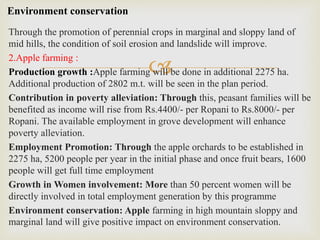
Through the promotion of perennial crops in marginal and sloppy land of
mid hills, the condition of soil erosion and landslide will improve.
2.Apple farming :
Production growth :Apple farming will be done in additional 2275 ha.
Additional production of 2802 m.t. will be seen in the plan period.
Contribution in poverty alleviation: Through this, peasant families will be
benefited as income will rise from Rs.4400/- per Ropani to Rs.8000/- per
Ropani. The available employment in grove development will enhance
poverty alleviation.
Employment Promotion: Through the apple orchards to be established in
2275 ha, 5200 people per year in the initial phase and once fruit bears, 1600
people will get full time employment
Growth in Women involvement: More than 50 percent women will be
directly involved in total employment generation by this programme
Environment conservation: Apple farming in high mountain sloppy and
marginal land will give positive impact on environment conservation.
Environment conservation

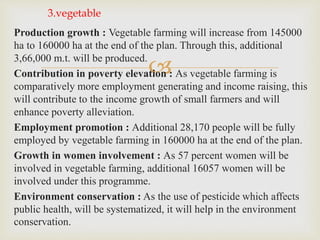
Production growth : Vegetable farming will increase from 145000
ha to 160000 ha at the end of the plan. Through this, additional
3,66,000 m.t. will be produced.
Contribution in poverty elevation : As vegetable farming is
comparatively more employment generating and income raising, this
will contribute to the income growth of small farmers and will
enhance poverty alleviation.
Employment promotion : Additional 28,170 people will be fully
employed by vegetable farming in 160000 ha at the end of the plan.
Growth in women involvement : As 57 percent women will be
involved in vegetable farming, additional 16057 women will be
involved under this programme.
Environment conservation : As the use of pesticide which affects
public health, will be systematized, it will help in the environment
conservation.
3.vegetable

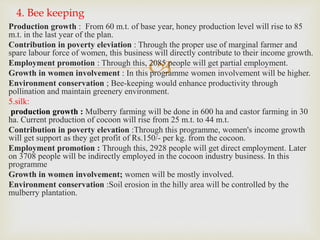
Production growth : From 60 m.t. of base year, honey production level will rise to 85
m.t. in the last year of the plan.
Contribution in poverty eleviation : Through the proper use of marginal farmer and
spare labour force of women, this business will directly contribute to their income growth.
Employment promotion : Through this, 2085 people will get partial employment.
Growth in women involvement : In this programme women involvement will be higher.
Environment conservation ; Bee-keeping would enhance productivity through
pollination and maintain greenery environment.
5.silk:
production growth : Mulberry farming will be done in 600 ha and castor farming in 30
ha. Current production of cocoon will rise from 25 m.t. to 44 m.t.
Contribution in poverty elevation :Through this programme, women's income growth
will get support as they get profit of Rs.150/- per kg. from the cocoon.
Employment promotion : Through this, 2928 people will get direct employment. Later
on 3708 people will be indirectly employed in the cocoon industry business. In this
programme
Growth in women involvement; women will be mostly involved.
Environment conservation :Soil erosion in the hilly area will be controlled by the
mulberry plantation.
4. Bee keeping

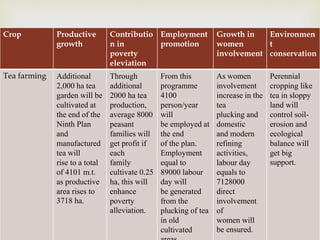
Crop Productive
growth
Contributio
n in
poverty
eleviation
Employment
promotion
Growth in
women
involvement
Environmen
t
conservation
Tea farming Additional
2,000 ha tea
garden will be
cultivated at
the end of the
Ninth Plan
and
manufactured
tea will
rise to a total
of 4101 m.t.
as productive
area rises to
3718 ha.
Through
additional
2000 ha tea
production,
average 8000
peasant
families will
get profit if
each
family
cultivate 0.25
ha, this will
enhance
poverty
alleviation.
From this
programme
4100
person/year
will
be employed at
the end
of the plan.
Employment
equal to
89000 labour
day will
be generated
from the
plucking of tea
in old
cultivated
As women
involvement
increase in the
tea
plucking and
domestic
and modern
refining
activities,
labour day
equals to
7128000
direct
involvement
of
women will
be ensured.
Perennial
cropping like
tea in sloppy
land will
control soil-
erosion and
ecological
balance will
get big
support.

Coffee farming : In the plan period, 444 ha. will be
cultivated by coffee and production level will be 110
m.t. from 252 ha productive area.
As improvement will be made in other fruit and high value
cropping programme which are not specified in the
Agriculture Perspective Plan but carried out by the peasants,
will give additional support to income generation for peasants
and to generate employment opportunities.

9th five year plan nepal.pptx

  • 1.
    Prepared by : PrajwalRegmi (surkhet , Nepal) IAAS
  • 2.
      It istrue that achievements, to some extent, have been made in the development of physical and social infrastructure through the implementation of preceding plans, and particularly, the growth rate of non-agriculture sector has increased as a result of policies adopted in the Eighth Plan.  However, it is also true that desirable progress has not so far been achieved in alleviating the problem of rampant poverty and unemployment in the country.  Therefore, with the aim of accelerating the process of national development, the Ninth Plan has adopted poverty alleviation as its main objective so as to lessen poverty confronting the whole nation. In doing so, a consistency will be maintained with the development concept of the 20-year perspective planning. Objective :
  • 3.
     Following strategies wasadopted to achieve the objective of poverty alleviation:  Integrated development of agriculture and forestry sectors and high, sustainable and poverty alleviation-oriented economic growth with a focus on those sectors.  Acceleration of industrial development process through the advancement of such sectors as agriculture, water resources, industry, tourism, and transportation on the basis of comparative advantage and competitive capability.  Reduction of economic and social inequality existing among various sectors and communities especially through the means of agriculture and social sector programmes.  Lessening the dependence on external aid through extensive mobilization and optimal utilization of natural, human, and economic resources available in the country.  Recognizing cooperatives as a powerful instrument for the development and expansion of economic sectors such as agriculture, industry, trade, etc.  Streamlining the development and expansion of modern sectors through liberal, market-oriented economic policies while stressing the active role of the government in developing and building rural sector. Recognizing the fact that a single set of policies cannot resolve basic problems of the organized modern sector as well as the unorganized, backward rural sector in the dual-structure Nepalese economy. Strategy :
  • 4.
      Enabling thelocal institutions to take leadership in rural development through decentralization.  Placing special priority on the development of backward regions so that the people in those regions will enjoy the benefits of economic programmes.  Developing human resources for sustainable and high economic growth through the extensive expansion of social sectors, especially education and health, and bringing the backward sections of society into the mainstream of development.  Expanding education and family planning programmes through gradual reduction in the population growth rate and promote ion of social awareness.
  • 5.
      Making economicgrowth rate high and broad-based with further consolidating the economic reform process.  Developing agriculture sector through implementing the Agriculture Perspective Plan (APP), considering the fact that majority of the people rely on agriculture for livelihood.  Increasing agricultural productivity with guaranteeing the safety of landownership, accessing landless farmers to the land, extending land-ownership, and alleviating poverty through the promotion of economic growth and employment by establishing, developing and expanding agro-based industries.  Empowering economically and socially the backward and downtrodden castes and communities through decentralization, local development and human resource development. People's participation will be made instrumental in this process.  Expanding income-oriented employment opportunities through outreaching the fruits of programmes effected in agriculture, cottage and small industries and tourism sectors.  Implementing in an integrated way the employment promotion programmes run by the government, private, banking and non-government sectors as well as local institutions. Policy and Implementation Strategy
  • 6.
      Enabling thegrowing human resources to become entrepreneurial, self- employed and employable getting employed through human resource development and extensive expansion of entrepreneurial and skill-oriented training programmes. Such programmes will be made a main instrument for poverty alleviation. In this process, services including technical assistance, consultancy and the credit-flow will be extensively made available in villages.  Reducing inequality of income and poverty by investing more in sectors that will give greater return within shorter period, that are employment- oriented, and that will contribute to equitable distribution of development benefits from such sectors as agriculture, small and cottage industries, tourism, and transportation.  Expanding export trade through diversifying foreign trade on the basis of comparative advantage and competitive capability. Necessary legal and institutional infrastructure will be developed in order to set a competitive climate.  Developing and expanding economic and social infrastructure for increasing production and the productivity of economy.
  • 7.
      Agriculture andForestry  Water Resources  Human Resource and Social Development  Industrialization, Tourism Development and International Trade  Physical Infrastructure Priority
  • 8.
     Attaining high economicgrowth rate is imperative with respect to achieving the goal of Attaining high economic growth rate is imperative with respect to achieving the goal of poverty alleviation enshrined in the Ninth Plan, and it has to be ensured that the economy can sustain the growth target. In keeping with this fact, the target of an average 6 percent annual growth of gross domestic product at factor cost has been set in the Ninth Plan. With the attainment of this target, poverty will be reduced, physical infrastructure will be developed, and it will be possible to channel more resources to social services sector due to the broadening of the revenue base. Poverty alleviation enshrined in the Ninth Plan, and it has to be ensured that the economy can sustain the growth target. In keeping with this fact, the target of an average 6 percent annual growth of gross domestic product at factor cost has been set in the Ninth Plan. With the attainment of this target, poverty will be reduced, physical infrastructure will be developed, and it will be possible to channel more resources to social services sector due to the broadening of the revenue base. 1. Economic Growth Rate, Total Investment and Sectorial Allocations
  • 9.
     sector Yearly growthrate (%) Agriculture, Irrigation and Forestry 4 .0 Non-agriculture 7.3 Industry 9.1 Electricity, Gas and Water 10.4 Construction 5.9 Trade, Hotel, and Restaurant 7.4 Transport and Communication 8.7 Finance and Real State 5.8 Social Services Gross Domestic Product 7.0 6.0
  • 10.
     2.1 Mobilization ofFinancial Resources  Special emphasis has to be given to the mobilization of the available financial resources for poverty alleviation, the main objective of the Ninth Plan.  To achieve higher rates of economic growth, investments need to be directed to the priority sectors viz. agriculture, water resources, electricity, human resources, and social, industrial, tourism and physical infrastructure development. An appropriate policy has to be framed to limit the extent of dependency on foreign loan by mobilizing internal resources on a sustainable basis and making optimum use of available resources to increase domestic savings rate as well as the investment of the private sector in the national economy. The changes witnessed in the economy through liberalization, globalization and regionalization have created opportunities as well as problems.  An appropriate mechanism for sustained balance is required to develop the market economy, providing direct support to targeted groups, reducing government subsidies. Policies for the establishment of interrelationship between various actors of the dual economy in order to identify the best opportunities are also indispensable.  Instead of aiming at ambitious economic growth rate, Nepal as a developing country has to invest 22/23 percent of the GDP annually to achieve the higher and sustainable rate of economic growth. A review of the sources of investment reveals that the internal savings alone can not meet the investment requirements. As a result, the burden of external debt has been gradually increasing. 2. Macro Economic Policy
  • 11.
     Following are theobjectives of the financial resource policy in the Ninth Plan:  To invest the available resources in productive sectors by increasing gross national saving and investment.  To fulfill the investment requirements through the mobilization of internal resources on sustainable basis and by reducing the burden of foreign debt.  To increase the capacity of utilization and mobilization of foreign assistance as aimed by the Plan in keeping with sectorial development programmes and investment requirements.  To make optimum use of available resources with the prioritization of government expenditures.  To assist private sector and market economy in increasing employment opportunities for poverty alleviation. Objective
  • 12.
      Mobilization ofInternal Resources -increasing the national savings by discouraging unproductive and wasteful expenditures. -Special attention will be given to developing the capital market. -By accelerating people's awareness on the Value Added Tax, income tax -Privatization policy -increase in the domestic savings  Mobilization of External Resources Coordination will be maintained with donor agencies to estimate foreign assistance based on detailed development programmes and to mobilize investment as per the Plan's projection. The existing system of aid consortium will be made effective to further mobilize foreign assistance by eliminating duplication. Policy and Implementation Strategy
  • 13.
     2.2 Government Expenditureand Management: The main objective of government expenditure management is to obtain optimum return by controlling unproductive and wasteful expenditure and make available government resources and means to the priority sector of plan at necessary quantity and in time. Under this objective are the following sub-objectives:  To establish a system of programme selection on the basis of high cost-benefit ratio.  To reduce magnitude of irregular expenditure by increasing effectiveness of expenditure.  To include direct expenditure incurred by donor agencies within the framework of budgetary procedures and make it transparent and auditable in the government programme.  To activate financial/accounting system to fulfill multi-sectorial requirement.  To increase the utility of durable goods and assets owned by the government. Programmes: Budget Formulation and Approval Budget Implementation and Expenditure Management Accounting, Information System and Auditing of Account
  • 14.
     2.3 Money, Banking,Financial Institution and Price 2.4 Foreign Exchange and Balance of Payments 2.5 Capital Market The main objective of the capital market is to create opportunity for maximum number of people to get benefit from the return obtained by directing the economy towards the productive sector by mobilising the long-term capital. The objective can be fulfilled only by the rational and accountable behavior relating to the three factors of the capital market such as institution, mediator and investor. 2.6 Public Enterprises and Privatization: The Ninth Plan has set the following objectives of privatization:  To increase the effectiveness and productivity of government resources through efficient utilization;  To make the government gradually assume the role of facilitator by encouraging and motivating the private sector for participation in economic development;  To help maintain economic stability by enforcing financial discipline and relieving the government progressively from the burden of financing corporation deficits;  To promote the participation of common people in the economic development by means of privatization;
  • 15.
     The enterprises privatizedduring the Eighth Plan and the modalities adopted are presented below S.N. Enterprise Modalities 1. Bhrikuti Paper Factory Sale of assets and business* 2 Harishiddi Brick and Tile Factory Sale of assets and business 3 .Banswari Leather and Shoe Factory Sale of assets and business 4 Nepal Film Development Corporation Sale of share ** 5. Balaju Textiles Industry Sale of share 6. Unprocessed Leather Collection and Processing Centre Sale of share 7. Nepal Bitumine and Barrel Industry Sale of share 8. Nepal Lube Oil Sale of share 9. Tobacco Development Company Liquidation*** 10. Jute Development Corporation Liquidation 11. Nepal Cast Iron Industry Sale of share 12. Shree Raghupati Jute Mill Sale of share 13. Agricultural Input Factory Sale of share 14. Nepal Bank Ltd. Sale of share 15. Bhaktapur Brick Factory Lease**** 16. Biratnagar Jute Mill Management Contract***** ** Ownership of HMG is transferred to the private sector and the company operates as usual when shares are sold. *** In liquidation, the company ceases to exist and the business comes to an end. **** The ownership remains with the government and the government receives some money as rent on an annual basis but the profit and loss is borne by the leaseholder. *****The ownership of the corporation remains with HMG. The profit and loss is borne by the government. The contractor is paid by the cooperation certain amount for management and operation of the corporation on an annual
  • 16.
      Programme : Withinthe conceptual framework mentioned earlier, to achieve the set objectives, actions will be taken to privatize the following enterprises during the Ninth Plan based on the findings of studies. Nepal Tea Development Corporation (2) Pokhara Dairy Development Project (3) Gorakhapatra Corporation (4) Himal Cement Company (5) Nepal Resin and Turpentine Ltd. (6) Nepal Bank Ltd. (7) Salt Trading Ltd. (8) Rastriya Beema Sansthan (9) Rastriya Banijya Bank (10) Butawal Power Company Ltd. (11) Lumbini Sugar Factory Ltd. (12) Janakpur Cigarette Factory Ltd. (13) Nepal Transport Corporation (14) Nepal Housing Development Finance Company (15) Industrial Management Ltd. (16) Agriculture Lim e Industry (17) Agricultural Projects Service Centre (18) Birgunj Sugar Factory Ltd. (19) Dairy Development Corporation (20) Cotton Development Committee (21) Herbs Production and Processing Company (22) Hetauda Cloth Industry Ltd. (23) Morang Sugar Factory Ltd. (24) Nepal Telecommunication Corporation (25) Royal Nepal Airlines Corporation (26) Birendra International Conference Centre (27) Nepal Oriend Magnesite (28) Hetauda Cement Company (29) Udaypur Cement Company (30) Nepal Electricity Authority. 2.7 Foreign Investment
  • 17.
     3.1 Poverty Alleviation: When the Eighth Plan commenced it was estimated that 49 percent of the population lived below the absolute poverty line. An objective to bring down the same to 42 percent was set in the Plan.  At last year ,Based on this, the size of population living below the poverty line has been found 42 percent. Of this, 24.9 percent is the poor and 17.1 percent is estimated to be ultra poor. Objectives of Ninth Plan  To gradually raise the living standard of the people below the poverty- line by reducing the pressure of poverty.  To launch special area and various targeted programmes to uplift the living standard of ultra-poor household which is without any means of production as well as income.  To socially and economically empower the backward, deprived and weak communities.  To reduce the concentration of existing poverty in backward and remote areas by developing physical, social and economic infrastructure. 3. Poverty Alleviation and Employment Promotion
  • 18.
     The existing sizeof the population, i.e. 42 percent living below the poverty line, would be reduced by 10 percent and brought down to 32 percent. In order to achieve this objective, following strategies would be adopted:  During the Ninth Plan, all development activities under all the sectors of economy would be directed towards poverty alleviation. For this, it is highly essential to achieve high economic growth. The agriculture sector would play the lead role in poverty alleviation. Besides this, emphasis would be laid on massive employment generation in industry, tourism, public works, transport and service sectors. Likewise, in order to mobilize people's participation and create self-employment, social and economic infrastructure would be built and arrangement would be made for required productive resource and skill development.  In addition to attempting to achieve high economic growth, special emphasis would be given to render primary health, educational and drinking water facilities to improve the socio-economic condition of the deprived and weak communities living in the backward and remote areas. Structural changes would be introduced in on-going, targeted programmes which would be implemented in an effective manner.  Experience has belied the notion that the fruit of development automatically trickles down to the lowest group of the society. As such, special attention would be paid to equitable distribution of the fruits of development.  The people falling below the poverty line have been categorized into two groups via, the poor and the ultra-poor. Alleviating poverty would be attempted as per the categorization. The impact of the overall strategies would be rendered complementary to each other as well as coordinated and integrated. Strategy
  • 19.
      Attempts wouldbe made to generate employment and income and raise the living standard of the poor group, which constitute 24.9 percent. This would be done through sectorial programmes and assimilating them into the open market system.  To the ultra-poor, who make up 17.1 percent, banking services and institutional assistance from development programmes would be extended at the local level. Besides this, backward groups and communities and women would be brought into the mainstream of socio -economic development by means of social mobilization and empowerment. Households, which fall in above category, would be identified, their access to productive resources would be increased. The government would extend direct assistance in mobilizing those resources. Sectorial and targeted programmes would also be implemented to this effect.  In order to alleviate poverty in the rural areas, emphasis would be laid upon agriculture, agro-based industries, agro-trade, community and rural tourism and rural infrastructure development programmed.  Employment and income opportunities would be expanded through expansion of skill development training and micro-credit.
  • 20.
     For poverty alleviation,employment generative, multi-sectoral, high growth-yielding,sectoral and targeted programmes which give direct benefit to the poor community would be implemented. Sector-wise Programmes: Employment generation;  In the agricultural sector, appropriate irrigation and other facilities would be expanded to increase productivity and create additional employment and to especially cater to the needs of small farmers.  Generation of nonagricultural employment opportunities will be increased through building infrastructure for development of rural and micro cottage industries, easy credit, technical assistance, marketing facilities and information flow.  Self-employment opportunities will be created through extensive training, credit and technical assistance by involving the rural people, especially the women folk,  In the rural areas. Programme like "food for work" would be launched throughout the country for infrastructural development and employment generation.  While supplying food-grain under this programme, stress would be given to procuring food-grain within the  country. In this regard, priority would be given to purchasing locally available food grain. In the course of transporting food-grain, employment generation at the local level would be encouraged. Illiterate and unskilled workers and labourers would be given training as per the market demand in order to make them fit for employment. Highly employment-generative techniques and processes would be adopted in all kinds of construction and infrastructural development activities. Various other activities would be carried out for employment generation. Programmes
  • 21.
     Manpower Development: Variousprogrammes relating to primary and basic education, adult literacy, primary and basic health service, maternal and child health care, nutrition and provision drinking water facility to village, etc. would be implemented all over the country for the development of manpower. Specialprogrammes would be run to encourage girls' and women's' education in districts where general literacy level and educational standard of the girls and women is very low. Local bodies, NGOs and CBOs would be mobilized for manpower development. Policy would be adopted only to own the programme on the part of the government. NGOs and CBOs would implement the programme which local bodies would supervise. Sectoral programme: • Agriculture and Forest • Non- agricultural productive Sector programme • Infrastructure • Social service • Population control Targeted Programme: • Very backward remote areas without road access • Deprived, ethnic and down-trodden group: To carry out study and research on tradition, culture, and rites of the ultra poor groups like Musahar, Dusad, Dum, Chamar, Kewat, Damai, Kami, Sarki, etc., and also in order to implement special programmes for their socio-economic development, an ethnic academy would be established. • Social and other oppressed group • Landless rural family • Families with small land holding • Specific Groups: The system of Kamaiya (bonded labourer) is still prevalent in the country. The families of bonded labourers is very poor. Programmes would be formulated to identify such families, create exploitation-free employment, rehabilitate and provide the Kamaiya an access to agricultural land. Similarly, programmes would be run to ident ify such exploitative labour relations an in other communities and inother parts of the country and to see the welfare of labour families. • Urban poor and unemployed • Social mobilisation programme
  • 22.
     • Poverty AlleviationCommission: In order to carry out research on various dimensions of poverty and poverty mapping and to carry out programme formulation, monitoring and evaluation in a coordinated manner, a Poverty Alleviation Commission would be formulated which should give policy directives, bring about coordination in the formulation of policies and programmes in the public and private sector, and effect institutional coordination and mobilization of economic resources required. • Poverty Alleviation Fund: A Poverty Alleviation Fund would be created to supplement endeavors of attaining the poverty alleviation objective. The fund, functioning as an autonomous body, would direct its activities towards fulfillment of the needs of the poor communities. The Fund would see to it that various poverty related programmes is run through the local bodies, government agencies and NGOs through mobilizing endogenous and exogenous resources. • Poverty Monitoring System: Effective poverty alleviation programme can be formulated only if studies is done on the intensity, extent and factors of poverty. As such, studies like the Nepal Living Standard survey would be continued. A poverty monitoring system would be evolved to regularly monitor poverty alleviation activities. Arrangement would be made to extend this system down to the VDC level. A poverty monitoring system, based on various social and economic indicators, would be implemented in each VDC. A system of evaluation of the minute impact of national, social and economic policies upon the lives of the people at the local level would be carried out on regular basis. • Geographic Information System (GIS): Based upon the collection of spatial data on poverty situation, poverty mapping would be done through GIS to study the concentration of poverty. Such studies would be oriented toward poverty measurement by collecting realistic and spatial data. An institutional arrangement would be made to implement and formulate annual programme based on these data. Besides this, a system of reviewing the impact of aggregate policies on poverty would be evolved. Policies and programmes on poverty alleviation would be refined in accordance with findings of the review. A mechanism will be set in place in order to regularly monitor and evaluate the impact of liberal market economy and structural adjustment programmes upon the lives of the poor people 3.2 Labor Force and Employment Promotion: The main reason behind the existing level of poverty within the country seems to be the pervasive unemployment and underemployment problems. Of the total labour force, 4.9 percent is unemployed and 47 percent is underemployed. Institutional Arrangement
  • 23.
     4.1 Population: Objective  Toattract the common people to have small family according to the concept of two children.  To carry out necessary population programmes to reduce the total fertility rate to the replacement level in the coming 20 years.  To ensure availability of qualitative family planning methods as well as maternal and infant health services in an easy and simple manner. Target 4. Population and Human Resources
  • 24.
     S.N Description Statusof 1996/97 Target of the Ninth Plan 2001/2002 1. Total fertility rate 4.58 4.20 2. Contraceptive users (in percentage) 30.1 37.0 3. Proportion of married female aged 15 to 19 (in Percentage) 42.1 36.1 4. Infant mortality rate (per 1000 live births) 74.1 61.5 5. Child mortality rate (below 5 years, per thousand live births) 118 102.5
  • 25.
     Programme Formulation of PopulationPerspective: The population of Nepal is estimated to exceed 32 million on the basis of different studies. Since population is multidimensional and multi sectoral subject, it is essential to have a long-term vision on population management by strengthening and integrating sectors related to it as a necessity to launch new programmes to achieve the goal of reducing total fertility to replacement level. To fulfill these objectives, a perspective plan on population will be formulated and implemented during the period of this plan. Special Programme for Adolescent and Youths: The number of adolescent and youth is high in Nepal because of high fertility rate. Therefore, taking into consideration that the principal actor for the growth of population will be the adolescent and youths aged below 25 years up to coming 20-25 years, special programmes will be launched in the Ninth Plan focusing on them. Marriageable Age: programmes which assist to raise awareness towards this as well as increase the minimum age for marriage of female and male. Moreover, priority will also be given to programme which enhances spacing to delay the conception of first child after marriage in order to lower the speed of population. Family Planning Services: Information, Education and Communication (IEC): Vital Registration System: Population and Reproductive Health Education in Women Education and Employment: Strengthening Monitoring and Evaluation Systems:
  • 26.
     Human development arethe ultimate objective of any development. Economic development is only a means to human development. Likewise, human resource is and important means for the economic development of the country. Human resource is the knowledge, skill, efficiency as well as physical and mental to perform inherent in the citizens of the country. Human resource is a means to human development as well as an aspect of human development too. Programme Education and Training To increase government investment to provide basic education and to increase opportunities in vocational training. To increase the investment capability in this sector, the participation of the guardians, local bodies and the private sectors will be encouraged in the management of education and training. The government sector will create a favorable environment for coordination, monitoring, evaluation and development. The responsibility of the management of the school will be gradually transferred to local bodies.  Special programmes will be launched to eliminate prevailing gender, regional, class and community discriminations. Health, Nutrition and Sanitation: • To enhance the investment capability regarding these sectors, the consumer groups, non- governmental organizations and local bodies will be included in the programme formulation and implementation process. • The programme will be launched to provide financial and other assistance to nongovernmental organizations or local bodies if they is delivering or planning to deliver health services.  Several programmes concerning child welfare and rehabilitation will be carried out through government and non-government organizations to eliminate child labour and exploitation.  Rural roads will be constructed by using labour intensive technology through consumer groups.  An environment will be created to provide new professional skills to the farmers emphasareing on 4.2.Human Resources Development
  • 27.
     Programme Women Development Programme:WDP has been implemented with an objective of uplifting socio-economic status of deprived women since 1983. Remote Area Development Programme(RADP): Local Development Training Programme Population Education Programme Monastery Development and Management Programme 5. Regional and Local Development
  • 28.
     Objective For achieving thetargets set by the Agricultural Perspective Plan in the area of production, food security, employment and income growth, the objectives of the Ninth Plan in agricultural sector are as follows:  To contribute to poverty alleviation by increasing productivity of resources and inputs and by generating opportunities s of employment through speeding up of the economic growth of the agricultural sector.  To minimize impact on environment by amalgamating the utilization of external production inputs and the natural resources in agriculture sector.  To strengthen the foundation of agro-based industry and industrialization through diversification and commercialization of agriculture.  To develop leadership of women in the production programmed by involving them in the agricultural development and by increasing their participation.  To improve the situation of nutrition of the people by increasing the production of the food grains and nutritious food in order to promote food security. Agriculture
  • 29.
     The strategies identifiedin the APP like green revolution based on improved technology, adequate utilization of available infrastructure, comparative advantage, large scale public participation and women involvement and programme implementation based on the selected priority, are the strategies adopted by this plan. Target: Particulars Annual increment (%) Cereals 5.18 Cash crops 6.50 Horticulture 5.0 Livestock and fish 8.76 Garand total : 5.33 Programme 1. Prioritized Programmes  Cropping Intensity and Productivity Enhancement Programme: market oriented commercial production programme along with the delivery of improved seed, chemical fertilizer, and water distribution, crop protection, loan facilities for such programmes.  High Value Agricultural Commodities Production and Development Programme:  Livestock and Poultry Production Related Extension Service Programme  Agro-business Promotion Programme Strategy
  • 30.
      Irrigation FacilitiesExpansion and Utilization Tube-well irrigation Programmes in which terai farmers can construct ground water tube well within a short period and can handle its maintenance by themselves. Geologic and watershed conservation programmes to be operated from forest and geo-conservation sector to maintain ground water recharge capabilities in the Siwalik region.  Fertilizer Supply  Agriculture Credit  Agriculture Research  Agriculture Extension  Women Farmer Development Programme:Thrust programmes to increase women participation in income generating agriculture profession through mobilization of inputs and services. Programmes to develop women efficiency and leadership in agricultural activities. Programme on Priority-production Input Mobilization:
  • 31.
      Crop Intensificationand Productivity Enhancement Programme: Some main food crops and high value crops contribute about 45 percent of agriculture GDP. That is why it is necessary to achieve substantial growth in crop sector so as to achieve make rapid agriculture development.  Mobilization of Service Programme And Prioritized Programme: Seed Multiplication Programme: • Seed production programme will be launched from the second fiscal year 1998/99 of the Ninth Plan in commercial way by the farmers groups of irrigated pocket areas. For this purpose, Nepal Agricultural Research Council will make available foundation crop seeds of 84.73 mt (rice-12 mt, maize-0.73 mt, wheat-72 mt ) from the fiscal year 1998/99 to the District Agriculture Development Office. 25 percent subsidies will be given to the foundation seed price. Seed production programme will be implemented in irrigated pocket areas of five mountain and ten terai districts of five development regions. The five mountainous districts will produce improved seed necessary for the farmers of mountains and high mountains. • District Agriculture Development Office (DADO) will launch a programme to cover 25 percent of districts cultivated area with improved seeds each year up to fourth generation seeds produced by farmers from the certified first generation seed. District level governmental, non- governmental and INGOS will advertise the use of first generation seed produced by seed resource centres. Irrigation and Intensive Cropping Programmes :  During the Eighth Plan period, total agricultural land with irrigation facilities was 1056000 ha. In the Ninth Plan period, irrigated area will be increased by additional 1,55,000 ha. Sectoral Programmes
  • 32.
      Contribution ofthe chemical fertilizers to the production growth of the agriculture sector will be 44 percent as estimated in the AP P.  Information on utilization pattern, quality and impact of fertilization on production growth will be analyzed and disseminated. Seed Quality Testing Services: Under the Seed Act, 1989 and Seed Regulations 1998, necessary technical services in qualitative seed use will be provided in organized manner. Regional seed testing laboratories established in five development regions will be strengthened in order to provide better testing services to the farmers. By strengthening central seed testing laboratory, quality control and regulatory works will be made effective. Integrated Plant Nutrient Management Service: Necessary programmes will be carried out in compost, green manure, legume production, biogas and bio- fertilizers in the marginal land and plots borders which is suitable to the agriculture system. Integrated Plant Protection Services:  Integrated pest control services will be carried out to lower down the adverse impact of the pesticides on the environment and public health. Technologies reducing the post harvest loss will be developed and extended and local mechanics will be provided with practical training for preparing appropriate tools for crop harvesting, processing and storage. Private sector involvement in the supply of these tools will be increased.  Arrangement for necessary insects and pests crop hazardous organisms equipment will be made for survey surveillance and impact map preparation. Training and demonstration programmes will be carried out through the medium of farmer household/ family by giving continuity to annual programmes. • To control the use of pesticides and its management, programmes such as pesticide registration, import license distribution and training for the retailers and pesticide inspectors will be conducted continuously by implementing Pesticide Act, 1991 Efforts will be made to establish a central laboratory to check and test the quality of pesticides. Agriculture Market Management: • Balanced and Extensive Utilization Of Chemical Fertilizers:
  • 33.
     Major Expected Achievementsthrough Implementation of the Agriculture Development Programme at the End of the Ninth Plan. Programme:1. Cropping intensity and productivity enhancement programme (Food grain and cash crop production); Production Growth: Cropping intensity will increase from 160 percent to 172 percent through the improvement of irrigation facilities. The annual growth rate of food grain and cash crop will be 5.18 percent andn6.5 percent respectively. The improved seed will cover 75 percent of the area covered by the major crops with wide extension of improved seed use. In this area, the chemical fertilizer use will increase from current 18 kg. to 50 kg. The yield will increase by 21 percent due to the irrigation, technically improved seed and the extension of chemical fertilizer use. Food grain (including potato and pulses) production will increase from 7580000 MT. to9842000 MT. Per capita food grain availability will increase from 354 kg to 450 kg (in gross) Contribution in poverty alleviation:Transforming subsistence crop production system to commercial system by maintaining relation with agro-based industries, will contribute to increase income of the farmers. Employment Promotion:Additional employment opportunities will increase through seed multiplication, seed supply, irrigation and extension of cropping intensity. Growth in Women involvement:Besides the activities of commercial crop production, the activities like agriculture extension, agriculture training, agriculture communication and seed production will see outstanding increase in women involvement. Expected Achievement
  • 34.
     Environment Conservation:Encouraging perennialcrops instead of growing food crop in marginalized and sloppy land, will assist in environmental conservation. Programme:2, Livestock and Fisheries Development. Production growth :Annual growth rate of livestock based products will be 5.55 percent in milk, 6.22 percent in meat and 7.03 percent in egg. Fish production will increase from 23,000 m.t. to 35,000 m.t. Contribution in Poverty alleviation: In the context of livestock business which is also main basis of living for 80 percent people through the commercialization of it will contribute commendably in the income growth of the common people. Besides, it will contribute to poverty alleviation as income level of women and low income families will increase due to the women specific livestock development programme and marginalized farmer specific livestock development programme. As it supports the marginalized merchants who release fingerlings in river and catch fish in public pools and ponds, it will support poverty alleviation. Employment Generation: As milk, meat and egg production will be oriented towards commercialization, additional self employment and full employment opportunities will be created in this area . Besides, 26 thousand additional families will get direct employment opportunities through the targeted programme for poor community and women. Additional employment opportunity will increase due in fisheries business. Growth in women involvement: In the various aspects of livestock business, women involvement will increase . Besides these, livestock development programme will organize women in 7000 group in order to involve them in Livestock business. The opportunity for employment of women fisherman community will increase due to the fingerling raising programme . ..
  • 35.
     Environment conservation: Innorthern bordering districts pasture will be developed in 5000 ha through people's participation . In addition, the contribution in environment improvement will be seen by the distribution of about 1513 m.t. grass seed and 22.2 million fodder trees . Through the fisheries in natural source and waste ditches, ponds will not be polluted and germs will also decrease. Programme:3 Production of high value agricultural commodities 1.Citrus Production growth: In the plan period, additional 5000 ha. Of the land will be cultivated and additional 33006 m.t. will be produced. Contribution in poverty alleviation: Through this, additional 20,000 employments will be generated at a rate of 4 person per hectare. This will contribute in poverty alleviation with the increase of income generating opportunities. Employment Promotion: By developing commercial and kitchen garden established in 5,000 ha, would generate employment for 20,000 people and full employment for one person per hectare after fruiting stage. Growth in Women involvement: Special growth in women involvement will be increased in extension, training, nursery production and garden programme.
  • 36.
     Through the promotionof perennial crops in marginal and sloppy land of mid hills, the condition of soil erosion and landslide will improve. 2.Apple farming : Production growth :Apple farming will be done in additional 2275 ha. Additional production of 2802 m.t. will be seen in the plan period. Contribution in poverty alleviation: Through this, peasant families will be benefited as income will rise from Rs.4400/- per Ropani to Rs.8000/- per Ropani. The available employment in grove development will enhance poverty alleviation. Employment Promotion: Through the apple orchards to be established in 2275 ha, 5200 people per year in the initial phase and once fruit bears, 1600 people will get full time employment Growth in Women involvement: More than 50 percent women will be directly involved in total employment generation by this programme Environment conservation: Apple farming in high mountain sloppy and marginal land will give positive impact on environment conservation. Environment conservation
  • 37.
     Production growth :Vegetable farming will increase from 145000 ha to 160000 ha at the end of the plan. Through this, additional 3,66,000 m.t. will be produced. Contribution in poverty elevation : As vegetable farming is comparatively more employment generating and income raising, this will contribute to the income growth of small farmers and will enhance poverty alleviation. Employment promotion : Additional 28,170 people will be fully employed by vegetable farming in 160000 ha at the end of the plan. Growth in women involvement : As 57 percent women will be involved in vegetable farming, additional 16057 women will be involved under this programme. Environment conservation : As the use of pesticide which affects public health, will be systematized, it will help in the environment conservation. 3.vegetable
  • 38.
     Production growth :From 60 m.t. of base year, honey production level will rise to 85 m.t. in the last year of the plan. Contribution in poverty eleviation : Through the proper use of marginal farmer and spare labour force of women, this business will directly contribute to their income growth. Employment promotion : Through this, 2085 people will get partial employment. Growth in women involvement : In this programme women involvement will be higher. Environment conservation ; Bee-keeping would enhance productivity through pollination and maintain greenery environment. 5.silk: production growth : Mulberry farming will be done in 600 ha and castor farming in 30 ha. Current production of cocoon will rise from 25 m.t. to 44 m.t. Contribution in poverty elevation :Through this programme, women's income growth will get support as they get profit of Rs.150/- per kg. from the cocoon. Employment promotion : Through this, 2928 people will get direct employment. Later on 3708 people will be indirectly employed in the cocoon industry business. In this programme Growth in women involvement; women will be mostly involved. Environment conservation :Soil erosion in the hilly area will be controlled by the mulberry plantation. 4. Bee keeping
  • 39.
     Crop Productive growth Contributio n in poverty eleviation Employment promotion Growthin women involvement Environmen t conservation Tea farming Additional 2,000 ha tea garden will be cultivated at the end of the Ninth Plan and manufactured tea will rise to a total of 4101 m.t. as productive area rises to 3718 ha. Through additional 2000 ha tea production, average 8000 peasant families will get profit if each family cultivate 0.25 ha, this will enhance poverty alleviation. From this programme 4100 person/year will be employed at the end of the plan. Employment equal to 89000 labour day will be generated from the plucking of tea in old cultivated As women involvement increase in the tea plucking and domestic and modern refining activities, labour day equals to 7128000 direct involvement of women will be ensured. Perennial cropping like tea in sloppy land will control soil- erosion and ecological balance will get big support.
  • 40.
     Coffee farming :In the plan period, 444 ha. will be cultivated by coffee and production level will be 110 m.t. from 252 ha productive area. As improvement will be made in other fruit and high value cropping programme which are not specified in the Agriculture Perspective Plan but carried out by the peasants, will give additional support to income generation for peasants and to generate employment opportunities.