MANAGEMENT
RICHARD L. DAFT
Managing Human
Resources
CHAPTER 11
chapter11
Copyright ©2010 by South-Western, a division of Cengage
Learning. All rights reserved.
3
Learning Outcomes
• Explain the strategic role of human resource management.
• Describe federal legislation and societal trends that influence
human resource management.
• Explain what the changing social contract between organizations
and employees means for workers and human resource managers.
• Show how organizations determine their future staffing needs
through human resource planning.
• Describe the tools managers use to recruit and select
employees.
• Describe how organizations develop an effective workforce
through training and performance appraisal.
• Explain how organizations maintain a workforce through the
administration of wages and salaries, benefits, and terminations.
chapter11
Copyright ©2010 by South-Western, a division of Cengage
Learning. All rights reserved.
4
Getting the Right
People on the Ship
• Hiring and keeping quality employees is one of the
most urgent concerns for today’s organizations
• Talent management is a top priority for managers
• Human Resources is the design and application
of formal systems to ensure the effective and
efficient use of human talent
• Attracting, developing, and maintaining an effective
workforce
chapter11
Copyright ©2010 by South-Western, a division of Cengage
Learning. All rights reserved.
5
The Strategic Role of HRM is to
Drive Organizational Performance
• Managers are involved in human resource management
• Employees are viewed as assets
• Employees provide the competitive edge
– Right people to become more competitive on a global basis
– Right people for improving quality, innovation, and customer
service
– Right people to retain during mergers and acquisitions
– Right people to apply new information technology for e-business
chapter11
Copyright ©2010 by South-Western, a division of Cengage
Learning. All rights reserved.
6
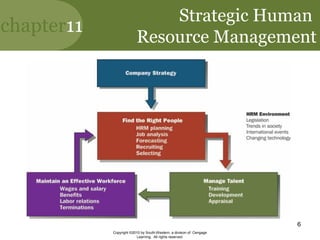
Strategic Human
Resource Management
chapter11
Copyright ©2010 by South-Western, a division of Cengage
Learning. All rights reserved.
7
Building Human Capital
to Drive Performance
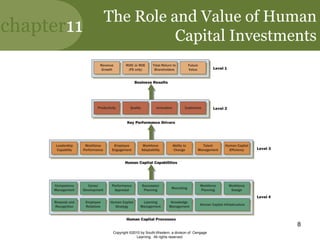
• Human Capital refers to the economic value of the
combined knowledge, experience, skills and
capabilities of employees
– Strategies for finding the best talent
– Enhancing skills and knowledge with training programs
– Opportunities for personal and professional development
– Compensation and benefits that support knowledge
sharing
chapter11
Copyright ©2010 by South-Western, a division of Cengage
Learning. All rights reserved.
8
The Role and Value of Human
Capital Investments
chapter11
Copyright ©2010 by South-Western, a division of Cengage
Learning. All rights reserved.
9
Globalization
• Globalization requires international human
resource management (IHRM)
• Managing diverse people on a global scale
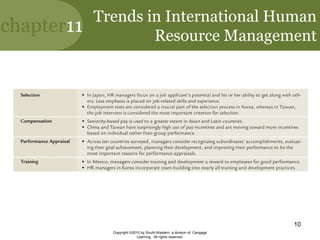
• HR practices and trends are converging globally
• IHRM Managers must be culturally sensitive
• Policies and practices must be culturally
sensitive
chapter11
Copyright ©2010 by South-Western, a division of Cengage
Learning. All rights reserved.
10
Trends in International Human
Resource Management
chapter11
Copyright ©2010 by South-Western, a division of Cengage
Learning. All rights reserved.
11
The Impact of Federal
Legislation on HRM
• Federal laws are enacted to ensure equal
employment opportunity
• The purpose of laws is to stop discriminatory
practices
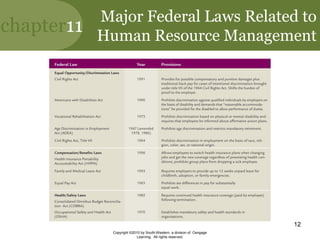
• The Equal Employment Opportunity Commission
(EEOC) was created by the Civil Rights Act of
1964
chapter11
Copyright ©2010 by South-Western, a division of Cengage
Learning. All rights reserved.
12
Major Federal Laws Related to
Human Resource Management
chapter11
Copyright ©2010 by South-Western, a division of Cengage
Learning. All rights reserved.
13
The Changing
Social Contract
• Changes in the business environment have changed the
social contract, a bulletin board at a company
restructuring noted:
– We can’t promise you how long we’ll be in business
– We can’t promise you that we won’t be acquired
– We can’t promise that there’ll be room for promotion
– We can’t promise that your job will exist when you reach
retirement age
– We can’t promise that the money will be available for your
pension
– We can’t expect your underlying loyalty, and we aren’t even sure
we want it
chapter11
Copyright ©2010 by South-Western, a division of Cengage
Learning. All rights reserved.
14
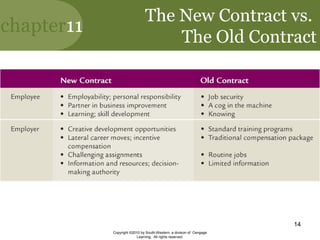
The New Contract vs.
The Old Contract
chapter11
Copyright ©2010 by South-Western, a division of Cengage
Learning. All rights reserved.
15
Innovations in HRM
• Becoming an Employer of Choice
• Using Temporary and Part-Time Employees
• Promoting Work/Life Balance
• Rightsizing the Organization
chapter11
Copyright ©2010 by South-Western, a division of Cengage
Learning. All rights reserved.
16
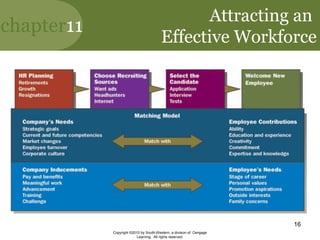
Attracting an
Effective Workforce
chapter11
Copyright ©2010 by South-Western, a division of Cengage
Learning. All rights reserved.
17
Human Resource Planning
• What new technologies are merging, and how will these
affect the work system?
• What is the volume of the business likely to be in the
next five to ten years?
• What is the turnover rate, and how much, if any, is
avoidable?
• What types of engineers will we need, and how many?
• How many administrative personnel will we need to
support the additional engineers?
• Can we temporary, part-time, or virtual workers to handle
some tasks?
chapter11
Copyright ©2010 by South-Western, a division of Cengage
Learning. All rights reserved.
18
Recruiting
• Assessing Organizational Needs
• Realistic Job Previews
• Legal Considerations
• E-cruiting
• Innovations in Recruiting
chapter11
Copyright ©2010 by South-Western, a division of Cengage
Learning. All rights reserved.
19
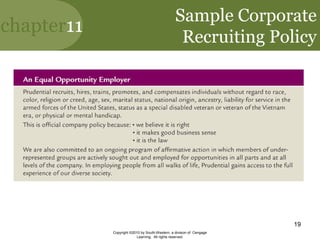
Sample Corporate
Recruiting Policy
chapter11
Copyright ©2010 by South-Western, a division of Cengage
Learning. All rights reserved.
20
Selecting
• Application Form
• Interview
• Employment Test
• Online Checks
chapter11
Copyright ©2010 by South-Western, a division of Cengage
Learning. All rights reserved.
21
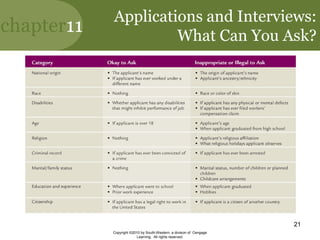
Applications and Interviews:
What Can You Ask?
chapter11
Copyright ©2010 by South-Western, a division of Cengage
Learning. All rights reserved.
22
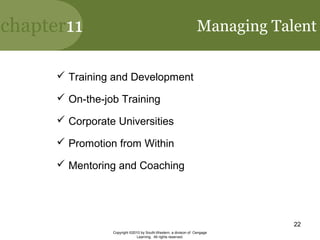
Managing Talent
 Training and Development
 On-the-job Training
 Corporate Universities
 Promotion from Within
 Mentoring and Coaching
chapter11
Copyright ©2010 by South-Western, a division of Cengage
Learning. All rights reserved.
23
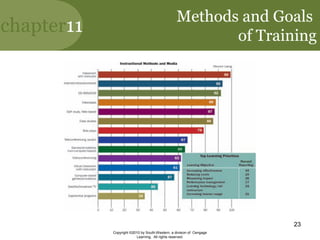
Methods and Goals
of Training
chapter11
Copyright ©2010 by South-Western, a division of Cengage
Learning. All rights reserved.
24
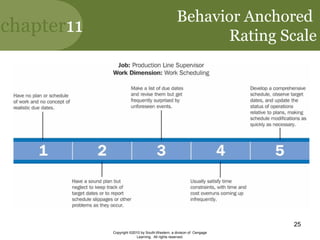
Performance Appraisal
• Accurately assess performance through the
development and application of assessment
systems such as rating scales
• Training managers to effectively use the
performance appraisal interview so managers
can provide feedback that reinforces good
performance and motivate development
chapter11
Copyright ©2010 by South-Western, a division of Cengage
Learning. All rights reserved.
25
Behavior Anchored
Rating Scale
chapter11
Copyright ©2010 by South-Western, a division of Cengage
Learning. All rights reserved.
26
Maintaining An
Effective Workforce
• Managers and HRM professionals must maintain
a workforce that has been recruited and
developed:
 Compensation
 Benefits
 Termination
chapter11
Copyright ©2010 by South-Western, a division of Cengage
Learning. All rights reserved.
27
Benefits
• Compensation packages are more than money
• Some benefits are required by law
– Social Security, Unemployment Compensation,
Workers’ Compensation
• Other types of benefits are optional
– Health Insurance, Vacations, Daycare, Fitness Centers
– Employees are beginning to absorb more
health insurance costs
• Many organizations offer cafeteria-plan benefits to address
the diverse needs of employees
chapter11 Minggu depan
• Pengelolaan Karyawan :
(Meningkatkan kepuasan pekerja
dan motivasi)
Copyright ©2010 by South-Western, a division of Cengage
Learning. All rights reserved.
28
chapter11
Copyright ©2010 by South-Western, a division of Cengage
Learning. All rights reserved.
29
Termination
• Retirement
• Voluntary Departure
• Mergers & Cutbacks
• Poor Performance
• Termination dismisses poor performers
• Opportunity to learn about dissatisfaction
through exit interview

9e daft chapter_11_managing_human_resources

  • 1.
  • 2.
  • 3.
    chapter11 Copyright ©2010 bySouth-Western, a division of Cengage Learning. All rights reserved. 3 Learning Outcomes • Explain the strategic role of human resource management. • Describe federal legislation and societal trends that influence human resource management. • Explain what the changing social contract between organizations and employees means for workers and human resource managers. • Show how organizations determine their future staffing needs through human resource planning. • Describe the tools managers use to recruit and select employees. • Describe how organizations develop an effective workforce through training and performance appraisal. • Explain how organizations maintain a workforce through the administration of wages and salaries, benefits, and terminations.
  • 4.
    chapter11 Copyright ©2010 bySouth-Western, a division of Cengage Learning. All rights reserved. 4 Getting the Right People on the Ship • Hiring and keeping quality employees is one of the most urgent concerns for today’s organizations • Talent management is a top priority for managers • Human Resources is the design and application of formal systems to ensure the effective and efficient use of human talent • Attracting, developing, and maintaining an effective workforce
  • 5.
    chapter11 Copyright ©2010 bySouth-Western, a division of Cengage Learning. All rights reserved. 5 The Strategic Role of HRM is to Drive Organizational Performance • Managers are involved in human resource management • Employees are viewed as assets • Employees provide the competitive edge – Right people to become more competitive on a global basis – Right people for improving quality, innovation, and customer service – Right people to retain during mergers and acquisitions – Right people to apply new information technology for e-business
  • 6.
    chapter11 Copyright ©2010 bySouth-Western, a division of Cengage Learning. All rights reserved. 6 Strategic Human Resource Management
  • 7.
    chapter11 Copyright ©2010 bySouth-Western, a division of Cengage Learning. All rights reserved. 7 Building Human Capital to Drive Performance • Human Capital refers to the economic value of the combined knowledge, experience, skills and capabilities of employees – Strategies for finding the best talent – Enhancing skills and knowledge with training programs – Opportunities for personal and professional development – Compensation and benefits that support knowledge sharing
  • 8.
    chapter11 Copyright ©2010 bySouth-Western, a division of Cengage Learning. All rights reserved. 8 The Role and Value of Human Capital Investments
  • 9.
    chapter11 Copyright ©2010 bySouth-Western, a division of Cengage Learning. All rights reserved. 9 Globalization • Globalization requires international human resource management (IHRM) • Managing diverse people on a global scale • HR practices and trends are converging globally • IHRM Managers must be culturally sensitive • Policies and practices must be culturally sensitive
  • 10.
    chapter11 Copyright ©2010 bySouth-Western, a division of Cengage Learning. All rights reserved. 10 Trends in International Human Resource Management
  • 11.
    chapter11 Copyright ©2010 bySouth-Western, a division of Cengage Learning. All rights reserved. 11 The Impact of Federal Legislation on HRM • Federal laws are enacted to ensure equal employment opportunity • The purpose of laws is to stop discriminatory practices • The Equal Employment Opportunity Commission (EEOC) was created by the Civil Rights Act of 1964
  • 12.
    chapter11 Copyright ©2010 bySouth-Western, a division of Cengage Learning. All rights reserved. 12 Major Federal Laws Related to Human Resource Management
  • 13.
    chapter11 Copyright ©2010 bySouth-Western, a division of Cengage Learning. All rights reserved. 13 The Changing Social Contract • Changes in the business environment have changed the social contract, a bulletin board at a company restructuring noted: – We can’t promise you how long we’ll be in business – We can’t promise you that we won’t be acquired – We can’t promise that there’ll be room for promotion – We can’t promise that your job will exist when you reach retirement age – We can’t promise that the money will be available for your pension – We can’t expect your underlying loyalty, and we aren’t even sure we want it
  • 14.
    chapter11 Copyright ©2010 bySouth-Western, a division of Cengage Learning. All rights reserved. 14 The New Contract vs. The Old Contract
  • 15.
    chapter11 Copyright ©2010 bySouth-Western, a division of Cengage Learning. All rights reserved. 15 Innovations in HRM • Becoming an Employer of Choice • Using Temporary and Part-Time Employees • Promoting Work/Life Balance • Rightsizing the Organization
  • 16.
    chapter11 Copyright ©2010 bySouth-Western, a division of Cengage Learning. All rights reserved. 16 Attracting an Effective Workforce
  • 17.
    chapter11 Copyright ©2010 bySouth-Western, a division of Cengage Learning. All rights reserved. 17 Human Resource Planning • What new technologies are merging, and how will these affect the work system? • What is the volume of the business likely to be in the next five to ten years? • What is the turnover rate, and how much, if any, is avoidable? • What types of engineers will we need, and how many? • How many administrative personnel will we need to support the additional engineers? • Can we temporary, part-time, or virtual workers to handle some tasks?
  • 18.
    chapter11 Copyright ©2010 bySouth-Western, a division of Cengage Learning. All rights reserved. 18 Recruiting • Assessing Organizational Needs • Realistic Job Previews • Legal Considerations • E-cruiting • Innovations in Recruiting
  • 19.
    chapter11 Copyright ©2010 bySouth-Western, a division of Cengage Learning. All rights reserved. 19 Sample Corporate Recruiting Policy
  • 20.
    chapter11 Copyright ©2010 bySouth-Western, a division of Cengage Learning. All rights reserved. 20 Selecting • Application Form • Interview • Employment Test • Online Checks
  • 21.
    chapter11 Copyright ©2010 bySouth-Western, a division of Cengage Learning. All rights reserved. 21 Applications and Interviews: What Can You Ask?
  • 22.
    chapter11 Copyright ©2010 bySouth-Western, a division of Cengage Learning. All rights reserved. 22 Managing Talent  Training and Development  On-the-job Training  Corporate Universities  Promotion from Within  Mentoring and Coaching
  • 23.
    chapter11 Copyright ©2010 bySouth-Western, a division of Cengage Learning. All rights reserved. 23 Methods and Goals of Training
  • 24.
    chapter11 Copyright ©2010 bySouth-Western, a division of Cengage Learning. All rights reserved. 24 Performance Appraisal • Accurately assess performance through the development and application of assessment systems such as rating scales • Training managers to effectively use the performance appraisal interview so managers can provide feedback that reinforces good performance and motivate development
  • 25.
    chapter11 Copyright ©2010 bySouth-Western, a division of Cengage Learning. All rights reserved. 25 Behavior Anchored Rating Scale
  • 26.
    chapter11 Copyright ©2010 bySouth-Western, a division of Cengage Learning. All rights reserved. 26 Maintaining An Effective Workforce • Managers and HRM professionals must maintain a workforce that has been recruited and developed:  Compensation  Benefits  Termination
  • 27.
    chapter11 Copyright ©2010 bySouth-Western, a division of Cengage Learning. All rights reserved. 27 Benefits • Compensation packages are more than money • Some benefits are required by law – Social Security, Unemployment Compensation, Workers’ Compensation • Other types of benefits are optional – Health Insurance, Vacations, Daycare, Fitness Centers – Employees are beginning to absorb more health insurance costs • Many organizations offer cafeteria-plan benefits to address the diverse needs of employees
  • 28.
    chapter11 Minggu depan •Pengelolaan Karyawan : (Meningkatkan kepuasan pekerja dan motivasi) Copyright ©2010 by South-Western, a division of Cengage Learning. All rights reserved. 28
  • 29.
    chapter11 Copyright ©2010 bySouth-Western, a division of Cengage Learning. All rights reserved. 29 Termination • Retirement • Voluntary Departure • Mergers & Cutbacks • Poor Performance • Termination dismisses poor performers • Opportunity to learn about dissatisfaction through exit interview