94 Ways Of Controlling The Clock
Here are 94 positive action steps for you to choose from to help
you regain control of your time. We suggest you select eight or 10
of these steps and include at least one in your Daily Planner List, a
copy of which accompanies this Special Action Report. We’ve also
included A Daily Time Log sheet for you to photocopy and use
diligently to help you further in planning better use of your valuable
time.
PREOCCUPATION ... ALERTNESS ... ENERGISING
1. Cultivate observation
2. Perform tasks faster
3. Think with pencil in hand
4. Periodically remind yourself to “Think Alertly”
5. Do the job right the first time
6. Reduce preoccupation time
7. Locate energy losses
8. Unblock natural drive by doing what you enjoy
9. Establish a balanced exercise program
10. Be highly selective in what you read
11. Set up a systematic program for reading
12. Double your speed of reading
13. Read a book like a newspaper
14. Do one thing at a time
15. Always have a high priority job with you for
when you have unexpected free time
16. Keep a writing pad accessible. Draw
pictures/diagrams as you explain a point to
visitors
17. Replace writing letters longhand with a
dictating machine
18. Dictate letters into a machine instead of
directly to a secretary
19. If possible, move your home closer to work, or
work closer to home, to reduce commuting
time.
20. Instead of bringing two or three individuals in
from different parts of the country for a brief
meeting, set up a “conference call”
21. When explaining an unfamiliar point, make
comparisons
22. Be aware of when you are tapering off from
peak levels of performance. At that point, shift
to another vital priority be on time to meetings,
appointments and scheduled events
23. Reduce the overlong visitor stay
24. Reduce the overlong telephone call
25. Accumulate telephone calls and handle them
at a time when the chance of getting through
is most likely
26. If you have a secretary, use him/her to screen
incoming telephone calls and drop-in visitors
27. When a visitor stay is too long, have a co-
worker or secretary interrupt you
28. Establish an appropriate balance between
vocational work and management work
29. Retire early and rise early
30. Get the necessary sleep each night, but no
more than is necessary
31. Be sensitive to the vital priorities of others
around you
COMMUNICATION AND ATTITUDE
32. Take 100% responsibility when sending or
receiving messages to see that
communication is secured
33. Ask others, “What can I do to help you make
better use of your time?”
34. Consistently use sincere positive reinforcers on
others
35. Use positive reinforcers on yourself
36. Reduce using negative reinforcers on other
people
37. Reduce using negative reinforcers on yourself
DELEGATION ... BOSS/SUBORDINATE
RELATIONSHIP
38. Earn the support of your boss
39. Enlarge your discretionary time by reducing
the time that is imposed by subordinates and
others
40. Instead of subordinates bringing you problems,
have them bring you the answers
41. Analyse yourself with the following questions :
42. What am I doing now that doesn’t need to be
done by me or anyone else?
43. What am I doing that others can do?
MEETINGS
44. Hold meetings standing up to make them
shorter
45. Double preparation time for meetings and cut
meeting time in half
46. Have only those people in the meeting who
need to be there
47. Maintain a strict contract agreement as to
when a meeting will start and end. End the
meeting on or before the agreed time.
48. Avoid holding a regularly-scheduled meeting
and see if it makes a difference
49. Use a carefully-prepared agenda at all
meetings
50. When in a meeting where your time is being
wasted, ask the leader, “Is there any other
contribution I can make to this meeting?”
51. Discuss with meeting leader in advance where
you will be on the agenda, and get yourself
moved up, if possible.
PHYSICAL WORK AREA, ORGANISING
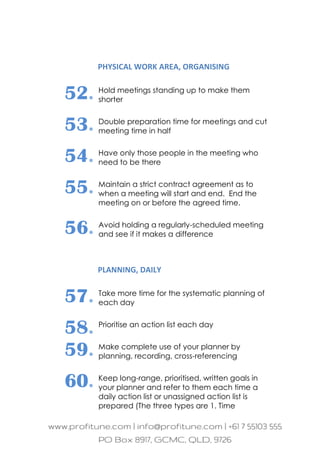
52. Hold meetings standing up to make them
shorter
53. Double preparation time for meetings and cut
meeting time in half
54. Have only those people in the meeting who
need to be there
55. Maintain a strict contract agreement as to
when a meeting will start and end. End the
meeting on or before the agreed time.
56. Avoid holding a regularly-scheduled meeting
and see if it makes a difference
PLANNING, DAILY
57. Take more time for the systematic planning of
each day
58. Prioritise an action list each day
59. Make complete use of your planner by
planning, recording, cross-referencing
60. Keep long-range, prioritised, written goals in
your planner and refer to them each time a
daily action list or unassigned action list is
prepared (The three types are 1. Time
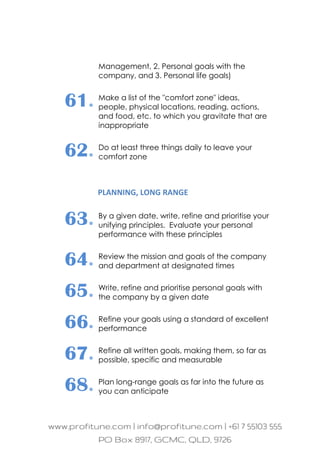
Management, 2. Personal goals with the
company, and 3. Personal life goals)
61. Make a list of the "comfort zone" ideas,
people, physical locations, reading, actions,
and food, etc. to which you gravitate that are
inappropriate
62. Do at least three things daily to leave your
comfort zone
PLANNING, LONG RANGE
63. By a given date, write, refine and prioritise your
unifying principles. Evaluate your personal
performance with these principles
64. Review the mission and goals of the company
and department at designated times
65. Write, refine and prioritise personal goals with
the company by a given date
66. Refine your goals using a standard of excellent
performance
67. Refine all written goals, making them, so far as
possible, specific and measurable
68. Plan long-range goals as far into the future as
you can anticipate
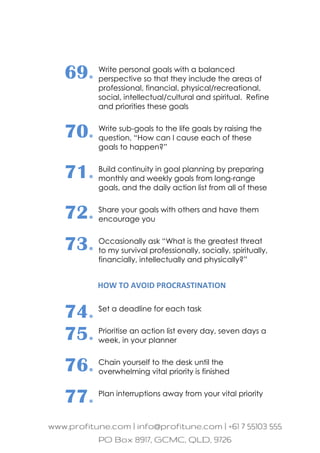
69. Write personal goals with a balanced
perspective so that they include the areas of
professional, financial, physical/recreational,
social, intellectual/cultural and spiritual. Refine
and priorities these goals
70. Write sub-goals to the life goals by raising the
question, “How can I cause each of these
goals to happen?”
71. Build continuity in goal planning by preparing
monthly and weekly goals from long-range
goals, and the daily action list from all of these
72. Share your goals with others and have them
encourage you
73. Occasionally ask “What is the greatest threat
to my survival professionally, socially, spiritually,
financially, intellectually and physically?”
HOW TO AVOID PROCRASTINATION
74. Set a deadline for each task
75. Prioritise an action list every day, seven days a
week, in your planner
76. Chain yourself to the desk until the
overwhelming vital priority is finished
77. Plan interruptions away from your vital priority
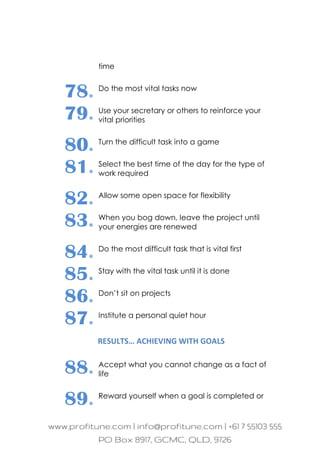
time
78. Do the most vital tasks now
79. Use your secretary or others to reinforce your
vital priorities
80. Turn the difficult task into a game
81. Select the best time of the day for the type of
work required
82. Allow some open space for flexibility
83. When you bog down, leave the project until
your energies are renewed
84. Do the most difficult task that is vital first
85. Stay with the vital task until it is done
86. Don’t sit on projects
87. Institute a personal quiet hour
RESULTS… ACHIEVING WITH GOALS
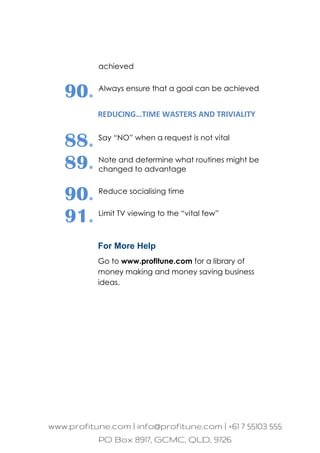
88. Accept what you cannot change as a fact of
life
89. Reward yourself when a goal is completed or
achieved
90. Always ensure that a goal can be achieved
REDUCING…TIME WASTERS AND TRIVIALITY
88. Say “NO” when a request is not vital
89. Note and determine what routines might be
changed to advantage
90. Reduce socialising time
91. Limit TV viewing to the “vital few”
For More Help
Go to www.profitune.com for a library of
money making and money saving business
ideas.
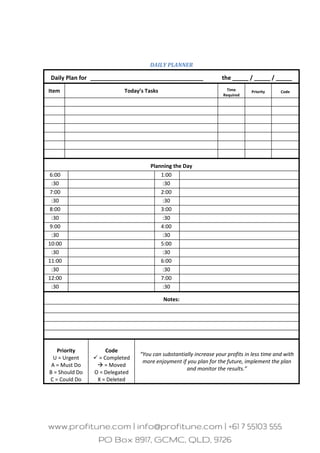
DAILY PLANNER
Daily Plan for ___________________________________ the _____ / _____ / _____
Item Today’s Tasks Time
Required
Priority Code
Planning the Day
6:00 1:00
:30 :30
7:00 2:00
:30 :30
8:00 3:00
:30 :30
9:00 4:00
:30 :30
10:00 5:00
:30 :30
11:00 6:00
:30 :30
12:00 7:00
:30 :30
Notes:
Priority
U = Urgent
A = Must Do
B = Should Do
C = Could Do
Code
 = Completed
 = Moved
O = Delegated
X = Deleted
“You can substantially increase your profits in less time and with
more enjoyment if you plan for the future, implement the plan
and monitor the results.”
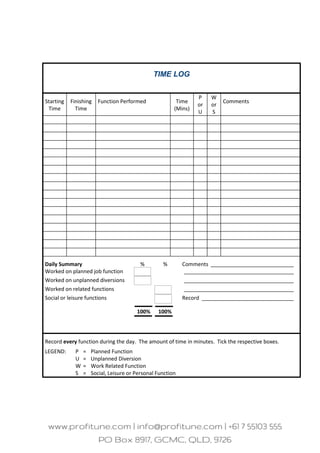
TIME LOG
Starting
Time
Finishing
Time
Function Performed Time
(Mins)
P
or
U
W
or
S
Comments
Daily Summary % % Comments ____________________________
Worked on planned job function _____________________________________
Worked on unplanned diversions _____________________________________
Worked on related functions _____________________________________
Social or leisure functions Record _______________________________
100% 100%
Record every function during the day. The amount of time in minutes. Tick the respective boxes.
LEGEND: P = Planned Function
U = Unplanned Diversion
W = Work Related Function
S = Social, Leisure or Personal Function
www.profitune.com
Tried Them All & Want
More?
If you’ve tried all of the above tips and you’re looking
for more, you’re probably in the top 5% of business
people. And they’re the ones we love to work with!
Maybe you’re one of them.
Maybe you just know that you would benefit
enormously if only you could get into the habits listed
above, but maybe you also just know that you’ll be
overwhelmed tomorrow and won’t do this either (I say
“either” because there are probably a lot of other
things that you’d like to do that you just don’t have the
time for).
Like to increase your chances of success, and
experience a truly great result?
Then please, give us a call and we’ll explain how we
can Coach
you to a better result - in no time at all!

94 Ways of Controlling The Clock

  • 2.
    94 Ways OfControlling The Clock Here are 94 positive action steps for you to choose from to help you regain control of your time. We suggest you select eight or 10 of these steps and include at least one in your Daily Planner List, a copy of which accompanies this Special Action Report. We’ve also included A Daily Time Log sheet for you to photocopy and use diligently to help you further in planning better use of your valuable time. PREOCCUPATION ... ALERTNESS ... ENERGISING 1. Cultivate observation 2. Perform tasks faster 3. Think with pencil in hand 4. Periodically remind yourself to “Think Alertly” 5. Do the job right the first time 6. Reduce preoccupation time 7. Locate energy losses 8. Unblock natural drive by doing what you enjoy 9. Establish a balanced exercise program 10. Be highly selective in what you read 11. Set up a systematic program for reading
  • 3.
    12. Double yourspeed of reading 13. Read a book like a newspaper 14. Do one thing at a time 15. Always have a high priority job with you for when you have unexpected free time 16. Keep a writing pad accessible. Draw pictures/diagrams as you explain a point to visitors 17. Replace writing letters longhand with a dictating machine 18. Dictate letters into a machine instead of directly to a secretary 19. If possible, move your home closer to work, or work closer to home, to reduce commuting time. 20. Instead of bringing two or three individuals in from different parts of the country for a brief meeting, set up a “conference call” 21. When explaining an unfamiliar point, make comparisons 22. Be aware of when you are tapering off from peak levels of performance. At that point, shift to another vital priority be on time to meetings,
  • 4.
    appointments and scheduledevents 23. Reduce the overlong visitor stay 24. Reduce the overlong telephone call 25. Accumulate telephone calls and handle them at a time when the chance of getting through is most likely 26. If you have a secretary, use him/her to screen incoming telephone calls and drop-in visitors 27. When a visitor stay is too long, have a co- worker or secretary interrupt you 28. Establish an appropriate balance between vocational work and management work 29. Retire early and rise early 30. Get the necessary sleep each night, but no more than is necessary 31. Be sensitive to the vital priorities of others around you COMMUNICATION AND ATTITUDE 32. Take 100% responsibility when sending or receiving messages to see that communication is secured
  • 5.
    33. Ask others,“What can I do to help you make better use of your time?” 34. Consistently use sincere positive reinforcers on others 35. Use positive reinforcers on yourself 36. Reduce using negative reinforcers on other people 37. Reduce using negative reinforcers on yourself DELEGATION ... BOSS/SUBORDINATE RELATIONSHIP 38. Earn the support of your boss 39. Enlarge your discretionary time by reducing the time that is imposed by subordinates and others 40. Instead of subordinates bringing you problems, have them bring you the answers 41. Analyse yourself with the following questions : 42. What am I doing now that doesn’t need to be done by me or anyone else?
  • 6.
    43. What amI doing that others can do? MEETINGS 44. Hold meetings standing up to make them shorter 45. Double preparation time for meetings and cut meeting time in half 46. Have only those people in the meeting who need to be there 47. Maintain a strict contract agreement as to when a meeting will start and end. End the meeting on or before the agreed time. 48. Avoid holding a regularly-scheduled meeting and see if it makes a difference 49. Use a carefully-prepared agenda at all meetings 50. When in a meeting where your time is being wasted, ask the leader, “Is there any other contribution I can make to this meeting?” 51. Discuss with meeting leader in advance where you will be on the agenda, and get yourself moved up, if possible.
  • 7.
    PHYSICAL WORK AREA,ORGANISING 52. Hold meetings standing up to make them shorter 53. Double preparation time for meetings and cut meeting time in half 54. Have only those people in the meeting who need to be there 55. Maintain a strict contract agreement as to when a meeting will start and end. End the meeting on or before the agreed time. 56. Avoid holding a regularly-scheduled meeting and see if it makes a difference PLANNING, DAILY 57. Take more time for the systematic planning of each day 58. Prioritise an action list each day 59. Make complete use of your planner by planning, recording, cross-referencing 60. Keep long-range, prioritised, written goals in your planner and refer to them each time a daily action list or unassigned action list is prepared (The three types are 1. Time
  • 8.
    Management, 2. Personalgoals with the company, and 3. Personal life goals) 61. Make a list of the "comfort zone" ideas, people, physical locations, reading, actions, and food, etc. to which you gravitate that are inappropriate 62. Do at least three things daily to leave your comfort zone PLANNING, LONG RANGE 63. By a given date, write, refine and prioritise your unifying principles. Evaluate your personal performance with these principles 64. Review the mission and goals of the company and department at designated times 65. Write, refine and prioritise personal goals with the company by a given date 66. Refine your goals using a standard of excellent performance 67. Refine all written goals, making them, so far as possible, specific and measurable 68. Plan long-range goals as far into the future as you can anticipate
  • 9.
    69. Write personalgoals with a balanced perspective so that they include the areas of professional, financial, physical/recreational, social, intellectual/cultural and spiritual. Refine and priorities these goals 70. Write sub-goals to the life goals by raising the question, “How can I cause each of these goals to happen?” 71. Build continuity in goal planning by preparing monthly and weekly goals from long-range goals, and the daily action list from all of these 72. Share your goals with others and have them encourage you 73. Occasionally ask “What is the greatest threat to my survival professionally, socially, spiritually, financially, intellectually and physically?” HOW TO AVOID PROCRASTINATION 74. Set a deadline for each task 75. Prioritise an action list every day, seven days a week, in your planner 76. Chain yourself to the desk until the overwhelming vital priority is finished 77. Plan interruptions away from your vital priority
  • 10.
    time 78. Do themost vital tasks now 79. Use your secretary or others to reinforce your vital priorities 80. Turn the difficult task into a game 81. Select the best time of the day for the type of work required 82. Allow some open space for flexibility 83. When you bog down, leave the project until your energies are renewed 84. Do the most difficult task that is vital first 85. Stay with the vital task until it is done 86. Don’t sit on projects 87. Institute a personal quiet hour RESULTS… ACHIEVING WITH GOALS 88. Accept what you cannot change as a fact of life 89. Reward yourself when a goal is completed or
  • 11.
    achieved 90. Always ensurethat a goal can be achieved REDUCING…TIME WASTERS AND TRIVIALITY 88. Say “NO” when a request is not vital 89. Note and determine what routines might be changed to advantage 90. Reduce socialising time 91. Limit TV viewing to the “vital few” For More Help Go to www.profitune.com for a library of money making and money saving business ideas.
  • 12.
    DAILY PLANNER Daily Planfor ___________________________________ the _____ / _____ / _____ Item Today’s Tasks Time Required Priority Code Planning the Day 6:00 1:00 :30 :30 7:00 2:00 :30 :30 8:00 3:00 :30 :30 9:00 4:00 :30 :30 10:00 5:00 :30 :30 11:00 6:00 :30 :30 12:00 7:00 :30 :30 Notes: Priority U = Urgent A = Must Do B = Should Do C = Could Do Code  = Completed  = Moved O = Delegated X = Deleted “You can substantially increase your profits in less time and with more enjoyment if you plan for the future, implement the plan and monitor the results.”
  • 13.
    TIME LOG Starting Time Finishing Time Function PerformedTime (Mins) P or U W or S Comments Daily Summary % % Comments ____________________________ Worked on planned job function _____________________________________ Worked on unplanned diversions _____________________________________ Worked on related functions _____________________________________ Social or leisure functions Record _______________________________ 100% 100% Record every function during the day. The amount of time in minutes. Tick the respective boxes. LEGEND: P = Planned Function U = Unplanned Diversion W = Work Related Function S = Social, Leisure or Personal Function
  • 14.
    www.profitune.com Tried Them All& Want More? If you’ve tried all of the above tips and you’re looking for more, you’re probably in the top 5% of business people. And they’re the ones we love to work with! Maybe you’re one of them. Maybe you just know that you would benefit enormously if only you could get into the habits listed above, but maybe you also just know that you’ll be overwhelmed tomorrow and won’t do this either (I say “either” because there are probably a lot of other things that you’d like to do that you just don’t have the time for). Like to increase your chances of success, and experience a truly great result? Then please, give us a call and we’ll explain how we can Coach you to a better result - in no time at all!