

9 Soft Skills Every
Employee Will Need In
The Age Of Artificial
Intelligence (AI)
© 2020 Bernard Marr, Bernard Marr & Co. All rights reserved
Title
Text
IntroductionIntroduction
Artificial Intelligence (AI) and machine learning systems are becoming increasingly
competent at doing jobs that previously, only humans could do. Here, we look at the
key soft skills everyone should be focusing on to compete well in the job market of the
future.
Technical skills and data literacy are obviously important in this age of AI, big data, and
automation. But that doesn't mean we should ignore the human side of work – skills in
areas that robots can't do so well. I believe these softer skills will become even more
critical for success as the nature of work evolves, and as machines take on more of the
easily automated aspects of work. In other words, the work of humans is going to
become altogether more, well, human.
9 Soft Skills Every Employee Will Need In The
Age Of Artificial Intelligence (AI)
© 2020 Bernard Marr, Bernard Marr & Co. All rights reserved
Title
Text
IntroductionIntroduction
With this in mind, what skills should employees be looking to cultivate going forward?
Here are nine soft skills that I think are going to become even more precious to
employers in the future.
9 Soft Skills Every Employee Will Need In The
Age Of Artificial Intelligence (AI)
© 2020 Bernard Marr, Bernard Marr & Co. All rights reserved
1. Creativity
Robots and machines can do many things, but they struggle to compete with humans
when it comes to our ability to create, imagine, invent, and dream. With all the new
technology coming our way, the workplaces of the future will require new ways of thinking
– making creative thinking and human creativity an important asset.
© 2020 Bernard Marr, Bernard Marr & Co. All rights reserved
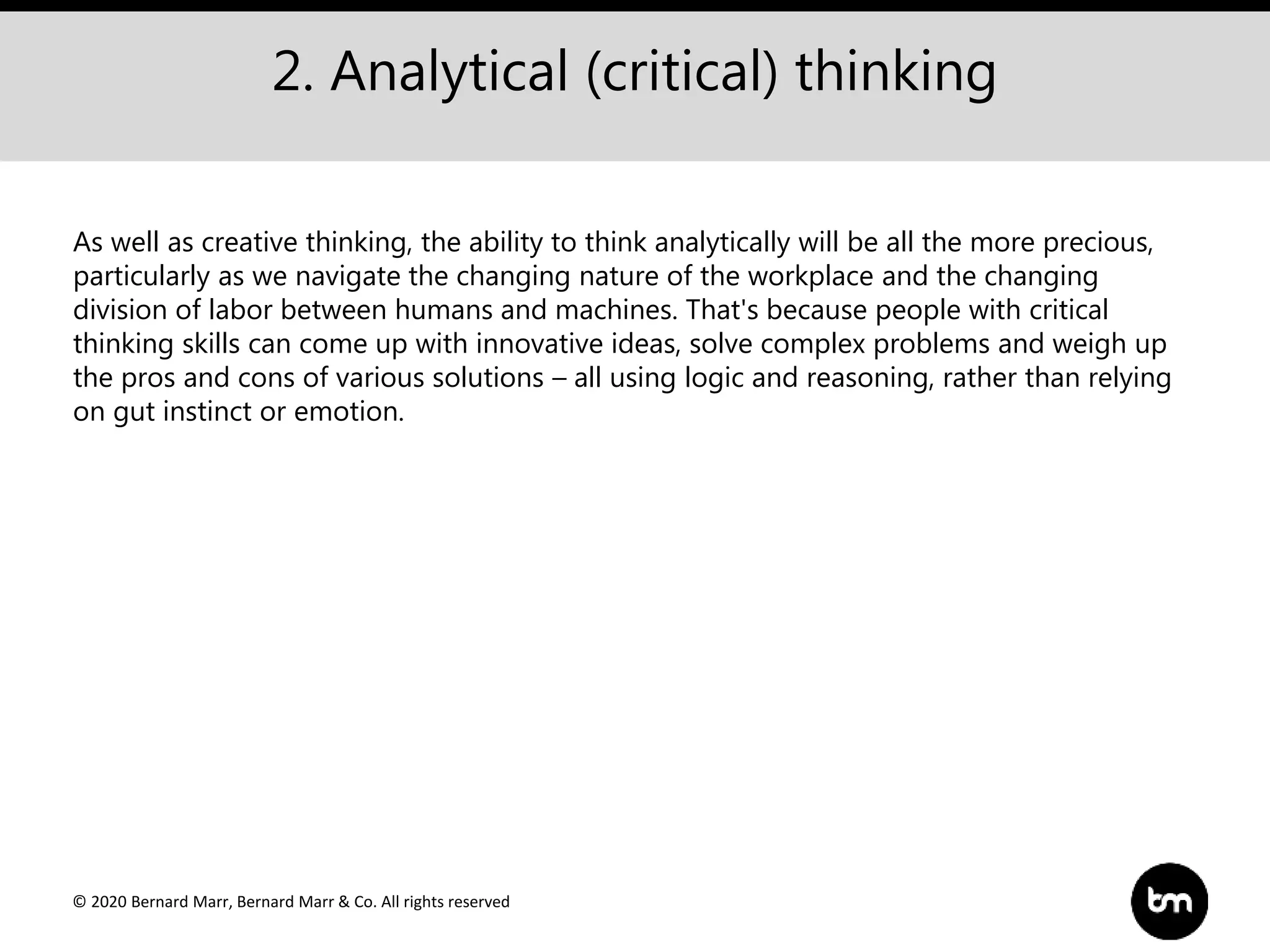
2. Analytical (critical) thinking
As well as creative thinking, the ability to think analytically will be all the more precious,
particularly as we navigate the changing nature of the workplace and the changing
division of labor between humans and machines. That's because people with critical
thinking skills can come up with innovative ideas, solve complex problems and weigh up
the pros and cons of various solutions – all using logic and reasoning, rather than relying
on gut instinct or emotion.
© 2020 Bernard Marr, Bernard Marr & Co. All rights reserved
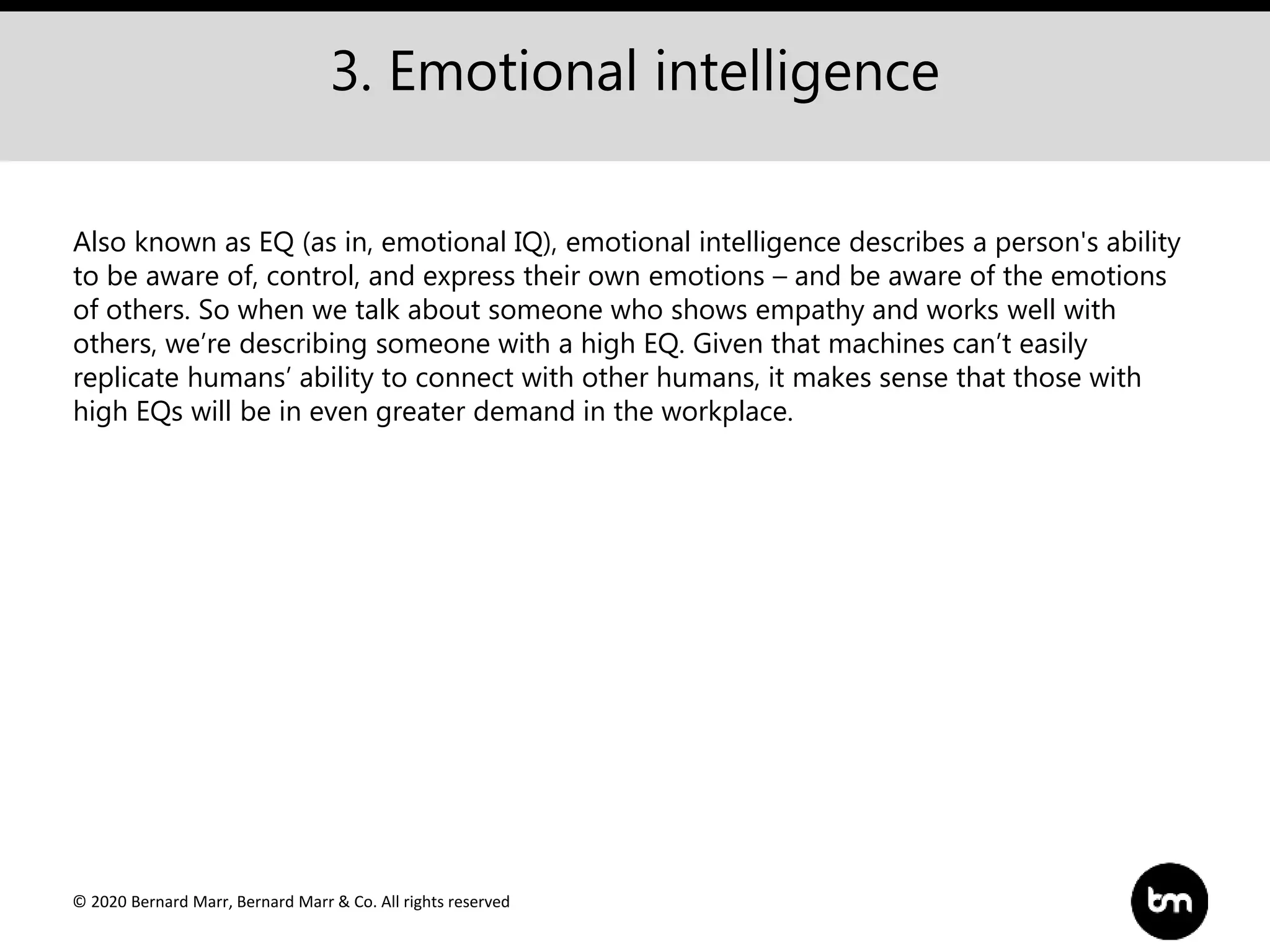
3. Emotional intelligence
Also known as EQ (as in, emotional IQ), emotional intelligence describes a person's ability
to be aware of, control, and express their own emotions – and be aware of the emotions
of others. So when we talk about someone who shows empathy and works well with
others, we’re describing someone with a high EQ. Given that machines can’t easily
replicate humans’ ability to connect with other humans, it makes sense that those with
high EQs will be in even greater demand in the workplace.
© 2020 Bernard Marr, Bernard Marr & Co. All rights reserved
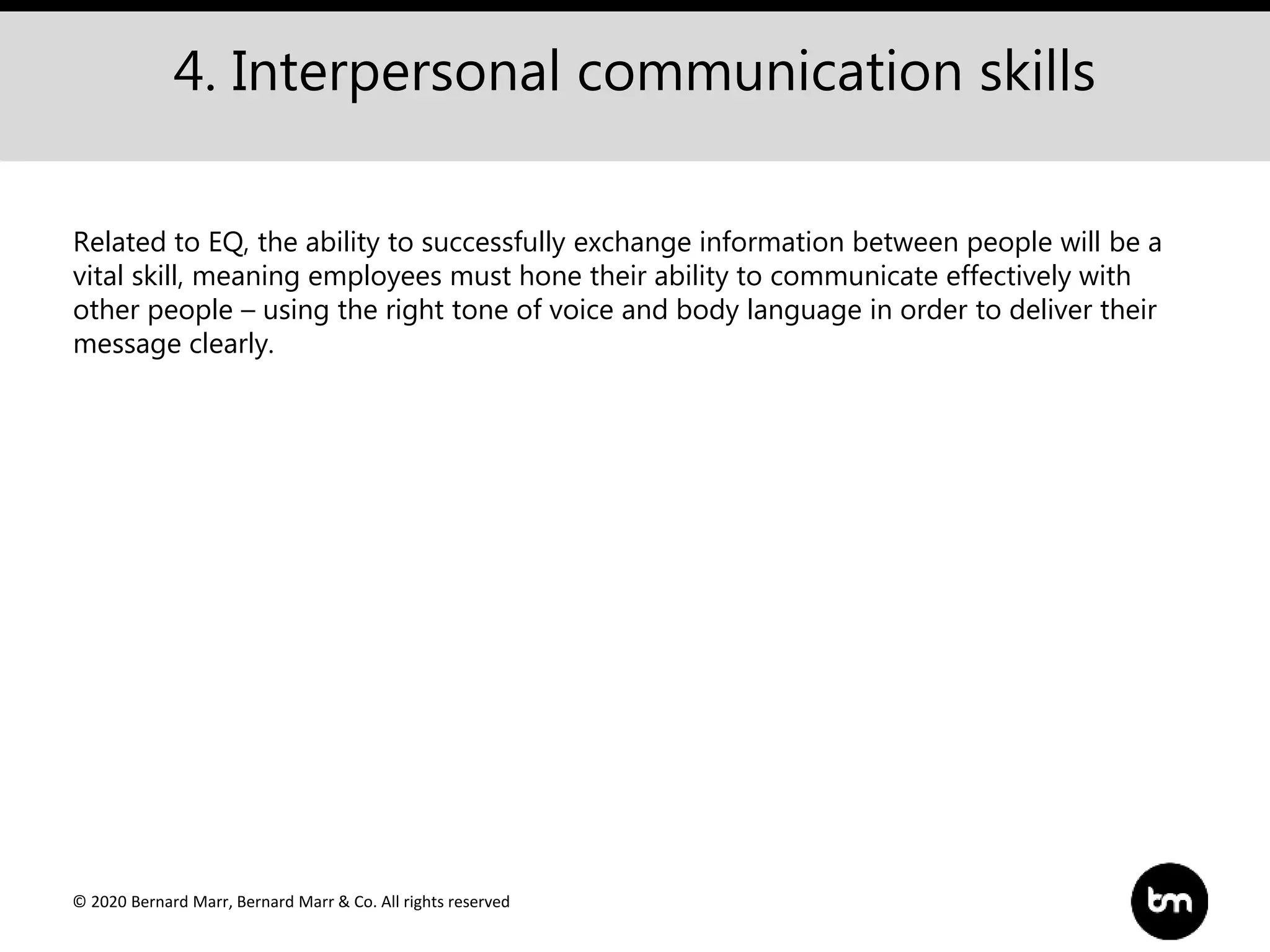
4. Interpersonal communication skills
Related to EQ, the ability to successfully exchange information between people will be a
vital skill, meaning employees must hone their ability to communicate effectively with
other people – using the right tone of voice and body language in order to deliver their
message clearly.
© 2020 Bernard Marr, Bernard Marr & Co. All rights reserved
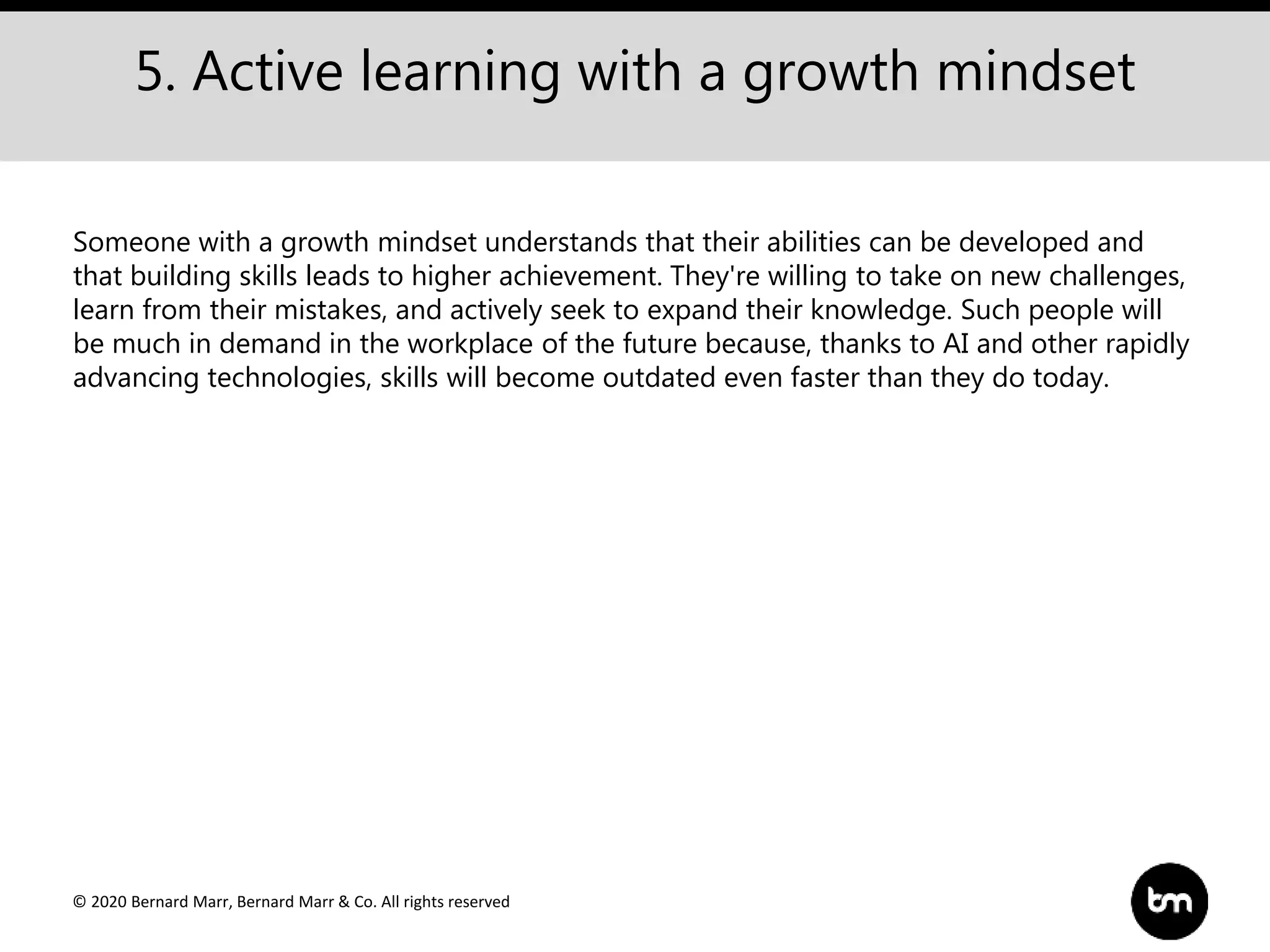
5. Active learning with a growth mindset
Someone with a growth mindset understands that their abilities can be developed and
that building skills leads to higher achievement. They're willing to take on new challenges,
learn from their mistakes, and actively seek to expand their knowledge. Such people will
be much in demand in the workplace of the future because, thanks to AI and other rapidly
advancing technologies, skills will become outdated even faster than they do today.
© 2020 Bernard Marr, Bernard Marr & Co. All rights reserved
6. Judgement and decision making
We already know that computers are capable of processing information better than the
human brain, but ultimately, it's humans who are responsible for making the business-
critical decisions in an organization. It's humans who have to take into account the
implications of their decisions in terms of the business and the people who work in it.
Decision-making skills will, therefore, remain important. But there's no doubt that the
nature of human decision making will evolve – specifically, technology will take care of
more menial and mundane decisions, leaving humans to focus on higher-level, more
complex decisions.
© 2020 Bernard Marr, Bernard Marr & Co. All rights reserved
7. Leadership skills
The workplaces of the future will look quite different from today's hierarchical
organizations. Project-based teams, remote teams, and fluid organizational structures will
probably become more commonplace. But that won't diminish the importance of good
leadership. Even within project teams, individuals will still need to take on leadership roles
to tackle issues and develop solutions – so common leadership traits like being inspiring
and helping others become the best versions of themselves will remain critical.
© 2020 Bernard Marr, Bernard Marr & Co. All rights reserved
8. Diversity and cultural intelligence
Workplaces are becoming more diverse and open, so employees will need to be able to
respect, understand, and adapt to others who might have different ways of perceiving the
world. This will obviously improve how people interact within the company, but I think it
will also make the business’s services and products more inclusive, too.
© 2020 Bernard Marr, Bernard Marr & Co. All rights reserved
9. Embracing change
Even for me, the pace of change right now is startling, particularly when it comes to AI.
This means people will have to be agile and cultivate the ability to embrace – and even
celebrate – change. Employees will need to be flexible and adapt to shifting workplaces,
expectations, and required skillsets. And, crucially, they'll need to see change not as a
burden but as an opportunity to grow.
Bottom line: we needn't be intimated by AI. The human brain is incredible. It's far more
complex and more powerful than any AI in existence. So rather than fearing AI and
automation and the changes this will bring to workplaces, we should all be looking to
harness our unique human capabilities and cultivate these softer skills – skills that will
become all the more important for the future of work.
AI is going to impact businesses of all shapes and sizes across all industries. Discover how
to prepare your organization for an AI-driven world in my book, The Intelligence
Revolution: Transforming Your Business With AI.
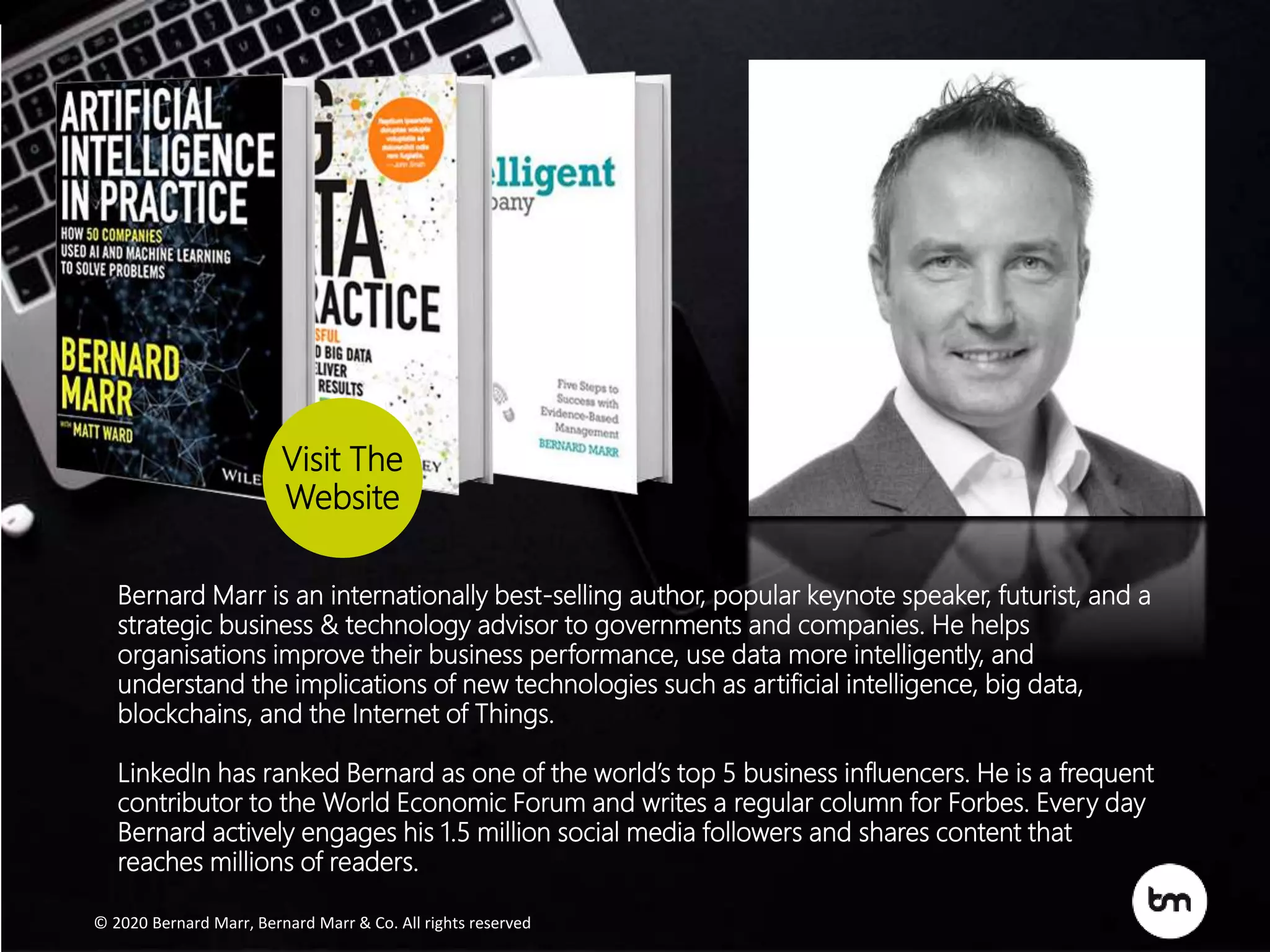
Bernard Marr is an internationally best-selling author, popular keynote speaker, futurist, and a
strategic business & technology advisor to governments and companies. He helps
organisations improve their business performance, use data more intelligently, and
understand the implications of new technologies such as artificial intelligence, big data,
blockchains, and the Internet of Things.
LinkedIn has ranked Bernard as one of the world’s top 5 business influencers. He is a frequent
contributor to the World Economic Forum and writes a regular column for Forbes. Every day
Bernard actively engages his 1.5 million social media followers and shares content that
reaches millions of readers.
Visit The
Website
© 2020 Bernard Marr , Bernard Marr & Co. All rights reserved© 2017 Bernard Marr , Bernard Marr & Co. All rights reserved
© 2020 Bernard Marr, Bernard Marr & Co. All rights reserved
Bernard Marr is an internationally best-selling author, popular keynote speaker, futurist, and a
strategic business & technology advisor to governments and companies. He helps
organisations improve their business performance, use data more intelligently, and
understand the implications of new technologies such as artificial intelligence, big data,
blockchains, and the Internet of Things.
LinkedIn has ranked Bernard as one of the world’s top 5 business influencers. He is a frequent
contributor to the World Economic Forum and writes a regular column for Forbes. Every day
Bernard actively engages his 1.5 million social media followers and shares content that
reaches millions of readers.
Visit The
Website
Title
Subtitle
Be the FIRST to receive news,
articles, insights and event
updates from Bernard Marr & Co
straight to your inbox.
Signing up is EASY! Simply fill out
the online form and we’ll be in
touch!
© 2020 Bernard Marr, Bernard Marr & Co. All rights reserved
BernardMarr
hello@bernardmarr.com
www.bernardmarr.com

9 Soft Skills Every Employee Will Need In The Age Of Artificial Intelligence (AI)

  • 1.
    9 Soft SkillsEvery Employee Will Need In The Age Of Artificial Intelligence (AI)
  • 2.
    © 2020 BernardMarr, Bernard Marr & Co. All rights reserved Title Text IntroductionIntroduction Artificial Intelligence (AI) and machine learning systems are becoming increasingly competent at doing jobs that previously, only humans could do. Here, we look at the key soft skills everyone should be focusing on to compete well in the job market of the future. Technical skills and data literacy are obviously important in this age of AI, big data, and automation. But that doesn't mean we should ignore the human side of work – skills in areas that robots can't do so well. I believe these softer skills will become even more critical for success as the nature of work evolves, and as machines take on more of the easily automated aspects of work. In other words, the work of humans is going to become altogether more, well, human. 9 Soft Skills Every Employee Will Need In The Age Of Artificial Intelligence (AI)
  • 3.
    © 2020 BernardMarr, Bernard Marr & Co. All rights reserved Title Text IntroductionIntroduction With this in mind, what skills should employees be looking to cultivate going forward? Here are nine soft skills that I think are going to become even more precious to employers in the future. 9 Soft Skills Every Employee Will Need In The Age Of Artificial Intelligence (AI)
  • 4.
    © 2020 BernardMarr, Bernard Marr & Co. All rights reserved 1. Creativity Robots and machines can do many things, but they struggle to compete with humans when it comes to our ability to create, imagine, invent, and dream. With all the new technology coming our way, the workplaces of the future will require new ways of thinking – making creative thinking and human creativity an important asset.
  • 5.
    © 2020 BernardMarr, Bernard Marr & Co. All rights reserved 2. Analytical (critical) thinking As well as creative thinking, the ability to think analytically will be all the more precious, particularly as we navigate the changing nature of the workplace and the changing division of labor between humans and machines. That's because people with critical thinking skills can come up with innovative ideas, solve complex problems and weigh up the pros and cons of various solutions – all using logic and reasoning, rather than relying on gut instinct or emotion.
  • 6.
    © 2020 BernardMarr, Bernard Marr & Co. All rights reserved 3. Emotional intelligence Also known as EQ (as in, emotional IQ), emotional intelligence describes a person's ability to be aware of, control, and express their own emotions – and be aware of the emotions of others. So when we talk about someone who shows empathy and works well with others, we’re describing someone with a high EQ. Given that machines can’t easily replicate humans’ ability to connect with other humans, it makes sense that those with high EQs will be in even greater demand in the workplace.
  • 7.
    © 2020 BernardMarr, Bernard Marr & Co. All rights reserved 4. Interpersonal communication skills Related to EQ, the ability to successfully exchange information between people will be a vital skill, meaning employees must hone their ability to communicate effectively with other people – using the right tone of voice and body language in order to deliver their message clearly.
  • 8.
    © 2020 BernardMarr, Bernard Marr & Co. All rights reserved 5. Active learning with a growth mindset Someone with a growth mindset understands that their abilities can be developed and that building skills leads to higher achievement. They're willing to take on new challenges, learn from their mistakes, and actively seek to expand their knowledge. Such people will be much in demand in the workplace of the future because, thanks to AI and other rapidly advancing technologies, skills will become outdated even faster than they do today.
  • 9.
    © 2020 BernardMarr, Bernard Marr & Co. All rights reserved 6. Judgement and decision making We already know that computers are capable of processing information better than the human brain, but ultimately, it's humans who are responsible for making the business- critical decisions in an organization. It's humans who have to take into account the implications of their decisions in terms of the business and the people who work in it. Decision-making skills will, therefore, remain important. But there's no doubt that the nature of human decision making will evolve – specifically, technology will take care of more menial and mundane decisions, leaving humans to focus on higher-level, more complex decisions.
  • 10.
    © 2020 BernardMarr, Bernard Marr & Co. All rights reserved 7. Leadership skills The workplaces of the future will look quite different from today's hierarchical organizations. Project-based teams, remote teams, and fluid organizational structures will probably become more commonplace. But that won't diminish the importance of good leadership. Even within project teams, individuals will still need to take on leadership roles to tackle issues and develop solutions – so common leadership traits like being inspiring and helping others become the best versions of themselves will remain critical.
  • 11.
    © 2020 BernardMarr, Bernard Marr & Co. All rights reserved 8. Diversity and cultural intelligence Workplaces are becoming more diverse and open, so employees will need to be able to respect, understand, and adapt to others who might have different ways of perceiving the world. This will obviously improve how people interact within the company, but I think it will also make the business’s services and products more inclusive, too.
  • 12.
    © 2020 BernardMarr, Bernard Marr & Co. All rights reserved 9. Embracing change Even for me, the pace of change right now is startling, particularly when it comes to AI. This means people will have to be agile and cultivate the ability to embrace – and even celebrate – change. Employees will need to be flexible and adapt to shifting workplaces, expectations, and required skillsets. And, crucially, they'll need to see change not as a burden but as an opportunity to grow. Bottom line: we needn't be intimated by AI. The human brain is incredible. It's far more complex and more powerful than any AI in existence. So rather than fearing AI and automation and the changes this will bring to workplaces, we should all be looking to harness our unique human capabilities and cultivate these softer skills – skills that will become all the more important for the future of work. AI is going to impact businesses of all shapes and sizes across all industries. Discover how to prepare your organization for an AI-driven world in my book, The Intelligence Revolution: Transforming Your Business With AI.
  • 13.
    Bernard Marr isan internationally best-selling author, popular keynote speaker, futurist, and a strategic business & technology advisor to governments and companies. He helps organisations improve their business performance, use data more intelligently, and understand the implications of new technologies such as artificial intelligence, big data, blockchains, and the Internet of Things. LinkedIn has ranked Bernard as one of the world’s top 5 business influencers. He is a frequent contributor to the World Economic Forum and writes a regular column for Forbes. Every day Bernard actively engages his 1.5 million social media followers and shares content that reaches millions of readers. Visit The Website © 2020 Bernard Marr , Bernard Marr & Co. All rights reserved© 2017 Bernard Marr , Bernard Marr & Co. All rights reserved © 2020 Bernard Marr, Bernard Marr & Co. All rights reserved Bernard Marr is an internationally best-selling author, popular keynote speaker, futurist, and a strategic business & technology advisor to governments and companies. He helps organisations improve their business performance, use data more intelligently, and understand the implications of new technologies such as artificial intelligence, big data, blockchains, and the Internet of Things. LinkedIn has ranked Bernard as one of the world’s top 5 business influencers. He is a frequent contributor to the World Economic Forum and writes a regular column for Forbes. Every day Bernard actively engages his 1.5 million social media followers and shares content that reaches millions of readers. Visit The Website
  • 14.
    Title Subtitle Be the FIRSTto receive news, articles, insights and event updates from Bernard Marr & Co straight to your inbox. Signing up is EASY! Simply fill out the online form and we’ll be in touch! © 2020 Bernard Marr, Bernard Marr & Co. All rights reserved
  • 15.