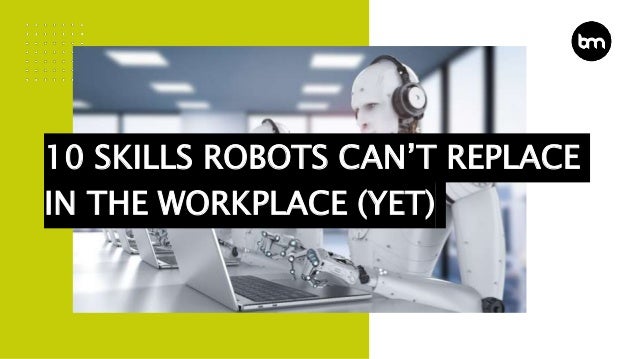
10 SKILLS ROBOTS CAN’T REPLACE
IN THE WORKPLACE (YET)
© 2021 Bernard Marr, Bernard Marr & Co. All rights reserved
Machines have made great strides, but there are still plenty of workplace skills
only humans have. Ensure your success by cultivating these top 10 skills.
10 SKILLS ROBOTS CAN’T REPLACE IN THE
WORKPLACE (YET)
© 2021 Bernard Marr, Bernard Marr & Co. All rights reserved
Machines can now do many things we would have deemed impossible a few
decades ago – but there are still human skills robots can’t yet replace.
Here are the top 10 skills you should focus on in today’s workplace, to ensure your
career success today and into the future.
© 2021 Bernard Marr, Bernard Marr & Co. All rights reserved
1. CRITICAL THINKING
There’s no shortage of information and data in the world, but individuals with the ability
to discern what information is trustworthy among the abundant mix of misinformation will
be critical to an organisation’s success.
In a world of deep fakes, propaganda, and fake news, companies will value employees
who are open-minded but able to judge the quality of information that inundates us
every day.
When you think critically, you’re not simply being negative – it means you can objectively
evaluate information, figure out if it’s credible, and figure out whether or not it should be
trusted by an organisation.
© 2021 Bernard Marr, Bernard Marr & Co. All rights reserved
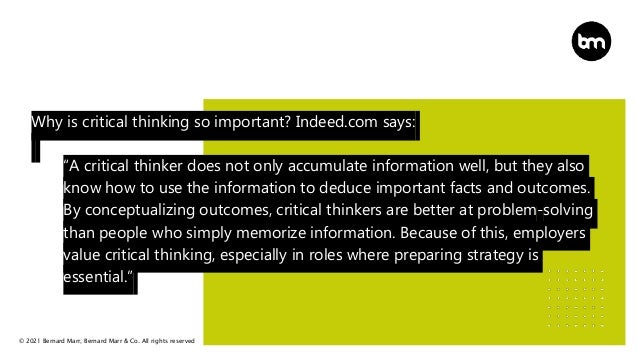
Why is critical thinking so important? Indeed.com says:
“A critical thinker does not only accumulate information well, but they also
know how to use the information to deduce important facts and outcomes.
By conceptualizing outcomes, critical thinkers are better at problem-solving
than people who simply memorize information. Because of this, employers
value critical thinking, especially in roles where preparing strategy is
essential.”
© 2021 Bernard Marr, Bernard Marr & Co. All rights reserved
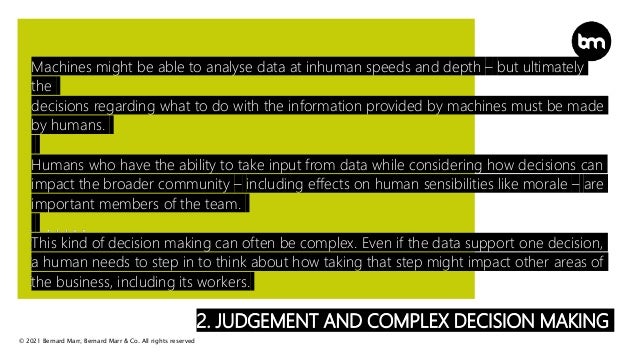
2. JUDGEMENT AND COMPLEX DECISION MAKING
Machines might be able to analyse data at inhuman speeds and depth – but ultimately
the
decisions regarding what to do with the information provided by machines must be made
by humans.
Humans who have the ability to take input from data while considering how decisions can
impact the broader community – including effects on human sensibilities like morale – are
important members of the team.
This kind of decision making can often be complex. Even if the data support one decision,
a human needs to step in to think about how taking that step might impact other areas of
the business, including its workers.
© 2021 Bernard Marr, Bernard Marr & Co. All rights reserved
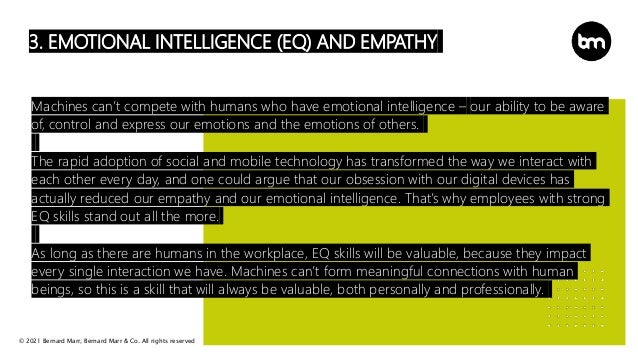
3. EMOTIONAL INTELLIGENCE (EQ) AND EMPATHY
Machines can’t compete with humans who have emotional intelligence – our ability to be aware
of, control and express our emotions and the emotions of others.
The rapid adoption of social and mobile technology has transformed the way we interact with
each other every day, and one could argue that our obsession with our digital devices has
actually reduced our empathy and our emotional intelligence. That’s why employees with strong
EQ skills stand out all the more.
As long as there are humans in the workplace, EQ skills will be valuable, because they impact
every single interaction we have. Machines can’t form meaningful connections with human
beings, so this is a skill that will always be valuable, both personally and professionally.
© 2021 Bernard Marr, Bernard Marr & Co. All rights reserved
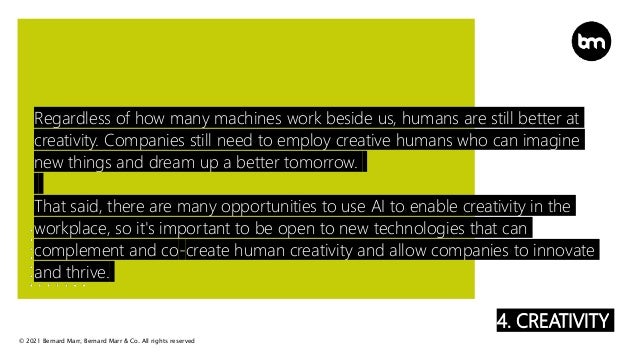
4. CREATIVITY
Regardless of how many machines work beside us, humans are still better at
creativity. Companies still need to employ creative humans who can imagine
new things and dream up a better tomorrow.
That said, there are many opportunities to use AI to enable creativity in the
workplace, so it's important to be open to new technologies that can
complement and co-create human creativity and allow companies to innovate
and thrive.
© 2021 Bernard Marr, Bernard Marr & Co. All rights reserved
5. COLLABORATION AND TEAMWORK
As companies recruit talent in the fourth industrial revolution, strong
collaboration skills are a must – and those abilities are currently unique to
humans.
Every company wants employees who can interact well with others, work well in
teams, and help drive the organization forward collectively.
© 2021 Bernard Marr, Bernard Marr & Co. All rights reserved
6. INTERPERSONAL COMMUNICATION SKILLS
Although machines are getting better at listening and speaking, their programming can only take them so
far. The ability to effectively communicate using a wide range of interpersonal skills is still a uniquely human
domain.
According to Fast Company, here are 7 interpersonal communication skills you should cultivate for
workplace success:
● Showing respect
● Active listening
● Displaying positive body language
● Asking questions
● Understanding online communication (messaging, email, etc.)
● Being open-minded
● Giving useful feedback
© 2021 Bernard Marr, Bernard Marr & Co. All rights reserved
7. ADAPTABILITY AND FLEXIBILITY
As quickly as the world is changing, the half-life of skills is constantly decreasing.
What worked yesterday isn’t necessarily the best strategy for tomorrow, so
openness to unlearning skills, upskilling, or reskilling throughout your career is
also important.
Additionally, it’s important to stay cognitively flexible, so you can be receptive to
new ideas and ways of doing things.
© 2021 Bernard Marr, Bernard Marr & Co. All rights reserved
8. CULTURAL INTELLIGENCE AND DIVERSITY
Companies are looking for strong cultural intelligence and the ability to adapt to working
with a vast array of colleagues and coworkers.
Employees with strong cultural intelligence and who can adapt to others who might
perceive the world differently also help their organizations develop more inclusive,
accessible products and services.
To flourish in business across international boundaries, keep your mind open and develop
sensitivity to other cultures, languages, religions, and political beliefs. Effective employees
must also respect diversity when it comes to race, age, gender and sexual orientation.
© 2021 Bernard Marr, Bernard Marr & Co. All rights reserved
9. ETHICAL AWARENESS
The digital transformation and the technologies of the fourth industrial
revolution come with many ethical dilemmas and challenges that need to be
managed skillfully. That management isn’t something that machines can
currently handle – only humans can wrestle with and address the ethical issues
stemming from things like artificial intelligence and genomics.
© 2021 Bernard Marr, Bernard Marr & Co. All rights reserved
10. LEADERSHIP SKILLS
Strong leadership skills aren’t just for those at the top of the traditional
corporate ladder – they are critical for anyone who makes decisions or leads
project teams in the modern workplace.
The pandemic has led to highly diversified teams. As a leader, it’s your job to
bring out the best in every individual on your team, regardless of where they’re
located or how much you see them in person – and that’s definitely not
something computers can do!
© 2021 Bernard Marr, Bernard Marr & Co. All rights reserved
To find out more about how you can build the best workplace skills for the
modern industrial revolution, check out my new book: Future Skills: The 20
Skills and Competencies Everyone Needs to Succeed in a Digital World and
subscribe to my newsletter.
© 2021 Bernard Marr , Bernard Marr & Co. All rights reserved
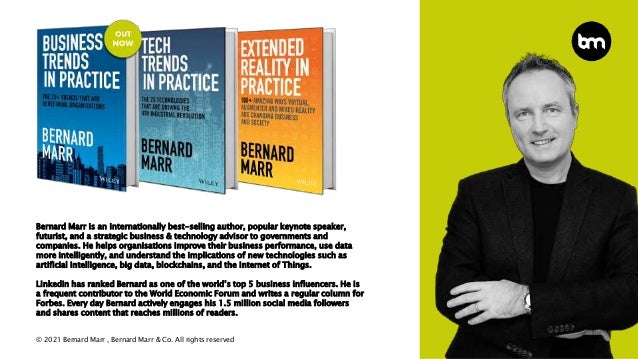
Bernard Marr is an internationally best-selling author, popular keynote speaker,
futurist, and a strategic business & technology advisor to governments and
companies. He helps organisations improve their business performance, use data
more intelligently, and understand the implications of new technologies such as
artificial intelligence, big data, blockchains, and the Internet of Things.
LinkedIn has ranked Bernard as one of the world’s top 5 business influencers. He is
a frequent contributor to the World Economic Forum and writes a regular column for
Forbes. Every day Bernard actively engages his 1.5 million social media followers
and shares content that reaches millions of readers.
hello@bernardmarr.com
www.bernardmarr.com

10 Skills Robots Can’t Replace In The Workplace (Yet)

  • 1.
    10 SKILLS ROBOTSCAN’T REPLACE IN THE WORKPLACE (YET)
  • 2.
    © 2021 BernardMarr, Bernard Marr & Co. All rights reserved Machines have made great strides, but there are still plenty of workplace skills only humans have. Ensure your success by cultivating these top 10 skills. 10 SKILLS ROBOTS CAN’T REPLACE IN THE WORKPLACE (YET)
  • 3.
    © 2021 BernardMarr, Bernard Marr & Co. All rights reserved Machines can now do many things we would have deemed impossible a few decades ago – but there are still human skills robots can’t yet replace. Here are the top 10 skills you should focus on in today’s workplace, to ensure your career success today and into the future.
  • 4.
    © 2021 BernardMarr, Bernard Marr & Co. All rights reserved 1. CRITICAL THINKING There’s no shortage of information and data in the world, but individuals with the ability to discern what information is trustworthy among the abundant mix of misinformation will be critical to an organisation’s success. In a world of deep fakes, propaganda, and fake news, companies will value employees who are open-minded but able to judge the quality of information that inundates us every day. When you think critically, you’re not simply being negative – it means you can objectively evaluate information, figure out if it’s credible, and figure out whether or not it should be trusted by an organisation.
  • 5.
    © 2021 BernardMarr, Bernard Marr & Co. All rights reserved Why is critical thinking so important? Indeed.com says: “A critical thinker does not only accumulate information well, but they also know how to use the information to deduce important facts and outcomes. By conceptualizing outcomes, critical thinkers are better at problem-solving than people who simply memorize information. Because of this, employers value critical thinking, especially in roles where preparing strategy is essential.”
  • 6.
    © 2021 BernardMarr, Bernard Marr & Co. All rights reserved 2. JUDGEMENT AND COMPLEX DECISION MAKING Machines might be able to analyse data at inhuman speeds and depth – but ultimately the decisions regarding what to do with the information provided by machines must be made by humans. Humans who have the ability to take input from data while considering how decisions can impact the broader community – including effects on human sensibilities like morale – are important members of the team. This kind of decision making can often be complex. Even if the data support one decision, a human needs to step in to think about how taking that step might impact other areas of the business, including its workers.
  • 7.
    © 2021 BernardMarr, Bernard Marr & Co. All rights reserved 3. EMOTIONAL INTELLIGENCE (EQ) AND EMPATHY Machines can’t compete with humans who have emotional intelligence – our ability to be aware of, control and express our emotions and the emotions of others. The rapid adoption of social and mobile technology has transformed the way we interact with each other every day, and one could argue that our obsession with our digital devices has actually reduced our empathy and our emotional intelligence. That’s why employees with strong EQ skills stand out all the more. As long as there are humans in the workplace, EQ skills will be valuable, because they impact every single interaction we have. Machines can’t form meaningful connections with human beings, so this is a skill that will always be valuable, both personally and professionally.
  • 8.
    © 2021 BernardMarr, Bernard Marr & Co. All rights reserved 4. CREATIVITY Regardless of how many machines work beside us, humans are still better at creativity. Companies still need to employ creative humans who can imagine new things and dream up a better tomorrow. That said, there are many opportunities to use AI to enable creativity in the workplace, so it's important to be open to new technologies that can complement and co-create human creativity and allow companies to innovate and thrive.
  • 9.
    © 2021 BernardMarr, Bernard Marr & Co. All rights reserved 5. COLLABORATION AND TEAMWORK As companies recruit talent in the fourth industrial revolution, strong collaboration skills are a must – and those abilities are currently unique to humans. Every company wants employees who can interact well with others, work well in teams, and help drive the organization forward collectively.
  • 10.
    © 2021 BernardMarr, Bernard Marr & Co. All rights reserved 6. INTERPERSONAL COMMUNICATION SKILLS Although machines are getting better at listening and speaking, their programming can only take them so far. The ability to effectively communicate using a wide range of interpersonal skills is still a uniquely human domain. According to Fast Company, here are 7 interpersonal communication skills you should cultivate for workplace success: ● Showing respect ● Active listening ● Displaying positive body language ● Asking questions ● Understanding online communication (messaging, email, etc.) ● Being open-minded ● Giving useful feedback
  • 11.
    © 2021 BernardMarr, Bernard Marr & Co. All rights reserved 7. ADAPTABILITY AND FLEXIBILITY As quickly as the world is changing, the half-life of skills is constantly decreasing. What worked yesterday isn’t necessarily the best strategy for tomorrow, so openness to unlearning skills, upskilling, or reskilling throughout your career is also important. Additionally, it’s important to stay cognitively flexible, so you can be receptive to new ideas and ways of doing things.
  • 12.
    © 2021 BernardMarr, Bernard Marr & Co. All rights reserved 8. CULTURAL INTELLIGENCE AND DIVERSITY Companies are looking for strong cultural intelligence and the ability to adapt to working with a vast array of colleagues and coworkers. Employees with strong cultural intelligence and who can adapt to others who might perceive the world differently also help their organizations develop more inclusive, accessible products and services. To flourish in business across international boundaries, keep your mind open and develop sensitivity to other cultures, languages, religions, and political beliefs. Effective employees must also respect diversity when it comes to race, age, gender and sexual orientation.
  • 13.
    © 2021 BernardMarr, Bernard Marr & Co. All rights reserved 9. ETHICAL AWARENESS The digital transformation and the technologies of the fourth industrial revolution come with many ethical dilemmas and challenges that need to be managed skillfully. That management isn’t something that machines can currently handle – only humans can wrestle with and address the ethical issues stemming from things like artificial intelligence and genomics.
  • 14.
    © 2021 BernardMarr, Bernard Marr & Co. All rights reserved 10. LEADERSHIP SKILLS Strong leadership skills aren’t just for those at the top of the traditional corporate ladder – they are critical for anyone who makes decisions or leads project teams in the modern workplace. The pandemic has led to highly diversified teams. As a leader, it’s your job to bring out the best in every individual on your team, regardless of where they’re located or how much you see them in person – and that’s definitely not something computers can do!
  • 15.
    © 2021 BernardMarr, Bernard Marr & Co. All rights reserved To find out more about how you can build the best workplace skills for the modern industrial revolution, check out my new book: Future Skills: The 20 Skills and Competencies Everyone Needs to Succeed in a Digital World and subscribe to my newsletter.
  • 16.
    © 2021 BernardMarr , Bernard Marr & Co. All rights reserved Bernard Marr is an internationally best-selling author, popular keynote speaker, futurist, and a strategic business & technology advisor to governments and companies. He helps organisations improve their business performance, use data more intelligently, and understand the implications of new technologies such as artificial intelligence, big data, blockchains, and the Internet of Things. LinkedIn has ranked Bernard as one of the world’s top 5 business influencers. He is a frequent contributor to the World Economic Forum and writes a regular column for Forbes. Every day Bernard actively engages his 1.5 million social media followers and shares content that reaches millions of readers.
  • 17.