Capacity Planning
SAP PP
Agenda: Capacity Planning
Capacity Planning Overview
Capacity Planning Elements
Settings for Capacity Planning
Maintaining available Capacity
Capacity Evaluation
Capacity Leveling
Mass Processing
Capacity Reduction
Capacity Planning Overview
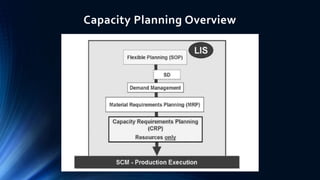
 A capacity availability check is not performed with Material Requirements
Planning (MRP).
 Capacity Planning must be executed separately in a second step.
 Master data, planned orders and production orders provide data that can be
used to represent available capacities and capacity requirements.
 The available capacity is a measure of the work that a capacity can perform per
workday.
 The capacity requirement is a measure of the work required by the individual
orders at a capacity at a certain point in time.
 Capacity requirements are created when the planned orders or production
orders are created.
 In the Capacity evaluations, these requirements can be compared with the
available capacities.
 In the Capacity leveling, capacity shortfalls and overloads can be leveled.You
can use alternative suitable resources for or you can use the sort criteria to plan
optimal loading.
Capacity Planning Elements
 The available capacity represents the capacity available for
production at a work center or resource.
 You can schedule the sequence of operations to determine the
times for the capacity requirements.
 To calculate the capacity requirements, the system uses formulas
containing the dates and quantities for production requirements.
 Capacity evaluation gives you an overview of the load and the
production requirements.
 Capacity leveling allows you to achieve optimal planning and an
optimal load.
 Capacity reduction occurs when operations are confirmed or order
quantities are reduced or cancelled.
Maintaining Available Capacities
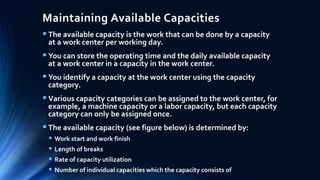
 The available capacity is the work that can be done by a capacity
at a work center per working day.
 You can store the operating time and the daily available capacity
at a work center in a capacity in the work center.
 You identify a capacity at the work center using the capacity
category.
 Various capacity categories can be assigned to the work center, for
example, a machine capacity or a labor capacity, but each capacity
category can only be assigned once.
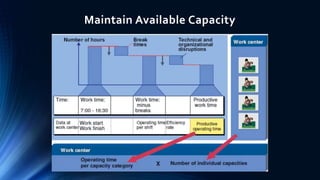
 The available capacity (see figure below) is determined by:
 Work start and work finish
 Length of breaks
 Rate of capacity utilization
 Number of individual capacities which the capacity consists of
Maintain Available Capacity
Capacity Requirement Calculation
Capacity Evaluation
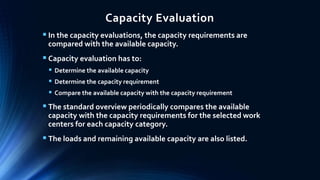
 In the capacity evaluations, the capacity requirements are
compared with the available capacity.
 Capacity evaluation has to:
 Determine the available capacity
 Determine the capacity requirement
 Compare the available capacity with the capacity requirement
 The standard overview periodically compares the available
capacity with the capacity requirements for the selected work
centers for each capacity category.
 The loads and remaining available capacity are also listed.
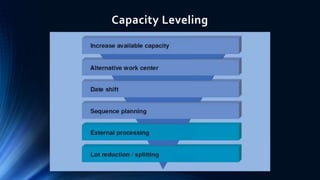
Capacity Leveling
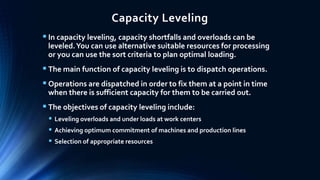
 In capacity leveling, capacity shortfalls and overloads can be
leveled.You can use alternative suitable resources for processing
or you can use the sort criteria to plan optimal loading.
 The main function of capacity leveling is to dispatch operations.
 Operations are dispatched in order to fix them at a point in time
when there is sufficient capacity for them to be carried out.
 The objectives of capacity leveling include:
 Leveling overloads and under loads at work centers
 Achieving optimum commitment of machines and production lines
 Selection of appropriate resources
Capacity Leveling
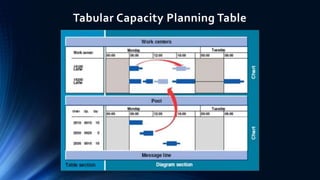
Tabular Capacity Planning Table
Dispatching
Capacity Reduction
Capacity requirements are reduced or deleted by order
confirmations, setting orders to one of the “Lock” or “Technical
completion” status, or by setting the deletion indicator.
Thank you

8.+Capacity+Requirement+Planning.pptx

  • 1.
  • 2.
    Agenda: Capacity Planning CapacityPlanning Overview Capacity Planning Elements Settings for Capacity Planning Maintaining available Capacity Capacity Evaluation Capacity Leveling Mass Processing Capacity Reduction
  • 3.
  • 4.
    Capacity Planning Overview A capacity availability check is not performed with Material Requirements Planning (MRP).  Capacity Planning must be executed separately in a second step.  Master data, planned orders and production orders provide data that can be used to represent available capacities and capacity requirements.  The available capacity is a measure of the work that a capacity can perform per workday.  The capacity requirement is a measure of the work required by the individual orders at a capacity at a certain point in time.  Capacity requirements are created when the planned orders or production orders are created.  In the Capacity evaluations, these requirements can be compared with the available capacities.  In the Capacity leveling, capacity shortfalls and overloads can be leveled.You can use alternative suitable resources for or you can use the sort criteria to plan optimal loading.
  • 5.
    Capacity Planning Elements The available capacity represents the capacity available for production at a work center or resource.  You can schedule the sequence of operations to determine the times for the capacity requirements.  To calculate the capacity requirements, the system uses formulas containing the dates and quantities for production requirements.  Capacity evaluation gives you an overview of the load and the production requirements.  Capacity leveling allows you to achieve optimal planning and an optimal load.  Capacity reduction occurs when operations are confirmed or order quantities are reduced or cancelled.
  • 6.
    Maintaining Available Capacities The available capacity is the work that can be done by a capacity at a work center per working day.  You can store the operating time and the daily available capacity at a work center in a capacity in the work center.  You identify a capacity at the work center using the capacity category.  Various capacity categories can be assigned to the work center, for example, a machine capacity or a labor capacity, but each capacity category can only be assigned once.  The available capacity (see figure below) is determined by:  Work start and work finish  Length of breaks  Rate of capacity utilization  Number of individual capacities which the capacity consists of
  • 7.
  • 8.
  • 9.
    Capacity Evaluation  Inthe capacity evaluations, the capacity requirements are compared with the available capacity.  Capacity evaluation has to:  Determine the available capacity  Determine the capacity requirement  Compare the available capacity with the capacity requirement  The standard overview periodically compares the available capacity with the capacity requirements for the selected work centers for each capacity category.  The loads and remaining available capacity are also listed.
  • 10.
    Capacity Leveling  Incapacity leveling, capacity shortfalls and overloads can be leveled.You can use alternative suitable resources for processing or you can use the sort criteria to plan optimal loading.  The main function of capacity leveling is to dispatch operations.  Operations are dispatched in order to fix them at a point in time when there is sufficient capacity for them to be carried out.  The objectives of capacity leveling include:  Leveling overloads and under loads at work centers  Achieving optimum commitment of machines and production lines  Selection of appropriate resources
  • 11.
  • 12.
  • 13.
  • 14.
    Capacity Reduction Capacity requirementsare reduced or deleted by order confirmations, setting orders to one of the “Lock” or “Technical completion” status, or by setting the deletion indicator.
  • 15.