BIOLOGY
GRADE - 9
MICROORGANISMS
AND
DISEASE
UNIT - 4
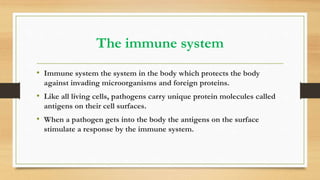
The immune system
• Immune system the system in the body which protects the body
against invading microorganisms and foreign proteins.
• Like all living cells, pathogens carry unique protein molecules called
antigens on their cell surfaces.
• When a pathogen gets into the body the antigens on the surface
stimulate a response by the immune system.
The immune system
• White blood cells (lymphocytes) produce antibodies to disable the
pathogen.
• Other white blood cells (the phagocytes) then engulf and digest the
disabled pathogens.
• Once someone have had a disease, the immune system ‘remembers’
the antigen and the right antibody to deal with it.
Artificial immunity
• Our body has its own natural ability to protect itself against artificial disease,
however if the immune
• system of the body fails to defend some dangerous disease it will be treated
by artificial immunity.
• Artificial immunity is given in the form of vaccine/drugs.
• Artificial active immunity: involves introduction of weakened or dead
pathogen in the body which stimulates the body to produce its own
antibodies.
Artificial immunity
• It can be natural from mother to child (natural passive)until the child
produces its own natural active immunity
• It has long-lasting effect on the body
• Artificial passive immunity: it involves giving specific antibodies in the form
of infection
• It provides a high type of resistance but last only for short time.
Vaccination (immunization) :
• is the use of dead or weakened strains of pathogens to produce immunity to
dangerous diseases
• the vaccination work through the following ways
• a weak or dead form of the infecting organism is put into the body by injection or
by mouth
• once in the body, the white blood cells respond by producing antibodies
• If the living micro-organism enters the body in the future, antibodies are produced
very rapidly to destroy it and so the disease does not develop
4.2 Diseases
• Disease is any form of disorder in or on the body distorts it’s normal
functioning
• Some of the most commonly known diseases which are caused by
pathogenic organisms among them include: tuberculosis, AWD, cholera
andtyphoid, cholera, typhoidandgastroenteritis
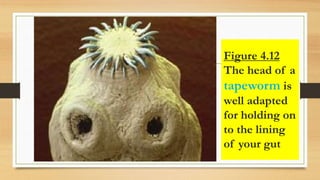
Figure 4.12
The head of a
tapeworm is
well adapted
for holding on
to the lining
of your gut
Disease….
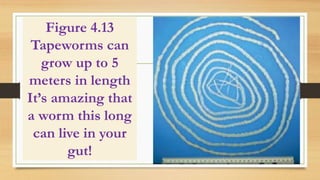
Figure 4.13
Tapeworms can
grow up to 5
meters in length
It’s amazing that
a worm this long
can live in your
gut!

BIOLOGY-GRADE-9-UNIT-FOUR-4-PRESESNTATION.pptx

  • 1.
  • 2.
  • 4.
    The immune system •Immune system the system in the body which protects the body against invading microorganisms and foreign proteins. • Like all living cells, pathogens carry unique protein molecules called antigens on their cell surfaces. • When a pathogen gets into the body the antigens on the surface stimulate a response by the immune system.
  • 5.
    The immune system •White blood cells (lymphocytes) produce antibodies to disable the pathogen. • Other white blood cells (the phagocytes) then engulf and digest the disabled pathogens. • Once someone have had a disease, the immune system ‘remembers’ the antigen and the right antibody to deal with it.
  • 6.
    Artificial immunity • Ourbody has its own natural ability to protect itself against artificial disease, however if the immune • system of the body fails to defend some dangerous disease it will be treated by artificial immunity. • Artificial immunity is given in the form of vaccine/drugs. • Artificial active immunity: involves introduction of weakened or dead pathogen in the body which stimulates the body to produce its own antibodies.
  • 7.
    Artificial immunity • Itcan be natural from mother to child (natural passive)until the child produces its own natural active immunity • It has long-lasting effect on the body • Artificial passive immunity: it involves giving specific antibodies in the form of infection • It provides a high type of resistance but last only for short time.
  • 8.
    Vaccination (immunization) : •is the use of dead or weakened strains of pathogens to produce immunity to dangerous diseases • the vaccination work through the following ways • a weak or dead form of the infecting organism is put into the body by injection or by mouth • once in the body, the white blood cells respond by producing antibodies • If the living micro-organism enters the body in the future, antibodies are produced very rapidly to destroy it and so the disease does not develop
  • 9.
    4.2 Diseases • Diseaseis any form of disorder in or on the body distorts it’s normal functioning • Some of the most commonly known diseases which are caused by pathogenic organisms among them include: tuberculosis, AWD, cholera andtyphoid, cholera, typhoidandgastroenteritis
  • 10.
    Figure 4.12 The headof a tapeworm is well adapted for holding on to the lining of your gut
  • 11.
  • 12.
    Figure 4.13 Tapeworms can growup to 5 meters in length It’s amazing that a worm this long can live in your gut!