Lesson 3:
ENGLISH 9
Analyzing the Contained
Information by
Determining the Relevance
of the Truthfulness of the
Ideas in the Material
Viewed
Objectives:
1. Analyze the contained
information in the material
viewed;
2. Infer thoughts, feelings, and
intentions in the material; and
Objectives:
3. Determine the relevance and
truthfulness of the ideas.
What is Analyzing Information?
A diversity of ideas is
embedded in even just one
millisecond of a video. On the
surface level a video uses light,
color, sound, and moving
What is Analyzing Information?
images, with the potential for
adding text and shape and
color and light filters as
overlays to communicate ideas,
while the most basic text
What is Analyzing Information?
structures use alphanumeric
symbols, paragraph and
sentence structure, and an
assortment of text features
What is Analyzing Information?
(e.g., white space, headings
and subheadings, fonts, etc.) to
convey their message.
Videos are meant to be
consumed slowly, while
literature, for example, is
meant to be ‘sat with’. Videos
are (often fast) sprints,
while texts are (often leisurely)
walks. Because of this very
different tone and purpose as a
matter of design, it’s unfair to
criticize videos as “less tiring”
than texts, just as it would be
misleading to say that video is
universally “more engaging”
than text (something I may or
may not have said in the past).
It’s more complex than that.
Infer Thoughts, Feelings and
Emotions
Reading strategies, viewing
strategies, thinking strategies–
any ‘strategy’ should be
studentcentered in pursuit of
student-centered learning. One
way to interpret this is to say
that it should only be used if
necessary, should be accessible
and meaningful to the student,
and ideally would be selected
by the student without
prompting.
Determine the Relevance and
Truthfulness of the Ideas
Presented
In the context of viewing is
much like how a person reads a
book before, during, after
viewing, and an extended
playback of what was not
understood is also sought.
III. Learning Tasks Learning Tasks
I. A Time for Us Instructions:
Watch a music video from a popular
romantic tragic play. After watching
the video, read a shortened version of
how the trouble between their two
families started.
Romeo and Juliet
A Time for Us
http://www.youtube.com/watch?V=4FHpmn-Kyec
Learning Tasks I. Making Connections
Instructions:
Check your understanding: through
reordering. Write a number (1–7) on
the space provided to put these
events from the story in order
Learning Tasks I. Making Connections
___ 1.Romeo and Juliet secretly get
married.
____ 2.Juliet wakes up, sees Romeo
dead and kills herself.
____ 3. Romeo thinks Juliet is really
dead. He takes poison.
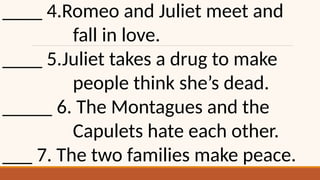
____ 4.Romeo and Juliet meet and
fall in love.
____ 5.Juliet takes a drug to make
people think she’s dead.
_____ 6. The Montagues and the
Capulets hate each other.
___ 7. The two families make peace.
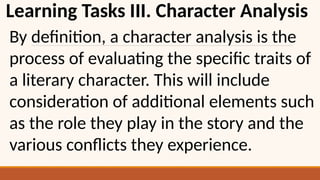
Learning Tasks III. Character Analysis
By definition, a character analysis is the
process of evaluating the specific traits of
a literary character. This will include
consideration of additional elements such
as the role they play in the story and the
various conflicts they experience.
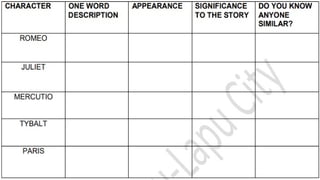
Instructions: Fill in the columns
your analysis of the
five characters of the
story Romeo and
Juliet.
Learning Tasks III. Process Questions:
Instructions: Write your answers in
complete sentences.
1. How do you feel about
meeting new friends?
2. What characteristics would you
like your new friends to have?
Learning Tasks III. Process Questions:
3. Can you imagine what could
happen if teenagers become friends
and eventually fall in love?
4. Are Romeo and Juliet’s deaths just
a tragic accident? If not, who is
responsible?
Learning Tasks III. Process Questions:
5. Do you think the story of Romeo
and Juliet is relevant to life today?
IV. Reflection: Sharing What I Have
Learned!
Instructions: Give your reflection
upon taking this self-paced module
by completing the sentence prompt
below.
IV. Reflection: Sharing What I Have Learned!
Upon reading this self-paced
module, the following are the things
that I have learned:
1.____________________________
______________________________
____________.
IV. Reflection: Sharing What I Have Learned!
Upon reading this self-paced
module, the following are the things
that I have learned:
2.____________________________
______________________________
____________.
IV. Reflection: Sharing What I Have Learned!
Upon reading this self-paced
module, the following are the things
that I have learned:
3.____________________________
______________________________
____________.
Thank you!

Lesson-Analyzing Literature Quarter 3 Week 3

  • 1.
  • 2.
    Analyzing the Contained Informationby Determining the Relevance of the Truthfulness of the Ideas in the Material Viewed
  • 3.
    Objectives: 1. Analyze thecontained information in the material viewed; 2. Infer thoughts, feelings, and intentions in the material; and
  • 4.
    Objectives: 3. Determine therelevance and truthfulness of the ideas.
  • 5.
    What is AnalyzingInformation? A diversity of ideas is embedded in even just one millisecond of a video. On the surface level a video uses light, color, sound, and moving
  • 6.
    What is AnalyzingInformation? images, with the potential for adding text and shape and color and light filters as overlays to communicate ideas, while the most basic text
  • 7.
    What is AnalyzingInformation? structures use alphanumeric symbols, paragraph and sentence structure, and an assortment of text features
  • 8.
    What is AnalyzingInformation? (e.g., white space, headings and subheadings, fonts, etc.) to convey their message.
  • 9.
    Videos are meantto be consumed slowly, while literature, for example, is meant to be ‘sat with’. Videos are (often fast) sprints,
  • 10.
    while texts are(often leisurely) walks. Because of this very different tone and purpose as a matter of design, it’s unfair to criticize videos as “less tiring”
  • 11.
    than texts, justas it would be misleading to say that video is universally “more engaging” than text (something I may or may not have said in the past). It’s more complex than that.
  • 12.
    Infer Thoughts, Feelingsand Emotions Reading strategies, viewing strategies, thinking strategies– any ‘strategy’ should be studentcentered in pursuit of
  • 13.
    student-centered learning. One wayto interpret this is to say that it should only be used if necessary, should be accessible and meaningful to the student,
  • 14.
    and ideally wouldbe selected by the student without prompting.
  • 15.
    Determine the Relevanceand Truthfulness of the Ideas Presented
  • 16.
    In the contextof viewing is much like how a person reads a book before, during, after viewing, and an extended playback of what was not understood is also sought.
  • 17.
    III. Learning TasksLearning Tasks I. A Time for Us Instructions: Watch a music video from a popular romantic tragic play. After watching the video, read a shortened version of how the trouble between their two families started.
  • 18.
    Romeo and Juliet ATime for Us http://www.youtube.com/watch?V=4FHpmn-Kyec
  • 19.
    Learning Tasks I.Making Connections Instructions: Check your understanding: through reordering. Write a number (1–7) on the space provided to put these events from the story in order
  • 20.
    Learning Tasks I.Making Connections ___ 1.Romeo and Juliet secretly get married. ____ 2.Juliet wakes up, sees Romeo dead and kills herself. ____ 3. Romeo thinks Juliet is really dead. He takes poison.
  • 21.
    ____ 4.Romeo andJuliet meet and fall in love. ____ 5.Juliet takes a drug to make people think she’s dead. _____ 6. The Montagues and the Capulets hate each other. ___ 7. The two families make peace.
  • 22.
    Learning Tasks III.Character Analysis By definition, a character analysis is the process of evaluating the specific traits of a literary character. This will include consideration of additional elements such as the role they play in the story and the various conflicts they experience.
  • 23.
    Instructions: Fill inthe columns your analysis of the five characters of the story Romeo and Juliet.
  • 25.
    Learning Tasks III.Process Questions: Instructions: Write your answers in complete sentences. 1. How do you feel about meeting new friends? 2. What characteristics would you like your new friends to have?
  • 26.
    Learning Tasks III.Process Questions: 3. Can you imagine what could happen if teenagers become friends and eventually fall in love? 4. Are Romeo and Juliet’s deaths just a tragic accident? If not, who is responsible?
  • 27.
    Learning Tasks III.Process Questions: 5. Do you think the story of Romeo and Juliet is relevant to life today?
  • 28.
    IV. Reflection: SharingWhat I Have Learned! Instructions: Give your reflection upon taking this self-paced module by completing the sentence prompt below.
  • 29.
    IV. Reflection: SharingWhat I Have Learned! Upon reading this self-paced module, the following are the things that I have learned: 1.____________________________ ______________________________ ____________.
  • 30.
    IV. Reflection: SharingWhat I Have Learned! Upon reading this self-paced module, the following are the things that I have learned: 2.____________________________ ______________________________ ____________.
  • 31.
    IV. Reflection: SharingWhat I Have Learned! Upon reading this self-paced module, the following are the things that I have learned: 3.____________________________ ______________________________ ____________.
  • 32.