8-11 Dividing Fractions
     Number Sense 2.4
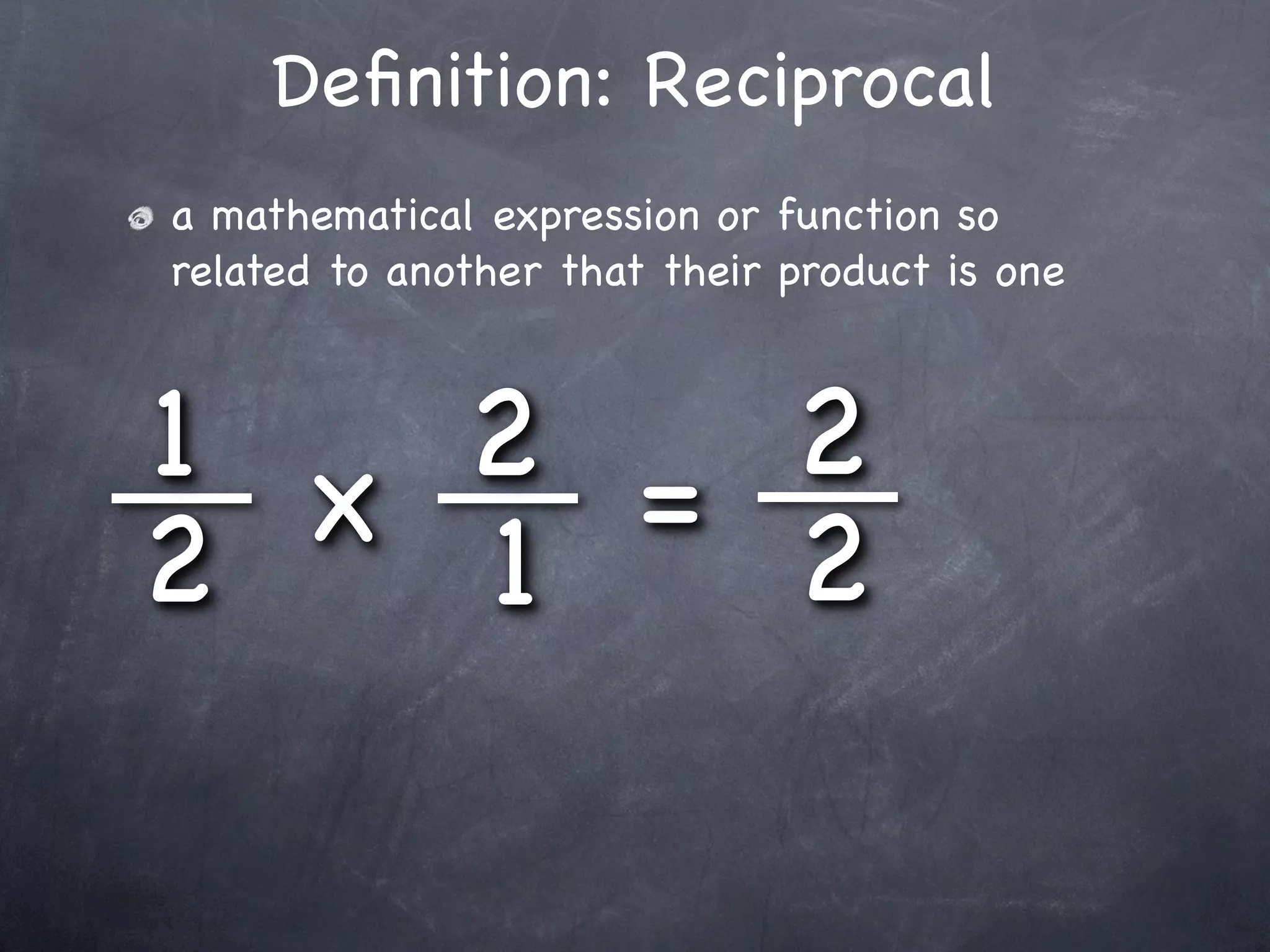
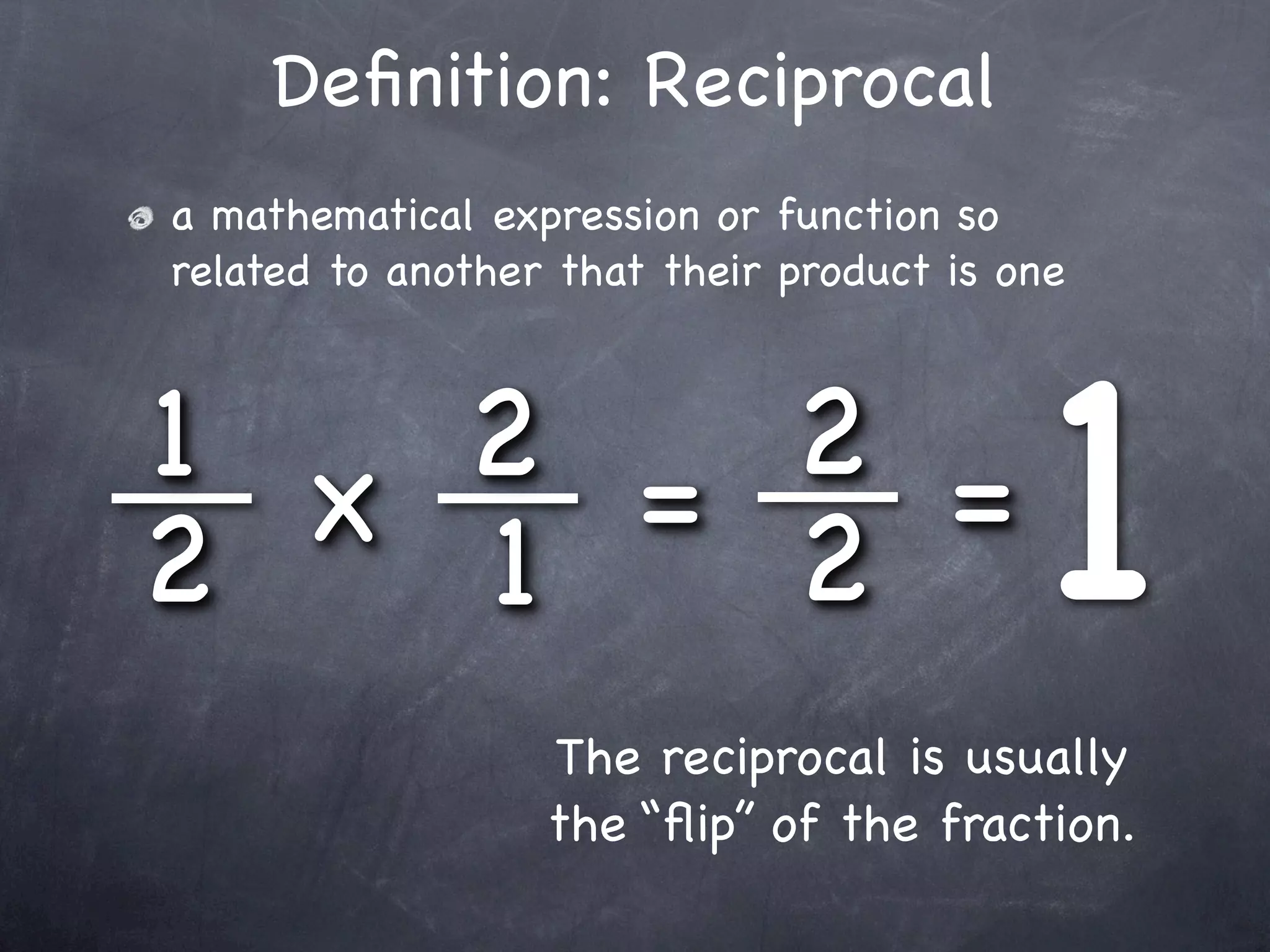
Definition: Reciprocal
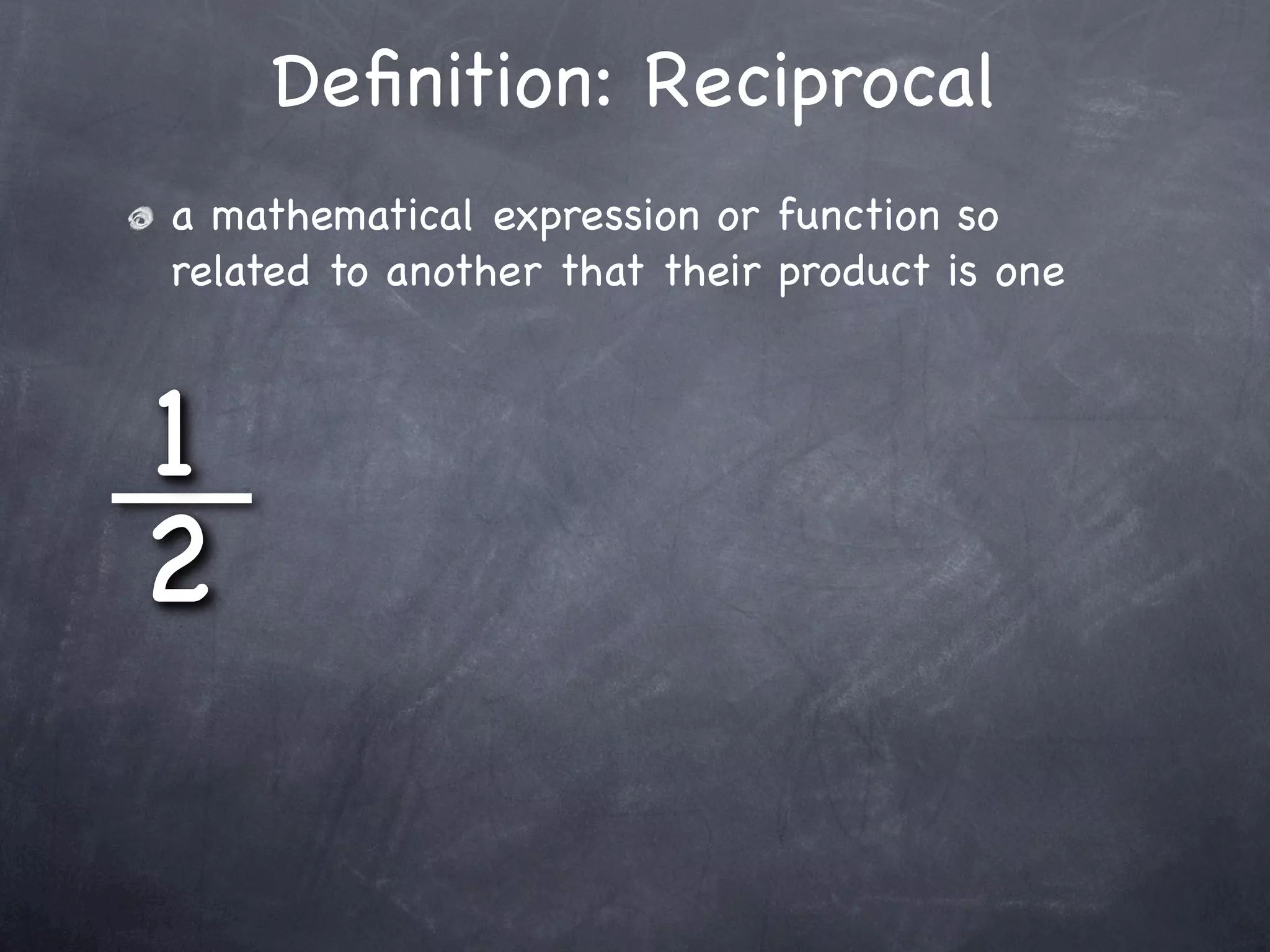
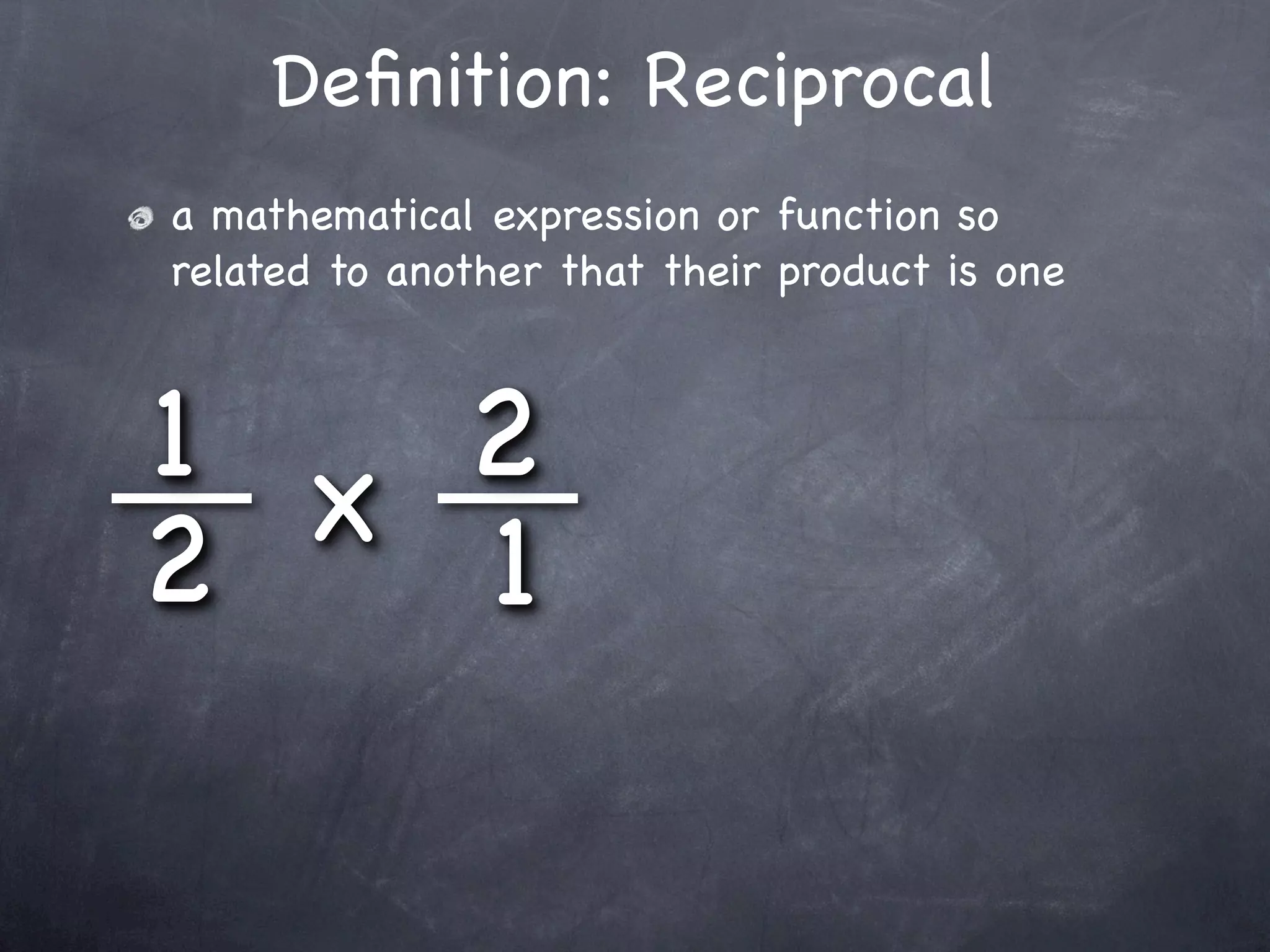
a mathematical expression or function so
related to another that their product is one
Definition: Reciprocal
a mathematical expression or function so
related to another that their product is one


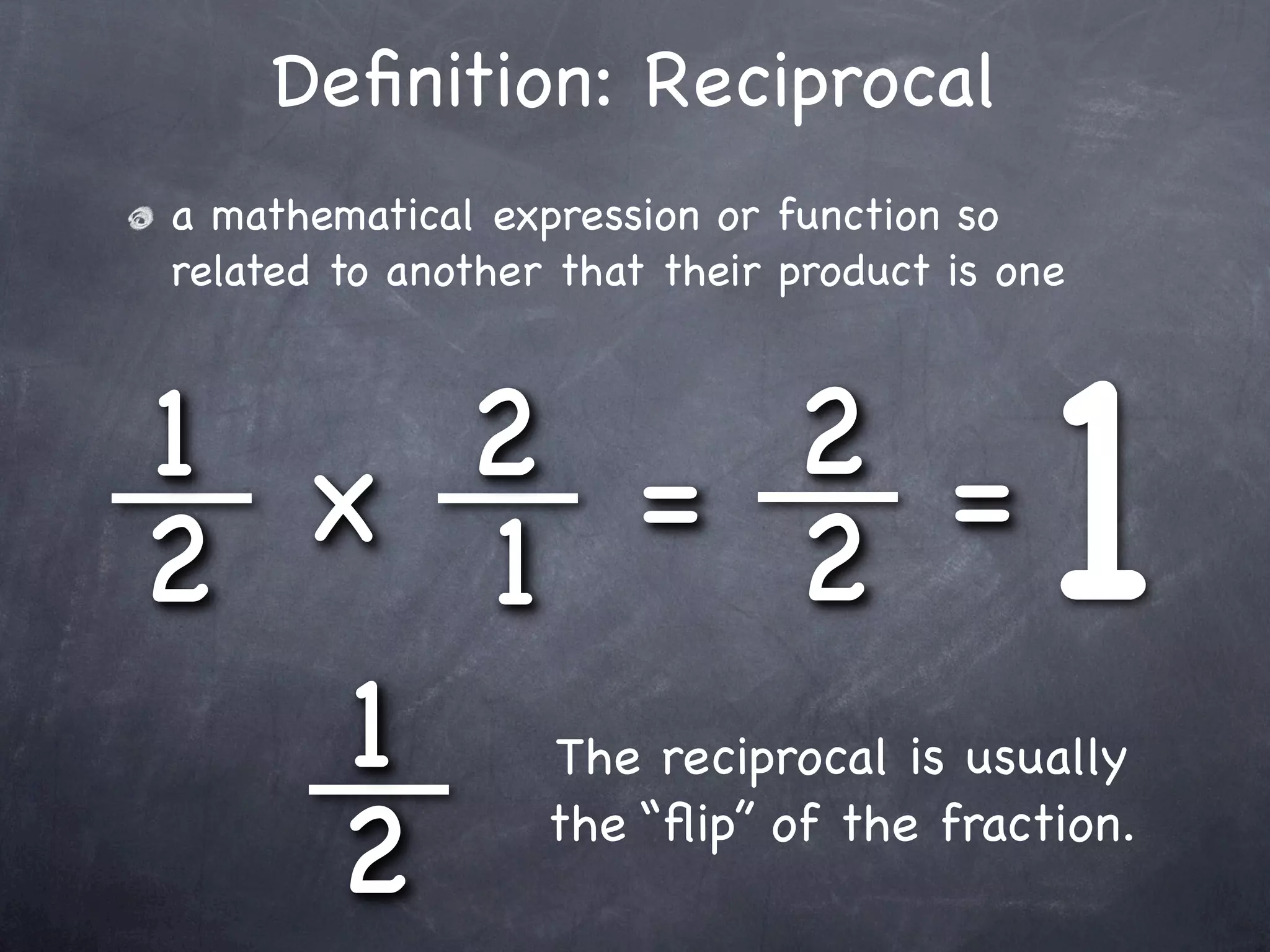
1
2
Definition: Reciprocal
a mathematical expression or function so
related to another that their product is one


1 x 2
2   1
Definition: Reciprocal
a mathematical expression or function so
related to another that their product is one


1 x 2 = 2
2   1   2
Definition: Reciprocal
a mathematical expression or function so
related to another that their product is one


1 x 2 = 2 =
2   1   2                                 1
Definition: Reciprocal
a mathematical expression or function so
related to another that their product is one


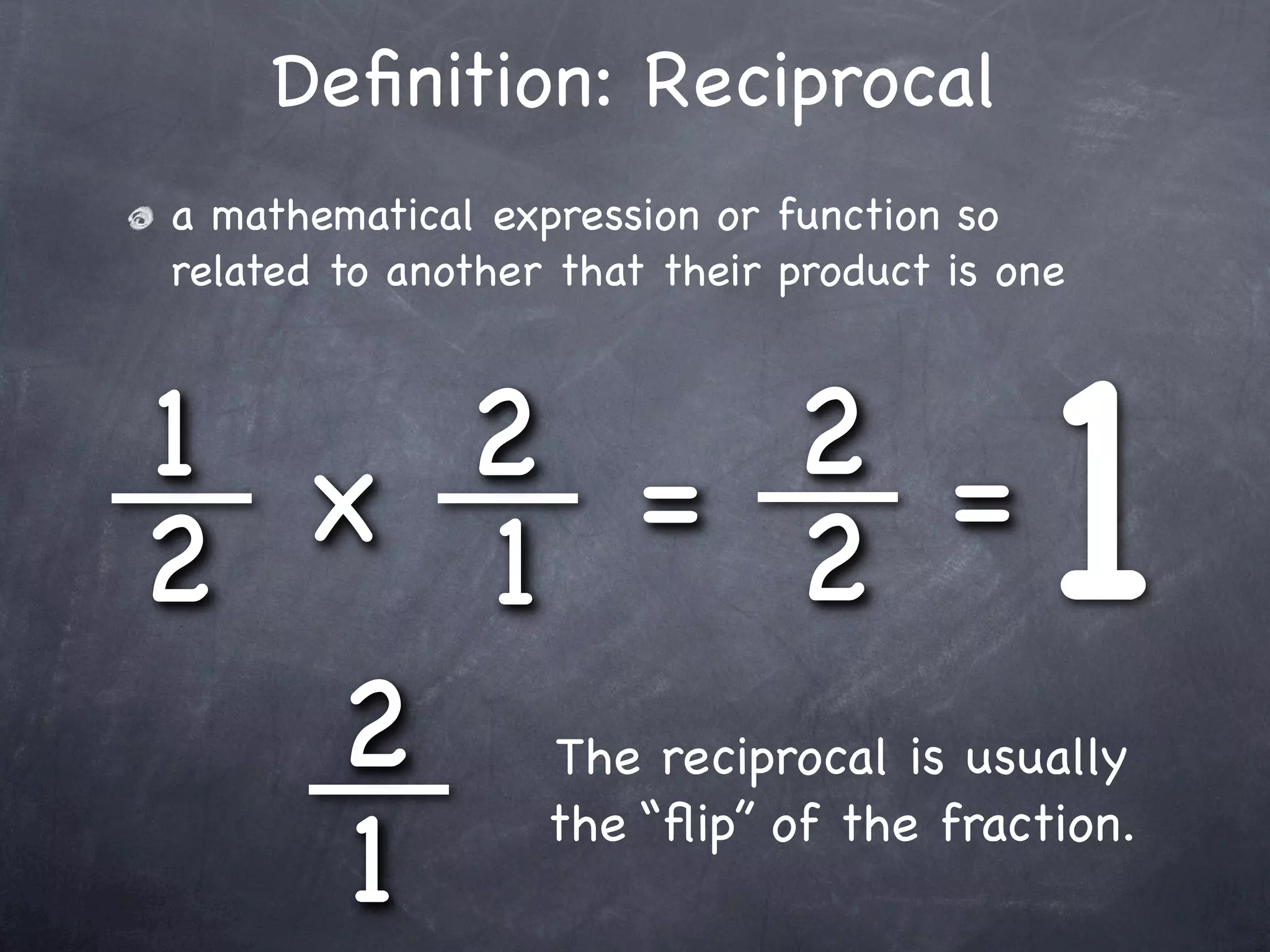
1 x 2 = 2 =
2   1   2                                 1
                  The reciprocal is usually
                  the “flip” of the fraction.
Definition: Reciprocal
 a mathematical expression or function so
 related to another that their product is one


1 x 2 = 2 =
2    1            2                        1
   1 The reciprocal is usually
  2    the “flip” of the fraction.
Definition: Reciprocal
 a mathematical expression or function so
 related to another that their product is one


1 x 2 = 2 =
2    1            2                        1
  2 The reciprocal is usually
   1   the “flip” of the fraction.
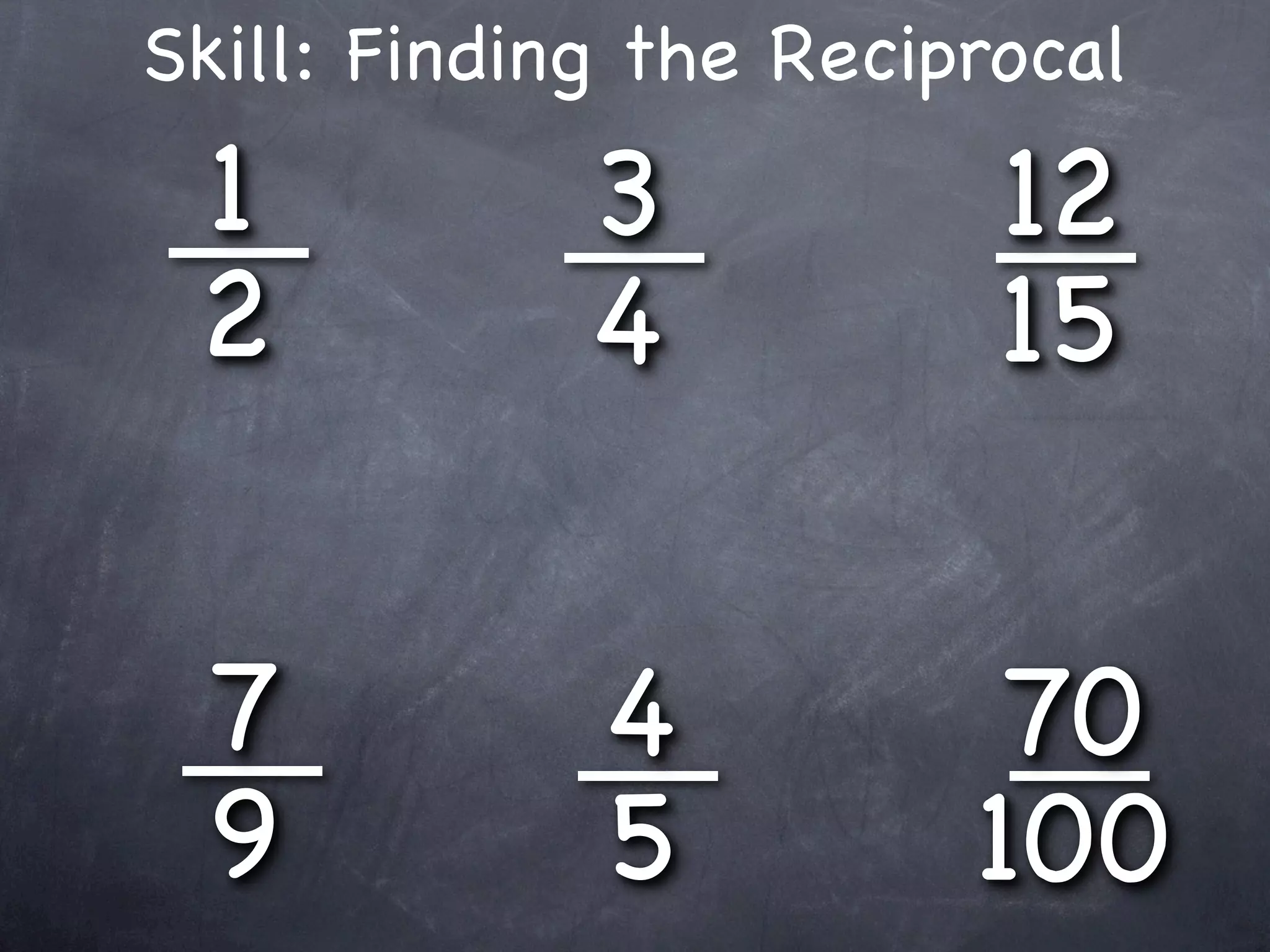
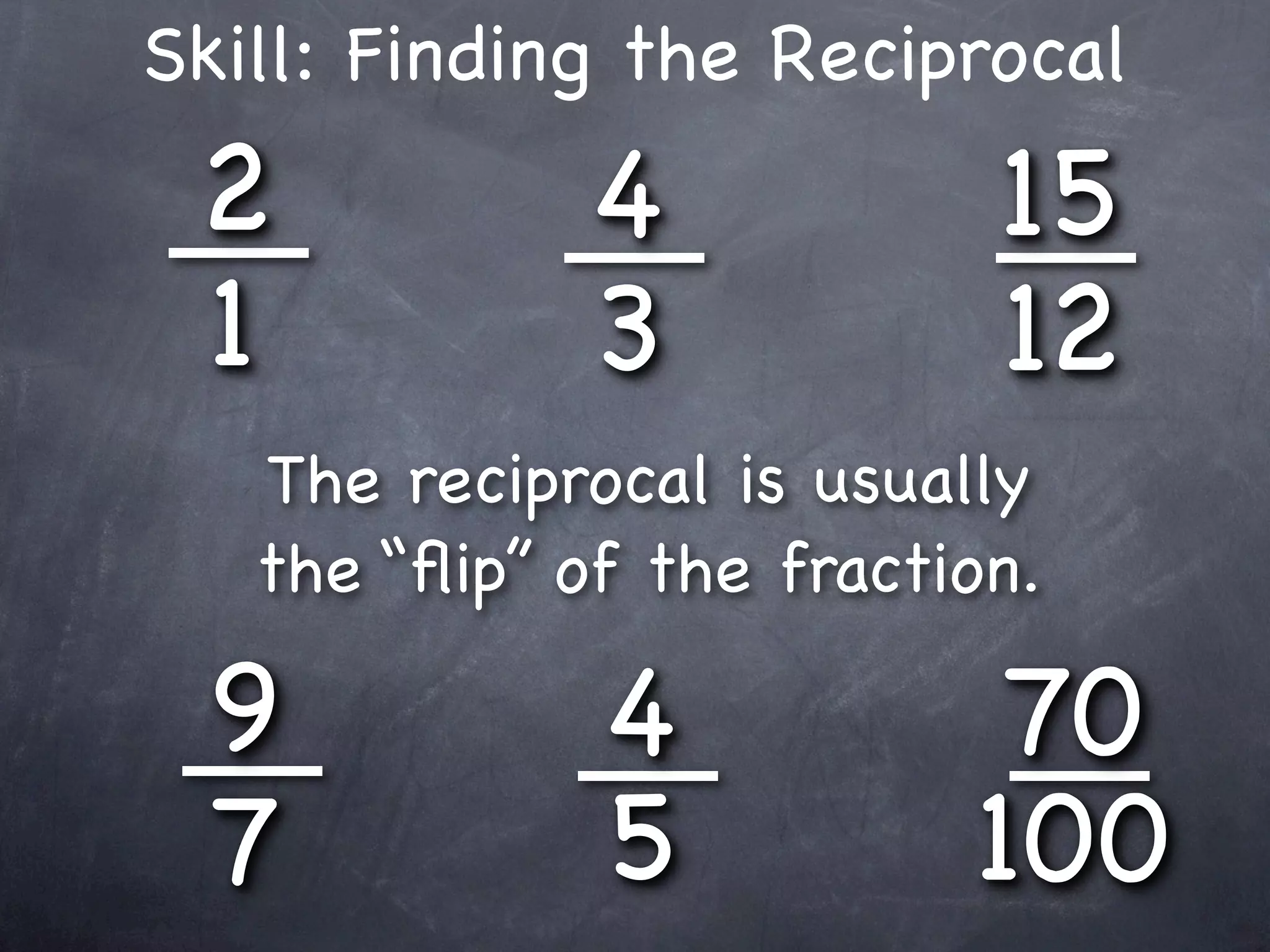
Skill: Finding the Reciprocal
 1           3           12
 2           4           15


 7           4           70
 9           5          100
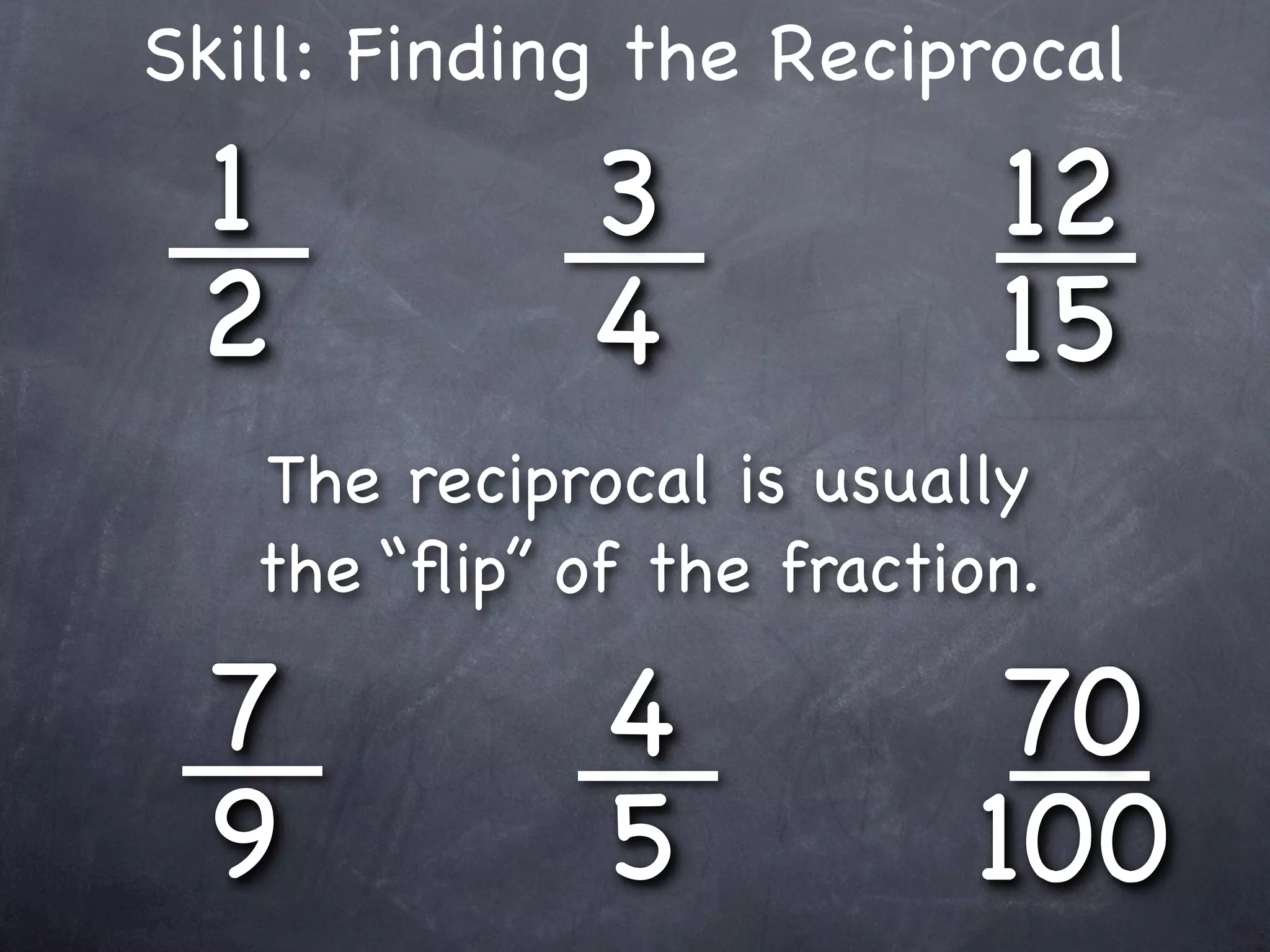
Skill: Finding the Reciprocal
 1            3            12
 2            4            15
   The reciprocal is usually
   the “flip” of the fraction.

 7            4            70
 9            5           100
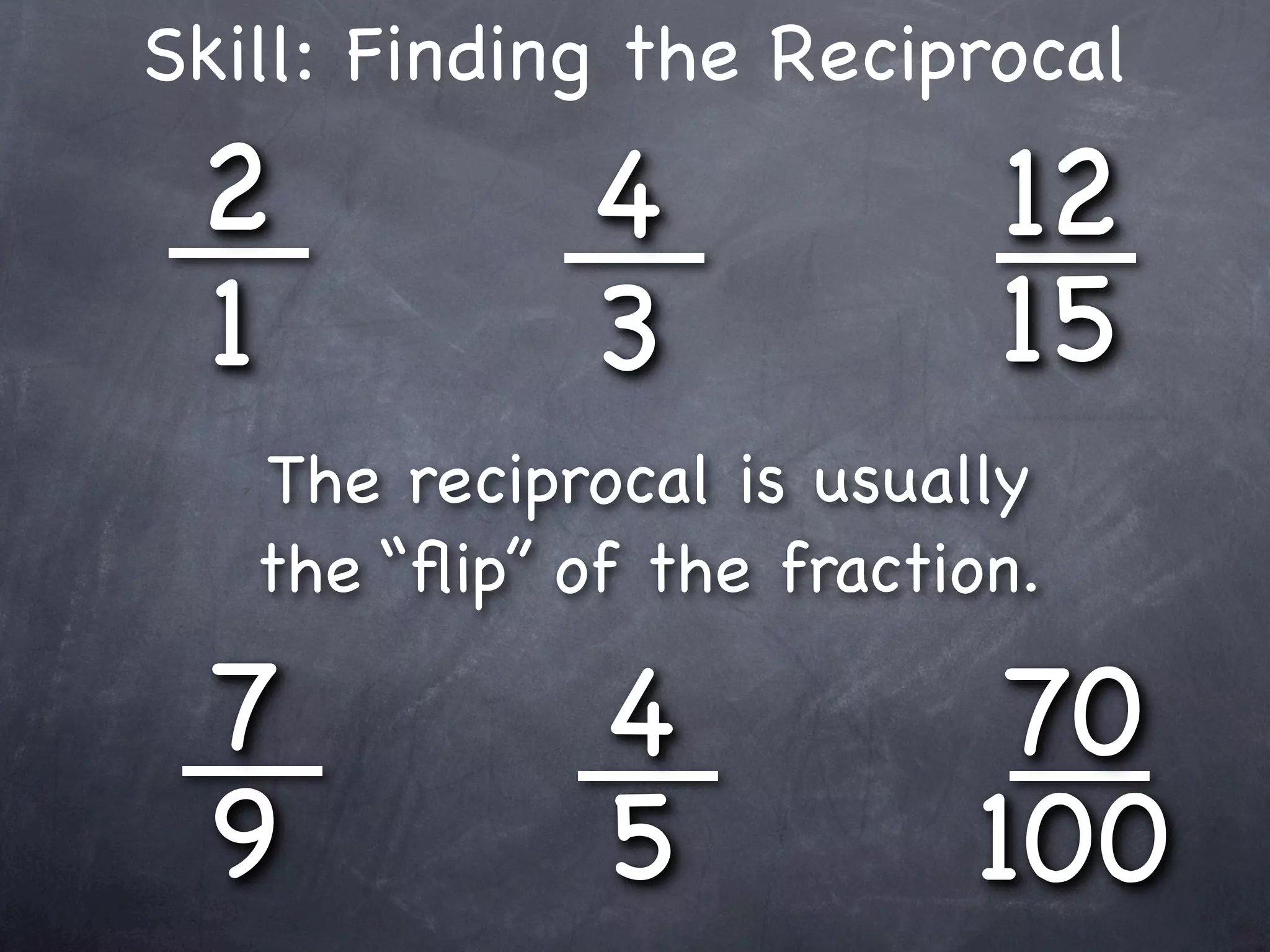
Skill: Finding the Reciprocal
 2            3            12
 1            4            15
   The reciprocal is usually
   the “flip” of the fraction.

 7            4            70
 9            5           100
Skill: Finding the Reciprocal
 2            4            12
 1            3            15
   The reciprocal is usually
   the “flip” of the fraction.

 7            4            70
 9            5           100
Skill: Finding the Reciprocal
 2            4            15
 1            3            12
   The reciprocal is usually
   the “flip” of the fraction.

 7            4            70
 9            5           100
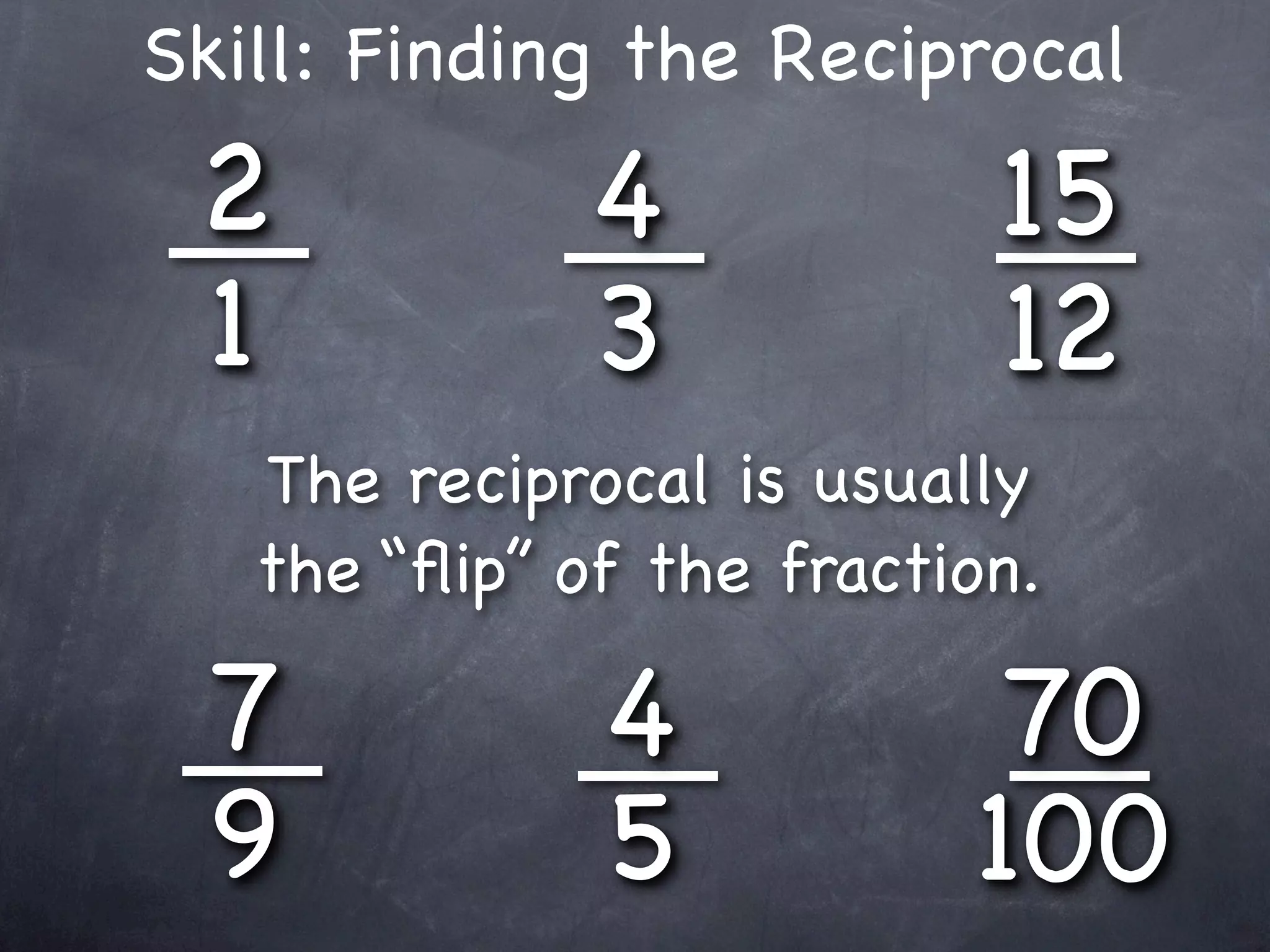
Skill: Finding the Reciprocal
 2            4            15
 1            3            12
   The reciprocal is usually
   the “flip” of the fraction.

 9            4            70
 7            5           100
Skill: Finding the Reciprocal
 2            4            15
 1            3            12
   The reciprocal is usually
   the “flip” of the fraction.

 9            5            70
 7            4           100
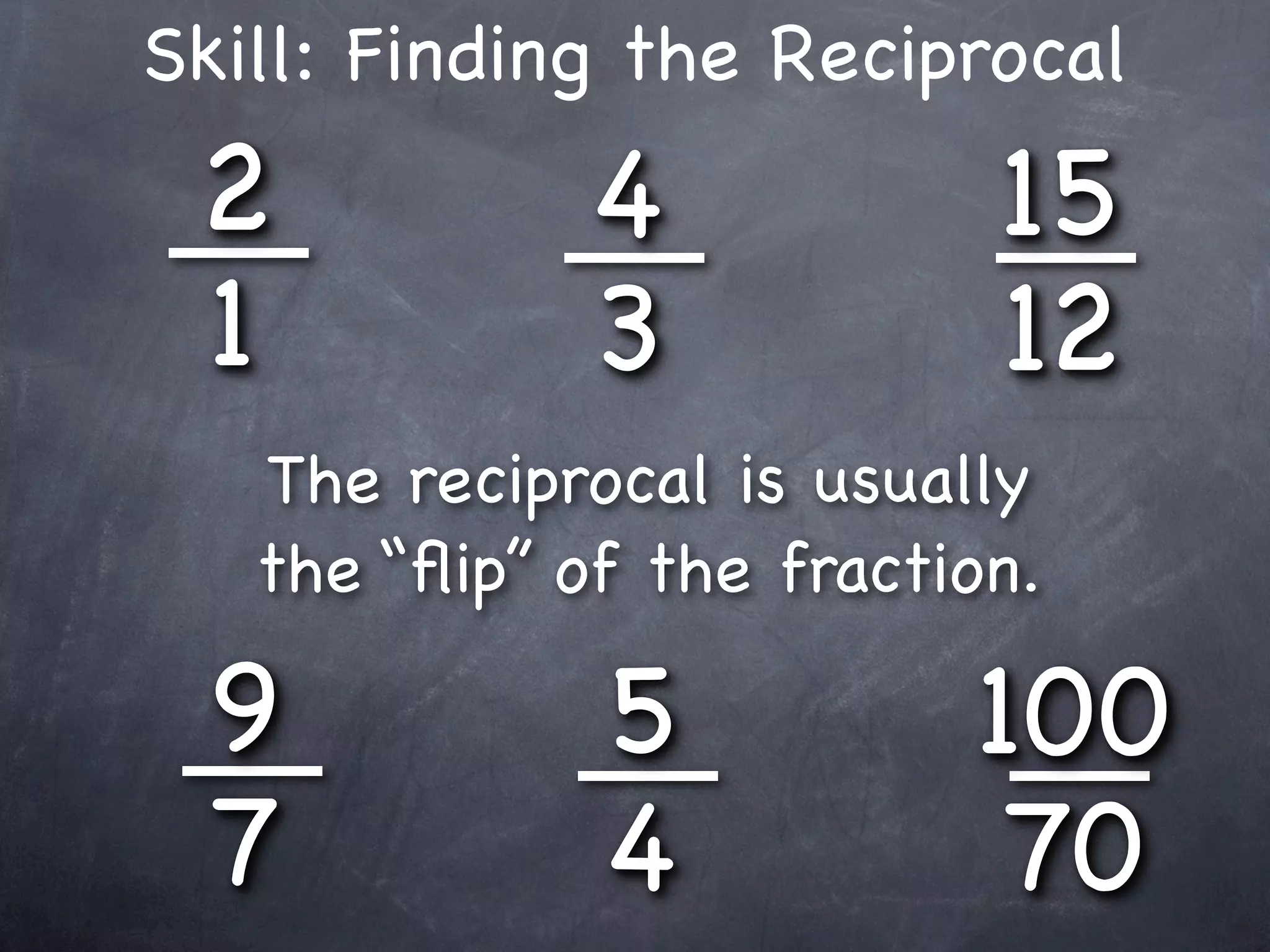
Skill: Finding the Reciprocal
 2            4            15
 1            3            12
   The reciprocal is usually
   the “flip” of the fraction.

 9            5           100
 7            4            70
Example 1


3 ÷ 1 =
7   2
Example 1
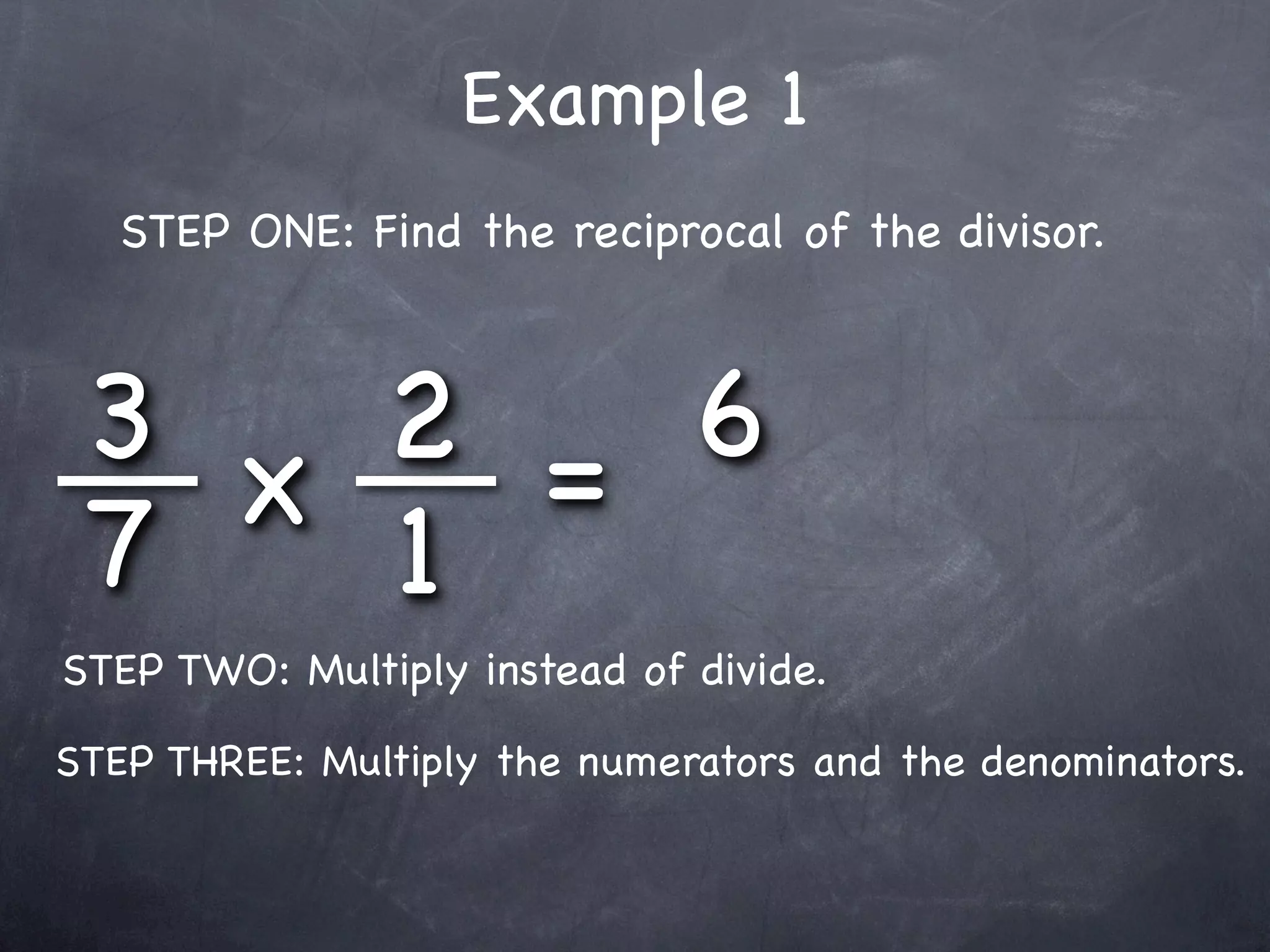
STEP ONE: Find the reciprocal of the divisor.


3 ÷ 1 =
7   2
Example 1
STEP ONE: Find the reciprocal of the divisor.


3 ÷ 2 =
7   1
Example 1
  STEP ONE: Find the reciprocal of the divisor.


 3 ÷ 2 =
 7   1
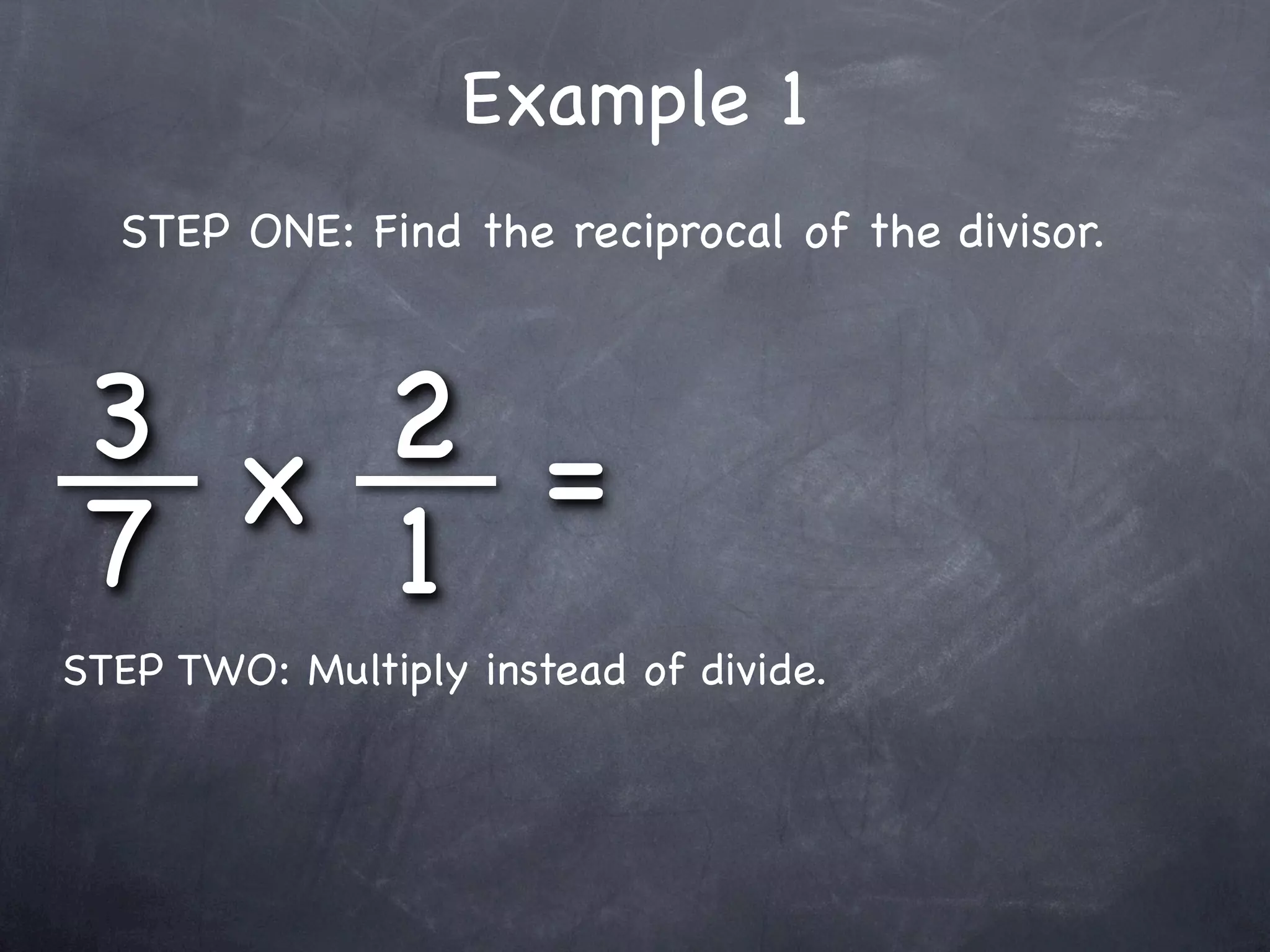
STEP TWO: Multiply instead of divide.
Example 1
  STEP ONE: Find the reciprocal of the divisor.


 3 x 2 =
 7   1
STEP TWO: Multiply instead of divide.
Example 1
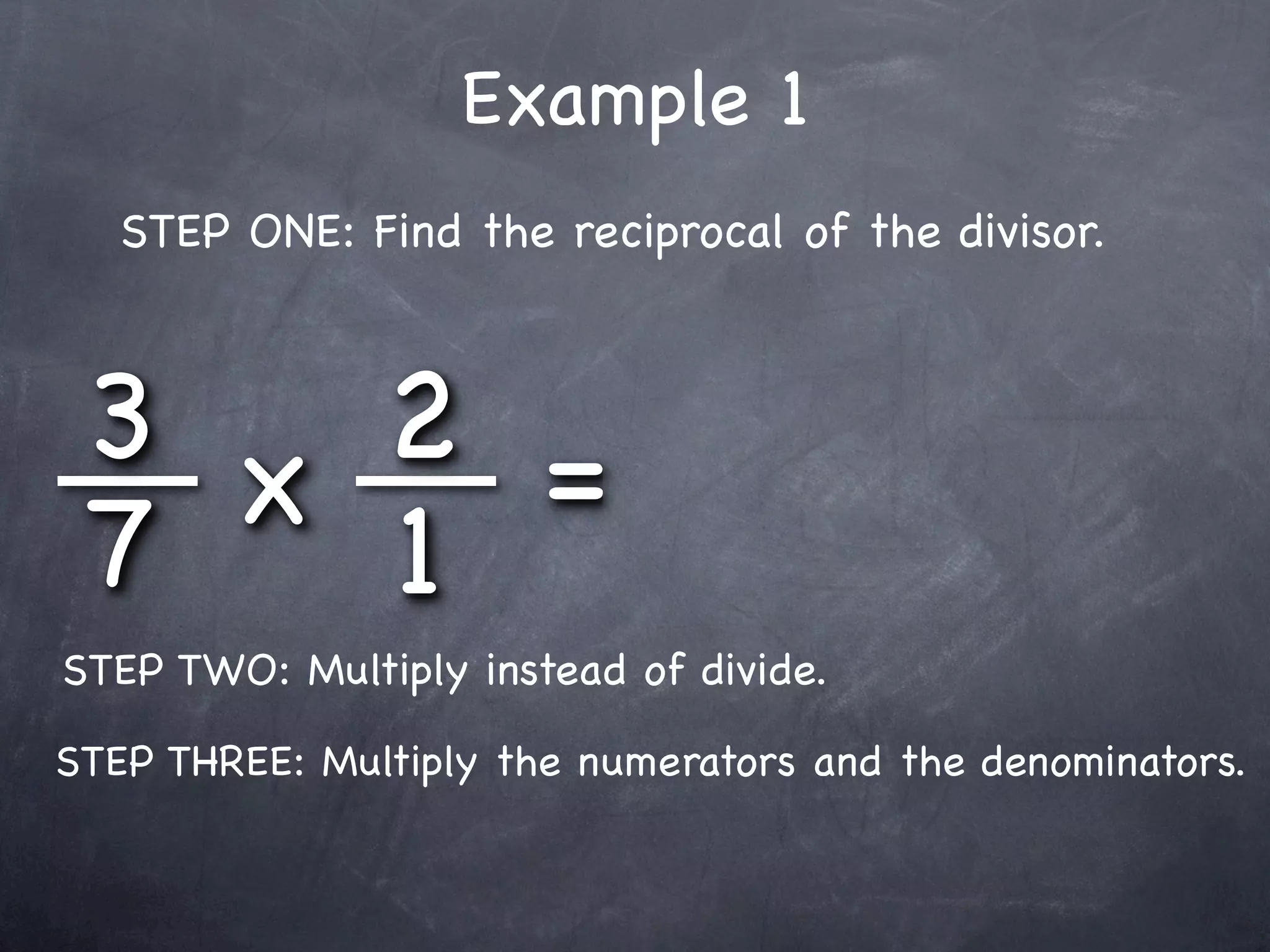
   STEP ONE: Find the reciprocal of the divisor.


 3 x 2 =
 7   1
STEP TWO: Multiply instead of divide.

STEP THREE: Multiply the numerators and the denominators.
Example 1
   STEP ONE: Find the reciprocal of the divisor.


 3 x 2 = 6
 7   1
STEP TWO: Multiply instead of divide.

STEP THREE: Multiply the numerators and the denominators.
Example 1
   STEP ONE: Find the reciprocal of the divisor.


 3 x 2 = 6
 7   1   7
STEP TWO: Multiply instead of divide.

STEP THREE: Multiply the numerators and the denominators.
Example 1
   STEP ONE: Find the reciprocal of the divisor.


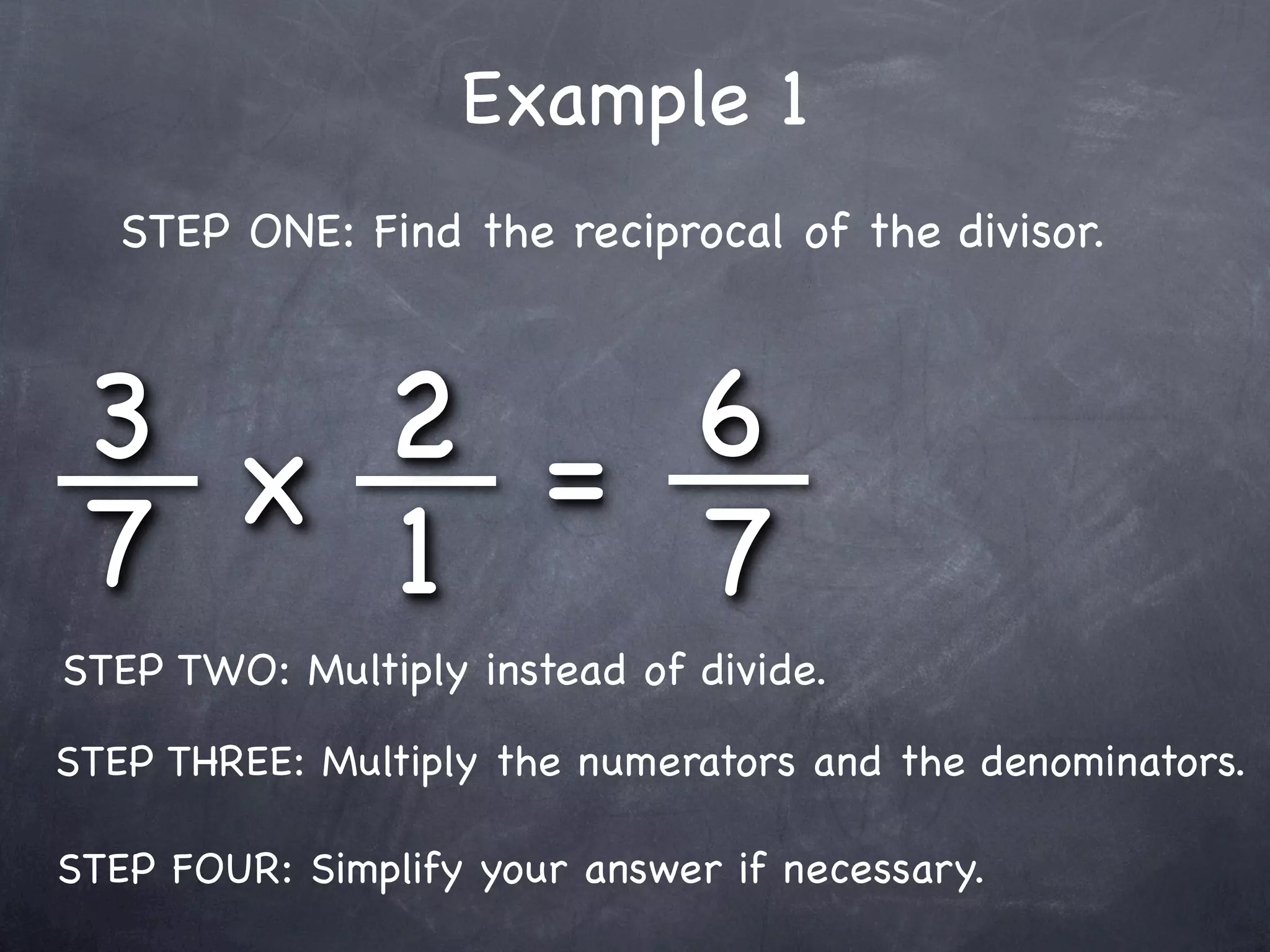
 3 x 2 = 6
 7   1   7
STEP TWO: Multiply instead of divide.

STEP THREE: Multiply the numerators and the denominators.

STEP FOUR: Simplify your answer if necessary.
Example 2


6 ÷ 3 =
1   4
Example 2
STEP ONE: Find the reciprocal of the divisor.


6 ÷ 3 =
1   4
Example 2
STEP ONE: Find the reciprocal of the divisor.


6 ÷ 4 =
1   3
Example 2
  STEP ONE: Find the reciprocal of the divisor.


 6 ÷ 4 =
 1   3
STEP TWO: Multiply instead of divide.
Example 2
  STEP ONE: Find the reciprocal of the divisor.


 6 x 4 =
 1   3
STEP TWO: Multiply instead of divide.
Example 2
   STEP ONE: Find the reciprocal of the divisor.


 6 x 4 =
 1   3
STEP TWO: Multiply instead of divide.

STEP THREE: Multiply the numerators and the denominators.
Example 2
   STEP ONE: Find the reciprocal of the divisor.


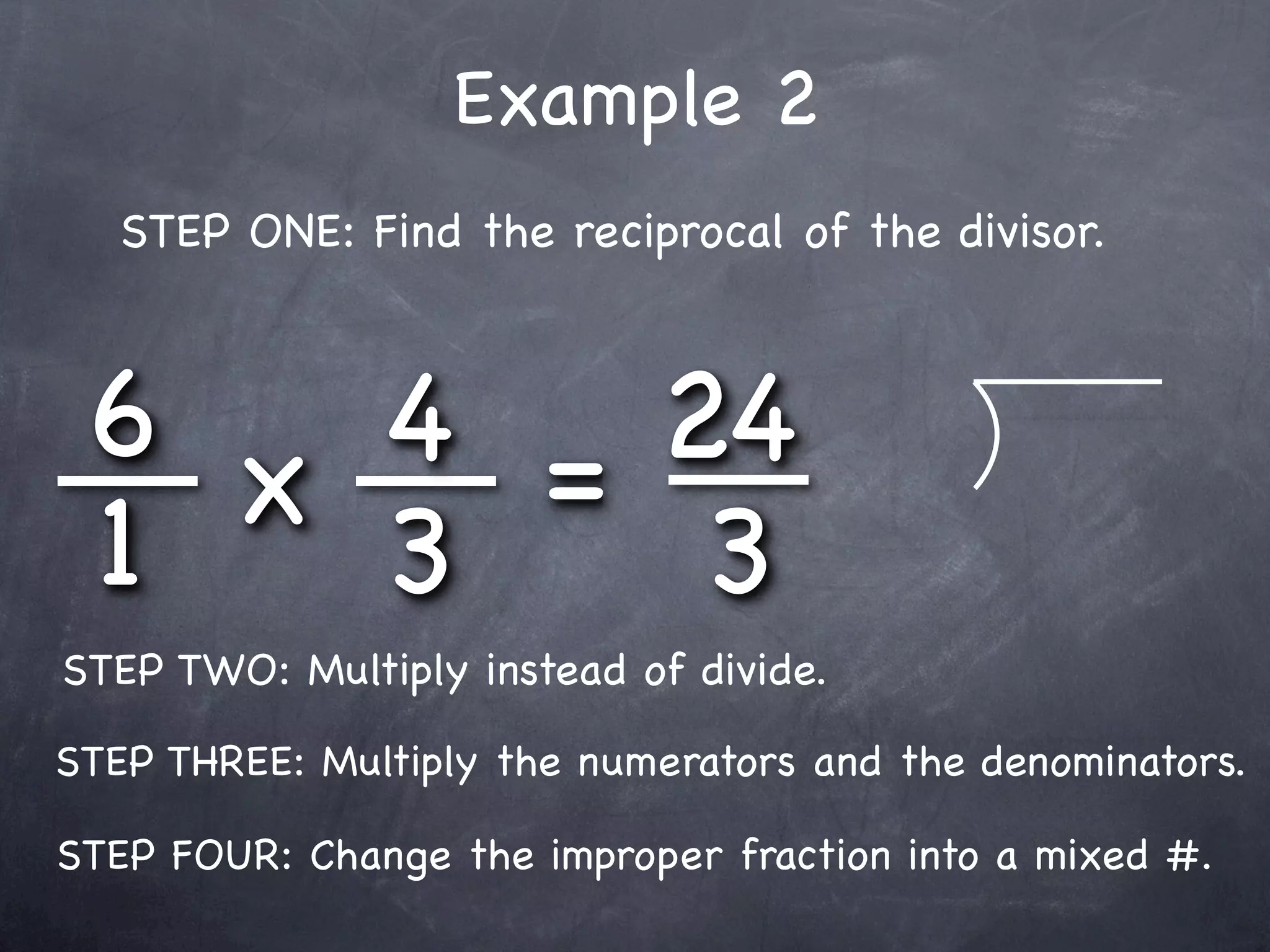
 6 x 4 = 24
 1   3
STEP TWO: Multiply instead of divide.

STEP THREE: Multiply the numerators and the denominators.
Example 2
   STEP ONE: Find the reciprocal of the divisor.


 6 x 4 = 24
 1   3    3
STEP TWO: Multiply instead of divide.

STEP THREE: Multiply the numerators and the denominators.
Example 2
   STEP ONE: Find the reciprocal of the divisor.


 6 x 4 = 24
 1   3    3
STEP TWO: Multiply instead of divide.

STEP THREE: Multiply the numerators and the denominators.

STEP FOUR: Change the improper fraction into a mixed #.
Example 2
   STEP ONE: Find the reciprocal of the divisor.


 6 x 4 = 24
 1   3    3
STEP TWO: Multiply instead of divide.

STEP THREE: Multiply the numerators and the denominators.

STEP FOUR: Change the improper fraction into a mixed #.
Example 2
   STEP ONE: Find the reciprocal of the divisor.

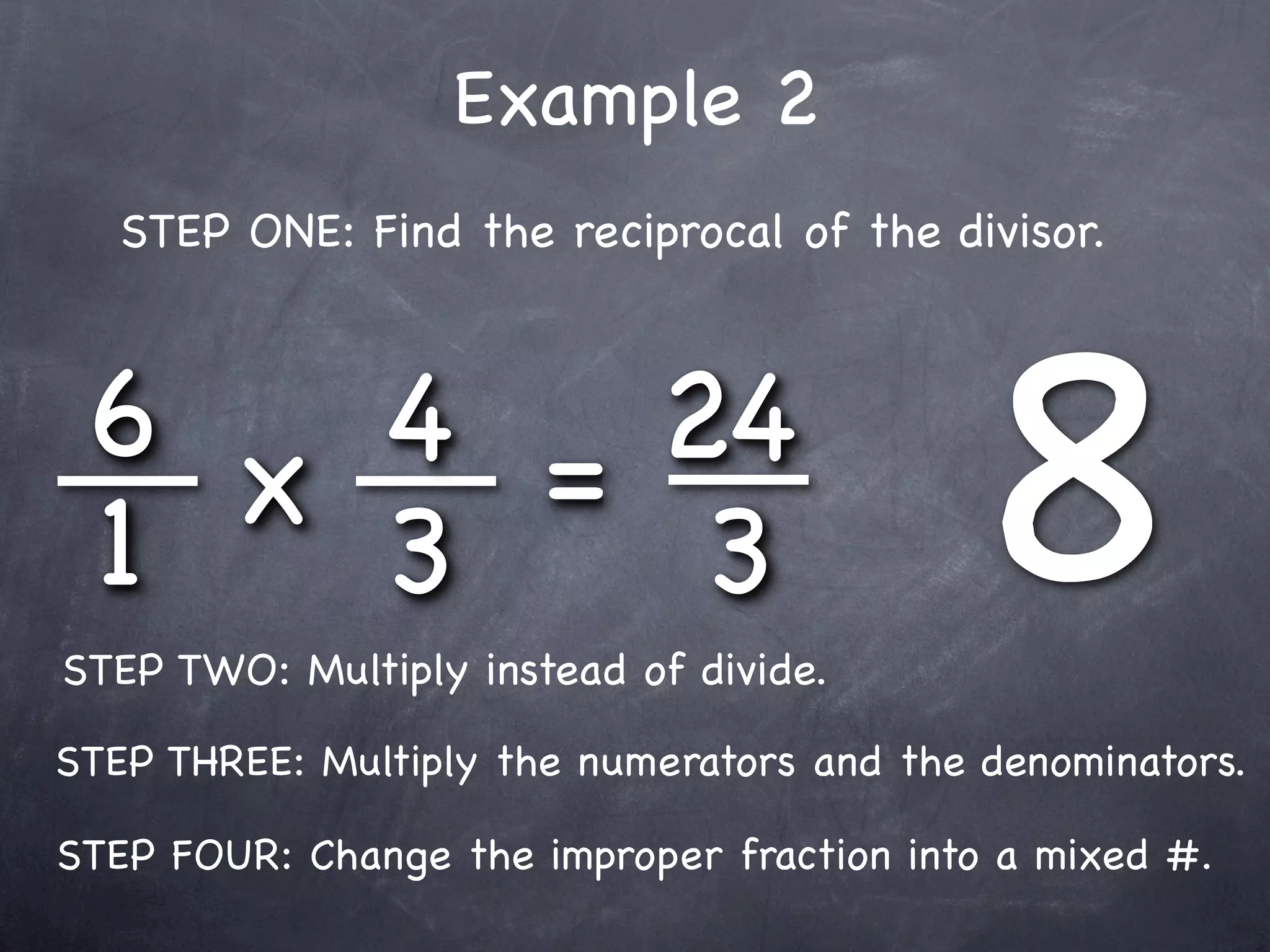
               8
 6 x 4 = 24 3 24
 1   3    3   24
               0
STEP TWO: Multiply instead of divide.

STEP THREE: Multiply the numerators and the denominators.

STEP FOUR: Change the improper fraction into a mixed #.
Example 2
   STEP ONE: Find the reciprocal of the divisor.


 6 x 4 = 24
 1   3    3
STEP TWO: Multiply instead of divide.
                                            8
STEP THREE: Multiply the numerators and the denominators.

STEP FOUR: Change the improper fraction into a mixed #.

8-11 Dividing Fractions

  • 1.
    8-11 Dividing Fractions Number Sense 2.4
  • 2.
    Definition: Reciprocal a mathematicalexpression or function so related to another that their product is one
  • 3.
    Definition: Reciprocal a mathematicalexpression or function so related to another that their product is one 1 2
  • 4.
    Definition: Reciprocal a mathematicalexpression or function so related to another that their product is one 1 x 2 2 1
  • 5.
    Definition: Reciprocal a mathematicalexpression or function so related to another that their product is one 1 x 2 = 2 2 1 2
  • 6.
    Definition: Reciprocal a mathematicalexpression or function so related to another that their product is one 1 x 2 = 2 = 2 1 2 1
  • 7.
    Definition: Reciprocal a mathematicalexpression or function so related to another that their product is one 1 x 2 = 2 = 2 1 2 1 The reciprocal is usually the “flip” of the fraction.
  • 8.
    Definition: Reciprocal amathematical expression or function so related to another that their product is one 1 x 2 = 2 = 2 1 2 1 1 The reciprocal is usually 2 the “flip” of the fraction.
  • 9.
    Definition: Reciprocal amathematical expression or function so related to another that their product is one 1 x 2 = 2 = 2 1 2 1 2 The reciprocal is usually 1 the “flip” of the fraction.
  • 10.
    Skill: Finding theReciprocal 1 3 12 2 4 15 7 4 70 9 5 100
  • 11.
    Skill: Finding theReciprocal 1 3 12 2 4 15 The reciprocal is usually the “flip” of the fraction. 7 4 70 9 5 100
  • 12.
    Skill: Finding theReciprocal 2 3 12 1 4 15 The reciprocal is usually the “flip” of the fraction. 7 4 70 9 5 100
  • 13.
    Skill: Finding theReciprocal 2 4 12 1 3 15 The reciprocal is usually the “flip” of the fraction. 7 4 70 9 5 100
  • 14.
    Skill: Finding theReciprocal 2 4 15 1 3 12 The reciprocal is usually the “flip” of the fraction. 7 4 70 9 5 100
  • 15.
    Skill: Finding theReciprocal 2 4 15 1 3 12 The reciprocal is usually the “flip” of the fraction. 9 4 70 7 5 100
  • 16.
    Skill: Finding theReciprocal 2 4 15 1 3 12 The reciprocal is usually the “flip” of the fraction. 9 5 70 7 4 100
  • 17.
    Skill: Finding theReciprocal 2 4 15 1 3 12 The reciprocal is usually the “flip” of the fraction. 9 5 100 7 4 70
  • 18.
  • 19.
    Example 1 STEP ONE:Find the reciprocal of the divisor. 3 ÷ 1 = 7 2
  • 20.
    Example 1 STEP ONE:Find the reciprocal of the divisor. 3 ÷ 2 = 7 1
  • 21.
    Example 1 STEP ONE: Find the reciprocal of the divisor. 3 ÷ 2 = 7 1 STEP TWO: Multiply instead of divide.
  • 22.
    Example 1 STEP ONE: Find the reciprocal of the divisor. 3 x 2 = 7 1 STEP TWO: Multiply instead of divide.
  • 23.
    Example 1 STEP ONE: Find the reciprocal of the divisor. 3 x 2 = 7 1 STEP TWO: Multiply instead of divide. STEP THREE: Multiply the numerators and the denominators.
  • 24.
    Example 1 STEP ONE: Find the reciprocal of the divisor. 3 x 2 = 6 7 1 STEP TWO: Multiply instead of divide. STEP THREE: Multiply the numerators and the denominators.
  • 25.
    Example 1 STEP ONE: Find the reciprocal of the divisor. 3 x 2 = 6 7 1 7 STEP TWO: Multiply instead of divide. STEP THREE: Multiply the numerators and the denominators.
  • 26.
    Example 1 STEP ONE: Find the reciprocal of the divisor. 3 x 2 = 6 7 1 7 STEP TWO: Multiply instead of divide. STEP THREE: Multiply the numerators and the denominators. STEP FOUR: Simplify your answer if necessary.
  • 27.
  • 28.
    Example 2 STEP ONE:Find the reciprocal of the divisor. 6 ÷ 3 = 1 4
  • 29.
    Example 2 STEP ONE:Find the reciprocal of the divisor. 6 ÷ 4 = 1 3
  • 30.
    Example 2 STEP ONE: Find the reciprocal of the divisor. 6 ÷ 4 = 1 3 STEP TWO: Multiply instead of divide.
  • 31.
    Example 2 STEP ONE: Find the reciprocal of the divisor. 6 x 4 = 1 3 STEP TWO: Multiply instead of divide.
  • 32.
    Example 2 STEP ONE: Find the reciprocal of the divisor. 6 x 4 = 1 3 STEP TWO: Multiply instead of divide. STEP THREE: Multiply the numerators and the denominators.
  • 33.
    Example 2 STEP ONE: Find the reciprocal of the divisor. 6 x 4 = 24 1 3 STEP TWO: Multiply instead of divide. STEP THREE: Multiply the numerators and the denominators.
  • 34.
    Example 2 STEP ONE: Find the reciprocal of the divisor. 6 x 4 = 24 1 3 3 STEP TWO: Multiply instead of divide. STEP THREE: Multiply the numerators and the denominators.
  • 35.
    Example 2 STEP ONE: Find the reciprocal of the divisor. 6 x 4 = 24 1 3 3 STEP TWO: Multiply instead of divide. STEP THREE: Multiply the numerators and the denominators. STEP FOUR: Change the improper fraction into a mixed #.
  • 36.
    Example 2 STEP ONE: Find the reciprocal of the divisor. 6 x 4 = 24 1 3 3 STEP TWO: Multiply instead of divide. STEP THREE: Multiply the numerators and the denominators. STEP FOUR: Change the improper fraction into a mixed #.
  • 37.
    Example 2 STEP ONE: Find the reciprocal of the divisor. 8 6 x 4 = 24 3 24 1 3 3 24 0 STEP TWO: Multiply instead of divide. STEP THREE: Multiply the numerators and the denominators. STEP FOUR: Change the improper fraction into a mixed #.
  • 38.
    Example 2 STEP ONE: Find the reciprocal of the divisor. 6 x 4 = 24 1 3 3 STEP TWO: Multiply instead of divide. 8 STEP THREE: Multiply the numerators and the denominators. STEP FOUR: Change the improper fraction into a mixed #.