BY:- Aman Sharma
Dronacharya College Of Engineering
Email Id- aman.sharma616@gmail.com
Key features of embedded c-
 It is easy and less time consuming to write in C
than Assembly.
 C is easier to modify and update.
 You can use code available in function libraries.
 C code is portable to other microcontroller with
little of no modification.
 A good understanding of C data types for 8051
can help programmers to create smaller hex files
Supports following data types-
 Unsigned char
 Signed char
 Unsigned int
 Signed int
 Sbit (single bit)
 Bit.
 Note:-C compilers use the signed char as the default
if we do not put the keyword Unsigned.
Their range
 Data types Size Range
 bit 1-bit RAM bit-addressable only
 sbit 1-bit SFR bit-addressable only
 (signed) int 16-bit -32768 to +32767
 unsigned int 16-bit 0 to 65535
 (signed) char 8-bit -128 to +127
 unsigned char 8-bit 0 to 255
//SFR= specific function register.
Some programmes…
//wap to send values 00 – FF to port P1.
 #include <reg51.h>
void main(void)
{
unsigned char z;
for (z=0;z<=255;z++)
P1=z;
}
//WAP to send hex values for ASCII characters of 0, 1, 2,
3, 4, 5, A, B, C, and D to port P1.
 #include <reg51.h>
void main(void)
{
unsigned char mynum[]={‘0’,’1’,’2’,’3’,’4’,’5’,’A’,’B’,’C’,’D’};
unsigned char z;
for (z=0;z<10;z++)
P1=mynum[z];
}
//WAP to toggle all the bits of P1 continuously.
 #include <reg51.h> #include<reg51.h>
void main(void) void main()
{ {
for (; ;) for (; ;)
{ {
p1=0x55; P1=0;
p1=0xAA; P1=1;
} } } }
NOTE:- You can use while loop in above program by:-
while(1)
{ condition ; }
To create Time delay --
Three factors that can affect the accuracy of the delay-
 The 8051 design..
– The number of machine cycle
– The number of clock periods per machine cycle
 The crystal frequency connected to the X1 – X2 input
pins
 Compiler choice
– C compiler converts the C statements and functions
to Assembly language instructions
– Different compilers produce different code
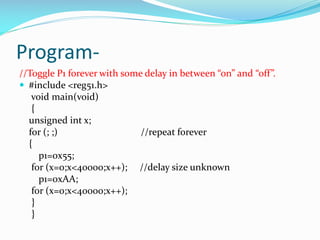
Program-
//Toggle P1 forever with some delay in between “on” and “off”.
 #include <reg51.h>
void main(void)
{
unsigned int x;
for (; ;) //repeat forever
{
p1=0x55;
for (x=0;x<40000;x++); //delay size unknown
p1=0xAA;
for (x=0;x<40000;x++);
}
}
//WAP to toggle bits of P1 ports continuously with a 250
ms.
 #include <reg51.h>
void main(void)
{
while (1) //repeat forever
{
p1=0x55;
MSDelay(250);
p1=0xAA;
MSDelay(250);
}
}
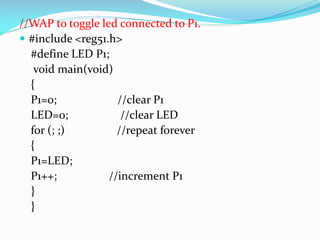
//WAP to toggle led connected to P1.
 #include <reg51.h>
#define LED P1;
void main(void)
{
P1=0; //clear P1
LED=0; //clear LED
for (; ;) //repeat forever
{
P1=LED;
P1++; //increment P1
}
}
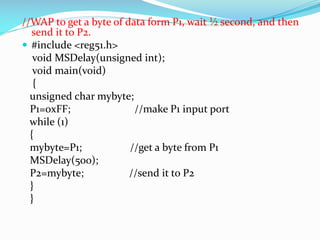
//WAP to get a byte of data form P1, wait ½ second, and then
send it to P2.
 #include <reg51.h>
void MSDelay(unsigned int);
void main(void)
{
unsigned char mybyte;
P1=0xFF; //make P1 input port
while (1)
{
mybyte=P1; //get a byte from P1
MSDelay(500);
P2=mybyte; //send it to P2
}
}
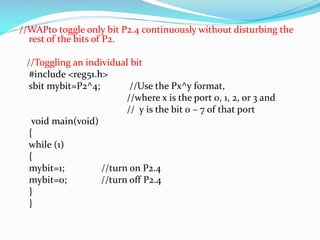
//WAPto toggle only bit P2.4 continuously without disturbing the
rest of the bits of P2.
//Toggling an individual bit
#include <reg51.h>
sbit mybit=P2^4; //Use the Px^y format,
//where x is the port 0, 1, 2, or 3 and
// y is the bit 0 – 7 of that port
void main(void)
{
while (1)
{
mybit=1; //turn on P2.4
mybit=0; //turn off P2.4
}
}
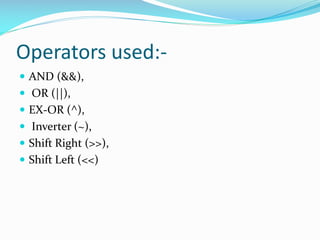
Operators used:-
 AND (&&),
 OR (||),
 EX-OR (^),
 Inverter (~),
 Shift Right (>>),
 Shift Left (<<)
//WAP to toggle all the bits of P0 and P2 continuously with a
250 ms delay, Using the inverting and Ex-OR operators,
respectively.
 #include <reg51.h>
void MSDelay(unsigned int);
void main(void)
{
P0=0x55;
P2=0x55;
while (1)
{
P0=~P0;
P2=P2^0xFF;
MSDelay(250);
}
}
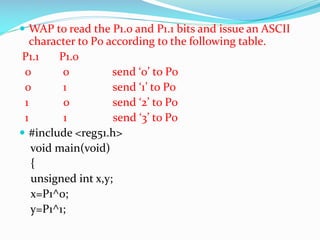
 WAP to read the P1.0 and P1.1 bits and issue an ASCII
character to P0 according to the following table.
P1.1 P1.0
0 0 send ‘0’ to P0
0 1 send ‘1’ to P0
1 0 send ‘2’ to P0
1 1 send ‘3’ to P0
 #include <reg51.h>
void main(void)
{
unsigned int x,y;
x=P1^0;
y=P1^1;
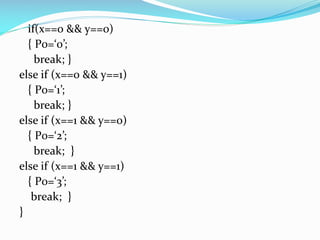
if(x==0 && y==0)
{ P0=‘0’;
break; }
else if (x==0 && y==1)
{ P0=‘1’;
break; }
else if (x==1 && y==0)
{ P0=‘2’;
break; }
else if (x==1 && y==1)
{ P0=‘3’;
break; }
}
//WAP to calculate the checksum byte for the data 25H, 62H, 3FH, and
52H.
 #include <reg51.h>
void main(void)
{
unsigned int mydata[]={‘0x25’,’0x62’,’0x3F’,’0x52’};
unsigned int sum=0;
unsigned int x;
unsigned int chksumbyte;
for (x=0;x<4;x++)
{
P2=mydata[x];
sum=sum+mydata[x];
P1=sum;
}
chksumbyte=~sum+1;
P1=chksumbyte;
}
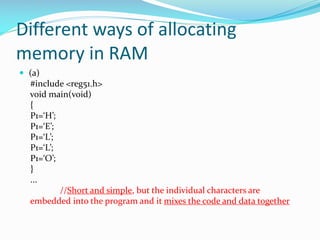
Different ways of allocating
memory in RAM
 (a)
#include <reg51.h>
void main(void)
{
P1=‘H’;
P1=‘E’;
P1=‘L’;
P1=‘L’;
P1=‘O’;
}
...
//Short and simple, but the individual characters are
embedded into the program and it mixes the code and data together
 (b)
#include <reg51.h>
void main(void)
{
unsigned char mydata[]={‘H’,’E’,’L’,’L’,’O’};
unsigned char z;
for (z=0;z<5;z++)
P1=mydata[z];
}
//Use the RAM data space to store array elements, therefore the size of the
array is limited
 (c)
#include <reg51.h>
void main(void)
{
code unsigned char mydata[]={‘H’,’E’,’L’,’L’,’O’};
unsigned char z;
for (z=0;z<=5;z++)
P1=mydata[z];
}
//Use a separate area of the code space for data. This allows the size of the
array to be as long as you want if you have the on-chip ROM.
//However, the more code space you use for data,the less space is left for
your program code.
8051 programming skills using EMBEDDED C

8051 programming skills using EMBEDDED C

  • 1.
    BY:- Aman Sharma DronacharyaCollege Of Engineering Email Id- aman.sharma616@gmail.com
  • 2.
    Key features ofembedded c-  It is easy and less time consuming to write in C than Assembly.  C is easier to modify and update.  You can use code available in function libraries.  C code is portable to other microcontroller with little of no modification.  A good understanding of C data types for 8051 can help programmers to create smaller hex files
  • 3.
    Supports following datatypes-  Unsigned char  Signed char  Unsigned int  Signed int  Sbit (single bit)  Bit.  Note:-C compilers use the signed char as the default if we do not put the keyword Unsigned.
  • 4.
    Their range  Datatypes Size Range  bit 1-bit RAM bit-addressable only  sbit 1-bit SFR bit-addressable only  (signed) int 16-bit -32768 to +32767  unsigned int 16-bit 0 to 65535  (signed) char 8-bit -128 to +127  unsigned char 8-bit 0 to 255 //SFR= specific function register.
  • 5.
    Some programmes… //wap tosend values 00 – FF to port P1.  #include <reg51.h> void main(void) { unsigned char z; for (z=0;z<=255;z++) P1=z; }
  • 6.
    //WAP to sendhex values for ASCII characters of 0, 1, 2, 3, 4, 5, A, B, C, and D to port P1.  #include <reg51.h> void main(void) { unsigned char mynum[]={‘0’,’1’,’2’,’3’,’4’,’5’,’A’,’B’,’C’,’D’}; unsigned char z; for (z=0;z<10;z++) P1=mynum[z]; }
  • 7.
    //WAP to toggleall the bits of P1 continuously.  #include <reg51.h> #include<reg51.h> void main(void) void main() { { for (; ;) for (; ;) { { p1=0x55; P1=0; p1=0xAA; P1=1; } } } } NOTE:- You can use while loop in above program by:- while(1) { condition ; }
  • 8.
    To create Timedelay -- Three factors that can affect the accuracy of the delay-  The 8051 design.. – The number of machine cycle – The number of clock periods per machine cycle  The crystal frequency connected to the X1 – X2 input pins  Compiler choice – C compiler converts the C statements and functions to Assembly language instructions – Different compilers produce different code
  • 9.
    Program- //Toggle P1 foreverwith some delay in between “on” and “off”.  #include <reg51.h> void main(void) { unsigned int x; for (; ;) //repeat forever { p1=0x55; for (x=0;x<40000;x++); //delay size unknown p1=0xAA; for (x=0;x<40000;x++); } }
  • 10.
    //WAP to togglebits of P1 ports continuously with a 250 ms.  #include <reg51.h> void main(void) { while (1) //repeat forever { p1=0x55; MSDelay(250); p1=0xAA; MSDelay(250); } }
  • 11.
    //WAP to toggleled connected to P1.  #include <reg51.h> #define LED P1; void main(void) { P1=0; //clear P1 LED=0; //clear LED for (; ;) //repeat forever { P1=LED; P1++; //increment P1 } }
  • 12.
    //WAP to geta byte of data form P1, wait ½ second, and then send it to P2.  #include <reg51.h> void MSDelay(unsigned int); void main(void) { unsigned char mybyte; P1=0xFF; //make P1 input port while (1) { mybyte=P1; //get a byte from P1 MSDelay(500); P2=mybyte; //send it to P2 } }
  • 13.
    //WAPto toggle onlybit P2.4 continuously without disturbing the rest of the bits of P2. //Toggling an individual bit #include <reg51.h> sbit mybit=P2^4; //Use the Px^y format, //where x is the port 0, 1, 2, or 3 and // y is the bit 0 – 7 of that port void main(void) { while (1) { mybit=1; //turn on P2.4 mybit=0; //turn off P2.4 } }
  • 14.
    Operators used:-  AND(&&),  OR (||),  EX-OR (^),  Inverter (~),  Shift Right (>>),  Shift Left (<<)
  • 15.
    //WAP to toggleall the bits of P0 and P2 continuously with a 250 ms delay, Using the inverting and Ex-OR operators, respectively.  #include <reg51.h> void MSDelay(unsigned int); void main(void) { P0=0x55; P2=0x55; while (1) { P0=~P0; P2=P2^0xFF; MSDelay(250); } }
  • 16.
     WAP toread the P1.0 and P1.1 bits and issue an ASCII character to P0 according to the following table. P1.1 P1.0 0 0 send ‘0’ to P0 0 1 send ‘1’ to P0 1 0 send ‘2’ to P0 1 1 send ‘3’ to P0  #include <reg51.h> void main(void) { unsigned int x,y; x=P1^0; y=P1^1;
  • 17.
    if(x==0 && y==0) {P0=‘0’; break; } else if (x==0 && y==1) { P0=‘1’; break; } else if (x==1 && y==0) { P0=‘2’; break; } else if (x==1 && y==1) { P0=‘3’; break; } }
  • 18.
    //WAP to calculatethe checksum byte for the data 25H, 62H, 3FH, and 52H.  #include <reg51.h> void main(void) { unsigned int mydata[]={‘0x25’,’0x62’,’0x3F’,’0x52’}; unsigned int sum=0; unsigned int x; unsigned int chksumbyte; for (x=0;x<4;x++) { P2=mydata[x]; sum=sum+mydata[x]; P1=sum; } chksumbyte=~sum+1; P1=chksumbyte; }
  • 19.
    Different ways ofallocating memory in RAM  (a) #include <reg51.h> void main(void) { P1=‘H’; P1=‘E’; P1=‘L’; P1=‘L’; P1=‘O’; } ... //Short and simple, but the individual characters are embedded into the program and it mixes the code and data together
  • 20.
     (b) #include <reg51.h> voidmain(void) { unsigned char mydata[]={‘H’,’E’,’L’,’L’,’O’}; unsigned char z; for (z=0;z<5;z++) P1=mydata[z]; } //Use the RAM data space to store array elements, therefore the size of the array is limited
  • 21.
     (c) #include <reg51.h> voidmain(void) { code unsigned char mydata[]={‘H’,’E’,’L’,’L’,’O’}; unsigned char z; for (z=0;z<=5;z++) P1=mydata[z]; } //Use a separate area of the code space for data. This allows the size of the array to be as long as you want if you have the on-chip ROM. //However, the more code space you use for data,the less space is left for your program code.