Cultural Competency
in a Diverse Environment
What is cultural competency?
The ability work with diverse values,
beliefs and behaviors including tailoring
programs and processes to meet social,
cultural, and linguistic needs.
Cultural Competency
in a Diverse Environment
Why is cultural competency training
important?
In the relatively small community of Sundown M Ranch over 20
nationalities/races are represented.
We are all influenced by the dimensions we bring with us
wherever we go, such as profession, education, parental status,
geographic location and much more
Cultural competency is about learning from others who are not
the same, about dignity and respect for all, and about creating
workplace environments and practices that make differences
work to our advantage.
Why Talk About It?
Understanding Cultural Diversity:
•Will increase the appreciation of differences represented among staff,
clients and families
•Will help preserve and encourage respect for the uniqueness of each
individual
•Will strengthen the organization by leveraging differences that mirror
the diversity of our population and then using them to our advantage
What if We Don’t?
If we overlook the importance of cultural competency:
•We are unable to recognize differences for what they are
(misperception, cultural background, language barrier, etc)
•For Example:
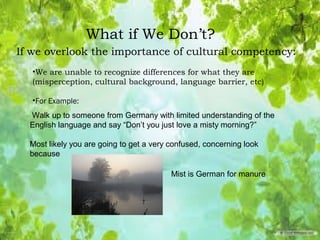
Mist is German for manure
Walk up to someone from Germany with limited understanding of the
English language and say “Don’t you just love a misty morning?”
Most likely you are going to get a very confused, concerning look
because
What if We Don’t?
•For Example:
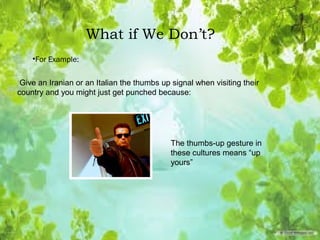
The thumbs-up gesture in
these cultures means “up
yours”
Give an Iranian or an Italian the thumbs up signal when visiting their
country and you might just get punched because:
What if We Don’t?
•For Example:
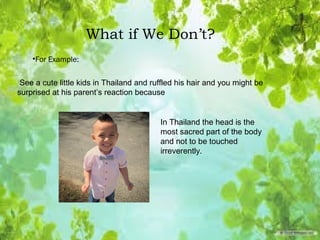
In Thailand the head is the
most sacred part of the body
and not to be touched
irreverently.
See a cute little kids in Thailand and ruffled his hair and you might be
surprised at his parent’s reaction because
What if We Don’t?
If we overlook the importance of cultural competency:
•We deny the significance of differences and the fact that our common
humanity often transcends them (Common humanity understands
kindness and tolerance)
•We don’t challenge ourselves to ‘get inside the issue’ and really
understand where someone else is coming from – which leads to
friction and lack of progress or productivity
•We miss the depth of feeling or the true motive that causes someone
to be different, react differently, perceive things differently. We become
rigid and static in our thinking.
What’s our strategy?
Sundown M Ranch addresses Cultural Competency by:
•Training to help eliminate bias, prejudice and discriminatory practices
•Simple example: Cultural Competency Training
•Using a variety of approaches with patients to meet their cultural needs
•We design our treatment plan around what will work for each
individual patient
•Interacting in the appropriate language/method, either personally or
through interpreter services
•Simple example: Signing for the deaf, brail for the blind, foreign
languages
What’s our strategy?
•We recognize the diversity of the employee group and
respect the differences.
•Simple example: Male versus Female - If we learn to
relate to and understand each other as employees, we
can transfer that knowledge to dealing with patients,
family, others
•We recruit, select, train, and promote the best qualified
candidates for employment regardless of ethnicity or
cultural difference.
•We recruit, select and train the best qualified persons,
regardless of ethnicity or cultural differences, to serve on
the Sundown M Ranch Board of Directors
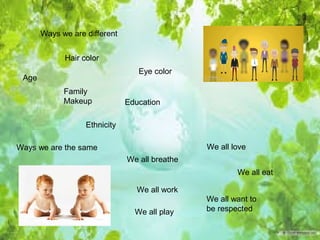
Ways we are different
We all breathe
Hair color
Eye color
Age
Education
Family
Makeup
Ethnicity
We all love
We all work
We all eat
We all want to
be respectedWe all play
Ways we are the same
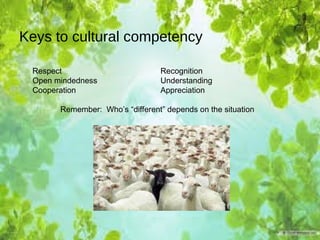
Keys to cultural competency
Respect Recognition
Open mindedness Understanding
Cooperation Appreciation
Remember: Who’s “different” depends on the situation
Keys to Cultural Competency
 Be “other minded”
 Be culturally aware (what culturally influenced
or impacted you?
 Regardless of the “group” remember the
individual
 Be empathetic
 Be respectful
 Be open and even curious
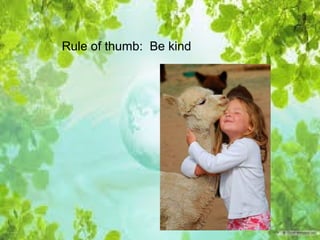
Rule of thumb: Be kind

8 cultural competency in a diverse environment2

  • 1.
    Cultural Competency in aDiverse Environment What is cultural competency? The ability work with diverse values, beliefs and behaviors including tailoring programs and processes to meet social, cultural, and linguistic needs.
  • 2.
    Cultural Competency in aDiverse Environment Why is cultural competency training important? In the relatively small community of Sundown M Ranch over 20 nationalities/races are represented. We are all influenced by the dimensions we bring with us wherever we go, such as profession, education, parental status, geographic location and much more Cultural competency is about learning from others who are not the same, about dignity and respect for all, and about creating workplace environments and practices that make differences work to our advantage.
  • 3.
    Why Talk AboutIt? Understanding Cultural Diversity: •Will increase the appreciation of differences represented among staff, clients and families •Will help preserve and encourage respect for the uniqueness of each individual •Will strengthen the organization by leveraging differences that mirror the diversity of our population and then using them to our advantage
  • 4.
    What if WeDon’t? If we overlook the importance of cultural competency: •We are unable to recognize differences for what they are (misperception, cultural background, language barrier, etc) •For Example: Mist is German for manure Walk up to someone from Germany with limited understanding of the English language and say “Don’t you just love a misty morning?” Most likely you are going to get a very confused, concerning look because
  • 5.
    What if WeDon’t? •For Example: The thumbs-up gesture in these cultures means “up yours” Give an Iranian or an Italian the thumbs up signal when visiting their country and you might just get punched because:
  • 6.
    What if WeDon’t? •For Example: In Thailand the head is the most sacred part of the body and not to be touched irreverently. See a cute little kids in Thailand and ruffled his hair and you might be surprised at his parent’s reaction because
  • 7.
    What if WeDon’t? If we overlook the importance of cultural competency: •We deny the significance of differences and the fact that our common humanity often transcends them (Common humanity understands kindness and tolerance) •We don’t challenge ourselves to ‘get inside the issue’ and really understand where someone else is coming from – which leads to friction and lack of progress or productivity •We miss the depth of feeling or the true motive that causes someone to be different, react differently, perceive things differently. We become rigid and static in our thinking.
  • 8.
    What’s our strategy? SundownM Ranch addresses Cultural Competency by: •Training to help eliminate bias, prejudice and discriminatory practices •Simple example: Cultural Competency Training •Using a variety of approaches with patients to meet their cultural needs •We design our treatment plan around what will work for each individual patient •Interacting in the appropriate language/method, either personally or through interpreter services •Simple example: Signing for the deaf, brail for the blind, foreign languages
  • 9.
    What’s our strategy? •Werecognize the diversity of the employee group and respect the differences. •Simple example: Male versus Female - If we learn to relate to and understand each other as employees, we can transfer that knowledge to dealing with patients, family, others •We recruit, select, train, and promote the best qualified candidates for employment regardless of ethnicity or cultural difference. •We recruit, select and train the best qualified persons, regardless of ethnicity or cultural differences, to serve on the Sundown M Ranch Board of Directors
  • 10.
    Ways we aredifferent We all breathe Hair color Eye color Age Education Family Makeup Ethnicity We all love We all work We all eat We all want to be respectedWe all play Ways we are the same
  • 11.
    Keys to culturalcompetency Respect Recognition Open mindedness Understanding Cooperation Appreciation Remember: Who’s “different” depends on the situation
  • 12.
    Keys to CulturalCompetency  Be “other minded”  Be culturally aware (what culturally influenced or impacted you?  Regardless of the “group” remember the individual  Be empathetic  Be respectful  Be open and even curious
  • 13.