denture insertion
denture insertion
dr. Eman husseiny mohammed
lecturer at prosthodontic department
Faculty of oral and dental medicine
Zagazig University
2021
1- knowledge and understanding :-
•Mention the various steps followed for
insertion of complete dentures
•Mention post insertion instructions
2- intellectual skills
•Correlate the clinical finding with
improperly constructed complete dentures
•Discover the appropriate treatment for
improperly constructed complete denture
denture insertion
denture insertion
A- Examination of the Finished Dentures
B- Treatment at the Time of Denture Insertion
1)Elimination of Basal Surface Errors
2) Evaluating Borders
3) Elimination of Maxillomandibular Relation
Errors
4) Correcting Occlusal Disharmony
5) Final Checks of The Prostheses
6) Patient education and management
7) Instructions to the patient
A-Examination of the Finished
Dentures
no imperfections on the tissue surface, Inspect for
spicules
the polished surface is smooth,
 the denture flanges have no sharp angles and are not too
thick,
 The denture borders are rounded and smooth with no
obvious overextension.
 The occlusion of all complete dentures should be
perfected before the patient is allowed to wear the
dentures.
B-Treatment at the Time of Denture
Insertion
1) 1- Elimination of Basal Surface Errors [fitting
surface, Intaglio Surface]
 any previous dentures out of the mouth for 12 to 24
hours immediately before the insertion appointment to
get the tissues healthy.
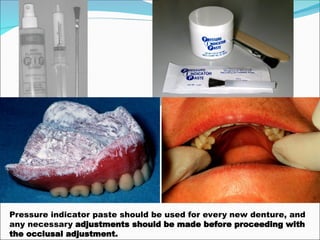
The use of pressure indicating paste is essential to
evaluate the accuracy of tissue contact especially when
- bilateral undercuts on residual ridge interfere with initial
placement of dentures
- When pressure spots are present or suspected in the final
impression.
Pressure indicator paste should be used for every new denture, and
any necessary adjustments should be made before proceeding with
the occlusal adjustment.
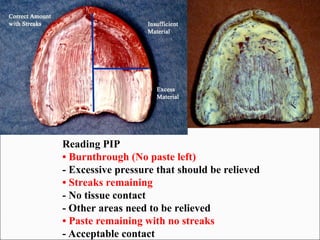
Reading PIP
• Burnthrough (No paste left)
- Excessive pressure that should be relieved
• Streaks remaining
- No tissue contact
- Other areas need to be relieved
• Paste remaining with no streaks
- Acceptable contact
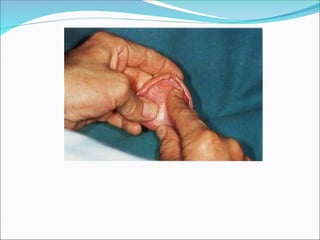
2) Evaluating Borders
Denture extension can be checked by:
A- Visual examination of the parts that can be easily
seen as the labial flanges (after slight raising of the
lip).
b- Palpation of the not-easily seen flanges, such as the
buccal flanges.
c- Testing paste as thin mix of alginate, or zinc oxide
eugenol paste (the white tube only) and disclosing
waxes are useful material.
To cheek the buccal and labial periphery:
1- Hold the denture in place with light pressure on the
occlusal surfaces of the teeth, and move the cheek on
one side gently, but firmly, simulating the motion it
makes when chewing.
2- Now relax the pressure on the teeth and observe if
the denture rises from
the ridge. If it does, trim the periphery where it is seen
to be overextended until little or no movement occurs.
3- Repeat for the opposite side and for the lip.
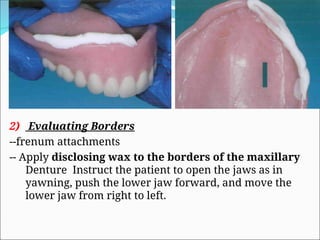
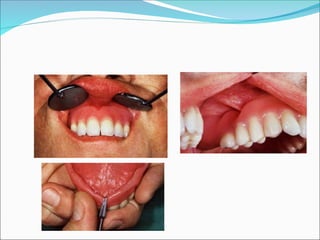
2) Evaluating Borders
--frenum attachments
-- Apply disclosing wax to the borders of the maxillary
Denture Instruct the patient to open the jaws as in
yawning, push the lower jaw forward, and move the
lower jaw from right to left.
3) Elimination of Maxillomandibular Relation
Errors:-
 Finished Dentures Exhibiting Incorrect Centric
Relation
If the difference is not more than a 1/4 cusp it may
be corrected by means of selective grinding.
When the error is gross it will require the removal of
all the posterior teeth from the lower denture and
new centric relation is recorded.( acrylic or
porcelain)
If the overjet resulting from the new record is
abnormal, the lower front teeth must also be
removed from the denture and new teeth are reset.
In most cases of gross error, the denture need to
be completely remade.
Finished Dentures Exhibiting an Incorrect
Vertical Dimension
 If the occlusal plane of the upper is judged to be
correct, a new lower denture with the correct
vertical height should be constructed.
 If the occlusal plane is incorrect, new upper and
lower dentures should be constructed.
4) Correcting Occlusal Disharmony (Error)
Errors in Occlusion Can Result From:-
I- Clinical errors in registering maxillo-mandibular
relationship.
II- Errors in mounting models on the articulator.
III- Errors arising during processing of the dentures.
I- Clinical Errors:-
1- Record bases that do not fit accurately as a result of faulty
adaptation or warpage of the bases or the presence of
intervening wax on the models.
2- A shifting of the record bases over displaceable tissues.
3- Record bases placed on abuse tissues that have been
resulted from ill-fitting dentures.
4- Excessive pressure exerted by the patient during the
registering of maxillomandibular relations.
5- Unequal distribution of stress (uneven bearing) during
registering of maxillomandibular relations. This may be due to
premature contact of the record rims on one side of the mouth
in the second molar region of both sides or in the incisor region.
6- Interference of the record bases in the posterior region
during registeration
7- Tooth movement may occur when trying in the waxed
dentures.
8- Patients not registering centric relation because of systemic
factors such as muscle spasm, abnormalities of muscle tonus,
or because of inability of mental, aged, or senile patients to
understand instructions-factors beyond the control of the
dentist.
II- Errors in Mounting Casts:-
1- Record bases that are not properly seated and secured to casts
during mounting procedures.
2- Occlusion rims not being definitely locked or keyed for correct
orientation during the mounting on the articulator.(moved against
each other)
3- Distortion of the wax used in sealing the record rims together. For
this reason, softened wax is preferred than soft type waxes
because it hardens immediately after sealing.
4- Interference of casts in the posterior region during mounting
.
5- Articulator not maintaining horizontal and vertical
relationship of casts e.g. interfering wax or plaster or loose
mounting ring.
6- Inaccuracies introduced by changes in the plaster used to
mount the casts.
7- Articulator wears. All articulators are subject to wear and the
older and more worn the articulator the greater will be the errors
in occlusion and articulation
III- Errors Arising During Processing of the Denture:-
1- Irregularities in setting the teeth. The technician when
setting teeth is unlikely to produce a perfectly even contact in
centric and lateral occlusions, some teeth will be in good
occlusion whilst other will be slightly out of occlusion, thus
producing areas of heavy pressure.tech.factor
2- In waxing up. It is possible for the teeth to move slightly due
to the contraction of the wax on cooling, causing irregularities
in the articulation and occlusion of completed dentures.
3- Tooth movement when flasking and packing.
4- Incomplete flask closure. Such an occurrence not only
causes increase of vertical dimension but also results in an
upset balanced occlusion.
5- Warpage of the dentures by overheating them during
polishing.
Treatment of occlusal disharmony
These errors in occlusion must be eliminated before the
dentures are worn, so the soft tissues interposed
between the bone and the denture bases will not be
distorted by
discrepancies in the occlusion.
One of the following methods may be used for correcting
occlusal disharmony by selective grinding:
I- Intraoral methods.
II- (laboratory remount)
III- Remount via new jaw relationship records.(clinical
remount)
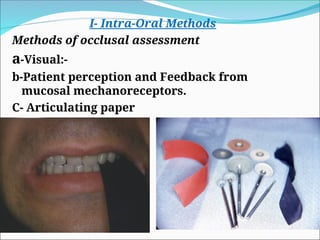
I- Intra-Oral Methods
Methods of occlusal assessment
a-Visual:-
b-Patient perception and Feedback from
mucosal mechanoreceptors.
C- Articulating paper
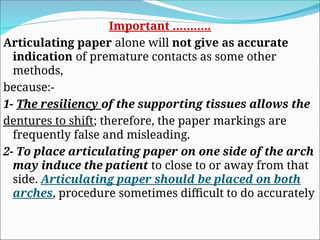
Important ………..
Articulating paper alone will not give as accurate
indication of premature contacts as some other
methods,
because:-
1- The resiliency of the supporting tissues allows the
dentures to shift; therefore, the paper markings are
frequently false and misleading.
2- To place articulating paper on one side of the arch
may induce the patient to close to or away from that
side. Articulating paper should be placed on both
arches, procedure sometimes difficult to do accurately
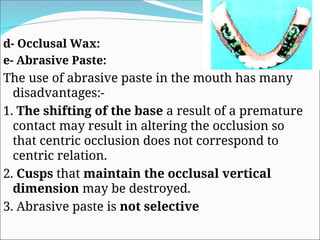
d- Occlusal Wax:
e- Abrasive Paste:
The use of abrasive paste in the mouth has many
disadvantages:-
1. The shifting of the base a result of a premature
contact may result in altering the occlusion so
that centric occlusion does not correspond to
centric relation.
2. Cusps that maintain the occlusal vertical
dimension may be destroyed.
3. Abrasive paste is not selective
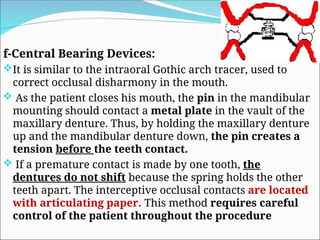
f-Central Bearing Devices:
It is similar to the intraoral Gothic arch tracer, used to
correct occlusal disharmony in the mouth.
 As the patient closes his mouth, the pin in the mandibular
mounting should contact a metal plate in the vault of the
maxillary denture. Thus, by holding the maxillary denture
up and the mandibular denture down, the pin creates a
tension before the teeth contact.
 If a premature contact is made by one tooth, the
dentures do not shift because the spring holds the other
teeth apart. The interceptive occlusal contacts are located
with articulating paper. This method requires careful
control of the patient throughout the procedure
Important …..
Disadvantage of the intra-oral method:-
Shifting of the dentures over resilient
supporting tissues in eccentric jaw positions
will give false markings. This is an excellent
method for correcting occlusion in the centric
position.
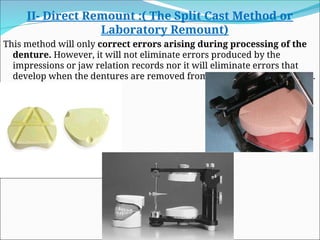
II- Direct Remount :( The Split Cast Method or
Laboratory Remount)
This method will only correct errors arising during processing of the
denture. However, it will not eliminate errors produced by the
impressions or jaw relation records nor it will eliminate errors that
develop when the dentures are removed from the casts or are polished.
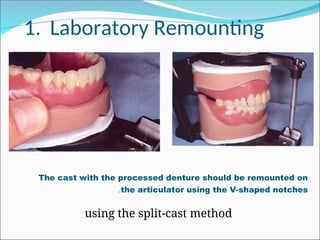
1. Laboratory Remounting
using the split-cast method
The cast with the processed denture should be remounted on
the articulator using the V-shaped notches
.
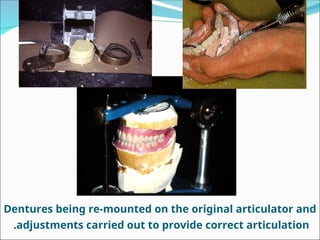
Dentures being re-mounted on the original articulator and
adjustments carried out to provide correct articulation
.
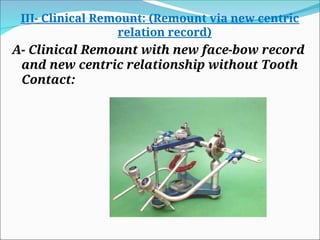
III- Clinical Remount: (Remount via new centric
relation record)
A- Clinical Remount with new face-bow record
and new centric relationship without Tooth
Contact:
III- Clinical Remount: (Remount via new centric
relation record)
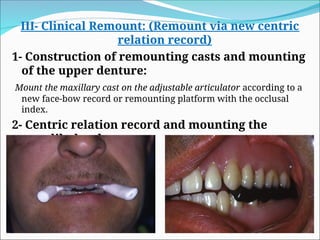
1- Construction of remounting casts and mounting
of the upper denture:
Mount the maxillary cast on the adjustable articulator according to a
new face-bow record or remounting platform with the occlusal
index.
2- Centric relation record and mounting the
mandibular denture:
Centric relation record and mounting the
mandibular denture:
a- The upper denture is seated in position in the
mouth.
b- A strip of softened wax of double thickness is
placed on occlusal surface of the lower denture.
c- The lower denture is seated in the mouth and
the patient requested to close in the retruded
position until the teeth are almost in occlusion.
It is extremely important that the teeth are not
allowed to make contact, for if tooth contact does
occur the lower cusps by moving along the cuspal
inclines of
the upper teeth may guide the mandible into the
position of occlusion to which the dentures were
constructed and thus, if an error exists, prevent the
desired correction of maxillomandibular
relationship.
d- mounting the lower cast with the new record
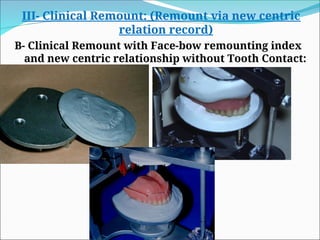
III- Clinical Remount: (Remount via new centric
relation record)
B- Clinical Remount with Face-bow remounting index
and new centric relationship without Tooth Contact:
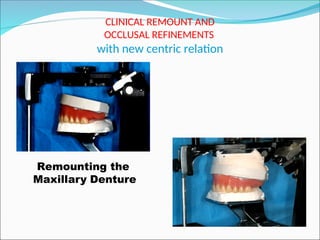
CLINICAL REMOUNT AND
OCCLUSAL REFINEMENTS
with new centric relation
Remounting the
Maxillary Denture
Selective grinding
For anatomic teeth
I-Grinding In Centric Occlusion:
II-Grinding To Obtain Occlusal Balance in Lateral
Movements:
Posterior teeth: Working side-Balancing side:
III-Grinding to Obtain Occlusal Balance in
Protrusive Movements:
IV- Milling-In
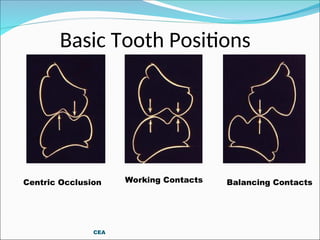
Basic Tooth Positions
CEA
Balancing Contacts
Centric Occlusion Working Contacts
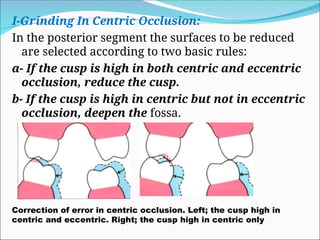
I-Grinding In Centric Occlusion:
In the posterior segment the surfaces to be reduced
are selected according to two basic rules:
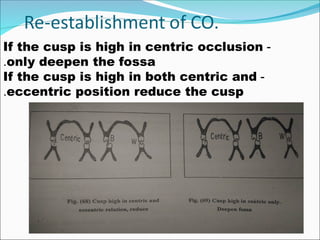
a- If the cusp is high in both centric and eccentric
occlusion, reduce the cusp.
b- If the cusp is high in centric but not in eccentric
occlusion, deepen the fossa.
Correction of error in centric occlusion. Left; the cusp high in
centric and eccentric. Right; the cusp high in centric only
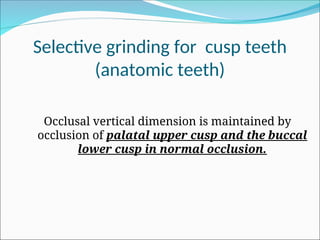
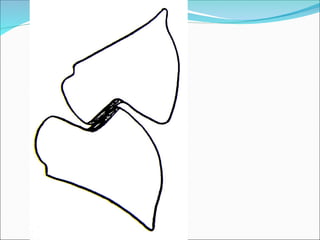
Selective grinding for cusp teeth
(anatomic teeth)
Occlusal vertical dimension is maintained by
occlusion of palatal upper cusp and the buccal
lower cusp in normal occlusion.
-
If the cusp is high in centric occlusion
only deepen the fossa
.
-
If the cusp is high in both centric and
eccentric position reduce the cusp
.
After the CO re-establishment….
 DO NOT:
 Reduce maxillary palatal cusps.
 Reduce mandibular buccal cusps.
 Deepen the fossae.
CEA
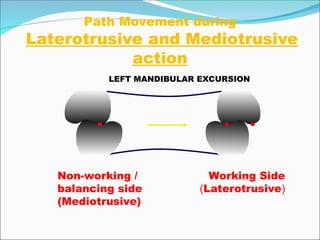
Path Movement during
Laterotrusive and Mediotrusive
action
Non-working /
balancing side
(Mediotrusive)
Working Side
(
Laterotrusive
)
LEFT MANDIBULAR EXCURSION
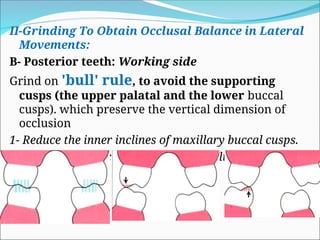
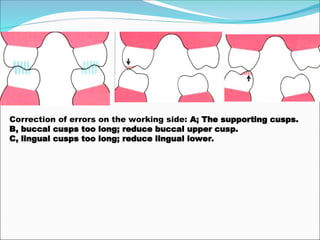
II-Grinding To Obtain Occlusal Balance in Lateral
Movements:
B- Posterior teeth: Working side
Grind on 'bull' rule, to avoid the supporting
cusps (the upper palatal and the lower buccal
cusps). which preserve the vertical dimension of
occlusion
1- Reduce the inner inclines of maxillary buccal cusps.
2- Reduce inner inclines of mandibular lingual cusps.
Correction of errors on the working side: A; The supporting cusps.
B, buccal cusps too long; reduce buccal upper cusp.
C, lingual cusps too long; reduce lingual lower.
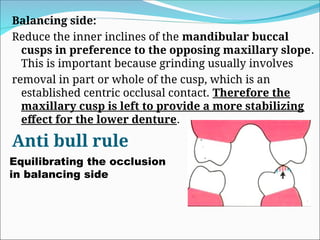
Balancing side:
Reduce the inner inclines of the mandibular buccal
cusps in preference to the opposing maxillary slope.
This is important because grinding usually involves
removal in part or whole of the cusp, which is an
established centric occlusal contact. Therefore the
maxillary cusp is left to provide a more stabilizing
effect for the lower denture.
Anti bull rule
Equilibrating the occlusion
in balancing side
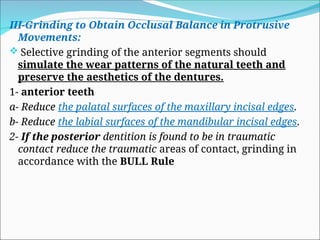
III-Grinding to Obtain Occlusal Balance in Protrusive
Movements:
 Selective grinding of the anterior segments should
simulate the wear patterns of the natural teeth and
preserve the aesthetics of the dentures.
1- anterior teeth
a- Reduce the palatal surfaces of the maxillary incisal edges.
b- Reduce the labial surfaces of the mandibular incisal edges.
2- If the posterior dentition is found to be in traumatic
contact reduce the traumatic areas of contact, grinding in
accordance with the BULL Rule
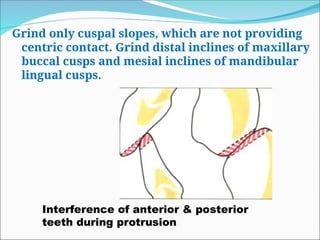
Grind only cuspal slopes, which are not providing
centric contact. Grind distal inclines of maxillary
buccal cusps and mesial inclines of mandibular
lingual cusps.
Interference of anterior & posterior
teeth during protrusion
IV- Milling-In
A small amount of abrasive paste is placed over
the lower teeth and the articulator is closed in
centric position. Several movements are made
from centric into each eccentric position to
eliminate any slight interference
5) Final Checks of The Prostheses
 the dentures should be evaluated for proper contour and
thickness. Improper contour can affect the final fit of the
prostheses and make muscles work against stabilization
instead of enhancing it.
 Contours of most external surfaces should be slightly
concave from the necks of the teeth to the denture borders.
 The palate should be 2-3 mm thick for proper strength and
be thinned to blend with the posterior palate after the
posterior palatal seal is finalized.
 All surfaces should be smooth and highly polished.
6) Patient education and management
1- Individuality of the patient:-
Patients must be reminded that their anatomic,
sychological, tissue tolerance and oral
conditions are individual in nature. Thus, they
cannot compare their progress with new dentures
to other persons’ experiences
2- Appearance with new dentures
Patients must understand that their appearance with
new dentures will become more natural with
time.
A repositioning of the oral and facial muscles and a
restoration of the former facial dimension and
contour by the new dentures may seem like too
great a change in the patient’s appearance.
3- Mastication with new dentures:
The food should be cut into small pieces and the
patient should take his time chewing.
 Learning to chew satisfactorily with new dentures
usually requires at least 6 to 8 weeks.
The most efficient artificial teeth are only about one
third as efficient as natural teeth. Eating habits must
be changed to compensate for this difference.
Sticky foods or hard foods that require considerable
force to masticate should be avoided.
 Patients should begin chewing relatively soft
food that has been cut into small pieces. If the
chewing can be done on both sides of the mouth
at the same time, the tendency of the dentures to
tip will be reduced.
 When biting with dentures, patients should be
instructed to place the food between their teeth
toward the corners of the mouth, rather than
between the anterior teeth.(avoid anterior biting)
Placing the food posteriorly, in the area of the first
molar, increases the power of the masticatory stroke and
places the occlusal load over the primary bearing area
 Biting with the front teeth, even if possible, should
be avoided. If this practice is continued, the support
will be lost, and the dentures will become loose. The
anterior part of the maxilla is the weakest part of the
upper arch to resist stress, and when the lower
anterior teeth occlude anterior to the basal support,
trauma is inevitable.
4-Coughing and sneezing:
Coughing and sneezing often dislodge the dentures.
Embarrassment can be avoided by covering the
mouth with a handkerchief.
5-Tasting
Taste sensitivity may be reduced when an upper
denture covers the hard palate due to the fact that
- A smooth denture surface may modify sense of
touch within oral cavity.
- it“protect” the mucosa from the sensation of hot or
cold foods.
- A reduced salivary flow rate also may have a
negative effect on taste perception, because the
flavoring agents in food are less likely to be dissolved.
6- Tongue position:-
Patients should be educated to the three basic problems associated
with all mandibular dentures.
1- The area of the mandibular denture basal seat is
approximately one-third the area of the maxillary denture and
both are subjected to the same occlusal loads and thrusts.
2- The mandibular denture is surrounded buccally as well as
lingually by muscles, all of which have a potential for denture
base disruption.
3- The mandibular denture depends on proper tongue position to
maintain adequate peripheral seal and stability.
Patients, whose tongue normally rests in a retracted
position relative to the lower anterior teeth, should
attempt to position the tongue farther forward
so it rests on the lingual surfaces of the lower
anterior teeth. This will help develop stability for
the lower denture.
7- Speaking with new dentures:
the tongue may be cramped temporarily by the bulk of the
lingual flange of the lower denture.
 Patients should be advised to read loud, and repeat words
or phrases that are difficult to pronounce.
Speech adaptation to a new denture usually takes place
between 2-4 weeks
 Speaking may be affected by:
 Change in tooth Shape, Size & Position (esp. anteriors)
 Tongue space
 Palatal contours
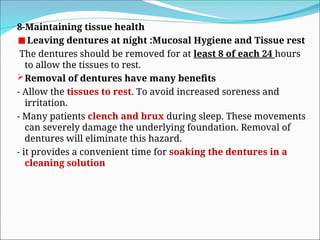
8-Maintaining tissue health
Leaving dentures at night :Mucosal Hygiene and Tissue rest
The dentures should be removed for at least 8 of each 24 hours
to allow the tissues to rest.
Removal of dentures have many benefits
- Allow the tissues to rest. To avoid increased soreness and
irritation.
- Many patients clench and brux during sleep. These movements
can severely damage the underlying foundation. Removal of
dentures will eliminate this hazard.
- it provides a convenient time for soaking the dentures in a
cleaning solution
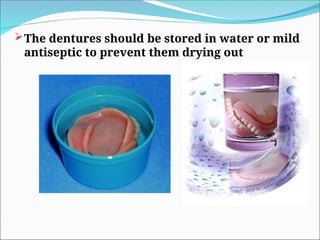
The dentures should be stored in water or mild
antiseptic to prevent them drying out
Tissue hygiene and massage
Massage all of the tissue - this will improve health
and stimulates tissue.
The mucosal surfaces of the residual ridges and the
dorsal surface of the tongue also should be brushed
daily with a soft brush. This will increase the
circulation and remove plaque and debris that
can cause irritation of the soft tissue or offensive
odors.
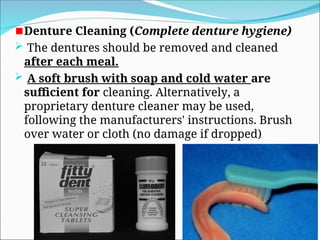
Denture Cleaning (Complete denture hygiene)
 The dentures should be removed and cleaned
after each meal.
 A soft brush with soap and cold water are
sufficient for cleaning. Alternatively, a
proprietary denture cleaner may be used,
following the manufacturers' instructions. Brush
over water or cloth (no damage if dropped)
The patient should be warned against using hard brasive
materials and hard bristle brushes, since both will wear
away the surface detail of the teeth and denture base.
Commercial Chemical Cleaners : Soak overnight to be
effective , 15-30 minutes is not sufficient . Solutions containing
phenol must be avoided as it may craze surface of the denture.
Denture cleanliness is essential to prevent malodor, poor
esthetics, and the accumulation of plaque/calculus and
biofilm which are major etiologic factors in the pathogenesis of
denture stomatitis, inflammatory papillary hyperplasia,
and chronic candidiasis.
9- Denture adhesives:-
Adhesives, especially home reliners, can modify
the position of the denture on the residual ridge,
resulting in a change of occlusal vertical
dimension or a change in the tooth contact in
the centric relation position, which may cause
irreparable damage to the residual ridges in a
short time.
The use of a denture adhesive is not a treatment
modality, but rather an adjunct to denture treatment.
(1) Use the minimum amount necessary to achieve the
desired result.
(2) Distribute the adhesive evenly over the tissue-
bearing surfaces.
(3) Apply or reapply when necessary.
(4) Always apply denture adhesive to a clean tissue-
bearing surface.
Regardless of the adhesive used, patients should
keep both the denture and soft tissues clean.
Adhesives can be very tenacious, and if they are
not completely
removed from the denture and the mouth, they can
harbor organisms harmful to the patient’s oral
health.
10-Pain and soreness:
Pain and soreness occur with new dentures.
Adjustment may be required. If the pain is severe, the
patient should leave the dentures out and arrange an
appointment with his dentist as soon as possible.
The patient should wear the dentures the day he
returns to the dentist so that the sore area may be
seen.
The patient should never attempt to adjust the
denture himself.
 The patient should be asked to attend for
examination 24 hours after the insertion to carry
out any necessary adjustments
 Soreness may occur in that time due to the fact that
functional trimming of the peripheries at the
impression stage rarely reproduce the functional
movements, and when the dentures are first worn
there is probably slight overextension somewhere.
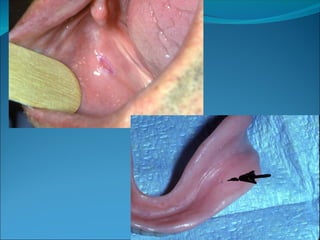
 The flange of the denture is thus too deep and
presses into the tissues of the sulcus forming, first
an angry line, which later breaks down into an
ulcer,. Also, in that time the denture will have
settled with possible slight changes in the evenness
of occlusion.
 A further visit may be necessary for the final
correction as it is never wise to remove too much
of the periphery at one stage, since over-easing
may lead to a leak in the peripheral seal.
11- Periodic recall for oral examination
The patient should be seen 24 hours after placement of the
dentures to address any difficulties or to answer any
questions the patient may have.
Periodic recall appointments should also be scheduled 1
week and 1 month after placement for the same purpose.
It is important to stress the importance of annual recalls
to make sure no damaging wear patterns develop that
could cause injury to underlying supporting structures
12- Educational material for patients
provide denture-wearing patients with printed
information about their new teeth, about the
care and cleaning of the teeth, about their
use.
7) Instructions to the patient
 Complete denture wearer should insert the lower
denture first.
 It is better to avoid eating hard food with new
dentures
 It is advised to eat soft food in the beginning and
slowly progress to hard food.
 Handle dentures carefully ,they can break if
dropped.
 Dentures should be cleaned after every meal
 In the night it is better to discontinue the use of
denture
 In the morning the denture should be cleaned using
soap and brush
 Do not clean the dentures using hot water or
chemicals
 When the dentures are not in use, keep in water
 In case of breakage of dentures report to repair
 it is imperative that you follow your doctor’s advice
1. Zarb GA, Bolender CL, Hickey JC, and Carlson CE: Boucher's prosthodontics
treatment for edentulous
patients,12th
ed.2004, C.V. Mosby Co. St. Louis.
2. Nallaswamy D. Text Book of Prosthodontics.1st ed,2003 Jaypee Brothers Medical
Puplishers (p) Ltd .
3. Winkler Sh: Essentials of Complete Denture Porosthodontics.2nd ed,2009
Ishiyaku EuroAmerica Inc.,USA

lecture denture insertion - dif Copy.ppt

  • 1.
    denture insertion denture insertion dr.Eman husseiny mohammed lecturer at prosthodontic department Faculty of oral and dental medicine Zagazig University 2021
  • 2.
    1- knowledge andunderstanding :- •Mention the various steps followed for insertion of complete dentures •Mention post insertion instructions 2- intellectual skills •Correlate the clinical finding with improperly constructed complete dentures •Discover the appropriate treatment for improperly constructed complete denture
  • 3.
    denture insertion denture insertion A-Examination of the Finished Dentures B- Treatment at the Time of Denture Insertion 1)Elimination of Basal Surface Errors 2) Evaluating Borders 3) Elimination of Maxillomandibular Relation Errors 4) Correcting Occlusal Disharmony 5) Final Checks of The Prostheses 6) Patient education and management 7) Instructions to the patient
  • 4.
    A-Examination of theFinished Dentures no imperfections on the tissue surface, Inspect for spicules the polished surface is smooth,  the denture flanges have no sharp angles and are not too thick,  The denture borders are rounded and smooth with no obvious overextension.  The occlusion of all complete dentures should be perfected before the patient is allowed to wear the dentures.
  • 6.
    B-Treatment at theTime of Denture Insertion 1) 1- Elimination of Basal Surface Errors [fitting surface, Intaglio Surface]  any previous dentures out of the mouth for 12 to 24 hours immediately before the insertion appointment to get the tissues healthy. The use of pressure indicating paste is essential to evaluate the accuracy of tissue contact especially when - bilateral undercuts on residual ridge interfere with initial placement of dentures - When pressure spots are present or suspected in the final impression.
  • 7.
    Pressure indicator pasteshould be used for every new denture, and any necessary adjustments should be made before proceeding with the occlusal adjustment.
  • 8.
    Reading PIP • Burnthrough(No paste left) - Excessive pressure that should be relieved • Streaks remaining - No tissue contact - Other areas need to be relieved • Paste remaining with no streaks - Acceptable contact
  • 9.
    2) Evaluating Borders Dentureextension can be checked by: A- Visual examination of the parts that can be easily seen as the labial flanges (after slight raising of the lip). b- Palpation of the not-easily seen flanges, such as the buccal flanges. c- Testing paste as thin mix of alginate, or zinc oxide eugenol paste (the white tube only) and disclosing waxes are useful material.
  • 10.
    To cheek thebuccal and labial periphery: 1- Hold the denture in place with light pressure on the occlusal surfaces of the teeth, and move the cheek on one side gently, but firmly, simulating the motion it makes when chewing. 2- Now relax the pressure on the teeth and observe if the denture rises from the ridge. If it does, trim the periphery where it is seen to be overextended until little or no movement occurs. 3- Repeat for the opposite side and for the lip.
  • 11.
    2) Evaluating Borders --frenumattachments -- Apply disclosing wax to the borders of the maxillary Denture Instruct the patient to open the jaws as in yawning, push the lower jaw forward, and move the lower jaw from right to left.
  • 13.
    3) Elimination ofMaxillomandibular Relation Errors:-  Finished Dentures Exhibiting Incorrect Centric Relation If the difference is not more than a 1/4 cusp it may be corrected by means of selective grinding. When the error is gross it will require the removal of all the posterior teeth from the lower denture and new centric relation is recorded.( acrylic or porcelain) If the overjet resulting from the new record is abnormal, the lower front teeth must also be removed from the denture and new teeth are reset. In most cases of gross error, the denture need to be completely remade.
  • 14.
    Finished Dentures Exhibitingan Incorrect Vertical Dimension  If the occlusal plane of the upper is judged to be correct, a new lower denture with the correct vertical height should be constructed.  If the occlusal plane is incorrect, new upper and lower dentures should be constructed.
  • 15.
    4) Correcting OcclusalDisharmony (Error) Errors in Occlusion Can Result From:- I- Clinical errors in registering maxillo-mandibular relationship. II- Errors in mounting models on the articulator. III- Errors arising during processing of the dentures.
  • 16.
    I- Clinical Errors:- 1-Record bases that do not fit accurately as a result of faulty adaptation or warpage of the bases or the presence of intervening wax on the models. 2- A shifting of the record bases over displaceable tissues. 3- Record bases placed on abuse tissues that have been resulted from ill-fitting dentures. 4- Excessive pressure exerted by the patient during the registering of maxillomandibular relations. 5- Unequal distribution of stress (uneven bearing) during registering of maxillomandibular relations. This may be due to premature contact of the record rims on one side of the mouth in the second molar region of both sides or in the incisor region.
  • 17.
    6- Interference ofthe record bases in the posterior region during registeration 7- Tooth movement may occur when trying in the waxed dentures. 8- Patients not registering centric relation because of systemic factors such as muscle spasm, abnormalities of muscle tonus, or because of inability of mental, aged, or senile patients to understand instructions-factors beyond the control of the dentist.
  • 18.
    II- Errors inMounting Casts:- 1- Record bases that are not properly seated and secured to casts during mounting procedures. 2- Occlusion rims not being definitely locked or keyed for correct orientation during the mounting on the articulator.(moved against each other) 3- Distortion of the wax used in sealing the record rims together. For this reason, softened wax is preferred than soft type waxes because it hardens immediately after sealing. 4- Interference of casts in the posterior region during mounting . 5- Articulator not maintaining horizontal and vertical relationship of casts e.g. interfering wax or plaster or loose mounting ring. 6- Inaccuracies introduced by changes in the plaster used to mount the casts. 7- Articulator wears. All articulators are subject to wear and the older and more worn the articulator the greater will be the errors in occlusion and articulation
  • 19.
    III- Errors ArisingDuring Processing of the Denture:- 1- Irregularities in setting the teeth. The technician when setting teeth is unlikely to produce a perfectly even contact in centric and lateral occlusions, some teeth will be in good occlusion whilst other will be slightly out of occlusion, thus producing areas of heavy pressure.tech.factor 2- In waxing up. It is possible for the teeth to move slightly due to the contraction of the wax on cooling, causing irregularities in the articulation and occlusion of completed dentures. 3- Tooth movement when flasking and packing. 4- Incomplete flask closure. Such an occurrence not only causes increase of vertical dimension but also results in an upset balanced occlusion. 5- Warpage of the dentures by overheating them during polishing.
  • 20.
    Treatment of occlusaldisharmony These errors in occlusion must be eliminated before the dentures are worn, so the soft tissues interposed between the bone and the denture bases will not be distorted by discrepancies in the occlusion. One of the following methods may be used for correcting occlusal disharmony by selective grinding: I- Intraoral methods. II- (laboratory remount) III- Remount via new jaw relationship records.(clinical remount)
  • 21.
    I- Intra-Oral Methods Methodsof occlusal assessment a-Visual:- b-Patient perception and Feedback from mucosal mechanoreceptors. C- Articulating paper
  • 22.
    Important ……….. Articulating paperalone will not give as accurate indication of premature contacts as some other methods, because:- 1- The resiliency of the supporting tissues allows the dentures to shift; therefore, the paper markings are frequently false and misleading. 2- To place articulating paper on one side of the arch may induce the patient to close to or away from that side. Articulating paper should be placed on both arches, procedure sometimes difficult to do accurately
  • 23.
    d- Occlusal Wax: e-Abrasive Paste: The use of abrasive paste in the mouth has many disadvantages:- 1. The shifting of the base a result of a premature contact may result in altering the occlusion so that centric occlusion does not correspond to centric relation. 2. Cusps that maintain the occlusal vertical dimension may be destroyed. 3. Abrasive paste is not selective
  • 24.
    f-Central Bearing Devices: Itis similar to the intraoral Gothic arch tracer, used to correct occlusal disharmony in the mouth.  As the patient closes his mouth, the pin in the mandibular mounting should contact a metal plate in the vault of the maxillary denture. Thus, by holding the maxillary denture up and the mandibular denture down, the pin creates a tension before the teeth contact.  If a premature contact is made by one tooth, the dentures do not shift because the spring holds the other teeth apart. The interceptive occlusal contacts are located with articulating paper. This method requires careful control of the patient throughout the procedure
  • 25.
    Important ….. Disadvantage ofthe intra-oral method:- Shifting of the dentures over resilient supporting tissues in eccentric jaw positions will give false markings. This is an excellent method for correcting occlusion in the centric position.
  • 26.
    II- Direct Remount:( The Split Cast Method or Laboratory Remount) This method will only correct errors arising during processing of the denture. However, it will not eliminate errors produced by the impressions or jaw relation records nor it will eliminate errors that develop when the dentures are removed from the casts or are polished.
  • 27.
    1. Laboratory Remounting usingthe split-cast method The cast with the processed denture should be remounted on the articulator using the V-shaped notches .
  • 28.
    Dentures being re-mountedon the original articulator and adjustments carried out to provide correct articulation .
  • 29.
    III- Clinical Remount:(Remount via new centric relation record) A- Clinical Remount with new face-bow record and new centric relationship without Tooth Contact:
  • 30.
    III- Clinical Remount:(Remount via new centric relation record) 1- Construction of remounting casts and mounting of the upper denture: Mount the maxillary cast on the adjustable articulator according to a new face-bow record or remounting platform with the occlusal index. 2- Centric relation record and mounting the mandibular denture:
  • 31.
    Centric relation recordand mounting the mandibular denture: a- The upper denture is seated in position in the mouth. b- A strip of softened wax of double thickness is placed on occlusal surface of the lower denture. c- The lower denture is seated in the mouth and the patient requested to close in the retruded position until the teeth are almost in occlusion.
  • 32.
    It is extremelyimportant that the teeth are not allowed to make contact, for if tooth contact does occur the lower cusps by moving along the cuspal inclines of the upper teeth may guide the mandible into the position of occlusion to which the dentures were constructed and thus, if an error exists, prevent the desired correction of maxillomandibular relationship. d- mounting the lower cast with the new record
  • 33.
    III- Clinical Remount:(Remount via new centric relation record) B- Clinical Remount with Face-bow remounting index and new centric relationship without Tooth Contact:
  • 34.
    CLINICAL REMOUNT AND OCCLUSALREFINEMENTS with new centric relation Remounting the Maxillary Denture
  • 35.
    Selective grinding For anatomicteeth I-Grinding In Centric Occlusion: II-Grinding To Obtain Occlusal Balance in Lateral Movements: Posterior teeth: Working side-Balancing side: III-Grinding to Obtain Occlusal Balance in Protrusive Movements: IV- Milling-In
  • 36.
    Basic Tooth Positions CEA BalancingContacts Centric Occlusion Working Contacts
  • 37.
    I-Grinding In CentricOcclusion: In the posterior segment the surfaces to be reduced are selected according to two basic rules: a- If the cusp is high in both centric and eccentric occlusion, reduce the cusp. b- If the cusp is high in centric but not in eccentric occlusion, deepen the fossa. Correction of error in centric occlusion. Left; the cusp high in centric and eccentric. Right; the cusp high in centric only
  • 38.
    Selective grinding forcusp teeth (anatomic teeth) Occlusal vertical dimension is maintained by occlusion of palatal upper cusp and the buccal lower cusp in normal occlusion.
  • 40.
    - If the cuspis high in centric occlusion only deepen the fossa . - If the cusp is high in both centric and eccentric position reduce the cusp .
  • 41.
    After the COre-establishment….  DO NOT:  Reduce maxillary palatal cusps.  Reduce mandibular buccal cusps.  Deepen the fossae. CEA
  • 42.
    Path Movement during Laterotrusiveand Mediotrusive action Non-working / balancing side (Mediotrusive) Working Side ( Laterotrusive ) LEFT MANDIBULAR EXCURSION
  • 43.
    II-Grinding To ObtainOcclusal Balance in Lateral Movements: B- Posterior teeth: Working side Grind on 'bull' rule, to avoid the supporting cusps (the upper palatal and the lower buccal cusps). which preserve the vertical dimension of occlusion 1- Reduce the inner inclines of maxillary buccal cusps. 2- Reduce inner inclines of mandibular lingual cusps.
  • 44.
    Correction of errorson the working side: A; The supporting cusps. B, buccal cusps too long; reduce buccal upper cusp. C, lingual cusps too long; reduce lingual lower.
  • 45.
    Balancing side: Reduce theinner inclines of the mandibular buccal cusps in preference to the opposing maxillary slope. This is important because grinding usually involves removal in part or whole of the cusp, which is an established centric occlusal contact. Therefore the maxillary cusp is left to provide a more stabilizing effect for the lower denture. Anti bull rule Equilibrating the occlusion in balancing side
  • 46.
    III-Grinding to ObtainOcclusal Balance in Protrusive Movements:  Selective grinding of the anterior segments should simulate the wear patterns of the natural teeth and preserve the aesthetics of the dentures. 1- anterior teeth a- Reduce the palatal surfaces of the maxillary incisal edges. b- Reduce the labial surfaces of the mandibular incisal edges. 2- If the posterior dentition is found to be in traumatic contact reduce the traumatic areas of contact, grinding in accordance with the BULL Rule
  • 47.
    Grind only cuspalslopes, which are not providing centric contact. Grind distal inclines of maxillary buccal cusps and mesial inclines of mandibular lingual cusps. Interference of anterior & posterior teeth during protrusion
  • 48.
    IV- Milling-In A smallamount of abrasive paste is placed over the lower teeth and the articulator is closed in centric position. Several movements are made from centric into each eccentric position to eliminate any slight interference
  • 49.
    5) Final Checksof The Prostheses  the dentures should be evaluated for proper contour and thickness. Improper contour can affect the final fit of the prostheses and make muscles work against stabilization instead of enhancing it.  Contours of most external surfaces should be slightly concave from the necks of the teeth to the denture borders.  The palate should be 2-3 mm thick for proper strength and be thinned to blend with the posterior palate after the posterior palatal seal is finalized.  All surfaces should be smooth and highly polished.
  • 50.
    6) Patient educationand management 1- Individuality of the patient:- Patients must be reminded that their anatomic, sychological, tissue tolerance and oral conditions are individual in nature. Thus, they cannot compare their progress with new dentures to other persons’ experiences
  • 51.
    2- Appearance withnew dentures Patients must understand that their appearance with new dentures will become more natural with time. A repositioning of the oral and facial muscles and a restoration of the former facial dimension and contour by the new dentures may seem like too great a change in the patient’s appearance.
  • 52.
    3- Mastication withnew dentures: The food should be cut into small pieces and the patient should take his time chewing.  Learning to chew satisfactorily with new dentures usually requires at least 6 to 8 weeks. The most efficient artificial teeth are only about one third as efficient as natural teeth. Eating habits must be changed to compensate for this difference. Sticky foods or hard foods that require considerable force to masticate should be avoided.
  • 53.
     Patients shouldbegin chewing relatively soft food that has been cut into small pieces. If the chewing can be done on both sides of the mouth at the same time, the tendency of the dentures to tip will be reduced.  When biting with dentures, patients should be instructed to place the food between their teeth toward the corners of the mouth, rather than between the anterior teeth.(avoid anterior biting)
  • 54.
    Placing the foodposteriorly, in the area of the first molar, increases the power of the masticatory stroke and places the occlusal load over the primary bearing area  Biting with the front teeth, even if possible, should be avoided. If this practice is continued, the support will be lost, and the dentures will become loose. The anterior part of the maxilla is the weakest part of the upper arch to resist stress, and when the lower anterior teeth occlude anterior to the basal support, trauma is inevitable.
  • 55.
    4-Coughing and sneezing: Coughingand sneezing often dislodge the dentures. Embarrassment can be avoided by covering the mouth with a handkerchief.
  • 56.
    5-Tasting Taste sensitivity maybe reduced when an upper denture covers the hard palate due to the fact that - A smooth denture surface may modify sense of touch within oral cavity. - it“protect” the mucosa from the sensation of hot or cold foods. - A reduced salivary flow rate also may have a negative effect on taste perception, because the flavoring agents in food are less likely to be dissolved.
  • 57.
    6- Tongue position:- Patientsshould be educated to the three basic problems associated with all mandibular dentures. 1- The area of the mandibular denture basal seat is approximately one-third the area of the maxillary denture and both are subjected to the same occlusal loads and thrusts. 2- The mandibular denture is surrounded buccally as well as lingually by muscles, all of which have a potential for denture base disruption. 3- The mandibular denture depends on proper tongue position to maintain adequate peripheral seal and stability.
  • 58.
    Patients, whose tonguenormally rests in a retracted position relative to the lower anterior teeth, should attempt to position the tongue farther forward so it rests on the lingual surfaces of the lower anterior teeth. This will help develop stability for the lower denture.
  • 59.
    7- Speaking withnew dentures: the tongue may be cramped temporarily by the bulk of the lingual flange of the lower denture.  Patients should be advised to read loud, and repeat words or phrases that are difficult to pronounce. Speech adaptation to a new denture usually takes place between 2-4 weeks  Speaking may be affected by:  Change in tooth Shape, Size & Position (esp. anteriors)  Tongue space  Palatal contours
  • 60.
    8-Maintaining tissue health Leavingdentures at night :Mucosal Hygiene and Tissue rest The dentures should be removed for at least 8 of each 24 hours to allow the tissues to rest. Removal of dentures have many benefits - Allow the tissues to rest. To avoid increased soreness and irritation. - Many patients clench and brux during sleep. These movements can severely damage the underlying foundation. Removal of dentures will eliminate this hazard. - it provides a convenient time for soaking the dentures in a cleaning solution
  • 61.
    The dentures shouldbe stored in water or mild antiseptic to prevent them drying out
  • 62.
    Tissue hygiene andmassage Massage all of the tissue - this will improve health and stimulates tissue. The mucosal surfaces of the residual ridges and the dorsal surface of the tongue also should be brushed daily with a soft brush. This will increase the circulation and remove plaque and debris that can cause irritation of the soft tissue or offensive odors.
  • 63.
    Denture Cleaning (Completedenture hygiene)  The dentures should be removed and cleaned after each meal.  A soft brush with soap and cold water are sufficient for cleaning. Alternatively, a proprietary denture cleaner may be used, following the manufacturers' instructions. Brush over water or cloth (no damage if dropped)
  • 64.
    The patient shouldbe warned against using hard brasive materials and hard bristle brushes, since both will wear away the surface detail of the teeth and denture base. Commercial Chemical Cleaners : Soak overnight to be effective , 15-30 minutes is not sufficient . Solutions containing phenol must be avoided as it may craze surface of the denture. Denture cleanliness is essential to prevent malodor, poor esthetics, and the accumulation of plaque/calculus and biofilm which are major etiologic factors in the pathogenesis of denture stomatitis, inflammatory papillary hyperplasia, and chronic candidiasis.
  • 65.
    9- Denture adhesives:- Adhesives,especially home reliners, can modify the position of the denture on the residual ridge, resulting in a change of occlusal vertical dimension or a change in the tooth contact in the centric relation position, which may cause irreparable damage to the residual ridges in a short time.
  • 66.
    The use ofa denture adhesive is not a treatment modality, but rather an adjunct to denture treatment. (1) Use the minimum amount necessary to achieve the desired result. (2) Distribute the adhesive evenly over the tissue- bearing surfaces. (3) Apply or reapply when necessary. (4) Always apply denture adhesive to a clean tissue- bearing surface.
  • 67.
    Regardless of theadhesive used, patients should keep both the denture and soft tissues clean. Adhesives can be very tenacious, and if they are not completely removed from the denture and the mouth, they can harbor organisms harmful to the patient’s oral health.
  • 68.
    10-Pain and soreness: Painand soreness occur with new dentures. Adjustment may be required. If the pain is severe, the patient should leave the dentures out and arrange an appointment with his dentist as soon as possible. The patient should wear the dentures the day he returns to the dentist so that the sore area may be seen. The patient should never attempt to adjust the denture himself.
  • 69.
     The patientshould be asked to attend for examination 24 hours after the insertion to carry out any necessary adjustments  Soreness may occur in that time due to the fact that functional trimming of the peripheries at the impression stage rarely reproduce the functional movements, and when the dentures are first worn there is probably slight overextension somewhere.
  • 70.
     The flangeof the denture is thus too deep and presses into the tissues of the sulcus forming, first an angry line, which later breaks down into an ulcer,. Also, in that time the denture will have settled with possible slight changes in the evenness of occlusion.  A further visit may be necessary for the final correction as it is never wise to remove too much of the periphery at one stage, since over-easing may lead to a leak in the peripheral seal.
  • 72.
    11- Periodic recallfor oral examination The patient should be seen 24 hours after placement of the dentures to address any difficulties or to answer any questions the patient may have. Periodic recall appointments should also be scheduled 1 week and 1 month after placement for the same purpose. It is important to stress the importance of annual recalls to make sure no damaging wear patterns develop that could cause injury to underlying supporting structures
  • 73.
    12- Educational materialfor patients provide denture-wearing patients with printed information about their new teeth, about the care and cleaning of the teeth, about their use.
  • 74.
    7) Instructions tothe patient  Complete denture wearer should insert the lower denture first.  It is better to avoid eating hard food with new dentures  It is advised to eat soft food in the beginning and slowly progress to hard food.  Handle dentures carefully ,they can break if dropped.
  • 75.
     Dentures shouldbe cleaned after every meal  In the night it is better to discontinue the use of denture  In the morning the denture should be cleaned using soap and brush  Do not clean the dentures using hot water or chemicals  When the dentures are not in use, keep in water  In case of breakage of dentures report to repair  it is imperative that you follow your doctor’s advice
  • 76.
    1. Zarb GA,Bolender CL, Hickey JC, and Carlson CE: Boucher's prosthodontics treatment for edentulous patients,12th ed.2004, C.V. Mosby Co. St. Louis. 2. Nallaswamy D. Text Book of Prosthodontics.1st ed,2003 Jaypee Brothers Medical Puplishers (p) Ltd . 3. Winkler Sh: Essentials of Complete Denture Porosthodontics.2nd ed,2009 Ishiyaku EuroAmerica Inc.,USA

Editor's Notes

  • #42 An illustration of laterotrusive and mediotrusive sides in a lateral excursion. The lower jaw moves towards the right, which is the working or laterotrusive side. The left side is the balancing side, or non-working side, or mediotrusive side- these are all synonomous