Representing
Real-Life
Situations Using
Rational
Functions
OBJECTIVE
• At the end of the lesson, the learner is able
• to represent real-life situations rational functions.
REVIEW
•Recall the definition of a
polynomial function.
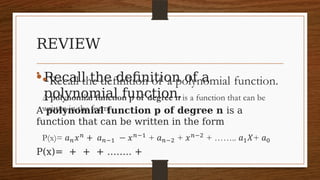
A polynomial function p of degree n is a
function that can be written in the form
P(x)= + + + …….. +
•  
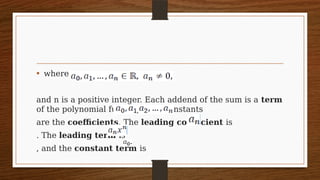
• where
and n is a positive integer. Each addend of the sum is a term
of the polynomial function. The constants
are the coefficients. The leading coefficient is
. The leading term is
, and the constant term is
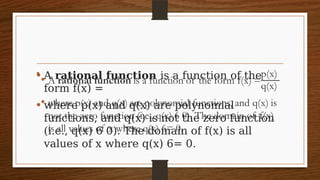
• A rational function is a function of the
form f(x) =
• where p(x) and q(x) are polynomial
functions, and q(x) is not the zero function
(i.e., q(x) 6 0). The domain of f(x) is all
values of x where q(x) 6= 0.
•  
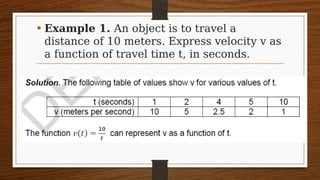
• Example 1. An object is to travel a
distance of 10 meters. Express velocity v as
a function of travel time t, in seconds.
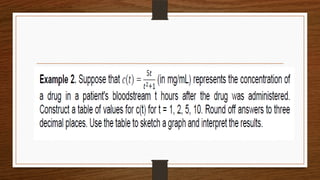
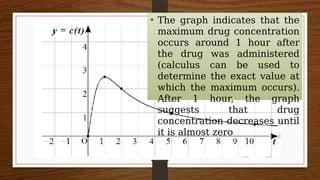
• The graph indicates that the
maximum drug concentration
occurs around 1 hour after
the drug was administered
(calculus can be used to
determine the exact value at
which the maximum occurs).
After 1 hour, the graph
suggests that drug
concentration decreases until
it is almost zero
Solved Examples
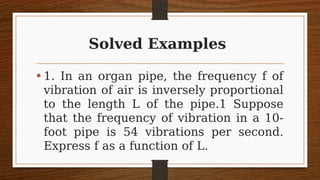
• 1. In an organ pipe, the frequency f of
vibration of air is inversely proportional
to the length L of the pipe.1 Suppose
that the frequency of vibration in a 10-
foot pipe is 54 vibrations per second.
Express f as a function of L.
SOLUTION
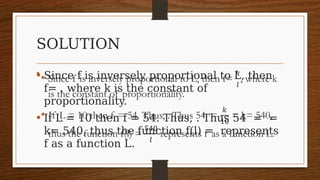
• Since f is inversely proportional to L, then
f= , where k is the constant of
proportionality.
• If L = 10 then f = 54. Thus, . Thus 54 = =
k= 540, thus the function f(l) = represents
f as a function L.
•  
2. The distance from Manila to Baguio is around 250
kilometers.
• (a) How long will it take you to get to Baguio if
your average speed is 25 kilometers per hour? 40
kilometers per hour? 50 kilometers per hour?
• (b) Construct a function (s) , where (s) is the
speed of travel, that describes the time it takes to
drive from Manila to Baguio.
Solution
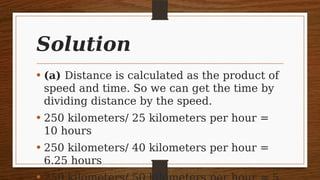
• (a) Distance is calculated as the product of
speed and time. So we can get the time by
dividing distance by the speed.
• 250 kilometers/ 25 kilometers per hour =
10 hours
• 250 kilometers/ 40 kilometers per hour =
6.25 hours
Solution
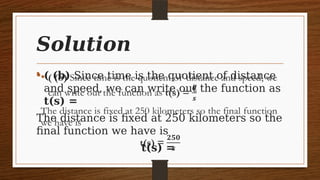
• ( (b) Since time is the quotient of distance
and speed, we can write out the function as
t(s) =
The distance is fixed at 250 kilometers so the
final function we have is
t(s) =
•  
7._Representing_Real_Life_Situations_Using_Rational_Functions.pptx.pdf

7._Representing_Real_Life_Situations_Using_Rational_Functions.pptx.pdf

  • 1.
  • 2.
    OBJECTIVE • At theend of the lesson, the learner is able • to represent real-life situations rational functions.
  • 3.
    REVIEW •Recall the definitionof a polynomial function. A polynomial function p of degree n is a function that can be written in the form P(x)= + + + …….. + •  
  • 4.
    • where and nis a positive integer. Each addend of the sum is a term of the polynomial function. The constants are the coefficients. The leading coefficient is . The leading term is , and the constant term is
  • 5.
    • A rationalfunction is a function of the form f(x) = • where p(x) and q(x) are polynomial functions, and q(x) is not the zero function (i.e., q(x) 6 0). The domain of f(x) is all values of x where q(x) 6= 0. •  
  • 6.
    • Example 1.An object is to travel a distance of 10 meters. Express velocity v as a function of travel time t, in seconds.
  • 9.
    • The graphindicates that the maximum drug concentration occurs around 1 hour after the drug was administered (calculus can be used to determine the exact value at which the maximum occurs). After 1 hour, the graph suggests that drug concentration decreases until it is almost zero
  • 10.
    Solved Examples • 1.In an organ pipe, the frequency f of vibration of air is inversely proportional to the length L of the pipe.1 Suppose that the frequency of vibration in a 10- foot pipe is 54 vibrations per second. Express f as a function of L.
  • 11.
    SOLUTION • Since fis inversely proportional to L, then f= , where k is the constant of proportionality. • If L = 10 then f = 54. Thus, . Thus 54 = = k= 540, thus the function f(l) = represents f as a function L. •  
  • 12.
    2. The distancefrom Manila to Baguio is around 250 kilometers. • (a) How long will it take you to get to Baguio if your average speed is 25 kilometers per hour? 40 kilometers per hour? 50 kilometers per hour? • (b) Construct a function (s) , where (s) is the speed of travel, that describes the time it takes to drive from Manila to Baguio.
  • 13.
    Solution • (a) Distanceis calculated as the product of speed and time. So we can get the time by dividing distance by the speed. • 250 kilometers/ 25 kilometers per hour = 10 hours • 250 kilometers/ 40 kilometers per hour = 6.25 hours
  • 14.
    Solution • ( (b)Since time is the quotient of distance and speed, we can write out the function as t(s) = The distance is fixed at 250 kilometers so the final function we have is t(s) = •