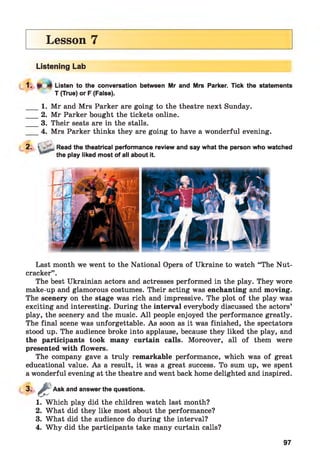
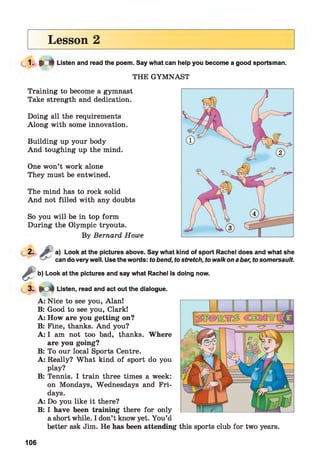
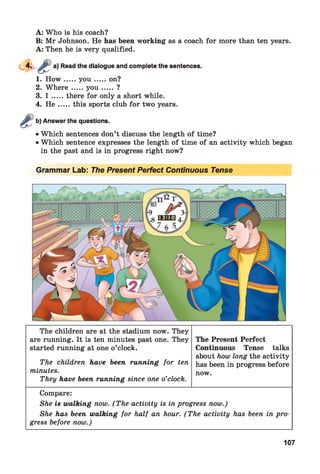
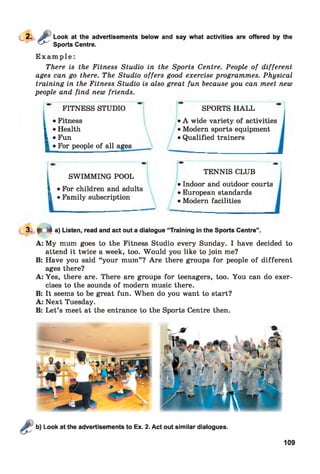
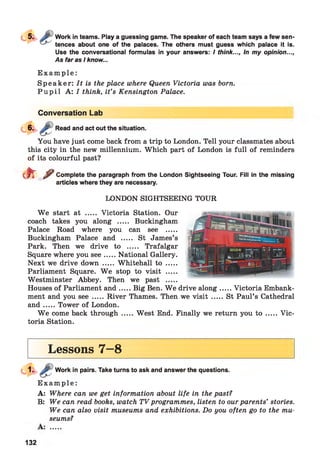
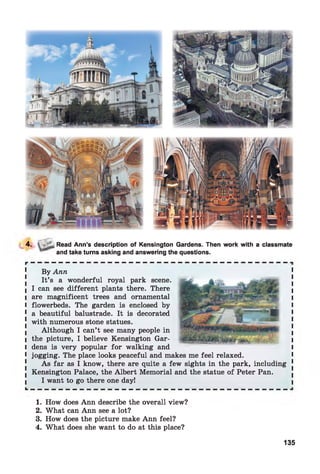
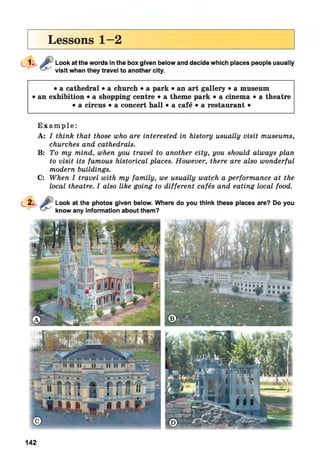
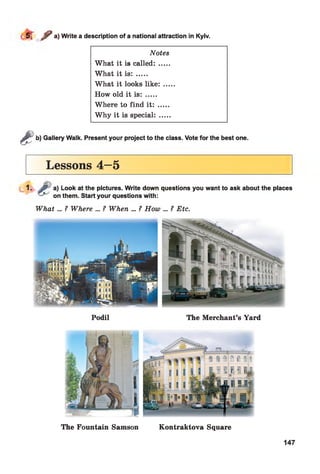
УД К 811.11(075.3)
ББК 81.2Англ-922
Н55
Рекомендовано Міністерством освіти і науки України
(Наказ МОН України від 20.07.2015. № 777)
Видано за рахунок державних коштів.
Продаж заборонено
Н е з а л е ж н и й експерт: Сюзанна Торкінгтон (Велика Британія).
The author and the publishers are thankful to Suzanne Torkington (Great
Britain) for proofreading the manuscript of this book.
УМОВНІ ПОЗНАЧЕННЯ:
Є —говоріння ^ —письмо
Qäi—читання ^ - домашнє завдання
► л - аудіювання ~проектна робота
Несвіт А лла
Н55 Англійська мова (7-й рік навч.): підруч. для 7 кл.
загальноосвіт. навч. закл. / А. М. Несвіт. - Київ : Генеза,
2015. - 208 с.
ШВИ 978-966-11-0647-4.
Підручник створено відповідно до нової програми з іно­
земних мов і рекомендовано для оволодіння англійською
мовою в загальноосвітніх навчальних закладах. Він є скла­
довою навчально-методичного комплекту і продовжує серію
НМК автора Алли Несвіт.
Підручник побудовано на принципах комунікативпості,
інтегрованого розвитку чотирьох видів мовленнєвої діяль­
ності: аудіювання, говоріння, читання і письма. У ньому
дотримано загальнодидактичних принципів посильності,
логічності, доступності, активності та наочності в навчанні.
УДК 811.11.(075.3)
ББК 81.2Англ-922
©Алла Несвіт ™, 2015
©Видавництво «Генеза»,
оригінал-макет, 2015ISBN 978-966-11-0647-4
Шановні семикласники!
Гучний шкільний дзвінок знову запросив вас у
захопливу подорож країною знань.
Звичайно, у перші шкільні дні ви ще перебуваєте
під враженнями від літнього відпочинку в колі
рідних і близьких, і це не дивно, адже сім’я -
найбільший скарб у житті людини. Цього року
ви навчитеся розповідати про сімейні традиції,
обов’язки членів родини та взаємини з друзями.
Дружна сім’я - це обов’язково затишний
дім, гостинний стіл. Ми розкриємо вам секрети
приготування улюблених страв, з нашою
допомогою ви навчитеся швидко й вишукано
сервірувати стіл для рідних та друзів.
У темі «Охорона здоров’я» разом з головними героями ви завітаєте до
лікаря, навчитесь описувати симптоми захворювання.
Усі сторони нашого життя знаходять відображення на сцені та в кіно, і
тому ми залюбки відвідуємо кінотеатри й обговорюємо нові спектаклі. Тут
відтворюються реальні події нашого життя, і, споглядаючи гру акторів,
ми маємо можливість проаналізувати свої вчинки, стати кращими.
Сподіваємося, що у коло ваших захоплень входить і спорт. Більшість
із вас відвідують різноманітні спортивні клуби та секції, беруть участь
у змаганнях. Багато хто вже пізнав радість перших перемог. У темі,
присвяченій спорту, ми поговоримо про різні види спортивних змагань,
спортивні клуби та секції. Ви будете висловлювати свої враження, давати
поради.
Наступна тема запросить вас до Великої Британії, зокрема до Лондона -
великого міста з давньою історією. Подорожуючи вулицями Лондона,
ви дізнаєтеся про місця, пов’язані з королівською родиною, а також
відвідаєте кілька найвідоміших музеїв.
Після цікавої подорожі так приємно повернутися додому - в
Україну. На вас чекає її прадавня столиця - Київ - колиска нашої
держави. Тож погуляймо його центральною вулицею, Хрещатиком, та
відвідаймо історичні місця Подолу. А найкраще це зробити з друзями та
однокласниками. От де відчуєте справжню радість спілкування і нових
відкриттів!
Про позакласні заходи ми поговоримо в темі «Ш кільне життя».
Отже, друзі, вирушаймо у казково-чарівну подорож сторінками нашого
підручника. У добру путь! Бажаємо успіхів!
З повагою, автор
3
revise question words and types of
questions; the Past Simple Tense.
IN THIS UNIT YOU WILL:
• talk about the first day at school and
the summer holidays;
• read a magazine article;
listen to a dialogue;
write a letter about your summer
holidays; the English learner’s year
plan;
Lesson 1
Look at the picture and the keywords. Talk about the joys of going back to school.
What feelings do you have on your first school day?
• happy • excited • cheerful • interested • glad • calm •
E x a m p l e :
A: I ’m usually excited about the beginning of the new school year.
B: I ’m glad to share my summer stories with my classmates.
C: I ’m happy to meet my school friends on the first of September.
2. $cm Listen and read the dialogues.
1.
Dan: Hello, Oles! Nice to see you again!
Oles: Hi, Dan! Nice to see you, too! What was
your summer like?
Dan: It was really fantastic!
Oles: Did you spend any time at the seaside?
Dan: Yes, I did. W e went to Turkey in August.
W e swam in the sea, dived with an aqua­
lung and went on wonderful excursions
there. And where did you go in summer?
Oles: I spent a month in Yaremche. It’s a very
nice place for a holiday. W e often went
to the forest with my grandad. W e also
went hiking with my friends.
Dan: I like hiking in the mountains, too. But
I didn’t go to the mountains this summer.
5
Jane: Hi Ann - you’re back! How was your trip to Europe?
Ann: It was fantastic. I saw a lot of ancient buildings like castles, churches
and cathedrals. The weather in England was not very good, though. It
rained a lot.
Jane: What about France?
Ann: It was so interesting! I liked the Eiffel Tower and the Louvre. The
people were really friendly. Now I ’ve got a few friends there.
Jane: And Italy?
Ann: That was the best of all. The weather was fine and the food was so
tasty. W e did a lot of shopping!
Jane: Have you practised your English?
Ann: Yes, I have. I could communicate by speaking slowly in English. I have
also learnt a few French and Italian words.
Jane: Have you taken lots of photos?
Ann: Yes, I have. And I have got a lot of stories to share. Come and see me
one day!
Jane: W ith pleasure!
2.
Portobello Road Market in London Shopping in Milan
The Eiffel Tower in Paris
Read and say who:
spent holidays at the seaside?
practised English in summer?
Windmills and gardens in
the Netherlands
6
... enjoyed some time in the mountains?
... asked a friend about the holiday photos?
... wants to share holiday stories with a friend?
a) Match the questions (1-6) and the answers (A-F). Then listen and check.
Work in pairs and talk with your friend.
1. What did you do in the A W e went by plane.
holidays? B W e went away for two weeks and the
2. Where did you go? rest of the time I was at home.
3. How did you get there? C Turkey - we spent some time at the
4. Who did you go there with? seaside.
5. W hy did you go there? D Because we all like seaside holidays.
6. When did you come home? E My parents and my cousins.
F In August.
Look and describe the pictures (1-4) on page 6. Use the adjectives from the box
given below.
• wonderful • exciting • busy • great • lovely • excellent
• bright • huge • crowded •
Conversation Lab
Speak in class. Act out the situations. Use Ex. 1 as a model.
1. You have met your friends on the first of September. Ask them how
they spent their summer holidays.
2. Talk about the activities children enjoyed doing in summer.
e f t ^ Write a letter to your English-speaking friend about your summer holidays.
Describe the places you visited and the activities you did there. Use the prompts
given below.
r ————————_ _ _ _ _ _ _ _ _ _ _ _ _ _ _ _ _ _ _ _ _ ———------------ 1
1 H i all! 1
Now it’s September and I ’m back at school. What wonderful holidays .
I had last summer!
I was....... That was such a fantastic ....... and the people were.......
I went there w ith.......We travelled by........ We went t o ...... and watched
.....there. It was s o ......./ I took.........
How did you spend your summer holidays?
Yours,
L — — — — — — — — — — — — — — — — — — — — — — — — — — — — — — — — — — — — — J
7
Lesson 2
Look at the pictures. Say where the children spent their last summer holidays and
what they did there. Use the words from the box given below.
• to go on an excursion • to play games on the beach
• to spend a month at grandma’s • to take some photos •
2. ■ Read and say what Ann thinks about school holidays.
Dear Mary,
How are you? Thank you for your letter about your summer holidays.
I You really had a great time.
I All school holidays are exciting, and there are some reasons for this. |
I Firstly, you can stay up late. Secondly, you can watch lots of TV pro- I
l grammes and play outdoors with your friends. Thirdly, you can visit new I
1 places and meet new faces.
However, there are some things that I don’t like about my summer !
■ holidays.
I To start with, I usually miss my school friends and teachers. Also, my 
I parents’ holidays are not as long as school holidays, and we can’t spend i
I all three months together. Finally, my mum always makes me read a lot I
1 in summer.
This summer I visited Greece. I have seen the Parthenon at last.
Come and see me one day. I ’ll show you my holidayphotos and a video film. .
Yours,
l Ann l
L __ __ _ _ _ _ _ _ _ _ _ _ _ _ _ _ _ _ _ _ _ _ __ __ __ __
Read and complete the sentences.
1. Ann thinks that all school holidays a r e .......
2. There are some things that Ann doesn’t like about her school holidays.
They a r e .......
3. The things that Ann likes about school holidays a r e .......
4. This summer Ann has visited .......
5. She promises t o .......
8
Conversation Lab
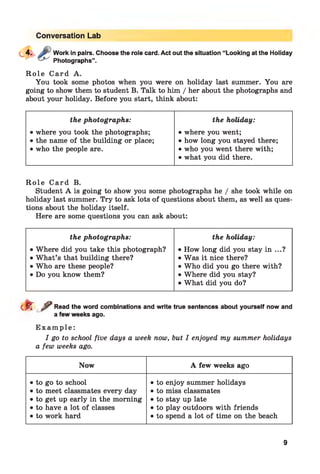
Work in pairs. Choose the role card. Act out the situation “Looking at the Holiday
Photographs”.
R o l e C ard A.
You took some photos when you were on holiday last summer. You are
going to show them to student B. Talk to him / her about the photographs and
about your holiday. Before you start, think about:
the photographs: the holiday:
• where you took the photographs; • where you went;
• the name of the building or place; • how long you stayed there;
• who the people are. • who you went there with;
• what you did there.
R o l e C ard B.
Student A is going to show you some photographs he / she took while on
holiday last summer. Try to ask lots of questions about them, as well as ques­
tions about the holiday itself.
Here are some questions you can ask about:
the photographs: the holiday:
• Where did you take this photograph? • How long did you stay in ...?
• W hat’s that building there? • Was it nice there?
• Who are these people? • Who did you go there with?
• Do you know them? • Where did you stay?
• What did you do?
d r ^ Read the word combinations and write true sentences about yourself now and
a few weeks ago.
E x a m p l e :
I go to school five days a week now, but I enjoyed my summer holidays
a few weeks ago.
Now A few weeks ago
• to go to school
• to meet classmates every day
• to get up early in the morning
• to have a lot of classes
• to work hard
• to enjoy summer holidays
• to miss classmates
• to stay up late
• to play outdoors with friends
• to spend a lot of time on the beach
9
Lesson 3
Work in pairs. Look at the picture and talk with your friends about the new school
year.
E x a m p l e :
A: Our school looks wonderful. Will I find all the classrooms in it?
B: Don’t worry! There is always someone to help you.
W ill I find all
the classrooms in
my new school?
W ill I like my
new teacher?
2-
,r Read a newspaper article and match the paragraphs (1-5) to the headings (A-F).
There is one heading that you do not need. Say which advice you like most of all.
A Learn to be a good friend
B Everybody is special
C Be positive
D Share what you know
E The same feelings
F Be flexible
1......
A t the beginning of school almost everybody tries to look cool and calm.
Each back-to-school student is wondering what will happen during the new
school year. Most children feel a little shy. But it won’t take long for you to
feel at home at school.
2.......
You know that you are special to your parents, friends and family. You
will meet other children at school. They are special to their parents, friends
and families, too. You will have to learn to share the attention of the teachers
with others.
10
3 ............
W e learn to read, write and do sums at school. W e also learn to get on well
with others. Try to be a good friend to everyone.
4 ...
If something goes wrong with you, don’t let it ruin your day.
When something at home really upsets you, talk to your parents or
a teacher at school about it.
5 ...
Try to be a positive thinker and talker. Look at the bright side of things.
By Betty Debnam
3 - ê Work in pairs. Ask and answer the questions.
• What do back-to-school students look at the beginning of the school year?
• What do they sometimes wonder about?
• Which pieces of advice can help them feel comfortable during their first
school days?
• wonder • look • cool • shy • at home • know • read • write
• do sums • get on well with somebody • friend • back-to-school student
• thinker • talker • family • teacher • learn • talk •
People Things people do Things people feel
Read and complete the sentences with the words from the box given below. Use
the verbs in the correct tense form.
• shy • to ruin • to upset • to share something
• not / to wonder • to get on well •
1. I ..... if she is the best student in class - she has always worked so
hard.
2. Her illness.....her chances of winning the race.
3. He was v e r y .....that you didn’t reply to his letters.
4. If y o u .....with someone you like them and have the same interests.
5. W ill y o u .....your sandwich with me?
6. Children are o fte n .....with people they don’t know.
Write a paragraph to the advice column of your school newspaper on the topic
“Back to School”. Use the ideas from the text of Ex. 2.
11
Lesson 4
1. fp Look at the photos. Ask and answer the questions about them.
1. Where are the children?
2. What lesson are they having now?
3. What is the classroom like?
4. What are the children doing?
5. What do you usually do in the English lessons?
2- 9Cm Listen, read and act out the dialogue.
Jane is helping Ann with her English
homework.
Ann: Jane, could you help me with this
grammar exercise?
Jane: Sure, Ann. Have you looked at
the examples properly?
Ann: No, I haven’t. Do you mean I have
to analyse the examples?
Jane: Right. Read the sentence. Ima­
gine the situation and apply the
grammar rule to your sentence.
Why don’t you try one now?
Ann: Oops! A mistake again!
Jane: That’s okay, try again. This time, keep your eye on the subject of
a sentence.
Ann: Oh, I see. Let me try again...
Jane: Here is another sentence... Wow! You’ve done it correctly.
Ann: “Practice makes perfect!” they say. Thank you, Jane for your help.
12
Answer the questions to the dialogue of Ex. 2 on page 12.
1. Why does Ann ask Jane for help?
2. What does Jane advise her to do?
3. Why has Ann made a mistake again?
4. Were Jane’s recommendations helpful?
Work in pairs. Talk with your friend about your school English lessons and the
following classroom activities:
1. Learning vocabulary and grammar.
2. Working with the text.
3. W riting tests.
Expressing Likes and Dislikes
I like it.
I like it a lot.
I like it very much.
I really like it very much.
I love it.
I don’t like it.
I don’t like it at all.
I don’t like it a bit.
I hate it.
I think I can’t stand it.
5. J? Speak in class. Tell the classmates about your way of learning English. What can
your friends recommend you to do?
E x a m p l e :
This is my seventh year of learning a foreign language. I have two Eng­
lish lessons a week. I try to practise the language every day. Sometimes we
speak English with my friends during the breaks. I t ’s great fun! I read
books in English. I also listen to songs in English. Watching videos helps
me, too!
cl^Tf Write your plan for this school year. Use the prompts given below to help you.
Nam e:_____________________ D ate:______________________
ENGLISH LEARNER’S YEAR PLAN
This year I am going to work harder at m y ....... I want to improve my [
■ .....an d...... skills. I am going to w o rk ...... hours a day. I need to practise .
I ....... I am going to u se.........I am going to consult.......an d ......... I
. Signature: .....
I Teacher: .....
13
>шт Шш^ш*^ J H
1 * М h L JJ B K J »f
'Ж Ж ^І І - J J 9»nM . , 1
чï П Р * Ж ЭH 1
Щг * -^ Н г ' * * ■ § '
л à^ щ 1H
Г г # j i «ш - j
Г ч
IN THIS UNIT YOU WILL
talk about your family and friends;
describe your household chores;
read about family relationships;
listen to a dialogue with personal
information;
write a story about your household
chores and family traditions;
revise personal and object pronouns;
learn about the reflexive pronouns
and the question tags.
Lesson 1
Work in pairs. Ask your friend about his / her family.
• How many members are there in your family?
• Who do you live with?
• Do other members of your family live near you, or do you have to travel
to visit them?
• Are there any traditions in your family?
b) Tell the class what you have learnt about your friend.
E x a m p le :
My friend Olena comes from a large family. There are five of them
in it - her father, mother and two younger brothers. They are twins. They
live in a large flat. Their grandparents don’t live with them. They live in
another town. Olena and her family often visit them on holidays. Olena’s
family have got some good traditions - they always celebrate Christmas
together and travel to Zakarpattia in summer.
Reading Lab
Reading Strategy: Predicting
• Before you begin to read, look at the pictures and the title.
• Guess what the text is about.
*
2. ? Read the texts on page 17 and find out what the children say about their families.
16
OUR FAMILIES
Dan: I love my family very much. My mother is very caring and kind. She
is excellent at cooking. I love her apple pies. She often bakes them for
our family celebrations. My father is very intelligent and smart. He is
good with his hands. When we are together, I ’m never bored. We
always do something: modelling a plane or repairing our family car.
Ann: My grandparents live in another city, so I always travel to visit them.
W e often meet at family celebrations. I always get a present from
them. My granny is interested in art. So every time I visit her, we go
to museums together. My grandad is fond of photography. He is very
funny and outgoing. When we are together, we always go on a picnic.
It’s fantastic!
Tom: I’m lucky to have an elder brother. His name is Nick, he is 15. He’s
shy and some people think he is moody but I get on with him really
well. When you get to know him, he’s really friendly. He is excellent
at studying. He is fond of playing football. I like spending time with
him. W e often watch films or do sports together.
3 - s Read and tick D (Dan), A (Ann) or T (Tom). Which of the children:
... likes doing something with hands?
... likes doing sport?
... enjoys eating their mother’s pies?
... enjoys spending time outdoors?
... has got the same hobby as the granny?
Grammar Lab: Verbs + -ing form
Write sentences about yourself. Use the word combinations from the box given
below.
• listening to music • working in the garden • cleaning my room
• playing the musical instrument • cooking • doing my homework
• playing with my younger sister / brother • going shopping •
E x a m p l e :
I like listening to music. I don’t like working in the garden. I am good
at cooking.
17
Conversation Lab
Work in pairs. Take turns to ask and answer the questions given below.
1. How large is your family?
2. What do your parents like doing? What are your sisters and brothers
good at?
3. Are you a good son (daughter)? How do you take care of people around
you?
4. Who usually helps you when in need?
d r ^ Write a paragraph to a school newspaper about your family. What do you value
most in your family members? Start like this:
My family is very friendly. I love my mother because.......I enjoy spending
time w ith....... When I need a piece of advice I ask.........Etc.
Lesson 2
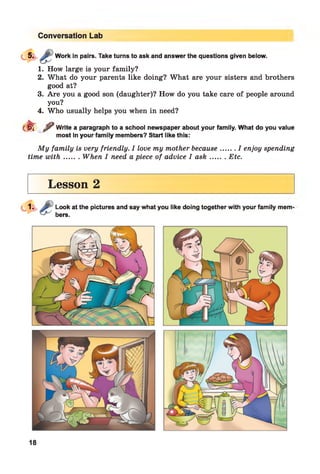
Look at the pictures and say what you like doing together with your family mem
bers.
18
2- K M Listen to the children talking about the things they have learnt to do from their
relatives. Match the children’s names with the activities they can do.
1. Tetiana A to knit and embroider
2. Taras B to cook spaghetti and make sandwiches
3. Olha C practical life skills: to choose the clothes to wear
according to the weather, brush the shoes, make the
bed in the morning, keep things in the right place
4. Oleksandr D to make bird feeders
Speak in class. Say what the children have learnt to do from the adults.
Conversation Lab
4-
• to keep promises • to share activities • to be honest with each other
• to stay in contact with each other • to take an active interest in each
other’s hobbies • to care about each other • to do things for each other •
e
Work in pairs. Complete the dialogue and act it out.
A: Hi, .....! W e are doing a survey on family ties. Can I ask you a few
questions?
B: Yes, please.
A: What makes a home a pleasant place to live in?
B: Happy families have certain traits in common. They en jo y.....
A: Who do you admire most in your family? What have you learnt to do
from this person?
B: I like m y .....best. He / S h e.........W e o fte n .........
A: .....
B: Children benefit from regular mealtimes, affection, play, traditions
and outings with the whole family.
Talk about the members of the family you admire. What have they taught you
to do? Use the word combinations given below.
• to be good (excellent) at • to be full of • to set a good example
• to be fond of • to like (love) doing something • to be good with
your / their hands •
< lk ^ Write a short story to post on the Internet blog about the person in your family
you admire. Use the questions given below to help you.•
• What makes this person so special to you?
• What does he / she teach you to do?
• Would you like to be like this person when you are his / her age?
19
Lesson 3
Work in pairs. Decide which of these may not be possible in big families:
... being by yourself?
... playing sport with others?
... helping other children?
... living in a big house?
... doing lots of cooking and washing?
... doing what you like?
... keeping the place tidy?
,Read Tom’s blog about his family. Is it small or big? Who does he get on well
with in his family?
FR OFILL
&Tom Baker
latest yoMTH
І Si T W f f І
іл і і шЛ ч a|
,|S 1^ in -L І І ,tj ±4
; j rf. J a* jt . j i
W r лі Апіги
Fa C I ICTHUa FV
Hello, my name is Tom Baker and I am thirteen
years old. My eldest brother John is seventeen and
I have a younger brother Jeremy. My little sister, who
is called Abby, is only three.
My brothers are all fond of football. So, we often
play this game at weekends. Jeremy is excellent at
playing the violin. I am not. I don’t like playing any
musical instrument.
I get on well with my brother John. I think we have
a lot of things in common. W e often make car models,
all by ourselves!
It’s good being part of a big family. You can play
games with everyone. You can also have a lot of birth­
day parties which are great fun! Also, a big family
means a big house, so you can always find somewhere
to be by yourself. I like that sometimes.
I love my big family!
Read what Tom says again. Tick the sentences A (True) or B (False). If Tom doesn’t
tell you the answer tick (C).
1. There are four children in Tom’s family.
2. Tom is older than Abby.
3. Tom has a lot of things in common with his brothers.
4. Tom is fond of playing the piano.
5. Tom wants to be like his elder brother.
6. Tom sometimes enjoys spending time alone in his house.
7. Tom doesn’t like it when the house is dirty.
20
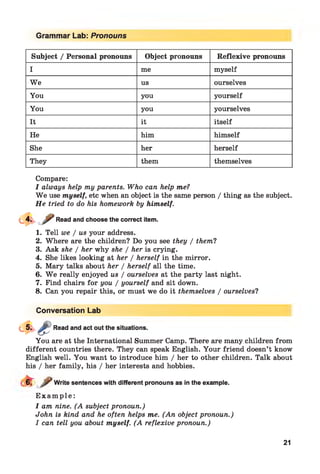
Grammar Lab: Pronouns
Subject / Personal pronouns Object pronouns Reflexive pronouns
I me myself
We us ourselves
You you yourself
You you yourselves
It it itself
He him himself
She her herself
They them themselves
Compare:
I always help my parents. Who can help me?
W e use myself, etc when an object is the same person / thing as the subject.
He tried to do his homework by himself.
Read and choose the correct item.
1. Tell we / us your address.
2. Where are the children? Do you see they / them?
3. Ask she / her why she / her is crying.
4. She likes looking at her / herself in the mirror.
5. Mary talks about her / herself all the time.
6. W e really enjoyed us / ourselves at the party last night.
7. Find chairs for you / yourself and sit down.
8. Can you repair this, or must we do it themselves / ourselves?
Conversation Lab
Read and act out the situations.
You are at the International Summer Camp. There are many children from
different countries there. They can speak English. Your friend doesn’t know
English well. You want to introduce him / her to other children. Talk about
his / her family, his / her interests and hobbies.
Write sentences with different pronouns as in the example.
E x a m p l e :
I am nine. (A subject pronoun.)
John is kind and he often helps me. (An object pronoun.)
I can tell you about myself. (A reflexive pronoun.)
21
Lesson 4
1. ► 4 a) Listen and repeat. Match the words with the pictures.
• to make one’s bed • to tidy up the room • to wash up • to iron clothes
• to water flowers • to sew buttons on • to wash clothes • to cook meals •
Make sentences with these words about your household chores.
E x a m p l e :
I tidy up my room twice a week.
I always wash my clothes by myself.
Reading Lab
2. ' a) Read and complete the text with the sentences (A-E) from the box given below.
It was Saturday. The alarm clock rang. Ann jumped out of bed. She had
a lot of things to do. First, she had to help her mum in the kitchen. So she
washed up the dishes. ( 1 ) .....Then, it was time to do the washing. Ann put
her dresses, blouses and T-shirts in the washing machine. (2) ..... A ll of
a sudden, she heard a noise in the next room. Rosie, her cat, knocked a vase
o ff the table. ( 3 ) .....What a naughty cat!
A fter that Ann still had her Maths homework to do. ( 4 ) .....
It took her an hour and a half to do it.
“Now I can work on my stamp collection,” she thought happily.
The telephone rang. It was Jane. (5) ..... In twenty minutes Ann put her
jacket on and left home.
A Ann had to clean it up.
B Next, she had to dust the furniture in her room and vacuum the carpet.
C She invited Ann for a walk.
D She almost forgot to put her socks in the machine.
E She sat down at her desk and did the sums.
22
1 .___ 2 .____ 3 .____ 4 .____ 5 .____ 6 .____
3 - £ Agree or disagree. Correct the wrong statements.
1. Ann had to help her mum in the kitchen.
2. She had to dust the furniture in her mother’s room.
3. Ann put her jacket and trousers in the washing machine.
4. She heard a noise in the next room.
5. The cat knocked a vase o ff the table.
6. Ann sat down at her desk and read a book.
7. Jane invited Ann for a walk.
Look at the pictures of Ex. 2b again and retell the story to your classmates.
Conversation Lab
Work in pairs. Take turns to ask and answer the questions.
1. Do you help your family about the house?
2. What do you usually do? When do you do it?
3. What can you do well? Who taught you to do it?
4. Do you help your family to do the shopping?
Write a paragraph to the Internet blog about the household chores you usually
do. Use the word combinations from Ex. 1.
E x a m p l e : I never set the table. I do the washing up every day.
23
Lesson 5
1. Work in pairs. Take turns to ask and answer the questions.
E x a m p l e :
A: Do you like to work about the house?
B: No, I don’t. But I have to do some things to help my parents. I usually
dust the furniture in my room, clean my parrot’s cage and do the
washing. And what about you?
A: On Saturday I usually help my mother in the kitchen. I wash the floor,
put the rubbish out and do the washing up.
Questions You Your Friend
• Do you like to work about the house?
• What are your household chores?
• When do you help your parents?
• Why is it great to share your household
duties with other family members?
• What did you do about the house yesterday?
• Who did you work with?
• It is important to keep your house clean and
tidy, isn’t it?
2. > Read and tick what the children usually do about the house.
My name is Taras. I live in the village. You know,
there is so much work to do there every day. My
parents are always so busy. My mum spends hours
working in the kitchen garden and my dad usually
takes care of our domestic animals.
I try to do my best and help my parents. I always
tidy up my room, and do the shopping. Sometimes
I set the table for dinner. I can cook a tasty tomato
salad and boiled potato.
2.
My name is Olia. I live in the town of Zhyto-
myr. My family is very friendly. W e share all our
household chores. My father bought a new
modern washing machine last month. Now I like
to do the laundry. You practically have to do
nothing but put the laundry in and out. I also
enjoy taking my dog for a walk. He is my real
friend and we like playing together.
24
3. My name is Semen. I live in Lviv. Our family
is big. There are five of us: my father, my mother,
my elder brother, my younger sister and me.
A ll the members in our family have their duties
about the house. My elder brother always vacuums
the carpets and mats, my younger sister has to keep
her dolls in the right place.
I have to water the flowers, do the cleaning and
sometimes I do the shopping. I don’t set the table
for dinner but I always wash up after meals. I would
like to take care of a dog or a cat, but unfortunately,
we don’t have any.
....................... Chores
Names .....................
Taras Olia Semen
Set the table for dinner
Look after a pet
Do the shopping
Do the cleaning
Do the laundry
3- < ^ a)
Work in groups. Talk about the household chores children usually have.
E x a m p l e :
A: A household chore is something people do about the house they live in.
In my family I have to walk the dog in the afternoon, tidy up my room
every day and do the shopping on Sundays. Sometimes I do the laundry.
B: As for me, I wash up after dinner, vacuum the carpet in the living room
every day. I also look after my younger sister when my mother is busy
in the kitchen. I don’t think it’s difficult.
C: I t ’s great when family members share their household chores. Then they
usually have more time to spend together.
Look at the pictures and say what the children are doing at the moment.
25
a) Read and complete the dialogue. Put the verbs in brackets into the correct
tense form: Present Simple, Future Simple, Past Simple or Present Perfect.
S teve: I think our mother ( 1 ) .....(to be) very
pleased with us. W e ( 2 ) .....(to white­
wash) all the trees in our garden.
M o lly : And I ( 3 ) .....(to weed) all the flower­
beds, haven’t I? The garden looks so
nicel
S teve: Father (4) ..... (to want) me to help
him dig around the trees on Saturday.
How surprised he ( 5 ) .....(to be) when
he comes to the garden tomorrow!
M o lly : What if we whitewash the fence?
S teve: Not today, I think. W e can’t do every­
thing in one day.
M rs P a r k e r : Molly! Steve! Where (6) ..... (to
dren.) Oh no...
be) you? (She sees the chil-
M b) Listen and check your answers.
^ c) Work in pairs. Act out the dialogue.
*
5- ? a) Complete the sentences with the words from the word bank.
• household chores • do • rake • wash • fold • do • weed •
In many families, men and women share....... For example, in some fami­
lies wom en.....the cooking, and m en .......the dishes. Sometimes wom en.......
the laundry, and men ..... the clothes. Sometimes women weed the garden,
and m en .....the leaves. What chores do you do in your family?
t e / b) Write a letter to your English-speaking friend. In your letter, tell him / her what
household chores you have, how often you do them, who helps you, what you
like / don’t like doing most of all.
26
Lesson 6
Reading Lab
2. Read the story and say why the Parkers have decided to buy a summer cottage.
A NEW SUMMER COTTAGE
(A fter Margaret Mahy)
Summer was coming. The Parkers were planning their rest. Mr Parker
worked really hard this year and made quite a lot of money. One day the
family had a lovely talk in the living room. They decided to buy a new
summer cottage.
“Dearest,” said Mr Parker to his wife, Mrs Parker, “we can buy a house at
last and have a nice garden like the one we used to have in England.”
“Oh yes, our garden was full of rose bushes. It was especially fantastic in
spring. You know I love gardening.”
“I can help you, Mum, plant and water the flowers, and weed the flower­
beds, can’t I?” asked Molly. She was so excited!
“And I’ll assist father in digging around the trees as well as whitewashing
the trees and gathering fruit in autumn. I ’ll also water the lawn in front of
the house and rake the leaves in the garden in autumn. A t last, I ’ll have
a room for a tree house!” Steve cried happily, for climbing trees was his
hobby and he spent as much time as he could up among the leaves of the
tallest trees in his native town.
So the next week the Parkers started to look for a house that suited them.
27
Read and complete the sentences.
1. The Parkers decided to buy the house lik e .....
2. Mrs Parker is dreaming about.....because she
3. Mrs Parker wants to plant som e.......
4. Molly can help her m um .......
5. Mr Parker usually.....in the garden.
6. Steve can h elp .......
7. Steve is dreaming about.......
4. jr Ask questions to the sentences below. Say what type of question each of them is.
-
1. I have been busy weeding the garden this week. (Who?)
2. My parents had a lovely talk around the dinner table yesterday. (When?)
3. They kept on walking along the street. ( ..... ?)
4. Mary and Brian are planning their rest now. ( .....o r ....... ?)
5. This skirt suits me wonderfully. (How?)
6. The city is full of places of interest for tourists. ( .....o r .......?)
7. He spent much time working in the garden yesterday. (..... ?)
8. Molly was scared of big spiders in the old house. (.....o r .......?)
9. Steve has dreamt about a tree house for years. (What?)
10. There are so many cobwebs in this old roof. ( ..... ?)
11. There were marble staircases and grand pianos in the king’s palace.
(Where?)
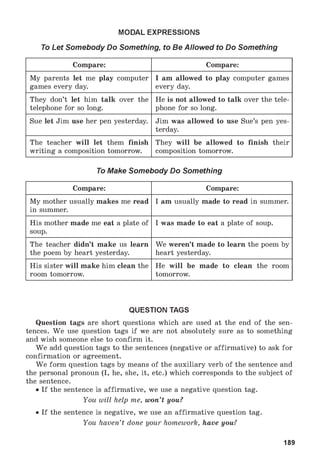
Grammar Lab: Question Tags
Use
Question tags are short questions which are used at the end of the sentences
if we are not absolutely sure about something and wish someone else to
confirm it.
Form
To form question tags, we use the auxiliary verb of the sentence and the
personal pronoun (I, he, she, it, etc.) which corresponds to the subject of the
sentence.
• We use a negative question tag in an affirmative sentence.
You always help me, don’t you?
You will help me, won’t you?
• We use an affirmative question tag in a negative sentence.
You haven’t done your homework, have you?
28
If there is a modal verb (can, could, should, etc.) in the sentence, we use
the same modal verb to form the question tag.
He can’t swim very well, can he?
• We use the auxiliary verbs do, does in the Present Simple Tense and did
in the Past Simple Tense (except for to be and to have).
He works in an office, doesn’t he?
You didn’t eat my ice cream, did you?
• The question tag for I am is aren’t I?
I ’m busy, aren’t I?
• The question tag for Let’s is shall we?
Let’s go, shall we?
Pronunciation
We pronounce question tags with a rising intonation (/) when we are not
sure and expect an answer, or a falling intonation () when we are sure and
don’t really expect an answer.
*■
«■ / a) Complete the questions with the correct question tags.
1. Their house is all marble staircases and grand pianos, ...
2. Clark doesn’t often assist the father in repairing a car, .
3. The Davidsons made quite a lot of money two years ago,
4. My brother can’t climb trees as well as my cousin can, ..
5. They gathered fruit in their garden last autumn....... ?
6. He is whitewashing the fence now....... ?
7. I ’m working in the garden now....... ?
8. Let’s do the shopping, .....?
9. They have raked the leaves in the y a rd ,.....?
10. Let’s build a tree house....... ?
?
....?
v
b) Listen and check your answers. Repeat the sentences after the speaker. Pay atten'
tion to the intonation.
29
Lesson 7
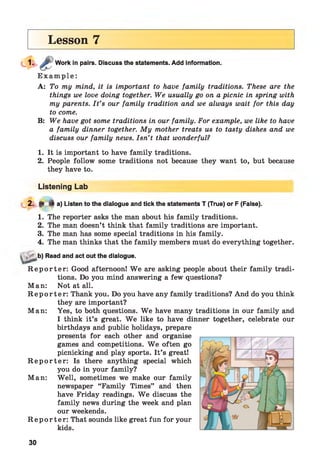
Work in pairs. Discuss the statements. Add information.
E x a m p le :
A: To my mind, it is important to have family traditions. These are the
things we love doing together. We usually go on a picnic in spring with
my parents. I t ’s our family tradition and we always wait for this day
to come.
B: We have got some traditions in our family. For example, we like to have
a family dinner together. My mother treats us to tasty dishes and we
discuss our family news. Isn’t that wonderful?
1. It is important to have family traditions.
2. People follow some traditions not because they want to, but because
they have to.
Listening Lab
2. ^ 4 a) Listen to the dialogue and tick the statements T (True) or F (False).
1. The reporter asks the man about his family traditions.
2. The man doesn’t think that family traditions are important.
3. The man has some special traditions in his family.
4. The man thinks that the family members must do everything together.
„ b) Read and act out the dialogue.
R e p o r t e r : Good afternoon! W e are asking people about their family tradi­
tions. Do you mind answering a few questions?
Man: Not at all.
R e p o r t e r : Thank you. Do you have any family traditions? And do you think
they are important?
Man: Yes, to both questions. W e have many traditions in our family and
I think it’s great. W e like to have dinner together, celebrate our
birthdays and public holidays, prepare
presents for each other and organise
games and competitions. W e often go
picnicking and play sports. It’s great!
R e p o r t e r : Is there anything special which
you do in your family?
Man: Well, sometimes we make our family
newspaper “Family Times” and then
have Friday readings. W e discuss the
family news during the week and plan
our weekends.
R e p o r t e r : That sounds like great fun for your
kids.
30
Man: Oh yes! They like drawing pictures and sometimes they write funny
stories.
R e p o r t e r : Thank you so much for the interview.
Man: You’re welcome.
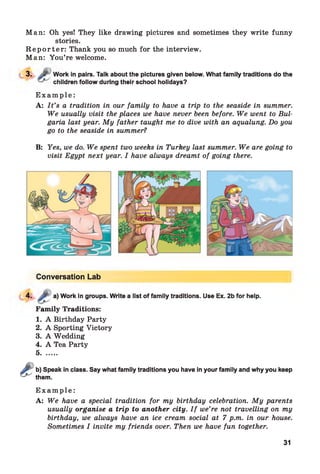
3. 'j? Work in pairs. Talk about the pictures given below. What family traditions do the
children follow during their school holidays?
E x a m p l e :
A: I t ’s a tradition in our family to have a trip to the seaside in summer.
We usually visit the places we have never been before. We went to Bul­
garia last year. My father taught me to dive with an aqualung. Do you
go to the seaside in summer?
B: Yes, we do. We spent two weeks in Turkey last summer. We are going to
visit Egypt next year. I have always dreamt of going there.
Conversation Lab
4. a) Work in groups. Write a list of family traditions. Use Ex. 2b for help.
Family Traditions:
1. A Birthday Party
2. A Sporting Victory
3. A Wedding
4. A Tea Party
5........
b) Speak in class. Say what family traditions you have in your family and why you keep
them.
E x a m p le :
A: We have a special tradition for my birthday celebration. My parents
usually organise a trip to another city. I f we’re not travelling on my
birthday, we always have an ice cream social at 7 p.m. in our house.
Sometimes I invite my friends over. Then we have fun together.
31
B: Christmas is an exciting time. I t ’s a
big family party for everyone. We make
banners and put them all around the
house and put out our nativity scene.
We have fun decorating and baking
and doing all that, too. We prepare
presents for everyone and put them
under a Christmas tree. I personally
enjoy giving presents more. Giving to
others is really the focus of celebrating
the Christmas season.
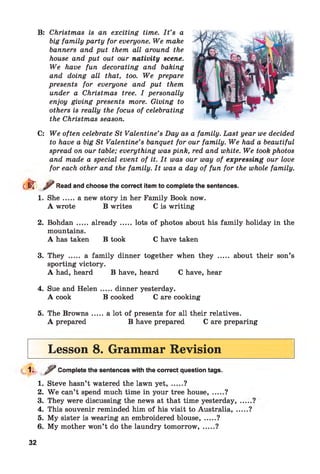
C: We often celebrate St Valentine’s Day as a family. Last year we decided
to have a big St Valentine’s banquet for our family. We had a beautiful
spread on our table; everything waspink, red and white. We took photos
and made a special event of it. It was our way of expressing our love
for each other and the family. It was a day of fun for the whole family.
5 ^ jt* Read and choose the correct item to complete the sentences.
1. S h e.... a new story in her Family Book now.
A wrote B writes C is writing
2. Bohdan.... already....... lots of photos about his family holiday in the
mountains.
A has taken B took C have taken
3. They ..... a family dinner together when they ..... about their son’s
sporting victory.
A had, heard B have, heard C have, hear
4. Sue and H elen .....dinner yesterday.
A cook B cooked C are cooking
5. The Browns.....a lot of presents for all their relatives.
A prepared B have prepared C are preparing
Lesson 8. Grammar Revision
1. ^ Complete the sentences with the correct question tags.
1. Steve hasn’t watered the lawn yet, .....?
2. W e can’t spend much time in your tree house....... ?
3. They were discussing the news at that time yesterday, .....
4. This souvenir reminded him of his visit to Australia, .....?
5. My sister is wearing an embroidered blouse, .....?
6. My mother won’t do the laundry tomorrow.......?
32
2. Read the text and put the missing sentences (A-F) in the correct spaces (1-6).
EASTER IN UKRAINE
Easter is the feast of the Christ’s Resurrec­
tion. ( 1 ) ....... It is celebrated on Sunday between
the 4th of April and the 8th of May. The Ukrai­
nians celebrate Easter over a long period of his­
tory and this holiday has had many rich tradi­
tions. ( 2 ) ........During this time people try to
finish all work before Thursday. ( 3 ) ........after
which people return home with lighted candles.
( 4 ) ........Butter, lard, cheese, roast suckling
pigs, sausage, smoked meat and little napkins,
containing poppy seeds, horseradish and other
provisions are also blessed. ( 5 ) ........ Easter is
a feast of joy and gladness. People celebrate it
for three days. ( 6 ) .......
A A fter the matins people exchange Easter greetings, give each other
krashankas and then go back home with their baskets full of blessed
food.
B In the evening of Pure Thursday the Passion service is performed.
C Nowadays Easter is a national holiday in Ukraine.
D It is celebrated according to the Moon calendar on the first Sunday after
the first spring full Moon.
E Easter begins with matins and a High Mass, during which the paskas
(traditional Easter breads), pysankas and krashankas (decorated or
coloured Easter eggs) are blessed in the church.
F The week before Easter, the Great Week, is called the White or Pure
Week.
33
3. ,?Put the verbs in brackets into the correct tense form.
1. The children.....(to whitewash) the trees in the garden every spring.
2. T h ey .....already.......(to gather) fruit in the garden this year.
3........th ey .......(to rake) the leaves in the garden tomorrow?
4. “Jane, w h a t.....y o u .......(to do) now?” - “I .......(to change) the sheets
in the bedroom.”
5. The Parkers.....already.......(to choose) the house to buy.
6. S u e.....(to shake) out the rugs from her room once a month.
4. Complete the sentences with myself, yourself, himself, herselfor themselves.
1. The children enjoyed.....in the Aquapark yesterday.
2. Steve fell o ff the tree and h u rt.......
3. “I can take care o f .....,” Jane thought.
4. “Did you en joy.....at the cinema, Ann?” Dan asked.
“Yes, I enjoyed.....very much,” Ann answered.
5. “Did Mr Smith en jo y.....in the Netherlands?”
“Yes, he did. But Mrs Smith didn’t en jo y ........She got sick the first
day they arrived there.”
Conversation Lab
Read and act out the situations.
1. You have just moved to a new flat. You feel really happy about it. Tell
your English-speaking friend about your house and your household
chores.
2. Tell your classmates about your best friend. Say whether you have
much in common or how different you are; whether you spend your free
time together or not. Say what you like about your friend and whether
there is something about him / her which you don’t like.
Project Work
a) Work in groups. Design a family newspa'
per under the title “Family Times”.
Think of the things you would like to write about.
Write about family activities for the week. Use sym­
bols for the rubrics, draw cartoons, etc.
b) Gallery Walk. Present your newspapers in class.
Vote for the best project.
34
Self-assessment
Think of your records. Tick how well you know it:
4 = very well, 3 = OK, 2 = a little, 1 = needs to improve.
Skills Now I can.... 4 3 2 1
e
• talk about my family ties
• talk about my duties in the family
• describe my family traditions
• ask and present information about events and facts
□□□□
□□□□
□□□□
□□□□
M • understand the text of the interview
• understand the information during the discussion
□ □ □ □
□ □ □ □
• find relevant and necessary information in the
texts
• choose from the sentences in the list the one that
fits the gap in the text
□ □ □ □
□ □ □ □
/ • write an informal letter
• write a short story to post on the Internet blog
□ □ □ □
□ □ □ □
35
IN THIS UNIT YOU WILL:
• talk about food and cooking;
• read the recipes;
• listen to a dialogue;
• write a paragraph about your kitchen;
a recipe of your favourite dish;
• revise pronouns some I any, much I
many,
• learn how to make suggestions;
• learn the structures le t/m a k e
somebody do something and to
be allowed to do something and
the Past Perfect Tense.
Lesson 1
Work in pairs. Look at the pictures and match them to the words in the box
below. Talk about the food you like and dislike. Use the phrases:
• a croissant • sweets • sausages • peaches • bread • sausage
• butter • sour cream • a pizza • a bread roll • a hamburger • lemons
• beetroot • ice cream • cabbage • fish • cakes • spaghetti • jam •
I lik e .... .. it’s delicious.
I really lik e .......it’s healthy.
I don’t lik e .......
I h ate.......I don’t think it’s healthy. / It looks greasy.
I can’t stand.......It’s too hot. / It’s too spicy.
E x a m p l e :
A: I think I have a healthy diet. For breakfast I have cereal and milk,
which gives me carbohydrates and protein. For lunch I like to eat sand­
wiches and fruit. For an afternoon snack I like to eat yoghurt. I t ’s deli­
cious. I usually have meat for dinner.
B: I love to eat, but more than just eating, I love to eat home-cooked food.
My favourite dishes are my mum’s apple pie and her Ukrainian borshch.
I think she’s got a special secret recipe, because it’s different from all
the others I ’ve ever tried. I don’t like spicy food.
C: I love food, who doesn’t? When I am having a meal, I am thinking
what’s in the dish I ’m eating. I can’t stand the food which is too hot and
greasy. I have a passion for food and want to be a cook when I grow up.
38
Listening Lab
2- M a) Listen to the interview and tick the boy’s answers.
1. How often do you eat fresh fruit? 4. Do you take sugar in hot drinks?
A every day A always
B twice or three times a week B sometimes
C never C never
2. Is most of the fresh food you 5. How often do you drink fizzy
e a t.... drinks?
A steamed? A every day
B boiled? B twice or more times a week
C fried? C never
3. How many sweets do you eat 6. What do you eat during the
during a week? breaks (as a snack)?
A more than five A a bar of chocolate
B one or two B some biscuits
C none C an apple or a banana
Work in pairs. Interview your friends. Use the questions of Ex. 1 or think of your
own.
1. What is your favourite health food?
2. What is the most delicious thing you’ve ever eaten?
3. Do you eat anything that is unhealthy? What is it? Why do you eat it
then?
4. Have you ever created new dishes? What ingredients did you use?
5. What helps you decide on a food to eat: somebody’s recommendations
or your own choice?
4. J? Speak in class. Tell your classmates what you have learnt about your friends’
eating habits.
E x a m p l e :
I want to tell you about my friends’ eating habits. Both Maksym and
Natalia eat a lot of fruit and vegetables. They eat dairy products three
times a week, although Natalia doesn’t likeporridge. Both Oles and Maksym
are vegetarians. The boys’ favourite dishes are a cabbage salad and holubtsi
with vegetable and mushroom fillings. Iryna has decided to eat less meat
recently, too, as she would like to lose weight. However, both girls Natalia
and Iryna like going to fast food restaurants once a week.
M l in all, my friends want to be healthy and try to eat the right food.
cfe f Write a note to your host family about food you usually take / don’t take to school
in your lunchbox. Use countable and uncountable nouns.
39
Lesson 2
Look and say which of these products you usually have in your packed lunch.
Start like this:
I would rather have a home packed lunch than take my chances with the
school lunch. Our lunch break is a bit short and the school line is a bit long.
With bringing my lunch from home, I get to eat my whole lunch without
rushing. I usually have...
iRead and act out the dialogue.
M o th e r:
Ann:
M o th e r:
Ann:
M o th e r:
Ann:
M o th e r:
Ann:
M o th e r:
What is in your packed lunch, Ann?
There is a sandwich, a chocolate bar, a packet of crisps and a can
of Coke.
I don’t let you eat junk food. I think you should leave a packet of
crisps and a can of Coke at home and take an apple instead.
Oh, Mum! Between school, home­
work, sports, and my after-school
activities, there’s no time for
healthy eating.
Do you want to say that you have
no time during the breaks?
When I stop to eat, it’s probably
quicker and easier to grab a burger
and fries, potato chips, or a sweet.
But it is possible to treat yourself
to a healthy snack. In fact, if you
have a busy schedule, you must
have enough energy to keep going.
OK, I’ll take an apple and a can of
orange juice. Does it sound fine?
Sure.
40
Grammar Lab: to Let Somebody Do Something
They let us eat what we want.
They don’t let me eat many sweets.
He didn’t let them eat spicy food.
C om pa re:
We are allowed to eat what we want.
We aren’t allowed to eat many sweets.
They weren’t allowed to eat spicy food.
- Вони дозволяють нам їсти те,
що ми хочемо.
- Вони не дозволяють мені їсти
багато цукерок.
- Він не дозволив їм їсти їжу, в
котрій багато спецій.
- Нам дозволяють їсти те, що ми
хочемо.
- Нам не дозволяють їсти багато
цукерок.
- їм не дозволили їсти їжу, в
котрій багато спецій.
Read and complete the sentences with the particle to where necessary.
1. Steve is not allowed.....eat junk food.
2. Do your parents let y o u .....eat so much ice cream?
3. Are they allowed.....buy so many sweet things?
4. What snack foods do your parents let y o u .....take to school?
5. Who lets y o u .....drink coffee before you go to bed?
6. W e aren’t allowed.....take jam from the cupboard.
4 - £ Agree or disagree with the following statements. Add information.
E x a m p l e :
Every morning I spend a few minutes in the kitchen packing my lunchbox.
I usually take a cheese and ham sandwich, and an apple or an orange. I also
buy something for a snack in the school canteen. This can be a packet of bis­
cuits or a bar of chocolate. I don’t eat much of those, only a little.
1. It is important to have a healthy snack in your packed lunch.
2. It’s better to eat a packet of crisps than nothing at all.
3. Pupils are so busy during the day. They can’t find time for a snack.
Conversation Lab
5
P u p i l A. Describe your favourite food from your lunchbox to your friend.
P u p i l B. Guess what food your friend takes to school.
£Work in pairs. Act out the situation.
Write an email to your English-speaking friend. Tell him / her what food you eat
during the school day. Use countable and uncountable nouns and the phrases to
let somebody do something and to be allowed to do something.
41
Lesson 3
» e f t a) Listen and repeat the words in the word bank.
• dishwasher • a kitchen sink • a paper towel holder • a paper towel
• a microwave oven • a kitchen counter (worktop) • a cutting board
• a toaster • a freezer • a refrigerator • an oven • an ice maker
• a kitchen table • a kitchen chair • a wastebin • a cupboard •
&b) Look at the picture and match the numbers (1-15) to the words in Ex. 1a. Then
describe the kitchen you see. Start like this:
This is a kitchen. It is quite modem. There is ..... in it. There are
also.......
Read, complete and act out the dialogues. Use the words from Ex. 1a.
1.
A: May I help you?
B: Yes, please. Do you h a ve..... ?
A: Yes....... are right over there.
B: Thank you.
2.
A: Here is our kitchen.
B: It’s really nice. Is th ere.....in it?
A: No, we haven’t got one, but I think we’ll buy it soon. W e have bought
a n ew .....this month.
B: Oh, it’s a quite modern one. I think you have made a nice choice.
42
3.
A: Uh-oh! I have just spilled coffee o n .....!
B: That’s OK. Don’t worry about that.
4.
A: Where can I fin d ..... , Mum?
B: Have you looked o n ..... ?
A: Yes, I have.
B: I think you should.......
A: Oh yes. Here it is. Thank you, Mum.
5.
A: Can I help you with the cooking?
B: Yes, please. I think th e .....doesn’t work.
A: I think we need a n ew .......
B: I think you are right.
Conversation Lab
3. Jy a) Work in pairs. Ask your friend questions about the things he / she has got in
- f~' the kitchen.
E x a m p l e :
• Have you got a refrigerator in your kitchen?
• Is there a dishwasher in your kitchen?
• Are there any flowers in your kitchen?
b) Speak in class. Say what things you have or don’t have in your kitchen. Start like
this:
The kitchen is a very special place in our house (fla t). This is the room
where the whole family meets together at breakfast, lunch or dinner. I think
that our kitchen is comfortable. We have got all the modern conveniences: gas
and hot and cold running water. There is also a fridge, a cooker and a micro-
wave oven in it. There isn’t .... but............ There are some.....and a few .......
4-
1. The Parkers.....(to buy) a new dishwasher last month.
2. You should.....(to keep) meat in the refrigerator.
3. Ann is in the kitchen. S h e.....already.......(to wash) the dishes.
4. The dishes are too greasy. Use the washing liq u id .....(to wash) them!
5. Jack.....(to look for) an ice maker now.
6. D an .....(not to scrub) the kitchen sink yet.
Put the verbs in brackets into the correct tense form.
Write about the modern conveniences you have in your kitchen. What do you and
your family members do in this part of your house (flat)?
43
Lesson 4
1- * * a) Listen and repeat the words. Number the objects.
COOKING EQUIPMENT
1. a cutting board 7. a wooden spoon 13. a hand mixer
2. a set of knives 8. a grater 14. a measuring cup
3. a (frying) pan 9. a vegetable peeler 15. a vegetable steamer
4. a grill 10. a bottle opener 16. a wok
5. a pot 11. a can opener
6 .a food processor 12. a ladle
b) Speak in class. Say what food you like to cook. What cooking equipment do you use?
£Say which five pieces of cooking equipment you use most often. What do you use
each piece for? Use the verbs in the box given below.
• to cut • to peel • to mix • to steam • to spread • to open • to boil
• to cook • to chop • to slice • to grate • to fry •
3. a) Read and complete the text with the words from Ex. 1a.
Every country has its own c..... e........ For example, Italian kitchens
usually have a big p..... for cooking pasta. Many Mexican kitchens have a
special p.....to make tortillas. Asian kitchens often have a g ...... for meat and
a special v ..... s........Ukrainian kitchens have beautifully decorated wooden
cooking utensils such as m..... b....., m..... s..... and c..... b........ Many
kitchens around the world have a set of k....., a g ......and a f .......p.........
M b) Listen and check your answers.
44
4. Jp a) Read the list of verbs for preparing and cooking food (1-10) and match them
with the food words (A-J).
Verbs Food Verbs Food
1. To bake
2. To boil
3. To chop
4. To cut
5. To fry
A meat
B potato
C fish
D a cake
E an onion
6. To grill
7. To peel
8. To roast
9. To slice
10. To squeeze
F chicken
G a banana
H a lemon
I a carrot
J turkey
j t * b) Make sentences with the word combinations you have made. Use the different tense
forms.
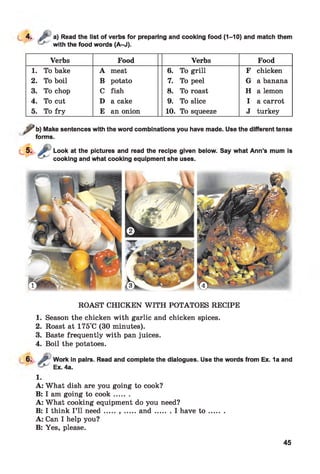
Look at the pictures and read the recipe given below. Say what Ann’s mum is
cooking and what cooking equipment she uses.
ROAST CHICKEN W ITH POTATOES RECIPE
1. Season the chicken with garlic and chicken spices.
2. Roast at 175°C (30 minutes).
3. Baste frequently with pan juices.
4. Boil the potatoes.
6. .JP Work in pairs. Read and complete the dialogues. Use the words from Ex. 1a and
Ex. 4a.
1.
A: What dish are you going to cook?
B: I am going to cook.......
A: What cooking equipment do you need?
B: I think I’ll need..... , .....an d .........I have t o .........
A: Can I help you?
B: Yes, please.
45
A: What are you looking for?
B: I’m looking for th e ....... Do you know where it is?
A: Did you look in the cupboard?
B: Yes. I looked everywhere.
7- Read the instructions and play a guessing game.
2.
• tea • a sandwich • a vegetable (fruit) salad • a roast chicken
• fried fish with potato •
T h e s p e a k e r chooses one of the dishes from the word bank. He / She
says what cooking equipment he / she uses to cook it and describes the pro­
cess of preparing and cooking it.
T h e class tries to guess what dish the speaker is talking about. The
person who names the dish becomes the speaker and the game starts again.
^ Write the recipe of your favourite Ukrainian dish. Describe how you / your mother
cook(s) it and what cooking equipment you use / she uses.
Lesson 5
1 - £Look at the picture and name the things you see. Use the words:
a saladplate, abread-and-butterplate, adinnerplate, asoup bowl, awaterglass,
a cup, asaucer, a napkin; silverware: a saladfork, a dinner fork, aknife, a teaspoon,
asoupspoon, abutterknife.
E x a m p le : Number 1 is a dinner plate.
A Place Setting
46
Work in pairs. Look at the picture on page 46. Read, complete and act out the
dialogues.
1.
A: Excuse me. Where does the knife go?
B: It goes to the right of the dinner plate.
2.
A: Excuse....... Where does.......go?
B: I t .....to the left / between / o n .......(a n d .......).
3.
A : ...............W h ere...... a salad fo r k .......?
B: It goes.......
Listening Lab
3. > ’L, Complete the conversation between Ann and Kim. They are talking about
cooking. For questions (1-5), mark the correct letters (A-H).
Ann: I ’m learning to make cakes. Can you cook, Kim?
K im : (0) E I can cook pasta, that’s all.
Ann: I can’t. How long does that take to cook?
K im : ( 1 ) .....
Ann: That’s quick. And do you have that with tomatoes and cheese? I love
that!
K im : ( 2 ) .....
Ann: That sounds great! Why don’t we make a meal for everyone?
K im : ( 3 ) .....
Ann: Let’s do it at your house. How about next Friday?
K im : ( 4 ) .....
Ann: OK. You do the main course and I ’ll make a chocolate cake. It’ll be
fun!
K im : ( 5 ) .....
Ann: I hope so!
A So do I! But I like it with chicken, eggs and cream, too.
B Not long - you boil it in water for about ten minutes.
C Is it? What do you need?
D Yes, it will. I ’ll check with mum, but it’ll be OK, I ’m sure.
E I can cook pasta, that’s all.
F Saturday’s better, Ann. Mum has to work on Friday nights.
G No, there’ll be only your parents, my parents and Dan.
H That’s a great idea. Shall we do that at our house or at your house?
* 4 b) Listen and check. Then work in pairs. Act out the dialogue.
47
Conversation Lab: Making Suggestions
4. J;* a) Look at the ways we can make suggestions. Match the suggestions and
responses.
1. Why don’t we make some lemo­
nade?
2. W e could have fried rice for din­
ner.
3. What about having a picnic?
4. Shall we buy some burgers?
5. How about having a boiled egg
for breakfast?
6. Let’s put some pieces of apple in
the salad.
A OK. W e could fry some onions
with it too.
B But we haven’t got any lemons.
C Sorry, we can’t do that. I haven’t
got enough money.
D Good idea! I ’ll go and make one.
E How about putting some grapes
in it, instead?
F I ’d rather just have some bread,
thanks.
b) Look through the text of Ex. 3 on page 47 again. Which phrases have the girls used
to make suggestions?
5. ? You are planning a picnic with your friends. Write sentences to make sug­
gestions. Use the phrases given above. Then act out a dialogue.
Read the recipe and write a story about the way Ann cooked Curry Chicken Salad
one day. Start like this:
One Sunday Ann decided to cook....... She got up very early, because she
had to get the food prepared by noon.
She took a large bowl and prepared....... First she....... Then she.........
After that she added....... She began t o ..................Finally,........
Curry Chicken Salad
You’ll need:
• 2 cups cooked chicken, shredded
• 1 teaspoon curry powder
• 1 celery stalk, chopped
• 2 hard-boiled eggs, chopped
• 1/2 cup mayonnaise
• 1A cup almonds, slivered
What to do:
1. Combine all ingredients in a large bowl.
Mix well.
2. Refrigerate several hours before serving. Serves 4.
48
Lesson 6
Work in pairs. Make and act out a dialogue “In the Kitchen”. Use the phrases from the
table.
QUESTIONS IN THE KITCHEN
Where can I fin d .... ?
Can I help w ith .... ?
Where does th is .... go?
Where do I keep.... ?
Where shall I p u t.... ?
2. ^ Read and say why Justin felt guilty.
A D AY W ITH GRANDPA
(By Mildred Pitts Walter)
The smell of coffee and home-smoked ham
woke Justin. His grandpa was cooking break­
fast downstairs. Justin jumped out of a bed
and quickly put on his clothes.
Grandpa had hot pancakes, apple jelly and
ham all ready for the table.
“They taste delicious, aren’t they?” grand­
pa asked.
“Of course, they are,” Justin answered.
A fter breakfast, grandpa cleared the
table, preparing to wash the dishes.
“Would you rather wash or dry?” he asked
Justin.
“ Neither,” Justin replied.
Grandpa said nothing. He slowly removed the dishes from the table. A fter
that he washed each dish and rinsed it with care, too.
A fter washing the dishes, grandpa swept the floor and then went upstairs.
Justin stood around downstairs. He had a strange feeling of guilt and
wished he had helped with the dishes.
3- < # 'a)
Read and complete the sentences with the correct words from the text (Ex. 2).
1. T h e .....from the kitchen filled the room.
2. A .....is a flat round cake made with flour, eggs and milk, fried on both
sides.
3. My m other.....the dishes from the table to wash them up.
4. Peanut butter and sandwiches.....delicious.
5. “ .....” means to wash something with clean water.
49
Grammar Lab: the Past Perfect Tense
W e use the Past Perfect Tense when we talk about two different events
at two different times in the past; one event ends before the second event
happens:
When mum came back home, the room wasn’t in a mess. Dan had
cleaned it. Dan had cleaned his room before his mother came back home.
e
6
Look through the text of Ex. 2 and find the examples of the Past Perfect Tense
in it.
Look, read and say which action took place first in the past and which action took
place second.
E x a m p l e :
I had done my homework, when my parents came back home.
1st: I did my homework.
2nd: My parents came back home.1
1. I took a newspaper to my father, but he didn’t want it. He had read it
during the lunch hour.
___ I took a newspaper to my father.
___ My father read a newspaper.
2. I arrived at school on time, but I wasn’t happy. I had left my homework
at home.
___ I arrived at school.
___ I left my homework at home.
3. My mother came home, and she was surprised. I had cleaned my room.
My mother came home.
___ I cleaned my room.
4. I played in the yard with my friends. I had written a composition.
___ I played in the yard.
_ I wrote a composition.
50
d r ^ Look at the pictures and write what the children had done before another action
happened.
Lesson 7. Grammar Revision
Read and complete the sentences with the correct question tags.
1. It’s important to eat a wide variety of food, .....?
2. You must eat well but not too much of one food, ..... ?
3. I ’ll take an apple and a can of orange juice for lunch....... ?
4. He doesn’t eat much chocolate every day, ..... ?
5. Ann mixed the egg, sugar, milk and baking mix in a large bowl,
6. Snack foods such as sweets and crisps don’t have much food value,
7. Let’s have something for a snack....... ?
8. Dan has already done the shopping today....... ?
?
?
Put a (an) with the countable nouns and some with the uncountable nouns.
..... bread, ..... spaghetti, ..... tomato, ..... potato, ..... sugar, ..... loaf of
bread,.....sa lt,...... m ilk ,...... bottle of lemonade,...... carton of yoghurt,......
meat, ..... can of Coke, ..... water, ..... carrot, ..... ice cream, ..... kilo of
flour, .....oil, .......bottle of oil.
2.
3.
4.
5.
6.
7.
8.
j r Put the verbs in brackets into the Past Perfect Tense.
W e came too late to the shop. The shop-assistant.....(to close / already)
the shop.
Jack wanted to introduce his cousin sister to me, but it wasn’t neces­
sary. I .....(to meet / already) her before.
He was very tired when he got to the top of the mountain. H e ..... (to
walk / already) a long distance.
I didn’t go to the museum with my friends yesterday. I ..... (to be /
already) there with my parents before.
My mum was angry, when I saw her. She ..... (to talk / already) with
my teacher.
He wasn’t hungry. H e .....(to have dinner / already).
He wanted to let them see a house, but it wasn’t necessary. They .....
(to buy) a house by the first of September last year.
She wanted to tell me what the film was about, but it wasn’t necessary.
I .....(to watch / already).
51
Ann: Hi, Jane! I ’m logged in now.
Jane: Hi, Ann! It’s good to see you online. What’s happening?
Ann: Not much. I ’m just doing some research for a project.
Jane: Sounds boring!
Ann: No, it’s OK. I love doing projects. Actually, maybe you can help me...
Jane: Sure. What is the project about?
Ann: I have to find out about food of the future. Do you know any good
websites?
Jane: Let me think. Why don’t you visit the website of the Science Museum
in London? Here is the link http://www.sciencemuseum.org.uk/anten-
na/futurefoods/
Ann: That sounds good. And do you know anything about the history of fish
and chips?
Jane: Um... no, not really. I ’ll try to find the email address for you.
Ann: Thanks! I ’ve just found a picture of fish and chips. I ’m downloading
it now.
4. ■ Read the online chat and email. What is Ann’s project about?
* ■ * From: mark@yahoo.com
! To: annl4@gmail.com
Sent: Wed., Nov 10
Subject: information about fish and chips
Attached: & Fishchips.doc
Hi Ann,
My name is Mark, and I ’m Jane’s classmate. She asked me to send you
some information about the history of fish and chips.
I am interested in the history of the traditional British food. I hope
that the information in the attachment may help you with your project.
Here is the link you can also use: http://www.historic-uk.com/Cul-
tureUK/Fish-Chips/
Please, let me know if you find it helpful.
Best wishes,
Mark
a) Answer the questions.
1. What is Ann’s project about?
2. How does Jane help her friend Ann?
3. What has Mark found in the Internet?
^ b ) Read the sentences and tick them T (True) or F (False).
___ 1. Ann and Jane are talking over the telephone.
___ 2. Both girls like doing the school projects.
___ 3. Jane is the only person who helps Ann with her project.
52
4. Mark is in the class with Jane.
5. Mark has sent Ann a necessary photo.
6. Mark has recommended Ann uses an Internet website.
dr You’ve got an email from your English-speaking friend in which he / she asks you
to help him / her with the school research project. Write your reply.
•■ i From: mark@yahoo.com
i From: clark@yahoo.com
To: ukraine@gmail.com
Subject: research on Ukrainian food
Hi there,
I got your email address from the friendsonline website.
I am doing a project on food at school in different countries.
I read your article on the website. I wonder if you could provide me
with some more information about the traditional Ukrainian dishes. It
would help me a lot.
I look forward to your reply.
Clark
Self-assessment
Think of your records. Tick how well you know it:
4 = very well, 3 = OK, 2 = a little, 1 = needs to improve.
Skills Now I can.... 4 3 2 1
s
• describe a kitchen, the kitchenware, a process of
cooking and a place setting
• talk about different kinds of foods and drinks
• ask questions and present information on the topic
□ □ □ □
□ □ □ □
□ □ □ □
¥ <
• understand short conversations
• understand the recipe
□ □ □ □
□ □ □ □
• read and understand the text of a magazine
article, a booklet, a recipe
• find relevant and necessary information in the
texts
□ □ □ □
□ □ □ □
/
• write a paragraph about my kitchen
• write a recipe of my favourite dish
□ □ □ □
□ □ □ □
53
IN THIS UNIT YOU WILL:
• talk about your health, healthy lifestyle,
illnesses and their treatment;
• read about the doctor’s visit;
• listen to a dialogue in the policlinics; the
doctor’s recommendations;
• write a paragraph / a letter to a friend who is
in hospital;
• learn what to do in case of emergency;
• revise the modal verb should/ shouldn’t;
• learn about the modal verb must.
Lesson 1
1- ► * Listen and read. Say what you think about Addy and Andy.
Addy Andy
ADDY AND AND Y
Addy is healthy,
And Andy is not.
Addy can run fast,
And Andy cannot.
What makes Addy strong?
Good exercises.
What makes Andy sick?
He eats many pies.
From this good example
It soon becomes clear
That being unhealthy
Is often quite drear.
So drink up fresh milk
And say no to pie,
Get enough sleep
And you’ll be just fine.
a) Look at the pictures. Listen and repeat the sentences.
I feel fine. She looks happy. He looks tired.
56
I feel sick.
I don’t feel very well. He feels cold. She feels hot.
b) Work in pairs. Read and act out the dialogue.
A: How do you feel?
B: I fe e l.......
A: That’s good. / Oh, dear. I’m sorry to hear that.
Work in pairs. Look at the pictures and make sentences as in the example.
E x a m p l e :
- Does Ann feel cold? - Does Peter look sleepy?
- Yes, she does. She feels cold. - No, he doesn’t. He doesn’t look sleepy.
Dan / feel hot Kim / feel thirsty Tom / feel fine
The worker /
look tired
The farmer /
look angry
The boy /
look cheerful
57
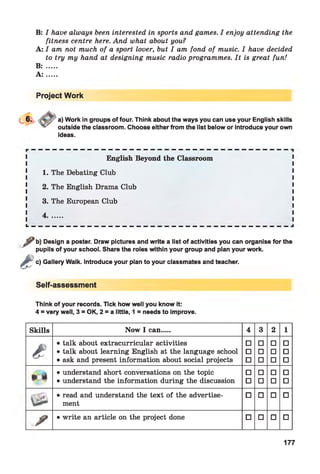
A My temperature was very high.
B Did the doctor visit you yesterday?
C You must follow the doctor’s advice
D How do you feel?
Denys: Hello!
Olena: Hi, Denys! This is Olena. ( 1 ) .....
Denys: Not very well. I must stay in bed. ( 2 ) .....yesterday.
Olena: Oh, no! Sorry to hear that! ( 3 ) .....
Denys: Yes, he did. He told me to stay in bed for a week. I must also drink
hot milk with butter and honey.
Olena: ( 4 ) .....then you will feel better soon. Hope to see you at school next
week. Bye!
Denys: Thank you for your call. Remember me to our classmates. Bye!
2.
E When you get sick you have a high temperature
F They look clean.
G Germs are so small that you can’t see them.
Mum: Time for dinner! Wash your hands, Alex.
A l e x : But they are already clean.
Mum: ( 5 ) .....You were playing outside with the dog in the afternoon.
A l e x : But look! No dirt!
Mum: There are still germs. ( 6 ) .....But they are everywhere. If you eat with
dirty hands, the germs get on your food and go into your body.
A l e x : And then I get sick. Good, I don’t want to go to school tomorrow any­
way.
Mum: (7) .....And feel very unhappy. And you can’t play outside. Go and
wash your hands.
A l e x : Fine, but after dinner I’m going out to play again.
Mum: That’s all right, dear.
58
r / Read and complete the sentences. Use the words: comfortable, ill, busy, happy,
tired, difficult.
1. Mary looks....... Her face is very white.
2. May I sit in that armchair, please? It looks v e r y .......
3. You seem v e r y ....... Peter. Go to bed early tonight.
4. John seems v e r y ....... He always has a smile on his face.
5. The children seem v e r y ....... They are working hard.
6. This sum looks v e r y ....... but I will try to do it.
Lesson 2
Listen and repeat.
a bad cold a cough a sore throat a headache
a high temperature a pain in the knee a pain in the elbow
59
Listen, read and act out the dialogue.
A: W hat’s the matter with you? Has anything happened?
B: I don’t feel very well.
A: Oh, dear! W hat’s wrong?
B: I’ve got terrible earache.
A: I’m sorry to hear that.
B: It’s all right. I ’ll be better soon.
A: I hope you will.
B: Thank you.
3. a) Look, read and say which picture this dialogue goes with.
A: W hat’s the matter?
B: My left foot hurts.
A: Oh, dear. How did it happen?
B: Well, yesterday I played football.
C
Work in pairs. Choose a picture and act out another dialogue.
A: W hat’s the matter with you?
B: I don’t .......
A: Oh, dear!.....?
B: I’ve g o t .......
A: I’m sorry to hear that.
B : .......
4- !Read and say what happened to Jane yesterday.
Jane hurt her arm in the gym yesterday. She is waiting to see the doctor
now. There are other patients waiting, too. There is a boy with a bad cold and
a girl with a headache. There is a woman there with her sons. One of the
woman’s sons has earache. The other son has toothache.
Now Jane and her mother see a doctor.
D o cto r: Hello, Jane. What’s the matter?
Jane: I ’ve hurt my arm.
60
D octo r: Let me examine it. Yes ..... You’ve got some cuts and bruises,
Jane, but your arm isn’t broken. I ’ll put a bandage on it.
Jane: Thank you, doctor.
Conversation Lab
Read and act out a situation “At the Doctor’s”,
as a model.
Use Ex. 4 or the one given below
A: Good morning!
B: Good morning! What can I do for you?
A: I ’ve got a terrible headache.
B: How long have you had it?
A: For about two hours.
B: Try this medicine and visit me in three days.
A: Thank you, doctor.
Put the verbs in brackets in the correct tense form.
Peter is six. He ( 1 ).....(to have) a very bad toothache last week. He ( 2 )......
(can / not / to eat), he ( 3 ) .....(can / not / to play), he ( 4 ) .......(can / not / to
sleep) at night. Peter’s father (5 ).....(to take) him to the dentist. The dentist
( 6 ) .....(to pull out) Peter’s tooth.
Peter ( 7 ) .....(to cry) and ( 8 ) .......(to say), “Oh, how shall I eat now?”
But the doctor ( 9 ).....(to say), “Don’t cry, little boy! Your tooth will grow
again.”
61
Lesson 3
Look at the pictures. Say what’s wrong with the children.
E x a m p l e : Bill has got a fever. He has to stay in bed.
a fever a sore throat / quinsy a bad cold
a headache a stomach ache
Reading Lab
2 - - I s * Read the text and say why the doctor visited the Parkers’ family last week.
THE DOCTOR’S VISIT
Steve started to feel ill on Monday morning. He was pale. He had a headache
and a sore throat. Besides he was sneezing and coughing badly. His mother took
his temperature. It was very high. Steve had a fever. She said, “I think you
can’t go to school today. You have to stay in bed. I’ll call the doctor.”
Mrs Parker phoned their family doctor, Mr Johnson.
Mr Johnson came in an hour. He examined his patient, listened to his
heart and lungs, looked at his eyes and ears. Steve had a bad cold.
The doctor said, “Steve, you have to stay in bed for a day, gargle your
throat with salt water three times a day, drink hot milk with butter and
honey, dear. Here’s the prescription, Mrs Parker. I think everything will be
fine in a week. Follow my advice, please.”
62
The boys’ health improved wonderfully. Steve felt much better in a week
under the doctor’s treatment.
3-
1. Mr Johnson alw ays.....when somebody.......in the family.
2. The doctor.....the recommendations an d .......medicines to the patient.
3. S teve.....a bad cold.
4. Steve recovered soon because.......
4-
1. How did Steve feel himself on Monday morning?
2. What was his temperature like?
3. Did Steve call a doctor himself?
4. What did the doctor do when he came?
5. What did the doctor recommend?
6. The boys health improved in a week, didn’t it?
êWork in pairs. Ask and answer the questions.
aRead and complete the sentences.
Conversation Lab
5-
E x a m p le s :
1.
A: You were absent yesterday, weren’t you?
B: Yes, I was.
A: What was the matter?
B: I had toothache.
A: Oh dear! Are you all right now?
B: Yes, thank you.
aWork in pairs. Make short dialogues as in the examples.
2.
A: How do you feel?
B: Not so good. / Not very well. / Terrible!
A: What’s the matter?
B: I have a ....., ...... , and........
A: I ’m sorry to hear that.
3.
A: You look pale. Are you OK?
B: Oh no. I think I have caught a cold. I am coughing and sneezing.
A: You should stay in bed and consult a doctor. There is the epidemic of
the flu now.
T ^ You were ill two weeks ago. Write a letter to your English-speaking friend. In your
letter:
• explain what happened to you;
• if the doctor visited you;
• what recommendations you got;
• what helped you recover.
63
Lesson 4
1- * * Listen and repeat. Then make sentences with the word combinations.
• to feel ill • to phone the mother • to take somebody home
• to examine the patient • to write a prescription • to go to the chemist’s
• to take the medicine (pills) • to feel better •
Listening Lab
2. g Look at the pictures and match them with the word combinations of Ex. 1.
L 3 - . M Listen to the story. Order the pictures (A-H) to Ex. 2 according to the text. Then
complete the sentences given below.
1. 2. 3. 4. 5. 6. 7. 8.
1. Suddenly I f e l t ....... I h ad ......... 5. She examined .
2. My teacher....... 6. She told me ....
3. My m other....... 7. I .....and soon
4. The doctor visited m e ....... 8. I thanked ,
Speak in class. Use the pictures to Ex. 2 and retell the story. Start like this:
One day Sue started to feel ill.
64
Conversation Lab
5 - & Read and act out the dialogue.
S teve: Good morning, Miss Alison!
M iss A lis o n : Good morning, Steve! You
weren’t at school last week. Were you ill?
S teve: Yes, Miss. I had to stay in bed for five
days.
M iss A lis o n : Oh dear. What was the matter?
S teve: I had a cold and a sore throat.
M iss A lis o n : Did your mum call a doctor?
S teve: Yes, she did.
M iss A lis o n : Are you better now?
S teve: Sure. Thank you. Here’s a letter from
my mum.
^ Read the dialogue to Ex. 5 again and complete Mrs Parker’s letter from home.
r — — — — — — — — — — — — — — — — — — — — — — — — — — — — — — — — — — — — — i
Dear M is s .......
.....wasn’t at school.......week, because he was.........He had........
Yours sincerely, 1
M r s ..... !
Lesson 5
Listen and read the poem. Say what the doctor usually does when he visits his
patient.
When I am ill I go to bed,
And on the pillow lay my head.
The doctor comes and says, “Dear me!
Whatever can the matter be?”
She feels my pulse and sees my tongue,
She tests my heart and then each lung;
She asks how old I am, and then
She takes her paper and her pen.
She gives me medicines that taste
So bitter, that I ’m sure it’s waste
To take them.
But she says, “Each noon
Take this, and you’ll be better soon.”
65
2- * * Read and listen to a part of a lecture. What must you do to stay healthy?
When we are ill, we feel unhappy and sometimes have a high tempera- 1
! ture. Very often the cause of illness and disease is dirt. Dirt is full of .
I germs. They are very, very small but they are alive. They can get in (
l through our nose or mouth and make us ill. They can get into our body i
I through our skin, too. W e must keep our body clean. W e must wash our I
1 hands before meals. W e must keep our fingernails clean.
W e must also think of our teeth and clean them twice a day. Germs can !
I make teeth bad. A toothache is very painful. That’s why we must visit our |
I dentist regularly to be sure that everything is OK with our teeth. i
I Our body also needs fresh air to breathe. W e must have plenty of clean I
1 air to stay healthy. W e must do sport regularly. And we also must keep 1
! our home clean.
L __ __ _ _ _ _ _ _ _ _ _ _ _ _ _ _ _ _ _ _ _ _ __ __ __ __
Read and choose the correct items to complete the sentences.
1. When we are ill we sometimes have a h ig h .......
A germs B temperature C dirt
2. Very often the cause of illness i s .......
A pain B dirt C headache
3. W e m ust.....our teeth twice a day.
A wash B sweep C clean
4. W e m ust.....keep our home clean.
A always B sometimes C never
Grammar Lab: Modal Verbs: must / mustn’t; should / shouldn’t
The modal verbs are a special group of auxiliary verbs.
They are different from most other verbs in four ways:
• A fter modals we use infinitives without to (after other verbs we use
infinitives with to).
• Modal verbs have no -s on the third person singular (he / she / it form).
• W e make modal questions and negatives without do.
• Modal verbs have no infinitives or -mg-forms. Instead, we use other verbs.
W e use the modal verb MUST when we mean: ‘This is necessary.’ Or
‘This is a good idea.’
I must get up early tomorrow.
You must visit a dentist twice a year.
In questions, we use MUST when we mean: ‘Is this really necessary?’
To make questions with MUST, we put MUST before the subject.
Must you sleep eight hours a day?
To make negative sentences we put NOT after MUST.
You mustn’t do that.
66
We use SHOULD to talk about a good thing to do.
You should be more careful to your health.
You shouldn’t drink cold water. You can get a sore throat.
Should I take these medicines three times a day?
4 - £ Look and say what you must / mustn’t or should I shouldn’t do to keep fit.
Example:
You should take part in a sport regularly.
to take part in a sport to smoke to go to bed late
to eat too much to eat many sweets to eat fruit and vegetables
r ? Complete the sentences. Put in shouldor must.
1. I can’t leave; I .....finish this report today.
2. I .....take more exercise, but I ’m too busy.
3. Y o u .....n’t smoke.
4. W h a t.....I do to keep fit?
5. What clothes.....I wear? - Put on a jacket. It’s cold outside.
6. W h en .....you consult a doctor?
7. Sue needs to lose some weight. I believe sh e.......exercise more.
8. The weather is fine today. It’s warm enough. You ..... put a warm
sweater on.
67
Lesson 6
1 - 4 - Work in pairs. Talk with your friend.
1. Do you often feel ill?
2. Where do you usually get medical care?
3. Have you got a family doctor? When do you consult the doctor?
4. When did you have your last medical check-up?
5. What did the doctor say?
6. Did he prescribe any medicines to you?
2. 4 a) Listen and repeat.
b) Work in pairs. Use the words to make sentences as in the example.
E x a m p l e :
A: I ’ve got a headache.
B: You should take an aspirin.
A: My eyes hurt.
B: You should consult the doctor and use some eye drops.
an aspirin a cough syrup/ a nasal spray cold tablets
cough drops
vitamins eye drops a pill /
a tablet
a teaspoon /
a tablespoon
68
3. ? Complete the sentences with the words from Ex. 2a on page 68.
1. People u se.....when they have problems with their eyes.
2. “What has happened with your knee, Tom? It is swelling. I ’ll bring you
....... It’ll help you.”
3. “How often should I take these ..... , Doctor?” - “Three times a day,
after meal.”
4. “I have got a running nose, Mum. Is there a n y .....at home?”
5. Use this ..... when you have a backache. It can ease your pain. It is
a good anaesthetic.
6. You should use th is .....after you have washed a cut.
7. You can use th is .....on your dry skin.
8. Is there a n ..............to take for a headache?
9. Steve is very weak after his illness. That’s why his mother gives him
.....twice a day.
Conversation Lab
4-
E x a m p l e :
1. (A t school, in the Nurse’s Room)
A: Good afternoon, Mrs Petrenko! I don’t feel very well now.
B: What’s the matter?
A: I have a headache. I think that’s because of the weather.
B: Here is a thermometer. Take your temperature.
A: I t ’s 37,5°C.
B: I think you should go home and call a doctor. Here is a headache
tablet.
A: A painkiller.
B: Right you are. Now let’s phone your mum.......
ê
Work in pairs. Act out a dialogue as in the example.
2. (A t home)
A: How do you feel, dear?
B: I feel really dizzy. What did the doctor say?
A: He advised you to take cold tablets and cough syrup.
B: What’s the dosage?
A: You must take these pills three times a day after meal and one teaspoon
of the cough syrup every three hours.
B: OK, Mum.
dr ^ Write questions to the sentences.
1. Peter had his tooth pulled out yesterday. ( ....., ......?)
2. Sue visited a dentist last month. (When?)
3. The germs cause this infectious disease. (What?)
4. Alexander Fleming discovered penicillin 200 years ago. (..
5. My grandmother knows a lot about herbal medicine. (......
•?)
•?)
69
Lesson 7
1. * 4 Listen and repeat.
bleeding a small burn choking a broken bone a shock
or scald
to press a clean
piece of cloth
to tie a bandage to swallow some­
thing / to hit some­
body on the back
to call
an ambulance
Reading Lab
2.
ê
Work in groups of five,
a) Choose the text to read by yourself,
b) Tell the information to the other members of your group.
W H AT SHOULD I DO?
Sometimes people hurt themselves. If it happens you must know what to
do. Then you will be very helpful. If you are not sure what to do, you should
get help.
1. Bleeding
A little bleeding can be a good thing. It helps to wash away the dirt and
germs. Press a clean piece of cloth over the cut to stop the bleeding. When
the bleeding stops, tie a bandage firm ly but not tightly around it. Get help if
bleeding doesn’t stop or if the cut is deep or if there is dirt in it.
2. A small burn or scald
A scald is like a burn but it is caused buy a hot liquid. If it is a very bad
burn or scald, get help at once. If it is a small burn or scald, first cool it. You
can do this by placing it in a bowl of clean, cold water, or under a tap.
70
Then put a clean bandage on it to keep out the air. Do not put any oil or
cream on it. They may contain germs.
3. Choking
It happens if you swallow a large piece of food or a small toy. If it blocks
the airway only partly, the person may still be able to breathe enough air to
cough. If the cough is strong, the person may be able to cough up what he
has swallowed. If he cannot, then you must help. Make him sit down on
a chair with his head between his knees. Hit him sharply on the back with
your hand. If he is still choking, get help quickly.
4. A broken bone
If you think the person has broken a bone, do not move him. This might
hurt him. Keep him still. Send for an ambulance. If the wound is bleeding,
treat it as explained in text 1. If necessary treat for shock.
5. Shock
Any accident is a very unpleasant thing. It usually makes people ill. If the
face turns grey and the skin becomes cold and wet, we say that the person is
in shock. Keep him warm. Wrap a blanket or a jacket around him and give
him a warm drink.1
3. Work in groups of five. Share the information with your groupmates. Complete
the table given below.
What happens The First Aid What to do next
Bleeding • press a clean piece of cloth
over the cut
• get help if bleeding
doesn’t stop
A small burn or scald
Choking
A broken bone
Shock
4. Check yourself about the things you have learnt from your friends. Say if the
statements are true or false.
1. A little bleeding can be a good thing.
2. If you use a piece of cloth it must be clean.
3. If the bleeding doesn’t stop, tie a tight bandage around it.
4. If there is a dirt in the wound, you must clean it.
5. Hold a small burn or scald under a cold tap or place it in a bowl of cold
water.
6. Put a cool cream on a burn before you put on a bandage.
7. If the person is choking, tell him to cough.
8. If someone has broken a bone move him into a comfortable position and
send for an ambulance.
9. If a person’s skin turns grey and becomes wet and cold, keep him warm.
71
Conversation Lab
5 -
5. Speak in class. Talk about the situation when you had to help your friend. Say
when and where the accident happened, what symptoms you paid attention to,
and how you gave them first aid.
Write a paragraph to post on the Internet blog about the place where you usually
get medical care. Describe a health problem you had when you came there and
how your health improved. What were the recommendations of the doctors?
Lesson 8
. .J ^ W c
^ to I
Work in pairs. Take turns to ask and answer the questions about the pictures
Ex. 1.
Ask about the following:•
• what made the children consult a doctor;
• what the children suffer from (complain of);
• whether the doctor examined the patient carefully;
72
• whether the doctor gave any practical advice;
• what the doctor prescribed to the patient;
• what the patient should do;
• how the doctor helped;
• what medicines helped the patient recover.
Writing Lab
13. V rL, Read Jane’s letter and say why she is in hospital.
____________________________________________________________
■■ i From: janel3@gmail.com
i Copy:
To: ann_flower@gmail.com
Subject: Hi there
Dear Ann,
This is just a short letter to let you know that I ’m in hospital - but
don’t worry, it’s nothing serious, I have got a quinsy again. You know,
I had so many sore throats last year.
My throat was pretty sore after I woke up two days ago. I had a fever
and my mum was worried and called an ambulance. I feel much better now
but it’s still difficult for me to swallow and to speak. The doctor says I have
to stay in hospital for a few days if there are no serious complications.
I ’ve got lots of books and magazines, but even so, being in hospital is
boring! I am not allowed to go for a walk, and I don’t know what to do with
my time.
Anyway, it’d be great to hear from you with any news. A funny letter
would really cheer me up.
Hope to see you very soon.
Best wishes,
Jane.
*■
1. Why is Jane writing a letter?
2. Who is she writing her letter to?
3. How does she start her letter?
4. What is paragraph 1 about?
5. What do paragraphs 2 and 3 tell her friend about?
6. How does Ann finish her letter?
sAnswer the questions.
Read and complete the sentences.
1. Jane has g o t .......
2. It’s difficult for h e r .......
3. Jane thinks that staying in hospital is
4. Jane wants her friend t o .......
73
Writing Lab: An Informal Letter
When you write a letter to a close friend, it’s better to use informal
language.
Here are the phrases that can help you:
Explaining why you are writing:
This is just a short letter to let you know th a t.....
Explaining what had happened:
It happened o n .....
It happened so th a t.....
To change the subject:
Anyway, .....
Now.......
Sympathising:
I was sorry to hear about your illness.
I was really sad to hear th a t.....
Ending a letter:
W rite soon, it’d be great to hear from you.
Hope to see you soon.
A ll the best, .....
Love, .....
dJrf Write a reply to Jane’s letter. Cheer her up. Use the phrases from the “Writing
Lab”.
Lesson 9. Grammar Revision
1- y Complete the questions with the correct question tags.
1. The doctor diagnosed Steve with a bad cold yesterday, .....?
2. Bill had to stay in bed last week because he was ill, ..... ?
3. The nurse gives medicines to the patient three times a day, ..... ?
4. You must follow the doctor’s recommendations to avoid serious compli­
cations, ..... ?
5. My brother goes to the policlinics for a medical check-up once a month,
9
6. Steve didn’t go to school yesterday,
Work in pairs. Read the sentences given below and discuss them with your
friend. Are they T (True) or F (False).
1. Virtual Reality (VR) is a computer-simulated environment.
2. VR can simulate physical presence in places in the real world, but not
in the imagined worlds.
74
3. Virtual reality can recreate sensory experiences, which include taste,
sight, smell, sound, touch, etc.
4. VR is not useful in real life.
3. ■ Read the article from a teenagers’ magazine and say how virtual reality affects
f k n Il f A /f П А Л П Іа «ЖІІ А Г А ill
the life of people who are
VIRTU AL REALITY
Have you ever imagined yourself in the
place where you have never been before? Have
you seen films like The M atrix? Have you
ever heard of virtual reality or VR? Of course,
you have, if you have played computer games.
But have you thought that virtual reality can
affect our lives in different ways? Not many
of you can answer, “Yes” . Not many of you
have also thought that virtual reality can be
useful for people in some ways.
One of the commonest uses of VR is in
medicine. Scientists have managed to build
VR machines which can help to train doctors in surgical techniques, but VR
is also used in the operating theatre itself. For children who are seriously ill
in hospital, there is now a VR game network that links seven hospitals. The
children have a lot of fun but, apart from that, research has shown that the
system helps to reduce their pain and loneliness.
W e can expect VR to become part of our lives in the nearest future.
4-
1. Have you ever played computer games?
2. Have you ever heard of virtual reality?
3. How does virtual reality or VR affect our lives?
4. Can virtual reality be useful?
5. What can VR machines help people to do?
6. People use VR in medicine, don’t they?
Work in pairs. Take turns to ask and answer the questions.
Conversation Lab
5- £
Work in pairs. Put the conversation in the correct order.
P a t ie n t :
P a t ie n t :
D octo r:
D octo r:
P a t ie n t :
P a t ie n t :
Yesterday. I fell over while I was playing football.
Should I go today?
Goodbye.
Hmm. I think you’ve only sprained it. I ’ll put a bandage on
it for now. But you should go to hospital for an X-ray.
Yes, but it hurts.
I ’ve hurt my ankle.
75
_____P a t i e n t : Thank you, Doctor. Goodbye.
_____D o c to r: Can you just take your shoe off? Hmm, yes. Can you move
your foot?
_____D o c to r: Yes. Take this note with you.
_____D o c to r: When did it happen?
_____D o c to r: Hello. W hat’s the problem?
b) Listen and check. Then act the dialogue out.
Conversation Lab
Work in groups of three. Act out the situation.
P u p i l A. You are a pupil. You have become the witness of an accident
not far from your school. The boy fell down and broke his leg. Talk about
your actions.
P u p i l B. You are a doctor. First aid was given to the sick boy before you
arrived. Ask about the accident. Say if the first aid was given correctly or
not.
P u p i l C. You were playing football in the school yard but unfortu­
nately fell down. You think that you have broken your leg. Your classmate
gave you first aid. He did everything to keep you as still as possible. He
covered you with his jacket to keep you warm and then went to call an
ambulance.
Work in pairs. Talk with your friend about the hospital in the place where you live.
Start like this:
A: The new hospital for children was opened in Kyiv two months ago. It has
all necessary equipment to help the patients.
76
B: How many children are there in one room?
A: There are not many. The hospital has rooms for two and three children.
B: ...
8.r ^ Write an email to your friend about your visit to the policlinics. Use the words:
to suffer from, to complain of, to recover, to give practical advice, to prevent
an illness, to avoid serious complications, to find out, to examine someone’s
eyes, to extract a bad tooth, etc.
Self-assessment
Think of your records. Tick how well you know it:
4 = very well, 3 = OK, 2 = a little, 1 = needs to improve.
Skills Now I can.... 4 3 2 1
• describe feelings and health problems □ □ □ □
6
• talk about the symptoms of illnesses, their reasons,
first aid and the ways of treatment
□ □ □ □
• talk about medicines n n n n
• talk about healthy well-being □ □ □ □
• ask questions and present information on health
issues
□ □ □ □
¥ <
• understand the doctor’s recommendations □ □ □ □
• understand the lecture on health issues □ □ □ □
• read and understand the information of a magazine
article and an informal letter
□ □ □ □
/
• write an informal letter □ □ □ □
• write about a visit to the policlinics □ □ □ □
77
IN T H IS U N IT Y O U W IL L
talk about watching films and theatrical
performances;
read about the best cinemas and theatres
read the information on the Internet;
listen to short conversations;
write about your visit to a cinema;
write a film / a play review; M
revise the Present Perfect Tense;
learn how to buy a ticket;
learn about linking p h r a s e s . '
Lesson 1
Look at the photos and say which of these places you have been to. Add infor­
mation.
E x a m p l e :
A: I live in Kyiv, the capital of Ukraine. There are many cinemas and
theatres in our city. Kyiv is the cultural centre of Ukraine.
B: I live in the village of Lypivka, Kyiv Region. My class went on an excur­
sion to Kyiv during the last winter holidays. We went to the theatre
there. We watched the ballet “The Nutcracker.”
a theatre a cinema
an opera a ballet
Work in pairs. Talk with your friend about your plans for the weekend. Use the
words from Ex. 1.
1.
A: What are you going to do this afternoon?
B: I’m going to v is it .......
A: W h a t.....are you going to watch?
B : .......
80
A: Are you going to do anything special on Saturday?
B: No, I am not.
A: Let’s ..... , shall we?
B: W ith pleasure.
2.
Reading Lab
Ju lia: When I have free time I enjoy reading a book, watching a film or
a theatrical performance. I like visiting new places with my favourite cha­
racters. I always try to be part of adventure. I imagine myself living in the
world created by actors or actresses. I can do this quite easily.
Steph en : My name is Stephen and I live in Manchester. I go to school, and
we often have school trips. Sometimes we go to the theatre or to the cinema
with our teacher. I always follow a play or a film plot very attentively. Some­
times I agree with the way the main characters act, sometimes I don’t.
I enjoy watching a theatrical performance more than watching films. I think
that theatre actors and actresses are much closer to the audience than they
are to the film viewers.
P e te r: To my mind, watching a film is as exciting as watching a theatrical
performance. Many people can find answers to their questions when they
watch them. I think that it is very important to be an active participant of a
film or a theatrical performance you watch. The world of cinema and theatre
gives us a chance to cast a glance at ourselves and become better.
— — Names
This person--- --------------
Julia Stephen Peter
• likes visiting new places with the favou­
rite characters.
• learns a lot of new facts while watching
films and performances.
• enjoys watching a theatrical performance
more than watching films.
81
• imagines living in the world created by
actors or actresses quite easily.
• thinks that theatre actors are quite close
to the audience.
• thinks that it is very important to be an
active participant of a film or a theatrical
performance you watch.
4-
1. What do you usually do at your leisure time?
2. Do you go to the cinema? What films do you like to watch there?
3. Have you ever been to the theatre? What did you like about the perfor­
mance?
4. Is it easy to be an active participant of the theatrical performance or
the film you watch?
ê
Work in pairs. Take turns to ask and answer the questions.
cPr f Write a paragraph for a school newspaper about spending your leisure time at
the theatre or at the cinema. Use Ex. 3 as a model.
Lesson 2
Match the words to the posters.
• an action film • an adventure film • a comedy • a fantasy
• a horror film • a romance • a science fiction film • a thriller •
82
Work in pairs. Act out short dialogues.
A: What kind o f .....do you like to watch?
B: I like to w atch.....because th e y .........And what about you?
A : .......
B :.......
Work in pairs. Look at the pictures and talk about the films you like to watch. Use
the phrases: to tell somebody about real life events, to entertain somebody, to
make somebody think about something, to teach the viewers about the moral
values, to predictsomething, to reflect theproblems ofasociety, etc.
E x a m p l e :
A: Have you watched the Pirates of the Caribbean?
B: Yes, I have. It was exciting. Some parts made me scared.
A: Could you easily predict what was going to happen?
B: Not always. It made me think.
3 .^ f r 0 | Listen and read. Say what kinds of film the children are talking about. Then act
out the dialogue. Change the underlined words.
P e te r:
Dan:
P e te r:
Dan:
P e te r:
Dan:
P e te r:
Dan:
Hi, DanI Do you want to go to the cinema this weekend?
Yeah, OK. Who are you going with?
Just Alex and Dan.
Great! I like them. What film shall we see?
I ’m not sure. What sort of thing do you like?
Anything except romance! What about you?
I like horror films, but I know Dan doesn’t like them.
Well, what about that new thriller? I’ve heard it’s really exciting.
83
P e t e r : Good idea. What time is best for you?
Dan: Saturday afternoon - I ’ve got a football practice on Sunday.
P e t e r : Fine. I ’ll tell Alex and Dan. W ill you check the film times?
Dan: Sure, I ’ll do that tonight.
P e t e r : Thanks, I ’ll speak to you later, Dan. Bye!
Dan: Bye!
4 - & Agree or disagree.
1. The boys are planning a visit to a theatre.
2. The boys will spend time together on Saturday afternoon.
3. They are going to watch a romance.
4. The boys know the film times.
5. Dan will check the film times tonight.
6. Dan will talk to Peter later today.
Conversation Lab
Work in pairs. Take turns to ask and answer the questions.
1. Do you usually watch films on TV or do you go to the cinema?
2. Why is it good to watch the new production of a film on a wide
screen?
3. How are the modern films different from the films people used to watch
at the beginning of the 20th century?
4. How do the computers change the world of cinema?
5. Is the music an important part of a film? W hy do you think so?
6. Would you like to be a film producer? What will your film tell the
viewers about?
6. a) Write. Complete the magazine article with the words from the box given below.
• form • recording • audience • dialogues • cameras • cultures
• attraction • special • reflect • different •
Films are produced by ( 1 ) .....actual people and objects with ( 2 ) .........
Producers also use ( 3 ) .....animation techniques and / or ( 4 ) .......effects.
Film is considered by many to be an important art ( 5 ).....; films enter­
tain, educate, enlighten and inspire the ( 6 ) ........Any film can become
a worldwide ( 7 ) ....., especially with the addition of dubbing or subtitles
that translate the ( 8 ) ........ Films are also artifacts created by specific
( 9 ) ..... , which (1 0 ).....those cultures, and, in turn, affect them.
b) Speak in class. Talk about cinematography as an important art form. What makes
watching films special?
84
Lesson 3
» e ft a) Look at the photos. Listen and read the short conversations (1-3) and match
them with the pictures (A-C). Say where the people are.
a hall, a billboard a box office a refreshment stand
1.
A: Oh n o .....The film has just started.
B: Do you want to watch this film? I think we can buy tickets for the next
show then.
A: Let’s look at the billboard. There is another film in the Red Hall of the
cinema. It starts in half an hour.
B: What’s on?
A: Shrek 2. What about watching it?
B: Hurry up! Or we’ll miss the performance again.
2.
A: Good morning!
B: Good morning, Madam!
A: Two tickets for the film Shrek 2, please.
B: Is Row 5 OK for you?
A: Yes, please. How much are the tickets?
B: Seven pounds each.
A: Here are twenty pounds. Thank you.
B: Here is your change. Enjoy watching the film!
A: Thank you.
3.
A: Good morning! Can I help you?
B: Yes. Two packets of crisps, please.
A: Which kinds of crisps would you like?
B: Cheese and bacon crisps, please.
A: Would you like anything to drink?
B: One little Coke and one Sprite, please.
A: That’s sixty hryvnias.
B: Here you are.
A: Here is your purchase and your change.
B: Thank you.
85
2. > ._ Read the letter and say what Dan likes most about the “Ukraina” cinema.
20 February 20... 1
Dear Alex,
l I ’m writing to tell you about my visit to the cinema. I watched the film |
I “Shrek 2” at the “Ukraina”cinema last Sunday. It was wonderful. I
Today it is one of the best cinemas in our country. You can watch come- 1
! dies, thrillers, horror films, animated cartoons and other types of films !
I there.
l There are two halls in the Ukraina cinema, the Red Hall and the Blue i
l Hall. The technical equipment of the halls is modern. In both halls there I
1 are the newest motion picture projectors. The halls are also equipped with 1
. special sound-absorbing panels, new pearl screens and comfortable seats. .
I The seats feature special props for drinks and popcorn. In the foyer there 
l are six monitors, a video projector and three bars with the variety of tra- I
1 ditional snacks and drinks. The comfortable summer terrace is located on 1
[ the second floor.
The main thing that attracts the audience is a unique calm and home- x
l like atmosphere. I
I Do you like to go to the cinema? What is your favourite place to watch I
1 new films? Write me soon.
Yours, .
Dan. |
L — — — — — — — — — — — — — — — — — — — — — — — — — — — — — — — — — — — — — J
3- £ a)
Look through the text of Ex. 2 and complete the sentences.
1. The “ .....” cinema is known a s ........
2. You can w atch...... .....a n d .......there.
3. The technical equipment of the halls i s .......
4. In both halls there are the newest.......
5. The halls are also equipped w ith .......
6. The seats featu re.......
7. In the foyer there a r e .......
8. The main thing that attracts the audience is
86
Conversation Lab
Speak in class. Use the prompts of Ex. 3a to talk about the cinema in the place
where you live. What makes this cinema a special place to visit?
Put the words in the correct order to make sentences.
1. films / always / Science / are / fiction / by / sensation / accompa­
nied / .
2. The / local / of / our / cinema / will / start / reconstruction / in / a /
month / .
3. second / Is / a / terrace / wonderful / located / on / the / floor / the­
re / ?
4. to / all / Does / modern / the /Ukraina / correspond/ cinema / the
standards / ?
5. programme / interior / , / of / attract / design / service/ , / location /
quality / and / this / The / audience / to / cinema / .
6. drinks / the / popcorn / feature / cinema / any / special / seats / halls /
props / for / and / in / the / of / Do / the / ?
87
Lesson 4
1. ;îv Work in pairs. Take turns to ask and answer the questions. Add information.
Questions You Your Friend
• Do you often go to the cinema?
• What kinds of film do you like to watch?
• What makes this cinema a popular place to visit?
• What are the halls equipped with?
• Do you like the quality of service in this cinema?
What features attract the audience?
• What film have you watched recently?
Were there any special effects in the film?
• What helps this film become a worldwide attrac­
tion?
Writing Lab: A Film Review
Look at the photos from the film “The Hobbit: The Battle of the Five Armies”
(2014) given below. Have you seen this film? What do you think of it?
•'L, Read the review of “The Hobbit: The Battle of the Five Armies”,
positive or negative?
Is it generally
By Dan
A FILM REVIEW
(1) The Hobbit: The Battle of the Five Armies (2014) is directed by Peter
Jackson. It is the third in a trilogy of films that brings the masterpiece The Hob­
bit, by J.R.R. Tolkien, to life. It is a 2014 epic fantasy adventure film. The
stars are Ian McKellen, Martin Freeman, Richard Armitage and others.
(2) The film tells the viewers about the adventures of Bilbo Baggins,
Thorin Oakenshield and the Company of Dwarves. They have taken back their
88
homeland from the Dragon Smaug, but have suddenly released a deadly force
into the world. Now Bilbo and Company have to keep the Lonely Mountain
from falling into the hands of a rising darkness. The races of Dwarves, Elves
and Men must either unite or be destroyed. Bilbo finds himself fighting for
his life and the lives of his friends as five great armies go to war.
(3) Although, this film is 144 minutes long, it never gets boring because
the special effects are extraordinary. It’s one of the most expensive films
ever made. However, the film is criticised for a lack of plot. Also, there are
repetitive battle scenes which I find quite annoying.
(4) I don’t usually enjoy films like The Hobbit: The Battle of the Five
Armies, but I really liked this one for its energy, shorter running time and
satisfying closure.
or disagree with the following statements.
1. The plot of the film is based on the novel by J.R.R. Tolkien.
2. It is the last film in the series.
3. The film is directed by Steven Spielberg.
4. The events in the film take place in the past.
5. Dan likes everything in the film.
6. Dan recommends this film to his friends.
Match the paragraphs (1-4) of Ex. 3 with the topics (A-D) given below.
A Recommendations
B Background to the story
C Opinions
D Basic information
Look at the underlined words in the text of Ex. 3. Which do we use for:
• addition?
• contrast?
• examples?
eft ^ Write a review of a film you have seen recently. Was it a wonderful experience for
you? What kind of film was it? Did it make you laugh or cry? Did it deal with any­
thing that happened or might happen to you? Follow the plan given below.
1. W rite notes about the film.
• Basic information: title, date, kind of film, director, stars;
• background to the story: Where? When? What happens?;
• opinions: acting, story, special effects and photography, music;
• recommendations: it’s (not) worth seeing, I do (don’t) recommend it.
2. Use your notes to write the review. W rite four short paragraphs.
3. Check spelling, vocabulary and grammar.
4. Work in groups. Read each other’s reviews. Do you agree with them?
E x a m p l e :
I agree with Ilona’s review. The film is really fantastic, and the music is great.
89
^
Lesson 5
1. ► * a) Listen and repeatthe words.
• the lights • the curtain • the spotlight • the scenery • the stage
• the chorus • a dancer • an actress • an actor • an orchestra • a balcony
• the audience • the stalls • the usher • a programme • a ticket •
2. y / a) Work individually. Write down anything you don’t know about going to the
theatre. You may want to think about the places to buy the tickets, the people
who work at the theatre, etc. Write down questions starting with:
W h y ..... ? W h en .....? W here...... ? W h a t..... ? H ow .....?
b) Work in pairs. Discuss your questions with your friends. Can you answer them? Take
notes and complete the first and the second column in the chart below.
c) Work in groups. Complete the third column.
I Know I Want to Know I Learnt
90
Read the Internet pages A and B from London Theatre Guide quickly. Which kind
of information do they provide you with?
a
; LondnnTheatniCEfr LONDON THEATRE TICKETS
_____ E Stow 199Ü
91
Tickets Home Musicals Comedies Drama Miscellaneous Meal & Show Deal Special Offers Contact
Charlie and
the Chocolate Factory
Based on Roald Dahl’s classic story. Book by
David Greig and new songs from Marc Shaiman
and Scott Wittman
Directed by: Sam Mendes
Choreography by: Peter Darling
Genre: Musical
Click button above to buy tickets online now
at Encore instant booking site.
Or click Here for ticket enquiry!
The mysterious Willy Wonka is opening his Chocolate Factory for just one day,
and for Charlie Bucket it promises to be a mouth-watering chance to feast his eyes
on sweets beyond his wildest imagination.
Venue
Theatre Royal Drury Lane
Catherine St
London, WC2B 5JF
Tube: Covent Garden
Date & Times
From: 22 May 2013
Booking to 30 May 2017
Mon - Sat 7.30pm
Matinees Wed & Sat 2.30pm
o
4-
1. The names of the theatres where you can see the musicals.
2. How many performances of Matilda there are during a week.
3. When you can book tickets to see Charlie and the Chocolate Factory.
4. Abbreviations for ‘matinees’ and the days of the week.
5. When you can see Matilda at the weekend.
£ Find the following information in the theatre guides on pages 91-92.
92
6. When Charlie and the Chocolate Factory will leave Theatre Royal Drury
Lane.
7. On which days there are matinees for Matilda.
8. The name of the closest underground station to get to the theatre.
Conversation Lab
Work in pairs. Read the Internet page and act out the situation.
You are staying in London. You are planning a visit to the theatre with
your English-speaking friend. Read the information from the e-newsletter
‘London Theatre Guide’ . Then talk with your friend. Decide which is the best
way for you to buy theatre tickets at the moment. Use the questions below to
help you.
1. How often do you visit a theatrical performance?
2. How do you usually buy theatre tickets?
3. What is the most comfortable way of buying tickets nowadays?
4. What should I know when I buy a theatre ticket from the ticket agent?
5. How can I pay for the ticket?
r — — — — — — — — — — — — — — — — — — — — — — — — — — — — — — — — — — — — — -|
LONDON THEATRE GUIDE: BUYING TICKETS
J You can buy theatre tickets from a variety of places ...
I From the theatre box office I
I From the ticket booth in Leicester Square I
l From the ticket agents I
■ You can buy in person, via telephone, or online. You can pay by cash,
l cheque, credit or debit card, or by Theatre Tokens. I
L — — — — — — — — — — — — — — — — — — — — — — — — — — — — — — — — — — — — — J
Write. Complete the text on page 94with the words from the box given below.
• features • tells • celebrating • decided • attract • chose • based • cost •
93
The ‘West End’ is London’s theatreland - home to over forty theatres.
London’s plays, shows, operas (1) ..... around 11 million visitors per year.
Tickets ( 2 ) .....around thirty pounds each. The biggest West End attractions
are always musicals. Cats ran for 21 years, and Les Miserables is currently
( 3 ) .....its 18thyear in the West End.
My Fair Lady is (4 ).....on G. B. Shaw’s 1916 play Pygmalion and ( 5 ) ......
the story of Eliza Doolittle, the Cockney flowerseller. A professor of lin­
guistics Mr Higgins ( 6 ) .....her from the streets and ( 7 ) ...... to turn her into
a lady. This current production opened in 2001. It ( 8 ) .....well-known songs.
Lesson 6
Work in pairs. Discuss the play you watched at the theatre one day. Use the queS'
tions given below.
1. Which theatre did you go to?
2. Which play did you watch there?
3. Which performers did you like best?
4. Has the director staged the play well?
5. Was the performance space used well?
6. What kind of actor-audience relationship did the space create?
7. Was the scenery helpful to the play and the performers?
8. How did the costumes define the period, style and individual charac­
ters?
9. How did the audience react to the performance?
10. Would you recommend this play to your friends? Why?
2. y / Match the words connected with the theatre (1-10) to their definitions (A-J).
1. A musical A the planning of the dance moves in a show
2. A script B when a show begins in a theatre
3. A box office C the spoken dialogue in a show
4. To open D when a show lasts for a time in a theatre
5. To run E an afternoon performance of a show
6. Special effects F all the performers in a show
7. The choreography G the background and scenery for a show
8. A matinee H a show with singing and dancing
9. The set I technical illusions
10. A cast J a theatre’s ticket-selling service
94
Reading Lab
3 -
Look through the information from the theatre leaflets. Which of these shows
would you like to see? Why?
Charlie and the Chocolate Factory
The Musical
Our critic’s rating ★ ★ ★ ★ ★
Average press rating ★ ★ ★ ★ ★
Matilda
The Musical
Our critic’s rating ★ ★ ★ ★ ★
Average press rating ★ ★ ★ ★ ★
Venue: Theatre Royal, Drury Lane
Genre: Musical
Previews from 22 May 2013
Opened 25 June 2013
Written: Based on Roald Dahl’s
classic story. Book by David Greig
and new songs from Marc Shaiman
and Scott Wittman
Director: Sam Mendes
The mysterious W illy Wonka is
opening his Chocolate Factory for
just one day, and for Charlie Bucket
it promises to be a mouth-watering
chance to feast his eyes on sweets
beyond his wildest imagination.
Click here for latest cast & more
details....
Venue: Cambridge Theatre
Genre: Musical
Previewed from 25 Oct 2011
Opens 24 Nov 2011
Written: by Roald Dahl. Book by
Dennis Kelly, music and lyrics by
Tim Minchin
Directed: by Matthew Warchus
The Wormwoods dislike their
daughter Matilda intensely. They do
not understand her interest in books
and encourage her to be like her older
brother. Mr Wormwood even refers
to Matilda as ‘boy’ even though she
repeatedly corrects him.
A story about a girl with extra­
ordinary powers.
Click here for latest cast & more
details....
95
Read the theatre leaflets again. Complete the table with the information about
these musicals.
Show
Charlie and the
Chocolate Factory
Matilda
Opening year
Main character
Who directed the play
Who wrote the songs for the show
5-
' r Read and order the sentences to make a story about Jane’s visit to the theatre.
As it was a special occasion, we had some of the best seats in the stalls,
and there was a great feeling of excitement while we were waiting for
the curtain to go up.
On my birthday I went to the theatre with my family.
It’s about one man’s struggle to survive in the most terrible circum­
stances.
W e went to see the musical ‘Les Miserables’ .
The acting, music and singing were fantastic, and there were some
really memorable moments.
‘Les Miserables’ is based on the novel by the French author Victor Hugo
and is set in early 19th century France.
Conversation Lab
Read and act out the situations.
1. You want to go to the theatre. You meet your friend and ask him / her
what is on in the local theatre and what show he / she prefers to see.
2. You have been to the theatre recently. Tell your friend what theatrical
performance you watched there. Talk about the building of the theatre
and the play you watched there.
e f t ^ Write a paragraph to post on the Internet blog about your visit to the theatre. Use
Ex. 5 as a model.
96
Lesson 7
Listening Lab
Listen to the conversation between Mr and Mrs Parker. Tick the statements
T (True) or F (False).
1. Mr and Mrs Parker are going to the theatre next Sunday.
2. Mr Parker bought the tickets online.
3. Their seats are in the stalls.
4. Mrs Parker thinks they are going to have a wonderful evening.
2-
2. > _ Read the theatrical performance review and say what the person who watched
the play liked most of all about it.
Last month we went to the National Opera of Ukraine to watch “The Nut­
cracker” .
The best Ukrainian actors and actresses performed in the play. They wore
make-up and glamorous costumes. Their acting was enchanting and moving.
The scenery on the stage was rich and impressive. The plot of the play was
exciting and interesting. During the interval everybody discussed the actors’
play, the scenery and the music. A ll people enjoyed the performance greatly.
The final scene was unforgettable. As soon as it was finished, the spectators
stood up. The audience broke into applause, because they liked the play, and
the participants took many curtain calls. Moreover, all of them were
presented with flowers.
The company gave a truly remarkable performance, which was of great
educational value. As a result, it was a great success. To sum up, we spent
a wonderful evening at the theatre and went back home delighted and inspired.
3-
1. Which play did the children watch last month?
2. What did they like most about the performance?
3. What did the audience do during the interval?
4. Why did the participants take many curtain calls?
a Ask and answer the questions.
97
Writing Lab: The Theatrical Performance Review
A fter the performance people usually talk about the plot of the play, the
actors’ and actresses’ performance on the stage. They also describe the
scenery and the music.
A theatrical performance review is a written report in a newspaper or
magazine about the performance. When you write a review:
• describe a performance;
• use colourful, vivid language;
• include figures of speech;
• express your opinion;
• use the necessary linking words and phrases;
• check your work for spelling and grammar mistakes.
Work in groups. Discuss the theatrical performance you went to with your class
last week. Take notes. What did you like most of all about it? Use the plan to help
you.
Plan
1. The theatre you went to.
2. The actors and actresses that performed in the play.
3. The scenery on the stage.
4. The costumes of the participants.
5. The actors’ and actresses’ performance.
6. The music.
7. The plot and the final scene of the play.
Write a letter to your English-speaking friend about the theatrical performance
you have seen. Use Ex. 3 as a model.
Lesson 8. Grammar Revision
Fill in the correct articles a, an, the or zero article where they are necessary.
1. When you watch ..... film or come to
.....theatre to en joy...... theatrical per­
formance you also become ..... part of
.....wonderful adventure.
2. I always try to watch ..... new film on
.....wide screen a t ...... cinema.
3. My brother likes to w atch.....comedies
more than traditional.....feature films.
4. What makes.....cinem a.......popular place to visit?
5. The person who meets you at ..... entrance of ..... theatre hall is
usher.
6........interval starts w hen...... the lights go up.
98
f t
a) Read the parts of the text (A-D) and put them in the correct order to make
a story.
OLEKSANDR DOVZHENKO FILM STUDIOS
A The construction of the O. Dovzhenko Film Studios began in 1927.
Although the filming pavilions were still unfinished a year later, the
film production had begun.
B The apple orchard located on the side of the avenue near the studios
was planted by the order of O. Dovzhenko himself. Since 1957, they
were named in memory of Oleksandr Dovzhenko.
C The Oleksandr Dovzhenko Film Studios, named after the Ukrainian
film producer, Oleksandr Dovzhenko, are large film production studios.
They are located in Kyiv, the capital of Ukraine.
D Many memorial plates are located within the studios in memory of the
many film producers who had once worked here. One film pavilion is
named Shchorsovskiy, because Oleksandr Dovzhenko shot his film,
Shchors, there. This area of the studios is used as a museum now.
1 ._____2 ._____ 3 ._____ 4 ._____
b) Write different types of questions to the story using the prompts below.
1. The Oleksandr Dovzhenko Film Studios / locate / ?
2. The Oleksandr Dovzhenko Film Studios / name after / ?
3. The construction / begin / ?
4. Shchorsovskiy film pavilion / call / ?
5. Many memorial plates / connect / ?
6. The apple orchard / plant / ?
3. Put the verbs in brackets into the correct tense form.
1. The ligh ts.....(to go down) and i t ...... (to be) difficult to find the seats
in the theatre hall.
2. W e ..... (to show) our tickets to the usher when the second bell .....
(to ring). The performance.....(to start) in three minutes.
3. When the curtain ..... (to go up), you can ..... (to see) the scenery on
the stage.
4. The afternoon performance at the theatre usually.....(to start) at one
o’clock.
99
^ b) Write questions to ask your friend about this modern wonder of the world.
The Sydney Opera House: Facts and Figures
l • Was designed by the Danish architect Jorn Utzon. I
[ • Was opened by Queen Elizabeth II on 20th October 1973.
! • Presented, as its first performance, the Australian Opera’s production ,
I of W ar and Peace by Prokofiev.
I • Cost AU$102 000 000 to build.
1 • Conducts 3000 events each year.
! • Provides guided tours to 200 000 peo­
ple each year.
i • Has an audience of 2 million for its
I performances.
1 • Includes 1000 rooms.
. • Is 185 metres long and 120 metres
wide.
I • Has roof sections weighing up to 15 tons.
I • Has over 1 million tiles on the roof.
[ • Uses 6225 square metres of glass and 645 kilometres of electric
cable.
4. ' a) Read the information about the Sydney Opera House.
c) Work in two groups. Play a quiz game. Don’t look at the information in the textbook.
Take turns to ask and answer the questions. Who knows more about the Sydney
Opera House?
Conversation Lab
a) Read and complete the dialogue “In the National Opera of Ukraine”.
A: Where did you go last Sunday, .....?
B: I went to the National Opera of
Ukraine named after Taras Shev­
chenko.
A: What was on there?
B: .....
A: Where did you sit during the per­
formance?
B: W e sat in th e .......
A: Did you like the performance there?
B : .......
Act out similar dialogues. Talk about your visit to the local theatre.
100
r / Write about the cinema or theatre you have been to. What films or theatrical per­
formances are shown there? Use the phrases to help you: to be constructed,
to be equipped with, to gain the sympathy o f somebody, to take part in the
cinema / theatre festivals, to seat up t o .... people, a big screen, comfortable
seats, the up-to-date sound system, to get unforgettable impressions from,
a constant popularity among the viewers, etc.
Self-assessment
Think of your records. Tick how well you know it:
4 = very well, 3 = OK, 2 = a little, 1 = needs to improve.
Skills Now I c a n .... 4 3 2 1
• describe a cinema and a theatre buildings □ □ □ □
6
• talk about my favourite films and performances □ □ □ □
• talk about going to the theatre and the actors’ per­
formance
□ □ □ □
• express my personal point of view □ □ □ □
P *
• understand the information during the discussion □ □ □ □
• understand the information during the presenta­
tion
□ □ □ □
• read and understand the text of an Internet page □ □ □ □
/
• write a film / theatrical performance review □ □ □ □
101
IN T H IS U N IT Y O U W ILL:
• talk about your favourite kinds of sport and
sports events;
• read about sports clubs and competitions;
• read about famous sportsmen;
• listen to a radio programme; a dialogue about
sports training sessions in the local Sports
Centre;
• write a letter about sports activities at school;
• write a report about a sporting event;
• revise the Present Perfect Tense; different
types of questions;
• learn about the Present Perfect Continuous
Tense;
• learn how to ask your friend about his / her
interests.
-lU> L<
 T f l
v j , V m .
W . |. '.V,■ V ^ B
Lesson 1
j / t Look at the pictures and say what helps you to be healthy and cheerful. Use the
phrases: to feel cheerful, to feel excited, to be full o f joy, to be delighted with,
not to feel/be tired/bored, to have a fabulous / wonderful time, etc.
E x a m p l e :
I don’t like to be bored, that’s why I always try to find something useful
to do. I t ’s good to spend an hour in the gym or have a nice walk in the park.
I think that sport helps us to be healthy and cheerful. I enjoy playing out­
door games with my friends. I also like riding a long distance somewhere
in the countryside.
Dear Polly,
How are the things going? I am as busy as a bee these days. Lots of home- .
I work, you know... But a little exercise each day helps me keep fit. I ’m |
l usually very tired after sitting at the desk for hours. I go jogging in the park l
1 every morning. Today after half an hour run I feel fine.
Dan has joined the school Sports Club this year. He wants to set a school !
I record in swimming and running, and he is training hard for that. Every- (
I day training has done wonders for his stamina. Dan’s parents want him 
l to participate in sports competitions. They are really proud of his won- I
1 derful achievements.
Now we’ve got a new PE teacher at school. He’s going to start a bad- .
I minton club, which sounds like fun. So, I think I ’ll try that - though 
l I hardly imagine where I ’ll find the time. I
What sports do you do, Polly? Would you like to join any sports club? 1
! Write to me soon.
Best wishes,
i Ann i
L — — — — — — — — — — — — — — — — — — — — — — — — — — — — — — — — — — — — — J
Listen and read Ann’s letter to Polly. Say what activities help the children
to keep fit.
104
Work in pairs. Take turns to ask and answer the questions given below.
1. What helps Ann to keep fit?
2. How does the girl train her body every day?
3. She doesn’t have any sports club at school, does she?
4. Have everyday training done wonders for Dan’s stamina?
5. Do Dan’s parents encourage their son to take part in a sport?
6. What has Ann decided to do?
Conversation Lab
4. Work in pairs. Act out a conversation with your classmate about his / her favou
rite kinds of sport. Use the phrases from the tables below.
Asking about Interests Showing Surprise
• Are you interested i n .... ?
• Aren’t you interested i n .... ?
• Does / Doesn’t .... interest you?
• Really?
• How surprising!
• That is surprising!
E x a m p l e :
A: Does tennis interest you?
B: It, certainly, does. I started playing tennis when I was six years old.
A: Really? Have you participated in any competitions?
B: Yes, I have. I have won the city tournament. I am training for the All-
Ukrainian tournament at the moment.
A: Good luck!
B: Thank you.
cfT^ Put the verbs in brackets into the correct tense form.
1. W e .....(to need) the good physical stamina to become successful in sport.
2. Bill’s parents.....(to encourage) him to train harder last year.
3. Our coach.....(to study) the sports results after every competition.
4........y o u .......(to set) a record at last?
5. W h o .....(to invite) you to take part in the school competition?
6. T h ey .....(to organise) the chess contest in our city next month.
105
Lesson 2
1 . * * Listen and read the poem. Say what can help you become a good sportsman.
THE GYMNAST
Training to become a gymnast
Take strength and dedication.
Doing all the requirements
Along with some innovation.
Building up your body
And toughing up the mind.
One won’t work alone
They must be entwined.
The mind has to rock solid
And not filled with any doubts
So you will be in top form
During the Olympic tryouts.
By Bernard Howe
2. f t ' a) Look at the pictures above. Say what kind of sport Rachel does and what she
can do very well. Use the words: to bend, to stretch, to walk on a bar, to somersault.
^ b) Look at the pictures and say what Rachel is doing
L 3 - • C f Listen, read and act out the dialogue.
now.
A:
B:
A:
B:
A:
B:
A:
B:
A:
B:
Nice to see you, Alan!
Good to see you, Clark!
How are you getting on?
Fine, thanks. And you?
I am not too bad, thanks. Where
are you going?
To our local Sports Centre.
Really? What kind of sport do you
play?
Tennis. I train three times a week:
on Mondays, Wednesdays and Fri­
days.
Do you like it there?
I have been training there for only
a short while. I don’t know yet. You’d
better ask Jim. He has been attending this sports club for two years.
106
A: Who is his coach?
B: Mr Johnson. He has been working as a coach for more than ten years.
A: Then he is very qualified.
Read the dialogue and complete the sentences.
1. H o w .....y o u .......on?
2. W h ere.....y o u .......?
3. I .....there for only a short while.
4. H e .....this sports club for two years.
b) Answer the questions.
• Which sentences don’t discuss the length of time?
• Which sentence expresses the length of time of an activity which began
in the past and is in progress right now?
Grammar Lab: The Present Perfect Continuous Tense
The children are at the stadium now. They
are running. It is ten minutes past one. They
started running at one o’clock.
The children have been running for ten
minutes.
They have been running since one o’clock.
The Present Perfect
Continuous Tense talks
about how long the activity
has been in progress before
now.
Compare:
She is walking now. (The activity is in progress now.)
She has been walking for half an hour. (The activity has been in pro­
gress before now.)
107
Look at the pictures and say where the children are, what they are doing now and
how long they have been doing these activities.
E x a m p l e :
The girls are in the gym. They are skipping now. They have been skip­
ping for five minutes.
to skip /
five minutes
to do karate /
two years
to play golf /
three hours
Put the verbs in brackets into the Present Continuous or Present Perfect Continuous
Tense.
1. Steve and D an.....(to sit) at the stadium now. T h ey.......(to watch) the
football match for forty minutes.
2. Jim is very busy now. H e .....(to talk) with his coach. H e ...... (to talk)
with his coach for half an hour.
3. My classmates are in the gym now. T h ey .....(to play) volleyball. They
.....(to play) volleyball for an hour.
4. Sue ..... (to train) in the Sports Centre now. She ..... (to attend) the
tennis club for three years.
5. Mr Brown is in the swimming pool. H e .....(to watch) the young sports­
men swim. H e .....(to train) them for a year.
6. My uncle and my father are in the Sports Palace now. They ..... (to
watch) the hockey match. T h ey .....(to watch) it for fifteen minutes.
Lesson 3
Work in pairs. Talk with your friend. Discuss the questions given below.
1. Do you take part in sports regularly? If yes, where do you train? If no,
would you like to start regular sports training?
2. Why do people take part in sports? How does sport influence our body
and our mind?
3. What physical activities enjoy the greatest popularity among the boys /
girls?
4. How many PE lessons do you have every week? Would you like to have
more?
5. What sports facilities do you have in your school?
6. Are there any sports competitions in your school? Do you participate in them?
108
Look at the advertisements below and say what activities are offered by the
Sports Centre.
E x a m p l e :
There is the Fitness Studio in the Sports Centre. People of different
ages can go there. The Studio offers good exercise programmes. Physical
training in the Fitness Studio is also great fun because you can meet new
people and find new friends.
FITNESS STUDIO
• Fitness
l • Health
I *Fun
■ •For people of all ages
SPORTS H ALL
• A wide variety of activities
• Modern sports equipment
• Qualified trainers
SWIMMING POOL
I • For children and adults
L • Family subscription
TENNIS CLUB
• Indoor and outdoor courts
• European standards
• Modern facilities
13. >C$ a) Listen, read and act out a dialogue “Training in the Sports Centre”.
A: My mum goes to the Fitness Studio every Sunday. I have decided to
attend it twice a week, too. Would you like to join me?
B: Have you said “your mum” ? Are there groups for people of different
ages there?
A: Yes, there are. There are groups for teenagers, too. You can do exer­
cises to the sounds of modern music there.
B: It seems to be great fun. When do you want to start?
A: Next Tuesday.
B: Let’s meet at the entrance to the Sports Centre then.
Look at the advertisements to Ex. 2. Act out similar dialogues.
109
Conversation Lab
Work in pairs. Talk about the kind of sport you like most. Ask each other ques­
tions about the time you spend training and where you can train.
^ Write a paragraph to post on the Internet blog about your school PE lessons.
What do you like most about them? What would you like to change? Are you
satisfied with the sports facilities in your school?
Lesson 4
Look at the pictures and say what kinds of sport children do.
2-
J j? Read the names of different kinds of sport. Which of them are: water sports,
adventure sports, ball games, other individual sports?
Wrestling, karate, weightlifting, hockey, tennis, golf, boating, horse
riding, parachuting, running, athletics, figure skating, skiing, fencing,
surfing, cycling, judo.
Say what kind of sport you do / would like to do. Why do you like it? How long
have you been training?
4 - & You are going to do a class survey “Sport in Our Class”.
a) Work in pairs. Decide what kind of information you would like to find out. Use
the ideas to help you.
Which kind of sport is:
• the most popular?
• the least popular?
• the most unusual?
• ....?
110
b) Work in groups. Write six questions you would like to ask your friends. Use the ideas
to help you:
• W h a t.....do y o u .......?
• What a r e .....?
• Why do you lik e .....?
• How long have you been .....?
• When did y o u .....?
• ....?
&
c) Move around the class talking to different children until you have asked everybody.
Take notes.
5 - ê Speak in class. Tell the class what you have found out.
Write a letter to your English-speaking friend about your classmates’ favourite
kinds of sport.
1 15thMarch 20... 1
D ear......
I I am writing in reply to your request for information about sports which 
I are popular among the teenagers in Ukraine. I have done a class survey I
1 recently and I thought I ’d let you know about my friends’ favourite acti- 1
vities. Everybody says th a t.....is very exciting.
We have school competitions during the year. Many of my classmates (
I ....... W e .........The other great thing about.......is .........So you ca n ......... i
I I t ’s best to jo in .....and d o .......training....... ( three times a week). I
So why not give it a try? I t ’s lots of fun!
Yours, !
a) Read and tick the statements T (True) or F (False).
1. It is easy to find time for training every day.
2. Fitness activities include keeping to a balanced diet.
3. There is no need to go on foot if you can get to school by public trans­
port.
4. W e can’t train if the weather is rainy and cold.
b) Work in pairs. Share your answers with your friend. Add information to support your
opinion.
111
2. 9CM Listen to the radio programme and complete the sentences with the correct
prepositions.
..... today’s stress-filled world, people often talk ..... ‘finding time’ .....
fitness activities. Here’s what you could do to train your body even if you
can’t find tim e .....regular sports training:
• Use the stairs, not the lift! G o .....a n d .......the stairs!
• G o .....the p a rk .......your friend o r .......a long w a lk .......the fo re st.......
the weekends! Don’t s it .....TV!
• Don’t eat fast fo o d .....the day! K eep .......a balanced diet!
• G e t.....ten minutes earlier.......the morning and w a lk .......school.
• T ra in .....the g y m .......o r .......classes!
• Ride a bicycle more when you a r e .....holiday!
• .....cold and rainy days don’t s it .......the armchair but listen .......your
favourite music and dance!
Keep moving and enjoy it!
Speak in class. Say how you can exercise during the day.
Look at the pictures. Say how children exercise every day, why they are tired now
and what they have been doing for two hours.
E x a m p l e :
Steve usually rides a bike instead of using public transport. Steve is
tired now because he has been riding a bicycle for two hours.
5‘
a) Look at the prompts. Write questions
Tense.
using the Present Perfect Continuous
1.
2.
3.
Where / Mary / run / two hours? (A t the stadium)
How long / Ann / train in the gym? (For three hours)
What game / Steve / play? (Basketball)
Who / train / Sue / five years? (Mrs Fletcher)
Work in pairs. Ask and answer the questions you have prepared.
112
Grammar Lab:
the Present Perfect and Present Perfect Continuous Tenses
We use the Present Perfect Tense for actions that happened at an unspe­
cific time in the past.
I have already watched this football match on TV.
We use the Present Perfect Continuous Tense to emphasise that some­
thing has been happening repeatedly or continuously since an unspecific
time in the past.
I have been watching this football match for an hour.
R e m e m b e r!
Some verbs do not usually use the continuous form. They are:
know, see, like, hate, remember, want, love, etc.
I ’ve seen this football match on TV.
We use the preposition for to talk about the duration of an action.
We use the preposition since to say when we started doing the action.
6. / “ Complete the sentences. Use the correct form of the Present Perfect or Present
Perfect Continuous Tense.
1. H e .....(to be) in boxing since he was 9 years old.
2. My classmates ..... already ..... (to know) some amazing facts about
Ukrainian sportsmen.
3. T h ey .....(to play) volleyball for an hour.
4. B ill.....(to play) baseball before.
5. John can’t participate in the competition because h e .....(to break) his
arm.
6. W e .....(to train) in the Sports Centre for three years.
7. Read and complete the sentences with the words: sportsmanship, a coach,
teammate, a referee, influences, an opponent, to reserve, attitude.1
1........is a person who is against another person in a game.
2. He told u s .....our strength for the next day’s tournament.
3. Mr Dickinson is the b est....... His students have won many sports com­
petitions.
4. He is m y ....... W e are the members of the same team.
5. A ll kinds of physical activities deserve a positive.......
6. Sport alw ays.....human character.
7 ............ is an official who controls a sports game and makes sure that
players do not break the rules.
8 ............is a fair or generous behaviour of the participants when they are
playing a sport or a game.
8- & Speak in class. Say what the “golden rules” of sport are.
^ Write a list of sports rules every sportsman should follow.
113
Lessons 7—8
Work in pairs. Take turns to ask and answer the questions.
E x a m p le :
A: Do you think it is necessary for people of all ages to play sports?
B: Yes, I do. Physical exercises help our blood to move inside our body and
bring oxygen to our lungs. Those who lack physical exercises can suffer
from different diseases. What do you think?
A: I am quite sure that doing sport does more good than harm. There are
so many different kinds of sport that everyone can choose one for him-
or herself.
Questions You Your Friend
• Do you think it is necessary for people of
all ages to play sports?
• How is sport helpful for teenagers?
• Why is it sometimes difficult to find time
for regular sports?
• What competitions are exciting for you to
watch and why?
£
b) Speak in class. Tell the classmates what you have learnt from your friend.
2 . . K * Listen to the dialogue of Ex. 3. Tick T (True) or F (False) statements.
___ 1. The boys haven’t seen each other for a long time.
___ 2. Alex has attended the hockey competititon.
___ 3. The Ukrainian hockey team “Sokil” won the match.
___ 4. There weren’t many people at the stadium.
___ 5. Dan isn’t a hockey fan.
___ 6. Alex thinks that the fan’s encouragement was really helpful for the
sportsmen.
3. > v_ Work in pairs. Read the dialogue and make a similar one. Talk about the sporting
event you attended.
A l e x : Hi, Dan! I haven’t seen you for ages!
Dan: Nice to see you, Alex! It’s been a long time since we met.
A l e x : You are so excited! Where have you been these days?
Dan: I have attended the hockey competition at the Palace of Sports this
week. My favourite Ukrainian hockey team “Sokil” met “Levy” (Lviv).
“Sokil” won a victory with the score 2:1. Aleksiuk scored the last
goal. He showed his best play in the game.
A l e x : Congratulations! I can imagine how wonderful the sight was! Did you
cheer your favourite players up?
114
Dan: Oh, yes. It was impossible to sit still during the game. There was
a crowd of spectators at the stadium. They followed the game with
great interest and shouted to their favourite players.
A l e x : I hope that the fan’s encouragement was really helpful for the sports­
men.
Dan: It certainly was.
Writing Lab: A Report about a Sporting Event
When you write about the sporting event you have to mention:
• the countries-participants;
• where and when the competition (the game) was held;
• the results;
• the best players (sportsmen);
• any exciting (amusing, thrilling) moment;
• your impressions.
W rite your conclusion about the contest as a social event.
*■ £ %
Work in pairs. Look through the dialogue of Ex. 3 and find the facts you need
mention while writing a report about this hockey competition.
b) Speak in class. Make a report about the hockey competition Jim has attended.
Look at the pictures. Talk about the sporting events on them. Describe the spec­
tators’ feelings. Use the words to help you: the excitement o f the competition,
to admire, to show particular interest in, to applaud, to be enthusiastic, etc.
r f Write a paragraph to a school newspaper about the most popular sporting event
attended by thousands of spectators. Describe their feelings. Why was the event
enormously popular with them?
115
Lessons 9—10
1- M a) Listen and read the poem.
If you think you are beaten, you are.
If you think you dare not, you don’t!
If you like to win, but think you can’t,
It’s almost a cinch you won’t.
If you think you’ll lose, you’re lost;
For out in the world we find
Success begins with a fellow’s will;
It’s all in the state of mind.
Life’s battles don’t always go
To the stronger or faster man
But sooner or later the man who wins
Is the man who THINKS HE CAN.
A cinch - something that will definitely happen.
b) Speak in class. Explain the main idea of the poem above. Say what you think
excellence in sport is.
E x a m p l e :
Excellence in sport is a state of mind. You must set realistic goals and
work hard to achieve them. I t ’s important to believe in yourself.
2. . Read the text and say what made Serhiy Bubka a great record holder.
Serhiy Bubka, Ukraine, is a famous sportsman.
He won his sixth consecutive World Championships
title in 1997 in Athens - certainly one of the
greatest accomplishments in the history of the
sport. He has also set 17 world records outdoors
and 10 indoors. He has cleared 6.00 m or better in
more than 44 competitions. He was voted Sports­
man of the Year for 1997.
“My interest in sport came from playing in the
streets around my home with my brother and my
friends. As a boy I loved to play all sports. But
what I loved the best were games like street hockey
and football. When I played football, which was
the most popular sport, I would play as an atta­
cker, or in the defense or even in goal if I felt
I had to save the team. I would play in five positions. I would run like crazy
because I just had to win.
116
From the age of eight I began physical education classes in school and took
part in sporting competitions between schools and also between the different
classes. I could really run until I was dead on the sports field because I had
to win.
As long as I can remember, what I call the Spirit of Sport - the competi­
tive spirit was in my blood. I realised that sport was something fantastic.
When I do sport, I must give everything I have. This is part of my cha­
racter.”
S. Bubka, «Human Performance in Athletics: Limits and Possibilities,»
(Budapest, l l th-12thOctober,1997)
13. Read and complete the sentences.
1. Serhiy Bubka’s interest in sport came from
2. When he played football he used to play as
3. He used to run like crazy because......
4. S. Bubka began his physical education....
5. He took part i n ......
6. When he did sport, he had t o ......
Look at the photos and say what these sportsmen are famous for.
E x a m p le :
Vitaliy Klychko is famous for his wonderful achievements in boxing. He
is known as «Dr. Iron Fist». He became aprofessional boxer in 1996. He was
the WBC Heavyweight Boxing Champion of the world in 2004 and 2005.
Vitaliy Klychko Yana Klochkova Kateryna Serebrianska
Work in pairs. Talk about your favourite sportsmen. Say why they were success­
ful in their sports career. Use the words: to be well-known, to be famous for, to
have a great interest in, a strong will to win, to set realistic goals, to take part in
sporting competitions, the competitive spirit, etc.
cl^Tf Write a short story for a school newspaper about your favourite sportsman’s
career.
117
Lesson 11. Grammar Revision
Put the verbs in brackets into the Present Perfect Continuous Tense.
1. W e .....(to practise) this kind of sport for two years.
2. H e .....(to go) swimming for six years.
3. T h ey .....(to build) a new stadium for two years.
4. W e .....(to watch) the Olympic Games on TV for an hour.
5. Tom and D an.....(to discuss) the results of the game for half an hour.
6. A th letes.....(to compete) with their opponents for two days.
2. y / Write different types of questions to the sentences given below.
1. They have been training in the gym for two hours.
2. He has participated in the city chess tournament this year.
3. My brother attended the tennis club last year.
4. They are watching the competition at the stadium now.
5. There are indoor and outdoor sports and games.
6. You can go skiing in winter.
Look at the pictures. Write what kind of sport children do and for how long.
Use the correct tense forms of the verbs.
3 years 2 years since she was 5
Conversation Lab
Work in pairs. Talk about the famous sportsmen you know. Use the questions
below to help you.
E x a m p l e :
A: What kind of sport are you interested in?
B: I am interested in football.
A: What famous football players are you curious about?
B: There are some really great players today. I have heard of Zinedine
Zidane, David Beckham, Andriy Shevchenko, Serhiy Rebrov, but I don’t
know much about Diego Maradona. I am also curious to find out what
kind of man he was.
118
1. What kind of sport are you interested in?
2. What famous sportsmen do you want to know about?
3. Who is your favourite sportsman? What do you know about his / her
life?
4. Do you watch him / her play at the stadium or on TV?
5. What games (matches) were you impressed with?
Write a story about the sports event you participated in. Include the following:
• how you have been training before the competition;
• the people who helped you to get the victory;
• who supported you at the stadium.
Self-assessment
Think of your records. Tick how well you know it:
4 = very well, 3 = OK, 2 = a little, 1 = needs to improve.
Skills Now I can... 4 3 2 1
• talk about my favourite kinds of sport and my
sports training
□ □ □ □
• describe sports events □ □ □ □
e • talk about famous sportsmen □ □ □ □
• talk about school PE lessons and sports clubs □ □ □ □
• participate actively in the discussion □ □ □ □
• ask questions while doing a survey and present
information about events and facts
□ □ □ □
¥ é
• understand short conversations □ □ □ □
• understand a radio programme □ □ □ □
• read and understand the text of the advertisement □ □ □ □
Sà • find relevant and necessary information in the texts □ □ □ □
/
• write a story based on personal experience □ □ □ □
• write a report about a sporting event □ □ □ □
119
Щ т ,
IN THIS UNIT YOU WILL:
talk about London and its famous landmarks;
read about the Royal palaces and London’s
museums;
read the information in the tourists’ leaflets and
brochures;
listen to a radio programme; a sightseeing tour;
write a description of a place;
write a short report on the place of interest;
revise the grammar tenses;
learn how to give short responses with
So / Neither + an auxiliary verb + a subject.
Lessons 1—2
Sb) Work in pairs. Take turns to ask and answerthe questions about
London. Talk about: the River Thames, the Tower o f London,
Tower Bridge, the Houses o f Parliament Westminster Abbey,
Trafalgar Square, Nelson’s Column, the Globe Theatre, etc.
E x a m p l e :
A: What city does this photo remind you of?
B: Big Ben reminds me of London. It is the capital of
the United Kingdom of Great Britain and Northern
Ireland.
A: What river does London stand on?
B: London stands on the River Thames.
A: .....
122
Listening Lab
2. ^ i Listen and complete the dialogue.
Jane: Have you ( 1 ) .....your English project yet?
A l e x : The one about London mysteries? Yes. I ’m ( 2 ) .....a poster about the
Monument to the Great Fire of London. I ’m (3) ..... write an article
about it to put on the poster. Then I ’m going to put some pictures on
the poster as well. What about you?
Jane: I haven’t decided yet. Maybe I (4) ..... prepare something about
St Bride’s Church. It’s in the City of London.
A l e x : Where can you get some interesting information about it?
Jane: There’s a wonderful display in this church this month. Besides, I ’ve
seen the Rob Bell’s new show where he explores the secret under­
ground places in London.
A l e x : That’s a good idea. ( 5 ) .....find this show online tonight.
Jane: ( 6 ) .....to check the school library, too.
A l e x : W ith pleasure.
3-
1. Which project are Jane and Alex working on?
2. Who has started doing the project?
3. What is this project about?
4. Who is still thinking what to write about?
5. Where can the students get some information?
6. What does Jane recommend Alex to do?
&
Work in pairs. Ask and answer the questions.
123
a) Read and match the words (1-6) with their definitions (A-F).
1. A project A a piece of writing on a particular subject in a newspa­
per or magazine, or on the Internet
2. A poster B a collection of objects or pictures arranged for people
to look at, or a performance or show for people to watch
3. An article C a study of a particular subject done over a period of
time, especially by students
4. A display D an event at which objects such as paintings, sculptures
etc. are shown to the public
5. A show E a large printed picture, photograph, or notice that you
stick or pin to a wall or board, usually for decoration
or to advertise something
6. An exhibition F a theatre performance or a television or radio pro­
gramme that is entertaining rather than serious
Complete the sentences with the correct words (1-6) in Ex. 4a.
1. There was an interesting.....on vegetarianism in the paper yesterday.
2. The children put up th e ir...... on the classroom walls.
3. There’s an Egyptian art collection o n .....(= being shown) at the museum
at the moment.
4. In our third year at college everyone had to do a special.......
5. There’s a n ew .....of sculpture on at the city gallery.
6. W e had a puppet.....for Jamie’s birthday party.
5- / Complete the sentences with will or be going to.
1. Next summer we’re going to London for our holiday. W e’ve booked the
flight.
2. Your host fa m ily .....(give) you all the meals, and th e y .......(take) you
to interesting places.
3. I .... (write) a message to my English-speaking friend. I .....(tell) him
about the places in London I .....(visit).
4. They ..... (meet) up with some friends on Sunday evening. They .....
(travel) along the Thames River.
5. If we are in London, w e .....(go) sightseeing a lot.
6. Please, can you lend me some money? I promise I ..... (pay) you back
next week.
Conversation Lab
You are talking with your English-speaking friend about the project on London
landmarks you’re doing / going to do. Use Ex. 3 as a model. Talk about different
places in London and the sources of information you can use. Use the prompts
on page 125. Change the underlined words and word combinations.
124
Jane: Have you ( 1 ) .....your English project yet?
A l e x : The one about London mysteries? Yes. I ’m ( 2 ) ............... about the
Tower of London. I ’m ( 3 ) .....w rite....... (an article) about it to put on
the poster. Then I ’m going to find some beautiful photos from our trip
to London as well. What about you?
Jane: I haven’t decided yet. Maybe I (4) .....prepare something about the
Houses of Parliament. I t ’s in Westminster.
A l e x : Where can you get some.....about.......?
Jane: I ’ve bought some nice books when I was in London last year. Besides,
I ’ve seen a good TV programme on the Discovery Channel where they
told the viewers about the Gunpowder plot i n .......
A l e x : That’s a good idea. ( 5 ) .....find this show online tonight.
Jane: (6) ....,. to check the school library, too.
A l e x : With pleasure.
Read the information from the brochure about St Bride’s Church. Complete the
short summary given below.
ST BRIDE’S CHURCH, CITY OF LONDON
There’s been a church in this very spot for
more than 2000 years. The current church is
the eighth reconstruction of the building. In
W W II the Blitz1 flattened the church, leaving
an interesting discovery - a giant crypt below
the ground floor. Archaeologists did some dig­
ging and found another 1000 years of history.
During a tour of the crypt, visitors can see the
different layers in the walls, dating back centu­
ries. They can also view an exhibition about the
remains of 200 bodies found in this spot. The
church is open seven days a week, and tours run
every Tuesday afternoon.
Address: Fleet St, EC4Y 8AU
Nearest Tube: Blackfriars
L — — — — — — — — — — — — — — — — — — — — — — — — — — — — — — — — — — — — — J
St Bride’s Church is located in ( 1 ) ........The first church was built in
this place ( 2 ).....years ago. The church has been reconstructed for ( 3 ) ......
times. In ..... the Blitz totally ruined the church, only a big (4) ..... was
left. The archeologists ( 5 ) .....some ( 6 ) ......... They found ( 7 ) ......... Nowa­
days, visitors can ( 8 ) ....... There is also an exhibition about ( 9 ) ......... The
church is open (1 0 )....... Tours run (1 1 ).........
1the Blitz - aperiodofintensebombingofLondonandothercitiesthatstarted
onSeptember7th1940andcontinueduntilthefollowingMay.Londonwasbombed
for57dayseitherduringthedayornight.
125
Lessons 3—4
E x a m p l e :
A: I think that the tourists took these photos in the centre of London.
Central London has tall office buildings and busy streets as well as
outstanding museums, art galleries, theatres and beautiful parks.
B: The Houses of Parliament is in the centre of London. Westminster
Bridge is a road and foot traffic bridge over the River Thames in Central
London.
C: The City of London’s Coat of Arms has two dragons supporting the
City’s crest. I t ’s in Photo 3.
Reading Lab
2. > Read the article from a teenage magazine. Which part of London is older: the City
of London or the City of Westminster? Read the text quickly to find the answer.
THIS IS LONDON
London grew up around two historic cities - the City of London and the
City of Westminster. The City of Westminster began as a residence for Eng­
land’s rulers.
Today the area where the Roman London stood is known as the City of
London. It is often called the City. It is the oldest part of London. In ancient
times the City was surrounded by a great wall.
126
The City of Westminster stood about 3 miles southwest of the City. As London
grew, it spread far beyond its walls and took in the royal City of Westminster.
Today the City of London is a famous financial district. But it also has
some reminders of its colourful past. The great dome of St Paul’s Cathedral,
for example, still towers over buildings in the air.
The City of Westminster is the centre of the Britain’s government. It is
the oldest part of the West End. It is also known for its theatres and Lon­
don’s trade and nightlife.
Read the article again and choose the correct item A, B, or C to answer the ques'
tions.
1. Where did London grow up?
A It grew around two historic cities.
B It grew around the place where the Roman London stood.
C It grew around the place which was the residence of the England’s rulers.
2. Where was the City of Westminster situated?
A It was situated in the area where the Roman London stood.
B It was situated three miles southwest of the City of London.
C It was situated two miles southeast of the City of London.
3. What is the City of London famous for?
A It is a famous financial district.
B It is the place where you can find famous historical landmarks.
C It is the famous financial district of London as well as the place
where you can find outstanding historical landmarks.
127
4. Which of the facts below doesn’t tell you about the West End?
A It is the seat of the British government.
B It is known for its theatres and London’s trade and nightlife.
C It is the place where you can’t find many theatres.
L 4 - a) Andrew and Brian are in London. They are planning their trip for tomorrow.
Listen and tick what place they are going to see.
___ St Paul’s Cathedral
___ The National Gallery
A n d r e w : Did you see much of London during your last trip, Brian?
Brian : No, I didn’t.
A n d r e w : Neither did 1.1 had only a few hours to spend in London. I had no
time to see all the famous landmarks of the capital. I am happy to
be here again. Here is the map of London. Let’s plan our trip for
tomorrow. Have you visited St Paul’s Cathedral yet?
Brian : Yes, I have.
A n d r e w : So have I. Have you been to the National Gallery?
Brian : No, I haven’t.
A n d r e w : Neither have I. There is a good collection of medieval painting
there. Do you like art?
Brian : Yes, I do.
A n d r e w : So do I. Let’s visit this gallery tomorrow!
Brian : OK.
b) Listen again. Pay attention to Andrew’s answers.
Grammar Lab: So/Neither Do I etc
W e use so to agree with affirmative statements and neither to agree
with negative statements.
If be, have, do, can, could, should, will or must etc. is used in the ori­
ginal statement, we use a form of the same verb after so or neither. Pay
attention to the word order.
So + an auxiliary verb + a subject
Neither + an auxiliary verb + a subject
Compare:
1.
A: I visited the British Museum last year.
B: So did I.
2.
A: He has never been to the Houses of Parliament.
B: Neither have I.
128
Match the correct short responses (A-J) to the sentences (1-10), then practise
them.
Sentences Responses
1 .1 don’t want to go there.
2 .1 am proud of my city.
3 .1 wouldn’t like to buy it.
4 .1 can’t stand listening to horror stories.
5 .1 am not planning my trip now.
6 .1 can tell you a legend.
7 .1 have a nice photo of Big Ben.
8. I ’ll never forget my trip to London.
9 .1 usually take a double-decker bus tour.
10.1 haven’t visited the British Museum yet.
A So have I.
B Neither am I.
C Neither can I.
D Neither will I.
E Neither would I.
F Neither do I.
G So do I.
H So can I.
I So am I.
J Neither have I.
Write short responses to the following sentences.
E x a m p l e :
St Paul’s Cathedral is a famous landmark of London. (Westminster Abbey) -
So is Westminster Abbey.
1. London stands on the river banks. (Kyiv)
2. This part of the city isn’t a famous financial district. (That part of the
city)
3. London is known for its theatres. (K yiv)
4. Many office buildings are located in the centre of London. (Shops and
restaurants)
5. New attractions and exhibitions were built in the city. (New art galle­
ries)
129
Lessons 5—6
Work in pairs. Give your responses to agree with the statements given below.
1. I would like to visit London next year. (My cousin)
2. Ann hasn’t read much interesting information about London’s out­
standing museums yet. (Kim)
3. Dan is interested in the history of London. (Steve)
4. They didn’t learn a lot about the art galleries in London last year. (I)
5. You must prepare a short report for the next lesson. (Jim)
Reading Lab
2. ^ Work in three groups A, B and C. Read your part of the brochure and take notes.
Complete the table given below.
Name of the Palace
Dates of construction
Who owned a palace
Some interesting facts from its history
The palace today
London has been a seat of royal power for more than a thousand years -
and there are a lot of palaces and royal buildings to prove it. Each palace at
different times was the main home of the king or queen and the royal court.i
i A St James’s Palace
It is the official residence of the
l sovereign and the most senior royal pa-
l lace in the United Kingdom. It is located
1 in the City of Westminster. Henry V III
. built it in 1532. He didn’t really need
I another palace, but he was a great col-
l lector of grand houses - he had about
1 sixty of them. A fter Whitehall Palace
! burned down, St James’s became the
I official royal residence,
l William IV was the last king to live there, but members of the royal i
I family have houses and apartments within the palace today. The State I
1 Rooms at St James’s are still used for royal ceremonies. Today the palace 1
. houses a number of official offices, societies and collections.
k — — — — — — — — — — — — — — — — — — — — — — — — — — — — — — — — — — — — — J
130
JL
B Kensington Palace
The Royal Borough of Kensington was
once a pretty village on the outskirts of
London. In 1689, Queen Mary II bought
a house there for herself and her husband
William. In 1819, the Duke and Duchess
of Kent moved there for the birth of their
daughter, the future Queen Victoria. Vic­
toria lived at Kensington until she became
queen in 1837. The palace is still a royal
residence, and members of the royal family have apartments there.
Parts of Kensington Palace are open to the public. A t Kensington Palace
you can see a fabulous collection of royal and court dresses and costumes.
C Buckingham Palace
Buckingham Palace began its life as
Buckingham House. It was built in the
1700s for the first Duke of Buckingham,
but in 1762 the Duke’s son sold it to
George III who wanted it as a family home.
George IV thought it was not grand enough
and set about rebuilding it. The work took
so long he died before he could live in it.
When Queen Victoria came to the
throne in 1837, the palace was still half-
finished. Victoria made more changes, but she and her family lived in it j
all her reign, as have all monarchs since. I
L — — — — — — — — — — — — — — — — — — — — — — — — — — — — — — — — — — — — — J
Work in new groups. Listen to your classmates. Complete the table with
the information about two other palaces. Then change groups again and
add more information.
^ Look through your notes. Tick the statements J (St James’s Palace), K (Kensing­
ton Palace), B (Buckingham Palace). Consult the texts of Ex. 2 if necessary.
Which of the following palaces:
• ... was not an originally royal place?
• ... was rebuilt for a very long time?
• ... was built in the sixteenth century?
• ... became the birthplace of the future queen?
• ... houses a number of offices today?
• ... became the official residence after Whitehall burned down?
• ... was never used by Queen Victoria as a royal house?
• ... can boast a great collection of royal and court dresses and costumes?
• ... is used by the monarch today?
• ... was bought as part of a grand house collection?
• ... used to be part of a village?
• ... didn’t become a home for George IV?
131
JL
Work in teams. Play a guessing game. The speaker of each team says a few sen­
tences about one of the palaces. The others must guess which palace it is.
Use the conversational formulas in your answers: / think..., In my opinion...,
As far as I know...
E x a m p l e :
Speaker: It is the place where Queen Victoria was bom.
P u p i l A: I think, it’s Kensington Palace.
Conversation Lab
Read and act out the situation.
You have just come back from a trip to London. Tell your classmates about
this city in the new millennium. Which part of London is full of reminders
of its colourful past?
(ft ^ Complete the paragraph from the London Sightseeing Tour. Fill in the missing
articles where they are necessary.
LONDON SIGHTSEEING TOUR
W e start at ..... Victoria Station. Our
coach takes you along ..... Buckingham
Palace Road where you can see .....
Buckingham Palace and ..... St James’s
Park. Then we drive to ..... Trafalgar
Square where you see.....National Gallery.
Next we drive down ..... Whitehall to .....
Parliament Square. W e stop to visit .....
Westminster Abbey. Then we past .....
Houses of Parliament an d.....Big Ben. W e drive along...... Victoria Embank­
ment and you s e e .....River Thames. Then we v is it .......St Paul’s Cathedral
an d .....Tower of London.
W e come back through .....West End. Finally we return you t o .......Vic­
toria Station.
Lessons 7—8
Work in pairs. Take turns to ask and answer the questions.
E x a m p le :
A: Where can we get information about life in the past?
B: We can read books, watch TV programmes, listen to our parents’ stories.
We can also visit museums and exhibitions. Do you often go to the mu­
seums?
132
Questions You Your Friend
• Where can we get information about
life in the past?
• Do you often go to the museums?
• What museums have you visited?
• Were there any exhibitions?
• What things were on display?
• What did they tell you about?
• Which museums in London would you
like to visit?
• Why?
2.  j Lj Look through the information in the tourist leaflets. Which of the following
museums will you recommend to your friends who:
.....are interested in natural life?
.....are fond of the history of Ancient civilizations?
.....would like to know more about life on the Earth?
.....want to become a fashion designer in future?
.....studies information about natural disasters?
.....is good at making model planes?
Natural History Museum
• The museum has exhibits on eve­
rything from dinosaurs to dia­
monds;
• You can see a full-size blue whale,
or get a close look at Tyrannosau­
rus Rex.
• You can find out about the history
of human race; what an earth­
quake feels like, or how a volcano
erupts.
Science Museum
• You can check out some real space
rockets.
• You can a trip on the Motionride
Simulator.
• You can record your own radio
programme.
• You can find out about the history
of medicine.
• You can sit back and see a breath­
taking show in the IM AX cinema.
133
The British Museum
• The museum has exhibits covering
every period of human history.
• The museum boasts the fantastic
collection of ancient mummies
both human and animal.
• You can explore the king’s trea­
sure found in the Sutton Hoo bu­
rial ship, or the life and times of
Ancient Rome, Africa and Japan.
Victoria and Albert Museum
• The museum has one of the world’s
largest collections of art and design -
everything from spoons to shoes.
• The most fun displays are probably
the fashion and jewellery, which
go back to 1600s.
• There are lots of activities on
offer, such as dressing up, or ma­
king masks.
E x a m p l e :
My friend Ilona is planning to become a fashion designer in future.
I believe that she will enjoy her visit to Victoria and Albert Museum in Lon­
don because it has one of the world’s largest collections of art and design.
Listening Lab
3- * d Listen and complete the radio programme using the words in the box given below.
Then listen and check your answers.
• cathedrals • built • the English Baroque style • skyline
• feature • read about • 1675 and 1711 •
Welcome to Famous Places! Today we’re going to talk about one of the
most famous (1) cathedrals in London. It is well-known as an iconic
(2) ..... of the London (3) ........ Do you know which cathedral we’re
talking about? Have you (4) ..... the Whispering Gallery? St Paul’s
Cathedral was (5) ..... over a period of 35 years betw een........It was
designed in ( 6 ) .....by Sir Christopher Wren.
St Paul’s Cathedral is very beautiful at night when it is lit up. Tourists
love to visit it and go up to the top of the Dome to see the wonderful
views of London.
134
4. Read Ann’s description of Kensington Gardens. Then work with a classmate
and take turns asking and answering the questions.
By Ann
It’s a wonderful royal park scene.
I can see different plants there. There
are magnificent trees and ornamental
flowerbeds. The garden is enclosed by
a beautiful balustrade. It is decorated
with numerous stone statues.
Although I can’t see many people in
the picture, I believe Kensington Gar­
dens is very popular for walking and
jogging. The place looks peaceful and makes me feel relaxed.
As far as I know, there are quite a few sights in the park, including
Kensington Palace, the Albert Memorial and the statue of Peter Pan.
I want to go there one day!
1. How does Ann describe the overall view?
2. What can Ann see a lot?
3. How does the picture make Ann feel?
4. What does she want to do at this place?
135
Writing Lab: Describing a Place
C5. i'" a) Look at the pictures given below. Which of the places below would you like to go?
^ Why?
The Royal Opera House,
Covent Garden
Covent Garden Market
j j ? b) Look at the pictures above and prepare a description of one of the places to present
to the class. Use the words in the box and the prompts given below.
• crowded • shopping • bright lights • busy • fantastic • popular
• street performers • visitors • curious • enchanted •
I can see ( 1 ) ........It looks ( 2 ) ......... It must be quite ( 3 ) ......... There are
a lot of ( 4 ) .....there, and it looks like they have a lot of ( 5 ) ......... The place
makes me feel ( 6 ) .......
I ’d like to go there one day!
Your friend was in London during his / her school holidays. He / She had a chance
to visit one of London’s museums. Write a few questions you want to ask your
friend about this museum.
Lesson 9. Grammar Revision
Work in pairs. Read the information in the leaflet. Take turns to ask and answer
the questions given below.
Madame Tussaud’s
Waxworks Museum
Baker Street London
Open every day
except Christmas Day
10 a.m. - 5.30 p.m.
Adults £ 8. 75 Children £ 2. 50
136
1. What place does the leaflet give information about?
2. Where is the place situated?
3. When is it open?
4. When does it close?
5. How much does it cost to get in?
You are in London for a week. Write a few sentences about the places you are
going to visit. Why are you going to visit them?
E x a m p l e :
I am going to visit the British Museum because I am interested in
Ancient history.
Dan:
Steve:
Dan:
Steve:
Dan:
Steve:
Dan:
Steve:
Dan:
Steve:
Circle the correct words.
(1) ....,. are you going next week?
I ’m going to the British Museum.
(2) ....,. are you going with?
My friends Jane and Ann and their parents. W e’re going there
( 3 ) ...underground.
I ’m sure you ( 4 ) .....have fun! Are you going to take photos?
No, we (5) ..... take photos in the museum. But I (6) ..... going to
buy some postcards and books.
You’ll love (7) ..... there. I (8) ..... it last year. (9) ..... are you
leaving tomorrow?
W e’re leaving (1 0 ).....nine o’clock.
Well, have a good time.
I (1 1 )....... And I (1 2 ).......phone you from there.
1 A Where B When C Who D Why
2 A Whose B Who C When D Why
3 A with B by C on D in
4 A do B going to C will D were
5 A can’t B can C not D wouldn’t
6 A am B isn’t C are D is
7 A them B its C they D it
8 A will visit B visited C going to visit D am visiting
9 A Why B How C How often D When
10 A by B after C at D on
11 A will B won’t C would D wouldn’t
12 A am going to B am C am not going to D will
137
Read and act out the dialogue.
Chris: Hi, Tom! How about going to the cinema today?
Tom: I don’t like that idea. I went to the cinema yesterday with my cousin.
The film was boring.
Chris: Let’s go to the Science Museum instead. I haven’t visited it yet.
They say that there are many interesting things connected with new
discoveries there.
Tom: OK. I hope it’ll be exciting!
Use the prompts below to make a similar dialogue.
The theatre / the performance / Madam Tussauds Waxworks Museum.
Project Work
a) Read the poster. Answer the questions on page 139.
DON’T MISS THE BIGGEST
COMPETITION OF THE YEAR!
Do you go to Green Park School?
Have you always wanted to be a famous writer?
Can you take photos well?
The Famous Places Competition is a great place
to start your career as an author.
W rite a story of 150 words about a famous place in London.
Make your story exciting. Add interesting photos.
The best story will win 50 free English lessons online!
Email your stories to ann_bright@gmail.com
If you haven’t started yet, you must get writing quickly!
The competition closes on May 1st.
138
1. Who is the competition for?
2. What do the participants have to do?
3. How long should the story be?
4. Do the participants have to decorate their work?
5. Where do they have to send their works?
6. What is the deadline?
r / b) You have decided to take part in this competition. Work individually. Write your
story. Add the photos or the pictures of your choice.
Self-assessment
Think of your records. Tick how well you know it:
4 = very well, 3 = OK, 2 = a little, 1 = needs to improve.
Skills Now I can... 4 3 2 1
£
• describe the places of interest in London □ □ □ □
• talk about the famous sights of the UK capital □ □ □ □
• talk about the favourite places to see in London □ □ □ □
» 4
• understand the information of the radio
programme
□ □ □ □
• read and understand the text of the travel
brochures and leaflets
□ □ □ □
/
• write a description of a place □ □ □ □
• write a short report on the place of interest □ □ □ □
139
IN T H IS U N IT Y O U W ILL:
talk about Kyiv and its famous landmarks;
read about the Ukrainian national attractions;
read about Khreshchatyk Street and Maidan
Nezalezhnosti;
listen to a dialogue about the plans for the
coming weekend;
write a description of a place;
write an article to a school newspaper about
Kyiv’s historical sights;
revise the grammar tenses;
learn how to design a travel brochure.
F '
Lessons 1—2
Look at the words in the box given below and decide which places people usually
visit when they travel to another city.
• a cathedral • a church • a park • an art gallery • a museum
• an exhibition • a shopping centre • a theme park • a cinema • a theatre
• a circus • a concert hall • a cafe • a restaurant •
Exam ple :
A: I think that those who are interested in history usually visit museums,
churches and cathedrals.
B: To my mind, when you travel to another city, you should always plan
to visit its famous historical places. However, there are also wonderful
modern buildings.
C: When I travel with my family, we usually watch a performance at the
local theatre. I also like going to different cafés and eating local food.
Look at the photos given below. Where do you think these places are? Do you
know any information about them?
142
3. > Read Ann’s letter and say why Ann and her friends have decided to start
a project.
Dear Jane,
Thank you for your letter. I ’m so glad that you’re coming to Kyiv on .
I holiday. I t ’s beautiful in summer here, and I hope that we’ll spend a won- |
l derful time together. I
As for the places of interest, I think we’ll go to the Kyiv in Miniature 1
! Museum first. You’ll be able to see copies of all the best Kyiv attractions !
l there and decide which one you would like to visit. Recently they have also |
I added some Ukrainian castles and attractions from other cities, so it’s i
l even more fun to visit now. They say that all copies of Kyiv’s attractions I
1 are nicely done, so we will take gorgeous photos.
However, there is no guide to help the visitors. There are only some .
I small signs on the ground mentioning the name of the exhibit. So, my |
I friends and I are preparing some information about the places for you. I
1 I know you’re fond of history!
Write me soon, and tell me if you like the idea.
I Kind regards,
l Ann l
L — — — — — — — — — — — — — — — — — — — — — — — — — — — — — — — — — — — — — J
4-
1. Jane is coming to K yiv in spring.
2. Ann knows which places Jane would like to visit.
3. K yiv in Miniature Museum has all copies of K yiv’s most famous land­
marks.
4. The visitors will be able to take beautiful pictures in the museum.
5. The service is well-provided in the museum.
6. Ann and her friends are working on the project about K yiv at the
moment.
Grammar Lab: So as an Adverb and a Conjunction
£
Read and say if the statements are T (True) or F (False).
So can be used in the following ways:
• as an adverb (followed by an adjective or another adverb):
It all happened so quickly.
• as a conjunction (connecting two clauses):
There wasn’t enough time, so I had to take a taxi.
• as a way of starting a new sentence:
So, when do you start your trip?
• in the conjunction phrase so that:
He was standing in the shadow so that I could not see his face clearly.
So ... + adjective / adverb + (that) makes the adjective stronger. (=result)
143
Compare:
He was so tired ( that) he went to bed. (= He was very tired. The result
was he went to bed.)
He was tired, so he went to bed.
Look through the text of Ex. 3 on page 143. Find the examples of so and explain
its function in each sentence.
a) Choose adjectives to make sentences with so (+adjective + (that)).
• hard • poor • small • busy • happy • inexpensive •
1. The tickets w ere.....we could afford them.
2. W e w ere.....that we didn’t have time to talk to each other.
3. Our house w a s.....there was no room for all.
4. A t first life there w a s.....that we got depressed.
5. But after a year, we w ere .....we decided we could never go backl
6. A t first, he w a s.....he couldn’t afford to buy anything.
r / b)Join the sentences with so (that) and write them down.
E x a m p l e :
He changed his job. He wanted to spend more time with his family. -
He wanted to spend more time with his family, so he changed his job.
1. She went to the tourist information centre. She wanted to find out
about the city’s attractions.
2. W e hired a taxi. W e wanted to get to the airport quickly.
3. W e moved to the country. W e wanted to grow our own vegetables.
4. They went to the tourist agency. They wanted to have a well-planned
rest.
5. They bought the tickets. They wanted to watch that theatrical perfor­
mance.
6. She bought a book about the history of Kyiv. She was preparing a report
on K yiv in the Middle Ages.
Lesson 3
Look at the photos (1-6) on page 145 and match them to the names in the box
given below. Where can you find these places of interest? What do you know
about them?
• Mariyinskiy Palace • Mykhailivska Square
• The House with Chimeras • The National Opera House
• St Volodymyr’s Cathedral • Maidan Nezalezhnosti
(Independence Square) •
144
2. # d | Listen and read the dialogue. Then act it out. Talk about other places of interest
in Kyiv.
T ea ch er: Most big cities in the world have their national attractions. What
do we have here in Kyiv?
Ann: Kyiv can boast lots of beautiful cathedrals and churches. Some of them
are included into the UNESCO World Heritage List. So St Sophia’s
Cathedral is a national attraction, isn’t it?
T ea ch er: It is indeed, Ann. What can you tell us about it?
Ann: Let me see... It’s gorgeous in its design and decorations. It dates back
to the 11th century and contains some great mosaics and frescoes. It’s
worth visiting.
T ea ch er: Good job. Can you think of some other examples, Dan?
Dan: Yes. In my opinion, it’s the Kyiv-Pecherska Lavra.
T ea ch er: But why do you think it’s a national attraction, Dan?
Dan: I think so because it’s a symbol of Kyiv. It attracts many tourists all
year round.
145
Read and complete the sentences.
1. Most big cities in the world h a ve.......
2. St Sophia’s Cathedral is worth visiting because .
3. Many of the K yiv’s landmarks are included into
4. The Kyiv-Pecherska Lavra i s .......
Writing Lab
4. > Read one of the descriptions and match the sentences to the correct infor­
mation.
A Why it is special D What it looks like
B Where to find it E What it is
C How old it is F What it is called
By Ann
___ St Andrew’s Church is an impor­
tant national attraction in Ukraine.
___ It’s a major Baroque church located
in Kyiv, the capital of Ukraine.
___ The church was constructed in
1747-1754, to a design by the Italian
architect Bartolomeo Rastrelli.
___ The church is part of the National
Sanctuary “Sophia of K yiv” as a landmark
of cultural heritage.
_ It’s a symbol of K yiv’s ancient past.
By Dan
___ St Sophia’s Cathedral is an impor­
tant national attraction in Ukraine.
___ It is located in the capital city of
Kyiv.
___ It’s the most ancient monument
through Eastern Europe. The foundation
of St. Sophia’s cathedral was held in 1017,
and in 1037 the construction of the temple
was completed.
_____ The whole structure is based on
the Byzantine traditions. The artists raised
this cathedral and decorated its walls with
mosaics and frescoes.
___ The cathedral has been created as a centre of K yiv Metropolis and
the main temple of the state of Rus.
_ It’s a symbol of K yiv’s ancient past.
146
r / a) Write a description of a national attraction in Kyiv.
Notes
What it is called: .....
What it is: .....
What it looks like: ...
How old it is: .....
Where to find it: .....
Why it is special: .....
&
b) Gallery Walk. Present your project to the class. Vote for the best one.
Lessons 4—5
1. f t a) Look at the pictures. Write down questions you want to ask about the places
on them. Start your questions with:
W hat... ? Where ... ? When ... ? How ... ? Etc.
Podil The Merchant’s Yard
The Fountain Samson Kontraktova Square
147
Work in pairs. Discuss the questions with your friend. Can you answer them?
E x a m p le :
A: What do these photos remind you of?
B: I see St Andrew’s Church in Photo 1, so this is the heart of Kyiv, Podil.
A: Do you know when it was constructed?
B: Yes, I do. In the 18thcentury. The church is in the Baroque style.
A: .....
Reading Lab
Look at the pictures and photos given below. Do they depict the same place?
What helps you decide on your answer?
3. Look at the pictures and the title of the text in Ex. 5. What do you think the text is
going to be about?
4. ■ Read the text quickly and say what these dates stand for:
1798, 1811, 1749.
5 ‘ Read the text and order the paragraphs (A-E).
PODIL, THE JEWEL OF K YIV
A Kontraktova Square has become the market place since 1798. Merchants
from all parts of the country visited the trade fairs there. For the needs
of customers the Merchants’ Yard was put up. There were fifty stores in
it with various goods and products.
B People loved their native Podil very much and rebuilt the district after the
fire. The Merchants’ Yard didn’t survive the fire either, so a new building
of the same look was built.
C The jewel of Kyiv is Podil. The word literally means “the place in the
valley”. Craftsmen and fishermen used to live there. The craftsmen pro­
duced different goods for sale. Fishing was one of the most important
occupations of the inhabitants at the dawn of K yiv’s history.
148
D Next to the Merchants’ Yard there is the Fountain Samson. It was designed
in 1749 by the Ukrainian architect Ivan Hryhorovych-Barskiy. One of the
legends says that the person who tastes “Samson’s water” will stay in Kyiv
forever.
E In 1811 there was a great fire in Podil and the old district was destroyed.
As all the houses were wooden, they burnt down very quickly.
Kyiv harbour in Pochaina,
the reconstruction
Kyiv today
*■ Read and match the parts of the sentences.
1. Podil A became famous because of the fairs.
2. Craftsmen and fishermen B was destroyed by the fire.
3. Kontraktova Square C you will stay in K yiv forever.
4. The old district D is situated in the northern part of
5. People rebuilt Podil
Kyiv.
6. If you drink “Samson’s water” ,
E lived there many years ago.
F because they loved it very much.
7-
1. How is Podil called in the text? Why?
2. Where is Podil situated?
3. Who used to live there?
4. What did the craftsmen produce?
5. Why has Kontraktova Square become famous since 1798?
6. When was the old district burnt down?
7. What did people do after the fire?
8. What does one of the legends say about the Fountain Samson?
aWork in pairs. Take turns to ask and answer questions given below.
149
Conversation Lab
8 - £ Speak in class. Tell your new friend what you know about Podil.
Read and choose the correct item to complete the sentences.
1. Podil is located in th e ....near the Dnipro River.
A yard B valley C hill
2. Fishing was one o f ....most important occupations of people there.
A a B the C an
3........were visited by merchants from all parts of the country.
A The shops B The place C Fairs
4. A ll the houses.....down very quickly.
A blew B burnt C built
5. Rebuilt after the fire Podil became....beautiful than before.
A more B most C the most
6. The Ukrainian architect....the fountain.
A designed B drew C built
Lesson 6
Work in pairs. Look at the pictures. Talk about Khreshchatyk Street in different
periods of history. Use the adjectives: narrow - wide, modern - old, impressive -
common, magnificent - simple, etc.
E x a m p l e :
A: Nowadays Khreshchatyk looks like a wide and an attractive street.
B: In ancient times the street looked narrower.
150
2. > Read the text about the main street of Kyiv and complete it with the sentences
(A-D) given below. Then tell your classmates how Khreshchatyk got its name.
KHRESHCHATYK STREET
Khreshchatyk Street is the symbol of Kyiv, the capital of Ukraine. (1 ).....
How has the street got its name? Many years ago there was a valley sur­
rounded by a thick forest with a stream across it on the place where Khresh­
chatyk stands nowadays. (2) ..... Khreshchatyk is a shortened name of
Khreshchatiy Yar (Crossed Valley).
Now, the street is old and young at the same time but only tourists “hunt”
here for souvenirs in the stores of the street. (3) ..... Streams of cars run
along Khreshchatyk.
Thousands of people travel along its pavements. (4 ).....People live, work,
do the shopping, have fun, and rest there.
On Sundays the traffic doesn’t run in Khreshchatyk Street. It becomes
a walking place. ( 5 ) .....Kids can go skateboarding and roller skating.
A You can see a lot of modern and old buildings, fine shops, cosy cafés,
fashionable restaurants, modern offices in the street.
B It became the main street of the city 200 years ago.
C So the families can stroll in the street with their children.
D Kyivan princes used to hunt wild animals in this swampy place.
E The street is alive.
Work in pairs. Take turns to ask and answer the questions.
1. Why does Khreshchatyk attract the visitors?
2. What kind of place was it many years ago?
3. Did anybody live there then?
4. What did Kyivan princes do in the swampy place?
5. Where does the word ‘Khreshchatyk’ come from?
6. What does the street look like today?
7. When doesn’t traffic run in Khreshchatyk?
8. What can children enjoy doing on Sundays in the centre of Kyiv?
151
sb) Speak in class. Talk about Khreshchatyk Street. Use the word combinations given
below and used to be I is now.
Surrounded by a thick forest, a valley, to hunt wild animals, a swampy place,
to be lined up with chestnut trees, a walking place, a place for entertainment.
4. P 4 a) Listen, read and act out the dialogue.
A n d r i y : Hello! This is Andriy calling! Is Oleksandr in?
O l e k s a n d r ’ s m oth er: Yes, he is. Andriy, hold the line, please!
O lek sa n d r: Hello!
A n d r i y : Hi, Oleksandr! How’s life going? Have you got anything special
on this weekend?
O lek sa n d r: Not really! Why do you ask?
A n d r i y : You know, my friends and I are going to have some fun in
Khreshchatyk Street on Sunday.
O lek sa n d r: Are you going to hunt for souvenirs in the stores?
A n d r i y : No, I am not. I just want to relax a little. Have you got
a skateboard?
O lek sa n d r: I ’ve got one, but I cannot find a good place to ride it.
A n d r i y : Don’t worry. Khreshchatyk is just the place for that on Sun­
days. There is no traffic at weekends.
O lek sa n d r: That sounds fine. What time shall we meet then?
A n d r i y : I think, 10 o’clock is fine.
O lek sa n d r: Let’s meet at Khreshchatyk Metro Station.
A n d r i y : OK. See you tomorrow then! Bye!
&
b) You are one of the boys. Tell the class about your weekend in Khreshchatyk Street
last Sunday. Use the correct tenses. Start like this:
Last Thursday Andriy called me. We agreed to ride our skateboards on
Sunday. So, on Sunday we took skateboards and went to Khreshchatyk Street...
Finish with:
We also enjoyed different street shows that were organised for the enter­
tainment of Kyivites and visitors of the city.
5- / Write questions to the words in italics.
E x a m p l e :
Khreshchatyk is the main street of the capital of Ukraine. - What is the
main street of the capital of Ukraine?
1. The main street in K yiv attracts citizens of Ukraine and tourists from
abroad.
2. Kyivan princes used to hunt wild animals in this swampy place.
3. Chestnut trees are in blossom in K yiv in spring.
4. On Sundays the traffic doesn’t run in Khreshchatyk Street.
5. Kyivites and visitors of the city enjoy different street shows on Sundays.
152
Conversation Lab
C6. i'" Speak in class. Tell your classmates what you know about Khreshchatyk Street
in Kyiv.
e f t ^ Write an article to a school newspaper about the street you live in.
Lesson 7
&
b) Speak in class. Answer the questions below.
• What can you see in the square?
• How do you feel about it?
• What can you do there?
E x a m p le s :
I can see people of different ages, races and nationalities there. I feel
comfortable in the square. I can take photos of the square.
2. p 4 JP Listen and read the magazine article about Maidan Nezalezhnosti in Kyiv.
Match the titles (A-C) with paragraphs (1—3).
A The Place to Share
B The Place of Attraction
C The Main Sights of the Square
M AIDAN NEZALEZHNOSTI
(1) ........
Among the squares of K yiv Maidan Nezalezhnosti (Independence Square)
stands out as the most attractive one. It has wide grass-covered areas, foun­
tains and magnificent historic buildings.
153
In ancient times it used to be a swampy place with only the Polish Gate
(Liadski Vorota) through which people could enter the city. Nowadays you
can hardly imagine that. Only a model of the old gate reminds Kyivites and
visitors to the capital of the fact.
Visitors of the square can see the monument to the legendary founders of
Kyiv, the Statue to the Patron Saint Archangel Michael, the Hotel “Ukraina” ,
the Conservatoire, the International Centre of Culture and Arts (the former
Zhovtneviy Palace) and the underground entertainment and trade centre
“Globus” in Maidan Nezalezhnosti.
The Monument to the Independence of Ukraine is definitely the most
impressive one. It is the white column, with the statue of the Ukrainian girl
on the top.
( 3 ) ......
The square is the place where people of Ukraine can share the days of sun­
shine and shadow.
Maidan Nezalezhnosti is the heart of Kyiv. It is especially solemn on
holidays. Thousands of people come here to watch concerts performed by
celebrities, and to observe firework displays.
(2 )....
Work in pairs. Take turns to ask and answer the questions.
1. How did Maidan Nezalezhnosti get its name? What landmark in the square
tells the Kyivites and the visitors about this historical event?
2. Why does Maidan Nezalezhnosti stand out as the most attractive square
in Kyiv?
3. What landmarks in Maidan Nezalezhnosti remind of the historical
past? Which of them are of special interest to the visitors?
4. Why is Maidan Nezalezhnosti especially solemn on holidays?
154
4. / “a) Match the words (1-6) with their definitions (A-F).
1. To stand out A shows, films, television, or other performances
2. Magnificent or activities that entertain people
3. To enter B to be very noticeable
4. An entertainment C serious and without any humour
5. Impressive D very good, beautiful
6. Solemn E special, important, or very large
F to come or go into a particular place
4.
5.
6.
Read and complete the sentences with the words from Ex. 4a.
They live in a (n ).....medieval house.
That building rea lly ............ on that orange background.
There’s not much in the way o f .....in this town - just the cinema and
a couple of cafés.
There are some v e r y .....buildings in the town.
Everyone looked v e r y .......
T h ey .....the building through the side door.
Find the verbs in the sentences below and define their tenses.
E x a m p le :
They admired the statue to Saint Archangel Michael in the city centre
last week. - admired - Past Simple Tense.
1. W e had discussed the film before they came.
2. The Ukrainian girl is stretching her arms with the snowball tree branch
into the sky.
3. Many Kyivites enjoy their time in the main square of the city.
4. Look at the firework display! It has been shining for almost a quarter
of an hour.
5. Maidan Nezalezhnosti has changed a lot recently.
Conversation Lab
You are touring Kyiv. Talk about your walk in Maidan Nezalezhnosti. Use the
words given below. Start like this:
Maidan Nezalezhnosti has played a prominent role in Kyiv’s history. Etc.
• to play a prominent role • to stand out • magnificent historic buildings
• to remind of • a patron saint • the Conservatoire • an entertainment centre
• impressive • a statue • to share • solemn • celebrities • a firework display •
Write a letter to your English-speaking friend. Tell him / her about the main square
of the capital of Ukraine and its places of interest.
155
Lesson 8. Grammar Revision
1. ^ Complete the questions with the correct question tags.
1. Podil suffered a great fire in the past....... ?
2. There are many interesting picture galleries and souvenir stores in
Andriyivskiy Uzviz, ..... ?
3. The inhabitants of K yiv and the tourists like to have a walk along
Khreshchatyk Street, ..... ?
4. The traffic doesn’t run in Khreshchatyk Street on Sundays....... ?
5. Maidan Nezalehnosti is the main square in K yiv....... ?
6. Different shows and performances are organised in the centre of Kyiv
on holidays....... ?
2 . f Put the verbs in brackets into the correct tense form.
1. W e .....(to have) a lesson on the history of K yiv Rus yesterday.
2. Look! The flag ..... (to fly) on the top of Buckingham Palace, so the
Queen.....(to be) in her residence.
3. London.....(to change) during the centuries but the River Thames......
always.....(to be) the central part of it.
4. Kyiv boasts a lot of places w h ich.....(to be) worth visiting.
5. Londoners.....(to rebuild) the city with brick and stone after the Great
Fire of London.
6. The pupil .....(to look for) the information about the historical places
of K yiv when they ..... (to find) an old photo of Kyiv in the 18th cen­
tury.
7. Kyiv and London.....always...... (to be) an d...... always...... (to remain)
great historical capitals.
Work in pairs. Look at the pictures on page 157. Ask each other questions to
find out if you (your friends, the members of your family, etc.) have visited the
places in the photos. Agree with your friend’s answer.
E x a m p l e s :
1.
A: Have you visited the Golden Gate?
B: No, I haven’t.
A: Neither have I.
2.
A: Did your sister go on an excursion to St Sophia’s Cathedral last year?
B: Yes, she did.
A: So did I.
156
a) Work in groups. Write five questions to ask the other group about Podil. Use
the words and word combinations: to be situated on, the jewel, craftsmen, to
produce, to be destroyed, to be built, to burn down.
E x a m p l e :
1. Where is Podil located?
2. Why is it called the jewel of Kyiv?
3........
Ask and answer the questions you have written.
157
5. y , ) Match the names of the tenses (1-8) with the correct verbs (A-H).
1. Past Continuous Tense
2. Past Perfect Tense
3. Past Simple Tense
4. Present Perfect Tense
5. Present Perfect Continuous Tense
6. Present Simple Tense
7. Present Continuous Tense
8. Future Simple Tense
A am looking
B are
C were discussing
D will restore
E had lost
F haven’t seen
G have been travelling
H lived
^ b) Write sentences using the verb forms above and the correct time expressions.
Put the verbs in brackets into the correct tense form.
K yiv (1) ..... (to be) the city with a history that ( 2 ) ..... (to span) more
than a millennium. It (3) ..... (to be) one of the most picturesque cities in
the world. Green streets fully (4) ..... (to harmonise) with its impressive
architecture.
Prince Volodymyr the Great (5) ..... (to build) the first stone church in
Ukraine during his reign. The Golden Gate, built in the 11th century and
restored in 1989, ( 6 ) .....(to be) very famous in Eastern Europe.
St Sophia’s Cathedral (7) ..... (to locate) not far from the Golden Gate.
It (8) ..... (to face) a square in the centre of which there (9) ..... (to be)
a monument to Bohdan Khmelnitskiy, the Hetman of the Ukrainian Cossacks.
You (1 0 ).....(can / to find) the first school and library in it as well.
Project Work
7. a) Work in groups. Design a Kyiv Travel Brochure. Think of the places of interest
you would like to include there. Draw pictures, or stick postcards or photos.
Write a short paragraph about the place.
158
Self-assessment
Think of your records. Tick how well you know it:
4 = very well, 3 = OK, 2 = a little, 1 = needs to improve.
Skills Now I can.... 4 3 2 1
£
• describe the places of interest in Kyiv
• talk about famous sights of the capital city
• talk about favourite places to visit in Kyiv
□□□
nnn
□□□
□□□
• understand the information during the presenta­
tion
□ □ □ □
u*
• read and understand the text of the travel
brochure
□ □ □ □
/
• write an informal letter
• write a short report on the place of interest
□□
□□
□□
□□
159
IN T H IS U N IT Y O U W IL L
talk about extracurricular activities;
talk about learning English at the language
school;
read and compare the information about
different school clubs on the Internet;
read the text of the advertisements;
listen to short conversations;
write an article on the social project done;
write a short paragraph on the Internet blog;
revise the Present Perfect Tense; different
types of questions;
learn about the sentences with so and such;
learn about service learning.
Lessons 1—2
Look at the photos. Say which extracurricular activities schoolchildren
participate in.
a school orchestra the Drama Club a school newspaper
the Sports Club Arts and Crafts Club the piano classes
a school choir the Literature Club the Nature Study Club
E x a m p le s :
A: We have got a school choir. I have been singing in it since the fifth grade
and have always enjoyed music. I want it to be part of my life forever.
B: I have joined the School Orchestra. It is a chance to do something
different during the school day. It is a break from sitting at the desk
and taking notes.
C: Our Drama Club mission is to explore and perform art, serve through
art and recognise excellence in art. We put on productions, organise
service opportunities, appreciate excellence in theatre. We dedicate our
time to develop each artist. Students may sign up for the Drama Club
on the school website.
D: The Literature Club is open to all pupils in Year 7. It is for those who
love reading for pleasure. As well as group reading books, we also take
part in a range of fun, reading-related activities.
162
Reading Lab
2. J:': Look through the advertisements given below. Say which of the clubs you would
-f~' like to sign up for.
3 -
Read the advertisements given below. Then say which of the following is / are
good for those who:
• just want to do some exercise after school;
• is interested in performing arts;
• would like to practise alone;
• wants to learn to move in time to the music and develop a sense of rhythm;
• is on a limited budget.
A. Club Dance Unlimited
• Where: Runcie Hall
• When: Wednesday 3.45pm - 5.15pm
• Who: Years 3, 4, 5, 6
• Staff: Mrs Anna Nayler
• Places: 30
• Term: All year
• Cost: £6.00 per session
Description
Dance Unlimited gives the girls an
opportunity to learn Rock’n’Roll, Latin
and Disco. Each term, we learn many
new dance steps, which we perform for
the parents at the end of each term.
It’s great fun and builds the girls’ confi­
dence and it also gives them the chance
to show off their talents. At the end
of the year they take the UKA dance
exams.
B. Skipping Club
• Where: Runcie Hall
• When: Thursday 3.15pm - 4.00pm
• Who: Year2 (Autumn) Year 1 (Spring)
Reception (Summer)
• Staff: Mrs Christine Catlin and
Mrs Wendy Mackenzie
• Places: 24
• Term: All year
• Cost: None
Additional Information
A good skipping rope is essential.
Description
An energetic club where girls learn to
skip to the beat of popular music. Skip­
ping is fabulous exercise and develops
coordination, rhythm and balance. They
will learn to perform tricks either alone
or with a partner.
163
C. Ballet Club
• Where: JGS Music studio
• When: Monday 3.15pm - 4.05pm
• Who: Years 1 and 2
• Staff: Mrs Tammany Maybrey
• Places:12
• Term: All year
• Cost: £3.00 - £4.00 per session
(depending on numbers)
Additional Information
Girls will need pink leather ballet shoes.
Description
The girls will be learning basic ballet
steps and as well as ballet vocabulary.
We start the term with simple moves. The
girls will not take exams at the end of the
year. They will perform either a demon­
stration class or a dance in the last les­
son of the term for their parents.
D. Club Mini Movers
• Where: 2N classroom
• When: Wednesday 1.00pm - 1.30pm
• Who: Year 2
• Staff: Miss Kelly Nayler
• Places: 12
• Term: All year
• Cost: None
Description
The girls will have the chance to move in
time to the music and develop their sense
of rhythm. They will learn some short
choreographed dances as well as have
the chance to add some of their own
moves. Some dances may be group rou­
tines and others may be partner dances.
This will include a mixture of dance styles
from street dance to salsa.
Work in pairs. Ask and answer the questions.
1. Which two clubs meet the same day?
2. Which of the clubs has got the biggest number of places available?
3. Which of the clubs are good for Year 2 students?
4. Which of the clubs doesn’t have the exact price for a session?
5. Which of the clubs demands special footwear?
6. Which of the clubs remind the participants of the special equipment
needed?
Read and complete the sentences on page 165 with some of the word combi
nations in the box given below. Then make sentences with other phrases.
• to build up one’s confidence • to show off someone’s talent • to take the
qualification exam • to skip to the beat of music • to develop coordination •
to perform tricks • to develop a sense of rhythm • to start with simple moves •
164
1. If you always do things as you’ve always done them, you won’t be able
t o .......
2. Listening to music is a good way to s ta rt.......
3. There are several excellent reasons to use slow and gentle movement as
a means t o .....
4. If you join our Young Magicians Club, you will learn how t o .......
5. Candidates must meet certain criteria in order t o .......
6. Anyone who wants to learn to dance should.......
Conversation Lab
6. # d | Listen, read and act out the dialogues.
1. Ann: Are you going home right after classes, Kim?
Kim : No, I ’m not. I ’m having a meeting at the Literature Club. W ill
you join me?
Ann: W ith pleasure.
2. S teve: I think I will join the Nature Study Club this year. How about
you?
Dan: I ’d like to attend the school orchestra.
S teve: That’s a good choice.
3. M iss A lis o n : Welcome to our school Drama Club!
Jane: Thank you.
M iss A lis o n : How do you like this year’s programme?
Jane: It’s very nice, but we will have a lot of work to do.
M iss A lis o n : And we will also have lots of fun.
You have found the following advertisement on the Internet and decided to
respond. Write an email of at least 45-50 words. In your email:
• state that you love reading the posts on this website;
• introduce your idea for a discussion;
• invite your peers to participate in it;
• give your contact details.
■ Got an idea for a pack?
I Drop us an email telling us about a theme that’s
■ missing and why you think it will be popular with other
1 students, parents and teachers. If we think it's a great
| idea it may end up on the website!
naturedetectives@woodlandtrust.org.uk
Sharing these resources?
You must be 13 or over to use Facebook,
please check other social networks’ policies. *
l. — — — — — — — — — — — — — — — — — — — — — — — J
Woodland Trust
naturedetectives
165
Lesson 3
Listening Lab
1. Children have time for extracurricular activities at school.
2. The boys have joined the jazz band.
3. Emi plays the trumpet.
4. There is the cultural presentation on Wednesday.
5. Carlos can watch Emi play his musical instrument next week.
6. Emi is busy and can’t see the basketball game.
Listen and read. Say why it is good to help the others.
LEARNING BY SERVING
Schoolchildren in many schools in the USA are learning how to help those
in need. They take part in service projects and find out how to care for the
world. They learn how to be responsible and find out for themselves how they
can make a difference - not only during the school year, but for the rest of
their life. It’s so great when you feel yourself being a good citizen.
Schoolchildren do their projects with the help of their teachers. They
practise many school subjects while helping others.
166
This special way of doing things is called “service learning” . Children who
help the others also help themselves. They develop such wonderful character
traits as cooperation, responsibility and caring.
By Betty Debnam
4 - 4 Read and complete the sentences.
1. Schoolchildren in many schools in the USA are learning.......
2. They take part i n .......
3. They learn how to b e .....and find out about.........
4. Schoolchildren do their projects.......
5. They practise.......
6. This special way of doing things is called.......
Grammar Lab: So and Such
So and such make the words after them stronger.
so + adjective (adverb) such (+adjective) + noun
This book is so interesting.
This is such an interesting book.
This story is so boring.
This is such a boring story.
5- / Read and complete the sentences with so or such.
1. You can join our school choir. You s in g .....well.
2. Look at this nice drawing. Helen i s .....a smart girl.
3. I think she can play the leading role in this play. She i s .....pretty.
4. He is a good writer. His stories a r e .....interesting.
5. Miss Alison i s .....a busy person. She always has a lot of things to do.
6. Computer skills a r e .....useful nowadays.
167
Conversation Lab
Work in groups. Discuss the situations. Use so or such.
1. You are planning a school party. Decide which play you are going to
stage, who will play the leading roles.
E x a m p l e :
I think Olena will play the leading role. She sings so well.
2. You want to organise a talent show in your school. Discuss when
you will have the party, what each of you can prepare for it and what
costumes you will wear.
E x a m p l e :
I think we will have the party next Friday. Olia and Katia can prepare
decorations. They can make things so well...
You have found the following advertisement in a school newspaper. Write what
extracurricular activities you would like to take part in and which of the clubs you
might join. Explain your choice.
E x a m p l e s :
A: I would like to join the debating team. I love discussing different
questions. I think I can easily persuade the listener of my point of
view.
B: I am fond of literature and art. I enjoy going to the theatre and
I am willing to perform on the stage. I think that I might join the
Drama Club.
EXTRACURRICULAR EXCITEMENT
Bored? Sick of watching TV? Tired of lessons? Time to see what’s out !
l there.
I You can join our basketball, baseball, track and field, gymnastics, ten- i
I nis, aerobics, or volleyball club. >
Not into team sports? There’s the French club, the debating team, [
I chess club, radio, newspaper, environmental club, drama, choir, photog- (
I raphy, a jazz band, computer club, and more. I
EVERYTHING TO YOUR TASTE AND INTEREST!
There are so many clubs that you can easily find one for yourself. Get- 1
. ting involved in new activities with new people is a fun way to challenge .
I yourself. I
L — — — — — — — — — — — — — — — — — — — — — — — — — — — — — — — — — — — — — J
168
Lessons 4—5
a) Work individually. Think of any social project your class / school has partici
pated in. Take notes.
What? When? Where? Who? Why?
&
b) Work in pairs. Share your ideas. Talk about the projects you know. Use the words in
the box given below.
• to organise a concert for the orphans • to clean the river bank
• to plant a fruit garden • to help the elderly people
• to collect toys and school things • to work collaboratively
• to organise a charity event • to run a charity marathon •
Look at the photos (1-4) given below and the match them with the names of the
social projects (A-D). What do you think teenagers do in these projects?
A Plant a Tree
B Saving the River
C Keep the Town Clean
D Bringing a Smile
169
Reading Lab
Look through the text of Ex. 4 quickly and say what social project the students
did in their school.
4‘
4. Read the article from a school newspaper and order the steps of the project
(A-E).
A Gather information on the problem
B Present the project to the audience
C Identify the problem
D Reflect on your experience
E Develop a class portfolio
M AN Y HANDS MAKE GREAT PLA Y
The kids are smiling, laughing, shouting, jumping and exploring. They’re
happy as they have their own running track as part of a social school project.
It continued to be rainy and grey all week. The sun came out for half the
day on Friday, but the students still couldn’t enjoy it as the school track was
too muddy.
“How can we make it possible to use the track in any weather?” one boy
said. That was how the students started to plan their project called “The
Running Track” .
Together with their PE and English teachers they outlined the steps of the
project.
Firstly, they identified the problem and gathered the necessary information
on it. Then, they made a list of the things needed to solve it and discussed
who they could ask for help. A fter that they developed a class portfolio and
presented it to the audience.
“Creating that running track from scratch was not an easy task. Our role
was quite simple. Provide a space and ingredients - the kids did the rest.
Many hands make great play,” the project coordinator, said. “Now we’re
proud of what we’ve done.”
170
“When we think of all the experience - we know that it will have a posi­
tive lasting impact on our future gymnasium life. W e love sport and now we
have better sports facilities,” the students said. “It’s good to be socially and
physically active.”
Read the article again. Choose the correct item to answer the questions.
1. Why did the students decide to start a social project?
A They wanted to have fun.
B They wanted to use the track in any weather.
C They spend more time outdoors.
2. What was the name of the project?
A Saving the River
B The Running Track
C Keep the Town Clean
3. What did the students do after they had identified the problem?
A They developed a class portfolio.
B They had to gather information on the problem.
C They presented their project before an audience.
4. What did the teachers do?
A They helped the students with the resources.
B They guided the project.
C They judged the project.
5. What do the students think of the result of their work?
A They wanted to be socially active.
B They want to write an article about it.
C They feel honoured to have this opportunity.
6. Which step of the project is depicted in the picture?
A Identification of the problem.
B Reflecting on students’ learning experience.
C Presentation of the project before an audience.
Match the words (1-9) with the words (A-l) to make word combinations.
1. To analyse A the steps
2. To complete B the problem
3. To outline C a project before an audience
4. To identify D how everything has been done
5. To develop E on students’ learning experience
6. To present F a week day
7. To discuss G mistakes
8. To reflect H class portfolio
9. To avoid I a project
171
Conversation Lab
Read and act out the situations.
1. You are doing a school social project on the level of river pollution in
the place where you live. A t the moment you are discussing a visit to a sani­
tary station you’ve made together with your friend.
E x a m p l e :
A: Well done, Nina! You’ve done a great job!
B: You too! You have described the project so distinctly.
A: Yes, because we needed the information so much.
B: We are lucky to have all information needed. That was a great idea
to make a visit to the sanitary station.
A: Now we’ve got fantastic news for our team!
B: And we’ve taken wonderful photos!
2. You have completed the project “Let Our Town Bloom” . Now you are
reflecting on your learning experience. Work in groups of four and act out
a dialogue. Use the questions. Use the questions and the conversational
phrases in the box given below.
• What did I personally learn from working with my classmates?
• What skills did I learn in the project?
• What are the advantages of working as a team?
• What did I do well?
• What did we do well?
• What would we do differently if we were to develop another project?
• In addition....• Indeed. • I can agree with that.
• It is not as simple as it seems.
• I completely / absolutely agree with you. •
Jjf* Write an article to a school newspaper about the project you’ve participated in.
Use the text of Ex. 4 as a model. Describe all steps of your project. Check your
article for grammar and spelling mistakes.
Lessons 6—7
,Read the advertisement on page 173 and find what it says about these things:
• classes;
• teachers;
• the location;
• the school library.
172
f t " — — — — — — — — — — — — — — — — — — — — — — — — — — — — — — — — — — — — n
FEATURES OF THE LANGUAGE SCHOOL
• Small school - one-to-one personal attention.
• Private classes or small closed groups only.
I • Intensive classes, but in an informal atmosphere. I
I • Extra language practice during the meetingof the Drama and Deba- I
ting Clubs.
• Highly experienced teachers.
• The latest teaching methodologies and modern technology.
I • Located in the city centre. I
l • Start the first Tuesday of any month. I
• FREE - use of school library - student can loan books, audio CDs or 1
DVDs for self-study.
2 - £
Say why you would like to learn English at the language school described
Ex. 1.
in
E x a m p l e :
I am very shy and it’s not easy for me to speak in the classroom. I am
always afraid of making a mistake. At this school students work in pairs
and in small closed groups. I think I will feel comfortable while learning
English there.
Reading Lab
3. u * Read the text of Ex. 4 quickly and say why it is good to know English nowadays.
4. > Read the text and complete the gaps (1-5) with the parts (A-E) given after the
text.
Language belongs to each of us. W e live through and by language. W e all
speak and ( 1 ) ....... Nowadays there are also international languages. People
use them in different countries. English is one of them. Three quarters of the
world’s mail is in English. Eighty per cent of the information in the world’s
computers is also in English. English is the main language of business. It is
the language of sports.
173
In Ukraine pupils start ( 2 ) .....in the first grade at school. Many of them
learn English at the language courses after school. It’s a great experience.
There are courses to ( 3 ) .....from beginner to advanced. A ll classes are spe­
cially designed to ( 4 ) .....in English. The focus is on speaking skills, so the
learners can quickly ( 5 ) .....in their ability to communicate.
A learning a foreign language
B use our mother tongue
C see an improvement
D build confidence
E suit learners of all levels
Ask and answer the questions.
1. What is your mother tongue?
2. Is English your mother tongue or a foreign language?
3. Is English an international language?
4. When do children start learning English in Ukraine?
5. Why is going to a language school a great experience?
Conversation Lab
Work in pairs. Discuss the topic and complete the mind map.
174
7 - £
Speak in class. Introduce your ideas to your classmates. Use your mind map and
the words: the international language, the language o f computers, culture,
penfriends, to communicate, etc.:
E x a m p l e :
A: Learning a foreign language takes time and dedication, but it’s a road
to your success.
B: The knowledge of a foreign language gives you a chance to exchange
information with people from other countries. Naturally, we want to
know as much as possible about each other.
C: When you travel to a different country, learning the local language will
help you to communicate with local people. It can also give you a better
understanding of their culture and way of thinking. A person competent
in other languages can bridge the gap between cultures more easily than
the one who doesn’t know it.
D: Knowledge of foreign languages may also increase your chances of
finding a good job, or of going on foreign business trips.
E: Learning other languages gives you access to a greater range of
information. I t ’s better to read books in the original language than
those which have been translated into your language.
8. Write what you think about the importance of learning English. Start like this:
More and more people nowadays learn foreign languages. English is one of
the most popular languages in the world. Children and grown ups develop their
communicative skills at school, language courses and summer language schools.
I study English at school. We have...English lessons a week. In the Eng­
lish lessons we..... I am good a t .......I am interested in .......I also attend a
language school. What I really like there is ..... I believe......
Lesson 8. Grammar Revision
Look at the pictures and say what activities children enjoy doing, and what
activities they are good at.
E x a m p l e :
The children are in the Environmental Club. They enjoy taking care of
pets. They are good at planting flowers.
175
2. / > Look at Steve’s planner and write what he is / isn’t going to do this week.
E x a m p l e :
Steve is going to work on his project this week.
May 17-23
Work on the project ■/
Participate in the sports competition X
Play the piano X
Help my grandparents ■/
Do the shopping X
Take some pictures ■/
Read and choose the correct item to complete the sentences.
1. I came / had come to the assembly hall at 16.30, but the concert
started / had already started and there were / had been no free seats.
2. Sue didn’t recognise / hadn’t recognised Mary, because she cut / had
cut her hair very short.
3. Joe didn’t play / hadn’t played the game on Saturday because he hurt /
had hurt his leg.
4. Where can / will they go / going next month?
Conversation Lab
Work in pairs. Read, complete and act out the dialogue. Put the verbs in brackets
into the correct tense form.
Ann: What ( 1 ) .....y o u ..... (to do), Anika? What (2 )........(to be) this list?
A n ik a : These are the things I ( 3 ) .....(to do) and ( 4 ) .......(not, to do) in my
life!
Ann: ( 5 ) .....y o u ...... (to be) to many countries in Europe?
A n ik a : Yes, ( 6 ) ........ I (7) ..... (to visit) Greece and Italy, but I (8) .....
never.....(to be) to the Netherlands. What countries (9 )...... you ......
(to be) to?
Ann: I (1 0 ).....(to go) to Poland last year. And I (1 1 )...... (to have) a rest
in England at the moment. I (1 2 ).....(to be) going to spend a week
in Moldova in August.
A n ik a : Summer (1 3 ).....(to become) the travelling time for you this year.
Ann: Oh yes, it really (1 4 )........
Work in pairs. Talk with your friend about the activities you would like to take
part in.
E x a m p l e :
A: Hi, Alice! What club have you joined?
176
^B: I have always been interested in sports and games. I enjoy attending the
fitness centre here. And what about you?
A: I am not much of a sport lover, but I am fond of music. I have decided
to try my hand at designing music radio programmes. It is great fun!
B : .....
A : .....
Project Work
a) Work in groups of four. Think about the ways you can use your English skills
outside the classroom. Choose either from the list below or introduce your own
ideas.
English Beyond the Classroom
1. The Debating Club
2. The English Drama Club
3. The European Club
4.......
L _ _ _ __ __ __ _ _ _ _ _ _ _ _ _ _ _ _ _ _ _ _ _ _ _ _ _ __ __ __
b) Design a poster. Draw pictures and write a list of activities you can organise for the
pupils of your school. Share the roles within your group and plan your work.
c) Gallery Walk. Introduce your plan to your classmates and teacher.
Self-assessment
Think of your records. Tick how well you know it:
4 = very well, 3 = OK, 2 = a little, 1 = needs to improve.
Skills Now 1 can.... 4 3 2 1
e
• talk about extracurricular activities □ □ □ □
• talk about learning English at the language school □ □ □ □
• ask and present information about social projects □ □ □ □
» 4
• understand short conversations on the topic □ □ □ □
• understand the information during the discussion □ □ □ □
• read and understand the text of the advertise­
ment
□ □ □ □
/ • write an article on the project done □ □ □ □
177
Tapescripts
Unit 1, Lesson 3, Ex. 2 (p. 19)
Taras: My name is Taras. My father loves cooking. He often creates new
dishes. He has taught me to cook spaghetti and make sandwiches.
When my friends come to see me, I always try to cook something to
surprise them.
Olha: My name is Olha. I think we learn from our parents a lot of simple
practical life skills. We learn which clothes to wear according to
the weather, brush our shoes in the evening, make our bed in the
morning, and keep things in their proper places. This is really very
important.
Oleksandr: My name is Oleksandr. I like to spend time with my uncle. He
lives in the village. He is very good at making things. He has taught
me to make bird feeders and I can do it very well now.
Tetiana: My name is Tetiana. I live in Ivano-Frankivsk. We like traditional
Ukrainian things. There is the embroidered cloth on the table in our
living room. This is my aunt’s piece of work. She has taught me to make
handmade things. Now I am fond of knitting and embroidering, too.
Unit 1, Lesson 7, Ex. 4b (p. 26)
Steve: I think our mother will be very pleased with us. We have white­
washed all the trees in our garden.
Molly: And I have weeded all the flowerbeds, haven’t I? The garden looks so
nice!
Steve: Father wanted me to help him dig around the trees on Saturday. How
surprised he will be when he comes to the garden tomorrow!
Molly: What if we whitewash the fence?
Steve: Not today, I think. We can’t do everything in one day.
M rs Parker: Molly! Steve! Where are you? Oh no...
Unit 1, Lessons 8-9, Ex. 5b (p. 29)
1. Their house is all marble staircases and grand pianos, isn’t it?
2. Clark usually doesn’t assist his father in repairing a car, does he?
3. The Davidsons made quite a lot of money two years ago, didn’t they?
4. My brother can’t climb trees as well as my cousin can, can he?
5. They gathered fruit in their garden last autumn, didn’t they?
6. He is whitewashing the fence now, isn’t he?
7. I’m working in the garden now, aren’t I?
8. Let’s do the shopping, shall we?
9. They have raked the leaves in the yard, haven’t they?
10. Let’s build a free house, shall we?
178
Unit 2, Lesson 1, Ex. 2 (p. 39)
A: Hello! We are doing a poll on eating habits. Will you answer the questionnaire?
B: Sure, why not?
A: So, the first question is: Do you take sugar in hot drinks?
B: Yes, I always take sugar in my tea. I like it sweet.
A: And how many sweets do you eat per week?
B: One or two. Not many.
A: The next question. How often do you drink fizzy drinks, like Coke, Fanta,
or Sprite?
B: Never. I prefer juice and tea to fizzy drinks.
A: Right. How often do you eat fresh fruit?
B: Let me think... Almost every day. I like fruit.
A: Is most of the fresh food you eat steamed, boiled, or fried?
B: Boiled, I guess.
A: Well, and the last question: What do you eat during the breaks?
B: As a snack? Bananas. Sometimes apples or oranges.
A: OK, I’ve marked your answers. Thank you for the interview.
B: You are welcome.
Unit 2, Lessons 5-6, Ex. 3b (p. 44)
Every country has its own cooking equipment. For example, Italian kitchens
usually have a big pot for cooking pasta. Many Mexican kitchens have a special
pan to make tortillas. Asian kitchens often have a grill for meat and a special
vegetable steamer. Ukrainian kitchens have beautifully decorated wooden cooking
utensils such as measuring cups, spoons and cutting boards. Many kitchens
around the world have a set of knives, a grill and a food processor.
Unit 3, Lesson 5, Ex. 3 (p. 64)
The Doctor Visited Me
About a month ago I was at the lesson working with my textbook. Suddenly
I felt really ill. I felt very cold and I had a headache and my eyes hurt. My
teacher phoned my mother. She came soon, took me home and called a doctor.
In the afternoon the doctor visited me. She examined my throat, listened to
my heart and lungs, looked at my eyes and ears. In the end she said, “Well, it’s
a bad cold. You have to stay in bed for a week.” She wrote me a prescription for
some medicines. She told me to take pills three times a day. She also asked my
mum to give me hot milk with butter and honey or hot tea with raspberries.
My mum went to the chemist’s and bought the medicines for me. I followed
the doctor’s advice and soon I felt much better. My friends were glad to see me
at school again.
Unit 3, Lesson 10, Ex. 5b (p. 75)
Doctor: Hello. What’s the problem?
Patient: I’ve hurt my ankle.
179
Doctor: When did it happen?
Patient: Yesterday. I fell over while I was playing football.
Doctor: Can you just take your shoe off? Hmm, yes. Can you move your
foot?
Patient: Yes, but it hurts.
Doctor: Hmm. I think you’ve only sprained it. I’ll put a bandage on it for
now. But you should go to hospital for an X-ray.
Patient: Should I go today?
Doctor: Yes. Take this letter with you.
Patient: Thank you, Doctor. Goodbye!
Doctor : Goodbye!
Unit 4, Lesson 7, Ex. 1 (p. 97)
M r Parker: Here are our tickets for the theatrical performance next
Saturday.
M rs Parker: When did you have time to buy them? I know that you’ve been
really busy this month.
M r Parker: Do you think it’s difficult nowadays? You can buy your tickets
from the ticket agent, from the theatre box office or from the
ticket booth in Leicester Square. You can even save your time and
buy your ticket online. I bought the tickets from the ticket agent.
He visited our office two weeks ago.
M rs Parker: Where are our seats?
M r Parker: They are in the stalls, so we’ll be able to see the performance
clearly.
M rs Parker: W e’ll have a wonderful time, I think.
Unit 6, Lessons 1-2, Ex. 2 (p. 123)
Jane: Have you (1) started doing your English project yet?
Alex: The one about London mysteries? Yes. I’m (2) working on a poster
about the Monument to the Great Fire of London. I’m (3) going to
write an article about it to put on the poster. Then I’m going to put
some pictures on the poster as well. What about you?
Jane: I haven’t decided yet. Maybe I (4) ’ll prepare something about St
Bride’s Church. It’s in the City of London.
Alex: Where can you get some interesting information about it?
Jane: There’s a wonderful display in this church this month. Besides, I’ve
seen the Rob Bell’s new show where he explores the secret under­
ground places in London.
Alex: That’s a good idea. I (5) ’ll probably find this show online tonight.
Jane: (6) Don’t forget to check the school library, too.
Alex: With pleasure.
180
Unit 6, Lessons 7-8 , Ex. 3 (p. 134)
Welcome to FamousPlaces! Today we’re going to talk about one of the most
famous (1) cathedralsin London. It is well-known as an iconic (2) feature of the
London (3) skyline. Do you know which cathedral we’re talking about? Have you
(4) read about the Whispering Gallery? St Paul’s Cathedral was (5) built over
a period of 35 years between 1675 and 1711. It was designed in (6) the English
Baroque style by Sir Christopher Wren.
St Paul’s Cathedral is very beautiful at night when it is lit up. Tourists
love to visit it and go up to the top of the Dome to see the wonderful views of
London.
Unit 8, Lesson 3, Ex. 2 (p. 166)
Emi: We are having a great time here, I think. Interesting lessons, wonder­
ful parties, educational trips... There is something new to learn every
day. What I like most is the chance to participate in extracurricular
activities. I’ve joined the jazz band.
Carlos: That’s great! Jazz is one of the greatest forms of music originating
from the USA. The home of jazz in Britain is Ronnie Scott’s club in
London. What musical instrument do you play?
Emi: I play the trumpet, and Denys plays the saxophone. We are going to
take part in the cultural presentation next week. You’ll be able to hear
me play. What club have you chosen for yourself?
Carlos: I am fond of sports and games. My favourite sport is basketball. I am
in the school team. There is the basketball game on Wednesday. Come
to the sports ground and watch me play.
Emi: With great pleasure! I’d like to come. Thank you for the invitation.
181
Grammar Reference
UNCOUNTABLE AND COUNTABLE NOUNS
Most nouns in English are countable. This means they can have singular
and plural forms:
One sandwich - four sandwiches, the child - the children.
Common uncountable nouns: advice, furniture, help, homework, information,
jewellery, luck, mail, money, music, peace, traffic, weather, work, milk, tea, bread,
sugar, flour, coffee, cheese, food, fruit, meat, pepper, rice, salt, soup, water...
Uncountable Nouns
Use Example
You use uncountable nouns with a
singular verb form.
You don’t use articles a or an with
them.
This news is not interesting.
I don’t like milk.
They want some sugar with tea.
Uncountable nouns have no plural
form.
money
some money
a lot of money
much money
a little money
Countable Nouns
Use Example
Countable nouns have singular and
plural forms.
a book books
one book two books
some books
You use them with articles a and an
in the singular.
a lot of books
many books
a few books
There is an orange and some apples
on the plate.
We use them with the definite arti­
cle the or without an article in the
plural.
You use them with singular and plu­
ral verb forms.
Pineapples are very delicious.
Mango is a tropical fruit.
182
A lot of- Many - Much
Only countable nouns can follow a / an, many, a few, these, one, two, etc.
We use (not) many with countable nouns in questions and negative sen­
tences.
Only uncountable nouns can follow much, little / a little.
Both plural countable nouns and uncountable nouns can follow some, any,
a lot of.
W e say: sugar, some sugar, a lot of sugar much sugar, a little sugar.
Countable
Nouns
Uncountable
Nouns
Example
Positive
A lot of/lots
of/many
A lot of/lots
of/much
There are a lot of classrooms
in our school.
There is a lot of jam in this
jar.
Interrogative many much
Are there many classrooms in
your school?
Is there much jam in this jar?
Negative many much
There aren’t many old books
in our school library.
There isn’t much oil left in
the bottle.
a few
(= some) /
few (= not
many,
not enough)
a little
(= some) /
little (= not
much,
not enough)
PRESENT SIMPLE (INDEFINITE) TENSE
Time expressions: never, seldom, often, frequently, always, usually, rarely,
sometimes.
Positive Negative
I/You/We/They work. I/You/
We/They
don’t
(do not)
work.
He/She/It works. He/She/It doesn’t
(does not)
Question Answer
Do you work?
Does he work?
Yes, I do./No, I don’t.
Yes, he does./No, he doesn’t.
Use Example
Long-term situations.
Habits and routines.
Feelings and opinions.
Facts.
Timetables and programmes.
She lives in London.
How often do you go abroad?
I don’t like spicy food.
It rains a lot in the spring.
The train arrives at 18.20.
183
Frequency adverbs go after the verb to be, but before all other verbs:
They are often late. She usually phones me on Sundays.
PAST SIMPLE (INDEFINITE) TENSE
Time expressions: yesterday, last week, last month, last year, in 2000.
Positive Negative
I/You/We/They answered. I/You/
We/They
didn’t
(did not)
write.
He/She/It wrote. He/She/It didn’t
(did not)
Question Answer
Did he answer? Yes, he did./No, he didn’t.
Use Example
Finished actions and situations in
the past.
I lived in Paris from 1980 to 1989.
How long ago did you meet her?
The Parkers travelled to the USA last
summer.
They didn’t drive a car yesterday.
Regular verbs in the Past Simple end in -ed.
W e have to memorize the forms of the irregular verbs. (See Irregular Verbs
list on p. 242.)
/t/ /d/ /id/
after voiceless conso­
nants except t
after vowels and voiced
consonants except d
after t, d
watched answered decided
noticed skied painted
helped played nodded
FUTURE SIMPLE (INDEFINITE) TENSE
W e use the Future Simple to express a single or a permanent action in the
future:
We will (shall) go to the theatre next week. He will have aparty tomorrow.
W e form the Future Simple Tense by means of the verb will (shall) and
the infinitive of the main verb. Shall is sometimes used for the first person
singular and plural, and will may be used for all the persons.
184
FUTURE INTENTION: to Be Going to Do Something
Positive Negative
I ’m (am)
going
to
visit. I ’m (am)
going
to
visit.
You/We/
They
’re (are) read. You/
We/They
aren’t
(are not)
read.
He/She/
It
’s (is) speak. He/She/It isn’t
(is not)
speak.
Question Answer
Is he going to visit his granny?
Are they going to read a book?
Yes, he is./No, he isn’t.
Yes, they are./No, they aren’t.
Use Example
Future plans, intentions, decisions. I ’m going to visit the USA this summer.
PRESENT CONTINUOUS TENSE
Time expressions: now, at the moment.
Positive Negative
I ’m (am)
w riting.
I ’m not
(am not)
writing.
You/We/They ’re (are) You/
We/They
aren’t
(are not)
He/She/It ’s (is) He/She/It isn’t
(is not)
Question Answer
Are you writing?
Is he writing?
Yes, I am./No, I am not.
Yes, he is./No, he isn’t.
Use Example
Actions happening now. He is writing a thank-you letter now.
State Verbs
Verbs of Feelings and Thinking Verbs of Senses Other Verbs
like, love, want, prefer, dislike,
hate, think, know, believe, under­
stand, forget, remember, mean,
realise, recognise
hear, see, taste, feel,
smell
own, have, be, belong,
consist of, contain,
exist, include
185
State verbs are not normally used in the continuous tense forms. W e often
use can with the verbs of senses:
I can smell something burning.
PRESENT PERFECT TENSE
Time expressions: already, just, yet, never, ever, lately, recently, this mor­
ning, this evening, this week, this month, this year, today.
Positive Negative
I/You/
We/They
’ve (have) worked. I/You/
We/They
haven’t
(have not)
worked.
He/She/It ’s (has) left. He/She/It hasn’t
(has not)
left.
Question Answer
Have you worked?
Has it worked?
Yes, I have./No, I haven’t.
Yes, it has./No, it hasn’t.
Use Example
Situations that began in the past
and continue up to the present.
Situations and actions in a time
up to the present.
Past actions with results in the
present.
She has worked as a teacher for ten
years.
They have just discussed this question
with their relatives.
He’s broken his leg.
PAST PERFECT TENSE
Time expressions: before she came home, by 6 o’clock yesterday.
Positive Negative
I/You/
We/They
’d (had) arrived. I/You/
We/They
hadn’t
(had not)
arrived.
He/She/It left. He/She/It left.
Question Answer
Had they arrived? Yes, they had./No, they hadn’t.
Use Example
A past action which happened
before another past action.
He had left when I arrived.
She was nervous, because she had never
flown by plane before.
W e use the Past Perfect Tense to say which past action happened first.
186
We often do not use the Past Perfect Tense if it is already clear which action
happened first: He left, I arrived. I arrived before he left.
PRESENT PERFECT CONTINUOUS TENSE
Time expressions: for two hours, since 5 o’clock, since morning.
Positive Negative
I/You/
We/ They
’ve (have)
been
working.
I/You/
We/They
haven’t
(have not)
been
working.
He/She/It ’s (has) He/She/It hasn’t
(has not)
Question Answer
Have
I/we/you/
they
been
working?
Yes, I/we/you/
they
have.
No, haven’t.
Has he/she/it
Yes, he/she/it has.
No, hasn’t.
Use Example
To express the actions that began
in the past and continue up to the
present.
To express the actions that began
in the past and have just stopped.
I ’ve have been learning English since
I was seven years old.
I ’ve been riding a bike for two hours.
For and Since
Use Example
for
with a period of
time
three days
five hours
a month
ten minutes
a long time
ages
They have been playing tennis for three
hours.
Jane has been training for two months.
The boys have been running for twenty
minutes.
He hasn’t been reading the newspapers
for a long time.
since
with a point in
time
Tuesday
8 August
4 o’clock
last summer
2004
I last saw you
I have been learning English since 2000.
187
VERB CONTRASTS
Past Indefinite Tense and Present Perfect Tense
W e use the Past Simple Tense:
1) to talk about the specific time in the past:
Builders finished their work yesterday.
John went to Rome last year.
2) when the speaker is thinking of an action completed at a time in the
past:
Paper was invented in China.
They grew many vegetables last year.
W e use the Present Perfect Tense when no specific past time is mentioned
or when a connection is made between the past and the present:
I have met that man before.
John has already read that book.
Have you ever visited London?
I have never seen a camel.
He hasn’t written the letter yet.
Past Indefinite Tense and Past Perfect Tense
W e use the Past Simple Tense when we talk about the past, and follow the
events in the order in which they happened:
I read a book and ate a cake.
W e use the Past Perfect Tense to go back to an earlier time:
I read a book I had got from the library and ate a cake my sister had
made.
Present Perfect Tense
and Present Perfect Continuous Tense
W e use the Present Perfect Tense for actions that happened at an unspe­
cific time in the past.
I have already watched this football match on TV.
W e use the Present Perfect Continuous Tense to emphasise that something
has been happening repeatedly or continuously since an unspecific time in the
past.
I have been watching this football match for an hour.
R e m e m b e r!
Some verbs do not usually use the continuous form. They are: know, see,
like, hate, remember, want, love, etc. (See State Verbs on p. 185.)
I ’ve seen this football match on TV.
188
MODAL EXPRESSIONS
To Let Somebody Do Something, to Be Allowed to Do Something
Compare: Compare:
My parents let me play computer
games every day.
I am allowed to play computer games
every day.
They don’t let him talk over the
telephone for so long.
He is not allowed to talk over the tele­
phone for so long.
Sue let Jim use her pen yesterday. Jim was allowed to use Sue’s pen yes­
terday.
The teacher will let them finish
writing a composition tomorrow.
They will be allowed to finish their
composition tomorrow.
To Make Somebody Do Something
Compare: Compare:
My mother usually makes me read
in summer.
I am usually made to read in summer.
His mother made me eat a plate of
soup.
I was made to eat a plate of soup.
The teacher didn’t make us learn
the poem by heart yesterday.
We weren’t made to learn the poem by
heart yesterday.
His sister will make him clean the
room tomorrow.
He will be made to clean the room
tomorrow.
QUESTION TAGS
Question tags are short questions which are used at the end of the sen­
tences. We use question tags if we are not absolutely sure as to something
and wish someone else to confirm it.
We add question tags to the sentences (negative or affirmative) to ask for
confirmation or agreement.
We form question tags by means of the auxiliary verb of the sentence and
the personal pronoun (I, he, she, it, etc.) which corresponds to the subject of
the sentence.
• If the sentence is affirmative, we use a negative question tag.
You will help me, won’t you?
• If the sentence is negative, we use an affirmative question tag.
You haven’t done your homework, have you?
189
• If there is a modal verb (can, could, should, etc.) in the sentence, we use
the same modal verb to form the question tag.
He can’t swim very well, can he?
•If there is no auxiliary verb in the sentence, we use the auxiliary verb
to do (except for to be and to have).Thus, for a sentence which is in the Pre­
sent Simple we use do / does and for a sentence which is in the Past Simple
we use did.
He works in an office, doesn’t he?
You didn’t eat my ice cream, did you?
•The question tag for I am is aren’t I?
I ’m a pupil, aren’t I?
•The question tag for Let’s is shall we?
Let’s go, shall we?
W e pronounce question tags with a rising intonation when we are not sure
and expect an answer, or a falling intonation when we are sure and don’t re­
ally expect an answer.
Question Tags (Short Answers)
W e give short answers to avoid repetition of the question asked before.
W e form positive short answer with:
Yes + personal pronoun + auxiliary verb.
W e form negative short answer with:
No + personal pronoun + negative auxiliary verb.
E x a m p l e s:
There’s a room for me in your car, isn’t there? - Yes, there is.
He went to England last summer, didn’t he? - No, he didn’t.
He didn’t go to London last year, did he? - Yes, he did. (Ні, він їздив.) /
No, he didn’t. (Так, він не їздив.)
Short Responses
W e often use auxiliary verbs in short answers when we don’t want to re­
peat something:
Does he read books every evening? - Yes, he does. (= He reads books every
evening.)
Do you go to the library on Saturdays? - Yes, I do. (= I go to the library
on Saturdays.)
W e also use auxiliary verbs with so and neither:
I play tennis every Sunday. - So do I. (= I play tennis every Sunday, too.)
I never read newspapers. - Neither do I. (= I never read newspapers, too.)
It is important to remember the word order after so and neither - verb
before the subject.
I go in for sports. So do my friends.
190
Irregular Verbs
Infinitive
Past
Indefinite
Past
Participle
Translation
arise arose arisen виникати, поставати
bear bore born(e) нести, носити
beat beat beaten бити
become became become ставати, робити
begin began begun починати(ся)
blow blew blown Дути
break broke broken (з)ламати
bring brought brought приносити
build built built будувати
burn burnt burnt палити; горіти
burst burst burst розбиватися; вибухати
buy bought bought купувати
catch caught caught ловити, (с)піймати
choose chose chosen вибирати
come came come приходити
cost cost cost коштувати
cut cut cut різати
dig dug dug копати
do did done робити
draw drew drawn тягти; малювати
dream dreamt,
dreamed
dreamt,
dreamed
бачити уві сні; мріяти
drink drank drunk пити
drive drove driven гнати; їхати
eat ate eaten їсти
fall fell fallen падати
feed fed fed годувати
feel felt felt почувати; відчувати
fight fought fought битися; боротися
find found found знаходити
fly flew flown літати
forget forgot forgotten забувати
forgive forgave forgiven вибачати; прощати
191
Infinitive
Past
Indefinite
Past
Participle
Translation
freeze froze frozen заморожувати; замерзати
get got got діставати; одержувати
give gave given давати
go went gone іти; іти геть
grind ground ground молоти; точити
grow grew grown рости
hang hung/hanged hung/hanged висіти; повісити
have had had мати
hear heard heard чути
hide hid hidden ховати(ся)
hit hit hit ударяти; влучати
hold held held мати; держати
hurt hurt hurt завдавати болю; боліти
keep kept kept тримати; зберігати
know knew known знати
lay laid laid класти; покласти
lead led led вести; водити
leap leapt,
leaped
leapt,
leaped
плигати, стрибати
learn learnt,
learned
learnt,
learned
вчити
leave left left залишати
lend lent lent позичати (комусь)
let let let пускати; дозволяти
lie lay lain лежати
lose lost lost втрачати; губити
make made made робити
mean meant meant означати; мати намір
meet met met зустрічати
mistake mistook mistaken помилятися; неправильно
розуміти
pay paid paid платити
put put put класти; ставити
read read read читати
ride rode ridden їздити верхи
ring rang rung телефонувати, дзвонити
192
Infinitive
Past
Indefinite
Past
Participle
Translation
rise rose risen вставати; підніматися
run ran run бігти
say said said говорити; сказати
see saw seen бачити
sell sold sold продавати
send sent sent посилати
set set set ставити; установлювати
shine shone shone світити; проливати світло
shoot shot shot стріляти; підковувати
show showed shown показувати
shut shut shut закривати
sing sang sung співати
sink sank sunk спускати(ся); занурюватися
sit sat sat сидіти
sleep slept slept спати
speak spoke spoken говорити
spell spelt spelled spelt
spend spent spent витрачати
spin spun spun прясти
spring sprang sprung стрибати; виникати
stand stood stood стояти
strike struck struck бити; вдаряти(ся)
sweep swept swept мести; мчати
swim swam swum плавати; пливти
swing swung swung гойдати, розмахувати
take took taken брати; взяти
teach taught taught вчити; навчати
tell told told розповідати, говорити
think thought thought думати
throw threw thrown кидати
understand understood understood розуміти
wake woke,
waked
woken,
waked
прокидатися; будити
wear wore worn носити (одяг)
win won won вигравати
write wrote written писати
193
English-Ukrainian Vocabulary
n noun
v verb
adj adjective
prep preposition
A a
abbreviation, n/a.brivi'eijn/
аббревиатура
absolutely, adv/{bsalutli/ абсолютно
accident, n/'^ks^dant/ аварія
according, prep/a'ka:dir)/ згідно
achieve, v/a't|i:v/ досягати
achievement, n/a'^iivmant/ досягнен­
ня, здобуток
acting, n/'^ktip/ гра акторів
action film, phr/'^kjan 'film/ бойовик
active, adv/{ktiv/ активний
activity, n/^k'tiv^ti/ діяльність, вправа
actor, n/{kta/ актор
actress, n/{ktr|s/ актриса
addition, n/a'dijan/ додаток
admire, v/ad'maia/ захоплюватися
advanced, adj/ad'vanst/ продвинутий
adventure film, phr/ad'ven^a ,film/
пригодницький фільм
adventure, n/ad'ventja/ пригода
adverb, n/'^dv3:b/ прислівник
affect, v/a'fekt/ впливати
affirmative, adj/a'f3:mativ/
стверджувальний
agree, v/a'gri:/ погоджуватися
airway, n/'eawei/ повітряна лінія
alert, adj/a'l3:t/ тривожний
alive, adj/a'laiv/ живий
all year round, phr/ 'a:ljia 'raund/
увесь рік
allow, v/a'lau/ дозволяти
almond, n/'amand/ мигдаль
already, adv/a:l'redi/ вже
also, adv/'a:lsau/ також
although, conj/a:l'6au/ хоча
amazing, adj/a'meizir)/ дивовижний
ambulance, n/{mbjUlans/ швидка до­
помога
analyse, v/{nalaiz/ аналізувати
adv adverb
phr phrase
conj conjunction
ancient, adj/'einjant/ стародавній
angry, adj/{pgri/ сердитий
animated cartoon, phr/'^nameitad
ka'tun/ мультиплікаційний фільм
annoy, v/a'noi/ дратувати
antique, adj/{n'ti:k/ антикварний
anyway, adv/'eniwei/ у будь-якому
випадку
apartment, n/a'patmant/ квартира,
апартаменти
apply, v/a'plai/ застосовувати
appreciate, v/a'pri:Jieit/ цінувати
aqualung, n/{kwalvp/ акваланг
archaeologist, n/.akia'lniikal] археолог
architect, n/'ak^tekt/ архітектор
architecture, n/'akgtektja/ архитектура
armchair, n/'amtjea/ крісло
arrange, v/a'reini/ організовувати
article, n/'atikal/ стаття
artifact(s), n/'atafekts/ артефакти
aspirin, n/{sp^n/ аспірин
assist smb, v/a'sist/ допомагати комусь
attachment, n/a'tetjmant/
прикріплення, додаток
attacker, n/a't{ka/ нападаючий
attend, v/a'tend/ відвідувати
attention, n/a'tenjan/ увага
attentive viewer, phr/a'tentiv 'vjua/
уважний глядач
attentively, adv/'atentivli/ уважно
attraction, n/a'trakjan/ визначне
місце
audience, n/'a:dians/ публіка
audiovisual, adj/.aidiau'vi^al/ аудіо­
візуальний
auxiliary, adj/a:g'ziljari/ допоміжний
average press rating, phr/'^vani/
середній рейтинг
avoid, v/a'vaid/ уникати
award, n/a'wa:d/ нагорода
194
B b
backache, n/'Ьжкеїк/ біль у спині
background, n/'Ьжкдгаипб/ задній
план
bad cold, phr/'Ьжб ,kauld/ застуда
badge, n/Ьжф/ емблема, значок
balance, n/telsns/ баланс
balcony, n/'Ьжікзпі/ балкон
ballet, n/'Ьжіеї/ балет
bandage, n/'Ьж^їф/ пов’язка
bar, n/Ьа/ бревно, колода
baseball, n/'ЬєвЬз:1/ бейсбол
baste, v/teist/ поливати (страву)
battle, n/'ЬжІЇ/ битва
be blessed, phr/Ьї ^fessd/ бути
освяченим
be fond of, phr/Ьї 'fond sv/ любити,
захоплюватися
be good with smb’s hands, phr/Ьї 'gud
wi6/ добре уміти робити щось
be interested in, phr/Ьї 'mtrSstSdїп/
цікавитися
be proud of, phr/Ьї 'praudsv/ пишатися
be sure, phr/Ьї jb:/ бути впевненим
be worried, phr/Ьї 'wArid/ хвилюва­
тися
beach, n/ЬШ// берег річки
beat, n/Ьіі/ удар
behaviour, n/Ьї'йеї^з/ поведінка
believe, v/Ьд'li:v/ вірити
bend, v/tend/ нахилятися
besides, adv/ЬїЬа^/ окрім того
billboard, n/'ЬгіЬогі/ реклама
bird feeder, n/te:d 'fids/ годівничка
для птахів
bitter, adj/'tots/ гіркий
blanket, n/'Мж^к^/ ковдра
bleeding, n/'ЬШїр/ кровотеча
block, v/Ьінк/ блокувати
boast, v/teust/ хвалитися
boiled, adj/ЬзїШ/ зварений
book, v/Ьик/ замовляти, бронювати
booklet, n/'Ьик^/ буклет
boring, /'Ьз:пр/ adjнудний
bottle can, phr/'te>tl кдп/ відкривач
для пляшки
bottle opener, phr/tetl 'supsns/
відкривач пляшок
box office, phr/'Ьнкв ,nfSs/ каса
продажу квитків
boxing, n/'Ьнкзїр/ бокс
branch, n/teantj/ гілка
bread-and-butter plate, phr/^red snd
lЬAts p1eIt/ тарілка для хліба та
масла
break into applause, phr/'Ьгеїк mts
s'plo:z/ вибухнути оплесками
break, n/'Ьгеїк/ перерва
breathe, v/Ьгі:6/ дихати
bright, adj/Ьгай/ яскравий
broken bone, phr/'^s^gn ,teun/
перелом кістки
building, n/'ЬїИц)/ будівля
burial, adj/lberis1/ похоронний
burn down, v/'Ьз:п 'daun/ згоріти
business, n/'Ькг^/ бізнес
busy, adj/lЬIzi/ жвавий, зайнятий
C c
cafe, n/'к{еї/ кафе
call the doctor, phr/'кзі 6s 'dotes/
викликати лікаря
calm, adj/каш/ спокійний
camera, n/'кжшзгз/ камера
can opener, phr^sn 'supsns/
відкривач для консервів
candle, n/fendl/ свічка
canteen, n/кж^іш/ їдальня
capital, n/fepstl/ столиця
caring, adj/'kesrIr)/ турботливий
carrot, n/ferst/ морква
carton, n/'каШ/ пакет
cartwheel, n/^twiil/ візок
cast a glance, phr/fest s ,glans/
кинути погляд
cast, n/kаst/ склад акторів
castle, n/^assl/ замок
cathedral, n/ks'0i:drs1/ собор
celebrate, vД є1|Ьгєй/ святкувати
celebrity, n^ 'Ь Ь ^ і/ видатна особа
ceremony, n/^^msm/ церемонія
character, n/'кж^kts/ персонаж
charity event, phr/'tj^rsti I'vent/
благодійна акція, подія
check, v/tjek/ перевіряти
195
check out, v/'tjek 'aut/ перевіряти
cheer up, phr/^ізг'лр/ підбадьорювати
cheerful, adj/'tjlafal/ радісний
choice, n/tjois/ вибір
choir, n/kwais/ хор
choking, n/'^sukip/ похлинутися
chop, v/fop/ нарізати дрібно
choreography, n/kori'ogrsfi/ хореогра­
фия
chorus, n/'ko:ras/ хор
church, n/tJ3:tf/ церква
cinema, n/'singma/ кинотеатр
circumstance(s), n/'seiksmstensiz/
обставини
circus, n/'s3:kss/ цирк
citizen, n/'sitgzsn/ громадянин
classic story, phr/'ktesik 'sto:ri/
класична історія
classmate, n/'klasmeit/ однокласник
clear, v/klis/ прибирати
club, n/kUb/ гурток, клуб
coach, n/ksuf/ тренер
cold tablet(s), phr/'ksuld 't{bl|t/
пілюлі від застуди
collection, n/ks'lekjsn/ колекція
collector, n/ks'lekts/ колекціонер
column, n/'kolsm/ колона
combatant, n/'kombstsnt/ суперник
combine, v/ksm'bain/ поєднувати
come out, v/'^m 'aut/ виходити,
з’являтися
come back, phr/'^m 'b^k/ повертатися
comedy, n/'komsdi/ комедія
comfortable, adj/lkлmftэbэl/ зручний
communicate, v/ks'mjuingkeit/
спілкуватися
competition, n/knmpg'tijsn/ змагання
competitive, adj/ksm'petgtiv/ той, хто
змагається
complication, n/komplg'keijbn/ усклад­
нення
concert hall, phr/'konsst ,ho:l/
концертний зал
confidence, adj/'konfgdsns/ упевненість
confirm, v/kgn'f3:m/ підтверджувати
Congratulation(s), phr/ksn.gratTUleiJsn/
Вітаємо!
conjunction, n/ksn'ipkjbn/ сполучник
consecutive, adj/ksn'sekjUgtiv/
послідовний
consider, v/ksn'sids/ розглядати,
брати до уваги
construction, n/ksn'strAkJsn/
будівництво
consult a doctor, phr/ksn'sAlt/
радитися з лікарем
contain, v/ksn'tein/ містити
control, v/ksn'trsul/ контролювати
cook meals, phr/'kuk'mi:lz/ готувати
їжу
cool, adj/ku:l/ гарний
cooperation, n/ksupps'reiJSn/ співпраця
coordination, n/ksupdg'neijsn/
координація
copy, n/'kopi/ копія
cost, n,v/kost/ вартість; коштувати
costume, n,v/'kostjum/ костюм
cottage, n/'kotid3/ котедж, дачний
будинок
cough drop(s), phr/'kof'drops/ краплі
від кашлю
cough syrop, phr/'kof'sirsp/ сироп від
кашлю
cough, n/kof/ кашель
countryside, n/'kAntrisaid/ сільська
місцевість, передмістя
cover, v/'kAvs/ покривати
create smth from scratch, phr/kri'eit/
створювати щось із самого початку
create, v/kri'eit/ створювати
crisp(s) n/krisps/ чіпси
criticise, v/'kritgsaiz/ критикувати
crowded, adj/'kraudgd/ наповнений
людьми
cupboard, n/'kAbsd/ шафа для посуду
current, adj/'kArsnt/ поточний
currently, adv/'kArsntli/ у поточному
періоді
curry powder, phr/'kAri ,pauds/ каррі
curtain, n/'k3:tn/ завіса
customer, n/'kAstsms/ клієнт, споживач
cut, v/kAt/ різати
cutting board, phr/'kAtip 'bad/ дошка
для нарізання
cycling, n/'saiklip/ велосипедний
спорт
196
D d
dairy product(s), phr/'deari 'prodAkt/
молочні продукти
dancer, n/'dansa/ танцюрист
dare, n/dea/ виклик
darkness, n/'daknas/ темрява
dawn, n/dan/ світанок, ранкова
зоря
deadly force, phr/'dedli 'fas/ зла сила
decide, v/di'said/ вирішувати
decorate, v/'dekareit/ прикрашати
decoration, n/deka'reijan/ прикраса
dedicate one’s time, phr/'dedakeit/
присвятити чийсь час
deep, adj/di:p/ глибокий
defender, n/di'fenda/ захисник
defense, n/di'fens/ захист
delicious, adj/di'lijas/ смачний
delighted, adj/di'laitgd/ захоплений,
зачарований, радісний
demonstration class, phr
/deman'streijan 'klas/ відкрите за­
няття
dentist, n/'dentast/ зубний лікар
depend on, v/di'pendбп/ залежати від
describe, v/di'skraib/ описувати
deserve, v/di'z3:v/ заслуговувати
design, n,v/di'zain/ дизайн, дизай-
нувати
destroyed, adj/di'stroid/ зруйнований
dialogue, /'daialog/ діалог
diet, n/'daiat/ дієта
difference, n/'difarans/ відмінність
difficult, adj/'difikalt/ важкий
dig, v/dig/ копати
dinner plate, phr/'dina 'pleit/ тарілка
для другої страви
direct a film, phr/da'rekt a film/ керу­
вати зйомками фільму
dirt, n/d3:t/ бруд
discuss, v/di'skAs/ обговорювати
dishwasher, n/'dij^wo/a/ посудомийна
машина
display, n/di'splei/ виставка
distance, n/'distans/ відстань
district, n/'distrikt/ район
do karate, phr/ka'rati/ займатися
карате
do sports, phrзайматися спортивним
вправами
do the knitting, phr/'nitip/ в’язати
спицями
do the laundry, phr/'landri/ прати
білизну
do sums, phrрозв’язувати приклади
do the washing, phr/'wafip/ прати
білизну
downstairs, /'daun'steaz/ внизу (по
сходах)
dream about, phr/'dri:ma'baut/ мріяти
про щось
drear, adj/dria/ похмурий, понурий;
безрадісний; нудний
drink, n/dripk/ напій
drive, v/draiv/ водити автомобіль
dubbing, n/'dAbip/ дубляж
dust the furniture, phr/'dAst 6a 'f3:nitja/
витирати пил з меблів
duty, n/'dju:ti/ обов’язок
E e
earache, n/'iareik/ біль у вусі
earthquake, n/'3:0kweik/ землетрус
eating habit, phr/'i:tip 'h{bit/ звичка
у харчуванні
either, conj/'ai6a/ чи
elbow, n/'elbau/ лікоть
elderly people, phr/'eldali 'pi:pl/ люди
похилого віку
email, n/'imeil/ електронний лист
embroidering, n/im'broidarip/ виши­
вання
emphasise, v/'emfasaiz/ наголошу­
вати, надавати особливого зна­
чення
enchanting, adj/in'tfantip/ чарівний
encourage, v/in'kArii/ заохочувати
energy, n/'enaii/ енергія
engage, v/in'geii/ залучати; займа­
тися
enlighten, v/in'laitn/ просвітити
enough, n/i'nAf/ досить, достатньо
enquiry, n/in'kwaiari/ запит
enter, v/'enta/ входити
entertain, v/'enta'tein/ розважати
197
entertainment, n/enta'teinmant/
розвага
erupt, v/I'rApt/ виверження
essential, adj/i'senjal/ необхідний
everyone, pron/'evriwAn/ кожний
examine, v/I'gz^men/ оглядати
example, n/i'gzampal/ приклад
excellence, n/'eksalans/ видатна
майстерність, досконалість
excellent, adj/'eksalant/ прекрасний
excited, adj/ik'saited/ зворушений
excitement, n/ik'saitmant/ звору­
шення; збудження
exciting, adj/ik'saitip/ дивовижний
excursion, n/Л^з^^/екскурсія
exhibit, v/ig'zib^t/ виставляти
exhibition, n/eksgbijan/ виставка
expect, v/ik'spekt/ очікувати
expensive, adj/ik'spensiv/ коштовний
experience, n/ik'spiarians/ досвід
explore, v/ik'splo:/ досліджувати
express, v/ik'spres/ висловлювати
extraordinary, adj/ Ik'strэ:danari/неор-
динарний
eye drops, phr/,ai 'drops/ очні краплі
F f
fabulous, adj/' f e bj^las/ чудовий
face, v/feis/ стикатися
factory, n/' f e ktari/ фабрика
fall off, v /'fa:l of/ падати
family ties, phr/'femali 'taiz/ родинні
зв’язки
fantastic, adj/'fen'testik/ фантастич­
ний
fantasy, n/'fentasi/ фентезі фільм
fashion designer, n/'fejan di'zaina/
дизайнер одягу
fashion, n/'fejan/ мода
favourite, adj/'feivarlt/ улюблений
feast, n/'fist/ святкування
feature, v/'fi:tja/ риси обличчя
feel honoured, phr/fil 'onad/ почувати
гордість
fellowship, n/'felaujip/ товаришу­
вання
fencing, n/'fensip/ фехтування
fever, n/'fiva/ жар, висока температура
figure skating, n/'figa/ фігурне ка­
тання
filling, n/'filip/ начинка
finally, adv/'fainali/ нарешті
find out, v/'faind ,aut/ дізнатися
fingernail, n/'fipganeil/ ніготь на
пальці
fire, n/faia/ пожежа
firework display, phr/'faiaw3:kdi'splei/
фейерверк
firmly, adv/'f3:mli/ щільно; міцно;
рішуче
firstly, adv/festli/ перш за все
fitness studio, phr/'fitnas 'stjudiau/
студія фітнесу
fitness, n/'fitnas/ фітнес
fizzy drink, phr/'fizi ,dripk/ газований
напій
flatten, v/'ffetn/ розгладжувати;
робити рівним
flexible, adj/'fleks^bal/ гнучкий
flour, n/'flaua/ мука
focus, v/'faukas/ фокусуватися
fold, v/fauld/ складати
follow, v/'folau/ слідувати
food processor, phr/fud 'prausesa/ ку­
хонний комбайн
founder, n/'faunda/ засновник
fountain, n/'fauntan/ фонтан
foyer, n/'foie/ фойє
freezer, n/'friza/ морозильна камера
frequently, adv/'frikwantli/ часто, по­
стійно
fresco, n/'freskau/ фреска
fried, adj/fraid/ смажений
friendly, adj/'frendli/ дружній
fry, v/frai/ смажити
frying pan, phr/'fraiip 'p^n/ сковорід­
ка
full-size, adj/'fulsaiz/ у повний розмір
G g
gallery, n/'g^lari/ галерея
gardening, n/'gadnip/ садівництво
gargle, v/'gagal/ полоскати
garlic, n/'galik/ часник
198
get around the table, phr/get/ збира­
тися за столом
get in through smb’s nose, phrпотра­
пляти через ніс
get on well with smb, phrладити з
кимось
glad, adj/діжб/ радий
gladness, n/'gl{dnas/ радість
go away, phr/gau a'wei/ від’їжджати
до іншого місця
go down, phrопускатися
go hiking, phr/'haikir)/ ходити у похід
go picnicking, phr/'piknikir/ ходити
на пікнік
go sightseeing, phr/'sait,si:ir)/ оглядати
визначні місця
go up, phrпідійматися
go wrong, phrзіпсуватися
golf, n/golf/ гольф
gorgeous, adj/'goias/ величний
government, n/'gAvamant/ уряд
grab, v/'grab/ схопити швидкоруч
grand, adj/'grand/ величний
grape(s), n/greip(s)/ виноград
grass-covered area, phrтериторія,
вкрита травою
gratefulness, n/'greitfalnas/ вдячність
grater, n/'greita/ терка
great, adj/greit/ величний, чудовий
grill, n/gril/ гриль
guess, v/ges/ здогадуватися
guide, n/gaid/ путівник, екскурсовод
guilt, n/gilt/ провина
gymnast, n/'iimn^st/ гімнаст(ка)
H h
hand mixer, phr/'h^nd 'miksa/ ручний
міксер
happy, adj/'h^pi/ щасливий
hard, adj/had/ важкий
harmonise, v/'hamanaiz/ гармонувати
have a great time, phrдобре проводи­
ти час
have smth in common, phrмати щось
спільне
headache, n/'hedeik/ головний біль
heading, n/'hedip/ заголовок
heating pad, phr/'hi:tip 'p{d/ грілка
high temperature, phr/hai 'tempratja/
висока температура
hire, v/haia/ наймати
historic, v/hi'storik/ історичний
hit, v/hit/ ударяти
hockey, n/'hoki/ хокей
homeland, n/'hauml^nd/ домівка,
рідна земля
homelike, adj/'haumlaik/ домашній
honey, n/'hAni/ мед
horror film, phr/'hora/ фільм жахів
horse riding, n/'has 'raidip/ верхова
їзда
horseradish, n/'has.radij/ хрін
hospital, n/'hospitl/ лікарня
hot and cold running water, phrгаря­
ча та холодна вода (водопровід)
household chores, phr/'haushauld 'tjaz/
домашні обов’язки
however, linker/hau'eva/ однак
huge, adj/hju:i/ величезний
hunt, v/hAnt/ полювати
hurt v/h3:t/ пошкодити
I i
ice maker, phr/'ais 'meika/ форма для
виготовлення льоду
ice pack, phr/'ais 'p^k/ пузир з льодом
identify, v/ai'dentafai/ ідентифікувати
ill, adj/il/ хворий
illusion, n/i'lu3an/ ілюзія
imagination, n/i,m^ia'neijan/ уява
imagine, v/i'm^ian/ уявляти
important, n/im'patant/ важливий
impressive, adj/im'presiv/ вражаючий
improve, v/im'pruv/ покращуватися
in memory of smb, phr/in memari av/
на пам’ять про когось
in need, phr/in 'ni:d/ нужденний
infinitive, n/in'finativ/ інфінітив
influence, v/'influans/ впливати
ingredient, n/in'gridiant/ інгредієнт,
складова (страви)
inhabitant, n/in'h^batant/ житель
inside, prep/in'said/ усередині, у при­
міщенні
199
inspire, v/in'spaia/ надихати
instead, prep/in'sted/ замість
intelligent, adj/in'telgiant/ розумний
intensely, v/in'tensli/ дуже сильно;
надмірно
interested, adj/in'tr|st^d/ зацікавлений
interval, n/'intaval/ антракт
invite smb for smth, phr/in'vait/ за­
просити когось кудись
iron clothes, /'aian 'klauSz/ прасувати
білизну
J j
jelly, n/'ieli/ желе
jewel, n/'iu:al/ перлина
jewellery, n/'iualri/ коштовності
join, v/фат/ вступити, приєднатися
judo, n/'iudau/ дзюдо
K k
keep an eye on smth, phr/'kip an 'ai on
'sAm0ir)/ звертати увагу
kind, adj/kaind/ добрий
kitchen counter, phr/'kitfan 'kaunta/
кухонна поверхня
kitchen sink, phr/'kitfan ,sigk/ мийка
на кухні
kitchenware, n/'kitfanwea/ кухонне
приладдя
knee, n/ni:/ коліно
knife, n/naif/ ніж
knock smth off, phr/nokof/ скинути
щось
L l
ladle, n/'leidl/ черпак, ополоник
landmark, n/'tendmak/ визначне місце
lard, n/lad/ сало
lawn, n/la:n/ газон
legendary, adj/'led3andari/ легендарний
lemonade, n/lemaneid/ лимонад
length, n/lep0/ довжина
lift, n/lift/ ліфт
lights, n/laits/ вогні
link, n/lipk/ зв’язок
liquid, n/'likwad/ рідина
listen to smb’s lungs, phr/'lisanta
'sAmbadiz 'Lqz/ послухати легені
locate, v/lau'keit/ розташовуватися
loneliness, n/'launlinas/ самотність
look for smth, phr/lukfa/ шукати щось
look forward, phr/'luk 'fa:wad/ чекати
з нетерпінням
lose, v/luz/ програвати
lotion, n/'laujan/ лосьон, примочка
lovely, adj/'Lwli/ чудовий, гарний
lunch box, n/'lAntf'boks/ сніданок
M l
magazine, n/m^ga'zin/ журнал
magnificent, adj/m^g'nifasant/ велич­
ний, чудовий, пишний
main course, phr/mein 'ka:s/ головна
страва
main, adj/mein/ головний
make money, phr/'meik 'mAni/ заро­
бляти гроші
make one’s bed, phr/'meik 'wAnz 'bed/
застилати ліжко
maraphon, n/'m^raGan/ марафон
marble, adj/'mabal/ мармуровий
market, n/'makat/ ринок
match, n/m^tj/ матч
matins, n/'m^tinz/ вранішня служба
у церкві
matinee, n/'m^tgnei/ ранковий (ден­
ний) показ фільму або театральної
вистави
mayonnaise, n/meia'neiz/ майонез
measuring cup, phr/'me3ariq 'kAp/
мірна чашка
medicine, n/'medsan/ ліки
medieval, v/medi'i:val/ середньовічний
memorable, adj/'memarabal/ пам’ятний
memorial plate, phr/me'ma:rial ,pleit/
меморіальна дошка
merchant, n/'m3:tfant/ торговець
message, n/'mesii/ послання
messy, adj/'mesi/ безладний
microwave oven, phr/'maikrawerv Avan/
мікрохвильова піч
mile, n/mail/ миля
millennium, n/mi'leniam/ тисячоліття
200
miss, v/mis/ someone сумувати за
кимось
modelling, n/'modlip/ моделювання
modern, adj/'mndn/ сучасний
monarch, n/'monak/ монарх
monument, n/'mnnjgmant/ пам’ятник
moody, adj/'mu:di/ у поганому настрої
mosaic(s), n/mau'zeiiks/ мозаїка
motion picture projector, phr/'maujan
'piktja pra'iekta/ кінопроектор
mountain, n/'mauntan/ гора
mouth-watering, v/'mau0 'wo:tarip/
апетитний
move, n,v/muv/ рух; рухатися
moving, adj/'mu:vip/ зворушливий
muddy, adj/'mAdi/ брудний
mummy, n/'mAmi/ мумія
museum, n/'mju:'zi:am/ музей
musical, n/'mju:zikal/ мюзикл
mysterious, adj/mi'stiarias/ загадко­
вий, таємничий
N n
napkin, n/'n^pkan/ серветка
nasal spray, phr/'neizal ,sprei/ краплі
в ніс
nativity scene, phr/na'tivati 'si:n/
Різдв’яна сцена
naughty, adj/'nodi/ неслухняний
necessary, adv/'nesasari/ необхідний
negative, adj/'negativ/ заперечний
neither, conj/'naiSa/ ні
network, n/'netw3:k/ мережа
newspaper, n/'nju:s,peipa/ газета
nightlife, n/'naitlaif/ нічне життя
noise, n/noiz/ шум, галас
novel, n/'nnval/ роман
O o
observe, v/ab'z3:v/ спостерігати
occasion, n/a'ke^an/ випадок, подія
occupation, n/okjU'peiJan/ рід занять
office, n/'ofas/ офіс
official, adj/a'fijal/ офіційний
oil, n/oil/ олія
ointment, n/'ointmant/ мазь
onion, n/Anjan/ цибуля
online, adv/'onlain/ онлайн
opera, n/'npara/ опера
operating theatre, n/'opareitip '0iata/
операційна
opportunity, n/ope'tju:ngti/ можливість
orchestra, n/'okastra/ оркестр
organise, v/'oganaiz/ організовувати
orphan, n/'ofan/ сирота
outline, v/'autlain/ визначати
outside, prep/aut'said/ зовні, на свіжо­
му повітрі
outskirts, n/'autsk3:ts/ околиця
outstanding, adj/aut'stendip/ визначний
oven, n/Avan/ плита
own, v/aun/ володіти
P p
pain, n/pein/ біль
painting, n/'peintip/ картина
palace, n/'p^s/ палац
pancake(s), n/'p^nkeik(s)/ млинці
paper towel holder, phr/'peipa 'taual
'haulda/ тримач паперових рушни­
ків
parachuting, n/'p{raju:tip/ парашут­
ний спорт
paragraph, n/'p^ragraf/ абзац
participant, n/pa'tisapant/ учасник
participate in smth, phr/pa'tis^peit/
брати участь у чомусь
particular, adj/pa'tikjgla/ особливий
partly, adv/'patli/ часково
patient, n/'peijant/ пацієнт, хворий
patron saint, phr/'peitran 'seint/ свя­
тий покровитель
pavement, n/'peivmant/ тротуар
pavilion, n/pa'viljan/ павільйон
performance, n/pa'fa:mans/ вистава
picturesque, adj/piktja'resk/ живопис­
ний
pill, n/pil/ таблетка, пилюля
pillow, n/'pilau/ подушка
plant, v/plant/ садити
play golf, phr/'plei 'golf/ грати у гольф
play outdoors, phr/'plei ,aut'do:z/ гра­
тися на свіжому повітрі
pleasure, n/'ple3a/ задоволення
plural, adj/'pluaral/ множина
201
pollution, n/pa'lujan/ я забрудненн
poor, adj/po:/ бідний
popcorn, n/'pnpkon/ попкорн
poppy seed(s), phr/'popi 'si:dz/ макові
зернята
popular, adj /'popjЩіз/ популярний
popularity, n/'püpjU'lær|ti/ популярність
portfolio, n/po:t'fauliau/ портфоліо
position, n/pa'zijan/ позиція, місцез­
находження
possible, adj/'püs^bal/ можливий
poster, n/'pausta/ постер, листівка
pot, n/pot/ глечик
pound, n/paund/ фунт стерлінгів
(грошоваодиниця)
power, n/'paua/ влада
practically, adv/'præktikali/ практично
prepare present(s), phr/pri'pea
'prezants/ готувати подарунки
prescription, n/pri'skripjan/ рецепт ліків
present smb with smth, phr/'prezant/
дарувати комусь щось
probably, adv/'probabli/ можливо
producer, n/pra'dju:sa/ продюсер
production, n/pra'dAkJn/ виробництво,
продукція
professional, adj/pra'fejanal/ профе­
сійний
programme, n/'praugræm/ програма
project, n/'prüd3ekt/ проект
prominent, adj/'prnmanant/ видатний
promise, v/'prnmas/ обіцяти
pronounce, v/pra'nauns/ вимовляти
pronunciation, n/pra.nAnsi'eiJan/ вимова
provide, v/pra'vaid/ забезпечувати
provision, /pra'vi3an/ провізія, про­
дукт харчування
public, n/'pAblik/ спільнота
pulse, n/pAls/ пульс
Q q
quinsy, n/'kwinzi/ ангіна
R e
rake, v/reik/ загрібати
really, adv/'riali/ справді
recently, adv/'ri:santli/ нещодавно
recipe, n/'resapi/ рецепт
recommendation, n/rekamen'deijan/
рекомендація
recording, n/n'ka:dip/ запис
reduce, v/ridju:s/ зменшувати
reflect, v/ri'flekt/ відображати, від­
творювати
refrigerate, v/ri'frid3areit/ заморожу­
вати
refrigerator, n/ri'frid3areita/ холо­
дильник
regularly, adv/'regjUlali/ регулярно
reign, v/rein/ правити, управляти
released, adj/ri'li:st/ випущений
relevant, adj/'recant/ відповідний
remarkable, adj/ri'makabal/ визначний
remind smb of smth, phr/ri'maind/ на­
гадувати комусь про щось
reminder, n/ri'mainda/ те, що нагадує
remove, v/ri'muv/ забирати
repairing, n/ri'pearip/ ремонт
repeatedly, adv/ri'pitadli/ постійно
repetitive battles, phr/ri'petativ 'b^tlz/
повторювані битви
residence, n/'rezadans/ резиденція
resource, n/ri'za:s/ ресурс
responsibility, n/ri,spons^'bilati/ відпо­
відальність
restaurant, n/'restarnnt/ ресторан
restore, v/ri'sto:/ відновлювати, рес­
таврувати
return, v/ri't3:n/ повертатися
rhythm, n/'ridam/ ритм
rice, n/rais/ рис
rich, adj/rrtf/ багатий
ride, v/raid/ їздити
rinse, v/rins/ змивати
roast suckling pig, phr/raust 'sAklip
'pig/ смажене порося
roast, v/raust/ запікати
romance, n/rau'm^ns/ фільм про
кохання
row, n/rau/ ряд
royal, adj/'raial/ королівський
rubbish, n/'rAbif/ сміття
ruin, v/'ru^n/ руйнувати
ruler, n/'rula/ правитель
202
run, v/глп/ простиратися, тягнутися
(провулицю)
running time, phr/'глпір ,taim/ трива­
лість показу
S s
salad fork, phr/'s^lad 'fo:k/ виделка
для салату
salad plate, phr/'s^lad 'pleit/ тарілка
для салату
salsa, n/'sslsa/ сальса (танок)
sanitary station, phr/'s^^tari 'steifan/
санітарна станція
satisfy, v/'s^tafai/ задовольняти
satisfying closure, phr/'s^tasfaiig
'klau3a/ задовольняюче завершення
saucer, n/'so:sa/ блюдце
save, v/seiv/ зберігати
scald, n/skald/ незначний опік
scenery, n/'si:nari/ декорація
schedule, n/'Jedjul/ розклад
science fiction film, phr/'saians 'fikfan
film/ науково-фантастичний фільм
screen, n/skrin/ екран
script, n/skript / сценарій
sculpture, n/'s^lptja/ скульптура
seaside, n/'sisaid/ морське узбережжя
season, v/'sizan/ приправляти спеці­
ями
seat, n/sit/ місце
secondly, adv/'sekandli/ по-друге
selection, n/sa'lekfan/ вибір
serious, adj/'siarias/ серйозний
serve, v/s3:v/ подавати (настіл)
service, n/'s3:vas/ сервіс, обслугову­
вання
session, n/'sejan/ заняття
set a good example, phr/set a 'gud
ig'za:mpal/ встановлювати добрий
приклад
set a record, phr/set a 'reka:d/ встано­
вити рекорд
set of knives, phr/set av 'naivz/ набір
кухонних ножів
set one’s goals, phr/set Wnz 'gaulz/
ставити цілі
set the table, phr/set 6a 'teibal/ накри­
вати на стіл
sew buttons on, phr/sau '^tnz on/
пришивати ґудзики
share, v/fea/ ділити
sharply, adv/j^pli/ різко
shock, n/Jbk/ шок
shopping centre, phr/'Jopig 'senta/ тор-
гівельний центр
show, n/fau/ шоу
shredded, adj/^fredid/ подрібнений
shy, adj/fai/ сором’язливий
sight, n/sait/ зір
sign up for smth, phr/'sain ^p fa
'sAm0ir)/ записатися
sign, n/sain/ напис, підпис
silverware, n/'silvawea/ столові прилади
simple moves, phr/'simpal 'muvz/ про­
сті рухи
simulator, n/'simjuleita/ симулянт
singular, adj/'siggjula/ однина
skiing, n/'skiig/ лижний спорт
skin, n/skin/ шкіра
skip, v/skip/ стрибати на скакалці
skyline, n/'skailain/ лінія обрію
slivered, adj/'slivad/ подрібнений
slowly, adv/'slauli/ повільно
small burn, phr/'sma:l 'Ьз:п/ незнач­
ний опік
smart, adj/smat/ розумний
smell, v/smel/ пахнути
smoke, v/smauk/ палити
smoked meat, phr/'smaukt 'mit/ копче­
не м’ясо
sneeze, v/sniz/ чихати
snowball tree, phr/'snaubal 'tri/ калина
socially, adv/'saujali/ соціально, офі­
ційно
society, n/sa'saiati/ суспільство
solemn, adj/'solam/ урочистий
somersault, v/'sAmasalt/ робити сальто
sore throat, phr/so: '0raut/ біль у гор­
лі, хворе горло
sound, v/saund/ звучати
soup bowl, phr/sup 'baul/ тарілка для
супу
southeast, adj/sauT'ist/ південно-
східний
southwest, adj/sauT'west/ південно-
західний
sovereign, n/'sovran/ правитель
203
spaghetti, n/spa'geti/ спагетті
span, v/sp^n/ перекривати
special-effects-packed, phr/'spejal-ifekts-
'p^kt/ наповнений спецефектами
spice, n/spais/ спеція
sports facilities, phr/'spats fa'silltiz/
спортивні спорядження (зручності)
sportsman, n/'spa:tsman/ спортсмен
spot, n/spot/ місце
stadium, n/'steidiam/ стадіон
stage, n/steid3/ сцена
staircase, n/'steakeis/ сходи
stamina, n/'stemgna/ життєві сили,
життєздатність
stay in, v/'stei ,in/ залишатися, зупи­
нятися
steamed, adj/sti:md/ приготовлений
на пару
step, n/step/ крок
stomach ache, n/'stvmakeik/ біль у
шлунку
stream, n/strim/ струмок
strength, n/strepG/ сила
stress-filled world, phr/s'tresfild 'w3:ld/
світ, сповнений стресами
stretch, v/stretf/ простиратися, роз­
тягнутися
strong, adj/strop/ сильний
struggle, v/'strAgal/ боротися
style, n/stail/ стиль
subtitles, n/'sAb'taitlz/ субтитри
success, n/sak'ses/ успіх
sugar, n/juga/ цукор
suit, v/sat/ підходити
surfing, n/'s3:fip/ серфінг
surround, v/'saraund/ оточувати
survey, n/'s3:vei/ опитування
swallow, v/'swolau/ ковтати
swampy, adj/'swompi/ болотистий
swimming pool, n/'swimip 'pal/ басейн
T t
take care of smb, phr/'teik kear ,av/
піклуватися про когось
take many curtain calls, phr/'teik
'meni 'k3:tn'kalz/ виходити на біс
take part in, phr/'teik 'pat in/ брати
участь
take photographs (photos), phr/'teik
'fautagrafs/ фотографувати
take up, phr/teikAp/ займатися
teaspoon, n/'tispan/ чайна ложка
technical equipment, phr/'teknikal
i'kwipmant/ технічне обладнання
technology, n/tek'nolad3 i/ технологія
temple, n/'tempal/ храм
terrace, n/'teras/ тераса
terrible, adj/'terabal/ жахливий
theatre guide, phr/'Giata ,gaid/
театральний путівник (інформа­
ційний збірник)
theatre, п/'Giata/ театр
theatreland, n/'Giata'l^nd/ театраль­
ний світ
theatrical performance, phr/'Gi^trikal
pa'famans/ театральна вистава
theme park, phr/'Gi:m'pak/ парк
атракціонів
thirdly, adv/'Q3:dli/ по-третє
thirsty, adj/'G3:sti/ спраглий
though, conj/9au/ хоча
thriller, n/'Grila/ трілер
through, prep/'Gru:/ крізь
ticket, n/'tik.at/ квиток
tidy up the room, phr/'taidi Ap 6a ,rum/
прибирати кімнату
tightly, adv/'taitli/ міцно
tired, adj/taiad/ стомлений
To start with, phr/ta 'stat wi6/ Перш
за все
toaster, n/'tausta/ тостер
tomato, n/ta'matau/ помідор
tongue, n/tAp/ язик
toothache, n/'tuGeik/ зубний біль
totally, adv/'tautli/ повністю
tourist information centre, phr
/'tuarast ,infa'meijan 'senta/ туристич­
ний центр
tournament, n/'tuanamant/ турнір
track, n/trak/ бігова доріжка
trade fair, phr/treid 'fea/ торгівельний
ярмарок
trade, n/treid/ торгівля
tradition, n/tra'dijan/ традиція
traffic, n/'trafik/ транспортний потік
train doctors, phr/'trein 'doktaz/ готу­
вати лікарів
204
train, v/trein/ тренувати
training session, phr/'treinip 'sejan/
тренування
trampoline, n/'trampali:n/ трамплін
travel, v/'trsval/ подорожувати
treat smb to smth, phr/trit/ пригоща­
ти когось чимось
treatment, n/'tritmant/ лікування
treehouse, n/'trihaus/ будиночок на
дереві
trip, n/trip/ подорож
turkey, n/'t3:ki/ індичка
twins, n/twinz/ близнюки
U u
understand, v/rnda 'stend/ розуміти
unfinished, adj/An'finiTt/ незакінчений
unforgettable, adj/Anfa'getabal/ неза­
бутній
unfortunately, adv/An'fa:tjanatli/ на
жаль
unhealthy, adj/An'helGi/ нездоровий,
некорисний
unique, adj/ju'ni:k/ унікальний
unpleasant, adj/An'plezant/ неприєм­
ний
unspecific, adj/Anspe'sifik/ неспеци­
фічний
upset, v/Ap'set/ розчаровуватися
upstairs, /,Ap'steaz/ нагорі (no сходах)
useful, adj/'jusfal/ корисний
usher, n/Aa/ білетер
V v
vacuum the carpet, phr/'v^kjuam 6a
'kapat/ пилососити килим
value, n/Vffilju:/ цінність
variety, n/va'raiti/ розмаїття
vegetable peeler, phr/'ved3tabal 'pi:la/
чистка для овочів
vegetable steamer, phr/'ved3tabal
'stima/ пароварка
victory, n/'viktari/ перемога
view, n/'vju:/ вид, точка зору
village, n/'vilid3/ село
violin, n/yaia'lin/ скрипка
virtual reality, phr/'v3:tjual гі'жіati/
віртуальна реальність
visitor, n/'viZata/ відвідувач
vitamin, n/'vitaman/ вітамін
volleyball, n/'vt>liba:l/ волейбол
W w
wake up, v/weikAp/ прокидатися
wash, v/wqf/ мити посуд
waste, v/weist/ витрачати марно
wastebin, n/'weistbin/ смітник
water glass, phr/'wa:ta ,glus/ склянка
для води
water the flowers, phr/'wa:ta 6a 'flauaz/
поливати квіти
wealthy, adj/'welGi/ коштовний, ба­
гатий
wear make-up, phr/wea 'meikAp/ носи­
ти грим
website, n/'websait/ сторінка Інтернету
wedding, n/'wedip/ весілля
weed, v/wid/ полоти
weekend, n/wik'end/ вихідний день
weighlifting, n/'weit ,liftip/ важка
атлетика
weight, n/weit/ вага
well-known, adj/'wel ,naun/ добре
відомий
well-provided, adj/'wel pra'vaidid/
добре забезпечений
whitewash, v/'waitwpT/ білити
windmill, n/'wind.mil/ млин
wok, n/wok/ вок (nocyduna)
wonder, v/'wAnda/ цікавитися
wonderful, adj/'wAndafal/ чудовий
wonderfully, /'wAndafali/ чудово
wooden, adj/'wudn/ дерев’яний
wooden spoon, phr/'wudn 'spun/
дерев’яна ложка
worldwide, adv/'w3:ld'waid/ у всьому
світі
wound, n/'wund/ рана
wrestling, n/'reslip/боротьба
Y y
yoghurt, n/'jogat/ йогурт
205

7 англ несвіт_7год_2015_укр

  • 2.
    УД К 811.11(075.3) ББК81.2Англ-922 Н55 Рекомендовано Міністерством освіти і науки України (Наказ МОН України від 20.07.2015. № 777) Видано за рахунок державних коштів. Продаж заборонено Н е з а л е ж н и й експерт: Сюзанна Торкінгтон (Велика Британія). The author and the publishers are thankful to Suzanne Torkington (Great Britain) for proofreading the manuscript of this book. УМОВНІ ПОЗНАЧЕННЯ: Є —говоріння ^ —письмо Qäi—читання ^ - домашнє завдання ► л - аудіювання ~проектна робота Несвіт А лла Н55 Англійська мова (7-й рік навч.): підруч. для 7 кл. загальноосвіт. навч. закл. / А. М. Несвіт. - Київ : Генеза, 2015. - 208 с. ШВИ 978-966-11-0647-4. Підручник створено відповідно до нової програми з іно­ земних мов і рекомендовано для оволодіння англійською мовою в загальноосвітніх навчальних закладах. Він є скла­ довою навчально-методичного комплекту і продовжує серію НМК автора Алли Несвіт. Підручник побудовано на принципах комунікативпості, інтегрованого розвитку чотирьох видів мовленнєвої діяль­ ності: аудіювання, говоріння, читання і письма. У ньому дотримано загальнодидактичних принципів посильності, логічності, доступності, активності та наочності в навчанні. УДК 811.11.(075.3) ББК 81.2Англ-922 ©Алла Несвіт ™, 2015 ©Видавництво «Генеза», оригінал-макет, 2015ISBN 978-966-11-0647-4
  • 3.
    Шановні семикласники! Гучний шкільнийдзвінок знову запросив вас у захопливу подорож країною знань. Звичайно, у перші шкільні дні ви ще перебуваєте під враженнями від літнього відпочинку в колі рідних і близьких, і це не дивно, адже сім’я - найбільший скарб у житті людини. Цього року ви навчитеся розповідати про сімейні традиції, обов’язки членів родини та взаємини з друзями. Дружна сім’я - це обов’язково затишний дім, гостинний стіл. Ми розкриємо вам секрети приготування улюблених страв, з нашою допомогою ви навчитеся швидко й вишукано сервірувати стіл для рідних та друзів. У темі «Охорона здоров’я» разом з головними героями ви завітаєте до лікаря, навчитесь описувати симптоми захворювання. Усі сторони нашого життя знаходять відображення на сцені та в кіно, і тому ми залюбки відвідуємо кінотеатри й обговорюємо нові спектаклі. Тут відтворюються реальні події нашого життя, і, споглядаючи гру акторів, ми маємо можливість проаналізувати свої вчинки, стати кращими. Сподіваємося, що у коло ваших захоплень входить і спорт. Більшість із вас відвідують різноманітні спортивні клуби та секції, беруть участь у змаганнях. Багато хто вже пізнав радість перших перемог. У темі, присвяченій спорту, ми поговоримо про різні види спортивних змагань, спортивні клуби та секції. Ви будете висловлювати свої враження, давати поради. Наступна тема запросить вас до Великої Британії, зокрема до Лондона - великого міста з давньою історією. Подорожуючи вулицями Лондона, ви дізнаєтеся про місця, пов’язані з королівською родиною, а також відвідаєте кілька найвідоміших музеїв. Після цікавої подорожі так приємно повернутися додому - в Україну. На вас чекає її прадавня столиця - Київ - колиска нашої держави. Тож погуляймо його центральною вулицею, Хрещатиком, та відвідаймо історичні місця Подолу. А найкраще це зробити з друзями та однокласниками. От де відчуєте справжню радість спілкування і нових відкриттів! Про позакласні заходи ми поговоримо в темі «Ш кільне життя». Отже, друзі, вирушаймо у казково-чарівну подорож сторінками нашого підручника. У добру путь! Бажаємо успіхів! З повагою, автор 3
  • 4.
    revise question wordsand types of questions; the Past Simple Tense. IN THIS UNIT YOU WILL: • talk about the first day at school and the summer holidays; • read a magazine article; listen to a dialogue; write a letter about your summer holidays; the English learner’s year plan;
  • 5.
    Lesson 1 Look atthe picture and the keywords. Talk about the joys of going back to school. What feelings do you have on your first school day? • happy • excited • cheerful • interested • glad • calm • E x a m p l e : A: I ’m usually excited about the beginning of the new school year. B: I ’m glad to share my summer stories with my classmates. C: I ’m happy to meet my school friends on the first of September. 2. $cm Listen and read the dialogues. 1. Dan: Hello, Oles! Nice to see you again! Oles: Hi, Dan! Nice to see you, too! What was your summer like? Dan: It was really fantastic! Oles: Did you spend any time at the seaside? Dan: Yes, I did. W e went to Turkey in August. W e swam in the sea, dived with an aqua­ lung and went on wonderful excursions there. And where did you go in summer? Oles: I spent a month in Yaremche. It’s a very nice place for a holiday. W e often went to the forest with my grandad. W e also went hiking with my friends. Dan: I like hiking in the mountains, too. But I didn’t go to the mountains this summer. 5
  • 6.
    Jane: Hi Ann- you’re back! How was your trip to Europe? Ann: It was fantastic. I saw a lot of ancient buildings like castles, churches and cathedrals. The weather in England was not very good, though. It rained a lot. Jane: What about France? Ann: It was so interesting! I liked the Eiffel Tower and the Louvre. The people were really friendly. Now I ’ve got a few friends there. Jane: And Italy? Ann: That was the best of all. The weather was fine and the food was so tasty. W e did a lot of shopping! Jane: Have you practised your English? Ann: Yes, I have. I could communicate by speaking slowly in English. I have also learnt a few French and Italian words. Jane: Have you taken lots of photos? Ann: Yes, I have. And I have got a lot of stories to share. Come and see me one day! Jane: W ith pleasure! 2. Portobello Road Market in London Shopping in Milan The Eiffel Tower in Paris Read and say who: spent holidays at the seaside? practised English in summer? Windmills and gardens in the Netherlands 6
  • 7.
    ... enjoyed sometime in the mountains? ... asked a friend about the holiday photos? ... wants to share holiday stories with a friend? a) Match the questions (1-6) and the answers (A-F). Then listen and check. Work in pairs and talk with your friend. 1. What did you do in the A W e went by plane. holidays? B W e went away for two weeks and the 2. Where did you go? rest of the time I was at home. 3. How did you get there? C Turkey - we spent some time at the 4. Who did you go there with? seaside. 5. W hy did you go there? D Because we all like seaside holidays. 6. When did you come home? E My parents and my cousins. F In August. Look and describe the pictures (1-4) on page 6. Use the adjectives from the box given below. • wonderful • exciting • busy • great • lovely • excellent • bright • huge • crowded • Conversation Lab Speak in class. Act out the situations. Use Ex. 1 as a model. 1. You have met your friends on the first of September. Ask them how they spent their summer holidays. 2. Talk about the activities children enjoyed doing in summer. e f t ^ Write a letter to your English-speaking friend about your summer holidays. Describe the places you visited and the activities you did there. Use the prompts given below. r ————————_ _ _ _ _ _ _ _ _ _ _ _ _ _ _ _ _ _ _ _ _ ———------------ 1 1 H i all! 1 Now it’s September and I ’m back at school. What wonderful holidays . I had last summer! I was....... That was such a fantastic ....... and the people were....... I went there w ith.......We travelled by........ We went t o ...... and watched .....there. It was s o ......./ I took......... How did you spend your summer holidays? Yours, L — — — — — — — — — — — — — — — — — — — — — — — — — — — — — — — — — — — — — J 7
  • 8.
    Lesson 2 Look atthe pictures. Say where the children spent their last summer holidays and what they did there. Use the words from the box given below. • to go on an excursion • to play games on the beach • to spend a month at grandma’s • to take some photos • 2. ■ Read and say what Ann thinks about school holidays. Dear Mary, How are you? Thank you for your letter about your summer holidays. I You really had a great time. I All school holidays are exciting, and there are some reasons for this. | I Firstly, you can stay up late. Secondly, you can watch lots of TV pro- I l grammes and play outdoors with your friends. Thirdly, you can visit new I 1 places and meet new faces. However, there are some things that I don’t like about my summer ! ■ holidays. I To start with, I usually miss my school friends and teachers. Also, my I parents’ holidays are not as long as school holidays, and we can’t spend i I all three months together. Finally, my mum always makes me read a lot I 1 in summer. This summer I visited Greece. I have seen the Parthenon at last. Come and see me one day. I ’ll show you my holidayphotos and a video film. . Yours, l Ann l L __ __ _ _ _ _ _ _ _ _ _ _ _ _ _ _ _ _ _ _ _ _ __ __ __ __ Read and complete the sentences. 1. Ann thinks that all school holidays a r e ....... 2. There are some things that Ann doesn’t like about her school holidays. They a r e ....... 3. The things that Ann likes about school holidays a r e ....... 4. This summer Ann has visited ....... 5. She promises t o ....... 8
  • 9.
    Conversation Lab Work inpairs. Choose the role card. Act out the situation “Looking at the Holiday Photographs”. R o l e C ard A. You took some photos when you were on holiday last summer. You are going to show them to student B. Talk to him / her about the photographs and about your holiday. Before you start, think about: the photographs: the holiday: • where you took the photographs; • where you went; • the name of the building or place; • how long you stayed there; • who the people are. • who you went there with; • what you did there. R o l e C ard B. Student A is going to show you some photographs he / she took while on holiday last summer. Try to ask lots of questions about them, as well as ques­ tions about the holiday itself. Here are some questions you can ask about: the photographs: the holiday: • Where did you take this photograph? • How long did you stay in ...? • W hat’s that building there? • Was it nice there? • Who are these people? • Who did you go there with? • Do you know them? • Where did you stay? • What did you do? d r ^ Read the word combinations and write true sentences about yourself now and a few weeks ago. E x a m p l e : I go to school five days a week now, but I enjoyed my summer holidays a few weeks ago. Now A few weeks ago • to go to school • to meet classmates every day • to get up early in the morning • to have a lot of classes • to work hard • to enjoy summer holidays • to miss classmates • to stay up late • to play outdoors with friends • to spend a lot of time on the beach 9
  • 10.
    Lesson 3 Work inpairs. Look at the picture and talk with your friends about the new school year. E x a m p l e : A: Our school looks wonderful. Will I find all the classrooms in it? B: Don’t worry! There is always someone to help you. W ill I find all the classrooms in my new school? W ill I like my new teacher? 2- ,r Read a newspaper article and match the paragraphs (1-5) to the headings (A-F). There is one heading that you do not need. Say which advice you like most of all. A Learn to be a good friend B Everybody is special C Be positive D Share what you know E The same feelings F Be flexible 1...... A t the beginning of school almost everybody tries to look cool and calm. Each back-to-school student is wondering what will happen during the new school year. Most children feel a little shy. But it won’t take long for you to feel at home at school. 2....... You know that you are special to your parents, friends and family. You will meet other children at school. They are special to their parents, friends and families, too. You will have to learn to share the attention of the teachers with others. 10
  • 11.
    3 ............ W elearn to read, write and do sums at school. W e also learn to get on well with others. Try to be a good friend to everyone. 4 ... If something goes wrong with you, don’t let it ruin your day. When something at home really upsets you, talk to your parents or a teacher at school about it. 5 ... Try to be a positive thinker and talker. Look at the bright side of things. By Betty Debnam 3 - ê Work in pairs. Ask and answer the questions. • What do back-to-school students look at the beginning of the school year? • What do they sometimes wonder about? • Which pieces of advice can help them feel comfortable during their first school days? • wonder • look • cool • shy • at home • know • read • write • do sums • get on well with somebody • friend • back-to-school student • thinker • talker • family • teacher • learn • talk • People Things people do Things people feel Read and complete the sentences with the words from the box given below. Use the verbs in the correct tense form. • shy • to ruin • to upset • to share something • not / to wonder • to get on well • 1. I ..... if she is the best student in class - she has always worked so hard. 2. Her illness.....her chances of winning the race. 3. He was v e r y .....that you didn’t reply to his letters. 4. If y o u .....with someone you like them and have the same interests. 5. W ill y o u .....your sandwich with me? 6. Children are o fte n .....with people they don’t know. Write a paragraph to the advice column of your school newspaper on the topic “Back to School”. Use the ideas from the text of Ex. 2. 11
  • 12.
    Lesson 4 1. fpLook at the photos. Ask and answer the questions about them. 1. Where are the children? 2. What lesson are they having now? 3. What is the classroom like? 4. What are the children doing? 5. What do you usually do in the English lessons? 2- 9Cm Listen, read and act out the dialogue. Jane is helping Ann with her English homework. Ann: Jane, could you help me with this grammar exercise? Jane: Sure, Ann. Have you looked at the examples properly? Ann: No, I haven’t. Do you mean I have to analyse the examples? Jane: Right. Read the sentence. Ima­ gine the situation and apply the grammar rule to your sentence. Why don’t you try one now? Ann: Oops! A mistake again! Jane: That’s okay, try again. This time, keep your eye on the subject of a sentence. Ann: Oh, I see. Let me try again... Jane: Here is another sentence... Wow! You’ve done it correctly. Ann: “Practice makes perfect!” they say. Thank you, Jane for your help. 12
  • 13.
    Answer the questionsto the dialogue of Ex. 2 on page 12. 1. Why does Ann ask Jane for help? 2. What does Jane advise her to do? 3. Why has Ann made a mistake again? 4. Were Jane’s recommendations helpful? Work in pairs. Talk with your friend about your school English lessons and the following classroom activities: 1. Learning vocabulary and grammar. 2. Working with the text. 3. W riting tests. Expressing Likes and Dislikes I like it. I like it a lot. I like it very much. I really like it very much. I love it. I don’t like it. I don’t like it at all. I don’t like it a bit. I hate it. I think I can’t stand it. 5. J? Speak in class. Tell the classmates about your way of learning English. What can your friends recommend you to do? E x a m p l e : This is my seventh year of learning a foreign language. I have two Eng­ lish lessons a week. I try to practise the language every day. Sometimes we speak English with my friends during the breaks. I t ’s great fun! I read books in English. I also listen to songs in English. Watching videos helps me, too! cl^Tf Write your plan for this school year. Use the prompts given below to help you. Nam e:_____________________ D ate:______________________ ENGLISH LEARNER’S YEAR PLAN This year I am going to work harder at m y ....... I want to improve my [ ■ .....an d...... skills. I am going to w o rk ...... hours a day. I need to practise . I ....... I am going to u se.........I am going to consult.......an d ......... I . Signature: ..... I Teacher: ..... 13
  • 14.
    >шт Шш^ш*^ JH 1 * М h L JJ B K J »f 'Ж Ж ^І І - J J 9»nM . , 1 чï П Р * Ж ЭH 1 Щг * -^ Н г ' * * ■ § ' л à^ щ 1H Г г # j i «ш - j Г ч
  • 15.
    IN THIS UNITYOU WILL talk about your family and friends; describe your household chores; read about family relationships; listen to a dialogue with personal information; write a story about your household chores and family traditions; revise personal and object pronouns; learn about the reflexive pronouns and the question tags.
  • 16.
    Lesson 1 Work inpairs. Ask your friend about his / her family. • How many members are there in your family? • Who do you live with? • Do other members of your family live near you, or do you have to travel to visit them? • Are there any traditions in your family? b) Tell the class what you have learnt about your friend. E x a m p le : My friend Olena comes from a large family. There are five of them in it - her father, mother and two younger brothers. They are twins. They live in a large flat. Their grandparents don’t live with them. They live in another town. Olena and her family often visit them on holidays. Olena’s family have got some good traditions - they always celebrate Christmas together and travel to Zakarpattia in summer. Reading Lab Reading Strategy: Predicting • Before you begin to read, look at the pictures and the title. • Guess what the text is about. * 2. ? Read the texts on page 17 and find out what the children say about their families. 16
  • 17.
    OUR FAMILIES Dan: Ilove my family very much. My mother is very caring and kind. She is excellent at cooking. I love her apple pies. She often bakes them for our family celebrations. My father is very intelligent and smart. He is good with his hands. When we are together, I ’m never bored. We always do something: modelling a plane or repairing our family car. Ann: My grandparents live in another city, so I always travel to visit them. W e often meet at family celebrations. I always get a present from them. My granny is interested in art. So every time I visit her, we go to museums together. My grandad is fond of photography. He is very funny and outgoing. When we are together, we always go on a picnic. It’s fantastic! Tom: I’m lucky to have an elder brother. His name is Nick, he is 15. He’s shy and some people think he is moody but I get on with him really well. When you get to know him, he’s really friendly. He is excellent at studying. He is fond of playing football. I like spending time with him. W e often watch films or do sports together. 3 - s Read and tick D (Dan), A (Ann) or T (Tom). Which of the children: ... likes doing something with hands? ... likes doing sport? ... enjoys eating their mother’s pies? ... enjoys spending time outdoors? ... has got the same hobby as the granny? Grammar Lab: Verbs + -ing form Write sentences about yourself. Use the word combinations from the box given below. • listening to music • working in the garden • cleaning my room • playing the musical instrument • cooking • doing my homework • playing with my younger sister / brother • going shopping • E x a m p l e : I like listening to music. I don’t like working in the garden. I am good at cooking. 17
  • 18.
    Conversation Lab Work inpairs. Take turns to ask and answer the questions given below. 1. How large is your family? 2. What do your parents like doing? What are your sisters and brothers good at? 3. Are you a good son (daughter)? How do you take care of people around you? 4. Who usually helps you when in need? d r ^ Write a paragraph to a school newspaper about your family. What do you value most in your family members? Start like this: My family is very friendly. I love my mother because.......I enjoy spending time w ith....... When I need a piece of advice I ask.........Etc. Lesson 2 Look at the pictures and say what you like doing together with your family mem bers. 18
  • 19.
    2- K MListen to the children talking about the things they have learnt to do from their relatives. Match the children’s names with the activities they can do. 1. Tetiana A to knit and embroider 2. Taras B to cook spaghetti and make sandwiches 3. Olha C practical life skills: to choose the clothes to wear according to the weather, brush the shoes, make the bed in the morning, keep things in the right place 4. Oleksandr D to make bird feeders Speak in class. Say what the children have learnt to do from the adults. Conversation Lab 4- • to keep promises • to share activities • to be honest with each other • to stay in contact with each other • to take an active interest in each other’s hobbies • to care about each other • to do things for each other • e Work in pairs. Complete the dialogue and act it out. A: Hi, .....! W e are doing a survey on family ties. Can I ask you a few questions? B: Yes, please. A: What makes a home a pleasant place to live in? B: Happy families have certain traits in common. They en jo y..... A: Who do you admire most in your family? What have you learnt to do from this person? B: I like m y .....best. He / S h e.........W e o fte n ......... A: ..... B: Children benefit from regular mealtimes, affection, play, traditions and outings with the whole family. Talk about the members of the family you admire. What have they taught you to do? Use the word combinations given below. • to be good (excellent) at • to be full of • to set a good example • to be fond of • to like (love) doing something • to be good with your / their hands • < lk ^ Write a short story to post on the Internet blog about the person in your family you admire. Use the questions given below to help you.• • What makes this person so special to you? • What does he / she teach you to do? • Would you like to be like this person when you are his / her age? 19
  • 20.
    Lesson 3 Work inpairs. Decide which of these may not be possible in big families: ... being by yourself? ... playing sport with others? ... helping other children? ... living in a big house? ... doing lots of cooking and washing? ... doing what you like? ... keeping the place tidy? ,Read Tom’s blog about his family. Is it small or big? Who does he get on well with in his family? FR OFILL &Tom Baker latest yoMTH І Si T W f f І іл і і шЛ ч a| ,|S 1^ in -L І І ,tj ±4 ; j rf. J a* jt . j i W r лі Апіги Fa C I ICTHUa FV Hello, my name is Tom Baker and I am thirteen years old. My eldest brother John is seventeen and I have a younger brother Jeremy. My little sister, who is called Abby, is only three. My brothers are all fond of football. So, we often play this game at weekends. Jeremy is excellent at playing the violin. I am not. I don’t like playing any musical instrument. I get on well with my brother John. I think we have a lot of things in common. W e often make car models, all by ourselves! It’s good being part of a big family. You can play games with everyone. You can also have a lot of birth­ day parties which are great fun! Also, a big family means a big house, so you can always find somewhere to be by yourself. I like that sometimes. I love my big family! Read what Tom says again. Tick the sentences A (True) or B (False). If Tom doesn’t tell you the answer tick (C). 1. There are four children in Tom’s family. 2. Tom is older than Abby. 3. Tom has a lot of things in common with his brothers. 4. Tom is fond of playing the piano. 5. Tom wants to be like his elder brother. 6. Tom sometimes enjoys spending time alone in his house. 7. Tom doesn’t like it when the house is dirty. 20
  • 21.
    Grammar Lab: Pronouns Subject/ Personal pronouns Object pronouns Reflexive pronouns I me myself We us ourselves You you yourself You you yourselves It it itself He him himself She her herself They them themselves Compare: I always help my parents. Who can help me? W e use myself, etc when an object is the same person / thing as the subject. He tried to do his homework by himself. Read and choose the correct item. 1. Tell we / us your address. 2. Where are the children? Do you see they / them? 3. Ask she / her why she / her is crying. 4. She likes looking at her / herself in the mirror. 5. Mary talks about her / herself all the time. 6. W e really enjoyed us / ourselves at the party last night. 7. Find chairs for you / yourself and sit down. 8. Can you repair this, or must we do it themselves / ourselves? Conversation Lab Read and act out the situations. You are at the International Summer Camp. There are many children from different countries there. They can speak English. Your friend doesn’t know English well. You want to introduce him / her to other children. Talk about his / her family, his / her interests and hobbies. Write sentences with different pronouns as in the example. E x a m p l e : I am nine. (A subject pronoun.) John is kind and he often helps me. (An object pronoun.) I can tell you about myself. (A reflexive pronoun.) 21
  • 22.
    Lesson 4 1. ►4 a) Listen and repeat. Match the words with the pictures. • to make one’s bed • to tidy up the room • to wash up • to iron clothes • to water flowers • to sew buttons on • to wash clothes • to cook meals • Make sentences with these words about your household chores. E x a m p l e : I tidy up my room twice a week. I always wash my clothes by myself. Reading Lab 2. ' a) Read and complete the text with the sentences (A-E) from the box given below. It was Saturday. The alarm clock rang. Ann jumped out of bed. She had a lot of things to do. First, she had to help her mum in the kitchen. So she washed up the dishes. ( 1 ) .....Then, it was time to do the washing. Ann put her dresses, blouses and T-shirts in the washing machine. (2) ..... A ll of a sudden, she heard a noise in the next room. Rosie, her cat, knocked a vase o ff the table. ( 3 ) .....What a naughty cat! A fter that Ann still had her Maths homework to do. ( 4 ) ..... It took her an hour and a half to do it. “Now I can work on my stamp collection,” she thought happily. The telephone rang. It was Jane. (5) ..... In twenty minutes Ann put her jacket on and left home. A Ann had to clean it up. B Next, she had to dust the furniture in her room and vacuum the carpet. C She invited Ann for a walk. D She almost forgot to put her socks in the machine. E She sat down at her desk and did the sums. 22
  • 23.
    1 .___ 2.____ 3 .____ 4 .____ 5 .____ 6 .____ 3 - £ Agree or disagree. Correct the wrong statements. 1. Ann had to help her mum in the kitchen. 2. She had to dust the furniture in her mother’s room. 3. Ann put her jacket and trousers in the washing machine. 4. She heard a noise in the next room. 5. The cat knocked a vase o ff the table. 6. Ann sat down at her desk and read a book. 7. Jane invited Ann for a walk. Look at the pictures of Ex. 2b again and retell the story to your classmates. Conversation Lab Work in pairs. Take turns to ask and answer the questions. 1. Do you help your family about the house? 2. What do you usually do? When do you do it? 3. What can you do well? Who taught you to do it? 4. Do you help your family to do the shopping? Write a paragraph to the Internet blog about the household chores you usually do. Use the word combinations from Ex. 1. E x a m p l e : I never set the table. I do the washing up every day. 23
  • 24.
    Lesson 5 1. Workin pairs. Take turns to ask and answer the questions. E x a m p l e : A: Do you like to work about the house? B: No, I don’t. But I have to do some things to help my parents. I usually dust the furniture in my room, clean my parrot’s cage and do the washing. And what about you? A: On Saturday I usually help my mother in the kitchen. I wash the floor, put the rubbish out and do the washing up. Questions You Your Friend • Do you like to work about the house? • What are your household chores? • When do you help your parents? • Why is it great to share your household duties with other family members? • What did you do about the house yesterday? • Who did you work with? • It is important to keep your house clean and tidy, isn’t it? 2. > Read and tick what the children usually do about the house. My name is Taras. I live in the village. You know, there is so much work to do there every day. My parents are always so busy. My mum spends hours working in the kitchen garden and my dad usually takes care of our domestic animals. I try to do my best and help my parents. I always tidy up my room, and do the shopping. Sometimes I set the table for dinner. I can cook a tasty tomato salad and boiled potato. 2. My name is Olia. I live in the town of Zhyto- myr. My family is very friendly. W e share all our household chores. My father bought a new modern washing machine last month. Now I like to do the laundry. You practically have to do nothing but put the laundry in and out. I also enjoy taking my dog for a walk. He is my real friend and we like playing together. 24
  • 25.
    3. My nameis Semen. I live in Lviv. Our family is big. There are five of us: my father, my mother, my elder brother, my younger sister and me. A ll the members in our family have their duties about the house. My elder brother always vacuums the carpets and mats, my younger sister has to keep her dolls in the right place. I have to water the flowers, do the cleaning and sometimes I do the shopping. I don’t set the table for dinner but I always wash up after meals. I would like to take care of a dog or a cat, but unfortunately, we don’t have any. ....................... Chores Names ..................... Taras Olia Semen Set the table for dinner Look after a pet Do the shopping Do the cleaning Do the laundry 3- < ^ a) Work in groups. Talk about the household chores children usually have. E x a m p l e : A: A household chore is something people do about the house they live in. In my family I have to walk the dog in the afternoon, tidy up my room every day and do the shopping on Sundays. Sometimes I do the laundry. B: As for me, I wash up after dinner, vacuum the carpet in the living room every day. I also look after my younger sister when my mother is busy in the kitchen. I don’t think it’s difficult. C: I t ’s great when family members share their household chores. Then they usually have more time to spend together. Look at the pictures and say what the children are doing at the moment. 25
  • 26.
    a) Read andcomplete the dialogue. Put the verbs in brackets into the correct tense form: Present Simple, Future Simple, Past Simple or Present Perfect. S teve: I think our mother ( 1 ) .....(to be) very pleased with us. W e ( 2 ) .....(to white­ wash) all the trees in our garden. M o lly : And I ( 3 ) .....(to weed) all the flower­ beds, haven’t I? The garden looks so nicel S teve: Father (4) ..... (to want) me to help him dig around the trees on Saturday. How surprised he ( 5 ) .....(to be) when he comes to the garden tomorrow! M o lly : What if we whitewash the fence? S teve: Not today, I think. W e can’t do every­ thing in one day. M rs P a r k e r : Molly! Steve! Where (6) ..... (to dren.) Oh no... be) you? (She sees the chil- M b) Listen and check your answers. ^ c) Work in pairs. Act out the dialogue. * 5- ? a) Complete the sentences with the words from the word bank. • household chores • do • rake • wash • fold • do • weed • In many families, men and women share....... For example, in some fami­ lies wom en.....the cooking, and m en .......the dishes. Sometimes wom en....... the laundry, and men ..... the clothes. Sometimes women weed the garden, and m en .....the leaves. What chores do you do in your family? t e / b) Write a letter to your English-speaking friend. In your letter, tell him / her what household chores you have, how often you do them, who helps you, what you like / don’t like doing most of all. 26
  • 27.
    Lesson 6 Reading Lab 2.Read the story and say why the Parkers have decided to buy a summer cottage. A NEW SUMMER COTTAGE (A fter Margaret Mahy) Summer was coming. The Parkers were planning their rest. Mr Parker worked really hard this year and made quite a lot of money. One day the family had a lovely talk in the living room. They decided to buy a new summer cottage. “Dearest,” said Mr Parker to his wife, Mrs Parker, “we can buy a house at last and have a nice garden like the one we used to have in England.” “Oh yes, our garden was full of rose bushes. It was especially fantastic in spring. You know I love gardening.” “I can help you, Mum, plant and water the flowers, and weed the flower­ beds, can’t I?” asked Molly. She was so excited! “And I’ll assist father in digging around the trees as well as whitewashing the trees and gathering fruit in autumn. I ’ll also water the lawn in front of the house and rake the leaves in the garden in autumn. A t last, I ’ll have a room for a tree house!” Steve cried happily, for climbing trees was his hobby and he spent as much time as he could up among the leaves of the tallest trees in his native town. So the next week the Parkers started to look for a house that suited them. 27
  • 28.
    Read and completethe sentences. 1. The Parkers decided to buy the house lik e ..... 2. Mrs Parker is dreaming about.....because she 3. Mrs Parker wants to plant som e....... 4. Molly can help her m um ....... 5. Mr Parker usually.....in the garden. 6. Steve can h elp ....... 7. Steve is dreaming about....... 4. jr Ask questions to the sentences below. Say what type of question each of them is. - 1. I have been busy weeding the garden this week. (Who?) 2. My parents had a lovely talk around the dinner table yesterday. (When?) 3. They kept on walking along the street. ( ..... ?) 4. Mary and Brian are planning their rest now. ( .....o r ....... ?) 5. This skirt suits me wonderfully. (How?) 6. The city is full of places of interest for tourists. ( .....o r .......?) 7. He spent much time working in the garden yesterday. (..... ?) 8. Molly was scared of big spiders in the old house. (.....o r .......?) 9. Steve has dreamt about a tree house for years. (What?) 10. There are so many cobwebs in this old roof. ( ..... ?) 11. There were marble staircases and grand pianos in the king’s palace. (Where?) Grammar Lab: Question Tags Use Question tags are short questions which are used at the end of the sentences if we are not absolutely sure about something and wish someone else to confirm it. Form To form question tags, we use the auxiliary verb of the sentence and the personal pronoun (I, he, she, it, etc.) which corresponds to the subject of the sentence. • We use a negative question tag in an affirmative sentence. You always help me, don’t you? You will help me, won’t you? • We use an affirmative question tag in a negative sentence. You haven’t done your homework, have you? 28 If there is a modal verb (can, could, should, etc.) in the sentence, we use the same modal verb to form the question tag. He can’t swim very well, can he?
  • 29.
    • We usethe auxiliary verbs do, does in the Present Simple Tense and did in the Past Simple Tense (except for to be and to have). He works in an office, doesn’t he? You didn’t eat my ice cream, did you? • The question tag for I am is aren’t I? I ’m busy, aren’t I? • The question tag for Let’s is shall we? Let’s go, shall we? Pronunciation We pronounce question tags with a rising intonation (/) when we are not sure and expect an answer, or a falling intonation () when we are sure and don’t really expect an answer. *■ «■ / a) Complete the questions with the correct question tags. 1. Their house is all marble staircases and grand pianos, ... 2. Clark doesn’t often assist the father in repairing a car, . 3. The Davidsons made quite a lot of money two years ago, 4. My brother can’t climb trees as well as my cousin can, .. 5. They gathered fruit in their garden last autumn....... ? 6. He is whitewashing the fence now....... ? 7. I ’m working in the garden now....... ? 8. Let’s do the shopping, .....? 9. They have raked the leaves in the y a rd ,.....? 10. Let’s build a tree house....... ? ? ....? v b) Listen and check your answers. Repeat the sentences after the speaker. Pay atten' tion to the intonation. 29
  • 30.
    Lesson 7 Work inpairs. Discuss the statements. Add information. E x a m p le : A: To my mind, it is important to have family traditions. These are the things we love doing together. We usually go on a picnic in spring with my parents. I t ’s our family tradition and we always wait for this day to come. B: We have got some traditions in our family. For example, we like to have a family dinner together. My mother treats us to tasty dishes and we discuss our family news. Isn’t that wonderful? 1. It is important to have family traditions. 2. People follow some traditions not because they want to, but because they have to. Listening Lab 2. ^ 4 a) Listen to the dialogue and tick the statements T (True) or F (False). 1. The reporter asks the man about his family traditions. 2. The man doesn’t think that family traditions are important. 3. The man has some special traditions in his family. 4. The man thinks that the family members must do everything together. „ b) Read and act out the dialogue. R e p o r t e r : Good afternoon! W e are asking people about their family tradi­ tions. Do you mind answering a few questions? Man: Not at all. R e p o r t e r : Thank you. Do you have any family traditions? And do you think they are important? Man: Yes, to both questions. W e have many traditions in our family and I think it’s great. W e like to have dinner together, celebrate our birthdays and public holidays, prepare presents for each other and organise games and competitions. W e often go picnicking and play sports. It’s great! R e p o r t e r : Is there anything special which you do in your family? Man: Well, sometimes we make our family newspaper “Family Times” and then have Friday readings. W e discuss the family news during the week and plan our weekends. R e p o r t e r : That sounds like great fun for your kids. 30
  • 31.
    Man: Oh yes!They like drawing pictures and sometimes they write funny stories. R e p o r t e r : Thank you so much for the interview. Man: You’re welcome. 3. 'j? Work in pairs. Talk about the pictures given below. What family traditions do the children follow during their school holidays? E x a m p l e : A: I t ’s a tradition in our family to have a trip to the seaside in summer. We usually visit the places we have never been before. We went to Bul­ garia last year. My father taught me to dive with an aqualung. Do you go to the seaside in summer? B: Yes, we do. We spent two weeks in Turkey last summer. We are going to visit Egypt next year. I have always dreamt of going there. Conversation Lab 4. a) Work in groups. Write a list of family traditions. Use Ex. 2b for help. Family Traditions: 1. A Birthday Party 2. A Sporting Victory 3. A Wedding 4. A Tea Party 5........ b) Speak in class. Say what family traditions you have in your family and why you keep them. E x a m p le : A: We have a special tradition for my birthday celebration. My parents usually organise a trip to another city. I f we’re not travelling on my birthday, we always have an ice cream social at 7 p.m. in our house. Sometimes I invite my friends over. Then we have fun together. 31
  • 32.
    B: Christmas isan exciting time. I t ’s a big family party for everyone. We make banners and put them all around the house and put out our nativity scene. We have fun decorating and baking and doing all that, too. We prepare presents for everyone and put them under a Christmas tree. I personally enjoy giving presents more. Giving to others is really the focus of celebrating the Christmas season. C: We often celebrate St Valentine’s Day as a family. Last year we decided to have a big St Valentine’s banquet for our family. We had a beautiful spread on our table; everything waspink, red and white. We took photos and made a special event of it. It was our way of expressing our love for each other and the family. It was a day of fun for the whole family. 5 ^ jt* Read and choose the correct item to complete the sentences. 1. S h e.... a new story in her Family Book now. A wrote B writes C is writing 2. Bohdan.... already....... lots of photos about his family holiday in the mountains. A has taken B took C have taken 3. They ..... a family dinner together when they ..... about their son’s sporting victory. A had, heard B have, heard C have, hear 4. Sue and H elen .....dinner yesterday. A cook B cooked C are cooking 5. The Browns.....a lot of presents for all their relatives. A prepared B have prepared C are preparing Lesson 8. Grammar Revision 1. ^ Complete the sentences with the correct question tags. 1. Steve hasn’t watered the lawn yet, .....? 2. W e can’t spend much time in your tree house....... ? 3. They were discussing the news at that time yesterday, ..... 4. This souvenir reminded him of his visit to Australia, .....? 5. My sister is wearing an embroidered blouse, .....? 6. My mother won’t do the laundry tomorrow.......? 32
  • 33.
    2. Read thetext and put the missing sentences (A-F) in the correct spaces (1-6). EASTER IN UKRAINE Easter is the feast of the Christ’s Resurrec­ tion. ( 1 ) ....... It is celebrated on Sunday between the 4th of April and the 8th of May. The Ukrai­ nians celebrate Easter over a long period of his­ tory and this holiday has had many rich tradi­ tions. ( 2 ) ........During this time people try to finish all work before Thursday. ( 3 ) ........after which people return home with lighted candles. ( 4 ) ........Butter, lard, cheese, roast suckling pigs, sausage, smoked meat and little napkins, containing poppy seeds, horseradish and other provisions are also blessed. ( 5 ) ........ Easter is a feast of joy and gladness. People celebrate it for three days. ( 6 ) ....... A A fter the matins people exchange Easter greetings, give each other krashankas and then go back home with their baskets full of blessed food. B In the evening of Pure Thursday the Passion service is performed. C Nowadays Easter is a national holiday in Ukraine. D It is celebrated according to the Moon calendar on the first Sunday after the first spring full Moon. E Easter begins with matins and a High Mass, during which the paskas (traditional Easter breads), pysankas and krashankas (decorated or coloured Easter eggs) are blessed in the church. F The week before Easter, the Great Week, is called the White or Pure Week. 33
  • 34.
    3. ,?Put theverbs in brackets into the correct tense form. 1. The children.....(to whitewash) the trees in the garden every spring. 2. T h ey .....already.......(to gather) fruit in the garden this year. 3........th ey .......(to rake) the leaves in the garden tomorrow? 4. “Jane, w h a t.....y o u .......(to do) now?” - “I .......(to change) the sheets in the bedroom.” 5. The Parkers.....already.......(to choose) the house to buy. 6. S u e.....(to shake) out the rugs from her room once a month. 4. Complete the sentences with myself, yourself, himself, herselfor themselves. 1. The children enjoyed.....in the Aquapark yesterday. 2. Steve fell o ff the tree and h u rt....... 3. “I can take care o f .....,” Jane thought. 4. “Did you en joy.....at the cinema, Ann?” Dan asked. “Yes, I enjoyed.....very much,” Ann answered. 5. “Did Mr Smith en jo y.....in the Netherlands?” “Yes, he did. But Mrs Smith didn’t en jo y ........She got sick the first day they arrived there.” Conversation Lab Read and act out the situations. 1. You have just moved to a new flat. You feel really happy about it. Tell your English-speaking friend about your house and your household chores. 2. Tell your classmates about your best friend. Say whether you have much in common or how different you are; whether you spend your free time together or not. Say what you like about your friend and whether there is something about him / her which you don’t like. Project Work a) Work in groups. Design a family newspa' per under the title “Family Times”. Think of the things you would like to write about. Write about family activities for the week. Use sym­ bols for the rubrics, draw cartoons, etc. b) Gallery Walk. Present your newspapers in class. Vote for the best project. 34
  • 35.
    Self-assessment Think of yourrecords. Tick how well you know it: 4 = very well, 3 = OK, 2 = a little, 1 = needs to improve. Skills Now I can.... 4 3 2 1 e • talk about my family ties • talk about my duties in the family • describe my family traditions • ask and present information about events and facts □□□□ □□□□ □□□□ □□□□ M • understand the text of the interview • understand the information during the discussion □ □ □ □ □ □ □ □ • find relevant and necessary information in the texts • choose from the sentences in the list the one that fits the gap in the text □ □ □ □ □ □ □ □ / • write an informal letter • write a short story to post on the Internet blog □ □ □ □ □ □ □ □ 35
  • 37.
    IN THIS UNITYOU WILL: • talk about food and cooking; • read the recipes; • listen to a dialogue; • write a paragraph about your kitchen; a recipe of your favourite dish; • revise pronouns some I any, much I many, • learn how to make suggestions; • learn the structures le t/m a k e somebody do something and to be allowed to do something and the Past Perfect Tense.
  • 38.
    Lesson 1 Work inpairs. Look at the pictures and match them to the words in the box below. Talk about the food you like and dislike. Use the phrases: • a croissant • sweets • sausages • peaches • bread • sausage • butter • sour cream • a pizza • a bread roll • a hamburger • lemons • beetroot • ice cream • cabbage • fish • cakes • spaghetti • jam • I lik e .... .. it’s delicious. I really lik e .......it’s healthy. I don’t lik e ....... I h ate.......I don’t think it’s healthy. / It looks greasy. I can’t stand.......It’s too hot. / It’s too spicy. E x a m p l e : A: I think I have a healthy diet. For breakfast I have cereal and milk, which gives me carbohydrates and protein. For lunch I like to eat sand­ wiches and fruit. For an afternoon snack I like to eat yoghurt. I t ’s deli­ cious. I usually have meat for dinner. B: I love to eat, but more than just eating, I love to eat home-cooked food. My favourite dishes are my mum’s apple pie and her Ukrainian borshch. I think she’s got a special secret recipe, because it’s different from all the others I ’ve ever tried. I don’t like spicy food. C: I love food, who doesn’t? When I am having a meal, I am thinking what’s in the dish I ’m eating. I can’t stand the food which is too hot and greasy. I have a passion for food and want to be a cook when I grow up. 38
  • 39.
    Listening Lab 2- Ma) Listen to the interview and tick the boy’s answers. 1. How often do you eat fresh fruit? 4. Do you take sugar in hot drinks? A every day A always B twice or three times a week B sometimes C never C never 2. Is most of the fresh food you 5. How often do you drink fizzy e a t.... drinks? A steamed? A every day B boiled? B twice or more times a week C fried? C never 3. How many sweets do you eat 6. What do you eat during the during a week? breaks (as a snack)? A more than five A a bar of chocolate B one or two B some biscuits C none C an apple or a banana Work in pairs. Interview your friends. Use the questions of Ex. 1 or think of your own. 1. What is your favourite health food? 2. What is the most delicious thing you’ve ever eaten? 3. Do you eat anything that is unhealthy? What is it? Why do you eat it then? 4. Have you ever created new dishes? What ingredients did you use? 5. What helps you decide on a food to eat: somebody’s recommendations or your own choice? 4. J? Speak in class. Tell your classmates what you have learnt about your friends’ eating habits. E x a m p l e : I want to tell you about my friends’ eating habits. Both Maksym and Natalia eat a lot of fruit and vegetables. They eat dairy products three times a week, although Natalia doesn’t likeporridge. Both Oles and Maksym are vegetarians. The boys’ favourite dishes are a cabbage salad and holubtsi with vegetable and mushroom fillings. Iryna has decided to eat less meat recently, too, as she would like to lose weight. However, both girls Natalia and Iryna like going to fast food restaurants once a week. M l in all, my friends want to be healthy and try to eat the right food. cfe f Write a note to your host family about food you usually take / don’t take to school in your lunchbox. Use countable and uncountable nouns. 39
  • 40.
    Lesson 2 Look andsay which of these products you usually have in your packed lunch. Start like this: I would rather have a home packed lunch than take my chances with the school lunch. Our lunch break is a bit short and the school line is a bit long. With bringing my lunch from home, I get to eat my whole lunch without rushing. I usually have... iRead and act out the dialogue. M o th e r: Ann: M o th e r: Ann: M o th e r: Ann: M o th e r: Ann: M o th e r: What is in your packed lunch, Ann? There is a sandwich, a chocolate bar, a packet of crisps and a can of Coke. I don’t let you eat junk food. I think you should leave a packet of crisps and a can of Coke at home and take an apple instead. Oh, Mum! Between school, home­ work, sports, and my after-school activities, there’s no time for healthy eating. Do you want to say that you have no time during the breaks? When I stop to eat, it’s probably quicker and easier to grab a burger and fries, potato chips, or a sweet. But it is possible to treat yourself to a healthy snack. In fact, if you have a busy schedule, you must have enough energy to keep going. OK, I’ll take an apple and a can of orange juice. Does it sound fine? Sure. 40
  • 41.
    Grammar Lab: toLet Somebody Do Something They let us eat what we want. They don’t let me eat many sweets. He didn’t let them eat spicy food. C om pa re: We are allowed to eat what we want. We aren’t allowed to eat many sweets. They weren’t allowed to eat spicy food. - Вони дозволяють нам їсти те, що ми хочемо. - Вони не дозволяють мені їсти багато цукерок. - Він не дозволив їм їсти їжу, в котрій багато спецій. - Нам дозволяють їсти те, що ми хочемо. - Нам не дозволяють їсти багато цукерок. - їм не дозволили їсти їжу, в котрій багато спецій. Read and complete the sentences with the particle to where necessary. 1. Steve is not allowed.....eat junk food. 2. Do your parents let y o u .....eat so much ice cream? 3. Are they allowed.....buy so many sweet things? 4. What snack foods do your parents let y o u .....take to school? 5. Who lets y o u .....drink coffee before you go to bed? 6. W e aren’t allowed.....take jam from the cupboard. 4 - £ Agree or disagree with the following statements. Add information. E x a m p l e : Every morning I spend a few minutes in the kitchen packing my lunchbox. I usually take a cheese and ham sandwich, and an apple or an orange. I also buy something for a snack in the school canteen. This can be a packet of bis­ cuits or a bar of chocolate. I don’t eat much of those, only a little. 1. It is important to have a healthy snack in your packed lunch. 2. It’s better to eat a packet of crisps than nothing at all. 3. Pupils are so busy during the day. They can’t find time for a snack. Conversation Lab 5 P u p i l A. Describe your favourite food from your lunchbox to your friend. P u p i l B. Guess what food your friend takes to school. £Work in pairs. Act out the situation. Write an email to your English-speaking friend. Tell him / her what food you eat during the school day. Use countable and uncountable nouns and the phrases to let somebody do something and to be allowed to do something. 41
  • 42.
    Lesson 3 » ef t a) Listen and repeat the words in the word bank. • dishwasher • a kitchen sink • a paper towel holder • a paper towel • a microwave oven • a kitchen counter (worktop) • a cutting board • a toaster • a freezer • a refrigerator • an oven • an ice maker • a kitchen table • a kitchen chair • a wastebin • a cupboard • &b) Look at the picture and match the numbers (1-15) to the words in Ex. 1a. Then describe the kitchen you see. Start like this: This is a kitchen. It is quite modem. There is ..... in it. There are also....... Read, complete and act out the dialogues. Use the words from Ex. 1a. 1. A: May I help you? B: Yes, please. Do you h a ve..... ? A: Yes....... are right over there. B: Thank you. 2. A: Here is our kitchen. B: It’s really nice. Is th ere.....in it? A: No, we haven’t got one, but I think we’ll buy it soon. W e have bought a n ew .....this month. B: Oh, it’s a quite modern one. I think you have made a nice choice. 42
  • 43.
    3. A: Uh-oh! Ihave just spilled coffee o n .....! B: That’s OK. Don’t worry about that. 4. A: Where can I fin d ..... , Mum? B: Have you looked o n ..... ? A: Yes, I have. B: I think you should....... A: Oh yes. Here it is. Thank you, Mum. 5. A: Can I help you with the cooking? B: Yes, please. I think th e .....doesn’t work. A: I think we need a n ew ....... B: I think you are right. Conversation Lab 3. Jy a) Work in pairs. Ask your friend questions about the things he / she has got in - f~' the kitchen. E x a m p l e : • Have you got a refrigerator in your kitchen? • Is there a dishwasher in your kitchen? • Are there any flowers in your kitchen? b) Speak in class. Say what things you have or don’t have in your kitchen. Start like this: The kitchen is a very special place in our house (fla t). This is the room where the whole family meets together at breakfast, lunch or dinner. I think that our kitchen is comfortable. We have got all the modern conveniences: gas and hot and cold running water. There is also a fridge, a cooker and a micro- wave oven in it. There isn’t .... but............ There are some.....and a few ....... 4- 1. The Parkers.....(to buy) a new dishwasher last month. 2. You should.....(to keep) meat in the refrigerator. 3. Ann is in the kitchen. S h e.....already.......(to wash) the dishes. 4. The dishes are too greasy. Use the washing liq u id .....(to wash) them! 5. Jack.....(to look for) an ice maker now. 6. D an .....(not to scrub) the kitchen sink yet. Put the verbs in brackets into the correct tense form. Write about the modern conveniences you have in your kitchen. What do you and your family members do in this part of your house (flat)? 43
  • 44.
    Lesson 4 1- ** a) Listen and repeat the words. Number the objects. COOKING EQUIPMENT 1. a cutting board 7. a wooden spoon 13. a hand mixer 2. a set of knives 8. a grater 14. a measuring cup 3. a (frying) pan 9. a vegetable peeler 15. a vegetable steamer 4. a grill 10. a bottle opener 16. a wok 5. a pot 11. a can opener 6 .a food processor 12. a ladle b) Speak in class. Say what food you like to cook. What cooking equipment do you use? £Say which five pieces of cooking equipment you use most often. What do you use each piece for? Use the verbs in the box given below. • to cut • to peel • to mix • to steam • to spread • to open • to boil • to cook • to chop • to slice • to grate • to fry • 3. a) Read and complete the text with the words from Ex. 1a. Every country has its own c..... e........ For example, Italian kitchens usually have a big p..... for cooking pasta. Many Mexican kitchens have a special p.....to make tortillas. Asian kitchens often have a g ...... for meat and a special v ..... s........Ukrainian kitchens have beautifully decorated wooden cooking utensils such as m..... b....., m..... s..... and c..... b........ Many kitchens around the world have a set of k....., a g ......and a f .......p......... M b) Listen and check your answers. 44
  • 45.
    4. Jp a)Read the list of verbs for preparing and cooking food (1-10) and match them with the food words (A-J). Verbs Food Verbs Food 1. To bake 2. To boil 3. To chop 4. To cut 5. To fry A meat B potato C fish D a cake E an onion 6. To grill 7. To peel 8. To roast 9. To slice 10. To squeeze F chicken G a banana H a lemon I a carrot J turkey j t * b) Make sentences with the word combinations you have made. Use the different tense forms. Look at the pictures and read the recipe given below. Say what Ann’s mum is cooking and what cooking equipment she uses. ROAST CHICKEN W ITH POTATOES RECIPE 1. Season the chicken with garlic and chicken spices. 2. Roast at 175°C (30 minutes). 3. Baste frequently with pan juices. 4. Boil the potatoes. 6. .JP Work in pairs. Read and complete the dialogues. Use the words from Ex. 1a and Ex. 4a. 1. A: What dish are you going to cook? B: I am going to cook....... A: What cooking equipment do you need? B: I think I’ll need..... , .....an d .........I have t o ......... A: Can I help you? B: Yes, please. 45
  • 46.
    A: What areyou looking for? B: I’m looking for th e ....... Do you know where it is? A: Did you look in the cupboard? B: Yes. I looked everywhere. 7- Read the instructions and play a guessing game. 2. • tea • a sandwich • a vegetable (fruit) salad • a roast chicken • fried fish with potato • T h e s p e a k e r chooses one of the dishes from the word bank. He / She says what cooking equipment he / she uses to cook it and describes the pro­ cess of preparing and cooking it. T h e class tries to guess what dish the speaker is talking about. The person who names the dish becomes the speaker and the game starts again. ^ Write the recipe of your favourite Ukrainian dish. Describe how you / your mother cook(s) it and what cooking equipment you use / she uses. Lesson 5 1 - £Look at the picture and name the things you see. Use the words: a saladplate, abread-and-butterplate, adinnerplate, asoup bowl, awaterglass, a cup, asaucer, a napkin; silverware: a saladfork, a dinner fork, aknife, a teaspoon, asoupspoon, abutterknife. E x a m p le : Number 1 is a dinner plate. A Place Setting 46
  • 47.
    Work in pairs.Look at the picture on page 46. Read, complete and act out the dialogues. 1. A: Excuse me. Where does the knife go? B: It goes to the right of the dinner plate. 2. A: Excuse....... Where does.......go? B: I t .....to the left / between / o n .......(a n d .......). 3. A : ...............W h ere...... a salad fo r k .......? B: It goes....... Listening Lab 3. > ’L, Complete the conversation between Ann and Kim. They are talking about cooking. For questions (1-5), mark the correct letters (A-H). Ann: I ’m learning to make cakes. Can you cook, Kim? K im : (0) E I can cook pasta, that’s all. Ann: I can’t. How long does that take to cook? K im : ( 1 ) ..... Ann: That’s quick. And do you have that with tomatoes and cheese? I love that! K im : ( 2 ) ..... Ann: That sounds great! Why don’t we make a meal for everyone? K im : ( 3 ) ..... Ann: Let’s do it at your house. How about next Friday? K im : ( 4 ) ..... Ann: OK. You do the main course and I ’ll make a chocolate cake. It’ll be fun! K im : ( 5 ) ..... Ann: I hope so! A So do I! But I like it with chicken, eggs and cream, too. B Not long - you boil it in water for about ten minutes. C Is it? What do you need? D Yes, it will. I ’ll check with mum, but it’ll be OK, I ’m sure. E I can cook pasta, that’s all. F Saturday’s better, Ann. Mum has to work on Friday nights. G No, there’ll be only your parents, my parents and Dan. H That’s a great idea. Shall we do that at our house or at your house? * 4 b) Listen and check. Then work in pairs. Act out the dialogue. 47
  • 48.
    Conversation Lab: MakingSuggestions 4. J;* a) Look at the ways we can make suggestions. Match the suggestions and responses. 1. Why don’t we make some lemo­ nade? 2. W e could have fried rice for din­ ner. 3. What about having a picnic? 4. Shall we buy some burgers? 5. How about having a boiled egg for breakfast? 6. Let’s put some pieces of apple in the salad. A OK. W e could fry some onions with it too. B But we haven’t got any lemons. C Sorry, we can’t do that. I haven’t got enough money. D Good idea! I ’ll go and make one. E How about putting some grapes in it, instead? F I ’d rather just have some bread, thanks. b) Look through the text of Ex. 3 on page 47 again. Which phrases have the girls used to make suggestions? 5. ? You are planning a picnic with your friends. Write sentences to make sug­ gestions. Use the phrases given above. Then act out a dialogue. Read the recipe and write a story about the way Ann cooked Curry Chicken Salad one day. Start like this: One Sunday Ann decided to cook....... She got up very early, because she had to get the food prepared by noon. She took a large bowl and prepared....... First she....... Then she......... After that she added....... She began t o ..................Finally,........ Curry Chicken Salad You’ll need: • 2 cups cooked chicken, shredded • 1 teaspoon curry powder • 1 celery stalk, chopped • 2 hard-boiled eggs, chopped • 1/2 cup mayonnaise • 1A cup almonds, slivered What to do: 1. Combine all ingredients in a large bowl. Mix well. 2. Refrigerate several hours before serving. Serves 4. 48
  • 49.
    Lesson 6 Work inpairs. Make and act out a dialogue “In the Kitchen”. Use the phrases from the table. QUESTIONS IN THE KITCHEN Where can I fin d .... ? Can I help w ith .... ? Where does th is .... go? Where do I keep.... ? Where shall I p u t.... ? 2. ^ Read and say why Justin felt guilty. A D AY W ITH GRANDPA (By Mildred Pitts Walter) The smell of coffee and home-smoked ham woke Justin. His grandpa was cooking break­ fast downstairs. Justin jumped out of a bed and quickly put on his clothes. Grandpa had hot pancakes, apple jelly and ham all ready for the table. “They taste delicious, aren’t they?” grand­ pa asked. “Of course, they are,” Justin answered. A fter breakfast, grandpa cleared the table, preparing to wash the dishes. “Would you rather wash or dry?” he asked Justin. “ Neither,” Justin replied. Grandpa said nothing. He slowly removed the dishes from the table. A fter that he washed each dish and rinsed it with care, too. A fter washing the dishes, grandpa swept the floor and then went upstairs. Justin stood around downstairs. He had a strange feeling of guilt and wished he had helped with the dishes. 3- < # 'a) Read and complete the sentences with the correct words from the text (Ex. 2). 1. T h e .....from the kitchen filled the room. 2. A .....is a flat round cake made with flour, eggs and milk, fried on both sides. 3. My m other.....the dishes from the table to wash them up. 4. Peanut butter and sandwiches.....delicious. 5. “ .....” means to wash something with clean water. 49
  • 50.
    Grammar Lab: thePast Perfect Tense W e use the Past Perfect Tense when we talk about two different events at two different times in the past; one event ends before the second event happens: When mum came back home, the room wasn’t in a mess. Dan had cleaned it. Dan had cleaned his room before his mother came back home. e 6 Look through the text of Ex. 2 and find the examples of the Past Perfect Tense in it. Look, read and say which action took place first in the past and which action took place second. E x a m p l e : I had done my homework, when my parents came back home. 1st: I did my homework. 2nd: My parents came back home.1 1. I took a newspaper to my father, but he didn’t want it. He had read it during the lunch hour. ___ I took a newspaper to my father. ___ My father read a newspaper. 2. I arrived at school on time, but I wasn’t happy. I had left my homework at home. ___ I arrived at school. ___ I left my homework at home. 3. My mother came home, and she was surprised. I had cleaned my room. My mother came home. ___ I cleaned my room. 4. I played in the yard with my friends. I had written a composition. ___ I played in the yard. _ I wrote a composition. 50
  • 51.
    d r ^Look at the pictures and write what the children had done before another action happened. Lesson 7. Grammar Revision Read and complete the sentences with the correct question tags. 1. It’s important to eat a wide variety of food, .....? 2. You must eat well but not too much of one food, ..... ? 3. I ’ll take an apple and a can of orange juice for lunch....... ? 4. He doesn’t eat much chocolate every day, ..... ? 5. Ann mixed the egg, sugar, milk and baking mix in a large bowl, 6. Snack foods such as sweets and crisps don’t have much food value, 7. Let’s have something for a snack....... ? 8. Dan has already done the shopping today....... ? ? ? Put a (an) with the countable nouns and some with the uncountable nouns. ..... bread, ..... spaghetti, ..... tomato, ..... potato, ..... sugar, ..... loaf of bread,.....sa lt,...... m ilk ,...... bottle of lemonade,...... carton of yoghurt,...... meat, ..... can of Coke, ..... water, ..... carrot, ..... ice cream, ..... kilo of flour, .....oil, .......bottle of oil. 2. 3. 4. 5. 6. 7. 8. j r Put the verbs in brackets into the Past Perfect Tense. W e came too late to the shop. The shop-assistant.....(to close / already) the shop. Jack wanted to introduce his cousin sister to me, but it wasn’t neces­ sary. I .....(to meet / already) her before. He was very tired when he got to the top of the mountain. H e ..... (to walk / already) a long distance. I didn’t go to the museum with my friends yesterday. I ..... (to be / already) there with my parents before. My mum was angry, when I saw her. She ..... (to talk / already) with my teacher. He wasn’t hungry. H e .....(to have dinner / already). He wanted to let them see a house, but it wasn’t necessary. They ..... (to buy) a house by the first of September last year. She wanted to tell me what the film was about, but it wasn’t necessary. I .....(to watch / already). 51
  • 52.
    Ann: Hi, Jane!I ’m logged in now. Jane: Hi, Ann! It’s good to see you online. What’s happening? Ann: Not much. I ’m just doing some research for a project. Jane: Sounds boring! Ann: No, it’s OK. I love doing projects. Actually, maybe you can help me... Jane: Sure. What is the project about? Ann: I have to find out about food of the future. Do you know any good websites? Jane: Let me think. Why don’t you visit the website of the Science Museum in London? Here is the link http://www.sciencemuseum.org.uk/anten- na/futurefoods/ Ann: That sounds good. And do you know anything about the history of fish and chips? Jane: Um... no, not really. I ’ll try to find the email address for you. Ann: Thanks! I ’ve just found a picture of fish and chips. I ’m downloading it now. 4. ■ Read the online chat and email. What is Ann’s project about? * ■ * From: mark@yahoo.com ! To: annl4@gmail.com Sent: Wed., Nov 10 Subject: information about fish and chips Attached: & Fishchips.doc Hi Ann, My name is Mark, and I ’m Jane’s classmate. She asked me to send you some information about the history of fish and chips. I am interested in the history of the traditional British food. I hope that the information in the attachment may help you with your project. Here is the link you can also use: http://www.historic-uk.com/Cul- tureUK/Fish-Chips/ Please, let me know if you find it helpful. Best wishes, Mark a) Answer the questions. 1. What is Ann’s project about? 2. How does Jane help her friend Ann? 3. What has Mark found in the Internet? ^ b ) Read the sentences and tick them T (True) or F (False). ___ 1. Ann and Jane are talking over the telephone. ___ 2. Both girls like doing the school projects. ___ 3. Jane is the only person who helps Ann with her project. 52
  • 53.
    4. Mark isin the class with Jane. 5. Mark has sent Ann a necessary photo. 6. Mark has recommended Ann uses an Internet website. dr You’ve got an email from your English-speaking friend in which he / she asks you to help him / her with the school research project. Write your reply. •■ i From: mark@yahoo.com i From: clark@yahoo.com To: ukraine@gmail.com Subject: research on Ukrainian food Hi there, I got your email address from the friendsonline website. I am doing a project on food at school in different countries. I read your article on the website. I wonder if you could provide me with some more information about the traditional Ukrainian dishes. It would help me a lot. I look forward to your reply. Clark Self-assessment Think of your records. Tick how well you know it: 4 = very well, 3 = OK, 2 = a little, 1 = needs to improve. Skills Now I can.... 4 3 2 1 s • describe a kitchen, the kitchenware, a process of cooking and a place setting • talk about different kinds of foods and drinks • ask questions and present information on the topic □ □ □ □ □ □ □ □ □ □ □ □ ¥ < • understand short conversations • understand the recipe □ □ □ □ □ □ □ □ • read and understand the text of a magazine article, a booklet, a recipe • find relevant and necessary information in the texts □ □ □ □ □ □ □ □ / • write a paragraph about my kitchen • write a recipe of my favourite dish □ □ □ □ □ □ □ □ 53
  • 55.
    IN THIS UNITYOU WILL: • talk about your health, healthy lifestyle, illnesses and their treatment; • read about the doctor’s visit; • listen to a dialogue in the policlinics; the doctor’s recommendations; • write a paragraph / a letter to a friend who is in hospital; • learn what to do in case of emergency; • revise the modal verb should/ shouldn’t; • learn about the modal verb must.
  • 56.
    Lesson 1 1- ►* Listen and read. Say what you think about Addy and Andy. Addy Andy ADDY AND AND Y Addy is healthy, And Andy is not. Addy can run fast, And Andy cannot. What makes Addy strong? Good exercises. What makes Andy sick? He eats many pies. From this good example It soon becomes clear That being unhealthy Is often quite drear. So drink up fresh milk And say no to pie, Get enough sleep And you’ll be just fine. a) Look at the pictures. Listen and repeat the sentences. I feel fine. She looks happy. He looks tired. 56
  • 57.
    I feel sick. Idon’t feel very well. He feels cold. She feels hot. b) Work in pairs. Read and act out the dialogue. A: How do you feel? B: I fe e l....... A: That’s good. / Oh, dear. I’m sorry to hear that. Work in pairs. Look at the pictures and make sentences as in the example. E x a m p l e : - Does Ann feel cold? - Does Peter look sleepy? - Yes, she does. She feels cold. - No, he doesn’t. He doesn’t look sleepy. Dan / feel hot Kim / feel thirsty Tom / feel fine The worker / look tired The farmer / look angry The boy / look cheerful 57
  • 58.
    A My temperaturewas very high. B Did the doctor visit you yesterday? C You must follow the doctor’s advice D How do you feel? Denys: Hello! Olena: Hi, Denys! This is Olena. ( 1 ) ..... Denys: Not very well. I must stay in bed. ( 2 ) .....yesterday. Olena: Oh, no! Sorry to hear that! ( 3 ) ..... Denys: Yes, he did. He told me to stay in bed for a week. I must also drink hot milk with butter and honey. Olena: ( 4 ) .....then you will feel better soon. Hope to see you at school next week. Bye! Denys: Thank you for your call. Remember me to our classmates. Bye! 2. E When you get sick you have a high temperature F They look clean. G Germs are so small that you can’t see them. Mum: Time for dinner! Wash your hands, Alex. A l e x : But they are already clean. Mum: ( 5 ) .....You were playing outside with the dog in the afternoon. A l e x : But look! No dirt! Mum: There are still germs. ( 6 ) .....But they are everywhere. If you eat with dirty hands, the germs get on your food and go into your body. A l e x : And then I get sick. Good, I don’t want to go to school tomorrow any­ way. Mum: (7) .....And feel very unhappy. And you can’t play outside. Go and wash your hands. A l e x : Fine, but after dinner I’m going out to play again. Mum: That’s all right, dear. 58
  • 59.
    r / Readand complete the sentences. Use the words: comfortable, ill, busy, happy, tired, difficult. 1. Mary looks....... Her face is very white. 2. May I sit in that armchair, please? It looks v e r y ....... 3. You seem v e r y ....... Peter. Go to bed early tonight. 4. John seems v e r y ....... He always has a smile on his face. 5. The children seem v e r y ....... They are working hard. 6. This sum looks v e r y ....... but I will try to do it. Lesson 2 Listen and repeat. a bad cold a cough a sore throat a headache a high temperature a pain in the knee a pain in the elbow 59
  • 60.
    Listen, read andact out the dialogue. A: W hat’s the matter with you? Has anything happened? B: I don’t feel very well. A: Oh, dear! W hat’s wrong? B: I’ve got terrible earache. A: I’m sorry to hear that. B: It’s all right. I ’ll be better soon. A: I hope you will. B: Thank you. 3. a) Look, read and say which picture this dialogue goes with. A: W hat’s the matter? B: My left foot hurts. A: Oh, dear. How did it happen? B: Well, yesterday I played football. C Work in pairs. Choose a picture and act out another dialogue. A: W hat’s the matter with you? B: I don’t ....... A: Oh, dear!.....? B: I’ve g o t ....... A: I’m sorry to hear that. B : ....... 4- !Read and say what happened to Jane yesterday. Jane hurt her arm in the gym yesterday. She is waiting to see the doctor now. There are other patients waiting, too. There is a boy with a bad cold and a girl with a headache. There is a woman there with her sons. One of the woman’s sons has earache. The other son has toothache. Now Jane and her mother see a doctor. D o cto r: Hello, Jane. What’s the matter? Jane: I ’ve hurt my arm. 60
  • 61.
    D octo r:Let me examine it. Yes ..... You’ve got some cuts and bruises, Jane, but your arm isn’t broken. I ’ll put a bandage on it. Jane: Thank you, doctor. Conversation Lab Read and act out a situation “At the Doctor’s”, as a model. Use Ex. 4 or the one given below A: Good morning! B: Good morning! What can I do for you? A: I ’ve got a terrible headache. B: How long have you had it? A: For about two hours. B: Try this medicine and visit me in three days. A: Thank you, doctor. Put the verbs in brackets in the correct tense form. Peter is six. He ( 1 ).....(to have) a very bad toothache last week. He ( 2 )...... (can / not / to eat), he ( 3 ) .....(can / not / to play), he ( 4 ) .......(can / not / to sleep) at night. Peter’s father (5 ).....(to take) him to the dentist. The dentist ( 6 ) .....(to pull out) Peter’s tooth. Peter ( 7 ) .....(to cry) and ( 8 ) .......(to say), “Oh, how shall I eat now?” But the doctor ( 9 ).....(to say), “Don’t cry, little boy! Your tooth will grow again.” 61
  • 62.
    Lesson 3 Look atthe pictures. Say what’s wrong with the children. E x a m p l e : Bill has got a fever. He has to stay in bed. a fever a sore throat / quinsy a bad cold a headache a stomach ache Reading Lab 2 - - I s * Read the text and say why the doctor visited the Parkers’ family last week. THE DOCTOR’S VISIT Steve started to feel ill on Monday morning. He was pale. He had a headache and a sore throat. Besides he was sneezing and coughing badly. His mother took his temperature. It was very high. Steve had a fever. She said, “I think you can’t go to school today. You have to stay in bed. I’ll call the doctor.” Mrs Parker phoned their family doctor, Mr Johnson. Mr Johnson came in an hour. He examined his patient, listened to his heart and lungs, looked at his eyes and ears. Steve had a bad cold. The doctor said, “Steve, you have to stay in bed for a day, gargle your throat with salt water three times a day, drink hot milk with butter and honey, dear. Here’s the prescription, Mrs Parker. I think everything will be fine in a week. Follow my advice, please.” 62
  • 63.
    The boys’ healthimproved wonderfully. Steve felt much better in a week under the doctor’s treatment. 3- 1. Mr Johnson alw ays.....when somebody.......in the family. 2. The doctor.....the recommendations an d .......medicines to the patient. 3. S teve.....a bad cold. 4. Steve recovered soon because....... 4- 1. How did Steve feel himself on Monday morning? 2. What was his temperature like? 3. Did Steve call a doctor himself? 4. What did the doctor do when he came? 5. What did the doctor recommend? 6. The boys health improved in a week, didn’t it? êWork in pairs. Ask and answer the questions. aRead and complete the sentences. Conversation Lab 5- E x a m p le s : 1. A: You were absent yesterday, weren’t you? B: Yes, I was. A: What was the matter? B: I had toothache. A: Oh dear! Are you all right now? B: Yes, thank you. aWork in pairs. Make short dialogues as in the examples. 2. A: How do you feel? B: Not so good. / Not very well. / Terrible! A: What’s the matter? B: I have a ....., ...... , and........ A: I ’m sorry to hear that. 3. A: You look pale. Are you OK? B: Oh no. I think I have caught a cold. I am coughing and sneezing. A: You should stay in bed and consult a doctor. There is the epidemic of the flu now. T ^ You were ill two weeks ago. Write a letter to your English-speaking friend. In your letter: • explain what happened to you; • if the doctor visited you; • what recommendations you got; • what helped you recover. 63
  • 64.
    Lesson 4 1- ** Listen and repeat. Then make sentences with the word combinations. • to feel ill • to phone the mother • to take somebody home • to examine the patient • to write a prescription • to go to the chemist’s • to take the medicine (pills) • to feel better • Listening Lab 2. g Look at the pictures and match them with the word combinations of Ex. 1. L 3 - . M Listen to the story. Order the pictures (A-H) to Ex. 2 according to the text. Then complete the sentences given below. 1. 2. 3. 4. 5. 6. 7. 8. 1. Suddenly I f e l t ....... I h ad ......... 5. She examined . 2. My teacher....... 6. She told me .... 3. My m other....... 7. I .....and soon 4. The doctor visited m e ....... 8. I thanked , Speak in class. Use the pictures to Ex. 2 and retell the story. Start like this: One day Sue started to feel ill. 64
  • 65.
    Conversation Lab 5 -& Read and act out the dialogue. S teve: Good morning, Miss Alison! M iss A lis o n : Good morning, Steve! You weren’t at school last week. Were you ill? S teve: Yes, Miss. I had to stay in bed for five days. M iss A lis o n : Oh dear. What was the matter? S teve: I had a cold and a sore throat. M iss A lis o n : Did your mum call a doctor? S teve: Yes, she did. M iss A lis o n : Are you better now? S teve: Sure. Thank you. Here’s a letter from my mum. ^ Read the dialogue to Ex. 5 again and complete Mrs Parker’s letter from home. r — — — — — — — — — — — — — — — — — — — — — — — — — — — — — — — — — — — — — i Dear M is s ....... .....wasn’t at school.......week, because he was.........He had........ Yours sincerely, 1 M r s ..... ! Lesson 5 Listen and read the poem. Say what the doctor usually does when he visits his patient. When I am ill I go to bed, And on the pillow lay my head. The doctor comes and says, “Dear me! Whatever can the matter be?” She feels my pulse and sees my tongue, She tests my heart and then each lung; She asks how old I am, and then She takes her paper and her pen. She gives me medicines that taste So bitter, that I ’m sure it’s waste To take them. But she says, “Each noon Take this, and you’ll be better soon.” 65
  • 66.
    2- * *Read and listen to a part of a lecture. What must you do to stay healthy? When we are ill, we feel unhappy and sometimes have a high tempera- 1 ! ture. Very often the cause of illness and disease is dirt. Dirt is full of . I germs. They are very, very small but they are alive. They can get in ( l through our nose or mouth and make us ill. They can get into our body i I through our skin, too. W e must keep our body clean. W e must wash our I 1 hands before meals. W e must keep our fingernails clean. W e must also think of our teeth and clean them twice a day. Germs can ! I make teeth bad. A toothache is very painful. That’s why we must visit our | I dentist regularly to be sure that everything is OK with our teeth. i I Our body also needs fresh air to breathe. W e must have plenty of clean I 1 air to stay healthy. W e must do sport regularly. And we also must keep 1 ! our home clean. L __ __ _ _ _ _ _ _ _ _ _ _ _ _ _ _ _ _ _ _ _ _ __ __ __ __ Read and choose the correct items to complete the sentences. 1. When we are ill we sometimes have a h ig h ....... A germs B temperature C dirt 2. Very often the cause of illness i s ....... A pain B dirt C headache 3. W e m ust.....our teeth twice a day. A wash B sweep C clean 4. W e m ust.....keep our home clean. A always B sometimes C never Grammar Lab: Modal Verbs: must / mustn’t; should / shouldn’t The modal verbs are a special group of auxiliary verbs. They are different from most other verbs in four ways: • A fter modals we use infinitives without to (after other verbs we use infinitives with to). • Modal verbs have no -s on the third person singular (he / she / it form). • W e make modal questions and negatives without do. • Modal verbs have no infinitives or -mg-forms. Instead, we use other verbs. W e use the modal verb MUST when we mean: ‘This is necessary.’ Or ‘This is a good idea.’ I must get up early tomorrow. You must visit a dentist twice a year. In questions, we use MUST when we mean: ‘Is this really necessary?’ To make questions with MUST, we put MUST before the subject. Must you sleep eight hours a day? To make negative sentences we put NOT after MUST. You mustn’t do that. 66
  • 67.
    We use SHOULDto talk about a good thing to do. You should be more careful to your health. You shouldn’t drink cold water. You can get a sore throat. Should I take these medicines three times a day? 4 - £ Look and say what you must / mustn’t or should I shouldn’t do to keep fit. Example: You should take part in a sport regularly. to take part in a sport to smoke to go to bed late to eat too much to eat many sweets to eat fruit and vegetables r ? Complete the sentences. Put in shouldor must. 1. I can’t leave; I .....finish this report today. 2. I .....take more exercise, but I ’m too busy. 3. Y o u .....n’t smoke. 4. W h a t.....I do to keep fit? 5. What clothes.....I wear? - Put on a jacket. It’s cold outside. 6. W h en .....you consult a doctor? 7. Sue needs to lose some weight. I believe sh e.......exercise more. 8. The weather is fine today. It’s warm enough. You ..... put a warm sweater on. 67
  • 68.
    Lesson 6 1 -4 - Work in pairs. Talk with your friend. 1. Do you often feel ill? 2. Where do you usually get medical care? 3. Have you got a family doctor? When do you consult the doctor? 4. When did you have your last medical check-up? 5. What did the doctor say? 6. Did he prescribe any medicines to you? 2. 4 a) Listen and repeat. b) Work in pairs. Use the words to make sentences as in the example. E x a m p l e : A: I ’ve got a headache. B: You should take an aspirin. A: My eyes hurt. B: You should consult the doctor and use some eye drops. an aspirin a cough syrup/ a nasal spray cold tablets cough drops vitamins eye drops a pill / a tablet a teaspoon / a tablespoon 68
  • 69.
    3. ? Completethe sentences with the words from Ex. 2a on page 68. 1. People u se.....when they have problems with their eyes. 2. “What has happened with your knee, Tom? It is swelling. I ’ll bring you ....... It’ll help you.” 3. “How often should I take these ..... , Doctor?” - “Three times a day, after meal.” 4. “I have got a running nose, Mum. Is there a n y .....at home?” 5. Use this ..... when you have a backache. It can ease your pain. It is a good anaesthetic. 6. You should use th is .....after you have washed a cut. 7. You can use th is .....on your dry skin. 8. Is there a n ..............to take for a headache? 9. Steve is very weak after his illness. That’s why his mother gives him .....twice a day. Conversation Lab 4- E x a m p l e : 1. (A t school, in the Nurse’s Room) A: Good afternoon, Mrs Petrenko! I don’t feel very well now. B: What’s the matter? A: I have a headache. I think that’s because of the weather. B: Here is a thermometer. Take your temperature. A: I t ’s 37,5°C. B: I think you should go home and call a doctor. Here is a headache tablet. A: A painkiller. B: Right you are. Now let’s phone your mum....... ê Work in pairs. Act out a dialogue as in the example. 2. (A t home) A: How do you feel, dear? B: I feel really dizzy. What did the doctor say? A: He advised you to take cold tablets and cough syrup. B: What’s the dosage? A: You must take these pills three times a day after meal and one teaspoon of the cough syrup every three hours. B: OK, Mum. dr ^ Write questions to the sentences. 1. Peter had his tooth pulled out yesterday. ( ....., ......?) 2. Sue visited a dentist last month. (When?) 3. The germs cause this infectious disease. (What?) 4. Alexander Fleming discovered penicillin 200 years ago. (.. 5. My grandmother knows a lot about herbal medicine. (...... •?) •?) 69
  • 70.
    Lesson 7 1. *4 Listen and repeat. bleeding a small burn choking a broken bone a shock or scald to press a clean piece of cloth to tie a bandage to swallow some­ thing / to hit some­ body on the back to call an ambulance Reading Lab 2. ê Work in groups of five, a) Choose the text to read by yourself, b) Tell the information to the other members of your group. W H AT SHOULD I DO? Sometimes people hurt themselves. If it happens you must know what to do. Then you will be very helpful. If you are not sure what to do, you should get help. 1. Bleeding A little bleeding can be a good thing. It helps to wash away the dirt and germs. Press a clean piece of cloth over the cut to stop the bleeding. When the bleeding stops, tie a bandage firm ly but not tightly around it. Get help if bleeding doesn’t stop or if the cut is deep or if there is dirt in it. 2. A small burn or scald A scald is like a burn but it is caused buy a hot liquid. If it is a very bad burn or scald, get help at once. If it is a small burn or scald, first cool it. You can do this by placing it in a bowl of clean, cold water, or under a tap. 70
  • 71.
    Then put aclean bandage on it to keep out the air. Do not put any oil or cream on it. They may contain germs. 3. Choking It happens if you swallow a large piece of food or a small toy. If it blocks the airway only partly, the person may still be able to breathe enough air to cough. If the cough is strong, the person may be able to cough up what he has swallowed. If he cannot, then you must help. Make him sit down on a chair with his head between his knees. Hit him sharply on the back with your hand. If he is still choking, get help quickly. 4. A broken bone If you think the person has broken a bone, do not move him. This might hurt him. Keep him still. Send for an ambulance. If the wound is bleeding, treat it as explained in text 1. If necessary treat for shock. 5. Shock Any accident is a very unpleasant thing. It usually makes people ill. If the face turns grey and the skin becomes cold and wet, we say that the person is in shock. Keep him warm. Wrap a blanket or a jacket around him and give him a warm drink.1 3. Work in groups of five. Share the information with your groupmates. Complete the table given below. What happens The First Aid What to do next Bleeding • press a clean piece of cloth over the cut • get help if bleeding doesn’t stop A small burn or scald Choking A broken bone Shock 4. Check yourself about the things you have learnt from your friends. Say if the statements are true or false. 1. A little bleeding can be a good thing. 2. If you use a piece of cloth it must be clean. 3. If the bleeding doesn’t stop, tie a tight bandage around it. 4. If there is a dirt in the wound, you must clean it. 5. Hold a small burn or scald under a cold tap or place it in a bowl of cold water. 6. Put a cool cream on a burn before you put on a bandage. 7. If the person is choking, tell him to cough. 8. If someone has broken a bone move him into a comfortable position and send for an ambulance. 9. If a person’s skin turns grey and becomes wet and cold, keep him warm. 71
  • 72.
    Conversation Lab 5 - 5.Speak in class. Talk about the situation when you had to help your friend. Say when and where the accident happened, what symptoms you paid attention to, and how you gave them first aid. Write a paragraph to post on the Internet blog about the place where you usually get medical care. Describe a health problem you had when you came there and how your health improved. What were the recommendations of the doctors? Lesson 8 . .J ^ W c ^ to I Work in pairs. Take turns to ask and answer the questions about the pictures Ex. 1. Ask about the following:• • what made the children consult a doctor; • what the children suffer from (complain of); • whether the doctor examined the patient carefully; 72
  • 73.
    • whether thedoctor gave any practical advice; • what the doctor prescribed to the patient; • what the patient should do; • how the doctor helped; • what medicines helped the patient recover. Writing Lab 13. V rL, Read Jane’s letter and say why she is in hospital. ____________________________________________________________ ■■ i From: janel3@gmail.com i Copy: To: ann_flower@gmail.com Subject: Hi there Dear Ann, This is just a short letter to let you know that I ’m in hospital - but don’t worry, it’s nothing serious, I have got a quinsy again. You know, I had so many sore throats last year. My throat was pretty sore after I woke up two days ago. I had a fever and my mum was worried and called an ambulance. I feel much better now but it’s still difficult for me to swallow and to speak. The doctor says I have to stay in hospital for a few days if there are no serious complications. I ’ve got lots of books and magazines, but even so, being in hospital is boring! I am not allowed to go for a walk, and I don’t know what to do with my time. Anyway, it’d be great to hear from you with any news. A funny letter would really cheer me up. Hope to see you very soon. Best wishes, Jane. *■ 1. Why is Jane writing a letter? 2. Who is she writing her letter to? 3. How does she start her letter? 4. What is paragraph 1 about? 5. What do paragraphs 2 and 3 tell her friend about? 6. How does Ann finish her letter? sAnswer the questions. Read and complete the sentences. 1. Jane has g o t ....... 2. It’s difficult for h e r ....... 3. Jane thinks that staying in hospital is 4. Jane wants her friend t o ....... 73
  • 74.
    Writing Lab: AnInformal Letter When you write a letter to a close friend, it’s better to use informal language. Here are the phrases that can help you: Explaining why you are writing: This is just a short letter to let you know th a t..... Explaining what had happened: It happened o n ..... It happened so th a t..... To change the subject: Anyway, ..... Now....... Sympathising: I was sorry to hear about your illness. I was really sad to hear th a t..... Ending a letter: W rite soon, it’d be great to hear from you. Hope to see you soon. A ll the best, ..... Love, ..... dJrf Write a reply to Jane’s letter. Cheer her up. Use the phrases from the “Writing Lab”. Lesson 9. Grammar Revision 1- y Complete the questions with the correct question tags. 1. The doctor diagnosed Steve with a bad cold yesterday, .....? 2. Bill had to stay in bed last week because he was ill, ..... ? 3. The nurse gives medicines to the patient three times a day, ..... ? 4. You must follow the doctor’s recommendations to avoid serious compli­ cations, ..... ? 5. My brother goes to the policlinics for a medical check-up once a month, 9 6. Steve didn’t go to school yesterday, Work in pairs. Read the sentences given below and discuss them with your friend. Are they T (True) or F (False). 1. Virtual Reality (VR) is a computer-simulated environment. 2. VR can simulate physical presence in places in the real world, but not in the imagined worlds. 74
  • 75.
    3. Virtual realitycan recreate sensory experiences, which include taste, sight, smell, sound, touch, etc. 4. VR is not useful in real life. 3. ■ Read the article from a teenagers’ magazine and say how virtual reality affects f k n Il f A /f П А Л П Іа «ЖІІ А Г А ill the life of people who are VIRTU AL REALITY Have you ever imagined yourself in the place where you have never been before? Have you seen films like The M atrix? Have you ever heard of virtual reality or VR? Of course, you have, if you have played computer games. But have you thought that virtual reality can affect our lives in different ways? Not many of you can answer, “Yes” . Not many of you have also thought that virtual reality can be useful for people in some ways. One of the commonest uses of VR is in medicine. Scientists have managed to build VR machines which can help to train doctors in surgical techniques, but VR is also used in the operating theatre itself. For children who are seriously ill in hospital, there is now a VR game network that links seven hospitals. The children have a lot of fun but, apart from that, research has shown that the system helps to reduce their pain and loneliness. W e can expect VR to become part of our lives in the nearest future. 4- 1. Have you ever played computer games? 2. Have you ever heard of virtual reality? 3. How does virtual reality or VR affect our lives? 4. Can virtual reality be useful? 5. What can VR machines help people to do? 6. People use VR in medicine, don’t they? Work in pairs. Take turns to ask and answer the questions. Conversation Lab 5- £ Work in pairs. Put the conversation in the correct order. P a t ie n t : P a t ie n t : D octo r: D octo r: P a t ie n t : P a t ie n t : Yesterday. I fell over while I was playing football. Should I go today? Goodbye. Hmm. I think you’ve only sprained it. I ’ll put a bandage on it for now. But you should go to hospital for an X-ray. Yes, but it hurts. I ’ve hurt my ankle. 75
  • 76.
    _____P a ti e n t : Thank you, Doctor. Goodbye. _____D o c to r: Can you just take your shoe off? Hmm, yes. Can you move your foot? _____D o c to r: Yes. Take this note with you. _____D o c to r: When did it happen? _____D o c to r: Hello. W hat’s the problem? b) Listen and check. Then act the dialogue out. Conversation Lab Work in groups of three. Act out the situation. P u p i l A. You are a pupil. You have become the witness of an accident not far from your school. The boy fell down and broke his leg. Talk about your actions. P u p i l B. You are a doctor. First aid was given to the sick boy before you arrived. Ask about the accident. Say if the first aid was given correctly or not. P u p i l C. You were playing football in the school yard but unfortu­ nately fell down. You think that you have broken your leg. Your classmate gave you first aid. He did everything to keep you as still as possible. He covered you with his jacket to keep you warm and then went to call an ambulance. Work in pairs. Talk with your friend about the hospital in the place where you live. Start like this: A: The new hospital for children was opened in Kyiv two months ago. It has all necessary equipment to help the patients. 76
  • 77.
    B: How manychildren are there in one room? A: There are not many. The hospital has rooms for two and three children. B: ... 8.r ^ Write an email to your friend about your visit to the policlinics. Use the words: to suffer from, to complain of, to recover, to give practical advice, to prevent an illness, to avoid serious complications, to find out, to examine someone’s eyes, to extract a bad tooth, etc. Self-assessment Think of your records. Tick how well you know it: 4 = very well, 3 = OK, 2 = a little, 1 = needs to improve. Skills Now I can.... 4 3 2 1 • describe feelings and health problems □ □ □ □ 6 • talk about the symptoms of illnesses, their reasons, first aid and the ways of treatment □ □ □ □ • talk about medicines n n n n • talk about healthy well-being □ □ □ □ • ask questions and present information on health issues □ □ □ □ ¥ < • understand the doctor’s recommendations □ □ □ □ • understand the lecture on health issues □ □ □ □ • read and understand the information of a magazine article and an informal letter □ □ □ □ / • write an informal letter □ □ □ □ • write about a visit to the policlinics □ □ □ □ 77
  • 79.
    IN T HIS U N IT Y O U W IL L talk about watching films and theatrical performances; read about the best cinemas and theatres read the information on the Internet; listen to short conversations; write about your visit to a cinema; write a film / a play review; M revise the Present Perfect Tense; learn how to buy a ticket; learn about linking p h r a s e s . '
  • 80.
    Lesson 1 Look atthe photos and say which of these places you have been to. Add infor­ mation. E x a m p l e : A: I live in Kyiv, the capital of Ukraine. There are many cinemas and theatres in our city. Kyiv is the cultural centre of Ukraine. B: I live in the village of Lypivka, Kyiv Region. My class went on an excur­ sion to Kyiv during the last winter holidays. We went to the theatre there. We watched the ballet “The Nutcracker.” a theatre a cinema an opera a ballet Work in pairs. Talk with your friend about your plans for the weekend. Use the words from Ex. 1. 1. A: What are you going to do this afternoon? B: I’m going to v is it ....... A: W h a t.....are you going to watch? B : ....... 80
  • 81.
    A: Are yougoing to do anything special on Saturday? B: No, I am not. A: Let’s ..... , shall we? B: W ith pleasure. 2. Reading Lab Ju lia: When I have free time I enjoy reading a book, watching a film or a theatrical performance. I like visiting new places with my favourite cha­ racters. I always try to be part of adventure. I imagine myself living in the world created by actors or actresses. I can do this quite easily. Steph en : My name is Stephen and I live in Manchester. I go to school, and we often have school trips. Sometimes we go to the theatre or to the cinema with our teacher. I always follow a play or a film plot very attentively. Some­ times I agree with the way the main characters act, sometimes I don’t. I enjoy watching a theatrical performance more than watching films. I think that theatre actors and actresses are much closer to the audience than they are to the film viewers. P e te r: To my mind, watching a film is as exciting as watching a theatrical performance. Many people can find answers to their questions when they watch them. I think that it is very important to be an active participant of a film or a theatrical performance you watch. The world of cinema and theatre gives us a chance to cast a glance at ourselves and become better. — — Names This person--- -------------- Julia Stephen Peter • likes visiting new places with the favou­ rite characters. • learns a lot of new facts while watching films and performances. • enjoys watching a theatrical performance more than watching films. 81
  • 82.
    • imagines livingin the world created by actors or actresses quite easily. • thinks that theatre actors are quite close to the audience. • thinks that it is very important to be an active participant of a film or a theatrical performance you watch. 4- 1. What do you usually do at your leisure time? 2. Do you go to the cinema? What films do you like to watch there? 3. Have you ever been to the theatre? What did you like about the perfor­ mance? 4. Is it easy to be an active participant of the theatrical performance or the film you watch? ê Work in pairs. Take turns to ask and answer the questions. cPr f Write a paragraph for a school newspaper about spending your leisure time at the theatre or at the cinema. Use Ex. 3 as a model. Lesson 2 Match the words to the posters. • an action film • an adventure film • a comedy • a fantasy • a horror film • a romance • a science fiction film • a thriller • 82
  • 83.
    Work in pairs.Act out short dialogues. A: What kind o f .....do you like to watch? B: I like to w atch.....because th e y .........And what about you? A : ....... B :....... Work in pairs. Look at the pictures and talk about the films you like to watch. Use the phrases: to tell somebody about real life events, to entertain somebody, to make somebody think about something, to teach the viewers about the moral values, to predictsomething, to reflect theproblems ofasociety, etc. E x a m p l e : A: Have you watched the Pirates of the Caribbean? B: Yes, I have. It was exciting. Some parts made me scared. A: Could you easily predict what was going to happen? B: Not always. It made me think. 3 .^ f r 0 | Listen and read. Say what kinds of film the children are talking about. Then act out the dialogue. Change the underlined words. P e te r: Dan: P e te r: Dan: P e te r: Dan: P e te r: Dan: Hi, DanI Do you want to go to the cinema this weekend? Yeah, OK. Who are you going with? Just Alex and Dan. Great! I like them. What film shall we see? I ’m not sure. What sort of thing do you like? Anything except romance! What about you? I like horror films, but I know Dan doesn’t like them. Well, what about that new thriller? I’ve heard it’s really exciting. 83
  • 84.
    P e te r : Good idea. What time is best for you? Dan: Saturday afternoon - I ’ve got a football practice on Sunday. P e t e r : Fine. I ’ll tell Alex and Dan. W ill you check the film times? Dan: Sure, I ’ll do that tonight. P e t e r : Thanks, I ’ll speak to you later, Dan. Bye! Dan: Bye! 4 - & Agree or disagree. 1. The boys are planning a visit to a theatre. 2. The boys will spend time together on Saturday afternoon. 3. They are going to watch a romance. 4. The boys know the film times. 5. Dan will check the film times tonight. 6. Dan will talk to Peter later today. Conversation Lab Work in pairs. Take turns to ask and answer the questions. 1. Do you usually watch films on TV or do you go to the cinema? 2. Why is it good to watch the new production of a film on a wide screen? 3. How are the modern films different from the films people used to watch at the beginning of the 20th century? 4. How do the computers change the world of cinema? 5. Is the music an important part of a film? W hy do you think so? 6. Would you like to be a film producer? What will your film tell the viewers about? 6. a) Write. Complete the magazine article with the words from the box given below. • form • recording • audience • dialogues • cameras • cultures • attraction • special • reflect • different • Films are produced by ( 1 ) .....actual people and objects with ( 2 ) ......... Producers also use ( 3 ) .....animation techniques and / or ( 4 ) .......effects. Film is considered by many to be an important art ( 5 ).....; films enter­ tain, educate, enlighten and inspire the ( 6 ) ........Any film can become a worldwide ( 7 ) ....., especially with the addition of dubbing or subtitles that translate the ( 8 ) ........ Films are also artifacts created by specific ( 9 ) ..... , which (1 0 ).....those cultures, and, in turn, affect them. b) Speak in class. Talk about cinematography as an important art form. What makes watching films special? 84
  • 85.
    Lesson 3 » eft a) Look at the photos. Listen and read the short conversations (1-3) and match them with the pictures (A-C). Say where the people are. a hall, a billboard a box office a refreshment stand 1. A: Oh n o .....The film has just started. B: Do you want to watch this film? I think we can buy tickets for the next show then. A: Let’s look at the billboard. There is another film in the Red Hall of the cinema. It starts in half an hour. B: What’s on? A: Shrek 2. What about watching it? B: Hurry up! Or we’ll miss the performance again. 2. A: Good morning! B: Good morning, Madam! A: Two tickets for the film Shrek 2, please. B: Is Row 5 OK for you? A: Yes, please. How much are the tickets? B: Seven pounds each. A: Here are twenty pounds. Thank you. B: Here is your change. Enjoy watching the film! A: Thank you. 3. A: Good morning! Can I help you? B: Yes. Two packets of crisps, please. A: Which kinds of crisps would you like? B: Cheese and bacon crisps, please. A: Would you like anything to drink? B: One little Coke and one Sprite, please. A: That’s sixty hryvnias. B: Here you are. A: Here is your purchase and your change. B: Thank you. 85
  • 86.
    2. > ._Read the letter and say what Dan likes most about the “Ukraina” cinema. 20 February 20... 1 Dear Alex, l I ’m writing to tell you about my visit to the cinema. I watched the film | I “Shrek 2” at the “Ukraina”cinema last Sunday. It was wonderful. I Today it is one of the best cinemas in our country. You can watch come- 1 ! dies, thrillers, horror films, animated cartoons and other types of films ! I there. l There are two halls in the Ukraina cinema, the Red Hall and the Blue i l Hall. The technical equipment of the halls is modern. In both halls there I 1 are the newest motion picture projectors. The halls are also equipped with 1 . special sound-absorbing panels, new pearl screens and comfortable seats. . I The seats feature special props for drinks and popcorn. In the foyer there l are six monitors, a video projector and three bars with the variety of tra- I 1 ditional snacks and drinks. The comfortable summer terrace is located on 1 [ the second floor. The main thing that attracts the audience is a unique calm and home- x l like atmosphere. I I Do you like to go to the cinema? What is your favourite place to watch I 1 new films? Write me soon. Yours, . Dan. | L — — — — — — — — — — — — — — — — — — — — — — — — — — — — — — — — — — — — — J 3- £ a) Look through the text of Ex. 2 and complete the sentences. 1. The “ .....” cinema is known a s ........ 2. You can w atch...... .....a n d .......there. 3. The technical equipment of the halls i s ....... 4. In both halls there are the newest....... 5. The halls are also equipped w ith ....... 6. The seats featu re....... 7. In the foyer there a r e ....... 8. The main thing that attracts the audience is 86
  • 87.
    Conversation Lab Speak inclass. Use the prompts of Ex. 3a to talk about the cinema in the place where you live. What makes this cinema a special place to visit? Put the words in the correct order to make sentences. 1. films / always / Science / are / fiction / by / sensation / accompa­ nied / . 2. The / local / of / our / cinema / will / start / reconstruction / in / a / month / . 3. second / Is / a / terrace / wonderful / located / on / the / floor / the­ re / ? 4. to / all / Does / modern / the /Ukraina / correspond/ cinema / the standards / ? 5. programme / interior / , / of / attract / design / service/ , / location / quality / and / this / The / audience / to / cinema / . 6. drinks / the / popcorn / feature / cinema / any / special / seats / halls / props / for / and / in / the / of / Do / the / ? 87
  • 88.
    Lesson 4 1. ;îvWork in pairs. Take turns to ask and answer the questions. Add information. Questions You Your Friend • Do you often go to the cinema? • What kinds of film do you like to watch? • What makes this cinema a popular place to visit? • What are the halls equipped with? • Do you like the quality of service in this cinema? What features attract the audience? • What film have you watched recently? Were there any special effects in the film? • What helps this film become a worldwide attrac­ tion? Writing Lab: A Film Review Look at the photos from the film “The Hobbit: The Battle of the Five Armies” (2014) given below. Have you seen this film? What do you think of it? •'L, Read the review of “The Hobbit: The Battle of the Five Armies”, positive or negative? Is it generally By Dan A FILM REVIEW (1) The Hobbit: The Battle of the Five Armies (2014) is directed by Peter Jackson. It is the third in a trilogy of films that brings the masterpiece The Hob­ bit, by J.R.R. Tolkien, to life. It is a 2014 epic fantasy adventure film. The stars are Ian McKellen, Martin Freeman, Richard Armitage and others. (2) The film tells the viewers about the adventures of Bilbo Baggins, Thorin Oakenshield and the Company of Dwarves. They have taken back their 88
  • 89.
    homeland from theDragon Smaug, but have suddenly released a deadly force into the world. Now Bilbo and Company have to keep the Lonely Mountain from falling into the hands of a rising darkness. The races of Dwarves, Elves and Men must either unite or be destroyed. Bilbo finds himself fighting for his life and the lives of his friends as five great armies go to war. (3) Although, this film is 144 minutes long, it never gets boring because the special effects are extraordinary. It’s one of the most expensive films ever made. However, the film is criticised for a lack of plot. Also, there are repetitive battle scenes which I find quite annoying. (4) I don’t usually enjoy films like The Hobbit: The Battle of the Five Armies, but I really liked this one for its energy, shorter running time and satisfying closure. or disagree with the following statements. 1. The plot of the film is based on the novel by J.R.R. Tolkien. 2. It is the last film in the series. 3. The film is directed by Steven Spielberg. 4. The events in the film take place in the past. 5. Dan likes everything in the film. 6. Dan recommends this film to his friends. Match the paragraphs (1-4) of Ex. 3 with the topics (A-D) given below. A Recommendations B Background to the story C Opinions D Basic information Look at the underlined words in the text of Ex. 3. Which do we use for: • addition? • contrast? • examples? eft ^ Write a review of a film you have seen recently. Was it a wonderful experience for you? What kind of film was it? Did it make you laugh or cry? Did it deal with any­ thing that happened or might happen to you? Follow the plan given below. 1. W rite notes about the film. • Basic information: title, date, kind of film, director, stars; • background to the story: Where? When? What happens?; • opinions: acting, story, special effects and photography, music; • recommendations: it’s (not) worth seeing, I do (don’t) recommend it. 2. Use your notes to write the review. W rite four short paragraphs. 3. Check spelling, vocabulary and grammar. 4. Work in groups. Read each other’s reviews. Do you agree with them? E x a m p l e : I agree with Ilona’s review. The film is really fantastic, and the music is great. 89
  • 90.
    ^ Lesson 5 1. ►* a) Listen and repeatthe words. • the lights • the curtain • the spotlight • the scenery • the stage • the chorus • a dancer • an actress • an actor • an orchestra • a balcony • the audience • the stalls • the usher • a programme • a ticket • 2. y / a) Work individually. Write down anything you don’t know about going to the theatre. You may want to think about the places to buy the tickets, the people who work at the theatre, etc. Write down questions starting with: W h y ..... ? W h en .....? W here...... ? W h a t..... ? H ow .....? b) Work in pairs. Discuss your questions with your friends. Can you answer them? Take notes and complete the first and the second column in the chart below. c) Work in groups. Complete the third column. I Know I Want to Know I Learnt 90
  • 91.
    Read the Internetpages A and B from London Theatre Guide quickly. Which kind of information do they provide you with? a ; LondnnTheatniCEfr LONDON THEATRE TICKETS _____ E Stow 199Ü 91
  • 92.
    Tickets Home MusicalsComedies Drama Miscellaneous Meal & Show Deal Special Offers Contact Charlie and the Chocolate Factory Based on Roald Dahl’s classic story. Book by David Greig and new songs from Marc Shaiman and Scott Wittman Directed by: Sam Mendes Choreography by: Peter Darling Genre: Musical Click button above to buy tickets online now at Encore instant booking site. Or click Here for ticket enquiry! The mysterious Willy Wonka is opening his Chocolate Factory for just one day, and for Charlie Bucket it promises to be a mouth-watering chance to feast his eyes on sweets beyond his wildest imagination. Venue Theatre Royal Drury Lane Catherine St London, WC2B 5JF Tube: Covent Garden Date & Times From: 22 May 2013 Booking to 30 May 2017 Mon - Sat 7.30pm Matinees Wed & Sat 2.30pm o 4- 1. The names of the theatres where you can see the musicals. 2. How many performances of Matilda there are during a week. 3. When you can book tickets to see Charlie and the Chocolate Factory. 4. Abbreviations for ‘matinees’ and the days of the week. 5. When you can see Matilda at the weekend. £ Find the following information in the theatre guides on pages 91-92. 92
  • 93.
    6. When Charlieand the Chocolate Factory will leave Theatre Royal Drury Lane. 7. On which days there are matinees for Matilda. 8. The name of the closest underground station to get to the theatre. Conversation Lab Work in pairs. Read the Internet page and act out the situation. You are staying in London. You are planning a visit to the theatre with your English-speaking friend. Read the information from the e-newsletter ‘London Theatre Guide’ . Then talk with your friend. Decide which is the best way for you to buy theatre tickets at the moment. Use the questions below to help you. 1. How often do you visit a theatrical performance? 2. How do you usually buy theatre tickets? 3. What is the most comfortable way of buying tickets nowadays? 4. What should I know when I buy a theatre ticket from the ticket agent? 5. How can I pay for the ticket? r — — — — — — — — — — — — — — — — — — — — — — — — — — — — — — — — — — — — — -| LONDON THEATRE GUIDE: BUYING TICKETS J You can buy theatre tickets from a variety of places ... I From the theatre box office I I From the ticket booth in Leicester Square I l From the ticket agents I ■ You can buy in person, via telephone, or online. You can pay by cash, l cheque, credit or debit card, or by Theatre Tokens. I L — — — — — — — — — — — — — — — — — — — — — — — — — — — — — — — — — — — — — J Write. Complete the text on page 94with the words from the box given below. • features • tells • celebrating • decided • attract • chose • based • cost • 93
  • 94.
    The ‘West End’is London’s theatreland - home to over forty theatres. London’s plays, shows, operas (1) ..... around 11 million visitors per year. Tickets ( 2 ) .....around thirty pounds each. The biggest West End attractions are always musicals. Cats ran for 21 years, and Les Miserables is currently ( 3 ) .....its 18thyear in the West End. My Fair Lady is (4 ).....on G. B. Shaw’s 1916 play Pygmalion and ( 5 ) ...... the story of Eliza Doolittle, the Cockney flowerseller. A professor of lin­ guistics Mr Higgins ( 6 ) .....her from the streets and ( 7 ) ...... to turn her into a lady. This current production opened in 2001. It ( 8 ) .....well-known songs. Lesson 6 Work in pairs. Discuss the play you watched at the theatre one day. Use the queS' tions given below. 1. Which theatre did you go to? 2. Which play did you watch there? 3. Which performers did you like best? 4. Has the director staged the play well? 5. Was the performance space used well? 6. What kind of actor-audience relationship did the space create? 7. Was the scenery helpful to the play and the performers? 8. How did the costumes define the period, style and individual charac­ ters? 9. How did the audience react to the performance? 10. Would you recommend this play to your friends? Why? 2. y / Match the words connected with the theatre (1-10) to their definitions (A-J). 1. A musical A the planning of the dance moves in a show 2. A script B when a show begins in a theatre 3. A box office C the spoken dialogue in a show 4. To open D when a show lasts for a time in a theatre 5. To run E an afternoon performance of a show 6. Special effects F all the performers in a show 7. The choreography G the background and scenery for a show 8. A matinee H a show with singing and dancing 9. The set I technical illusions 10. A cast J a theatre’s ticket-selling service 94
  • 95.
    Reading Lab 3 - Lookthrough the information from the theatre leaflets. Which of these shows would you like to see? Why? Charlie and the Chocolate Factory The Musical Our critic’s rating ★ ★ ★ ★ ★ Average press rating ★ ★ ★ ★ ★ Matilda The Musical Our critic’s rating ★ ★ ★ ★ ★ Average press rating ★ ★ ★ ★ ★ Venue: Theatre Royal, Drury Lane Genre: Musical Previews from 22 May 2013 Opened 25 June 2013 Written: Based on Roald Dahl’s classic story. Book by David Greig and new songs from Marc Shaiman and Scott Wittman Director: Sam Mendes The mysterious W illy Wonka is opening his Chocolate Factory for just one day, and for Charlie Bucket it promises to be a mouth-watering chance to feast his eyes on sweets beyond his wildest imagination. Click here for latest cast & more details.... Venue: Cambridge Theatre Genre: Musical Previewed from 25 Oct 2011 Opens 24 Nov 2011 Written: by Roald Dahl. Book by Dennis Kelly, music and lyrics by Tim Minchin Directed: by Matthew Warchus The Wormwoods dislike their daughter Matilda intensely. They do not understand her interest in books and encourage her to be like her older brother. Mr Wormwood even refers to Matilda as ‘boy’ even though she repeatedly corrects him. A story about a girl with extra­ ordinary powers. Click here for latest cast & more details.... 95
  • 96.
    Read the theatreleaflets again. Complete the table with the information about these musicals. Show Charlie and the Chocolate Factory Matilda Opening year Main character Who directed the play Who wrote the songs for the show 5- ' r Read and order the sentences to make a story about Jane’s visit to the theatre. As it was a special occasion, we had some of the best seats in the stalls, and there was a great feeling of excitement while we were waiting for the curtain to go up. On my birthday I went to the theatre with my family. It’s about one man’s struggle to survive in the most terrible circum­ stances. W e went to see the musical ‘Les Miserables’ . The acting, music and singing were fantastic, and there were some really memorable moments. ‘Les Miserables’ is based on the novel by the French author Victor Hugo and is set in early 19th century France. Conversation Lab Read and act out the situations. 1. You want to go to the theatre. You meet your friend and ask him / her what is on in the local theatre and what show he / she prefers to see. 2. You have been to the theatre recently. Tell your friend what theatrical performance you watched there. Talk about the building of the theatre and the play you watched there. e f t ^ Write a paragraph to post on the Internet blog about your visit to the theatre. Use Ex. 5 as a model. 96
  • 97.
    Lesson 7 Listening Lab Listento the conversation between Mr and Mrs Parker. Tick the statements T (True) or F (False). 1. Mr and Mrs Parker are going to the theatre next Sunday. 2. Mr Parker bought the tickets online. 3. Their seats are in the stalls. 4. Mrs Parker thinks they are going to have a wonderful evening. 2- 2. > _ Read the theatrical performance review and say what the person who watched the play liked most of all about it. Last month we went to the National Opera of Ukraine to watch “The Nut­ cracker” . The best Ukrainian actors and actresses performed in the play. They wore make-up and glamorous costumes. Their acting was enchanting and moving. The scenery on the stage was rich and impressive. The plot of the play was exciting and interesting. During the interval everybody discussed the actors’ play, the scenery and the music. A ll people enjoyed the performance greatly. The final scene was unforgettable. As soon as it was finished, the spectators stood up. The audience broke into applause, because they liked the play, and the participants took many curtain calls. Moreover, all of them were presented with flowers. The company gave a truly remarkable performance, which was of great educational value. As a result, it was a great success. To sum up, we spent a wonderful evening at the theatre and went back home delighted and inspired. 3- 1. Which play did the children watch last month? 2. What did they like most about the performance? 3. What did the audience do during the interval? 4. Why did the participants take many curtain calls? a Ask and answer the questions. 97
  • 98.
    Writing Lab: TheTheatrical Performance Review A fter the performance people usually talk about the plot of the play, the actors’ and actresses’ performance on the stage. They also describe the scenery and the music. A theatrical performance review is a written report in a newspaper or magazine about the performance. When you write a review: • describe a performance; • use colourful, vivid language; • include figures of speech; • express your opinion; • use the necessary linking words and phrases; • check your work for spelling and grammar mistakes. Work in groups. Discuss the theatrical performance you went to with your class last week. Take notes. What did you like most of all about it? Use the plan to help you. Plan 1. The theatre you went to. 2. The actors and actresses that performed in the play. 3. The scenery on the stage. 4. The costumes of the participants. 5. The actors’ and actresses’ performance. 6. The music. 7. The plot and the final scene of the play. Write a letter to your English-speaking friend about the theatrical performance you have seen. Use Ex. 3 as a model. Lesson 8. Grammar Revision Fill in the correct articles a, an, the or zero article where they are necessary. 1. When you watch ..... film or come to .....theatre to en joy...... theatrical per­ formance you also become ..... part of .....wonderful adventure. 2. I always try to watch ..... new film on .....wide screen a t ...... cinema. 3. My brother likes to w atch.....comedies more than traditional.....feature films. 4. What makes.....cinem a.......popular place to visit? 5. The person who meets you at ..... entrance of ..... theatre hall is usher. 6........interval starts w hen...... the lights go up. 98
  • 99.
    f t a) Readthe parts of the text (A-D) and put them in the correct order to make a story. OLEKSANDR DOVZHENKO FILM STUDIOS A The construction of the O. Dovzhenko Film Studios began in 1927. Although the filming pavilions were still unfinished a year later, the film production had begun. B The apple orchard located on the side of the avenue near the studios was planted by the order of O. Dovzhenko himself. Since 1957, they were named in memory of Oleksandr Dovzhenko. C The Oleksandr Dovzhenko Film Studios, named after the Ukrainian film producer, Oleksandr Dovzhenko, are large film production studios. They are located in Kyiv, the capital of Ukraine. D Many memorial plates are located within the studios in memory of the many film producers who had once worked here. One film pavilion is named Shchorsovskiy, because Oleksandr Dovzhenko shot his film, Shchors, there. This area of the studios is used as a museum now. 1 ._____2 ._____ 3 ._____ 4 ._____ b) Write different types of questions to the story using the prompts below. 1. The Oleksandr Dovzhenko Film Studios / locate / ? 2. The Oleksandr Dovzhenko Film Studios / name after / ? 3. The construction / begin / ? 4. Shchorsovskiy film pavilion / call / ? 5. Many memorial plates / connect / ? 6. The apple orchard / plant / ? 3. Put the verbs in brackets into the correct tense form. 1. The ligh ts.....(to go down) and i t ...... (to be) difficult to find the seats in the theatre hall. 2. W e ..... (to show) our tickets to the usher when the second bell ..... (to ring). The performance.....(to start) in three minutes. 3. When the curtain ..... (to go up), you can ..... (to see) the scenery on the stage. 4. The afternoon performance at the theatre usually.....(to start) at one o’clock. 99
  • 100.
    ^ b) Writequestions to ask your friend about this modern wonder of the world. The Sydney Opera House: Facts and Figures l • Was designed by the Danish architect Jorn Utzon. I [ • Was opened by Queen Elizabeth II on 20th October 1973. ! • Presented, as its first performance, the Australian Opera’s production , I of W ar and Peace by Prokofiev. I • Cost AU$102 000 000 to build. 1 • Conducts 3000 events each year. ! • Provides guided tours to 200 000 peo­ ple each year. i • Has an audience of 2 million for its I performances. 1 • Includes 1000 rooms. . • Is 185 metres long and 120 metres wide. I • Has roof sections weighing up to 15 tons. I • Has over 1 million tiles on the roof. [ • Uses 6225 square metres of glass and 645 kilometres of electric cable. 4. ' a) Read the information about the Sydney Opera House. c) Work in two groups. Play a quiz game. Don’t look at the information in the textbook. Take turns to ask and answer the questions. Who knows more about the Sydney Opera House? Conversation Lab a) Read and complete the dialogue “In the National Opera of Ukraine”. A: Where did you go last Sunday, .....? B: I went to the National Opera of Ukraine named after Taras Shev­ chenko. A: What was on there? B: ..... A: Where did you sit during the per­ formance? B: W e sat in th e ....... A: Did you like the performance there? B : ....... Act out similar dialogues. Talk about your visit to the local theatre. 100
  • 101.
    r / Writeabout the cinema or theatre you have been to. What films or theatrical per­ formances are shown there? Use the phrases to help you: to be constructed, to be equipped with, to gain the sympathy o f somebody, to take part in the cinema / theatre festivals, to seat up t o .... people, a big screen, comfortable seats, the up-to-date sound system, to get unforgettable impressions from, a constant popularity among the viewers, etc. Self-assessment Think of your records. Tick how well you know it: 4 = very well, 3 = OK, 2 = a little, 1 = needs to improve. Skills Now I c a n .... 4 3 2 1 • describe a cinema and a theatre buildings □ □ □ □ 6 • talk about my favourite films and performances □ □ □ □ • talk about going to the theatre and the actors’ per­ formance □ □ □ □ • express my personal point of view □ □ □ □ P * • understand the information during the discussion □ □ □ □ • understand the information during the presenta­ tion □ □ □ □ • read and understand the text of an Internet page □ □ □ □ / • write a film / theatrical performance review □ □ □ □ 101
  • 103.
    IN T HIS U N IT Y O U W ILL: • talk about your favourite kinds of sport and sports events; • read about sports clubs and competitions; • read about famous sportsmen; • listen to a radio programme; a dialogue about sports training sessions in the local Sports Centre; • write a letter about sports activities at school; • write a report about a sporting event; • revise the Present Perfect Tense; different types of questions; • learn about the Present Perfect Continuous Tense; • learn how to ask your friend about his / her interests. -lU> L< T f l v j , V m . W . |. '.V,■ V ^ B
  • 104.
    Lesson 1 j /t Look at the pictures and say what helps you to be healthy and cheerful. Use the phrases: to feel cheerful, to feel excited, to be full o f joy, to be delighted with, not to feel/be tired/bored, to have a fabulous / wonderful time, etc. E x a m p l e : I don’t like to be bored, that’s why I always try to find something useful to do. I t ’s good to spend an hour in the gym or have a nice walk in the park. I think that sport helps us to be healthy and cheerful. I enjoy playing out­ door games with my friends. I also like riding a long distance somewhere in the countryside. Dear Polly, How are the things going? I am as busy as a bee these days. Lots of home- . I work, you know... But a little exercise each day helps me keep fit. I ’m | l usually very tired after sitting at the desk for hours. I go jogging in the park l 1 every morning. Today after half an hour run I feel fine. Dan has joined the school Sports Club this year. He wants to set a school ! I record in swimming and running, and he is training hard for that. Every- ( I day training has done wonders for his stamina. Dan’s parents want him l to participate in sports competitions. They are really proud of his won- I 1 derful achievements. Now we’ve got a new PE teacher at school. He’s going to start a bad- . I minton club, which sounds like fun. So, I think I ’ll try that - though l I hardly imagine where I ’ll find the time. I What sports do you do, Polly? Would you like to join any sports club? 1 ! Write to me soon. Best wishes, i Ann i L — — — — — — — — — — — — — — — — — — — — — — — — — — — — — — — — — — — — — J Listen and read Ann’s letter to Polly. Say what activities help the children to keep fit. 104
  • 105.
    Work in pairs.Take turns to ask and answer the questions given below. 1. What helps Ann to keep fit? 2. How does the girl train her body every day? 3. She doesn’t have any sports club at school, does she? 4. Have everyday training done wonders for Dan’s stamina? 5. Do Dan’s parents encourage their son to take part in a sport? 6. What has Ann decided to do? Conversation Lab 4. Work in pairs. Act out a conversation with your classmate about his / her favou rite kinds of sport. Use the phrases from the tables below. Asking about Interests Showing Surprise • Are you interested i n .... ? • Aren’t you interested i n .... ? • Does / Doesn’t .... interest you? • Really? • How surprising! • That is surprising! E x a m p l e : A: Does tennis interest you? B: It, certainly, does. I started playing tennis when I was six years old. A: Really? Have you participated in any competitions? B: Yes, I have. I have won the city tournament. I am training for the All- Ukrainian tournament at the moment. A: Good luck! B: Thank you. cfT^ Put the verbs in brackets into the correct tense form. 1. W e .....(to need) the good physical stamina to become successful in sport. 2. Bill’s parents.....(to encourage) him to train harder last year. 3. Our coach.....(to study) the sports results after every competition. 4........y o u .......(to set) a record at last? 5. W h o .....(to invite) you to take part in the school competition? 6. T h ey .....(to organise) the chess contest in our city next month. 105
  • 106.
    Lesson 2 1 .* * Listen and read the poem. Say what can help you become a good sportsman. THE GYMNAST Training to become a gymnast Take strength and dedication. Doing all the requirements Along with some innovation. Building up your body And toughing up the mind. One won’t work alone They must be entwined. The mind has to rock solid And not filled with any doubts So you will be in top form During the Olympic tryouts. By Bernard Howe 2. f t ' a) Look at the pictures above. Say what kind of sport Rachel does and what she can do very well. Use the words: to bend, to stretch, to walk on a bar, to somersault. ^ b) Look at the pictures and say what Rachel is doing L 3 - • C f Listen, read and act out the dialogue. now. A: B: A: B: A: B: A: B: A: B: Nice to see you, Alan! Good to see you, Clark! How are you getting on? Fine, thanks. And you? I am not too bad, thanks. Where are you going? To our local Sports Centre. Really? What kind of sport do you play? Tennis. I train three times a week: on Mondays, Wednesdays and Fri­ days. Do you like it there? I have been training there for only a short while. I don’t know yet. You’d better ask Jim. He has been attending this sports club for two years. 106
  • 107.
    A: Who ishis coach? B: Mr Johnson. He has been working as a coach for more than ten years. A: Then he is very qualified. Read the dialogue and complete the sentences. 1. H o w .....y o u .......on? 2. W h ere.....y o u .......? 3. I .....there for only a short while. 4. H e .....this sports club for two years. b) Answer the questions. • Which sentences don’t discuss the length of time? • Which sentence expresses the length of time of an activity which began in the past and is in progress right now? Grammar Lab: The Present Perfect Continuous Tense The children are at the stadium now. They are running. It is ten minutes past one. They started running at one o’clock. The children have been running for ten minutes. They have been running since one o’clock. The Present Perfect Continuous Tense talks about how long the activity has been in progress before now. Compare: She is walking now. (The activity is in progress now.) She has been walking for half an hour. (The activity has been in pro­ gress before now.) 107
  • 108.
    Look at thepictures and say where the children are, what they are doing now and how long they have been doing these activities. E x a m p l e : The girls are in the gym. They are skipping now. They have been skip­ ping for five minutes. to skip / five minutes to do karate / two years to play golf / three hours Put the verbs in brackets into the Present Continuous or Present Perfect Continuous Tense. 1. Steve and D an.....(to sit) at the stadium now. T h ey.......(to watch) the football match for forty minutes. 2. Jim is very busy now. H e .....(to talk) with his coach. H e ...... (to talk) with his coach for half an hour. 3. My classmates are in the gym now. T h ey .....(to play) volleyball. They .....(to play) volleyball for an hour. 4. Sue ..... (to train) in the Sports Centre now. She ..... (to attend) the tennis club for three years. 5. Mr Brown is in the swimming pool. H e .....(to watch) the young sports­ men swim. H e .....(to train) them for a year. 6. My uncle and my father are in the Sports Palace now. They ..... (to watch) the hockey match. T h ey .....(to watch) it for fifteen minutes. Lesson 3 Work in pairs. Talk with your friend. Discuss the questions given below. 1. Do you take part in sports regularly? If yes, where do you train? If no, would you like to start regular sports training? 2. Why do people take part in sports? How does sport influence our body and our mind? 3. What physical activities enjoy the greatest popularity among the boys / girls? 4. How many PE lessons do you have every week? Would you like to have more? 5. What sports facilities do you have in your school? 6. Are there any sports competitions in your school? Do you participate in them? 108
  • 109.
    Look at theadvertisements below and say what activities are offered by the Sports Centre. E x a m p l e : There is the Fitness Studio in the Sports Centre. People of different ages can go there. The Studio offers good exercise programmes. Physical training in the Fitness Studio is also great fun because you can meet new people and find new friends. FITNESS STUDIO • Fitness l • Health I *Fun ■ •For people of all ages SPORTS H ALL • A wide variety of activities • Modern sports equipment • Qualified trainers SWIMMING POOL I • For children and adults L • Family subscription TENNIS CLUB • Indoor and outdoor courts • European standards • Modern facilities 13. >C$ a) Listen, read and act out a dialogue “Training in the Sports Centre”. A: My mum goes to the Fitness Studio every Sunday. I have decided to attend it twice a week, too. Would you like to join me? B: Have you said “your mum” ? Are there groups for people of different ages there? A: Yes, there are. There are groups for teenagers, too. You can do exer­ cises to the sounds of modern music there. B: It seems to be great fun. When do you want to start? A: Next Tuesday. B: Let’s meet at the entrance to the Sports Centre then. Look at the advertisements to Ex. 2. Act out similar dialogues. 109
  • 110.
    Conversation Lab Work inpairs. Talk about the kind of sport you like most. Ask each other ques­ tions about the time you spend training and where you can train. ^ Write a paragraph to post on the Internet blog about your school PE lessons. What do you like most about them? What would you like to change? Are you satisfied with the sports facilities in your school? Lesson 4 Look at the pictures and say what kinds of sport children do. 2- J j? Read the names of different kinds of sport. Which of them are: water sports, adventure sports, ball games, other individual sports? Wrestling, karate, weightlifting, hockey, tennis, golf, boating, horse riding, parachuting, running, athletics, figure skating, skiing, fencing, surfing, cycling, judo. Say what kind of sport you do / would like to do. Why do you like it? How long have you been training? 4 - & You are going to do a class survey “Sport in Our Class”. a) Work in pairs. Decide what kind of information you would like to find out. Use the ideas to help you. Which kind of sport is: • the most popular? • the least popular? • the most unusual? • ....? 110
  • 111.
    b) Work ingroups. Write six questions you would like to ask your friends. Use the ideas to help you: • W h a t.....do y o u .......? • What a r e .....? • Why do you lik e .....? • How long have you been .....? • When did y o u .....? • ....? & c) Move around the class talking to different children until you have asked everybody. Take notes. 5 - ê Speak in class. Tell the class what you have found out. Write a letter to your English-speaking friend about your classmates’ favourite kinds of sport. 1 15thMarch 20... 1 D ear...... I I am writing in reply to your request for information about sports which I are popular among the teenagers in Ukraine. I have done a class survey I 1 recently and I thought I ’d let you know about my friends’ favourite acti- 1 vities. Everybody says th a t.....is very exciting. We have school competitions during the year. Many of my classmates ( I ....... W e .........The other great thing about.......is .........So you ca n ......... i I I t ’s best to jo in .....and d o .......training....... ( three times a week). I So why not give it a try? I t ’s lots of fun! Yours, ! a) Read and tick the statements T (True) or F (False). 1. It is easy to find time for training every day. 2. Fitness activities include keeping to a balanced diet. 3. There is no need to go on foot if you can get to school by public trans­ port. 4. W e can’t train if the weather is rainy and cold. b) Work in pairs. Share your answers with your friend. Add information to support your opinion. 111
  • 112.
    2. 9CM Listento the radio programme and complete the sentences with the correct prepositions. ..... today’s stress-filled world, people often talk ..... ‘finding time’ ..... fitness activities. Here’s what you could do to train your body even if you can’t find tim e .....regular sports training: • Use the stairs, not the lift! G o .....a n d .......the stairs! • G o .....the p a rk .......your friend o r .......a long w a lk .......the fo re st....... the weekends! Don’t s it .....TV! • Don’t eat fast fo o d .....the day! K eep .......a balanced diet! • G e t.....ten minutes earlier.......the morning and w a lk .......school. • T ra in .....the g y m .......o r .......classes! • Ride a bicycle more when you a r e .....holiday! • .....cold and rainy days don’t s it .......the armchair but listen .......your favourite music and dance! Keep moving and enjoy it! Speak in class. Say how you can exercise during the day. Look at the pictures. Say how children exercise every day, why they are tired now and what they have been doing for two hours. E x a m p l e : Steve usually rides a bike instead of using public transport. Steve is tired now because he has been riding a bicycle for two hours. 5‘ a) Look at the prompts. Write questions Tense. using the Present Perfect Continuous 1. 2. 3. Where / Mary / run / two hours? (A t the stadium) How long / Ann / train in the gym? (For three hours) What game / Steve / play? (Basketball) Who / train / Sue / five years? (Mrs Fletcher) Work in pairs. Ask and answer the questions you have prepared. 112
  • 113.
    Grammar Lab: the PresentPerfect and Present Perfect Continuous Tenses We use the Present Perfect Tense for actions that happened at an unspe­ cific time in the past. I have already watched this football match on TV. We use the Present Perfect Continuous Tense to emphasise that some­ thing has been happening repeatedly or continuously since an unspecific time in the past. I have been watching this football match for an hour. R e m e m b e r! Some verbs do not usually use the continuous form. They are: know, see, like, hate, remember, want, love, etc. I ’ve seen this football match on TV. We use the preposition for to talk about the duration of an action. We use the preposition since to say when we started doing the action. 6. / “ Complete the sentences. Use the correct form of the Present Perfect or Present Perfect Continuous Tense. 1. H e .....(to be) in boxing since he was 9 years old. 2. My classmates ..... already ..... (to know) some amazing facts about Ukrainian sportsmen. 3. T h ey .....(to play) volleyball for an hour. 4. B ill.....(to play) baseball before. 5. John can’t participate in the competition because h e .....(to break) his arm. 6. W e .....(to train) in the Sports Centre for three years. 7. Read and complete the sentences with the words: sportsmanship, a coach, teammate, a referee, influences, an opponent, to reserve, attitude.1 1........is a person who is against another person in a game. 2. He told u s .....our strength for the next day’s tournament. 3. Mr Dickinson is the b est....... His students have won many sports com­ petitions. 4. He is m y ....... W e are the members of the same team. 5. A ll kinds of physical activities deserve a positive....... 6. Sport alw ays.....human character. 7 ............ is an official who controls a sports game and makes sure that players do not break the rules. 8 ............is a fair or generous behaviour of the participants when they are playing a sport or a game. 8- & Speak in class. Say what the “golden rules” of sport are. ^ Write a list of sports rules every sportsman should follow. 113
  • 114.
    Lessons 7—8 Work inpairs. Take turns to ask and answer the questions. E x a m p le : A: Do you think it is necessary for people of all ages to play sports? B: Yes, I do. Physical exercises help our blood to move inside our body and bring oxygen to our lungs. Those who lack physical exercises can suffer from different diseases. What do you think? A: I am quite sure that doing sport does more good than harm. There are so many different kinds of sport that everyone can choose one for him- or herself. Questions You Your Friend • Do you think it is necessary for people of all ages to play sports? • How is sport helpful for teenagers? • Why is it sometimes difficult to find time for regular sports? • What competitions are exciting for you to watch and why? £ b) Speak in class. Tell the classmates what you have learnt from your friend. 2 . . K * Listen to the dialogue of Ex. 3. Tick T (True) or F (False) statements. ___ 1. The boys haven’t seen each other for a long time. ___ 2. Alex has attended the hockey competititon. ___ 3. The Ukrainian hockey team “Sokil” won the match. ___ 4. There weren’t many people at the stadium. ___ 5. Dan isn’t a hockey fan. ___ 6. Alex thinks that the fan’s encouragement was really helpful for the sportsmen. 3. > v_ Work in pairs. Read the dialogue and make a similar one. Talk about the sporting event you attended. A l e x : Hi, Dan! I haven’t seen you for ages! Dan: Nice to see you, Alex! It’s been a long time since we met. A l e x : You are so excited! Where have you been these days? Dan: I have attended the hockey competition at the Palace of Sports this week. My favourite Ukrainian hockey team “Sokil” met “Levy” (Lviv). “Sokil” won a victory with the score 2:1. Aleksiuk scored the last goal. He showed his best play in the game. A l e x : Congratulations! I can imagine how wonderful the sight was! Did you cheer your favourite players up? 114
  • 115.
    Dan: Oh, yes.It was impossible to sit still during the game. There was a crowd of spectators at the stadium. They followed the game with great interest and shouted to their favourite players. A l e x : I hope that the fan’s encouragement was really helpful for the sports­ men. Dan: It certainly was. Writing Lab: A Report about a Sporting Event When you write about the sporting event you have to mention: • the countries-participants; • where and when the competition (the game) was held; • the results; • the best players (sportsmen); • any exciting (amusing, thrilling) moment; • your impressions. W rite your conclusion about the contest as a social event. *■ £ % Work in pairs. Look through the dialogue of Ex. 3 and find the facts you need mention while writing a report about this hockey competition. b) Speak in class. Make a report about the hockey competition Jim has attended. Look at the pictures. Talk about the sporting events on them. Describe the spec­ tators’ feelings. Use the words to help you: the excitement o f the competition, to admire, to show particular interest in, to applaud, to be enthusiastic, etc. r f Write a paragraph to a school newspaper about the most popular sporting event attended by thousands of spectators. Describe their feelings. Why was the event enormously popular with them? 115
  • 116.
    Lessons 9—10 1- Ma) Listen and read the poem. If you think you are beaten, you are. If you think you dare not, you don’t! If you like to win, but think you can’t, It’s almost a cinch you won’t. If you think you’ll lose, you’re lost; For out in the world we find Success begins with a fellow’s will; It’s all in the state of mind. Life’s battles don’t always go To the stronger or faster man But sooner or later the man who wins Is the man who THINKS HE CAN. A cinch - something that will definitely happen. b) Speak in class. Explain the main idea of the poem above. Say what you think excellence in sport is. E x a m p l e : Excellence in sport is a state of mind. You must set realistic goals and work hard to achieve them. I t ’s important to believe in yourself. 2. . Read the text and say what made Serhiy Bubka a great record holder. Serhiy Bubka, Ukraine, is a famous sportsman. He won his sixth consecutive World Championships title in 1997 in Athens - certainly one of the greatest accomplishments in the history of the sport. He has also set 17 world records outdoors and 10 indoors. He has cleared 6.00 m or better in more than 44 competitions. He was voted Sports­ man of the Year for 1997. “My interest in sport came from playing in the streets around my home with my brother and my friends. As a boy I loved to play all sports. But what I loved the best were games like street hockey and football. When I played football, which was the most popular sport, I would play as an atta­ cker, or in the defense or even in goal if I felt I had to save the team. I would play in five positions. I would run like crazy because I just had to win. 116
  • 117.
    From the ageof eight I began physical education classes in school and took part in sporting competitions between schools and also between the different classes. I could really run until I was dead on the sports field because I had to win. As long as I can remember, what I call the Spirit of Sport - the competi­ tive spirit was in my blood. I realised that sport was something fantastic. When I do sport, I must give everything I have. This is part of my cha­ racter.” S. Bubka, «Human Performance in Athletics: Limits and Possibilities,» (Budapest, l l th-12thOctober,1997) 13. Read and complete the sentences. 1. Serhiy Bubka’s interest in sport came from 2. When he played football he used to play as 3. He used to run like crazy because...... 4. S. Bubka began his physical education.... 5. He took part i n ...... 6. When he did sport, he had t o ...... Look at the photos and say what these sportsmen are famous for. E x a m p le : Vitaliy Klychko is famous for his wonderful achievements in boxing. He is known as «Dr. Iron Fist». He became aprofessional boxer in 1996. He was the WBC Heavyweight Boxing Champion of the world in 2004 and 2005. Vitaliy Klychko Yana Klochkova Kateryna Serebrianska Work in pairs. Talk about your favourite sportsmen. Say why they were success­ ful in their sports career. Use the words: to be well-known, to be famous for, to have a great interest in, a strong will to win, to set realistic goals, to take part in sporting competitions, the competitive spirit, etc. cl^Tf Write a short story for a school newspaper about your favourite sportsman’s career. 117
  • 118.
    Lesson 11. GrammarRevision Put the verbs in brackets into the Present Perfect Continuous Tense. 1. W e .....(to practise) this kind of sport for two years. 2. H e .....(to go) swimming for six years. 3. T h ey .....(to build) a new stadium for two years. 4. W e .....(to watch) the Olympic Games on TV for an hour. 5. Tom and D an.....(to discuss) the results of the game for half an hour. 6. A th letes.....(to compete) with their opponents for two days. 2. y / Write different types of questions to the sentences given below. 1. They have been training in the gym for two hours. 2. He has participated in the city chess tournament this year. 3. My brother attended the tennis club last year. 4. They are watching the competition at the stadium now. 5. There are indoor and outdoor sports and games. 6. You can go skiing in winter. Look at the pictures. Write what kind of sport children do and for how long. Use the correct tense forms of the verbs. 3 years 2 years since she was 5 Conversation Lab Work in pairs. Talk about the famous sportsmen you know. Use the questions below to help you. E x a m p l e : A: What kind of sport are you interested in? B: I am interested in football. A: What famous football players are you curious about? B: There are some really great players today. I have heard of Zinedine Zidane, David Beckham, Andriy Shevchenko, Serhiy Rebrov, but I don’t know much about Diego Maradona. I am also curious to find out what kind of man he was. 118
  • 119.
    1. What kindof sport are you interested in? 2. What famous sportsmen do you want to know about? 3. Who is your favourite sportsman? What do you know about his / her life? 4. Do you watch him / her play at the stadium or on TV? 5. What games (matches) were you impressed with? Write a story about the sports event you participated in. Include the following: • how you have been training before the competition; • the people who helped you to get the victory; • who supported you at the stadium. Self-assessment Think of your records. Tick how well you know it: 4 = very well, 3 = OK, 2 = a little, 1 = needs to improve. Skills Now I can... 4 3 2 1 • talk about my favourite kinds of sport and my sports training □ □ □ □ • describe sports events □ □ □ □ e • talk about famous sportsmen □ □ □ □ • talk about school PE lessons and sports clubs □ □ □ □ • participate actively in the discussion □ □ □ □ • ask questions while doing a survey and present information about events and facts □ □ □ □ ¥ é • understand short conversations □ □ □ □ • understand a radio programme □ □ □ □ • read and understand the text of the advertisement □ □ □ □ Sà • find relevant and necessary information in the texts □ □ □ □ / • write a story based on personal experience □ □ □ □ • write a report about a sporting event □ □ □ □ 119
  • 120.
  • 121.
    IN THIS UNITYOU WILL: talk about London and its famous landmarks; read about the Royal palaces and London’s museums; read the information in the tourists’ leaflets and brochures; listen to a radio programme; a sightseeing tour; write a description of a place; write a short report on the place of interest; revise the grammar tenses; learn how to give short responses with So / Neither + an auxiliary verb + a subject.
  • 122.
    Lessons 1—2 Sb) Workin pairs. Take turns to ask and answerthe questions about London. Talk about: the River Thames, the Tower o f London, Tower Bridge, the Houses o f Parliament Westminster Abbey, Trafalgar Square, Nelson’s Column, the Globe Theatre, etc. E x a m p l e : A: What city does this photo remind you of? B: Big Ben reminds me of London. It is the capital of the United Kingdom of Great Britain and Northern Ireland. A: What river does London stand on? B: London stands on the River Thames. A: ..... 122
  • 123.
    Listening Lab 2. ^i Listen and complete the dialogue. Jane: Have you ( 1 ) .....your English project yet? A l e x : The one about London mysteries? Yes. I ’m ( 2 ) .....a poster about the Monument to the Great Fire of London. I ’m (3) ..... write an article about it to put on the poster. Then I ’m going to put some pictures on the poster as well. What about you? Jane: I haven’t decided yet. Maybe I (4) ..... prepare something about St Bride’s Church. It’s in the City of London. A l e x : Where can you get some interesting information about it? Jane: There’s a wonderful display in this church this month. Besides, I ’ve seen the Rob Bell’s new show where he explores the secret under­ ground places in London. A l e x : That’s a good idea. ( 5 ) .....find this show online tonight. Jane: ( 6 ) .....to check the school library, too. A l e x : W ith pleasure. 3- 1. Which project are Jane and Alex working on? 2. Who has started doing the project? 3. What is this project about? 4. Who is still thinking what to write about? 5. Where can the students get some information? 6. What does Jane recommend Alex to do? & Work in pairs. Ask and answer the questions. 123
  • 124.
    a) Read andmatch the words (1-6) with their definitions (A-F). 1. A project A a piece of writing on a particular subject in a newspa­ per or magazine, or on the Internet 2. A poster B a collection of objects or pictures arranged for people to look at, or a performance or show for people to watch 3. An article C a study of a particular subject done over a period of time, especially by students 4. A display D an event at which objects such as paintings, sculptures etc. are shown to the public 5. A show E a large printed picture, photograph, or notice that you stick or pin to a wall or board, usually for decoration or to advertise something 6. An exhibition F a theatre performance or a television or radio pro­ gramme that is entertaining rather than serious Complete the sentences with the correct words (1-6) in Ex. 4a. 1. There was an interesting.....on vegetarianism in the paper yesterday. 2. The children put up th e ir...... on the classroom walls. 3. There’s an Egyptian art collection o n .....(= being shown) at the museum at the moment. 4. In our third year at college everyone had to do a special....... 5. There’s a n ew .....of sculpture on at the city gallery. 6. W e had a puppet.....for Jamie’s birthday party. 5- / Complete the sentences with will or be going to. 1. Next summer we’re going to London for our holiday. W e’ve booked the flight. 2. Your host fa m ily .....(give) you all the meals, and th e y .......(take) you to interesting places. 3. I .... (write) a message to my English-speaking friend. I .....(tell) him about the places in London I .....(visit). 4. They ..... (meet) up with some friends on Sunday evening. They ..... (travel) along the Thames River. 5. If we are in London, w e .....(go) sightseeing a lot. 6. Please, can you lend me some money? I promise I ..... (pay) you back next week. Conversation Lab You are talking with your English-speaking friend about the project on London landmarks you’re doing / going to do. Use Ex. 3 as a model. Talk about different places in London and the sources of information you can use. Use the prompts on page 125. Change the underlined words and word combinations. 124
  • 125.
    Jane: Have you( 1 ) .....your English project yet? A l e x : The one about London mysteries? Yes. I ’m ( 2 ) ............... about the Tower of London. I ’m ( 3 ) .....w rite....... (an article) about it to put on the poster. Then I ’m going to find some beautiful photos from our trip to London as well. What about you? Jane: I haven’t decided yet. Maybe I (4) .....prepare something about the Houses of Parliament. I t ’s in Westminster. A l e x : Where can you get some.....about.......? Jane: I ’ve bought some nice books when I was in London last year. Besides, I ’ve seen a good TV programme on the Discovery Channel where they told the viewers about the Gunpowder plot i n ....... A l e x : That’s a good idea. ( 5 ) .....find this show online tonight. Jane: (6) ....,. to check the school library, too. A l e x : With pleasure. Read the information from the brochure about St Bride’s Church. Complete the short summary given below. ST BRIDE’S CHURCH, CITY OF LONDON There’s been a church in this very spot for more than 2000 years. The current church is the eighth reconstruction of the building. In W W II the Blitz1 flattened the church, leaving an interesting discovery - a giant crypt below the ground floor. Archaeologists did some dig­ ging and found another 1000 years of history. During a tour of the crypt, visitors can see the different layers in the walls, dating back centu­ ries. They can also view an exhibition about the remains of 200 bodies found in this spot. The church is open seven days a week, and tours run every Tuesday afternoon. Address: Fleet St, EC4Y 8AU Nearest Tube: Blackfriars L — — — — — — — — — — — — — — — — — — — — — — — — — — — — — — — — — — — — — J St Bride’s Church is located in ( 1 ) ........The first church was built in this place ( 2 ).....years ago. The church has been reconstructed for ( 3 ) ...... times. In ..... the Blitz totally ruined the church, only a big (4) ..... was left. The archeologists ( 5 ) .....some ( 6 ) ......... They found ( 7 ) ......... Nowa­ days, visitors can ( 8 ) ....... There is also an exhibition about ( 9 ) ......... The church is open (1 0 )....... Tours run (1 1 )......... 1the Blitz - aperiodofintensebombingofLondonandothercitiesthatstarted onSeptember7th1940andcontinueduntilthefollowingMay.Londonwasbombed for57dayseitherduringthedayornight. 125
  • 126.
    Lessons 3—4 E xa m p l e : A: I think that the tourists took these photos in the centre of London. Central London has tall office buildings and busy streets as well as outstanding museums, art galleries, theatres and beautiful parks. B: The Houses of Parliament is in the centre of London. Westminster Bridge is a road and foot traffic bridge over the River Thames in Central London. C: The City of London’s Coat of Arms has two dragons supporting the City’s crest. I t ’s in Photo 3. Reading Lab 2. > Read the article from a teenage magazine. Which part of London is older: the City of London or the City of Westminster? Read the text quickly to find the answer. THIS IS LONDON London grew up around two historic cities - the City of London and the City of Westminster. The City of Westminster began as a residence for Eng­ land’s rulers. Today the area where the Roman London stood is known as the City of London. It is often called the City. It is the oldest part of London. In ancient times the City was surrounded by a great wall. 126
  • 127.
    The City ofWestminster stood about 3 miles southwest of the City. As London grew, it spread far beyond its walls and took in the royal City of Westminster. Today the City of London is a famous financial district. But it also has some reminders of its colourful past. The great dome of St Paul’s Cathedral, for example, still towers over buildings in the air. The City of Westminster is the centre of the Britain’s government. It is the oldest part of the West End. It is also known for its theatres and Lon­ don’s trade and nightlife. Read the article again and choose the correct item A, B, or C to answer the ques' tions. 1. Where did London grow up? A It grew around two historic cities. B It grew around the place where the Roman London stood. C It grew around the place which was the residence of the England’s rulers. 2. Where was the City of Westminster situated? A It was situated in the area where the Roman London stood. B It was situated three miles southwest of the City of London. C It was situated two miles southeast of the City of London. 3. What is the City of London famous for? A It is a famous financial district. B It is the place where you can find famous historical landmarks. C It is the famous financial district of London as well as the place where you can find outstanding historical landmarks. 127
  • 128.
    4. Which ofthe facts below doesn’t tell you about the West End? A It is the seat of the British government. B It is known for its theatres and London’s trade and nightlife. C It is the place where you can’t find many theatres. L 4 - a) Andrew and Brian are in London. They are planning their trip for tomorrow. Listen and tick what place they are going to see. ___ St Paul’s Cathedral ___ The National Gallery A n d r e w : Did you see much of London during your last trip, Brian? Brian : No, I didn’t. A n d r e w : Neither did 1.1 had only a few hours to spend in London. I had no time to see all the famous landmarks of the capital. I am happy to be here again. Here is the map of London. Let’s plan our trip for tomorrow. Have you visited St Paul’s Cathedral yet? Brian : Yes, I have. A n d r e w : So have I. Have you been to the National Gallery? Brian : No, I haven’t. A n d r e w : Neither have I. There is a good collection of medieval painting there. Do you like art? Brian : Yes, I do. A n d r e w : So do I. Let’s visit this gallery tomorrow! Brian : OK. b) Listen again. Pay attention to Andrew’s answers. Grammar Lab: So/Neither Do I etc W e use so to agree with affirmative statements and neither to agree with negative statements. If be, have, do, can, could, should, will or must etc. is used in the ori­ ginal statement, we use a form of the same verb after so or neither. Pay attention to the word order. So + an auxiliary verb + a subject Neither + an auxiliary verb + a subject Compare: 1. A: I visited the British Museum last year. B: So did I. 2. A: He has never been to the Houses of Parliament. B: Neither have I. 128
  • 129.
    Match the correctshort responses (A-J) to the sentences (1-10), then practise them. Sentences Responses 1 .1 don’t want to go there. 2 .1 am proud of my city. 3 .1 wouldn’t like to buy it. 4 .1 can’t stand listening to horror stories. 5 .1 am not planning my trip now. 6 .1 can tell you a legend. 7 .1 have a nice photo of Big Ben. 8. I ’ll never forget my trip to London. 9 .1 usually take a double-decker bus tour. 10.1 haven’t visited the British Museum yet. A So have I. B Neither am I. C Neither can I. D Neither will I. E Neither would I. F Neither do I. G So do I. H So can I. I So am I. J Neither have I. Write short responses to the following sentences. E x a m p l e : St Paul’s Cathedral is a famous landmark of London. (Westminster Abbey) - So is Westminster Abbey. 1. London stands on the river banks. (Kyiv) 2. This part of the city isn’t a famous financial district. (That part of the city) 3. London is known for its theatres. (K yiv) 4. Many office buildings are located in the centre of London. (Shops and restaurants) 5. New attractions and exhibitions were built in the city. (New art galle­ ries) 129
  • 130.
    Lessons 5—6 Work inpairs. Give your responses to agree with the statements given below. 1. I would like to visit London next year. (My cousin) 2. Ann hasn’t read much interesting information about London’s out­ standing museums yet. (Kim) 3. Dan is interested in the history of London. (Steve) 4. They didn’t learn a lot about the art galleries in London last year. (I) 5. You must prepare a short report for the next lesson. (Jim) Reading Lab 2. ^ Work in three groups A, B and C. Read your part of the brochure and take notes. Complete the table given below. Name of the Palace Dates of construction Who owned a palace Some interesting facts from its history The palace today London has been a seat of royal power for more than a thousand years - and there are a lot of palaces and royal buildings to prove it. Each palace at different times was the main home of the king or queen and the royal court.i i A St James’s Palace It is the official residence of the l sovereign and the most senior royal pa- l lace in the United Kingdom. It is located 1 in the City of Westminster. Henry V III . built it in 1532. He didn’t really need I another palace, but he was a great col- l lector of grand houses - he had about 1 sixty of them. A fter Whitehall Palace ! burned down, St James’s became the I official royal residence, l William IV was the last king to live there, but members of the royal i I family have houses and apartments within the palace today. The State I 1 Rooms at St James’s are still used for royal ceremonies. Today the palace 1 . houses a number of official offices, societies and collections. k — — — — — — — — — — — — — — — — — — — — — — — — — — — — — — — — — — — — — J 130
  • 131.
    JL B Kensington Palace TheRoyal Borough of Kensington was once a pretty village on the outskirts of London. In 1689, Queen Mary II bought a house there for herself and her husband William. In 1819, the Duke and Duchess of Kent moved there for the birth of their daughter, the future Queen Victoria. Vic­ toria lived at Kensington until she became queen in 1837. The palace is still a royal residence, and members of the royal family have apartments there. Parts of Kensington Palace are open to the public. A t Kensington Palace you can see a fabulous collection of royal and court dresses and costumes. C Buckingham Palace Buckingham Palace began its life as Buckingham House. It was built in the 1700s for the first Duke of Buckingham, but in 1762 the Duke’s son sold it to George III who wanted it as a family home. George IV thought it was not grand enough and set about rebuilding it. The work took so long he died before he could live in it. When Queen Victoria came to the throne in 1837, the palace was still half- finished. Victoria made more changes, but she and her family lived in it j all her reign, as have all monarchs since. I L — — — — — — — — — — — — — — — — — — — — — — — — — — — — — — — — — — — — — J Work in new groups. Listen to your classmates. Complete the table with the information about two other palaces. Then change groups again and add more information. ^ Look through your notes. Tick the statements J (St James’s Palace), K (Kensing­ ton Palace), B (Buckingham Palace). Consult the texts of Ex. 2 if necessary. Which of the following palaces: • ... was not an originally royal place? • ... was rebuilt for a very long time? • ... was built in the sixteenth century? • ... became the birthplace of the future queen? • ... houses a number of offices today? • ... became the official residence after Whitehall burned down? • ... was never used by Queen Victoria as a royal house? • ... can boast a great collection of royal and court dresses and costumes? • ... is used by the monarch today? • ... was bought as part of a grand house collection? • ... used to be part of a village? • ... didn’t become a home for George IV? 131 JL
  • 132.
    Work in teams.Play a guessing game. The speaker of each team says a few sen­ tences about one of the palaces. The others must guess which palace it is. Use the conversational formulas in your answers: / think..., In my opinion..., As far as I know... E x a m p l e : Speaker: It is the place where Queen Victoria was bom. P u p i l A: I think, it’s Kensington Palace. Conversation Lab Read and act out the situation. You have just come back from a trip to London. Tell your classmates about this city in the new millennium. Which part of London is full of reminders of its colourful past? (ft ^ Complete the paragraph from the London Sightseeing Tour. Fill in the missing articles where they are necessary. LONDON SIGHTSEEING TOUR W e start at ..... Victoria Station. Our coach takes you along ..... Buckingham Palace Road where you can see ..... Buckingham Palace and ..... St James’s Park. Then we drive to ..... Trafalgar Square where you see.....National Gallery. Next we drive down ..... Whitehall to ..... Parliament Square. W e stop to visit ..... Westminster Abbey. Then we past ..... Houses of Parliament an d.....Big Ben. W e drive along...... Victoria Embank­ ment and you s e e .....River Thames. Then we v is it .......St Paul’s Cathedral an d .....Tower of London. W e come back through .....West End. Finally we return you t o .......Vic­ toria Station. Lessons 7—8 Work in pairs. Take turns to ask and answer the questions. E x a m p le : A: Where can we get information about life in the past? B: We can read books, watch TV programmes, listen to our parents’ stories. We can also visit museums and exhibitions. Do you often go to the mu­ seums? 132
  • 133.
    Questions You YourFriend • Where can we get information about life in the past? • Do you often go to the museums? • What museums have you visited? • Were there any exhibitions? • What things were on display? • What did they tell you about? • Which museums in London would you like to visit? • Why? 2. j Lj Look through the information in the tourist leaflets. Which of the following museums will you recommend to your friends who: .....are interested in natural life? .....are fond of the history of Ancient civilizations? .....would like to know more about life on the Earth? .....want to become a fashion designer in future? .....studies information about natural disasters? .....is good at making model planes? Natural History Museum • The museum has exhibits on eve­ rything from dinosaurs to dia­ monds; • You can see a full-size blue whale, or get a close look at Tyrannosau­ rus Rex. • You can find out about the history of human race; what an earth­ quake feels like, or how a volcano erupts. Science Museum • You can check out some real space rockets. • You can a trip on the Motionride Simulator. • You can record your own radio programme. • You can find out about the history of medicine. • You can sit back and see a breath­ taking show in the IM AX cinema. 133
  • 134.
    The British Museum •The museum has exhibits covering every period of human history. • The museum boasts the fantastic collection of ancient mummies both human and animal. • You can explore the king’s trea­ sure found in the Sutton Hoo bu­ rial ship, or the life and times of Ancient Rome, Africa and Japan. Victoria and Albert Museum • The museum has one of the world’s largest collections of art and design - everything from spoons to shoes. • The most fun displays are probably the fashion and jewellery, which go back to 1600s. • There are lots of activities on offer, such as dressing up, or ma­ king masks. E x a m p l e : My friend Ilona is planning to become a fashion designer in future. I believe that she will enjoy her visit to Victoria and Albert Museum in Lon­ don because it has one of the world’s largest collections of art and design. Listening Lab 3- * d Listen and complete the radio programme using the words in the box given below. Then listen and check your answers. • cathedrals • built • the English Baroque style • skyline • feature • read about • 1675 and 1711 • Welcome to Famous Places! Today we’re going to talk about one of the most famous (1) cathedrals in London. It is well-known as an iconic (2) ..... of the London (3) ........ Do you know which cathedral we’re talking about? Have you (4) ..... the Whispering Gallery? St Paul’s Cathedral was (5) ..... over a period of 35 years betw een........It was designed in ( 6 ) .....by Sir Christopher Wren. St Paul’s Cathedral is very beautiful at night when it is lit up. Tourists love to visit it and go up to the top of the Dome to see the wonderful views of London. 134
  • 135.
    4. Read Ann’sdescription of Kensington Gardens. Then work with a classmate and take turns asking and answering the questions. By Ann It’s a wonderful royal park scene. I can see different plants there. There are magnificent trees and ornamental flowerbeds. The garden is enclosed by a beautiful balustrade. It is decorated with numerous stone statues. Although I can’t see many people in the picture, I believe Kensington Gar­ dens is very popular for walking and jogging. The place looks peaceful and makes me feel relaxed. As far as I know, there are quite a few sights in the park, including Kensington Palace, the Albert Memorial and the statue of Peter Pan. I want to go there one day! 1. How does Ann describe the overall view? 2. What can Ann see a lot? 3. How does the picture make Ann feel? 4. What does she want to do at this place? 135
  • 136.
    Writing Lab: Describinga Place C5. i'" a) Look at the pictures given below. Which of the places below would you like to go? ^ Why? The Royal Opera House, Covent Garden Covent Garden Market j j ? b) Look at the pictures above and prepare a description of one of the places to present to the class. Use the words in the box and the prompts given below. • crowded • shopping • bright lights • busy • fantastic • popular • street performers • visitors • curious • enchanted • I can see ( 1 ) ........It looks ( 2 ) ......... It must be quite ( 3 ) ......... There are a lot of ( 4 ) .....there, and it looks like they have a lot of ( 5 ) ......... The place makes me feel ( 6 ) ....... I ’d like to go there one day! Your friend was in London during his / her school holidays. He / She had a chance to visit one of London’s museums. Write a few questions you want to ask your friend about this museum. Lesson 9. Grammar Revision Work in pairs. Read the information in the leaflet. Take turns to ask and answer the questions given below. Madame Tussaud’s Waxworks Museum Baker Street London Open every day except Christmas Day 10 a.m. - 5.30 p.m. Adults £ 8. 75 Children £ 2. 50 136
  • 137.
    1. What placedoes the leaflet give information about? 2. Where is the place situated? 3. When is it open? 4. When does it close? 5. How much does it cost to get in? You are in London for a week. Write a few sentences about the places you are going to visit. Why are you going to visit them? E x a m p l e : I am going to visit the British Museum because I am interested in Ancient history. Dan: Steve: Dan: Steve: Dan: Steve: Dan: Steve: Dan: Steve: Circle the correct words. (1) ....,. are you going next week? I ’m going to the British Museum. (2) ....,. are you going with? My friends Jane and Ann and their parents. W e’re going there ( 3 ) ...underground. I ’m sure you ( 4 ) .....have fun! Are you going to take photos? No, we (5) ..... take photos in the museum. But I (6) ..... going to buy some postcards and books. You’ll love (7) ..... there. I (8) ..... it last year. (9) ..... are you leaving tomorrow? W e’re leaving (1 0 ).....nine o’clock. Well, have a good time. I (1 1 )....... And I (1 2 ).......phone you from there. 1 A Where B When C Who D Why 2 A Whose B Who C When D Why 3 A with B by C on D in 4 A do B going to C will D were 5 A can’t B can C not D wouldn’t 6 A am B isn’t C are D is 7 A them B its C they D it 8 A will visit B visited C going to visit D am visiting 9 A Why B How C How often D When 10 A by B after C at D on 11 A will B won’t C would D wouldn’t 12 A am going to B am C am not going to D will 137
  • 138.
    Read and actout the dialogue. Chris: Hi, Tom! How about going to the cinema today? Tom: I don’t like that idea. I went to the cinema yesterday with my cousin. The film was boring. Chris: Let’s go to the Science Museum instead. I haven’t visited it yet. They say that there are many interesting things connected with new discoveries there. Tom: OK. I hope it’ll be exciting! Use the prompts below to make a similar dialogue. The theatre / the performance / Madam Tussauds Waxworks Museum. Project Work a) Read the poster. Answer the questions on page 139. DON’T MISS THE BIGGEST COMPETITION OF THE YEAR! Do you go to Green Park School? Have you always wanted to be a famous writer? Can you take photos well? The Famous Places Competition is a great place to start your career as an author. W rite a story of 150 words about a famous place in London. Make your story exciting. Add interesting photos. The best story will win 50 free English lessons online! Email your stories to ann_bright@gmail.com If you haven’t started yet, you must get writing quickly! The competition closes on May 1st. 138
  • 139.
    1. Who isthe competition for? 2. What do the participants have to do? 3. How long should the story be? 4. Do the participants have to decorate their work? 5. Where do they have to send their works? 6. What is the deadline? r / b) You have decided to take part in this competition. Work individually. Write your story. Add the photos or the pictures of your choice. Self-assessment Think of your records. Tick how well you know it: 4 = very well, 3 = OK, 2 = a little, 1 = needs to improve. Skills Now I can... 4 3 2 1 £ • describe the places of interest in London □ □ □ □ • talk about the famous sights of the UK capital □ □ □ □ • talk about the favourite places to see in London □ □ □ □ » 4 • understand the information of the radio programme □ □ □ □ • read and understand the text of the travel brochures and leaflets □ □ □ □ / • write a description of a place □ □ □ □ • write a short report on the place of interest □ □ □ □ 139
  • 141.
    IN T HIS U N IT Y O U W ILL: talk about Kyiv and its famous landmarks; read about the Ukrainian national attractions; read about Khreshchatyk Street and Maidan Nezalezhnosti; listen to a dialogue about the plans for the coming weekend; write a description of a place; write an article to a school newspaper about Kyiv’s historical sights; revise the grammar tenses; learn how to design a travel brochure. F '
  • 142.
    Lessons 1—2 Look atthe words in the box given below and decide which places people usually visit when they travel to another city. • a cathedral • a church • a park • an art gallery • a museum • an exhibition • a shopping centre • a theme park • a cinema • a theatre • a circus • a concert hall • a cafe • a restaurant • Exam ple : A: I think that those who are interested in history usually visit museums, churches and cathedrals. B: To my mind, when you travel to another city, you should always plan to visit its famous historical places. However, there are also wonderful modern buildings. C: When I travel with my family, we usually watch a performance at the local theatre. I also like going to different cafés and eating local food. Look at the photos given below. Where do you think these places are? Do you know any information about them? 142
  • 143.
    3. > ReadAnn’s letter and say why Ann and her friends have decided to start a project. Dear Jane, Thank you for your letter. I ’m so glad that you’re coming to Kyiv on . I holiday. I t ’s beautiful in summer here, and I hope that we’ll spend a won- | l derful time together. I As for the places of interest, I think we’ll go to the Kyiv in Miniature 1 ! Museum first. You’ll be able to see copies of all the best Kyiv attractions ! l there and decide which one you would like to visit. Recently they have also | I added some Ukrainian castles and attractions from other cities, so it’s i l even more fun to visit now. They say that all copies of Kyiv’s attractions I 1 are nicely done, so we will take gorgeous photos. However, there is no guide to help the visitors. There are only some . I small signs on the ground mentioning the name of the exhibit. So, my | I friends and I are preparing some information about the places for you. I 1 I know you’re fond of history! Write me soon, and tell me if you like the idea. I Kind regards, l Ann l L — — — — — — — — — — — — — — — — — — — — — — — — — — — — — — — — — — — — — J 4- 1. Jane is coming to K yiv in spring. 2. Ann knows which places Jane would like to visit. 3. K yiv in Miniature Museum has all copies of K yiv’s most famous land­ marks. 4. The visitors will be able to take beautiful pictures in the museum. 5. The service is well-provided in the museum. 6. Ann and her friends are working on the project about K yiv at the moment. Grammar Lab: So as an Adverb and a Conjunction £ Read and say if the statements are T (True) or F (False). So can be used in the following ways: • as an adverb (followed by an adjective or another adverb): It all happened so quickly. • as a conjunction (connecting two clauses): There wasn’t enough time, so I had to take a taxi. • as a way of starting a new sentence: So, when do you start your trip? • in the conjunction phrase so that: He was standing in the shadow so that I could not see his face clearly. So ... + adjective / adverb + (that) makes the adjective stronger. (=result) 143
  • 144.
    Compare: He was sotired ( that) he went to bed. (= He was very tired. The result was he went to bed.) He was tired, so he went to bed. Look through the text of Ex. 3 on page 143. Find the examples of so and explain its function in each sentence. a) Choose adjectives to make sentences with so (+adjective + (that)). • hard • poor • small • busy • happy • inexpensive • 1. The tickets w ere.....we could afford them. 2. W e w ere.....that we didn’t have time to talk to each other. 3. Our house w a s.....there was no room for all. 4. A t first life there w a s.....that we got depressed. 5. But after a year, we w ere .....we decided we could never go backl 6. A t first, he w a s.....he couldn’t afford to buy anything. r / b)Join the sentences with so (that) and write them down. E x a m p l e : He changed his job. He wanted to spend more time with his family. - He wanted to spend more time with his family, so he changed his job. 1. She went to the tourist information centre. She wanted to find out about the city’s attractions. 2. W e hired a taxi. W e wanted to get to the airport quickly. 3. W e moved to the country. W e wanted to grow our own vegetables. 4. They went to the tourist agency. They wanted to have a well-planned rest. 5. They bought the tickets. They wanted to watch that theatrical perfor­ mance. 6. She bought a book about the history of Kyiv. She was preparing a report on K yiv in the Middle Ages. Lesson 3 Look at the photos (1-6) on page 145 and match them to the names in the box given below. Where can you find these places of interest? What do you know about them? • Mariyinskiy Palace • Mykhailivska Square • The House with Chimeras • The National Opera House • St Volodymyr’s Cathedral • Maidan Nezalezhnosti (Independence Square) • 144
  • 145.
    2. # d| Listen and read the dialogue. Then act it out. Talk about other places of interest in Kyiv. T ea ch er: Most big cities in the world have their national attractions. What do we have here in Kyiv? Ann: Kyiv can boast lots of beautiful cathedrals and churches. Some of them are included into the UNESCO World Heritage List. So St Sophia’s Cathedral is a national attraction, isn’t it? T ea ch er: It is indeed, Ann. What can you tell us about it? Ann: Let me see... It’s gorgeous in its design and decorations. It dates back to the 11th century and contains some great mosaics and frescoes. It’s worth visiting. T ea ch er: Good job. Can you think of some other examples, Dan? Dan: Yes. In my opinion, it’s the Kyiv-Pecherska Lavra. T ea ch er: But why do you think it’s a national attraction, Dan? Dan: I think so because it’s a symbol of Kyiv. It attracts many tourists all year round. 145
  • 146.
    Read and completethe sentences. 1. Most big cities in the world h a ve....... 2. St Sophia’s Cathedral is worth visiting because . 3. Many of the K yiv’s landmarks are included into 4. The Kyiv-Pecherska Lavra i s ....... Writing Lab 4. > Read one of the descriptions and match the sentences to the correct infor­ mation. A Why it is special D What it looks like B Where to find it E What it is C How old it is F What it is called By Ann ___ St Andrew’s Church is an impor­ tant national attraction in Ukraine. ___ It’s a major Baroque church located in Kyiv, the capital of Ukraine. ___ The church was constructed in 1747-1754, to a design by the Italian architect Bartolomeo Rastrelli. ___ The church is part of the National Sanctuary “Sophia of K yiv” as a landmark of cultural heritage. _ It’s a symbol of K yiv’s ancient past. By Dan ___ St Sophia’s Cathedral is an impor­ tant national attraction in Ukraine. ___ It is located in the capital city of Kyiv. ___ It’s the most ancient monument through Eastern Europe. The foundation of St. Sophia’s cathedral was held in 1017, and in 1037 the construction of the temple was completed. _____ The whole structure is based on the Byzantine traditions. The artists raised this cathedral and decorated its walls with mosaics and frescoes. ___ The cathedral has been created as a centre of K yiv Metropolis and the main temple of the state of Rus. _ It’s a symbol of K yiv’s ancient past. 146
  • 147.
    r / a)Write a description of a national attraction in Kyiv. Notes What it is called: ..... What it is: ..... What it looks like: ... How old it is: ..... Where to find it: ..... Why it is special: ..... & b) Gallery Walk. Present your project to the class. Vote for the best one. Lessons 4—5 1. f t a) Look at the pictures. Write down questions you want to ask about the places on them. Start your questions with: W hat... ? Where ... ? When ... ? How ... ? Etc. Podil The Merchant’s Yard The Fountain Samson Kontraktova Square 147
  • 148.
    Work in pairs.Discuss the questions with your friend. Can you answer them? E x a m p le : A: What do these photos remind you of? B: I see St Andrew’s Church in Photo 1, so this is the heart of Kyiv, Podil. A: Do you know when it was constructed? B: Yes, I do. In the 18thcentury. The church is in the Baroque style. A: ..... Reading Lab Look at the pictures and photos given below. Do they depict the same place? What helps you decide on your answer? 3. Look at the pictures and the title of the text in Ex. 5. What do you think the text is going to be about? 4. ■ Read the text quickly and say what these dates stand for: 1798, 1811, 1749. 5 ‘ Read the text and order the paragraphs (A-E). PODIL, THE JEWEL OF K YIV A Kontraktova Square has become the market place since 1798. Merchants from all parts of the country visited the trade fairs there. For the needs of customers the Merchants’ Yard was put up. There were fifty stores in it with various goods and products. B People loved their native Podil very much and rebuilt the district after the fire. The Merchants’ Yard didn’t survive the fire either, so a new building of the same look was built. C The jewel of Kyiv is Podil. The word literally means “the place in the valley”. Craftsmen and fishermen used to live there. The craftsmen pro­ duced different goods for sale. Fishing was one of the most important occupations of the inhabitants at the dawn of K yiv’s history. 148
  • 149.
    D Next tothe Merchants’ Yard there is the Fountain Samson. It was designed in 1749 by the Ukrainian architect Ivan Hryhorovych-Barskiy. One of the legends says that the person who tastes “Samson’s water” will stay in Kyiv forever. E In 1811 there was a great fire in Podil and the old district was destroyed. As all the houses were wooden, they burnt down very quickly. Kyiv harbour in Pochaina, the reconstruction Kyiv today *■ Read and match the parts of the sentences. 1. Podil A became famous because of the fairs. 2. Craftsmen and fishermen B was destroyed by the fire. 3. Kontraktova Square C you will stay in K yiv forever. 4. The old district D is situated in the northern part of 5. People rebuilt Podil Kyiv. 6. If you drink “Samson’s water” , E lived there many years ago. F because they loved it very much. 7- 1. How is Podil called in the text? Why? 2. Where is Podil situated? 3. Who used to live there? 4. What did the craftsmen produce? 5. Why has Kontraktova Square become famous since 1798? 6. When was the old district burnt down? 7. What did people do after the fire? 8. What does one of the legends say about the Fountain Samson? aWork in pairs. Take turns to ask and answer questions given below. 149
  • 150.
    Conversation Lab 8 -£ Speak in class. Tell your new friend what you know about Podil. Read and choose the correct item to complete the sentences. 1. Podil is located in th e ....near the Dnipro River. A yard B valley C hill 2. Fishing was one o f ....most important occupations of people there. A a B the C an 3........were visited by merchants from all parts of the country. A The shops B The place C Fairs 4. A ll the houses.....down very quickly. A blew B burnt C built 5. Rebuilt after the fire Podil became....beautiful than before. A more B most C the most 6. The Ukrainian architect....the fountain. A designed B drew C built Lesson 6 Work in pairs. Look at the pictures. Talk about Khreshchatyk Street in different periods of history. Use the adjectives: narrow - wide, modern - old, impressive - common, magnificent - simple, etc. E x a m p l e : A: Nowadays Khreshchatyk looks like a wide and an attractive street. B: In ancient times the street looked narrower. 150
  • 151.
    2. > Readthe text about the main street of Kyiv and complete it with the sentences (A-D) given below. Then tell your classmates how Khreshchatyk got its name. KHRESHCHATYK STREET Khreshchatyk Street is the symbol of Kyiv, the capital of Ukraine. (1 )..... How has the street got its name? Many years ago there was a valley sur­ rounded by a thick forest with a stream across it on the place where Khresh­ chatyk stands nowadays. (2) ..... Khreshchatyk is a shortened name of Khreshchatiy Yar (Crossed Valley). Now, the street is old and young at the same time but only tourists “hunt” here for souvenirs in the stores of the street. (3) ..... Streams of cars run along Khreshchatyk. Thousands of people travel along its pavements. (4 ).....People live, work, do the shopping, have fun, and rest there. On Sundays the traffic doesn’t run in Khreshchatyk Street. It becomes a walking place. ( 5 ) .....Kids can go skateboarding and roller skating. A You can see a lot of modern and old buildings, fine shops, cosy cafés, fashionable restaurants, modern offices in the street. B It became the main street of the city 200 years ago. C So the families can stroll in the street with their children. D Kyivan princes used to hunt wild animals in this swampy place. E The street is alive. Work in pairs. Take turns to ask and answer the questions. 1. Why does Khreshchatyk attract the visitors? 2. What kind of place was it many years ago? 3. Did anybody live there then? 4. What did Kyivan princes do in the swampy place? 5. Where does the word ‘Khreshchatyk’ come from? 6. What does the street look like today? 7. When doesn’t traffic run in Khreshchatyk? 8. What can children enjoy doing on Sundays in the centre of Kyiv? 151
  • 152.
    sb) Speak inclass. Talk about Khreshchatyk Street. Use the word combinations given below and used to be I is now. Surrounded by a thick forest, a valley, to hunt wild animals, a swampy place, to be lined up with chestnut trees, a walking place, a place for entertainment. 4. P 4 a) Listen, read and act out the dialogue. A n d r i y : Hello! This is Andriy calling! Is Oleksandr in? O l e k s a n d r ’ s m oth er: Yes, he is. Andriy, hold the line, please! O lek sa n d r: Hello! A n d r i y : Hi, Oleksandr! How’s life going? Have you got anything special on this weekend? O lek sa n d r: Not really! Why do you ask? A n d r i y : You know, my friends and I are going to have some fun in Khreshchatyk Street on Sunday. O lek sa n d r: Are you going to hunt for souvenirs in the stores? A n d r i y : No, I am not. I just want to relax a little. Have you got a skateboard? O lek sa n d r: I ’ve got one, but I cannot find a good place to ride it. A n d r i y : Don’t worry. Khreshchatyk is just the place for that on Sun­ days. There is no traffic at weekends. O lek sa n d r: That sounds fine. What time shall we meet then? A n d r i y : I think, 10 o’clock is fine. O lek sa n d r: Let’s meet at Khreshchatyk Metro Station. A n d r i y : OK. See you tomorrow then! Bye! & b) You are one of the boys. Tell the class about your weekend in Khreshchatyk Street last Sunday. Use the correct tenses. Start like this: Last Thursday Andriy called me. We agreed to ride our skateboards on Sunday. So, on Sunday we took skateboards and went to Khreshchatyk Street... Finish with: We also enjoyed different street shows that were organised for the enter­ tainment of Kyivites and visitors of the city. 5- / Write questions to the words in italics. E x a m p l e : Khreshchatyk is the main street of the capital of Ukraine. - What is the main street of the capital of Ukraine? 1. The main street in K yiv attracts citizens of Ukraine and tourists from abroad. 2. Kyivan princes used to hunt wild animals in this swampy place. 3. Chestnut trees are in blossom in K yiv in spring. 4. On Sundays the traffic doesn’t run in Khreshchatyk Street. 5. Kyivites and visitors of the city enjoy different street shows on Sundays. 152
  • 153.
    Conversation Lab C6. i'"Speak in class. Tell your classmates what you know about Khreshchatyk Street in Kyiv. e f t ^ Write an article to a school newspaper about the street you live in. Lesson 7 & b) Speak in class. Answer the questions below. • What can you see in the square? • How do you feel about it? • What can you do there? E x a m p le s : I can see people of different ages, races and nationalities there. I feel comfortable in the square. I can take photos of the square. 2. p 4 JP Listen and read the magazine article about Maidan Nezalezhnosti in Kyiv. Match the titles (A-C) with paragraphs (1—3). A The Place to Share B The Place of Attraction C The Main Sights of the Square M AIDAN NEZALEZHNOSTI (1) ........ Among the squares of K yiv Maidan Nezalezhnosti (Independence Square) stands out as the most attractive one. It has wide grass-covered areas, foun­ tains and magnificent historic buildings. 153
  • 154.
    In ancient timesit used to be a swampy place with only the Polish Gate (Liadski Vorota) through which people could enter the city. Nowadays you can hardly imagine that. Only a model of the old gate reminds Kyivites and visitors to the capital of the fact. Visitors of the square can see the monument to the legendary founders of Kyiv, the Statue to the Patron Saint Archangel Michael, the Hotel “Ukraina” , the Conservatoire, the International Centre of Culture and Arts (the former Zhovtneviy Palace) and the underground entertainment and trade centre “Globus” in Maidan Nezalezhnosti. The Monument to the Independence of Ukraine is definitely the most impressive one. It is the white column, with the statue of the Ukrainian girl on the top. ( 3 ) ...... The square is the place where people of Ukraine can share the days of sun­ shine and shadow. Maidan Nezalezhnosti is the heart of Kyiv. It is especially solemn on holidays. Thousands of people come here to watch concerts performed by celebrities, and to observe firework displays. (2 ).... Work in pairs. Take turns to ask and answer the questions. 1. How did Maidan Nezalezhnosti get its name? What landmark in the square tells the Kyivites and the visitors about this historical event? 2. Why does Maidan Nezalezhnosti stand out as the most attractive square in Kyiv? 3. What landmarks in Maidan Nezalezhnosti remind of the historical past? Which of them are of special interest to the visitors? 4. Why is Maidan Nezalezhnosti especially solemn on holidays? 154
  • 155.
    4. / “a)Match the words (1-6) with their definitions (A-F). 1. To stand out A shows, films, television, or other performances 2. Magnificent or activities that entertain people 3. To enter B to be very noticeable 4. An entertainment C serious and without any humour 5. Impressive D very good, beautiful 6. Solemn E special, important, or very large F to come or go into a particular place 4. 5. 6. Read and complete the sentences with the words from Ex. 4a. They live in a (n ).....medieval house. That building rea lly ............ on that orange background. There’s not much in the way o f .....in this town - just the cinema and a couple of cafés. There are some v e r y .....buildings in the town. Everyone looked v e r y ....... T h ey .....the building through the side door. Find the verbs in the sentences below and define their tenses. E x a m p le : They admired the statue to Saint Archangel Michael in the city centre last week. - admired - Past Simple Tense. 1. W e had discussed the film before they came. 2. The Ukrainian girl is stretching her arms with the snowball tree branch into the sky. 3. Many Kyivites enjoy their time in the main square of the city. 4. Look at the firework display! It has been shining for almost a quarter of an hour. 5. Maidan Nezalezhnosti has changed a lot recently. Conversation Lab You are touring Kyiv. Talk about your walk in Maidan Nezalezhnosti. Use the words given below. Start like this: Maidan Nezalezhnosti has played a prominent role in Kyiv’s history. Etc. • to play a prominent role • to stand out • magnificent historic buildings • to remind of • a patron saint • the Conservatoire • an entertainment centre • impressive • a statue • to share • solemn • celebrities • a firework display • Write a letter to your English-speaking friend. Tell him / her about the main square of the capital of Ukraine and its places of interest. 155
  • 156.
    Lesson 8. GrammarRevision 1. ^ Complete the questions with the correct question tags. 1. Podil suffered a great fire in the past....... ? 2. There are many interesting picture galleries and souvenir stores in Andriyivskiy Uzviz, ..... ? 3. The inhabitants of K yiv and the tourists like to have a walk along Khreshchatyk Street, ..... ? 4. The traffic doesn’t run in Khreshchatyk Street on Sundays....... ? 5. Maidan Nezalehnosti is the main square in K yiv....... ? 6. Different shows and performances are organised in the centre of Kyiv on holidays....... ? 2 . f Put the verbs in brackets into the correct tense form. 1. W e .....(to have) a lesson on the history of K yiv Rus yesterday. 2. Look! The flag ..... (to fly) on the top of Buckingham Palace, so the Queen.....(to be) in her residence. 3. London.....(to change) during the centuries but the River Thames...... always.....(to be) the central part of it. 4. Kyiv boasts a lot of places w h ich.....(to be) worth visiting. 5. Londoners.....(to rebuild) the city with brick and stone after the Great Fire of London. 6. The pupil .....(to look for) the information about the historical places of K yiv when they ..... (to find) an old photo of Kyiv in the 18th cen­ tury. 7. Kyiv and London.....always...... (to be) an d...... always...... (to remain) great historical capitals. Work in pairs. Look at the pictures on page 157. Ask each other questions to find out if you (your friends, the members of your family, etc.) have visited the places in the photos. Agree with your friend’s answer. E x a m p l e s : 1. A: Have you visited the Golden Gate? B: No, I haven’t. A: Neither have I. 2. A: Did your sister go on an excursion to St Sophia’s Cathedral last year? B: Yes, she did. A: So did I. 156
  • 157.
    a) Work ingroups. Write five questions to ask the other group about Podil. Use the words and word combinations: to be situated on, the jewel, craftsmen, to produce, to be destroyed, to be built, to burn down. E x a m p l e : 1. Where is Podil located? 2. Why is it called the jewel of Kyiv? 3........ Ask and answer the questions you have written. 157
  • 158.
    5. y ,) Match the names of the tenses (1-8) with the correct verbs (A-H). 1. Past Continuous Tense 2. Past Perfect Tense 3. Past Simple Tense 4. Present Perfect Tense 5. Present Perfect Continuous Tense 6. Present Simple Tense 7. Present Continuous Tense 8. Future Simple Tense A am looking B are C were discussing D will restore E had lost F haven’t seen G have been travelling H lived ^ b) Write sentences using the verb forms above and the correct time expressions. Put the verbs in brackets into the correct tense form. K yiv (1) ..... (to be) the city with a history that ( 2 ) ..... (to span) more than a millennium. It (3) ..... (to be) one of the most picturesque cities in the world. Green streets fully (4) ..... (to harmonise) with its impressive architecture. Prince Volodymyr the Great (5) ..... (to build) the first stone church in Ukraine during his reign. The Golden Gate, built in the 11th century and restored in 1989, ( 6 ) .....(to be) very famous in Eastern Europe. St Sophia’s Cathedral (7) ..... (to locate) not far from the Golden Gate. It (8) ..... (to face) a square in the centre of which there (9) ..... (to be) a monument to Bohdan Khmelnitskiy, the Hetman of the Ukrainian Cossacks. You (1 0 ).....(can / to find) the first school and library in it as well. Project Work 7. a) Work in groups. Design a Kyiv Travel Brochure. Think of the places of interest you would like to include there. Draw pictures, or stick postcards or photos. Write a short paragraph about the place. 158
  • 159.
    Self-assessment Think of yourrecords. Tick how well you know it: 4 = very well, 3 = OK, 2 = a little, 1 = needs to improve. Skills Now I can.... 4 3 2 1 £ • describe the places of interest in Kyiv • talk about famous sights of the capital city • talk about favourite places to visit in Kyiv □□□ nnn □□□ □□□ • understand the information during the presenta­ tion □ □ □ □ u* • read and understand the text of the travel brochure □ □ □ □ / • write an informal letter • write a short report on the place of interest □□ □□ □□ □□ 159
  • 161.
    IN T HIS U N IT Y O U W IL L talk about extracurricular activities; talk about learning English at the language school; read and compare the information about different school clubs on the Internet; read the text of the advertisements; listen to short conversations; write an article on the social project done; write a short paragraph on the Internet blog; revise the Present Perfect Tense; different types of questions; learn about the sentences with so and such; learn about service learning.
  • 162.
    Lessons 1—2 Look atthe photos. Say which extracurricular activities schoolchildren participate in. a school orchestra the Drama Club a school newspaper the Sports Club Arts and Crafts Club the piano classes a school choir the Literature Club the Nature Study Club E x a m p le s : A: We have got a school choir. I have been singing in it since the fifth grade and have always enjoyed music. I want it to be part of my life forever. B: I have joined the School Orchestra. It is a chance to do something different during the school day. It is a break from sitting at the desk and taking notes. C: Our Drama Club mission is to explore and perform art, serve through art and recognise excellence in art. We put on productions, organise service opportunities, appreciate excellence in theatre. We dedicate our time to develop each artist. Students may sign up for the Drama Club on the school website. D: The Literature Club is open to all pupils in Year 7. It is for those who love reading for pleasure. As well as group reading books, we also take part in a range of fun, reading-related activities. 162
  • 163.
    Reading Lab 2. J:':Look through the advertisements given below. Say which of the clubs you would -f~' like to sign up for. 3 - Read the advertisements given below. Then say which of the following is / are good for those who: • just want to do some exercise after school; • is interested in performing arts; • would like to practise alone; • wants to learn to move in time to the music and develop a sense of rhythm; • is on a limited budget. A. Club Dance Unlimited • Where: Runcie Hall • When: Wednesday 3.45pm - 5.15pm • Who: Years 3, 4, 5, 6 • Staff: Mrs Anna Nayler • Places: 30 • Term: All year • Cost: £6.00 per session Description Dance Unlimited gives the girls an opportunity to learn Rock’n’Roll, Latin and Disco. Each term, we learn many new dance steps, which we perform for the parents at the end of each term. It’s great fun and builds the girls’ confi­ dence and it also gives them the chance to show off their talents. At the end of the year they take the UKA dance exams. B. Skipping Club • Where: Runcie Hall • When: Thursday 3.15pm - 4.00pm • Who: Year2 (Autumn) Year 1 (Spring) Reception (Summer) • Staff: Mrs Christine Catlin and Mrs Wendy Mackenzie • Places: 24 • Term: All year • Cost: None Additional Information A good skipping rope is essential. Description An energetic club where girls learn to skip to the beat of popular music. Skip­ ping is fabulous exercise and develops coordination, rhythm and balance. They will learn to perform tricks either alone or with a partner. 163
  • 164.
    C. Ballet Club •Where: JGS Music studio • When: Monday 3.15pm - 4.05pm • Who: Years 1 and 2 • Staff: Mrs Tammany Maybrey • Places:12 • Term: All year • Cost: £3.00 - £4.00 per session (depending on numbers) Additional Information Girls will need pink leather ballet shoes. Description The girls will be learning basic ballet steps and as well as ballet vocabulary. We start the term with simple moves. The girls will not take exams at the end of the year. They will perform either a demon­ stration class or a dance in the last les­ son of the term for their parents. D. Club Mini Movers • Where: 2N classroom • When: Wednesday 1.00pm - 1.30pm • Who: Year 2 • Staff: Miss Kelly Nayler • Places: 12 • Term: All year • Cost: None Description The girls will have the chance to move in time to the music and develop their sense of rhythm. They will learn some short choreographed dances as well as have the chance to add some of their own moves. Some dances may be group rou­ tines and others may be partner dances. This will include a mixture of dance styles from street dance to salsa. Work in pairs. Ask and answer the questions. 1. Which two clubs meet the same day? 2. Which of the clubs has got the biggest number of places available? 3. Which of the clubs are good for Year 2 students? 4. Which of the clubs doesn’t have the exact price for a session? 5. Which of the clubs demands special footwear? 6. Which of the clubs remind the participants of the special equipment needed? Read and complete the sentences on page 165 with some of the word combi nations in the box given below. Then make sentences with other phrases. • to build up one’s confidence • to show off someone’s talent • to take the qualification exam • to skip to the beat of music • to develop coordination • to perform tricks • to develop a sense of rhythm • to start with simple moves • 164
  • 165.
    1. If youalways do things as you’ve always done them, you won’t be able t o ....... 2. Listening to music is a good way to s ta rt....... 3. There are several excellent reasons to use slow and gentle movement as a means t o ..... 4. If you join our Young Magicians Club, you will learn how t o ....... 5. Candidates must meet certain criteria in order t o ....... 6. Anyone who wants to learn to dance should....... Conversation Lab 6. # d | Listen, read and act out the dialogues. 1. Ann: Are you going home right after classes, Kim? Kim : No, I ’m not. I ’m having a meeting at the Literature Club. W ill you join me? Ann: W ith pleasure. 2. S teve: I think I will join the Nature Study Club this year. How about you? Dan: I ’d like to attend the school orchestra. S teve: That’s a good choice. 3. M iss A lis o n : Welcome to our school Drama Club! Jane: Thank you. M iss A lis o n : How do you like this year’s programme? Jane: It’s very nice, but we will have a lot of work to do. M iss A lis o n : And we will also have lots of fun. You have found the following advertisement on the Internet and decided to respond. Write an email of at least 45-50 words. In your email: • state that you love reading the posts on this website; • introduce your idea for a discussion; • invite your peers to participate in it; • give your contact details. ■ Got an idea for a pack? I Drop us an email telling us about a theme that’s ■ missing and why you think it will be popular with other 1 students, parents and teachers. If we think it's a great | idea it may end up on the website! naturedetectives@woodlandtrust.org.uk Sharing these resources? You must be 13 or over to use Facebook, please check other social networks’ policies. * l. — — — — — — — — — — — — — — — — — — — — — — — J Woodland Trust naturedetectives 165
  • 166.
    Lesson 3 Listening Lab 1.Children have time for extracurricular activities at school. 2. The boys have joined the jazz band. 3. Emi plays the trumpet. 4. There is the cultural presentation on Wednesday. 5. Carlos can watch Emi play his musical instrument next week. 6. Emi is busy and can’t see the basketball game. Listen and read. Say why it is good to help the others. LEARNING BY SERVING Schoolchildren in many schools in the USA are learning how to help those in need. They take part in service projects and find out how to care for the world. They learn how to be responsible and find out for themselves how they can make a difference - not only during the school year, but for the rest of their life. It’s so great when you feel yourself being a good citizen. Schoolchildren do their projects with the help of their teachers. They practise many school subjects while helping others. 166
  • 167.
    This special wayof doing things is called “service learning” . Children who help the others also help themselves. They develop such wonderful character traits as cooperation, responsibility and caring. By Betty Debnam 4 - 4 Read and complete the sentences. 1. Schoolchildren in many schools in the USA are learning....... 2. They take part i n ....... 3. They learn how to b e .....and find out about......... 4. Schoolchildren do their projects....... 5. They practise....... 6. This special way of doing things is called....... Grammar Lab: So and Such So and such make the words after them stronger. so + adjective (adverb) such (+adjective) + noun This book is so interesting. This is such an interesting book. This story is so boring. This is such a boring story. 5- / Read and complete the sentences with so or such. 1. You can join our school choir. You s in g .....well. 2. Look at this nice drawing. Helen i s .....a smart girl. 3. I think she can play the leading role in this play. She i s .....pretty. 4. He is a good writer. His stories a r e .....interesting. 5. Miss Alison i s .....a busy person. She always has a lot of things to do. 6. Computer skills a r e .....useful nowadays. 167
  • 168.
    Conversation Lab Work ingroups. Discuss the situations. Use so or such. 1. You are planning a school party. Decide which play you are going to stage, who will play the leading roles. E x a m p l e : I think Olena will play the leading role. She sings so well. 2. You want to organise a talent show in your school. Discuss when you will have the party, what each of you can prepare for it and what costumes you will wear. E x a m p l e : I think we will have the party next Friday. Olia and Katia can prepare decorations. They can make things so well... You have found the following advertisement in a school newspaper. Write what extracurricular activities you would like to take part in and which of the clubs you might join. Explain your choice. E x a m p l e s : A: I would like to join the debating team. I love discussing different questions. I think I can easily persuade the listener of my point of view. B: I am fond of literature and art. I enjoy going to the theatre and I am willing to perform on the stage. I think that I might join the Drama Club. EXTRACURRICULAR EXCITEMENT Bored? Sick of watching TV? Tired of lessons? Time to see what’s out ! l there. I You can join our basketball, baseball, track and field, gymnastics, ten- i I nis, aerobics, or volleyball club. > Not into team sports? There’s the French club, the debating team, [ I chess club, radio, newspaper, environmental club, drama, choir, photog- ( I raphy, a jazz band, computer club, and more. I EVERYTHING TO YOUR TASTE AND INTEREST! There are so many clubs that you can easily find one for yourself. Get- 1 . ting involved in new activities with new people is a fun way to challenge . I yourself. I L — — — — — — — — — — — — — — — — — — — — — — — — — — — — — — — — — — — — — J 168
  • 169.
    Lessons 4—5 a) Workindividually. Think of any social project your class / school has partici pated in. Take notes. What? When? Where? Who? Why? & b) Work in pairs. Share your ideas. Talk about the projects you know. Use the words in the box given below. • to organise a concert for the orphans • to clean the river bank • to plant a fruit garden • to help the elderly people • to collect toys and school things • to work collaboratively • to organise a charity event • to run a charity marathon • Look at the photos (1-4) given below and the match them with the names of the social projects (A-D). What do you think teenagers do in these projects? A Plant a Tree B Saving the River C Keep the Town Clean D Bringing a Smile 169
  • 170.
    Reading Lab Look throughthe text of Ex. 4 quickly and say what social project the students did in their school. 4‘ 4. Read the article from a school newspaper and order the steps of the project (A-E). A Gather information on the problem B Present the project to the audience C Identify the problem D Reflect on your experience E Develop a class portfolio M AN Y HANDS MAKE GREAT PLA Y The kids are smiling, laughing, shouting, jumping and exploring. They’re happy as they have their own running track as part of a social school project. It continued to be rainy and grey all week. The sun came out for half the day on Friday, but the students still couldn’t enjoy it as the school track was too muddy. “How can we make it possible to use the track in any weather?” one boy said. That was how the students started to plan their project called “The Running Track” . Together with their PE and English teachers they outlined the steps of the project. Firstly, they identified the problem and gathered the necessary information on it. Then, they made a list of the things needed to solve it and discussed who they could ask for help. A fter that they developed a class portfolio and presented it to the audience. “Creating that running track from scratch was not an easy task. Our role was quite simple. Provide a space and ingredients - the kids did the rest. Many hands make great play,” the project coordinator, said. “Now we’re proud of what we’ve done.” 170
  • 171.
    “When we thinkof all the experience - we know that it will have a posi­ tive lasting impact on our future gymnasium life. W e love sport and now we have better sports facilities,” the students said. “It’s good to be socially and physically active.” Read the article again. Choose the correct item to answer the questions. 1. Why did the students decide to start a social project? A They wanted to have fun. B They wanted to use the track in any weather. C They spend more time outdoors. 2. What was the name of the project? A Saving the River B The Running Track C Keep the Town Clean 3. What did the students do after they had identified the problem? A They developed a class portfolio. B They had to gather information on the problem. C They presented their project before an audience. 4. What did the teachers do? A They helped the students with the resources. B They guided the project. C They judged the project. 5. What do the students think of the result of their work? A They wanted to be socially active. B They want to write an article about it. C They feel honoured to have this opportunity. 6. Which step of the project is depicted in the picture? A Identification of the problem. B Reflecting on students’ learning experience. C Presentation of the project before an audience. Match the words (1-9) with the words (A-l) to make word combinations. 1. To analyse A the steps 2. To complete B the problem 3. To outline C a project before an audience 4. To identify D how everything has been done 5. To develop E on students’ learning experience 6. To present F a week day 7. To discuss G mistakes 8. To reflect H class portfolio 9. To avoid I a project 171
  • 172.
    Conversation Lab Read andact out the situations. 1. You are doing a school social project on the level of river pollution in the place where you live. A t the moment you are discussing a visit to a sani­ tary station you’ve made together with your friend. E x a m p l e : A: Well done, Nina! You’ve done a great job! B: You too! You have described the project so distinctly. A: Yes, because we needed the information so much. B: We are lucky to have all information needed. That was a great idea to make a visit to the sanitary station. A: Now we’ve got fantastic news for our team! B: And we’ve taken wonderful photos! 2. You have completed the project “Let Our Town Bloom” . Now you are reflecting on your learning experience. Work in groups of four and act out a dialogue. Use the questions. Use the questions and the conversational phrases in the box given below. • What did I personally learn from working with my classmates? • What skills did I learn in the project? • What are the advantages of working as a team? • What did I do well? • What did we do well? • What would we do differently if we were to develop another project? • In addition....• Indeed. • I can agree with that. • It is not as simple as it seems. • I completely / absolutely agree with you. • Jjf* Write an article to a school newspaper about the project you’ve participated in. Use the text of Ex. 4 as a model. Describe all steps of your project. Check your article for grammar and spelling mistakes. Lessons 6—7 ,Read the advertisement on page 173 and find what it says about these things: • classes; • teachers; • the location; • the school library. 172
  • 173.
    f t "— — — — — — — — — — — — — — — — — — — — — — — — — — — — — — — — — — — — n FEATURES OF THE LANGUAGE SCHOOL • Small school - one-to-one personal attention. • Private classes or small closed groups only. I • Intensive classes, but in an informal atmosphere. I I • Extra language practice during the meetingof the Drama and Deba- I ting Clubs. • Highly experienced teachers. • The latest teaching methodologies and modern technology. I • Located in the city centre. I l • Start the first Tuesday of any month. I • FREE - use of school library - student can loan books, audio CDs or 1 DVDs for self-study. 2 - £ Say why you would like to learn English at the language school described Ex. 1. in E x a m p l e : I am very shy and it’s not easy for me to speak in the classroom. I am always afraid of making a mistake. At this school students work in pairs and in small closed groups. I think I will feel comfortable while learning English there. Reading Lab 3. u * Read the text of Ex. 4 quickly and say why it is good to know English nowadays. 4. > Read the text and complete the gaps (1-5) with the parts (A-E) given after the text. Language belongs to each of us. W e live through and by language. W e all speak and ( 1 ) ....... Nowadays there are also international languages. People use them in different countries. English is one of them. Three quarters of the world’s mail is in English. Eighty per cent of the information in the world’s computers is also in English. English is the main language of business. It is the language of sports. 173
  • 174.
    In Ukraine pupilsstart ( 2 ) .....in the first grade at school. Many of them learn English at the language courses after school. It’s a great experience. There are courses to ( 3 ) .....from beginner to advanced. A ll classes are spe­ cially designed to ( 4 ) .....in English. The focus is on speaking skills, so the learners can quickly ( 5 ) .....in their ability to communicate. A learning a foreign language B use our mother tongue C see an improvement D build confidence E suit learners of all levels Ask and answer the questions. 1. What is your mother tongue? 2. Is English your mother tongue or a foreign language? 3. Is English an international language? 4. When do children start learning English in Ukraine? 5. Why is going to a language school a great experience? Conversation Lab Work in pairs. Discuss the topic and complete the mind map. 174
  • 175.
    7 - £ Speakin class. Introduce your ideas to your classmates. Use your mind map and the words: the international language, the language o f computers, culture, penfriends, to communicate, etc.: E x a m p l e : A: Learning a foreign language takes time and dedication, but it’s a road to your success. B: The knowledge of a foreign language gives you a chance to exchange information with people from other countries. Naturally, we want to know as much as possible about each other. C: When you travel to a different country, learning the local language will help you to communicate with local people. It can also give you a better understanding of their culture and way of thinking. A person competent in other languages can bridge the gap between cultures more easily than the one who doesn’t know it. D: Knowledge of foreign languages may also increase your chances of finding a good job, or of going on foreign business trips. E: Learning other languages gives you access to a greater range of information. I t ’s better to read books in the original language than those which have been translated into your language. 8. Write what you think about the importance of learning English. Start like this: More and more people nowadays learn foreign languages. English is one of the most popular languages in the world. Children and grown ups develop their communicative skills at school, language courses and summer language schools. I study English at school. We have...English lessons a week. In the Eng­ lish lessons we..... I am good a t .......I am interested in .......I also attend a language school. What I really like there is ..... I believe...... Lesson 8. Grammar Revision Look at the pictures and say what activities children enjoy doing, and what activities they are good at. E x a m p l e : The children are in the Environmental Club. They enjoy taking care of pets. They are good at planting flowers. 175
  • 176.
    2. / >Look at Steve’s planner and write what he is / isn’t going to do this week. E x a m p l e : Steve is going to work on his project this week. May 17-23 Work on the project ■/ Participate in the sports competition X Play the piano X Help my grandparents ■/ Do the shopping X Take some pictures ■/ Read and choose the correct item to complete the sentences. 1. I came / had come to the assembly hall at 16.30, but the concert started / had already started and there were / had been no free seats. 2. Sue didn’t recognise / hadn’t recognised Mary, because she cut / had cut her hair very short. 3. Joe didn’t play / hadn’t played the game on Saturday because he hurt / had hurt his leg. 4. Where can / will they go / going next month? Conversation Lab Work in pairs. Read, complete and act out the dialogue. Put the verbs in brackets into the correct tense form. Ann: What ( 1 ) .....y o u ..... (to do), Anika? What (2 )........(to be) this list? A n ik a : These are the things I ( 3 ) .....(to do) and ( 4 ) .......(not, to do) in my life! Ann: ( 5 ) .....y o u ...... (to be) to many countries in Europe? A n ik a : Yes, ( 6 ) ........ I (7) ..... (to visit) Greece and Italy, but I (8) ..... never.....(to be) to the Netherlands. What countries (9 )...... you ...... (to be) to? Ann: I (1 0 ).....(to go) to Poland last year. And I (1 1 )...... (to have) a rest in England at the moment. I (1 2 ).....(to be) going to spend a week in Moldova in August. A n ik a : Summer (1 3 ).....(to become) the travelling time for you this year. Ann: Oh yes, it really (1 4 )........ Work in pairs. Talk with your friend about the activities you would like to take part in. E x a m p l e : A: Hi, Alice! What club have you joined? 176
  • 177.
    ^B: I havealways been interested in sports and games. I enjoy attending the fitness centre here. And what about you? A: I am not much of a sport lover, but I am fond of music. I have decided to try my hand at designing music radio programmes. It is great fun! B : ..... A : ..... Project Work a) Work in groups of four. Think about the ways you can use your English skills outside the classroom. Choose either from the list below or introduce your own ideas. English Beyond the Classroom 1. The Debating Club 2. The English Drama Club 3. The European Club 4....... L _ _ _ __ __ __ _ _ _ _ _ _ _ _ _ _ _ _ _ _ _ _ _ _ _ _ _ __ __ __ b) Design a poster. Draw pictures and write a list of activities you can organise for the pupils of your school. Share the roles within your group and plan your work. c) Gallery Walk. Introduce your plan to your classmates and teacher. Self-assessment Think of your records. Tick how well you know it: 4 = very well, 3 = OK, 2 = a little, 1 = needs to improve. Skills Now 1 can.... 4 3 2 1 e • talk about extracurricular activities □ □ □ □ • talk about learning English at the language school □ □ □ □ • ask and present information about social projects □ □ □ □ » 4 • understand short conversations on the topic □ □ □ □ • understand the information during the discussion □ □ □ □ • read and understand the text of the advertise­ ment □ □ □ □ / • write an article on the project done □ □ □ □ 177
  • 178.
    Tapescripts Unit 1, Lesson3, Ex. 2 (p. 19) Taras: My name is Taras. My father loves cooking. He often creates new dishes. He has taught me to cook spaghetti and make sandwiches. When my friends come to see me, I always try to cook something to surprise them. Olha: My name is Olha. I think we learn from our parents a lot of simple practical life skills. We learn which clothes to wear according to the weather, brush our shoes in the evening, make our bed in the morning, and keep things in their proper places. This is really very important. Oleksandr: My name is Oleksandr. I like to spend time with my uncle. He lives in the village. He is very good at making things. He has taught me to make bird feeders and I can do it very well now. Tetiana: My name is Tetiana. I live in Ivano-Frankivsk. We like traditional Ukrainian things. There is the embroidered cloth on the table in our living room. This is my aunt’s piece of work. She has taught me to make handmade things. Now I am fond of knitting and embroidering, too. Unit 1, Lesson 7, Ex. 4b (p. 26) Steve: I think our mother will be very pleased with us. We have white­ washed all the trees in our garden. Molly: And I have weeded all the flowerbeds, haven’t I? The garden looks so nice! Steve: Father wanted me to help him dig around the trees on Saturday. How surprised he will be when he comes to the garden tomorrow! Molly: What if we whitewash the fence? Steve: Not today, I think. We can’t do everything in one day. M rs Parker: Molly! Steve! Where are you? Oh no... Unit 1, Lessons 8-9, Ex. 5b (p. 29) 1. Their house is all marble staircases and grand pianos, isn’t it? 2. Clark usually doesn’t assist his father in repairing a car, does he? 3. The Davidsons made quite a lot of money two years ago, didn’t they? 4. My brother can’t climb trees as well as my cousin can, can he? 5. They gathered fruit in their garden last autumn, didn’t they? 6. He is whitewashing the fence now, isn’t he? 7. I’m working in the garden now, aren’t I? 8. Let’s do the shopping, shall we? 9. They have raked the leaves in the yard, haven’t they? 10. Let’s build a free house, shall we? 178
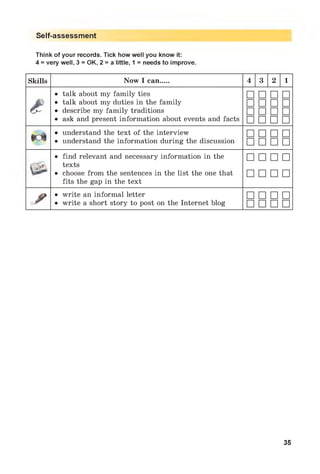
  • 179.
    Unit 2, Lesson1, Ex. 2 (p. 39) A: Hello! We are doing a poll on eating habits. Will you answer the questionnaire? B: Sure, why not? A: So, the first question is: Do you take sugar in hot drinks? B: Yes, I always take sugar in my tea. I like it sweet. A: And how many sweets do you eat per week? B: One or two. Not many. A: The next question. How often do you drink fizzy drinks, like Coke, Fanta, or Sprite? B: Never. I prefer juice and tea to fizzy drinks. A: Right. How often do you eat fresh fruit? B: Let me think... Almost every day. I like fruit. A: Is most of the fresh food you eat steamed, boiled, or fried? B: Boiled, I guess. A: Well, and the last question: What do you eat during the breaks? B: As a snack? Bananas. Sometimes apples or oranges. A: OK, I’ve marked your answers. Thank you for the interview. B: You are welcome. Unit 2, Lessons 5-6, Ex. 3b (p. 44) Every country has its own cooking equipment. For example, Italian kitchens usually have a big pot for cooking pasta. Many Mexican kitchens have a special pan to make tortillas. Asian kitchens often have a grill for meat and a special vegetable steamer. Ukrainian kitchens have beautifully decorated wooden cooking utensils such as measuring cups, spoons and cutting boards. Many kitchens around the world have a set of knives, a grill and a food processor. Unit 3, Lesson 5, Ex. 3 (p. 64) The Doctor Visited Me About a month ago I was at the lesson working with my textbook. Suddenly I felt really ill. I felt very cold and I had a headache and my eyes hurt. My teacher phoned my mother. She came soon, took me home and called a doctor. In the afternoon the doctor visited me. She examined my throat, listened to my heart and lungs, looked at my eyes and ears. In the end she said, “Well, it’s a bad cold. You have to stay in bed for a week.” She wrote me a prescription for some medicines. She told me to take pills three times a day. She also asked my mum to give me hot milk with butter and honey or hot tea with raspberries. My mum went to the chemist’s and bought the medicines for me. I followed the doctor’s advice and soon I felt much better. My friends were glad to see me at school again. Unit 3, Lesson 10, Ex. 5b (p. 75) Doctor: Hello. What’s the problem? Patient: I’ve hurt my ankle. 179
  • 180.
    Doctor: When didit happen? Patient: Yesterday. I fell over while I was playing football. Doctor: Can you just take your shoe off? Hmm, yes. Can you move your foot? Patient: Yes, but it hurts. Doctor: Hmm. I think you’ve only sprained it. I’ll put a bandage on it for now. But you should go to hospital for an X-ray. Patient: Should I go today? Doctor: Yes. Take this letter with you. Patient: Thank you, Doctor. Goodbye! Doctor : Goodbye! Unit 4, Lesson 7, Ex. 1 (p. 97) M r Parker: Here are our tickets for the theatrical performance next Saturday. M rs Parker: When did you have time to buy them? I know that you’ve been really busy this month. M r Parker: Do you think it’s difficult nowadays? You can buy your tickets from the ticket agent, from the theatre box office or from the ticket booth in Leicester Square. You can even save your time and buy your ticket online. I bought the tickets from the ticket agent. He visited our office two weeks ago. M rs Parker: Where are our seats? M r Parker: They are in the stalls, so we’ll be able to see the performance clearly. M rs Parker: W e’ll have a wonderful time, I think. Unit 6, Lessons 1-2, Ex. 2 (p. 123) Jane: Have you (1) started doing your English project yet? Alex: The one about London mysteries? Yes. I’m (2) working on a poster about the Monument to the Great Fire of London. I’m (3) going to write an article about it to put on the poster. Then I’m going to put some pictures on the poster as well. What about you? Jane: I haven’t decided yet. Maybe I (4) ’ll prepare something about St Bride’s Church. It’s in the City of London. Alex: Where can you get some interesting information about it? Jane: There’s a wonderful display in this church this month. Besides, I’ve seen the Rob Bell’s new show where he explores the secret under­ ground places in London. Alex: That’s a good idea. I (5) ’ll probably find this show online tonight. Jane: (6) Don’t forget to check the school library, too. Alex: With pleasure. 180
  • 181.
    Unit 6, Lessons7-8 , Ex. 3 (p. 134) Welcome to FamousPlaces! Today we’re going to talk about one of the most famous (1) cathedralsin London. It is well-known as an iconic (2) feature of the London (3) skyline. Do you know which cathedral we’re talking about? Have you (4) read about the Whispering Gallery? St Paul’s Cathedral was (5) built over a period of 35 years between 1675 and 1711. It was designed in (6) the English Baroque style by Sir Christopher Wren. St Paul’s Cathedral is very beautiful at night when it is lit up. Tourists love to visit it and go up to the top of the Dome to see the wonderful views of London. Unit 8, Lesson 3, Ex. 2 (p. 166) Emi: We are having a great time here, I think. Interesting lessons, wonder­ ful parties, educational trips... There is something new to learn every day. What I like most is the chance to participate in extracurricular activities. I’ve joined the jazz band. Carlos: That’s great! Jazz is one of the greatest forms of music originating from the USA. The home of jazz in Britain is Ronnie Scott’s club in London. What musical instrument do you play? Emi: I play the trumpet, and Denys plays the saxophone. We are going to take part in the cultural presentation next week. You’ll be able to hear me play. What club have you chosen for yourself? Carlos: I am fond of sports and games. My favourite sport is basketball. I am in the school team. There is the basketball game on Wednesday. Come to the sports ground and watch me play. Emi: With great pleasure! I’d like to come. Thank you for the invitation. 181
  • 182.
    Grammar Reference UNCOUNTABLE ANDCOUNTABLE NOUNS Most nouns in English are countable. This means they can have singular and plural forms: One sandwich - four sandwiches, the child - the children. Common uncountable nouns: advice, furniture, help, homework, information, jewellery, luck, mail, money, music, peace, traffic, weather, work, milk, tea, bread, sugar, flour, coffee, cheese, food, fruit, meat, pepper, rice, salt, soup, water... Uncountable Nouns Use Example You use uncountable nouns with a singular verb form. You don’t use articles a or an with them. This news is not interesting. I don’t like milk. They want some sugar with tea. Uncountable nouns have no plural form. money some money a lot of money much money a little money Countable Nouns Use Example Countable nouns have singular and plural forms. a book books one book two books some books You use them with articles a and an in the singular. a lot of books many books a few books There is an orange and some apples on the plate. We use them with the definite arti­ cle the or without an article in the plural. You use them with singular and plu­ ral verb forms. Pineapples are very delicious. Mango is a tropical fruit. 182 A lot of- Many - Much Only countable nouns can follow a / an, many, a few, these, one, two, etc.
  • 183.
    We use (not)many with countable nouns in questions and negative sen­ tences. Only uncountable nouns can follow much, little / a little. Both plural countable nouns and uncountable nouns can follow some, any, a lot of. W e say: sugar, some sugar, a lot of sugar much sugar, a little sugar. Countable Nouns Uncountable Nouns Example Positive A lot of/lots of/many A lot of/lots of/much There are a lot of classrooms in our school. There is a lot of jam in this jar. Interrogative many much Are there many classrooms in your school? Is there much jam in this jar? Negative many much There aren’t many old books in our school library. There isn’t much oil left in the bottle. a few (= some) / few (= not many, not enough) a little (= some) / little (= not much, not enough) PRESENT SIMPLE (INDEFINITE) TENSE Time expressions: never, seldom, often, frequently, always, usually, rarely, sometimes. Positive Negative I/You/We/They work. I/You/ We/They don’t (do not) work. He/She/It works. He/She/It doesn’t (does not) Question Answer Do you work? Does he work? Yes, I do./No, I don’t. Yes, he does./No, he doesn’t. Use Example Long-term situations. Habits and routines. Feelings and opinions. Facts. Timetables and programmes. She lives in London. How often do you go abroad? I don’t like spicy food. It rains a lot in the spring. The train arrives at 18.20. 183
  • 184.
    Frequency adverbs goafter the verb to be, but before all other verbs: They are often late. She usually phones me on Sundays. PAST SIMPLE (INDEFINITE) TENSE Time expressions: yesterday, last week, last month, last year, in 2000. Positive Negative I/You/We/They answered. I/You/ We/They didn’t (did not) write. He/She/It wrote. He/She/It didn’t (did not) Question Answer Did he answer? Yes, he did./No, he didn’t. Use Example Finished actions and situations in the past. I lived in Paris from 1980 to 1989. How long ago did you meet her? The Parkers travelled to the USA last summer. They didn’t drive a car yesterday. Regular verbs in the Past Simple end in -ed. W e have to memorize the forms of the irregular verbs. (See Irregular Verbs list on p. 242.) /t/ /d/ /id/ after voiceless conso­ nants except t after vowels and voiced consonants except d after t, d watched answered decided noticed skied painted helped played nodded FUTURE SIMPLE (INDEFINITE) TENSE W e use the Future Simple to express a single or a permanent action in the future: We will (shall) go to the theatre next week. He will have aparty tomorrow. W e form the Future Simple Tense by means of the verb will (shall) and the infinitive of the main verb. Shall is sometimes used for the first person singular and plural, and will may be used for all the persons. 184
  • 185.
    FUTURE INTENTION: toBe Going to Do Something Positive Negative I ’m (am) going to visit. I ’m (am) going to visit. You/We/ They ’re (are) read. You/ We/They aren’t (are not) read. He/She/ It ’s (is) speak. He/She/It isn’t (is not) speak. Question Answer Is he going to visit his granny? Are they going to read a book? Yes, he is./No, he isn’t. Yes, they are./No, they aren’t. Use Example Future plans, intentions, decisions. I ’m going to visit the USA this summer. PRESENT CONTINUOUS TENSE Time expressions: now, at the moment. Positive Negative I ’m (am) w riting. I ’m not (am not) writing. You/We/They ’re (are) You/ We/They aren’t (are not) He/She/It ’s (is) He/She/It isn’t (is not) Question Answer Are you writing? Is he writing? Yes, I am./No, I am not. Yes, he is./No, he isn’t. Use Example Actions happening now. He is writing a thank-you letter now. State Verbs Verbs of Feelings and Thinking Verbs of Senses Other Verbs like, love, want, prefer, dislike, hate, think, know, believe, under­ stand, forget, remember, mean, realise, recognise hear, see, taste, feel, smell own, have, be, belong, consist of, contain, exist, include 185
  • 186.
    State verbs arenot normally used in the continuous tense forms. W e often use can with the verbs of senses: I can smell something burning. PRESENT PERFECT TENSE Time expressions: already, just, yet, never, ever, lately, recently, this mor­ ning, this evening, this week, this month, this year, today. Positive Negative I/You/ We/They ’ve (have) worked. I/You/ We/They haven’t (have not) worked. He/She/It ’s (has) left. He/She/It hasn’t (has not) left. Question Answer Have you worked? Has it worked? Yes, I have./No, I haven’t. Yes, it has./No, it hasn’t. Use Example Situations that began in the past and continue up to the present. Situations and actions in a time up to the present. Past actions with results in the present. She has worked as a teacher for ten years. They have just discussed this question with their relatives. He’s broken his leg. PAST PERFECT TENSE Time expressions: before she came home, by 6 o’clock yesterday. Positive Negative I/You/ We/They ’d (had) arrived. I/You/ We/They hadn’t (had not) arrived. He/She/It left. He/She/It left. Question Answer Had they arrived? Yes, they had./No, they hadn’t. Use Example A past action which happened before another past action. He had left when I arrived. She was nervous, because she had never flown by plane before. W e use the Past Perfect Tense to say which past action happened first. 186
  • 187.
    We often donot use the Past Perfect Tense if it is already clear which action happened first: He left, I arrived. I arrived before he left. PRESENT PERFECT CONTINUOUS TENSE Time expressions: for two hours, since 5 o’clock, since morning. Positive Negative I/You/ We/ They ’ve (have) been working. I/You/ We/They haven’t (have not) been working. He/She/It ’s (has) He/She/It hasn’t (has not) Question Answer Have I/we/you/ they been working? Yes, I/we/you/ they have. No, haven’t. Has he/she/it Yes, he/she/it has. No, hasn’t. Use Example To express the actions that began in the past and continue up to the present. To express the actions that began in the past and have just stopped. I ’ve have been learning English since I was seven years old. I ’ve been riding a bike for two hours. For and Since Use Example for with a period of time three days five hours a month ten minutes a long time ages They have been playing tennis for three hours. Jane has been training for two months. The boys have been running for twenty minutes. He hasn’t been reading the newspapers for a long time. since with a point in time Tuesday 8 August 4 o’clock last summer 2004 I last saw you I have been learning English since 2000. 187
  • 188.
    VERB CONTRASTS Past IndefiniteTense and Present Perfect Tense W e use the Past Simple Tense: 1) to talk about the specific time in the past: Builders finished their work yesterday. John went to Rome last year. 2) when the speaker is thinking of an action completed at a time in the past: Paper was invented in China. They grew many vegetables last year. W e use the Present Perfect Tense when no specific past time is mentioned or when a connection is made between the past and the present: I have met that man before. John has already read that book. Have you ever visited London? I have never seen a camel. He hasn’t written the letter yet. Past Indefinite Tense and Past Perfect Tense W e use the Past Simple Tense when we talk about the past, and follow the events in the order in which they happened: I read a book and ate a cake. W e use the Past Perfect Tense to go back to an earlier time: I read a book I had got from the library and ate a cake my sister had made. Present Perfect Tense and Present Perfect Continuous Tense W e use the Present Perfect Tense for actions that happened at an unspe­ cific time in the past. I have already watched this football match on TV. W e use the Present Perfect Continuous Tense to emphasise that something has been happening repeatedly or continuously since an unspecific time in the past. I have been watching this football match for an hour. R e m e m b e r! Some verbs do not usually use the continuous form. They are: know, see, like, hate, remember, want, love, etc. (See State Verbs on p. 185.) I ’ve seen this football match on TV. 188
  • 189.
    MODAL EXPRESSIONS To LetSomebody Do Something, to Be Allowed to Do Something Compare: Compare: My parents let me play computer games every day. I am allowed to play computer games every day. They don’t let him talk over the telephone for so long. He is not allowed to talk over the tele­ phone for so long. Sue let Jim use her pen yesterday. Jim was allowed to use Sue’s pen yes­ terday. The teacher will let them finish writing a composition tomorrow. They will be allowed to finish their composition tomorrow. To Make Somebody Do Something Compare: Compare: My mother usually makes me read in summer. I am usually made to read in summer. His mother made me eat a plate of soup. I was made to eat a plate of soup. The teacher didn’t make us learn the poem by heart yesterday. We weren’t made to learn the poem by heart yesterday. His sister will make him clean the room tomorrow. He will be made to clean the room tomorrow. QUESTION TAGS Question tags are short questions which are used at the end of the sen­ tences. We use question tags if we are not absolutely sure as to something and wish someone else to confirm it. We add question tags to the sentences (negative or affirmative) to ask for confirmation or agreement. We form question tags by means of the auxiliary verb of the sentence and the personal pronoun (I, he, she, it, etc.) which corresponds to the subject of the sentence. • If the sentence is affirmative, we use a negative question tag. You will help me, won’t you? • If the sentence is negative, we use an affirmative question tag. You haven’t done your homework, have you? 189
  • 190.
    • If thereis a modal verb (can, could, should, etc.) in the sentence, we use the same modal verb to form the question tag. He can’t swim very well, can he? •If there is no auxiliary verb in the sentence, we use the auxiliary verb to do (except for to be and to have).Thus, for a sentence which is in the Pre­ sent Simple we use do / does and for a sentence which is in the Past Simple we use did. He works in an office, doesn’t he? You didn’t eat my ice cream, did you? •The question tag for I am is aren’t I? I ’m a pupil, aren’t I? •The question tag for Let’s is shall we? Let’s go, shall we? W e pronounce question tags with a rising intonation when we are not sure and expect an answer, or a falling intonation when we are sure and don’t re­ ally expect an answer. Question Tags (Short Answers) W e give short answers to avoid repetition of the question asked before. W e form positive short answer with: Yes + personal pronoun + auxiliary verb. W e form negative short answer with: No + personal pronoun + negative auxiliary verb. E x a m p l e s: There’s a room for me in your car, isn’t there? - Yes, there is. He went to England last summer, didn’t he? - No, he didn’t. He didn’t go to London last year, did he? - Yes, he did. (Ні, він їздив.) / No, he didn’t. (Так, він не їздив.) Short Responses W e often use auxiliary verbs in short answers when we don’t want to re­ peat something: Does he read books every evening? - Yes, he does. (= He reads books every evening.) Do you go to the library on Saturdays? - Yes, I do. (= I go to the library on Saturdays.) W e also use auxiliary verbs with so and neither: I play tennis every Sunday. - So do I. (= I play tennis every Sunday, too.) I never read newspapers. - Neither do I. (= I never read newspapers, too.) It is important to remember the word order after so and neither - verb before the subject. I go in for sports. So do my friends. 190
  • 191.
    Irregular Verbs Infinitive Past Indefinite Past Participle Translation arise arosearisen виникати, поставати bear bore born(e) нести, носити beat beat beaten бити become became become ставати, робити begin began begun починати(ся) blow blew blown Дути break broke broken (з)ламати bring brought brought приносити build built built будувати burn burnt burnt палити; горіти burst burst burst розбиватися; вибухати buy bought bought купувати catch caught caught ловити, (с)піймати choose chose chosen вибирати come came come приходити cost cost cost коштувати cut cut cut різати dig dug dug копати do did done робити draw drew drawn тягти; малювати dream dreamt, dreamed dreamt, dreamed бачити уві сні; мріяти drink drank drunk пити drive drove driven гнати; їхати eat ate eaten їсти fall fell fallen падати feed fed fed годувати feel felt felt почувати; відчувати fight fought fought битися; боротися find found found знаходити fly flew flown літати forget forgot forgotten забувати forgive forgave forgiven вибачати; прощати 191
  • 192.
    Infinitive Past Indefinite Past Participle Translation freeze froze frozenзаморожувати; замерзати get got got діставати; одержувати give gave given давати go went gone іти; іти геть grind ground ground молоти; точити grow grew grown рости hang hung/hanged hung/hanged висіти; повісити have had had мати hear heard heard чути hide hid hidden ховати(ся) hit hit hit ударяти; влучати hold held held мати; держати hurt hurt hurt завдавати болю; боліти keep kept kept тримати; зберігати know knew known знати lay laid laid класти; покласти lead led led вести; водити leap leapt, leaped leapt, leaped плигати, стрибати learn learnt, learned learnt, learned вчити leave left left залишати lend lent lent позичати (комусь) let let let пускати; дозволяти lie lay lain лежати lose lost lost втрачати; губити make made made робити mean meant meant означати; мати намір meet met met зустрічати mistake mistook mistaken помилятися; неправильно розуміти pay paid paid платити put put put класти; ставити read read read читати ride rode ridden їздити верхи ring rang rung телефонувати, дзвонити 192
  • 193.
    Infinitive Past Indefinite Past Participle Translation rise rose risenвставати; підніматися run ran run бігти say said said говорити; сказати see saw seen бачити sell sold sold продавати send sent sent посилати set set set ставити; установлювати shine shone shone світити; проливати світло shoot shot shot стріляти; підковувати show showed shown показувати shut shut shut закривати sing sang sung співати sink sank sunk спускати(ся); занурюватися sit sat sat сидіти sleep slept slept спати speak spoke spoken говорити spell spelt spelled spelt spend spent spent витрачати spin spun spun прясти spring sprang sprung стрибати; виникати stand stood stood стояти strike struck struck бити; вдаряти(ся) sweep swept swept мести; мчати swim swam swum плавати; пливти swing swung swung гойдати, розмахувати take took taken брати; взяти teach taught taught вчити; навчати tell told told розповідати, говорити think thought thought думати throw threw thrown кидати understand understood understood розуміти wake woke, waked woken, waked прокидатися; будити wear wore worn носити (одяг) win won won вигравати write wrote written писати 193
  • 194.
    English-Ukrainian Vocabulary n noun vverb adj adjective prep preposition A a abbreviation, n/a.brivi'eijn/ аббревиатура absolutely, adv/{bsalutli/ абсолютно accident, n/'^ks^dant/ аварія according, prep/a'ka:dir)/ згідно achieve, v/a't|i:v/ досягати achievement, n/a'^iivmant/ досягнен­ ня, здобуток acting, n/'^ktip/ гра акторів action film, phr/'^kjan 'film/ бойовик active, adv/{ktiv/ активний activity, n/^k'tiv^ti/ діяльність, вправа actor, n/{kta/ актор actress, n/{ktr|s/ актриса addition, n/a'dijan/ додаток admire, v/ad'maia/ захоплюватися advanced, adj/ad'vanst/ продвинутий adventure film, phr/ad'ven^a ,film/ пригодницький фільм adventure, n/ad'ventja/ пригода adverb, n/'^dv3:b/ прислівник affect, v/a'fekt/ впливати affirmative, adj/a'f3:mativ/ стверджувальний agree, v/a'gri:/ погоджуватися airway, n/'eawei/ повітряна лінія alert, adj/a'l3:t/ тривожний alive, adj/a'laiv/ живий all year round, phr/ 'a:ljia 'raund/ увесь рік allow, v/a'lau/ дозволяти almond, n/'amand/ мигдаль already, adv/a:l'redi/ вже also, adv/'a:lsau/ також although, conj/a:l'6au/ хоча amazing, adj/a'meizir)/ дивовижний ambulance, n/{mbjUlans/ швидка до­ помога analyse, v/{nalaiz/ аналізувати adv adverb phr phrase conj conjunction ancient, adj/'einjant/ стародавній angry, adj/{pgri/ сердитий animated cartoon, phr/'^nameitad ka'tun/ мультиплікаційний фільм annoy, v/a'noi/ дратувати antique, adj/{n'ti:k/ антикварний anyway, adv/'eniwei/ у будь-якому випадку apartment, n/a'patmant/ квартира, апартаменти apply, v/a'plai/ застосовувати appreciate, v/a'pri:Jieit/ цінувати aqualung, n/{kwalvp/ акваланг archaeologist, n/.akia'lniikal] археолог architect, n/'ak^tekt/ архітектор architecture, n/'akgtektja/ архитектура armchair, n/'amtjea/ крісло arrange, v/a'reini/ організовувати article, n/'atikal/ стаття artifact(s), n/'atafekts/ артефакти aspirin, n/{sp^n/ аспірин assist smb, v/a'sist/ допомагати комусь attachment, n/a'tetjmant/ прикріплення, додаток attacker, n/a't{ka/ нападаючий attend, v/a'tend/ відвідувати attention, n/a'tenjan/ увага attentive viewer, phr/a'tentiv 'vjua/ уважний глядач attentively, adv/'atentivli/ уважно attraction, n/a'trakjan/ визначне місце audience, n/'a:dians/ публіка audiovisual, adj/.aidiau'vi^al/ аудіо­ візуальний auxiliary, adj/a:g'ziljari/ допоміжний average press rating, phr/'^vani/ середній рейтинг avoid, v/a'vaid/ уникати award, n/a'wa:d/ нагорода 194
  • 195.
    B b backache, n/'Ьжкеїк/біль у спині background, n/'Ьжкдгаипб/ задній план bad cold, phr/'Ьжб ,kauld/ застуда badge, n/Ьжф/ емблема, значок balance, n/telsns/ баланс balcony, n/'Ьжікзпі/ балкон ballet, n/'Ьжіеї/ балет bandage, n/'Ьж^їф/ пов’язка bar, n/Ьа/ бревно, колода baseball, n/'ЬєвЬз:1/ бейсбол baste, v/teist/ поливати (страву) battle, n/'ЬжІЇ/ битва be blessed, phr/Ьї ^fessd/ бути освяченим be fond of, phr/Ьї 'fond sv/ любити, захоплюватися be good with smb’s hands, phr/Ьї 'gud wi6/ добре уміти робити щось be interested in, phr/Ьї 'mtrSstSdїп/ цікавитися be proud of, phr/Ьї 'praudsv/ пишатися be sure, phr/Ьї jb:/ бути впевненим be worried, phr/Ьї 'wArid/ хвилюва­ тися beach, n/ЬШ// берег річки beat, n/Ьіі/ удар behaviour, n/Ьї'йеї^з/ поведінка believe, v/Ьд'li:v/ вірити bend, v/tend/ нахилятися besides, adv/ЬїЬа^/ окрім того billboard, n/'ЬгіЬогі/ реклама bird feeder, n/te:d 'fids/ годівничка для птахів bitter, adj/'tots/ гіркий blanket, n/'Мж^к^/ ковдра bleeding, n/'ЬШїр/ кровотеча block, v/Ьінк/ блокувати boast, v/teust/ хвалитися boiled, adj/ЬзїШ/ зварений book, v/Ьик/ замовляти, бронювати booklet, n/'Ьик^/ буклет boring, /'Ьз:пр/ adjнудний bottle can, phr/'te>tl кдп/ відкривач для пляшки bottle opener, phr/tetl 'supsns/ відкривач пляшок box office, phr/'Ьнкв ,nfSs/ каса продажу квитків boxing, n/'Ьнкзїр/ бокс branch, n/teantj/ гілка bread-and-butter plate, phr/^red snd lЬAts p1eIt/ тарілка для хліба та масла break into applause, phr/'Ьгеїк mts s'plo:z/ вибухнути оплесками break, n/'Ьгеїк/ перерва breathe, v/Ьгі:6/ дихати bright, adj/Ьгай/ яскравий broken bone, phr/'^s^gn ,teun/ перелом кістки building, n/'ЬїИц)/ будівля burial, adj/lberis1/ похоронний burn down, v/'Ьз:п 'daun/ згоріти business, n/'Ькг^/ бізнес busy, adj/lЬIzi/ жвавий, зайнятий C c cafe, n/'к{еї/ кафе call the doctor, phr/'кзі 6s 'dotes/ викликати лікаря calm, adj/каш/ спокійний camera, n/'кжшзгз/ камера can opener, phr^sn 'supsns/ відкривач для консервів candle, n/fendl/ свічка canteen, n/кж^іш/ їдальня capital, n/fepstl/ столиця caring, adj/'kesrIr)/ турботливий carrot, n/ferst/ морква carton, n/'каШ/ пакет cartwheel, n/^twiil/ візок cast a glance, phr/fest s ,glans/ кинути погляд cast, n/kаst/ склад акторів castle, n/^assl/ замок cathedral, n/ks'0i:drs1/ собор celebrate, vД є1|Ьгєй/ святкувати celebrity, n^ 'Ь Ь ^ і/ видатна особа ceremony, n/^^msm/ церемонія character, n/'кж^kts/ персонаж charity event, phr/'tj^rsti I'vent/ благодійна акція, подія check, v/tjek/ перевіряти 195
  • 196.
    check out, v/'tjek'aut/ перевіряти cheer up, phr/^ізг'лр/ підбадьорювати cheerful, adj/'tjlafal/ радісний choice, n/tjois/ вибір choir, n/kwais/ хор choking, n/'^sukip/ похлинутися chop, v/fop/ нарізати дрібно choreography, n/kori'ogrsfi/ хореогра­ фия chorus, n/'ko:ras/ хор church, n/tJ3:tf/ церква cinema, n/'singma/ кинотеатр circumstance(s), n/'seiksmstensiz/ обставини circus, n/'s3:kss/ цирк citizen, n/'sitgzsn/ громадянин classic story, phr/'ktesik 'sto:ri/ класична історія classmate, n/'klasmeit/ однокласник clear, v/klis/ прибирати club, n/kUb/ гурток, клуб coach, n/ksuf/ тренер cold tablet(s), phr/'ksuld 't{bl|t/ пілюлі від застуди collection, n/ks'lekjsn/ колекція collector, n/ks'lekts/ колекціонер column, n/'kolsm/ колона combatant, n/'kombstsnt/ суперник combine, v/ksm'bain/ поєднувати come out, v/'^m 'aut/ виходити, з’являтися come back, phr/'^m 'b^k/ повертатися comedy, n/'komsdi/ комедія comfortable, adj/lkлmftэbэl/ зручний communicate, v/ks'mjuingkeit/ спілкуватися competition, n/knmpg'tijsn/ змагання competitive, adj/ksm'petgtiv/ той, хто змагається complication, n/komplg'keijbn/ усклад­ нення concert hall, phr/'konsst ,ho:l/ концертний зал confidence, adj/'konfgdsns/ упевненість confirm, v/kgn'f3:m/ підтверджувати Congratulation(s), phr/ksn.gratTUleiJsn/ Вітаємо! conjunction, n/ksn'ipkjbn/ сполучник consecutive, adj/ksn'sekjUgtiv/ послідовний consider, v/ksn'sids/ розглядати, брати до уваги construction, n/ksn'strAkJsn/ будівництво consult a doctor, phr/ksn'sAlt/ радитися з лікарем contain, v/ksn'tein/ містити control, v/ksn'trsul/ контролювати cook meals, phr/'kuk'mi:lz/ готувати їжу cool, adj/ku:l/ гарний cooperation, n/ksupps'reiJSn/ співпраця coordination, n/ksupdg'neijsn/ координація copy, n/'kopi/ копія cost, n,v/kost/ вартість; коштувати costume, n,v/'kostjum/ костюм cottage, n/'kotid3/ котедж, дачний будинок cough drop(s), phr/'kof'drops/ краплі від кашлю cough syrop, phr/'kof'sirsp/ сироп від кашлю cough, n/kof/ кашель countryside, n/'kAntrisaid/ сільська місцевість, передмістя cover, v/'kAvs/ покривати create smth from scratch, phr/kri'eit/ створювати щось із самого початку create, v/kri'eit/ створювати crisp(s) n/krisps/ чіпси criticise, v/'kritgsaiz/ критикувати crowded, adj/'kraudgd/ наповнений людьми cupboard, n/'kAbsd/ шафа для посуду current, adj/'kArsnt/ поточний currently, adv/'kArsntli/ у поточному періоді curry powder, phr/'kAri ,pauds/ каррі curtain, n/'k3:tn/ завіса customer, n/'kAstsms/ клієнт, споживач cut, v/kAt/ різати cutting board, phr/'kAtip 'bad/ дошка для нарізання cycling, n/'saiklip/ велосипедний спорт 196
  • 197.
    D d dairy product(s),phr/'deari 'prodAkt/ молочні продукти dancer, n/'dansa/ танцюрист dare, n/dea/ виклик darkness, n/'daknas/ темрява dawn, n/dan/ світанок, ранкова зоря deadly force, phr/'dedli 'fas/ зла сила decide, v/di'said/ вирішувати decorate, v/'dekareit/ прикрашати decoration, n/deka'reijan/ прикраса dedicate one’s time, phr/'dedakeit/ присвятити чийсь час deep, adj/di:p/ глибокий defender, n/di'fenda/ захисник defense, n/di'fens/ захист delicious, adj/di'lijas/ смачний delighted, adj/di'laitgd/ захоплений, зачарований, радісний demonstration class, phr /deman'streijan 'klas/ відкрите за­ няття dentist, n/'dentast/ зубний лікар depend on, v/di'pendбп/ залежати від describe, v/di'skraib/ описувати deserve, v/di'z3:v/ заслуговувати design, n,v/di'zain/ дизайн, дизай- нувати destroyed, adj/di'stroid/ зруйнований dialogue, /'daialog/ діалог diet, n/'daiat/ дієта difference, n/'difarans/ відмінність difficult, adj/'difikalt/ важкий dig, v/dig/ копати dinner plate, phr/'dina 'pleit/ тарілка для другої страви direct a film, phr/da'rekt a film/ керу­ вати зйомками фільму dirt, n/d3:t/ бруд discuss, v/di'skAs/ обговорювати dishwasher, n/'dij^wo/a/ посудомийна машина display, n/di'splei/ виставка distance, n/'distans/ відстань district, n/'distrikt/ район do karate, phr/ka'rati/ займатися карате do sports, phrзайматися спортивним вправами do the knitting, phr/'nitip/ в’язати спицями do the laundry, phr/'landri/ прати білизну do sums, phrрозв’язувати приклади do the washing, phr/'wafip/ прати білизну downstairs, /'daun'steaz/ внизу (по сходах) dream about, phr/'dri:ma'baut/ мріяти про щось drear, adj/dria/ похмурий, понурий; безрадісний; нудний drink, n/dripk/ напій drive, v/draiv/ водити автомобіль dubbing, n/'dAbip/ дубляж dust the furniture, phr/'dAst 6a 'f3:nitja/ витирати пил з меблів duty, n/'dju:ti/ обов’язок E e earache, n/'iareik/ біль у вусі earthquake, n/'3:0kweik/ землетрус eating habit, phr/'i:tip 'h{bit/ звичка у харчуванні either, conj/'ai6a/ чи elbow, n/'elbau/ лікоть elderly people, phr/'eldali 'pi:pl/ люди похилого віку email, n/'imeil/ електронний лист embroidering, n/im'broidarip/ виши­ вання emphasise, v/'emfasaiz/ наголошу­ вати, надавати особливого зна­ чення enchanting, adj/in'tfantip/ чарівний encourage, v/in'kArii/ заохочувати energy, n/'enaii/ енергія engage, v/in'geii/ залучати; займа­ тися enlighten, v/in'laitn/ просвітити enough, n/i'nAf/ досить, достатньо enquiry, n/in'kwaiari/ запит enter, v/'enta/ входити entertain, v/'enta'tein/ розважати 197
  • 198.
    entertainment, n/enta'teinmant/ розвага erupt, v/I'rApt/виверження essential, adj/i'senjal/ необхідний everyone, pron/'evriwAn/ кожний examine, v/I'gz^men/ оглядати example, n/i'gzampal/ приклад excellence, n/'eksalans/ видатна майстерність, досконалість excellent, adj/'eksalant/ прекрасний excited, adj/ik'saited/ зворушений excitement, n/ik'saitmant/ звору­ шення; збудження exciting, adj/ik'saitip/ дивовижний excursion, n/Л^з^^/екскурсія exhibit, v/ig'zib^t/ виставляти exhibition, n/eksgbijan/ виставка expect, v/ik'spekt/ очікувати expensive, adj/ik'spensiv/ коштовний experience, n/ik'spiarians/ досвід explore, v/ik'splo:/ досліджувати express, v/ik'spres/ висловлювати extraordinary, adj/ Ik'strэ:danari/неор- динарний eye drops, phr/,ai 'drops/ очні краплі F f fabulous, adj/' f e bj^las/ чудовий face, v/feis/ стикатися factory, n/' f e ktari/ фабрика fall off, v /'fa:l of/ падати family ties, phr/'femali 'taiz/ родинні зв’язки fantastic, adj/'fen'testik/ фантастич­ ний fantasy, n/'fentasi/ фентезі фільм fashion designer, n/'fejan di'zaina/ дизайнер одягу fashion, n/'fejan/ мода favourite, adj/'feivarlt/ улюблений feast, n/'fist/ святкування feature, v/'fi:tja/ риси обличчя feel honoured, phr/fil 'onad/ почувати гордість fellowship, n/'felaujip/ товаришу­ вання fencing, n/'fensip/ фехтування fever, n/'fiva/ жар, висока температура figure skating, n/'figa/ фігурне ка­ тання filling, n/'filip/ начинка finally, adv/'fainali/ нарешті find out, v/'faind ,aut/ дізнатися fingernail, n/'fipganeil/ ніготь на пальці fire, n/faia/ пожежа firework display, phr/'faiaw3:kdi'splei/ фейерверк firmly, adv/'f3:mli/ щільно; міцно; рішуче firstly, adv/festli/ перш за все fitness studio, phr/'fitnas 'stjudiau/ студія фітнесу fitness, n/'fitnas/ фітнес fizzy drink, phr/'fizi ,dripk/ газований напій flatten, v/'ffetn/ розгладжувати; робити рівним flexible, adj/'fleks^bal/ гнучкий flour, n/'flaua/ мука focus, v/'faukas/ фокусуватися fold, v/fauld/ складати follow, v/'folau/ слідувати food processor, phr/fud 'prausesa/ ку­ хонний комбайн founder, n/'faunda/ засновник fountain, n/'fauntan/ фонтан foyer, n/'foie/ фойє freezer, n/'friza/ морозильна камера frequently, adv/'frikwantli/ часто, по­ стійно fresco, n/'freskau/ фреска fried, adj/fraid/ смажений friendly, adj/'frendli/ дружній fry, v/frai/ смажити frying pan, phr/'fraiip 'p^n/ сковорід­ ка full-size, adj/'fulsaiz/ у повний розмір G g gallery, n/'g^lari/ галерея gardening, n/'gadnip/ садівництво gargle, v/'gagal/ полоскати garlic, n/'galik/ часник 198
  • 199.
    get around thetable, phr/get/ збира­ тися за столом get in through smb’s nose, phrпотра­ пляти через ніс get on well with smb, phrладити з кимось glad, adj/діжб/ радий gladness, n/'gl{dnas/ радість go away, phr/gau a'wei/ від’їжджати до іншого місця go down, phrопускатися go hiking, phr/'haikir)/ ходити у похід go picnicking, phr/'piknikir/ ходити на пікнік go sightseeing, phr/'sait,si:ir)/ оглядати визначні місця go up, phrпідійматися go wrong, phrзіпсуватися golf, n/golf/ гольф gorgeous, adj/'goias/ величний government, n/'gAvamant/ уряд grab, v/'grab/ схопити швидкоруч grand, adj/'grand/ величний grape(s), n/greip(s)/ виноград grass-covered area, phrтериторія, вкрита травою gratefulness, n/'greitfalnas/ вдячність grater, n/'greita/ терка great, adj/greit/ величний, чудовий grill, n/gril/ гриль guess, v/ges/ здогадуватися guide, n/gaid/ путівник, екскурсовод guilt, n/gilt/ провина gymnast, n/'iimn^st/ гімнаст(ка) H h hand mixer, phr/'h^nd 'miksa/ ручний міксер happy, adj/'h^pi/ щасливий hard, adj/had/ важкий harmonise, v/'hamanaiz/ гармонувати have a great time, phrдобре проводи­ ти час have smth in common, phrмати щось спільне headache, n/'hedeik/ головний біль heading, n/'hedip/ заголовок heating pad, phr/'hi:tip 'p{d/ грілка high temperature, phr/hai 'tempratja/ висока температура hire, v/haia/ наймати historic, v/hi'storik/ історичний hit, v/hit/ ударяти hockey, n/'hoki/ хокей homeland, n/'hauml^nd/ домівка, рідна земля homelike, adj/'haumlaik/ домашній honey, n/'hAni/ мед horror film, phr/'hora/ фільм жахів horse riding, n/'has 'raidip/ верхова їзда horseradish, n/'has.radij/ хрін hospital, n/'hospitl/ лікарня hot and cold running water, phrгаря­ ча та холодна вода (водопровід) household chores, phr/'haushauld 'tjaz/ домашні обов’язки however, linker/hau'eva/ однак huge, adj/hju:i/ величезний hunt, v/hAnt/ полювати hurt v/h3:t/ пошкодити I i ice maker, phr/'ais 'meika/ форма для виготовлення льоду ice pack, phr/'ais 'p^k/ пузир з льодом identify, v/ai'dentafai/ ідентифікувати ill, adj/il/ хворий illusion, n/i'lu3an/ ілюзія imagination, n/i,m^ia'neijan/ уява imagine, v/i'm^ian/ уявляти important, n/im'patant/ важливий impressive, adj/im'presiv/ вражаючий improve, v/im'pruv/ покращуватися in memory of smb, phr/in memari av/ на пам’ять про когось in need, phr/in 'ni:d/ нужденний infinitive, n/in'finativ/ інфінітив influence, v/'influans/ впливати ingredient, n/in'gridiant/ інгредієнт, складова (страви) inhabitant, n/in'h^batant/ житель inside, prep/in'said/ усередині, у при­ міщенні 199
  • 200.
    inspire, v/in'spaia/ надихати instead,prep/in'sted/ замість intelligent, adj/in'telgiant/ розумний intensely, v/in'tensli/ дуже сильно; надмірно interested, adj/in'tr|st^d/ зацікавлений interval, n/'intaval/ антракт invite smb for smth, phr/in'vait/ за­ просити когось кудись iron clothes, /'aian 'klauSz/ прасувати білизну J j jelly, n/'ieli/ желе jewel, n/'iu:al/ перлина jewellery, n/'iualri/ коштовності join, v/фат/ вступити, приєднатися judo, n/'iudau/ дзюдо K k keep an eye on smth, phr/'kip an 'ai on 'sAm0ir)/ звертати увагу kind, adj/kaind/ добрий kitchen counter, phr/'kitfan 'kaunta/ кухонна поверхня kitchen sink, phr/'kitfan ,sigk/ мийка на кухні kitchenware, n/'kitfanwea/ кухонне приладдя knee, n/ni:/ коліно knife, n/naif/ ніж knock smth off, phr/nokof/ скинути щось L l ladle, n/'leidl/ черпак, ополоник landmark, n/'tendmak/ визначне місце lard, n/lad/ сало lawn, n/la:n/ газон legendary, adj/'led3andari/ легендарний lemonade, n/lemaneid/ лимонад length, n/lep0/ довжина lift, n/lift/ ліфт lights, n/laits/ вогні link, n/lipk/ зв’язок liquid, n/'likwad/ рідина listen to smb’s lungs, phr/'lisanta 'sAmbadiz 'Lqz/ послухати легені locate, v/lau'keit/ розташовуватися loneliness, n/'launlinas/ самотність look for smth, phr/lukfa/ шукати щось look forward, phr/'luk 'fa:wad/ чекати з нетерпінням lose, v/luz/ програвати lotion, n/'laujan/ лосьон, примочка lovely, adj/'Lwli/ чудовий, гарний lunch box, n/'lAntf'boks/ сніданок M l magazine, n/m^ga'zin/ журнал magnificent, adj/m^g'nifasant/ велич­ ний, чудовий, пишний main course, phr/mein 'ka:s/ головна страва main, adj/mein/ головний make money, phr/'meik 'mAni/ заро­ бляти гроші make one’s bed, phr/'meik 'wAnz 'bed/ застилати ліжко maraphon, n/'m^raGan/ марафон marble, adj/'mabal/ мармуровий market, n/'makat/ ринок match, n/m^tj/ матч matins, n/'m^tinz/ вранішня служба у церкві matinee, n/'m^tgnei/ ранковий (ден­ ний) показ фільму або театральної вистави mayonnaise, n/meia'neiz/ майонез measuring cup, phr/'me3ariq 'kAp/ мірна чашка medicine, n/'medsan/ ліки medieval, v/medi'i:val/ середньовічний memorable, adj/'memarabal/ пам’ятний memorial plate, phr/me'ma:rial ,pleit/ меморіальна дошка merchant, n/'m3:tfant/ торговець message, n/'mesii/ послання messy, adj/'mesi/ безладний microwave oven, phr/'maikrawerv Avan/ мікрохвильова піч mile, n/mail/ миля millennium, n/mi'leniam/ тисячоліття 200
  • 201.
    miss, v/mis/ someoneсумувати за кимось modelling, n/'modlip/ моделювання modern, adj/'mndn/ сучасний monarch, n/'monak/ монарх monument, n/'mnnjgmant/ пам’ятник moody, adj/'mu:di/ у поганому настрої mosaic(s), n/mau'zeiiks/ мозаїка motion picture projector, phr/'maujan 'piktja pra'iekta/ кінопроектор mountain, n/'mauntan/ гора mouth-watering, v/'mau0 'wo:tarip/ апетитний move, n,v/muv/ рух; рухатися moving, adj/'mu:vip/ зворушливий muddy, adj/'mAdi/ брудний mummy, n/'mAmi/ мумія museum, n/'mju:'zi:am/ музей musical, n/'mju:zikal/ мюзикл mysterious, adj/mi'stiarias/ загадко­ вий, таємничий N n napkin, n/'n^pkan/ серветка nasal spray, phr/'neizal ,sprei/ краплі в ніс nativity scene, phr/na'tivati 'si:n/ Різдв’яна сцена naughty, adj/'nodi/ неслухняний necessary, adv/'nesasari/ необхідний negative, adj/'negativ/ заперечний neither, conj/'naiSa/ ні network, n/'netw3:k/ мережа newspaper, n/'nju:s,peipa/ газета nightlife, n/'naitlaif/ нічне життя noise, n/noiz/ шум, галас novel, n/'nnval/ роман O o observe, v/ab'z3:v/ спостерігати occasion, n/a'ke^an/ випадок, подія occupation, n/okjU'peiJan/ рід занять office, n/'ofas/ офіс official, adj/a'fijal/ офіційний oil, n/oil/ олія ointment, n/'ointmant/ мазь onion, n/Anjan/ цибуля online, adv/'onlain/ онлайн opera, n/'npara/ опера operating theatre, n/'opareitip '0iata/ операційна opportunity, n/ope'tju:ngti/ можливість orchestra, n/'okastra/ оркестр organise, v/'oganaiz/ організовувати orphan, n/'ofan/ сирота outline, v/'autlain/ визначати outside, prep/aut'said/ зовні, на свіжо­ му повітрі outskirts, n/'autsk3:ts/ околиця outstanding, adj/aut'stendip/ визначний oven, n/Avan/ плита own, v/aun/ володіти P p pain, n/pein/ біль painting, n/'peintip/ картина palace, n/'p^s/ палац pancake(s), n/'p^nkeik(s)/ млинці paper towel holder, phr/'peipa 'taual 'haulda/ тримач паперових рушни­ ків parachuting, n/'p{raju:tip/ парашут­ ний спорт paragraph, n/'p^ragraf/ абзац participant, n/pa'tisapant/ учасник participate in smth, phr/pa'tis^peit/ брати участь у чомусь particular, adj/pa'tikjgla/ особливий partly, adv/'patli/ часково patient, n/'peijant/ пацієнт, хворий patron saint, phr/'peitran 'seint/ свя­ тий покровитель pavement, n/'peivmant/ тротуар pavilion, n/pa'viljan/ павільйон performance, n/pa'fa:mans/ вистава picturesque, adj/piktja'resk/ живопис­ ний pill, n/pil/ таблетка, пилюля pillow, n/'pilau/ подушка plant, v/plant/ садити play golf, phr/'plei 'golf/ грати у гольф play outdoors, phr/'plei ,aut'do:z/ гра­ тися на свіжому повітрі pleasure, n/'ple3a/ задоволення plural, adj/'pluaral/ множина 201
  • 202.
    pollution, n/pa'lujan/ язабрудненн poor, adj/po:/ бідний popcorn, n/'pnpkon/ попкорн poppy seed(s), phr/'popi 'si:dz/ макові зернята popular, adj /'popjЩіз/ популярний popularity, n/'püpjU'lær|ti/ популярність portfolio, n/po:t'fauliau/ портфоліо position, n/pa'zijan/ позиція, місцез­ находження possible, adj/'püs^bal/ можливий poster, n/'pausta/ постер, листівка pot, n/pot/ глечик pound, n/paund/ фунт стерлінгів (грошоваодиниця) power, n/'paua/ влада practically, adv/'præktikali/ практично prepare present(s), phr/pri'pea 'prezants/ готувати подарунки prescription, n/pri'skripjan/ рецепт ліків present smb with smth, phr/'prezant/ дарувати комусь щось probably, adv/'probabli/ можливо producer, n/pra'dju:sa/ продюсер production, n/pra'dAkJn/ виробництво, продукція professional, adj/pra'fejanal/ профе­ сійний programme, n/'praugræm/ програма project, n/'prüd3ekt/ проект prominent, adj/'prnmanant/ видатний promise, v/'prnmas/ обіцяти pronounce, v/pra'nauns/ вимовляти pronunciation, n/pra.nAnsi'eiJan/ вимова provide, v/pra'vaid/ забезпечувати provision, /pra'vi3an/ провізія, про­ дукт харчування public, n/'pAblik/ спільнота pulse, n/pAls/ пульс Q q quinsy, n/'kwinzi/ ангіна R e rake, v/reik/ загрібати really, adv/'riali/ справді recently, adv/'ri:santli/ нещодавно recipe, n/'resapi/ рецепт recommendation, n/rekamen'deijan/ рекомендація recording, n/n'ka:dip/ запис reduce, v/ridju:s/ зменшувати reflect, v/ri'flekt/ відображати, від­ творювати refrigerate, v/ri'frid3areit/ заморожу­ вати refrigerator, n/ri'frid3areita/ холо­ дильник regularly, adv/'regjUlali/ регулярно reign, v/rein/ правити, управляти released, adj/ri'li:st/ випущений relevant, adj/'recant/ відповідний remarkable, adj/ri'makabal/ визначний remind smb of smth, phr/ri'maind/ на­ гадувати комусь про щось reminder, n/ri'mainda/ те, що нагадує remove, v/ri'muv/ забирати repairing, n/ri'pearip/ ремонт repeatedly, adv/ri'pitadli/ постійно repetitive battles, phr/ri'petativ 'b^tlz/ повторювані битви residence, n/'rezadans/ резиденція resource, n/ri'za:s/ ресурс responsibility, n/ri,spons^'bilati/ відпо­ відальність restaurant, n/'restarnnt/ ресторан restore, v/ri'sto:/ відновлювати, рес­ таврувати return, v/ri't3:n/ повертатися rhythm, n/'ridam/ ритм rice, n/rais/ рис rich, adj/rrtf/ багатий ride, v/raid/ їздити rinse, v/rins/ змивати roast suckling pig, phr/raust 'sAklip 'pig/ смажене порося roast, v/raust/ запікати romance, n/rau'm^ns/ фільм про кохання row, n/rau/ ряд royal, adj/'raial/ королівський rubbish, n/'rAbif/ сміття ruin, v/'ru^n/ руйнувати ruler, n/'rula/ правитель 202
  • 203.
    run, v/глп/ простиратися,тягнутися (провулицю) running time, phr/'глпір ,taim/ трива­ лість показу S s salad fork, phr/'s^lad 'fo:k/ виделка для салату salad plate, phr/'s^lad 'pleit/ тарілка для салату salsa, n/'sslsa/ сальса (танок) sanitary station, phr/'s^^tari 'steifan/ санітарна станція satisfy, v/'s^tafai/ задовольняти satisfying closure, phr/'s^tasfaiig 'klau3a/ задовольняюче завершення saucer, n/'so:sa/ блюдце save, v/seiv/ зберігати scald, n/skald/ незначний опік scenery, n/'si:nari/ декорація schedule, n/'Jedjul/ розклад science fiction film, phr/'saians 'fikfan film/ науково-фантастичний фільм screen, n/skrin/ екран script, n/skript / сценарій sculpture, n/'s^lptja/ скульптура seaside, n/'sisaid/ морське узбережжя season, v/'sizan/ приправляти спеці­ ями seat, n/sit/ місце secondly, adv/'sekandli/ по-друге selection, n/sa'lekfan/ вибір serious, adj/'siarias/ серйозний serve, v/s3:v/ подавати (настіл) service, n/'s3:vas/ сервіс, обслугову­ вання session, n/'sejan/ заняття set a good example, phr/set a 'gud ig'za:mpal/ встановлювати добрий приклад set a record, phr/set a 'reka:d/ встано­ вити рекорд set of knives, phr/set av 'naivz/ набір кухонних ножів set one’s goals, phr/set Wnz 'gaulz/ ставити цілі set the table, phr/set 6a 'teibal/ накри­ вати на стіл sew buttons on, phr/sau '^tnz on/ пришивати ґудзики share, v/fea/ ділити sharply, adv/j^pli/ різко shock, n/Jbk/ шок shopping centre, phr/'Jopig 'senta/ тор- гівельний центр show, n/fau/ шоу shredded, adj/^fredid/ подрібнений shy, adj/fai/ сором’язливий sight, n/sait/ зір sign up for smth, phr/'sain ^p fa 'sAm0ir)/ записатися sign, n/sain/ напис, підпис silverware, n/'silvawea/ столові прилади simple moves, phr/'simpal 'muvz/ про­ сті рухи simulator, n/'simjuleita/ симулянт singular, adj/'siggjula/ однина skiing, n/'skiig/ лижний спорт skin, n/skin/ шкіра skip, v/skip/ стрибати на скакалці skyline, n/'skailain/ лінія обрію slivered, adj/'slivad/ подрібнений slowly, adv/'slauli/ повільно small burn, phr/'sma:l 'Ьз:п/ незнач­ ний опік smart, adj/smat/ розумний smell, v/smel/ пахнути smoke, v/smauk/ палити smoked meat, phr/'smaukt 'mit/ копче­ не м’ясо sneeze, v/sniz/ чихати snowball tree, phr/'snaubal 'tri/ калина socially, adv/'saujali/ соціально, офі­ ційно society, n/sa'saiati/ суспільство solemn, adj/'solam/ урочистий somersault, v/'sAmasalt/ робити сальто sore throat, phr/so: '0raut/ біль у гор­ лі, хворе горло sound, v/saund/ звучати soup bowl, phr/sup 'baul/ тарілка для супу southeast, adj/sauT'ist/ південно- східний southwest, adj/sauT'west/ південно- західний sovereign, n/'sovran/ правитель 203
  • 204.
    spaghetti, n/spa'geti/ спагетті span,v/sp^n/ перекривати special-effects-packed, phr/'spejal-ifekts- 'p^kt/ наповнений спецефектами spice, n/spais/ спеція sports facilities, phr/'spats fa'silltiz/ спортивні спорядження (зручності) sportsman, n/'spa:tsman/ спортсмен spot, n/spot/ місце stadium, n/'steidiam/ стадіон stage, n/steid3/ сцена staircase, n/'steakeis/ сходи stamina, n/'stemgna/ життєві сили, життєздатність stay in, v/'stei ,in/ залишатися, зупи­ нятися steamed, adj/sti:md/ приготовлений на пару step, n/step/ крок stomach ache, n/'stvmakeik/ біль у шлунку stream, n/strim/ струмок strength, n/strepG/ сила stress-filled world, phr/s'tresfild 'w3:ld/ світ, сповнений стресами stretch, v/stretf/ простиратися, роз­ тягнутися strong, adj/strop/ сильний struggle, v/'strAgal/ боротися style, n/stail/ стиль subtitles, n/'sAb'taitlz/ субтитри success, n/sak'ses/ успіх sugar, n/juga/ цукор suit, v/sat/ підходити surfing, n/'s3:fip/ серфінг surround, v/'saraund/ оточувати survey, n/'s3:vei/ опитування swallow, v/'swolau/ ковтати swampy, adj/'swompi/ болотистий swimming pool, n/'swimip 'pal/ басейн T t take care of smb, phr/'teik kear ,av/ піклуватися про когось take many curtain calls, phr/'teik 'meni 'k3:tn'kalz/ виходити на біс take part in, phr/'teik 'pat in/ брати участь take photographs (photos), phr/'teik 'fautagrafs/ фотографувати take up, phr/teikAp/ займатися teaspoon, n/'tispan/ чайна ложка technical equipment, phr/'teknikal i'kwipmant/ технічне обладнання technology, n/tek'nolad3 i/ технологія temple, n/'tempal/ храм terrace, n/'teras/ тераса terrible, adj/'terabal/ жахливий theatre guide, phr/'Giata ,gaid/ театральний путівник (інформа­ ційний збірник) theatre, п/'Giata/ театр theatreland, n/'Giata'l^nd/ театраль­ ний світ theatrical performance, phr/'Gi^trikal pa'famans/ театральна вистава theme park, phr/'Gi:m'pak/ парк атракціонів thirdly, adv/'Q3:dli/ по-третє thirsty, adj/'G3:sti/ спраглий though, conj/9au/ хоча thriller, n/'Grila/ трілер through, prep/'Gru:/ крізь ticket, n/'tik.at/ квиток tidy up the room, phr/'taidi Ap 6a ,rum/ прибирати кімнату tightly, adv/'taitli/ міцно tired, adj/taiad/ стомлений To start with, phr/ta 'stat wi6/ Перш за все toaster, n/'tausta/ тостер tomato, n/ta'matau/ помідор tongue, n/tAp/ язик toothache, n/'tuGeik/ зубний біль totally, adv/'tautli/ повністю tourist information centre, phr /'tuarast ,infa'meijan 'senta/ туристич­ ний центр tournament, n/'tuanamant/ турнір track, n/trak/ бігова доріжка trade fair, phr/treid 'fea/ торгівельний ярмарок trade, n/treid/ торгівля tradition, n/tra'dijan/ традиція traffic, n/'trafik/ транспортний потік train doctors, phr/'trein 'doktaz/ готу­ вати лікарів 204
  • 205.
    train, v/trein/ тренувати trainingsession, phr/'treinip 'sejan/ тренування trampoline, n/'trampali:n/ трамплін travel, v/'trsval/ подорожувати treat smb to smth, phr/trit/ пригоща­ ти когось чимось treatment, n/'tritmant/ лікування treehouse, n/'trihaus/ будиночок на дереві trip, n/trip/ подорож turkey, n/'t3:ki/ індичка twins, n/twinz/ близнюки U u understand, v/rnda 'stend/ розуміти unfinished, adj/An'finiTt/ незакінчений unforgettable, adj/Anfa'getabal/ неза­ бутній unfortunately, adv/An'fa:tjanatli/ на жаль unhealthy, adj/An'helGi/ нездоровий, некорисний unique, adj/ju'ni:k/ унікальний unpleasant, adj/An'plezant/ неприєм­ ний unspecific, adj/Anspe'sifik/ неспеци­ фічний upset, v/Ap'set/ розчаровуватися upstairs, /,Ap'steaz/ нагорі (no сходах) useful, adj/'jusfal/ корисний usher, n/Aa/ білетер V v vacuum the carpet, phr/'v^kjuam 6a 'kapat/ пилососити килим value, n/Vffilju:/ цінність variety, n/va'raiti/ розмаїття vegetable peeler, phr/'ved3tabal 'pi:la/ чистка для овочів vegetable steamer, phr/'ved3tabal 'stima/ пароварка victory, n/'viktari/ перемога view, n/'vju:/ вид, точка зору village, n/'vilid3/ село violin, n/yaia'lin/ скрипка virtual reality, phr/'v3:tjual гі'жіati/ віртуальна реальність visitor, n/'viZata/ відвідувач vitamin, n/'vitaman/ вітамін volleyball, n/'vt>liba:l/ волейбол W w wake up, v/weikAp/ прокидатися wash, v/wqf/ мити посуд waste, v/weist/ витрачати марно wastebin, n/'weistbin/ смітник water glass, phr/'wa:ta ,glus/ склянка для води water the flowers, phr/'wa:ta 6a 'flauaz/ поливати квіти wealthy, adj/'welGi/ коштовний, ба­ гатий wear make-up, phr/wea 'meikAp/ носи­ ти грим website, n/'websait/ сторінка Інтернету wedding, n/'wedip/ весілля weed, v/wid/ полоти weekend, n/wik'end/ вихідний день weighlifting, n/'weit ,liftip/ важка атлетика weight, n/weit/ вага well-known, adj/'wel ,naun/ добре відомий well-provided, adj/'wel pra'vaidid/ добре забезпечений whitewash, v/'waitwpT/ білити windmill, n/'wind.mil/ млин wok, n/wok/ вок (nocyduna) wonder, v/'wAnda/ цікавитися wonderful, adj/'wAndafal/ чудовий wonderfully, /'wAndafali/ чудово wooden, adj/'wudn/ дерев’яний wooden spoon, phr/'wudn 'spun/ дерев’яна ложка worldwide, adv/'w3:ld'waid/ у всьому світі wound, n/'wund/ рана wrestling, n/'reslip/боротьба Y y yoghurt, n/'jogat/ йогурт 205