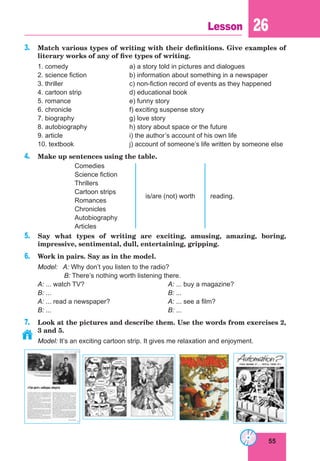
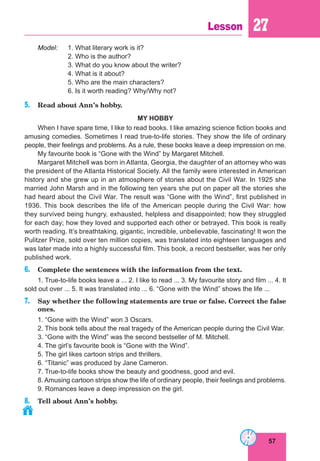
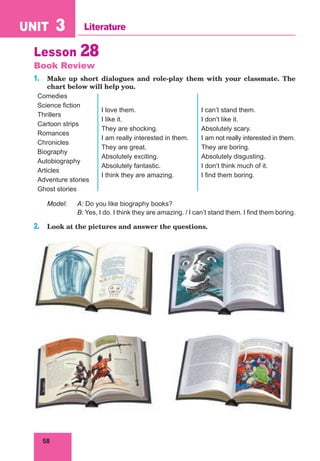
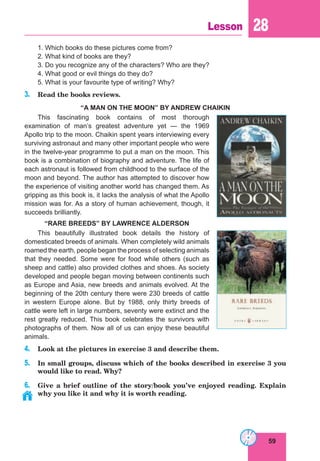
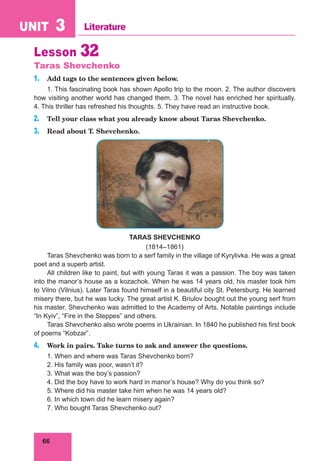
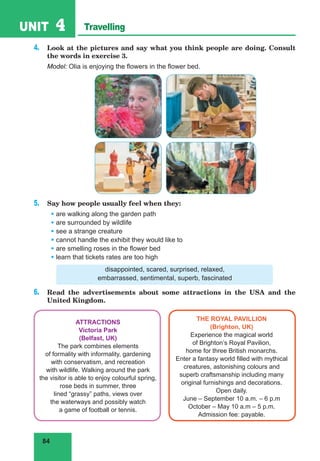
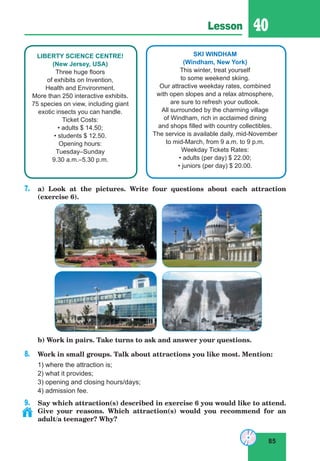
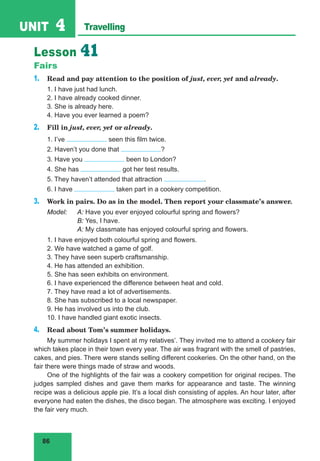
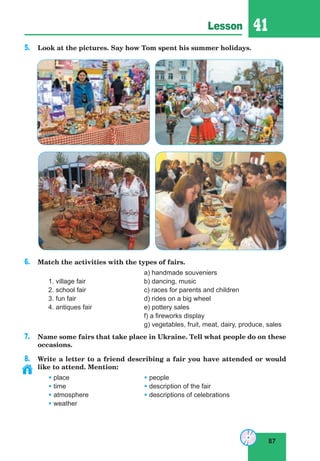
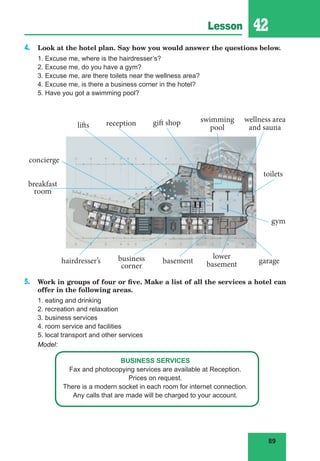
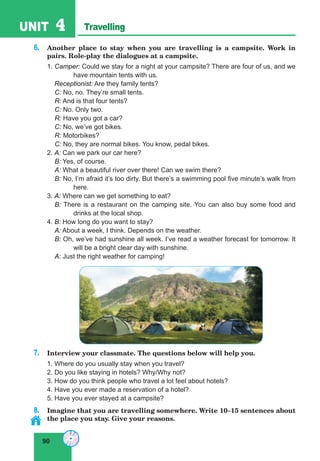
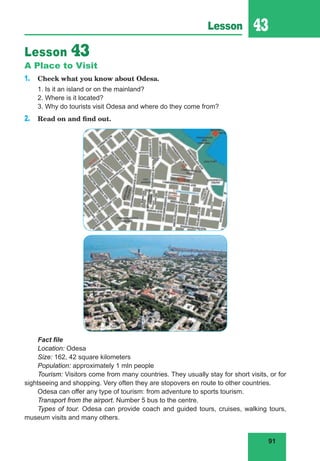
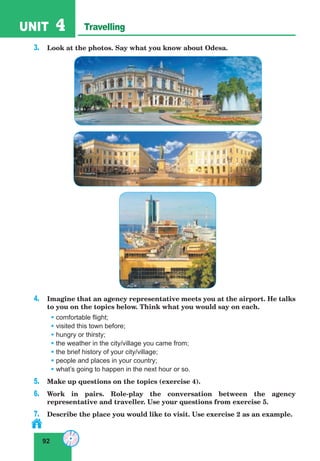
English
Англійська мова
АНГЛІЙСЬКАМОВАEnglish
99 п’ятий рік навчання
2017
М.О. Кучма, Л.І. Морська
М.О.Кучма
Л.І.Морська
М.О.Кучма
Л.І.Морська
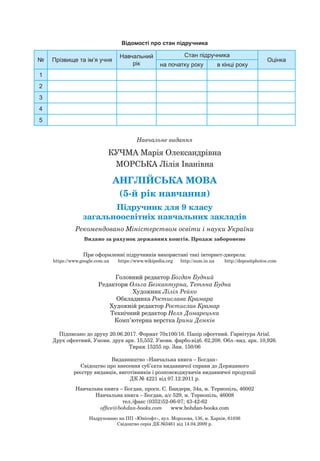
Кучма М.О.
К 88 Англійська мова. 5-й рік навчання : підручник для 9 кл.
загальноосвіт. навч. закл. ; English. Year 5 : a textbook for the
9th form of secondary schools / М.О. Кучма, Л.І. Морська. —
Тернопіль : Навчальна книга – Богдан, 2017. — 192 с. : іл.
ISBN 978-966-10-4823-1
УДК 811.111(075.3)
© Кучма М.О., Морська Л.І., 2017
© Навчальна книга – Богдан, 2017
УДК 811.111(075.3)
К 88
Охороняється законом про авторське право.
Жодна частина цього видання не може бути відтворена
в будь-якому вигляді без дозволу видавництва.
ISBN 978-966-10-4823-1
Рекомендовано Міністерством освіти і науки України
(наказ Міністерства освіти і науки України
від 20.03.2017 р. №417)
ВИДАНО ЗА РАХУНОК ДЕРЖАВНИХ КОШТІВ. ПРОДАЖ ЗАБОРОНЕНО
Експерти, які здійснили експертизу даного підручника під час проведення конкурсного
відбору проектів підручників для 9 класу загальноосвітніх навчальних закладів
і зробили висновок про доцільність надання підручнику грифа
«Рекомендовано Міністерством освіти і науки України»:
Дочу А.Р., кандидат філологічних наук, молодший науковий співробітник
відділу загального та порівняльно-історичного мовознавства
Інституту мовознавства ім. О.О. Потебні НАН України
Тріфан М.С., методист кабінету методики викладання суспільно-гуманітарних
та художньо-естетичних дисциплін ЗІППО
Троян Ю.Р., учитель СЗОШ № 6 м. Хмельницького
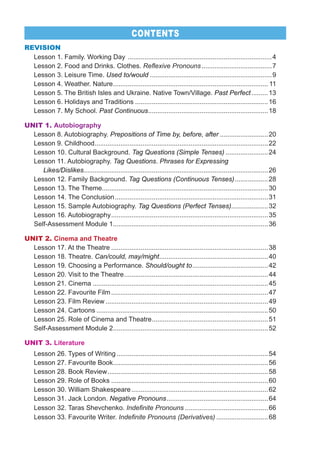
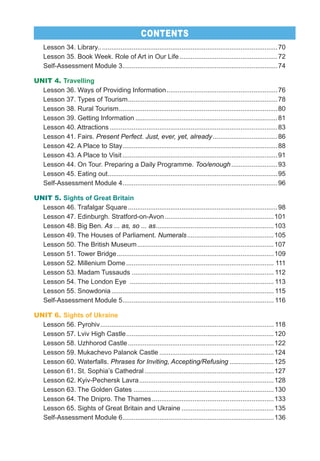
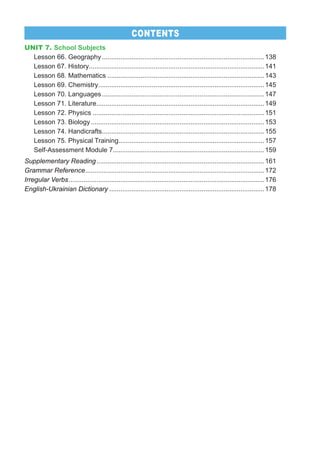
ÓÌÎÂͲ ÏÎÇÍÀ×ÅÍÍß
Grammar!
Listen! Interactive Exercises
ϳêòîãðàìàìè , ó ï³äðó÷íèêó ïîçíà÷åíî ò³ éîãî ñêëàäîâ³, ÿê³ ìîæ-
íà â³äêðèòè â åëåêòðîíí³é âåðñ³¿ çà ïîñèëàííÿì:
http://www.bohdan-digital.com/edu.
Äîðîã³ äðóç³!
Ðîçïî÷èíàºòüñÿ âàø ï’ÿòèé ð³ê âèâ÷åííÿ îäí³º¿ ç íàéïîïóëÿðí³-
øèõ ìîâ ñâ³òó. Çà ïîïåðåäí³ ðîêè âè íàâ÷èëèñÿ áàãàòî: ðîçïîâ³äàòè
àíãë³éñüêîþ ïðî ñâîþ çîâí³øí³ñòü, ñ³ì’þ, äðóç³â, øêîëó, ïðî÷èòàëè òà
ïðîñëóõàëè ö³êàâ³ òåêñòè ïðî Âåëèêîáðèòàí³þ, ÑØÀ, Êàíàäó, Àâñòðà-
ë³þ òîùî. Ïåðåêîíàí³, ùî âè ðîçó쳺òå âàæëèâ³ñòü âèâ÷åííÿ ³íîçåì-
íî¿ ìîâè ó ñó÷àñíîìó ñâ³ò³, à òîìó ùå ç á³ëüøèì åíòóç³àçìîì ïîãëèá-
ëþâàòèìåòå ñâî¿ çíàííÿ ç àíãë³éñüêî¿ ìîâè.
Öüîãî ðîêó âè ïî÷åðïíåòå áàãàòî ö³êàâî¿ òà ï³çíàâàëüíî¿ ³íôîðìàö³¿
ïðî âèçíà÷í³ ì³ñöÿ Âåëèêîáðèòàí³¿ é Óêðà¿íè òà âèäàòíèõ ëþäåé öèõ
êðà¿í. Ó êíèç³ íà âàñ òàêîæ ÷åêàþòü òåêñòè ïðî òåàòð, ê³íî ³ ë³òåðàòóðó.
Çàâäÿêè ¿ì âè é ñàì³ çìîæåòå ðîçïîâ³äàòè ïðî óëþáëåí³ êíèãè, âèñòàâè
òà ô³ëüìè. ϳäðó÷íèê äîïîìîæå òàêîæ ïîãëèáèòè çíàííÿ ç ãðàìàòèêè
àíãë³éñüêî¿ ìîâè òà çíà÷íî ðîçøèðèòè ñëîâíèêîâèé çàïàñ.
Òîæ áàæàºìî âàì óñï³õ³â ó íàâ÷àíí³ òà çàõîïëþþ÷î¿ ïðàö³ ç êíèæ-
êîþ, ñòîð³íêè ÿêî¿ âè ãîðòàòèìåòå óïðîäîâæ ðîêó!
Àâòîðè
Home Assignment
 Exercises for Fun
Revision
Lesson 1
Family. Working Day
! The Present Perfect Tense
have
Утворення:
has
+ III форма дієслова
Допоміжні дієслова:
have, has
1. Express a surprise in connection with the
statements given below.
Model: — You have just had your supper.
— Have I? I haven’t had my supper yet.
1. You have just come home from school.
2. Your brother has just cleaned his room.
3. Your aunt has just watched TV.
4. Your uncle has just gone to sleep.
5. Your grandparents have just done morning
exercises.
6. You have just taken a shower.
2. Read the text and tell about your working day.
MY WORKING DAY
I’d like to tell you about my weekdays during my final
year at school.
On weekdays my working day began early in the
morning. I don’t like to get up early, but I got used to it.
I usually got up at about 7 o’clock. Then I did my morning
exercises and went to the bathroom to wash my face and
hands with soap and clean my teeth with toothpaste. At
a quarter past seven I was ready to have my breakfast.
As a rule, I had a quick light breakfast which consisted of
5
1
5
Lesson 1
a cup of coffee or tea, a boiled egg or an omelette and a cheese or sausage sandwich.
After breakfast I put on my coat, took my bag and left for school.
As my school is not far from my house, it took me 10 minutes to get there. I never took
a bus or a trolleybus on my way to school.
I usually had six or seven lessons a day. I loved all my subjects at school, because our
teachers were highly qualified and enthusiastic. They always knew how to stimulate us to
study and how to develop our intellectual curiosity.
The classes at school were over at about three o’clock. Sometimes I stayed at school
after classes to play basketball or table tennis or to take part in any other after school
activities.
When I came home I had dinner. My mother always cooked delicious dishes for me.
After my dinner I went out with my friends. On rainy days I stayed at home and listened to
music, watched TV or played computer games. At about 8 o’clock in the evening I started
doing my home assignments. I had to work hard at all the subjects as it was my final year
at school.
I did well in most school subjects, but I had to have private lessons in English and
Mathematics as I wanted to enter the university.
As a rule, I took a shower or a bath late in the evening and at about 11.30 p.m. I went
to bed.
3. Read Ann’s letter about her uncle and aunt.
Dear friend,
My uncle Den and aunt Polly are a lovely and imaginative couple. They love sports
and travelling very much. They have just come from the trip round the world. They are
happy because they have visited a lot of countries: France, Germany, the USA, Canada,
Australia and others.
When they are in their village, their daily schedule is a little boring, I think. They
usually get up at 8 a.m., take a shower, have breakfast and leave for work. My aunt is a
nurse in the village hospital, and my uncle is a construction worker. They have lunch at
their places of work. At about 5 or 6 p.m. they come back home. They have supper, watch
TV or read a newspaper and at 10 p.m. they go to bed.
But during their trip around the world everything was different. They got up very early,
had their breakfast and went on excursions. They managed to see Eiffel Tower in France,
attend Dresden Gallery in Germany, enjoy the attractions of Disney Land in the USA, swim
in the five Great Lakes in Canada, and ride a cangaroo in Australia.
My cousin Susan and her husband Tom didn’t travel with them, because they have
a baby, my nephew. He is a lovely, funny and cute boy. He always looks and smiles at me.
Will you tell me, please, about your aunt’s family?
Write me soon.
Yours,
Ann
6
REVISION
6
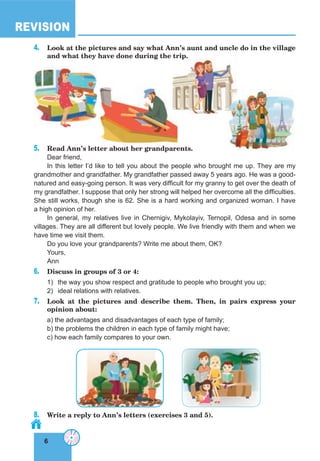
4. Look at the pictures and say what Ann’s aunt and uncle do in the village
and what they have done during the trip.
5. Read Ann’s letter about her grandparents.
Dear friend,
In this letter I’d like to tell you about the people who brought me up. They are my
grandmother and grandfather. My grandfather passed away 5 years ago. He was a good-
natured and easy-going person. It was very difficult for my granny to get over the death of
my grandfather. I suppose that only her strong will helped her overcome all the difficulties.
She still works, though she is 62. She is a hard working and organized woman. I have
a high opinion of her.
In general, my relatives live in Chernigiv, Mykolayiv, Ternopil, Odesa and in some
villages. They are all different but lovely people. We live friendly with them and when we
have time we visit them.
Do you love your grandparents? Write me about them, OK?
Yours,
Ann
6. Discuss in groups of 3 or 4:
1) the way you show respect and gratitude to people who brought you up;
2) ideal relations with relatives.
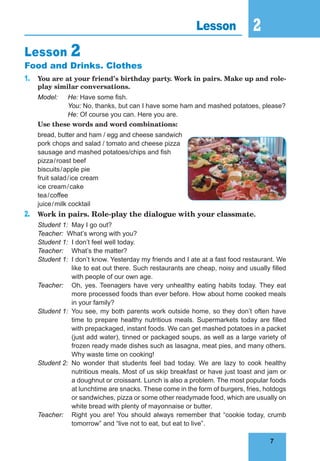
7. Look at the pictures and describe them. Then, in pairs express your
opinion about:
a) the advantages and disadvantages of each type of family;
b) the problems the children in each type of family might have;
c) how each family compares to your own.
8. Write a reply to Ann’s letters (exercises 3 and 5).
and what they have done during the trip.
7
2
7
Lesson 2
Lesson 2
Food and Drinks. Clothes
1. You are at your friend’s birthday party. Work in pairs. Make up and role-
play similar conversations.
Model: He: Have some fish.
You: No, thanks, but can I have some ham and mashed potatoes, please?
He: Of course you can. Here you are.
Use these words and word combinations:
bread, butter and ham / egg and cheese sandwich
pork chops and salad / tomato and cheese pizza
sausage and mashed potatoes/chips and fish
pizza/roast beef
biscuits/apple pie
fruit salad/ice cream
ice cream/cake
tea/coffee
juice/milk cocktail
2. Work in pairs. Role-play the dialogue with your classmate.
Student 1: May I go out?
Teacher: What’s wrong with you?
Student 1: I don’t feel well today.
Teacher: What’s the matter?
Student 1: I don’t know. Yesterday my friends and I ate at a fast food restaurant. We
like to eat out there. Such restaurants are cheap, noisy and usually filled
with people of our own age.
Teacher: Oh, yes. Teenagers have very unhealthy eating habits today. They eat
more processed foods than ever before. How about home cooked meals
in your family?
Student 1: You see, my both parents work outside home, so they don’t often have
time to prepare healthy nutritious meals. Supermarkets today are filled
with prepackaged, instant foods. We can get mashed potatoes in a packet
(just add water), tinned or packaged soups, as well as a large variety of
frozen ready made dishes such as lasagna, meat pies, and many others.
Why waste time on cooking!
Student 2: No wonder that students feel bad today. We are lazy to cook healthy
nutritious meals. Most of us skip breakfast or have just toast and jam or
a doughnut or croissant. Lunch is also a problem. The most popular foods
at lunchtime are snacks. These come in the form of burgers, fries, hotdogs
or sandwiches, pizza or some other readymade food, which are usually on
white bread with plenty of mayonnaise or butter.
Teacher: Right you are! You should always remember that “cookie today, crumb
tomorrow” and “live not to eat, but eat to live”.
8
REVISION
8
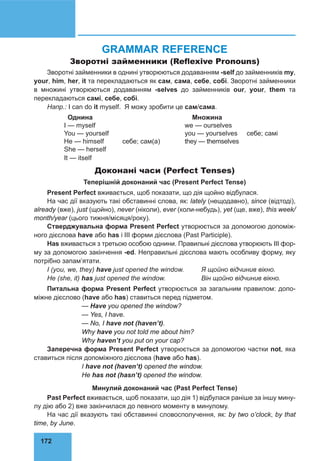
! Reflexive pronouns (зворотні займенники)
Однина Множина
I — myself we — ourselves
You — yourself you — yourselves себе; самі
He — himself себе; сам(а) they — themselves
She — herself
It — itself
3. Do as in the model. Start the sentences with the words in brackets.
Model: She can’t do this exercise herself. She needs help. (They) —
They can’t do this exercise themselves. They need help.
1. I can get dressed myself. I am not a baby. (We) —
2. You may sing yourself. Your voice is strong. (You) —
3. He may go to the shop himself. It is not dark outside. (She) —
4. You can’t do that yourself. You don’t know the rules. (He) —
5. Your brother can clean the room himself. (We) —
6. Her niece can cook a cake herself. (I) —
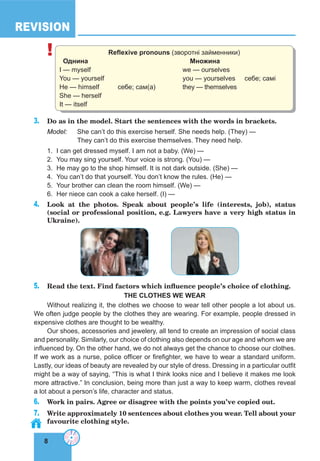
4. Look at the photos. Speak about people’s life (interests, job), status
(social or professional position, e.g. Lawyers have a very high status in
Ukraine).
5. Read the text. Find factors which influence people’s choice of clothing.
THE CLOTHES WE WEAR
Without realizing it, the clothes we choose to wear tell other people a lot about us.
We often judge people by the clothes they are wearing. For example, people dressed in
expensive clothes are thought to be wealthy.
Our shoes, accessories and jewelery, all tend to create an impression of social class
and personality. Similarly, our choice of clothing also depends on our age and whom we are
influenced by. On the other hand, we do not always get the chance to choose our clothes.
If we work as a nurse, police officer or firefighter, we have to wear a standard uniform.
Lastly, our ideas of beauty are revealed by our style of dress. Dressing in a particular outfit
might be a way of saying, “This is what I think looks nice and I believe it makes me look
more attractive.” In conclusion, being more than just a way to keep warm, clothes reveal
a lot about a person’s life, character and status.
6. Work in pairs. Agree or disagree with the points you’ve copied out.
7. Write approximately 10 sentences about clothes you wear. Tell about your
favourite clothing style.
9
3
9
Lesson 3
Lesson 3
Leisure Time
1. a) In your exercise book evaluate each activity:
1. the sports and pastimes you participate in, are interested in, or watch ();
2. the ones that other members of your family take an interest in (+);
3. the games and pastimes you dislike or disapprove of (x);
4. the ones you might take up or get interested in one day (?).
Team sports: football , baseball , hockey , rugby , basketball .
Individual competetive and non-competetive sports: boxing , badminton , motor
racing , golf , squash , cycling , field and track athletics , surfing ,
jogging , fitness exercises .
Outdoor activities: gardening , walking the dog , hunting .
Indoor games: chess , draughts ; board games: monopoly, etc. .
Hobbies: collecting things , doing crossword puzzles , do-it-yourself .
b) Underline your favourite activity in each category and add any which
are missing.
c) Work in groups. Compare your lists. Present the information to class.
2. Make up a dialogue, using the key questions given below.
What sports do your friends go in for? Where do they train?
Who is good at basketball? How often do they go to the gym?
3. Read how members of Mark’s family spend their spare time.
Hi! My name is Mark. I’m fourteen. I cannot say that I’m a couch potato, but I’m quite
happy to stay at home most evenings. I usually watch TV, read interesting books or play
computer games.
My sister’s name is Mary. She is nine. She has very energetic interests and hobbies. She
loves playing tennis, basketball, dancing and hiking. But she hates collecting labels or coins.
My father is a football fan. He is a Dynamo supporter. He goes to all their matches
when they play at home.
My mother is an absolutely wonderful cook. She makes fantastic dishes.
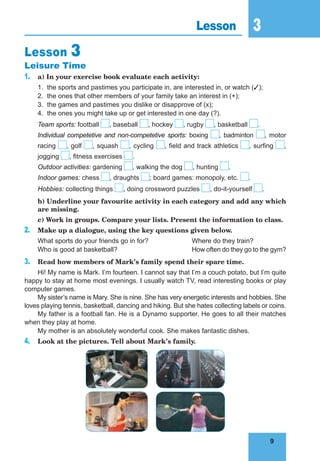
4. Look at the pictures. Tell about Mark’s family.
10
REVISION
10
5. Make up questions to the given answers.
Student 1: Where ____________________ ? St. 1: Who _______________ ?
St. 2: I am going to my school gym. St. 2: Petrenko is my coach.
St. 1: Why __________________________ ? St. 1: Do ________________ ?
St. 2: I’ll have my training there. St. 2: Of course I do.
St. 1: How often _____________________ ?
St. 2: I have my training every other day.
6. Make some notes about yourself. Use the ideas below and those from
exercises 1 and 2 and add more ideas of your own. Present the information
to class.
1. Sports and hobbies
I play a little _____________________
I used to play _____________________ but now _____________________
I like to go _____________________ (+ verb with -ing)
I collect _____________________
2. Cultural interests and holidays
(books) I like _____________________
(music) I like _____________________
(films) I like _____________________
(magazines) I like _____________________
! Would expresses past repeated actions and routine.
Used to expresses past states or habits.
Model: Grandma would always make me porridge for breakfast (also: used
to make). When I was young I used to live in Lviv (Not: would).
7. Work in groups. Discuss the changes in your lives over the years. Talk
about:
1. hobbies 4. personality 7. daily routine
2. sports 5. food 8. favourite books
3. clothes 6. likes/dislikes
Use used to.
Model: — What were your hobbies and what are they now?
— 5 years ago I used to play football but I don’t play it any more. I’d rather
play the guitar.
8. Write 10–12 sentences about how members of your family spend their
spare time. Then tell your class about it.
11
4
11
Lesson 4
Lesson 4
Weather. Nature
1. Complete the sentences with the words from the box.
since for yet already
1. Mike: Haven’t you cleaned your room ...?
Chris: You’ve ... asked me that three times today.
2. They have been married ... 15 years.
3. I haven’t seen them ... June.
2. Write the following sentences in the Present Perfect.
1. They will spend a lot of money on the tour.
2. I am trying on a new pair of jeans.
3. She visits Poland every year.
4. He saw a lot of amusing films.
3. Read two weather reports. Talk with your classmate about the damage
after the storm.
Model: — Have you heard what happened in Southampton?
— Oh, it’s terrible! Hundreds of roofs were damaged!
This is David Smeeton in Southampton. In the southern region it’s been a day of
assessing the damage to hundreds of roofs, many of them torn completely off, while
some homes are partially collapsed. Overnight scores of people were looked after in
emergency centres.
And finally this is Andrew Roberts with a look at how the storms have affected
the capital. Two people were killed as winds of 94 miles an hour — the highest ever
recorded — gusted across London. In Croydon a motorist died when his car was crushed
by a falling tree.
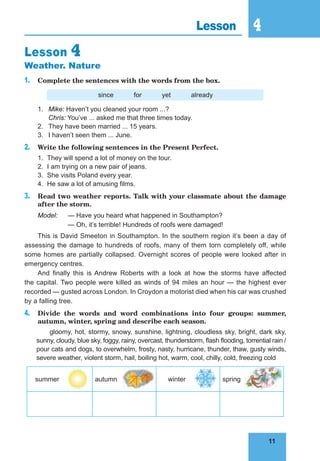
4. Divide the words and word combinations into four groups: summer,
autumn, winter, spring and describe each season.
gloomy, hot, stormy, snowy, sunshine, lightning, cloudless sky, bright, dark sky,
sunny, cloudy, blue sky, foggy, rainy, overcast, thunderstorm, flash flooding, torrential rain /
pour cats and dogs, to overwhelm, frosty, nasty, hurricane, thunder, thaw, gusty winds,
severe weather, violent storm, hail, boiling hot, warm, cool, chilly, cold, freezing cold
summer autumn winter spring
12
REVISION
12
5. Work in pairs. Listen to the dialogue and role-play it. Make up a similar
one.
A: Why don’t we go to Switzerland?
B: It’s a very long way. Besides it’s often very cold and slippery at this time of the year.
It may snow heavily.
A: Well, yes… it may… but I don’t think it will.
B: We may not be able to find a hotel. They may be closed.
A: Oh, that’s no problem. I can book a hotel by phone.
B: Well, perhaps it’s not a bad idea. Let’s watch the weather forecast on television.
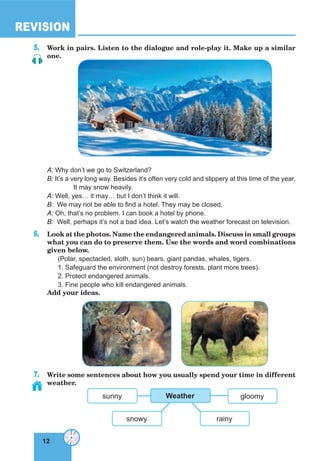
6. Look at the photos. Name the endangered animals. Discuss in small groups
what you can do to preserve them. Use the words and word combinations
given below.
(Polar, spectacled, sloth, sun) bears, giant pandas, whales, tigers.
1. Safeguard the environment (not destroy forests, plant more trees).
2. Protect endangered animals.
3. Fine people who kill endangered animals.
Add your ideas.
7. Write some sentences about how you usually spend your time in different
weather.
snowy
gloomysunny Weather
rainy
13
5
13
Lesson 5
Lesson 5
The British Isles and Ukraine. Native Town/Village
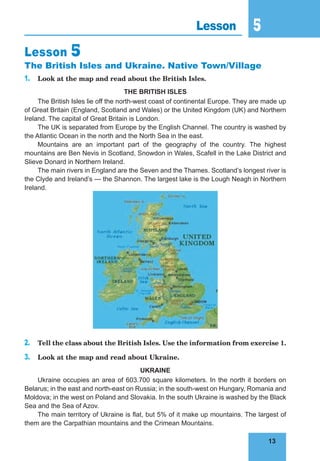
1. Look at the map and read about the British Isles.
THE BRITISH ISLES
The British Isles lie off the north-west coast of continental Europe. They are made up
of Great Britain (England, Scotland and Wales) or the United Kingdom (UK) and Northern
Ireland. The capital of Great Britain is London.
The UK is separated from Europe by the English Channel. The country is washed by
the Atlantic Ocean in the north and the North Sea in the east.
Mountains are an important part of the geography of the country. The highest
mountains are Ben Nevis in Scotland, Snowdon in Wales, Scafell in the Lake District and
Slieve Donard in Northern Ireland.
The main rivers in England are the Seven and the Thames. Scotland’s longest river is
the Clyde and Ireland’s — the Shannon. The largest lake is the Lough Neagh in Northern
Ireland.
2. Tell the class about the British Isles. Use the information from exercise 1.
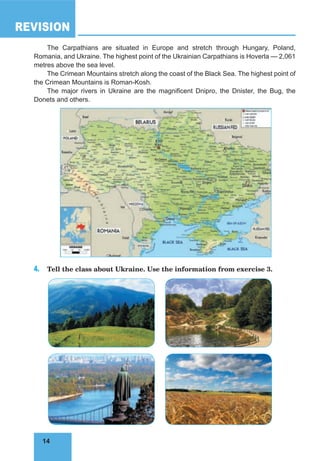
3. Look at the map and read about Ukraine.
UKRAINE
Ukraine occupies an area of 603.700 square kilometers. In the north it borders on
Belarus; in the east and north-east on Russia; in the south-west on Hungary, Romania and
Moldova; in the west on Poland and Slovakia. In the south Ukraine is washed by the Black
Sea and the Sea of Azov.
The main territory of Ukraine is flat, but 5% of it make up mountains. The largest of
them are the Carpathian mountains and the Crimean Mountains.
14
REVISION
14
The Carpathians are situated in Europe and stretch through Hungary, Poland,
Romania, and Ukraine. The highest point of the Ukrainian Carpathians is Hoverla — 2,061
metres above the sea level.
The Crimean Mountains stretch along the coast of the Black Sea. The highest point of
the Crimean Mountains is Roman-Kosh.
The major rivers in Ukraine are the magnificent Dnipro, the Dnister, the Bug, the
Donets and others.
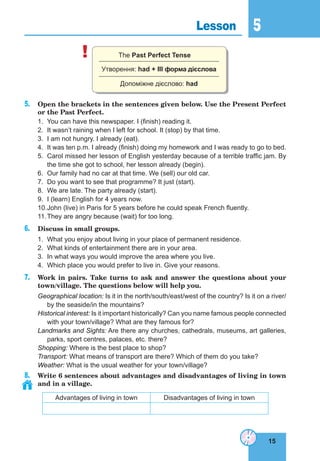
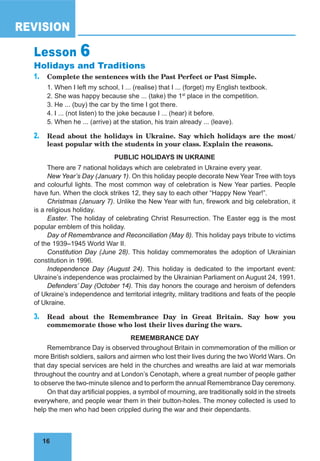
4. Tell the class about Ukraine. Use the information from exercise 3.
15
5
15
Lesson 5
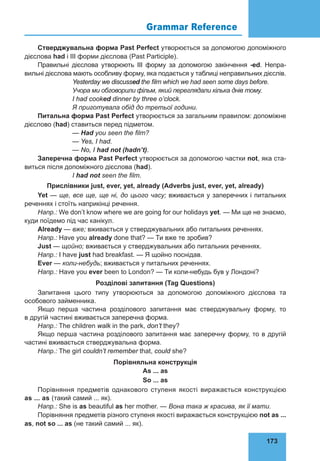
! The Past Perfect Tense
Утворення: had + IIІ форма дієслова
Допоміжне дієслово: had
5. Open the brackets in the sentences given below. Use the Present Perfect
or the Past Perfect.
1. You can have this newspaper. I (finish) reading it.
2. It wasn’t raining when I left for school. It (stop) by that time.
3. I am not hungry. I already (eat).
4. It was ten p.m. I already (finish) doing my homework and I was ready to go to bed.
5. Carol missed her lesson of English yesterday because of a terrible traffic jam. By
the time she got to school, her lesson already (begin).
6. Our family had no car at that time. We (sell) our old car.
7. Do you want to see that programme? It just (start).
8. We are late. The party already (start).
9. I (learn) English for 4 years now.
10.John (live) in Paris for 5 years before he could speak French fluently.
11.They are angry because (wait) for too long.
6. Discuss in small groups.
1. What you enjoy about living in your place of permanent residence.
2. What kinds of entertainment there are in your area.
3. In what ways you would improve the area where you live.
4. Which place you would prefer to live in. Give your reasons.
7. Work in pairs. Take turns to ask and answer the questions about your
town/village. The questions below will help you.
Geographical location: Is it in the north/south/east/west of the country? Is it on a river/
by the seaside/in the mountains?
Historical interest: Is it important historically? Can you name famous people connected
with your town/village? What are they famous for?
Landmarks and Sights: Are there any churches, cathedrals, museums, art galleries,
parks, sport centres, palaces, etc. there?
Shopping: Where is the best place to shop?
Transport: What means of transport are there? Which of them do you take?
Weather: What is the usual weather for your town/village?
8. Write 6 sentences about advantages and disadvantages of living in town
and in a village.
Advantages of living in town Disadvantages of living in town
16
REVISION
16
Lesson 6
Holidays and Traditions
1. Complete the sentences with the Past Perfect or Past Simple.
1. When I left my school, I ... (realise) that I ... (forget) my English textbook.
2. She was happy because she ... (take) the 1st
place in the competition.
3. He ... (buy) the car by the time I got there.
4. I ... (not listen) to the joke because I ... (hear) it before.
5. When he ... (arrive) at the station, his train already ... (leave).
2. Read about the holidays in Ukraine. Say which holidays are the most/
least popular with the students in your class. Explain the reasons.
PUBLIC HOLIDAYS IN UKRAINE
There are 7 national holidays which are celebrated in Ukraine every year.
New Year’s Day (January 1). On this holiday people decorate New Year Tree with toys
and colourful lights. The most common way of celebration is New Year parties. People
have fun. When the clock strikes 12, they say to each other “Happy New Year!”.
Christmas (January 7). Unlike the New Year with fun, firework and big celebration, it
is a religious holiday.
Easter. The holiday of celebrating Christ Resurrection. The Easter egg is the most
popular emblem of this holiday.
Day of Remembrance and Reconciliation (May 8). This holiday pays tribute to victims
of the 1939–1945 World War II.
Constitution Day (June 28). This holiday commemorates the adoption of Ukrainian
constitution in 1996.
Independence Day (August 24). This holiday is dedicated to the important event:
Ukraine’s independence was proclaimed by the Ukrainian Parliament on August 24, 1991.
Defenders’ Day (October 14). This day honors the courage and heroism of defenders
of Ukraine’s independence and territorial integrity, military traditions and feats of the people
of Ukraine.
3. Read about the Remembrance Day in Great Britain. Say how you
commemorate those who lost their lives during the wars.
REMEMBRANCE DAY
Remembrance Day is observed throughout Britain in commemoration of the million or
more British soldiers, sailors and airmen who lost their lives during the two World Wars. On
that day special services are held in the churches and wreaths are laid at war memorials
throughout the country and at London’s Cenotaph, where a great number of people gather
to observe the two-minute silence and to perform the annual Remembrance Day ceremony.
On that day artificial poppies, a symbol of mourning, are traditionally sold in the streets
everywhere, and people wear them in their button-holes. The money collected is used to
help the men who had been crippled during the war and their dependants.
17
6
17
Lesson 6
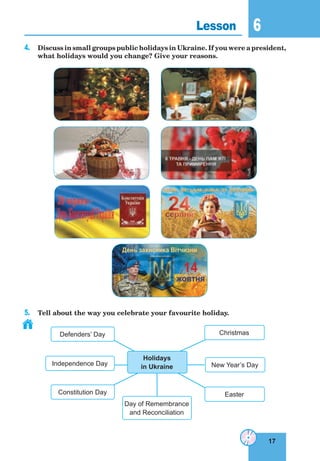
4. Discuss in small groups public holidays in Ukraine. If you were a president,
what holidays would you change? Give your reasons.
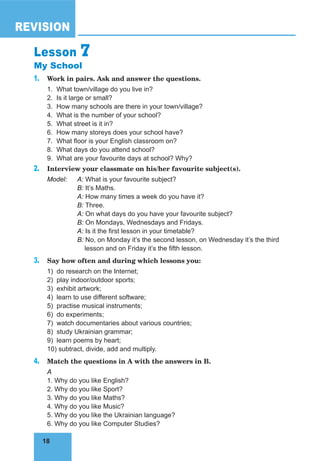
5. Tell about the way you celebrate your favourite holiday.
New Year’s Day
Christmas
EasterConstitution Day
Independence Day
Defenders’ Day
Holidays
in Ukraine
Day of Remembrance
and Reconciliation
День захисника Вітчизни
14
жовтня
18
REVISION
18
Lesson 7
My School
1. Work in pairs. Ask and answer the questions.
1. What town/village do you live in?
2. Is it large or small?
3. How many schools are there in your town/village?
4. What is the number of your school?
5. What street is it in?
6. How many storeys does your school have?
7. What floor is your English classroom on?
8. What days do you attend school?
9. What are your favourite days at school? Why?
2. Interview your classmate on his/her favourite subject(s).
Model: A: What is your favourite subject?
B: It’s Maths.
A: How many times a week do you have it?
B: Three.
A: On what days do you have your favourite subject?
B: On Mondays, Wednesdays and Fridays.
A: Is it the first lesson in your timetable?
B: No, on Monday it’s the second lesson, on Wednesday it’s the third
lesson and on Friday it’s the fifth lesson.
3. Say how often and during which lessons you:
1) do research on the Internet;
2) play indoor/outdoor sports;
3) exhibit artwork;
4) learn to use different software;
5) practise musical instruments;
6) do experiments;
7) watch documentaries about various countries;
8) study Ukrainian grammar;
9) learn poems by heart;
10) subtract, divide, add and multiply.
4. Match the questions in A with the answers in B.
A
1. Why do you like English?
2. Why do you like Sport?
3. Why do you like Maths?
4. Why do you like Music?
5. Why do you like the Ukrainian language?
6. Why do you like Computer Studies?
19
7
19
Lesson 7
My Friend
My English Lessons
B
a) because I like counting and doing sums;
b) because I like singing and playing musical instruments;
c) because I like jumping and running;
d) because I like telling stories and reading books;
e) because I like to write computer programmes;
f) because I like describing pictures, making up dialogues and playing games.
5. Complete the text in the Past Simple. Use the verbs from the box.
talk, work, arrive, continue, finish, listen, play, start
I remember my first day at school in 20... . I ... at 8.30 and … lessons at 9.00. We
… from 9.00 to 12.00. The teachers … to us a lot. Then we … football for an hour. In the
afternoon we … the lessons and … to the teacher carefully. Then at 3.30 the lessons … .
It was a long and tiring day!
6. Make the sentences interrogative and negative.
1. We were attending smart shops at that moment. 2. Ann was answering the questions.
3. The teacher was explaining what to do. 4. We were making up dialogues. 5. The students
were writing the words into their vocabularies. 6. I was jumping at that time.
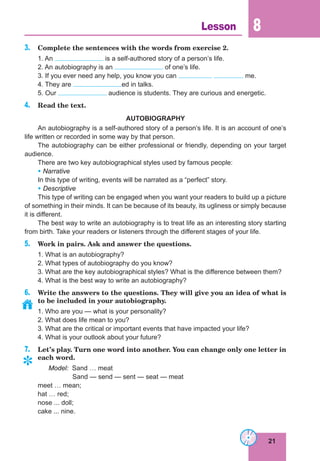
7. Read Sam’s letter about him and his English lessons. Write a reply to
Sam’s letter.
Dear Friend,
Hi! My name is Sam. I live in Poland in a beautiful cottage in a small village.
My village is surrounded by lovely countryside with fields, woods, streams and
a small lake. Opposite my house there is a big shopping centre with a multi-storey
car park. My mother works there.
I go to school. I am a student of the ninth form. I love my English lessons
very much. They are interesting and we have a lot of fun. We discuss different
questions in English. We also do a lot of exercises, ask and answer questions,
describe pictures, make up and role-play dialogues, play games, sing songs, learn
poems and rhymes, read and create stories and jokes, prepare reports, learn to
predict, compare and contrast, learn to explain quotations in our own words, make
word charts, do project and research work. I do enjoy my English lessons.
How about you? Do you love your English lessons?Are they as exciting as mine?
I am looking forward to your answer.
Yours,
Sam
Lesson 8
Autobiography
! Prepositions of time by, before and after
by = до
before = до, перед тим як
after = після, після того як
1. Supply a suitable preposition by, before or
after.
1. I had decorated the room the time
they came.
2. She had swept the floor he came.
3. We moved to the village the war.
4. I’ll begin to work he comes.
5. You’ll watch TV they leave.
6. What will you do you finish high
school.
7. I usually come to school ten minutes
the classes begin.
2. Listen, read and remember the words and
word combination.
autobiography
an account
depend on
target
audience
narrative
engage
ugliness
[ˌɔːtəbaɪˈɒɡrəfɪ]
[əˈkaʊnt]
[dɪˈpend ɒn]
[ˈtɑːɡɪt]
[ˈɔːdɪəns]
[ˈnærətɪv]
[ɪnˈɡeɪdʒ]
[ˈʌɡlɪnəs]
Unit1
AUTOBIOGRAPHY
21
Lesson 8
3. Complete the sentences with the words from exercise 2.
1. An is a self-authored story of a person’s life.
2. An autobiography is an of one’s life.
3. If you ever need any help, you know you can me.
4. They are ed in talks.
5. Our audience is students. They are curious and energetic.
4. Read the text.
AUTOBIOGRAPHY
An autobiography is a self-authored story of a person’s life. It is an account of one’s
life written or recorded in some way by that person.
The autobiography can be either professional or friendly, depending on your target
audience.
There are two key autobiographical styles used by famous people:
• Narrative
In this type of writing, events will be narrated as a “perfect” story.
• Descriptive
This type of writing can be engaged when you want your readers to build up a picture
of something in their minds. It can be because of its beauty, its ugliness or simply because
it is different.
The best way to write an autobiography is to treat life as an interesting story starting
from birth. Take your readers or listeners through the different stages of your life.
5. Work in pairs. Ask and answer the questions.
1. What is an autobiography?
2. What types of autobiography do you know?
3. What are the key autobiographical styles? What is the difference between them?
4. What is the best way to write an autobiography?
6. Write the answers to the questions. They will give you an idea of what is
to be included in your autobiography.
1. Who are you — what is your personality?
2. What does life mean to you?
3. What are the critical or important events that have impacted your life?
4. What is your outlook about your future?
7. Let’s play. Turn one word into another. You can change only one letter in
each word.
Model: Sand … meat
Sand — send — sent — seat — meat
meet … mean;
hat … red;
nose ... doll;
cake ... nine.

22
UNIT 1 Autobiography
Lesson 9
Childhood
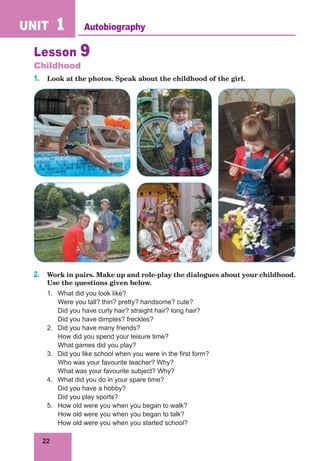
1. Look at the photos. Speak about the childhood of the girl.
2. Work in pairs. Make up and role-play the dialogues about your childhood.
Use the questions given below.
1. What did you look like?
Were you tall? thin? pretty? handsome? cute?
Did you have curly hair? straight hair? long hair?
Did you have dimples? freckles?
2. Did you have many friends?
How did you spend your leisure time?
What games did you play?
3. Did you like school when you were in the first form?
Who was your favourite teacher? Why?
What was your favourite subject? Why?
4. What did you do in your spare time?
Did you have a hobby?
Did you play sports?
5. How old were you when you began to walk?
How old were you when you began to talk?
How old were you when you started school?
23
Lesson 9
3. Exchange the information about your childhood with your classmate. Say
what differences and similarities you have noticed. Use phrases given
below.
Describing Similarities Describing Differences
• is rather like • is nothing like
• appears similar to • is totally different from
• seems like • varies greatly from
• resembles • has very little in common with
• reminds me of • is quite unlike
• has a lot in common with • bears little resemblance to
• is pretty much the same as • differs dramatically from
• is comparable to
4. Listen, read and remember the words and word combinations.
include
recollect
define
bring up
grow up
prefer
glimpse
precious
[ɪnˈkluːd]
[ˌrekəˈlekt]
[dɪˈfaɪn]
[brɪŋ ʌp]
[ɡrəʊ ʌp]
[prɪˈfɜː(r)]
[ɡlɪmps]
[ˈpreʃəs]
5. Match the words with their definitions.
1. grow up
2. recollect
3. include
4. define
5. bring up
6. prefer
a) to make sb/sth part
b) to look after a child until he or she becomes an adult
c) to explain the exact nature of sth clearly
d) to develop into an adult
e) to like sth better
f) to remember sth
6. Write German/French equivalents to the English word combinations.
Make up four sentences with them.
Depend on, different stages of your life, bring up, grow up.
7. a) Recollect and write down the information about the events that taught
you something interesting and important.
b) Add some events that are funny and an important part of your
childhood.
Model: I was quite bored with my life. Once I attended a football match with my
Dad. It was fantastic! I realized I need to do something new. I have learnt to
play tennis. Now I am happy. Firstly, I have many friends. Secondly, I have
great trainings three times a week. Finally, I feel much healthier than ever
before.
24
UNIT 1
Lesson 10
Cultural Background
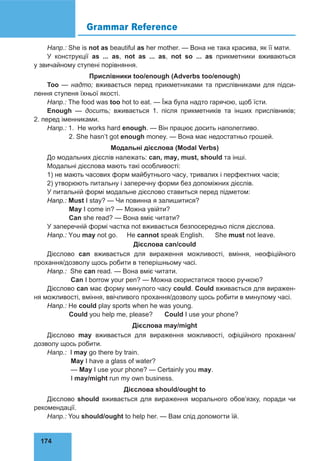
Tag Questions
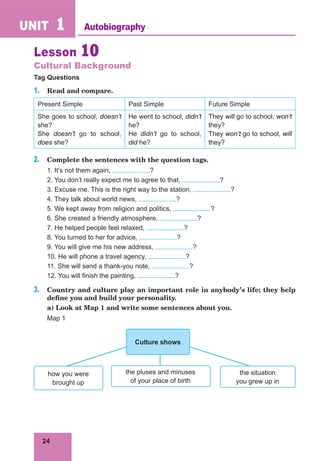
1. Read and compare.
Present Simple Past Simple Future Simple
She goes to school, doesn’t
she?
She doesn’t go to school,
does she?
He went to school, didn’t
he?
He didn’t go to school,
did he?
They will go to school, won’t
they?
They won’t go to school, will
they?
2. Complete the sentences with the question tags.
1. It’s not them again, ?
2. You don’t really expect me to agree to that, ?
3. Excuse me. This is the right way to the station, ?
4. They talk about world news, ?
5. We kept away from religion and politics, ?
6. She created a friendly atmosphere, ?
7. He helped people feel relaxed, ?
8. You turned to her for advice, ?
9. You will give me his new address, ?
10. He will phone a travel agency, ?
11. She will send a thank-you note, ?
12. You will finish the painting, ?
3. Country and culture play an important role in anybody’s life; they help
define you and build your personality.
a) Look at Map 1 and write some sentences about you.
Map 1
the situation
you grew up in
the pluses and minuses
of your place of birth
how you were
brought up
Culture shows
Autobiography
25
Lesson 10
b) Look at Map 2 and write some sentences about your family.
Map 2
celebrations and rituals
you practised
the clothes
you wore
the food you ate
the holidays
you preferred
the customs
of your family
Cultural
background
includes
Include the things like the dearest present you got or popular foods
served during special celebrations.
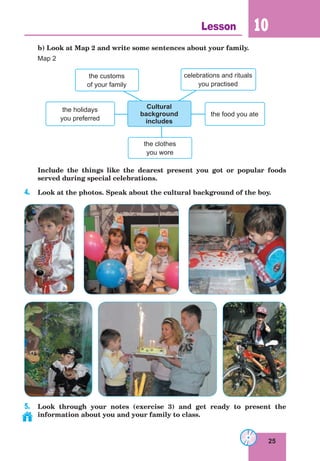
4. Look at the photos. Speak about the cultural background of the boy.
5. Look through your notes (exercise 3) and get ready to present the
information about you and your family to class.
26
UNIT 1
Lesson 11
Autobiography
1. Choose the alternative in each sentence which you think is true for your
classmate.
1. likes/doesn’t like dancing
2. has/hasn’t watched a film on You Tube in the last two weeks
3. would/wouldn’t like to live in a foreign country
4. is/isn’t a morning person
5. is/isn’t a night bird
6. has/hasn’t got a dog
7. can/can’t sing well
8. has/hasn’t been to the cinema/theatre in the last two weeks
Model: I think my friend 1. likes dancing; 2. hasn’t watched a film on You Tube in
the last two weeks; 3. ...
2. Work in pairs. Use question tags to check whether your predictions were
right. Use phrases given below.
Model: I. A: You don’t like dancing, do you?
B: Yes, I like actually. I really like the way our trainer conducts classes.
II. A: You like dancing, don’t you?
B: Yes, you are right. I like dancing very much.
Expressing Likes:
I really like/love...
I’m really very fond of/interested in...
I find ... really interesting/fascinating/exciting.
Expressing Dislikes:
I (absolutely) hate/can’t stand...
I’m not (very) interested in...
I don’t fancy...
I find ... rather boring/dull/etc.
Expressing Indifference:
It doesn’t bother me either way.
It doesn’t concern me.
I don’t care.
It’s OK/all right I suppose.
I don’t have an opinion on it.
Explaining what you like about something:
What I like most is...
I really like the way...
Explaining what you don’t like about something:
What bothers/annoys me the most is...
Autobiography
27
Lesson 11
3. Add up your total number of right guesses. Tell the results to class.
4. Listen, read and remember the words and word combinations.
view
background
overview
shape (v)
undertake
unique
ancestor
achievement
inspire
[vjuː]
[ˈbækɡraʊnd]
[ˈəʊvəvjuː]
[ʃeɪp]
[ˌʌndəˈteɪk]
[juˈniːk]
[ˈænsestər]
[əˈtʃiːvmənt]
[ɪnˈspaɪə(r)]
5. Put the words from exercise 4 in alphabet order. Make up and write down
one sentence with each of them.
6. Write German/French equivalents to the English words.
Ancestor, achievement, inspire, entertainment.
7. Make up and write down nine tag questions with the words from
exercise 4.
8. Listen to the joke and dramatize it.
IN THE TRAIN
Nick with his father went to see Grandmother. In the train Nick every minute put his
head out of the window. His father said, “Nick, keep quiet. Don’t put your head out of the
window!” But Nick went on putting his head out of the window.
Here his father took Nick’s cap quietly, hid it behind his back and said, “You see, your
cap has flown”. Nick was sorry for his cap and began to cry. Then his father said, “Well,
whistle once! Perhaps, your cap will come back”.
Nick came up to the window and whistled. Nick’s father put quickly the cap on Nick’s
head.
Oh! It was wonderful. Nick was very pleased. He took quickly his father’s cap and
threw it out of the window. “Now it is your turn to whistle, Dad!” said the boy.

28
UNIT 1
Lesson 12
Family Background
You know already that information about your childhood and your culture should be
included in your autobiography.
As you undertake this task you will soon find your life to be unique from anyone else’s.
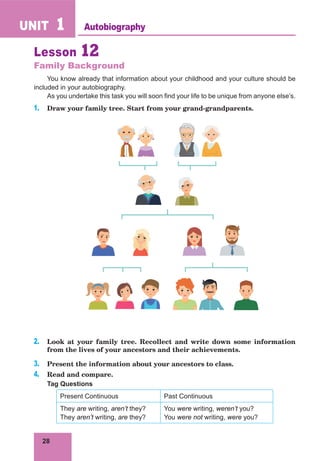
1. Draw your family tree. Start from your grand-grandparents.
2. Look at your family tree. Recollect and write down some information
from the lives of your ancestors and their achievements.
3. Present the information about your ancestors to class.
4. Read and compare.
Tag Questions
Present Continuous Past Continuous
They are writing, aren’t they?
They aren’t writing, are they?
You were writing, weren’t you?
You were not writing, were you?
Autobiography
29
Lesson 12
5. Complete the sentences with the question tags.
1. She is working away from home, ?
2. They are buying a box of chocolates, ?
3. He is giving a bunch of flowers to her, ?
4. You are reading a story to your children, ?
5. He was wearing an Italian suit, ?
6. They were starting the engine, ?
7. She was beginning to get bored, ?
8. You were showing photos of your home, ?
6. Recollect your place of birth. Write down what changes have taken place
there since your childhood. Mention:
• public transport (poor/good)
• roads
• entertainment (leisure centres)
• schools
• hospitals (new, old)
• variety of jobs (many, few)
Use phrases given below.
Describing Similarities
• is rather like
• appears similar to
• seems like
• resembles
• reminds me of
• has a lot in common with
• is pretty much the same as
• is comparable to
Describing Differences
• is nothing like
• is totally different from
• varies greatly from
• has very little in common with
• is quite unlike
• bears little resemblance to
• differs dramatically from
Model:
1. Public transport in my place of birth is pretty much the same as it was 12 years ago.
2. Public transport in my place of birth was rather poor but it is good enough nowadays.
30
UNIT 1
Lesson 13
The Theme
A particular event that had a huge impact on your life can be your theme.
1. Listen, read and remember the words and word combinations.
twist
event
list
theme
impact
revert back
out of shape
divine
influence
[twɪst]
[ɪˈvent]
[lɪst]
[θiːm]
[ˈɪmpækt]
[rɪˈvɜːt bæk]
[aʊt əv ʃeɪp]
[dɪˈvaɪn]
[ˈɪnfluəns]
2. Find, read and write down the words.
eventlistinfluencerevertbackthemeimpactdivine
3. Let’s play. One student says the word. Another student should repeat the
first word and add his own one. The student who won’t be able to repeat
all the words lose. Use the words from exercise 1.
Model. Student 1: impact
St 2: impact, divine.
St. 3: impact, divine, influence and so on.
4. Find and mark that one day and/or one event that changed your life and
made you think about your future.
5. Find out and write down what makes your life or experience special. It
may be a list of many events that revert back to a central theme.
6. Make a list of those people who influenced your life: your family, your
friends, ex-girlfriend or boyfriend.
7. Write down all the beautiful stories you’ve had and those you think may
happen in your life.
1. Childhood stories
2. Love stories
3. Crisis stories
Remember! Write in simple words as if you are narrating to your friend.
Autobiography

31
Lesson 14
Lesson 14
The Conclusion
1. Listen, read and remember the words and word combinations.
conclusion
take a resolution
gain
sense
learn a lesson
aspire
[kənˈkluːʒn]
[teɪk ə ˌrezəˈluːʃn]
[ɡeɪn]
[sens]
[lɜːn ə ˈlesn]
[əˈspaɪə(r)]
2. Look at the words and word combinations in exercise 1 and say what you
have already experienced in your life.
Model: I have already taken a resolution... Once after one incident at school I and
my classmates took a decision not to miss classes anymore.
3. Work in pairs. Compare your life experience (exercise 2) with that of your
classmate’s. Use phrases given below.
Comparing and Contrasting
• The main/greatest/most important/most significant difference between the ... is
that ...
• The most striking/obvious similarity is that...
4. To conclude your autobiography recollect and write down:
1) an experience you gained;
2) a lesson you learned;
3) a resolution you decided to take after that.
Remember! Your conclusion should give the reader a sense of hope for his/her own
future.
5. Look through all your notes you have done in Unit 1. Get ready to write
down your autobiography.
6. Guess the riddle.
He is intelligent and smart,
He has a strict but loving heart.
He cannot hurt the smallest creature!
He puts us marks, he’s our ... .

32
UNIT 1
Lesson 15
Sample Autobiography
1. Read and compare.
Tag Questions
Present Perfect Past Perfect
She has lived in Paris, hasn’t she?
She hasn’t lived in Paris, has she?
You had read it by Sunday, hadn’t you?
You hadn’t read it by Sunday, had you?
2. Complete the sentences with the question tags.
1. He hasn’t paid the gas bill yet, ?
2. You haven’t booked the tickets yet, ?
3. They have found their dog, ?
4. She has arrived at the office, ?
5. She hadn’t collected her brother’s present by Sunday, ?
6. They hadn’t seen the house by five o’clock, ?
7. You had spoken to Mr. Davidson by Monday, ?
8. He had worked for two different companies by that time, ?
3. Listen, read and remember the words and word combinations.
neighbourhood
laugh at
break up
as far as
trilingual
fluent
cultural background
award
trust
get away with
[ˈneɪbəhʊd]
[lɑːf ət]
[breɪk ʌp]
[əz fɑː(r) əz]
[ˈtraɪˈlɪŋɡwəl]
[ˈfluːənt]
[ˈkʌltʃərəl ˈbækɡraʊnd]
[əˈwɔːd]
[trʌst]
[ɡet əˈweɪ wɪð]
4. Read the clues and put the letters in order to form the words. Make up
sentences with these words.
1. A particular part of a town and the people who live there. bourneihoodgh
2. To show that you think somebody is ridiculous. ghaul at
3. The type of family and social class you come from and the
education and experience you have.
undgrockab
4. To believe that somebody is good, sincere, honest, etc. and
will not try to harm or trick you. usttr
Autobiography
33
Lesson 15
5. Read the sample autobiography. Mark the paragraphs where the writer
mentions:
- his childhood;
- cultural background;
- family background;
- theme,
and makes the conclusion.
AUTOBIOGRAPHY
I was born in June, 2000, in Kyiv, Ukraine. Our family, made up of my mother, father,
and brother emigrated to Noranda, Quebec, when I was five years old. In Noranda I
encountered my first, but not last, taste of shame when kids in the neighbourhood laughed
at my poor command of English. But that made me stronger, I started to learn not only
English, but French as well. I became trilingual, speaking fluent French and English,
as well as Ukrainian. In the process, I made new friends from a lot of different cultural
backgrounds.
In a few years we moved to Sarasota, Florida, where my Dad got a well-paid job in
one of the resorts. From my earliest days, I knew our family always struggled for every
penny, so this appointment was of great importance to us.
My name is Ihor Ivanov. I started school when I was six years old. I went to the
kindergarten at Booker Elementary. My father was rather hard on me. He used to say: “If
a child does something wrong, he has to be told and punished, if necessary. If you keep
letting him off and being soft on him, he’ll think he can get away with anything.” I tried
my best to behave well. So while I was at Booker Elementary, I won an award for perfect
attendance. Then I attended Booker Middle School, and there I also won a couple of
awards: one for perfect attendance and two for being named Student of the Year — one in
the sixth grade and the other in the eighth grade. When I was in grade six, it so happened
that I was in hospital for two months, and it changed my whole life. I realised that life is very
precious. We should value every moment of it. I seriously took up playing guitar. I began
to do photography, and joined the audiovisual club. I discovered that I was artistic with an
interest in graphic art, although I didn’t always agree with the kind of art assignments the
teacher gave us. However, I had no idea what to do after high school graduation. I am now
a senior at Booker High School. I plan on finishing school, and as electronics is the wave
of the future, I want to go to George Brown College in Instrumentation Technology.
Life to me means friends and family who you can trust and who trust you. I am pretty
much on the happy side of life, but like all teens I do have my “days off”. That means I do
have some sad days or depressed days. I have a few friends here and when I am having
a bad day, I have someone here at school to talk to. I make my school days go by thinking
of either the next hour or what I will do when I get home or on the weekend. I’m not seeing
anyone now but when I did have a girlfriend, our favourite places to go were the movies
and out to dinner. Sometimes we went to the beach. Only once we went to an amusement
park: Universal Studios. We were together for twenty-nine days and then we broke up.
The year 2027 will make ten years since I graduate from high school. I think I will
probably be living here in Sarasota. I will be quite comfortable with my living situation,
34
UNIT 1
meaning that I will concentrate on pursuing university studies. Then I will marry. We will
have cute children and will be happy together forever.
As I said in the beginning I was born in Ukraine and moved first to Noranda, Quebec,
then Sarasota, Florida. I would like to see more of the USA but, unfortunately, I don’t have
any money to leave Florida to go anywhere right now.
So far my life has been pretty eventful, full of surprises. I try my best to make the most
out of every moment I have. My best times are with my family and friends. Try to get as
much as you can out of school; you’re only there for eleven years and when you graduate,
you’re home free.
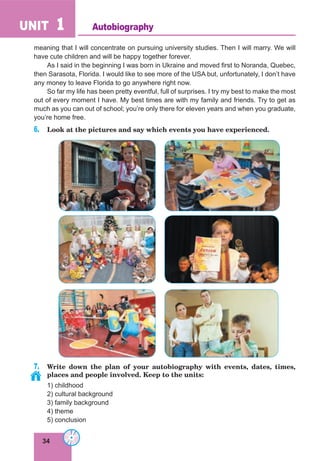
6. Look at the pictures and say which events you have experienced.
7. Write down the plan of your autobiography with events, dates, times,
places and people involved. Keep to the units:
1) childhood
2) cultural background
3) family background
4) theme
5) conclusion
Autobiography
35
Lesson 16
Lesson 16
Autobiography
1. Work in pairs. Ask and answer the questions using the given words.
Model: A: Why are you hungry? Because you are very busy, aren’t you?
B: Right. I am very busy and I haven’t eaten all day.
1. why/be/hungry? not/eat/all day
2. why/be/upset? just fail/driving test
3. why look happy? just book a holiday
4. why look worried? just hear/some bad news
5. why/look/relaxed? listen/classical music
2. Complete the sentences about your childhood.
1. My earliest memories, as a child, were
2. My happiest moments, as a child, were
3. My favourite toy was
4. My most memorable babysitter was
5. My first bike was
6. When I grew up I wanted to be
3. Work in groups of four. Discuss the statements given below.
1. “I wanted to be independent, but I find it’s better to be independent at home.”
2. Some teenagers use the house like a hotel, with all services. They treat parents as
moneybags and then ignore them or just insult them.
3. Well-educated, middle-class young adults are not leaving home. They find it just
easier and cheaper to stay in the family nest.
4. Work in pairs. Talk about your cultural background. Use the information
from your plan (Lesson 8). Consult the Maps 1 and 2 (Lesson 3).
Model: A: Have your parents ever been hard on you?
B: No, I try not to hurt or argue with my parents. I love and respect them.
And you?
A: Oh, I am sometimes bored, sometimes disobedient and rude. So, my father has to
be firm.
B: Are any customs or traditions kept in your family?
A: Yes, I love our family reunions, the day when all relatives from towns, villages and
even foreign countries arrive and we have a great garden party. We grill meat,
cook exotic and tasty dishes, make fire and then play outdoor games. It’s really
fun! And how about your family?
B: You see, my grandgrandfather was a sailor. He lost his life during the World War II.
It’s a ritual for our family to go to the church and then lay flowers at war memorial
on Remembrance Day.
5. Write down your autobiography.
36
UNIT 1
SELF-ASSESSMENT MODULE 1
LEVEL 1
1. Fill in the vowels and write down the words.
Vnt, tbgrph, rcllct, ncld, cstms, ncstr, chldhd.
2. Сorrect mistakes in the sentences.
1. An autobiography is an account of one’s life, isn’t they?
2. Her favourite subject was Mathematics, didn’t it?
3. He brought up in a poor family, doesn’t he?
4. They have ridden bikes, hasn’t they?
3. Write five sentences about your childhood.
LEVEL 2
1. Match the words with their definitions.
1. bring up
2. recollect
3. audience
4. prefer
5. ancestor
6. inspire
a) a group of people who come to watch and listen
to someone speaking or performing in public
b) to look after and influence a child until he or she
is grown up
c) to encourage someone by making them feel
confident and eager to do something
d) to like someone or something more than someone
or something else
e) a member of your family who lived a long time ago
f) to be able to remember something
2. Choose and write down the correct item.
1. The boy learned a good lesson, ?
a) did the boy b) didn’t the boy c) didn’t he
2. He often takes resolutions, ?
a) don’t he b) doesn’t he c) do he
3. You are writing your autobiography, ?
a) isn’t you b) don’t you c) aren’t you
4. She has recollected her childhood, ?
a) doesn’t she b) hasn’t she c) didn’t she
3. Write five questions to ask your classmate about the events that taught
him/her something important.
Autobiography
37
Lesson 16
LEVEL 3
1. Write down as many words and word combinations as you can under each
heading.
autobiography cultural background family background
2. Сomplete the sentences with the question tags.
1. Young adults find it cheaper to live with parents, ?
2. He missed the lively atmosphere, ?
3. They have treated parents as moneybags, ?
4. Young people want to be independent, ?
5. My cousins are still playing those games, ?
3. Write 10 sentences about your cultural background.
4. Translate the English sentences into German/French.
1. I started school when I was 6 years old.
2. We used to play basketball.
3. It’s sometimes useful to recollect your past.
CHECKLIST
Assess your progress in this unit. Tick () the statements which are true.
I can give information on my childhood.
I can give information on my cultural background.
I can give information on my family background.
I can write my autobiography.
I can understand and use Tag Questions (Simple Tenses) in spoken and written
forms.
I can understand and use Tag Questions (Continuous Tenses) in spoken and
written forms.
I can understand and use Tag Questions (Perfect Tenses) in spoken and written
forms.
I can use prepositions of time by, before and after in spoken and written forms.
Self-Assessment Module 1
Lesson 17
At the Theatre
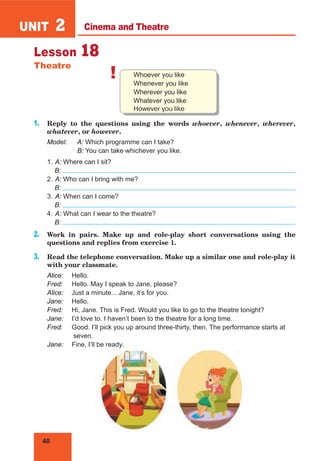
1. Look at the picture and match the numbers
with the words.
a) audience [ˈɔːdɪəns]
b) balcony [ˈbælkənɪ]
c) box [bɒks]
d) box office [bɒks ˈɒfɪs]
e) curtain [ˈkɜːtn]
f) dress-circle [dres ˈsɜːkl]
g) scenery [ˈsiːnərɪ]
h) stage [steɪdʒ]
i) theatre [ˈθɪətə(r)]
j) pit [pɪt]
Unit2
CINEMA
AND THEATRE
1
8 6
5
4
3
2
7
9
10
39
Lesson 17
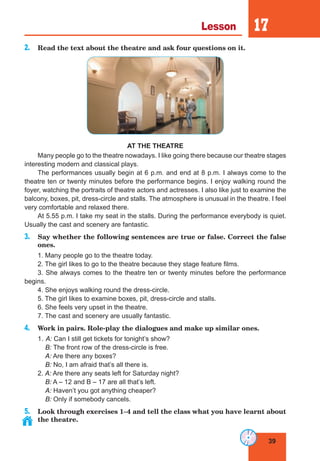
2. Read the text about the theatre and ask four questions on it.
AT THE THEATRE
Many people go to the theatre nowadays. I like going there because our theatre stages
interesting modern and classical plays.
The performances usually begin at 6 p.m. and end at 8 p.m. I always come to the
theatre ten or twenty minutes before the performance begins. I enjoy walking round the
foyer, watching the portraits of theatre actors and actresses. I also like just to examine the
balcony, boxes, pit, dress-circle and stalls. The atmosphere is unusual in the theatre. I feel
very comfortable and relaxed there.
At 5.55 p.m. I take my seat in the stalls. During the performance everybody is quiet.
Usually the cast and scenery are fantastic.
3. Say whether the following sentences are true or false. Correct the false
ones.
1. Many people go to the theatre today.
2. The girl likes to go to the theatre because they stage feature films.
3. She always comes to the theatre ten or twenty minutes before the performance
begins.
4. She enjoys walking round the dress-circle.
5. The girl likes to examine boxes, pit, dress-circle and stalls.
6. She feels very upset in the theatre.
7. The cast and scenery are usually fantastic.
4. Work in pairs. Role-play the dialogues and make up similar ones.
1. A: Can I still get tickets for tonight’s show?
B: The front row of the dress-circle is free.
A: Are there any boxes?
B: No, I am afraid that’s all there is.
2. A: Are there any seats left for Saturday night?
B: A – 12 and B – 17 are all that’s left.
A: Haven’t you got anything cheaper?
B: Only if somebody cancels.
5. Look through exercises 1–4 and tell the class what you have learnt about
the theatre.
40
UNIT 2
Lesson 18
Theatre
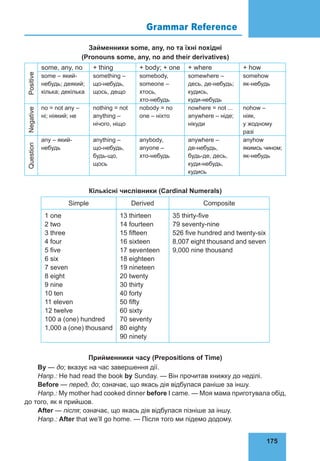
! Whoever you like
Whenever you like
Wherever you like
Whatever you like
However you like
1. Reply to the questions using the words whoever, whenever, wherever,
whatever, or however.
Model: A: Which programme can I take?
B: You can take whichever you like.
1. A: Where can I sit?
B:
2. A: Who can I bring with me?
B:
3. A: When can I come?
B:
4. A: What can I wear to the theatre?
B:
2. Work in pairs. Make up and role-play short conversations using the
questions and replies from exercise 1.
3. Read the telephone conversation. Make up a similar one and role-play it
with your classmate.
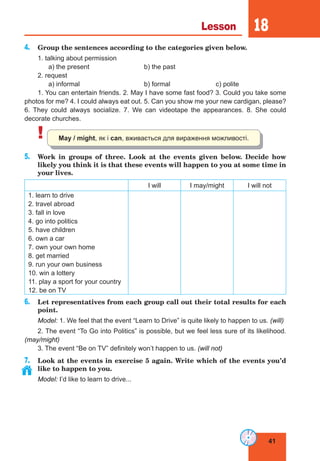
Alice: Hello.
Fred: Hello. May I speak to Jane, please?
Alice: Just a minute... Jane, it’s for you.
Jane: Hello.
Fred: Hi, Jane. This is Fred. Would you like to go to the theatre tonight?
Jane: I’d love to. I haven’t been to the theatre for a long time.
Fred: Good. I’ll pick you up around three-thirty, then. The performance starts at
seven.
Jane: Fine, I’ll be ready.
Cinema and Theatre
41
Lesson 18
4. Group the sentences according to the categories given below.
1. talking about permission
a) the present b) the past
2. request
a) informal b) formal c) polite
1. You can entertain friends. 2. May I have some fast food? 3. Could you take some
photos for me? 4. I could always eat out. 5. Can you show me your new cardigan, please?
6. They could always socialize. 7. We can videotape the appearances. 8. She could
decorate churches.
! May / might, як і can, вживається для вираження можливості.
5. Work in groups of three. Look at the events given below. Decide how
likely you think it is that these events will happen to you at some time in
your lives.
I will I may/might I will not
1. learn to drive
2. travel abroad
3. fall in love
4. go into politics
5. have children
6. own a car
7. own your own home
8. get married
9. run your own business
10. win a lottery
11. play a sport for your country
12. be on TV
6. Let representatives from each group call out their total results for each
point.
Model: 1. We feel that the event “Learn to Drive” is quite likely to happen to us. (will)
2. The event “To Go into Politics” is possible, but we feel less sure of its likelihood.
(may/might)
3. The event “Be on TV” definitely won’t happen to us. (will not)
7. Look at the events in exercise 5 again. Write which of the events you’d
like to happen to you.
Model: I’d like to learn to drive...
42
UNIT 2
Lesson 19
Choosing a Performance
1. Match the words with their definitions.
1. billboard a) seats in the part of a theatre nearest to the stage
2. box office b) a place where hats and coats may be left
3. the stalls c) programme
4. the gallery d) a placard, notice, giving information about a play
5. cloak-room e) the highest balcony where the cheapest seats are placed
6. cast f) the main role
7. play-bill g) an office for booking seats in a theatre
8. the leading role h) a set of actors in a play
2. Read the text and answer the questions after it.
If you want to go to a theatre you must first look through the billboard to find out what is
on. Some people don’t like to have seats far from the stage. They get tickets for the stalls.
If you have little money you take seats on the gallery. When you come to any theatre you
leave your coat in the cloak-room.
If you want to know the cast you buy a play-bill. You look through it to find out who
plays the leading role in the performance you are going to see. After this you take your
seat and wait for the lights to go down. Soon the lights go down, the curtain goes up and
the play begins.
1. How can you find out what is on?
2. Do you like to have seats far from the stage or near it? Which tickets are the
cheapest ones?
3. What is the cloak-room for?
4. What do you do if you want to know the cast?
5. How do you know that the play begins?
3. Practise saying the names.
“Madam Butterfly”
“The Sleeping Beauty”
“Swan Lake”
“Cinderella”
“Romeo and Juliet”
[ˈmædəm ˈbʌtəflaɪ]
[ðə sliːpɪŋ ˈbjuːtɪ]
[swɒn leɪk]
[ˌsɪndəˈrelə]
[ˈrəʊmɪəʊ ənd ˈdʒulɪət]
Cinema and Theatre
43
Lesson 19
4. Work in pairs. Make up and role-play the dialogue(s). Use the sentences
given below.
1. Where would you like to go?
2. What about going to ?
3. Do you know what is on today?
4. Let’s go over to the billboard and see what’s on.
5. Who is it by?
6. Is it worth seeing?
7. How long will it take us to get there?
8. How will we get there?
9. Let’s go.
! Should, ought to
виражають моральний обов’язок, пораду, рекомендацію.
5. Read the sentences. Pay attention to the translation.
You ought to go there. Тобі слід піти туди.
You should visit her. Тобі слід/варто відвідати її.
You oughtn’t to go there. Тобі не слід/не варто йти туди.
You shouldn’t visit her. Тобі не слід/не варто відвідувати її.
6. Choose the word that best completes each sentence.
1. Neighbours to help each other.
a) ought b) should c) could
2. You really be more careful.
a) ought b) should c) have
3. You are 18! You to be able to look after yourself.
a) ought b) have c) should
4. He focus more on his family.
a) ought b) have c) should
7. Write about the performance you’ve seen recently. Use the key sentences
given below.
1. The play by is exciting (boring).
2. It was so dull to watch this play that I felt like walking out.
3. I could not help crying (laughing).
4. The acting was first-rate.
5. The play deals with (e.g. the events of our time).
6. It was an evening/matinée performance.
7. The house was full/half empty.
8. The house burst into applause.
9. The performance was a great success with the public.
44
UNIT 2
Lesson 20
Visit to the Theatre
1. Work in pairs. Ask your classmate all possible questions about the
performance he/she liked best.
2. Read the joke and tell it to your class.
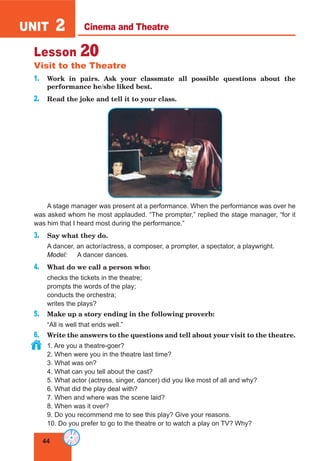
A stage manager was present at a performance. When the performance was over he
was asked whom he most applauded. “The prompter,ˮ replied the stage manager, “for it
was him that I heard most during the performance.”
3. Say what they do.
A dancer, an actor/actress, a composer, a prompter, a spectator, a playwright.
Model: A dancer dances.
4. What do we call a person who:
checks the tickets in the theatre;
prompts the words of the play;
conducts the orchestra;
writes the plays?
5. Make up a story ending in the following proverb:
“All is well that ends well.”
6. Write the answers to the questions and tell about your visit to the theatre.
1. Are you a theatre-goer?
2. When were you in the theatre last time?
3. What was on?
4. What can you tell about the cast?
5. What actor (actress, singer, dancer) did you like most of all and why?
6. What did the play deal with?
7. When and where was the scene laid?
8. When was it over?
9. Do you recommend me to see this play? Give your reasons.
10. Do you prefer to go to the theatre or to watch a play on TV? Why?
Cinema and Theatre
45
Lesson 21
Lesson 21
Cinema
1. Listen, read and remember the words and word combinations.
feature film
horror film
thriller film
popular science film
travelogue
mystery
documentary
animated cartoon
dubbed film
three-dimensional film
science fiction film
adventure film
comedy film
[ˈfiːtʃə(r) fɪlm]
[ˈhɒrə(r) fɪlm]
[ˈθrɪlə(r) fɪlm]
[ˈpɒpjələ(r) ˈsaɪəns fɪlm]
[ˈtrævəlɒɡ]
[ˈmɪstrɪ]
[ˌdɒkjuˈmentrɪ]
[ˈænɪmeɪtɪd kɑːˈtuːn]
[dʌbd fɪlm]
[θriː-daɪˈmenʃənl fɪlm]
[ˈsaɪəns ˈfɪkʃn fɪlm]
[ədˈventʃə(r) fɪlm]
[ˈkɒmədɪ fɪlm]
2. Sort out the films above according to the following categories. Explain
your choice.
1. leave/make a deep impression upon/on you
2. leave/make a lasting impression upon/on you
3. create a true-to-life image
4. deal with science
5. arouse a feeling of fear and anxiety
Model: I like three dimensional films because they arouse a fascinating feeling as
if what you see on the screen is happening to you.
3. Work in pairs. Role-play short conversations. Use information from
exercise 2 and phrases below:
Model: A: What do you think of horror films?
B: I absolutely hate them. They arouse a feeling of fear and anxiety.
Asking for Personal Views:
What do you think of...?
What’s your opinion of...?
How do you feel about...?
How do you like...?
Expressing Likes:
I really like/love...
I’m really very fond of/interested in...
I find ... really interesting/fascinating/exciting.
46
UNIT 2
Expressing Dislikes:
I (absolutely) hate/can’t stand...
I’m not (very) interested in...
I don’t fancy...
I find ... rather boring/dull/etc.
Expressing Indifference:
It doesn’t bother me either way.
It doesn’t concern me.
I don’t care.
It’s OK/all right I suppose.
I don’t have an opinion on it.
Explaining what you like about something:
What I like most is...
I really like the way...
Explaining what you don’t like about something:
What bothers/annoys me the most is...
4. Complete the sentences below with should or ought.
1. That hat doesn’t suit you: you buy another one.
2. She told her children that they always say “Please” and “Thank you”.
3. He looks tired. He not to work so hard.
4. My grandfather is nearly seventy years old. He is still working, but he
to retire.
5. There are too many accidents. Everyone be more careful.
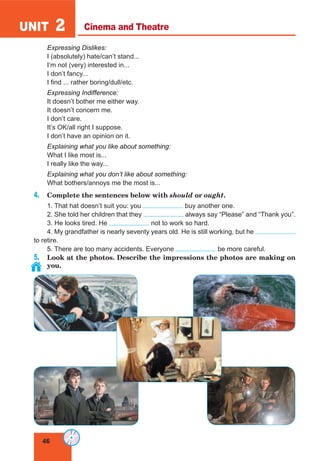
5. Look at the photos. Describe the impressions the photos are making on
you.
Cinema and Theatre
47
Lesson 22
Lesson 22
Favourite Film
1. Read the text.
HOLLYWOOD
Hollywood in California in America is the film centre of the world. You can visit the film
studios there, and see the houses of famous film stars.
In Hollywood in 1900s the first films were exciting adventures and love stories. The
most popular films that directors make nowadays are cartoons and science fiction films.
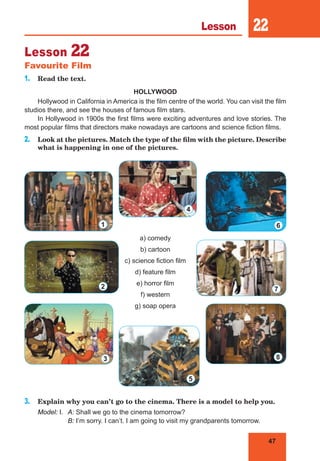
2. Look at the pictures. Match the type of the film with the picture. Describe
what is happening in one of the pictures.
a) comedy
b) cartoon
c) science fiction film
d) feature film
e) horror film
f) western
g) soap opera
3. Explain why you can’t go to the cinema. There is a model to help you.
Model: I. A: Shall we go to the cinema tomorrow?
B: I’m sorry. I can’t. I am going to visit my grandparents tomorrow.
1
2
6
4
5
3
7
8
48
UNIT 2
4. Read the text.
MY FAVOURITE FILM
I like to go to the cinema. When I have time I always go to see some new films. There
is a cinema not far from my house and I often go there with my friends. I prefer feature
films and amusing comedies. I also like true-to-life films describing the life of ordinary
people, their feelings and problems. As a rule, such films leave a deep impression on
me. My favourite film, which I have seen lately, is “Titanic”. It is an American film that was
produced and directed by a famous director James Cameron. This film tells us about the
real tragedy of the British passenger liner “Titanic”. It was supposed to be unsinkable but
it struck in an iceberg and sank off on its first voyage in 1912. There were many victims —
1513 lives were lost. While watching the film I was mostly impressed by special effects.
A young American actor Leonardo DiCaprio and an English actress Kate Winslet played
the leading parts. This film achieved a world-wide fame. It won 11 Oscars in 1998, the
highest annual motion picture awards of the Academy of Motion Picture Arts of the USA for
the best picture, best director, best cinematography, best screenplay, best scenery, best
costumes, best sound and best music. This film was very popular with cinema-goers and
I like it a lot.
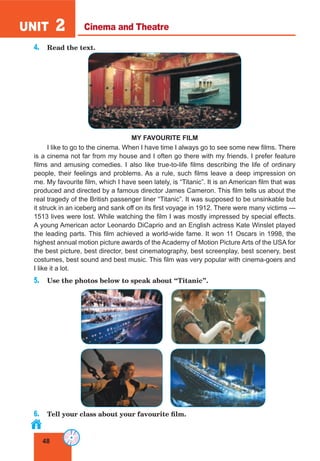
5. Use the photos below to speak about “Titanic”.
6. Tell your class about your favourite film.
Cinema and Theatre
49
Lesson 23
Lesson 23
Film Review
1. Read the film reviews.
1. “Crocodile” Dundee”
Paul Hogan’s hilarious, endearing performance made “Crocodile” Dundee” the biggest
box office comedy smash of 1986! “Crocodile” Dundee is a free spirited Australian who
hunts crocodiles with his bare hands, stares down giant water buffaloes. But he’s about to
face the ultimate torture test — a trip to New York City.
2. “Henna”
A young man is ready for his wedding when a storm sweeps him away to sea and he
wakes up in the care of a young girl. He finds that he doesn’t remember his past life. He
falls in love with the girl but a storm on their wedding brings back his memory. He is sure
that he must go back home. This film leaves deep and lasting impression. A young man
attracts our sympathy because he is honest and reliable. It is worth seeing.
2. Which of the adjectives below characterize “Crocodile” Dundee, a young
man and girl from “Henna”.
Greedy, conceited, cheerful, generous, optimistic, reserved, sensitive, reliable,
honest, lazy, brave, friendly.
3. Read the dialogues and role-play them with your partner.
1. A: Have you seen “Crocodile” Dundee”?
B: No, what is it about?
A: It’s about a free-spirited Australian who hunts crocodiles with his bare hands.
B: You think this film is worth seeing, don’t you?
A: I do. It’ll give you laugh, relaxation and enjoyment.
2. A: Yesterday, I saw “Henna”. It’s an interesting and exciting film.
B: Oh, come on. It’s very naive and not true-to-life. I don’t think such films are worth
seeing.
A: Just the other way round. Thank to such films we may understand the nature of
people’s relations and see the false and true values.
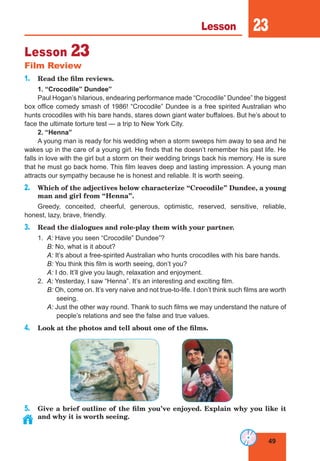
4. Look at the photos and tell about one of the films.
5. Give a brief outline of the film you’ve enjoyed. Explain why you like it
and why it is worth seeing.
50
UNIT 2 Cinema and Theatre
Lesson 24
Cartoons
1. Do you like watching cartoons? Read about a man who created them.
VOLODYMYR TYTLA: MASTER ANIMATOR
For more than 70 years, such animated cartoons as “Snow White and the Seven
Dwarfs” (1937), “Pinocchio” (1940), “Fantasia” (1940) and “Dumbo” (1941) are big hits all
over the world.
The above cartoons were animated by Volodymyr Tytla, one of the greatest animator. His
characters come alive as individuals who can think, solve problems and express emotions.
They have souls. V. Tytla had a unique ability to transfer human feelings into drawings.
Volodymyr was born on October 25, 1904 in Yonkers, New York. His father Peter was
born in Pidhajce, Ternopil region, Ukraine.
V. Tytla learned his craft in the silent film era in New York City in the 1920s at art
schools in the USA and abroad. He had the talent to develop such art form as animated
cartoon at the Disney Studio.
In 1943 he left Disney and worked for other studios. Through the 1950s and 60s he
directed televisions commercials.
2. Complete the sentences using the information from the text (exercise 1).
1. and were animated by V. Tytla.
2. His characters can , and .
3. V. Tytla learned his craft in in the 1920s.
3. Say which of the cartoons animated by Volodymyr Tytla you like most.
Why?
4. Many artists use cartoon forms to express how they feel about the world.
Look at the forms and decide how you think each artist feels. Happy?
Sad? Angry? Lonely? Upset?
5. Write and then tell about your favourite cartoon(s) from your childhood.
Mention:
• what your favourite cartoon was about; • what feelings it evoked;
• why it was your favourite cartoon; • what it taught you.
• its main characters;
51
Lesson 25
Lesson 25
Role of Cinema and Theatre
1. Work in pairs. Make up and role-play the dialogues. Use phrases given
below.
1. Let’s go to the cinema.
2. What’s on at the cinema?
3. Two tickets for 7 p.m. show, please.
4. This film was the season’s hit.
5. This film is a great success.
6. How did you like the film?
7. Who produced the film?
8. Who stars in the film?
2. Work in small groups. Discuss the following statements.
1. Violence should not be shown on the screen.
2. The success of a film depends on the film director.
3. Cinema and theatre are just entertainment.
4. Films and performances develop people’s cultural level and taste.
3. Make up and write down a story ending in the following proverb:
“A friend in need is a friend indeed.”
4. Read the following dialogue. Pay attention to the use of can and may.
A nephew: Can I smoke in your living room, Aunt?
An aunt: You can, Charles, but you may not.
5. Complete the sentences below with can/could or may/might.
1. I come in? — Please, do. 2. I remember the address. —
you even remember the street? 3. He answer the teacher’s
questions yesterday, but he not answer the same questions today. 4. When
I first went to Spain I read Spanish but I speak it. 5. He said
that we use his flat whenever we liked. 6. I borrow your
umbrella? 7. I smoke here? — No, you not.
6. Agree or disagree with the following statement. Give your reasons. Write
approximately 10 sentences.
People nowadays prefer going to the cinema to going to the theatre.
52
UNIT 2
SELF-ASSESSMENT MODULE 2
LEVEL 1
1. Find and write down 7 words on the topic “Cinema and Theatre”.
curtainboxdresscircleperformanceadventurehorrorscience
2. Choose the correct item.
1. I to see that performance.
a) can b) should c) ought
2. When I was a child, I go to the cinema myself.
a) can b) could c) may
3. During the performance you be quiet.
a) can b) should c) ought
4. His characters solve problems.
a) can b) might c) ought
3. Write five sentences about your visit to the cinema or theatre.
LEVEL 2
1. Choose the odd-word-out.
1. curtain, stage, scenery, film
2. box, award, pit, dress-circle
3. audience, actor, playwright, prompter
2. Choose the correct item.
1. You see this film. It’s worth seeing.
a) may b) can c) should
2. We be late for the performance. There’s a traffic jam on the road.
a) should b) can c) ought to
3. If you don’t have much money, you get tickets for the gallery.
a) might b) can c) could
4. I think first we look through the billboard to find out what is on.
a) might b) can c) should
3. Make up and write down a dialogue discussing your favourite film or
performance.
53
Lesson 25
LEVEL 3
1. Write down as many words and word combinations as you can under each
heading.
performance film animated cartoon
2. Make up and write down three sentences using can/could, may/might, or
should/ought to.
3. Write ten sentences about different types of films.
CHECKLIST
Assess your progress in this unit. Tick () the statements which are true.
I can use basic vocabulary to talk about cinema and theatre.
I know different types of films and can describe impressions they make on me.
I can write a film review.
I can give a brief outline of a film.
I can tell about my favourite film/performance.
I can ask for personal views, express likes/dislikes, indifference.
I can give my own opinion about the role of cinema and theatre.
I can understand and use modal verbs can/could.
I can understand and use modal verbs may/might.
I can understand and use modal verbs should/ought to.
Self-Assessment Module 2
Unit3
LITERATURE
Lesson 26
Types of Writing
1. Work in pairs. Ask and answer the questions.
1. When did you learn to read?
2. What are your favourite books?
3. Who is your favourite author?
4. What books of this author have you read?
5. Why do you like his/her works?
6. Who are your favourite poets?
2. Listen, read and remember the words and
word combinations.
impressive
be worth doing something
excite sympathy
beauty and goodness
trouble
enrich
value
be a big hit
become a national hit
review
magazine
article
science fiction
thriller
cartoon strip
[ɪmˈpresɪv]
[bɪ wɜːθ ˈduːɪŋ ˈsʌmθɪŋ]
[ɪkˈsaɪt ˈsɪmpəθi]
[ˈbjuːtɪ ənd ˈɡʊdnəs]
[ˈtrʌbl]
[ɪnˈrɪtʃ]
[ˈvæljuː]
[bɪ ə bɪɡ hɪt]
[bɪˈkʌm ə ˈnæʃnəl hɪt]
[rɪˈvjuː]
[ˌmæɡəˈziːn]
[ˈɑːtɪkl]
[ˈsaɪəns ˈfɪkʃn]
[ˈθrɪlə(r)]
[kɑːˈtuːn strɪp]
55
Lesson 26
3. Match various types of writing with their definitions. Give examples of
literary works of any of five types of writing.
1. comedy a) a story told in pictures and dialogues
2. science fiction b) information about something in a newspaper
3. thriller c) non-fiction record of events as they happened
4. cartoon strip d) educational book
5. romance e) funny story
6. chronicle f) exciting suspense story
7. biography g) love story
8. autobiography h) story about space or the future
9. article i) the author’s account of his own life
10. textbook j) account of someone’s life written by someone else
4. Make up sentences using the table.
Comedies
Science fiction
Thrillers
Cartoon strips
Romances
Chronicles
Autobiography
Articles
is/are (not) worth reading.
5. Say what types of writing are exciting, amusing, amazing, boring,
impressive, sentimental, dull, entertaining, gripping.
6. Work in pairs. Say as in the model.
Model: A: Why don’t you listen to the radio?
B: There’s nothing worth listening there.
A: ... watch TV? A: ... buy a magazine?
B: ... B: ...
A: ... read a newspaper? A: ... see a film?
B: ... B: ...
7. Look at the pictures and describe them. Use the words from exercises 2,
3 and 5.
Model: It’s an exciting cartoon strip. It gives me relaxation and enjoyment.
56
UNIT 3 Literature
Lesson 27
Favourite Book
1. Read the clues and put the letters in order to form the words. Make up
sentences with these words.
1. The people in a country or an area, thought of as a group, who
have shared customs and laws.
tysocie
2. Places of interest that are often visited by tourists. htssig
3. Visiting the sights of a city, etc. as a tourist. seeingghsit
4. A person or thing that is very popular or successful. iht
5. The importance of something. lueva
6. To make the sounds that show you are happy or amused. laguh
7. Something that you do in order to rest. tionxalare
8. Pleasure or a thing which gives pleasure. oyenjentm
2. Listen, read and remember the words and word combinations.
romance
novel
non-fiction books
good and evil
spiritual life
thanks to
[rəʊˈmæns]
[ˈnɒvl]
[nɒn ˈfɪkʃn bʊks]
[ɡʊd ənd ˈiːvl]
[ˈspɪrɪtʃuəl laɪf]
[θæŋks tə]
3. Find the odd-word-out in each line.
1. impressive, exciting, amazing, mood, dull
2. review, channel, modern, magazine, newspaper
3. sympathy, enrich, mood, spirits, trouble
4. exciting, good, evil, beauty, goodness
4. Work in pairs. Look at the pictures. By asking questions, learn about the
work as much as possible.
57
Lesson 27
Model: 1. What literary work is it?
2. Who is the author?
3. What do you know about the writer?
4. What is it about?
5. Who are the main characters?
6. Is it worth reading? Why/Why not?
5. Read about Ann’s hobby.
MY HOBBY
When I have spare time, I like to read books. I like amazing science fiction books and
amusing comedies. Sometimes I read true-to-life stories. They show the life of ordinary
people, their feelings and problems. As a rule, these books leave a deep impression on me.
My favourite book is “Gone with the Wind” by Margaret Mitchell.
Margaret Mitchell was born in Atlanta, Georgia, the daughter of an attorney who was
the president of the Atlanta Historical Society. All the family were interested in American
history and she grew up in an atmosphere of stories about the Civil War. In 1925 she
married John Marsh and in the following ten years she put on paper all the stories she
had heard about the Civil War. The result was “Gone with the Wind”, first published in
1936. This book describes the life of the American people during the Civil War: how
they survived being hungry, exhausted, helpless and disappointed; how they struggled
for each day; how they loved and supported each other or betrayed. This book is really
worth reading. It’s breathtaking, gigantic, incredible, unbelievable, fascinating! It won the
Pulitzer Prize, sold over ten million copies, was translated into eighteen languages and
was later made into a highly successful film. This book, a record bestseller, was her only
published work.
6. Complete the sentences with the information from the text.
1. True-to-life books leave a ... 2. I like to read ... 3. My favourite story and film ... 4. It
sold out over ... 5. It was translated into ... 6. “Gone with the Wind” shows the life ...
7. Say whether the following statements are true or false. Correct the false
ones.
1. “Gone with the Wind” won 3 Oscars.
2. This book tells about the real tragedy of the American people during the Civil War.
3. “Gone with the Wind” was the second bestseller of M. Mitchell.
4. The girl’s favourite book is “Gone with the Wind”.
5. The girl likes cartoon strips and thrillers.
6. “Titanic” was produced by Jane Cameron.
7. True-to-life books show the beauty and goodness, good and evil.
8. Amusing cartoon strips show the life of ordinary people, their feelings and problems.
9. Romances leave a deep impression on the girl.
8. Tell about Ann’s hobby.
58
UNIT 3 Literature
Lesson 28
Book Review
1. Make up short dialogues and role-play them with your classmate. The
chart below will help you.
Comedies
Science fiction
Thrillers
Cartoon strips
Romances
Chronicles
Biography
Autobiography
Articles
Adventure stories
Ghost stories
I love them.
I like it.
They are shocking.
I am really interested in them.
They are great.
Absolutely exciting.
Absolutely fantastic.
I think they are amazing.
I can’t stand them.
I don’t like it.
Absolutely scary.
I am not really interested in them.
They are boring.
Absolutely disgusting.
I don’t think much of it.
I find them boring.
Model: A: Do you like biography books?
B: Yes, I do. I think they are amazing. / I can’t stand them. I find them boring.
2. Look at the pictures and answer the questions.
59
Lesson 28
1. Which books do these pictures come from?
2. What kind of books are they?
3. Do you recognize any of the characters? Who are they?
4. What good or evil things do they do?
5. What is your favourite type of writing? Why?
3. Read the books reviews.
“A MAN ON THE MOON” BY ANDREW CHAIKIN
This fascinating book contains of most thorough
examination of man’s greatest adventure yet — the 1969
Apollo trip to the moon. Chaikin spent years interviewing every
surviving astronaut and many other important people who were
in the twelve-year programme to put a man on the moon. This
book is a combination of biography and adventure. The life of
each astronaut is followed from childhood to the surface of the
moon and beyond. The author has attempted to discover how
the experience of visiting another world has changed them. As
gripping as this book is, it lacks the analysis of what the Apollo
mission was for. As a story of human achievement, though, it
succeeds brilliantly.
“RARE BREEDS” BY LAWRENCE ALDERSON
This beautifully illustrated book details the history of
domesticated breeds of animals. When completely wild animals
roamed the earth, people began the process of selecting animals
that they needed. Some were for food while others (such as
sheep and cattle) also provided clothes and shoes. As society
developed and people began moving between continents such
as Europe and Asia, new breeds and animals evolved. At the
beginning of the 20th century there were 230 breeds of cattle
in western Europe alone. But by 1988, only thirty breeds of
cattle were left in large numbers, seventy were extinct and the
rest greatly reduced. This book celebrates the survivors with
photographs of them. Now all of us can enjoy these beautiful
animals.
4. Look at the pictures in exercise 3 and describe them.
5. In small groups, discuss which of the books described in exercise 3 you
would like to read. Why?
6. Give a brief outline of the story/book you’ve enjoyed reading. Explain
why you like it and why it is worth reading.
60
UNIT 3 Literature
Lesson 29
Role of Books
1. Listen, read and remember the words.
inspiration
wisdom
refresh
instruction
[ˌɪnspɪreɪʃn]
[ˈwɪzdəm]
[rɪˈfreʃ]
[ɪnˈstrʌkʃn]
2. Listen to the dialogue. Make up a similar one. Role-play it with your
classmate.
Tony: I have a fantastic home assignment. Unfortunately, I haven’t done it yet
because I need some books. Can you borrow those books from your school
library for me?
Peter: Yes, sure. Our library provides books for class research and individual study.
Tony: How long have you been a member of it?
Peter: I’ve joined the library this year.
3. Read what students think about reading books. Say which point(s) you
share. Give your reasons.
Natalia Nikolaieva
Books became the most integral part of our life. They give us inspiration, enrich us
spiritually, they accumulate the wisdom of the whole race. Books are like clear streams
which refresh our thoughts. Just open a book and you will comprehend the wise strength
of the word — the strength which unites people, their minds and emotions, makes a man
61
Lesson 29
and nature a harmonious unity. Some of them are full of adventures and help us relax,
others touch upon important social problems and are very instructive.
Yet not every book can give us this pleasure and make on us a lasting impression.
So, we must be very selective in choosing books. We must choose books so properly as
we choose our friends.
Natalia Stetsko
Books make up a significant and necessary part of our life. Some people like to read
for pleasure, some — for instruction, some read from a habit. For me, reading a book
is just a drug I cannot live without. Reading books I can travel to different countries and
places, make acquaintances with interesting people, take part in different adventures.
Reading books I can climb the mountains or swim in the ocean, fly in the sky or make my
way through the impassable jungle, be thirsty in the desert or suffer from cold among the
snow of the North Pole.
Without books our souls are poor, our life is primitive, and the world in which we live
is brightless and joyless.
You can change your life just now! Try to become good friends with books and you’ll
see that life is beautiful!
4. Read the statements. Say which literary work influenced you that way.
1. It gave you inspiration.
2. It enriched you spiritually.
3. It accumulates the wisdom of the race.
4. It refreshed your thoughts.
5. It made a man and nature a harmonious unity.
6. It is full of adventures.
7. It helped you relax.
8. It touches upon important social problems.
9. It is very instructive.
10. You learned about different countries and places.
11. You learned about interesting/famous people.
5. Work in groups of 4–5. Agree or disagree. Use examples to support your
opinion.
“Tell me what you read, and I will tell you what you are.” J.W. Goette
“What is the use of a book”, thought Alice, “without pictures and conversations?”
Lewis Carrol
“No furniture is so charming as books, even if you never open them and read a single
word.” Syndey Smith
6. Write and then tell about the role of books in your life.
62
UNIT 3 Literature
Lesson 30
William Shakespeare
1. Practise saying the words and word combination.
Shakespeare [ʃeɪk'spɪər]
genius [ˈdʒiːnɪəs]
Stratford-on-Avon ['strætfəd ɒn eɪv(ə)n]
Romeo and Juliet [ˈrəʊmɪəʊ ənd ˈdʒulɪət]
Hamlet [ˈhæmlət]
2. Read about an English writer William Shakespeare. Ask three questions
on the text.
WILLIAM SHAKESPEARE
(1564–1616)
William Shakespeare was born in the heart of England in Stratford-on-Avon in 1564.
Shakespeare’s parents were plain country people.
At twenty-eight Shakespeare was well-known in London as an actor. A few years later,
his genius found its most important expression as an original dramatist. Many of his plays
were staged at a London Theatre called “The Globe”.
William Shakespeare is known as a writer of comedies and historical dramas. His
comedies “A Midsummer Night’s Dream” and “Comedy of Errors” — are light and bright.
The tragedies “Othello”, “Romeo and Juliet” and “Hamlet” are profound. His plays,
translated into many languages, are performed on the stages of the best theatres in the
world.
William Shakespeare died at the age of fifty-two in 1616. He was buried in Stratford
Church.
3. Work in pairs. Ask and answer your questions about William Shakespeare.
63
Lesson 30
4. Read one of the William Shakespeare’s sonnets. Tell what you think the
writer conveys in this sonnet.
* * *
Unthrifty loveliness, why dost thou spend
Upon thyself thy beauty’s legacy?
Nature’s bequest gives nothing, but doth lend;
And, being frank, she lands to those are free.
Then, beauteous niggard, why dost thou use
So great a sum of sums, yet canst not live?
For having traffic with thyself alone,
Thou of thyself thy sweet self dost deceive.
Then how, when nature calls thee to be gone,
What acceptable audit canst thou leave?
Thy unused beauty must be tomb’d with thee,
Which, used, lives th’ executor to be.
* * *
О, красеню недбалий, силу чар
Ти маєш не за власним побажанням.
Це — спадщина природи, вільний дар
Для тимчасового користування.
Цю спадщину не стискуй у руках,
Її ж бо вік не можна зберігати,
Ти ходиш у природи в боржниках:
Красу потрібно людям дарувати.
Не будь жаднюгою, як багатій,
Що тільки скриню власну обіймає,
І гроші позичає сам собі,
А врешті-решт нічого він не має.
Краса для себе — зникне без остатку,
А віддана — дарується нащадкам.
Переклав Георгій Пилипенко
5. Work in pairs. Take turns to ask and answer the questions.
1. What sonnets or plays written by William Shakespeare have you read?
2. Have you read them in English or Ukrainian?
3. What are they about?
6. Write some interesting facts from William Shakespeare’s life.
64
UNIT 3 Literature
Lesson 31
Jack London
1. Read about an American writer Jack London.
JACK LONDON
(1876–1916)
The famous American novelist Jack London (pen-name of John Griffith) came from
an extremely poor family.
Even during his school years he had to support himself by selling newspapers and
doing other small jobs. Then he became a sailor and later a gold-miner. Some of the
difficulties he met during the first years of his literary work are described in “Martin Eden”.
During the sixteen years of his literary career, London published about fifty books,
short stories, novels and other works.
2. Look at the pictures. Which of them show Jack London’s life. Describe
these pictures.
3. Read the title from “Martin Eden” by Jack London. What do you expect
to read about? Read the extract.
MARTIN EDEN STUDIES
(From “Martin Eden”. Abridged)
...One day, because the days were so short, he decided to give up algebra and
geometry. Trigonometry he had not even attempted. Then he cut chemistry from his study
list, remaining only physics.
65
Lesson 31
“I am not a specialist,” he said in defence to Ruth. “Nor am I going to try to be
a specialist. There are too many special fields for any one man, in a whole lifetime, to
master them. I must pursue general knowledge. When I need the work of specialists,
I shall refer to their books.”
“But that is not like having the knowledge yourself,” she protested.
“But it is unnecessary to have it. We profit from the work of the specialists. That’s what
they are for. When I came in, I noticed the chimney-sweeper at work. They’re specialists,
and when they get done, you will enjoy clean chimneys without knowing anything about
the construction of chimneys.”
“That’s far fetched, I am afraid.”
She looked at him curiously, and he felt a reproach in her gaze and manner. But he
was convinced of the Tightness of his position...
4. Answer the questions.
1. Were your predictions correct?
2. What is the main idea of the extract?
3. Who are the main characters?
4. Do you agree with Martin Eden that it is useless to study all subjects at school?
Give your reasons.
! Negative Pronouns
No nobody / no one nothing
ні / не / жоден ніщо, нічого ніхто, нікого
5. Work in pairs. Take turns to answer the questions, using no or its
derivatives.
Model: Did you find anybody in your room when you return from school today?
No, I found nobody there.
1. Can any of your friends speak Italian?
2. Is there anything on the floor now?
3. Has anybody invited you to his birthday party in the last two weeks?
4. Did you see any of your relatives yesterday?
5. Do you know anything about space?
6. Do you have many friends in France?
7. Has any of your friends won a lottery?
6. Find on the Internet or any other source the additional information
about Jack London and his works. Prepare a brief report about it.
66
UNIT 3 Literature
Lesson 32
Taras Shevchenko
1. Add tags to the sentences given below.
1. This fascinating book has shown Apollo trip to the moon. 2. The author discovers
how visiting another world has changed them. 3. The novel has enriched her spiritually.
4. This thriller has refreshed his thoughts. 5. They have read an instructive book.
2. Tell your class what you already know about Taras Shevchenko.
3. Read about T. Shevchenko.
TARAS SHEVCHENKO
(1814–1861)
Taras Shevchenko was born to a serf family in the village of Kyrylivka. He was a great
poet and a superb artist.
All children like to paint, but with young Taras it was a passion. The boy was taken
into the manor’s house as a kozachok. When he was 14 years old, his master took him
to Vilno (Vilnius). Later Taras found himself in a beautiful city St. Petersburg. He learned
misery there, but he was lucky. The great artist K. Briulov bought out the young serf from
his master. Shevchenko was admitted to the Academy of Arts. Notable paintings include
“In Kyiv”, “Fire in the Steppes” and others.
Taras Shevchenko also wrote poems in Ukrainian. In 1840 he published his first book
of poems “Kobzar”.
4. Work in pairs. Take turns to ask and answer the questions.
1. When and where was Taras Shevchenko born?
2. His family was poor, wasn’t it?
3. What was the boy’s passion?
4. Did the boy have to work hard in manor’s house? Why do you think so?
5. Where did his master take him when he was 14 years old?
6. In which town did he learn misery again?
7. Who bought Taras Shevchenko out?
67
Lesson 32
8. Shevchenko was admitted to the Academy of Arts, wasn’t he?
9. Can you name some of his paintings?
10. What is the title of T. Shevchenko’s first book of poems?
11. When was it published?
5. Complete the conversations and role-play them with your classmate.
1. A: Have you seen any paintings by Taras Shevchenko?
B:
2. A: Have you read any works by Taras Shevchenko?
B:
3. A: Why has everybody read T. Shevchenko’s poems?
B:
4. A: Have you already discussed “Kobzar” by T. Shevchenko in your class?
B:
! Indefinite Pronouns
some
який-небудь; декілька
any
який-небудь
is used
in affirmative sentences
in interrogative and
negative sentences
6. Fill in the blanks with some or any.
1. The little boy has toys.
2. Are there cucumbers and tomatoes in the fridge?
3. There isn’t milk in the fridge.
4. There aren’t books on the table.
5. Have you got relatives in Donetsk?
6. I’ve read novels by Dickens.
7. I’ve seen interesting films.
8. Have you got sisters or brothers?
9. There are windows in the class.
7. Make a library research. Find some interesting information about Taras
Shevchenko and present it to class.
68
UNIT 3 Literature
Lesson 33
Favourite Writer
1. Read and learn the first column of a poem.
MY TESTAMENT
T. Shevchenko
When I am dead, then bury me
In my beloved Ukraine,
My tomb upon a grave mound high
Amid the splendid plain.
So that the fields, the boundless steppes,
The Dnieper’s plunging shore
My eyes could see, my ears could hear
The mighty river roar.
Translated by John Weir
2. Work in pairs. Read and role-play the dialogues with your classmate.
1. A: Where are you hurrying?
B: Haven’t you heard? We are having a party today.
A: I remember! Devoted to T. Shevchenko, right?
B: Right you are. Join me.
A: With pleasure.
2. A: By the way, what facts from Shevchenko’s biography do you know?
B: I know that he was born in a serf family. From the very childhood he learned
misery.
A: Which of his works do you like best of all?
B: “The Mighty Dnieper”.
A: What is this poem about?
B: It’s about Taras’ love to his native country, Ukraine.
A: Is he your favourite poet?
B: Yes.
A: Then, you will enjoy the party.
69
Lesson 33
! Indefinite Pronouns (Derivatives)
some
somebody something
хтось щось
any
anybody anything
хто-небудь що-небудь
one
someone anyone
хто-небудь хто-небудь
3. Complete short conversations with indefinite pronouns.
1. A: has taken my book. Has seen it?
B: No, took it. It’s over there.
2. A: The fire destroyed everything. We couldn’t find afterwards.
B: Right you are. There was left.
3. A: If calls, just take their number and say I’ll call them back as soon
as possible.
B: OK.
4. A: I am looking for who speaks French.
B: I can speak French and German.
A: Great!
5. A: Do you want else?
B: No, thank you.
6. A: I didn’t bring my money with me.
B: Don’t worry, I’ve got .
7. A: Aren’t there other jobs she could do better?
B: Of course, there are.
4. Split into small groups. Take turns to talk about given topics. You are
allowed to pass and miss a turn. The group, which talks about more
topics, will win.
1. three cities you’ve been to in the last year
2. a beautiful place you’ve visited
3. something dangerous you’ve done
4. any new words you’ve learnt today
5. someone interesting you’ve met recently
6. something delicious you’ve eaten this week
7. the most expensive thing you’ve bought
8. something you’ve given up
9. something you’ve dreamt about recently
10. a film you haven’t enjoyed
5. Work in small groups. Discuss:
1) what book by an English, American, or Ukrainian writer you have read,
2) whom it was written by,
3) what it is about,
4) what your impression of the book is,
5) if you want to read another book by the same writer.
6. Make a library research. Write and then tell about your favourite writer/
poet and his works.
70
UNIT 3 Literature
Lesson 34
Library
1. Interview your classmate. The questions below will help you.
1. Do you have a library in your town/village?
2. How many books are there in your school library?
3. Do you go to the district/town library?
4. How often do you go there to take out books?
5. Do you often use the reading room in the library?
6. What do you use it for?
7. What book are you reading these days? What is it about? Who is the author?
2. Listen, read and remember the words and word combinations.
librarian
fiction and non-fiction books
facilities
to select
to provide
research
to deliver
magazines on subscription
issuing and cataloguing system
to involve
annual membership fee
to borrow books from the library
library resources
to appeal to
[laɪˈbreərɪən]
[ˈfɪkʃn ənd nɒn fɪkʃn bʊks]
[fəˈsɪlətɪz]
[tə sɪˈlekt]
[tə prəˈvaɪd]
[rɪˈsɜːtʃ]
[tə dɪˈlɪvə(r)]
[ˌmæɡəˈziːns ɒn səbˈskrɪpʃn]
[ˈɪʃuːɪŋ ənd ˈkætəlɒɡɪŋ ˈsɪstəm]
[tə ɪnˈvɒlv]
[ˈænjuəl ˈmembəʃɪp fiː]
[tə ˈbɒrəʊ bʊks frəm ðə ˈlaɪbrərɪ]
[ˈlaɪbrərɪ rɪˈsɔːsɪz]
[tə əˈpiːl tə]
3. a) Write down how often you do the following:
1. say something in your defence
2. give up something
3. discover something new
4. read fiction and non-fiction books
5. borrow books from libraries
6. pay library membership fee
7. use issuing and cataloguing system in the library
8. discuss in class/with your friend true-to-life books
b) Work in pairs. Exchange your informations. Say what you have in
common with your classmate.
4. Copy out the words and word combinations (from exercise 2) you think
you’ll find in the text of exercise 5. Make up three sentences with them.
once
twice
three times
four times
five times
a
two
three
four
five
day(s)
week(s)
month(s)
year(s)
71
Lesson 34
5. Read about the secondary school library.
OPENED
in September 2016,
the Secondary School Library plays
an important role in the whole community.
Secondary School Students and the Staff are automatically members.
Parents of the whole School are invited to become members.
Opening Times:
Monday to Friday — 8.30 to 18.00.
A librarian is always available to provide help and support.
The library:
1) is stocked with 1600 carefully selected fiction and non-fiction books;
2) supports all levels of the Secondary curriculum;
3) provides areas for whole class research, individual study;
4) has comfortable areas for reading;
5) has daily newspapers delivered (in English and French) along with
a range of magazines on subscription in English, French and German;
6) has a fully automated issuing and cataloguing system;
7) is involved with annual Book Week;
8) invites Parents to join for an annual membership fee of $15.
6. How different/similar is the library in your school? Write 12–14 sentences.
Use phrases given below.
Describing Similarities Describing Differences
• is rather like • is nothing like
• appears similar to • is totally different from
• seems like • varies greatly from
• resembles • has very little in common with
• reminds me of • is quite unlike
• has a lot in common with • bears little resemblance to
• is pretty much the same as • differs dramatically from
• is comparable to
72
UNIT 3 Literature
My Friend
A Book Week
Lesson 35
Book Week. Role of Art in Our Life
1. Read Sam’s letter about a Book Week in his school.
Dear friend,
I’d like to tell you about one eagerly anticipated and successful event which
our students benefit enormously. It’s an annual Book Week.
Our annual Book Week is a school event dedicated to the enjoyment of books
and reading. Authors, performance poets and illustrators are invited to spend several
days with our students, taking part in workshops, presentations and performances,
including an evening performance in our theatre to which parents are also invited.
The principal guest at Book Week 2017 was Tim Bowler. His books have
become favourites of our Key Stage 3 students. Tim read the opening dramatic
passages of his new book “Frozen Fire” with such feeling and intensity that we
were all spellbound. He prepared to take risks, be controversial and deal with
difficult subjects. In this psychological thriller Tim maintains the tension till the
shocking and violent climax. This book will appeal to both boys and girls though it
is probably not suitable for students younger than 13/14.
Besides Tim Bowler, we also invited Adele Geras, and Adisa the rap
performance poet, who proved to be as engaging as in a previous visit to school.
The Wednesday evening show is generally considered to be the best ever.
Write me soon.
Yours,
Sam
2. Work in pairs. Discuss if you have Book Weeks in your school. How
different/similar are events in your and Sam’s school? Use phrases given
below.
Describing Similarities Describing Differences
• is rather like • is nothing like
• appears similar to • is totally different from
• seems like • varies greatly from
• resembles • has very little in common with
• reminds me of • is quite unlike
• has a lot in common with • bears little resemblance to
• is pretty much the same as • differs dramatically from
• is comparable to
73
Lesson 35
3. Listen, read and remember the words and word combinations.
books belong to art
no doubt
powerful forces
amusing circumstances
naive
to enrich spiritual life
spirits
mood
manipulate
triumph
wicked world
[bʊks bɪˈlɒŋ tə ɑːt]
[nəʊ daʊt]
[ˈpaʊəfl fɔːsɪz]
[əˈmjuːzɪŋ ˈsɜːkəmstənsɪz]
[naɪˈiːv]
[tə ɪnˈrɪtʃ ˈspɪrɪtʃuəl laɪf]
[ˈspɪrɪts]
[muːd]
[məˈnɪpjuleɪt]
[ˈtraɪʌmf]
[ˈwɪkɪd wɜːld]
4. Match the pairs of words.
1. true-to-life a) sympathy
2. people’s b) circumstances
3. attract c) world
4. powerful d) doubt
5. triumph e) character
6. no f) of beauty and goodness
7. amusing g) relations
8. wicked h) forces
5. Read about the role of art in our life.
THE ROLE OF ART IN OUR LIFE
Cinema, theatre, painting, music and books belong to art. No doubt they are the most
powerful forces for good and evil in modern life. Amusing circumstances, naive but good
characters excite our sympathy and help us forget all the troubles of everyday life. True-
to-life characters help us to understand the nature of people’s relations. They enrich our
spiritual life, show all the false and true values. Thanks to art we can manipulate our mood.
When we are in a low spirits we can read an amusing comedy and it’ll give us a good
laugh, relaxation and enjoyment. It makes us feel all right.
So art helps us understand this world better, it gives us hope, it makes us believe in
the triumph of beauty and goodness over the wicked world.
6. Work in pairs. Ask and answer the questions.
1. What belongs to art?
2. What are the most powerful forces for good and evil?
3. Is it important to understand the nature of people’s relations? Why?
4. What helps us understand the nature of people’s relations?
5. How do amusing circumstances and naive but good characters influence you?
6. What enriches your spiritual life?
7. Thanks to art we can manipulate our mood. How?
8. Do books, films and TV shows help you understand this world better?
9. Does art give you relaxation and enjoyment?
7. Tell about the role of art in your life.
74
UNIT 3 Literature
SELF-ASSESSMENT MODULE 3
LEVEL 1
1. Complete the sentences with the words from the topic “Literature”.
1. The of “Titanic” is James Cameron.
2. make up a significant part of our life.
3. Books our thoughts.
4. W. Shakespeare in 1564.
5. Books our spiritual life.
2. Choose the correct sentence(s).
1. Some books enrich us spiritually.
2. Something books enrich us spiritually.
3. Anybody books enrich us spiritually.
1. Something of them are full of adventures.
2. Some of them are full of adventures.
3. Nothing of them are full of adventures.
1. Anyone can travel to different countries.
2. No one can travel to different countries.
3. Someone can travel to different countries.
3. Write five sentences about different types of literary works.
LEVEL 2
1. Match the words with their definitions.
1. article
2. thriller
3. wisdom
4. novel
5. value
a) the importance or usefulness of something
b) a book or film that tells an exciting story about
murder or crime
c) good sense and judgment, based especially
on your experience of life
d) a piece of writing about a particular subject
in a newspaper or magazine
e) a long written story in which the characters
and events are usually imaginary
2. Correct the mistakes in the sentences given below.
1. Did somebody take part in presentations?
2. This book appealed to anybody.
3. Has anything library a fully automated cataloguing system?
4. Is some invited to School Book Week?
3. Write approximately 10 sentences about the role of books in your life.
75
Lesson 35
LEVEL 3
1. Write down as many words and word combinations as you can under each
heading.
types of writing writers role of books library
2. Complete the sentences using the indefinite pronouns or their derivatives.
1. books are a combination of biography and adventure.
a) some b) something c) somebody
2. Can enjoy discovering new lands?
a) somebody b) anybody c) no one
3. Do you have thrillers?
a) any b) some c) none
4. No, we have .
a) any b) some c) none
5. took part in that performance.
a) Nobody b) Anybody c) None
3. Write a short review of your favourite book.
4. Translate the English sentences into German/French.
1. Cinema, theatre, painting, music and books belong to art.
2. Books show all the false and true values.
3. Amusing comedies give us a good laugh and relaxation.
4. Art helps us understand this world better.
CHECKLIST
Assess your progress in this unit. Tick () the statements which are true.
I can understand and talk about school library.
I can tell about William Shakespeare, Jack London, Taras Shevchenko.
I can create a plan of a Book Week for my school.
I can write a book review.
I can give a brief outline of a story/book.
I can understand and use Indefinite Pronouns in spoken and written forms.
I can use phrases for describing similarities/differences.
Self-Assessment Module 3
Lesson 36
Ways of Providing Information
1. Look at the pictures. Choose those that show
something you have already done. Tell your
class about it.
Unit4
TRAVELLING
77
Lesson 36
2. Write down different ways of providing information to tourists. Use the
photos to help you.
3. Look at the photos in exercise 2 again. Say what services you think they
involve.
4. Listen, read and remember the words and word combinations.
display
entertainment
touch-screen
leaflet
venue
staff
attraction
accommodation
emergency
provide
[dɪˈspleɪ]
[ˌentəˈteɪnmənt]
[ˈtʌtʃ skriːn]
[ˈliːflət]
[ˈvenjuː]
[stɑːf]
[əˈtrækʃn]
[əˌkɒməˈdeɪʃn]
[ɪˈmɜːdʒənsɪ]
[prəˈvaɪd]
5. Match the pictures to the words and word combinations in exercise 4.
6. Make up and write down 10 sentences with the words from exercise 4.
A
B
C
D
E
78
UNIT 4 Travelling
Lesson 37
Types of Tourism
1. Listen, read and remember the words and word combinations.
adventure tourism
bird-watching
business tourism
cruise tourism
cultural tourism
ecological tourism
educational tourism
holiday tourism
international tourism
out-going tourism
pilgrimage tourism
special-interest tourism
sports tourism
[ədˈventʃə(r) ˈtʊərɪzəm]
[bɜːd wɒtʃɪŋ]
[ˈbɪznəs ˈtʊərɪzəm]
[kruːz ˈtʊərɪzəm]
[ˈkʌltʃərəl ˈtʊərɪzəm]
[ˌiːkəˈlɒdʒɪkl ˈtʊərɪzəm]
[ˌedʒuˈkeɪʃənl ˈtʊərɪzəm]
[ˈhɒlədeɪ ˈtʊərɪzəm]
[ˌɪntəˈnæʃnəl ˈtʊərɪzəm]
[aʊt ˈɡəʊɪŋ ˈtʊərɪzəm]
[ˈpɪlɡrɪmɪdʒ ˈtʊərɪzəm]
[ˈspeʃl ˈɪntrəst ˈtʊərɪzəm]
[spɔːts ˈtʊərɪzəm]
2. Match the terms with the definitions.
1. sports tourism
2. leisure tourism
3. special-interest tourism
a) a type of tourism, which involves journeys for people
who share the same hobby
b) a type of tourism which involves tours for relaxation
and entertainment
c) a type of tourism which involves tours with a lot of
physical training, exercising and keeping fit
3. Read the descriptions, guess the types of tourism and match them with
the corresponding pictures.
1. It is a type of tourism when a person goes on holiday. The purpose is recreation.
The travellers want to go sunbathing, swimming and diving. They enjoy organized
entertainment and sport, local sights, amusement or theme parks.
2. This tourism is a travel for business purposes. People often travel to attend a
conference or a seminar, an international exhibition or a trade fair.
3. This tourism is a type of active holiday. Tourist companies offer hiking, cycling,
boating, rafting and other kinds of tours. Very often such tours require preparation and
special training.
Within this tourism there is water tourism, mountain tourism, downhill skiing, horse
riding and many other types.
79
Lesson 37
4. Work in pairs. Listen, read and role-play the dialogue given below.
A: I was wondering if we could continue talking about travel and tourism.
B: That sounds fine with me.
A: Are there many types of tourism nowadays?
B: Quite a lot! They depend on the purposes of travelling people. The more purposes
the travellers have, the more types of tourism will be. The purposes are
holidays, business, health, study, sports, etc.
A: What is a special-interest tourism?
B: Any hobby you can think of: cookery, painting, bird-watching, motor racing, horse
riding, botany and survival.
A: Survival? It must be fantastic! Is it an adventure holiday somewhere on the
uninhabited island?
B: Absolutely so!
A: Oh! The more you are telling me about tourism, the more ignorant I am feeling.
5. Write approximately 10 sentences about the most popular types of tourism
with your family and relatives. Give the reasons.
A B
DC
FE
80
UNIT 4 Travelling
Lesson 38
Rural Tourism
1. Listen, read and remember the words.
orchard
woodcarving
pottery
landscape
crafts
weaving
[ˈɔːtʃəd]
[ˈwʊdkɑːvɪŋ]
[ˈpɒtərɪ]
[ˈlændskeɪp]
[krɑːfts]
[ˈwiːvɪŋ]
2. Read the names of resources for rural tourism. Add some other resources.
Orchards, pottery, crafts, waterfall, weaving, wildlife, woodcarving, landscape, farms,
forests, etc.
3. Divide the resources in exercise 2 into four categories:
1. something for tourist to watch
2. something for tourist to do
3. something to learn local culture
4. something to learn natural environment
4. Work in pairs. Read the dialogue. Make up and role-play a similar one.
A: You know, rural tourism is almost the most popular type of tourism nowadays.
B: That’s true. Many people from megapolises try to escape from noise, traffic jams,
polluted air.
A: I can only sympathize those people. I live in the village, so I know how relaxing it is
to watch birds or just fish.
5. Make notes.
1. Which elements of rural tourism are typical for your area?
2. Which adjectives will help you to describe your region and make it sound unique?
3. Which rural tourism activities would you like to participate?
6. Present your notes (exercise 5) to class.
7. Find out:
• how long there has been rural tourism;
• what sort of accommodation is available;
• what types of activities visitors can do;
• when the high and low seasons are;
• if there are any professional associations of rural tourism.
8. Make a brief report of your findings.
81
Lesson 39
Lesson 39
Getting Information
1. Study the map. Say where and what services you can receive.
Map
Tourist Information Centres (TIC(s))
1. displays of leaflets and brochures on local
attractions, entertainment venues and events
2. transport information such as timetables
and schedules
3. listings of accommodation providers
Many TIC(s) have touch-screen facilities
and interactive information displays, as well as
trained staff.
Websites
1. accommodation
2. events
3. attractions
4. children’s activities
5. transport
6. guide tours
7. emergencies
Both
Accommodation booking service, booking theatre tickets, car rental, excursions/
guides, changing currency, arranging a dental appointment
2. You want information on different attractions. Look at the interactive
information display. Choose the attraction you would like to attend.
Explain your reasons.
Study the map. Say where and what services you can receive.
Many TIC(s) have touch-screen facilities
and interactive information displays, as well as
82
UNIT 4 Travelling
3. Work in pairs. Read the dialogue. Make up and role-play a similar one.
Travel Agent: Hello. What can I do for you?
You: I’d like to go on a holiday tour somewhere abroad. What do you suggest?
Travel Agent: We have many fascinating offers. I think it’s better to come up to our
agency. We’ll serve you or you will be able to use our touch-screen facilities
or interactive information.
4. Work in small groups. Discuss which ways of getting tour information are
more popular with young people in your native town/village. The pictures
below will help you.
5. Write approximately 10 sentences about the way(s) your family get
information about tours and services.
83
Lesson 40
Lesson 40
Attractions
1. Study the categories of visitor attractions in the box. Think of another
example for each category.
Natural Built
1. mountains
2. rivers and lakes
3. national parks
4. coasts
1. historic site (for example: Shakespeare’s birthplace,
Stratford-upon-Avon, UK)
2. archaeological site
3. monument (for example: Nelson’s Column, Trafalgar
Square, London)
4. museum
5. art gallery
6. theme park (for example: Disneyland)
7. palace
8. castle/cathedral
Events Entertainment and Leisure
1. music/arts festival
2. religious festival
3. carnival
4. parade
1. theatre
2. concert hall
3. zoo
4. shopping
5. sports centre/stadium
2. Work in pairs. Take turns to ask and answer the questions.
1. What is the most interesting attraction you have visited? Why was it interesting?
2. Have you ever taken part in a festival or major public event?
3. What do you think are the three best tourist attractions in your country?
3. Listen, read and remember the words.
wildlife
bed
path
experience
creature
craftsmanship
exhibit
handle
rate
outlook
surround
recreation
[ˈwaɪldlaɪf]
[bed]
[pɑːθ]
[ɪkˈspɪərɪəns]
[ˈkriːtʃə(r)]
[ˈkrɑːftsmənʃɪp]
[ɪɡˈzɪbɪt]
[ˈhændl]
[reɪt]
[ˈaʊtlʊk]
[səˈraʊnd]
[ˌriːkrɪˈeɪʃn]
84
UNIT 4 Travelling
4. Look at the pictures and say what you think people are doing. Consult
the words in exercise 3.
Model: Olia is enjoying the flowers in the flower bed.
5. Say how people usually feel when they:
• are walking along the garden path
• are surrounded by wildlife
• see a strange creature
• cannot handle the exhibit they would like to
• are smelling roses in the flower bed
• learn that tickets rates are too high
disappointed, scared, surprised, relaxed,
embarrassed, sentimental, superb, fascinated
6. Read the advertisements about some attractions in the USA and the
United Kingdom.
ATTRACTIONS
Victoria Park
(Belfast, UK)
The park combines elements
of formality with informality, gardening
with conservatism, and recreation
with wildlife. Walking around the park
the visitor is able to enjoy colourful spring,
rose beds in summer, three
lined “grassy” paths, views over
the waterways and possibly watch
a game of football or tennis.
THE ROYAL PAVILLION
(Brighton, UK)
Experience the magical world
of Brighton’s Royal Pavilion,
home for three British monarchs.
Enter a fantasy world filled with mythical
creatures, astonishing colours and
superb craftsmanship including many
original furnishings and decorations.
Open daily.
June – September 10 a.m. – 6 p.m
October – May 10 a.m – 5 p.m.
Admission fee: payable.
85
Lesson 40
LIBERTY SCIENCE CENTRE!
(New Jersey, USA)
Three huge floors
of exhibits on Invention,
Health and Environment.
More than 250 interactive exhibits.
75 species on view, including giant
exotic insects you can handle.
Ticket Costs:
• adults $ 14.50;
• students $ 12.50.
Opening hours:
Tuesday–Sunday
9.30 a.m.–5.30 p.m.
SKI WINDHAM
(Windham, New York)
This winter, treat yourself
to some weekend skiing.
Our attractive weekday rates, combined
with open slopes and a relax atmosphere,
are sure to refresh your outlook.
All surrounded by the charming village
of Windham, rich in acclaimed dining
and shops filled with country collectibles.
The service is available daily, mid-November
to mid-March, from 9 a.m. to 9 p.m.
Weekday Tickets Rates:
• adults (per day) $ 22.00;
• juniors (per day) $ 20.00.
7. a) Look at the pictures. Write four questions about each attraction
(exercise 6).
b) Work in pairs. Take turns to ask and answer your questions.
8. Work in small groups. Talk about attractions you like most. Mention:
1) where the attraction is;
2) what it provides;
3) opening and closing hours/days;
4) admission fee.
9. Say which attraction(s) described in exercise 6 you would like to attend.
Give your reasons. Which attraction(s) would you recommend for an
adult/a teenager? Why?
86
UNIT 4 Travelling
Lesson 41
Fairs
1. Read and pay attention to the position of just, ever, yet and already.
1. I have just had lunch.
2. I have already cooked dinner.
3. She is already here.
4. Have you ever learned a poem?
2. Fill in just, ever, yet or already.
1. I’ve seen this film twice.
2. Haven’t you done that ?
3. Have you been to London?
4. She has got her test results.
5. They haven’t attended that attraction .
6. I have taken part in a cookery competition.
3. Work in pairs. Do as in the model. Then report your classmate’s answer.
Model: A: Have you ever enjoyed colourful spring and flowers?
B: Yes, I have.
A: My classmate has enjoyed colourful spring and flowers.
1. I have enjoyed both colourful spring and flowers.
2. We have watched a game of golf.
3. They have seen superb craftsmanship.
4. He has attended an exhibition.
5. She has seen exhibits on environment.
6. I have experienced the difference between heat and cold.
7. They have read a lot of advertisements.
8. She has subscribed to a local newspaper.
9. He has involved us into the club.
10. I have handled giant exotic insects.
4. Read about Tom’s summer holidays.
My summer holidays I spent at my relatives’. They invited me to attend a cookery fair
which takes place in their town every year. The air was fragrant with the smell of pastries,
cakes, and pies. There were stands selling different cookeries. On the other hand, on the
fair there were things made of straw and woods.
One of the highlights of the fair was a cookery competition for original recipes. The
judges sampled dishes and gave them marks for appearance and taste. The winning
recipe was a delicious apple pie. It’s a local dish consisting of apples. An hour later, after
everyone had eaten the dishes, the disco began. The atmosphere was exciting. I enjoyed
the fair very much.
87
Lesson 41
5. Look at the pictures. Say how Tom spent his summer holidays.
6. Match the activities with the types of fairs.
a) handmade souveniers
1. village fair b) dancing, music
2. school fair c) races for parents and children
3. fun fair d) rides on a big wheel
4. antiques fair e) pottery sales
f) a fireworks display
g) vegetables, fruit, meat, dairy, produce, sales
7. Name some fairs that take place in Ukraine. Tell what people do on these
occasions.
8. Write a letter to a friend describing a fair you have attended or would
like to attend. Mention:
• place • people
• time • description of the fair
• atmosphere • descriptions of celebrations
• weather
88
UNIT 4 Travelling
Lesson 42
A Place to Stay
1. Listen, read and remember the words and word combinations.
wellness area
stay
single/double room
reserve
include
swipe
request book
discount
sign
charge
identification
[ˈwelnəs ˈeərɪə]
[steɪ]
[ˈsɪŋɡl/ˈdʌbl ruːm]
[rɪˈzɜːv]
[ɪnˈkluːd]
[swaɪp]
[rɪˈkwest bʊk]
[ˈdɪskaʊnt]
[saɪn]
[tʃɑːdʒ]
[aɪˌdentɪfɪˈkeɪʃn]
2. One of the places to stay when you are travelling is a hotel. Complete the
dialogue and role-play it with your classmate.
A: Hello, I’m Mr Smith. I’d like to book a single/double room for two nights. Have you
got any vacancies?
B: Yes. The room costs $ 50 per night.
A: Is breakfast included?
B: No.
A: Do I have to pay a deposit?
B: Yes, please.
A: Is there a discount for children?
B: Yes. That’s 10 % discount.
3. Now you are at the hotel. Complete the dialogue and role-play it with
your classmate.
A: Good evening, sir/madam. How can I help you?
B:
A: Could I just see some identification, please?
B:
A: And will you be using a garage?
B:
A: Will you be paying by credit card?
B:
A: Could I just have your card please, to swipe it?
B:
A: Could you sign here, on the registration card, please?
B:
A: And this is your key card.
89
Lesson 42
4. Look at the hotel plan. Say how you would answer the questions below.
1. Excuse me, where is the hairdresser’s?
2. Excuse me, do you have a gym?
3. Excuse me, are there toilets near the wellness area?
4. Excuse me, is there a business corner in the hotel?
5. Have you got a swimming pool?
5. Work in groups of four or five. Make a list of all the services a hotel can
offer in the following areas.
1. eating and drinking
2. recreation and relaxation
3. business services
4. room service and facilities
5. local transport and other services
Model:
BUSINESS SERVICES
Fax and photocopying services are available at Reception.
Prices on request.
There is a modern socket in each room for internet connection.
Any calls that are made will be charged to your account.
toilets
lifts
lower
basement
wellness area
and sauna
concierge
hairdresser’s
swimming
pool
business
corner
gift shop
breakfast
room
basement
gym
garage
reception
90
UNIT 4 Travelling
6. Another place to stay when you are travelling is a campsite. Work in
pairs. Role-play the dialogues at a campsite.
1. Camper: Could we stay for a night at your campsite? There are four of us, and we
have mountain tents with us.
Receptionist: Are they family tents?
C: No, no. They’re small tents.
R: And is that four tents?
C: No. Only two.
R: Have you got a car?
C: No, we’ve got bikes.
R: Motorbikes?
C: No, they are normal bikes. You know, pedal bikes.
2. A: Can we park our car here?
B: Yes, of course.
A: What a beautiful river over there! Can we swim there?
B: No, I’m afraid it’s too dirty. But there’s a swimming pool five minute’s walk from
here.
3. A: Where can we get something to eat?
B: There is a restaurant on the camping site. You can also buy some food and
drinks at the local shop.
4. B: How long do you want to stay?
A: About a week, I think. Depends on the weather.
B: Oh, we’ve had sunshine all week. I’ve read a weather forecast for tomorrow. It
will be a bright clear day with sunshine.
A: Just the right weather for camping!
7. Interview your classmate. The questions below will help you.
1. Where do you usually stay when you travel?
2. Do you like staying in hotels? Why/Why not?
3. How do you think people who travel a lot feel about hotels?
4. Have you ever made a reservation of a hotel?
5. Have you ever stayed at a campsite?
8. Imagine that you are travelling somewhere. Write 10–15 sentences about
the place you stay. Give your reasons.
91
Lesson 43
Lesson 43
A Place to Visit
1. Check what you know about Odesa.
1. Is it an island or on the mainland?
2. Where is it located?
3. Why do tourists visit Odesa and where do they come from?
2. Read on and find out.
Fact file
Location: Odesa
Size: 162, 42 square kilometers
Population: approximately 1 mln people
Tourism: Visitors come from many countries. They usually stay for short visits, or for
sightseeing and shopping. Very often they are stopovers en route to other countries.
Odesa can offer any type of tourism: from adventure to sports tourism.
Transport from the airport. Number 5 bus to the centre.
Types of tour. Odesa can provide coach and guided tours, cruises, walking tours,
museum visits and many others.
92
UNIT 4 Travelling
3. Look at the photos. Say what you know about Odesa.
4. Imagine that an agency representative meets you at the airport. He talks
to you on the topics below. Think what you would say on each.
• comfortable flight;
• visited this town before;
• hungry or thirsty;
• the weather in the city/village you came from;
• the brief history of your city/village;
• people and places in your country;
• what’s going to happen in the next hour or so.
5. Make up questions on the topics (exercise 4).
6. Work in pairs. Role-play the conversation between the agency
representative and traveller. Use your questions from exercise 5.
7. Describe the place you would like to visit. Use exercise 2 as an example.
93
Lesson 44
Lesson 44
On Tour. Preparing a Daily Programme
! too +
adjective
adverb
adjective
+ enough
adverb
enough + noun
1. Work in groups of three. Talk about the negative aspects of the place
where you are living now.
Model: I think that (name of town) is too far from the sea and it’s not sunny enough.
There are too many restaurants and there aren’t enough theatres.
2. Write under each heading the features of your ideal place to live.
(environment) e.g.1
near the sea (places to do sport) e.g. football grounds
(weather) e.g. dry (places to go in the evening) e.g. theatre
(people) e.g. friendly (other) e.g. good transport
(places to visit) e.g. art galleries
3. Look at your notes in exercise 2 and make up sentences using too or
enough.
4. Tell the class about your ideal place to live.
5. Work in pairs. Take turns to ask and answer the questions.
1. Have you ever been on a coach tour or guided tour that you have either really
enjoyed or really disliked? Where was it? What did you see?
2. What made the tour successful/unsuccessful?
3. What problems do you think can occur on a guided tour, either on coach or another
form of transport?
6. a) What do you know about the places in the picture?
1
e.g. = for example
94
UNIT 4 Travelling
b) Why do you think tourists would visit them? What types of tours might
they go on — for example: cruises, walking tours, museum visits?
7. Make up a story, using the following key expressions.
1) to pack one’s luggage;
2) to walk up and down the platform;
3) to see off;
4) to have heavy luggage;
5) to catch the train/to miss the train.
8. Prepare and write down a daily entertainment and activity programme.
Put originality and effort into your programme. Make every day different
and make it special. The ideas below will help you.
bungee jumping
aqua aerobics
scuba diving
white-water rafting
fitness centre
spa centre
shopping
disco
swimming
talent competition
pedal boat
trip to a museum or art gallery
trip to a theme park
candlelit dinner
making things and playing games
spa: all kinds of massages and spa services
You may start like this:
My programme for today would cover all the principle sights of Kyiv from the Golden
Gates to St. Sophia’s Cathedral. In the evening I would...
95
Lesson 45
Lesson 45
Eating out
1. Work in pairs. Discuss which of the methods of preparing food you can
use when you travel?
bake stew fry boil stuff grill
2. Say which ingredients you normally use in
1. a starter 2. a main course 3. a dessert
3. Work in pairs. Complete the dialogue and role-play it. Make up a similar one.
AT A CAFÉ
Waiter: Would you like to order now?
You:
Waiter: What would you like to start with?
You:
Waiter: And what would you like to follow?
You:
Waiter: All right. What vegetables would you like?
You:
Waiter: Something to drink with your meal?
You:
Waiter: What would you like for dessert?
You:
4. Read the names of places to eat. Say which of them your family prefers
when you travel.
1) hamburger stand
2) café
3) fast food restaurant
4) pizzeria
5) steak house
5. Look through the lessons 36–45 and plan your trip. Think about:
1. way of getting information
2. type of tourism
3. type of tour
4. visas
5. transport
6. accommodation
7. eating out
8. guided excursions
9. sights, attractions, fairs and events to visit
10. local maps
96
UNIT 4 Travelling
SELF-ASSESSMENT MODULE 4
LEVEL 1
1. Complete the sentences with the words which start from the given letters.
1. Many people from megapolises try to e from noise.
2. Is there a d for children?
3. Will you be paying by c card?
4. Could we stay for a night at your c ?
5. What would you like to o ?
2. Correct the mistakes in the sentences given below.
1. He has yet visited a theme park.
2. We haven’t taken part in a festival already.
3. She has smelled roses never.
4. I think that there are too enough hotels in our town.
3. Write five sentences about different types of tourism.
LEVEL 2
1. Match the words with their definitions.
1. recreation
2. pottery
3. accomodation
4. craftsmanship
5. book
6. woodcarving
7. provide
a) the process of shaping wood with special tools
b) the activity of making pots, dishes etc. out of clay
c) an activity that you do for pleasure or amusement
d) to give something to someone or make it available to
them, because they need it or want it
e) a place for someone to stay, live, or work
f) the special skill that someone uses to make something
beautiful with their hands
g) to make arrangements to stay in a place, eat in
a restaurant, go to a theatre etc. at a particular time
in the future
2. Write questions to the sentences. Start them with the words in brackets.
1. I have just ordered the meal. (What ?)
2. She has already returned from the guided tour. (Who ?)
3. They haven’t solved their problems yet. (Have ?)
4. You can get information at TIC. (Where ?)
3. You want to stay somewhere at night. Write a short dialogue.
97
Lesson 45
LEVEL 3
1. Write down as many words and word combinations as you can under each
heading.
types of tourism attractions getting information a place to stay eating out
2. Make up and write down five sentences using already, yet, just; too and
enough.
3. You plan to travel somewhere. Write a daily programme for your trip.
4. Translate the English sentences into German/French.
1. Tourists enjoy organized entertainment.
2. TIC(s) and websites provide information on tours.
3. While travelling you can attend many interesting attractions.
CHECKLIST
Assess your progress in this unit. Tick () the statements which are true.
I can talk about attractions in my native town/village/country.
I can describe fairs.
I can speak and understand people talking about places to stay.
I can use basic vocabulary to discuss the ways of providing information for tourists.
I know the types of tourism and tours.
I can create on Daily Programme for my trip.
I can understand and use too and enough in spoken and written forms.
I can use already, yet and just in spoken and written forms.
Self-Assessment Module 4
Unit5Lesson 46
Trafalgar Square
1. Listen, read and remember the words and
word combination.
admire
attraction
carol singer
[ədˈmaɪə(r)]
[əˈtrækʃn]
[ˈkærəl ˈsɪŋə(r)]
2. Complete the sentences with the words from
the box.
exciting, admire, splashed,
attractions, twinkle,
carol singers
1. There are many ... in the world. 2. I ... my father.
3. The stars ... in the sky. 4. In Ukraine at Christmas ...
sing carols. 5. A little boy ... in a lovely fountain. 6. What
a(n) ... sight!
3. Explain in English.
admire
attraction
sight
unforgettable
twinkling
SIGHTS
OF GREAT BRITAIN
99
Lesson 46
My Parents
Excursion to London
4. Read the letter.
Dear Dad and Mum,
I miss you a lot, though I am having a great time. Yesterday, we went on an
excursion to London. London is the capital of Great Britain. It’s the best city I’ve
ever visited. The most exciting sight I have seen is Trafalgar Square. It is one of
Britain’s great tourist attractions. The square was named after the Spanish Cape
Trafalgar where Admiral Nelson’s last battle was won. A visit to the capital would
be incomplete without going to Nelson’s Column with the four giant lions at its
base. This monument is in the centre of Trafalgar Square. It was erected in 1843.
You can also admire the lovely fountains and feed the pigeons, who made their
home there. I also learned that each year in December, the people of Norway
send a present of an enormous Christmas Tree to Britain, which is erected in
Trafalgar Square. This is in thanks for Britain’s part in their liberation during the
Second World War. One of the unforgettable sights of London is to see the giant
tree after dark. It is lit by hundreds of twinkling lights. Floodlights illuminate the
sparkling water in the fountains of the square. Carol singers group around the
Christmas Tree and sing carols.
Love,
Olia
5. Complete the sentences according to Olia’s letter.
1. A visit to the capital would be incomplete without admiring the ... and feeding ... .
2. The square was built to ... . 3. The square was named after ... . 4. The giant Christmas
Tree is especially nice after dark, when ... . 5. Floodlights illuminate ... . 6. Each year in
December ... .
6. Listen to the dialogue and role-play it with your classmate.
A: Excuse me, officer, is there a bus from here to Trafalgar Square?
Officer: Yes, sir, any bus’ll take you. There’s a bus stop just over there. Ask the
conductor to put you down at Trafalgar Square.
A: Thank you.
Does this bus go to Trafalgar Square?
Conductor: Yes, sir. Come along, hurry up.
A: And will you tell me when we get there?
Conductor: Trafalgar Square. This is where you get off, sir.
A: Thank you.
100
UNIT 5
7. Match the pictures to the sentences.
1. Trafalgar Square is in the central part of London.
2. This is Nelson’s Column with 4 giant lions at its base.
3. People are admiring the lovely splashing fountains.
4. Children are feeding the pigeons.
5. An enormous Christmas Tree was erected in Trafalgar Square.
6. Floodlights illuminate the sparkling water in the fountains.
8. Answer the questions.
1. What is one of Britain’s great tourist attractions?
2. What makes Trafalgar Square so beautiful and attractive?
3. What can you see at the base of Nelson’s Column?
4. Do the people of Norway send a present of pigeons or of an enormous Christmas
Tree to Britain?
5. What is one of the unforgettable sights of London?
6. Would you like to walk on Trafalgar Square? Why?/Why not?
7. What would you prefer: to see the 4 giant lions at Nelson’s Column base, to admire
the lovely splashing fountains, or to see the giant Christmas Tree after dark? Why?
9. Tell about Trafalgar Square.
Sights of Great Britain
A B
DC
FE
101
Lesson 47
Lesson 47
Edinburgh. Stratford-on-Avon
1. Listen, read and remember the words.
situate
hill
border
valley
ancient
royal
playwright
[ˈsɪtʃueɪt]
[hɪl]
[ˈbɔːdə(r)]
[ˈvælɪ]
[ˈeɪnʃənt]
[ˈrɔɪəl]
[ˈpleɪraɪt]
2. Find the pieces of words that fit together and write down the words.
1
situ 2
ro 3
an 4
wright
5
bor 6
val 7
ate 8
yal
9
cient 10
der 11
play 12
ley
3. Make up a short story with the words from exercise 1. You may start like
this:
One day I decided to travel to...
4. Read about the Edinburgh and Stratford-on-Avon.
Edinburgh
Edinburgh, the capital of Scotland, is one of the Britain’s most attractive cities.
It is situated on seven hills on the river Forth. The highest hill called “King Arthur’s
Seat” is a dead volcano. The principle street, Princess Street, is a modern street with
beautiful houses, elegant shops and restaurants. The other side of the street borders
on a deep valley. Opposite the valley there is a high grey massive rock with the ancient
Edinburgh Castle on it. It was a home of Scotland’s royal family until the year 1603 when
King James VI of Scotland became the King of England.
Stratford-on-Avon
Stratford-on-Avon is a small town in the centre of England. The England’s greatest poet
and playwright William Shakespeare was born here. The house where W. Shakespeare
was born and spent his early years is in Henley Street. One part of the house is a museum
and another one is used as a library which has a unique collection of books, manuscripts,
pictures and objects illustrating the life and works of the poet. Half a mile from the house
there is a church where W. Shakespeare was buried.
102
UNIT 5
5. Write down in your exercise book whether the statements below are true
or false. Correct the false ones.
1. The Edinburgh Castle is situated on the highest hill called “King Arthur’s Seat”.
2. The principle street in Edinburgh is called Princess Street.
3. Stratford-on-Avon is situated on seven hills.
4. The Edinburgh Castle was the home of Scotland’s royal family.
5. You can find Stratford-on-Avon in Scotland.
6. W. Shakespeare spent his childhood in the house in Henley Street.
7. The museum, which is in the house where W. Shakespeare was born, has a unique
collection of books and manuscripts.
6. Write and then say what the following refers to in the text.
Model:
- 1603
The Edinburgh Castle was a home of Scotland’s royal family until the year 1603.
- the river Forth
- a high grey massive rock
- King James VI
- “King Arthur’s Seat”
- Stratford-on-Avon
- the house where W. Shakespeare was born
- a church
7. Put the phrases in exercise 6 in the order they are met in the text. Use
them as a plan and tell about Edinburgh and Stratford-on-Avon.
Edinburgh Stratford-on-Avon
Sights of Great Britain
103
Lesson 48
Lesson 48
Big Ben
! As ... as is used to say that people or things are equal in some way.
e.g. Is it as tasty as you expected?
So ... as can be used after not instead of as ... as.
He’s not so/as successful as his father.
1. Make up and write down the sentences with (not) as + adjective + as.
Model: A: London is the most beautiful city I know.
B: (Paris) Well, it isn’t as beautiful as Paris!
1. A: That is the nicest cardigan I’ve seen.
B: (yours)
2. A: The location and size of my school is the most advantageous.
B: (hers)
3. A: Jane is the most conceited and reserved girl I know.
B: (Peter)
4. A: Our school uniform is really expensive.
B: (theirs)
5. A: Riding is a really attractive and dynamic sport.
B: (boxing)
6. A: Pizza and fries are really unhealthy foods.
B: (hot dogs and burgers)
2. Think of two towns you know. Compare them using (not) as + adjective + as.
3. Listen, read and remember the words.
landmark
spectacular
parliament
[ˈlændmɑːk]
[spekˈtækjələ(r)]
[ˈpɑːləmənt]
4. Read about Big Ben.
BIG BEN
Big Ben is one of London’s best-known landmarks.
It looks most spectacular at night when the clock faces
are illuminated. You always know when Parliament is
in session, because the light shines above the clock
face. Big Ben is an excellent timekeeper that has rarely
stopped. The name Big Ben actually refers not to the
clock-tower itself, but to the thirteen ton bell hung within.
The bell was named after Sir Benjamin Hall. This bell
was originally from the old Palace of Westminster. It
was given to the Dean of St. Paul’s by William III.
104
UNIT 5
5. Answer the questions.
1. What is London’s best-known landmark?
2. When does Big Ben look most spectacular? Why?
3. How can you know when Parliament is in session?
4. Why is Big Ben an excellent timekeeper?
5. The name Big Ben refers to the clock tower itself, doesn’t it?
6. After whom was the bell named?
7. Who gave this bell to the Dean of St. Paul’s?
6. Prepare a report about Big Ben.
7. Read the joke and dramatize it.
During the rush hours a group of women got on a London bus, but every seat was
already occupied. The conductor noticed a man who seemed to be asleep. “He’ll miss his
stop”, he thought, and coming up to the man he said, “Wake up”.
The man opened his eyes and looked at the conductor in surprise.
“I wasn’t asleep”, he said.
“Not asleep? But you had your eyes
closed”.
“I know. I just hate to see ladies standing
up in a crowded bus”, answered the man.
Sights of Great Britain

105
Lesson 49
Lesson 49
The Houses of Parliament
! Numerals
100 one hundred
121 one hundred and twenty-one
200 two hundred
248 two hundred and forty-eight
500 five hundred
598 five hundred and ninety-eight
957 nine hundred and fifty-seven
1000 one thousand
1. Write the figures in words.
1. We drove about 100 miles.
2. He wants £999 for the car.
3. “What’s the population of your village?” “Oh 1000, I suppose.”
4. (on a cheque) Pay £844 only.
2. Listen, read and remember the words and word combination.
site
royal residence
Chapel
[saɪt]
[ˈrɔɪəl ˈrezɪdəns]
[ˈtʃæpl]
3. Read about the Houses of Parliament.
THE HOUSES OF PARLIAMENT
The Houses of Parliament, otherwise known as the Palace of Westminster, stands
on the site where Edward the Confessor had built the original palace in the first half of the
eleventh century. The palace has more than 1000 rooms. In 1547 A.D., the royal residence
was moved to Whitehall Palace, but the Lords continued to meet at Westminster, while
the Commons met in St. Stephen’s Chapel. Ever since these early times, the Palace of
Westminster has been home to the English Parliament. When Parliament is sitting, the
national flag fields from Victoria Tower and the light shines by night.
4. Complete the sentences.
1. The Palace of Westminster stands on the site... 2. Edward’s original palace was
built in... 3. The royal residence was moved to Whitehall Palace in... 4. The Lords met
at ... , while the Commons... 5. The Palace of Westminster is home to...
106
UNIT 5
5. Answer the questions.
1. What is another name for the Houses of Parliament?
2. The royal residence was moved to Whitehall Palace, wasn’t it?
3. From what times has the Palace of Westminster been home to the English
Parliament?
4. When was the Westminster Palace built?
5. How is the name of the Houses of Parliament connected with the name of Edward
the Confessor?
6. Imagine that you are on a trip to London. Write a postcard to your parents.
There is a model to help you.
7. Look at the photos and write 6–8 sentences to describe each of them.
Sights of Great Britain
A B
DC
This is a picture of London. The town is exciting.
There are a lot of interesting sights here. They are
fantastic! The food is delicious. The people are friendly.
See you in two weeks.
Dear Mum and Dad,
Petrenko
19 Ivan Franko St.
Ternopil
Ukraine
Ivan and Nadia
107
Lesson 50
Lesson 50
The British Museum
1. Listen, read and remember the words and word combination.
dedicate
establish
permanent
nevertheless
originate from
preserve
human
artifacts
[ˈdedɪkeɪt]
[ɪˈstæblɪʃ]
[ˈpɜːmənənt]
[ˌnevəðəˈles]
[əˈrɪdʒɪneɪt frəm]
[prɪˈzɜːv]
[ˈhjuːmən]
[ˈɑːtɪfækts]
2. Find, read and write down the words.
permanentpreservededicateestablishneverthelessoriginatefrom
3. Explain in English:
preserve, establish, dedicate, collection, illustrate, manuscript, ancient, modern.
4. Read about the British Museum.
The British Museum is dedicated to human history, art and culture, and is located in
the Bloomsbury district of London. Its permanent collection, numbering some 8 million
works, originates from all continents, illustrating and documenting the story of human
culture from its beginning to the present.
The British Museum was established in 1753.
Today the museum no longer houses collections of natural history, books and
manuscripts. The Museum nevertheless preserves its collections of artifacts, representing
the cultures of the world, ancient and modern.
108
UNIT 5
5. Fill in the gaps with the words from the box.
manuscripts art collection culture ancient
1. The British Museum is dedicated to and .
2. Its numbers 8 million works.
3. Today the museum no longer houses the books and .
4. The museum represents the and modern cultures of the world.
6. Make the following sentences interrogative. Then take turns to ask and
answer your questions.
1. The British Museum is dedicated to human history. (To what ?)
2. The British Museum is located in the Bloomsbury area of London. (Where
?)
3. Its permanent collection numbers some 8 million works. (How many ?)
4. The British Museum was established in 1753. (When ?)
5. Its collection illustrates and documents the story of human culture. (What
its collection ?)
7. Use either as … as or not as … as in the sentences below.
1.The weather this summer is last year. (bad)
2. It’s I thought it would be, actually. (not/heavy)
3. These new shoes are my old ones. (not/comfortable)
4. Ben Nevis is Mont Blanc (not/high).
5. London is Berlin. (interesting)
8. Compare two things using as/so … as.
museum / art gallery
castle / monastery
church / cathedral
exhibition / fair
square / yard
parliament / government
9. Find additional information on the Internet or any other source and tell
about the British Museum.
Sights of Great Britain
109
Lesson 51
Lesson 51
Tower Bridge
1. Listen, read and remember the words.
cross
view
bridge
overhead
tower
exhibition
walkway
[krɒs]
[vjuː]
[brɪdʒ]
[ˌəʊvəˈhed]
[ˈtaʊə(r)]
[ˌeksɪˈbɪʃn]
[ˈwɔːkweɪ]
2. Unscramble the words and match them with the photos.
1. dirgeb 2. erowt 3. bihitiexon 4. wklaayw
3. Explain in English:
cross, exhibition, walkway, symbol, inside, landmark, museum, panoramic view,
booklet.
A B
DC
110
UNIT 5
4. Read about Tower Bridge.
Tower Bridge was built in 1886–1894. The bridge crosses the River Thames. It has
become an iconic symbol of London.
The bridge consists of two bridge towers tied together. You can learn about the
London’s greatest landmarks from the exhibitions inside the towers and the Engine Room
Museum.
You haven’t seen London until you’ve seen the panoramic views from the overhead
walkways.
In the gift shop you can buy from picture packed information booklets to a Bridge
Master’s Key ring.
5. Say whether the following sentences about Tower Bridge are true or
false. Correct the false sentences.
1. The bridge consists of three bridge towers.
2. You can see the panoramic views from the overhead vehicle.
3. You can buy a picture packed information booklet in the gift shop.
4. The bridge crosses the River Thames.
6. Write down five questions on the text (exercise 4). Interview your friend
about Tower Bridge.
7. Listen to the dialogue. Say what it is about.
A: While seeing the Tower of London, did you notice several ravens in the courtyard?
B: Yes, I did. There were some.
A: There’s a belief that the British Empire will come to an end when those ravens
leave the Tower.
B: Well, but as far as I know the British Empire doesn’t exist any more, though the
ravens are still there.
A: That’s right. Their wings are clipped.
8. Tell about Tower Bridge.
Sights of Great Britain
111
Lesson 52
Lesson 52
Millenium Dome
1. Listen, read and remember the words.
millennium
major
dome
peninsula
[mɪˈlenɪəm]
[ˈmeɪdʒə(r)]
[dəʊm]
[pəˈnɪnsjələ]
2. Read about the Millennium Dome.
The Millennium Dome is the original name of a large dome-shaped building, a major
exhibition for celebrating the beginning of the third millennium. It is located on the
Greenwich Peninsula in South East London, England.
The exhibition was open to the public from January 1 to December 31, 2000. The
dome is one of the largest of its type in the world.
3. You have got the answers to the questions. Say what the questions are.
Model: There are many sights in London. (How many ?) —
How many sights are there in London?
1. The Millennium Dome is a major exhibition for celebrating the beginning of the 3rd
millennium. (+ tag?)
2. The Millennium Dome is located in South East London. (Where ?)
3. The Millenium Dome is one of the largest in the world. (What ?)
4. The exhibition was open to the public from January 1 to December 31, 2000. (When
?)
4. Work in pairs. Ask and answer your questions from exercise 3.
5. Look at the picture and describe the Millenium Dome.
112
UNIT 5
Lesson 53
Madam Tussauds
1. Listen, read and remember the words.
Tussauds
royal
wax
star
branch
display
[təˈsɔːds]
[ˈrɔɪəl]
[wæks]
[stɑː(r)]
[brɑːntʃ]
[dɪˈspleɪ]
2. Find and write down as many words as you can.
starwaxtussaudsdisplaybranchroyal
3. Read about Madam Tussauds.
Madam Tussauds is a wax museum in London with branches in a number of major
cities. It was founded by wax sculptor Marie Tussaud. Madam Tussaud is a major tourist
attraction in London displaying waxworks of famous people and historical and royal figures,
film stars, sports stars and others.
4. Fill in the missing words.
1. Madam Tussauds is a museum.
2. Madam Tussauds is a major in London.
3. It was founded by Marie Tussaud.
4. Madam Tussauds displays waxworks of people.
5. There are many branches of Madam Tussauds in a number of
.
5. Find additional information on the Internet or any other source about
Madam Tussauds. Present it to your class.
Sights of Great Britain
113
Lesson 54
Lesson 54
The London Eye
1. Listen, read and remember the words and word combination.
giant
capsule
rotate
Ferris wheel
borough
revolution
erect
provide
[ˈdʒaɪənt]
[ˈkæpsjuːl]
[rəʊˈteɪt]
[ˈferɪs wiːl]
[ˈbʌrə]
[ˌrevəˈluːʃn]
[ɪˈrekt]
[prəˈvaɪd]
2. Work in pairs. Discuss the following questions.
1. Have you ever turned round on Ferris wheel?
2. Have you ever found yourself in a 10-tonne capsule? Would you like to? Why/Why
not?
3. Do you have the Ferris wheel in your native town?
4. At what speed does the Ferris wheel rotate in your town?
5. How many minutes does one revolution of the wheel in your town take?
6. When was the wheel in your town erected?
7. How many people does your Ferris wheel hold up?
8. Do you like to turn round on Ferris wheel? Why/Why not?
3. Read about the London Eye.
The London Eye is a giant Ferris wheel on the South Bank of the River Thames in
London.
The structure is 443 feet (135 m) tall and the wheel has a diameter of 394 feet (120 m).
When erected in 1999 it was the world’s tallest Ferris wheel.
Each of the10-tonne capsules represents one of the London Boroughs, and holds up
to 25 people, who are free to walk around inside the capsule, though seating is provided.
The wheel rotates at 26 cm per second (about 0,9 kph) so that one revolution takes about
30 minutes. It does not usually stop to take on passengers.
4. Look at the numbers and write down the sentences about the London
Eye.
135, 120, 1999, 10, 25, 26, 30
114
UNIT 5
5. Look at the pictures and tell about the London Eye.
6. Fill in the box in your exercise book with the names of the sights in
London.
description sight
1. a large dome-shaped building
2. it’s the home to the English parliament
3. it rotates at 26 cm per second
4. a structure with four giant lions at its base
5. it has the thirteen ton bell within
6. it displays waxworks of famous people
7. it was named after the Spanish Cape
7. Match the sights with the photos. Then tell about the sight you’d like to
attend.
1. Madam Tussauds museum 3. The British Museum
2. The London Eye 4. Millenium Dome
Sights of Great Britain
A B
DC
115
Lesson 55
Lesson 55
Snowdonia
1. Listen, read and remember the words.
reach
railway
include
climbing
peak
range
summit
[riːtʃ]
[ˈreɪlweɪ]
[ɪnˈkluːd]
[ˈklaɪmɪŋ]
[piːk]
[reɪndʒ]
[ˈsʌmɪt]
2. Read abour Snowdonia.
SNOWDONIA
Snowdonia is the most famous of the three National Parks in Wales. The highest
mountain range in Wales is in this area. The highest peak, Mount Snowdon, is 1085 m
above sea level. It is the highest mountain in England and Wales. You may reach the
summit on foot or by Snowdon Mountain Railway, which is 7 km long.
Many people come to Snowdonia each year for special holidays. These include a large
number of outdoor activities such as walking, climbing, riding, water sports and fishing.
3. Write in the vowels. Find these words in the text (exercise 2) and read the
sentences with them.
rlw, pk, clmbng, rng, fms
4. Say whether the statements below are true or false. Correct the false ones.
1. Snowdonia is a famous mountain range in Wales.
2. Mount Snowdon is higher than Hoverla.
3. You may reach the summit only by Snowdon Mountain Railway.
4. People come to Snowdonia to skate and sledge.
5. Complete the sentences with some, any or their derivatives.
1. I need money. I want to buy .
2. Can you speak foreign languages?
3. Unfortunately, I cannot take photos.
4. Do you have tickets to Snowdonia?
5. Is there in the classroom?
6. Compare and contrast Snowdonia in Wales and a National Park in
Ukraine. Use the phrases given below.
Comparing and Contrasting
• The main/greatest/most important/most significant difference between the ... is that ...
• The most striking/obvious similarity is that...
116
UNIT 5
SELF-ASSESSMENT MODULE 5
LEVEL 1
1. Complete the sentences with the information from Unit 5.
1. Nelson’s Column is .
2. William Shakespeare was born in .
3. Edinburgh is the capital of .
4. The Houses of Parliament has more than rooms.
5. Madam Tussauds is a in London.
2. Correct the mistakes in the sentences given below.
1. The Golden Gates are awesome as the Big Ben. 2. The Dnipro is spectacular as
the Thames. 3. Kyiv-Pechersk Lavra is as remarkable St. Sophia’s Cathedral.
3. Write the numerals in the words.
10, 25, 150, 270, 987
4. Write five sentences about your favourite sight in Great Britain.
LEVEL 2
1. Match the words with their definitions.
1. spectacular
2. valley
3. bridge
4. tower
5. artifact
6. parliament
7. ancient
8. giant
a) the group of people who are elected to make a country’s
laws and discuss important national affairs
b) a structure built over a river, road etc. that allows people or
vehicles to cross from one side to the other
c) an area of lower land between two lines of hills or mountains
d) extremely big
e) a tall narrow building either built on its own or forming part
of a castle, church etc.
f) belonging to a time long ago in history, especially thousands
of years ago
g) an object such as a tool, weapon etc. that was made in the
past and is historically important
h) very impressive
2. Make up and write down the sentences with as + adjective + as.
1. Trafalgar Square is the most beautiful place in the world. (St. Sophia’s Cathedral ...)
2. The giant Christmas Tree is the most amazing thing I’ve ever seen. (The sparkling water
in the fountains ...) 3. Big Ben is the most spectacular landmark in London. (The Golden
Gates ...)
117
Lesson 55
3. Write the numerals in the words.
97, 29, 305, 615, 790
4. Write down 7 questions about the places of interest in Great Britain.
LEVEL 3
1. Write down as many words and word combinations as you can under each
heading.
Trafalgar
Square
Edinburgh
Stratford-on-Avon
Snowdonia
Big Ben
The Houses
of Parliament
Madam Tussauds
The London Eye
2. Make up and write down 3 sentences with (not) as + adjective + as.
3. Write the numerals in the words.
198, 345, 779, 821, 963
4. Write down 2–3 sentences about every sight of Great Britain.
CHECKLIST
Assess your progress in this unit. Tick () the statements which are true.
I can name the sights in Great Britain.
I can talk about Trafalgar Square, Edinburgh, Stratford-on-Avon, Snowdonia.
I can talk about Big Ben, The Houses of Parliament.
I can talk about Madam Tussauds, The London Eye.
I can explain the meaning of words in English.
I can understand and use as/so…as in spoken and written forms.
I know numerals from 100 to 1000.
Self-Assessment Module 5
Lesson 56
Pyrohiv
1. Listen, read and remember the words.
unique
windmill
artisan
architecture
huge
cuisine
exhibit
furniture
[juˈniːk]
[ˈwɪndmɪl]
[ˌɑːtɪˈzæn]
[ˈɑːkɪtektʃə(r)]
[hjuːdʒ]
[kwɪˈziːn]
[ɪɡˈzɪbɪt]
[ˈfɜːnɪtʃə(r)]
2. Match the pictures to the words in exercise 1.
Unit6
SIGHTS
OF UKRAINE
A B
C
D
119
Lesson 56
3. Find, read and write down the words.
exhibitfurniturearchitectureuniqueartisancuisinewindmillhuge
4. Read about Pyrohiv.
PYROHIV
Pyrohiv is a unique open-air museum of traditional Ukrainian architecture. It exhibits
about 300 buildings (houses, churches, windmills, etc.) from different Ukrainian regions.
There is also a huge collection of folk costumes, furniture, musical instruments, etc. There
are a lot of musicians and artisans dressed in traditional costumes who play old instruments
and sell handmade souvenirs.
There are two or three restaurants inside the museum where you can try original
Ukrainian cuisine.
5. Complete the sentences with the information from exercise 4.
1. There is a huge collection of , , .
2. Pyrohiv is a unique .
3. There are a lot of and .
4. In the restaurants you can try .
6. Look at the pictures and match them with the sentences from exercise 4.
7. Make a library research about Pyrohiv. Present your findings to class.
120
UNIT 6 Sights of Ukraine
Lesson 57
Lviv High Castle
1. Listen, read and remember the words.
locate
defensive
destroy
castle
existence
brick
point
soil
noble
[ləʊˈkeɪt]
[dɪˈfensɪv]
[dɪˈstrɔɪ]
[ˈkɑːsl]
[ɪɡˈzɪstəns]
[brɪk]
[pɔɪnt]
[sɔɪl]
[ˈnəʊbl]
2. Match the pictures to the words in exercise 1.
3. Write a short story with the words from exercise 1. You may start like
this:
Once my family went hiking. We had been walking the whole day. We were very tired
and decided to look for a place to stay, when we looked around…
121
Lesson 57
4. Read about Lviv High Castle.
Lviv High Castle is a historic castle located on the top of the Castle Hill of the city of
Lviv. It is currently the highest point in the city, 413 metres above the sea level.
The castle was the main defensive fort of the city.
The first fortifying structures were built from wood and soil. In 1259 they were
destroyed, but in 1270 were rebuilt. In 1340, when Lviv was captured by Casimir III, the
wooden castle was set on fire. In 1353, it was destroyed again by the Lithuanians. A new
brick castle appeared on the hill in 1362. It became the residence of Polish nobles.
In the 19th century, the destroyed castle was taken apart and new items were built in
its place. The fortification was strengthened, the trees were planted on the hill’s slope, and
the park was constructed.
The castle currently stands in ruins.
5. Study the box of dates. Write 5 sentences describing the events connected
with these dates.
1340 1362 1270 1353 1259
6. Look at the pictures. Match them with your sentences from exercise 5.
7. a) Make a library research. Find some interesting facts about Lviv High
Castle.
b) Imagine that you are a guide. Tell your group of tourists about Lviv
High Castle.
122
UNIT 6 Sights of Ukraine
Lesson 58
Uzhhorod Castle
1. Listen, read and remember the words.
surround
ware
border
equip
Carpathian
Hungary
canon
[səˈraʊnd]
[weə(r)]
[ˈbɔːdə(r)]
[ɪˈkwɪp]
[kɑːˈpeɪθɪən]
[ˈhʌŋɡərɪ]
[ˈkænən]
2. Unscramble the words. Write some questions with them.
arygnuh, derbor, arthcpaani, rosurund, rnwets, pique
3. Work in pairs. Take turns to ask and answer your questions from
exercise 2.
4. Read about Uzhhorod Castle.
Uzhhorod Castle was built on the top of a 30-meter hill. It is surrounded by bastions
that protrude outward and are equipped with canons. It’s two-storey building with square
towers in the corners and walls three meters thick.
The castle houses are a historical museum which possesses the richest collection
of ancient bronze ware.
Under the castle hill there is a museum of folk architecture and lifestyle. Here you
can see wooden architecture of Carpathian ethnic groups such as the Lemky, Boyki and
Hutsuls.
5. Read the answers. Guess and write down the questions. Make up the
dialogue and role-play it with your classmate.
Question Answer
1. ? Yes, I have been there this summer.
2. ? It’s a two-storey building with square towers in the corners.
3. ? A historical museum... It is fascinating. It possesses the
richest collection of ancient bronze ware.
4. ? No, unfortunately, we didn’t have enough time to see
a museum of folk architecture.
5. ? Yes, our guide told us about the wooden architecture of
Carpathian ethnic groups.
6. ? They are Lemky, Boyki and Hutsuls.
7. ? Sure. Would you like to join us?
123
Lesson 58
6. Look at the pictures and describe them.
UZHHOROD CASTLE
7. Choose the correct word from those in brackets.
1. I want to say (something, anything).
2. I don’t want (something, anything).
3. There isn’t (anything, nothing) in the box.
4. Is there (something, anything) in the box?
5. There is (nothing, anything) in the box.
6. Do you want (some, any) water?
8. Your friend hesitates whether to go and see Uzhhorod Castle. Persuade
him that this castle is worth seeing.
124
UNIT 6 Sights of Ukraine
Lesson 59
Mukachevo Palanok Castle
1. Listen, read and remember the words and word combination.
valley
moat
make up
century
contain
beneath
exhibition
[ˈvælɪ]
[məʊt]
[meɪk ʌp]
[ˈsentʃərɪ]
[kənˈteɪn]
[bɪˈniːθ]
[ˌeksɪˈbɪʃn]
2. Make up true sentences.
I think each
valley
century
exhibition
moat
is/was worth
digging.
seeing.
studying.
attending.
3. Read about Mukachevo Palanok Castle.
Mukachevo Palanok Castle was built on
a 68-meter hill rising over the Valley of Latorytsa
River. The oldest part of the castle “the upper
castle” was constructed in the 15th century, while
the “middle” and “lower” castles were built in the
middle of the 17th century. Bastions surround
each castle. There are also fortified gates with
bridges over the moats. Nowadays the castle
functions as a historical museum. Its galleries
contain an exhibition of modern sculpture.
4. Read the sentences. Say whether they are true or false. Correct the false
ones.
1. In the 19th century, the destroyed Mukachevo Palanok Castle was taken apart and
new items were built in its place.
2. Mukachevo Palanok Castle is exhibiting about 300 buildings (houses, churches,
etc.) from different regions of Ukraine.
3. The oldest part of the Mukachevo Palanok Castle “the upper castle” was constructed
in the 15th century.
4. Mukachevo Palanok Castle is rising over the Valley of Latorytsa River.
5. The galleries of Mukachevo Palanok Castle contain the exhibition of modern music.
5. Tell about Mukachevo Palanok Castle.
125
Lesson 60
Lesson 60
Waterfalls
1. Listen, read and remember the words.
waterfall
melt
create
diverse
feed
remain
include
elevation
through
[ˈwɔːtəfɔːl]
[melt]
[kriˈeɪt]
[daɪˈvɜːs]
[fiːd]
[rɪˈmeɪn]
[ɪnˈkluːd]
[ˌelɪˈveɪʃn]
[θruː]
2. Make up and act out short dialogues. Use phrases given below.
Inviting: Accepting/Refusing:
Let’s/Shall we... I’d love to... but...
Why don’t we/you... I don’t really feel up to it.
We could... I’d love to.
Would you like to... That would be great.
I’m not sure I can.
Model: A: How about feeding the animals?
B: It’s a good idea.
1. see/waterfalls
2. create/a picture
3. move to/elevation
4. look through that magazine
5. eat an ice-cream/before it melts
6. spend the weekend at the waterfalls
3. Read about the waterfalls.
WATERFALLS
Ukraine has diverse geographic features, including waterfalls. A vast number of rivers
run through the mountain ranges. The snow melts from the mountains, feeding the rivers,
and sudden drops in elevation create many opportunities for waterfalls to form.
Most of the waterfalls in the Carpathian Mountains are short and cascade downward
quickly. The highest waterfall is the Maniava waterfall, which is 14 metres tall.
The Maniava waterfall also boasts a small lake, where the water remains cool,
even in the hot seasons. Fir and beech forests line the waterfall creating a very beautiful
environment.
126
UNIT 6 Sights of Ukraine
4. Work in pairs. Ask and answer the questions given below.
1. How are the waterfalls formed?
2. Which is the highest waterfall in the Carpathian Mountains?
3. What lines the Maniava waterfall?
4. What kind of waterfalls can you find in the Carpathian Mountains?
5. What can you say about the lake at the Maniava waterfall?
5. Look at the photos and describe them.
6. Choose one of the sights in Ukraine and say what you know about it. Use
the mind map below to help you.
Uzhhorod Castle
Mukachevo
Palanok Castle
Lviv High Castle
Pyrohiv
Sights
in Ukraine
127
Lesson 61
Lesson 61
St. Sophia’s Cathedral
1. Listen, read and remember the words and word combinations.
to glorify
a holy place
worship
to be buried inside
[ˈɡlɔːrɪfaɪ]
[ˈhəʊli pleɪs]
[ˈwɜːʃɪp]
[ˈberid ˌɪnˈsaɪd]
2. Read about St. Sophia’s Cathedral.
ST. SOPHIA’S CATHEDRAL
The Cathedral is a part of St. Sophia’s Cathedral Monastery. It was built in 1037 A.D.
by Prince Yaroslav the Wise (he is buried inside) to commemorate the victory over the
Pechenegs and to glorify Christianity. The church became a holy place of worship for
ancient inhabitants of Kyiv. Today, the complex of buildings and churches, that makes up
St. Sophia’s, is a museum.
3. Choose the correct answer(s).
1. St. Sophia’s Cathedral was built in ... .
a) 1030 A.D. b) 1039 A.D. c) 1037 A.D.
2. St. Sophia’s Cathedral was built by ... .
a) Prince Volodymyr
b) Prince Yaroslav the Wise
c) Prince Sviatoslav
3. Today, St. Sophia’s is ... .
a) a church
b) an exhibition
c) a museum
4. St. Sophia’s Cathedral was built to ... .
a) glorify Christianity
b) commemorate the victory over Pechenegs
c) worship
4. Work in pairs. Discuss with your classmate the weather forecast for
tomorrow.
Model: A: What’s the weather forecast for London?
B: It’s going to be cloudy and wet.
A: Would you admire fountains in such weather?
B: I think, no.
5. Make up and write down a plan of your report about St. Sophia’s
Cathedral.
128
UNIT 6 Sights of Ukraine
Lesson 62
Kyiv-Pechersk Lavra
1. Listen, read and remember the words and word combinations.
century
spiritual centre
mummified remains
monk
cave
revival
[ˈsentʃərɪ]
[ˈspɪrɪtʃuəl ˈsentə(r)]
[ˈmʌmɪfəd rɪˈmeɪnz]
[mʌŋk]
[keɪv]
[rɪˈvaɪvl]
2. Read about Kyiv-Pechersk Lavra.
KYIV-PECHERSK LAVRA
Kyiv-Pechersk Lavra is much more than just an ancient monastery. For many
centuries it was truly the spiritual centre of Ukraine. Kyiv-Pechersk Lavra is famous for
housing the mummified remains of monks within its underground caves. For many years
the Monastery functioned only as a museum. A revival of spirituality has begun with monks
returning to the Lavra.
3. Put the sentences in the order you’ve read them in the text.
1. Kyiv-Pechersk Lavra is famous for housing the mummified remains of monks.
2. The Monastery functioned only as a museum.
3. For many centuries it was truly the spiritual centre of Ukraine.
4. A revival of spirituality began when monks returned to the Lavra.
5. Kyiv-Pechersk Lavra is an ancient monastery.
6. There are underground caves in Kyiv-Pechersk Lavra.
129
Lesson 62
4. Choose the correct item.
1. For many centuries Kyiv-Pechersk Lavra was ... .
a) the spiritual centre of Ukraine
b) an ancient monastery
c) a museum
2. Kyiv-Pechersk Lavra is famous for ... .
a) spirituality
b) housing the mummified remains of monks
c) returning monks
3. In Kyiv-Pechersk Lavra there are ... .
a) underground caves
b) ancient monasteries
c) monks
5. Ask questions to the sentences.
1. The Cathedral is a part of St. Sophia’s Monastery.
2. It was built in 1037 A.D.
3. St. Sophia’s Cathedral was built by Prince Yaroslav the Wise.
4. It was built to commemorate the victory over the Pechenegs.
5. St. Sophia’s Cathedral was built to glorify Christianity.
6. The church became a holy place of worship.
7. Today, St. Sophia’s Cathedral is a museum.
6. Name the word that corresponds to the figure.
a) eight 8 b) eighteen
a) two 2 b) twenty
a) nineteen 90 b) ninety
a) fifteen 15 b) fifty
a) fourteen 40 b) forty
a) nine thousand 900 b) nine hundred
7. Find the additional information about St. Sophia’s Cathedral and Kyiv-
Pechersk Lavra and present it to your class.
130
UNIT 6 Sights of Ukraine
Lesson 63
The Golden Gates
1. Read about the Golden Gates.
THE GOLDEN GATES
The Golden Gates is a remarkable monument of the twelfth century architecture.
It was erected in 1164 A.D. to protect Kyiv from invaders. The Golden Gates, a strong
main gateway, was the entrance to the fortress when Kyiv was attacked in 1238 A.D. The
Mongol-Tatar invaders were powerless against the Gates. They were able to break into the
town only through a breach of the wooden walls.
2. Work in groups of three. Take turns to ask and answer the questions on
the text.
Why
What
Who
How
was
were
the Golden Gates
a strong main gateway
powerless
the invaders able
to break into the town?
before the gate?
to the fortress?
erected?
3. Look at the photos. Make up short dialogues.
Model: A: How do you find the Palace of Westminster?
B: It’s amazing.
Questions: Adjectives:
How do you like ...? Amazing!
How do you find ...? Great!
What do you think of ...? Awesome!
What about ...? Outstanding!
What sights do you like most? Fantastic! Spectacular! Remarkable!
sparkling, attractive, enormous, unforgettable, lovely, giant, elegant, unique,
spectacular, famous
Kyiv-Pechersk Lavra The Golden Gates
A B
131
Lesson 63
St. Sophia’s Cathedral
Trafalgar Square
The Houses of Parliament
The London Eye
The Dnipro
Big Ben
The Thames
C D
E F
G H
I
132
UNIT 6 Sights of Ukraine
4. Match the photos from exercise 3 to the sentences given below. Describe
one of the photos.
1. Every foot of it has a tale of former days.
2. It was built to commemorate the victory over the Pechenegs.
3. Every year an enormous Christmas Tree is erected in it.
4. It is one of the most unforgettable sights when it is lit by hundreds of twinkling fairy lights.
5. If you enjoy peace and natural beauty then it will suit you.
6. You may go shopping in the luxurious malls along it.
7. It was erected in 1164 A.D. to protect Kyiv from invaders.
8. It was a truly spiritual centre of Ukraine.
9. It was a strong main gateway and the entrance to the fortress.
10. It became a holy place of worship for people.
11. It is one of London’s best-known landmarks.
12. It is home to the English Parliament.
5. Prepare a report about the Golden Gates.
Maniava Waterfall Snowdonia
Lviv High Castle
J K
L
133
Lesson 64
Lesson 64
The Dnipro. The Thames
1. Read about the Dnipro.
THE DNIPRO
The river has something for everyone. If you enjoy peace and natural beauty,
then the gentle and often remote stretches of the Dnipro will suit you. In Kyiv, the river
springs to life. Here you can take a cruise, hire a motor boat, just sit in the sun, or play
volleyball.
2. Make up 5 sentences using the table.
If you enjoy peace
If you are energetic
If you enjoy travelling
then
the part of the river which springs to life
you may take a cruise
the gentle Dnipro
sitting at a riverside
watching the people who play volleyball
will suit you.
3. Report about the Dnipro.
4. Read about the Thames.
THE THAMES
It was the Thames that gave birth to the capital. The Thames meanders its way
through beautiful countryside and historic settlements with an enormous variety of places
to visit. In the central part of London every foot of the river has a tale of former days —
palaces, docks, cathedrals and churches, fine bridges, theatres, and museums. Here you
can spend many happy days exploring the city’s past, both on foot or by boat, shopping in
the luxurious malls along the river and sampling fine foods at the numerous riverside pubs
and restaurants.
5. Answer the questions.
1. Which river gave birth to the capital?
2. Where does the Thames run?
3. What tells of former days of the Thames?
4. What is situated along the river?
5. Can you sample fine food in cafés and restaurants in Ukraine?
6. Why do you think the Thames is so important for the people of Great Britain?
6. Report about the Thames.
134
UNIT 6 Sights of Ukraine
7. Look at the photos. Compare and contrast them. Use phrases given below.
Both photos show...
In comparison to photo A, photo B is...
The photos show different...
In this photo ... while in the other photo...
8. Choose the words that best complete the sentences.
1. Look! Nick for his friend.
a) is waiting b) waits
2. He often for him after classes.
a) is waiting b) waits
3. She an interesting book now.
a) is reading b) reads
4. She usually books and newspapers in the evening.
a) is reading b) reads
5. The moon round the earth.
a) goes b) is going
6. I he will be back soon.
a) think b) am thinking
7. She is sorry, she French.
a) doesn’t speak b) isn’t speaking
9. Look at the photos again (exercise 7). Say what river appeals to you more.
Why? Would you like to take a cruise?
Model: The Thames appeals to me more. There are a number of reasons for
this. First of all, my favourite subject at school is History, so I’d like to take
a cruise along the Thames and visit palaces, cathedrals and churches.
Secondly, I like English. While shopping in the luxurious malls, sampling
fine foods, and going on excursions, I would be able to practise my English.
A B
135
Lesson 65
Lesson 65
Sights of Great Britain and Ukraine
1. Say which of the following adjectives you will use to describe the sights
of Great Britain and Ukraine. Give the reasons for your choice.
noisy, lively, dangerous, exciting, lovely, disgusting, fascinating, historical, attractive,
amazing, aggressive, superb, ancient
2. Look at the pictures (exercise 3, lesson 63). Which place would you like to
visit? Give the reasons for your choice.
3. Work in groups of four. Discuss and then explain the following quotation
in your own words:
Few wishes come true by themselves. June Smith
4. Look at the pictures of towns. Compare and contrast them. Use phrases
given below.
Comparing and Contrasting
• The main/greatest/most important/most significant difference between the ... is
that ...
• The most striking/obvious similarity is that...
5. Work in pairs. Create a plan of your ideal town. Bare in mind all the sights
you have learned about. Form groups with another pair and exchange
your ideas.
6. Divide the words in the box into 3 groups: 1) those which were used to
describe the sights of Great Britain; 2) those which were used to describe
the sights of Ukraine; 3) those which were used to describe the sights of
both countries.
splash, worship, parliament, twinkle, spiritual centre, luxurious, admire, cathedral,
a holy place, monk, erect, ancient, cave, royal residence, natural beauty, cruise,
explore, the Golden Gates, sample, invader, century, castle, waterfall, capsule,
Ferris Wheel, waxworks, rotate, National Park, mount, folk, souveniers, museum,
noble, gates, bridge, exhibition
7. Group all the sights you’ve learned according to their similarities.
Describe each group.
136
UNIT 6 Sights of Ukraine
SELF-ASSESSMENT MODULE 6
LEVEL 1
1. Complete the sentences with the words which start from the given letters.
1. U... C... is surrounded by bastions equipped with canons. 2. Most of the w... in
the Carpathian Mountains are cascade. 3. In a small lake near the Maniava waterfall the
water remains cool even in h... s... . 4. The G... G... is a remarkable monument of the
12th century architecture. 5. P... is a unique open-air museum of Ukrainian architecture.
6. M... ... Castle includes “the upper castle”, “the middle castle”, and “the lover castle”.
7. The B... ... is dedicated to human history. 8. You can walk around inside F... ... capsule.
2. Choose the correct item.
1. There isn’t here who can help you.
a) anyone b) someone c) no one
2. There’s here.
a) anyone b) no one c) nobody
3. Is there here who’s a doctor?
a) somebody b) someone c) anyone
3. Write five sentences about your favourite sight.
LEVEL 2
1. Match the words with their definitions.
1. castle
2. exhibit
3. admire
4. windmill
5. worship
6. revival
7. waterfall
a) a process in which something becomes active or strong
again
b) a building or structure with parts that turn around in the
wind, used for producing electrical power or crushing
grain
c) a place where water from a river or stream falls down
over a cliff or rock
d) to show something in a public place so that people can
go to see it
e) to respect and like someone because they have done
something that you think is good, or to respect their
qualities or skills
f) a very large strong building, built in the past as a safe
place that could be easily defended against attack
g) the activity of praying or singing in a religious building
in order to show respect and love for a god
137
Lesson 65
2. Supply the derivatives of some/any in the following sentences.
1. I know who can help you.
2. He sat at the table, but he didn’t have to eat.
3. Is there here who can speak German?
4. Does want a second helping?
3. Write 7–10 sentences about the sight you would like to see.
LEVEL 3
1. List as many words as you can under each heading.
cathedrals
Lavra
castles museums
waterfalls, lakes,
rivers
2. Supply the derivatives of some/any in the following sentences.
1. There’s in the clothes basket. It’s empty.
2. Is there in the clothes basket? — No, it’s empty.
3. I’ve tried phoning, but every time I phone there’s in.
4. I’ve prepared for dinner which you’ll like very much.
3. Compare and contrast your favourite sights.
CHECKLIST
Assess your progress in this unit. Tick () the statements which are true.
I can name and talk about the sights in Ukraine.
I can talk about Pyrohiv.
I can talk about St. Sophia’s Cathedral, Kyiv-Pechersk Lavra.
I can talk about the Golden Gates.
I can compare and contrast different sights.
I can invite, accept or refuse the invitation.
I can compare and contrust.
Self-Assessment Module 6
Lesson 66
Geography
1. Look through the list of school subjects.
Name those you study in the 9th form.
School Subjects
Physics Biology
Ukrainian language History of Ukraine
Ukrainian literature World History
English Chemistry
World literature Law
Algebra Art
Geometry Physical training/Sport
Geography Handicrafts
Computer Studies
2. Rank the subjects according to your
preference. Start from that you like the most.
3. Work in pairs. Compare your lists of subjects.
Say which subject is the most popular with
your classmates.
Geography studies how we affect our environment
and how environment affects us. Geography is typically
divided into two main areas: Physical Geography that
deals with climate, atmosphere, soil, streams, landforms
and oceans and Human Geography that deals with
people, cultures, migration.
Unit7
SCHOOL
SUBJECTS
139
Lesson 66
4. Discuss the objects you/your teacher use(s) at Geography lessons. Use the
photos and words below to help you.
5. Listen, read and remember the words.
affect
surface
ocean
current
earth
increasingly
provide
interdependent
insight
arrange
resource
[əˈfekt]
[ˈsɜːfɪs]
[ˈəʊʃn]
[ˈkʌrənt]
[ɜːθ]
[ɪnˈkriːsɪŋlɪ]
[prəˈvaɪd]
[ˌɪntədɪˈpendənt]
[ˈɪnsaɪt]
[əˈreɪndʒ]
[rɪˈsɔːs]
6. Look at the words in exercise 5. Say which topics you can discuss using
these words. Give examples.
maps
DVDsgeography software
meteorological
instruments
140
School SubjectsUNIT 7
7. Read about the importance of Geography. Divide the information into
two parts: you agree with / you disagree with. Give your reasons.
REASONS TO STUDY GEOGRAPHY
Geography helps:
• to understand the basic physical systems that affect everyday life (e.g. earth-sun
relationships, water cycles, wind and ocean currents, etc.);
• to understand the geography of past times and how geography has played role in
the evolution of people, places and environments;
• to appreciate Earth as the homeland of humankind and provide insight into how
the planet’s resources should be used;
• to understand global interdependence;
• to get the most out of travel experiences.
Human culture is fundamentally place-based. The land determines or influences the
cuisine, clothing, architecture, even social relationships.
8. Work in small groups. Discuss the arguments from exercise 7.
Model: Oksana doesn’t understand how a person can function more effectively, if
he/she knows the location of places, physical and cultural characteristics of
those places. Can anybody explain that to her?
9. Is Geography your favourite subject? Why/Why not? Write approximately
10 sentences.
10. Learn as much additional information about the situations below as
possible.
Model:
Situation 1:
Teacher: We’ll have a new student in our school.
Students (put questions in turn): 1. What’s the name of this student?
2. What school is he/she coming from?
3. What’s his/her progress in studies? Go on…
Possible situations:
1. Ihor Olegovych will be your Geography teacher next year.
2. There will be no classes tomorrow.
3. Your ideas.

141
Lesson 67
Lesson 67
History
1. Look at the pictures. Say which items your teacher uses at History
lessons.
2. Give three reasons why the use of the items above makes History lessons
more interesting.
3. Listen, read and remember the words.
treat
warrior
society
relate
genius
inherit
influence
war
shape
invention
civil
king
discovery
[triːt]
[ˈwɒrɪə(r)]
[səˈsaɪətɪ]
[rɪˈleɪt]
[ˈdʒiːnɪəs]
[ɪnˈherɪt]
[ˈɪnfluəns]
[wɔː(r)]
[ʃeɪp]
[ɪnˈvenʃn]
[ˈsɪvl]
[kɪŋ]
[dɪˈskʌvərɪ]
historic photos
documents
digital resources, videos
visual resources
newspapers
historic photos
documents
digital resources, videos
visual resources
newspapers
142
School SubjectsUNIT 7
4. Complete the sentences with the words from exersice 3.
1. Many fought in battles.
2. She quite a lot of money from her parents.
3. The Prime Minister announced that the country was at .
4. is a group of people who share customs and laws.
5. It’s a real for me to buy some cakes.
6. The computer is a very useful .
7. He worked as a lawyer a history teacher.
5. Read about the importance of History. Complete the sentences after the
text.
REASONS TO STUDY HISTORY
• History is a great treat into the past. It lets us live in an era where we weren’t
present. It helps us relate to people whose actions influence the shape of the
present day. It takes us back into the times of kings, princesses, horses, warriors,
geniuses, wars, inventions and discoveries.
• History helps us understand who we are, where our ancestors came from, what
kind of society and culture they lived in, what we have inherited from them.
• We can learn the types of cultures and traditions people followed, as well as their
way of living. All cultures that we know today have their roots in the cultures of the
past.
• Studying history one can explore how people, communities, nations and the world
that we live in have changed over time.
• World history helps prepare young people for international experience, and active
participation in civic life.
1. History lets us live in an era .
2. All cultures that we know today .
3. Studying History we can understand how have changed over time.
4. World History helps international experience, and .
6. Rank the arguments from the text according to their importance. Put the
strongest argument the first.
7. Work in small groups. Compare and contrast your classification of
arguments (exercise 5).
8. Is History your favourite subject? Why/Why not? Write approximately
10 sentences.
143
Lesson 68
Lesson 68
Mathematics
1. Discuss the teaching aids your teacher uses at Mathematics lessons. Add
some other ones.
2. Listen, read and remember the words and word combinations.
competitive
solve
wonder
have an edge on
research
white-collar job
complement
take up
field
[kəmˈpetətɪv]
[sɒlv]
[ˈwʌndə(r)]
[həv ən edʒ ɒn]
[rɪˈsɜːtʃ]
[waɪtˈkɒlə(r) dʒɒb]
[ˈkɒmplɪment]
[teɪk ʌp]
[fiːld]
3. Match the words with their definitions.
1. fascinate
2. solve
3. white-collar job
4. field
5. have an edge over
6. complement
7. wonder
8. competitive
9. take up
10. research
a) involving people or organizations competing against each other
b) a detailed and careful study of sth
c) to attract or interest sb very much
d) a thing that goes together well with sth else
e) used sth else about people who work in an office
f) to start doing sth regularly
g) to find a way of dealing with a problem or difficult situation
h) something that causes you to feel surprise or admiration
i) a small advantage over sb/sth
j) an area of study or knowledge
calculator
magnetic fractions visual aids
144
School SubjectsUNIT 7
4. Complete the sentences with the words from exercise 3.
1. He is an expert in the of economics.
2. The travel industry is a highly business.
3. I have basketball recently.
4. We are carrying out medical to find out how to treat that disease.
5. Read about the importance of Mathematics. Find and read the sentences
by the key words given after the text.
REASONS TO STUDY MATHEMATICS
• Maths is the language of the universe. Most of the wonders of the world are
mathematical wonders.
• Maths forms the basis of research in everything that is moving in the world.
• Being good at even calculative maths can make you more desirable for the white-
collar job.
• Maths complements other subjects. No matter what field you choose to take up
later — computer, physics or even biology — you have to have a solid foundation
of maths.
• In todays highly competitive world you have an edge over the others if you are
good at mathematics.
• Mathematics is training in general problem solving, logical thinking.
• Maths teaches you to think.
Key words: calculative Maths, mathematical wonders, logical thinking, take up, have
an edge, general problem solving.
6. Explain the following statements in your own words.
1. “Study Mathematics if you want to be wanted.”
2. “Maths makes you rich.”
3. “Most of the wonders of the world are mathematical wonders.”
7. Choose the word that best completes the sentence.
1. She to the cinema yesterday.
a) go b) went c) has gone
2. The students a composition last week.
a) write b) wrote c) have written
3. Look! The boy the window.
a) break b) broke c) has broken
4. I often the children. They play snowballs.
a) see b) saw c) have seen
5. The doctor Spanish at the last meeting.
a) speak b) spoke c) has spoken
6. The tourists a bus this morning.
a) take b) took c) have taken
8. IsMathematicsyourfavouritesubject?Why/Whynot?Writeapproximately
10 sentences.
145
Lesson 69
Lesson 69
Chemistry
Chemistry is the study of matter and energy and the interaction between them.
Chemistry is everywhere in the world around you. It’s in the food you eat, clothes you
wear, water you drink, medicines, air, cleaners...
1. Say which items in the photos you/your teacher use(s) at Chemistry
lessons.
2. Give three reasons why the use of the items above makes Chemistry
lessons more interesting.
3. Listen, read and remember the words and word combination.
matter
plant
boom
interaction
command
glow
medicine
keep
sale
occur
cleaner
household chemicals
advance
[ˈmætə(r)]
[plɑːnt]
[buːm]
[ˌɪntərˈækʃn]
[kəˈmɑːnd]
[ɡləʊ]
[ˈmedsn]
[kiːp]
[seɪl]
[əˈkɜː(r)]
[ˈkliːnə(r)]
[ˈhaʊshəʊld ˈkemɪkls]
[ədˈvɑːns]
balance
pipet
burner gloves
hand lens
apron
goggles
paper filter
146
School SubjectsUNIT 7
4. Match the pictures with the words from exercise 3.
5. Read about the importance of Chemistry. Complete the sentences after
the text.
REASONS TO STUDY CHEMISTRY
• Chemistry helps you to understand the world around you: why leaves change
colour in the autumn; why plants are green; how cheese is made; what is in soap
and how it cleans.
• A basic understanding of chemistry helps you read and understand product labels.
• A command of chemistry can help keep you safe! You know which household
chemicals are dangerous to keep together or mix and which can be used safely.
• Chemistry helps you understand current events, including news about petroleum,
pollution, the environment and technological advances.
• Chemistry explains how things work.
• Chemistry is fun! There are lots of interesting chemistry projects you can do. They
don’t just go boom. They can glow in the dark, change colours, produce bubbles
and change states. Fireworks and explosions are based on chemistry.
• Chemistry explains how food changes as you cook it, how to preserve food, how
your body uses the food you eat, and how ingredients interact to make food.
• We use chemicals every day and perform chemical reactions without thinking
much about them. Even your body is made of chemicals. Chemical reactions occur
when you breathe, eat, or just sit.
1. Chemistry projects can glow in the dark .
2. Chemistry explains , how to preserve food .
3. Chemistry helps understand news about .
4. Chemistry helps understand, why plants are green .
6. Give five reasons why we should study Chemistry.
7. Is Chemistry your favourite subject? Why/Why not? Write approximately
10 sentences.
147
Lesson 70
Lesson 70
Languages
1. Say which items in the photos you/your teacher use(s) at Language
lessons.
2. Give three reasons why the use of the items above makes Language
lessons more interesting.
videos
on-line resources
images
flashcards
audio recordings
148
School SubjectsUNIT 7
3. Listen, read and remember the words and word combinations.
engaging
improve
confidence
experience
brain capacity
keep up with
research
[ɪnˈɡeɪdʒɪŋ]
[ɪmˈpruːv]
[ˈkɒnfɪdəns]
[ɪkˈspɪərɪəns]
[breɪn kəˈpæsəti]
[kiːp ʌp wɪð]
[rɪˈsɜːtʃ]
4. Read the text and ask five questions on it.
REASONS TO STUDY LANGUAGES
Speaking the second language will
• open a world of job opportunities;
• help you meet new people and develop life-long friendship;
• help you get an outsider’s perspective about your own culture. If you’ve only ridden
inside the bus you can’t see the bus’s wheels, the exterior colour, or the engine
that drives it. Want a bigger picture? You need to get off that bus and examine
it from the outside. Learn another language and you’ll have insight not only into
another culture, but get a clear view of your own;
• help you become more interesting and meet more interesting people. If you speak
two or more languages, you’ll have many more lively, engaging conversations on
a variety of topics;
• develop confidence;
• improve your decision making skills;
• completely transform your travel experience. You’ll see the world from a different
perspective;
• give you a chance to study or live overseas;
• help you discover a new culture. You can learn a lot about music, films, food,
literature, poetry, theatre, fine arts, etc.;
• really make you stand out from the crowd;
• increase your brain capacity and you’ll have better memory too;
• let you keep up with the rest of the world. Read/watch the latest news in science,
engineering, technology, business, or the latest research.
5. Work in pairs. Ask and answer your questions on the text.
6. Give five reasons why we should study Languages.
7. AreLanguagesyourfavouritesubjects?Why/Whynot?Writeapproximately
10 sentences.
149
Lesson 71
Lesson 71
Literature
1. Say which items in the photos you/your teacher use(s) at Literature
lessons.
2. Give three reasons why the use of the items above makes Literature
lessons more interesting.
slideshow presentations
interactive exercises
flashcards
top-quality online resources
quizzes
videos
images
audio recordings
literature map
articles
drawing
150
School SubjectsUNIT 7
3. Listen, read and remember the words.
imagination
persuade
encounter
challenge
consequence
inspire
evidence
significance
notice
[ɪˌmædʒɪˈneɪʃn]
[pəˈsweɪd]
[ɪnˈkaʊntə(r)]
[ˈtʃælɪndʒ]
[ˈkɒnsɪkwəns]
[ɪnˈspaɪə(r)]
[ˈevɪdəns]
[sɪɡˈnɪfɪkəns]
[ˈnəʊtɪs]
4. Unscramble the words. Make up sentences with them.
ginaimation, cenedive, chageenll, suaperde, seconcesenqu
5. Read about the importance of Literature. Rank all arguments according
to your preference. Put the strongest argument in the beginning. Explain
your choice.
REASONS TO STUDY LITERATURE
• Literature cultivates the imagination.
• Writing and talking about literature helps to prepare us to write and talk about
anything.
• Literary works — whether fiction, poetry, drama, creative non-fiction — challenge
readers to make connections, to weight evidence, to question, to notice details, to
make sense out of a rich experience. These analytical abilities are fundamental life
skills.
• We learn to think about how other people see the world. We can understand,
persuade, accept and help these others more effectively and fully.
• People who’ve experienced more stories are better able to think about actions and
consequences.
• Literary works often challenge us to think about our place in the world, about the
significance of what we are trying to do.
• Literature allows us to visit places and times and encounter cultures that we would
otherwise never experience.
• Literature inspires us to live.
• Literature is fun.
6. Work in small groups. Discuss your preferences with your classmates.
7. Is Literature your favourite subject? Why/Why not? Write approximately
10 sentences.
151
Lesson 72
Lesson 72
Physics
1. Say how often and with what purpose your Physics teacher uses the
equipment given in the photos.
2. Give three reasons why the use of the items above makes Physics lessons
more interesting.
instructor’s desk with central
control unit
calorimeterampermeter
containers
magnet
rheostat
pendulumtelescope dynamometerthermometer
152
School SubjectsUNIT 7
3. Listen, read and remember the words and word combination.
govern
contain
require
solar power
consumer
universe
obtain
create
goods
branch
sound
provide
mining
[ˈɡʌvn]
[kənˈteɪn]
[rɪˈkwaɪə(r)]
[ˈsəʊlə(r) ˈpaʊə(r)]
[kənˈsjuːmə(r)]
[ˈjuːnɪvɜːs]
[əbˈteɪn]
[kriˈeɪt]
[ɡʊdz]
[brɑːntʃ]
[saʊnd]
[prəˈvaɪd]
[ˈmaɪnɪŋ]
4. Unscramble the words. Make up sentences with them.
qiurere, merconsu, odsog, prodevi, rnvego, inobta.
5. Read about the importance of Physics. From the list of arguments choose
those which are important to you. Give your reasons.
REASONS TO STUDY PHYSICS
• Physics helps us develop critical thinking and problem-solving skills. It requires
from students to think logically, use analogies, etc.
• It helps us understand the world we live in, how the world around us works, the
fundamental principles that govern our universe and everything in it.
• Modern technology is physics-based.
• Knowledge of Physics is needed to understand music, sound, light, art and
literature. Many authors use allusions to physics in their works.
• It helps us communicate. The creation of computers, the Internet, phones, etc.
wouldn’t be possible without physics.
• Physics plays an important role in providing energy. Everything from nuclear power
plants to solar powered cars require physics.
• Physics plays an important role in mining fuel, which powers our planes, trains and
automobiles; in developing consumer electronics; in constructing buildings.
6. Work in small groups. Discuss the arguments from exercise 5.
7. Is Physics your favourite subject? Why/Why not? Write approximately
10 sentences.
153
Lesson 73
Lesson 73
Biology
Biology plays an important role in understanding complex forms of life involving
humans, animals and plants. Understanding these details of life, humans understand how
to care for themselves, animals and plants in the proper manner.
1. Say how often and with what purpose your teacher uses the objects given
below.
2. Give three reasons why the use of the items above makes Biology lessons
more interesting.
dyes and other indicators
microscopes
forceps
test tubes
beaker
154
School SubjectsUNIT 7
3. Listen, read and remember the words and word combinations.
involve
breeding
improve
proper manner
supply
address (deal with)
challenge
derive from
[ɪnˈvɒlv]
[ˈbriːdɪŋ]
[ɪmˈpruːv]
[ˈprɒpə(r) ˈmænə(r)]
[səˈplaɪ]
[əˈdres diːl wɪð]
[ˈtʃælɪndʒ]
[dɪˈraɪv frəm]
4. Find, read and write down the words.
breedingsupplychallengeinvolveaddressimprove
5. Look at the words in exercise 3. Say on which topics you can speak using
these words. Support your ideas with examples.
6. Read about the importance of Biology. Add your own ideas why you
should study this subject.
REASONS TO STUDY BIOLOGY
• Biology helps understand the interaction between humanity and the world.
• Biological research has the potential to help us address global challenges.
• Approximately 70% of new medicines include chemicals produced by plants.
• It provides opportunities to learn about the processes of all living things.
• It helps us understand how to improve our health and diet.
• It helps us understand our interdependence: we, for example, depend on plants
and animals for food, clothing and shelter.
• Understanding the theory of evolution by natural selection is a major step in
anyone’s education.
7. Work in small groups. Exchange your ideas. Find out which of your ideas
and arguments from the text are the most popular with the students of
your class.
8. Is Biology your favourite subject? Why/Why not? Write approximately
10 sentences.
155
Lesson 74
Lesson 74
Handicrafts
1. Look at the pictures. Say which items you use at your Handicrafts lessons.
2. Work in pairs. Discuss what you can produce using the materials above.
3. Read the ideas below. Say what you already can do and what you would
like to learn to do.
textile,
leather
wood, metal,
clay, glass, stone
paper
or canvas
plants other
embroidery
macramé
needlework
sewing
bead work
doll making
jewellery design
pottery
puppet making
sculpture
toy making
wood carving
bookbinding
embossing/
paper
paper craft
pop-up books
scrapbooking
basket weaving
floral design
pressed flower craft
straw marquetry
cake
decorating
4. Listen, read and remember the words and word combination.
promote
neatness
encourage
heritage
manual dexterity
indigenous
establish
success
[prəˈməʊt]
[ˈniːtnəs]
[ɪnˈkʌrɪdʒ]
[ˈherɪtɪdʒ]
[ˈmænjuəl dekˈsterətɪ]
[ɪnˈdɪdʒənəs]
[ɪˈstæblɪʃ]
[səkˈses]
glass
metal
wood clay
plants
stone
leather
textiles
glass
wood clay
plants
stone
leather
textiles
156
School SubjectsUNIT 7
5. Match the words with their definitions.
1. promote
2. neat
3. encourage
4. heritage
5. dexterity
6. indigenous
7. success
8. manual
9. establish
a) the fact that you have achieved what you want
b) skill at doing things, especially with your hands
c) to help sth to happen or develop
d) arranged or done carefully
e) using your hands; operated by hand
f) the customs, qualities and culture of a country that have great
importance for the country
g) to start or create an organization, a system, etc.
h) to give hope, support or confidence to sb
i) living or growing in the place where they are from originally
6. Complete the sentences with the words from exercise 5.
1. The Prime Minister good relations between our countries.
2. Hard work is the key to .
3. She always her younger sister.
4. My grandfather was a skilled worker.
5. Before we start on the project we should some rules.
7. Read about the importance of Handicrafts. Add your own ideas why you
should study Handicrafts.
REASONS TO STUDY HANDICRAFTS
• Handicrafts promotes our cultural heritage through the use of indigenous
materials.
• Handicraft products show an individual’s creativity.
• Handicrafts trains the eye and hand.
• Handicrafts cultivates the artistic feeling.
• Handicrafts trains in neatness and good taste.
• Handicrafts trains in manual dexterity.
• Thanks to Handicrafts you can experience the pleasure of exact movements
and the triumph of success.
• Handicrafts is just fun.
8. Work in small groups. Exchange your ideas (exercise 6). Which of your
ideas and arguments from the text are the most popular with the students
of your class? Give the reasons.
9. Is Handicrafts your favourite subject? Why/Why not? Write approximately
10 sentences.
157
Lesson 75
Lesson 75
Physical Training
1. Look at the pictures. Say which of the items below you/your teacher
use(s) at Physical training lessons.
2. Give three reasons why the use of the items above makes Physical training
lessons more interesting.
plastic whistle
score board
stop watch
plastic whistle
score board
stop watch
tennis ball and racket
gymnastics ladder
basketball equipment
cup
ball
boxing gloves
pommel horse
parallel bars
158
School SubjectsUNIT 7
3. Listen, read and remember the words.
competency
participate
forever
leadership
strong
explore
effort
management
body
[ˈkɒmpɪtənsɪ]
[pɑːˈtɪsɪpeɪt]
[fərˈevə(r)]
[ˈliːdəʃɪp]
[strɒŋ]
[ɪkˈsplɔː(r)]
[ˈefət]
[ˈmænɪdʒmənt]
[ˈbɒdɪ]
4. Find, read and write down the words.
effortmanagementparticipatecompetencyforeverstrongexplorebody
5. Read about the importance of Physical training. Say why Physical
training is important in the life of every person.
REASONS TO STUDY PHYSICAL TRAINING
• Physical training helps develop skills, knowledge and competencies to live healthy
and physically active life.
• Physical training develops leadership and interpersonal skills.
• You learn how communicate and socialize with people in order to produce the best
results.
• Regular physical activity provides more energy to participate in hobbies and
interact with others.
• At Physical training lessons you do activities that help you feel strong and look good.
• Physical training teaches teamwork and how to help others.
• Physical training teaches that practice and effort equals success.
• Physical training teaches how the body works.
• Physical training teaches skills to enjoy physical activity forever.
6. Is Physical training your favourite subject? Why/Why not?
7. Compare some of your favourite subjects. Write down what they have in
common.
8. Group all school subjects according to their similarity and differences.
9. Investigate how certain groups of subjects are interrelated and
interconnected. Write approximately 10 sentences.
159
Lesson 75
SELF-ASSESSMENT MODULE 7
LEVEL 1
1. Find seven words and write them down.
biologysocietyresearchhandicraftsinheritsolvechemistry
2. Choose the correct item.
1. Your memory .
a) will improve b) shall improve
2. I one foreign language.
a) know b) am knowing
3. A photographer maths skills.
a) need b) needs
4. Robotics engineers a robot.
a) is designing b) designed
3. Write five sentences about your favourite subject.
LEVEL 2
1. Write in the vowels.
prsnttn, nln, chllng, sppl, mcrscp, hndcrfts
2. Complete the sentences with the words from the box.
friendship heritage food leadership
1. Handicrafts promotes our cultural .
2. Physical training develops teamwork and .
3. A foreign language helps to establish cross-cultural .
4. Chemistry explains how changes as you cook it.
3. Write approximately eight sentences about the importance of one of the
school subjects.
160
School SubjectsUNIT 7
LEVEL 3
1. Write down as many words and word combinations as you can under each
heading.
Geography
History
Mathematics
Chemistry
Languages
Literature
Physics
Biology
Handicrafts
Physical
training
2. Choose the best item a, b, c or d for each space.
Maths (1) the language of the universe. Our ancestors (2)
fascinated with Maths. Maths (3) logical thinking and problem solving. You
must (4) Mathematics if you want to be wanted.
1. a) is b) are c) was d) were
2. a) is b) are c) was d) were
3. a) teaches b) taught c) is teaching d) was teaching
4. a) study b) studied c) have studied d) had studied
3. Write about 15 sentences about the importance of History or Physics.
CHECKLIST
Assess your progress in this unit. Tick () the statements which are true.
I can use basic vocabulary to talk about the importance of Geography.
I can use basic vocabulary to talk about the importance of History.
I can use basic vocabulary to talk about the importance of Mathematics.
I can use basic vocabulary to talk about the importance of Chemistry.
I can use basic vocabulary to talk about the importance of Languages.
I can use basic vocabulary to talk about the importance of Literature.
I can use basic vocabulary to talk about the importance of Physics.
I can use basic vocabulary to talk about the importance of Biology.
I can use basic vocabulary to talk about the importance of Handicrafts.
I can use basic vocabulary to talk about the importance of Physical training.
I can compare and contrast different school subjects.
I can name objects/equipment teachers use at different lessons.
I can explain statements in my own words.
I can give reasons why this or that school subject is my favourite.
161
75
SUPPLEMENTARY READING
TASK 1
1. Read the words and word combinations. They will help you to understand
the text.
to try to make its way through — намагатися прокладати собі шлях через
too wide — надто широкий
to navigate through heavy traffic — керувати (транспортним засобом) під час
інтенсивного вуличного руху
unearthly — неземний
to make sense to me — бути зрозумілим мені
invention — винахід
2. Read the text and do after text activities.
JERRY’S PLAN
Part I
The other day, while my family and I were stuck in a traffic jam, my brother Jerry
started to draw what he called the “future vehicle”. It was the most unusual vehicle I had
ever seen.
We had just heard a siren. It was an ambulance trying to make its way through the
thick traffic jam on the highway. It had to zigzag through the slow-moving automobiles.
“You see, that’s the problem with ambulances. They are too wide to navigate easily
through heavy traffic. They should be elongated and narrower. Then they could fit between
lanes of traffic. Look at my idea of an ambulance,” said Jerry, pointing to his unearthly
drawing.
As traffic began to flow smoothly, Jerry continued to explain how his version of an
ambulance would work. It was beginning to make sense to me. Dad said it was a great
idea. Mum suggested that Jerry get a patent for his invention to make sure his idea was
not stolen.
3. Why does Jerry think ambulances should be narrower?
a) They could be seen more easily.
b) They could fit between traffic lanes.
c) They could move more quickly.
d) They would prevent traffic jams.
4. In this selection, elongated means:
a) broken into parts;
b) lengthened;
c) removed;
d) trimmed.
162
Supplementary Reading
TASK 2
1. Read the words and word combinations. They will help you to understand
the text.
to obtain — одержувати; діставати; здобувати
Patent and Trademark Office — Міністерство патентів та торгових марок
search — пошук
to fill out — заповнювати (анкету)
to be granted — бути дозволеним
item — окремий елемент
2. Read the text and do after text activities.
JERRY’S PLAN
Part II
Jerry was excited and decided to find out how to get a patent. He went to the library
and read about patents. Jerry learned that before you try to obtain a patent for your idea,
you must make sure that no one has a similar patent already. Some people hire an agent
to check this for them. The agent checks with the U.S. Patent and Trademark Office, which
has millions of patents registered. The agent must also check foreign patents. After the
search, Jerry would have to fill out an application and include drawings and a description
of his new vehicle. It could take as long as two years for the patent to be granted.
If Jerry receives his patent, he will be given a patent number, which tells the date of
the invention. Jerry will have certain rights as an inventor. No one other than the inventor
can make or sell the patented item for 17 years.
Learning about patents was an interesting experience. Jerry learned that he is not
the only one with an unusual invention. I hope that his idea is successful and that it does
not become just another number on the shelf in the U.S. Patent and Trademark Office in
Arlington, Virginia.
3. The boxes below show events from the selection.
Jerry observed
an ambulance stuck
in a traffic jam.
Dad said Jerry’s new
ambulance was
a great idea.
1 2 3
Which event belongs to the second box?
a) Jerry went to the library.
b) Jerry drew the “future vehicle”.
c) Jerry learned about the patent process.
d) Mom suggested Jerry get a patent.
4. Write and then tell what conclusion can be drawn from the last sentence
of the selection.
163
Supplementary Reading 75
TASK 3
1. Read the words and word combinations. They will help you to understand
the text.
to be bored — нудьгувати
to confess — зізнаватися
notice board — дошка оголошень
to publish — друкуватися; видавати
neatly — акуратно, охайно
mail — пошта
to notify — сповіщати, повідомляти
to judge — судити; оцінювати
2. Read the text and do after text activities.
LAURA’S SUMMER PROJECT
It was the middle of summer, and Laura was bored. Her best friend was away on
vacation, and her brother was at camp. She didn’t have anyone to play with or talk to.
She decided to bicycle up the street to the bookstore. She liked to visit there. It had a
lot of interesting toys, posters, and computer games, as well as books. She had become
friends with Mr. Hoffman, the owner.
“How are you doing today, Laura?” Mr. Hoffman greeted her.
“Okay, I guess. I’m kind of bored,” she confessed.
“Well, I have something exciting to show you,” he said. “It’s about one of your favourite
authors.” He led her to the notice board. She read the poster.
Laura was so excited she could hardly stand still. She had read all of Elizabeth
Blalock’s books. Laura thought Ms. Blalock was a wonderful writer. She couldn’t think
of anything more wonderful than meeting her — except maybe winning the contest and
having a story of her own published! Suddenly Laura wasn’t bored anymore. “Thanks,
Mr. Hoffman!” she said as she hurried out the door.
MEET ELIZABETH BLALOCK
Well-known author Elizabeth Blalock will be at Treehouse Bookstore on Saturday, July 13,
from 1.00 p.m. to autograph copies of her books.
Story-Writing Contest
Contest sponsored by Treehouse Bookstore and open to boys and girls ages 6–12.
Contest Rules
Stories must be: Mail your story to:
1. Original fiction Treehouse Bookstore
2. Between 500 and 700 words in length 1204 Jefferson Avenue
3. Neatly written or typed Madison, Wisconsin 53047
We must receive your story by August 1. Winners will be notified on August 15.
Contest Prizes
First place: $ 50 Treehouse Bookstore gift certificate.
Second and Third places: $ 30 Treehouse Bookstore gift certificates.
Ms. Blalock will judge our story-writing contest and hold a personal writing conference
with the first-place winner. Then the winning story will be published in Tom Thumb magazine.
164
Supplementary Reading
3. In this selection, autograph means:
a) to illustrate a book;
b) to sign one’s name;
c) to give away money;
d) to sell a book.
4. How did Laura feel after she read the poster?
a) She was worried.
b) She was excited and eager to start writing a story.
c) She was still bored.
d) She was sad.
5. Why did Laura like to visit the bookstore?
a) She needed a book for class.
b) It sold birthday cards and balloons.
c) She needed a poster for her bedroom.
d) It had interesting toys, posters, games, and books.
6. For this contest, you may enter:
a) a story you made up;
b) a report on an animal;
c) a biography about a famous person;
d) a short poem.
7. Which of these statements is the best summary of the story?
a) Laura was bored because her best friend was away on vacation and her brother
was at camp.
b) Laura liked to go to the bookstore and was friends with Mr. Hoffman, the owner.
c) Ms. Blalock will judge a story-writing contest sponsored by Treehouse Bookstore.
d) Laura was bored until she learned that one of her favourite authors would be the
judge in a story-writing contest.
TASK 4
1. Read the words and word combinations. They will help you to understand
the text.
soldier — солдат
scent — запах
war — війна
chemist — хімік
to establish — установлювати; влаштовувати
2. Read the text and do after text activities.
THE PERFUME INDUSTRY
The art of making perfumes was important inAsia. That was where English and French
soldiers found the sweet scents in the 1200s. They returned to England and France with
the perfumes. Some soldiers even wore perfume into war. They thought it brought them
165
Supplementary Reading 75
good luck. In the 1500s, perfume was very popular in Europe. In France, Queen Catherine
de Medici told her chemist to produce a fragrance for each flower in France. This was the
start of a big business there. Even Napoleon had a perfumer. In the next centuries, many
famous perfume companies were established.
3. When did the perfume industry begin in France?
a) at the time Catherine de Medici was queen;
b) before the soldiers used it;
c) at the same time that it was important in Asia;
d) in the next century.
4. According to the passage, perfumes were popular in Europe in:
a) the 1200s;
b) the 1500s;
c) the 1700s;
d) the 1900s.
TASK 5
1. Read the words and word combinations. They will help you to understand
the text.
prized possessions — цінне майно/власність
to stare — пильно дивитися
long-dead — давно померлий
rain forest — тропічний ліс
to save — зберігати
to be on fire — палати
to grab — раптово хапати
destruction — руйнування, знищення
right choice — правильний вибір
2. Read the text and do after text activities.
A DIFFICULT DECISION
Frieda and her mother lived in an apartment in New York City. Frieda had no brothers
or sisters, and there were no children living nearby. Her best friend was a very old woman
named Maria, who lived down the hall.
Maria’s most prized possessions were a cat named Javier and an album of photographs
from her family in Costa Rica. When she visited Maria, Frieda liked to study the album.
Men in big moustaches and women in blouses embroidered with bright flowers, leaves,
and native animals stared from the photographs. Maria would begin by talking about these
long-dead relatives but would end by telling stories about the jaguars and parrots that lived
in the rain forest near her family home. Frieda loved listening to these stories. She wanted
to become a scientist to help save the rain forests from destruction.
One night as Frieda was doing her homework she heard sirens, and fire trucks suddenly
appeared on the street below. The next thing she knew, a firefighter was pounding on their
door. The top floors of the building were on fire. Frieda’s mother shouted, “Grab your
stereo and let’s go!” Frieda had saved her money for a year to buy the stereo.
166
Supplementary Reading
“Maria may need help,” Frieda yelled as she raced down the hall to her friend’s
apartment. The door was standing open. The firefighters had already helped Maria and
Javier downstairs. Frieda grabbed the heavy photo album from the shelf where Maria
always kept it. Frieda hurried downstairs; smoke was filling the hallways.
Frieda’s mother was anxiously waiting for her on the street. She saw that her daughter
had saved only Maria’s photo album. “I’m sorry about your stereo,” Frieda’s mother said.
“That’s all right,” Frieda said, “I made the right choice.”
3. According to the story, Frieda grabbed the photo album mainly because:
a) she knew it meant a lot to Maria;
b) she always wanted to own it;
c) she did not see anything else to save;
d) Maria told her to save it.
4. The story takes place in:
a) Costa Rica;
b) the country;
c) a tropical rain forest;
d) New York City.
5. Maria’s most prized possessions were an album of photographs and a:
a) collection of postcards;
b) parrot from Brazil;
c) cat named Javier;
d) grandfather clock.
6. This selection is mostly about a girl who:
a) fights a fire;
b) saves her own favourite thing;
c) knows how to save money;
d) makes a difficult choice.
7. Which of these sentences would fit best at the end of this story?
a) “My album cost more than the stereo.”
b) “I will give her a reward.”
c) “I am tired of my stereo.”
d) “I could never replace the album.”
8. Why did Frieda like to visit Maria?
TASK 6
1. Read the words and word combinations. They will help you to understand
the text.
recipe — рецепт
to learn your way around the kitchen — шукати свій стиль приготування
Nutrition Association — Харчова Організація
167
Supplementary Reading 75
low-fat — з низьким вмістом жирів
to be delighted — бути задоволеним
free — безкоштовно
set of measuring spoons — набір ложок для міри
2. Read the text and do after text activities.
ANYONE CAN COOK!
A cookbook of easy-to-make recipes that taste good and are good for you.
Just learning your way around the kitchen? Want some recipes that are easy to follow
and quick to satisfy your sweet tooth? This cookbook is the one for you! And your parents
will love it too! The recipes have been approved by the American Nutrition Association.
The recipes are low-fat, high-taste.
“Anyone Can Cook!” comes with 200 recipes, full-colour photographs of the finished
products, and suggestions for setting the table for special occasions. The cookbook also helps
you make grocery lists for the ingredients you will need for the recipes you want to try.
The cookbook has enough recipes and other ideas to help you prepare a completely
balanced meal and surprise your family.
The cookbook will help you make and keep friends. Practise the recipes on your
friends. They will be delighted! They’ll want to help you with your creations.
For a limited time, we are offering “Anyone Can Cook!” for a fantastic price — $ 12.95
each or 2 for $ 20.95. And if you order within the next ten days, we will also send you (FREE)
a complete set of measuring spoons and cups for each book ordered!!! Don’t delay.
To order “Anyone Can Cook!”, just fill out the order form below. Please include a check.
Order Form
Send me . copy(ies) of “Anyone Can Cook!”.
Also send me . FREE set(s) of measuring spoons and cups.
I have enclosed $ .
Please send my cookbook(s) to:
Name .
Address .
City . State . Zip .
Phone (including Area Code) .
Cut out the order form and mail it to:
Anyone Can Cook!
1012 Cookie Dough Lane
Baking, PA 09876
Allow 4 to 5 weeks for delivery.
168
Supplementary Reading
3. According to the advertisement, when you practise the recipes on your
friends, they will:
a) want to help you make your creations;
b) not have room to eat dinner at home;
c) look for their favourite cookbook at home;
d) invite you over to try their favourite creations.
4. To get a free set of measuring spoons and cups you must:
a) pay for the cookbook with a check;
b) order within ten days;
c) fill out the order form;
d) buy two copies of the cookbook.
5. The ad tries to interest you in ordering the cookbook by:
a) making it sound like fun to make the recipes;
b) offering to send you a free copy;
c) showing you photographs from the book;
d) selling the book through the mail.
6. How long will it take to receive your cookbook?
a) 2 to 3 weeks;
b) 3 to 4 weeks;
c) 4 to 5 weeks;
d) 5 to 6 weeks.
7. Why would you buy the “Anyone Can Cook!” cookbook?
TASK 7
1. Read the words and word combinations. They will help you to understand
the text.
achievement — досягнення
government — уряд
to occur — траплятися; відбуватися
to reduce — зменшувати, знижувати
to cut taxes — знижувати податки
to design — проектувати
swivel chair — обертове крісло
dumbwaiter — столик, який обертається; відкритий прилавок для закусок
2. Read the text and do after text activities.
A MAN OF MANY TALENTS
Thomas Jefferson was the third President of the United States. He is also well-known
for many other achievements. He was a writer, an architect, an inventor, and a music lover.
Jefferson was involved in government for many years before he became President.
He was the governor of Virginia, a U.S. congressman, the minister of France, and the Vice
169
Supplementary Reading 75
President of the United States. He helped to write the Declaration of Independence, the
Constitution, and the Bill of Rights.
Jefferson served as President from 1801 to 1809. Many changes occurred during
his time in office. He tried to keep government simple and began to reduce government
spending and to cut taxes. In 1803, the United States bought the Louisiana Territory from
France. This territory nearly doubled the size of the country. He asked two army officers
and explorers, Lewis and Clark, to travel through the new land and find out all about it.
During and after his time as President, Jefferson followed his other interests. He
designed Monticello, his Virginia home, and the Virginia Capitol building. He invented the
swivel chair and the dumbwaiter.
Jefferson contributed greatly to the development of the University of Virginia. In
addition to designing the university buildings, he planned the courses, hired the teachers,
and selected the books. The university opened its doors in 1825.
Jefferson was a man of many talents, and he used his talents to improve life for many
people in his country.
3. This article is most like:
a) a folk tale;
b) historical fiction;
c) a biography;
d) fantasy.
4. There is enough information in this article to show that Thomas Jefferson:
a) was a good musician and a talented singer;
b) paid too much money for the Louisiana Territory;
c) greatly contributed to his country and its people;
d) increased government spending and increased taxes.
5. To learn more about Thomas Jefferson you should:
a) visit Louisiana;
b) look in a book about Presidents of the United States;
c) go to a university in France;
d) look in the dictionary under “architect”.
6. What are some of the things Thomas Jefferson is known for?
TASK 8
WHEN THINGS GO WRONG... ARE YOU A GOOD FRIEND?
1. Answer the questions below to discover the truth.
1. You and your friend try on identical T-shirts in a shop. When you put yours on, it
rips! You and your friend give the T-shirts back to the assistant. She accuses your friend of
ripping the T-shirt. What do you do?
a) Say nothing. The shop assistant might suspect you.
b) Defend your friend.
c) Admit that it was you.
170
Supplementary Reading
2. For a joke, everyone has told your best friend that this year’s school Christmas
party is fancy dress but it is not. You know he/she will be embarrassed. What do you do?
a) Tell him/her the truth before the party.
b) Take some normal clothes to the party because he/she might want to change.
c) Wait for the party then laugh.
3. You are going to stay with some friends. You invite a good friend from school to
go with you. After a day, you notice that your friends are talking to your school friend much
more than to you! What do you do?
a) Nothing, you are happy that your friends like each other.
b) Tell your friends something horrible about your school friend.
c) Try to be the centre of attention by doing silly things.
4. Either you or your friend might win the geography prize. The teacher recommends
a book to use for the geography assignment. Your friend did not write down the title of the
book. He/she asks you the title. What do you do?
a) Pretend that you can’t remember.
b) Tell him/her the title; you want to be fair.
c) Tell him/her the title then take the book out of the library before your friend finds it.
5. Your best friend didn’t use to be a rebel but now he/she is frequently breaking
school rules and lying. You try to talk about it but he/she says you are boring and never do
anything exciting. What do you do?
a) Demonstrate that you are not boring by breaking some rules too.
b) Decide it’s time to find a new friend.
c) Worry that he/she might get into trouble.
6. Your friend has told everyone that he/she used to act in films and advertisements.
Even worse! He/she has told everyone that he/she might be able to get Hugh Grant’s
autograph. It’s all a big lie. What do you do?
a) Tell everyone it’s true (and write begging letters to Hugh Grant).
b) Nothing, it might teach your friend not to lie.
c) Tell everyone that your friend is lying.
171
Supplementary Reading 75
6–9
You are brave and kind. Your friends are very lucky to have you as a friend. We hope
that they are good friends to you too. You enjoy helping and protecting people. However,
sometimes, you might forget someone — yourself.
10–14
You are a good friend but you are realistic too. You know that friends sometimes do
silly things and you can’t always stop them or help them. However, you take care of your
good friends and listen to their problems when things go wrong.
15–18
You are often selfish; you think only of yourself. You always want to be the centre of
attention. You don’t like helping others and you never think of other people’s feelings.
From “Team”
T-shirt — футболка
to rip — рватися, поротися
to accuse — звинувачувати
to suspect — підозрювати
to defend — захищати
to admit — визнавати
fancy dress — костюмований
embarrassed — засмучений
to change — переодягатися
to notice — помічати
horrible — жахливий
silly — безглуздий
assignment — завдання
title — назва
to pretend — прикидатись
fair — справедливий
rebel — бунтівник
frequently — часто
to break rules — порушувати правила
to lie — брехати
boring — набридливий, нудний
exciting — хвилюючий
advertisement — реклама
to protect — захищати
selfish — егоїстичний
172
GRAMMAR REFERENCE
Зворотні займенники (Reflexive Pronouns)
Зворотні займенники в однині утворюються додаванням -self до займенників my,
your, him, her, it та перекладаються як сам, сама, себе, собі. Зворотні займенники
в множині утворюються додаванням -selves до займенників our, your, them та
перекладаються самі, себе, собі.
Напр.: I can do it myself. Я можу зробити це сам/сама.
Однина Множина
I — myself we — ourselves
You — yourself you — yourselves себе; самі
He — himself себе; сам(а) they — themselves
She — herself
It — itself
Доконані часи (Perfect Tenses)
Теперішній доконаний час (Present Perfect Tense)
Present Perfect вживається, щоб показати, що дія щойно відбулася.
На час дії вказують такі обставинні слова, як: lately (нещодавно), since (відтоді),
already (вже), just (щойно), never (ніколи), ever (коли-небудь), yet (ще, вже), this week/
month/year (цього тижня/місяця/року).
Стверджувальна форма Present Perfect утворюється за допомогою допоміж-
ного дієслова have або has і III форми дієслова (Past Participle).
Has вживається з третьою особою однини. Правильні дієслова утворюють III фор-
му за допомогою закінчення -ed. Неправильні дієслова мають особливу форму, яку
потрібно запам’ятати.
І (you, we, they) have just opened the window. Я щойно відчинив вікно.
Не (she, it) has just opened the window. Він щойно відчинив вікно.
Питальна форма Present Perfect утворюється за загальним правилом: допо-
міжне дієслово (have або has) ставиться перед підметом.
— Have you opened the window?
— Yes, I have.
— No, I have not (haven’t).
Why have you not told me about him?
Why haven’t you put on your cap?
Заперечна форма Present Perfect утворюється за допомогою частки not, яка
ставиться після допоміжного дієслова (have або has).
І have not (haven’t) opened the window.
He has not (hasn’t) opened the window.
Минулий доконаний час (Past Perfect Tense)
Past Perfect вживається, щоб показати, що дія 1) відбулася раніше за іншу мину-
лу дію або 2) вже закінчилася до певного моменту в минулому.
На час дії вказують такі обставинні словосполучення, як: by two o’clock, by that
time, by June.
173
Grammar Reference 75
Стверджувальна форма Past Perfect утворюється за допомогою допоміжного
дієслова had і III форми дієслова (Past Participle).
Правильні дієслова утворюють III форму за допомогою закінчення -ed. Непра-
вильні дієслова мають особливу форму, яка подається у таблиці неправильних дієслів.
Yesterday we discussed the film which we had seen some days before.
Учора ми обговорили фільм, який переглядали кілька днів тому.
I had cooked dinner by three o’clock.
Я приготувала обід до третьої години.
Питальна форма Past Perfect утворюється за загальним правилом: допоміжне
дієслово (had) ставиться перед підметом.
— Had you seen the film?
— Yes, I had.
— No, I had not (hadn’t).
Заперечна форма Past Perfect утворюється за допомогою частки not, яка ста-
виться після допоміжного дієслова (had).
І had not seen the film.
Прислівники just, ever, yet, already (Adverbs just, ever, yet, already)
Yet — ще, все ще, ще ні, до цього часу; вживається у заперечних і питальних
реченнях і стоїть наприкінці речення.
Напр.: We don’t know where we are going for our holidays yet. — Ми ще не знаємо,
куди поїдемо під час канікул.
Already — вже; вживається у стверджувальних або питальних реченнях.
Напр.: Have you already done that? — Ти вже те зробив?
Just — щойно; вживається у стверджувальних або питальних реченнях.
Напр.: I have just had breakfast. — Я щойно поснідав.
Ever — коли-небудь; вживається у питальних реченнях.
Напр.: Have you ever been to London? — Ти коли-небудь був у Лондоні?
Розділові запитання (Tag Questions)
Запитання цього типу утворюються за допомогою допоміжного дієслова та
особового займенника.
Якщо перша частина розділового запитання має стверджувальну форму, то
в другій частині вживається заперечна форма.
Напр.: The children walk in the park, don’t they?
Якщо перша частина розділового запитання має заперечну форму, то в другій
частині вживається стверджувальна форма.
Напр.: The girl couldn’t remember that, could she?
Порівняльна конструкція
As ... as
So ... as
Порівняння предметів однакового ступеня якості виражається конструкцією
as ... as (такий самий ... як).
Напр.: She is as beautiful as her mother. — Вона така ж красива, як її мати.
Порівняння предметів різного ступеня якості виражається конструкцією not as ...
as, not so ... as (не такий самий ... як).
174
Grammar Reference
Напр.: She is not as beautiful as her mother. — Вона не така красива, як її мати.
У конструкції as ... as, not as ... as, not so ... as прикметники вживаються
у звичайному ступені порівняння.
Прислівники too/enough (Adverbs too/enough)
Too — надто; вживається перед прикметниками та прислівниками для підси-
лення ступеня їхньої якості.
Напр.: The food was too hot to eat. — Їжа була надто гарячою, щоб їсти.
Enough — досить; вживається 1. після прикметників та інших прислівників;
2. перед іменниками.
Напр.: 1. He works hard enough. — Він працює досить наполегливо.
2. She hasn’t got enough money. — Вона має недостатньо грошей.
Модальні дієслова (Modal Verbs)
До модальних дієслів належать: can, may, must, should та інші.
Модальні дієслова мають такі особливості:
1) не мають часових форм майбутнього часу, тривалих і перфектних часів;
2) утворюють питальну і заперечну форми без допоміжних дієслів.
У питальній формі модальне дієслово ставиться перед підметом:
Hanp.: Must I stay? — Чи повинна я залишитися?
May I come in? — Можна увійти?
Can she read? — Вона вміє читати?
У заперечній формі частка not вживається безпосередньо після дієслова.
Hanp.: You may not go. Не cannot speak English. She must not leave.
Дієслова can/could
Дієслово can вживається для вираження можливості, вміння, неофіційного
прохання/дозволу щось робити в теперішньому часі.
Hanp.: She can read. — Вона вміє читати.
Can I borrow your pen? — Можна скористатися твоєю ручкою?
Дієслово саn має форму минулого часу could. Could вживається для виражен-
ня можливості, вміння, ввічливого прохання/дозволу щось робити в минулому часі.
Hanp.: Не could play sports when he was young.
Could you help me, please? Could I use your phone?
Дієслова may/might
Дієслово may вживається для вираження можливості, офіційного прохання/
дозволу щось робити.
Напр.: I may go there by train.
May I have a glass of water?
— May I use your phone? — Certainly you may.
I may/might run my own business.
Дієслова should/ought to
Дієслово should вживається для вираження морального обов’язку, поради чи
рекомендації.
Напр.: You should/ought to help her. — Вам слід допомогти їй.
175
Grammar Reference 75
Займенники some, any, no та їхні похідні
(Pronouns some, any, no and their derivatives)
Positive
some, any, no + thing + body; + one + where + how
some – який-
небудь; деякий;
кілька; декілька
something –
що-небудь,
щось, дещо
somebody,
someone –
хтось,
хто-небудь
somewhere –
десь, де-небудь;
кудись,
куди-небудь
somehow
як-небудь
Negative
no = not any –
ні; ніякий; не
nothing = not
anything –
нічого, ніщо
nobody = no
one – ніхто
nowhere = not ...
anywhere – ніде;
нікуди
nohow –
ніяк,
у жодному
разі
Question
any – який-
небудь
anything –
що-небудь,
будь-що,
щось
anybody,
anyone –
хто-небудь
anywhere –
де-небудь,
будь-де, десь,
куди-небудь,
кудись
anyhow
якимсь чином;
як-небудь
Кількісні числівники (Cardinal Numerals)
Simple Derived Composite
1 one
2 two
3 three
4 four
5 five
6 six
7 seven
8 eight
9 nine
10 ten
11 eleven
12 twelve
100 a (one) hundred
1,000 a (one) thousand
13 thirteen
14 fourteen
15 fifteen
16 sixteen
17 seventeen
18 eighteen
19 nineteen
20 twenty
30 thirty
40 forty
50 fifty
60 sixty
70 seventy
80 eighty
90 ninety
35 thirty-five
79 seventy-nine
526 five hundred and twenty-six
8,007 eight thousand and seven
9,000 nine thousand
Прийменники часу (Prepositions of Time)
By — до; вказує на час завершення дії.
Напр.: He had read the book by Sunday. — Він прочитав книжку до неділі.
Before — перед, до; означає, що якась дія відбулася раніше за іншу.
Напр.: My mother had cooked dinner before I came. — Моя мама приготувала обід,
до того, як я прийшов.
After — після; означає, що якась дія відбулася пізніше за іншу.
Напр.: After that we’ll go home. — Після того ми підемо додому.
176
Irregular Verbs
IRREGULAR VERBS
Infinitive Past Simple Past Participle Translation
be [bɪ]
become [bɪˈkʌm]
begin [bɪˈɡɪn]
blow [bləʊ]
break [breɪk]
bring [brɪŋ]
build [bɪld]
buy [baɪ]
catch [kætʃ]
choose [tʃuːz]
come [kʌm]
cut [kʌt]
do [də]
draw [drɔː]
drink [drɪŋk]
drive [draɪv]
eat [iːt]
fall [fɔːl]
feed [fiːd]
fight [faɪt]
find [faɪnd]
fly [flaɪ]
forget [fəˈɡet]
forgive [fəˈɡɪv]
freeze [friːz]
get [ɡet]
give [ɡɪv]
go [ɡəʊ]
have [həv]
hide [haɪd]
hear [hɪə(r)]
keep [kiːp]
know [nəʊ]
lay [leɪ]
learn [lɜːn]
leave [liːv]
lend [lend]
let [let]
lie [laɪ]
was [wəz], were [wə(r)]
became [bɪˈkeɪm]
began [bɪˈɡæn]
blew [bluː]
broke [brəʊk]
brought [brɔːt]
built [bɪlt]
bought [bɔːt]
caught [kɔːt]
chose [tʃəʊz]
came [keɪm]
cut [kʌt]
did [dɪd]
drew [druː]
drank [dræŋk]
drove [drəʊv]
ate [et]
fell [fel]
fed [fed]
fought [fɔːt]
found [faʊnd]
flew [fluː]
forgot [fəˈɡɒt]
forgave [fəˈɡeɪv]
froze [frəʊz]
got [ɡɒt]
gave [ɡeɪv]
went [went]
had [həd]
hid [hɪd]
heard [hɪə(r)]
kept [kept]
knew [njuː]
laid [leɪd]
learnt [lɜːnt]
learned [lɜːnd]
left [left]
lent [lent]
let [let]
lay [leɪ]
been [biːn]
beсome [bɪˈkʌm]
begun [bɪˈɡʌn]
blown [bləʊn]
broken [ˈbrəʊkən]
brought [brɔːt]
built [bɪlt]
bought [bɔːt]
caught [kɔːt]
chosen [ˈtʃəʊzn]
come [kʌm]
cut [kʌt]
done [dʌn]
drawn [drɔːn]
drunk [drʌŋk]
driven [ˈdrɪvn]
eaten [iːtn]
fallen [ˈfɔːlən]
fed [fed]
fought [fɔːt]
found [faʊnd]
flown [fləʊn]
forgotten [fəˈɡɒtn]
forgiven [fəˈɡɪvn]
frozen [ˈfrəʊzn]
got [ɡɒt]
given [ˈɡɪvn]
gone [ɡɒn]
had [həd]
hidden [hɪdn]
heard [hɪə(r)]
kept [kept]
known [nəʊ]
laid [leɪd]
learnt [lɜːnt]
learned [lɜːnd]
left [left]
lent [lent]
let [let]
lain [leɪn]
бути
ставати
починати(ся)
дути
(з)ламати
приносити
будувати
купувати
ловити, (с)піймати
вибирати
приходити
різати
робити
тягти; малювати
пити
гнати; їхати
їсти
падати
годувати
битися, боротися
знаходити
літати
забувати
вибачати, прощати
замерзати
одержувати
давати
іти, іти геть
мати
ховати(ся)
чути
тримати; зберігати
знати
класти, покласти
вчити (щось), вивчати
залишати
позичати (комусь)
пускати; дозволяти
лежати
177
Irregular Verbs 75
Infinitive Past Simple Past Participle Translation
make [meɪk]
mean [miːn]
meet [miːt]
pay [peɪ]
put [pʊt]
read [riːd]
ride [raɪd]
rise [raɪz]
run [rʌn]
say [seɪ]
see [siː]
sell [sel]
send [send]
set [set]
shine [ʃaɪn]
shoot [ʃuːt]
show [ʃəʊ]
sing [sɪŋ]
sink [sɪŋk]
sit [sɪt]
sleep [sliːp]
speak [spiːk]
spend [spend]
stand [stænd]
sweep [swiːp]
swim [swɪm]
take [teɪk]
teach [tiːtʃ]
tell [tel]
think [θɪŋk]
throw [θrəʊ]
understand
[ˌʌndəˈstænd]
wake [weɪk]
wear [weə(r)]
win [wɪn]
write [raɪt]
made [meɪd]
meant [ment]
met [met]
paid [peɪd]
put [pʊt]
read [riːd]
rode [rəʊd]
rose [rəʊz]
ran [ræn]
said [sed]
saw [sɔː]
sold [səʊld]
sent [sent]
set [set]
shone [ʃɒn]
shot [ʃɒt]
showed [ʃəʊd]
sang [sæŋ]
sank [sæŋk]
sat [sæt]
slept [slept]
spoke [spəʊk]
spent [spent]
stood [stʊd]
swept [swept]
swam [swæm]
took [tʊk]
taught [tɔːt]
told [təʊld]
thought [θɔːt]
threw [θruː]
understood
[ˌʌndəˈstʊd]
woke [wəʊk]
waked [wəʊkd]
wore [wɔː(r)]
won [wʌn]
wrote [rəʊt]
made [meɪd]
meant [ment]
met [met]
paid [peɪd]
put [pʊt]
read [riːd]
ridden [ˈrɪdn]
risen [raɪzn]
run [rʌn]
said [sed]
seen [siːn]
sold [səʊld]
sent [sent]
set [set]
shone [ʃɒn]
shot [ʃɒt]
shown [ʃəʊn]
sung [sʌŋ]
sunk [sʌŋk]
sat [sæt]
slept [slept]
spoken [ˈspəʊkən]
spent [spent]
stood [stʊd]
swept [swept]
swum [swʌm]
taken [teɪkn]
taught [tɔːt]
told [təʊld]
thought [θɔːt]
thrown [θrəʊn]
understood
[ˌʌndəˈstʊd]
woken [wəʊkn]
waked [wəʊkd]
worn [wJn]
won [wʌn]
written [ˈrɪtn]
робити
означати
зустрічати
платити
класти, ставити
читати
їздити верхи
вставати
бігти
говорити, сказати
бачити
продавати
посилати
ставити;
установлювати
світити; сяяти
стріляти; влучити
показувати
співати
спускати(ся);
занурюватися
сидіти
спати
говорити
витрачати,
проводити (час)
стояти; знаходитися
мести; мчати
плавати, пливти
брати, взяти
учити, навчати
розповідати;
говорити
думати
кидати
розуміти, вважати
прокидатися;
будити
носити (одяг)
вигравати
писати
178
UNIT 1
AUTOBIOGRAPHY
account [əˈkaʊnt] рахунок
achievement [əˈtʃiːvmənt] досягнення
advice [ədˈvaɪs] порада
adult [ˈædʌlt] дорослий
agree [əˈɡriː] погоджуватися
although [ɔːlˈðəʊ] хоча
ancestor [ˈænsestər] предок
arrive [əˈraɪv] прибувати
aspire [əˈspaɪə(r)] прагнути
attend [əˈtend] бути присутнім
audience [ˈɔːdɪəns] аудиторія
autobiography [ˌɔːtəbaɪˈɒɡrəfɪ] автобіо-
графія
authority [ɔːˈθɒrətɪ] авторитет
award [əˈwɔːd] нагорода
background [ˈbækɡraʊnd] тло
bear [beə(r)] нести
behave [bɪˈheɪv] поводитися
believe [bɪˈliːv] вірити
bill [bɪl] законопроект
birth [bɜːθ] народження
command [kəˈmɑːnd] команда
conclusion [kənˈkluːʒn] висновок
custom [ˈkʌstəm] звичай
define [dɪˈfaɪn] визначати
depend [dɪˈpend] залежати
descriptive [dɪˈskrɪptɪv] образний
discovered [dɪˈskʌvərəd] виявлений
divine [dɪˈvaɪn] пророкувати
education [ˌedʒuˈkeɪʃn] освіта
encounter [ɪnˈkaʊntə(r)] зіткнення
engage [ɪnˈɡeɪdʒ] займатися
engine [ˈendʒɪn] двигун
entertainment [ˌentəˈteɪnmənt] розвага
event [ɪˈvent] подія
expect [ɪkˈspekt] очікувати
experience [ɪkˈspɪərɪəns] досвід
fluent [ˈfluːənt] побіжний
gain [ɡeɪn] досягати
generation [ˌdʒenəˈreɪʃn] покоління
glimpse [ɡlɪmps] проблиск
guess [ɡes] здогад
harm [hɑːm] шкода
honest [ˈɒnɪst] чесний
huge [hjuːdʒ] величезний
ignore [ɪɡˈnɔː(r)] ігнорувати
impact [ˈɪmpækt] вплив
include [ɪnˈkluːd] містити в собі
influence [ˈɪnfluəns] вплив
inspire [ɪnˈspaɪə(r)] надихати
insult [ɪnˈsʌlt] образа
key [kiː] ключ
kindergarten [ˈkɪndəɡɑːtn] дитячий
садок
letting [ˈletɪŋ] здача в оренду
like [laɪk] любити
list [lɪst] список
laugh [lɑːf] сміятися
mark [mɑːk] знак
mention [ˈmenʃn] згадувати
mind [maɪnd] розум
missed [mɪsəd] пропущений
narrate [nəˈreɪt] оповідати
narrative [ˈnærətɪv] розповідь
neighbourhood [ˈneɪbəhʊd] сусідство
nest [nest] гніздо
note [nəʊt] примітка
off [ɒf] вільний час
outlook [ˈaʊtlʊk] світогляд
overview [ˈəʊvəvjuː] огляд
particular [pəˈtɪkjələ(r)] зокрема
permissive [pəˈmɪsɪv] що дозволяє
precious [ˈpreʃəs] дорогоцінний
prediction [prɪˈdɪkʃn] прогноз
prefer [prɪˈfɜː(r)] надавати перевагу
punish [ˈpʌnɪʃ] карати
rather [ˈrɑːðə(r)] радше
realize [ˈriːəlaɪz] усвідомлювати
recollect [ˌrekəˈlekt] згадувати
ENGLISH-UKRAINIAN DICTIONARY
179
75
resemblance [rɪˈzembləns] схожість
resort [rɪˈzɔːt] курорт
ridiculous [rɪˈdɪkjələs] смішний
sample [ˈsɑːmpl] зразок
sense [sens] почуття
shame [ʃeɪm] ганьба
shape [ʃeɪp] форма
sincere [sɪnˈsɪə(r)] щирий
somebody [ˈsʌmbədɪ] хтось
spacious [ˈspeɪʃəs] просторий
special [ˈspeʃl] особливий
target [ˈtɑːɡɪt] ціль
theme [θiːm] тема
treat [triːt] лікувати
trick [trɪk] трюк
trilingual [ˈtraɪˈlɪŋɡwəl] тримовний
trust [trʌst] довіра
twist [twɪst] скручувати
ugliness [ˈʌɡlɪnəs] потворність
undertake [ˌʌndəˈteɪk] здійснювати
unique [juˈniːk] унікальний
unlike [ˌʌnˈlaɪk] на відміну від
value [ˈvæljuː] цінність
variety [vəˈraɪətɪ] різноманітність
view [vjuː] вид
world [wɜːld] світ
as far as — оскільки
break up — розійтись
bring up — виховувати
cultural background — культурне тло
either ... or — або ... або
get away with — забиратися з
grow up — виростати
has ... in common — мати щось
спільне
keep away — тримати подалі
laugh at — сміятися над
learn a lesson — здобути науку
look worried — виглядати стурбо-
ваним
pretty much — доволі багато
revert back — повертатися
self-authored — написаний про самого
себе
take a resolution — прийняти рішення
take up — займатися (чимось)
UNIT 2
CINEMA AND THEATRE
achieved [əˈtʃiːvd] досягнутий
achieve [əˈtʃiːv] досягати, добиватися
animate [ˈænɪmeɪt] оживляти
annual [ˈænjuəl] щорічний
appointment [əˈpɔɪntmənt] призначення
на посаду
audience [ˈɔːdɪəns] аудиторія, глядачі
award [əˈwɔːd] нагорода
balcony [ˈbælkənɪ] балкон
billboard [ˈbɪlbɔːd] рекламний щит
box [bɒks] партер
cast [kɑːst] склад виконавців
“Cinderella” [ˌsɪndəˈrelə] “Попелюшка”
commercial [kəˈmɜːʃl] рекламне оголо-
шення
conduct [kənˈdʌkt] поведінка
curtain [ˈkɜːtn] завіса
director [dəˈrektə(r)] режисер
documentary [ˌdɒkjuˈmentrɪ] докумен-
тальний фільм
drawing [ˈdrɔːɪŋ] малюнок
dress-circle [dres ˈsɜːkl] бельетаж
endearing [ɪnˈdɪərɪŋ] привабливий
fame [feɪm] слава, популярність
hilarious [hɪˈleərɪəs] веселий, гучний;
смішний
hunt [hʌnt] полювання
impression [ɪmˈpreʃn] враження
individual [ˌɪndɪˈvɪdʒuəl] індивід
lonely [ˈləʊnlɪ] самотній
memory [ˈmemərɪ] пам’ять
mystery [ˈmɪstrɪ] детектив
outline [ˈaʊtlaɪn] опис в загальних
рисах
performance [pəˈfɔːməns] вистава
English-Ukrainian Dictionary
180
pit [pɪt] амфітеатр
play-bill [ˈpleɪbɪl] театральна афіша
playwright [ˈpleɪraɪt] драматург
prefer [prɪˈfɜː(r)] надавати перевагу
prompter [ˈprɒmptə(r)] суфлер
relation [rɪˈleɪʃn] стосунок
sank [sæŋk] затонулий
scenery [ˈsiːnərɪ] декорації
screenplay [ˈskriːnpleɪ] сценарій
sink [sɪŋk] тонути
smash [smæʃ] громити
spectator [spekˈteɪtə(r)] глядач
stage [steɪdʒ] сцена
struck [strʌk] вражений
supposed [səˈpəʊzd] передбачуваний
theatre [ˈθɪətə(r)] театр
transfer [trænsˈfɜː(r)] передавати
travelogue [ˈtrævəlɒɡ] фільм про подо-
рожі
ultimate [ˈʌltɪmət] остаточний
unsinkable [en'sickəb(ə)l] який не тоне
value [ˈvæljuː] цінність
victim [ˈvɪktɪm] жертва
wedding [ˈwedɪŋ] весілля
adventure film — пригодницький фільм
animated cartoon — мультиплікаційний
фільм
bare hands — голими руками
box office — театральна каса
come alive — оживати
comedy film — кінокомедія
dubbed film — дубльований фільм
feature film — художній фільм
free spirited — безтурботний
horror film — фільм жахів
in the care of — під опікою
look through — переглядати
“Madam Butterfly” — “Мадам Баттер-
фляй”
pick up — підбирати
popular science film — науково-попу-
лярний фільм
“Romeo and Juliet” — “Ромео і Джуль-
єтта”
science fiction film — науково-фантас-
тичний фільм
stare down — змушувати опустити очі
“Swan Lake” — “Лебедине озеро”
sweep away — змивати (хвилею)
“The Sleeping Beauty” — “Спляча кра-
суня”
three-dimensional film — стереофільм
thriller film — бойовик
to be impressed by — бути враженим
to fall in love with — закохатися
UNIT 3
LITERATURE
accumulate [əˈkjuːmjəleɪt] накопичувати
achievement [əˈtʃiːvmənt] досягнення
acquaintance [əˈkweɪntəns] знайомство
annual [ˈænjuəl] щорічний
anticipated [ænˈtɪsɪpeɪtəd] очікуваний
article [ˈɑːtɪkl] стаття
attempt [əˈtempt] робити спробу
attorney [əˈtɜːnɪ] адвокат
author [ˈɔːθə(r)] автор
benefit [ˈbenɪfɪt] вигода
betray [bɪˈtreɪ] зраджувати
breathtaking [ˈbreθteɪkɪŋ] захоплюючий
breed [briːd] порода
chimney [ˈtʃɪmnɪ] димохід
circumstance [ˈsɜːkəmstəns] обставина
climb [klaɪm] підйом
column [ˈkɒləm] стовпчик
comprehend [ˌkɒmprɪˈhend] осягати
convey [kənˈveɪ] вкладати
convinced [kənˈvɪnst] переконаний
curiously [ˈkjʊərɪəslɪ] дивно
dedicated [ˈdedɪkeɪtɪd] присвячений
defence [dɪˈfens] оборона
deliver [dɪˈlɪvə(r)] доставляти
discussion [dɪˈskʌʃn] обговорення
проблеми; дискусія
English-Ukrainian Dictionary
181
75
disappointed [ˌdɪsəˈpɔɪntɪd] розчаро-
ваний
drug [drʌɡ] ліки
engaging [ɪnˈɡeɪdʒɪŋ] привабливий
enormously [ɪˈnɔːməslɪ] надзвичайно
enrich [ɪnˈrɪtʃ] збагачувати
evolve [ɪˈvɒlv] еволюціонувати
excite [ɪkˈsaɪt] викликати
exhausted [ɪɡˈzɔːstɪd] втомлений
experience [ɪkˈspɪərɪəns] досвід
extinct [ɪkˈstɪŋkt] вимерлий
facilities [fəˈsɪlətɪz] можливості; засоби
обслуговування; зручності
fascinating [ˈfæsɪneɪtɪŋ] чарівний
gaze [ɡeɪz] вдивлятися
gripping [ˈɡrɪpɪŋ] захоплюючий
guest [ɡest] гість
habit [ˈhæbɪt] звичка
impassable [ɪmˈpɑːsəbl] непрохідний
impressive [ɪmˈpresɪv] вражаючий
incredible [ɪnˈkredəbl] неймовірний
inspiration [ˌɪnspəˈreɪʃn] натхнення;
надихання
instruction [ɪnˈstrʌkʃn] навчання; на-
станова
instructive [ɪnˈstrʌktɪv] повчальний
intensity [ɪnˈtensətɪ] інтенсивність
involve [ɪnˈvɒlv] залучати
lack [læk] відсутність
librarian [laɪˈbreərɪən] бібліотекар
lifetime [ˈlaɪftaɪm] все життя
magazine [ˌmæɡəˈziːn] журнал
maintain [meɪnˈteɪn] підтримувати
manipulate [məˈnɪpjuleɪt] маніпулювати;
керувати
manner [ˈmænə(r)] манера
mind [maɪnd] розум
mood [muːd] настрій (робити щось)
moon [muːn] місяць
naive [naɪˈiːv] наївний
novel [ˈnɒvl] роман (побутовий, реаліс-
тичний)
passage [ˈpæsɪdʒ] уривок
powerful [ˈpaʊəfl] потужний
provide [prəˈvaɪd] забезпечувати
pursue [pəˈsjuː] переслідувати
reduce [rɪˈdjuːs] зменшувати
refresh [rɪˈfreʃ] освіжати
remain [rɪˈmeɪn] залишатися
reproach [rɪˈprəʊtʃ] дорікати
research [rɪˈsɜːtʃ] дослідження
review [rɪˈvjuː] огляд
roam [rəʊm] блукати
romance [rəʊˈmæns] роман (фантас-
тичний, рицарський)
sailor [ˈseɪlə(r)] матрос
select [sɪˈlekt] відбирати, добирати
sightseeing [ˈsaɪtsiːɪŋ] огляд визначних
місць
sights [saɪts] визначні місця
significant [sɪɡˈnɪfɪkənt] визначальний
society [səˈsaɪətɪ] суспільство
spellbound [ˈspelbaʊnd] заворожений
spirit [ˈspɪrɪt] настрій, душевний стан
staged [steɪdʒd] поставлений на сцені
stream [striːm] потік
strike [straɪk] страйк
succeed [səkˈsiːd] досягати успіху
suitable [ˈsuːtəbl] підходящий
support [səˈpɔːt] підтримка
surface [ˈsɜːfɪs] поверхня
survival [səˈvaɪvl] виживання
tension [ˈtenʃn] напруженість
thirsty [ˈθɜːstɪ] спраглий
thorough [ˈθʌrə] ретельний
thriller [ˈθrɪlə(r)] сенсаційний (особл.
детективний) роман
tightness [ˈtaɪtnəs] напруженість
triumph [ˈtraɪʌmf] перемога, торжество
trouble [ˈtrʌbl] проблема
unbelievable [ˌʌnbɪˈliːvəbl] неймовірний
values [ˈvæljuːs] цінності
wicked [ˈwɪkɪd] злий
wisdom [ˈwɪzdəm] мудрість
workshop [ˈwɜːkʃɒp] майстерня
amusing circumstances — смішні
обставини
English-Ukrainian Dictionary
182
annual membership fee — щорічні
членські внески
appeal to — апелювати до
be a big hit — мати значний успіх
beauty and goodness — краса і доб-
рота
become a national hit — стати націо-
нальним хітом
be worth doing something — варто
щось зробити
books belong to art — книги належать
до мистецтва
cartoon strip — оповідання у картин-
ках і діалогах
Civil War — Громадянська війна
deal with — мати справу з
either ... or — або ... або
excite sympathy — викликати симпатію
fiction and non-fiction books — худож-
ня література і документальна проза
ghost stories — історії про привидів
good and evil — добро і зло
issuing and cataloguing system —
система видань і каталогування
library resources — бібліотечні фонди
magazines on subscription — журнали
за передоплатою
national hit — національний хіт
no doubt — без сумніву
non-fiction books — документальна
проза
powerful forces — владні сили
profit from — прибуток від
science fiction — наукова фантастика
spiritual life — духовне життя
suffer from — страждати від
take part — брати участь
thanks to — завдяки
to appeal to — приваблювати, подоба-
тися
to borrow books from the library —
брати для читання книжки з
бібліотеки
to enrich spiritual life — збагачувати
духовне життя
to give a laugh — викликати сміх
to give relaxation and enjoyment —
розслабляти і приносити задово-
лення
true-to-life — правдивий; реалістичний
wicked world — злий, недобрий світ
UNIT 4
TRAVELLING
abroad [əˈbrɔːd] за кордоном
acclaimed [əˈkleɪmd] проголошений
accommodation [əˌkɒməˈdeɪʃn] розмі-
щення
account [əˈkaʊnt] рахунок
activity [ækˈtɪvətɪ] діяльність
admission [ədˈmɪʃn] вхід, доступ
admitted [ədˈmɪtɪd] визнаний
antique [ænˈtiːk] антикваріат
appearance [əˈpɪərəns] зовнішній ви-
гляд
appointment [əˈpɔɪntmənt] призначення
approximately [əˈprɒksɪmətlɪ] приблизно
arrange [əˈreɪndʒ] організовувати
astonishing [əˈstɒnɪʃɪŋ] дивовижний
attend [əˈtend] відвідувати
attraction [əˈtrækʃn] атракціон
available [əˈveɪləbl] доступний
bake [beɪk] випікати
bed [bed] клумба
bird-watching [ˈbɜːdwɒtʃɪŋ] спостере-
ження за птахами
boil [bɔɪl] кип’ятити
brief [briːf] короткий
bungee [ˈbʌndʒɪ] банджі
camping [ˈkæmpɪŋ] кемпінг, табір
campsite [ˈkæmpsaɪt] кемпінг
carnival [ˈkɑːnɪvl] карнавал
castle [ˈkɑːsl] замок
cathedral [kəˈθiːdrəl] собор
charge [tʃɑːdʒ] стягувати
English-Ukrainian Dictionary
183
75
island [ˈaɪlənd] острів
judge [dʒʌdʒ] суддя
jumping [dʒʌmpɪŋ] стрибки
landscape [ˈlændskeɪp] пейзаж
leaflet [ˈliːflət] листівка
leisure [ˈleʒə(r)] дозвілля
local [ˈləʊkl] місцевий
located [ləʊˈkeɪtɪd] розташований
mainland [ˈmeɪnlænd] материк
manor [ˈmænə(r)] маєток
misery [ˈmɪzərɪ] нещастя
nights [naɪts] уночі
occasion [əˈkeɪʒn] випадок
occur [əˈkɜː(r)] відбуватися
offer [ˈɒfə(r)] пропозиція
orchard [ˈɔːtʃəd] фруктовий сад
order [ˈɔːdə(r)] замовлення
outlook [ˈaʊtlʊk] кругозір
paint [peɪnt] фарба
park [pɑːk] паркувати (автомобіль)
passion [ˈpæʃn] пристрасть
path [pɑːθ] стежка
payable [ˈpeɪəbl] який підлягає сплаті
pedal [ˈpedl] педаль
pottery [ˈpɒtərɪ] гончарство
prefer [prɪˈfɜː(r)] надавати перевагу
race [reɪs] перегони
rate [reɪt] тариф; ціна
receive [rɪˈsiːv] отримувати
recipe [ˈresəpɪ] рецепт
recreation [ˌriːkrɪˈeɪʃn] відпочинок
rental [ˈrentl] оренда
representative [ˌreprɪˈzentətɪv] пред-
ставник
request [rɪˈkwest] запит
reserve [rɪˈzɜːv] резерв
rural [ˈrʊərəl] сільський
sample [ˈsɑːmpl] зразок
scared [skeəd] переляканий
serf [sɜːf] кріпак
shopping [ˈʃɒpɪŋ] відвідування магази-
нів з метою покупки
sightseeing [ˈsaɪtsiːɪŋ] огляд визначних
пам’яток
charming [ˈtʃɑːmɪŋ] чарівний
coach [kəʊtʃ] тренер
coast [kəʊst] узбережжя
collectible [kəˈlektəbl] предмет колек-
ціонування
competition [ˌkɒmpəˈtɪʃn] змагання
connection [kəˈnekʃn] підключення
cover [ˈkʌvə(r)] обкладинка
craft [krɑːft] ремесло
craftsmanship [ˈkrɑːftsmənʃɪp] майстер-
ність
creature [ˈkriːtʃə(r)] істота
currency [ˈkʌrənsɪ] валюта
delicious [dɪˈlɪʃəs] дуже смачний
dirty [ˈdɜːtɪ] брудний
disappointed [ˌdɪsəˈpɔɪntɪd] розчаро-
ваний
disco [ˈdɪskəʊ] дискотека
discount [ˈdɪskaʊnt] знижка
display [dɪˈspleɪ] дисплей
embarrassed [ɪmˈbærəst] збентежений
emergency [ɪˈmɜːdʒənsɪ] крайня необ-
хідність
entertainment [ˌentəˈteɪnmənt] розвага
environment [ɪnˈvaɪrənmənt] навколиш-
нє середовище
exhibit [ɪɡˈzɪbɪt] експонат
experience [ɪkˈspɪərɪəns] тут відчувати
facilities [fəˈsɪlətɪz] зручності
firework [ˈfaɪəwɜːk] феєрверк
fry [fraɪ] смажити
furnishing [ˈfɜːnɪʃɪŋ] обстановка
grill [ɡrɪl] гриль
guide [ˈɡaɪd] вести
handle [ˈhændl] брати (рукою)
happen [ˈhæpən] траплятися
highlight [ˈhaɪlaɪt] основний момент
identification [aɪˌdentɪfɪˈkeɪʃn] іденти-
фікація
ignorant [ˈɪɡnərənt] неосвічений
include [ɪnˈkluːd] містити
insect [ˈɪnsekt] комаха
interactive [ˌɪntərˈæktɪv] інтерактивний
invention [ɪnˈvenʃn] винахід
English-Ukrainian Dictionary
184
sign [saɪn] знак
single/double [ˈsɪŋɡl/ ˈdʌbl] для одного /
двох
site [saɪt] місце
slope [sləʊp] схил
smelling [smelɪŋ] нюх
socket [ˈsɒkɪt] гніздо
species [ˈspiːʃiːz] вид
staff [stɑːf] персонал
stand [stænd] стояти
stay [steɪ] залишатися
stew [stjuː] тушкувати
stopover [ˈstɒpəʊvə(r)] зупинка в дорозі
strange [streɪndʒ] дивний
stuff [stʌf] фарширувати
suggest [səˈdʒest] пропонувати
superb [suːˈpɜːb] чудовий
surround [səˈraʊnd] оточувати
survival [səˈvaɪvl] виживання
swimming [ˈswɪmɪŋ] плавання
swipe [swaɪp] красти
tent [tent] тент
touch-screen [ˈtʌtʃ skriːn] сенсорний
екран
treat [triːt] лікувати
uninhabited [ˌʌnɪnˈhæbɪtɪd] ненаселе-
ний
venue [ˈvenjuː] місце зустрічі
view [vjuː] вид
waterway [ˈwɔːtəweɪ] водний шлях
weaving [ˈwiːvɪŋ] ткацтво
wheel [wiːl] колесо
wildlife [ˈwaɪldlaɪf] дика природа
woodcarving [ˈwʊdkɑːvɪŋ] різьба по
дереву
adventure tourism — пригодницький
туризм
aqua aerobics — аква-аеробіка
be charged — заряджатися
business tourism — діловий туризм
camping site — місце привалу (кемпінг)
candlelit dinner — вечеря при свічках
cruise tourism — круїзний туризм
cultural tourism — культурно-пізна-
вальний туризм
depend on — залежати від
ecological tourism — екологічний ту-
ризм
educational tourism — освітній туризм
fitness centre — фітнес-центр
holiday tourism — канікулярний туризм
international tourism — міжнародний
туризм
key card — ключ-карта
making things and playing games —
виготовляючи речі та граючи в ігри
out-going tourism — виїзний туризм
pedal boat — катамаран
pilgrimage tourism — паломницький
туризм
request book — книга скарг
scuba diving — підводне плавання
single/double room — одномісний /
двомісний номер
all kinds of massages and spa
services — всі види масажу і спа-
послуг
spa centre — спа-центр
special-interest tourism — спеціалізо-
ваний туризм
sports tourism — спортивний туризм
steak house — кафе-гриль
swimming pool — басейн
talent competition — конкурс талантів
theme park — тематичний парк
trip to a museum or art gallery — по-
їздка в музей або художню галерею
trip to a theme park — поїздка в
тематичний парк
wellness area — оздоровчий центр
white-water rafting — рафтинг
English-Ukrainian Dictionary
185
75
UNIT 5
SIGHTS OF GREAT BRITAIN
admire [ədˈmaɪə(r)] милуватися,
захоплюватися
ancient [ˈeɪnʃənt] давній
artifacts [ˈɑːtɪfækts] артефакти
attraction [əˈtrækʃn] принада
battle [ˈbætl] бій
bell [bel] дзвін
border [ˈbɔːdə(r)] межа
borough [ˈbʌrə] район
branch [brɑːntʃ] філія
bridge [brɪdʒ] міст
bury [ˈberɪ] закопувати
capsule [ˈkæpsjuːl] капсула
climbing [ˈklaɪmɪŋ] сходження
clip [klɪp] підрізати
clock-tower [klɒk ˈtaʊə(r)] годинникова
вежа
cross [krɒs] перетинати
dead [ded] мертвий
dedicate [ˈdedɪkeɪt]присвячувати
dome [dəʊm] купол
dome-shaped [dəʊm ʃeɪpt]
куполоподібний
enormous [ɪˈnɔːməs] величезний
erect [ɪˈrekt] споруджувати
establish [ɪˈstæblɪʃ] встановлювати
exhibition [ˌeksɪˈbɪʃn] виставка
giant [ˈdʒaɪənt]велетенський
hill [hɪl] пагорб
human [ˈhjuːmən] людина
include [ɪnˈkluːd] містити
landmark [ˈlændmɑːk] об’єкт місцевості,
що впадає у вічі
liberation [ˌlɪbəˈreɪʃn] звільнення
locate [ləʊˈkeɪt] розмістити
major [ˈmeɪdʒə(r)] головний
manuscript [ˈmænjuskrɪpt] рукопис
millennium [mɪˈlenɪəm]тисячоліття
miss [mɪs] невдача
nevertheless [ˌnevəðəˈles] проте
overhead [ˌəʊvəˈhed] високий
parliament [ˈpɑːləmənt] парламент
passenger [ˈpæsɪndʒə(r)] пасажир
peak [piːk] пік
peninsula [pəˈnɪnsjələ] півострів
permanent [ˈpɜːmənənt] постійний
pigeon [ˈpɪdʒɪn] голуб
playwright [ˈpleɪraɪt] драматург
postcard [ˈpəʊstkɑːd] листівка
preserve [prɪˈzɜːv] зберігати
provide [prəˈvaɪd] забезпечувати
railway [ˈreɪlweɪ] залізниця
range [reɪndʒ] діапазон
raven [ˈreɪvn] ворона
reach [riːtʃ] досягати
restaurant [ˈrestrɒnt] ресторан
revolution [ˌrevəˈluːʃn] революція
rock [rɒk] скеля
rotate [rəʊˈteɪt] обертати
royal [ˈrɔɪəl] королівський
situate [ˈsɪtʃueɪt] розташовувати
sparkling [ˈspɑːklɪŋ] блискучий
spectacular [spekˈtækjələ(r)] ефектний
star [stɑː(r)] зірка
summit [ˈsʌmɪt] зустріч на вищому рівні
tower [ˈtaʊə(r)] вежа
Tussauds [təˈsɔːds] Тюссо
twinkling [ˈtwɪŋklɪŋ] мерехтливий
valley [ˈvælɪ] долина
view [vjuː] вид
walkway [ˈwɔːkweɪ] доріжка
wax [wæks] віск
carol singer — колядник
clock face — циферблат
Ferris wheel — колесо огляду
in thanks for — у подяку за
instead of — замість
originate from — походити з
refer to — стосуватися (чогось)
English-Ukrainian Dictionary
186
UNIT 6
SIGHTS OF UKRAINE
admire [ədˈmaɪə(r)] захоплюватися
architecture [ˈɑːkɪtektʃə(r)] архітектура
artisan [ˌɑːtɪˈzæn] ремісник
bastion [ˈbæstiən] бастіон
beneath [bɪˈniːθ] під
boast [bəʊst] хвалитися, пишатися
border [ˈbɔːdə(r)] межа
brick [brɪk] цегла
canon [ˈkænən] каньйон, глибока уще-
лина
Carpathian [θruː] Карпатський
castle [ˈkɑːsl] замок
cave [keɪv] печера
century [ˈsentʃərɪ] століття
church [tʃɜːtʃ] церква
commemorate [kəˈmeməreɪt] святку-
вати, відзначати
contain [kənˈteɪn] містити
create [krɪˈeɪt] створювати
cuisine [kwɪˈziːn] кухня
currently [ˈkʌrəntlɪ] в даний час
defensive [dɪˈfensɪv] оборонний
destroy [dɪˈstrɔɪ] знищувати
diverse [daɪˈvɜːs] різноманітний
elevation [ˌelɪˈveɪʃn] висота
environment [ɪnˈvaɪrənmənt] середо-
вище
equip [ɪˈkwɪp] обладнувати
exhibition [ˌeksɪˈbɪʃn] виставка
exhibit [ɪɡˈzɪbɪt] експонат
existence [ɪɡˈzɪstəns] існування
feed [fiːd] постачати, живити
fir [fɜː(r)] ялиця, ялина, смерека
fort [fɔːt] форт
fortifying [ˈfɔːtɪfaɪŋ] що укріплює
furniture [ˈfɜːnɪtʃə(r)] меблі
giant [ˈdʒaɪənt] велетенський
glorify [ˈɡlɔːrɪfaɪ] прославляти
hand-made [hænd meɪd] ручної роботи
huge [hjuːdʒ] величезний
Hungary [ˈhʌŋɡərɪ] Угорщина
include [ɪnˈkluːd] містити
inhabitant [ɪnˈhæbɪtənt] житель, меш-
канець
invader [ɪnˈveɪdə(r)] загарбник, окупант
item [ˈaɪtəm] пункт
locate [ləʊˈkeɪt] розмістити
luxurious [lʌɡˈʒʊəriəs] розкішний
meander [miˈændə(r)] вигин, заворот
melt [melt] танути
moat [məʊt] рів з водою
monk [mʌŋk] монах
musician [mjuˈzɪʃn] музикант
noble [ˈnəʊbl] благородний
outstanding [aʊtˈstændɪŋ] видатний
point [pɔɪnt] точка
possess [pəˈzes] володіти
protrude [prəˈtruːd] виробляти, пред-
ставляти
range [reɪndʒ] ряд, лінія
remain [rɪˈmeɪn] залишатися
remote [rɪˈməʊt] віддалений
revival [rɪˈvaɪvl] відродження
sample [ˈsɑːmpl] пробувати, випробову-
вати
similarity [ˌsɪməˈlærəti] подібність, схо-
жість
slope [sləʊp] схил
soil [sɔɪl] ґрунт
spectacular [spekˈtækjələ(r)] ефектний,
захоплюючий
spring [sprɪŋ] скакати, кидатися
strengthen [ˈstreŋθn] підсилювати,
зміцнювати
stretch [stretʃ] розтягувати, продовжу-
вати
surround [səˈraʊnd] оточувати
through [θruː] через
try [traɪ] пробувати
unique [juˈniːk] унікальний
valley [ˈvælɪ] долина
vast [vɑːst] значний, величезний
ware [weə(r)] вироби
waterfall [ˈwɔːtəfɔːl] водоспад
windmill [ˈwɪndmɪl] млин
English-Ukrainian Dictionary
187
75
worship [ˈwɜːʃɪp] вшановування; покло-
ніння
bare in mind — мати на увазі, пам’я-
тати
holy place — священне місце
make up — утворювати, становити
mummified remains — мощі
open-air museum — музей на відкри-
тому повітрі
spiritual centre — духовний центр
to be buried inside — бути похованим
у приміщенні
to look around — озиратися
to take apart — демонтовувати, розби-
рати
UNIT 7
SCHOOL SUBJECTS
advance [ədˈvɑːns] досягнення
affect [əˈfekt] впливати
arrange [əˈreɪndʒ] організовувати
body [ˈbɒdɪ] тіло
boom [buːm] гул, бум
branch [brɑːntʃ] філія
breeding [ˈbriːdɪŋ] розведення
challenge [ˈtʃælɪndʒ] виклик
civil [ˈsɪvl] цивільний
cleaner [ˈkliːnə(r)] очищувач
command [kəˈmɑːnd] команда
competency [ˈkɒmpɪtənsɪ] вправність
competitive [kəmˈpetətɪv] конкуренто-
спроможний
complement [ˈkɒmplɪment] доповнення
confidence [ˈkɒnfɪdəns] впевненість
consequence [ˈkɒnsɪkwəns] наслідок
consumer [kənˈsjuːmə(r)] споживач
contain [kənˈteɪn] містити
create [krɪˈeɪt] створювати
current [ˈkʌrənt] течія
discovery [dɪˈskʌvərɪ] відкриття
earth [ɜːθ] земля
effort [ˈefət] зусилля
encounter [ɪnˈkaʊntə(r)] зіткнення
encourage [ɪnˈkʌrɪdʒ] заохочувати
engaging [ɪnˈɡeɪdʒɪŋ] привабливий
establish [ɪˈstæblɪʃ] створювати
evidence [ˈevɪdəns] доказ
experience [ɪkˈspɪərɪəns] досвід
explore [ɪkˈsplɔː(r)] досліджувати
field [fiːld] поле
forever [fərˈevə(r)] назавжди
genius [ˈdʒiːnɪəs] геній
glow [ɡləʊ] світіння
goods [ɡʊdz] товари
govern [ˈɡʌvn] правити
heritage [ˈherɪtɪdʒ] спадок
imagination [ɪˌmædʒɪˈneɪʃn] уява
improve [ɪmˈpruːv] поліпшувати
increasingly [ɪnˈkriːsɪŋlɪ] все більше
і більше
indigenous [ɪnˈdɪdʒənəs] природні
матеріали
influence [ˈɪnfluəns] вплив
inherit [ɪnˈherɪt] успадковувати
insight [ˈɪnsaɪt] розуміння
inspire [ɪnˈspaɪə(r)] надихати
interaction [ˌɪntərˈækʃn] взаємодія
interdependent [ˌɪntədɪˈpendənt] взає-
мозалежний
invention [ɪnˈvenʃn] винахід
involve [ɪnˈvɒlv] залучати
keep [kiːp] тримати
king [kɪŋ] король
leadership [ˈliːdəʃɪp] керівництво
management [ˈmænɪdʒmənt] управління
matter [ˈmætə(r)] питання
medicine [ˈmedsn] медицина
mining [ˈmaɪnɪŋ] видобуток
neatness [ˈniːtnəs] охайність
notice [ˈnəʊtɪs] повідомлення
obtain [əbˈteɪn] отримувати
occur [əˈkɜː(r)] відбуватися
ocean [ˈəʊʃn] океан
participate [pɑːˈtɪsɪpeɪt] брати участь
persuade [pəˈsweɪd] умовляти
English-Ukrainian Dictionary
188
English-Ukrainian Dictionary
plant [plɑːnt] рослина
promote [prəˈməʊt] сприяти
provide [prəˈvaɪd] забезпечувати
relate [rɪˈleɪt] ставитися
require [rɪˈkwaɪə(r)] вимагати
research [rɪˈsɜːtʃ] дослідження
resource [rɪˈsɔːs] ресурс
sale [seɪl] продаж
shape [ʃeɪp] форма
significance [sɪɡˈnɪfɪkəns] значення
society [səˈsaɪətɪ] суспільство
solve [sɒlv] вирішувати
sound [saʊnd] звук
strong [strɒŋ] сильний
success [səkˈses] успіх
supply [səˈplaɪ] забезпечувати
surface [ˈsɜːfɪs] поверхня
treat [triːt] лікувати
universe [ˈjuːnɪvɜːs] всесвіт
warrior [ˈwɒrɪə(r)] воїн
war [wɔː(r)] війна
wonder [ˈwʌndə(r)] здивування
as well as — так добре, як
brain capacity — обсяг мозку
derive from — випливати з
have an edge on — мати перевагу
household chemicals — побутова хімія
keep up with — йти в ногу з
manual dexterity — спритність рук
proper manner — належним чином
solar power — сонячна енергія
take up — займати
white-collar job — робота в офісі
REVISION
Lesson 1. Family. Working Day ..............................................................................4
Lesson 2. Food and Drinks. Clothes. Reflexive Pronouns......................................7
Lesson 3. Leisure Time. Used to/would ..................................................................9
Lesson 4. Weather. Nature.................................................................................... 11
Lesson 5. The British Isles and Ukraine. Native Town/Village. Past Perfect.........13
Lesson 6. Holidays and Traditions ........................................................................16
Lesson 7. My School. Past Continuous.................................................................18
UNIT 1. Autobiography
Lesson 8. Autobiography. Prepositions of Time by, before, after ..........................20
Lesson 9. Childhood..............................................................................................22
Lesson 10. Cultural Background. Tag Questions (Simple Tenses) .......................24
Lesson 11. Autobiography. Tag Questions. Phrases for Expressing
Likes/Dislikes....................................................................................................26
Lesson 12. Family Background. Tag Questions (Continuous Tenses)..................28
Lesson 13. The Theme..........................................................................................30
Lesson 14. The Conclusion...................................................................................31
Lesson 15. Sample Autobiography. Tag Questions (Perfect Tenses)....................32
Lesson 16. Autobiography.....................................................................................35
Self-Assessment Module 1....................................................................................36
UNIT 2. Cinema and Theatre
Lesson 17. At the Theatre .....................................................................................38
Lesson 18. Theatre. Can/could, may/might...........................................................40
Lesson 19. Choosing a Performance. Should/ought to.........................................42
Lesson 20. Visit to the Theatre..............................................................................44
Lesson 21. Cinema ...............................................................................................45
Lesson 22. Favourite Film.....................................................................................47
Lesson 23. Film Review ........................................................................................49
Lesson 24. Cartoons .............................................................................................50
Lesson 25. Role of Cinema and Theatre...............................................................51
Self-Assessment Module 2....................................................................................52
UNIT 3. Literature
Lesson 26. Types of Writing ..................................................................................54
Lesson 27. Favourite Book....................................................................................56
Lesson 28. Book Review.......................................................................................58
Lesson 29. Role of Books .....................................................................................60
Lesson 30. William Shakespeare..........................................................................62
Lesson 31. Jack London. Negative Pronouns.......................................................64
Lesson 32. Taras Shevchenko. Indefinite Pronouns .............................................66
Lesson 33. Favourite Writer. Indefinite Pronouns (Derivatives) ............................68
CONTENTS
Lesson 34. Library.. ...............................................................................................70
Lesson 35. Book Week. Role of Art in Our Life.....................................................72
Self-Assessment Module 3....................................................................................74
UNIT 4. Travelling
Lesson 36. Ways of Providing Information............................................................76
Lesson 37. Types of Tourism.................................................................................78
Lesson 38. Rural Tourism......................................................................................80
Lesson 39. Getting Information .............................................................................81
Lesson 40. Attractions...........................................................................................83
Lesson 41. Fairs. Present Perfect. Just, ever, yet, already...................................86
Lesson 42. A Place to Stay....................................................................................88
Lesson 43. A Place to Visit ....................................................................................91
Lesson 44. On Tour. Preparing a Daily Programme. Too/enough.........................93
Lesson 45. Eating out............................................................................................95
Self-Assessment Module 4....................................................................................96
UNIT 5. Sights of Great Britain
Lesson 46. Trafalgar Square.................................................................................98
Lesson 47. Edinburgh. Stratford-on-Avon...........................................................101
Lesson 48. Big Ben. As ... as, so ... as................................................................103
Lesson 49. The Houses of Parliament. Numerals...............................................105
Lesson 50. The British Museum..........................................................................107
Lesson 51. Tower Bridge.....................................................................................109
Lesson 52. Millenium Dome................................................................................ 111
Lesson 53. Madam Tussauds ............................................................................. 112
Lesson 54. The London Eye .............................................................................. 113
Lesson 55. Snowdonia........................................................................................ 115
Self-Assessment Module 5.................................................................................. 116
UNIT 6. Sights of Ukraine
Lesson 56. Pyrohiv.............................................................................................. 118
Lesson 57. Lviv High Castle................................................................................120
Lesson 58. Uzhhorod Castle...............................................................................122
Lesson 59. Mukachevo Palanok Castle ..............................................................124
Lesson 60. Waterfalls. Phrases for Inviting, Accepting/Refusing ........................125
Lesson 61. St. Sophia’s Cathedral ......................................................................127
Lesson 62. Kyiv-Pechersk Lavra.........................................................................128
Lesson 63. The Golden Gates ............................................................................130
Lesson 64. The Dnipro. The Thames..................................................................133
Lesson 65. Sights of Great Britain and Ukraine ..................................................135
Self-Assessment Module 6..................................................................................136
CONTENTS
UNIT 7. School Subjects
Lesson 66. Geography........................................................................................138
Lesson 67. History...............................................................................................141
Lesson 68. Mathematics .....................................................................................143
Lesson 69. Chemistry..........................................................................................145
Lesson 70. Languages........................................................................................147
Lesson 71. Literature...........................................................................................149
Lesson 72. Physics .............................................................................................151
Lesson 73. Biology..............................................................................................153
Lesson 74. Handicrafts........................................................................................155
Lesson 75. Physical Training...............................................................................157
Self-Assessment Module 7..................................................................................159
Supplementary Reading...........................................................................................161
Grammar Reference.................................................................................................172
Irregular Verbs..........................................................................................................176
English-Ukrainian Dictionary ....................................................................................178
CONTENTS
Навчальне видання
КУЧМА Марія Олександрівна
МОРСЬКА Лілія Іванівна
АНГЛІЙСЬКА МОВА
(5-й рік навчання)
Підручник для 9 класу
загальноосвітніх навчальних закладів
Рекомендовано Міністерством освіти і науки України
Видано за рахунок державних коштів. Продаж заборонено
При оформленні підручників використані такі інтернет-джерела:
https://www.google.com.ua https://www.wikipedia.org http://sum.in.ua http://depositphotos.com
Головний редактор Богдан Будний
Редактори Ольга Безкаптурна, Тетяна Будна
Художник Лілія Рейко
Обкладинка Ростислава Крамара
Художній редактор Ростислав Крамар
Технічний редактор Неля Домарецька
Комп’ютерна верстка Ірини Демків
Підписано до друку 20.06.2017. Формат 70x100/16. Папір офсетний. Гарнітура Arial.
Друк офсетний. Умовн. друк арк. 15,552. Умовн. фарбо-відб. 62,208. Обл.-вид. арк. 10,926.
Тираж 15255 пр. Зам. 150/06
Видавництво «Навчальна книга – Богдан»
Свідоцтво про внесення суб’єкта видавничої справи до Державного
реєстру видавців, виготівників і розповсюджувачів видавничої продукції
ДК № 4221 від 07.12.2011 р.
Навчальна книга – Богдан, просп. С. Бандери, 34а, м. Тернопіль, 46002
Навчальна книга – Богдан, а/с 529, м. Тернопіль, 46008
тел./факс (0352)52-06-07; 43-42-62
office@bohdan-books.com www.bohdan-books.com
Відомості про стан підручника
№ Прізвище та ім’я учня
Навчальний
рік
Стан підручника
Оцінка
на початку року в кінці року
1
2
3
4
5
Надруковано на ПП «Юнісофт», вул. Морозова, 13б, м. Харків, 61036
Свідоцтво серія ДК №3461 від 14.04.2009 р.

9 am kuch_2017

  • 1.
    English Англійська мова АНГЛІЙСЬКАМОВАEnglish 99 п’ятийрік навчання 2017 М.О. Кучма, Л.І. Морська М.О.Кучма Л.І.Морська М.О.Кучма Л.І.Морська
  • 2.
    Кучма М.О. К 88Англійська мова. 5-й рік навчання : підручник для 9 кл. загальноосвіт. навч. закл. ; English. Year 5 : a textbook for the 9th form of secondary schools / М.О. Кучма, Л.І. Морська. — Тернопіль : Навчальна книга – Богдан, 2017. — 192 с. : іл. ISBN 978-966-10-4823-1 УДК 811.111(075.3) © Кучма М.О., Морська Л.І., 2017 © Навчальна книга – Богдан, 2017 УДК 811.111(075.3) К 88 Охороняється законом про авторське право. Жодна частина цього видання не може бути відтворена в будь-якому вигляді без дозволу видавництва. ISBN 978-966-10-4823-1 Рекомендовано Міністерством освіти і науки України (наказ Міністерства освіти і науки України від 20.03.2017 р. №417) ВИДАНО ЗА РАХУНОК ДЕРЖАВНИХ КОШТІВ. ПРОДАЖ ЗАБОРОНЕНО Експерти, які здійснили експертизу даного підручника під час проведення конкурсного відбору проектів підручників для 9 класу загальноосвітніх навчальних закладів і зробили висновок про доцільність надання підручнику грифа «Рекомендовано Міністерством освіти і науки України»: Дочу А.Р., кандидат філологічних наук, молодший науковий співробітник відділу загального та порівняльно-історичного мовознавства Інституту мовознавства ім. О.О. Потебні НАН України Тріфан М.С., методист кабінету методики викладання суспільно-гуманітарних та художньо-естетичних дисциплін ЗІППО Троян Ю.Р., учитель СЗОШ № 6 м. Хмельницького
  • 3.
    ÓÌÎÂͲ ÏÎÇÍÀ×ÅÍÍß Grammar! Listen! InteractiveExercises ϳêòîãðàìàìè , ó ï³äðó÷íèêó ïîçíà÷åíî ò³ éîãî ñêëàäîâ³, ÿê³ ìîæ- íà â³äêðèòè â åëåêòðîíí³é âåðñ³¿ çà ïîñèëàííÿì: http://www.bohdan-digital.com/edu. Äîðîã³ äðóç³! Ðîçïî÷èíàºòüñÿ âàø ï’ÿòèé ð³ê âèâ÷åííÿ îäí³º¿ ç íàéïîïóëÿðí³- øèõ ìîâ ñâ³òó. Çà ïîïåðåäí³ ðîêè âè íàâ÷èëèñÿ áàãàòî: ðîçïîâ³äàòè àíãë³éñüêîþ ïðî ñâîþ çîâí³øí³ñòü, ñ³ì’þ, äðóç³â, øêîëó, ïðî÷èòàëè òà ïðîñëóõàëè ö³êàâ³ òåêñòè ïðî Âåëèêîáðèòàí³þ, ÑØÀ, Êàíàäó, Àâñòðà- ë³þ òîùî. Ïåðåêîíàí³, ùî âè ðîçó쳺òå âàæëèâ³ñòü âèâ÷åííÿ ³íîçåì- íî¿ ìîâè ó ñó÷àñíîìó ñâ³ò³, à òîìó ùå ç á³ëüøèì åíòóç³àçìîì ïîãëèá- ëþâàòèìåòå ñâî¿ çíàííÿ ç àíãë³éñüêî¿ ìîâè. Öüîãî ðîêó âè ïî÷åðïíåòå áàãàòî ö³êàâî¿ òà ï³çíàâàëüíî¿ ³íôîðìàö³¿ ïðî âèçíà÷í³ ì³ñöÿ Âåëèêîáðèòàí³¿ é Óêðà¿íè òà âèäàòíèõ ëþäåé öèõ êðà¿í. Ó êíèç³ íà âàñ òàêîæ ÷åêàþòü òåêñòè ïðî òåàòð, ê³íî ³ ë³òåðàòóðó. Çàâäÿêè ¿ì âè é ñàì³ çìîæåòå ðîçïîâ³äàòè ïðî óëþáëåí³ êíèãè, âèñòàâè òà ô³ëüìè. ϳäðó÷íèê äîïîìîæå òàêîæ ïîãëèáèòè çíàííÿ ç ãðàìàòèêè àíãë³éñüêî¿ ìîâè òà çíà÷íî ðîçøèðèòè ñëîâíèêîâèé çàïàñ. Òîæ áàæàºìî âàì óñï³õ³â ó íàâ÷àíí³ òà çàõîïëþþ÷î¿ ïðàö³ ç êíèæ- êîþ, ñòîð³íêè ÿêî¿ âè ãîðòàòèìåòå óïðîäîâæ ðîêó! Àâòîðè Home Assignment  Exercises for Fun
  • 4.
    Revision Lesson 1 Family. WorkingDay ! The Present Perfect Tense have Утворення: has + III форма дієслова Допоміжні дієслова: have, has 1. Express a surprise in connection with the statements given below. Model: — You have just had your supper. — Have I? I haven’t had my supper yet. 1. You have just come home from school. 2. Your brother has just cleaned his room. 3. Your aunt has just watched TV. 4. Your uncle has just gone to sleep. 5. Your grandparents have just done morning exercises. 6. You have just taken a shower. 2. Read the text and tell about your working day. MY WORKING DAY I’d like to tell you about my weekdays during my final year at school. On weekdays my working day began early in the morning. I don’t like to get up early, but I got used to it. I usually got up at about 7 o’clock. Then I did my morning exercises and went to the bathroom to wash my face and hands with soap and clean my teeth with toothpaste. At a quarter past seven I was ready to have my breakfast. As a rule, I had a quick light breakfast which consisted of
  • 5.
    5 1 5 Lesson 1 a cupof coffee or tea, a boiled egg or an omelette and a cheese or sausage sandwich. After breakfast I put on my coat, took my bag and left for school. As my school is not far from my house, it took me 10 minutes to get there. I never took a bus or a trolleybus on my way to school. I usually had six or seven lessons a day. I loved all my subjects at school, because our teachers were highly qualified and enthusiastic. They always knew how to stimulate us to study and how to develop our intellectual curiosity. The classes at school were over at about three o’clock. Sometimes I stayed at school after classes to play basketball or table tennis or to take part in any other after school activities. When I came home I had dinner. My mother always cooked delicious dishes for me. After my dinner I went out with my friends. On rainy days I stayed at home and listened to music, watched TV or played computer games. At about 8 o’clock in the evening I started doing my home assignments. I had to work hard at all the subjects as it was my final year at school. I did well in most school subjects, but I had to have private lessons in English and Mathematics as I wanted to enter the university. As a rule, I took a shower or a bath late in the evening and at about 11.30 p.m. I went to bed. 3. Read Ann’s letter about her uncle and aunt. Dear friend, My uncle Den and aunt Polly are a lovely and imaginative couple. They love sports and travelling very much. They have just come from the trip round the world. They are happy because they have visited a lot of countries: France, Germany, the USA, Canada, Australia and others. When they are in their village, their daily schedule is a little boring, I think. They usually get up at 8 a.m., take a shower, have breakfast and leave for work. My aunt is a nurse in the village hospital, and my uncle is a construction worker. They have lunch at their places of work. At about 5 or 6 p.m. they come back home. They have supper, watch TV or read a newspaper and at 10 p.m. they go to bed. But during their trip around the world everything was different. They got up very early, had their breakfast and went on excursions. They managed to see Eiffel Tower in France, attend Dresden Gallery in Germany, enjoy the attractions of Disney Land in the USA, swim in the five Great Lakes in Canada, and ride a cangaroo in Australia. My cousin Susan and her husband Tom didn’t travel with them, because they have a baby, my nephew. He is a lovely, funny and cute boy. He always looks and smiles at me. Will you tell me, please, about your aunt’s family? Write me soon. Yours, Ann
  • 6.
    6 REVISION 6 4. Look atthe pictures and say what Ann’s aunt and uncle do in the village and what they have done during the trip. 5. Read Ann’s letter about her grandparents. Dear friend, In this letter I’d like to tell you about the people who brought me up. They are my grandmother and grandfather. My grandfather passed away 5 years ago. He was a good- natured and easy-going person. It was very difficult for my granny to get over the death of my grandfather. I suppose that only her strong will helped her overcome all the difficulties. She still works, though she is 62. She is a hard working and organized woman. I have a high opinion of her. In general, my relatives live in Chernigiv, Mykolayiv, Ternopil, Odesa and in some villages. They are all different but lovely people. We live friendly with them and when we have time we visit them. Do you love your grandparents? Write me about them, OK? Yours, Ann 6. Discuss in groups of 3 or 4: 1) the way you show respect and gratitude to people who brought you up; 2) ideal relations with relatives. 7. Look at the pictures and describe them. Then, in pairs express your opinion about: a) the advantages and disadvantages of each type of family; b) the problems the children in each type of family might have; c) how each family compares to your own. 8. Write a reply to Ann’s letters (exercises 3 and 5). and what they have done during the trip.
  • 7.
    7 2 7 Lesson 2 Lesson 2 Foodand Drinks. Clothes 1. You are at your friend’s birthday party. Work in pairs. Make up and role- play similar conversations. Model: He: Have some fish. You: No, thanks, but can I have some ham and mashed potatoes, please? He: Of course you can. Here you are. Use these words and word combinations: bread, butter and ham / egg and cheese sandwich pork chops and salad / tomato and cheese pizza sausage and mashed potatoes/chips and fish pizza/roast beef biscuits/apple pie fruit salad/ice cream ice cream/cake tea/coffee juice/milk cocktail 2. Work in pairs. Role-play the dialogue with your classmate. Student 1: May I go out? Teacher: What’s wrong with you? Student 1: I don’t feel well today. Teacher: What’s the matter? Student 1: I don’t know. Yesterday my friends and I ate at a fast food restaurant. We like to eat out there. Such restaurants are cheap, noisy and usually filled with people of our own age. Teacher: Oh, yes. Teenagers have very unhealthy eating habits today. They eat more processed foods than ever before. How about home cooked meals in your family? Student 1: You see, my both parents work outside home, so they don’t often have time to prepare healthy nutritious meals. Supermarkets today are filled with prepackaged, instant foods. We can get mashed potatoes in a packet (just add water), tinned or packaged soups, as well as a large variety of frozen ready made dishes such as lasagna, meat pies, and many others. Why waste time on cooking! Student 2: No wonder that students feel bad today. We are lazy to cook healthy nutritious meals. Most of us skip breakfast or have just toast and jam or a doughnut or croissant. Lunch is also a problem. The most popular foods at lunchtime are snacks. These come in the form of burgers, fries, hotdogs or sandwiches, pizza or some other readymade food, which are usually on white bread with plenty of mayonnaise or butter. Teacher: Right you are! You should always remember that “cookie today, crumb tomorrow” and “live not to eat, but eat to live”.
  • 8.
    8 REVISION 8 ! Reflexive pronouns(зворотні займенники) Однина Множина I — myself we — ourselves You — yourself you — yourselves себе; самі He — himself себе; сам(а) they — themselves She — herself It — itself 3. Do as in the model. Start the sentences with the words in brackets. Model: She can’t do this exercise herself. She needs help. (They) — They can’t do this exercise themselves. They need help. 1. I can get dressed myself. I am not a baby. (We) — 2. You may sing yourself. Your voice is strong. (You) — 3. He may go to the shop himself. It is not dark outside. (She) — 4. You can’t do that yourself. You don’t know the rules. (He) — 5. Your brother can clean the room himself. (We) — 6. Her niece can cook a cake herself. (I) — 4. Look at the photos. Speak about people’s life (interests, job), status (social or professional position, e.g. Lawyers have a very high status in Ukraine). 5. Read the text. Find factors which influence people’s choice of clothing. THE CLOTHES WE WEAR Without realizing it, the clothes we choose to wear tell other people a lot about us. We often judge people by the clothes they are wearing. For example, people dressed in expensive clothes are thought to be wealthy. Our shoes, accessories and jewelery, all tend to create an impression of social class and personality. Similarly, our choice of clothing also depends on our age and whom we are influenced by. On the other hand, we do not always get the chance to choose our clothes. If we work as a nurse, police officer or firefighter, we have to wear a standard uniform. Lastly, our ideas of beauty are revealed by our style of dress. Dressing in a particular outfit might be a way of saying, “This is what I think looks nice and I believe it makes me look more attractive.” In conclusion, being more than just a way to keep warm, clothes reveal a lot about a person’s life, character and status. 6. Work in pairs. Agree or disagree with the points you’ve copied out. 7. Write approximately 10 sentences about clothes you wear. Tell about your favourite clothing style.
  • 9.
    9 3 9 Lesson 3 Lesson 3 LeisureTime 1. a) In your exercise book evaluate each activity: 1. the sports and pastimes you participate in, are interested in, or watch (); 2. the ones that other members of your family take an interest in (+); 3. the games and pastimes you dislike or disapprove of (x); 4. the ones you might take up or get interested in one day (?). Team sports: football , baseball , hockey , rugby , basketball . Individual competetive and non-competetive sports: boxing , badminton , motor racing , golf , squash , cycling , field and track athletics , surfing , jogging , fitness exercises . Outdoor activities: gardening , walking the dog , hunting . Indoor games: chess , draughts ; board games: monopoly, etc. . Hobbies: collecting things , doing crossword puzzles , do-it-yourself . b) Underline your favourite activity in each category and add any which are missing. c) Work in groups. Compare your lists. Present the information to class. 2. Make up a dialogue, using the key questions given below. What sports do your friends go in for? Where do they train? Who is good at basketball? How often do they go to the gym? 3. Read how members of Mark’s family spend their spare time. Hi! My name is Mark. I’m fourteen. I cannot say that I’m a couch potato, but I’m quite happy to stay at home most evenings. I usually watch TV, read interesting books or play computer games. My sister’s name is Mary. She is nine. She has very energetic interests and hobbies. She loves playing tennis, basketball, dancing and hiking. But she hates collecting labels or coins. My father is a football fan. He is a Dynamo supporter. He goes to all their matches when they play at home. My mother is an absolutely wonderful cook. She makes fantastic dishes. 4. Look at the pictures. Tell about Mark’s family.
  • 10.
    10 REVISION 10 5. Make upquestions to the given answers. Student 1: Where ____________________ ? St. 1: Who _______________ ? St. 2: I am going to my school gym. St. 2: Petrenko is my coach. St. 1: Why __________________________ ? St. 1: Do ________________ ? St. 2: I’ll have my training there. St. 2: Of course I do. St. 1: How often _____________________ ? St. 2: I have my training every other day. 6. Make some notes about yourself. Use the ideas below and those from exercises 1 and 2 and add more ideas of your own. Present the information to class. 1. Sports and hobbies I play a little _____________________ I used to play _____________________ but now _____________________ I like to go _____________________ (+ verb with -ing) I collect _____________________ 2. Cultural interests and holidays (books) I like _____________________ (music) I like _____________________ (films) I like _____________________ (magazines) I like _____________________ ! Would expresses past repeated actions and routine. Used to expresses past states or habits. Model: Grandma would always make me porridge for breakfast (also: used to make). When I was young I used to live in Lviv (Not: would). 7. Work in groups. Discuss the changes in your lives over the years. Talk about: 1. hobbies 4. personality 7. daily routine 2. sports 5. food 8. favourite books 3. clothes 6. likes/dislikes Use used to. Model: — What were your hobbies and what are they now? — 5 years ago I used to play football but I don’t play it any more. I’d rather play the guitar. 8. Write 10–12 sentences about how members of your family spend their spare time. Then tell your class about it.
  • 11.
    11 4 11 Lesson 4 Lesson 4 Weather.Nature 1. Complete the sentences with the words from the box. since for yet already 1. Mike: Haven’t you cleaned your room ...? Chris: You’ve ... asked me that three times today. 2. They have been married ... 15 years. 3. I haven’t seen them ... June. 2. Write the following sentences in the Present Perfect. 1. They will spend a lot of money on the tour. 2. I am trying on a new pair of jeans. 3. She visits Poland every year. 4. He saw a lot of amusing films. 3. Read two weather reports. Talk with your classmate about the damage after the storm. Model: — Have you heard what happened in Southampton? — Oh, it’s terrible! Hundreds of roofs were damaged! This is David Smeeton in Southampton. In the southern region it’s been a day of assessing the damage to hundreds of roofs, many of them torn completely off, while some homes are partially collapsed. Overnight scores of people were looked after in emergency centres. And finally this is Andrew Roberts with a look at how the storms have affected the capital. Two people were killed as winds of 94 miles an hour — the highest ever recorded — gusted across London. In Croydon a motorist died when his car was crushed by a falling tree. 4. Divide the words and word combinations into four groups: summer, autumn, winter, spring and describe each season. gloomy, hot, stormy, snowy, sunshine, lightning, cloudless sky, bright, dark sky, sunny, cloudy, blue sky, foggy, rainy, overcast, thunderstorm, flash flooding, torrential rain / pour cats and dogs, to overwhelm, frosty, nasty, hurricane, thunder, thaw, gusty winds, severe weather, violent storm, hail, boiling hot, warm, cool, chilly, cold, freezing cold summer autumn winter spring
  • 12.
    12 REVISION 12 5. Work inpairs. Listen to the dialogue and role-play it. Make up a similar one. A: Why don’t we go to Switzerland? B: It’s a very long way. Besides it’s often very cold and slippery at this time of the year. It may snow heavily. A: Well, yes… it may… but I don’t think it will. B: We may not be able to find a hotel. They may be closed. A: Oh, that’s no problem. I can book a hotel by phone. B: Well, perhaps it’s not a bad idea. Let’s watch the weather forecast on television. 6. Look at the photos. Name the endangered animals. Discuss in small groups what you can do to preserve them. Use the words and word combinations given below. (Polar, spectacled, sloth, sun) bears, giant pandas, whales, tigers. 1. Safeguard the environment (not destroy forests, plant more trees). 2. Protect endangered animals. 3. Fine people who kill endangered animals. Add your ideas. 7. Write some sentences about how you usually spend your time in different weather. snowy gloomysunny Weather rainy
  • 13.
    13 5 13 Lesson 5 Lesson 5 TheBritish Isles and Ukraine. Native Town/Village 1. Look at the map and read about the British Isles. THE BRITISH ISLES The British Isles lie off the north-west coast of continental Europe. They are made up of Great Britain (England, Scotland and Wales) or the United Kingdom (UK) and Northern Ireland. The capital of Great Britain is London. The UK is separated from Europe by the English Channel. The country is washed by the Atlantic Ocean in the north and the North Sea in the east. Mountains are an important part of the geography of the country. The highest mountains are Ben Nevis in Scotland, Snowdon in Wales, Scafell in the Lake District and Slieve Donard in Northern Ireland. The main rivers in England are the Seven and the Thames. Scotland’s longest river is the Clyde and Ireland’s — the Shannon. The largest lake is the Lough Neagh in Northern Ireland. 2. Tell the class about the British Isles. Use the information from exercise 1. 3. Look at the map and read about Ukraine. UKRAINE Ukraine occupies an area of 603.700 square kilometers. In the north it borders on Belarus; in the east and north-east on Russia; in the south-west on Hungary, Romania and Moldova; in the west on Poland and Slovakia. In the south Ukraine is washed by the Black Sea and the Sea of Azov. The main territory of Ukraine is flat, but 5% of it make up mountains. The largest of them are the Carpathian mountains and the Crimean Mountains.
  • 14.
    14 REVISION 14 The Carpathians aresituated in Europe and stretch through Hungary, Poland, Romania, and Ukraine. The highest point of the Ukrainian Carpathians is Hoverla — 2,061 metres above the sea level. The Crimean Mountains stretch along the coast of the Black Sea. The highest point of the Crimean Mountains is Roman-Kosh. The major rivers in Ukraine are the magnificent Dnipro, the Dnister, the Bug, the Donets and others. 4. Tell the class about Ukraine. Use the information from exercise 3.
  • 15.
    15 5 15 Lesson 5 ! ThePast Perfect Tense Утворення: had + IIІ форма дієслова Допоміжне дієслово: had 5. Open the brackets in the sentences given below. Use the Present Perfect or the Past Perfect. 1. You can have this newspaper. I (finish) reading it. 2. It wasn’t raining when I left for school. It (stop) by that time. 3. I am not hungry. I already (eat). 4. It was ten p.m. I already (finish) doing my homework and I was ready to go to bed. 5. Carol missed her lesson of English yesterday because of a terrible traffic jam. By the time she got to school, her lesson already (begin). 6. Our family had no car at that time. We (sell) our old car. 7. Do you want to see that programme? It just (start). 8. We are late. The party already (start). 9. I (learn) English for 4 years now. 10.John (live) in Paris for 5 years before he could speak French fluently. 11.They are angry because (wait) for too long. 6. Discuss in small groups. 1. What you enjoy about living in your place of permanent residence. 2. What kinds of entertainment there are in your area. 3. In what ways you would improve the area where you live. 4. Which place you would prefer to live in. Give your reasons. 7. Work in pairs. Take turns to ask and answer the questions about your town/village. The questions below will help you. Geographical location: Is it in the north/south/east/west of the country? Is it on a river/ by the seaside/in the mountains? Historical interest: Is it important historically? Can you name famous people connected with your town/village? What are they famous for? Landmarks and Sights: Are there any churches, cathedrals, museums, art galleries, parks, sport centres, palaces, etc. there? Shopping: Where is the best place to shop? Transport: What means of transport are there? Which of them do you take? Weather: What is the usual weather for your town/village? 8. Write 6 sentences about advantages and disadvantages of living in town and in a village. Advantages of living in town Disadvantages of living in town
  • 16.
    16 REVISION 16 Lesson 6 Holidays andTraditions 1. Complete the sentences with the Past Perfect or Past Simple. 1. When I left my school, I ... (realise) that I ... (forget) my English textbook. 2. She was happy because she ... (take) the 1st place in the competition. 3. He ... (buy) the car by the time I got there. 4. I ... (not listen) to the joke because I ... (hear) it before. 5. When he ... (arrive) at the station, his train already ... (leave). 2. Read about the holidays in Ukraine. Say which holidays are the most/ least popular with the students in your class. Explain the reasons. PUBLIC HOLIDAYS IN UKRAINE There are 7 national holidays which are celebrated in Ukraine every year. New Year’s Day (January 1). On this holiday people decorate New Year Tree with toys and colourful lights. The most common way of celebration is New Year parties. People have fun. When the clock strikes 12, they say to each other “Happy New Year!”. Christmas (January 7). Unlike the New Year with fun, firework and big celebration, it is a religious holiday. Easter. The holiday of celebrating Christ Resurrection. The Easter egg is the most popular emblem of this holiday. Day of Remembrance and Reconciliation (May 8). This holiday pays tribute to victims of the 1939–1945 World War II. Constitution Day (June 28). This holiday commemorates the adoption of Ukrainian constitution in 1996. Independence Day (August 24). This holiday is dedicated to the important event: Ukraine’s independence was proclaimed by the Ukrainian Parliament on August 24, 1991. Defenders’ Day (October 14). This day honors the courage and heroism of defenders of Ukraine’s independence and territorial integrity, military traditions and feats of the people of Ukraine. 3. Read about the Remembrance Day in Great Britain. Say how you commemorate those who lost their lives during the wars. REMEMBRANCE DAY Remembrance Day is observed throughout Britain in commemoration of the million or more British soldiers, sailors and airmen who lost their lives during the two World Wars. On that day special services are held in the churches and wreaths are laid at war memorials throughout the country and at London’s Cenotaph, where a great number of people gather to observe the two-minute silence and to perform the annual Remembrance Day ceremony. On that day artificial poppies, a symbol of mourning, are traditionally sold in the streets everywhere, and people wear them in their button-holes. The money collected is used to help the men who had been crippled during the war and their dependants.
  • 17.
    17 6 17 Lesson 6 4. Discussin small groups public holidays in Ukraine. If you were a president, what holidays would you change? Give your reasons. 5. Tell about the way you celebrate your favourite holiday. New Year’s Day Christmas EasterConstitution Day Independence Day Defenders’ Day Holidays in Ukraine Day of Remembrance and Reconciliation День захисника Вітчизни 14 жовтня
  • 18.
    18 REVISION 18 Lesson 7 My School 1.Work in pairs. Ask and answer the questions. 1. What town/village do you live in? 2. Is it large or small? 3. How many schools are there in your town/village? 4. What is the number of your school? 5. What street is it in? 6. How many storeys does your school have? 7. What floor is your English classroom on? 8. What days do you attend school? 9. What are your favourite days at school? Why? 2. Interview your classmate on his/her favourite subject(s). Model: A: What is your favourite subject? B: It’s Maths. A: How many times a week do you have it? B: Three. A: On what days do you have your favourite subject? B: On Mondays, Wednesdays and Fridays. A: Is it the first lesson in your timetable? B: No, on Monday it’s the second lesson, on Wednesday it’s the third lesson and on Friday it’s the fifth lesson. 3. Say how often and during which lessons you: 1) do research on the Internet; 2) play indoor/outdoor sports; 3) exhibit artwork; 4) learn to use different software; 5) practise musical instruments; 6) do experiments; 7) watch documentaries about various countries; 8) study Ukrainian grammar; 9) learn poems by heart; 10) subtract, divide, add and multiply. 4. Match the questions in A with the answers in B. A 1. Why do you like English? 2. Why do you like Sport? 3. Why do you like Maths? 4. Why do you like Music? 5. Why do you like the Ukrainian language? 6. Why do you like Computer Studies?
  • 19.
    19 7 19 Lesson 7 My Friend MyEnglish Lessons B a) because I like counting and doing sums; b) because I like singing and playing musical instruments; c) because I like jumping and running; d) because I like telling stories and reading books; e) because I like to write computer programmes; f) because I like describing pictures, making up dialogues and playing games. 5. Complete the text in the Past Simple. Use the verbs from the box. talk, work, arrive, continue, finish, listen, play, start I remember my first day at school in 20... . I ... at 8.30 and … lessons at 9.00. We … from 9.00 to 12.00. The teachers … to us a lot. Then we … football for an hour. In the afternoon we … the lessons and … to the teacher carefully. Then at 3.30 the lessons … . It was a long and tiring day! 6. Make the sentences interrogative and negative. 1. We were attending smart shops at that moment. 2. Ann was answering the questions. 3. The teacher was explaining what to do. 4. We were making up dialogues. 5. The students were writing the words into their vocabularies. 6. I was jumping at that time. 7. Read Sam’s letter about him and his English lessons. Write a reply to Sam’s letter. Dear Friend, Hi! My name is Sam. I live in Poland in a beautiful cottage in a small village. My village is surrounded by lovely countryside with fields, woods, streams and a small lake. Opposite my house there is a big shopping centre with a multi-storey car park. My mother works there. I go to school. I am a student of the ninth form. I love my English lessons very much. They are interesting and we have a lot of fun. We discuss different questions in English. We also do a lot of exercises, ask and answer questions, describe pictures, make up and role-play dialogues, play games, sing songs, learn poems and rhymes, read and create stories and jokes, prepare reports, learn to predict, compare and contrast, learn to explain quotations in our own words, make word charts, do project and research work. I do enjoy my English lessons. How about you? Do you love your English lessons?Are they as exciting as mine? I am looking forward to your answer. Yours, Sam
  • 20.
    Lesson 8 Autobiography ! Prepositionsof time by, before and after by = до before = до, перед тим як after = після, після того як 1. Supply a suitable preposition by, before or after. 1. I had decorated the room the time they came. 2. She had swept the floor he came. 3. We moved to the village the war. 4. I’ll begin to work he comes. 5. You’ll watch TV they leave. 6. What will you do you finish high school. 7. I usually come to school ten minutes the classes begin. 2. Listen, read and remember the words and word combination. autobiography an account depend on target audience narrative engage ugliness [ˌɔːtəbaɪˈɒɡrəfɪ] [əˈkaʊnt] [dɪˈpend ɒn] [ˈtɑːɡɪt] [ˈɔːdɪəns] [ˈnærətɪv] [ɪnˈɡeɪdʒ] [ˈʌɡlɪnəs] Unit1 AUTOBIOGRAPHY
  • 21.
    21 Lesson 8 3. Completethe sentences with the words from exercise 2. 1. An is a self-authored story of a person’s life. 2. An autobiography is an of one’s life. 3. If you ever need any help, you know you can me. 4. They are ed in talks. 5. Our audience is students. They are curious and energetic. 4. Read the text. AUTOBIOGRAPHY An autobiography is a self-authored story of a person’s life. It is an account of one’s life written or recorded in some way by that person. The autobiography can be either professional or friendly, depending on your target audience. There are two key autobiographical styles used by famous people: • Narrative In this type of writing, events will be narrated as a “perfect” story. • Descriptive This type of writing can be engaged when you want your readers to build up a picture of something in their minds. It can be because of its beauty, its ugliness or simply because it is different. The best way to write an autobiography is to treat life as an interesting story starting from birth. Take your readers or listeners through the different stages of your life. 5. Work in pairs. Ask and answer the questions. 1. What is an autobiography? 2. What types of autobiography do you know? 3. What are the key autobiographical styles? What is the difference between them? 4. What is the best way to write an autobiography? 6. Write the answers to the questions. They will give you an idea of what is to be included in your autobiography. 1. Who are you — what is your personality? 2. What does life mean to you? 3. What are the critical or important events that have impacted your life? 4. What is your outlook about your future? 7. Let’s play. Turn one word into another. You can change only one letter in each word. Model: Sand … meat Sand — send — sent — seat — meat meet … mean; hat … red; nose ... doll; cake ... nine. 
  • 22.
    22 UNIT 1 Autobiography Lesson9 Childhood 1. Look at the photos. Speak about the childhood of the girl. 2. Work in pairs. Make up and role-play the dialogues about your childhood. Use the questions given below. 1. What did you look like? Were you tall? thin? pretty? handsome? cute? Did you have curly hair? straight hair? long hair? Did you have dimples? freckles? 2. Did you have many friends? How did you spend your leisure time? What games did you play? 3. Did you like school when you were in the first form? Who was your favourite teacher? Why? What was your favourite subject? Why? 4. What did you do in your spare time? Did you have a hobby? Did you play sports? 5. How old were you when you began to walk? How old were you when you began to talk? How old were you when you started school?
  • 23.
    23 Lesson 9 3. Exchangethe information about your childhood with your classmate. Say what differences and similarities you have noticed. Use phrases given below. Describing Similarities Describing Differences • is rather like • is nothing like • appears similar to • is totally different from • seems like • varies greatly from • resembles • has very little in common with • reminds me of • is quite unlike • has a lot in common with • bears little resemblance to • is pretty much the same as • differs dramatically from • is comparable to 4. Listen, read and remember the words and word combinations. include recollect define bring up grow up prefer glimpse precious [ɪnˈkluːd] [ˌrekəˈlekt] [dɪˈfaɪn] [brɪŋ ʌp] [ɡrəʊ ʌp] [prɪˈfɜː(r)] [ɡlɪmps] [ˈpreʃəs] 5. Match the words with their definitions. 1. grow up 2. recollect 3. include 4. define 5. bring up 6. prefer a) to make sb/sth part b) to look after a child until he or she becomes an adult c) to explain the exact nature of sth clearly d) to develop into an adult e) to like sth better f) to remember sth 6. Write German/French equivalents to the English word combinations. Make up four sentences with them. Depend on, different stages of your life, bring up, grow up. 7. a) Recollect and write down the information about the events that taught you something interesting and important. b) Add some events that are funny and an important part of your childhood. Model: I was quite bored with my life. Once I attended a football match with my Dad. It was fantastic! I realized I need to do something new. I have learnt to play tennis. Now I am happy. Firstly, I have many friends. Secondly, I have great trainings three times a week. Finally, I feel much healthier than ever before.
  • 24.
    24 UNIT 1 Lesson 10 CulturalBackground Tag Questions 1. Read and compare. Present Simple Past Simple Future Simple She goes to school, doesn’t she? She doesn’t go to school, does she? He went to school, didn’t he? He didn’t go to school, did he? They will go to school, won’t they? They won’t go to school, will they? 2. Complete the sentences with the question tags. 1. It’s not them again, ? 2. You don’t really expect me to agree to that, ? 3. Excuse me. This is the right way to the station, ? 4. They talk about world news, ? 5. We kept away from religion and politics, ? 6. She created a friendly atmosphere, ? 7. He helped people feel relaxed, ? 8. You turned to her for advice, ? 9. You will give me his new address, ? 10. He will phone a travel agency, ? 11. She will send a thank-you note, ? 12. You will finish the painting, ? 3. Country and culture play an important role in anybody’s life; they help define you and build your personality. a) Look at Map 1 and write some sentences about you. Map 1 the situation you grew up in the pluses and minuses of your place of birth how you were brought up Culture shows Autobiography
  • 25.
    25 Lesson 10 b) Lookat Map 2 and write some sentences about your family. Map 2 celebrations and rituals you practised the clothes you wore the food you ate the holidays you preferred the customs of your family Cultural background includes Include the things like the dearest present you got or popular foods served during special celebrations. 4. Look at the photos. Speak about the cultural background of the boy. 5. Look through your notes (exercise 3) and get ready to present the information about you and your family to class.
  • 26.
    26 UNIT 1 Lesson 11 Autobiography 1.Choose the alternative in each sentence which you think is true for your classmate. 1. likes/doesn’t like dancing 2. has/hasn’t watched a film on You Tube in the last two weeks 3. would/wouldn’t like to live in a foreign country 4. is/isn’t a morning person 5. is/isn’t a night bird 6. has/hasn’t got a dog 7. can/can’t sing well 8. has/hasn’t been to the cinema/theatre in the last two weeks Model: I think my friend 1. likes dancing; 2. hasn’t watched a film on You Tube in the last two weeks; 3. ... 2. Work in pairs. Use question tags to check whether your predictions were right. Use phrases given below. Model: I. A: You don’t like dancing, do you? B: Yes, I like actually. I really like the way our trainer conducts classes. II. A: You like dancing, don’t you? B: Yes, you are right. I like dancing very much. Expressing Likes: I really like/love... I’m really very fond of/interested in... I find ... really interesting/fascinating/exciting. Expressing Dislikes: I (absolutely) hate/can’t stand... I’m not (very) interested in... I don’t fancy... I find ... rather boring/dull/etc. Expressing Indifference: It doesn’t bother me either way. It doesn’t concern me. I don’t care. It’s OK/all right I suppose. I don’t have an opinion on it. Explaining what you like about something: What I like most is... I really like the way... Explaining what you don’t like about something: What bothers/annoys me the most is... Autobiography
  • 27.
    27 Lesson 11 3. Addup your total number of right guesses. Tell the results to class. 4. Listen, read and remember the words and word combinations. view background overview shape (v) undertake unique ancestor achievement inspire [vjuː] [ˈbækɡraʊnd] [ˈəʊvəvjuː] [ʃeɪp] [ˌʌndəˈteɪk] [juˈniːk] [ˈænsestər] [əˈtʃiːvmənt] [ɪnˈspaɪə(r)] 5. Put the words from exercise 4 in alphabet order. Make up and write down one sentence with each of them. 6. Write German/French equivalents to the English words. Ancestor, achievement, inspire, entertainment. 7. Make up and write down nine tag questions with the words from exercise 4. 8. Listen to the joke and dramatize it. IN THE TRAIN Nick with his father went to see Grandmother. In the train Nick every minute put his head out of the window. His father said, “Nick, keep quiet. Don’t put your head out of the window!” But Nick went on putting his head out of the window. Here his father took Nick’s cap quietly, hid it behind his back and said, “You see, your cap has flown”. Nick was sorry for his cap and began to cry. Then his father said, “Well, whistle once! Perhaps, your cap will come back”. Nick came up to the window and whistled. Nick’s father put quickly the cap on Nick’s head. Oh! It was wonderful. Nick was very pleased. He took quickly his father’s cap and threw it out of the window. “Now it is your turn to whistle, Dad!” said the boy. 
  • 28.
    28 UNIT 1 Lesson 12 FamilyBackground You know already that information about your childhood and your culture should be included in your autobiography. As you undertake this task you will soon find your life to be unique from anyone else’s. 1. Draw your family tree. Start from your grand-grandparents. 2. Look at your family tree. Recollect and write down some information from the lives of your ancestors and their achievements. 3. Present the information about your ancestors to class. 4. Read and compare. Tag Questions Present Continuous Past Continuous They are writing, aren’t they? They aren’t writing, are they? You were writing, weren’t you? You were not writing, were you? Autobiography
  • 29.
    29 Lesson 12 5. Completethe sentences with the question tags. 1. She is working away from home, ? 2. They are buying a box of chocolates, ? 3. He is giving a bunch of flowers to her, ? 4. You are reading a story to your children, ? 5. He was wearing an Italian suit, ? 6. They were starting the engine, ? 7. She was beginning to get bored, ? 8. You were showing photos of your home, ? 6. Recollect your place of birth. Write down what changes have taken place there since your childhood. Mention: • public transport (poor/good) • roads • entertainment (leisure centres) • schools • hospitals (new, old) • variety of jobs (many, few) Use phrases given below. Describing Similarities • is rather like • appears similar to • seems like • resembles • reminds me of • has a lot in common with • is pretty much the same as • is comparable to Describing Differences • is nothing like • is totally different from • varies greatly from • has very little in common with • is quite unlike • bears little resemblance to • differs dramatically from Model: 1. Public transport in my place of birth is pretty much the same as it was 12 years ago. 2. Public transport in my place of birth was rather poor but it is good enough nowadays.
  • 30.
    30 UNIT 1 Lesson 13 TheTheme A particular event that had a huge impact on your life can be your theme. 1. Listen, read and remember the words and word combinations. twist event list theme impact revert back out of shape divine influence [twɪst] [ɪˈvent] [lɪst] [θiːm] [ˈɪmpækt] [rɪˈvɜːt bæk] [aʊt əv ʃeɪp] [dɪˈvaɪn] [ˈɪnfluəns] 2. Find, read and write down the words. eventlistinfluencerevertbackthemeimpactdivine 3. Let’s play. One student says the word. Another student should repeat the first word and add his own one. The student who won’t be able to repeat all the words lose. Use the words from exercise 1. Model. Student 1: impact St 2: impact, divine. St. 3: impact, divine, influence and so on. 4. Find and mark that one day and/or one event that changed your life and made you think about your future. 5. Find out and write down what makes your life or experience special. It may be a list of many events that revert back to a central theme. 6. Make a list of those people who influenced your life: your family, your friends, ex-girlfriend or boyfriend. 7. Write down all the beautiful stories you’ve had and those you think may happen in your life. 1. Childhood stories 2. Love stories 3. Crisis stories Remember! Write in simple words as if you are narrating to your friend. Autobiography 
  • 31.
    31 Lesson 14 Lesson 14 TheConclusion 1. Listen, read and remember the words and word combinations. conclusion take a resolution gain sense learn a lesson aspire [kənˈkluːʒn] [teɪk ə ˌrezəˈluːʃn] [ɡeɪn] [sens] [lɜːn ə ˈlesn] [əˈspaɪə(r)] 2. Look at the words and word combinations in exercise 1 and say what you have already experienced in your life. Model: I have already taken a resolution... Once after one incident at school I and my classmates took a decision not to miss classes anymore. 3. Work in pairs. Compare your life experience (exercise 2) with that of your classmate’s. Use phrases given below. Comparing and Contrasting • The main/greatest/most important/most significant difference between the ... is that ... • The most striking/obvious similarity is that... 4. To conclude your autobiography recollect and write down: 1) an experience you gained; 2) a lesson you learned; 3) a resolution you decided to take after that. Remember! Your conclusion should give the reader a sense of hope for his/her own future. 5. Look through all your notes you have done in Unit 1. Get ready to write down your autobiography. 6. Guess the riddle. He is intelligent and smart, He has a strict but loving heart. He cannot hurt the smallest creature! He puts us marks, he’s our ... . 
  • 32.
    32 UNIT 1 Lesson 15 SampleAutobiography 1. Read and compare. Tag Questions Present Perfect Past Perfect She has lived in Paris, hasn’t she? She hasn’t lived in Paris, has she? You had read it by Sunday, hadn’t you? You hadn’t read it by Sunday, had you? 2. Complete the sentences with the question tags. 1. He hasn’t paid the gas bill yet, ? 2. You haven’t booked the tickets yet, ? 3. They have found their dog, ? 4. She has arrived at the office, ? 5. She hadn’t collected her brother’s present by Sunday, ? 6. They hadn’t seen the house by five o’clock, ? 7. You had spoken to Mr. Davidson by Monday, ? 8. He had worked for two different companies by that time, ? 3. Listen, read and remember the words and word combinations. neighbourhood laugh at break up as far as trilingual fluent cultural background award trust get away with [ˈneɪbəhʊd] [lɑːf ət] [breɪk ʌp] [əz fɑː(r) əz] [ˈtraɪˈlɪŋɡwəl] [ˈfluːənt] [ˈkʌltʃərəl ˈbækɡraʊnd] [əˈwɔːd] [trʌst] [ɡet əˈweɪ wɪð] 4. Read the clues and put the letters in order to form the words. Make up sentences with these words. 1. A particular part of a town and the people who live there. bourneihoodgh 2. To show that you think somebody is ridiculous. ghaul at 3. The type of family and social class you come from and the education and experience you have. undgrockab 4. To believe that somebody is good, sincere, honest, etc. and will not try to harm or trick you. usttr Autobiography
  • 33.
    33 Lesson 15 5. Readthe sample autobiography. Mark the paragraphs where the writer mentions: - his childhood; - cultural background; - family background; - theme, and makes the conclusion. AUTOBIOGRAPHY I was born in June, 2000, in Kyiv, Ukraine. Our family, made up of my mother, father, and brother emigrated to Noranda, Quebec, when I was five years old. In Noranda I encountered my first, but not last, taste of shame when kids in the neighbourhood laughed at my poor command of English. But that made me stronger, I started to learn not only English, but French as well. I became trilingual, speaking fluent French and English, as well as Ukrainian. In the process, I made new friends from a lot of different cultural backgrounds. In a few years we moved to Sarasota, Florida, where my Dad got a well-paid job in one of the resorts. From my earliest days, I knew our family always struggled for every penny, so this appointment was of great importance to us. My name is Ihor Ivanov. I started school when I was six years old. I went to the kindergarten at Booker Elementary. My father was rather hard on me. He used to say: “If a child does something wrong, he has to be told and punished, if necessary. If you keep letting him off and being soft on him, he’ll think he can get away with anything.” I tried my best to behave well. So while I was at Booker Elementary, I won an award for perfect attendance. Then I attended Booker Middle School, and there I also won a couple of awards: one for perfect attendance and two for being named Student of the Year — one in the sixth grade and the other in the eighth grade. When I was in grade six, it so happened that I was in hospital for two months, and it changed my whole life. I realised that life is very precious. We should value every moment of it. I seriously took up playing guitar. I began to do photography, and joined the audiovisual club. I discovered that I was artistic with an interest in graphic art, although I didn’t always agree with the kind of art assignments the teacher gave us. However, I had no idea what to do after high school graduation. I am now a senior at Booker High School. I plan on finishing school, and as electronics is the wave of the future, I want to go to George Brown College in Instrumentation Technology. Life to me means friends and family who you can trust and who trust you. I am pretty much on the happy side of life, but like all teens I do have my “days off”. That means I do have some sad days or depressed days. I have a few friends here and when I am having a bad day, I have someone here at school to talk to. I make my school days go by thinking of either the next hour or what I will do when I get home or on the weekend. I’m not seeing anyone now but when I did have a girlfriend, our favourite places to go were the movies and out to dinner. Sometimes we went to the beach. Only once we went to an amusement park: Universal Studios. We were together for twenty-nine days and then we broke up. The year 2027 will make ten years since I graduate from high school. I think I will probably be living here in Sarasota. I will be quite comfortable with my living situation,
  • 34.
    34 UNIT 1 meaning thatI will concentrate on pursuing university studies. Then I will marry. We will have cute children and will be happy together forever. As I said in the beginning I was born in Ukraine and moved first to Noranda, Quebec, then Sarasota, Florida. I would like to see more of the USA but, unfortunately, I don’t have any money to leave Florida to go anywhere right now. So far my life has been pretty eventful, full of surprises. I try my best to make the most out of every moment I have. My best times are with my family and friends. Try to get as much as you can out of school; you’re only there for eleven years and when you graduate, you’re home free. 6. Look at the pictures and say which events you have experienced. 7. Write down the plan of your autobiography with events, dates, times, places and people involved. Keep to the units: 1) childhood 2) cultural background 3) family background 4) theme 5) conclusion Autobiography
  • 35.
    35 Lesson 16 Lesson 16 Autobiography 1.Work in pairs. Ask and answer the questions using the given words. Model: A: Why are you hungry? Because you are very busy, aren’t you? B: Right. I am very busy and I haven’t eaten all day. 1. why/be/hungry? not/eat/all day 2. why/be/upset? just fail/driving test 3. why look happy? just book a holiday 4. why look worried? just hear/some bad news 5. why/look/relaxed? listen/classical music 2. Complete the sentences about your childhood. 1. My earliest memories, as a child, were 2. My happiest moments, as a child, were 3. My favourite toy was 4. My most memorable babysitter was 5. My first bike was 6. When I grew up I wanted to be 3. Work in groups of four. Discuss the statements given below. 1. “I wanted to be independent, but I find it’s better to be independent at home.” 2. Some teenagers use the house like a hotel, with all services. They treat parents as moneybags and then ignore them or just insult them. 3. Well-educated, middle-class young adults are not leaving home. They find it just easier and cheaper to stay in the family nest. 4. Work in pairs. Talk about your cultural background. Use the information from your plan (Lesson 8). Consult the Maps 1 and 2 (Lesson 3). Model: A: Have your parents ever been hard on you? B: No, I try not to hurt or argue with my parents. I love and respect them. And you? A: Oh, I am sometimes bored, sometimes disobedient and rude. So, my father has to be firm. B: Are any customs or traditions kept in your family? A: Yes, I love our family reunions, the day when all relatives from towns, villages and even foreign countries arrive and we have a great garden party. We grill meat, cook exotic and tasty dishes, make fire and then play outdoor games. It’s really fun! And how about your family? B: You see, my grandgrandfather was a sailor. He lost his life during the World War II. It’s a ritual for our family to go to the church and then lay flowers at war memorial on Remembrance Day. 5. Write down your autobiography.
  • 36.
    36 UNIT 1 SELF-ASSESSMENT MODULE1 LEVEL 1 1. Fill in the vowels and write down the words. Vnt, tbgrph, rcllct, ncld, cstms, ncstr, chldhd. 2. Сorrect mistakes in the sentences. 1. An autobiography is an account of one’s life, isn’t they? 2. Her favourite subject was Mathematics, didn’t it? 3. He brought up in a poor family, doesn’t he? 4. They have ridden bikes, hasn’t they? 3. Write five sentences about your childhood. LEVEL 2 1. Match the words with their definitions. 1. bring up 2. recollect 3. audience 4. prefer 5. ancestor 6. inspire a) a group of people who come to watch and listen to someone speaking or performing in public b) to look after and influence a child until he or she is grown up c) to encourage someone by making them feel confident and eager to do something d) to like someone or something more than someone or something else e) a member of your family who lived a long time ago f) to be able to remember something 2. Choose and write down the correct item. 1. The boy learned a good lesson, ? a) did the boy b) didn’t the boy c) didn’t he 2. He often takes resolutions, ? a) don’t he b) doesn’t he c) do he 3. You are writing your autobiography, ? a) isn’t you b) don’t you c) aren’t you 4. She has recollected her childhood, ? a) doesn’t she b) hasn’t she c) didn’t she 3. Write five questions to ask your classmate about the events that taught him/her something important. Autobiography
  • 37.
    37 Lesson 16 LEVEL 3 1.Write down as many words and word combinations as you can under each heading. autobiography cultural background family background 2. Сomplete the sentences with the question tags. 1. Young adults find it cheaper to live with parents, ? 2. He missed the lively atmosphere, ? 3. They have treated parents as moneybags, ? 4. Young people want to be independent, ? 5. My cousins are still playing those games, ? 3. Write 10 sentences about your cultural background. 4. Translate the English sentences into German/French. 1. I started school when I was 6 years old. 2. We used to play basketball. 3. It’s sometimes useful to recollect your past. CHECKLIST Assess your progress in this unit. Tick () the statements which are true. I can give information on my childhood. I can give information on my cultural background. I can give information on my family background. I can write my autobiography. I can understand and use Tag Questions (Simple Tenses) in spoken and written forms. I can understand and use Tag Questions (Continuous Tenses) in spoken and written forms. I can understand and use Tag Questions (Perfect Tenses) in spoken and written forms. I can use prepositions of time by, before and after in spoken and written forms. Self-Assessment Module 1
  • 38.
    Lesson 17 At theTheatre 1. Look at the picture and match the numbers with the words. a) audience [ˈɔːdɪəns] b) balcony [ˈbælkənɪ] c) box [bɒks] d) box office [bɒks ˈɒfɪs] e) curtain [ˈkɜːtn] f) dress-circle [dres ˈsɜːkl] g) scenery [ˈsiːnərɪ] h) stage [steɪdʒ] i) theatre [ˈθɪətə(r)] j) pit [pɪt] Unit2 CINEMA AND THEATRE 1 8 6 5 4 3 2 7 9 10
  • 39.
    39 Lesson 17 2. Readthe text about the theatre and ask four questions on it. AT THE THEATRE Many people go to the theatre nowadays. I like going there because our theatre stages interesting modern and classical plays. The performances usually begin at 6 p.m. and end at 8 p.m. I always come to the theatre ten or twenty minutes before the performance begins. I enjoy walking round the foyer, watching the portraits of theatre actors and actresses. I also like just to examine the balcony, boxes, pit, dress-circle and stalls. The atmosphere is unusual in the theatre. I feel very comfortable and relaxed there. At 5.55 p.m. I take my seat in the stalls. During the performance everybody is quiet. Usually the cast and scenery are fantastic. 3. Say whether the following sentences are true or false. Correct the false ones. 1. Many people go to the theatre today. 2. The girl likes to go to the theatre because they stage feature films. 3. She always comes to the theatre ten or twenty minutes before the performance begins. 4. She enjoys walking round the dress-circle. 5. The girl likes to examine boxes, pit, dress-circle and stalls. 6. She feels very upset in the theatre. 7. The cast and scenery are usually fantastic. 4. Work in pairs. Role-play the dialogues and make up similar ones. 1. A: Can I still get tickets for tonight’s show? B: The front row of the dress-circle is free. A: Are there any boxes? B: No, I am afraid that’s all there is. 2. A: Are there any seats left for Saturday night? B: A – 12 and B – 17 are all that’s left. A: Haven’t you got anything cheaper? B: Only if somebody cancels. 5. Look through exercises 1–4 and tell the class what you have learnt about the theatre.
  • 40.
    40 UNIT 2 Lesson 18 Theatre !Whoever you like Whenever you like Wherever you like Whatever you like However you like 1. Reply to the questions using the words whoever, whenever, wherever, whatever, or however. Model: A: Which programme can I take? B: You can take whichever you like. 1. A: Where can I sit? B: 2. A: Who can I bring with me? B: 3. A: When can I come? B: 4. A: What can I wear to the theatre? B: 2. Work in pairs. Make up and role-play short conversations using the questions and replies from exercise 1. 3. Read the telephone conversation. Make up a similar one and role-play it with your classmate. Alice: Hello. Fred: Hello. May I speak to Jane, please? Alice: Just a minute... Jane, it’s for you. Jane: Hello. Fred: Hi, Jane. This is Fred. Would you like to go to the theatre tonight? Jane: I’d love to. I haven’t been to the theatre for a long time. Fred: Good. I’ll pick you up around three-thirty, then. The performance starts at seven. Jane: Fine, I’ll be ready. Cinema and Theatre
  • 41.
    41 Lesson 18 4. Groupthe sentences according to the categories given below. 1. talking about permission a) the present b) the past 2. request a) informal b) formal c) polite 1. You can entertain friends. 2. May I have some fast food? 3. Could you take some photos for me? 4. I could always eat out. 5. Can you show me your new cardigan, please? 6. They could always socialize. 7. We can videotape the appearances. 8. She could decorate churches. ! May / might, як і can, вживається для вираження можливості. 5. Work in groups of three. Look at the events given below. Decide how likely you think it is that these events will happen to you at some time in your lives. I will I may/might I will not 1. learn to drive 2. travel abroad 3. fall in love 4. go into politics 5. have children 6. own a car 7. own your own home 8. get married 9. run your own business 10. win a lottery 11. play a sport for your country 12. be on TV 6. Let representatives from each group call out their total results for each point. Model: 1. We feel that the event “Learn to Drive” is quite likely to happen to us. (will) 2. The event “To Go into Politics” is possible, but we feel less sure of its likelihood. (may/might) 3. The event “Be on TV” definitely won’t happen to us. (will not) 7. Look at the events in exercise 5 again. Write which of the events you’d like to happen to you. Model: I’d like to learn to drive...
  • 42.
    42 UNIT 2 Lesson 19 Choosinga Performance 1. Match the words with their definitions. 1. billboard a) seats in the part of a theatre nearest to the stage 2. box office b) a place where hats and coats may be left 3. the stalls c) programme 4. the gallery d) a placard, notice, giving information about a play 5. cloak-room e) the highest balcony where the cheapest seats are placed 6. cast f) the main role 7. play-bill g) an office for booking seats in a theatre 8. the leading role h) a set of actors in a play 2. Read the text and answer the questions after it. If you want to go to a theatre you must first look through the billboard to find out what is on. Some people don’t like to have seats far from the stage. They get tickets for the stalls. If you have little money you take seats on the gallery. When you come to any theatre you leave your coat in the cloak-room. If you want to know the cast you buy a play-bill. You look through it to find out who plays the leading role in the performance you are going to see. After this you take your seat and wait for the lights to go down. Soon the lights go down, the curtain goes up and the play begins. 1. How can you find out what is on? 2. Do you like to have seats far from the stage or near it? Which tickets are the cheapest ones? 3. What is the cloak-room for? 4. What do you do if you want to know the cast? 5. How do you know that the play begins? 3. Practise saying the names. “Madam Butterfly” “The Sleeping Beauty” “Swan Lake” “Cinderella” “Romeo and Juliet” [ˈmædəm ˈbʌtəflaɪ] [ðə sliːpɪŋ ˈbjuːtɪ] [swɒn leɪk] [ˌsɪndəˈrelə] [ˈrəʊmɪəʊ ənd ˈdʒulɪət] Cinema and Theatre
  • 43.
    43 Lesson 19 4. Workin pairs. Make up and role-play the dialogue(s). Use the sentences given below. 1. Where would you like to go? 2. What about going to ? 3. Do you know what is on today? 4. Let’s go over to the billboard and see what’s on. 5. Who is it by? 6. Is it worth seeing? 7. How long will it take us to get there? 8. How will we get there? 9. Let’s go. ! Should, ought to виражають моральний обов’язок, пораду, рекомендацію. 5. Read the sentences. Pay attention to the translation. You ought to go there. Тобі слід піти туди. You should visit her. Тобі слід/варто відвідати її. You oughtn’t to go there. Тобі не слід/не варто йти туди. You shouldn’t visit her. Тобі не слід/не варто відвідувати її. 6. Choose the word that best completes each sentence. 1. Neighbours to help each other. a) ought b) should c) could 2. You really be more careful. a) ought b) should c) have 3. You are 18! You to be able to look after yourself. a) ought b) have c) should 4. He focus more on his family. a) ought b) have c) should 7. Write about the performance you’ve seen recently. Use the key sentences given below. 1. The play by is exciting (boring). 2. It was so dull to watch this play that I felt like walking out. 3. I could not help crying (laughing). 4. The acting was first-rate. 5. The play deals with (e.g. the events of our time). 6. It was an evening/matinée performance. 7. The house was full/half empty. 8. The house burst into applause. 9. The performance was a great success with the public.
  • 44.
    44 UNIT 2 Lesson 20 Visitto the Theatre 1. Work in pairs. Ask your classmate all possible questions about the performance he/she liked best. 2. Read the joke and tell it to your class. A stage manager was present at a performance. When the performance was over he was asked whom he most applauded. “The prompter,ˮ replied the stage manager, “for it was him that I heard most during the performance.” 3. Say what they do. A dancer, an actor/actress, a composer, a prompter, a spectator, a playwright. Model: A dancer dances. 4. What do we call a person who: checks the tickets in the theatre; prompts the words of the play; conducts the orchestra; writes the plays? 5. Make up a story ending in the following proverb: “All is well that ends well.” 6. Write the answers to the questions and tell about your visit to the theatre. 1. Are you a theatre-goer? 2. When were you in the theatre last time? 3. What was on? 4. What can you tell about the cast? 5. What actor (actress, singer, dancer) did you like most of all and why? 6. What did the play deal with? 7. When and where was the scene laid? 8. When was it over? 9. Do you recommend me to see this play? Give your reasons. 10. Do you prefer to go to the theatre or to watch a play on TV? Why? Cinema and Theatre
  • 45.
    45 Lesson 21 Lesson 21 Cinema 1.Listen, read and remember the words and word combinations. feature film horror film thriller film popular science film travelogue mystery documentary animated cartoon dubbed film three-dimensional film science fiction film adventure film comedy film [ˈfiːtʃə(r) fɪlm] [ˈhɒrə(r) fɪlm] [ˈθrɪlə(r) fɪlm] [ˈpɒpjələ(r) ˈsaɪəns fɪlm] [ˈtrævəlɒɡ] [ˈmɪstrɪ] [ˌdɒkjuˈmentrɪ] [ˈænɪmeɪtɪd kɑːˈtuːn] [dʌbd fɪlm] [θriː-daɪˈmenʃənl fɪlm] [ˈsaɪəns ˈfɪkʃn fɪlm] [ədˈventʃə(r) fɪlm] [ˈkɒmədɪ fɪlm] 2. Sort out the films above according to the following categories. Explain your choice. 1. leave/make a deep impression upon/on you 2. leave/make a lasting impression upon/on you 3. create a true-to-life image 4. deal with science 5. arouse a feeling of fear and anxiety Model: I like three dimensional films because they arouse a fascinating feeling as if what you see on the screen is happening to you. 3. Work in pairs. Role-play short conversations. Use information from exercise 2 and phrases below: Model: A: What do you think of horror films? B: I absolutely hate them. They arouse a feeling of fear and anxiety. Asking for Personal Views: What do you think of...? What’s your opinion of...? How do you feel about...? How do you like...? Expressing Likes: I really like/love... I’m really very fond of/interested in... I find ... really interesting/fascinating/exciting.
  • 46.
    46 UNIT 2 Expressing Dislikes: I(absolutely) hate/can’t stand... I’m not (very) interested in... I don’t fancy... I find ... rather boring/dull/etc. Expressing Indifference: It doesn’t bother me either way. It doesn’t concern me. I don’t care. It’s OK/all right I suppose. I don’t have an opinion on it. Explaining what you like about something: What I like most is... I really like the way... Explaining what you don’t like about something: What bothers/annoys me the most is... 4. Complete the sentences below with should or ought. 1. That hat doesn’t suit you: you buy another one. 2. She told her children that they always say “Please” and “Thank you”. 3. He looks tired. He not to work so hard. 4. My grandfather is nearly seventy years old. He is still working, but he to retire. 5. There are too many accidents. Everyone be more careful. 5. Look at the photos. Describe the impressions the photos are making on you. Cinema and Theatre
  • 47.
    47 Lesson 22 Lesson 22 FavouriteFilm 1. Read the text. HOLLYWOOD Hollywood in California in America is the film centre of the world. You can visit the film studios there, and see the houses of famous film stars. In Hollywood in 1900s the first films were exciting adventures and love stories. The most popular films that directors make nowadays are cartoons and science fiction films. 2. Look at the pictures. Match the type of the film with the picture. Describe what is happening in one of the pictures. a) comedy b) cartoon c) science fiction film d) feature film e) horror film f) western g) soap opera 3. Explain why you can’t go to the cinema. There is a model to help you. Model: I. A: Shall we go to the cinema tomorrow? B: I’m sorry. I can’t. I am going to visit my grandparents tomorrow. 1 2 6 4 5 3 7 8
  • 48.
    48 UNIT 2 4. Readthe text. MY FAVOURITE FILM I like to go to the cinema. When I have time I always go to see some new films. There is a cinema not far from my house and I often go there with my friends. I prefer feature films and amusing comedies. I also like true-to-life films describing the life of ordinary people, their feelings and problems. As a rule, such films leave a deep impression on me. My favourite film, which I have seen lately, is “Titanic”. It is an American film that was produced and directed by a famous director James Cameron. This film tells us about the real tragedy of the British passenger liner “Titanic”. It was supposed to be unsinkable but it struck in an iceberg and sank off on its first voyage in 1912. There were many victims — 1513 lives were lost. While watching the film I was mostly impressed by special effects. A young American actor Leonardo DiCaprio and an English actress Kate Winslet played the leading parts. This film achieved a world-wide fame. It won 11 Oscars in 1998, the highest annual motion picture awards of the Academy of Motion Picture Arts of the USA for the best picture, best director, best cinematography, best screenplay, best scenery, best costumes, best sound and best music. This film was very popular with cinema-goers and I like it a lot. 5. Use the photos below to speak about “Titanic”. 6. Tell your class about your favourite film. Cinema and Theatre
  • 49.
    49 Lesson 23 Lesson 23 FilmReview 1. Read the film reviews. 1. “Crocodile” Dundee” Paul Hogan’s hilarious, endearing performance made “Crocodile” Dundee” the biggest box office comedy smash of 1986! “Crocodile” Dundee is a free spirited Australian who hunts crocodiles with his bare hands, stares down giant water buffaloes. But he’s about to face the ultimate torture test — a trip to New York City. 2. “Henna” A young man is ready for his wedding when a storm sweeps him away to sea and he wakes up in the care of a young girl. He finds that he doesn’t remember his past life. He falls in love with the girl but a storm on their wedding brings back his memory. He is sure that he must go back home. This film leaves deep and lasting impression. A young man attracts our sympathy because he is honest and reliable. It is worth seeing. 2. Which of the adjectives below characterize “Crocodile” Dundee, a young man and girl from “Henna”. Greedy, conceited, cheerful, generous, optimistic, reserved, sensitive, reliable, honest, lazy, brave, friendly. 3. Read the dialogues and role-play them with your partner. 1. A: Have you seen “Crocodile” Dundee”? B: No, what is it about? A: It’s about a free-spirited Australian who hunts crocodiles with his bare hands. B: You think this film is worth seeing, don’t you? A: I do. It’ll give you laugh, relaxation and enjoyment. 2. A: Yesterday, I saw “Henna”. It’s an interesting and exciting film. B: Oh, come on. It’s very naive and not true-to-life. I don’t think such films are worth seeing. A: Just the other way round. Thank to such films we may understand the nature of people’s relations and see the false and true values. 4. Look at the photos and tell about one of the films. 5. Give a brief outline of the film you’ve enjoyed. Explain why you like it and why it is worth seeing.
  • 50.
    50 UNIT 2 Cinemaand Theatre Lesson 24 Cartoons 1. Do you like watching cartoons? Read about a man who created them. VOLODYMYR TYTLA: MASTER ANIMATOR For more than 70 years, such animated cartoons as “Snow White and the Seven Dwarfs” (1937), “Pinocchio” (1940), “Fantasia” (1940) and “Dumbo” (1941) are big hits all over the world. The above cartoons were animated by Volodymyr Tytla, one of the greatest animator. His characters come alive as individuals who can think, solve problems and express emotions. They have souls. V. Tytla had a unique ability to transfer human feelings into drawings. Volodymyr was born on October 25, 1904 in Yonkers, New York. His father Peter was born in Pidhajce, Ternopil region, Ukraine. V. Tytla learned his craft in the silent film era in New York City in the 1920s at art schools in the USA and abroad. He had the talent to develop such art form as animated cartoon at the Disney Studio. In 1943 he left Disney and worked for other studios. Through the 1950s and 60s he directed televisions commercials. 2. Complete the sentences using the information from the text (exercise 1). 1. and were animated by V. Tytla. 2. His characters can , and . 3. V. Tytla learned his craft in in the 1920s. 3. Say which of the cartoons animated by Volodymyr Tytla you like most. Why? 4. Many artists use cartoon forms to express how they feel about the world. Look at the forms and decide how you think each artist feels. Happy? Sad? Angry? Lonely? Upset? 5. Write and then tell about your favourite cartoon(s) from your childhood. Mention: • what your favourite cartoon was about; • what feelings it evoked; • why it was your favourite cartoon; • what it taught you. • its main characters;
  • 51.
    51 Lesson 25 Lesson 25 Roleof Cinema and Theatre 1. Work in pairs. Make up and role-play the dialogues. Use phrases given below. 1. Let’s go to the cinema. 2. What’s on at the cinema? 3. Two tickets for 7 p.m. show, please. 4. This film was the season’s hit. 5. This film is a great success. 6. How did you like the film? 7. Who produced the film? 8. Who stars in the film? 2. Work in small groups. Discuss the following statements. 1. Violence should not be shown on the screen. 2. The success of a film depends on the film director. 3. Cinema and theatre are just entertainment. 4. Films and performances develop people’s cultural level and taste. 3. Make up and write down a story ending in the following proverb: “A friend in need is a friend indeed.” 4. Read the following dialogue. Pay attention to the use of can and may. A nephew: Can I smoke in your living room, Aunt? An aunt: You can, Charles, but you may not. 5. Complete the sentences below with can/could or may/might. 1. I come in? — Please, do. 2. I remember the address. — you even remember the street? 3. He answer the teacher’s questions yesterday, but he not answer the same questions today. 4. When I first went to Spain I read Spanish but I speak it. 5. He said that we use his flat whenever we liked. 6. I borrow your umbrella? 7. I smoke here? — No, you not. 6. Agree or disagree with the following statement. Give your reasons. Write approximately 10 sentences. People nowadays prefer going to the cinema to going to the theatre.
  • 52.
    52 UNIT 2 SELF-ASSESSMENT MODULE2 LEVEL 1 1. Find and write down 7 words on the topic “Cinema and Theatre”. curtainboxdresscircleperformanceadventurehorrorscience 2. Choose the correct item. 1. I to see that performance. a) can b) should c) ought 2. When I was a child, I go to the cinema myself. a) can b) could c) may 3. During the performance you be quiet. a) can b) should c) ought 4. His characters solve problems. a) can b) might c) ought 3. Write five sentences about your visit to the cinema or theatre. LEVEL 2 1. Choose the odd-word-out. 1. curtain, stage, scenery, film 2. box, award, pit, dress-circle 3. audience, actor, playwright, prompter 2. Choose the correct item. 1. You see this film. It’s worth seeing. a) may b) can c) should 2. We be late for the performance. There’s a traffic jam on the road. a) should b) can c) ought to 3. If you don’t have much money, you get tickets for the gallery. a) might b) can c) could 4. I think first we look through the billboard to find out what is on. a) might b) can c) should 3. Make up and write down a dialogue discussing your favourite film or performance.
  • 53.
    53 Lesson 25 LEVEL 3 1.Write down as many words and word combinations as you can under each heading. performance film animated cartoon 2. Make up and write down three sentences using can/could, may/might, or should/ought to. 3. Write ten sentences about different types of films. CHECKLIST Assess your progress in this unit. Tick () the statements which are true. I can use basic vocabulary to talk about cinema and theatre. I know different types of films and can describe impressions they make on me. I can write a film review. I can give a brief outline of a film. I can tell about my favourite film/performance. I can ask for personal views, express likes/dislikes, indifference. I can give my own opinion about the role of cinema and theatre. I can understand and use modal verbs can/could. I can understand and use modal verbs may/might. I can understand and use modal verbs should/ought to. Self-Assessment Module 2
  • 54.
    Unit3 LITERATURE Lesson 26 Types ofWriting 1. Work in pairs. Ask and answer the questions. 1. When did you learn to read? 2. What are your favourite books? 3. Who is your favourite author? 4. What books of this author have you read? 5. Why do you like his/her works? 6. Who are your favourite poets? 2. Listen, read and remember the words and word combinations. impressive be worth doing something excite sympathy beauty and goodness trouble enrich value be a big hit become a national hit review magazine article science fiction thriller cartoon strip [ɪmˈpresɪv] [bɪ wɜːθ ˈduːɪŋ ˈsʌmθɪŋ] [ɪkˈsaɪt ˈsɪmpəθi] [ˈbjuːtɪ ənd ˈɡʊdnəs] [ˈtrʌbl] [ɪnˈrɪtʃ] [ˈvæljuː] [bɪ ə bɪɡ hɪt] [bɪˈkʌm ə ˈnæʃnəl hɪt] [rɪˈvjuː] [ˌmæɡəˈziːn] [ˈɑːtɪkl] [ˈsaɪəns ˈfɪkʃn] [ˈθrɪlə(r)] [kɑːˈtuːn strɪp]
  • 55.
    55 Lesson 26 3. Matchvarious types of writing with their definitions. Give examples of literary works of any of five types of writing. 1. comedy a) a story told in pictures and dialogues 2. science fiction b) information about something in a newspaper 3. thriller c) non-fiction record of events as they happened 4. cartoon strip d) educational book 5. romance e) funny story 6. chronicle f) exciting suspense story 7. biography g) love story 8. autobiography h) story about space or the future 9. article i) the author’s account of his own life 10. textbook j) account of someone’s life written by someone else 4. Make up sentences using the table. Comedies Science fiction Thrillers Cartoon strips Romances Chronicles Autobiography Articles is/are (not) worth reading. 5. Say what types of writing are exciting, amusing, amazing, boring, impressive, sentimental, dull, entertaining, gripping. 6. Work in pairs. Say as in the model. Model: A: Why don’t you listen to the radio? B: There’s nothing worth listening there. A: ... watch TV? A: ... buy a magazine? B: ... B: ... A: ... read a newspaper? A: ... see a film? B: ... B: ... 7. Look at the pictures and describe them. Use the words from exercises 2, 3 and 5. Model: It’s an exciting cartoon strip. It gives me relaxation and enjoyment.
  • 56.
    56 UNIT 3 Literature Lesson27 Favourite Book 1. Read the clues and put the letters in order to form the words. Make up sentences with these words. 1. The people in a country or an area, thought of as a group, who have shared customs and laws. tysocie 2. Places of interest that are often visited by tourists. htssig 3. Visiting the sights of a city, etc. as a tourist. seeingghsit 4. A person or thing that is very popular or successful. iht 5. The importance of something. lueva 6. To make the sounds that show you are happy or amused. laguh 7. Something that you do in order to rest. tionxalare 8. Pleasure or a thing which gives pleasure. oyenjentm 2. Listen, read and remember the words and word combinations. romance novel non-fiction books good and evil spiritual life thanks to [rəʊˈmæns] [ˈnɒvl] [nɒn ˈfɪkʃn bʊks] [ɡʊd ənd ˈiːvl] [ˈspɪrɪtʃuəl laɪf] [θæŋks tə] 3. Find the odd-word-out in each line. 1. impressive, exciting, amazing, mood, dull 2. review, channel, modern, magazine, newspaper 3. sympathy, enrich, mood, spirits, trouble 4. exciting, good, evil, beauty, goodness 4. Work in pairs. Look at the pictures. By asking questions, learn about the work as much as possible.
  • 57.
    57 Lesson 27 Model: 1.What literary work is it? 2. Who is the author? 3. What do you know about the writer? 4. What is it about? 5. Who are the main characters? 6. Is it worth reading? Why/Why not? 5. Read about Ann’s hobby. MY HOBBY When I have spare time, I like to read books. I like amazing science fiction books and amusing comedies. Sometimes I read true-to-life stories. They show the life of ordinary people, their feelings and problems. As a rule, these books leave a deep impression on me. My favourite book is “Gone with the Wind” by Margaret Mitchell. Margaret Mitchell was born in Atlanta, Georgia, the daughter of an attorney who was the president of the Atlanta Historical Society. All the family were interested in American history and she grew up in an atmosphere of stories about the Civil War. In 1925 she married John Marsh and in the following ten years she put on paper all the stories she had heard about the Civil War. The result was “Gone with the Wind”, first published in 1936. This book describes the life of the American people during the Civil War: how they survived being hungry, exhausted, helpless and disappointed; how they struggled for each day; how they loved and supported each other or betrayed. This book is really worth reading. It’s breathtaking, gigantic, incredible, unbelievable, fascinating! It won the Pulitzer Prize, sold over ten million copies, was translated into eighteen languages and was later made into a highly successful film. This book, a record bestseller, was her only published work. 6. Complete the sentences with the information from the text. 1. True-to-life books leave a ... 2. I like to read ... 3. My favourite story and film ... 4. It sold out over ... 5. It was translated into ... 6. “Gone with the Wind” shows the life ... 7. Say whether the following statements are true or false. Correct the false ones. 1. “Gone with the Wind” won 3 Oscars. 2. This book tells about the real tragedy of the American people during the Civil War. 3. “Gone with the Wind” was the second bestseller of M. Mitchell. 4. The girl’s favourite book is “Gone with the Wind”. 5. The girl likes cartoon strips and thrillers. 6. “Titanic” was produced by Jane Cameron. 7. True-to-life books show the beauty and goodness, good and evil. 8. Amusing cartoon strips show the life of ordinary people, their feelings and problems. 9. Romances leave a deep impression on the girl. 8. Tell about Ann’s hobby.
  • 58.
    58 UNIT 3 Literature Lesson28 Book Review 1. Make up short dialogues and role-play them with your classmate. The chart below will help you. Comedies Science fiction Thrillers Cartoon strips Romances Chronicles Biography Autobiography Articles Adventure stories Ghost stories I love them. I like it. They are shocking. I am really interested in them. They are great. Absolutely exciting. Absolutely fantastic. I think they are amazing. I can’t stand them. I don’t like it. Absolutely scary. I am not really interested in them. They are boring. Absolutely disgusting. I don’t think much of it. I find them boring. Model: A: Do you like biography books? B: Yes, I do. I think they are amazing. / I can’t stand them. I find them boring. 2. Look at the pictures and answer the questions.
  • 59.
    59 Lesson 28 1. Whichbooks do these pictures come from? 2. What kind of books are they? 3. Do you recognize any of the characters? Who are they? 4. What good or evil things do they do? 5. What is your favourite type of writing? Why? 3. Read the books reviews. “A MAN ON THE MOON” BY ANDREW CHAIKIN This fascinating book contains of most thorough examination of man’s greatest adventure yet — the 1969 Apollo trip to the moon. Chaikin spent years interviewing every surviving astronaut and many other important people who were in the twelve-year programme to put a man on the moon. This book is a combination of biography and adventure. The life of each astronaut is followed from childhood to the surface of the moon and beyond. The author has attempted to discover how the experience of visiting another world has changed them. As gripping as this book is, it lacks the analysis of what the Apollo mission was for. As a story of human achievement, though, it succeeds brilliantly. “RARE BREEDS” BY LAWRENCE ALDERSON This beautifully illustrated book details the history of domesticated breeds of animals. When completely wild animals roamed the earth, people began the process of selecting animals that they needed. Some were for food while others (such as sheep and cattle) also provided clothes and shoes. As society developed and people began moving between continents such as Europe and Asia, new breeds and animals evolved. At the beginning of the 20th century there were 230 breeds of cattle in western Europe alone. But by 1988, only thirty breeds of cattle were left in large numbers, seventy were extinct and the rest greatly reduced. This book celebrates the survivors with photographs of them. Now all of us can enjoy these beautiful animals. 4. Look at the pictures in exercise 3 and describe them. 5. In small groups, discuss which of the books described in exercise 3 you would like to read. Why? 6. Give a brief outline of the story/book you’ve enjoyed reading. Explain why you like it and why it is worth reading.
  • 60.
    60 UNIT 3 Literature Lesson29 Role of Books 1. Listen, read and remember the words. inspiration wisdom refresh instruction [ˌɪnspɪreɪʃn] [ˈwɪzdəm] [rɪˈfreʃ] [ɪnˈstrʌkʃn] 2. Listen to the dialogue. Make up a similar one. Role-play it with your classmate. Tony: I have a fantastic home assignment. Unfortunately, I haven’t done it yet because I need some books. Can you borrow those books from your school library for me? Peter: Yes, sure. Our library provides books for class research and individual study. Tony: How long have you been a member of it? Peter: I’ve joined the library this year. 3. Read what students think about reading books. Say which point(s) you share. Give your reasons. Natalia Nikolaieva Books became the most integral part of our life. They give us inspiration, enrich us spiritually, they accumulate the wisdom of the whole race. Books are like clear streams which refresh our thoughts. Just open a book and you will comprehend the wise strength of the word — the strength which unites people, their minds and emotions, makes a man
  • 61.
    61 Lesson 29 and naturea harmonious unity. Some of them are full of adventures and help us relax, others touch upon important social problems and are very instructive. Yet not every book can give us this pleasure and make on us a lasting impression. So, we must be very selective in choosing books. We must choose books so properly as we choose our friends. Natalia Stetsko Books make up a significant and necessary part of our life. Some people like to read for pleasure, some — for instruction, some read from a habit. For me, reading a book is just a drug I cannot live without. Reading books I can travel to different countries and places, make acquaintances with interesting people, take part in different adventures. Reading books I can climb the mountains or swim in the ocean, fly in the sky or make my way through the impassable jungle, be thirsty in the desert or suffer from cold among the snow of the North Pole. Without books our souls are poor, our life is primitive, and the world in which we live is brightless and joyless. You can change your life just now! Try to become good friends with books and you’ll see that life is beautiful! 4. Read the statements. Say which literary work influenced you that way. 1. It gave you inspiration. 2. It enriched you spiritually. 3. It accumulates the wisdom of the race. 4. It refreshed your thoughts. 5. It made a man and nature a harmonious unity. 6. It is full of adventures. 7. It helped you relax. 8. It touches upon important social problems. 9. It is very instructive. 10. You learned about different countries and places. 11. You learned about interesting/famous people. 5. Work in groups of 4–5. Agree or disagree. Use examples to support your opinion. “Tell me what you read, and I will tell you what you are.” J.W. Goette “What is the use of a book”, thought Alice, “without pictures and conversations?” Lewis Carrol “No furniture is so charming as books, even if you never open them and read a single word.” Syndey Smith 6. Write and then tell about the role of books in your life.
  • 62.
    62 UNIT 3 Literature Lesson30 William Shakespeare 1. Practise saying the words and word combination. Shakespeare [ʃeɪk'spɪər] genius [ˈdʒiːnɪəs] Stratford-on-Avon ['strætfəd ɒn eɪv(ə)n] Romeo and Juliet [ˈrəʊmɪəʊ ənd ˈdʒulɪət] Hamlet [ˈhæmlət] 2. Read about an English writer William Shakespeare. Ask three questions on the text. WILLIAM SHAKESPEARE (1564–1616) William Shakespeare was born in the heart of England in Stratford-on-Avon in 1564. Shakespeare’s parents were plain country people. At twenty-eight Shakespeare was well-known in London as an actor. A few years later, his genius found its most important expression as an original dramatist. Many of his plays were staged at a London Theatre called “The Globe”. William Shakespeare is known as a writer of comedies and historical dramas. His comedies “A Midsummer Night’s Dream” and “Comedy of Errors” — are light and bright. The tragedies “Othello”, “Romeo and Juliet” and “Hamlet” are profound. His plays, translated into many languages, are performed on the stages of the best theatres in the world. William Shakespeare died at the age of fifty-two in 1616. He was buried in Stratford Church. 3. Work in pairs. Ask and answer your questions about William Shakespeare.
  • 63.
    63 Lesson 30 4. Readone of the William Shakespeare’s sonnets. Tell what you think the writer conveys in this sonnet. * * * Unthrifty loveliness, why dost thou spend Upon thyself thy beauty’s legacy? Nature’s bequest gives nothing, but doth lend; And, being frank, she lands to those are free. Then, beauteous niggard, why dost thou use So great a sum of sums, yet canst not live? For having traffic with thyself alone, Thou of thyself thy sweet self dost deceive. Then how, when nature calls thee to be gone, What acceptable audit canst thou leave? Thy unused beauty must be tomb’d with thee, Which, used, lives th’ executor to be. * * * О, красеню недбалий, силу чар Ти маєш не за власним побажанням. Це — спадщина природи, вільний дар Для тимчасового користування. Цю спадщину не стискуй у руках, Її ж бо вік не можна зберігати, Ти ходиш у природи в боржниках: Красу потрібно людям дарувати. Не будь жаднюгою, як багатій, Що тільки скриню власну обіймає, І гроші позичає сам собі, А врешті-решт нічого він не має. Краса для себе — зникне без остатку, А віддана — дарується нащадкам. Переклав Георгій Пилипенко 5. Work in pairs. Take turns to ask and answer the questions. 1. What sonnets or plays written by William Shakespeare have you read? 2. Have you read them in English or Ukrainian? 3. What are they about? 6. Write some interesting facts from William Shakespeare’s life.
  • 64.
    64 UNIT 3 Literature Lesson31 Jack London 1. Read about an American writer Jack London. JACK LONDON (1876–1916) The famous American novelist Jack London (pen-name of John Griffith) came from an extremely poor family. Even during his school years he had to support himself by selling newspapers and doing other small jobs. Then he became a sailor and later a gold-miner. Some of the difficulties he met during the first years of his literary work are described in “Martin Eden”. During the sixteen years of his literary career, London published about fifty books, short stories, novels and other works. 2. Look at the pictures. Which of them show Jack London’s life. Describe these pictures. 3. Read the title from “Martin Eden” by Jack London. What do you expect to read about? Read the extract. MARTIN EDEN STUDIES (From “Martin Eden”. Abridged) ...One day, because the days were so short, he decided to give up algebra and geometry. Trigonometry he had not even attempted. Then he cut chemistry from his study list, remaining only physics.
  • 65.
    65 Lesson 31 “I amnot a specialist,” he said in defence to Ruth. “Nor am I going to try to be a specialist. There are too many special fields for any one man, in a whole lifetime, to master them. I must pursue general knowledge. When I need the work of specialists, I shall refer to their books.” “But that is not like having the knowledge yourself,” she protested. “But it is unnecessary to have it. We profit from the work of the specialists. That’s what they are for. When I came in, I noticed the chimney-sweeper at work. They’re specialists, and when they get done, you will enjoy clean chimneys without knowing anything about the construction of chimneys.” “That’s far fetched, I am afraid.” She looked at him curiously, and he felt a reproach in her gaze and manner. But he was convinced of the Tightness of his position... 4. Answer the questions. 1. Were your predictions correct? 2. What is the main idea of the extract? 3. Who are the main characters? 4. Do you agree with Martin Eden that it is useless to study all subjects at school? Give your reasons. ! Negative Pronouns No nobody / no one nothing ні / не / жоден ніщо, нічого ніхто, нікого 5. Work in pairs. Take turns to answer the questions, using no or its derivatives. Model: Did you find anybody in your room when you return from school today? No, I found nobody there. 1. Can any of your friends speak Italian? 2. Is there anything on the floor now? 3. Has anybody invited you to his birthday party in the last two weeks? 4. Did you see any of your relatives yesterday? 5. Do you know anything about space? 6. Do you have many friends in France? 7. Has any of your friends won a lottery? 6. Find on the Internet or any other source the additional information about Jack London and his works. Prepare a brief report about it.
  • 66.
    66 UNIT 3 Literature Lesson32 Taras Shevchenko 1. Add tags to the sentences given below. 1. This fascinating book has shown Apollo trip to the moon. 2. The author discovers how visiting another world has changed them. 3. The novel has enriched her spiritually. 4. This thriller has refreshed his thoughts. 5. They have read an instructive book. 2. Tell your class what you already know about Taras Shevchenko. 3. Read about T. Shevchenko. TARAS SHEVCHENKO (1814–1861) Taras Shevchenko was born to a serf family in the village of Kyrylivka. He was a great poet and a superb artist. All children like to paint, but with young Taras it was a passion. The boy was taken into the manor’s house as a kozachok. When he was 14 years old, his master took him to Vilno (Vilnius). Later Taras found himself in a beautiful city St. Petersburg. He learned misery there, but he was lucky. The great artist K. Briulov bought out the young serf from his master. Shevchenko was admitted to the Academy of Arts. Notable paintings include “In Kyiv”, “Fire in the Steppes” and others. Taras Shevchenko also wrote poems in Ukrainian. In 1840 he published his first book of poems “Kobzar”. 4. Work in pairs. Take turns to ask and answer the questions. 1. When and where was Taras Shevchenko born? 2. His family was poor, wasn’t it? 3. What was the boy’s passion? 4. Did the boy have to work hard in manor’s house? Why do you think so? 5. Where did his master take him when he was 14 years old? 6. In which town did he learn misery again? 7. Who bought Taras Shevchenko out?
  • 67.
    67 Lesson 32 8. Shevchenkowas admitted to the Academy of Arts, wasn’t he? 9. Can you name some of his paintings? 10. What is the title of T. Shevchenko’s first book of poems? 11. When was it published? 5. Complete the conversations and role-play them with your classmate. 1. A: Have you seen any paintings by Taras Shevchenko? B: 2. A: Have you read any works by Taras Shevchenko? B: 3. A: Why has everybody read T. Shevchenko’s poems? B: 4. A: Have you already discussed “Kobzar” by T. Shevchenko in your class? B: ! Indefinite Pronouns some який-небудь; декілька any який-небудь is used in affirmative sentences in interrogative and negative sentences 6. Fill in the blanks with some or any. 1. The little boy has toys. 2. Are there cucumbers and tomatoes in the fridge? 3. There isn’t milk in the fridge. 4. There aren’t books on the table. 5. Have you got relatives in Donetsk? 6. I’ve read novels by Dickens. 7. I’ve seen interesting films. 8. Have you got sisters or brothers? 9. There are windows in the class. 7. Make a library research. Find some interesting information about Taras Shevchenko and present it to class.
  • 68.
    68 UNIT 3 Literature Lesson33 Favourite Writer 1. Read and learn the first column of a poem. MY TESTAMENT T. Shevchenko When I am dead, then bury me In my beloved Ukraine, My tomb upon a grave mound high Amid the splendid plain. So that the fields, the boundless steppes, The Dnieper’s plunging shore My eyes could see, my ears could hear The mighty river roar. Translated by John Weir 2. Work in pairs. Read and role-play the dialogues with your classmate. 1. A: Where are you hurrying? B: Haven’t you heard? We are having a party today. A: I remember! Devoted to T. Shevchenko, right? B: Right you are. Join me. A: With pleasure. 2. A: By the way, what facts from Shevchenko’s biography do you know? B: I know that he was born in a serf family. From the very childhood he learned misery. A: Which of his works do you like best of all? B: “The Mighty Dnieper”. A: What is this poem about? B: It’s about Taras’ love to his native country, Ukraine. A: Is he your favourite poet? B: Yes. A: Then, you will enjoy the party.
  • 69.
    69 Lesson 33 ! IndefinitePronouns (Derivatives) some somebody something хтось щось any anybody anything хто-небудь що-небудь one someone anyone хто-небудь хто-небудь 3. Complete short conversations with indefinite pronouns. 1. A: has taken my book. Has seen it? B: No, took it. It’s over there. 2. A: The fire destroyed everything. We couldn’t find afterwards. B: Right you are. There was left. 3. A: If calls, just take their number and say I’ll call them back as soon as possible. B: OK. 4. A: I am looking for who speaks French. B: I can speak French and German. A: Great! 5. A: Do you want else? B: No, thank you. 6. A: I didn’t bring my money with me. B: Don’t worry, I’ve got . 7. A: Aren’t there other jobs she could do better? B: Of course, there are. 4. Split into small groups. Take turns to talk about given topics. You are allowed to pass and miss a turn. The group, which talks about more topics, will win. 1. three cities you’ve been to in the last year 2. a beautiful place you’ve visited 3. something dangerous you’ve done 4. any new words you’ve learnt today 5. someone interesting you’ve met recently 6. something delicious you’ve eaten this week 7. the most expensive thing you’ve bought 8. something you’ve given up 9. something you’ve dreamt about recently 10. a film you haven’t enjoyed 5. Work in small groups. Discuss: 1) what book by an English, American, or Ukrainian writer you have read, 2) whom it was written by, 3) what it is about, 4) what your impression of the book is, 5) if you want to read another book by the same writer. 6. Make a library research. Write and then tell about your favourite writer/ poet and his works.
  • 70.
    70 UNIT 3 Literature Lesson34 Library 1. Interview your classmate. The questions below will help you. 1. Do you have a library in your town/village? 2. How many books are there in your school library? 3. Do you go to the district/town library? 4. How often do you go there to take out books? 5. Do you often use the reading room in the library? 6. What do you use it for? 7. What book are you reading these days? What is it about? Who is the author? 2. Listen, read and remember the words and word combinations. librarian fiction and non-fiction books facilities to select to provide research to deliver magazines on subscription issuing and cataloguing system to involve annual membership fee to borrow books from the library library resources to appeal to [laɪˈbreərɪən] [ˈfɪkʃn ənd nɒn fɪkʃn bʊks] [fəˈsɪlətɪz] [tə sɪˈlekt] [tə prəˈvaɪd] [rɪˈsɜːtʃ] [tə dɪˈlɪvə(r)] [ˌmæɡəˈziːns ɒn səbˈskrɪpʃn] [ˈɪʃuːɪŋ ənd ˈkætəlɒɡɪŋ ˈsɪstəm] [tə ɪnˈvɒlv] [ˈænjuəl ˈmembəʃɪp fiː] [tə ˈbɒrəʊ bʊks frəm ðə ˈlaɪbrərɪ] [ˈlaɪbrərɪ rɪˈsɔːsɪz] [tə əˈpiːl tə] 3. a) Write down how often you do the following: 1. say something in your defence 2. give up something 3. discover something new 4. read fiction and non-fiction books 5. borrow books from libraries 6. pay library membership fee 7. use issuing and cataloguing system in the library 8. discuss in class/with your friend true-to-life books b) Work in pairs. Exchange your informations. Say what you have in common with your classmate. 4. Copy out the words and word combinations (from exercise 2) you think you’ll find in the text of exercise 5. Make up three sentences with them. once twice three times four times five times a two three four five day(s) week(s) month(s) year(s)
  • 71.
    71 Lesson 34 5. Readabout the secondary school library. OPENED in September 2016, the Secondary School Library plays an important role in the whole community. Secondary School Students and the Staff are automatically members. Parents of the whole School are invited to become members. Opening Times: Monday to Friday — 8.30 to 18.00. A librarian is always available to provide help and support. The library: 1) is stocked with 1600 carefully selected fiction and non-fiction books; 2) supports all levels of the Secondary curriculum; 3) provides areas for whole class research, individual study; 4) has comfortable areas for reading; 5) has daily newspapers delivered (in English and French) along with a range of magazines on subscription in English, French and German; 6) has a fully automated issuing and cataloguing system; 7) is involved with annual Book Week; 8) invites Parents to join for an annual membership fee of $15. 6. How different/similar is the library in your school? Write 12–14 sentences. Use phrases given below. Describing Similarities Describing Differences • is rather like • is nothing like • appears similar to • is totally different from • seems like • varies greatly from • resembles • has very little in common with • reminds me of • is quite unlike • has a lot in common with • bears little resemblance to • is pretty much the same as • differs dramatically from • is comparable to
  • 72.
    72 UNIT 3 Literature MyFriend A Book Week Lesson 35 Book Week. Role of Art in Our Life 1. Read Sam’s letter about a Book Week in his school. Dear friend, I’d like to tell you about one eagerly anticipated and successful event which our students benefit enormously. It’s an annual Book Week. Our annual Book Week is a school event dedicated to the enjoyment of books and reading. Authors, performance poets and illustrators are invited to spend several days with our students, taking part in workshops, presentations and performances, including an evening performance in our theatre to which parents are also invited. The principal guest at Book Week 2017 was Tim Bowler. His books have become favourites of our Key Stage 3 students. Tim read the opening dramatic passages of his new book “Frozen Fire” with such feeling and intensity that we were all spellbound. He prepared to take risks, be controversial and deal with difficult subjects. In this psychological thriller Tim maintains the tension till the shocking and violent climax. This book will appeal to both boys and girls though it is probably not suitable for students younger than 13/14. Besides Tim Bowler, we also invited Adele Geras, and Adisa the rap performance poet, who proved to be as engaging as in a previous visit to school. The Wednesday evening show is generally considered to be the best ever. Write me soon. Yours, Sam 2. Work in pairs. Discuss if you have Book Weeks in your school. How different/similar are events in your and Sam’s school? Use phrases given below. Describing Similarities Describing Differences • is rather like • is nothing like • appears similar to • is totally different from • seems like • varies greatly from • resembles • has very little in common with • reminds me of • is quite unlike • has a lot in common with • bears little resemblance to • is pretty much the same as • differs dramatically from • is comparable to
  • 73.
    73 Lesson 35 3. Listen,read and remember the words and word combinations. books belong to art no doubt powerful forces amusing circumstances naive to enrich spiritual life spirits mood manipulate triumph wicked world [bʊks bɪˈlɒŋ tə ɑːt] [nəʊ daʊt] [ˈpaʊəfl fɔːsɪz] [əˈmjuːzɪŋ ˈsɜːkəmstənsɪz] [naɪˈiːv] [tə ɪnˈrɪtʃ ˈspɪrɪtʃuəl laɪf] [ˈspɪrɪts] [muːd] [məˈnɪpjuleɪt] [ˈtraɪʌmf] [ˈwɪkɪd wɜːld] 4. Match the pairs of words. 1. true-to-life a) sympathy 2. people’s b) circumstances 3. attract c) world 4. powerful d) doubt 5. triumph e) character 6. no f) of beauty and goodness 7. amusing g) relations 8. wicked h) forces 5. Read about the role of art in our life. THE ROLE OF ART IN OUR LIFE Cinema, theatre, painting, music and books belong to art. No doubt they are the most powerful forces for good and evil in modern life. Amusing circumstances, naive but good characters excite our sympathy and help us forget all the troubles of everyday life. True- to-life characters help us to understand the nature of people’s relations. They enrich our spiritual life, show all the false and true values. Thanks to art we can manipulate our mood. When we are in a low spirits we can read an amusing comedy and it’ll give us a good laugh, relaxation and enjoyment. It makes us feel all right. So art helps us understand this world better, it gives us hope, it makes us believe in the triumph of beauty and goodness over the wicked world. 6. Work in pairs. Ask and answer the questions. 1. What belongs to art? 2. What are the most powerful forces for good and evil? 3. Is it important to understand the nature of people’s relations? Why? 4. What helps us understand the nature of people’s relations? 5. How do amusing circumstances and naive but good characters influence you? 6. What enriches your spiritual life? 7. Thanks to art we can manipulate our mood. How? 8. Do books, films and TV shows help you understand this world better? 9. Does art give you relaxation and enjoyment? 7. Tell about the role of art in your life.
  • 74.
    74 UNIT 3 Literature SELF-ASSESSMENTMODULE 3 LEVEL 1 1. Complete the sentences with the words from the topic “Literature”. 1. The of “Titanic” is James Cameron. 2. make up a significant part of our life. 3. Books our thoughts. 4. W. Shakespeare in 1564. 5. Books our spiritual life. 2. Choose the correct sentence(s). 1. Some books enrich us spiritually. 2. Something books enrich us spiritually. 3. Anybody books enrich us spiritually. 1. Something of them are full of adventures. 2. Some of them are full of adventures. 3. Nothing of them are full of adventures. 1. Anyone can travel to different countries. 2. No one can travel to different countries. 3. Someone can travel to different countries. 3. Write five sentences about different types of literary works. LEVEL 2 1. Match the words with their definitions. 1. article 2. thriller 3. wisdom 4. novel 5. value a) the importance or usefulness of something b) a book or film that tells an exciting story about murder or crime c) good sense and judgment, based especially on your experience of life d) a piece of writing about a particular subject in a newspaper or magazine e) a long written story in which the characters and events are usually imaginary 2. Correct the mistakes in the sentences given below. 1. Did somebody take part in presentations? 2. This book appealed to anybody. 3. Has anything library a fully automated cataloguing system? 4. Is some invited to School Book Week? 3. Write approximately 10 sentences about the role of books in your life.
  • 75.
    75 Lesson 35 LEVEL 3 1.Write down as many words and word combinations as you can under each heading. types of writing writers role of books library 2. Complete the sentences using the indefinite pronouns or their derivatives. 1. books are a combination of biography and adventure. a) some b) something c) somebody 2. Can enjoy discovering new lands? a) somebody b) anybody c) no one 3. Do you have thrillers? a) any b) some c) none 4. No, we have . a) any b) some c) none 5. took part in that performance. a) Nobody b) Anybody c) None 3. Write a short review of your favourite book. 4. Translate the English sentences into German/French. 1. Cinema, theatre, painting, music and books belong to art. 2. Books show all the false and true values. 3. Amusing comedies give us a good laugh and relaxation. 4. Art helps us understand this world better. CHECKLIST Assess your progress in this unit. Tick () the statements which are true. I can understand and talk about school library. I can tell about William Shakespeare, Jack London, Taras Shevchenko. I can create a plan of a Book Week for my school. I can write a book review. I can give a brief outline of a story/book. I can understand and use Indefinite Pronouns in spoken and written forms. I can use phrases for describing similarities/differences. Self-Assessment Module 3
  • 76.
    Lesson 36 Ways ofProviding Information 1. Look at the pictures. Choose those that show something you have already done. Tell your class about it. Unit4 TRAVELLING
  • 77.
    77 Lesson 36 2. Writedown different ways of providing information to tourists. Use the photos to help you. 3. Look at the photos in exercise 2 again. Say what services you think they involve. 4. Listen, read and remember the words and word combinations. display entertainment touch-screen leaflet venue staff attraction accommodation emergency provide [dɪˈspleɪ] [ˌentəˈteɪnmənt] [ˈtʌtʃ skriːn] [ˈliːflət] [ˈvenjuː] [stɑːf] [əˈtrækʃn] [əˌkɒməˈdeɪʃn] [ɪˈmɜːdʒənsɪ] [prəˈvaɪd] 5. Match the pictures to the words and word combinations in exercise 4. 6. Make up and write down 10 sentences with the words from exercise 4. A B C D E
  • 78.
    78 UNIT 4 Travelling Lesson37 Types of Tourism 1. Listen, read and remember the words and word combinations. adventure tourism bird-watching business tourism cruise tourism cultural tourism ecological tourism educational tourism holiday tourism international tourism out-going tourism pilgrimage tourism special-interest tourism sports tourism [ədˈventʃə(r) ˈtʊərɪzəm] [bɜːd wɒtʃɪŋ] [ˈbɪznəs ˈtʊərɪzəm] [kruːz ˈtʊərɪzəm] [ˈkʌltʃərəl ˈtʊərɪzəm] [ˌiːkəˈlɒdʒɪkl ˈtʊərɪzəm] [ˌedʒuˈkeɪʃənl ˈtʊərɪzəm] [ˈhɒlədeɪ ˈtʊərɪzəm] [ˌɪntəˈnæʃnəl ˈtʊərɪzəm] [aʊt ˈɡəʊɪŋ ˈtʊərɪzəm] [ˈpɪlɡrɪmɪdʒ ˈtʊərɪzəm] [ˈspeʃl ˈɪntrəst ˈtʊərɪzəm] [spɔːts ˈtʊərɪzəm] 2. Match the terms with the definitions. 1. sports tourism 2. leisure tourism 3. special-interest tourism a) a type of tourism, which involves journeys for people who share the same hobby b) a type of tourism which involves tours for relaxation and entertainment c) a type of tourism which involves tours with a lot of physical training, exercising and keeping fit 3. Read the descriptions, guess the types of tourism and match them with the corresponding pictures. 1. It is a type of tourism when a person goes on holiday. The purpose is recreation. The travellers want to go sunbathing, swimming and diving. They enjoy organized entertainment and sport, local sights, amusement or theme parks. 2. This tourism is a travel for business purposes. People often travel to attend a conference or a seminar, an international exhibition or a trade fair. 3. This tourism is a type of active holiday. Tourist companies offer hiking, cycling, boating, rafting and other kinds of tours. Very often such tours require preparation and special training. Within this tourism there is water tourism, mountain tourism, downhill skiing, horse riding and many other types.
  • 79.
    79 Lesson 37 4. Workin pairs. Listen, read and role-play the dialogue given below. A: I was wondering if we could continue talking about travel and tourism. B: That sounds fine with me. A: Are there many types of tourism nowadays? B: Quite a lot! They depend on the purposes of travelling people. The more purposes the travellers have, the more types of tourism will be. The purposes are holidays, business, health, study, sports, etc. A: What is a special-interest tourism? B: Any hobby you can think of: cookery, painting, bird-watching, motor racing, horse riding, botany and survival. A: Survival? It must be fantastic! Is it an adventure holiday somewhere on the uninhabited island? B: Absolutely so! A: Oh! The more you are telling me about tourism, the more ignorant I am feeling. 5. Write approximately 10 sentences about the most popular types of tourism with your family and relatives. Give the reasons. A B DC FE
  • 80.
    80 UNIT 4 Travelling Lesson38 Rural Tourism 1. Listen, read and remember the words. orchard woodcarving pottery landscape crafts weaving [ˈɔːtʃəd] [ˈwʊdkɑːvɪŋ] [ˈpɒtərɪ] [ˈlændskeɪp] [krɑːfts] [ˈwiːvɪŋ] 2. Read the names of resources for rural tourism. Add some other resources. Orchards, pottery, crafts, waterfall, weaving, wildlife, woodcarving, landscape, farms, forests, etc. 3. Divide the resources in exercise 2 into four categories: 1. something for tourist to watch 2. something for tourist to do 3. something to learn local culture 4. something to learn natural environment 4. Work in pairs. Read the dialogue. Make up and role-play a similar one. A: You know, rural tourism is almost the most popular type of tourism nowadays. B: That’s true. Many people from megapolises try to escape from noise, traffic jams, polluted air. A: I can only sympathize those people. I live in the village, so I know how relaxing it is to watch birds or just fish. 5. Make notes. 1. Which elements of rural tourism are typical for your area? 2. Which adjectives will help you to describe your region and make it sound unique? 3. Which rural tourism activities would you like to participate? 6. Present your notes (exercise 5) to class. 7. Find out: • how long there has been rural tourism; • what sort of accommodation is available; • what types of activities visitors can do; • when the high and low seasons are; • if there are any professional associations of rural tourism. 8. Make a brief report of your findings.
  • 81.
    81 Lesson 39 Lesson 39 GettingInformation 1. Study the map. Say where and what services you can receive. Map Tourist Information Centres (TIC(s)) 1. displays of leaflets and brochures on local attractions, entertainment venues and events 2. transport information such as timetables and schedules 3. listings of accommodation providers Many TIC(s) have touch-screen facilities and interactive information displays, as well as trained staff. Websites 1. accommodation 2. events 3. attractions 4. children’s activities 5. transport 6. guide tours 7. emergencies Both Accommodation booking service, booking theatre tickets, car rental, excursions/ guides, changing currency, arranging a dental appointment 2. You want information on different attractions. Look at the interactive information display. Choose the attraction you would like to attend. Explain your reasons. Study the map. Say where and what services you can receive. Many TIC(s) have touch-screen facilities and interactive information displays, as well as
  • 82.
    82 UNIT 4 Travelling 3.Work in pairs. Read the dialogue. Make up and role-play a similar one. Travel Agent: Hello. What can I do for you? You: I’d like to go on a holiday tour somewhere abroad. What do you suggest? Travel Agent: We have many fascinating offers. I think it’s better to come up to our agency. We’ll serve you or you will be able to use our touch-screen facilities or interactive information. 4. Work in small groups. Discuss which ways of getting tour information are more popular with young people in your native town/village. The pictures below will help you. 5. Write approximately 10 sentences about the way(s) your family get information about tours and services.
  • 83.
    83 Lesson 40 Lesson 40 Attractions 1.Study the categories of visitor attractions in the box. Think of another example for each category. Natural Built 1. mountains 2. rivers and lakes 3. national parks 4. coasts 1. historic site (for example: Shakespeare’s birthplace, Stratford-upon-Avon, UK) 2. archaeological site 3. monument (for example: Nelson’s Column, Trafalgar Square, London) 4. museum 5. art gallery 6. theme park (for example: Disneyland) 7. palace 8. castle/cathedral Events Entertainment and Leisure 1. music/arts festival 2. religious festival 3. carnival 4. parade 1. theatre 2. concert hall 3. zoo 4. shopping 5. sports centre/stadium 2. Work in pairs. Take turns to ask and answer the questions. 1. What is the most interesting attraction you have visited? Why was it interesting? 2. Have you ever taken part in a festival or major public event? 3. What do you think are the three best tourist attractions in your country? 3. Listen, read and remember the words. wildlife bed path experience creature craftsmanship exhibit handle rate outlook surround recreation [ˈwaɪldlaɪf] [bed] [pɑːθ] [ɪkˈspɪərɪəns] [ˈkriːtʃə(r)] [ˈkrɑːftsmənʃɪp] [ɪɡˈzɪbɪt] [ˈhændl] [reɪt] [ˈaʊtlʊk] [səˈraʊnd] [ˌriːkrɪˈeɪʃn]
  • 84.
    84 UNIT 4 Travelling 4.Look at the pictures and say what you think people are doing. Consult the words in exercise 3. Model: Olia is enjoying the flowers in the flower bed. 5. Say how people usually feel when they: • are walking along the garden path • are surrounded by wildlife • see a strange creature • cannot handle the exhibit they would like to • are smelling roses in the flower bed • learn that tickets rates are too high disappointed, scared, surprised, relaxed, embarrassed, sentimental, superb, fascinated 6. Read the advertisements about some attractions in the USA and the United Kingdom. ATTRACTIONS Victoria Park (Belfast, UK) The park combines elements of formality with informality, gardening with conservatism, and recreation with wildlife. Walking around the park the visitor is able to enjoy colourful spring, rose beds in summer, three lined “grassy” paths, views over the waterways and possibly watch a game of football or tennis. THE ROYAL PAVILLION (Brighton, UK) Experience the magical world of Brighton’s Royal Pavilion, home for three British monarchs. Enter a fantasy world filled with mythical creatures, astonishing colours and superb craftsmanship including many original furnishings and decorations. Open daily. June – September 10 a.m. – 6 p.m October – May 10 a.m – 5 p.m. Admission fee: payable.
  • 85.
    85 Lesson 40 LIBERTY SCIENCECENTRE! (New Jersey, USA) Three huge floors of exhibits on Invention, Health and Environment. More than 250 interactive exhibits. 75 species on view, including giant exotic insects you can handle. Ticket Costs: • adults $ 14.50; • students $ 12.50. Opening hours: Tuesday–Sunday 9.30 a.m.–5.30 p.m. SKI WINDHAM (Windham, New York) This winter, treat yourself to some weekend skiing. Our attractive weekday rates, combined with open slopes and a relax atmosphere, are sure to refresh your outlook. All surrounded by the charming village of Windham, rich in acclaimed dining and shops filled with country collectibles. The service is available daily, mid-November to mid-March, from 9 a.m. to 9 p.m. Weekday Tickets Rates: • adults (per day) $ 22.00; • juniors (per day) $ 20.00. 7. a) Look at the pictures. Write four questions about each attraction (exercise 6). b) Work in pairs. Take turns to ask and answer your questions. 8. Work in small groups. Talk about attractions you like most. Mention: 1) where the attraction is; 2) what it provides; 3) opening and closing hours/days; 4) admission fee. 9. Say which attraction(s) described in exercise 6 you would like to attend. Give your reasons. Which attraction(s) would you recommend for an adult/a teenager? Why?
  • 86.
    86 UNIT 4 Travelling Lesson41 Fairs 1. Read and pay attention to the position of just, ever, yet and already. 1. I have just had lunch. 2. I have already cooked dinner. 3. She is already here. 4. Have you ever learned a poem? 2. Fill in just, ever, yet or already. 1. I’ve seen this film twice. 2. Haven’t you done that ? 3. Have you been to London? 4. She has got her test results. 5. They haven’t attended that attraction . 6. I have taken part in a cookery competition. 3. Work in pairs. Do as in the model. Then report your classmate’s answer. Model: A: Have you ever enjoyed colourful spring and flowers? B: Yes, I have. A: My classmate has enjoyed colourful spring and flowers. 1. I have enjoyed both colourful spring and flowers. 2. We have watched a game of golf. 3. They have seen superb craftsmanship. 4. He has attended an exhibition. 5. She has seen exhibits on environment. 6. I have experienced the difference between heat and cold. 7. They have read a lot of advertisements. 8. She has subscribed to a local newspaper. 9. He has involved us into the club. 10. I have handled giant exotic insects. 4. Read about Tom’s summer holidays. My summer holidays I spent at my relatives’. They invited me to attend a cookery fair which takes place in their town every year. The air was fragrant with the smell of pastries, cakes, and pies. There were stands selling different cookeries. On the other hand, on the fair there were things made of straw and woods. One of the highlights of the fair was a cookery competition for original recipes. The judges sampled dishes and gave them marks for appearance and taste. The winning recipe was a delicious apple pie. It’s a local dish consisting of apples. An hour later, after everyone had eaten the dishes, the disco began. The atmosphere was exciting. I enjoyed the fair very much.
  • 87.
    87 Lesson 41 5. Lookat the pictures. Say how Tom spent his summer holidays. 6. Match the activities with the types of fairs. a) handmade souveniers 1. village fair b) dancing, music 2. school fair c) races for parents and children 3. fun fair d) rides on a big wheel 4. antiques fair e) pottery sales f) a fireworks display g) vegetables, fruit, meat, dairy, produce, sales 7. Name some fairs that take place in Ukraine. Tell what people do on these occasions. 8. Write a letter to a friend describing a fair you have attended or would like to attend. Mention: • place • people • time • description of the fair • atmosphere • descriptions of celebrations • weather
  • 88.
    88 UNIT 4 Travelling Lesson42 A Place to Stay 1. Listen, read and remember the words and word combinations. wellness area stay single/double room reserve include swipe request book discount sign charge identification [ˈwelnəs ˈeərɪə] [steɪ] [ˈsɪŋɡl/ˈdʌbl ruːm] [rɪˈzɜːv] [ɪnˈkluːd] [swaɪp] [rɪˈkwest bʊk] [ˈdɪskaʊnt] [saɪn] [tʃɑːdʒ] [aɪˌdentɪfɪˈkeɪʃn] 2. One of the places to stay when you are travelling is a hotel. Complete the dialogue and role-play it with your classmate. A: Hello, I’m Mr Smith. I’d like to book a single/double room for two nights. Have you got any vacancies? B: Yes. The room costs $ 50 per night. A: Is breakfast included? B: No. A: Do I have to pay a deposit? B: Yes, please. A: Is there a discount for children? B: Yes. That’s 10 % discount. 3. Now you are at the hotel. Complete the dialogue and role-play it with your classmate. A: Good evening, sir/madam. How can I help you? B: A: Could I just see some identification, please? B: A: And will you be using a garage? B: A: Will you be paying by credit card? B: A: Could I just have your card please, to swipe it? B: A: Could you sign here, on the registration card, please? B: A: And this is your key card.
  • 89.
    89 Lesson 42 4. Lookat the hotel plan. Say how you would answer the questions below. 1. Excuse me, where is the hairdresser’s? 2. Excuse me, do you have a gym? 3. Excuse me, are there toilets near the wellness area? 4. Excuse me, is there a business corner in the hotel? 5. Have you got a swimming pool? 5. Work in groups of four or five. Make a list of all the services a hotel can offer in the following areas. 1. eating and drinking 2. recreation and relaxation 3. business services 4. room service and facilities 5. local transport and other services Model: BUSINESS SERVICES Fax and photocopying services are available at Reception. Prices on request. There is a modern socket in each room for internet connection. Any calls that are made will be charged to your account. toilets lifts lower basement wellness area and sauna concierge hairdresser’s swimming pool business corner gift shop breakfast room basement gym garage reception
  • 90.
    90 UNIT 4 Travelling 6.Another place to stay when you are travelling is a campsite. Work in pairs. Role-play the dialogues at a campsite. 1. Camper: Could we stay for a night at your campsite? There are four of us, and we have mountain tents with us. Receptionist: Are they family tents? C: No, no. They’re small tents. R: And is that four tents? C: No. Only two. R: Have you got a car? C: No, we’ve got bikes. R: Motorbikes? C: No, they are normal bikes. You know, pedal bikes. 2. A: Can we park our car here? B: Yes, of course. A: What a beautiful river over there! Can we swim there? B: No, I’m afraid it’s too dirty. But there’s a swimming pool five minute’s walk from here. 3. A: Where can we get something to eat? B: There is a restaurant on the camping site. You can also buy some food and drinks at the local shop. 4. B: How long do you want to stay? A: About a week, I think. Depends on the weather. B: Oh, we’ve had sunshine all week. I’ve read a weather forecast for tomorrow. It will be a bright clear day with sunshine. A: Just the right weather for camping! 7. Interview your classmate. The questions below will help you. 1. Where do you usually stay when you travel? 2. Do you like staying in hotels? Why/Why not? 3. How do you think people who travel a lot feel about hotels? 4. Have you ever made a reservation of a hotel? 5. Have you ever stayed at a campsite? 8. Imagine that you are travelling somewhere. Write 10–15 sentences about the place you stay. Give your reasons.
  • 91.
    91 Lesson 43 Lesson 43 APlace to Visit 1. Check what you know about Odesa. 1. Is it an island or on the mainland? 2. Where is it located? 3. Why do tourists visit Odesa and where do they come from? 2. Read on and find out. Fact file Location: Odesa Size: 162, 42 square kilometers Population: approximately 1 mln people Tourism: Visitors come from many countries. They usually stay for short visits, or for sightseeing and shopping. Very often they are stopovers en route to other countries. Odesa can offer any type of tourism: from adventure to sports tourism. Transport from the airport. Number 5 bus to the centre. Types of tour. Odesa can provide coach and guided tours, cruises, walking tours, museum visits and many others.
  • 92.
    92 UNIT 4 Travelling 3.Look at the photos. Say what you know about Odesa. 4. Imagine that an agency representative meets you at the airport. He talks to you on the topics below. Think what you would say on each. • comfortable flight; • visited this town before; • hungry or thirsty; • the weather in the city/village you came from; • the brief history of your city/village; • people and places in your country; • what’s going to happen in the next hour or so. 5. Make up questions on the topics (exercise 4). 6. Work in pairs. Role-play the conversation between the agency representative and traveller. Use your questions from exercise 5. 7. Describe the place you would like to visit. Use exercise 2 as an example.
  • 93.
    93 Lesson 44 Lesson 44 OnTour. Preparing a Daily Programme ! too + adjective adverb adjective + enough adverb enough + noun 1. Work in groups of three. Talk about the negative aspects of the place where you are living now. Model: I think that (name of town) is too far from the sea and it’s not sunny enough. There are too many restaurants and there aren’t enough theatres. 2. Write under each heading the features of your ideal place to live. (environment) e.g.1 near the sea (places to do sport) e.g. football grounds (weather) e.g. dry (places to go in the evening) e.g. theatre (people) e.g. friendly (other) e.g. good transport (places to visit) e.g. art galleries 3. Look at your notes in exercise 2 and make up sentences using too or enough. 4. Tell the class about your ideal place to live. 5. Work in pairs. Take turns to ask and answer the questions. 1. Have you ever been on a coach tour or guided tour that you have either really enjoyed or really disliked? Where was it? What did you see? 2. What made the tour successful/unsuccessful? 3. What problems do you think can occur on a guided tour, either on coach or another form of transport? 6. a) What do you know about the places in the picture? 1 e.g. = for example
  • 94.
    94 UNIT 4 Travelling b)Why do you think tourists would visit them? What types of tours might they go on — for example: cruises, walking tours, museum visits? 7. Make up a story, using the following key expressions. 1) to pack one’s luggage; 2) to walk up and down the platform; 3) to see off; 4) to have heavy luggage; 5) to catch the train/to miss the train. 8. Prepare and write down a daily entertainment and activity programme. Put originality and effort into your programme. Make every day different and make it special. The ideas below will help you. bungee jumping aqua aerobics scuba diving white-water rafting fitness centre spa centre shopping disco swimming talent competition pedal boat trip to a museum or art gallery trip to a theme park candlelit dinner making things and playing games spa: all kinds of massages and spa services You may start like this: My programme for today would cover all the principle sights of Kyiv from the Golden Gates to St. Sophia’s Cathedral. In the evening I would...
  • 95.
    95 Lesson 45 Lesson 45 Eatingout 1. Work in pairs. Discuss which of the methods of preparing food you can use when you travel? bake stew fry boil stuff grill 2. Say which ingredients you normally use in 1. a starter 2. a main course 3. a dessert 3. Work in pairs. Complete the dialogue and role-play it. Make up a similar one. AT A CAFÉ Waiter: Would you like to order now? You: Waiter: What would you like to start with? You: Waiter: And what would you like to follow? You: Waiter: All right. What vegetables would you like? You: Waiter: Something to drink with your meal? You: Waiter: What would you like for dessert? You: 4. Read the names of places to eat. Say which of them your family prefers when you travel. 1) hamburger stand 2) café 3) fast food restaurant 4) pizzeria 5) steak house 5. Look through the lessons 36–45 and plan your trip. Think about: 1. way of getting information 2. type of tourism 3. type of tour 4. visas 5. transport 6. accommodation 7. eating out 8. guided excursions 9. sights, attractions, fairs and events to visit 10. local maps
  • 96.
    96 UNIT 4 Travelling SELF-ASSESSMENTMODULE 4 LEVEL 1 1. Complete the sentences with the words which start from the given letters. 1. Many people from megapolises try to e from noise. 2. Is there a d for children? 3. Will you be paying by c card? 4. Could we stay for a night at your c ? 5. What would you like to o ? 2. Correct the mistakes in the sentences given below. 1. He has yet visited a theme park. 2. We haven’t taken part in a festival already. 3. She has smelled roses never. 4. I think that there are too enough hotels in our town. 3. Write five sentences about different types of tourism. LEVEL 2 1. Match the words with their definitions. 1. recreation 2. pottery 3. accomodation 4. craftsmanship 5. book 6. woodcarving 7. provide a) the process of shaping wood with special tools b) the activity of making pots, dishes etc. out of clay c) an activity that you do for pleasure or amusement d) to give something to someone or make it available to them, because they need it or want it e) a place for someone to stay, live, or work f) the special skill that someone uses to make something beautiful with their hands g) to make arrangements to stay in a place, eat in a restaurant, go to a theatre etc. at a particular time in the future 2. Write questions to the sentences. Start them with the words in brackets. 1. I have just ordered the meal. (What ?) 2. She has already returned from the guided tour. (Who ?) 3. They haven’t solved their problems yet. (Have ?) 4. You can get information at TIC. (Where ?) 3. You want to stay somewhere at night. Write a short dialogue.
  • 97.
    97 Lesson 45 LEVEL 3 1.Write down as many words and word combinations as you can under each heading. types of tourism attractions getting information a place to stay eating out 2. Make up and write down five sentences using already, yet, just; too and enough. 3. You plan to travel somewhere. Write a daily programme for your trip. 4. Translate the English sentences into German/French. 1. Tourists enjoy organized entertainment. 2. TIC(s) and websites provide information on tours. 3. While travelling you can attend many interesting attractions. CHECKLIST Assess your progress in this unit. Tick () the statements which are true. I can talk about attractions in my native town/village/country. I can describe fairs. I can speak and understand people talking about places to stay. I can use basic vocabulary to discuss the ways of providing information for tourists. I know the types of tourism and tours. I can create on Daily Programme for my trip. I can understand and use too and enough in spoken and written forms. I can use already, yet and just in spoken and written forms. Self-Assessment Module 4
  • 98.
    Unit5Lesson 46 Trafalgar Square 1.Listen, read and remember the words and word combination. admire attraction carol singer [ədˈmaɪə(r)] [əˈtrækʃn] [ˈkærəl ˈsɪŋə(r)] 2. Complete the sentences with the words from the box. exciting, admire, splashed, attractions, twinkle, carol singers 1. There are many ... in the world. 2. I ... my father. 3. The stars ... in the sky. 4. In Ukraine at Christmas ... sing carols. 5. A little boy ... in a lovely fountain. 6. What a(n) ... sight! 3. Explain in English. admire attraction sight unforgettable twinkling SIGHTS OF GREAT BRITAIN
  • 99.
    99 Lesson 46 My Parents Excursionto London 4. Read the letter. Dear Dad and Mum, I miss you a lot, though I am having a great time. Yesterday, we went on an excursion to London. London is the capital of Great Britain. It’s the best city I’ve ever visited. The most exciting sight I have seen is Trafalgar Square. It is one of Britain’s great tourist attractions. The square was named after the Spanish Cape Trafalgar where Admiral Nelson’s last battle was won. A visit to the capital would be incomplete without going to Nelson’s Column with the four giant lions at its base. This monument is in the centre of Trafalgar Square. It was erected in 1843. You can also admire the lovely fountains and feed the pigeons, who made their home there. I also learned that each year in December, the people of Norway send a present of an enormous Christmas Tree to Britain, which is erected in Trafalgar Square. This is in thanks for Britain’s part in their liberation during the Second World War. One of the unforgettable sights of London is to see the giant tree after dark. It is lit by hundreds of twinkling lights. Floodlights illuminate the sparkling water in the fountains of the square. Carol singers group around the Christmas Tree and sing carols. Love, Olia 5. Complete the sentences according to Olia’s letter. 1. A visit to the capital would be incomplete without admiring the ... and feeding ... . 2. The square was built to ... . 3. The square was named after ... . 4. The giant Christmas Tree is especially nice after dark, when ... . 5. Floodlights illuminate ... . 6. Each year in December ... . 6. Listen to the dialogue and role-play it with your classmate. A: Excuse me, officer, is there a bus from here to Trafalgar Square? Officer: Yes, sir, any bus’ll take you. There’s a bus stop just over there. Ask the conductor to put you down at Trafalgar Square. A: Thank you. Does this bus go to Trafalgar Square? Conductor: Yes, sir. Come along, hurry up. A: And will you tell me when we get there? Conductor: Trafalgar Square. This is where you get off, sir. A: Thank you.
  • 100.
    100 UNIT 5 7. Matchthe pictures to the sentences. 1. Trafalgar Square is in the central part of London. 2. This is Nelson’s Column with 4 giant lions at its base. 3. People are admiring the lovely splashing fountains. 4. Children are feeding the pigeons. 5. An enormous Christmas Tree was erected in Trafalgar Square. 6. Floodlights illuminate the sparkling water in the fountains. 8. Answer the questions. 1. What is one of Britain’s great tourist attractions? 2. What makes Trafalgar Square so beautiful and attractive? 3. What can you see at the base of Nelson’s Column? 4. Do the people of Norway send a present of pigeons or of an enormous Christmas Tree to Britain? 5. What is one of the unforgettable sights of London? 6. Would you like to walk on Trafalgar Square? Why?/Why not? 7. What would you prefer: to see the 4 giant lions at Nelson’s Column base, to admire the lovely splashing fountains, or to see the giant Christmas Tree after dark? Why? 9. Tell about Trafalgar Square. Sights of Great Britain A B DC FE
  • 101.
    101 Lesson 47 Lesson 47 Edinburgh.Stratford-on-Avon 1. Listen, read and remember the words. situate hill border valley ancient royal playwright [ˈsɪtʃueɪt] [hɪl] [ˈbɔːdə(r)] [ˈvælɪ] [ˈeɪnʃənt] [ˈrɔɪəl] [ˈpleɪraɪt] 2. Find the pieces of words that fit together and write down the words. 1 situ 2 ro 3 an 4 wright 5 bor 6 val 7 ate 8 yal 9 cient 10 der 11 play 12 ley 3. Make up a short story with the words from exercise 1. You may start like this: One day I decided to travel to... 4. Read about the Edinburgh and Stratford-on-Avon. Edinburgh Edinburgh, the capital of Scotland, is one of the Britain’s most attractive cities. It is situated on seven hills on the river Forth. The highest hill called “King Arthur’s Seat” is a dead volcano. The principle street, Princess Street, is a modern street with beautiful houses, elegant shops and restaurants. The other side of the street borders on a deep valley. Opposite the valley there is a high grey massive rock with the ancient Edinburgh Castle on it. It was a home of Scotland’s royal family until the year 1603 when King James VI of Scotland became the King of England. Stratford-on-Avon Stratford-on-Avon is a small town in the centre of England. The England’s greatest poet and playwright William Shakespeare was born here. The house where W. Shakespeare was born and spent his early years is in Henley Street. One part of the house is a museum and another one is used as a library which has a unique collection of books, manuscripts, pictures and objects illustrating the life and works of the poet. Half a mile from the house there is a church where W. Shakespeare was buried.
  • 102.
    102 UNIT 5 5. Writedown in your exercise book whether the statements below are true or false. Correct the false ones. 1. The Edinburgh Castle is situated on the highest hill called “King Arthur’s Seat”. 2. The principle street in Edinburgh is called Princess Street. 3. Stratford-on-Avon is situated on seven hills. 4. The Edinburgh Castle was the home of Scotland’s royal family. 5. You can find Stratford-on-Avon in Scotland. 6. W. Shakespeare spent his childhood in the house in Henley Street. 7. The museum, which is in the house where W. Shakespeare was born, has a unique collection of books and manuscripts. 6. Write and then say what the following refers to in the text. Model: - 1603 The Edinburgh Castle was a home of Scotland’s royal family until the year 1603. - the river Forth - a high grey massive rock - King James VI - “King Arthur’s Seat” - Stratford-on-Avon - the house where W. Shakespeare was born - a church 7. Put the phrases in exercise 6 in the order they are met in the text. Use them as a plan and tell about Edinburgh and Stratford-on-Avon. Edinburgh Stratford-on-Avon Sights of Great Britain
  • 103.
    103 Lesson 48 Lesson 48 BigBen ! As ... as is used to say that people or things are equal in some way. e.g. Is it as tasty as you expected? So ... as can be used after not instead of as ... as. He’s not so/as successful as his father. 1. Make up and write down the sentences with (not) as + adjective + as. Model: A: London is the most beautiful city I know. B: (Paris) Well, it isn’t as beautiful as Paris! 1. A: That is the nicest cardigan I’ve seen. B: (yours) 2. A: The location and size of my school is the most advantageous. B: (hers) 3. A: Jane is the most conceited and reserved girl I know. B: (Peter) 4. A: Our school uniform is really expensive. B: (theirs) 5. A: Riding is a really attractive and dynamic sport. B: (boxing) 6. A: Pizza and fries are really unhealthy foods. B: (hot dogs and burgers) 2. Think of two towns you know. Compare them using (not) as + adjective + as. 3. Listen, read and remember the words. landmark spectacular parliament [ˈlændmɑːk] [spekˈtækjələ(r)] [ˈpɑːləmənt] 4. Read about Big Ben. BIG BEN Big Ben is one of London’s best-known landmarks. It looks most spectacular at night when the clock faces are illuminated. You always know when Parliament is in session, because the light shines above the clock face. Big Ben is an excellent timekeeper that has rarely stopped. The name Big Ben actually refers not to the clock-tower itself, but to the thirteen ton bell hung within. The bell was named after Sir Benjamin Hall. This bell was originally from the old Palace of Westminster. It was given to the Dean of St. Paul’s by William III.
  • 104.
    104 UNIT 5 5. Answerthe questions. 1. What is London’s best-known landmark? 2. When does Big Ben look most spectacular? Why? 3. How can you know when Parliament is in session? 4. Why is Big Ben an excellent timekeeper? 5. The name Big Ben refers to the clock tower itself, doesn’t it? 6. After whom was the bell named? 7. Who gave this bell to the Dean of St. Paul’s? 6. Prepare a report about Big Ben. 7. Read the joke and dramatize it. During the rush hours a group of women got on a London bus, but every seat was already occupied. The conductor noticed a man who seemed to be asleep. “He’ll miss his stop”, he thought, and coming up to the man he said, “Wake up”. The man opened his eyes and looked at the conductor in surprise. “I wasn’t asleep”, he said. “Not asleep? But you had your eyes closed”. “I know. I just hate to see ladies standing up in a crowded bus”, answered the man. Sights of Great Britain 
  • 105.
    105 Lesson 49 Lesson 49 TheHouses of Parliament ! Numerals 100 one hundred 121 one hundred and twenty-one 200 two hundred 248 two hundred and forty-eight 500 five hundred 598 five hundred and ninety-eight 957 nine hundred and fifty-seven 1000 one thousand 1. Write the figures in words. 1. We drove about 100 miles. 2. He wants £999 for the car. 3. “What’s the population of your village?” “Oh 1000, I suppose.” 4. (on a cheque) Pay £844 only. 2. Listen, read and remember the words and word combination. site royal residence Chapel [saɪt] [ˈrɔɪəl ˈrezɪdəns] [ˈtʃæpl] 3. Read about the Houses of Parliament. THE HOUSES OF PARLIAMENT The Houses of Parliament, otherwise known as the Palace of Westminster, stands on the site where Edward the Confessor had built the original palace in the first half of the eleventh century. The palace has more than 1000 rooms. In 1547 A.D., the royal residence was moved to Whitehall Palace, but the Lords continued to meet at Westminster, while the Commons met in St. Stephen’s Chapel. Ever since these early times, the Palace of Westminster has been home to the English Parliament. When Parliament is sitting, the national flag fields from Victoria Tower and the light shines by night. 4. Complete the sentences. 1. The Palace of Westminster stands on the site... 2. Edward’s original palace was built in... 3. The royal residence was moved to Whitehall Palace in... 4. The Lords met at ... , while the Commons... 5. The Palace of Westminster is home to...
  • 106.
    106 UNIT 5 5. Answerthe questions. 1. What is another name for the Houses of Parliament? 2. The royal residence was moved to Whitehall Palace, wasn’t it? 3. From what times has the Palace of Westminster been home to the English Parliament? 4. When was the Westminster Palace built? 5. How is the name of the Houses of Parliament connected with the name of Edward the Confessor? 6. Imagine that you are on a trip to London. Write a postcard to your parents. There is a model to help you. 7. Look at the photos and write 6–8 sentences to describe each of them. Sights of Great Britain A B DC This is a picture of London. The town is exciting. There are a lot of interesting sights here. They are fantastic! The food is delicious. The people are friendly. See you in two weeks. Dear Mum and Dad, Petrenko 19 Ivan Franko St. Ternopil Ukraine Ivan and Nadia
  • 107.
    107 Lesson 50 Lesson 50 TheBritish Museum 1. Listen, read and remember the words and word combination. dedicate establish permanent nevertheless originate from preserve human artifacts [ˈdedɪkeɪt] [ɪˈstæblɪʃ] [ˈpɜːmənənt] [ˌnevəðəˈles] [əˈrɪdʒɪneɪt frəm] [prɪˈzɜːv] [ˈhjuːmən] [ˈɑːtɪfækts] 2. Find, read and write down the words. permanentpreservededicateestablishneverthelessoriginatefrom 3. Explain in English: preserve, establish, dedicate, collection, illustrate, manuscript, ancient, modern. 4. Read about the British Museum. The British Museum is dedicated to human history, art and culture, and is located in the Bloomsbury district of London. Its permanent collection, numbering some 8 million works, originates from all continents, illustrating and documenting the story of human culture from its beginning to the present. The British Museum was established in 1753. Today the museum no longer houses collections of natural history, books and manuscripts. The Museum nevertheless preserves its collections of artifacts, representing the cultures of the world, ancient and modern.
  • 108.
    108 UNIT 5 5. Fillin the gaps with the words from the box. manuscripts art collection culture ancient 1. The British Museum is dedicated to and . 2. Its numbers 8 million works. 3. Today the museum no longer houses the books and . 4. The museum represents the and modern cultures of the world. 6. Make the following sentences interrogative. Then take turns to ask and answer your questions. 1. The British Museum is dedicated to human history. (To what ?) 2. The British Museum is located in the Bloomsbury area of London. (Where ?) 3. Its permanent collection numbers some 8 million works. (How many ?) 4. The British Museum was established in 1753. (When ?) 5. Its collection illustrates and documents the story of human culture. (What its collection ?) 7. Use either as … as or not as … as in the sentences below. 1.The weather this summer is last year. (bad) 2. It’s I thought it would be, actually. (not/heavy) 3. These new shoes are my old ones. (not/comfortable) 4. Ben Nevis is Mont Blanc (not/high). 5. London is Berlin. (interesting) 8. Compare two things using as/so … as. museum / art gallery castle / monastery church / cathedral exhibition / fair square / yard parliament / government 9. Find additional information on the Internet or any other source and tell about the British Museum. Sights of Great Britain
  • 109.
    109 Lesson 51 Lesson 51 TowerBridge 1. Listen, read and remember the words. cross view bridge overhead tower exhibition walkway [krɒs] [vjuː] [brɪdʒ] [ˌəʊvəˈhed] [ˈtaʊə(r)] [ˌeksɪˈbɪʃn] [ˈwɔːkweɪ] 2. Unscramble the words and match them with the photos. 1. dirgeb 2. erowt 3. bihitiexon 4. wklaayw 3. Explain in English: cross, exhibition, walkway, symbol, inside, landmark, museum, panoramic view, booklet. A B DC
  • 110.
    110 UNIT 5 4. Readabout Tower Bridge. Tower Bridge was built in 1886–1894. The bridge crosses the River Thames. It has become an iconic symbol of London. The bridge consists of two bridge towers tied together. You can learn about the London’s greatest landmarks from the exhibitions inside the towers and the Engine Room Museum. You haven’t seen London until you’ve seen the panoramic views from the overhead walkways. In the gift shop you can buy from picture packed information booklets to a Bridge Master’s Key ring. 5. Say whether the following sentences about Tower Bridge are true or false. Correct the false sentences. 1. The bridge consists of three bridge towers. 2. You can see the panoramic views from the overhead vehicle. 3. You can buy a picture packed information booklet in the gift shop. 4. The bridge crosses the River Thames. 6. Write down five questions on the text (exercise 4). Interview your friend about Tower Bridge. 7. Listen to the dialogue. Say what it is about. A: While seeing the Tower of London, did you notice several ravens in the courtyard? B: Yes, I did. There were some. A: There’s a belief that the British Empire will come to an end when those ravens leave the Tower. B: Well, but as far as I know the British Empire doesn’t exist any more, though the ravens are still there. A: That’s right. Their wings are clipped. 8. Tell about Tower Bridge. Sights of Great Britain
  • 111.
    111 Lesson 52 Lesson 52 MilleniumDome 1. Listen, read and remember the words. millennium major dome peninsula [mɪˈlenɪəm] [ˈmeɪdʒə(r)] [dəʊm] [pəˈnɪnsjələ] 2. Read about the Millennium Dome. The Millennium Dome is the original name of a large dome-shaped building, a major exhibition for celebrating the beginning of the third millennium. It is located on the Greenwich Peninsula in South East London, England. The exhibition was open to the public from January 1 to December 31, 2000. The dome is one of the largest of its type in the world. 3. You have got the answers to the questions. Say what the questions are. Model: There are many sights in London. (How many ?) — How many sights are there in London? 1. The Millennium Dome is a major exhibition for celebrating the beginning of the 3rd millennium. (+ tag?) 2. The Millennium Dome is located in South East London. (Where ?) 3. The Millenium Dome is one of the largest in the world. (What ?) 4. The exhibition was open to the public from January 1 to December 31, 2000. (When ?) 4. Work in pairs. Ask and answer your questions from exercise 3. 5. Look at the picture and describe the Millenium Dome.
  • 112.
    112 UNIT 5 Lesson 53 MadamTussauds 1. Listen, read and remember the words. Tussauds royal wax star branch display [təˈsɔːds] [ˈrɔɪəl] [wæks] [stɑː(r)] [brɑːntʃ] [dɪˈspleɪ] 2. Find and write down as many words as you can. starwaxtussaudsdisplaybranchroyal 3. Read about Madam Tussauds. Madam Tussauds is a wax museum in London with branches in a number of major cities. It was founded by wax sculptor Marie Tussaud. Madam Tussaud is a major tourist attraction in London displaying waxworks of famous people and historical and royal figures, film stars, sports stars and others. 4. Fill in the missing words. 1. Madam Tussauds is a museum. 2. Madam Tussauds is a major in London. 3. It was founded by Marie Tussaud. 4. Madam Tussauds displays waxworks of people. 5. There are many branches of Madam Tussauds in a number of . 5. Find additional information on the Internet or any other source about Madam Tussauds. Present it to your class. Sights of Great Britain
  • 113.
    113 Lesson 54 Lesson 54 TheLondon Eye 1. Listen, read and remember the words and word combination. giant capsule rotate Ferris wheel borough revolution erect provide [ˈdʒaɪənt] [ˈkæpsjuːl] [rəʊˈteɪt] [ˈferɪs wiːl] [ˈbʌrə] [ˌrevəˈluːʃn] [ɪˈrekt] [prəˈvaɪd] 2. Work in pairs. Discuss the following questions. 1. Have you ever turned round on Ferris wheel? 2. Have you ever found yourself in a 10-tonne capsule? Would you like to? Why/Why not? 3. Do you have the Ferris wheel in your native town? 4. At what speed does the Ferris wheel rotate in your town? 5. How many minutes does one revolution of the wheel in your town take? 6. When was the wheel in your town erected? 7. How many people does your Ferris wheel hold up? 8. Do you like to turn round on Ferris wheel? Why/Why not? 3. Read about the London Eye. The London Eye is a giant Ferris wheel on the South Bank of the River Thames in London. The structure is 443 feet (135 m) tall and the wheel has a diameter of 394 feet (120 m). When erected in 1999 it was the world’s tallest Ferris wheel. Each of the10-tonne capsules represents one of the London Boroughs, and holds up to 25 people, who are free to walk around inside the capsule, though seating is provided. The wheel rotates at 26 cm per second (about 0,9 kph) so that one revolution takes about 30 minutes. It does not usually stop to take on passengers. 4. Look at the numbers and write down the sentences about the London Eye. 135, 120, 1999, 10, 25, 26, 30
  • 114.
    114 UNIT 5 5. Lookat the pictures and tell about the London Eye. 6. Fill in the box in your exercise book with the names of the sights in London. description sight 1. a large dome-shaped building 2. it’s the home to the English parliament 3. it rotates at 26 cm per second 4. a structure with four giant lions at its base 5. it has the thirteen ton bell within 6. it displays waxworks of famous people 7. it was named after the Spanish Cape 7. Match the sights with the photos. Then tell about the sight you’d like to attend. 1. Madam Tussauds museum 3. The British Museum 2. The London Eye 4. Millenium Dome Sights of Great Britain A B DC
  • 115.
    115 Lesson 55 Lesson 55 Snowdonia 1.Listen, read and remember the words. reach railway include climbing peak range summit [riːtʃ] [ˈreɪlweɪ] [ɪnˈkluːd] [ˈklaɪmɪŋ] [piːk] [reɪndʒ] [ˈsʌmɪt] 2. Read abour Snowdonia. SNOWDONIA Snowdonia is the most famous of the three National Parks in Wales. The highest mountain range in Wales is in this area. The highest peak, Mount Snowdon, is 1085 m above sea level. It is the highest mountain in England and Wales. You may reach the summit on foot or by Snowdon Mountain Railway, which is 7 km long. Many people come to Snowdonia each year for special holidays. These include a large number of outdoor activities such as walking, climbing, riding, water sports and fishing. 3. Write in the vowels. Find these words in the text (exercise 2) and read the sentences with them. rlw, pk, clmbng, rng, fms 4. Say whether the statements below are true or false. Correct the false ones. 1. Snowdonia is a famous mountain range in Wales. 2. Mount Snowdon is higher than Hoverla. 3. You may reach the summit only by Snowdon Mountain Railway. 4. People come to Snowdonia to skate and sledge. 5. Complete the sentences with some, any or their derivatives. 1. I need money. I want to buy . 2. Can you speak foreign languages? 3. Unfortunately, I cannot take photos. 4. Do you have tickets to Snowdonia? 5. Is there in the classroom? 6. Compare and contrast Snowdonia in Wales and a National Park in Ukraine. Use the phrases given below. Comparing and Contrasting • The main/greatest/most important/most significant difference between the ... is that ... • The most striking/obvious similarity is that...
  • 116.
    116 UNIT 5 SELF-ASSESSMENT MODULE5 LEVEL 1 1. Complete the sentences with the information from Unit 5. 1. Nelson’s Column is . 2. William Shakespeare was born in . 3. Edinburgh is the capital of . 4. The Houses of Parliament has more than rooms. 5. Madam Tussauds is a in London. 2. Correct the mistakes in the sentences given below. 1. The Golden Gates are awesome as the Big Ben. 2. The Dnipro is spectacular as the Thames. 3. Kyiv-Pechersk Lavra is as remarkable St. Sophia’s Cathedral. 3. Write the numerals in the words. 10, 25, 150, 270, 987 4. Write five sentences about your favourite sight in Great Britain. LEVEL 2 1. Match the words with their definitions. 1. spectacular 2. valley 3. bridge 4. tower 5. artifact 6. parliament 7. ancient 8. giant a) the group of people who are elected to make a country’s laws and discuss important national affairs b) a structure built over a river, road etc. that allows people or vehicles to cross from one side to the other c) an area of lower land between two lines of hills or mountains d) extremely big e) a tall narrow building either built on its own or forming part of a castle, church etc. f) belonging to a time long ago in history, especially thousands of years ago g) an object such as a tool, weapon etc. that was made in the past and is historically important h) very impressive 2. Make up and write down the sentences with as + adjective + as. 1. Trafalgar Square is the most beautiful place in the world. (St. Sophia’s Cathedral ...) 2. The giant Christmas Tree is the most amazing thing I’ve ever seen. (The sparkling water in the fountains ...) 3. Big Ben is the most spectacular landmark in London. (The Golden Gates ...)
  • 117.
    117 Lesson 55 3. Writethe numerals in the words. 97, 29, 305, 615, 790 4. Write down 7 questions about the places of interest in Great Britain. LEVEL 3 1. Write down as many words and word combinations as you can under each heading. Trafalgar Square Edinburgh Stratford-on-Avon Snowdonia Big Ben The Houses of Parliament Madam Tussauds The London Eye 2. Make up and write down 3 sentences with (not) as + adjective + as. 3. Write the numerals in the words. 198, 345, 779, 821, 963 4. Write down 2–3 sentences about every sight of Great Britain. CHECKLIST Assess your progress in this unit. Tick () the statements which are true. I can name the sights in Great Britain. I can talk about Trafalgar Square, Edinburgh, Stratford-on-Avon, Snowdonia. I can talk about Big Ben, The Houses of Parliament. I can talk about Madam Tussauds, The London Eye. I can explain the meaning of words in English. I can understand and use as/so…as in spoken and written forms. I know numerals from 100 to 1000. Self-Assessment Module 5
  • 118.
    Lesson 56 Pyrohiv 1. Listen,read and remember the words. unique windmill artisan architecture huge cuisine exhibit furniture [juˈniːk] [ˈwɪndmɪl] [ˌɑːtɪˈzæn] [ˈɑːkɪtektʃə(r)] [hjuːdʒ] [kwɪˈziːn] [ɪɡˈzɪbɪt] [ˈfɜːnɪtʃə(r)] 2. Match the pictures to the words in exercise 1. Unit6 SIGHTS OF UKRAINE A B C D
  • 119.
    119 Lesson 56 3. Find,read and write down the words. exhibitfurniturearchitectureuniqueartisancuisinewindmillhuge 4. Read about Pyrohiv. PYROHIV Pyrohiv is a unique open-air museum of traditional Ukrainian architecture. It exhibits about 300 buildings (houses, churches, windmills, etc.) from different Ukrainian regions. There is also a huge collection of folk costumes, furniture, musical instruments, etc. There are a lot of musicians and artisans dressed in traditional costumes who play old instruments and sell handmade souvenirs. There are two or three restaurants inside the museum where you can try original Ukrainian cuisine. 5. Complete the sentences with the information from exercise 4. 1. There is a huge collection of , , . 2. Pyrohiv is a unique . 3. There are a lot of and . 4. In the restaurants you can try . 6. Look at the pictures and match them with the sentences from exercise 4. 7. Make a library research about Pyrohiv. Present your findings to class.
  • 120.
    120 UNIT 6 Sightsof Ukraine Lesson 57 Lviv High Castle 1. Listen, read and remember the words. locate defensive destroy castle existence brick point soil noble [ləʊˈkeɪt] [dɪˈfensɪv] [dɪˈstrɔɪ] [ˈkɑːsl] [ɪɡˈzɪstəns] [brɪk] [pɔɪnt] [sɔɪl] [ˈnəʊbl] 2. Match the pictures to the words in exercise 1. 3. Write a short story with the words from exercise 1. You may start like this: Once my family went hiking. We had been walking the whole day. We were very tired and decided to look for a place to stay, when we looked around…
  • 121.
    121 Lesson 57 4. Readabout Lviv High Castle. Lviv High Castle is a historic castle located on the top of the Castle Hill of the city of Lviv. It is currently the highest point in the city, 413 metres above the sea level. The castle was the main defensive fort of the city. The first fortifying structures were built from wood and soil. In 1259 they were destroyed, but in 1270 were rebuilt. In 1340, when Lviv was captured by Casimir III, the wooden castle was set on fire. In 1353, it was destroyed again by the Lithuanians. A new brick castle appeared on the hill in 1362. It became the residence of Polish nobles. In the 19th century, the destroyed castle was taken apart and new items were built in its place. The fortification was strengthened, the trees were planted on the hill’s slope, and the park was constructed. The castle currently stands in ruins. 5. Study the box of dates. Write 5 sentences describing the events connected with these dates. 1340 1362 1270 1353 1259 6. Look at the pictures. Match them with your sentences from exercise 5. 7. a) Make a library research. Find some interesting facts about Lviv High Castle. b) Imagine that you are a guide. Tell your group of tourists about Lviv High Castle.
  • 122.
    122 UNIT 6 Sightsof Ukraine Lesson 58 Uzhhorod Castle 1. Listen, read and remember the words. surround ware border equip Carpathian Hungary canon [səˈraʊnd] [weə(r)] [ˈbɔːdə(r)] [ɪˈkwɪp] [kɑːˈpeɪθɪən] [ˈhʌŋɡərɪ] [ˈkænən] 2. Unscramble the words. Write some questions with them. arygnuh, derbor, arthcpaani, rosurund, rnwets, pique 3. Work in pairs. Take turns to ask and answer your questions from exercise 2. 4. Read about Uzhhorod Castle. Uzhhorod Castle was built on the top of a 30-meter hill. It is surrounded by bastions that protrude outward and are equipped with canons. It’s two-storey building with square towers in the corners and walls three meters thick. The castle houses are a historical museum which possesses the richest collection of ancient bronze ware. Under the castle hill there is a museum of folk architecture and lifestyle. Here you can see wooden architecture of Carpathian ethnic groups such as the Lemky, Boyki and Hutsuls. 5. Read the answers. Guess and write down the questions. Make up the dialogue and role-play it with your classmate. Question Answer 1. ? Yes, I have been there this summer. 2. ? It’s a two-storey building with square towers in the corners. 3. ? A historical museum... It is fascinating. It possesses the richest collection of ancient bronze ware. 4. ? No, unfortunately, we didn’t have enough time to see a museum of folk architecture. 5. ? Yes, our guide told us about the wooden architecture of Carpathian ethnic groups. 6. ? They are Lemky, Boyki and Hutsuls. 7. ? Sure. Would you like to join us?
  • 123.
    123 Lesson 58 6. Lookat the pictures and describe them. UZHHOROD CASTLE 7. Choose the correct word from those in brackets. 1. I want to say (something, anything). 2. I don’t want (something, anything). 3. There isn’t (anything, nothing) in the box. 4. Is there (something, anything) in the box? 5. There is (nothing, anything) in the box. 6. Do you want (some, any) water? 8. Your friend hesitates whether to go and see Uzhhorod Castle. Persuade him that this castle is worth seeing.
  • 124.
    124 UNIT 6 Sightsof Ukraine Lesson 59 Mukachevo Palanok Castle 1. Listen, read and remember the words and word combination. valley moat make up century contain beneath exhibition [ˈvælɪ] [məʊt] [meɪk ʌp] [ˈsentʃərɪ] [kənˈteɪn] [bɪˈniːθ] [ˌeksɪˈbɪʃn] 2. Make up true sentences. I think each valley century exhibition moat is/was worth digging. seeing. studying. attending. 3. Read about Mukachevo Palanok Castle. Mukachevo Palanok Castle was built on a 68-meter hill rising over the Valley of Latorytsa River. The oldest part of the castle “the upper castle” was constructed in the 15th century, while the “middle” and “lower” castles were built in the middle of the 17th century. Bastions surround each castle. There are also fortified gates with bridges over the moats. Nowadays the castle functions as a historical museum. Its galleries contain an exhibition of modern sculpture. 4. Read the sentences. Say whether they are true or false. Correct the false ones. 1. In the 19th century, the destroyed Mukachevo Palanok Castle was taken apart and new items were built in its place. 2. Mukachevo Palanok Castle is exhibiting about 300 buildings (houses, churches, etc.) from different regions of Ukraine. 3. The oldest part of the Mukachevo Palanok Castle “the upper castle” was constructed in the 15th century. 4. Mukachevo Palanok Castle is rising over the Valley of Latorytsa River. 5. The galleries of Mukachevo Palanok Castle contain the exhibition of modern music. 5. Tell about Mukachevo Palanok Castle.
  • 125.
    125 Lesson 60 Lesson 60 Waterfalls 1.Listen, read and remember the words. waterfall melt create diverse feed remain include elevation through [ˈwɔːtəfɔːl] [melt] [kriˈeɪt] [daɪˈvɜːs] [fiːd] [rɪˈmeɪn] [ɪnˈkluːd] [ˌelɪˈveɪʃn] [θruː] 2. Make up and act out short dialogues. Use phrases given below. Inviting: Accepting/Refusing: Let’s/Shall we... I’d love to... but... Why don’t we/you... I don’t really feel up to it. We could... I’d love to. Would you like to... That would be great. I’m not sure I can. Model: A: How about feeding the animals? B: It’s a good idea. 1. see/waterfalls 2. create/a picture 3. move to/elevation 4. look through that magazine 5. eat an ice-cream/before it melts 6. spend the weekend at the waterfalls 3. Read about the waterfalls. WATERFALLS Ukraine has diverse geographic features, including waterfalls. A vast number of rivers run through the mountain ranges. The snow melts from the mountains, feeding the rivers, and sudden drops in elevation create many opportunities for waterfalls to form. Most of the waterfalls in the Carpathian Mountains are short and cascade downward quickly. The highest waterfall is the Maniava waterfall, which is 14 metres tall. The Maniava waterfall also boasts a small lake, where the water remains cool, even in the hot seasons. Fir and beech forests line the waterfall creating a very beautiful environment.
  • 126.
    126 UNIT 6 Sightsof Ukraine 4. Work in pairs. Ask and answer the questions given below. 1. How are the waterfalls formed? 2. Which is the highest waterfall in the Carpathian Mountains? 3. What lines the Maniava waterfall? 4. What kind of waterfalls can you find in the Carpathian Mountains? 5. What can you say about the lake at the Maniava waterfall? 5. Look at the photos and describe them. 6. Choose one of the sights in Ukraine and say what you know about it. Use the mind map below to help you. Uzhhorod Castle Mukachevo Palanok Castle Lviv High Castle Pyrohiv Sights in Ukraine
  • 127.
    127 Lesson 61 Lesson 61 St.Sophia’s Cathedral 1. Listen, read and remember the words and word combinations. to glorify a holy place worship to be buried inside [ˈɡlɔːrɪfaɪ] [ˈhəʊli pleɪs] [ˈwɜːʃɪp] [ˈberid ˌɪnˈsaɪd] 2. Read about St. Sophia’s Cathedral. ST. SOPHIA’S CATHEDRAL The Cathedral is a part of St. Sophia’s Cathedral Monastery. It was built in 1037 A.D. by Prince Yaroslav the Wise (he is buried inside) to commemorate the victory over the Pechenegs and to glorify Christianity. The church became a holy place of worship for ancient inhabitants of Kyiv. Today, the complex of buildings and churches, that makes up St. Sophia’s, is a museum. 3. Choose the correct answer(s). 1. St. Sophia’s Cathedral was built in ... . a) 1030 A.D. b) 1039 A.D. c) 1037 A.D. 2. St. Sophia’s Cathedral was built by ... . a) Prince Volodymyr b) Prince Yaroslav the Wise c) Prince Sviatoslav 3. Today, St. Sophia’s is ... . a) a church b) an exhibition c) a museum 4. St. Sophia’s Cathedral was built to ... . a) glorify Christianity b) commemorate the victory over Pechenegs c) worship 4. Work in pairs. Discuss with your classmate the weather forecast for tomorrow. Model: A: What’s the weather forecast for London? B: It’s going to be cloudy and wet. A: Would you admire fountains in such weather? B: I think, no. 5. Make up and write down a plan of your report about St. Sophia’s Cathedral.
  • 128.
    128 UNIT 6 Sightsof Ukraine Lesson 62 Kyiv-Pechersk Lavra 1. Listen, read and remember the words and word combinations. century spiritual centre mummified remains monk cave revival [ˈsentʃərɪ] [ˈspɪrɪtʃuəl ˈsentə(r)] [ˈmʌmɪfəd rɪˈmeɪnz] [mʌŋk] [keɪv] [rɪˈvaɪvl] 2. Read about Kyiv-Pechersk Lavra. KYIV-PECHERSK LAVRA Kyiv-Pechersk Lavra is much more than just an ancient monastery. For many centuries it was truly the spiritual centre of Ukraine. Kyiv-Pechersk Lavra is famous for housing the mummified remains of monks within its underground caves. For many years the Monastery functioned only as a museum. A revival of spirituality has begun with monks returning to the Lavra. 3. Put the sentences in the order you’ve read them in the text. 1. Kyiv-Pechersk Lavra is famous for housing the mummified remains of monks. 2. The Monastery functioned only as a museum. 3. For many centuries it was truly the spiritual centre of Ukraine. 4. A revival of spirituality began when monks returned to the Lavra. 5. Kyiv-Pechersk Lavra is an ancient monastery. 6. There are underground caves in Kyiv-Pechersk Lavra.
  • 129.
    129 Lesson 62 4. Choosethe correct item. 1. For many centuries Kyiv-Pechersk Lavra was ... . a) the spiritual centre of Ukraine b) an ancient monastery c) a museum 2. Kyiv-Pechersk Lavra is famous for ... . a) spirituality b) housing the mummified remains of monks c) returning monks 3. In Kyiv-Pechersk Lavra there are ... . a) underground caves b) ancient monasteries c) monks 5. Ask questions to the sentences. 1. The Cathedral is a part of St. Sophia’s Monastery. 2. It was built in 1037 A.D. 3. St. Sophia’s Cathedral was built by Prince Yaroslav the Wise. 4. It was built to commemorate the victory over the Pechenegs. 5. St. Sophia’s Cathedral was built to glorify Christianity. 6. The church became a holy place of worship. 7. Today, St. Sophia’s Cathedral is a museum. 6. Name the word that corresponds to the figure. a) eight 8 b) eighteen a) two 2 b) twenty a) nineteen 90 b) ninety a) fifteen 15 b) fifty a) fourteen 40 b) forty a) nine thousand 900 b) nine hundred 7. Find the additional information about St. Sophia’s Cathedral and Kyiv- Pechersk Lavra and present it to your class.
  • 130.
    130 UNIT 6 Sightsof Ukraine Lesson 63 The Golden Gates 1. Read about the Golden Gates. THE GOLDEN GATES The Golden Gates is a remarkable monument of the twelfth century architecture. It was erected in 1164 A.D. to protect Kyiv from invaders. The Golden Gates, a strong main gateway, was the entrance to the fortress when Kyiv was attacked in 1238 A.D. The Mongol-Tatar invaders were powerless against the Gates. They were able to break into the town only through a breach of the wooden walls. 2. Work in groups of three. Take turns to ask and answer the questions on the text. Why What Who How was were the Golden Gates a strong main gateway powerless the invaders able to break into the town? before the gate? to the fortress? erected? 3. Look at the photos. Make up short dialogues. Model: A: How do you find the Palace of Westminster? B: It’s amazing. Questions: Adjectives: How do you like ...? Amazing! How do you find ...? Great! What do you think of ...? Awesome! What about ...? Outstanding! What sights do you like most? Fantastic! Spectacular! Remarkable! sparkling, attractive, enormous, unforgettable, lovely, giant, elegant, unique, spectacular, famous Kyiv-Pechersk Lavra The Golden Gates A B
  • 131.
    131 Lesson 63 St. Sophia’sCathedral Trafalgar Square The Houses of Parliament The London Eye The Dnipro Big Ben The Thames C D E F G H I
  • 132.
    132 UNIT 6 Sightsof Ukraine 4. Match the photos from exercise 3 to the sentences given below. Describe one of the photos. 1. Every foot of it has a tale of former days. 2. It was built to commemorate the victory over the Pechenegs. 3. Every year an enormous Christmas Tree is erected in it. 4. It is one of the most unforgettable sights when it is lit by hundreds of twinkling fairy lights. 5. If you enjoy peace and natural beauty then it will suit you. 6. You may go shopping in the luxurious malls along it. 7. It was erected in 1164 A.D. to protect Kyiv from invaders. 8. It was a truly spiritual centre of Ukraine. 9. It was a strong main gateway and the entrance to the fortress. 10. It became a holy place of worship for people. 11. It is one of London’s best-known landmarks. 12. It is home to the English Parliament. 5. Prepare a report about the Golden Gates. Maniava Waterfall Snowdonia Lviv High Castle J K L
  • 133.
    133 Lesson 64 Lesson 64 TheDnipro. The Thames 1. Read about the Dnipro. THE DNIPRO The river has something for everyone. If you enjoy peace and natural beauty, then the gentle and often remote stretches of the Dnipro will suit you. In Kyiv, the river springs to life. Here you can take a cruise, hire a motor boat, just sit in the sun, or play volleyball. 2. Make up 5 sentences using the table. If you enjoy peace If you are energetic If you enjoy travelling then the part of the river which springs to life you may take a cruise the gentle Dnipro sitting at a riverside watching the people who play volleyball will suit you. 3. Report about the Dnipro. 4. Read about the Thames. THE THAMES It was the Thames that gave birth to the capital. The Thames meanders its way through beautiful countryside and historic settlements with an enormous variety of places to visit. In the central part of London every foot of the river has a tale of former days — palaces, docks, cathedrals and churches, fine bridges, theatres, and museums. Here you can spend many happy days exploring the city’s past, both on foot or by boat, shopping in the luxurious malls along the river and sampling fine foods at the numerous riverside pubs and restaurants. 5. Answer the questions. 1. Which river gave birth to the capital? 2. Where does the Thames run? 3. What tells of former days of the Thames? 4. What is situated along the river? 5. Can you sample fine food in cafés and restaurants in Ukraine? 6. Why do you think the Thames is so important for the people of Great Britain? 6. Report about the Thames.
  • 134.
    134 UNIT 6 Sightsof Ukraine 7. Look at the photos. Compare and contrast them. Use phrases given below. Both photos show... In comparison to photo A, photo B is... The photos show different... In this photo ... while in the other photo... 8. Choose the words that best complete the sentences. 1. Look! Nick for his friend. a) is waiting b) waits 2. He often for him after classes. a) is waiting b) waits 3. She an interesting book now. a) is reading b) reads 4. She usually books and newspapers in the evening. a) is reading b) reads 5. The moon round the earth. a) goes b) is going 6. I he will be back soon. a) think b) am thinking 7. She is sorry, she French. a) doesn’t speak b) isn’t speaking 9. Look at the photos again (exercise 7). Say what river appeals to you more. Why? Would you like to take a cruise? Model: The Thames appeals to me more. There are a number of reasons for this. First of all, my favourite subject at school is History, so I’d like to take a cruise along the Thames and visit palaces, cathedrals and churches. Secondly, I like English. While shopping in the luxurious malls, sampling fine foods, and going on excursions, I would be able to practise my English. A B
  • 135.
    135 Lesson 65 Lesson 65 Sightsof Great Britain and Ukraine 1. Say which of the following adjectives you will use to describe the sights of Great Britain and Ukraine. Give the reasons for your choice. noisy, lively, dangerous, exciting, lovely, disgusting, fascinating, historical, attractive, amazing, aggressive, superb, ancient 2. Look at the pictures (exercise 3, lesson 63). Which place would you like to visit? Give the reasons for your choice. 3. Work in groups of four. Discuss and then explain the following quotation in your own words: Few wishes come true by themselves. June Smith 4. Look at the pictures of towns. Compare and contrast them. Use phrases given below. Comparing and Contrasting • The main/greatest/most important/most significant difference between the ... is that ... • The most striking/obvious similarity is that... 5. Work in pairs. Create a plan of your ideal town. Bare in mind all the sights you have learned about. Form groups with another pair and exchange your ideas. 6. Divide the words in the box into 3 groups: 1) those which were used to describe the sights of Great Britain; 2) those which were used to describe the sights of Ukraine; 3) those which were used to describe the sights of both countries. splash, worship, parliament, twinkle, spiritual centre, luxurious, admire, cathedral, a holy place, monk, erect, ancient, cave, royal residence, natural beauty, cruise, explore, the Golden Gates, sample, invader, century, castle, waterfall, capsule, Ferris Wheel, waxworks, rotate, National Park, mount, folk, souveniers, museum, noble, gates, bridge, exhibition 7. Group all the sights you’ve learned according to their similarities. Describe each group.
  • 136.
    136 UNIT 6 Sightsof Ukraine SELF-ASSESSMENT MODULE 6 LEVEL 1 1. Complete the sentences with the words which start from the given letters. 1. U... C... is surrounded by bastions equipped with canons. 2. Most of the w... in the Carpathian Mountains are cascade. 3. In a small lake near the Maniava waterfall the water remains cool even in h... s... . 4. The G... G... is a remarkable monument of the 12th century architecture. 5. P... is a unique open-air museum of Ukrainian architecture. 6. M... ... Castle includes “the upper castle”, “the middle castle”, and “the lover castle”. 7. The B... ... is dedicated to human history. 8. You can walk around inside F... ... capsule. 2. Choose the correct item. 1. There isn’t here who can help you. a) anyone b) someone c) no one 2. There’s here. a) anyone b) no one c) nobody 3. Is there here who’s a doctor? a) somebody b) someone c) anyone 3. Write five sentences about your favourite sight. LEVEL 2 1. Match the words with their definitions. 1. castle 2. exhibit 3. admire 4. windmill 5. worship 6. revival 7. waterfall a) a process in which something becomes active or strong again b) a building or structure with parts that turn around in the wind, used for producing electrical power or crushing grain c) a place where water from a river or stream falls down over a cliff or rock d) to show something in a public place so that people can go to see it e) to respect and like someone because they have done something that you think is good, or to respect their qualities or skills f) a very large strong building, built in the past as a safe place that could be easily defended against attack g) the activity of praying or singing in a religious building in order to show respect and love for a god
  • 137.
    137 Lesson 65 2. Supplythe derivatives of some/any in the following sentences. 1. I know who can help you. 2. He sat at the table, but he didn’t have to eat. 3. Is there here who can speak German? 4. Does want a second helping? 3. Write 7–10 sentences about the sight you would like to see. LEVEL 3 1. List as many words as you can under each heading. cathedrals Lavra castles museums waterfalls, lakes, rivers 2. Supply the derivatives of some/any in the following sentences. 1. There’s in the clothes basket. It’s empty. 2. Is there in the clothes basket? — No, it’s empty. 3. I’ve tried phoning, but every time I phone there’s in. 4. I’ve prepared for dinner which you’ll like very much. 3. Compare and contrast your favourite sights. CHECKLIST Assess your progress in this unit. Tick () the statements which are true. I can name and talk about the sights in Ukraine. I can talk about Pyrohiv. I can talk about St. Sophia’s Cathedral, Kyiv-Pechersk Lavra. I can talk about the Golden Gates. I can compare and contrast different sights. I can invite, accept or refuse the invitation. I can compare and contrust. Self-Assessment Module 6
  • 138.
    Lesson 66 Geography 1. Lookthrough the list of school subjects. Name those you study in the 9th form. School Subjects Physics Biology Ukrainian language History of Ukraine Ukrainian literature World History English Chemistry World literature Law Algebra Art Geometry Physical training/Sport Geography Handicrafts Computer Studies 2. Rank the subjects according to your preference. Start from that you like the most. 3. Work in pairs. Compare your lists of subjects. Say which subject is the most popular with your classmates. Geography studies how we affect our environment and how environment affects us. Geography is typically divided into two main areas: Physical Geography that deals with climate, atmosphere, soil, streams, landforms and oceans and Human Geography that deals with people, cultures, migration. Unit7 SCHOOL SUBJECTS
  • 139.
    139 Lesson 66 4. Discussthe objects you/your teacher use(s) at Geography lessons. Use the photos and words below to help you. 5. Listen, read and remember the words. affect surface ocean current earth increasingly provide interdependent insight arrange resource [əˈfekt] [ˈsɜːfɪs] [ˈəʊʃn] [ˈkʌrənt] [ɜːθ] [ɪnˈkriːsɪŋlɪ] [prəˈvaɪd] [ˌɪntədɪˈpendənt] [ˈɪnsaɪt] [əˈreɪndʒ] [rɪˈsɔːs] 6. Look at the words in exercise 5. Say which topics you can discuss using these words. Give examples. maps DVDsgeography software meteorological instruments
  • 140.
    140 School SubjectsUNIT 7 7.Read about the importance of Geography. Divide the information into two parts: you agree with / you disagree with. Give your reasons. REASONS TO STUDY GEOGRAPHY Geography helps: • to understand the basic physical systems that affect everyday life (e.g. earth-sun relationships, water cycles, wind and ocean currents, etc.); • to understand the geography of past times and how geography has played role in the evolution of people, places and environments; • to appreciate Earth as the homeland of humankind and provide insight into how the planet’s resources should be used; • to understand global interdependence; • to get the most out of travel experiences. Human culture is fundamentally place-based. The land determines or influences the cuisine, clothing, architecture, even social relationships. 8. Work in small groups. Discuss the arguments from exercise 7. Model: Oksana doesn’t understand how a person can function more effectively, if he/she knows the location of places, physical and cultural characteristics of those places. Can anybody explain that to her? 9. Is Geography your favourite subject? Why/Why not? Write approximately 10 sentences. 10. Learn as much additional information about the situations below as possible. Model: Situation 1: Teacher: We’ll have a new student in our school. Students (put questions in turn): 1. What’s the name of this student? 2. What school is he/she coming from? 3. What’s his/her progress in studies? Go on… Possible situations: 1. Ihor Olegovych will be your Geography teacher next year. 2. There will be no classes tomorrow. 3. Your ideas. 
  • 141.
    141 Lesson 67 Lesson 67 History 1.Look at the pictures. Say which items your teacher uses at History lessons. 2. Give three reasons why the use of the items above makes History lessons more interesting. 3. Listen, read and remember the words. treat warrior society relate genius inherit influence war shape invention civil king discovery [triːt] [ˈwɒrɪə(r)] [səˈsaɪətɪ] [rɪˈleɪt] [ˈdʒiːnɪəs] [ɪnˈherɪt] [ˈɪnfluəns] [wɔː(r)] [ʃeɪp] [ɪnˈvenʃn] [ˈsɪvl] [kɪŋ] [dɪˈskʌvərɪ] historic photos documents digital resources, videos visual resources newspapers historic photos documents digital resources, videos visual resources newspapers
  • 142.
    142 School SubjectsUNIT 7 4.Complete the sentences with the words from exersice 3. 1. Many fought in battles. 2. She quite a lot of money from her parents. 3. The Prime Minister announced that the country was at . 4. is a group of people who share customs and laws. 5. It’s a real for me to buy some cakes. 6. The computer is a very useful . 7. He worked as a lawyer a history teacher. 5. Read about the importance of History. Complete the sentences after the text. REASONS TO STUDY HISTORY • History is a great treat into the past. It lets us live in an era where we weren’t present. It helps us relate to people whose actions influence the shape of the present day. It takes us back into the times of kings, princesses, horses, warriors, geniuses, wars, inventions and discoveries. • History helps us understand who we are, where our ancestors came from, what kind of society and culture they lived in, what we have inherited from them. • We can learn the types of cultures and traditions people followed, as well as their way of living. All cultures that we know today have their roots in the cultures of the past. • Studying history one can explore how people, communities, nations and the world that we live in have changed over time. • World history helps prepare young people for international experience, and active participation in civic life. 1. History lets us live in an era . 2. All cultures that we know today . 3. Studying History we can understand how have changed over time. 4. World History helps international experience, and . 6. Rank the arguments from the text according to their importance. Put the strongest argument the first. 7. Work in small groups. Compare and contrast your classification of arguments (exercise 5). 8. Is History your favourite subject? Why/Why not? Write approximately 10 sentences.
  • 143.
    143 Lesson 68 Lesson 68 Mathematics 1.Discuss the teaching aids your teacher uses at Mathematics lessons. Add some other ones. 2. Listen, read and remember the words and word combinations. competitive solve wonder have an edge on research white-collar job complement take up field [kəmˈpetətɪv] [sɒlv] [ˈwʌndə(r)] [həv ən edʒ ɒn] [rɪˈsɜːtʃ] [waɪtˈkɒlə(r) dʒɒb] [ˈkɒmplɪment] [teɪk ʌp] [fiːld] 3. Match the words with their definitions. 1. fascinate 2. solve 3. white-collar job 4. field 5. have an edge over 6. complement 7. wonder 8. competitive 9. take up 10. research a) involving people or organizations competing against each other b) a detailed and careful study of sth c) to attract or interest sb very much d) a thing that goes together well with sth else e) used sth else about people who work in an office f) to start doing sth regularly g) to find a way of dealing with a problem or difficult situation h) something that causes you to feel surprise or admiration i) a small advantage over sb/sth j) an area of study or knowledge calculator magnetic fractions visual aids
  • 144.
    144 School SubjectsUNIT 7 4.Complete the sentences with the words from exercise 3. 1. He is an expert in the of economics. 2. The travel industry is a highly business. 3. I have basketball recently. 4. We are carrying out medical to find out how to treat that disease. 5. Read about the importance of Mathematics. Find and read the sentences by the key words given after the text. REASONS TO STUDY MATHEMATICS • Maths is the language of the universe. Most of the wonders of the world are mathematical wonders. • Maths forms the basis of research in everything that is moving in the world. • Being good at even calculative maths can make you more desirable for the white- collar job. • Maths complements other subjects. No matter what field you choose to take up later — computer, physics or even biology — you have to have a solid foundation of maths. • In todays highly competitive world you have an edge over the others if you are good at mathematics. • Mathematics is training in general problem solving, logical thinking. • Maths teaches you to think. Key words: calculative Maths, mathematical wonders, logical thinking, take up, have an edge, general problem solving. 6. Explain the following statements in your own words. 1. “Study Mathematics if you want to be wanted.” 2. “Maths makes you rich.” 3. “Most of the wonders of the world are mathematical wonders.” 7. Choose the word that best completes the sentence. 1. She to the cinema yesterday. a) go b) went c) has gone 2. The students a composition last week. a) write b) wrote c) have written 3. Look! The boy the window. a) break b) broke c) has broken 4. I often the children. They play snowballs. a) see b) saw c) have seen 5. The doctor Spanish at the last meeting. a) speak b) spoke c) has spoken 6. The tourists a bus this morning. a) take b) took c) have taken 8. IsMathematicsyourfavouritesubject?Why/Whynot?Writeapproximately 10 sentences.
  • 145.
    145 Lesson 69 Lesson 69 Chemistry Chemistryis the study of matter and energy and the interaction between them. Chemistry is everywhere in the world around you. It’s in the food you eat, clothes you wear, water you drink, medicines, air, cleaners... 1. Say which items in the photos you/your teacher use(s) at Chemistry lessons. 2. Give three reasons why the use of the items above makes Chemistry lessons more interesting. 3. Listen, read and remember the words and word combination. matter plant boom interaction command glow medicine keep sale occur cleaner household chemicals advance [ˈmætə(r)] [plɑːnt] [buːm] [ˌɪntərˈækʃn] [kəˈmɑːnd] [ɡləʊ] [ˈmedsn] [kiːp] [seɪl] [əˈkɜː(r)] [ˈkliːnə(r)] [ˈhaʊshəʊld ˈkemɪkls] [ədˈvɑːns] balance pipet burner gloves hand lens apron goggles paper filter
  • 146.
    146 School SubjectsUNIT 7 4.Match the pictures with the words from exercise 3. 5. Read about the importance of Chemistry. Complete the sentences after the text. REASONS TO STUDY CHEMISTRY • Chemistry helps you to understand the world around you: why leaves change colour in the autumn; why plants are green; how cheese is made; what is in soap and how it cleans. • A basic understanding of chemistry helps you read and understand product labels. • A command of chemistry can help keep you safe! You know which household chemicals are dangerous to keep together or mix and which can be used safely. • Chemistry helps you understand current events, including news about petroleum, pollution, the environment and technological advances. • Chemistry explains how things work. • Chemistry is fun! There are lots of interesting chemistry projects you can do. They don’t just go boom. They can glow in the dark, change colours, produce bubbles and change states. Fireworks and explosions are based on chemistry. • Chemistry explains how food changes as you cook it, how to preserve food, how your body uses the food you eat, and how ingredients interact to make food. • We use chemicals every day and perform chemical reactions without thinking much about them. Even your body is made of chemicals. Chemical reactions occur when you breathe, eat, or just sit. 1. Chemistry projects can glow in the dark . 2. Chemistry explains , how to preserve food . 3. Chemistry helps understand news about . 4. Chemistry helps understand, why plants are green . 6. Give five reasons why we should study Chemistry. 7. Is Chemistry your favourite subject? Why/Why not? Write approximately 10 sentences.
  • 147.
    147 Lesson 70 Lesson 70 Languages 1.Say which items in the photos you/your teacher use(s) at Language lessons. 2. Give three reasons why the use of the items above makes Language lessons more interesting. videos on-line resources images flashcards audio recordings
  • 148.
    148 School SubjectsUNIT 7 3.Listen, read and remember the words and word combinations. engaging improve confidence experience brain capacity keep up with research [ɪnˈɡeɪdʒɪŋ] [ɪmˈpruːv] [ˈkɒnfɪdəns] [ɪkˈspɪərɪəns] [breɪn kəˈpæsəti] [kiːp ʌp wɪð] [rɪˈsɜːtʃ] 4. Read the text and ask five questions on it. REASONS TO STUDY LANGUAGES Speaking the second language will • open a world of job opportunities; • help you meet new people and develop life-long friendship; • help you get an outsider’s perspective about your own culture. If you’ve only ridden inside the bus you can’t see the bus’s wheels, the exterior colour, or the engine that drives it. Want a bigger picture? You need to get off that bus and examine it from the outside. Learn another language and you’ll have insight not only into another culture, but get a clear view of your own; • help you become more interesting and meet more interesting people. If you speak two or more languages, you’ll have many more lively, engaging conversations on a variety of topics; • develop confidence; • improve your decision making skills; • completely transform your travel experience. You’ll see the world from a different perspective; • give you a chance to study or live overseas; • help you discover a new culture. You can learn a lot about music, films, food, literature, poetry, theatre, fine arts, etc.; • really make you stand out from the crowd; • increase your brain capacity and you’ll have better memory too; • let you keep up with the rest of the world. Read/watch the latest news in science, engineering, technology, business, or the latest research. 5. Work in pairs. Ask and answer your questions on the text. 6. Give five reasons why we should study Languages. 7. AreLanguagesyourfavouritesubjects?Why/Whynot?Writeapproximately 10 sentences.
  • 149.
    149 Lesson 71 Lesson 71 Literature 1.Say which items in the photos you/your teacher use(s) at Literature lessons. 2. Give three reasons why the use of the items above makes Literature lessons more interesting. slideshow presentations interactive exercises flashcards top-quality online resources quizzes videos images audio recordings literature map articles drawing
  • 150.
    150 School SubjectsUNIT 7 3.Listen, read and remember the words. imagination persuade encounter challenge consequence inspire evidence significance notice [ɪˌmædʒɪˈneɪʃn] [pəˈsweɪd] [ɪnˈkaʊntə(r)] [ˈtʃælɪndʒ] [ˈkɒnsɪkwəns] [ɪnˈspaɪə(r)] [ˈevɪdəns] [sɪɡˈnɪfɪkəns] [ˈnəʊtɪs] 4. Unscramble the words. Make up sentences with them. ginaimation, cenedive, chageenll, suaperde, seconcesenqu 5. Read about the importance of Literature. Rank all arguments according to your preference. Put the strongest argument in the beginning. Explain your choice. REASONS TO STUDY LITERATURE • Literature cultivates the imagination. • Writing and talking about literature helps to prepare us to write and talk about anything. • Literary works — whether fiction, poetry, drama, creative non-fiction — challenge readers to make connections, to weight evidence, to question, to notice details, to make sense out of a rich experience. These analytical abilities are fundamental life skills. • We learn to think about how other people see the world. We can understand, persuade, accept and help these others more effectively and fully. • People who’ve experienced more stories are better able to think about actions and consequences. • Literary works often challenge us to think about our place in the world, about the significance of what we are trying to do. • Literature allows us to visit places and times and encounter cultures that we would otherwise never experience. • Literature inspires us to live. • Literature is fun. 6. Work in small groups. Discuss your preferences with your classmates. 7. Is Literature your favourite subject? Why/Why not? Write approximately 10 sentences.
  • 151.
    151 Lesson 72 Lesson 72 Physics 1.Say how often and with what purpose your Physics teacher uses the equipment given in the photos. 2. Give three reasons why the use of the items above makes Physics lessons more interesting. instructor’s desk with central control unit calorimeterampermeter containers magnet rheostat pendulumtelescope dynamometerthermometer
  • 152.
    152 School SubjectsUNIT 7 3.Listen, read and remember the words and word combination. govern contain require solar power consumer universe obtain create goods branch sound provide mining [ˈɡʌvn] [kənˈteɪn] [rɪˈkwaɪə(r)] [ˈsəʊlə(r) ˈpaʊə(r)] [kənˈsjuːmə(r)] [ˈjuːnɪvɜːs] [əbˈteɪn] [kriˈeɪt] [ɡʊdz] [brɑːntʃ] [saʊnd] [prəˈvaɪd] [ˈmaɪnɪŋ] 4. Unscramble the words. Make up sentences with them. qiurere, merconsu, odsog, prodevi, rnvego, inobta. 5. Read about the importance of Physics. From the list of arguments choose those which are important to you. Give your reasons. REASONS TO STUDY PHYSICS • Physics helps us develop critical thinking and problem-solving skills. It requires from students to think logically, use analogies, etc. • It helps us understand the world we live in, how the world around us works, the fundamental principles that govern our universe and everything in it. • Modern technology is physics-based. • Knowledge of Physics is needed to understand music, sound, light, art and literature. Many authors use allusions to physics in their works. • It helps us communicate. The creation of computers, the Internet, phones, etc. wouldn’t be possible without physics. • Physics plays an important role in providing energy. Everything from nuclear power plants to solar powered cars require physics. • Physics plays an important role in mining fuel, which powers our planes, trains and automobiles; in developing consumer electronics; in constructing buildings. 6. Work in small groups. Discuss the arguments from exercise 5. 7. Is Physics your favourite subject? Why/Why not? Write approximately 10 sentences.
  • 153.
    153 Lesson 73 Lesson 73 Biology Biologyplays an important role in understanding complex forms of life involving humans, animals and plants. Understanding these details of life, humans understand how to care for themselves, animals and plants in the proper manner. 1. Say how often and with what purpose your teacher uses the objects given below. 2. Give three reasons why the use of the items above makes Biology lessons more interesting. dyes and other indicators microscopes forceps test tubes beaker
  • 154.
    154 School SubjectsUNIT 7 3.Listen, read and remember the words and word combinations. involve breeding improve proper manner supply address (deal with) challenge derive from [ɪnˈvɒlv] [ˈbriːdɪŋ] [ɪmˈpruːv] [ˈprɒpə(r) ˈmænə(r)] [səˈplaɪ] [əˈdres diːl wɪð] [ˈtʃælɪndʒ] [dɪˈraɪv frəm] 4. Find, read and write down the words. breedingsupplychallengeinvolveaddressimprove 5. Look at the words in exercise 3. Say on which topics you can speak using these words. Support your ideas with examples. 6. Read about the importance of Biology. Add your own ideas why you should study this subject. REASONS TO STUDY BIOLOGY • Biology helps understand the interaction between humanity and the world. • Biological research has the potential to help us address global challenges. • Approximately 70% of new medicines include chemicals produced by plants. • It provides opportunities to learn about the processes of all living things. • It helps us understand how to improve our health and diet. • It helps us understand our interdependence: we, for example, depend on plants and animals for food, clothing and shelter. • Understanding the theory of evolution by natural selection is a major step in anyone’s education. 7. Work in small groups. Exchange your ideas. Find out which of your ideas and arguments from the text are the most popular with the students of your class. 8. Is Biology your favourite subject? Why/Why not? Write approximately 10 sentences.
  • 155.
    155 Lesson 74 Lesson 74 Handicrafts 1.Look at the pictures. Say which items you use at your Handicrafts lessons. 2. Work in pairs. Discuss what you can produce using the materials above. 3. Read the ideas below. Say what you already can do and what you would like to learn to do. textile, leather wood, metal, clay, glass, stone paper or canvas plants other embroidery macramé needlework sewing bead work doll making jewellery design pottery puppet making sculpture toy making wood carving bookbinding embossing/ paper paper craft pop-up books scrapbooking basket weaving floral design pressed flower craft straw marquetry cake decorating 4. Listen, read and remember the words and word combination. promote neatness encourage heritage manual dexterity indigenous establish success [prəˈməʊt] [ˈniːtnəs] [ɪnˈkʌrɪdʒ] [ˈherɪtɪdʒ] [ˈmænjuəl dekˈsterətɪ] [ɪnˈdɪdʒənəs] [ɪˈstæblɪʃ] [səkˈses] glass metal wood clay plants stone leather textiles glass wood clay plants stone leather textiles
  • 156.
    156 School SubjectsUNIT 7 5.Match the words with their definitions. 1. promote 2. neat 3. encourage 4. heritage 5. dexterity 6. indigenous 7. success 8. manual 9. establish a) the fact that you have achieved what you want b) skill at doing things, especially with your hands c) to help sth to happen or develop d) arranged or done carefully e) using your hands; operated by hand f) the customs, qualities and culture of a country that have great importance for the country g) to start or create an organization, a system, etc. h) to give hope, support or confidence to sb i) living or growing in the place where they are from originally 6. Complete the sentences with the words from exercise 5. 1. The Prime Minister good relations between our countries. 2. Hard work is the key to . 3. She always her younger sister. 4. My grandfather was a skilled worker. 5. Before we start on the project we should some rules. 7. Read about the importance of Handicrafts. Add your own ideas why you should study Handicrafts. REASONS TO STUDY HANDICRAFTS • Handicrafts promotes our cultural heritage through the use of indigenous materials. • Handicraft products show an individual’s creativity. • Handicrafts trains the eye and hand. • Handicrafts cultivates the artistic feeling. • Handicrafts trains in neatness and good taste. • Handicrafts trains in manual dexterity. • Thanks to Handicrafts you can experience the pleasure of exact movements and the triumph of success. • Handicrafts is just fun. 8. Work in small groups. Exchange your ideas (exercise 6). Which of your ideas and arguments from the text are the most popular with the students of your class? Give the reasons. 9. Is Handicrafts your favourite subject? Why/Why not? Write approximately 10 sentences.
  • 157.
    157 Lesson 75 Lesson 75 PhysicalTraining 1. Look at the pictures. Say which of the items below you/your teacher use(s) at Physical training lessons. 2. Give three reasons why the use of the items above makes Physical training lessons more interesting. plastic whistle score board stop watch plastic whistle score board stop watch tennis ball and racket gymnastics ladder basketball equipment cup ball boxing gloves pommel horse parallel bars
  • 158.
    158 School SubjectsUNIT 7 3.Listen, read and remember the words. competency participate forever leadership strong explore effort management body [ˈkɒmpɪtənsɪ] [pɑːˈtɪsɪpeɪt] [fərˈevə(r)] [ˈliːdəʃɪp] [strɒŋ] [ɪkˈsplɔː(r)] [ˈefət] [ˈmænɪdʒmənt] [ˈbɒdɪ] 4. Find, read and write down the words. effortmanagementparticipatecompetencyforeverstrongexplorebody 5. Read about the importance of Physical training. Say why Physical training is important in the life of every person. REASONS TO STUDY PHYSICAL TRAINING • Physical training helps develop skills, knowledge and competencies to live healthy and physically active life. • Physical training develops leadership and interpersonal skills. • You learn how communicate and socialize with people in order to produce the best results. • Regular physical activity provides more energy to participate in hobbies and interact with others. • At Physical training lessons you do activities that help you feel strong and look good. • Physical training teaches teamwork and how to help others. • Physical training teaches that practice and effort equals success. • Physical training teaches how the body works. • Physical training teaches skills to enjoy physical activity forever. 6. Is Physical training your favourite subject? Why/Why not? 7. Compare some of your favourite subjects. Write down what they have in common. 8. Group all school subjects according to their similarity and differences. 9. Investigate how certain groups of subjects are interrelated and interconnected. Write approximately 10 sentences.
  • 159.
    159 Lesson 75 SELF-ASSESSMENT MODULE7 LEVEL 1 1. Find seven words and write them down. biologysocietyresearchhandicraftsinheritsolvechemistry 2. Choose the correct item. 1. Your memory . a) will improve b) shall improve 2. I one foreign language. a) know b) am knowing 3. A photographer maths skills. a) need b) needs 4. Robotics engineers a robot. a) is designing b) designed 3. Write five sentences about your favourite subject. LEVEL 2 1. Write in the vowels. prsnttn, nln, chllng, sppl, mcrscp, hndcrfts 2. Complete the sentences with the words from the box. friendship heritage food leadership 1. Handicrafts promotes our cultural . 2. Physical training develops teamwork and . 3. A foreign language helps to establish cross-cultural . 4. Chemistry explains how changes as you cook it. 3. Write approximately eight sentences about the importance of one of the school subjects.
  • 160.
    160 School SubjectsUNIT 7 LEVEL3 1. Write down as many words and word combinations as you can under each heading. Geography History Mathematics Chemistry Languages Literature Physics Biology Handicrafts Physical training 2. Choose the best item a, b, c or d for each space. Maths (1) the language of the universe. Our ancestors (2) fascinated with Maths. Maths (3) logical thinking and problem solving. You must (4) Mathematics if you want to be wanted. 1. a) is b) are c) was d) were 2. a) is b) are c) was d) were 3. a) teaches b) taught c) is teaching d) was teaching 4. a) study b) studied c) have studied d) had studied 3. Write about 15 sentences about the importance of History or Physics. CHECKLIST Assess your progress in this unit. Tick () the statements which are true. I can use basic vocabulary to talk about the importance of Geography. I can use basic vocabulary to talk about the importance of History. I can use basic vocabulary to talk about the importance of Mathematics. I can use basic vocabulary to talk about the importance of Chemistry. I can use basic vocabulary to talk about the importance of Languages. I can use basic vocabulary to talk about the importance of Literature. I can use basic vocabulary to talk about the importance of Physics. I can use basic vocabulary to talk about the importance of Biology. I can use basic vocabulary to talk about the importance of Handicrafts. I can use basic vocabulary to talk about the importance of Physical training. I can compare and contrast different school subjects. I can name objects/equipment teachers use at different lessons. I can explain statements in my own words. I can give reasons why this or that school subject is my favourite.
  • 161.
    161 75 SUPPLEMENTARY READING TASK 1 1.Read the words and word combinations. They will help you to understand the text. to try to make its way through — намагатися прокладати собі шлях через too wide — надто широкий to navigate through heavy traffic — керувати (транспортним засобом) під час інтенсивного вуличного руху unearthly — неземний to make sense to me — бути зрозумілим мені invention — винахід 2. Read the text and do after text activities. JERRY’S PLAN Part I The other day, while my family and I were stuck in a traffic jam, my brother Jerry started to draw what he called the “future vehicle”. It was the most unusual vehicle I had ever seen. We had just heard a siren. It was an ambulance trying to make its way through the thick traffic jam on the highway. It had to zigzag through the slow-moving automobiles. “You see, that’s the problem with ambulances. They are too wide to navigate easily through heavy traffic. They should be elongated and narrower. Then they could fit between lanes of traffic. Look at my idea of an ambulance,” said Jerry, pointing to his unearthly drawing. As traffic began to flow smoothly, Jerry continued to explain how his version of an ambulance would work. It was beginning to make sense to me. Dad said it was a great idea. Mum suggested that Jerry get a patent for his invention to make sure his idea was not stolen. 3. Why does Jerry think ambulances should be narrower? a) They could be seen more easily. b) They could fit between traffic lanes. c) They could move more quickly. d) They would prevent traffic jams. 4. In this selection, elongated means: a) broken into parts; b) lengthened; c) removed; d) trimmed.
  • 162.
    162 Supplementary Reading TASK 2 1.Read the words and word combinations. They will help you to understand the text. to obtain — одержувати; діставати; здобувати Patent and Trademark Office — Міністерство патентів та торгових марок search — пошук to fill out — заповнювати (анкету) to be granted — бути дозволеним item — окремий елемент 2. Read the text and do after text activities. JERRY’S PLAN Part II Jerry was excited and decided to find out how to get a patent. He went to the library and read about patents. Jerry learned that before you try to obtain a patent for your idea, you must make sure that no one has a similar patent already. Some people hire an agent to check this for them. The agent checks with the U.S. Patent and Trademark Office, which has millions of patents registered. The agent must also check foreign patents. After the search, Jerry would have to fill out an application and include drawings and a description of his new vehicle. It could take as long as two years for the patent to be granted. If Jerry receives his patent, he will be given a patent number, which tells the date of the invention. Jerry will have certain rights as an inventor. No one other than the inventor can make or sell the patented item for 17 years. Learning about patents was an interesting experience. Jerry learned that he is not the only one with an unusual invention. I hope that his idea is successful and that it does not become just another number on the shelf in the U.S. Patent and Trademark Office in Arlington, Virginia. 3. The boxes below show events from the selection. Jerry observed an ambulance stuck in a traffic jam. Dad said Jerry’s new ambulance was a great idea. 1 2 3 Which event belongs to the second box? a) Jerry went to the library. b) Jerry drew the “future vehicle”. c) Jerry learned about the patent process. d) Mom suggested Jerry get a patent. 4. Write and then tell what conclusion can be drawn from the last sentence of the selection.
  • 163.
    163 Supplementary Reading 75 TASK3 1. Read the words and word combinations. They will help you to understand the text. to be bored — нудьгувати to confess — зізнаватися notice board — дошка оголошень to publish — друкуватися; видавати neatly — акуратно, охайно mail — пошта to notify — сповіщати, повідомляти to judge — судити; оцінювати 2. Read the text and do after text activities. LAURA’S SUMMER PROJECT It was the middle of summer, and Laura was bored. Her best friend was away on vacation, and her brother was at camp. She didn’t have anyone to play with or talk to. She decided to bicycle up the street to the bookstore. She liked to visit there. It had a lot of interesting toys, posters, and computer games, as well as books. She had become friends with Mr. Hoffman, the owner. “How are you doing today, Laura?” Mr. Hoffman greeted her. “Okay, I guess. I’m kind of bored,” she confessed. “Well, I have something exciting to show you,” he said. “It’s about one of your favourite authors.” He led her to the notice board. She read the poster. Laura was so excited she could hardly stand still. She had read all of Elizabeth Blalock’s books. Laura thought Ms. Blalock was a wonderful writer. She couldn’t think of anything more wonderful than meeting her — except maybe winning the contest and having a story of her own published! Suddenly Laura wasn’t bored anymore. “Thanks, Mr. Hoffman!” she said as she hurried out the door. MEET ELIZABETH BLALOCK Well-known author Elizabeth Blalock will be at Treehouse Bookstore on Saturday, July 13, from 1.00 p.m. to autograph copies of her books. Story-Writing Contest Contest sponsored by Treehouse Bookstore and open to boys and girls ages 6–12. Contest Rules Stories must be: Mail your story to: 1. Original fiction Treehouse Bookstore 2. Between 500 and 700 words in length 1204 Jefferson Avenue 3. Neatly written or typed Madison, Wisconsin 53047 We must receive your story by August 1. Winners will be notified on August 15. Contest Prizes First place: $ 50 Treehouse Bookstore gift certificate. Second and Third places: $ 30 Treehouse Bookstore gift certificates. Ms. Blalock will judge our story-writing contest and hold a personal writing conference with the first-place winner. Then the winning story will be published in Tom Thumb magazine.
  • 164.
    164 Supplementary Reading 3. Inthis selection, autograph means: a) to illustrate a book; b) to sign one’s name; c) to give away money; d) to sell a book. 4. How did Laura feel after she read the poster? a) She was worried. b) She was excited and eager to start writing a story. c) She was still bored. d) She was sad. 5. Why did Laura like to visit the bookstore? a) She needed a book for class. b) It sold birthday cards and balloons. c) She needed a poster for her bedroom. d) It had interesting toys, posters, games, and books. 6. For this contest, you may enter: a) a story you made up; b) a report on an animal; c) a biography about a famous person; d) a short poem. 7. Which of these statements is the best summary of the story? a) Laura was bored because her best friend was away on vacation and her brother was at camp. b) Laura liked to go to the bookstore and was friends with Mr. Hoffman, the owner. c) Ms. Blalock will judge a story-writing contest sponsored by Treehouse Bookstore. d) Laura was bored until she learned that one of her favourite authors would be the judge in a story-writing contest. TASK 4 1. Read the words and word combinations. They will help you to understand the text. soldier — солдат scent — запах war — війна chemist — хімік to establish — установлювати; влаштовувати 2. Read the text and do after text activities. THE PERFUME INDUSTRY The art of making perfumes was important inAsia. That was where English and French soldiers found the sweet scents in the 1200s. They returned to England and France with the perfumes. Some soldiers even wore perfume into war. They thought it brought them
  • 165.
    165 Supplementary Reading 75 goodluck. In the 1500s, perfume was very popular in Europe. In France, Queen Catherine de Medici told her chemist to produce a fragrance for each flower in France. This was the start of a big business there. Even Napoleon had a perfumer. In the next centuries, many famous perfume companies were established. 3. When did the perfume industry begin in France? a) at the time Catherine de Medici was queen; b) before the soldiers used it; c) at the same time that it was important in Asia; d) in the next century. 4. According to the passage, perfumes were popular in Europe in: a) the 1200s; b) the 1500s; c) the 1700s; d) the 1900s. TASK 5 1. Read the words and word combinations. They will help you to understand the text. prized possessions — цінне майно/власність to stare — пильно дивитися long-dead — давно померлий rain forest — тропічний ліс to save — зберігати to be on fire — палати to grab — раптово хапати destruction — руйнування, знищення right choice — правильний вибір 2. Read the text and do after text activities. A DIFFICULT DECISION Frieda and her mother lived in an apartment in New York City. Frieda had no brothers or sisters, and there were no children living nearby. Her best friend was a very old woman named Maria, who lived down the hall. Maria’s most prized possessions were a cat named Javier and an album of photographs from her family in Costa Rica. When she visited Maria, Frieda liked to study the album. Men in big moustaches and women in blouses embroidered with bright flowers, leaves, and native animals stared from the photographs. Maria would begin by talking about these long-dead relatives but would end by telling stories about the jaguars and parrots that lived in the rain forest near her family home. Frieda loved listening to these stories. She wanted to become a scientist to help save the rain forests from destruction. One night as Frieda was doing her homework she heard sirens, and fire trucks suddenly appeared on the street below. The next thing she knew, a firefighter was pounding on their door. The top floors of the building were on fire. Frieda’s mother shouted, “Grab your stereo and let’s go!” Frieda had saved her money for a year to buy the stereo.
  • 166.
    166 Supplementary Reading “Maria mayneed help,” Frieda yelled as she raced down the hall to her friend’s apartment. The door was standing open. The firefighters had already helped Maria and Javier downstairs. Frieda grabbed the heavy photo album from the shelf where Maria always kept it. Frieda hurried downstairs; smoke was filling the hallways. Frieda’s mother was anxiously waiting for her on the street. She saw that her daughter had saved only Maria’s photo album. “I’m sorry about your stereo,” Frieda’s mother said. “That’s all right,” Frieda said, “I made the right choice.” 3. According to the story, Frieda grabbed the photo album mainly because: a) she knew it meant a lot to Maria; b) she always wanted to own it; c) she did not see anything else to save; d) Maria told her to save it. 4. The story takes place in: a) Costa Rica; b) the country; c) a tropical rain forest; d) New York City. 5. Maria’s most prized possessions were an album of photographs and a: a) collection of postcards; b) parrot from Brazil; c) cat named Javier; d) grandfather clock. 6. This selection is mostly about a girl who: a) fights a fire; b) saves her own favourite thing; c) knows how to save money; d) makes a difficult choice. 7. Which of these sentences would fit best at the end of this story? a) “My album cost more than the stereo.” b) “I will give her a reward.” c) “I am tired of my stereo.” d) “I could never replace the album.” 8. Why did Frieda like to visit Maria? TASK 6 1. Read the words and word combinations. They will help you to understand the text. recipe — рецепт to learn your way around the kitchen — шукати свій стиль приготування Nutrition Association — Харчова Організація
  • 167.
    167 Supplementary Reading 75 low-fat— з низьким вмістом жирів to be delighted — бути задоволеним free — безкоштовно set of measuring spoons — набір ложок для міри 2. Read the text and do after text activities. ANYONE CAN COOK! A cookbook of easy-to-make recipes that taste good and are good for you. Just learning your way around the kitchen? Want some recipes that are easy to follow and quick to satisfy your sweet tooth? This cookbook is the one for you! And your parents will love it too! The recipes have been approved by the American Nutrition Association. The recipes are low-fat, high-taste. “Anyone Can Cook!” comes with 200 recipes, full-colour photographs of the finished products, and suggestions for setting the table for special occasions. The cookbook also helps you make grocery lists for the ingredients you will need for the recipes you want to try. The cookbook has enough recipes and other ideas to help you prepare a completely balanced meal and surprise your family. The cookbook will help you make and keep friends. Practise the recipes on your friends. They will be delighted! They’ll want to help you with your creations. For a limited time, we are offering “Anyone Can Cook!” for a fantastic price — $ 12.95 each or 2 for $ 20.95. And if you order within the next ten days, we will also send you (FREE) a complete set of measuring spoons and cups for each book ordered!!! Don’t delay. To order “Anyone Can Cook!”, just fill out the order form below. Please include a check. Order Form Send me . copy(ies) of “Anyone Can Cook!”. Also send me . FREE set(s) of measuring spoons and cups. I have enclosed $ . Please send my cookbook(s) to: Name . Address . City . State . Zip . Phone (including Area Code) . Cut out the order form and mail it to: Anyone Can Cook! 1012 Cookie Dough Lane Baking, PA 09876 Allow 4 to 5 weeks for delivery.
  • 168.
    168 Supplementary Reading 3. Accordingto the advertisement, when you practise the recipes on your friends, they will: a) want to help you make your creations; b) not have room to eat dinner at home; c) look for their favourite cookbook at home; d) invite you over to try their favourite creations. 4. To get a free set of measuring spoons and cups you must: a) pay for the cookbook with a check; b) order within ten days; c) fill out the order form; d) buy two copies of the cookbook. 5. The ad tries to interest you in ordering the cookbook by: a) making it sound like fun to make the recipes; b) offering to send you a free copy; c) showing you photographs from the book; d) selling the book through the mail. 6. How long will it take to receive your cookbook? a) 2 to 3 weeks; b) 3 to 4 weeks; c) 4 to 5 weeks; d) 5 to 6 weeks. 7. Why would you buy the “Anyone Can Cook!” cookbook? TASK 7 1. Read the words and word combinations. They will help you to understand the text. achievement — досягнення government — уряд to occur — траплятися; відбуватися to reduce — зменшувати, знижувати to cut taxes — знижувати податки to design — проектувати swivel chair — обертове крісло dumbwaiter — столик, який обертається; відкритий прилавок для закусок 2. Read the text and do after text activities. A MAN OF MANY TALENTS Thomas Jefferson was the third President of the United States. He is also well-known for many other achievements. He was a writer, an architect, an inventor, and a music lover. Jefferson was involved in government for many years before he became President. He was the governor of Virginia, a U.S. congressman, the minister of France, and the Vice
  • 169.
    169 Supplementary Reading 75 Presidentof the United States. He helped to write the Declaration of Independence, the Constitution, and the Bill of Rights. Jefferson served as President from 1801 to 1809. Many changes occurred during his time in office. He tried to keep government simple and began to reduce government spending and to cut taxes. In 1803, the United States bought the Louisiana Territory from France. This territory nearly doubled the size of the country. He asked two army officers and explorers, Lewis and Clark, to travel through the new land and find out all about it. During and after his time as President, Jefferson followed his other interests. He designed Monticello, his Virginia home, and the Virginia Capitol building. He invented the swivel chair and the dumbwaiter. Jefferson contributed greatly to the development of the University of Virginia. In addition to designing the university buildings, he planned the courses, hired the teachers, and selected the books. The university opened its doors in 1825. Jefferson was a man of many talents, and he used his talents to improve life for many people in his country. 3. This article is most like: a) a folk tale; b) historical fiction; c) a biography; d) fantasy. 4. There is enough information in this article to show that Thomas Jefferson: a) was a good musician and a talented singer; b) paid too much money for the Louisiana Territory; c) greatly contributed to his country and its people; d) increased government spending and increased taxes. 5. To learn more about Thomas Jefferson you should: a) visit Louisiana; b) look in a book about Presidents of the United States; c) go to a university in France; d) look in the dictionary under “architect”. 6. What are some of the things Thomas Jefferson is known for? TASK 8 WHEN THINGS GO WRONG... ARE YOU A GOOD FRIEND? 1. Answer the questions below to discover the truth. 1. You and your friend try on identical T-shirts in a shop. When you put yours on, it rips! You and your friend give the T-shirts back to the assistant. She accuses your friend of ripping the T-shirt. What do you do? a) Say nothing. The shop assistant might suspect you. b) Defend your friend. c) Admit that it was you.
  • 170.
    170 Supplementary Reading 2. Fora joke, everyone has told your best friend that this year’s school Christmas party is fancy dress but it is not. You know he/she will be embarrassed. What do you do? a) Tell him/her the truth before the party. b) Take some normal clothes to the party because he/she might want to change. c) Wait for the party then laugh. 3. You are going to stay with some friends. You invite a good friend from school to go with you. After a day, you notice that your friends are talking to your school friend much more than to you! What do you do? a) Nothing, you are happy that your friends like each other. b) Tell your friends something horrible about your school friend. c) Try to be the centre of attention by doing silly things. 4. Either you or your friend might win the geography prize. The teacher recommends a book to use for the geography assignment. Your friend did not write down the title of the book. He/she asks you the title. What do you do? a) Pretend that you can’t remember. b) Tell him/her the title; you want to be fair. c) Tell him/her the title then take the book out of the library before your friend finds it. 5. Your best friend didn’t use to be a rebel but now he/she is frequently breaking school rules and lying. You try to talk about it but he/she says you are boring and never do anything exciting. What do you do? a) Demonstrate that you are not boring by breaking some rules too. b) Decide it’s time to find a new friend. c) Worry that he/she might get into trouble. 6. Your friend has told everyone that he/she used to act in films and advertisements. Even worse! He/she has told everyone that he/she might be able to get Hugh Grant’s autograph. It’s all a big lie. What do you do? a) Tell everyone it’s true (and write begging letters to Hugh Grant). b) Nothing, it might teach your friend not to lie. c) Tell everyone that your friend is lying.
  • 171.
    171 Supplementary Reading 75 6–9 Youare brave and kind. Your friends are very lucky to have you as a friend. We hope that they are good friends to you too. You enjoy helping and protecting people. However, sometimes, you might forget someone — yourself. 10–14 You are a good friend but you are realistic too. You know that friends sometimes do silly things and you can’t always stop them or help them. However, you take care of your good friends and listen to their problems when things go wrong. 15–18 You are often selfish; you think only of yourself. You always want to be the centre of attention. You don’t like helping others and you never think of other people’s feelings. From “Team” T-shirt — футболка to rip — рватися, поротися to accuse — звинувачувати to suspect — підозрювати to defend — захищати to admit — визнавати fancy dress — костюмований embarrassed — засмучений to change — переодягатися to notice — помічати horrible — жахливий silly — безглуздий assignment — завдання title — назва to pretend — прикидатись fair — справедливий rebel — бунтівник frequently — часто to break rules — порушувати правила to lie — брехати boring — набридливий, нудний exciting — хвилюючий advertisement — реклама to protect — захищати selfish — егоїстичний
  • 172.
    172 GRAMMAR REFERENCE Зворотні займенники(Reflexive Pronouns) Зворотні займенники в однині утворюються додаванням -self до займенників my, your, him, her, it та перекладаються як сам, сама, себе, собі. Зворотні займенники в множині утворюються додаванням -selves до займенників our, your, them та перекладаються самі, себе, собі. Напр.: I can do it myself. Я можу зробити це сам/сама. Однина Множина I — myself we — ourselves You — yourself you — yourselves себе; самі He — himself себе; сам(а) they — themselves She — herself It — itself Доконані часи (Perfect Tenses) Теперішній доконаний час (Present Perfect Tense) Present Perfect вживається, щоб показати, що дія щойно відбулася. На час дії вказують такі обставинні слова, як: lately (нещодавно), since (відтоді), already (вже), just (щойно), never (ніколи), ever (коли-небудь), yet (ще, вже), this week/ month/year (цього тижня/місяця/року). Стверджувальна форма Present Perfect утворюється за допомогою допоміж- ного дієслова have або has і III форми дієслова (Past Participle). Has вживається з третьою особою однини. Правильні дієслова утворюють III фор- му за допомогою закінчення -ed. Неправильні дієслова мають особливу форму, яку потрібно запам’ятати. І (you, we, they) have just opened the window. Я щойно відчинив вікно. Не (she, it) has just opened the window. Він щойно відчинив вікно. Питальна форма Present Perfect утворюється за загальним правилом: допо- міжне дієслово (have або has) ставиться перед підметом. — Have you opened the window? — Yes, I have. — No, I have not (haven’t). Why have you not told me about him? Why haven’t you put on your cap? Заперечна форма Present Perfect утворюється за допомогою частки not, яка ставиться після допоміжного дієслова (have або has). І have not (haven’t) opened the window. He has not (hasn’t) opened the window. Минулий доконаний час (Past Perfect Tense) Past Perfect вживається, щоб показати, що дія 1) відбулася раніше за іншу мину- лу дію або 2) вже закінчилася до певного моменту в минулому. На час дії вказують такі обставинні словосполучення, як: by two o’clock, by that time, by June.
  • 173.
    173 Grammar Reference 75 Стверджувальнаформа Past Perfect утворюється за допомогою допоміжного дієслова had і III форми дієслова (Past Participle). Правильні дієслова утворюють III форму за допомогою закінчення -ed. Непра- вильні дієслова мають особливу форму, яка подається у таблиці неправильних дієслів. Yesterday we discussed the film which we had seen some days before. Учора ми обговорили фільм, який переглядали кілька днів тому. I had cooked dinner by three o’clock. Я приготувала обід до третьої години. Питальна форма Past Perfect утворюється за загальним правилом: допоміжне дієслово (had) ставиться перед підметом. — Had you seen the film? — Yes, I had. — No, I had not (hadn’t). Заперечна форма Past Perfect утворюється за допомогою частки not, яка ста- виться після допоміжного дієслова (had). І had not seen the film. Прислівники just, ever, yet, already (Adverbs just, ever, yet, already) Yet — ще, все ще, ще ні, до цього часу; вживається у заперечних і питальних реченнях і стоїть наприкінці речення. Напр.: We don’t know where we are going for our holidays yet. — Ми ще не знаємо, куди поїдемо під час канікул. Already — вже; вживається у стверджувальних або питальних реченнях. Напр.: Have you already done that? — Ти вже те зробив? Just — щойно; вживається у стверджувальних або питальних реченнях. Напр.: I have just had breakfast. — Я щойно поснідав. Ever — коли-небудь; вживається у питальних реченнях. Напр.: Have you ever been to London? — Ти коли-небудь був у Лондоні? Розділові запитання (Tag Questions) Запитання цього типу утворюються за допомогою допоміжного дієслова та особового займенника. Якщо перша частина розділового запитання має стверджувальну форму, то в другій частині вживається заперечна форма. Напр.: The children walk in the park, don’t they? Якщо перша частина розділового запитання має заперечну форму, то в другій частині вживається стверджувальна форма. Напр.: The girl couldn’t remember that, could she? Порівняльна конструкція As ... as So ... as Порівняння предметів однакового ступеня якості виражається конструкцією as ... as (такий самий ... як). Напр.: She is as beautiful as her mother. — Вона така ж красива, як її мати. Порівняння предметів різного ступеня якості виражається конструкцією not as ... as, not so ... as (не такий самий ... як).
  • 174.
    174 Grammar Reference Напр.: Sheis not as beautiful as her mother. — Вона не така красива, як її мати. У конструкції as ... as, not as ... as, not so ... as прикметники вживаються у звичайному ступені порівняння. Прислівники too/enough (Adverbs too/enough) Too — надто; вживається перед прикметниками та прислівниками для підси- лення ступеня їхньої якості. Напр.: The food was too hot to eat. — Їжа була надто гарячою, щоб їсти. Enough — досить; вживається 1. після прикметників та інших прислівників; 2. перед іменниками. Напр.: 1. He works hard enough. — Він працює досить наполегливо. 2. She hasn’t got enough money. — Вона має недостатньо грошей. Модальні дієслова (Modal Verbs) До модальних дієслів належать: can, may, must, should та інші. Модальні дієслова мають такі особливості: 1) не мають часових форм майбутнього часу, тривалих і перфектних часів; 2) утворюють питальну і заперечну форми без допоміжних дієслів. У питальній формі модальне дієслово ставиться перед підметом: Hanp.: Must I stay? — Чи повинна я залишитися? May I come in? — Можна увійти? Can she read? — Вона вміє читати? У заперечній формі частка not вживається безпосередньо після дієслова. Hanp.: You may not go. Не cannot speak English. She must not leave. Дієслова can/could Дієслово can вживається для вираження можливості, вміння, неофіційного прохання/дозволу щось робити в теперішньому часі. Hanp.: She can read. — Вона вміє читати. Can I borrow your pen? — Можна скористатися твоєю ручкою? Дієслово саn має форму минулого часу could. Could вживається для виражен- ня можливості, вміння, ввічливого прохання/дозволу щось робити в минулому часі. Hanp.: Не could play sports when he was young. Could you help me, please? Could I use your phone? Дієслова may/might Дієслово may вживається для вираження можливості, офіційного прохання/ дозволу щось робити. Напр.: I may go there by train. May I have a glass of water? — May I use your phone? — Certainly you may. I may/might run my own business. Дієслова should/ought to Дієслово should вживається для вираження морального обов’язку, поради чи рекомендації. Напр.: You should/ought to help her. — Вам слід допомогти їй.
  • 175.
    175 Grammar Reference 75 Займенникиsome, any, no та їхні похідні (Pronouns some, any, no and their derivatives) Positive some, any, no + thing + body; + one + where + how some – який- небудь; деякий; кілька; декілька something – що-небудь, щось, дещо somebody, someone – хтось, хто-небудь somewhere – десь, де-небудь; кудись, куди-небудь somehow як-небудь Negative no = not any – ні; ніякий; не nothing = not anything – нічого, ніщо nobody = no one – ніхто nowhere = not ... anywhere – ніде; нікуди nohow – ніяк, у жодному разі Question any – який- небудь anything – що-небудь, будь-що, щось anybody, anyone – хто-небудь anywhere – де-небудь, будь-де, десь, куди-небудь, кудись anyhow якимсь чином; як-небудь Кількісні числівники (Cardinal Numerals) Simple Derived Composite 1 one 2 two 3 three 4 four 5 five 6 six 7 seven 8 eight 9 nine 10 ten 11 eleven 12 twelve 100 a (one) hundred 1,000 a (one) thousand 13 thirteen 14 fourteen 15 fifteen 16 sixteen 17 seventeen 18 eighteen 19 nineteen 20 twenty 30 thirty 40 forty 50 fifty 60 sixty 70 seventy 80 eighty 90 ninety 35 thirty-five 79 seventy-nine 526 five hundred and twenty-six 8,007 eight thousand and seven 9,000 nine thousand Прийменники часу (Prepositions of Time) By — до; вказує на час завершення дії. Напр.: He had read the book by Sunday. — Він прочитав книжку до неділі. Before — перед, до; означає, що якась дія відбулася раніше за іншу. Напр.: My mother had cooked dinner before I came. — Моя мама приготувала обід, до того, як я прийшов. After — після; означає, що якась дія відбулася пізніше за іншу. Напр.: After that we’ll go home. — Після того ми підемо додому.
  • 176.
    176 Irregular Verbs IRREGULAR VERBS InfinitivePast Simple Past Participle Translation be [bɪ] become [bɪˈkʌm] begin [bɪˈɡɪn] blow [bləʊ] break [breɪk] bring [brɪŋ] build [bɪld] buy [baɪ] catch [kætʃ] choose [tʃuːz] come [kʌm] cut [kʌt] do [də] draw [drɔː] drink [drɪŋk] drive [draɪv] eat [iːt] fall [fɔːl] feed [fiːd] fight [faɪt] find [faɪnd] fly [flaɪ] forget [fəˈɡet] forgive [fəˈɡɪv] freeze [friːz] get [ɡet] give [ɡɪv] go [ɡəʊ] have [həv] hide [haɪd] hear [hɪə(r)] keep [kiːp] know [nəʊ] lay [leɪ] learn [lɜːn] leave [liːv] lend [lend] let [let] lie [laɪ] was [wəz], were [wə(r)] became [bɪˈkeɪm] began [bɪˈɡæn] blew [bluː] broke [brəʊk] brought [brɔːt] built [bɪlt] bought [bɔːt] caught [kɔːt] chose [tʃəʊz] came [keɪm] cut [kʌt] did [dɪd] drew [druː] drank [dræŋk] drove [drəʊv] ate [et] fell [fel] fed [fed] fought [fɔːt] found [faʊnd] flew [fluː] forgot [fəˈɡɒt] forgave [fəˈɡeɪv] froze [frəʊz] got [ɡɒt] gave [ɡeɪv] went [went] had [həd] hid [hɪd] heard [hɪə(r)] kept [kept] knew [njuː] laid [leɪd] learnt [lɜːnt] learned [lɜːnd] left [left] lent [lent] let [let] lay [leɪ] been [biːn] beсome [bɪˈkʌm] begun [bɪˈɡʌn] blown [bləʊn] broken [ˈbrəʊkən] brought [brɔːt] built [bɪlt] bought [bɔːt] caught [kɔːt] chosen [ˈtʃəʊzn] come [kʌm] cut [kʌt] done [dʌn] drawn [drɔːn] drunk [drʌŋk] driven [ˈdrɪvn] eaten [iːtn] fallen [ˈfɔːlən] fed [fed] fought [fɔːt] found [faʊnd] flown [fləʊn] forgotten [fəˈɡɒtn] forgiven [fəˈɡɪvn] frozen [ˈfrəʊzn] got [ɡɒt] given [ˈɡɪvn] gone [ɡɒn] had [həd] hidden [hɪdn] heard [hɪə(r)] kept [kept] known [nəʊ] laid [leɪd] learnt [lɜːnt] learned [lɜːnd] left [left] lent [lent] let [let] lain [leɪn] бути ставати починати(ся) дути (з)ламати приносити будувати купувати ловити, (с)піймати вибирати приходити різати робити тягти; малювати пити гнати; їхати їсти падати годувати битися, боротися знаходити літати забувати вибачати, прощати замерзати одержувати давати іти, іти геть мати ховати(ся) чути тримати; зберігати знати класти, покласти вчити (щось), вивчати залишати позичати (комусь) пускати; дозволяти лежати
  • 177.
    177 Irregular Verbs 75 InfinitivePast Simple Past Participle Translation make [meɪk] mean [miːn] meet [miːt] pay [peɪ] put [pʊt] read [riːd] ride [raɪd] rise [raɪz] run [rʌn] say [seɪ] see [siː] sell [sel] send [send] set [set] shine [ʃaɪn] shoot [ʃuːt] show [ʃəʊ] sing [sɪŋ] sink [sɪŋk] sit [sɪt] sleep [sliːp] speak [spiːk] spend [spend] stand [stænd] sweep [swiːp] swim [swɪm] take [teɪk] teach [tiːtʃ] tell [tel] think [θɪŋk] throw [θrəʊ] understand [ˌʌndəˈstænd] wake [weɪk] wear [weə(r)] win [wɪn] write [raɪt] made [meɪd] meant [ment] met [met] paid [peɪd] put [pʊt] read [riːd] rode [rəʊd] rose [rəʊz] ran [ræn] said [sed] saw [sɔː] sold [səʊld] sent [sent] set [set] shone [ʃɒn] shot [ʃɒt] showed [ʃəʊd] sang [sæŋ] sank [sæŋk] sat [sæt] slept [slept] spoke [spəʊk] spent [spent] stood [stʊd] swept [swept] swam [swæm] took [tʊk] taught [tɔːt] told [təʊld] thought [θɔːt] threw [θruː] understood [ˌʌndəˈstʊd] woke [wəʊk] waked [wəʊkd] wore [wɔː(r)] won [wʌn] wrote [rəʊt] made [meɪd] meant [ment] met [met] paid [peɪd] put [pʊt] read [riːd] ridden [ˈrɪdn] risen [raɪzn] run [rʌn] said [sed] seen [siːn] sold [səʊld] sent [sent] set [set] shone [ʃɒn] shot [ʃɒt] shown [ʃəʊn] sung [sʌŋ] sunk [sʌŋk] sat [sæt] slept [slept] spoken [ˈspəʊkən] spent [spent] stood [stʊd] swept [swept] swum [swʌm] taken [teɪkn] taught [tɔːt] told [təʊld] thought [θɔːt] thrown [θrəʊn] understood [ˌʌndəˈstʊd] woken [wəʊkn] waked [wəʊkd] worn [wJn] won [wʌn] written [ˈrɪtn] робити означати зустрічати платити класти, ставити читати їздити верхи вставати бігти говорити, сказати бачити продавати посилати ставити; установлювати світити; сяяти стріляти; влучити показувати співати спускати(ся); занурюватися сидіти спати говорити витрачати, проводити (час) стояти; знаходитися мести; мчати плавати, пливти брати, взяти учити, навчати розповідати; говорити думати кидати розуміти, вважати прокидатися; будити носити (одяг) вигравати писати
  • 178.
    178 UNIT 1 AUTOBIOGRAPHY account [əˈkaʊnt]рахунок achievement [əˈtʃiːvmənt] досягнення advice [ədˈvaɪs] порада adult [ˈædʌlt] дорослий agree [əˈɡriː] погоджуватися although [ɔːlˈðəʊ] хоча ancestor [ˈænsestər] предок arrive [əˈraɪv] прибувати aspire [əˈspaɪə(r)] прагнути attend [əˈtend] бути присутнім audience [ˈɔːdɪəns] аудиторія autobiography [ˌɔːtəbaɪˈɒɡrəfɪ] автобіо- графія authority [ɔːˈθɒrətɪ] авторитет award [əˈwɔːd] нагорода background [ˈbækɡraʊnd] тло bear [beə(r)] нести behave [bɪˈheɪv] поводитися believe [bɪˈliːv] вірити bill [bɪl] законопроект birth [bɜːθ] народження command [kəˈmɑːnd] команда conclusion [kənˈkluːʒn] висновок custom [ˈkʌstəm] звичай define [dɪˈfaɪn] визначати depend [dɪˈpend] залежати descriptive [dɪˈskrɪptɪv] образний discovered [dɪˈskʌvərəd] виявлений divine [dɪˈvaɪn] пророкувати education [ˌedʒuˈkeɪʃn] освіта encounter [ɪnˈkaʊntə(r)] зіткнення engage [ɪnˈɡeɪdʒ] займатися engine [ˈendʒɪn] двигун entertainment [ˌentəˈteɪnmənt] розвага event [ɪˈvent] подія expect [ɪkˈspekt] очікувати experience [ɪkˈspɪərɪəns] досвід fluent [ˈfluːənt] побіжний gain [ɡeɪn] досягати generation [ˌdʒenəˈreɪʃn] покоління glimpse [ɡlɪmps] проблиск guess [ɡes] здогад harm [hɑːm] шкода honest [ˈɒnɪst] чесний huge [hjuːdʒ] величезний ignore [ɪɡˈnɔː(r)] ігнорувати impact [ˈɪmpækt] вплив include [ɪnˈkluːd] містити в собі influence [ˈɪnfluəns] вплив inspire [ɪnˈspaɪə(r)] надихати insult [ɪnˈsʌlt] образа key [kiː] ключ kindergarten [ˈkɪndəɡɑːtn] дитячий садок letting [ˈletɪŋ] здача в оренду like [laɪk] любити list [lɪst] список laugh [lɑːf] сміятися mark [mɑːk] знак mention [ˈmenʃn] згадувати mind [maɪnd] розум missed [mɪsəd] пропущений narrate [nəˈreɪt] оповідати narrative [ˈnærətɪv] розповідь neighbourhood [ˈneɪbəhʊd] сусідство nest [nest] гніздо note [nəʊt] примітка off [ɒf] вільний час outlook [ˈaʊtlʊk] світогляд overview [ˈəʊvəvjuː] огляд particular [pəˈtɪkjələ(r)] зокрема permissive [pəˈmɪsɪv] що дозволяє precious [ˈpreʃəs] дорогоцінний prediction [prɪˈdɪkʃn] прогноз prefer [prɪˈfɜː(r)] надавати перевагу punish [ˈpʌnɪʃ] карати rather [ˈrɑːðə(r)] радше realize [ˈriːəlaɪz] усвідомлювати recollect [ˌrekəˈlekt] згадувати ENGLISH-UKRAINIAN DICTIONARY
  • 179.
    179 75 resemblance [rɪˈzembləns] схожість resort[rɪˈzɔːt] курорт ridiculous [rɪˈdɪkjələs] смішний sample [ˈsɑːmpl] зразок sense [sens] почуття shame [ʃeɪm] ганьба shape [ʃeɪp] форма sincere [sɪnˈsɪə(r)] щирий somebody [ˈsʌmbədɪ] хтось spacious [ˈspeɪʃəs] просторий special [ˈspeʃl] особливий target [ˈtɑːɡɪt] ціль theme [θiːm] тема treat [triːt] лікувати trick [trɪk] трюк trilingual [ˈtraɪˈlɪŋɡwəl] тримовний trust [trʌst] довіра twist [twɪst] скручувати ugliness [ˈʌɡlɪnəs] потворність undertake [ˌʌndəˈteɪk] здійснювати unique [juˈniːk] унікальний unlike [ˌʌnˈlaɪk] на відміну від value [ˈvæljuː] цінність variety [vəˈraɪətɪ] різноманітність view [vjuː] вид world [wɜːld] світ as far as — оскільки break up — розійтись bring up — виховувати cultural background — культурне тло either ... or — або ... або get away with — забиратися з grow up — виростати has ... in common — мати щось спільне keep away — тримати подалі laugh at — сміятися над learn a lesson — здобути науку look worried — виглядати стурбо- ваним pretty much — доволі багато revert back — повертатися self-authored — написаний про самого себе take a resolution — прийняти рішення take up — займатися (чимось) UNIT 2 CINEMA AND THEATRE achieved [əˈtʃiːvd] досягнутий achieve [əˈtʃiːv] досягати, добиватися animate [ˈænɪmeɪt] оживляти annual [ˈænjuəl] щорічний appointment [əˈpɔɪntmənt] призначення на посаду audience [ˈɔːdɪəns] аудиторія, глядачі award [əˈwɔːd] нагорода balcony [ˈbælkənɪ] балкон billboard [ˈbɪlbɔːd] рекламний щит box [bɒks] партер cast [kɑːst] склад виконавців “Cinderella” [ˌsɪndəˈrelə] “Попелюшка” commercial [kəˈmɜːʃl] рекламне оголо- шення conduct [kənˈdʌkt] поведінка curtain [ˈkɜːtn] завіса director [dəˈrektə(r)] режисер documentary [ˌdɒkjuˈmentrɪ] докумен- тальний фільм drawing [ˈdrɔːɪŋ] малюнок dress-circle [dres ˈsɜːkl] бельетаж endearing [ɪnˈdɪərɪŋ] привабливий fame [feɪm] слава, популярність hilarious [hɪˈleərɪəs] веселий, гучний; смішний hunt [hʌnt] полювання impression [ɪmˈpreʃn] враження individual [ˌɪndɪˈvɪdʒuəl] індивід lonely [ˈləʊnlɪ] самотній memory [ˈmemərɪ] пам’ять mystery [ˈmɪstrɪ] детектив outline [ˈaʊtlaɪn] опис в загальних рисах performance [pəˈfɔːməns] вистава English-Ukrainian Dictionary
  • 180.
    180 pit [pɪt] амфітеатр play-bill[ˈpleɪbɪl] театральна афіша playwright [ˈpleɪraɪt] драматург prefer [prɪˈfɜː(r)] надавати перевагу prompter [ˈprɒmptə(r)] суфлер relation [rɪˈleɪʃn] стосунок sank [sæŋk] затонулий scenery [ˈsiːnərɪ] декорації screenplay [ˈskriːnpleɪ] сценарій sink [sɪŋk] тонути smash [smæʃ] громити spectator [spekˈteɪtə(r)] глядач stage [steɪdʒ] сцена struck [strʌk] вражений supposed [səˈpəʊzd] передбачуваний theatre [ˈθɪətə(r)] театр transfer [trænsˈfɜː(r)] передавати travelogue [ˈtrævəlɒɡ] фільм про подо- рожі ultimate [ˈʌltɪmət] остаточний unsinkable [en'sickəb(ə)l] який не тоне value [ˈvæljuː] цінність victim [ˈvɪktɪm] жертва wedding [ˈwedɪŋ] весілля adventure film — пригодницький фільм animated cartoon — мультиплікаційний фільм bare hands — голими руками box office — театральна каса come alive — оживати comedy film — кінокомедія dubbed film — дубльований фільм feature film — художній фільм free spirited — безтурботний horror film — фільм жахів in the care of — під опікою look through — переглядати “Madam Butterfly” — “Мадам Баттер- фляй” pick up — підбирати popular science film — науково-попу- лярний фільм “Romeo and Juliet” — “Ромео і Джуль- єтта” science fiction film — науково-фантас- тичний фільм stare down — змушувати опустити очі “Swan Lake” — “Лебедине озеро” sweep away — змивати (хвилею) “The Sleeping Beauty” — “Спляча кра- суня” three-dimensional film — стереофільм thriller film — бойовик to be impressed by — бути враженим to fall in love with — закохатися UNIT 3 LITERATURE accumulate [əˈkjuːmjəleɪt] накопичувати achievement [əˈtʃiːvmənt] досягнення acquaintance [əˈkweɪntəns] знайомство annual [ˈænjuəl] щорічний anticipated [ænˈtɪsɪpeɪtəd] очікуваний article [ˈɑːtɪkl] стаття attempt [əˈtempt] робити спробу attorney [əˈtɜːnɪ] адвокат author [ˈɔːθə(r)] автор benefit [ˈbenɪfɪt] вигода betray [bɪˈtreɪ] зраджувати breathtaking [ˈbreθteɪkɪŋ] захоплюючий breed [briːd] порода chimney [ˈtʃɪmnɪ] димохід circumstance [ˈsɜːkəmstəns] обставина climb [klaɪm] підйом column [ˈkɒləm] стовпчик comprehend [ˌkɒmprɪˈhend] осягати convey [kənˈveɪ] вкладати convinced [kənˈvɪnst] переконаний curiously [ˈkjʊərɪəslɪ] дивно dedicated [ˈdedɪkeɪtɪd] присвячений defence [dɪˈfens] оборона deliver [dɪˈlɪvə(r)] доставляти discussion [dɪˈskʌʃn] обговорення проблеми; дискусія English-Ukrainian Dictionary
  • 181.
    181 75 disappointed [ˌdɪsəˈpɔɪntɪd] розчаро- ваний drug[drʌɡ] ліки engaging [ɪnˈɡeɪdʒɪŋ] привабливий enormously [ɪˈnɔːməslɪ] надзвичайно enrich [ɪnˈrɪtʃ] збагачувати evolve [ɪˈvɒlv] еволюціонувати excite [ɪkˈsaɪt] викликати exhausted [ɪɡˈzɔːstɪd] втомлений experience [ɪkˈspɪərɪəns] досвід extinct [ɪkˈstɪŋkt] вимерлий facilities [fəˈsɪlətɪz] можливості; засоби обслуговування; зручності fascinating [ˈfæsɪneɪtɪŋ] чарівний gaze [ɡeɪz] вдивлятися gripping [ˈɡrɪpɪŋ] захоплюючий guest [ɡest] гість habit [ˈhæbɪt] звичка impassable [ɪmˈpɑːsəbl] непрохідний impressive [ɪmˈpresɪv] вражаючий incredible [ɪnˈkredəbl] неймовірний inspiration [ˌɪnspəˈreɪʃn] натхнення; надихання instruction [ɪnˈstrʌkʃn] навчання; на- станова instructive [ɪnˈstrʌktɪv] повчальний intensity [ɪnˈtensətɪ] інтенсивність involve [ɪnˈvɒlv] залучати lack [læk] відсутність librarian [laɪˈbreərɪən] бібліотекар lifetime [ˈlaɪftaɪm] все життя magazine [ˌmæɡəˈziːn] журнал maintain [meɪnˈteɪn] підтримувати manipulate [məˈnɪpjuleɪt] маніпулювати; керувати manner [ˈmænə(r)] манера mind [maɪnd] розум mood [muːd] настрій (робити щось) moon [muːn] місяць naive [naɪˈiːv] наївний novel [ˈnɒvl] роман (побутовий, реаліс- тичний) passage [ˈpæsɪdʒ] уривок powerful [ˈpaʊəfl] потужний provide [prəˈvaɪd] забезпечувати pursue [pəˈsjuː] переслідувати reduce [rɪˈdjuːs] зменшувати refresh [rɪˈfreʃ] освіжати remain [rɪˈmeɪn] залишатися reproach [rɪˈprəʊtʃ] дорікати research [rɪˈsɜːtʃ] дослідження review [rɪˈvjuː] огляд roam [rəʊm] блукати romance [rəʊˈmæns] роман (фантас- тичний, рицарський) sailor [ˈseɪlə(r)] матрос select [sɪˈlekt] відбирати, добирати sightseeing [ˈsaɪtsiːɪŋ] огляд визначних місць sights [saɪts] визначні місця significant [sɪɡˈnɪfɪkənt] визначальний society [səˈsaɪətɪ] суспільство spellbound [ˈspelbaʊnd] заворожений spirit [ˈspɪrɪt] настрій, душевний стан staged [steɪdʒd] поставлений на сцені stream [striːm] потік strike [straɪk] страйк succeed [səkˈsiːd] досягати успіху suitable [ˈsuːtəbl] підходящий support [səˈpɔːt] підтримка surface [ˈsɜːfɪs] поверхня survival [səˈvaɪvl] виживання tension [ˈtenʃn] напруженість thirsty [ˈθɜːstɪ] спраглий thorough [ˈθʌrə] ретельний thriller [ˈθrɪlə(r)] сенсаційний (особл. детективний) роман tightness [ˈtaɪtnəs] напруженість triumph [ˈtraɪʌmf] перемога, торжество trouble [ˈtrʌbl] проблема unbelievable [ˌʌnbɪˈliːvəbl] неймовірний values [ˈvæljuːs] цінності wicked [ˈwɪkɪd] злий wisdom [ˈwɪzdəm] мудрість workshop [ˈwɜːkʃɒp] майстерня amusing circumstances — смішні обставини English-Ukrainian Dictionary
  • 182.
    182 annual membership fee— щорічні членські внески appeal to — апелювати до be a big hit — мати значний успіх beauty and goodness — краса і доб- рота become a national hit — стати націо- нальним хітом be worth doing something — варто щось зробити books belong to art — книги належать до мистецтва cartoon strip — оповідання у картин- ках і діалогах Civil War — Громадянська війна deal with — мати справу з either ... or — або ... або excite sympathy — викликати симпатію fiction and non-fiction books — худож- ня література і документальна проза ghost stories — історії про привидів good and evil — добро і зло issuing and cataloguing system — система видань і каталогування library resources — бібліотечні фонди magazines on subscription — журнали за передоплатою national hit — національний хіт no doubt — без сумніву non-fiction books — документальна проза powerful forces — владні сили profit from — прибуток від science fiction — наукова фантастика spiritual life — духовне життя suffer from — страждати від take part — брати участь thanks to — завдяки to appeal to — приваблювати, подоба- тися to borrow books from the library — брати для читання книжки з бібліотеки to enrich spiritual life — збагачувати духовне життя to give a laugh — викликати сміх to give relaxation and enjoyment — розслабляти і приносити задово- лення true-to-life — правдивий; реалістичний wicked world — злий, недобрий світ UNIT 4 TRAVELLING abroad [əˈbrɔːd] за кордоном acclaimed [əˈkleɪmd] проголошений accommodation [əˌkɒməˈdeɪʃn] розмі- щення account [əˈkaʊnt] рахунок activity [ækˈtɪvətɪ] діяльність admission [ədˈmɪʃn] вхід, доступ admitted [ədˈmɪtɪd] визнаний antique [ænˈtiːk] антикваріат appearance [əˈpɪərəns] зовнішній ви- гляд appointment [əˈpɔɪntmənt] призначення approximately [əˈprɒksɪmətlɪ] приблизно arrange [əˈreɪndʒ] організовувати astonishing [əˈstɒnɪʃɪŋ] дивовижний attend [əˈtend] відвідувати attraction [əˈtrækʃn] атракціон available [əˈveɪləbl] доступний bake [beɪk] випікати bed [bed] клумба bird-watching [ˈbɜːdwɒtʃɪŋ] спостере- ження за птахами boil [bɔɪl] кип’ятити brief [briːf] короткий bungee [ˈbʌndʒɪ] банджі camping [ˈkæmpɪŋ] кемпінг, табір campsite [ˈkæmpsaɪt] кемпінг carnival [ˈkɑːnɪvl] карнавал castle [ˈkɑːsl] замок cathedral [kəˈθiːdrəl] собор charge [tʃɑːdʒ] стягувати English-Ukrainian Dictionary
  • 183.
    183 75 island [ˈaɪlənd] острів judge[dʒʌdʒ] суддя jumping [dʒʌmpɪŋ] стрибки landscape [ˈlændskeɪp] пейзаж leaflet [ˈliːflət] листівка leisure [ˈleʒə(r)] дозвілля local [ˈləʊkl] місцевий located [ləʊˈkeɪtɪd] розташований mainland [ˈmeɪnlænd] материк manor [ˈmænə(r)] маєток misery [ˈmɪzərɪ] нещастя nights [naɪts] уночі occasion [əˈkeɪʒn] випадок occur [əˈkɜː(r)] відбуватися offer [ˈɒfə(r)] пропозиція orchard [ˈɔːtʃəd] фруктовий сад order [ˈɔːdə(r)] замовлення outlook [ˈaʊtlʊk] кругозір paint [peɪnt] фарба park [pɑːk] паркувати (автомобіль) passion [ˈpæʃn] пристрасть path [pɑːθ] стежка payable [ˈpeɪəbl] який підлягає сплаті pedal [ˈpedl] педаль pottery [ˈpɒtərɪ] гончарство prefer [prɪˈfɜː(r)] надавати перевагу race [reɪs] перегони rate [reɪt] тариф; ціна receive [rɪˈsiːv] отримувати recipe [ˈresəpɪ] рецепт recreation [ˌriːkrɪˈeɪʃn] відпочинок rental [ˈrentl] оренда representative [ˌreprɪˈzentətɪv] пред- ставник request [rɪˈkwest] запит reserve [rɪˈzɜːv] резерв rural [ˈrʊərəl] сільський sample [ˈsɑːmpl] зразок scared [skeəd] переляканий serf [sɜːf] кріпак shopping [ˈʃɒpɪŋ] відвідування магази- нів з метою покупки sightseeing [ˈsaɪtsiːɪŋ] огляд визначних пам’яток charming [ˈtʃɑːmɪŋ] чарівний coach [kəʊtʃ] тренер coast [kəʊst] узбережжя collectible [kəˈlektəbl] предмет колек- ціонування competition [ˌkɒmpəˈtɪʃn] змагання connection [kəˈnekʃn] підключення cover [ˈkʌvə(r)] обкладинка craft [krɑːft] ремесло craftsmanship [ˈkrɑːftsmənʃɪp] майстер- ність creature [ˈkriːtʃə(r)] істота currency [ˈkʌrənsɪ] валюта delicious [dɪˈlɪʃəs] дуже смачний dirty [ˈdɜːtɪ] брудний disappointed [ˌdɪsəˈpɔɪntɪd] розчаро- ваний disco [ˈdɪskəʊ] дискотека discount [ˈdɪskaʊnt] знижка display [dɪˈspleɪ] дисплей embarrassed [ɪmˈbærəst] збентежений emergency [ɪˈmɜːdʒənsɪ] крайня необ- хідність entertainment [ˌentəˈteɪnmənt] розвага environment [ɪnˈvaɪrənmənt] навколиш- нє середовище exhibit [ɪɡˈzɪbɪt] експонат experience [ɪkˈspɪərɪəns] тут відчувати facilities [fəˈsɪlətɪz] зручності firework [ˈfaɪəwɜːk] феєрверк fry [fraɪ] смажити furnishing [ˈfɜːnɪʃɪŋ] обстановка grill [ɡrɪl] гриль guide [ˈɡaɪd] вести handle [ˈhændl] брати (рукою) happen [ˈhæpən] траплятися highlight [ˈhaɪlaɪt] основний момент identification [aɪˌdentɪfɪˈkeɪʃn] іденти- фікація ignorant [ˈɪɡnərənt] неосвічений include [ɪnˈkluːd] містити insect [ˈɪnsekt] комаха interactive [ˌɪntərˈæktɪv] інтерактивний invention [ɪnˈvenʃn] винахід English-Ukrainian Dictionary
  • 184.
    184 sign [saɪn] знак single/double[ˈsɪŋɡl/ ˈdʌbl] для одного / двох site [saɪt] місце slope [sləʊp] схил smelling [smelɪŋ] нюх socket [ˈsɒkɪt] гніздо species [ˈspiːʃiːz] вид staff [stɑːf] персонал stand [stænd] стояти stay [steɪ] залишатися stew [stjuː] тушкувати stopover [ˈstɒpəʊvə(r)] зупинка в дорозі strange [streɪndʒ] дивний stuff [stʌf] фарширувати suggest [səˈdʒest] пропонувати superb [suːˈpɜːb] чудовий surround [səˈraʊnd] оточувати survival [səˈvaɪvl] виживання swimming [ˈswɪmɪŋ] плавання swipe [swaɪp] красти tent [tent] тент touch-screen [ˈtʌtʃ skriːn] сенсорний екран treat [triːt] лікувати uninhabited [ˌʌnɪnˈhæbɪtɪd] ненаселе- ний venue [ˈvenjuː] місце зустрічі view [vjuː] вид waterway [ˈwɔːtəweɪ] водний шлях weaving [ˈwiːvɪŋ] ткацтво wheel [wiːl] колесо wildlife [ˈwaɪldlaɪf] дика природа woodcarving [ˈwʊdkɑːvɪŋ] різьба по дереву adventure tourism — пригодницький туризм aqua aerobics — аква-аеробіка be charged — заряджатися business tourism — діловий туризм camping site — місце привалу (кемпінг) candlelit dinner — вечеря при свічках cruise tourism — круїзний туризм cultural tourism — культурно-пізна- вальний туризм depend on — залежати від ecological tourism — екологічний ту- ризм educational tourism — освітній туризм fitness centre — фітнес-центр holiday tourism — канікулярний туризм international tourism — міжнародний туризм key card — ключ-карта making things and playing games — виготовляючи речі та граючи в ігри out-going tourism — виїзний туризм pedal boat — катамаран pilgrimage tourism — паломницький туризм request book — книга скарг scuba diving — підводне плавання single/double room — одномісний / двомісний номер all kinds of massages and spa services — всі види масажу і спа- послуг spa centre — спа-центр special-interest tourism — спеціалізо- ваний туризм sports tourism — спортивний туризм steak house — кафе-гриль swimming pool — басейн talent competition — конкурс талантів theme park — тематичний парк trip to a museum or art gallery — по- їздка в музей або художню галерею trip to a theme park — поїздка в тематичний парк wellness area — оздоровчий центр white-water rafting — рафтинг English-Ukrainian Dictionary
  • 185.
    185 75 UNIT 5 SIGHTS OFGREAT BRITAIN admire [ədˈmaɪə(r)] милуватися, захоплюватися ancient [ˈeɪnʃənt] давній artifacts [ˈɑːtɪfækts] артефакти attraction [əˈtrækʃn] принада battle [ˈbætl] бій bell [bel] дзвін border [ˈbɔːdə(r)] межа borough [ˈbʌrə] район branch [brɑːntʃ] філія bridge [brɪdʒ] міст bury [ˈberɪ] закопувати capsule [ˈkæpsjuːl] капсула climbing [ˈklaɪmɪŋ] сходження clip [klɪp] підрізати clock-tower [klɒk ˈtaʊə(r)] годинникова вежа cross [krɒs] перетинати dead [ded] мертвий dedicate [ˈdedɪkeɪt]присвячувати dome [dəʊm] купол dome-shaped [dəʊm ʃeɪpt] куполоподібний enormous [ɪˈnɔːməs] величезний erect [ɪˈrekt] споруджувати establish [ɪˈstæblɪʃ] встановлювати exhibition [ˌeksɪˈbɪʃn] виставка giant [ˈdʒaɪənt]велетенський hill [hɪl] пагорб human [ˈhjuːmən] людина include [ɪnˈkluːd] містити landmark [ˈlændmɑːk] об’єкт місцевості, що впадає у вічі liberation [ˌlɪbəˈreɪʃn] звільнення locate [ləʊˈkeɪt] розмістити major [ˈmeɪdʒə(r)] головний manuscript [ˈmænjuskrɪpt] рукопис millennium [mɪˈlenɪəm]тисячоліття miss [mɪs] невдача nevertheless [ˌnevəðəˈles] проте overhead [ˌəʊvəˈhed] високий parliament [ˈpɑːləmənt] парламент passenger [ˈpæsɪndʒə(r)] пасажир peak [piːk] пік peninsula [pəˈnɪnsjələ] півострів permanent [ˈpɜːmənənt] постійний pigeon [ˈpɪdʒɪn] голуб playwright [ˈpleɪraɪt] драматург postcard [ˈpəʊstkɑːd] листівка preserve [prɪˈzɜːv] зберігати provide [prəˈvaɪd] забезпечувати railway [ˈreɪlweɪ] залізниця range [reɪndʒ] діапазон raven [ˈreɪvn] ворона reach [riːtʃ] досягати restaurant [ˈrestrɒnt] ресторан revolution [ˌrevəˈluːʃn] революція rock [rɒk] скеля rotate [rəʊˈteɪt] обертати royal [ˈrɔɪəl] королівський situate [ˈsɪtʃueɪt] розташовувати sparkling [ˈspɑːklɪŋ] блискучий spectacular [spekˈtækjələ(r)] ефектний star [stɑː(r)] зірка summit [ˈsʌmɪt] зустріч на вищому рівні tower [ˈtaʊə(r)] вежа Tussauds [təˈsɔːds] Тюссо twinkling [ˈtwɪŋklɪŋ] мерехтливий valley [ˈvælɪ] долина view [vjuː] вид walkway [ˈwɔːkweɪ] доріжка wax [wæks] віск carol singer — колядник clock face — циферблат Ferris wheel — колесо огляду in thanks for — у подяку за instead of — замість originate from — походити з refer to — стосуватися (чогось) English-Ukrainian Dictionary
  • 186.
    186 UNIT 6 SIGHTS OFUKRAINE admire [ədˈmaɪə(r)] захоплюватися architecture [ˈɑːkɪtektʃə(r)] архітектура artisan [ˌɑːtɪˈzæn] ремісник bastion [ˈbæstiən] бастіон beneath [bɪˈniːθ] під boast [bəʊst] хвалитися, пишатися border [ˈbɔːdə(r)] межа brick [brɪk] цегла canon [ˈkænən] каньйон, глибока уще- лина Carpathian [θruː] Карпатський castle [ˈkɑːsl] замок cave [keɪv] печера century [ˈsentʃərɪ] століття church [tʃɜːtʃ] церква commemorate [kəˈmeməreɪt] святку- вати, відзначати contain [kənˈteɪn] містити create [krɪˈeɪt] створювати cuisine [kwɪˈziːn] кухня currently [ˈkʌrəntlɪ] в даний час defensive [dɪˈfensɪv] оборонний destroy [dɪˈstrɔɪ] знищувати diverse [daɪˈvɜːs] різноманітний elevation [ˌelɪˈveɪʃn] висота environment [ɪnˈvaɪrənmənt] середо- вище equip [ɪˈkwɪp] обладнувати exhibition [ˌeksɪˈbɪʃn] виставка exhibit [ɪɡˈzɪbɪt] експонат existence [ɪɡˈzɪstəns] існування feed [fiːd] постачати, живити fir [fɜː(r)] ялиця, ялина, смерека fort [fɔːt] форт fortifying [ˈfɔːtɪfaɪŋ] що укріплює furniture [ˈfɜːnɪtʃə(r)] меблі giant [ˈdʒaɪənt] велетенський glorify [ˈɡlɔːrɪfaɪ] прославляти hand-made [hænd meɪd] ручної роботи huge [hjuːdʒ] величезний Hungary [ˈhʌŋɡərɪ] Угорщина include [ɪnˈkluːd] містити inhabitant [ɪnˈhæbɪtənt] житель, меш- канець invader [ɪnˈveɪdə(r)] загарбник, окупант item [ˈaɪtəm] пункт locate [ləʊˈkeɪt] розмістити luxurious [lʌɡˈʒʊəriəs] розкішний meander [miˈændə(r)] вигин, заворот melt [melt] танути moat [məʊt] рів з водою monk [mʌŋk] монах musician [mjuˈzɪʃn] музикант noble [ˈnəʊbl] благородний outstanding [aʊtˈstændɪŋ] видатний point [pɔɪnt] точка possess [pəˈzes] володіти protrude [prəˈtruːd] виробляти, пред- ставляти range [reɪndʒ] ряд, лінія remain [rɪˈmeɪn] залишатися remote [rɪˈməʊt] віддалений revival [rɪˈvaɪvl] відродження sample [ˈsɑːmpl] пробувати, випробову- вати similarity [ˌsɪməˈlærəti] подібність, схо- жість slope [sləʊp] схил soil [sɔɪl] ґрунт spectacular [spekˈtækjələ(r)] ефектний, захоплюючий spring [sprɪŋ] скакати, кидатися strengthen [ˈstreŋθn] підсилювати, зміцнювати stretch [stretʃ] розтягувати, продовжу- вати surround [səˈraʊnd] оточувати through [θruː] через try [traɪ] пробувати unique [juˈniːk] унікальний valley [ˈvælɪ] долина vast [vɑːst] значний, величезний ware [weə(r)] вироби waterfall [ˈwɔːtəfɔːl] водоспад windmill [ˈwɪndmɪl] млин English-Ukrainian Dictionary
  • 187.
    187 75 worship [ˈwɜːʃɪp] вшановування;покло- ніння bare in mind — мати на увазі, пам’я- тати holy place — священне місце make up — утворювати, становити mummified remains — мощі open-air museum — музей на відкри- тому повітрі spiritual centre — духовний центр to be buried inside — бути похованим у приміщенні to look around — озиратися to take apart — демонтовувати, розби- рати UNIT 7 SCHOOL SUBJECTS advance [ədˈvɑːns] досягнення affect [əˈfekt] впливати arrange [əˈreɪndʒ] організовувати body [ˈbɒdɪ] тіло boom [buːm] гул, бум branch [brɑːntʃ] філія breeding [ˈbriːdɪŋ] розведення challenge [ˈtʃælɪndʒ] виклик civil [ˈsɪvl] цивільний cleaner [ˈkliːnə(r)] очищувач command [kəˈmɑːnd] команда competency [ˈkɒmpɪtənsɪ] вправність competitive [kəmˈpetətɪv] конкуренто- спроможний complement [ˈkɒmplɪment] доповнення confidence [ˈkɒnfɪdəns] впевненість consequence [ˈkɒnsɪkwəns] наслідок consumer [kənˈsjuːmə(r)] споживач contain [kənˈteɪn] містити create [krɪˈeɪt] створювати current [ˈkʌrənt] течія discovery [dɪˈskʌvərɪ] відкриття earth [ɜːθ] земля effort [ˈefət] зусилля encounter [ɪnˈkaʊntə(r)] зіткнення encourage [ɪnˈkʌrɪdʒ] заохочувати engaging [ɪnˈɡeɪdʒɪŋ] привабливий establish [ɪˈstæblɪʃ] створювати evidence [ˈevɪdəns] доказ experience [ɪkˈspɪərɪəns] досвід explore [ɪkˈsplɔː(r)] досліджувати field [fiːld] поле forever [fərˈevə(r)] назавжди genius [ˈdʒiːnɪəs] геній glow [ɡləʊ] світіння goods [ɡʊdz] товари govern [ˈɡʌvn] правити heritage [ˈherɪtɪdʒ] спадок imagination [ɪˌmædʒɪˈneɪʃn] уява improve [ɪmˈpruːv] поліпшувати increasingly [ɪnˈkriːsɪŋlɪ] все більше і більше indigenous [ɪnˈdɪdʒənəs] природні матеріали influence [ˈɪnfluəns] вплив inherit [ɪnˈherɪt] успадковувати insight [ˈɪnsaɪt] розуміння inspire [ɪnˈspaɪə(r)] надихати interaction [ˌɪntərˈækʃn] взаємодія interdependent [ˌɪntədɪˈpendənt] взає- мозалежний invention [ɪnˈvenʃn] винахід involve [ɪnˈvɒlv] залучати keep [kiːp] тримати king [kɪŋ] король leadership [ˈliːdəʃɪp] керівництво management [ˈmænɪdʒmənt] управління matter [ˈmætə(r)] питання medicine [ˈmedsn] медицина mining [ˈmaɪnɪŋ] видобуток neatness [ˈniːtnəs] охайність notice [ˈnəʊtɪs] повідомлення obtain [əbˈteɪn] отримувати occur [əˈkɜː(r)] відбуватися ocean [ˈəʊʃn] океан participate [pɑːˈtɪsɪpeɪt] брати участь persuade [pəˈsweɪd] умовляти English-Ukrainian Dictionary
  • 188.
    188 English-Ukrainian Dictionary plant [plɑːnt]рослина promote [prəˈməʊt] сприяти provide [prəˈvaɪd] забезпечувати relate [rɪˈleɪt] ставитися require [rɪˈkwaɪə(r)] вимагати research [rɪˈsɜːtʃ] дослідження resource [rɪˈsɔːs] ресурс sale [seɪl] продаж shape [ʃeɪp] форма significance [sɪɡˈnɪfɪkəns] значення society [səˈsaɪətɪ] суспільство solve [sɒlv] вирішувати sound [saʊnd] звук strong [strɒŋ] сильний success [səkˈses] успіх supply [səˈplaɪ] забезпечувати surface [ˈsɜːfɪs] поверхня treat [triːt] лікувати universe [ˈjuːnɪvɜːs] всесвіт warrior [ˈwɒrɪə(r)] воїн war [wɔː(r)] війна wonder [ˈwʌndə(r)] здивування as well as — так добре, як brain capacity — обсяг мозку derive from — випливати з have an edge on — мати перевагу household chemicals — побутова хімія keep up with — йти в ногу з manual dexterity — спритність рук proper manner — належним чином solar power — сонячна енергія take up — займати white-collar job — робота в офісі
  • 189.
    REVISION Lesson 1. Family.Working Day ..............................................................................4 Lesson 2. Food and Drinks. Clothes. Reflexive Pronouns......................................7 Lesson 3. Leisure Time. Used to/would ..................................................................9 Lesson 4. Weather. Nature.................................................................................... 11 Lesson 5. The British Isles and Ukraine. Native Town/Village. Past Perfect.........13 Lesson 6. Holidays and Traditions ........................................................................16 Lesson 7. My School. Past Continuous.................................................................18 UNIT 1. Autobiography Lesson 8. Autobiography. Prepositions of Time by, before, after ..........................20 Lesson 9. Childhood..............................................................................................22 Lesson 10. Cultural Background. Tag Questions (Simple Tenses) .......................24 Lesson 11. Autobiography. Tag Questions. Phrases for Expressing Likes/Dislikes....................................................................................................26 Lesson 12. Family Background. Tag Questions (Continuous Tenses)..................28 Lesson 13. The Theme..........................................................................................30 Lesson 14. The Conclusion...................................................................................31 Lesson 15. Sample Autobiography. Tag Questions (Perfect Tenses)....................32 Lesson 16. Autobiography.....................................................................................35 Self-Assessment Module 1....................................................................................36 UNIT 2. Cinema and Theatre Lesson 17. At the Theatre .....................................................................................38 Lesson 18. Theatre. Can/could, may/might...........................................................40 Lesson 19. Choosing a Performance. Should/ought to.........................................42 Lesson 20. Visit to the Theatre..............................................................................44 Lesson 21. Cinema ...............................................................................................45 Lesson 22. Favourite Film.....................................................................................47 Lesson 23. Film Review ........................................................................................49 Lesson 24. Cartoons .............................................................................................50 Lesson 25. Role of Cinema and Theatre...............................................................51 Self-Assessment Module 2....................................................................................52 UNIT 3. Literature Lesson 26. Types of Writing ..................................................................................54 Lesson 27. Favourite Book....................................................................................56 Lesson 28. Book Review.......................................................................................58 Lesson 29. Role of Books .....................................................................................60 Lesson 30. William Shakespeare..........................................................................62 Lesson 31. Jack London. Negative Pronouns.......................................................64 Lesson 32. Taras Shevchenko. Indefinite Pronouns .............................................66 Lesson 33. Favourite Writer. Indefinite Pronouns (Derivatives) ............................68 CONTENTS
  • 190.
    Lesson 34. Library.................................................................................................70 Lesson 35. Book Week. Role of Art in Our Life.....................................................72 Self-Assessment Module 3....................................................................................74 UNIT 4. Travelling Lesson 36. Ways of Providing Information............................................................76 Lesson 37. Types of Tourism.................................................................................78 Lesson 38. Rural Tourism......................................................................................80 Lesson 39. Getting Information .............................................................................81 Lesson 40. Attractions...........................................................................................83 Lesson 41. Fairs. Present Perfect. Just, ever, yet, already...................................86 Lesson 42. A Place to Stay....................................................................................88 Lesson 43. A Place to Visit ....................................................................................91 Lesson 44. On Tour. Preparing a Daily Programme. Too/enough.........................93 Lesson 45. Eating out............................................................................................95 Self-Assessment Module 4....................................................................................96 UNIT 5. Sights of Great Britain Lesson 46. Trafalgar Square.................................................................................98 Lesson 47. Edinburgh. Stratford-on-Avon...........................................................101 Lesson 48. Big Ben. As ... as, so ... as................................................................103 Lesson 49. The Houses of Parliament. Numerals...............................................105 Lesson 50. The British Museum..........................................................................107 Lesson 51. Tower Bridge.....................................................................................109 Lesson 52. Millenium Dome................................................................................ 111 Lesson 53. Madam Tussauds ............................................................................. 112 Lesson 54. The London Eye .............................................................................. 113 Lesson 55. Snowdonia........................................................................................ 115 Self-Assessment Module 5.................................................................................. 116 UNIT 6. Sights of Ukraine Lesson 56. Pyrohiv.............................................................................................. 118 Lesson 57. Lviv High Castle................................................................................120 Lesson 58. Uzhhorod Castle...............................................................................122 Lesson 59. Mukachevo Palanok Castle ..............................................................124 Lesson 60. Waterfalls. Phrases for Inviting, Accepting/Refusing ........................125 Lesson 61. St. Sophia’s Cathedral ......................................................................127 Lesson 62. Kyiv-Pechersk Lavra.........................................................................128 Lesson 63. The Golden Gates ............................................................................130 Lesson 64. The Dnipro. The Thames..................................................................133 Lesson 65. Sights of Great Britain and Ukraine ..................................................135 Self-Assessment Module 6..................................................................................136 CONTENTS
  • 191.
    UNIT 7. SchoolSubjects Lesson 66. Geography........................................................................................138 Lesson 67. History...............................................................................................141 Lesson 68. Mathematics .....................................................................................143 Lesson 69. Chemistry..........................................................................................145 Lesson 70. Languages........................................................................................147 Lesson 71. Literature...........................................................................................149 Lesson 72. Physics .............................................................................................151 Lesson 73. Biology..............................................................................................153 Lesson 74. Handicrafts........................................................................................155 Lesson 75. Physical Training...............................................................................157 Self-Assessment Module 7..................................................................................159 Supplementary Reading...........................................................................................161 Grammar Reference.................................................................................................172 Irregular Verbs..........................................................................................................176 English-Ukrainian Dictionary ....................................................................................178 CONTENTS
  • 192.
    Навчальне видання КУЧМА МаріяОлександрівна МОРСЬКА Лілія Іванівна АНГЛІЙСЬКА МОВА (5-й рік навчання) Підручник для 9 класу загальноосвітніх навчальних закладів Рекомендовано Міністерством освіти і науки України Видано за рахунок державних коштів. Продаж заборонено При оформленні підручників використані такі інтернет-джерела: https://www.google.com.ua https://www.wikipedia.org http://sum.in.ua http://depositphotos.com Головний редактор Богдан Будний Редактори Ольга Безкаптурна, Тетяна Будна Художник Лілія Рейко Обкладинка Ростислава Крамара Художній редактор Ростислав Крамар Технічний редактор Неля Домарецька Комп’ютерна верстка Ірини Демків Підписано до друку 20.06.2017. Формат 70x100/16. Папір офсетний. Гарнітура Arial. Друк офсетний. Умовн. друк арк. 15,552. Умовн. фарбо-відб. 62,208. Обл.-вид. арк. 10,926. Тираж 15255 пр. Зам. 150/06 Видавництво «Навчальна книга – Богдан» Свідоцтво про внесення суб’єкта видавничої справи до Державного реєстру видавців, виготівників і розповсюджувачів видавничої продукції ДК № 4221 від 07.12.2011 р. Навчальна книга – Богдан, просп. С. Бандери, 34а, м. Тернопіль, 46002 Навчальна книга – Богдан, а/с 529, м. Тернопіль, 46008 тел./факс (0352)52-06-07; 43-42-62 office@bohdan-books.com www.bohdan-books.com Відомості про стан підручника № Прізвище та ім’я учня Навчальний рік Стан підручника Оцінка на початку року в кінці року 1 2 3 4 5 Надруковано на ПП «Юнісофт», вул. Морозова, 13б, м. Харків, 61036 Свідоцтво серія ДК №3461 від 14.04.2009 р.