Multimedia Principles
Let’s look at 7 research-based principles for the design of multimedia messages
1. Multimedia Principle Students learn better from words and pictures than from words alone.
The next slide is a description in words of how a tire pump works:
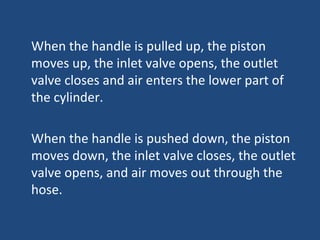
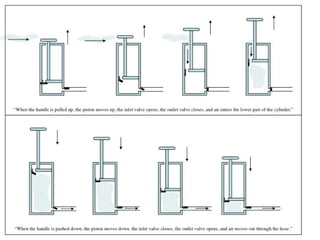
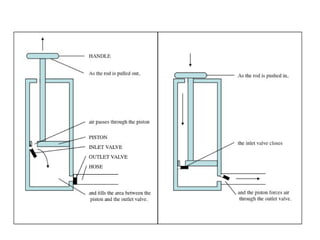
When the handle is pulled up, the piston moves up, the inlet valve opens, the outlet valve closes and air enters the lower part of the cylinder. When the handle is pushed down, the piston moves down, the inlet valve closes, the outlet valve opens, and air moves out through the hose.
The next slide is a description using both words and pictures of how a tire pump works:
 
Is the message clearer when pictures and words are used well together?
2. Spatial Contiguity Principle Students learn better when corresponding words and pictures are presented near rather than far from each other on the page or screen.
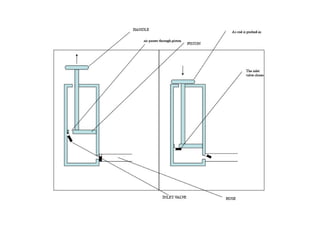
Let’s look at a diagram of a tire pump where the words are a bit too far from the parts:
 
Now let’s look at a slide that shows the words and pictures closer to one another:
 
Is the second diagram easier to understand?
3. Temporal Contiguity Principle Students learn better when corresponding words and pictures are presented simultaneously rather than successively.
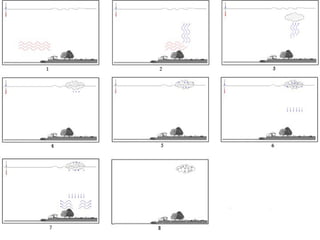
The next slide will present a textual description about rainfall. Please read it.
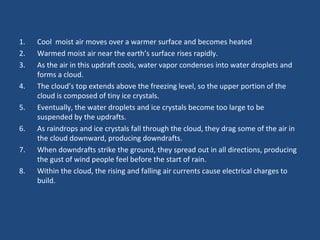
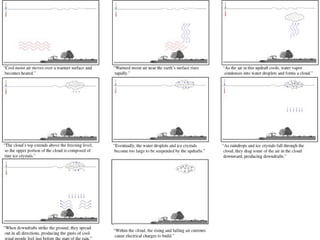
Cool  moist air moves over a warmer surface and becomes heated Warmed moist air near the earth’s surface rises rapidly. As the air in this updraft cools, water vapor condenses into water droplets and forms a cloud. The cloud’s top extends above the freezing level, so the upper portion of the cloud is composed of tiny ice crystals. Eventually, the water droplets and ice crystals become too large to be suspended by the updrafts. As raindrops and ice crystals fall through the cloud, they drag some of the air in the cloud downward, producing downdrafts. When downdrafts strike the ground, they spread out in all directions, producing the gust of wind people feel before the start of rain. Within the cloud, the rising and falling air currents cause electrical charges to build.
The next slide will present a pictorial description about rainfall. Please look at it:
 
The next slide will be present both a pictorial and textual version:
 
Does the combination of words and pictures enable you to construct a better mental image?
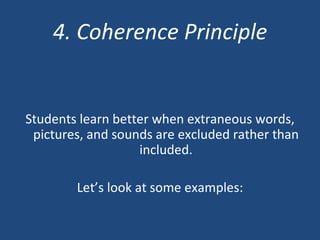
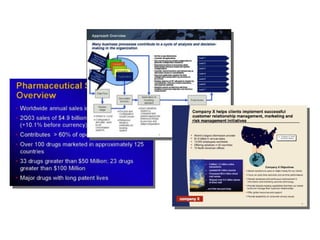
4. Coherence Principle Students learn better when extraneous words, pictures, and sounds are excluded rather than included. Let’s look at some examples:
 
5. Modality Principle Students learn better from animation and narration than from animation and on-screen text.
6. Redundancy Principle Better transfer occurs when animation and narration are not combined with printed text. When pictures and words are both presented visually, it can overload visual working memory capacity.
7. Individual Differences Principle Design effects are stronger for low-knowledge learners than from high-knowledge learners and for high-spatial learners than for low-spatial learners.

7 Multimedia Principles

  • 1.
  • 2.
    Let’s look at7 research-based principles for the design of multimedia messages
  • 3.
    1. Multimedia PrincipleStudents learn better from words and pictures than from words alone.
  • 4.
    The next slideis a description in words of how a tire pump works:
  • 5.
    When the handleis pulled up, the piston moves up, the inlet valve opens, the outlet valve closes and air enters the lower part of the cylinder. When the handle is pushed down, the piston moves down, the inlet valve closes, the outlet valve opens, and air moves out through the hose.
  • 6.
    The next slideis a description using both words and pictures of how a tire pump works:
  • 7.
  • 8.
    Is the messageclearer when pictures and words are used well together?
  • 9.
    2. Spatial ContiguityPrinciple Students learn better when corresponding words and pictures are presented near rather than far from each other on the page or screen.
  • 10.
    Let’s look ata diagram of a tire pump where the words are a bit too far from the parts:
  • 11.
  • 12.
    Now let’s lookat a slide that shows the words and pictures closer to one another:
  • 13.
  • 14.
    Is the seconddiagram easier to understand?
  • 15.
    3. Temporal ContiguityPrinciple Students learn better when corresponding words and pictures are presented simultaneously rather than successively.
  • 16.
    The next slidewill present a textual description about rainfall. Please read it.
  • 17.
    Cool moistair moves over a warmer surface and becomes heated Warmed moist air near the earth’s surface rises rapidly. As the air in this updraft cools, water vapor condenses into water droplets and forms a cloud. The cloud’s top extends above the freezing level, so the upper portion of the cloud is composed of tiny ice crystals. Eventually, the water droplets and ice crystals become too large to be suspended by the updrafts. As raindrops and ice crystals fall through the cloud, they drag some of the air in the cloud downward, producing downdrafts. When downdrafts strike the ground, they spread out in all directions, producing the gust of wind people feel before the start of rain. Within the cloud, the rising and falling air currents cause electrical charges to build.
  • 18.
    The next slidewill present a pictorial description about rainfall. Please look at it:
  • 19.
  • 20.
    The next slidewill be present both a pictorial and textual version:
  • 21.
  • 22.
    Does the combinationof words and pictures enable you to construct a better mental image?
  • 23.
    4. Coherence PrincipleStudents learn better when extraneous words, pictures, and sounds are excluded rather than included. Let’s look at some examples:
  • 24.
  • 25.
    5. Modality PrincipleStudents learn better from animation and narration than from animation and on-screen text.
  • 26.
    6. Redundancy PrincipleBetter transfer occurs when animation and narration are not combined with printed text. When pictures and words are both presented visually, it can overload visual working memory capacity.
  • 27.
    7. Individual DifferencesPrinciple Design effects are stronger for low-knowledge learners than from high-knowledge learners and for high-spatial learners than for low-spatial learners.