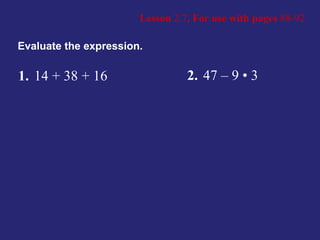
Lesson  2.7 , For use with pages  88-92 Evaluate the expression. 1. 14 + 38 + 16 2. 47 – 9 • 3
Lesson  2.7 , For use with pages  88-92 Evaluate the expression. 1. 14 + 38 + 16 2. 47 – 9 • 3 ANSWER 20 ANSWER 68
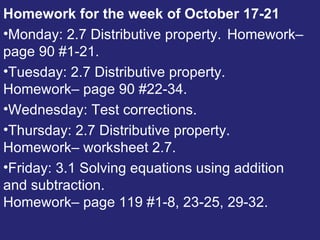
Homework for the week of October 17-21 Monday: 2.7 Distributive property.  Homework– page 90 #1-21. Tuesday: 2.7 Distributive property.  Homework– page 90 #22-34. Wednesday: Test corrections. Thursday: 2.7 Distributive property.  Homework– worksheet 2.7. Friday: 3.1 Solving equations using addition and subtraction.  Homework– page 119 #1-8, 23-25, 29-32.
Essential Questions: What strategies can be used to solve for unknown numbers? How does prior knowledge of order of operations and properties build the foundation for solving algebraic equations? How can writing equations help you solve real world problems?
Rewriting a number What is another way to write the number 25? 210? 1235?
Distributive Property 2.7
Vocabulary Coefficient  (of a variable): the number in front of the variable. 2 x,  5 ab,  x   think ( 1 ) x ,  -y   think  (- 1 ) y Like terms :  terms that have the same variable raised to the same power .  3x   and  -8x   are  like terms 5xy 2   and  xy 2   are   like terms Constant terms - plain numbers – no variable attached.  3x + 7 ,  x 2  – 5x  - 9
5x – 2y + 8x -7 Coefficients 5, -2, 8 Like Terms 5x and 8x Constant terms -7
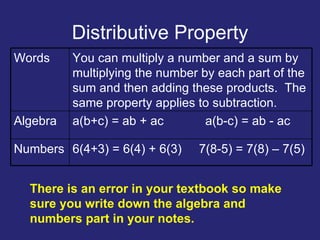
Distributive Property There is an error in your textbook so make sure you write down the algebra and numbers part in your notes. Words You can multiply a number and a sum by multiplying the number by each part of the sum and then adding these products.  The same property applies to subtraction.  Algebra a(b+c) = ab + ac  a(b-c) = ab - ac Numbers 6(4+3) = 6(4) + 6(3)  7(8-5) = 7(8) – 7(5)
5(10 + 8) =  Look at this example.  If you followed the  order of operations , what would you do first? Now if you had 5(18)  could you do that in mentally?
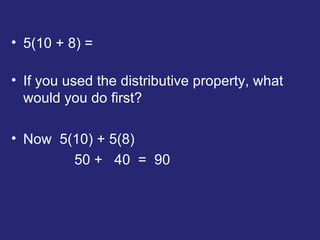
5(10 + 8) =  If you used the distributive property, what would you do first? Now  5(10) + 5(8) 50 +  40  =  90
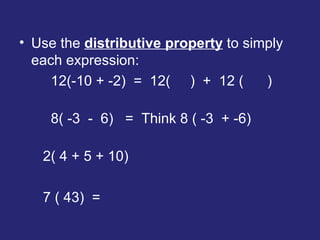
Use the  distributive property  to simply each expression: 12(-10 + -2)  =  12(  )  +  12 (  ) 8( -3  -  6)  =  Think 8 ( -3  + -6) 2( 4 + 5 + 10)  7 ( 43)  =
EXAMPLE 2 Using the Distributive Property =   –5 x  + ( –5 )(10) Distributive property = –5 x  + (–50) Multiply. =   3 x  + ( 3 )(8) Distributive property = 3 x  + 24 Multiply. a. – 5( x  + 10) b. 3( x  + 8)
EXAMPLE 2 Using the Distributive Property =  3 (1) –   3 (20) +   3 (–5) = 3 – 60 + (–15) = 3 + (–60) + (–15) = –72 Distributive property Multiply. Add the opposite of  60 . Add. c. 3 [1 – 20 + (–5)]
Find the difference mentally. Find the products mentally. The mental math is easier if you think of $11.95 as $12.00 – $.05. Write  11.95  as a difference. You are shopping for CDs. You want to buy six CDs  for $11.95 each. Use the distributive property to calculate the total cost  mentally. 6( 11.95 ) = 6( 12  –  0.05 )  Use the distributive property. = 6( 12 ) – 6( 0.05 ) = 72 – 0.30 = 71.70 S OLUTION The total cost of 6 CDs at $11.95 each is $71.70.
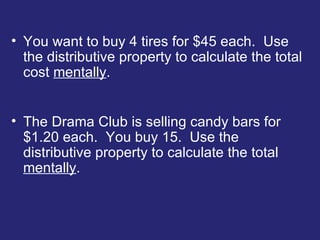
You want to buy 4 tires for $45 each.  Use the distributive property to calculate the total cost  mentally . The Drama Club is selling candy bars for $1.20 each.  You buy 15.  Use the distributive property to calculate the total  mentally .
Homework  Page 90 #1-21

2.7 distributive property day 1

  • 1.
    Lesson 2.7, For use with pages 88-92 Evaluate the expression. 1. 14 + 38 + 16 2. 47 – 9 • 3
  • 2.
    Lesson 2.7, For use with pages 88-92 Evaluate the expression. 1. 14 + 38 + 16 2. 47 – 9 • 3 ANSWER 20 ANSWER 68
  • 3.
    Homework for theweek of October 17-21 Monday: 2.7 Distributive property. Homework– page 90 #1-21. Tuesday: 2.7 Distributive property. Homework– page 90 #22-34. Wednesday: Test corrections. Thursday: 2.7 Distributive property. Homework– worksheet 2.7. Friday: 3.1 Solving equations using addition and subtraction. Homework– page 119 #1-8, 23-25, 29-32.
  • 4.
    Essential Questions: Whatstrategies can be used to solve for unknown numbers? How does prior knowledge of order of operations and properties build the foundation for solving algebraic equations? How can writing equations help you solve real world problems?
  • 5.
    Rewriting a numberWhat is another way to write the number 25? 210? 1235?
  • 6.
  • 7.
    Vocabulary Coefficient (of a variable): the number in front of the variable. 2 x, 5 ab, x think ( 1 ) x , -y think (- 1 ) y Like terms : terms that have the same variable raised to the same power . 3x and -8x are like terms 5xy 2 and xy 2 are like terms Constant terms - plain numbers – no variable attached. 3x + 7 , x 2 – 5x - 9
  • 8.
    5x – 2y+ 8x -7 Coefficients 5, -2, 8 Like Terms 5x and 8x Constant terms -7
  • 9.
    Distributive Property Thereis an error in your textbook so make sure you write down the algebra and numbers part in your notes. Words You can multiply a number and a sum by multiplying the number by each part of the sum and then adding these products. The same property applies to subtraction. Algebra a(b+c) = ab + ac a(b-c) = ab - ac Numbers 6(4+3) = 6(4) + 6(3) 7(8-5) = 7(8) – 7(5)
  • 10.
    5(10 + 8)= Look at this example. If you followed the order of operations , what would you do first? Now if you had 5(18) could you do that in mentally?
  • 11.
    5(10 + 8)= If you used the distributive property, what would you do first? Now 5(10) + 5(8) 50 + 40 = 90
  • 12.
    Use the distributive property to simply each expression: 12(-10 + -2) = 12( ) + 12 ( ) 8( -3 - 6) = Think 8 ( -3 + -6) 2( 4 + 5 + 10) 7 ( 43) =
  • 13.
    EXAMPLE 2 Usingthe Distributive Property = –5 x + ( –5 )(10) Distributive property = –5 x + (–50) Multiply. = 3 x + ( 3 )(8) Distributive property = 3 x + 24 Multiply. a. – 5( x + 10) b. 3( x + 8)
  • 14.
    EXAMPLE 2 Usingthe Distributive Property = 3 (1) – 3 (20) + 3 (–5) = 3 – 60 + (–15) = 3 + (–60) + (–15) = –72 Distributive property Multiply. Add the opposite of 60 . Add. c. 3 [1 – 20 + (–5)]
  • 15.
    Find the differencementally. Find the products mentally. The mental math is easier if you think of $11.95 as $12.00 – $.05. Write 11.95 as a difference. You are shopping for CDs. You want to buy six CDs for $11.95 each. Use the distributive property to calculate the total cost mentally. 6( 11.95 ) = 6( 12 – 0.05 ) Use the distributive property. = 6( 12 ) – 6( 0.05 ) = 72 – 0.30 = 71.70 S OLUTION The total cost of 6 CDs at $11.95 each is $71.70.
  • 16.
    You want tobuy 4 tires for $45 each. Use the distributive property to calculate the total cost mentally . The Drama Club is selling candy bars for $1.20 each. You buy 15. Use the distributive property to calculate the total mentally .
  • 17.
    Homework Page90 #1-21