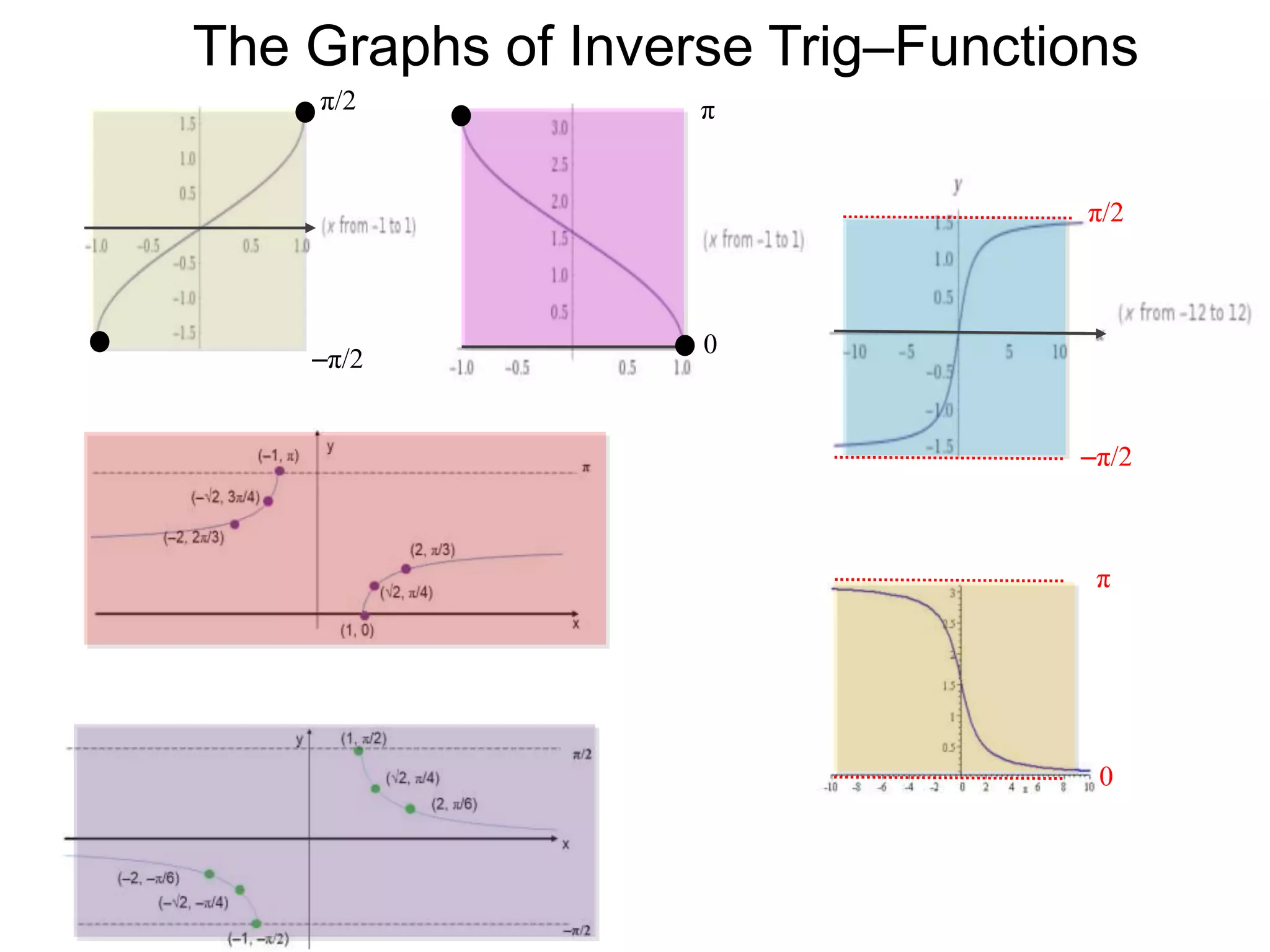
–π/2
π/2
The Graphs of Inverse Trig–Functions
π
0
π/2
–π/2
π
0
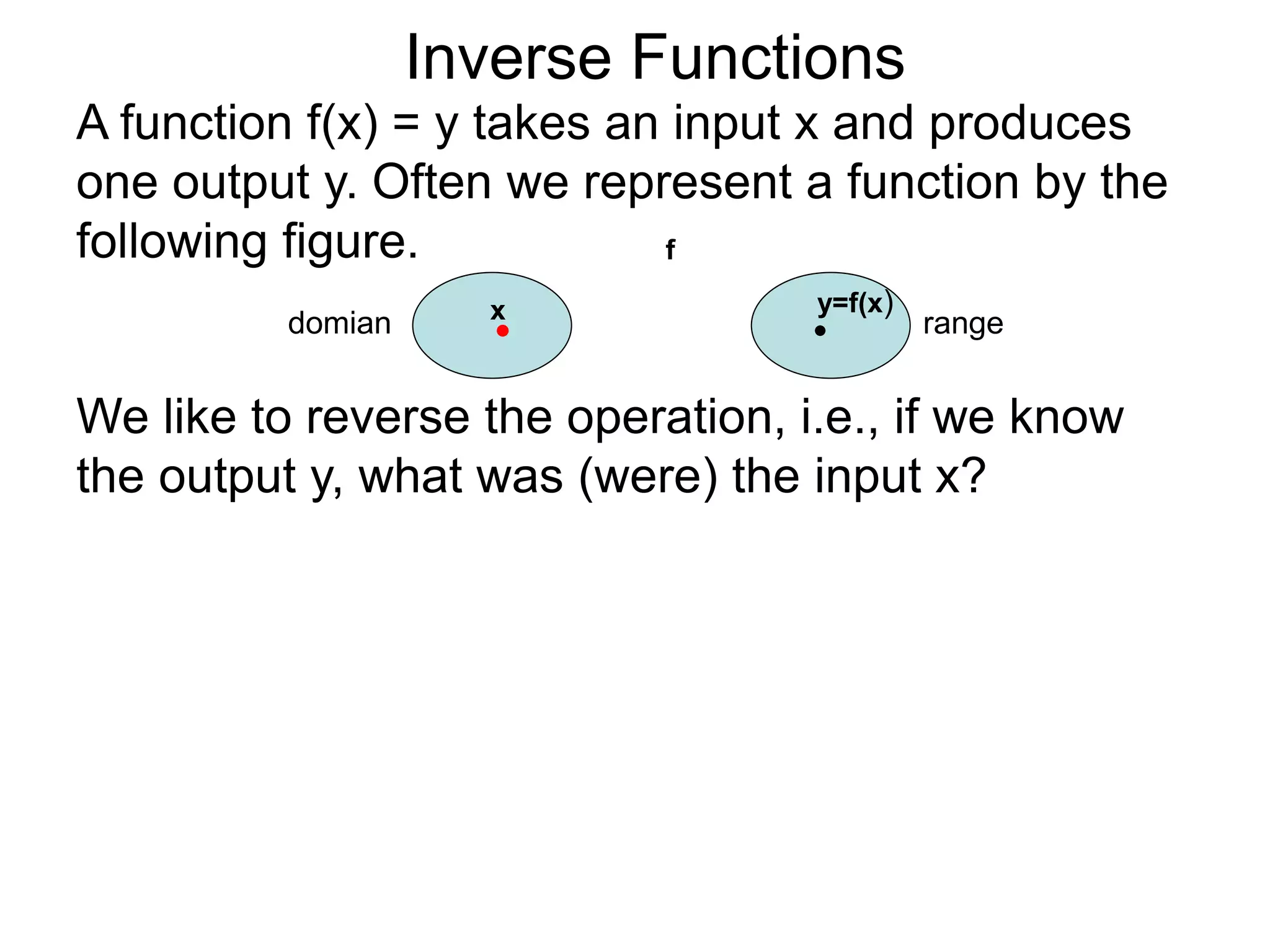
A function f(x) = y takes an input x and produces
one output y.
Inverse Functions
Inverse Functions
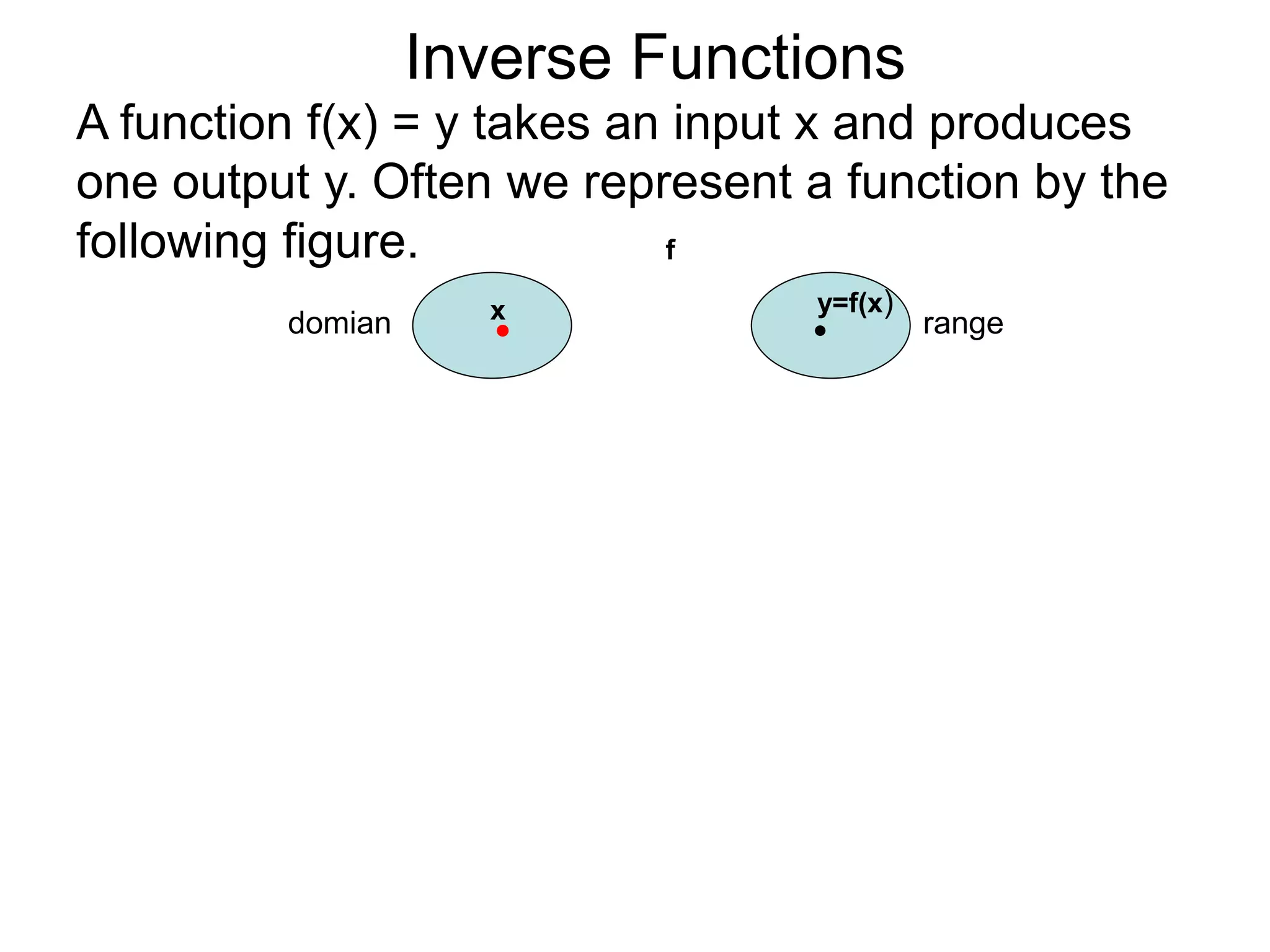
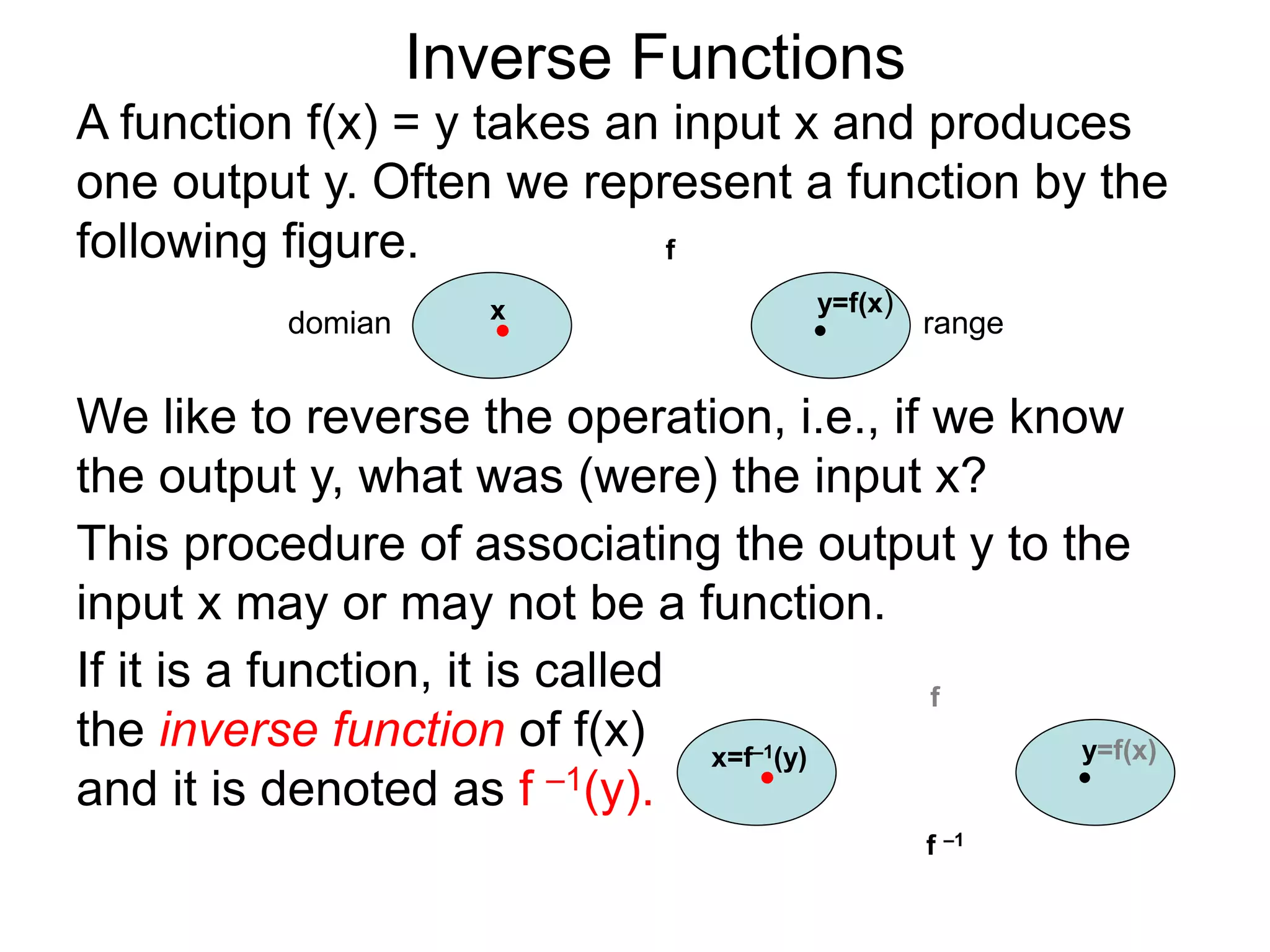
A function f(x) = y takes an input x and produces
one output y. Often we represent a function by the
following figure.
Inverse Functions
domian rangex y=f(x)
f
A function f(x) = y takes an input x and produces
one output y. Often we represent a function by the
following figure.
Inverse Functions
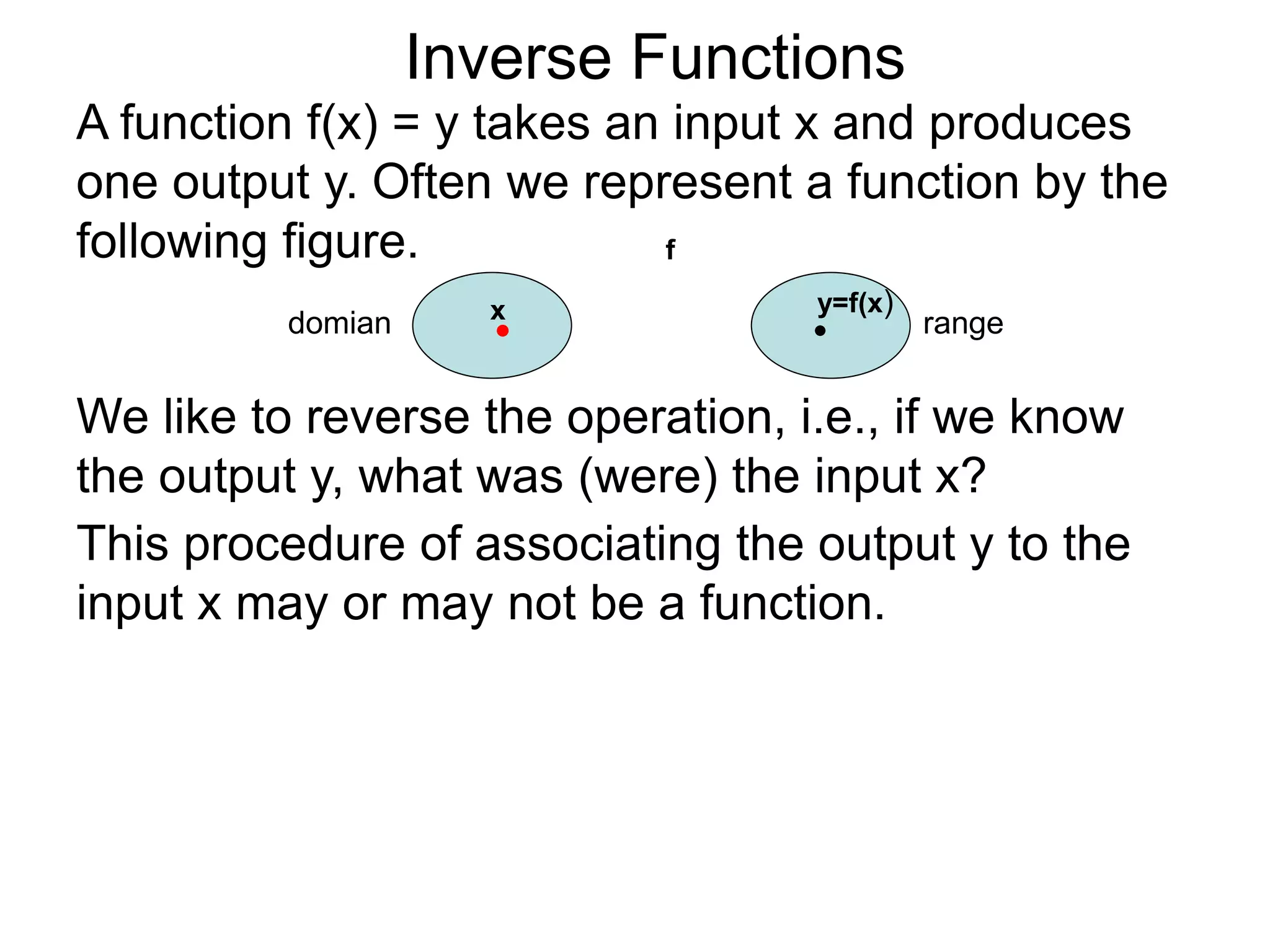
We like to reverse the operation, i.e., if we know
the output y, what was (were) the input x?
domian rangex y=f(x)
f
A function f(x) = y takes an input x and produces
one output y. Often we represent a function by the
following figure.
Inverse Functions
We like to reverse the operation, i.e., if we know
the output y, what was (were) the input x?
This procedure of associating the output y to the
input x may or may not be a function.
domian rangex y=f(x)
f
A function f(x) = y takes an input x and produces
one output y. Often we represent a function by the
following figure.
Inverse Functions
We like to reverse the operation, i.e., if we know
the output y, what was (were) the input x?
This procedure of associating the output y to the
input x may or may not be a function.
domian rangex y=f(x)
f
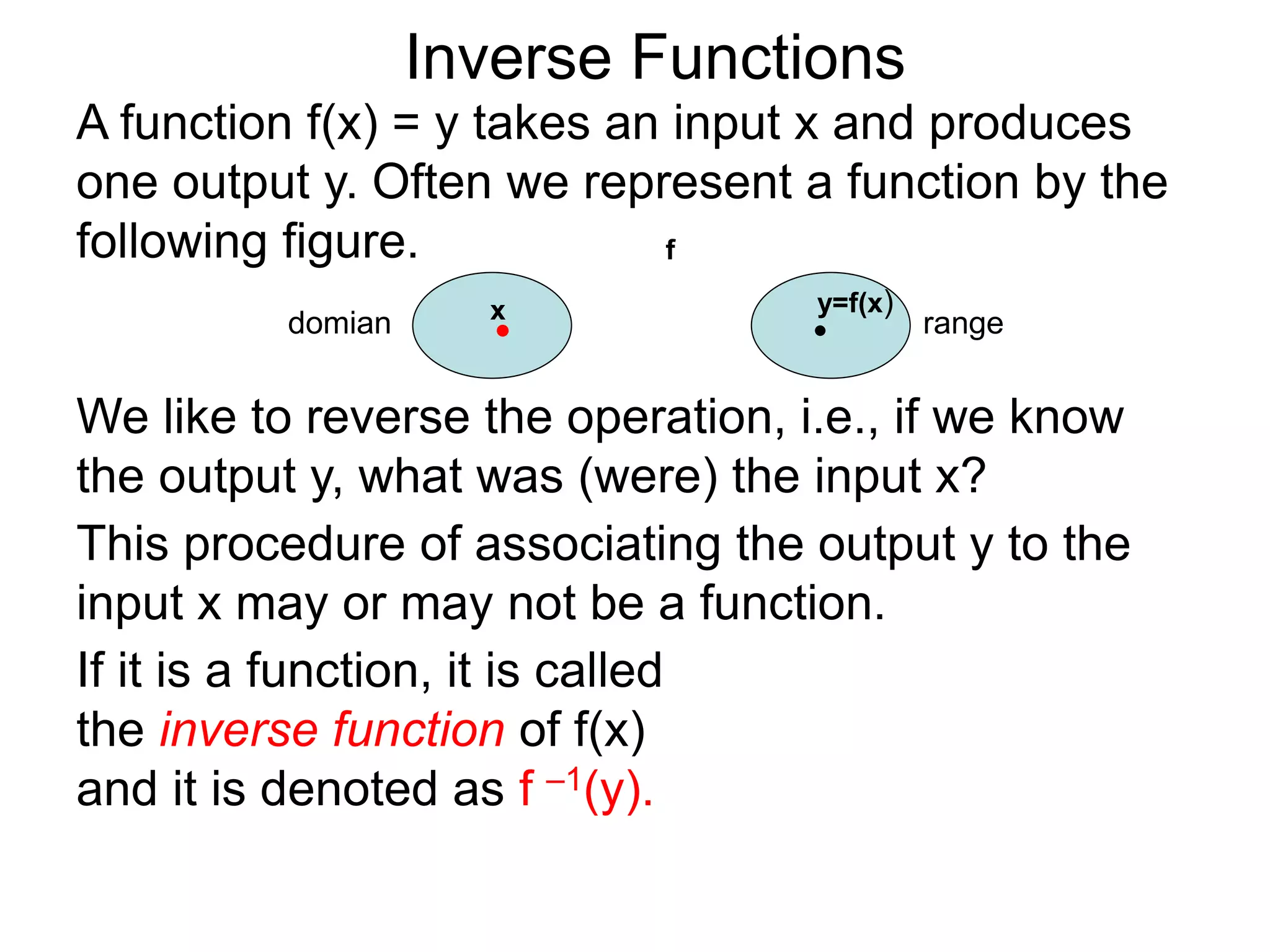
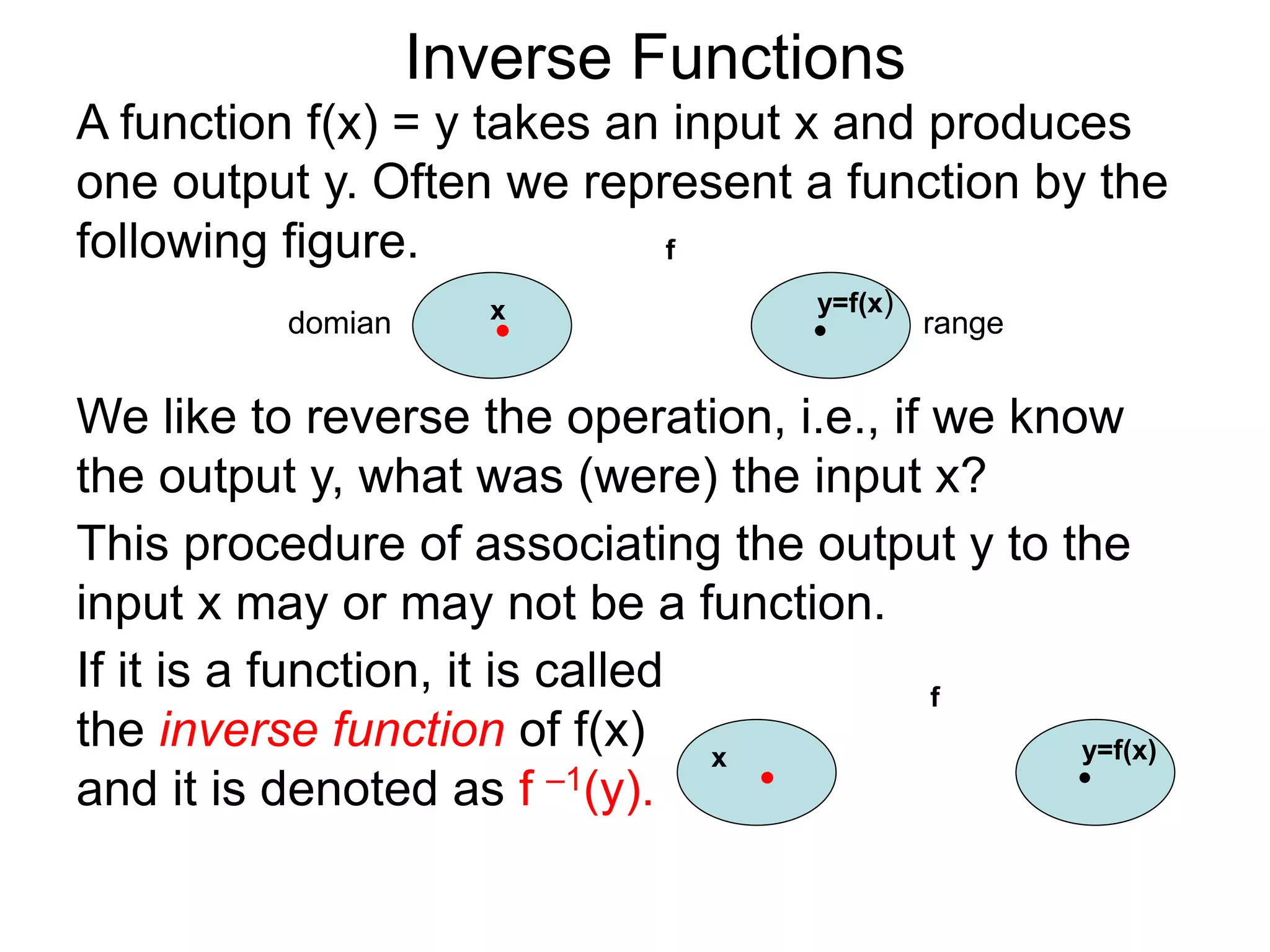
If it is a function, it is called
the inverse function of f(x)
and it is denoted as f –1(y).
A function f(x) = y takes an input x and produces
one output y. Often we represent a function by the
following figure.
Inverse Functions
We like to reverse the operation, i.e., if we know
the output y, what was (were) the input x?
This procedure of associating the output y to the
input x may or may not be a function.
domian rangex y=f(x)
f
If it is a function, it is called
the inverse function of f(x)
and it is denoted as f –1(y).
x y=f(x)
f
A function f(x) = y takes an input x and produces
one output y. Often we represent a function by the
following figure.
Inverse Functions
We like to reverse the operation, i.e., if we know
the output y, what was (were) the input x?
This procedure of associating the output y to the
input x may or may not be a function.
domian rangex y=f(x)
f
If it is a function, it is called
the inverse function of f(x)
and it is denoted as f –1(y).
x=f–1(y) y=f(x)
f
f –1
A function f(x) = y takes an input x and produces
one output y. Often we represent a function by the
following figure.
Inverse Functions
We like to reverse the operation, i.e., if we know
the output y, what was (were) the input x?
This procedure of associating the output y to the
input x may or may not be a function.
domian rangex y=f(x)
f
If it is a function, it is called
the inverse function of f(x)
and it is denoted as f –1(y).
We say f(x) and f –1(y) are
the inverse of each other.
x=f–1(y) y=f(x)
f
f –1
Example A.
a. The function y = f(x) = 2x takes the input x and
doubles it to get the output y.
Inverse Functions
Example A.
a. The function y = f(x) = 2x takes the input x and
doubles it to get the output y. To reverse the
operation, take an output y,
Inverse Functions
Example A.
a. The function y = f(x) = 2x takes the input x and
doubles it to get the output y. To reverse the
operation, take an output y, divided it by 2 and we
get back to the x.
Inverse Functions
Example A.
a. The function y = f(x) = 2x takes the input x and
doubles it to get the output y. To reverse the
operation, take an output y, divided it by 2 and we
get back to the x. In other words f –1(y) = y/2.
Inverse Functions
Example A.
a. The function y = f(x) = 2x takes the input x and
doubles it to get the output y. To reverse the
operation, take an output y, divided it by 2 and we
get back to the x. In other words f –1(y) = y/2.
So, for example, f –1(6) = 3 because f(3) = 6.
Inverse Functions
Example A.
a. The function y = f(x) = 2x takes the input x and
doubles it to get the output y. To reverse the
operation, take an output y, divided it by 2 and we
get back to the x. In other words f –1(y) = y/2.
So, for example, f –1(6) = 3 because f(3) = 6.
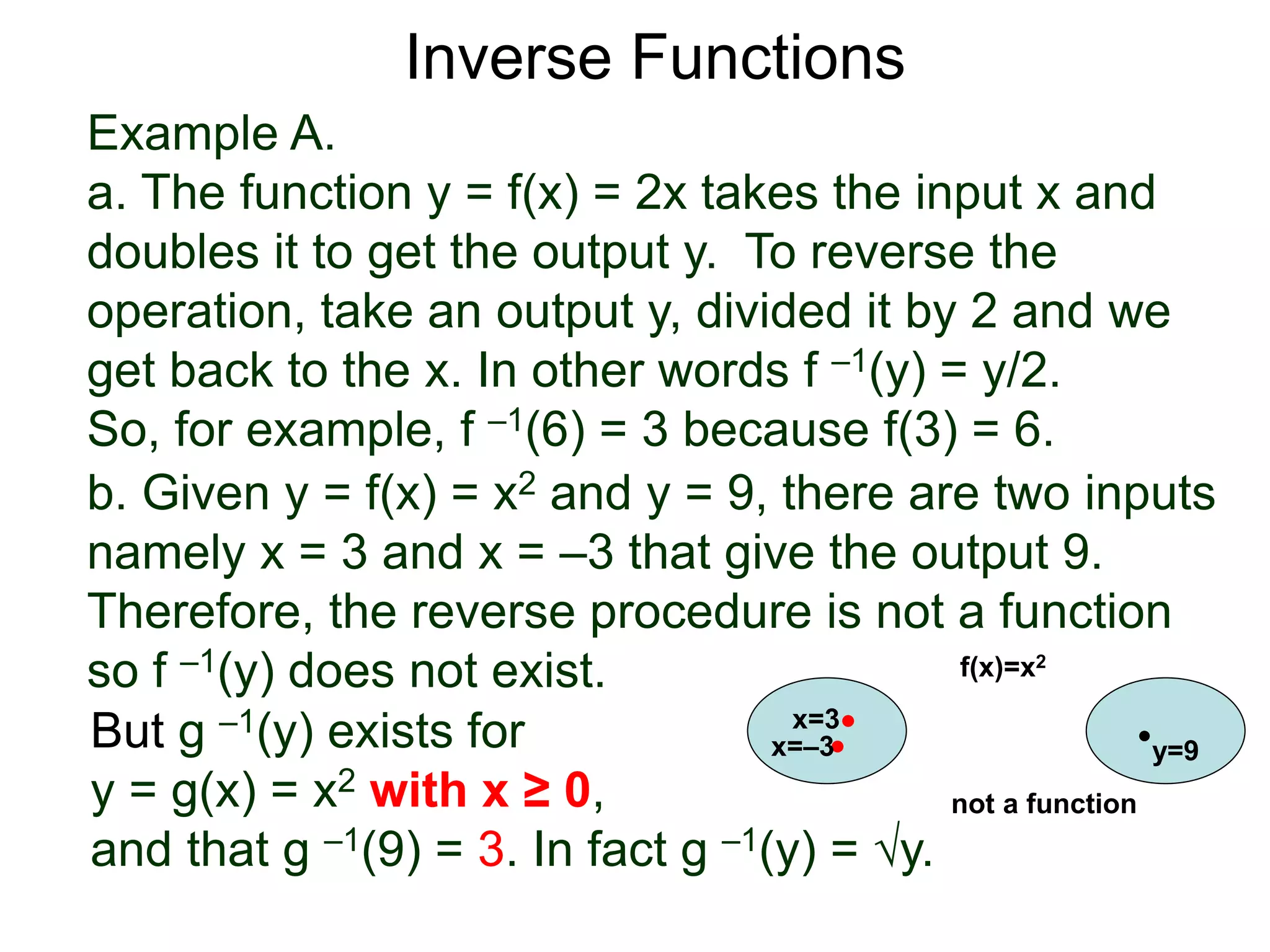
b. Given y = f(x) = x2 and y = 9,
Inverse Functions
Example A.
a. The function y = f(x) = 2x takes the input x and
doubles it to get the output y. To reverse the
operation, take an output y, divided it by 2 and we
get back to the x. In other words f –1(y) = y/2.
So, for example, f –1(6) = 3 because f(3) = 6.
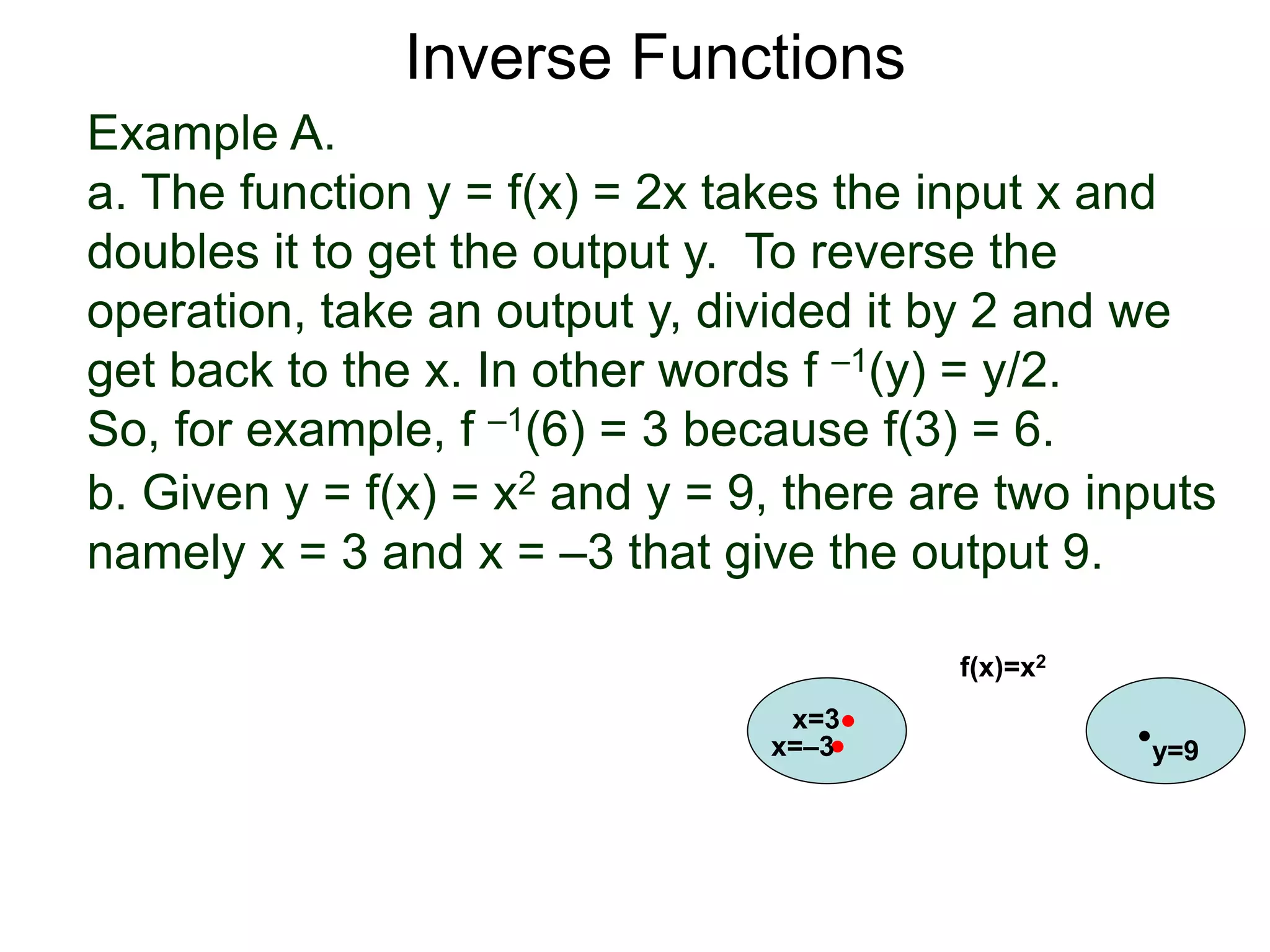
b. Given y = f(x) = x2 and y = 9, there are two inputs
namely x = 3 and x = –3 that give the output 9.
x=3
y=9
f(x)=x2
x=–3
Inverse Functions
Example A.
a. The function y = f(x) = 2x takes the input x and
doubles it to get the output y. To reverse the
operation, take an output y, divided it by 2 and we
get back to the x. In other words f –1(y) = y/2.
So, for example, f –1(6) = 3 because f(3) = 6.
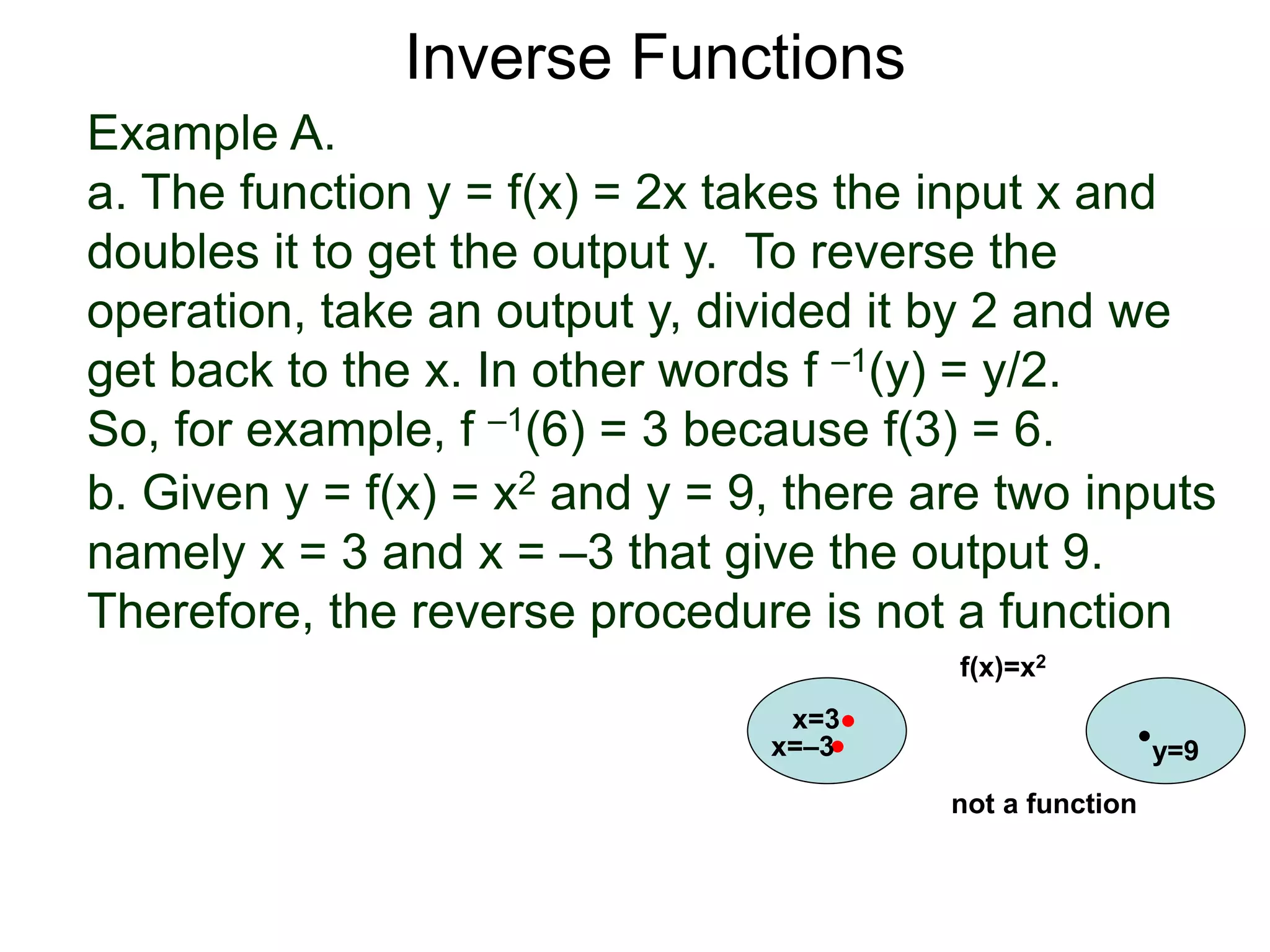
b. Given y = f(x) = x2 and y = 9, there are two inputs
namely x = 3 and x = –3 that give the output 9.
Therefore, the reverse procedure is not a function
x=3
y=9
f(x)=x2
x=–3
not a function
Inverse Functions
Example A.
a. The function y = f(x) = 2x takes the input x and
doubles it to get the output y. To reverse the
operation, take an output y, divided it by 2 and we
get back to the x. In other words f –1(y) = y/2.
So, for example, f –1(6) = 3 because f(3) = 6.
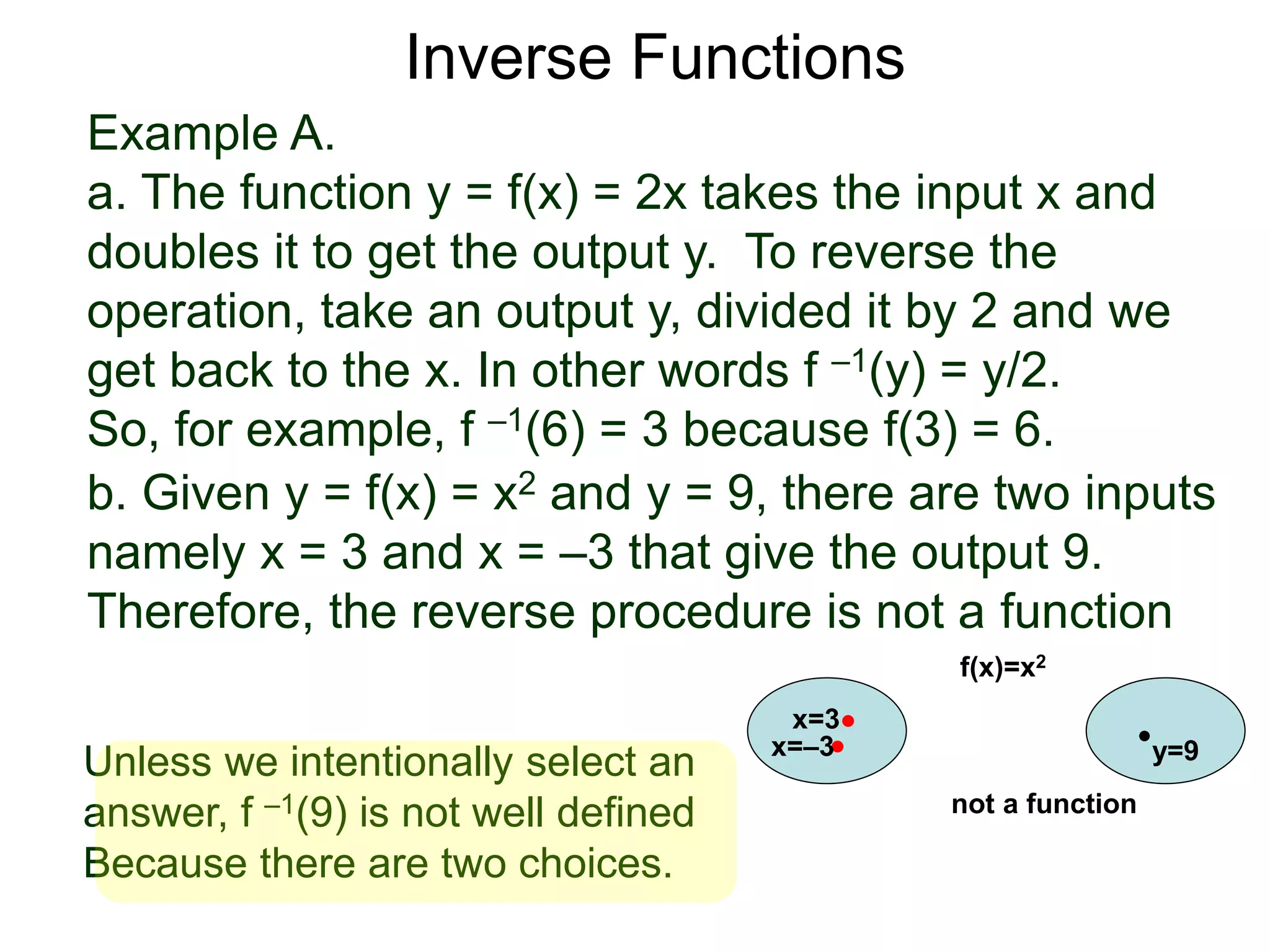
b. Given y = f(x) = x2 and y = 9, there are two inputs
namely x = 3 and x = –3 that give the output 9.
Therefore, the reverse procedure is not a function
Inverse Functions
x=3
y=9
f(x)=x2
x=–3
not a function
Unless we intentionally select an
answer, f –1(9) is not well defined
Because there are two choices.
Example A.
a. The function y = f(x) = 2x takes the input x and
doubles it to get the output y. To reverse the
operation, take an output y, divided it by 2 and we
get back to the x. In other words f –1(y) = y/2.
So, for example, f –1(6) = 3 because f(3) = 6.
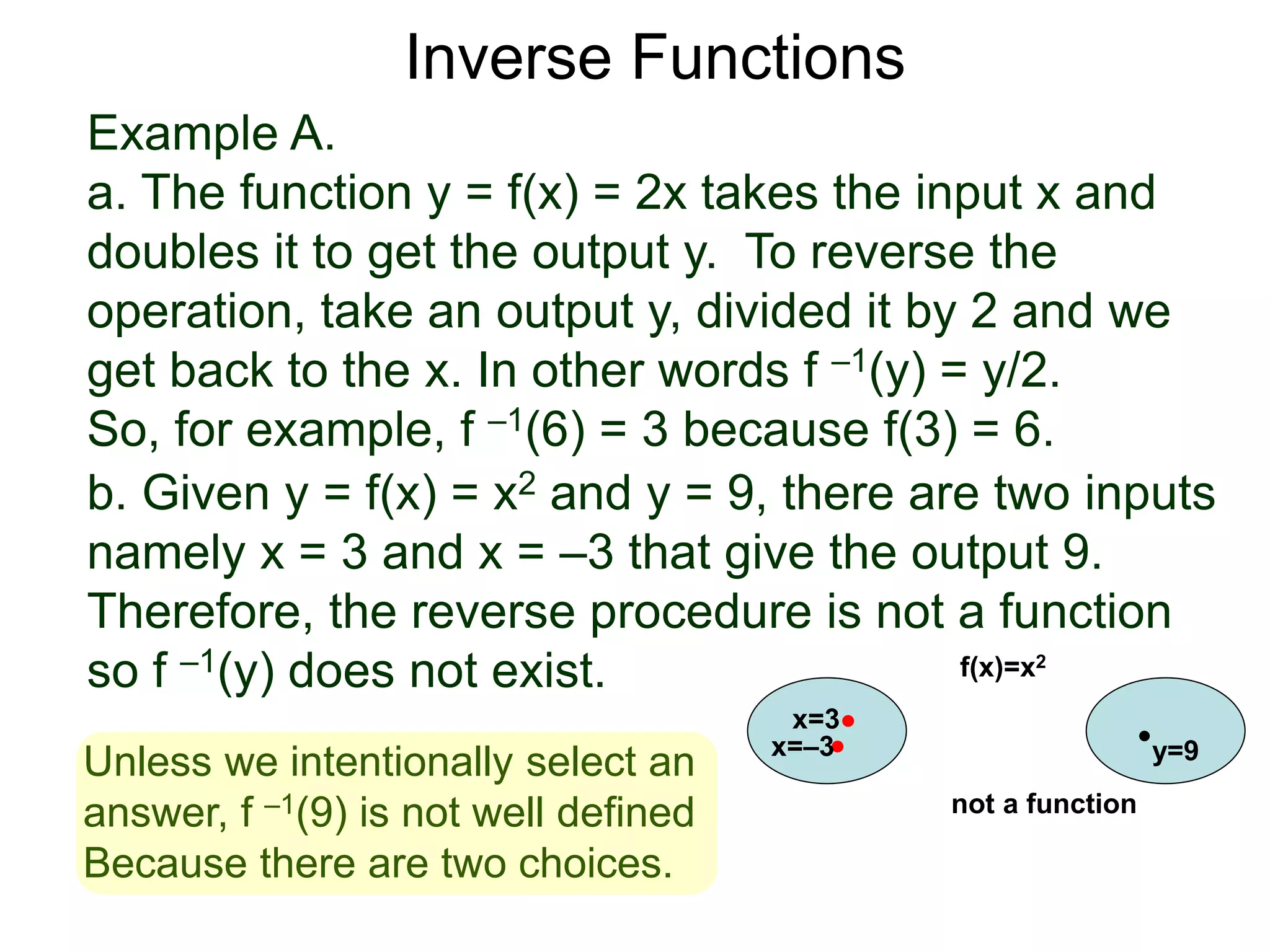
b. Given y = f(x) = x2 and y = 9, there are two inputs
namely x = 3 and x = –3 that give the output 9.
Therefore, the reverse procedure is not a function
so f –1(y) does not exist.
Inverse Functions
x=3
y=9
f(x)=x2
x=–3
not a function
Unless we intentionally select an
answer, f –1(9) is not well defined
Because there are two choices.
Example A.
a. The function y = f(x) = 2x takes the input x and
doubles it to get the output y. To reverse the
operation, take an output y, divided it by 2 and we
get back to the x. In other words f –1(y) = y/2.
So, for example, f –1(6) = 3 because f(3) = 6.
b. Given y = f(x) = x2 and y = 9, there are two inputs
namely x = 3 and x = –3 that give the output 9.
Therefore, the reverse procedure is not a function
so f –1(y) does not exist.
Inverse Functions
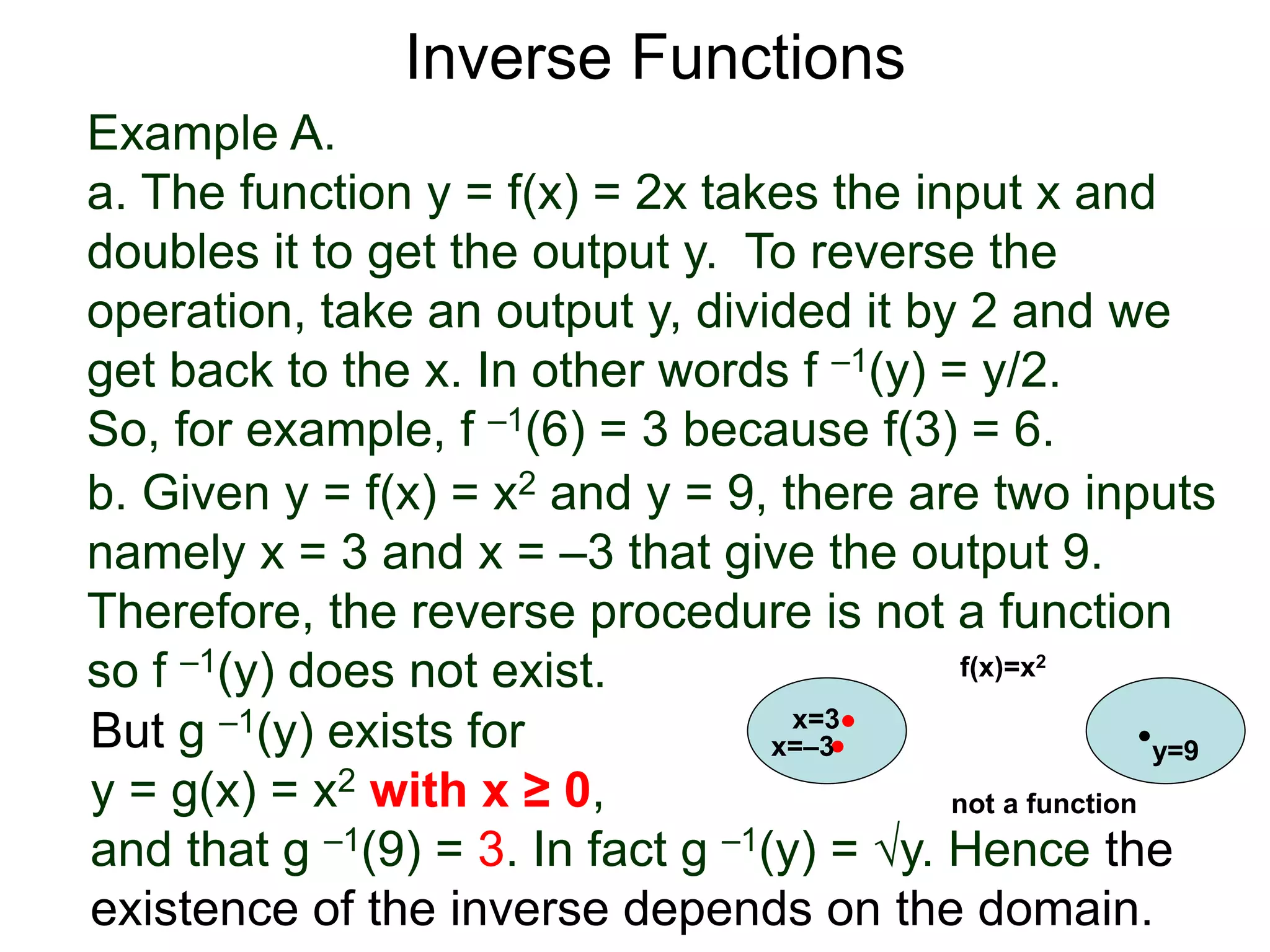
But g –1(y) exists for
y = g(x) = x2 with x ≥ 0,
and that g –1(9) = 3. In fact g –1(y) = √y.
x=3
y=9
f(x)=x2
x=–3
not a function
Example A.
a. The function y = f(x) = 2x takes the input x and
doubles it to get the output y. To reverse the
operation, take an output y, divided it by 2 and we
get back to the x. In other words f –1(y) = y/2.
So, for example, f –1(6) = 3 because f(3) = 6.
b. Given y = f(x) = x2 and y = 9, there are two inputs
namely x = 3 and x = –3 that give the output 9.
Therefore, the reverse procedure is not a function
so f –1(y) does not exist.
Inverse Functions
But g –1(y) exists for
y = g(x) = x2 with x ≥ 0,
and that g –1(9) = 3. In fact g –1(y) = √y. Hence the
existence of the inverse depends on the domain.
x=3
y=9
f(x)=x2
x=–3
not a function
Inverse Functions
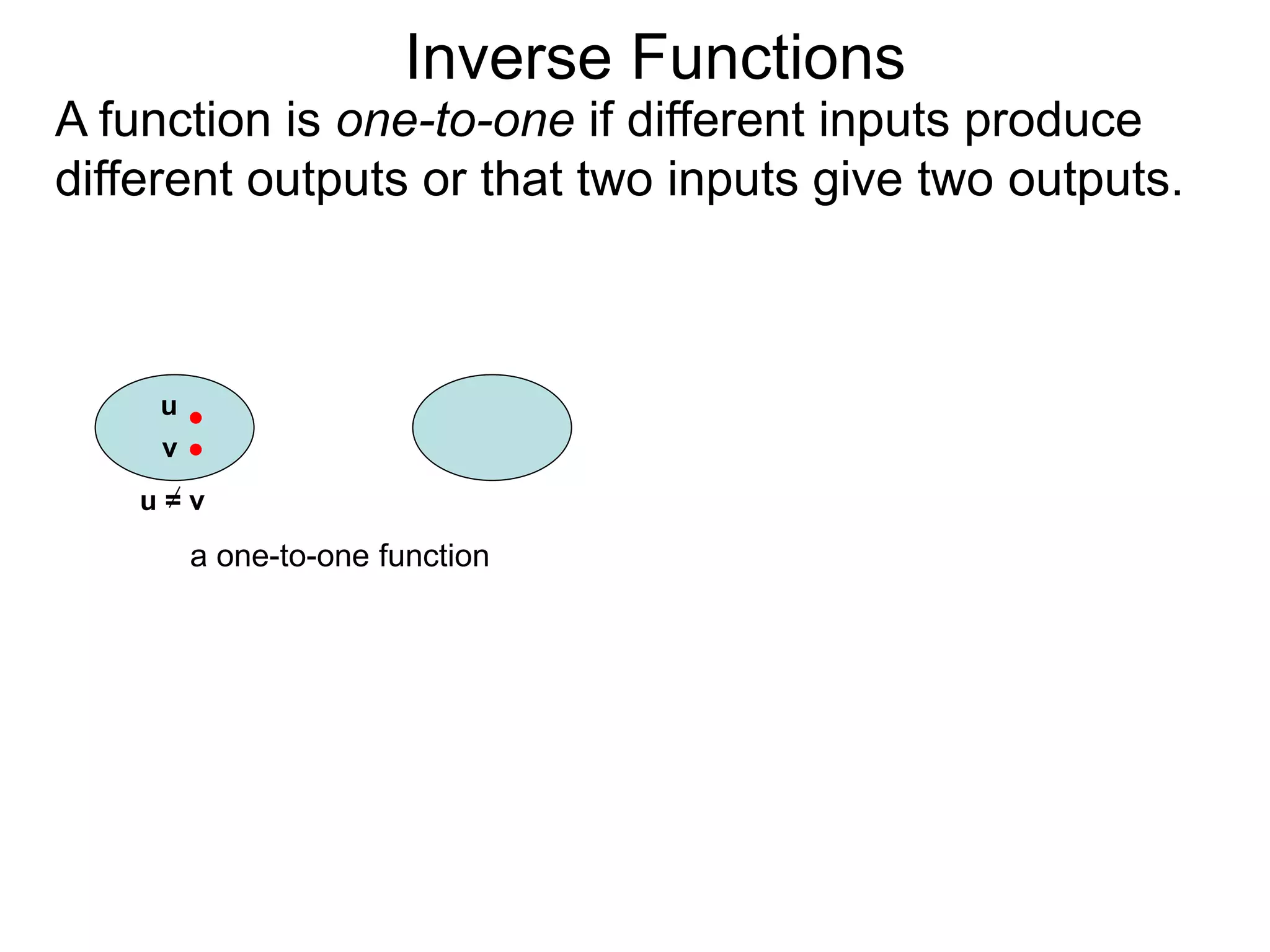
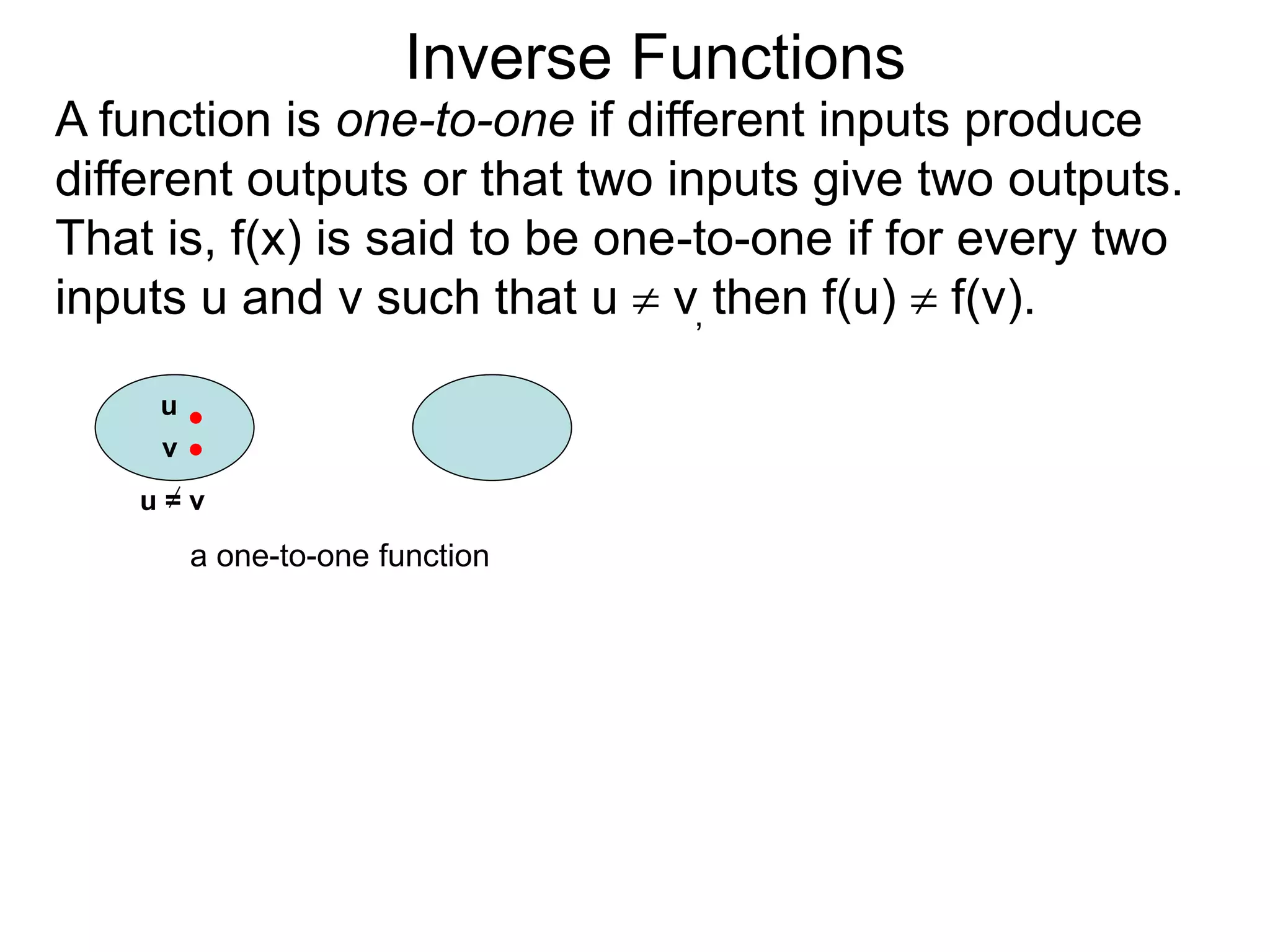
u
v
u = v
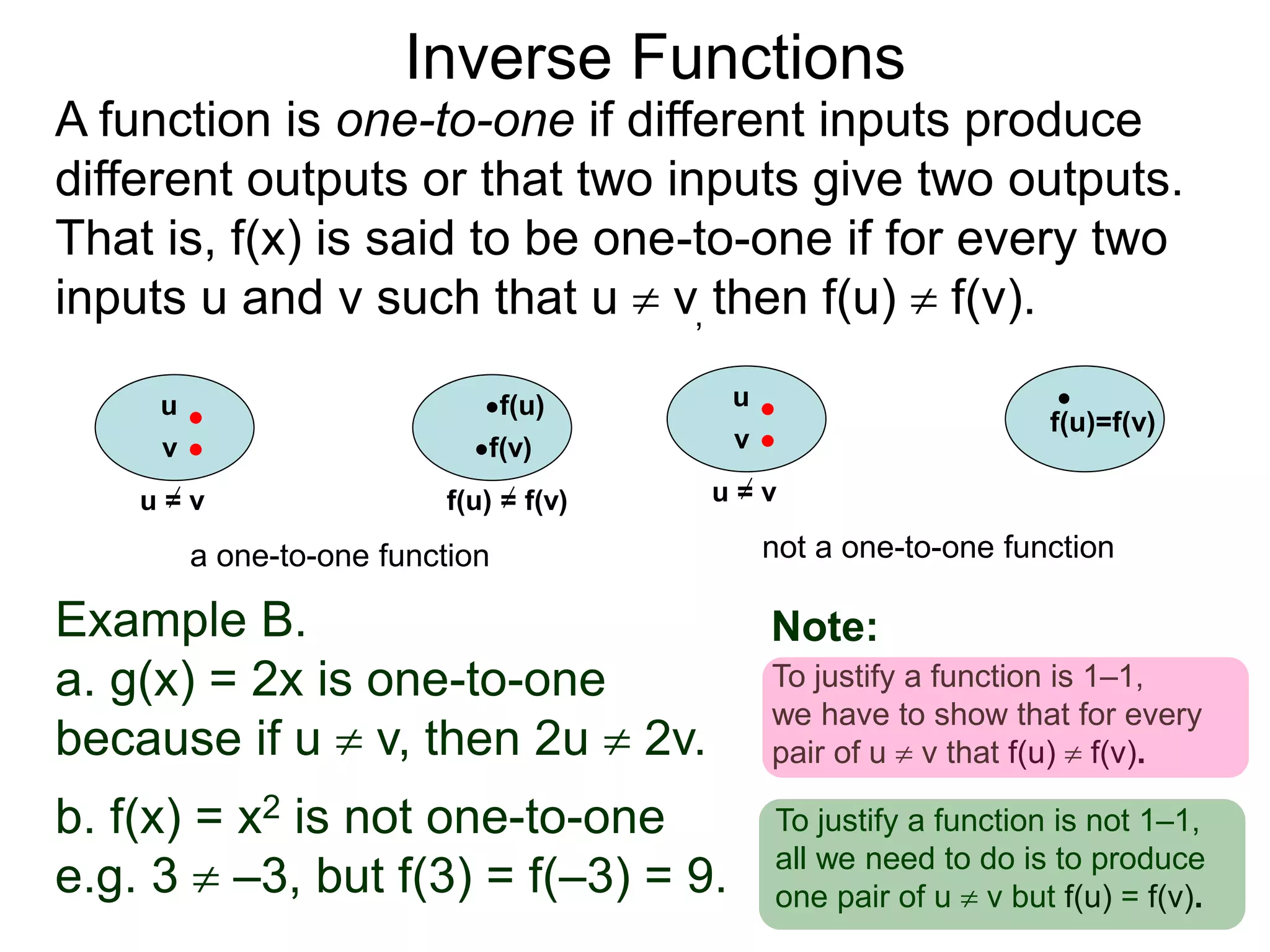
a one-to-one function
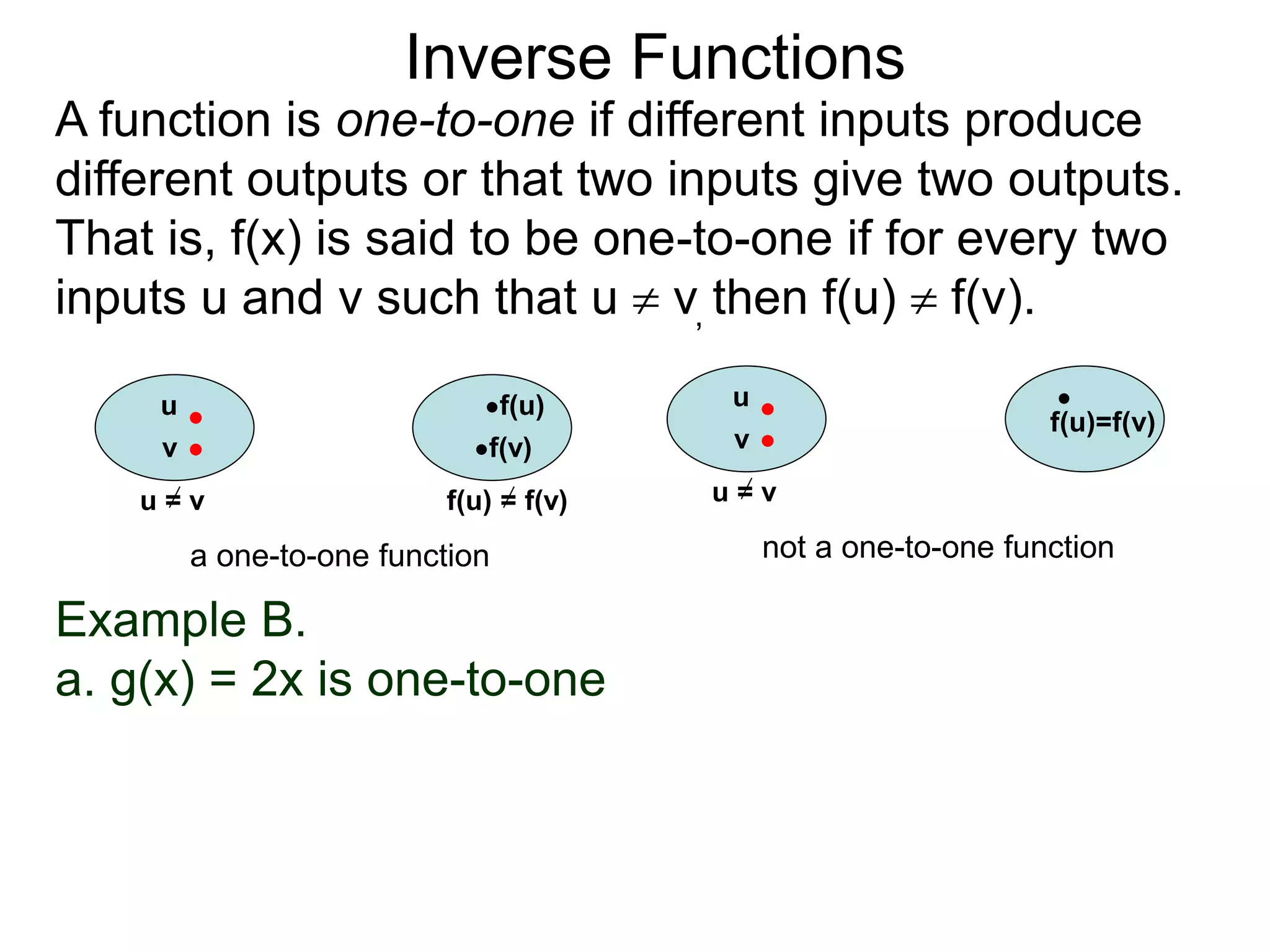
A function is one-to-one if different inputs produce
different outputs or that two inputs give two outputs.
Inverse Functions
A function is one-to-one if different inputs produce
different outputs or that two inputs give two outputs.
That is, f(x) is said to be one-to-one if for every two
inputs u and v such that u  v, then f(u)  f(v).
Inverse Functions
u
v
u = v
a one-to-one function
A function is one-to-one if different inputs produce
different outputs or that two inputs give two outputs.
That is, f(x) is said to be one-to-one if for every two
inputs u and v such that u  v, then f(u)  f(v).
Inverse Functions
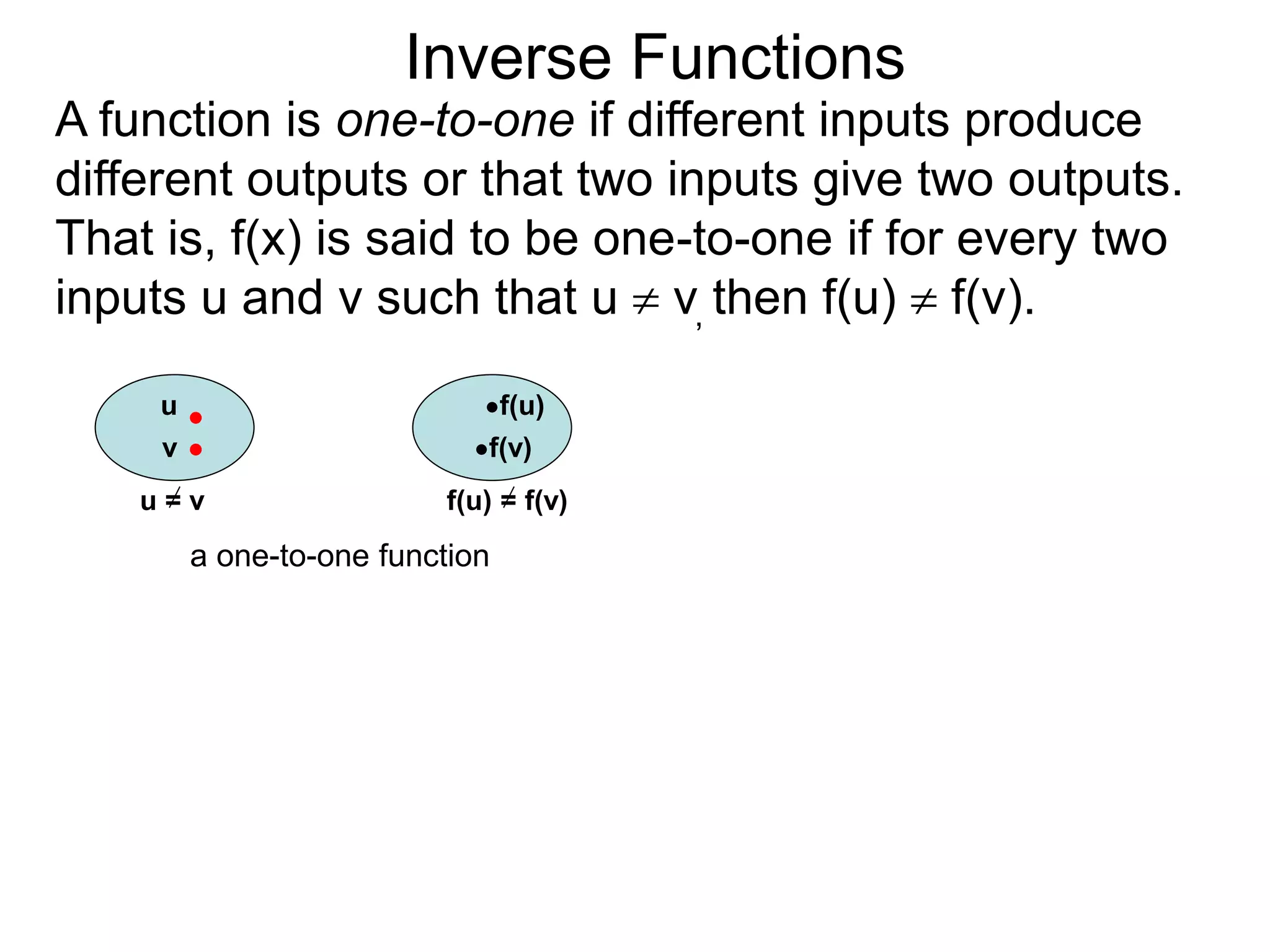
u f(u)
v f(v)
u = v f(u) = f(v)
a one-to-one function
A function is one-to-one if different inputs produce
different outputs or that two inputs give two outputs.
That is, f(x) is said to be one-to-one if for every two
inputs u and v such that u  v, then f(u)  f(v).
Inverse Functions
u f(u)
v f(v)
u = v f(u) = f(v)
a one-to-one function
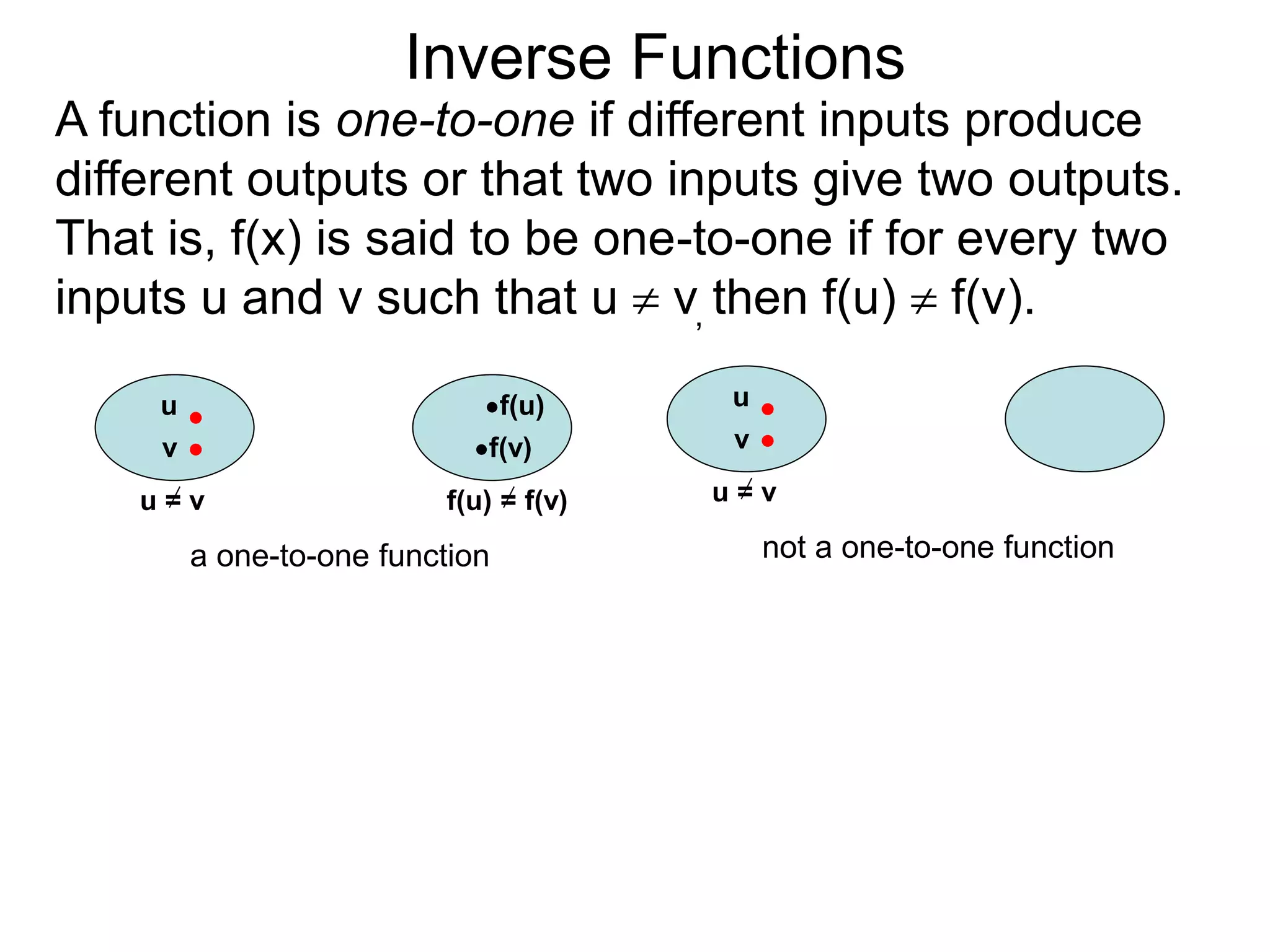
u
v
u = v
not a one-to-one function
A function is one-to-one if different inputs produce
different outputs or that two inputs give two outputs.
That is, f(x) is said to be one-to-one if for every two
inputs u and v such that u  v, then f(u)  f(v).
Inverse Functions
u f(u)
v f(v)
u = v f(u) = f(v)
a one-to-one function
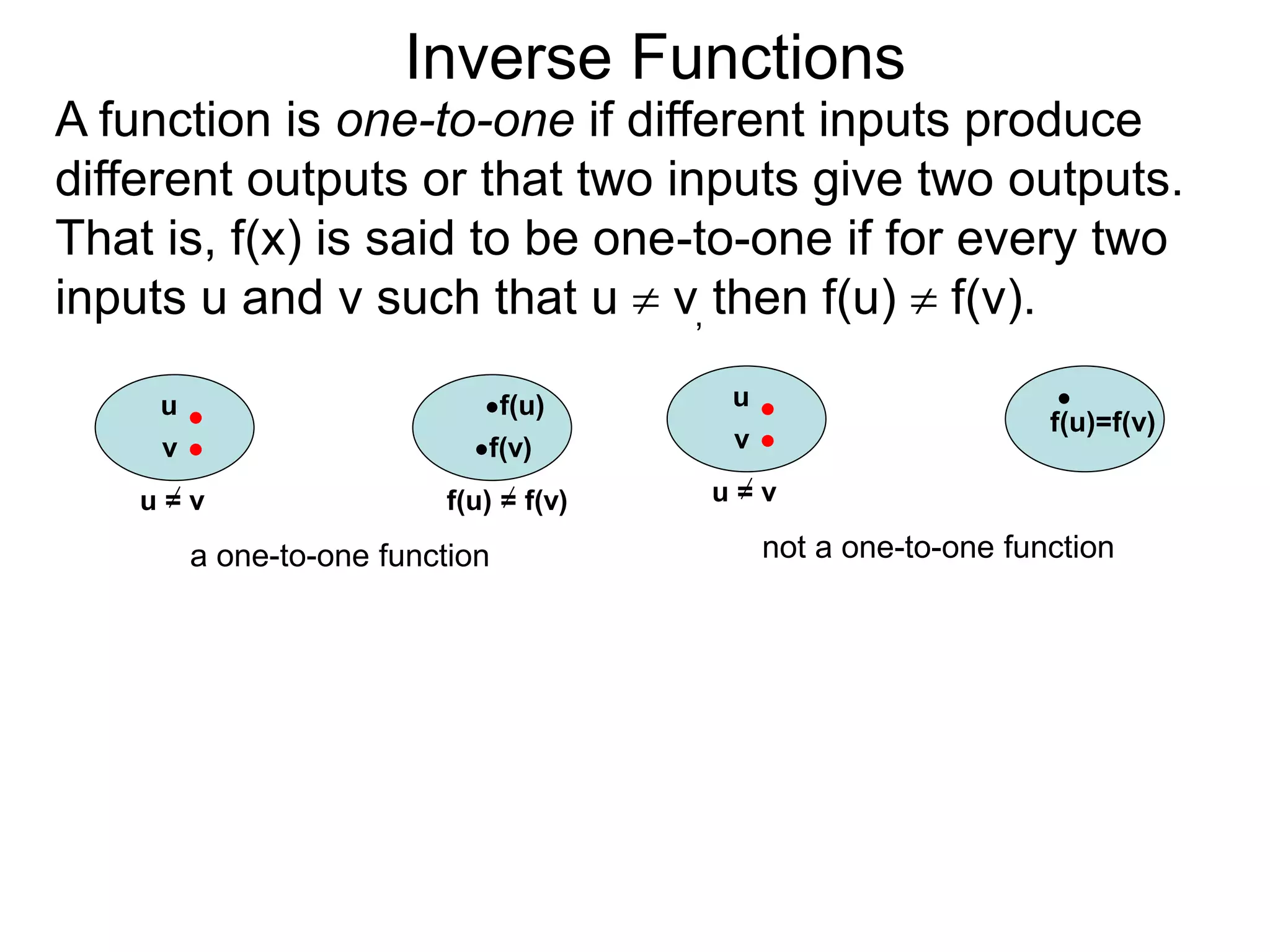
u
f(u)=f(v)
v
u = v
not a one-to-one function
A function is one-to-one if different inputs produce
different outputs or that two inputs give two outputs.
That is, f(x) is said to be one-to-one if for every two
inputs u and v such that u  v, then f(u)  f(v).
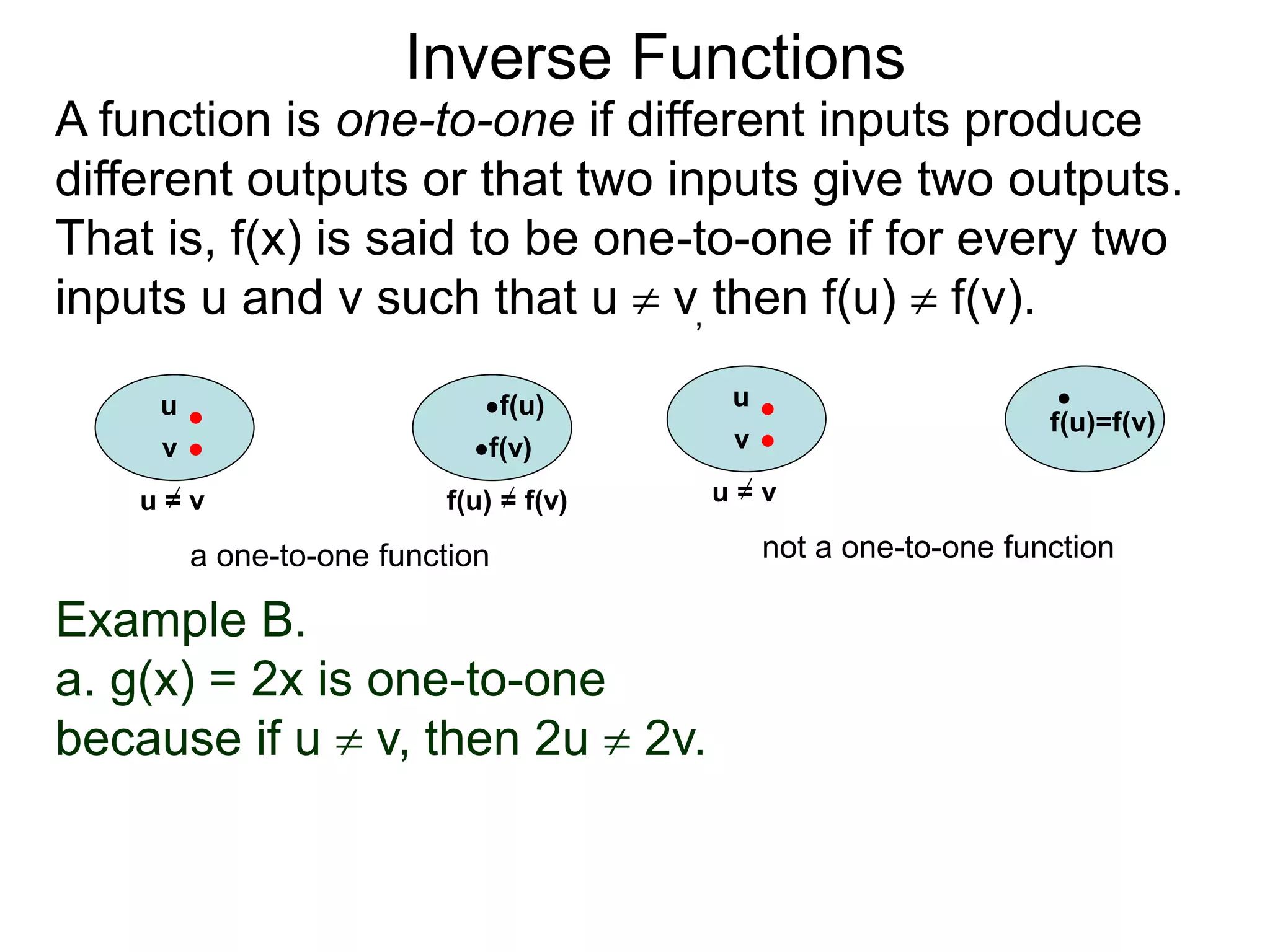
Example B.
a. g(x) = 2x is one-to-one
Inverse Functions
u f(u)
v f(v)
u = v f(u) = f(v)
a one-to-one function
u
f(u)=f(v)
v
u = v
not a one-to-one function
A function is one-to-one if different inputs produce
different outputs or that two inputs give two outputs.
That is, f(x) is said to be one-to-one if for every two
inputs u and v such that u  v, then f(u)  f(v).
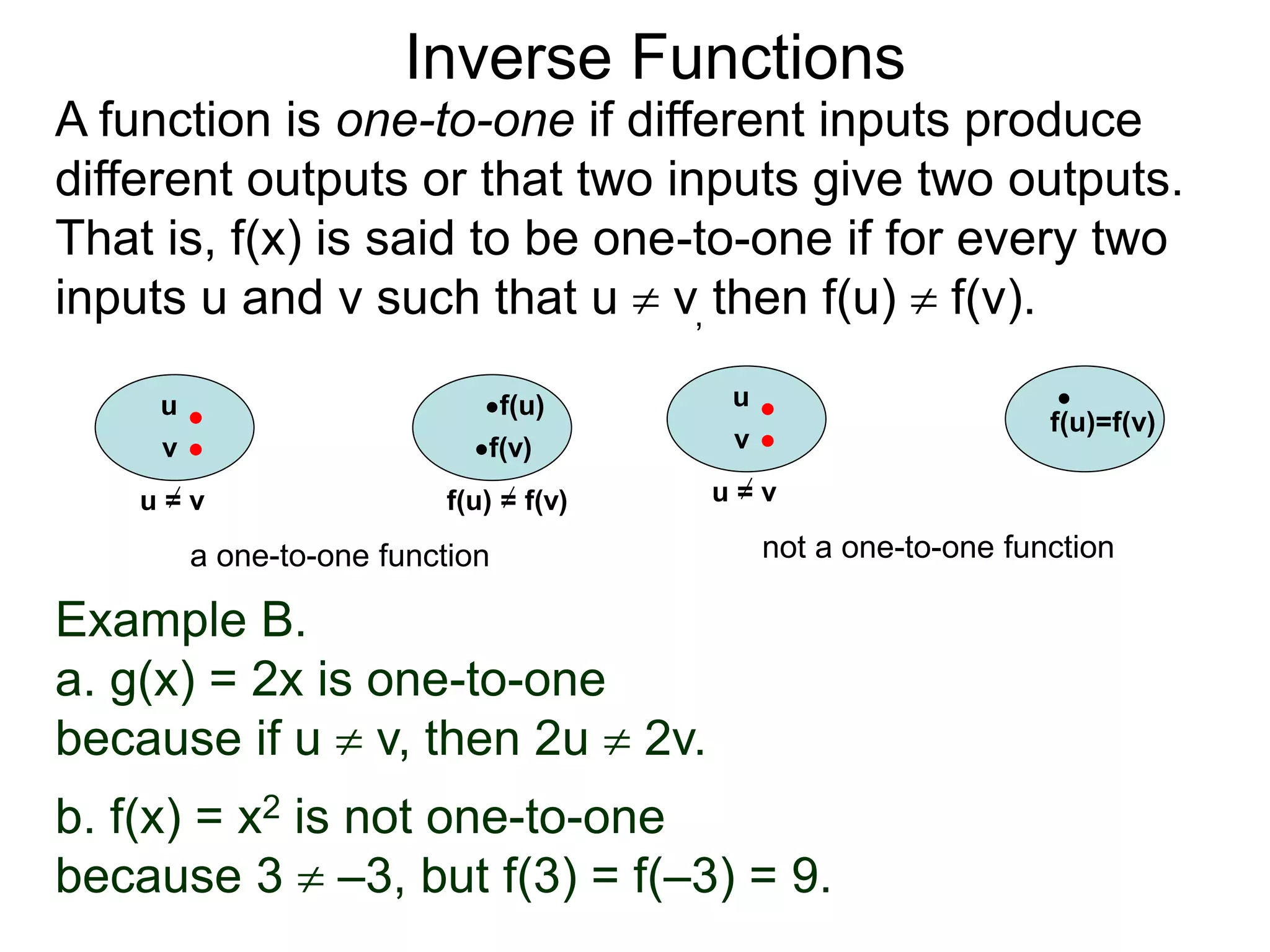
Example B.
a. g(x) = 2x is one-to-one
because if u  v, then 2u  2v.
Inverse Functions
u f(u)
v f(v)
u = v f(u) = f(v)
a one-to-one function
u
f(u)=f(v)
v
u = v
not a one-to-one function
A function is one-to-one if different inputs produce
different outputs or that two inputs give two outputs.
That is, f(x) is said to be one-to-one if for every two
inputs u and v such that u  v, then f(u)  f(v).
Example B.
a. g(x) = 2x is one-to-one
because if u  v, then 2u  2v.
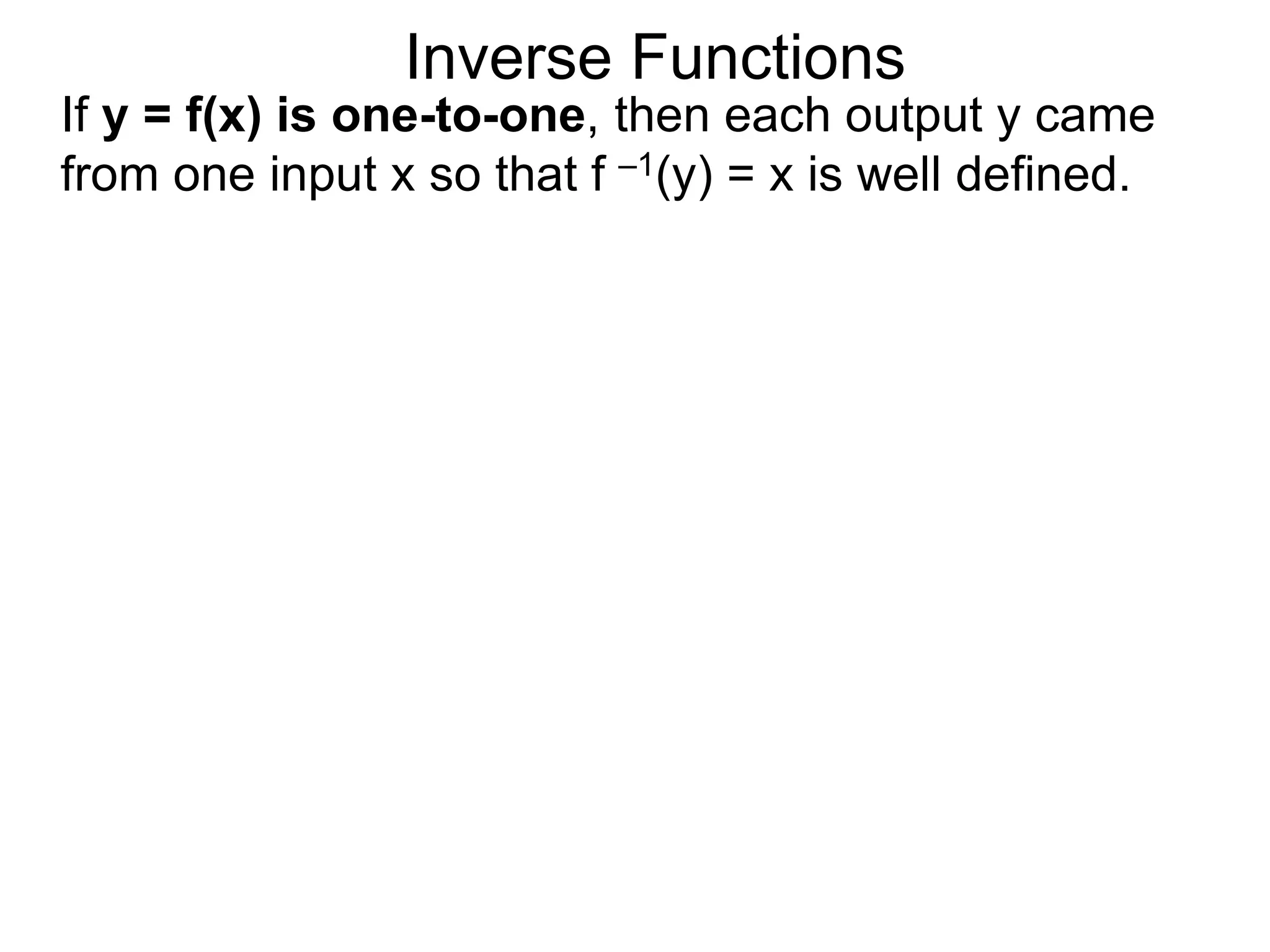
b. f(x) = x2 is not one-to-one
because 3  –3, but f(3) = f(–3) = 9.
Inverse Functions
u f(u)
v f(v)
u = v f(u) = f(v)
a one-to-one function
u
f(u)=f(v)
v
u = v
not a one-to-one function
A function is one-to-one if different inputs produce
different outputs or that two inputs give two outputs.
That is, f(x) is said to be one-to-one if for every two
inputs u and v such that u  v, then f(u)  f(v).
Example B.
a. g(x) = 2x is one-to-one
because if u  v, then 2u  2v.
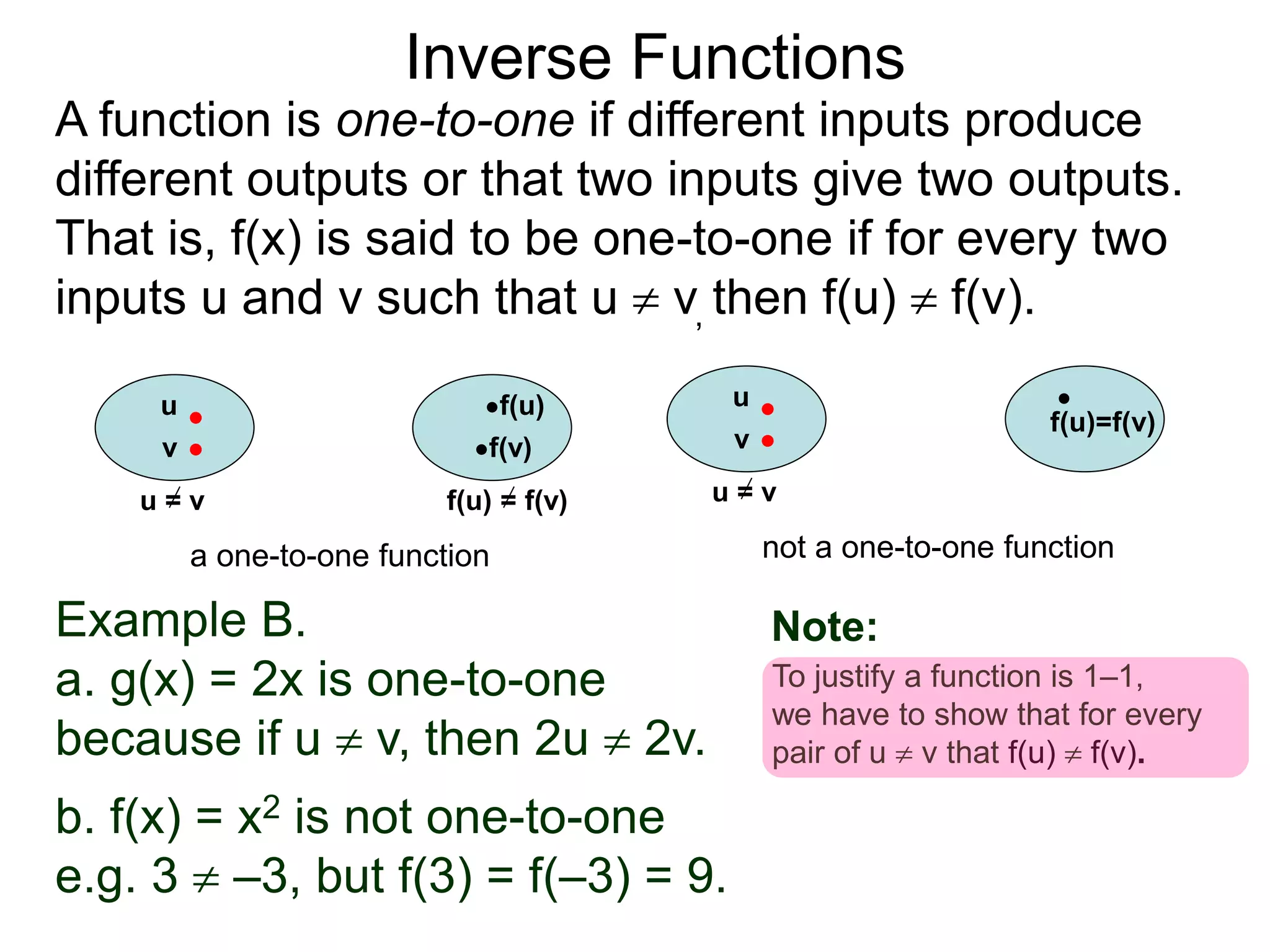
b. f(x) = x2 is not one-to-one
e.g. 3  –3, but f(3) = f(–3) = 9.
Inverse Functions
u f(u)
v f(v)
u = v f(u) = f(v)
a one-to-one function
u
f(u)=f(v)
v
u = v
not a one-to-one function
Note:
To justify a function is 1–1,
we have to show that for every
pair of u  v that f(u)  f(v).
A function is one-to-one if different inputs produce
different outputs or that two inputs give two outputs.
That is, f(x) is said to be one-to-one if for every two
inputs u and v such that u  v, then f(u)  f(v).
Example B.
a. g(x) = 2x is one-to-one
because if u  v, then 2u  2v.
b. f(x) = x2 is not one-to-one
e.g. 3  –3, but f(3) = f(–3) = 9.
Inverse Functions
u f(u)
v f(v)
u = v f(u) = f(v)
a one-to-one function
u
f(u)=f(v)
v
u = v
not a one-to-one function
Note:
To justify a function is 1–1,
we have to show that for every
pair of u  v that f(u)  f(v).
To justify a function is not 1–1,
all we need to do is to produce
one pair of u  v but f(u) = f(v).
A function is one-to-one if different inputs produce
different outputs or that two inputs give two outputs.
That is, f(x) is said to be one-to-one if for every two
inputs u and v such that u  v, then f(u)  f(v).
Inverse Functions
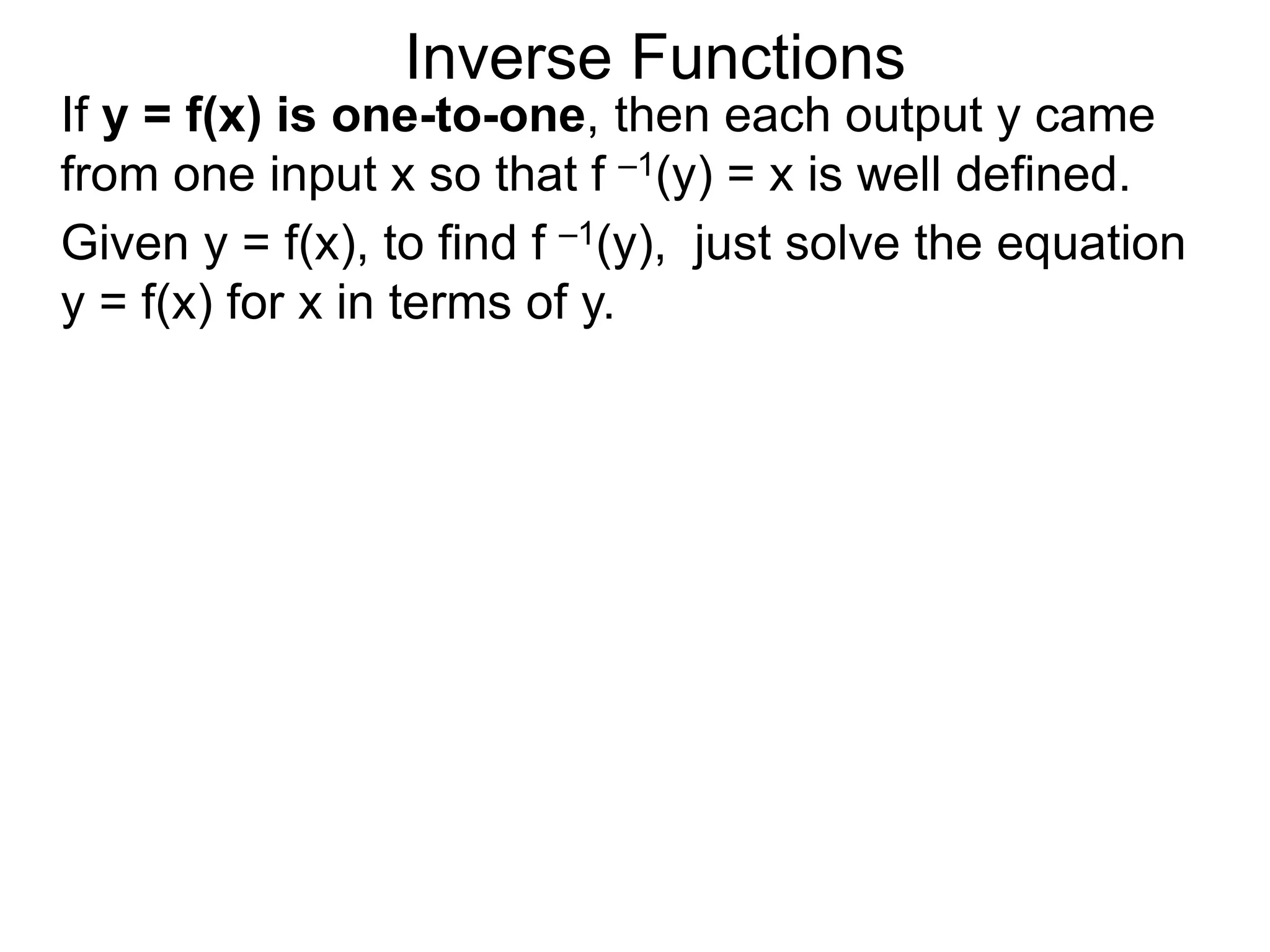
If y = f(x) is one-to-one, then each output y came
from one input x so that f –1(y) = x is well defined.
Inverse Functions
Given y = f(x), to find f –1(y), just solve the equation
y = f(x) for x in terms of y.
If y = f(x) is one-to-one, then each output y came
from one input x so that f –1(y) = x is well defined.
Inverse Functions
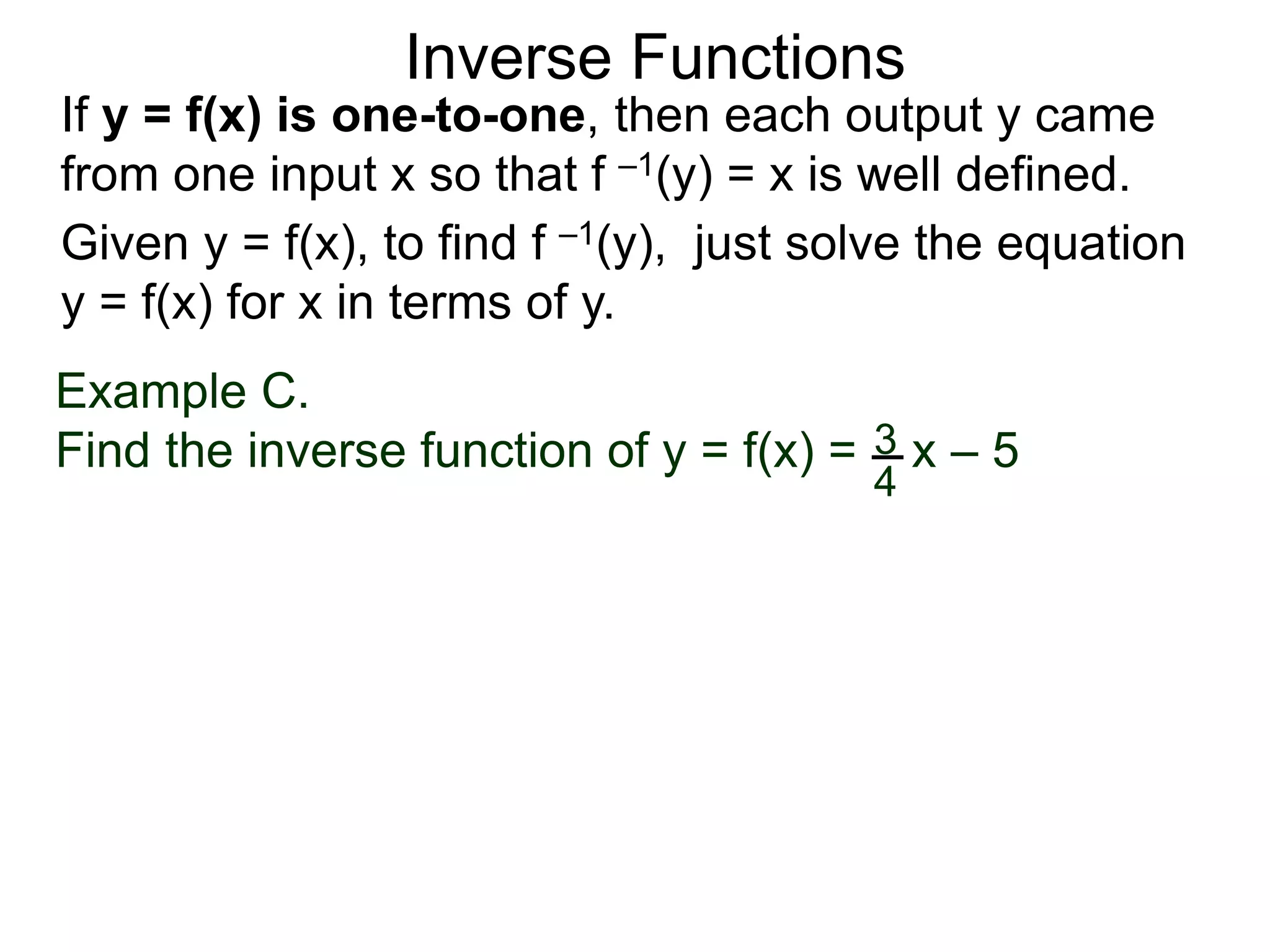
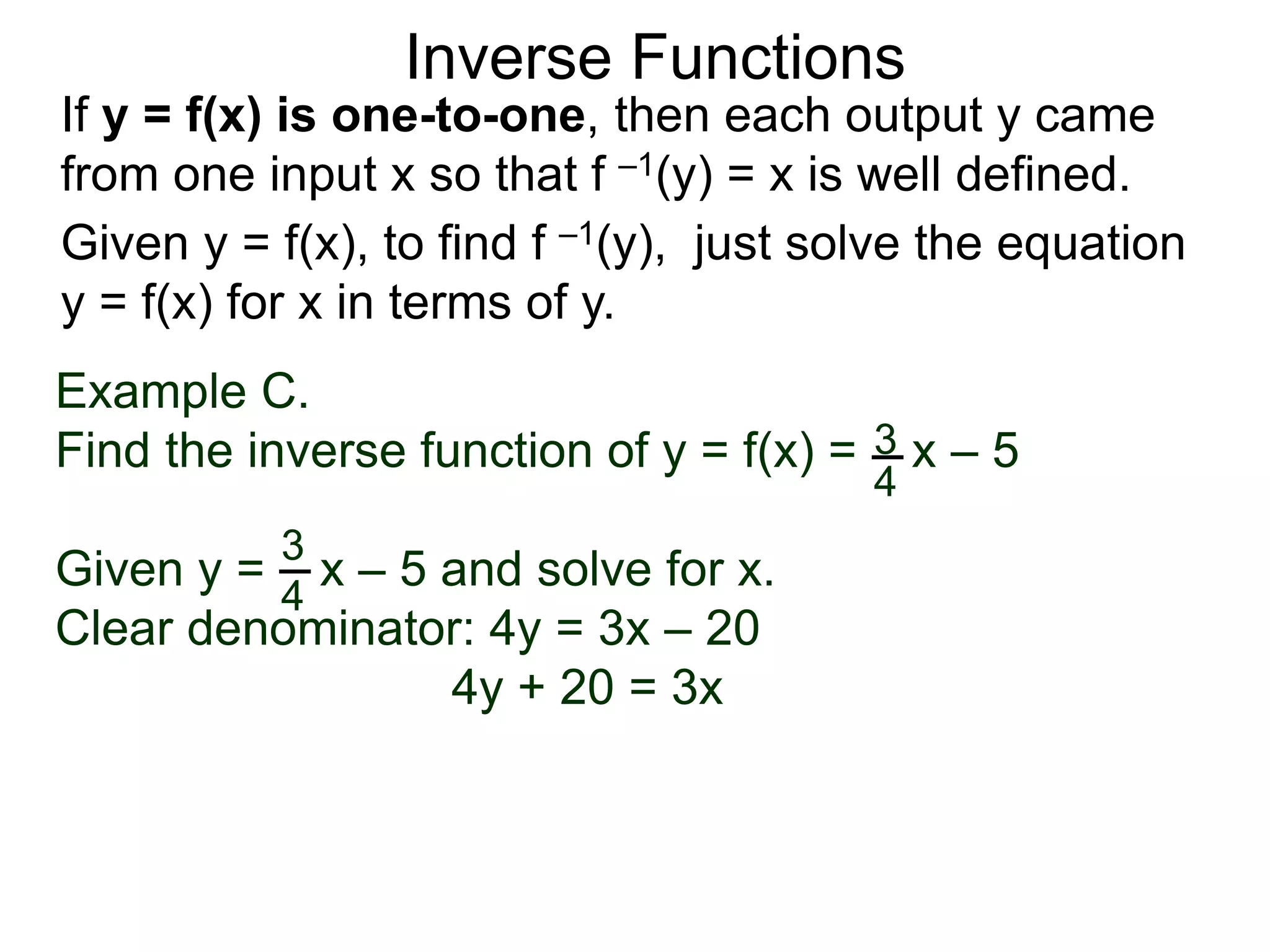
Example C.
Find the inverse function of y = f(x) = x – 53
4
Given y = f(x), to find f –1(y), just solve the equation
y = f(x) for x in terms of y.
If y = f(x) is one-to-one, then each output y came
from one input x so that f –1(y) = x is well defined.
Inverse Functions
Example C.
Find the inverse function of y = f(x) = x – 5
Given y = x – 5 and solve for x.
3
4
3
4
Given y = f(x), to find f –1(y), just solve the equation
y = f(x) for x in terms of y.
If y = f(x) is one-to-one, then each output y came
from one input x so that f –1(y) = x is well defined.
Inverse Functions
Example C.
Find the inverse function of y = f(x) = x – 5
Given y = x – 5 and solve for x.
Clear denominator: 4y = 3x – 20
3
4
3
4
Given y = f(x), to find f –1(y), just solve the equation
y = f(x) for x in terms of y.
If y = f(x) is one-to-one, then each output y came
from one input x so that f –1(y) = x is well defined.
Inverse Functions
Example C.
Find the inverse function of y = f(x) = x – 5
Given y = x – 5 and solve for x.
Clear denominator: 4y = 3x – 20
4y + 20 = 3x
3
4
3
4
Given y = f(x), to find f –1(y), just solve the equation
y = f(x) for x in terms of y.
If y = f(x) is one-to-one, then each output y came
from one input x so that f –1(y) = x is well defined.
Inverse Functions
Example C.
Find the inverse function of y = f(x) = x – 5
Given y = x – 5 and solve for x.
Clear denominator: 4y = 3x – 20
4y + 20 = 3x
x =
3
4
3
4
4y + 20
3
Given y = f(x), to find f –1(y), just solve the equation
y = f(x) for x in terms of y.
If y = f(x) is one-to-one, then each output y came
from one input x so that f –1(y) = x is well defined.
If y = f(x) is one-to-one, then each output y came
from one input x so that f –1(y) = x is well defined.
Inverse Functions
Example C.
Find the inverse function of y = f(x) = x – 5
Given y = x – 5 and solve for x.
Clear denominator: 4y = 3x – 20
4y + 20 = 3x
x =
3
4
3
4
4y + 20
3
Given y = f(x), to find f –1(y), just solve the equation
y = f(x) for x in terms of y.
Hence f –1(y) =
4y + 20
3
Inverse Trigonometric Functions
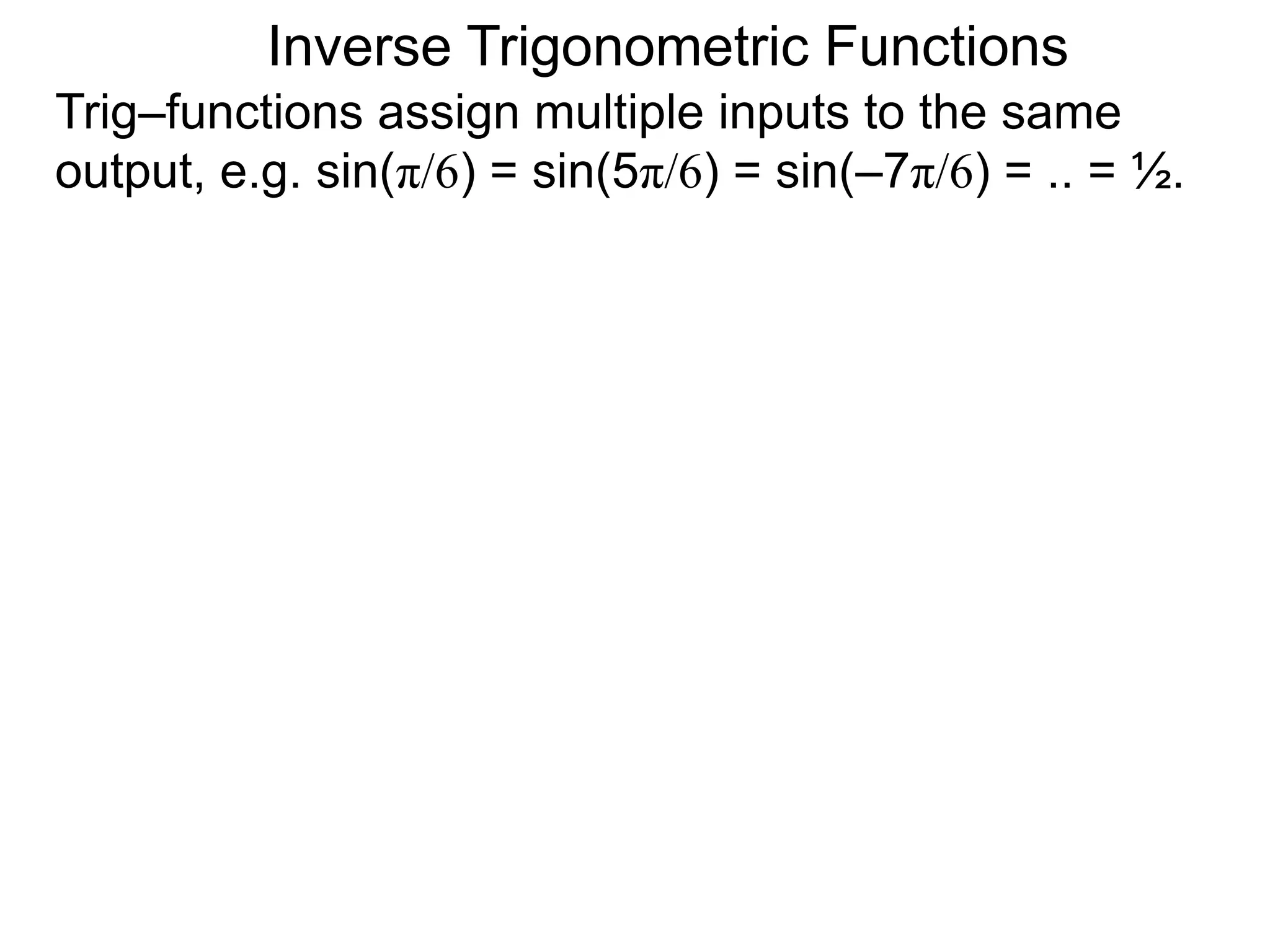
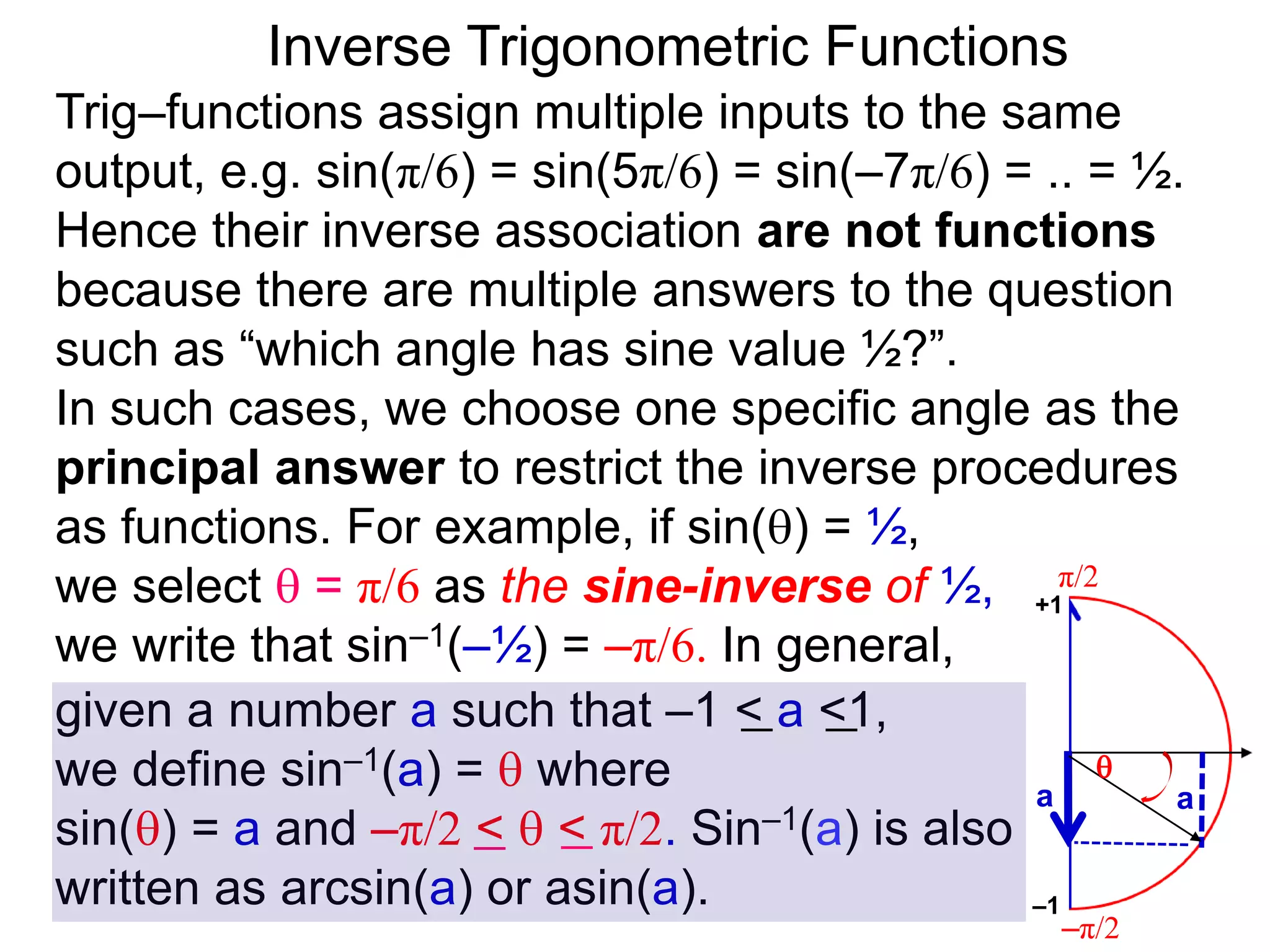
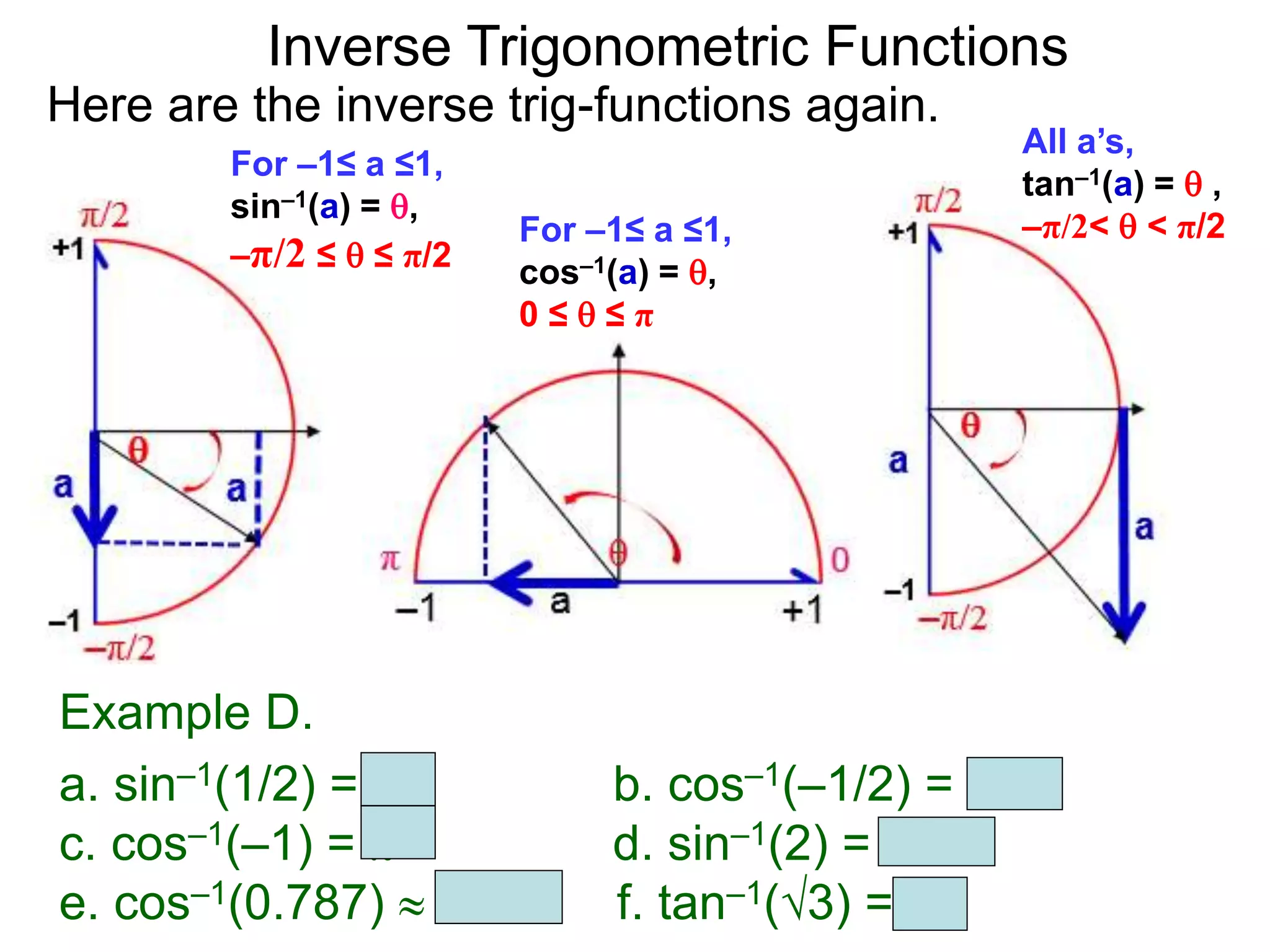
Trig–functions assign multiple inputs to the same
output, e.g. sin(π/6) = sin(5π/6) = sin(–7π/6) = .. = ½.
Inverse Trigonometric Functions
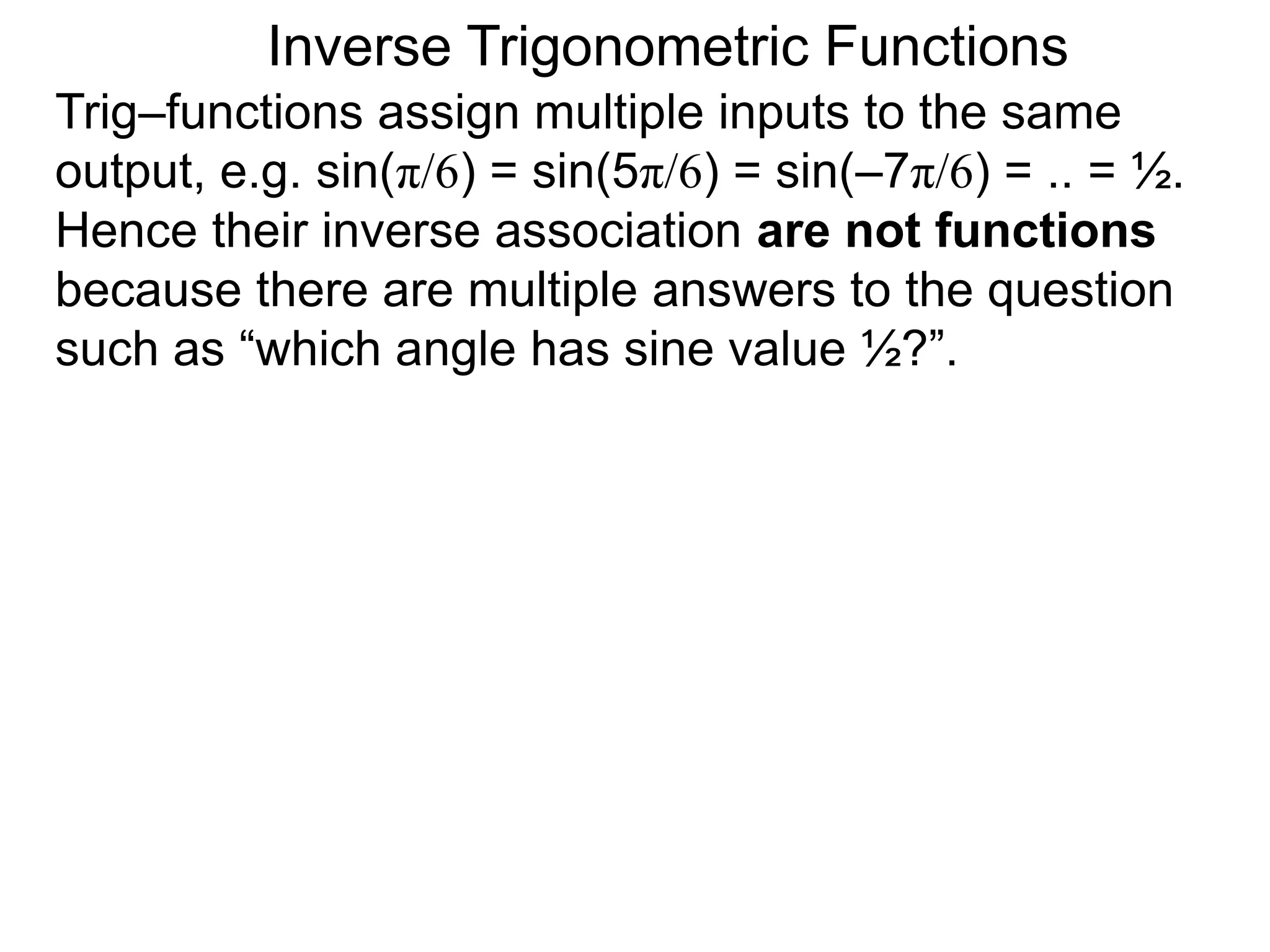
Trig–functions assign multiple inputs to the same
output, e.g. sin(π/6) = sin(5π/6) = sin(–7π/6) = .. = ½.
Hence their inverse association are not functions
because there are multiple answers to the question
such as “which angle has sine value ½?”.
Inverse Trigonometric Functions
Trig–functions assign multiple inputs to the same
output, e.g. sin(π/6) = sin(5π/6) = sin(–7π/6) = .. = ½.
Hence their inverse association are not functions
because there are multiple answers to the question
such as “which angle has sine value ½?”.
In such cases, we choose one specific angle as the
principal answer to restrict the inverse procedures
as functions.
Inverse Trigonometric Functions
Trig–functions assign multiple inputs to the same
output, e.g. sin(π/6) = sin(5π/6) = sin(–7π/6) = .. = ½.
Hence their inverse association are not functions
because there are multiple answers to the question
such as “which angle has sine value ½?”.
In such cases, we choose one specific angle as the
principal answer to restrict the inverse procedures
as functions. For example, if sin() = ½,
we select  = π/6 as the sine-inverse of ½,
we write that sin–1(½) = π/6.
Inverse Trigonometric Functions
Trig–functions assign multiple inputs to the same
output, e.g. sin(π/6) = sin(5π/6) = sin(–7π/6) = .. = ½.
Hence their inverse association are not functions
because there are multiple answers to the question
such as “which angle has sine value ½?”.
In such cases, we choose one specific angle as the
principal answer to restrict the inverse procedures
as functions. For example, if sin() = ½,
we select  = π/6 as the sine-inverse of ½,
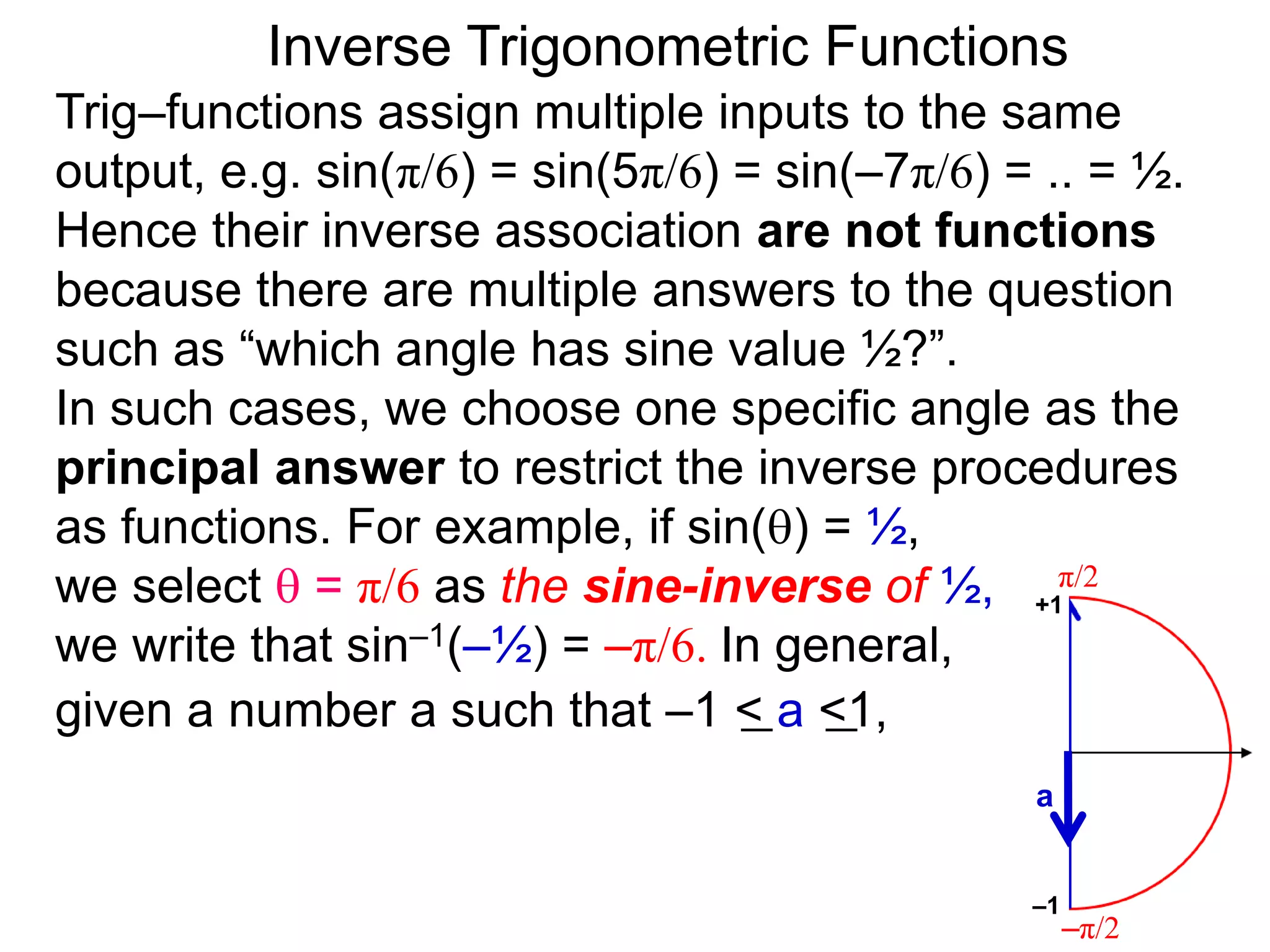
we write that sin–1(–½) = –π/6. In general,
given a number a such that –1 < a <1,
π/2
–π/2
a
–1
+1
Inverse Trigonometric Functions
Trig–functions assign multiple inputs to the same
output, e.g. sin(π/6) = sin(5π/6) = sin(–7π/6) = .. = ½.
Hence their inverse association are not functions
because there are multiple answers to the question
such as “which angle has sine value ½?”.
In such cases, we choose one specific angle as the
principal answer to restrict the inverse procedures
as functions. For example, if sin() = ½,
we select  = π/6 as the sine-inverse of ½,
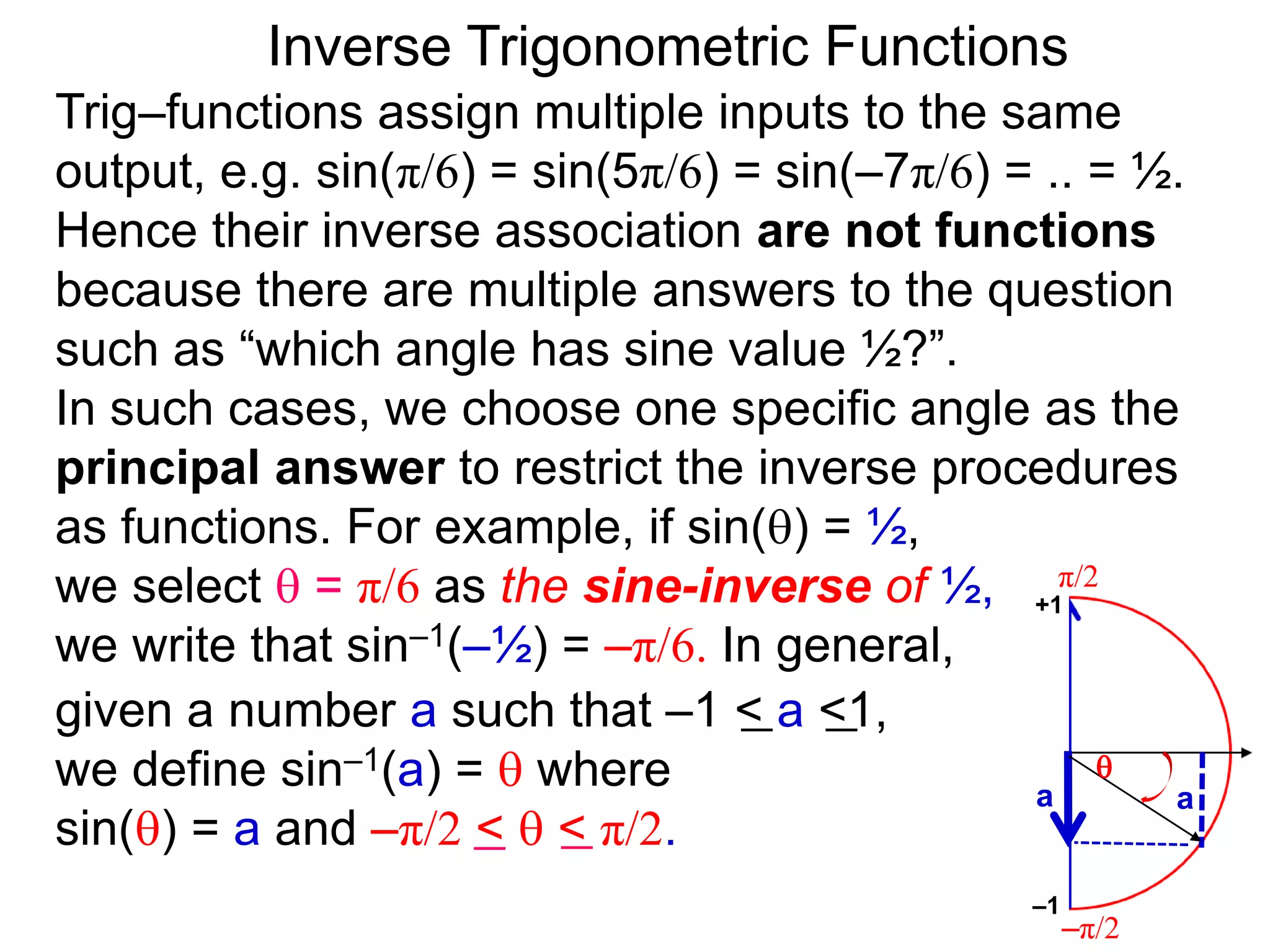
we write that sin–1(–½) = –π/6. In general,
given a number a such that –1 < a <1,
we define sin–1(a) =  where
sin() = a and –π/2 <  < π/2.
π/2
–π/2
aa

–1
+1
Inverse Trigonometric Functions
Trig–functions assign multiple inputs to the same
output, e.g. sin(π/6) = sin(5π/6) = sin(–7π/6) = .. = ½.
Hence their inverse association are not functions
because there are multiple answers to the question
such as “which angle has sine value ½?”.
In such cases, we choose one specific angle as the
principal answer to restrict the inverse procedures
as functions. For example, if sin() = ½,
we select  = π/6 as the sine-inverse of ½,
we write that sin–1(–½) = –π/6. In general,
given a number a such that –1 < a <1,
we define sin–1(a) =  where
sin() = a and –π/2 <  < π/2. Sin–1(a) is also
written as arcsin(a) or asin(a).
π/2
–π/2
aa

–1
+1
Inverse Trigonometric Functions
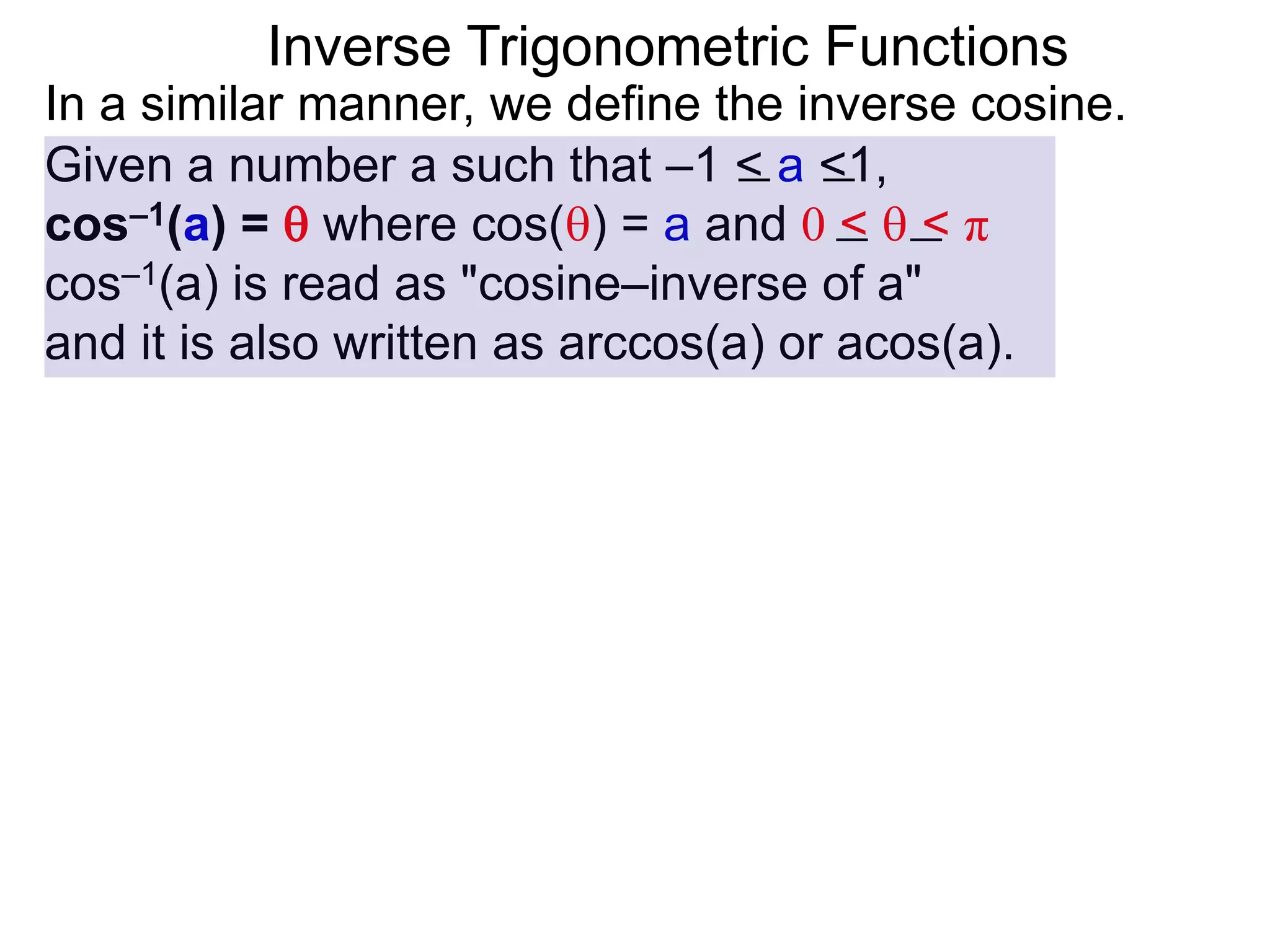
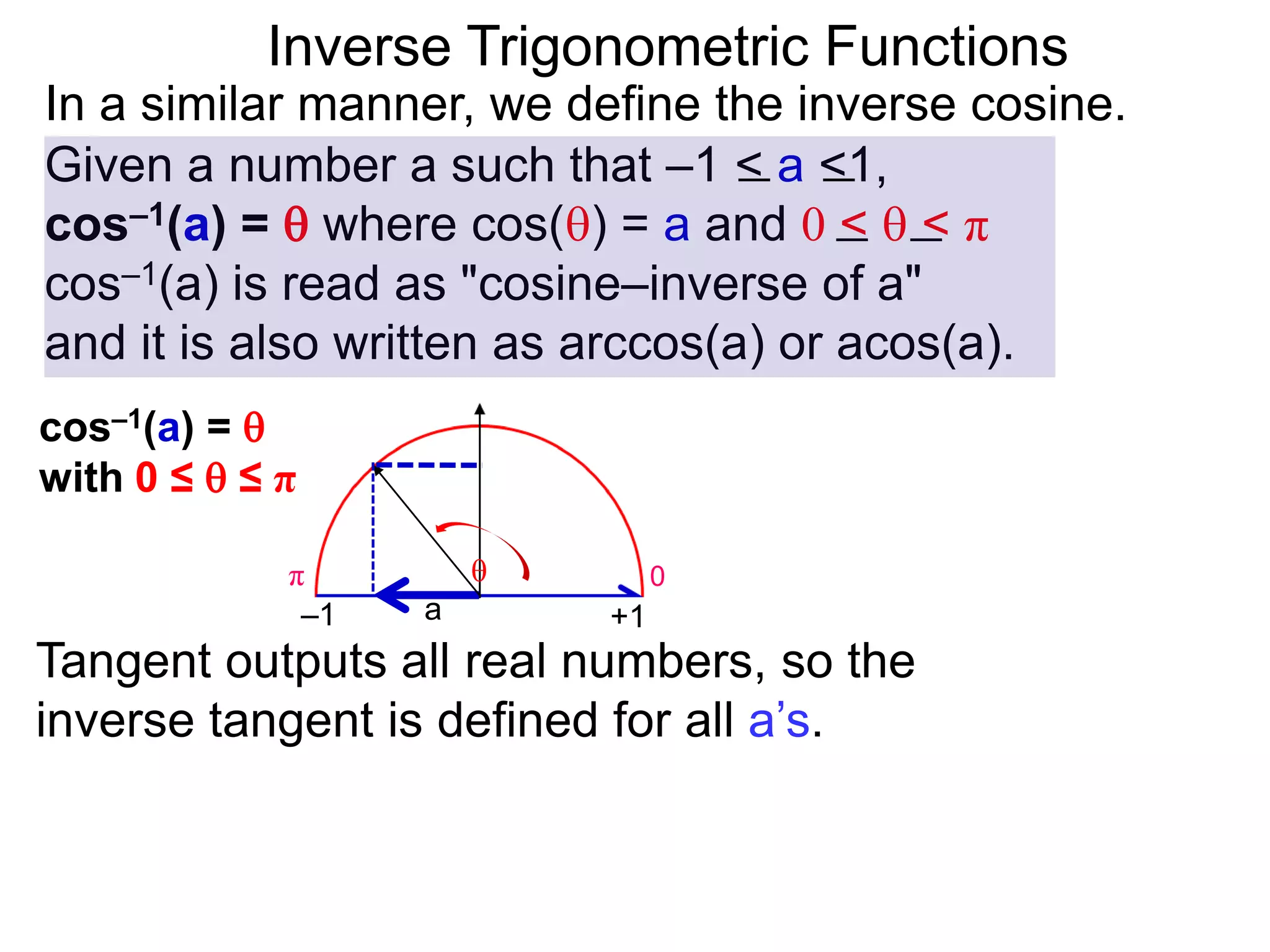
In a similar manner, we define the inverse cosine.
Given a number a such that –1 < a <1,
cos–1(a) =  where cos() = a and 0 <  < π
cos–1(a) is read as "cosine–inverse of a"
and it is also written as arccos(a) or acos(a).
Inverse Trigonometric Functions
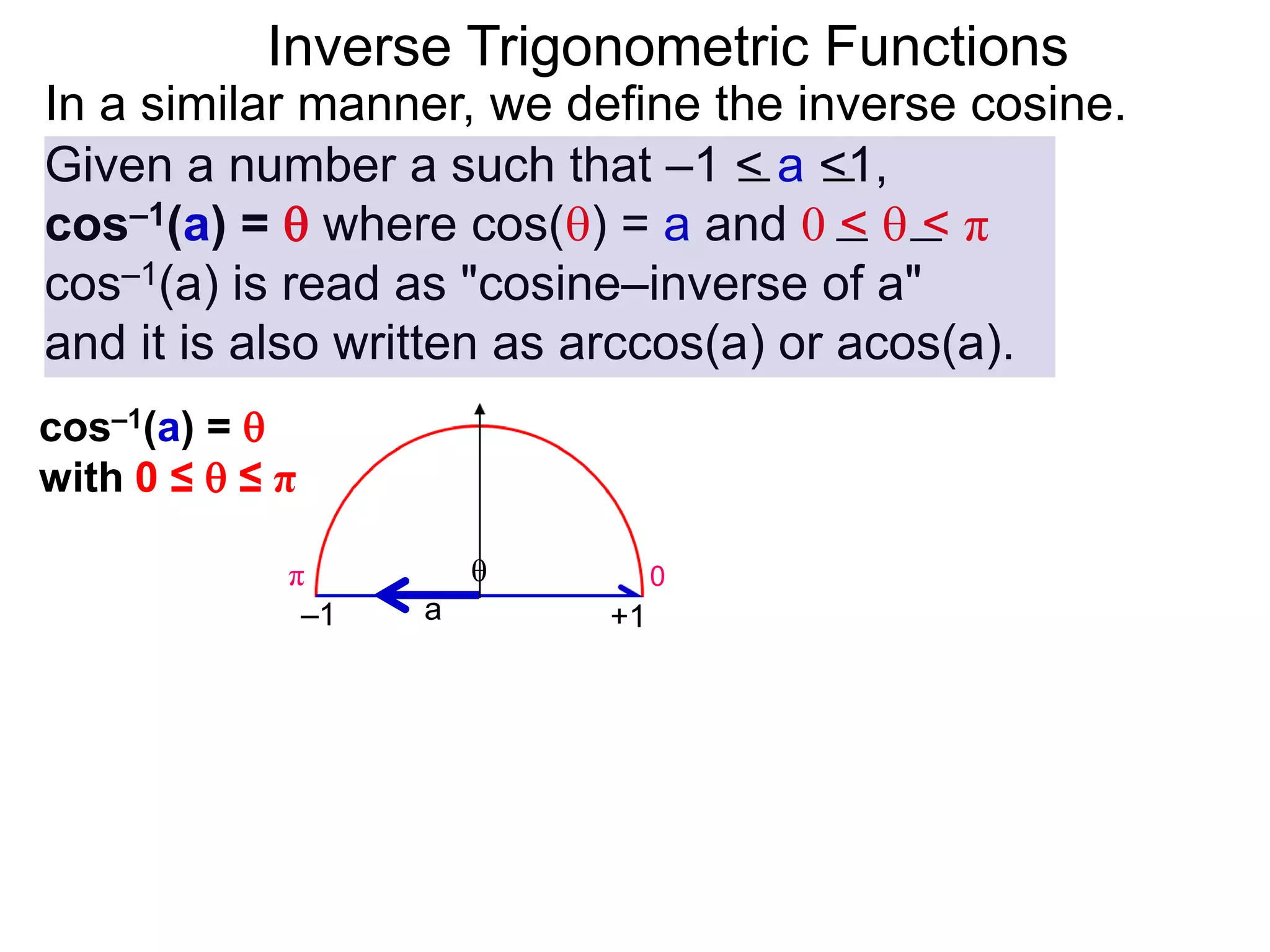
In a similar manner, we define the inverse cosine.
Given a number a such that –1 < a <1,
cos–1(a) =  where cos() = a and 0 <  < π
cos–1(a) is read as "cosine–inverse of a"
and it is also written as arccos(a) or acos(a).
0π
a

–1 +1
cos–1(a) = 
with 0 ≤  ≤ π
Inverse Trigonometric Functions
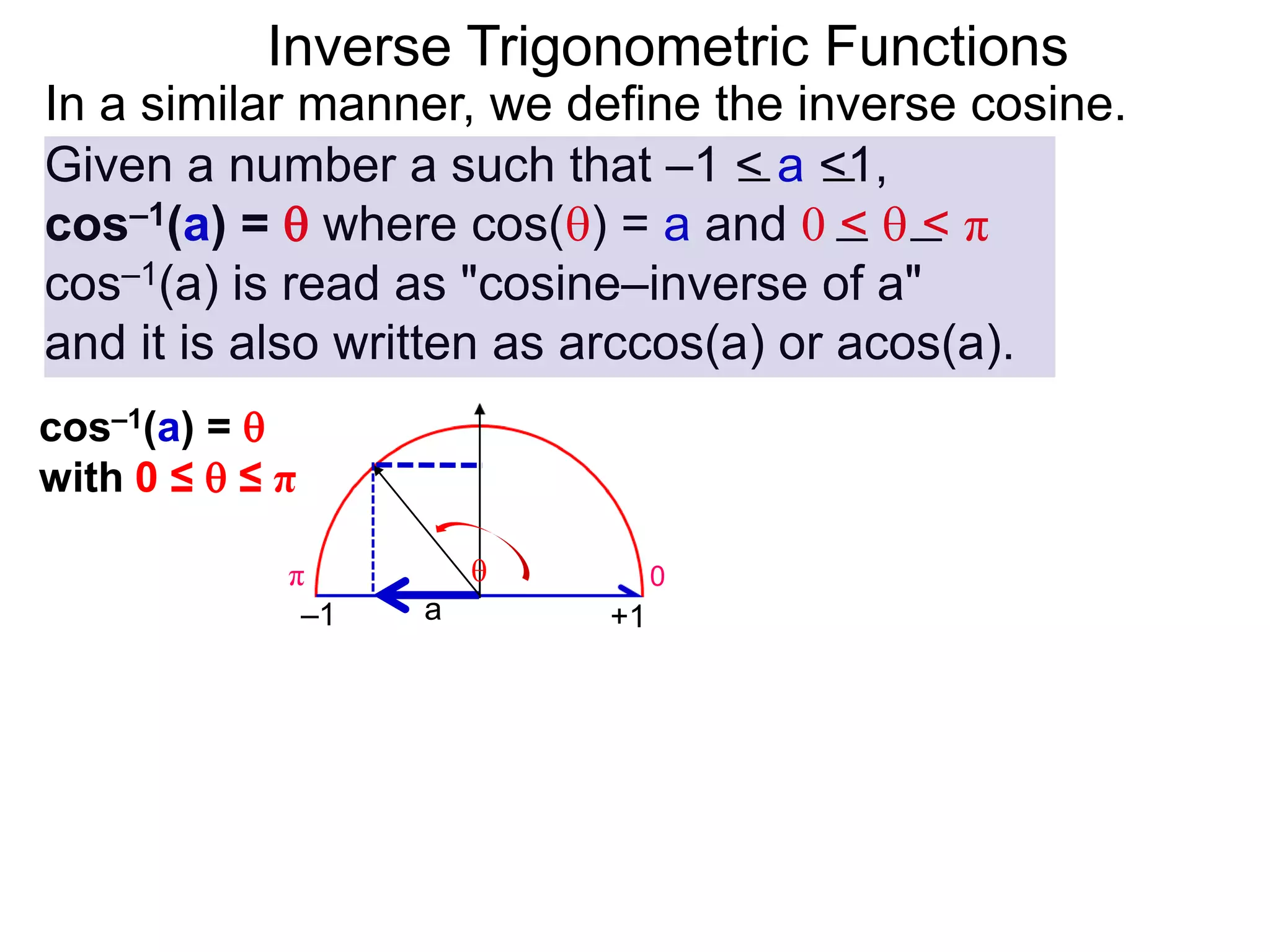
In a similar manner, we define the inverse cosine.
Given a number a such that –1 < a <1,
cos–1(a) =  where cos() = a and 0 <  < π
cos–1(a) is read as "cosine–inverse of a"
and it is also written as arccos(a) or acos(a).
0π
a

–1 +1
cos–1(a) = 
with 0 ≤  ≤ π
Inverse Trigonometric Functions
In a similar manner, we define the inverse cosine.
Given a number a such that –1 < a <1,
cos–1(a) =  where cos() = a and 0 <  < π
cos–1(a) is read as "cosine–inverse of a"
and it is also written as arccos(a) or acos(a).
Tangent outputs all real numbers, so the
inverse tangent is defined for all a’s.
0π
a

–1 +1
cos–1(a) = 
with 0 ≤  ≤ π
Inverse Trigonometric Functions
In a similar manner, we define the inverse cosine.
Given a number a such that –1 < a <1,
cos–1(a) =  where cos() = a and 0 <  < π
cos–1(a) is read as "cosine–inverse of a"
and it is also written as arccos(a) or acos(a).
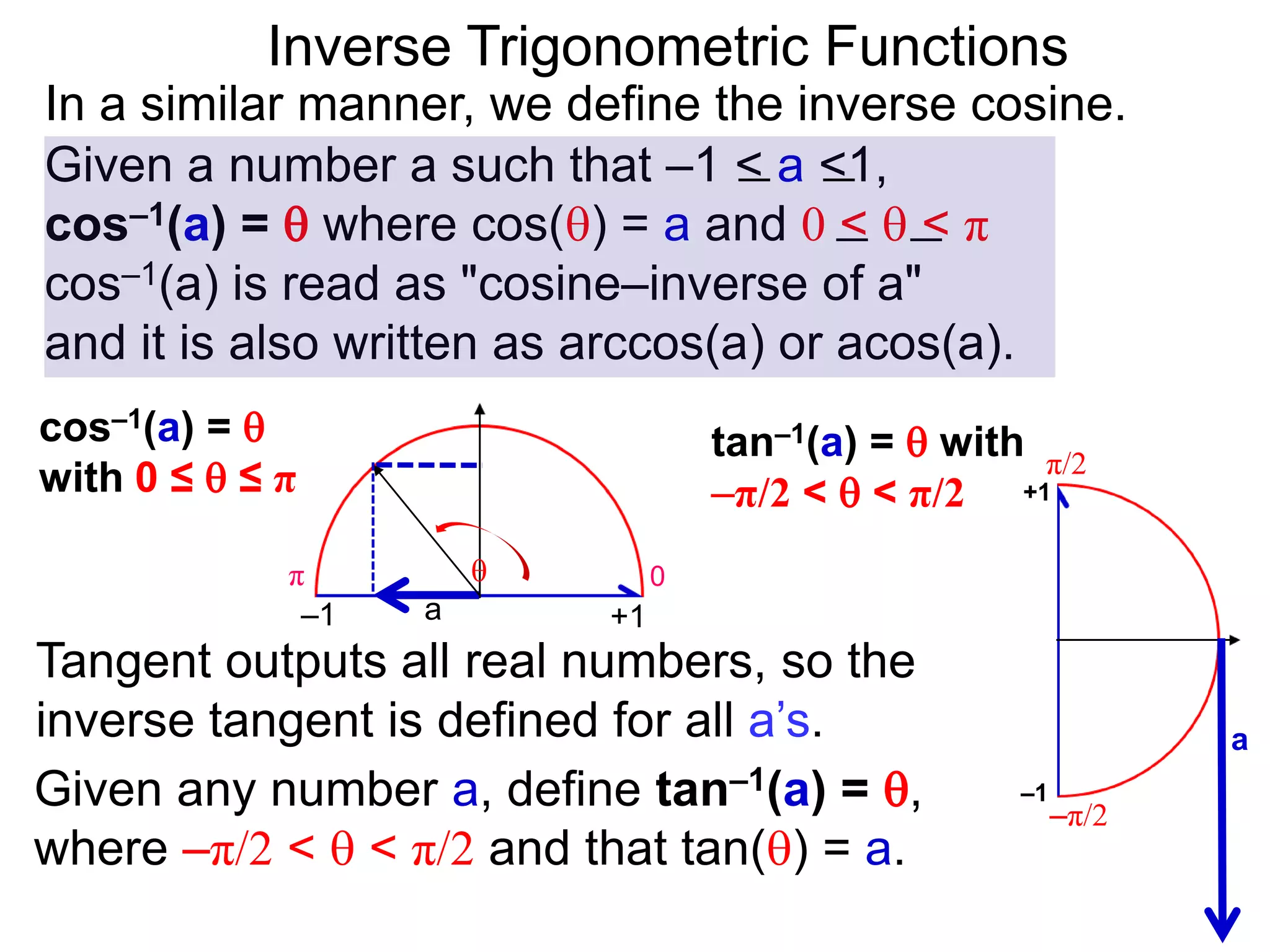
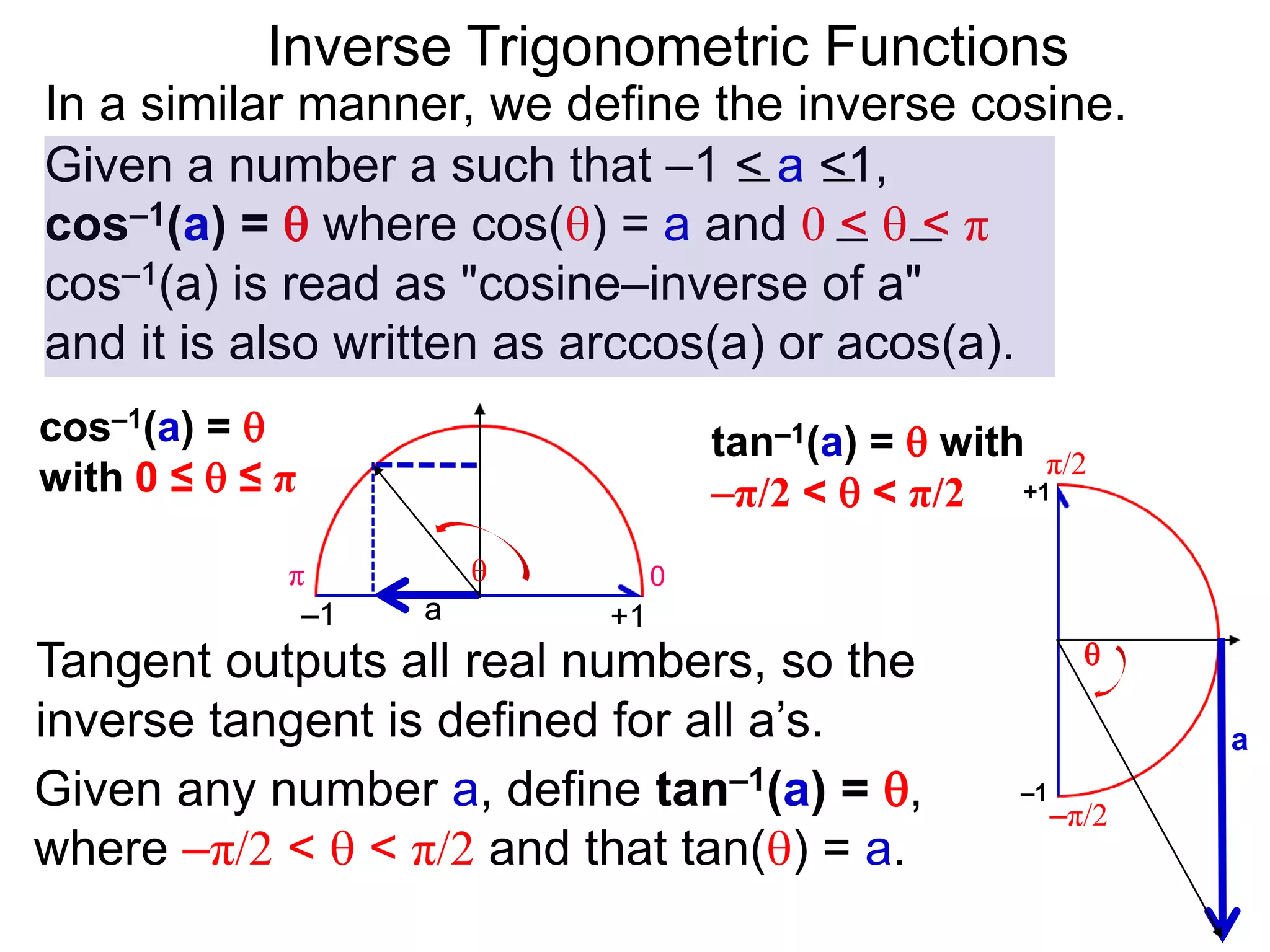
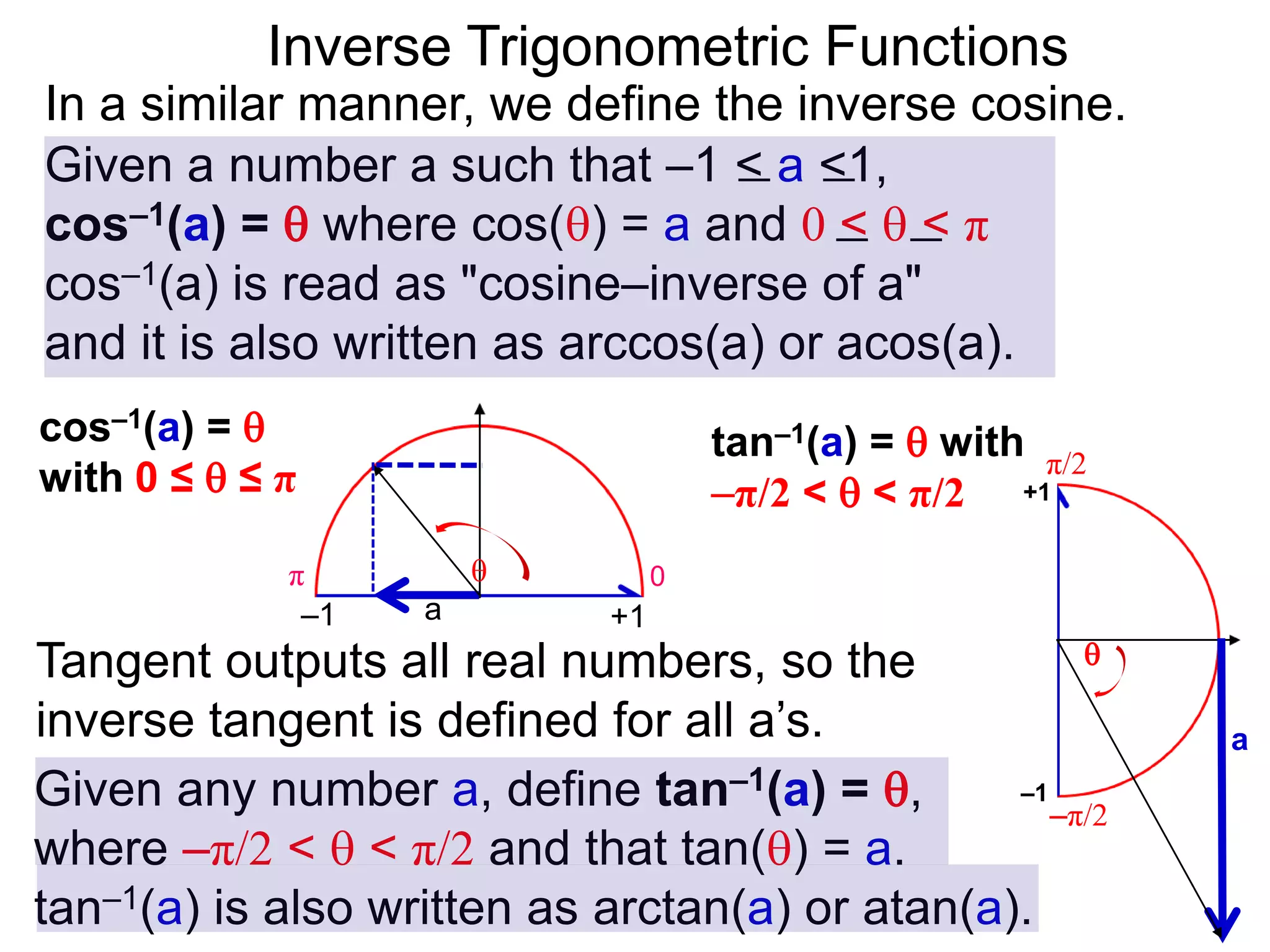
Given any number a, define tan–1(a) = ,
where –π/2 <  < π/2 and that tan() = a.
Tangent outputs all real numbers, so the
inverse tangent is defined for all a’s.
0π
a

–1 +1
cos–1(a) = 
with 0 ≤  ≤ π
tan–1(a) =  with
–π/2 <  < π/2
π/2
–π/2
a
–1
+1
Inverse Trigonometric Functions
In a similar manner, we define the inverse cosine.
Given a number a such that –1 < a <1,
cos–1(a) =  where cos() = a and 0 <  < π
cos–1(a) is read as "cosine–inverse of a"
and it is also written as arccos(a) or acos(a).
Given any number a, define tan–1(a) = ,
where –π/2 <  < π/2 and that tan() = a.
Tangent outputs all real numbers, so the
inverse tangent is defined for all a’s.
tan–1(a) =  with
–π/2 <  < π/2
0π
a

–1 +1
π/2
–π/2
a

–1
+1
cos–1(a) = 
with 0 ≤  ≤ π
Inverse Trigonometric Functions
In a similar manner, we define the inverse cosine.
Given a number a such that –1 < a <1,
cos–1(a) =  where cos() = a and 0 <  < π
cos–1(a) is read as "cosine–inverse of a"
and it is also written as arccos(a) or acos(a).
Given any number a, define tan–1(a) = ,
where –π/2 <  < π/2 and that tan() = a.
tan–1(a) is also written as arctan(a) or atan(a).
Tangent outputs all real numbers, so the
inverse tangent is defined for all a’s.
tan–1(a) =  with
–π/2 <  < π/2
0π
a

–1 +1
π/2
–π/2
a

–1
+1
cos–1(a) = 
with 0 ≤  ≤ π
Inverse Trigonometric Functions
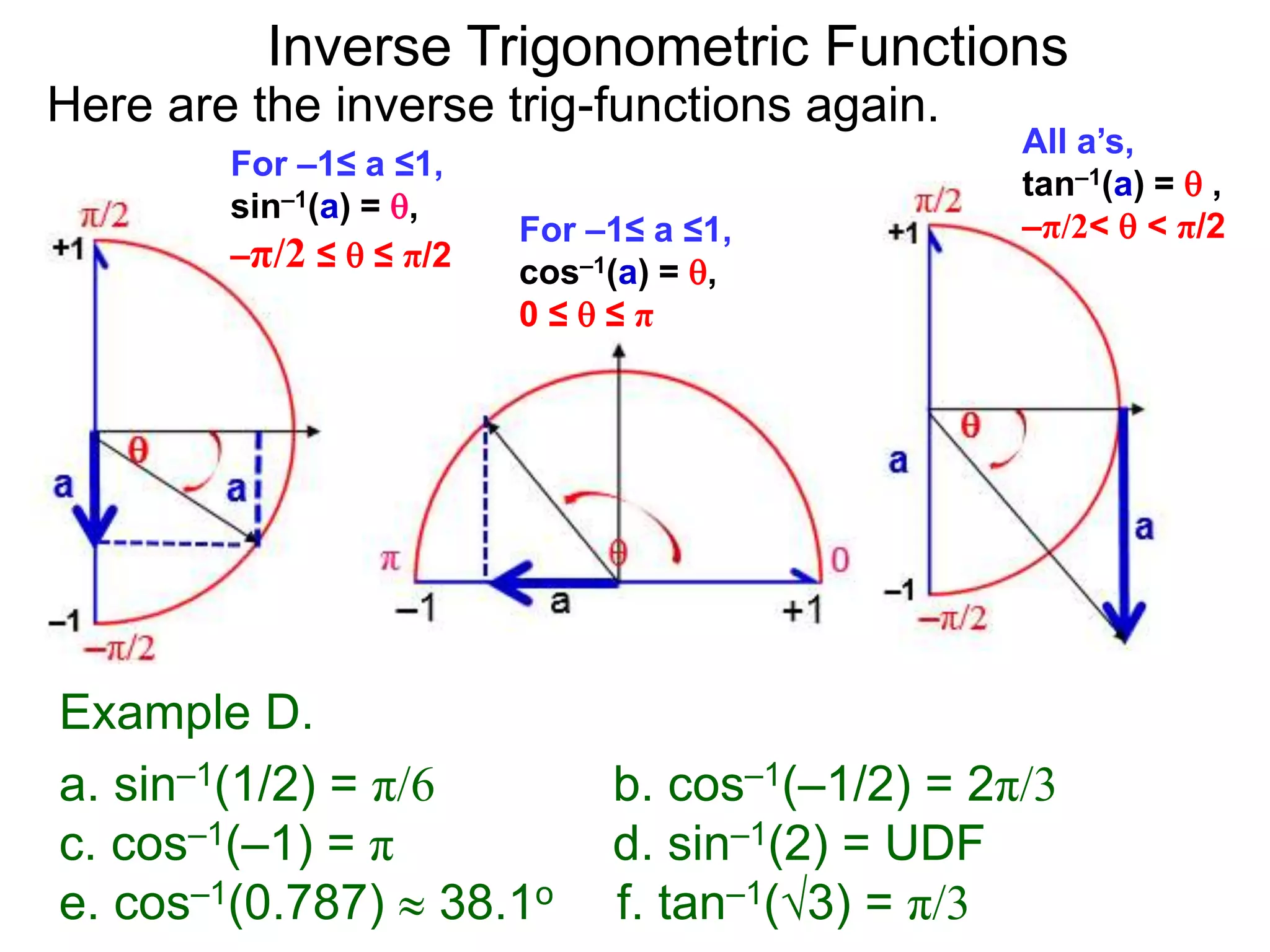
Example D.
a. sin–1(1/2) = π/6 b. cos–1(–1/2) = 2π/3
c. cos–1(–1) = π d. sin–1(2) = UND
e. cos–1(0.787)  38.1o f. tan–1(3) = π/3
For –1≤ a ≤1,
cos–1(a) = ,
0 ≤  ≤ π
Here are the inverse trig-functions again.
For –1≤ a ≤1,
sin–1(a) = ,
–π/2 ≤  ≤ π/2
All a’s,
tan–1(a) =  ,
–π/2<  < π/2
Inverse Trigonometric Functions
Example D.
a. sin–1(1/2) = π/6 b. cos–1(–1/2) = 2π/3
c. cos–1(–1) = π d. sin–1(2) = UDF
e. cos–1(0.787)  38.1o f. tan–1(3) = π/3
For –1≤ a ≤1,
cos–1(a) = ,
0 ≤  ≤ π
Here are the inverse trig-functions again.
For –1≤ a ≤1,
sin–1(a) = ,
–π/2 ≤  ≤ π/2
All a’s,
tan–1(a) =  ,
–π/2<  < π/2
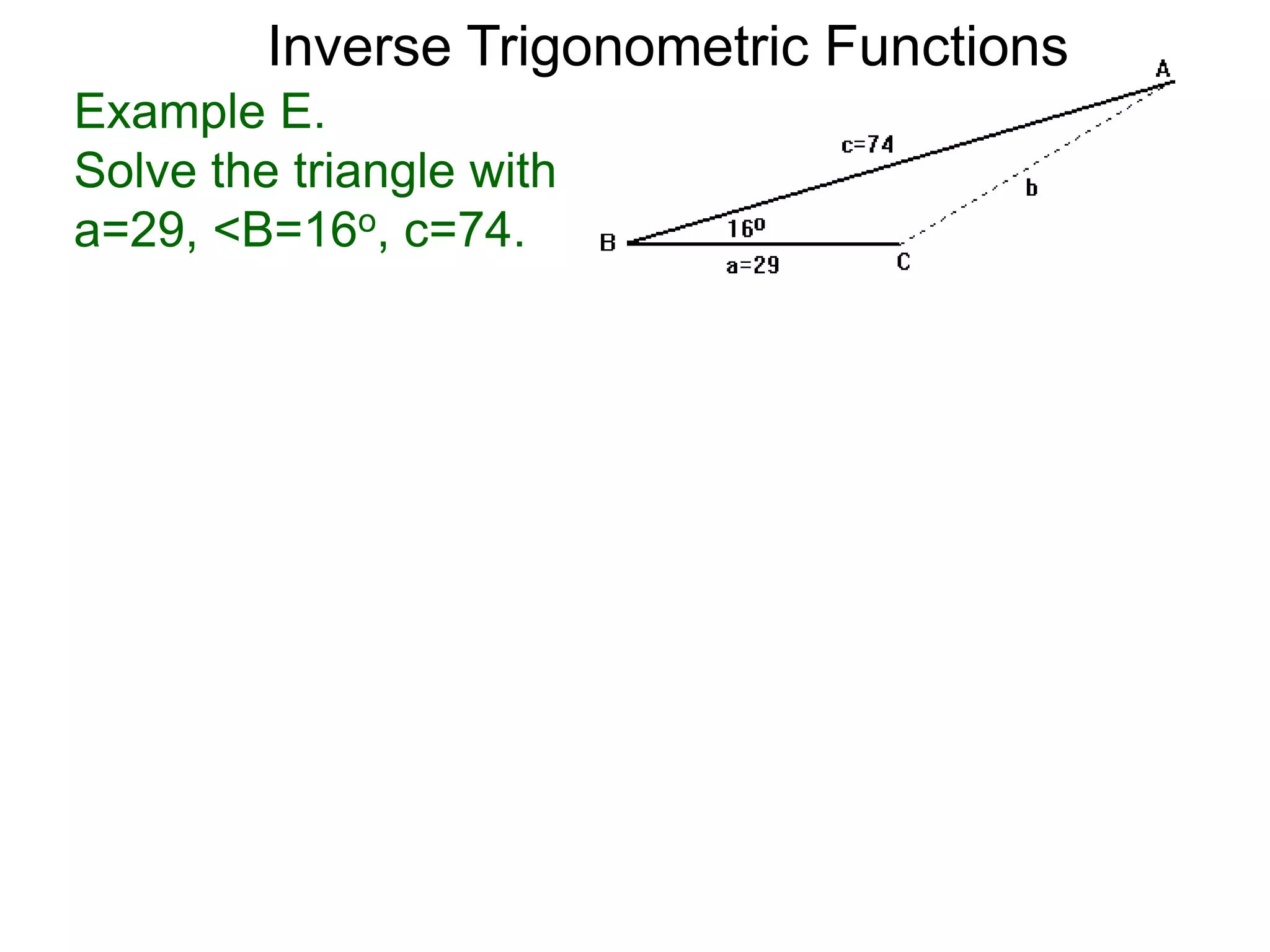
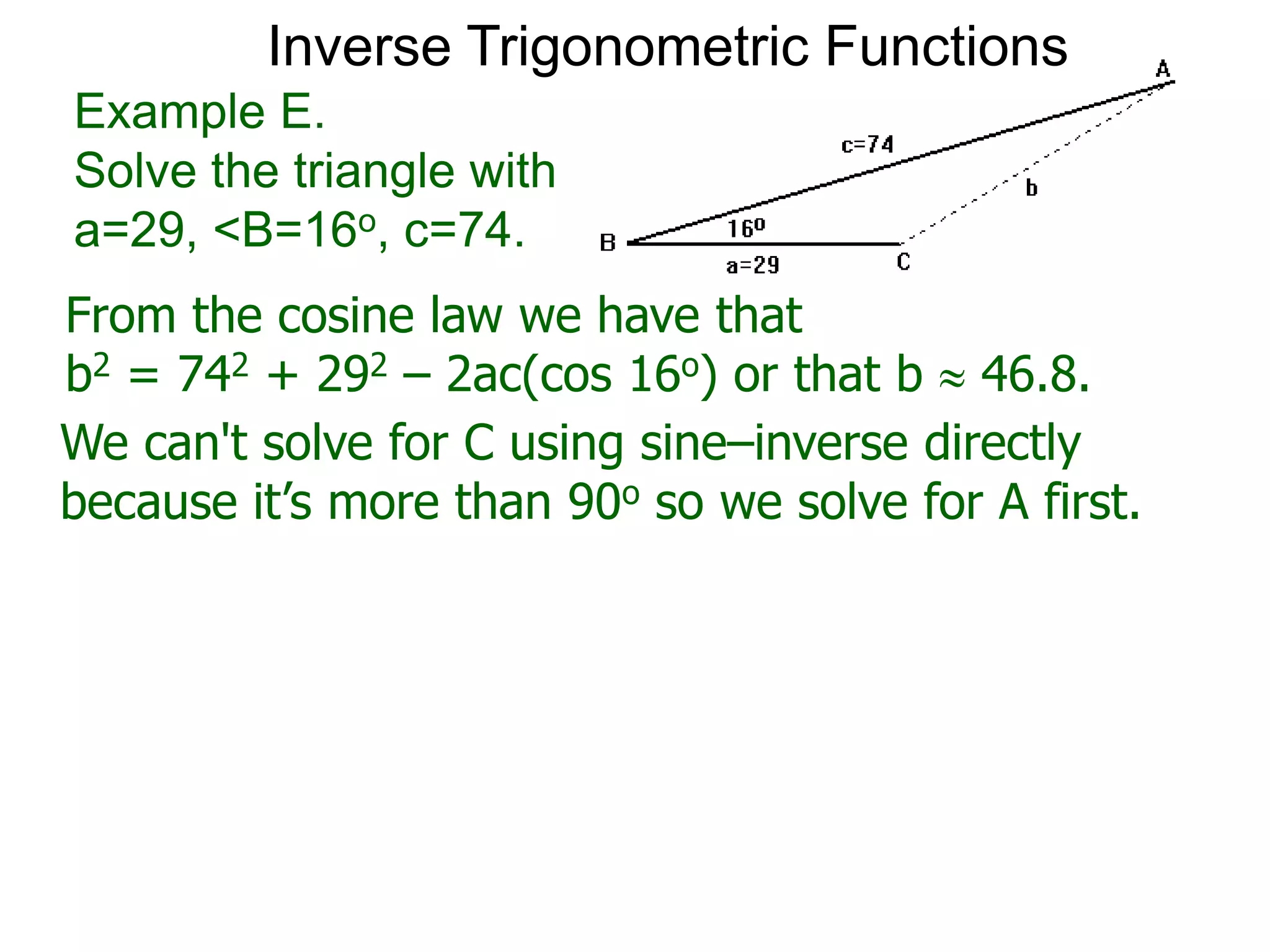
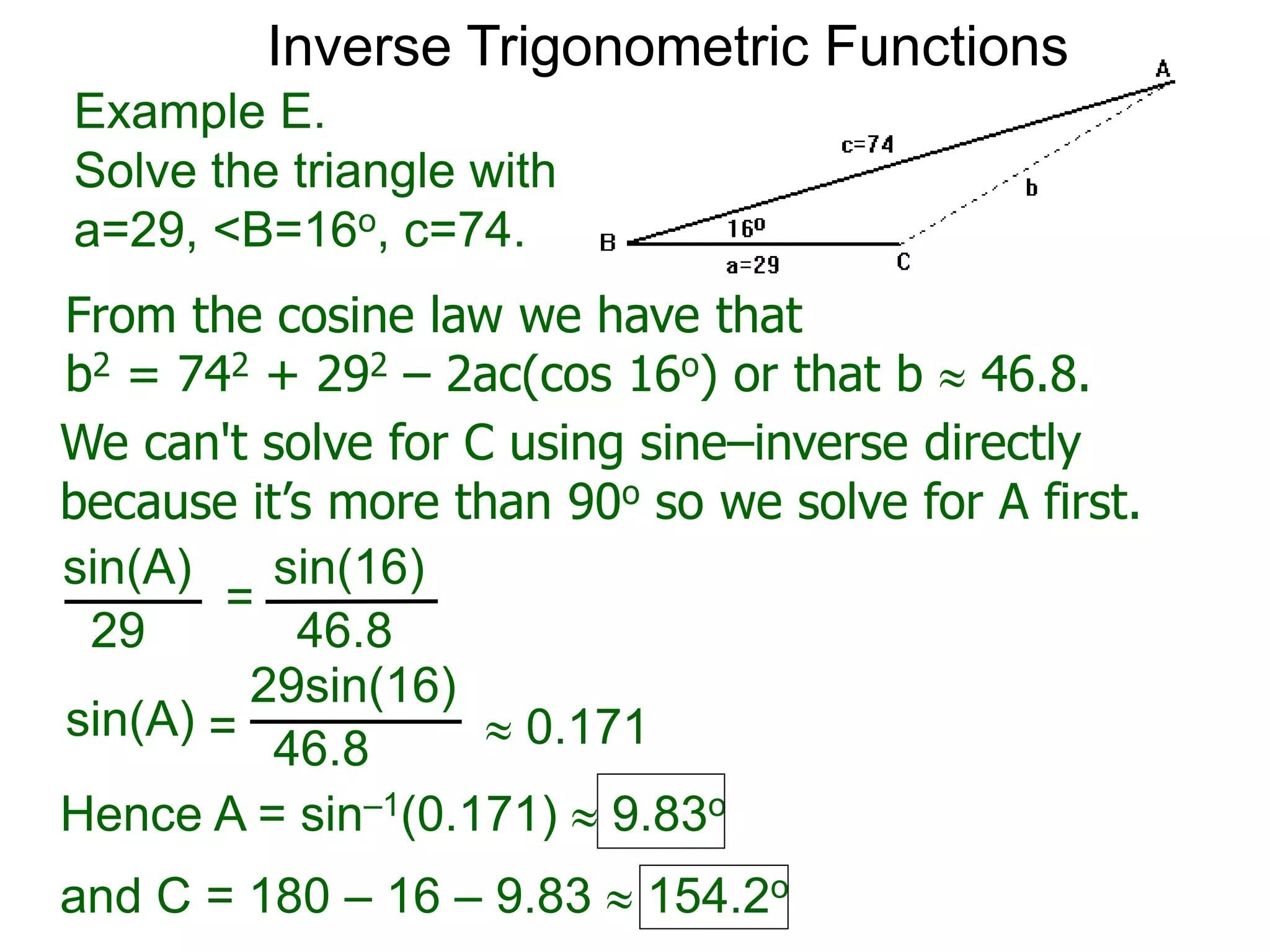
Example E.
Solve the triangle with
a=29, <B=16o, c=74.
Inverse Trigonometric Functions
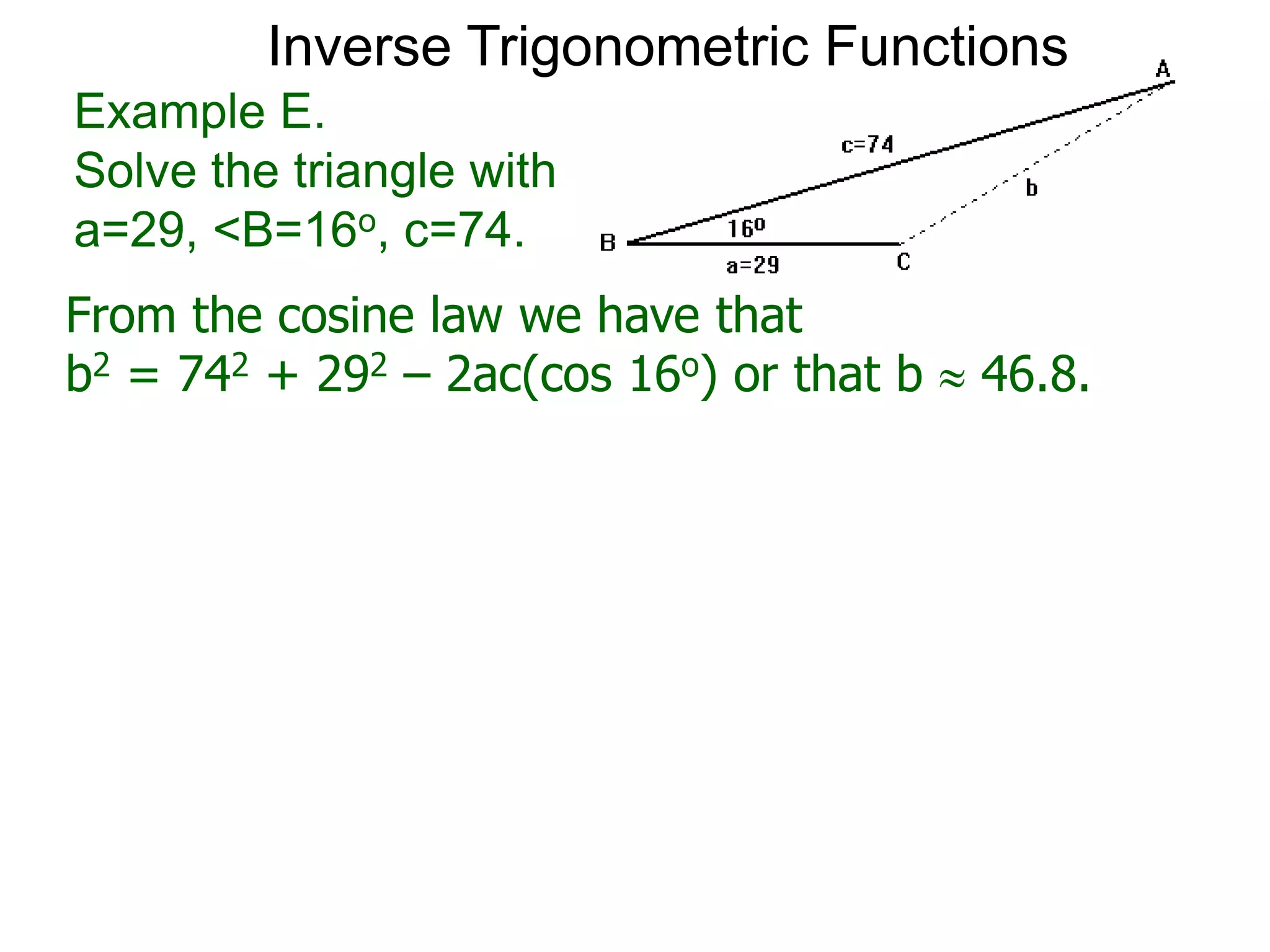
From the cosine law we have that
b2 = 742 + 292 – 2ac(cos 16o) or that b  46.8.
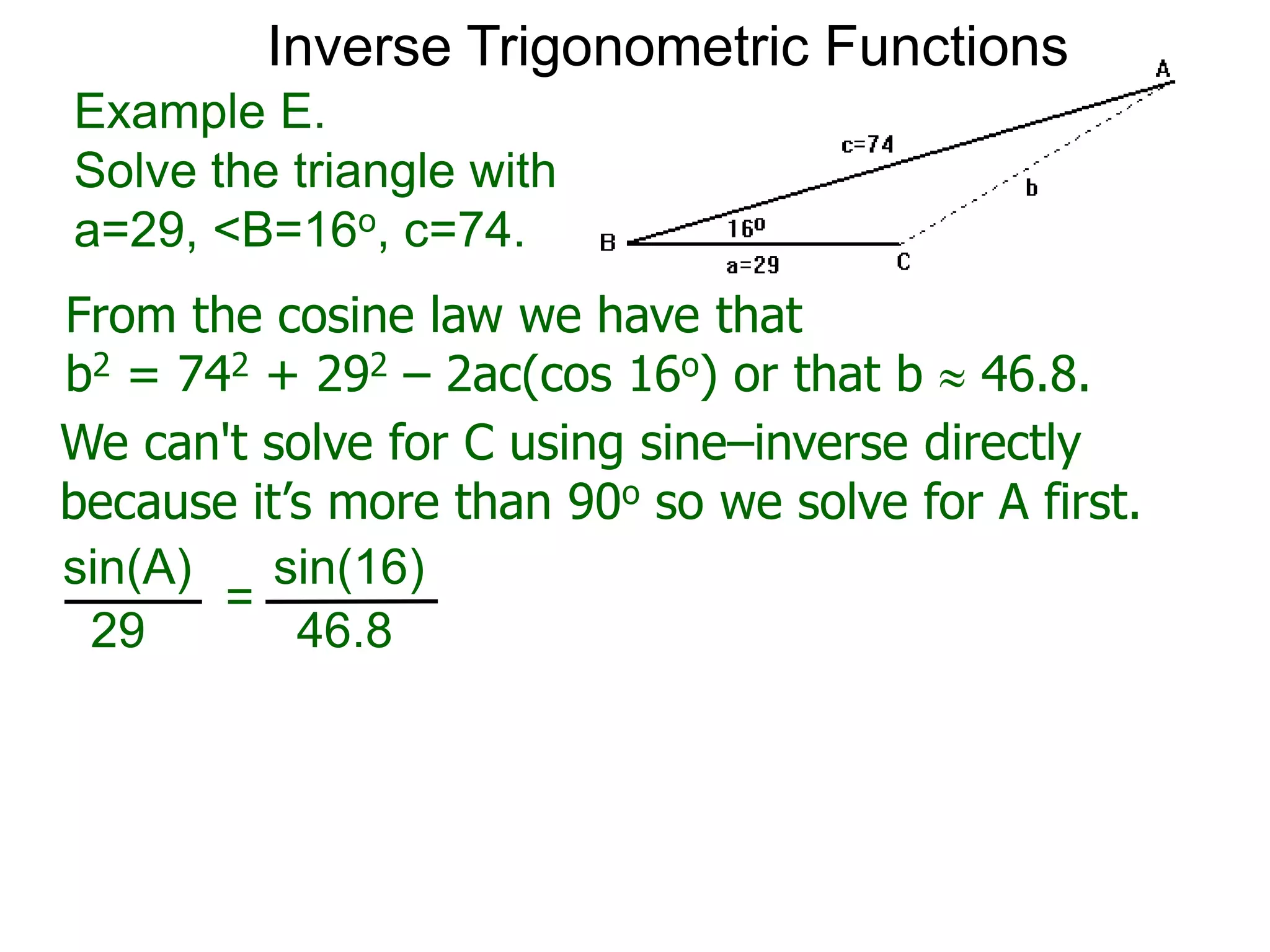
Example E.
Solve the triangle with
a=29, <B=16o, c=74.
Inverse Trigonometric Functions
From the cosine law we have that
b2 = 742 + 292 – 2ac(cos 16o) or that b  46.8.
Example E.
Solve the triangle with
a=29, <B=16o, c=74.
We can't solve for C using sine–inverse directly
because it’s more than 90o so we solve for A first.
Inverse Trigonometric Functions
From the cosine law we have that
b2 = 742 + 292 – 2ac(cos 16o) or that b  46.8.
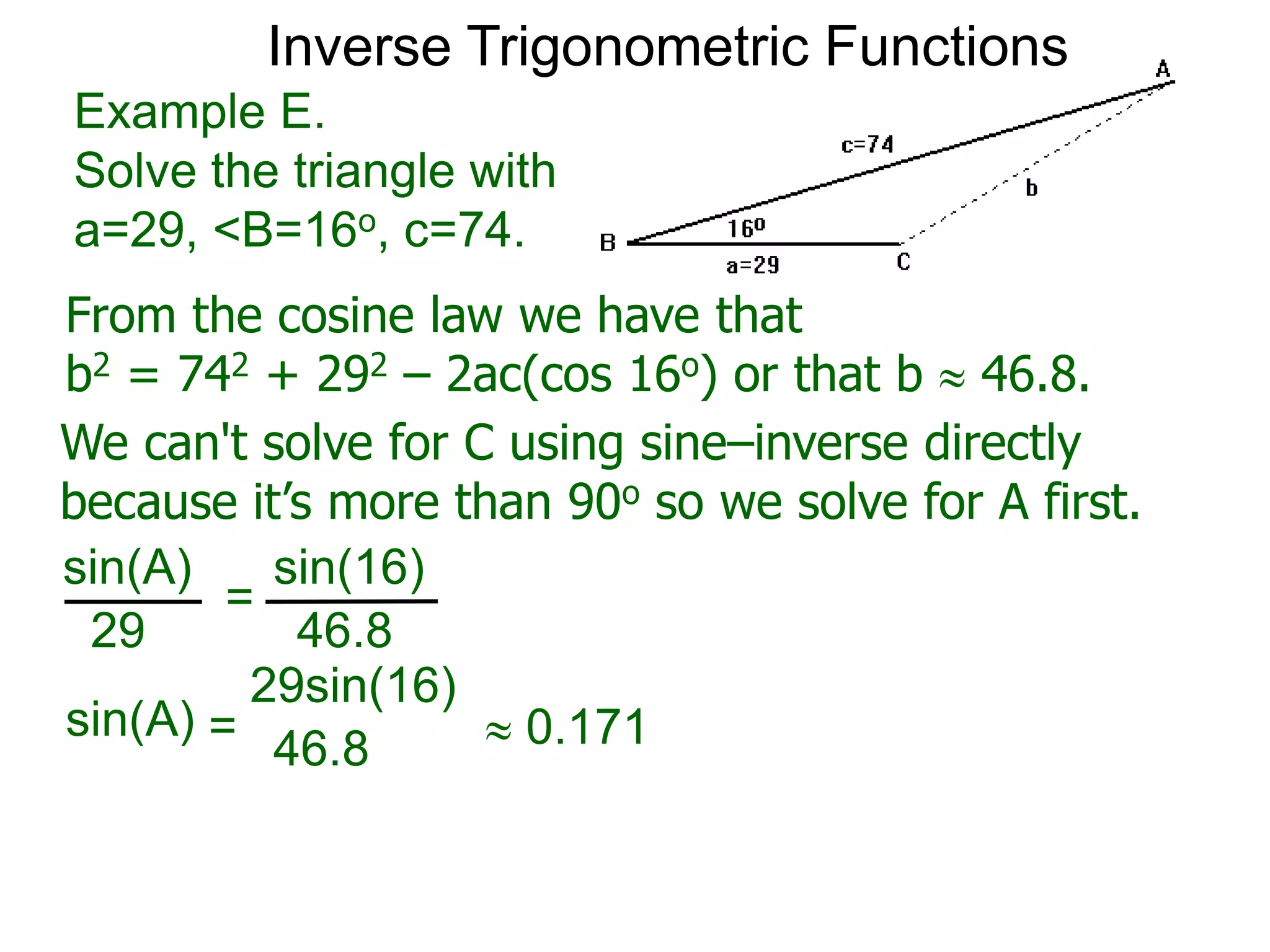
Example E.
Solve the triangle with
a=29, <B=16o, c=74.
We can't solve for C using sine–inverse directly
because it’s more than 90o so we solve for A first.
sin(A) sin(16)
29 46.8
=
Inverse Trigonometric Functions
From the cosine law we have that
b2 = 742 + 292 – 2ac(cos 16o) or that b  46.8.
Example E.
Solve the triangle with
a=29, <B=16o, c=74.
We can't solve for C using sine–inverse directly
because it’s more than 90o so we solve for A first.
sin(A) sin(16)
29 46.8
=
sin(A)
29sin(16)
46.8=  0.171
Inverse Trigonometric Functions
From the cosine law we have that
b2 = 742 + 292 – 2ac(cos 16o) or that b  46.8.
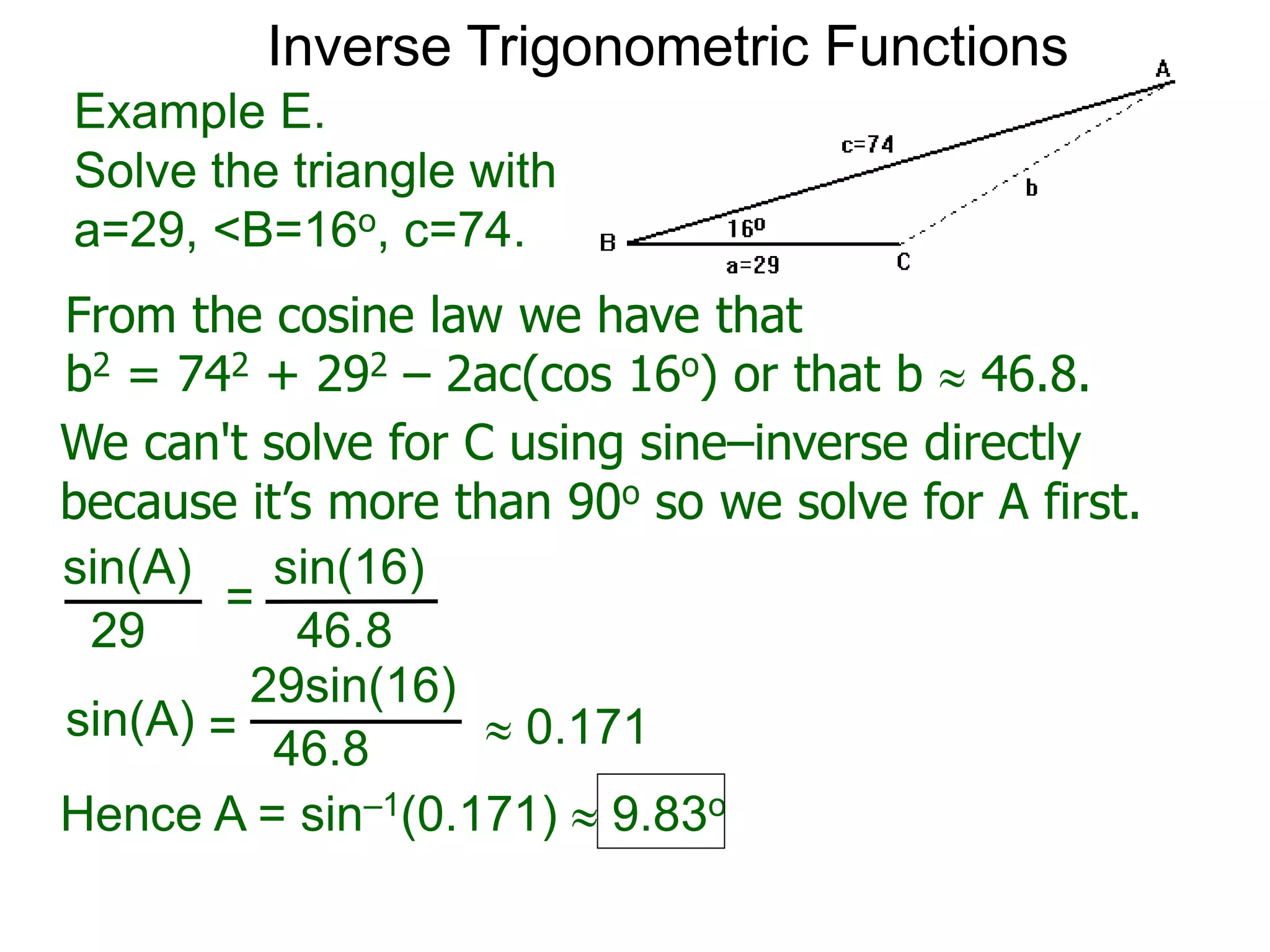
Example E.
Solve the triangle with
a=29, <B=16o, c=74.
We can't solve for C using sine–inverse directly
because it’s more than 90o so we solve for A first.
sin(A) sin(16)
29 46.8
=
sin(A)
29sin(16)
46.8=  0.171
Hence A = sin–1(0.171)  9.83o
Inverse Trigonometric Functions
From the cosine law we have that
b2 = 742 + 292 – 2ac(cos 16o) or that b  46.8.
Example E.
Solve the triangle with
a=29, <B=16o, c=74.
We can't solve for C using sine–inverse directly
because it’s more than 90o so we solve for A first.
sin(A) sin(16)
29 46.8
=
sin(A)
29sin(16)
46.8=  0.171
Hence A = sin–1(0.171)  9.83o
and C = 180 – 16 – 9.83  154.2o
Inverse Trigonometric Functions
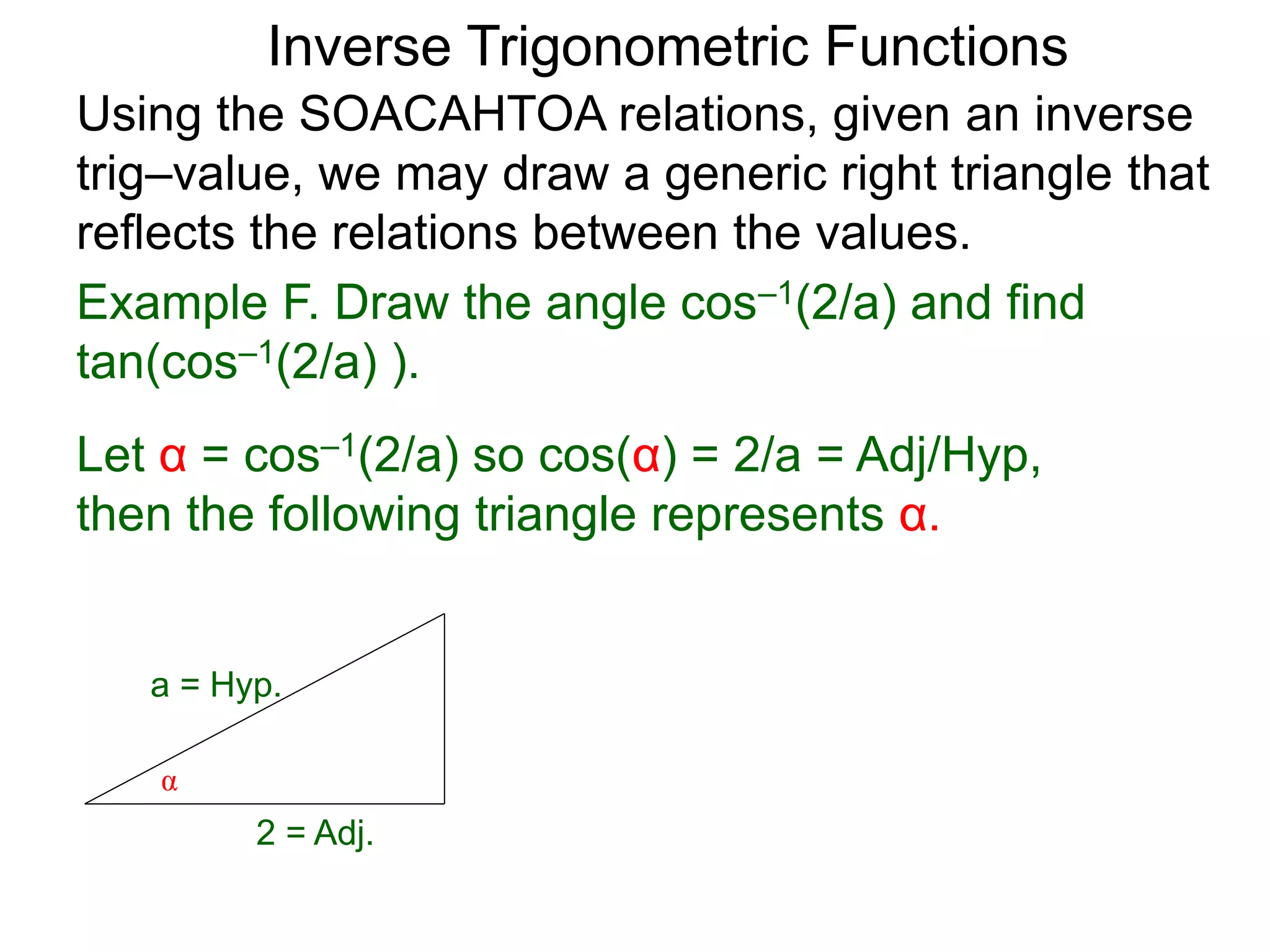
Using the SOACAHTOA relations, given an inverse
trig–value, we may draw a generic right triangle that
reflects the relations between the values.
Inverse Trigonometric Functions
Using the SOACAHTOA relations, given an inverse
trig–value, we may draw a generic right triangle that
reflects the relations between the values.
Example F. Draw the angle cos–1(2/a) and find
tan(cos–1(2/a) ).
Inverse Trigonometric Functions
Using the SOACAHTOA relations, given an inverse
trig–value, we may draw a generic right triangle that
reflects the relations between the values.
Example F. Draw the angle cos–1(2/a) and find
tan(cos–1(2/a) ).
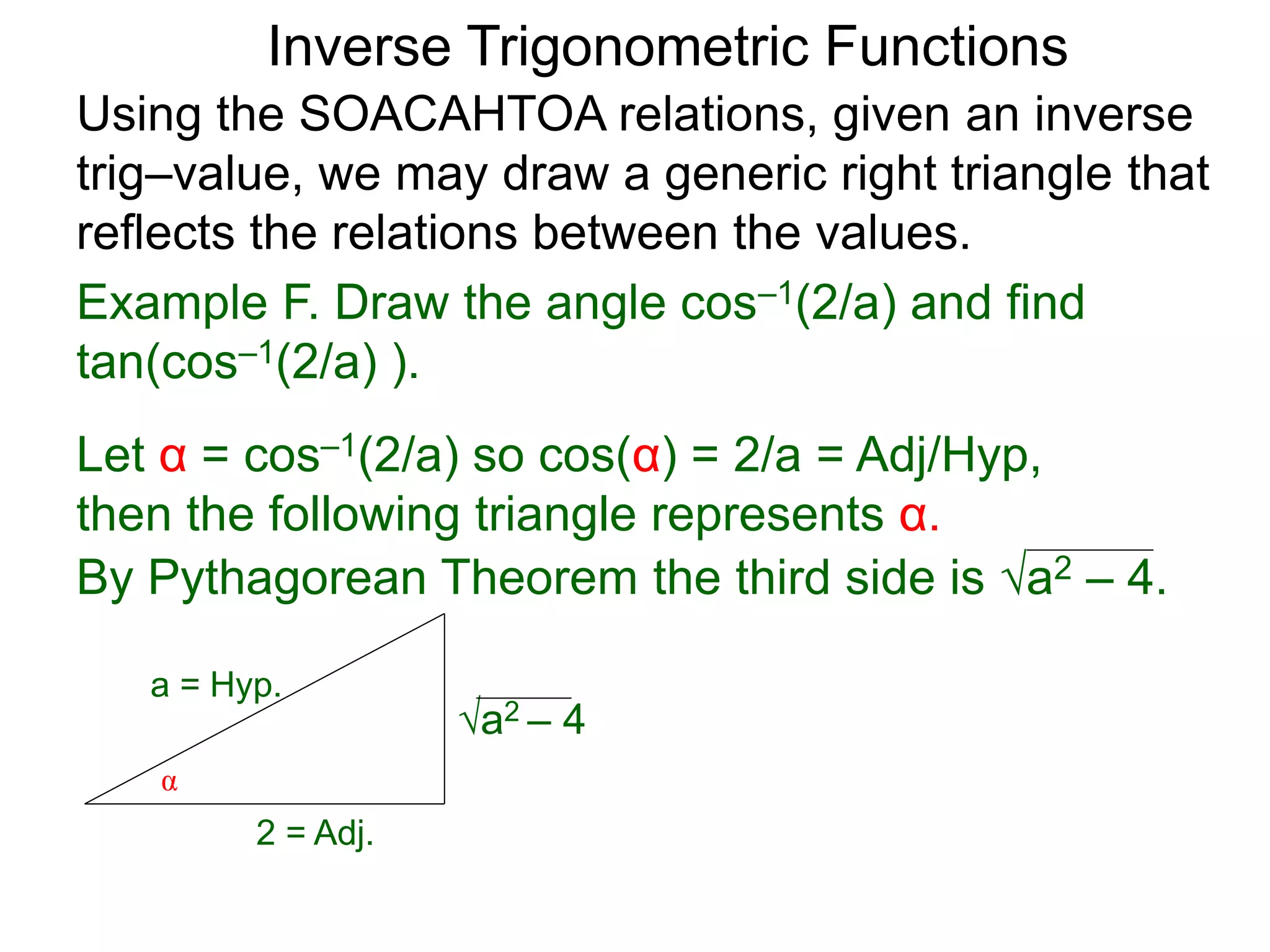
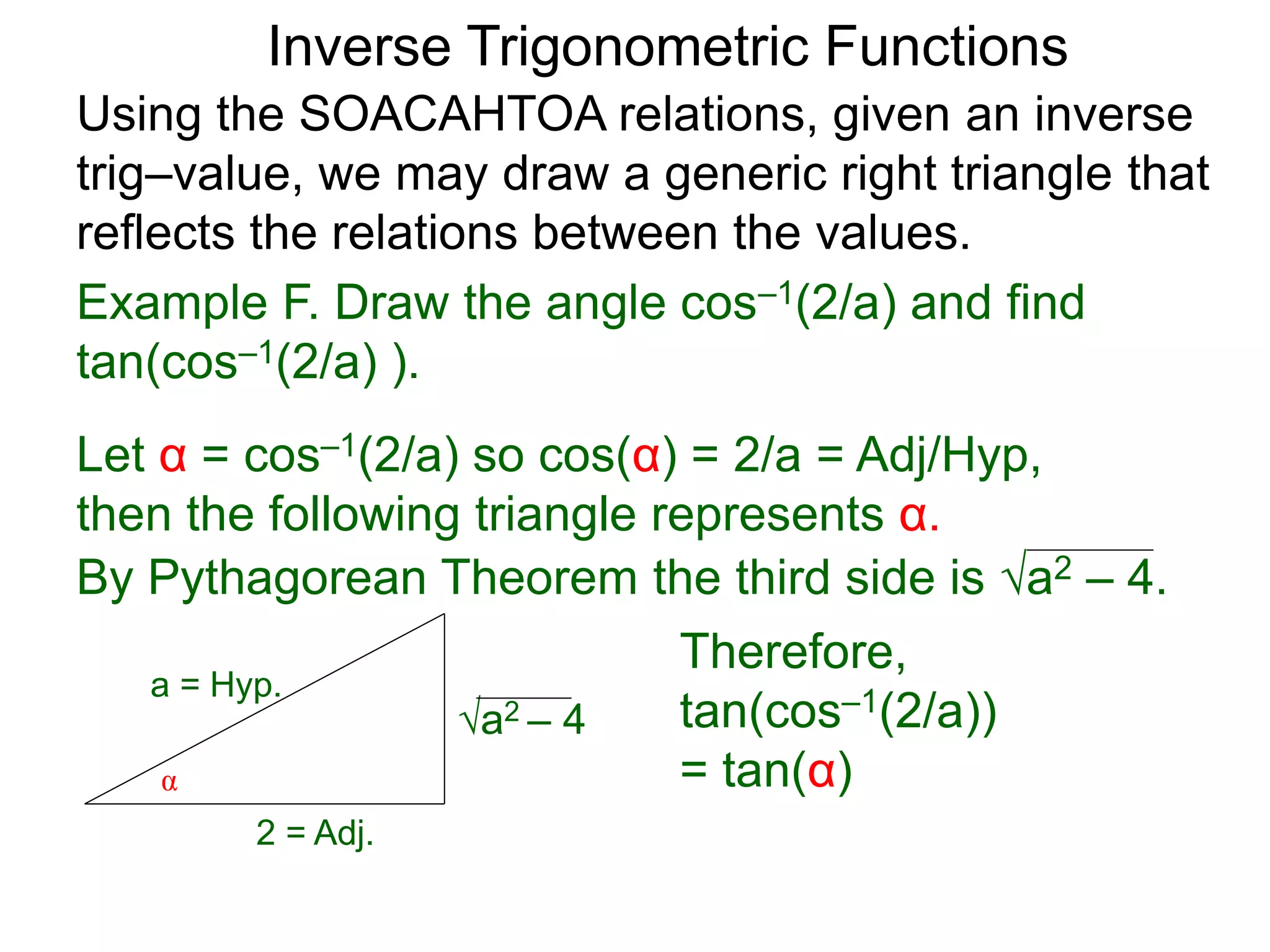
Let α = cos–1(2/a) so cos(α) = 2/a = Adj/Hyp,
Inverse Trigonometric Functions
Using the SOACAHTOA relations, given an inverse
trig–value, we may draw a generic right triangle that
reflects the relations between the values.
Example F. Draw the angle cos–1(2/a) and find
tan(cos–1(2/a) ).
Let α = cos–1(2/a) so cos(α) = 2/a = Adj/Hyp,
then the following triangle represents α.
Inverse Trigonometric Functions
Using the SOACAHTOA relations, given an inverse
trig–value, we may draw a generic right triangle that
reflects the relations between the values.
α
2 = Adj.
a = Hyp.
Example F. Draw the angle cos–1(2/a) and find
tan(cos–1(2/a) ).
Let α = cos–1(2/a) so cos(α) = 2/a = Adj/Hyp,
then the following triangle represents α.
a2 – 4
Inverse Trigonometric Functions
Using the SOACAHTOA relations, given an inverse
trig–value, we may draw a generic right triangle that
reflects the relations between the values.
α
2 = Adj.
a = Hyp.
Example F. Draw the angle cos–1(2/a) and find
tan(cos–1(2/a) ).
Let α = cos–1(2/a) so cos(α) = 2/a = Adj/Hyp,
then the following triangle represents α.
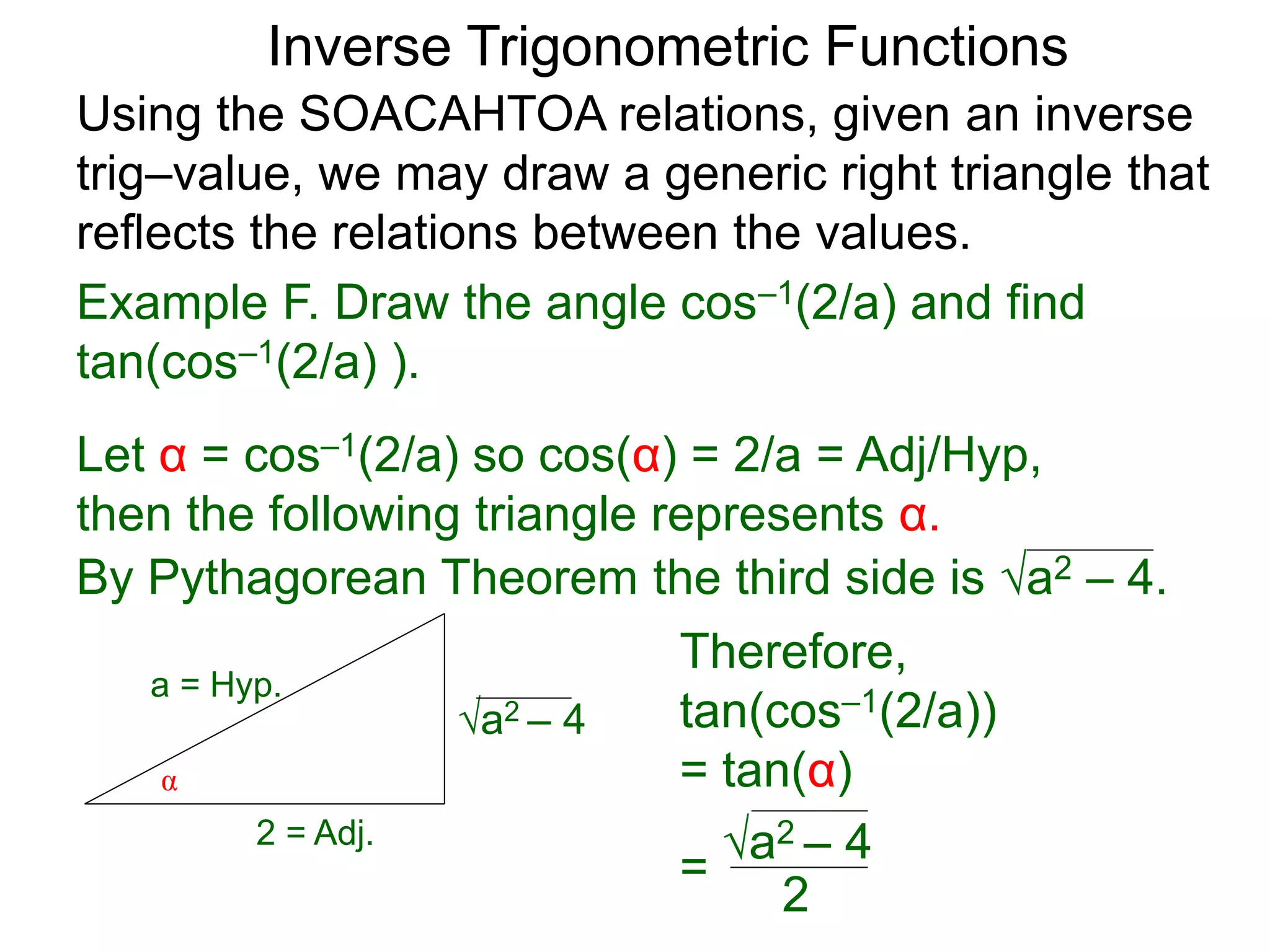
By Pythagorean Theorem the third side is a2 – 4.
a2 – 4
Therefore,
tan(cos–1(2/a))
= tan(α)
Inverse Trigonometric Functions
Using the SOACAHTOA relations, given an inverse
trig–value, we may draw a generic right triangle that
reflects the relations between the values.
α
2 = Adj.
a = Hyp.
Example F. Draw the angle cos–1(2/a) and find
tan(cos–1(2/a) ).
Let α = cos–1(2/a) so cos(α) = 2/a = Adj/Hyp,
then the following triangle represents α.
By Pythagorean Theorem the third side is a2 – 4.
a2 – 4
Therefore,
tan(cos–1(2/a))
= tan(α)
=
Inverse Trigonometric Functions
Using the SOACAHTOA relations, given an inverse
trig–value, we may draw a generic right triangle that
reflects the relations between the values.
α
2 = Adj.
a = Hyp.
Example F. Draw the angle cos–1(2/a) and find
tan(cos–1(2/a) ).
Let α = cos–1(2/a) so cos(α) = 2/a = Adj/Hyp,
then the following triangle represents α.
By Pythagorean Theorem the third side is a2 – 4.
a2 – 4
2
The Graphs of Inverse Trig–Functions
and the sine–inverse
y = sin–1(x) : [–1, 1] [–π/2, π/2].
We will use the variable x and y for the functions
y = sin(x): [–π/2, π/2] [–1, 1].
The Graphs of Inverse Trig–Functions
and the sine–inverse
y = sin–1(x) : [–1, 1] [–π/2, π/2].
We will use the variable x and y for the functions
y = sin(x): [–π/2, π/2] [–1, 1].
The Graphs of Inverse Trig–Functions
As in the case for all inverse pairs of functions,
the graph of y = sin–1(x) may be
obtained by reflecting
y = sin(x) across y = x.
–1
y = sin–1(x)
y = x
y = sin(x)
and the sine–inverse
y = sin–1(x) : [–1, 1] [–π/2, π/2].
We will use the variable x and y for the functions
y = sin(x): [–π/2, π/2] [–1, 1].
The Graphs of Inverse Trig–Functions
As in the case for all inverse pairs of functions,
the graph of y = sin–1(x) may be
obtained by reflecting
y = sin(x) across y = x.
–π/2 π/2
1
–1
–1
–π/2
y = sin–1(x)
1
–1
π/2
y = x
y = sin(x)
and the sine–inverse
y = sin–1(x) : [–1, 1] [–π/2, π/2].
We will use the variable x and y for the functions
y = sin(x): [–π/2, π/2] [–1, 1].
The Graphs of Inverse Trig–Functions
As in the case for all inverse pairs of functions,
the graph of y = sin–1(x) may be
obtained by reflecting
y = sin(x) across y = x.
–1
–π/2
1
–1
–π/2
π/2
1–1 π/2
y = x
y = sin(x)
and the sine–inverse
y = sin–1(x) : [–1, 1] [–π/2, π/2].
We will use the variable x and y for the functions
y = sin(x): [–π/2, π/2] [–1, 1].
The Graphs of Inverse Trig–Functions
As in the case for all inverse pairs of functions,
the graph of y = sin–1(x) may be
obtained by reflecting
y = sin(x) across y = x.
y = sin–1(x)
–1
–π/2
1
–1
–π/2
π/2
1–1 π/2
y = x
y = sin(x)
and the sine–inverse
y = sin–1(x) : [–1, 1] [–π/2, π/2].
We will use the variable x and y for the functions
y = sin(x): [–π/2, π/2] [–1, 1].
(π/6 ½)
The Graphs of Inverse Trig–Functions
As in the case for all inverse pairs of functions,
the graph of y = sin–1(x) may be
obtained by reflecting
y = sin(x) across y = x.
For example, the point
(π/6, ½) on y = sin(x)
y = sin–1(x)
–1
–π/2
1
–1
–π/2
π/2
1–1 π/2
y = x
y = sin(x)
and the sine–inverse
y = sin–1(x) : [–1, 1] [–π/2, π/2].
We will use the variable x and y for the functions
y = sin(x): [–π/2, π/2] [–1, 1].
(½, π/6)
(π/6 ½)
The Graphs of Inverse Trig–Functions
As in the case for all inverse pairs of functions,
the graph of y = sin–1(x) may be
obtained by reflecting
y = sin(x) across y = x.
For example, the point
(π/6, ½) on y = sin(x)
corresponds to (½, π/6)
on y = sin–1(x) since
(, a) and (a, ) are the
reflection of each other.
y = sin–1(x)
The graph of y = cos–1(x) is the reflection of the graph
of y = cos (x) where y = cos(x): [0, π] [–1, 1]
and y = cos–1(x): [–1, 1] [0, π]
The Graphs of Inverse Trig–Functions
y = x
π
0
1
–1
π
y = cos(x)
y = cos–1(x)
The graph of y = cos–1(x) is the reflection of the graph
of y = cos (x) where y = cos(x): [0, π] [–1, 1]
and y = cos–1(x): [–1, 1] [0, π]
The Graphs of Inverse Trig–Functions
y = x
π
0
1
–1
Here are some specific cosine inverse values:
π
(1, 0)
(–1, π)
(0, π/2)
cos–1(1) = 0,
cos–1(0) = π/2, and
cos–1(–1) = π.
y = cos(x)
y = cos–1(x)
The graph of y = cos–1(x) is the reflection of the graph
of y = cos (x) where y = cos(x): [0, π] [–1, 1]
and y = cos–1(x): [–1, 1] [0, π]
The Graphs of Inverse Trig–Functions
y = cos(x)
y = x
π
0
1
–1
Here are some specific cosine inverse values:
π
(1, 0)
(–1, π)
(0, π/2)
cos–1(1) = 0,
cos–1(0) = π/2, and
cos–1(–1) = π.
P  (0.74, 0.74) intersection point
P  (0.74, 0.74)
in radian.
By solving cos(x) = x
numerically, we've the
.y = cos–1(x)
The graph of y = cos–1(x) is the reflection of the graph
of y = cos (x) where y = cos(x): [0, π] [–1, 1]
and y = cos–1(x): [–1, 1] [0, π]
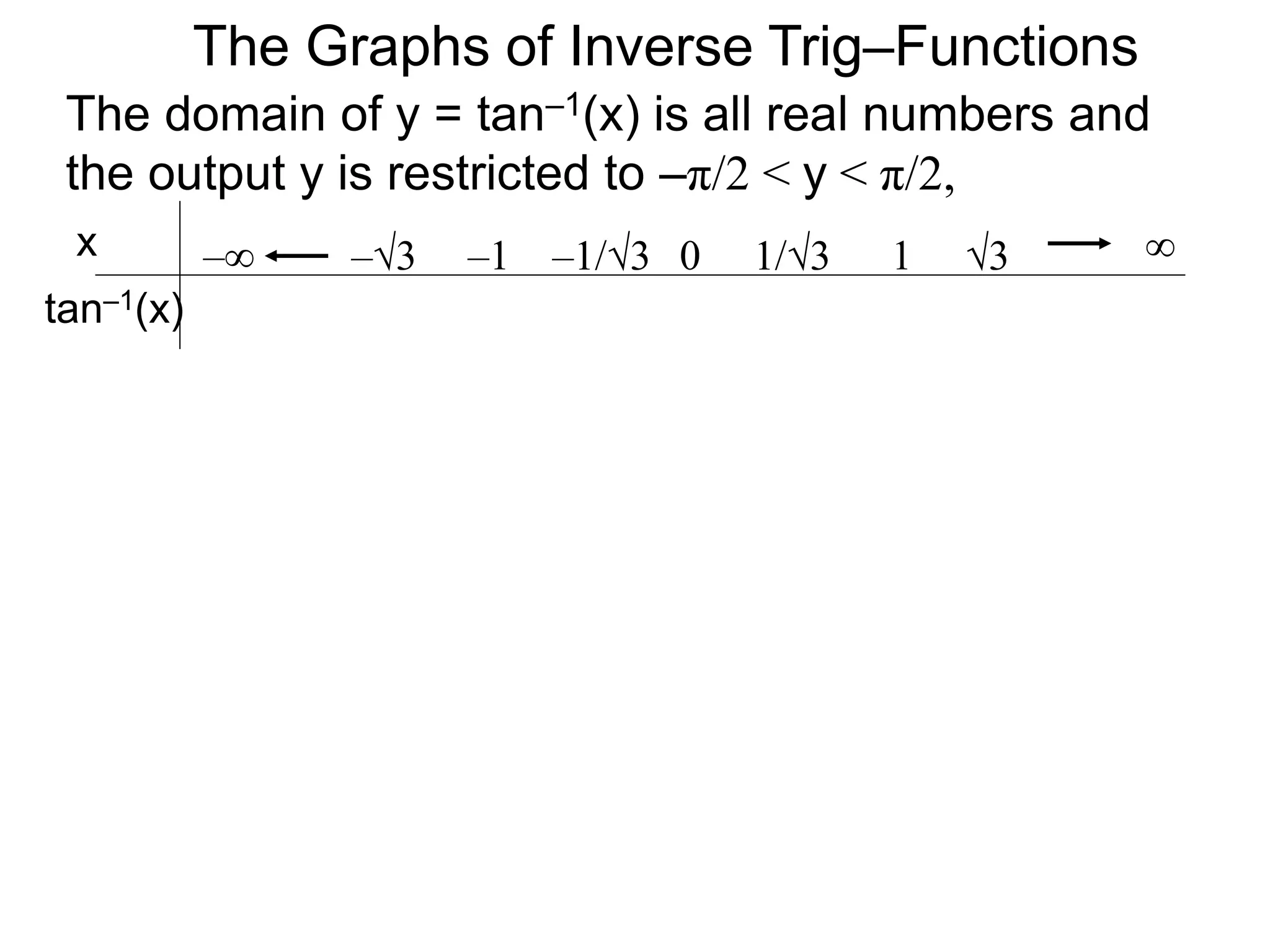
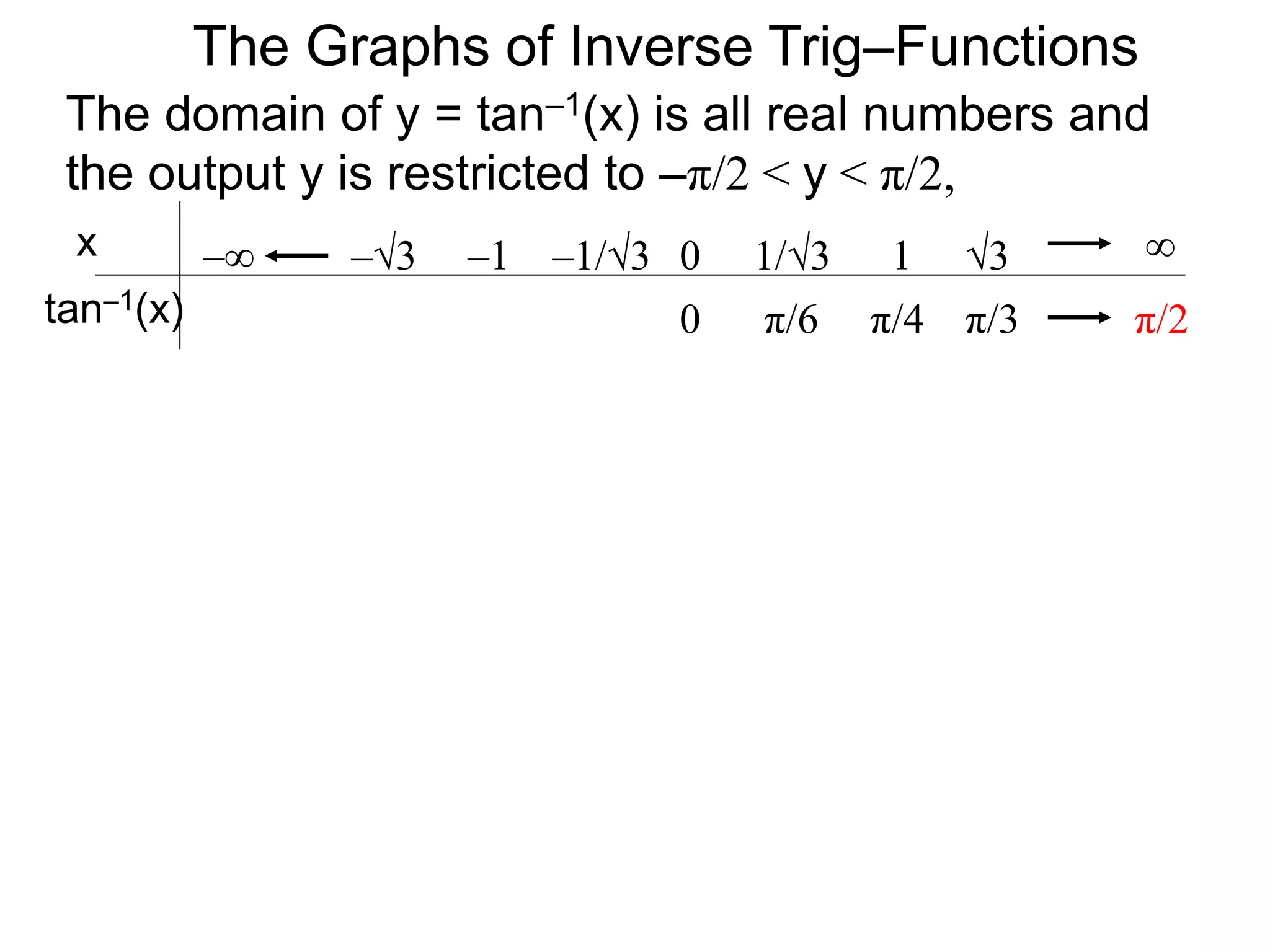
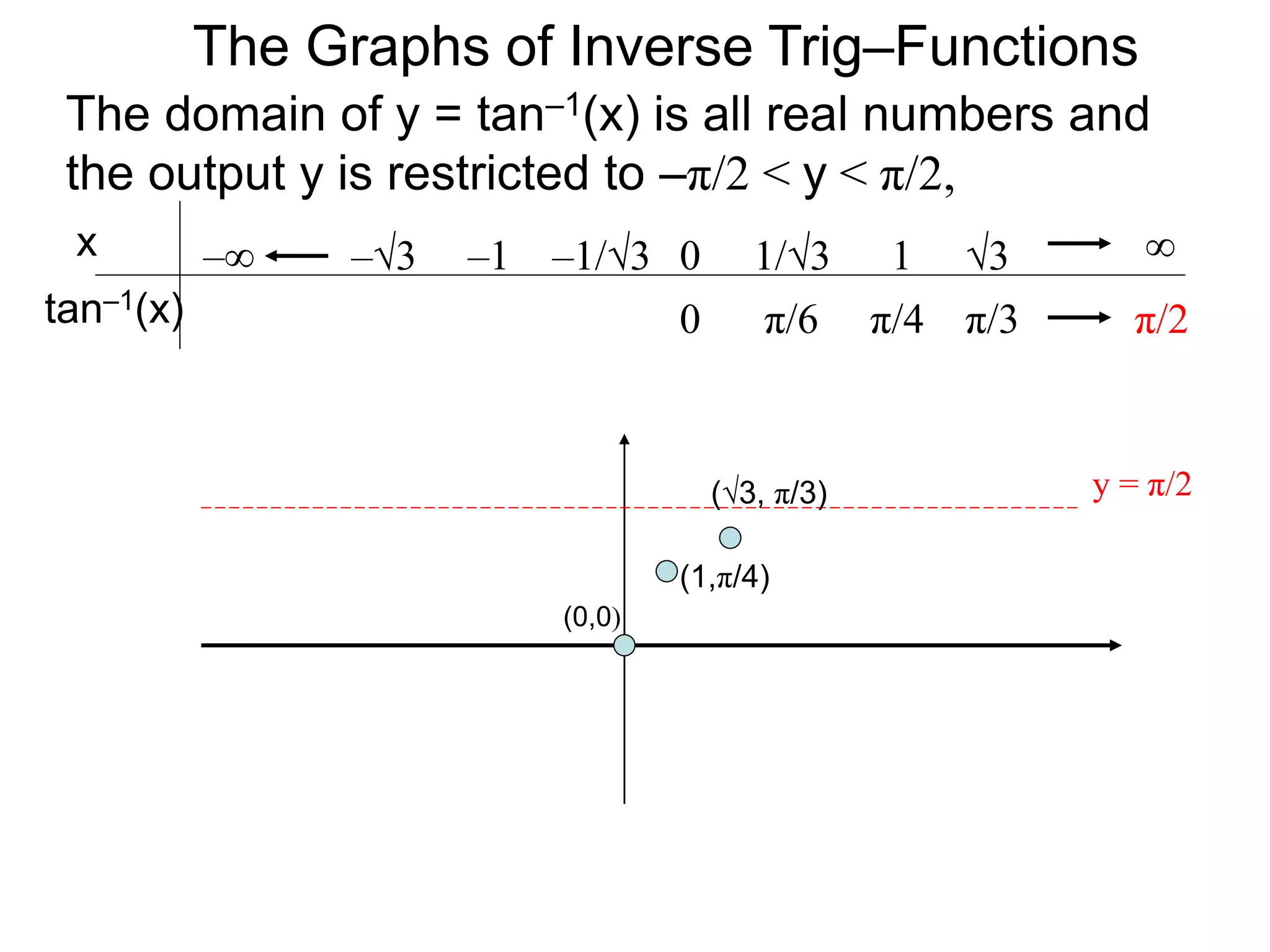
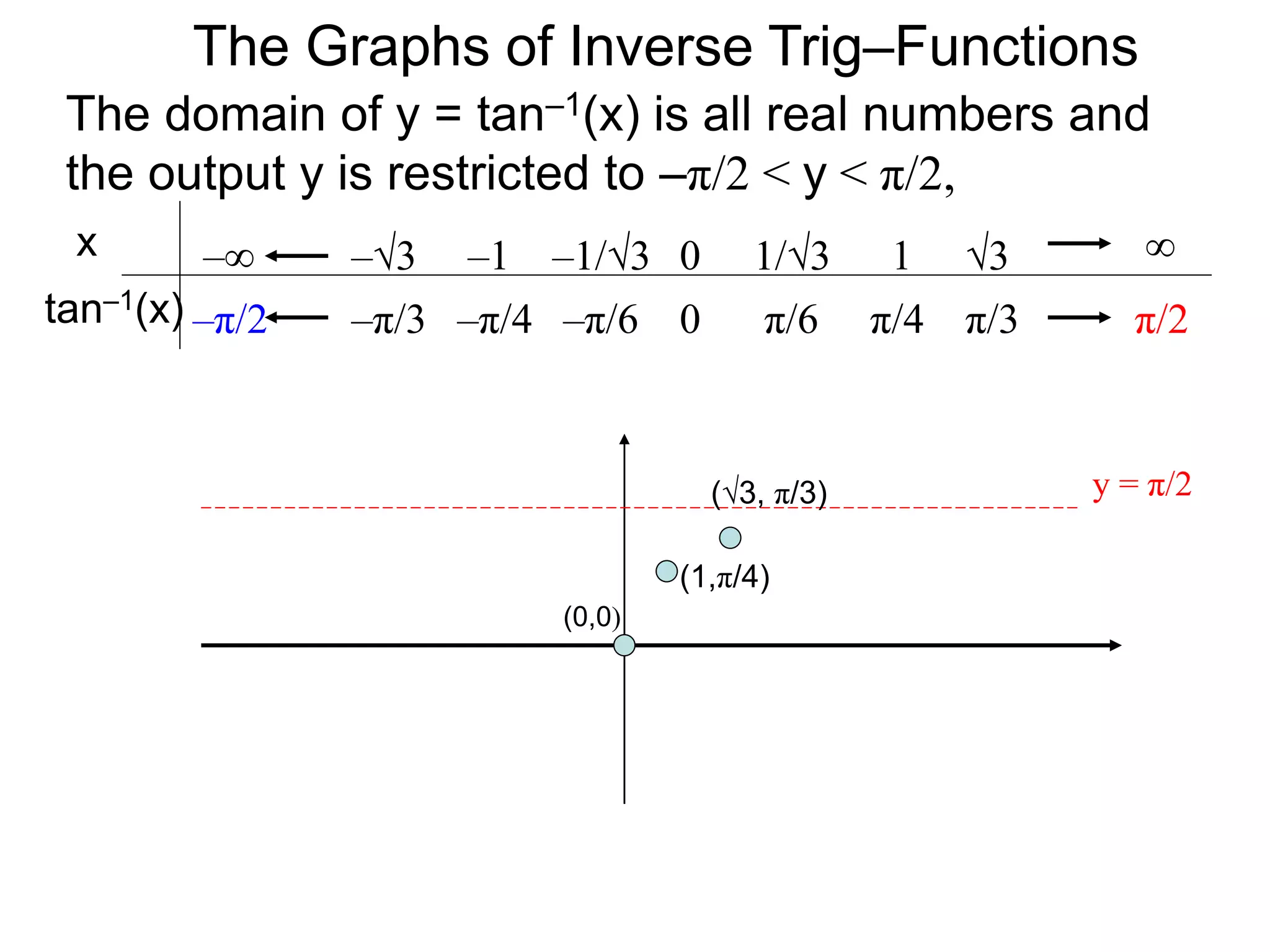
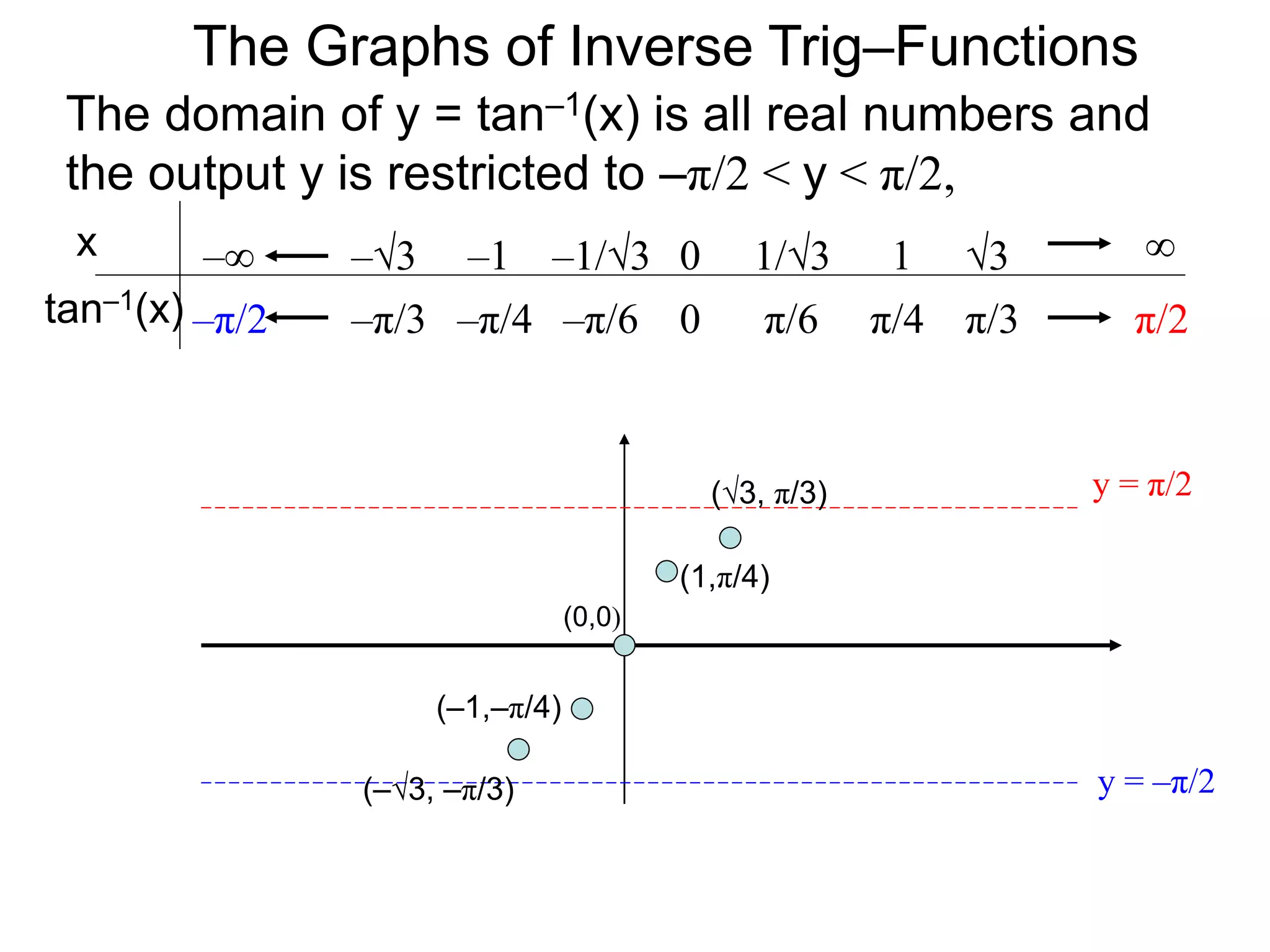
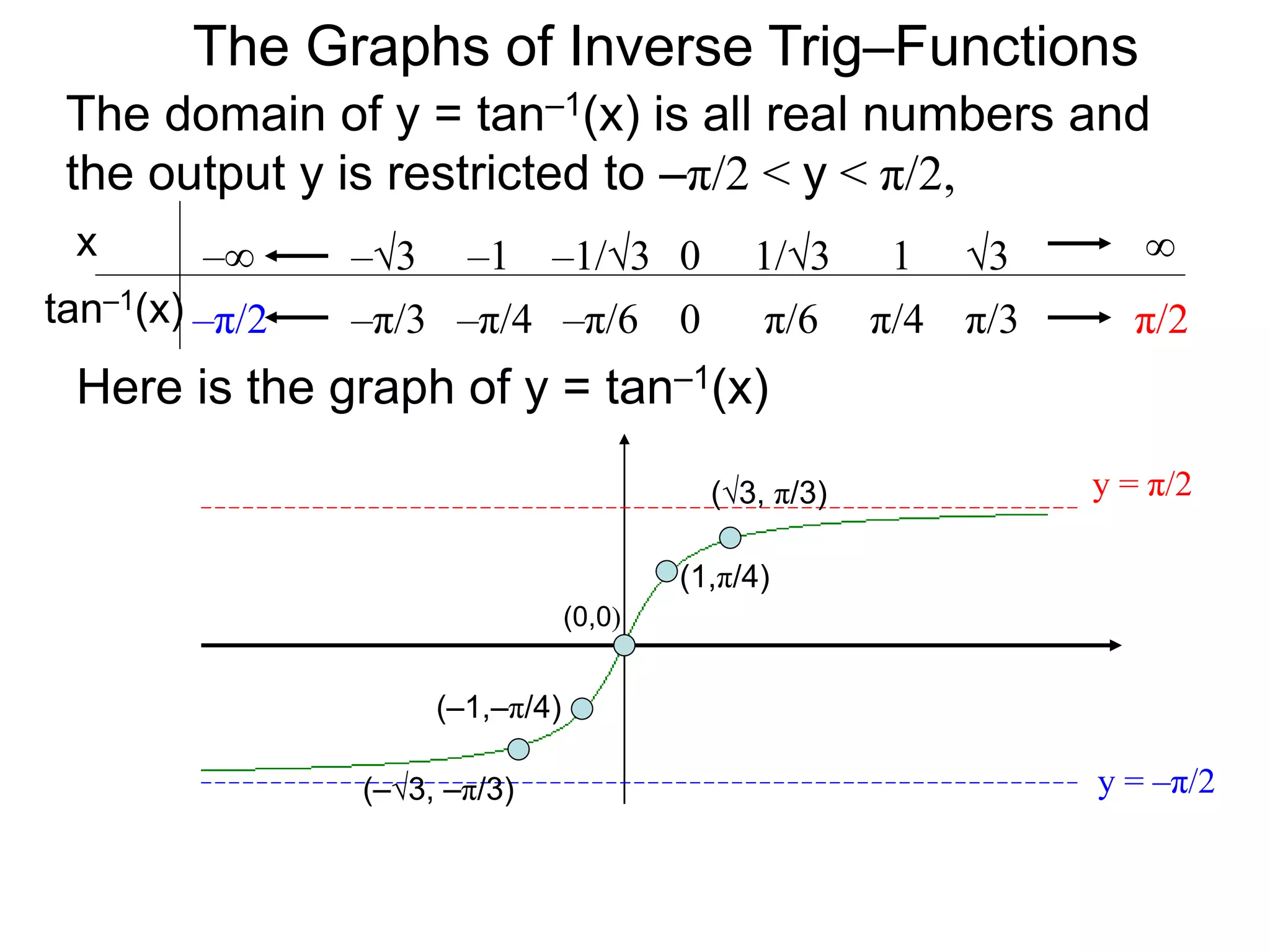
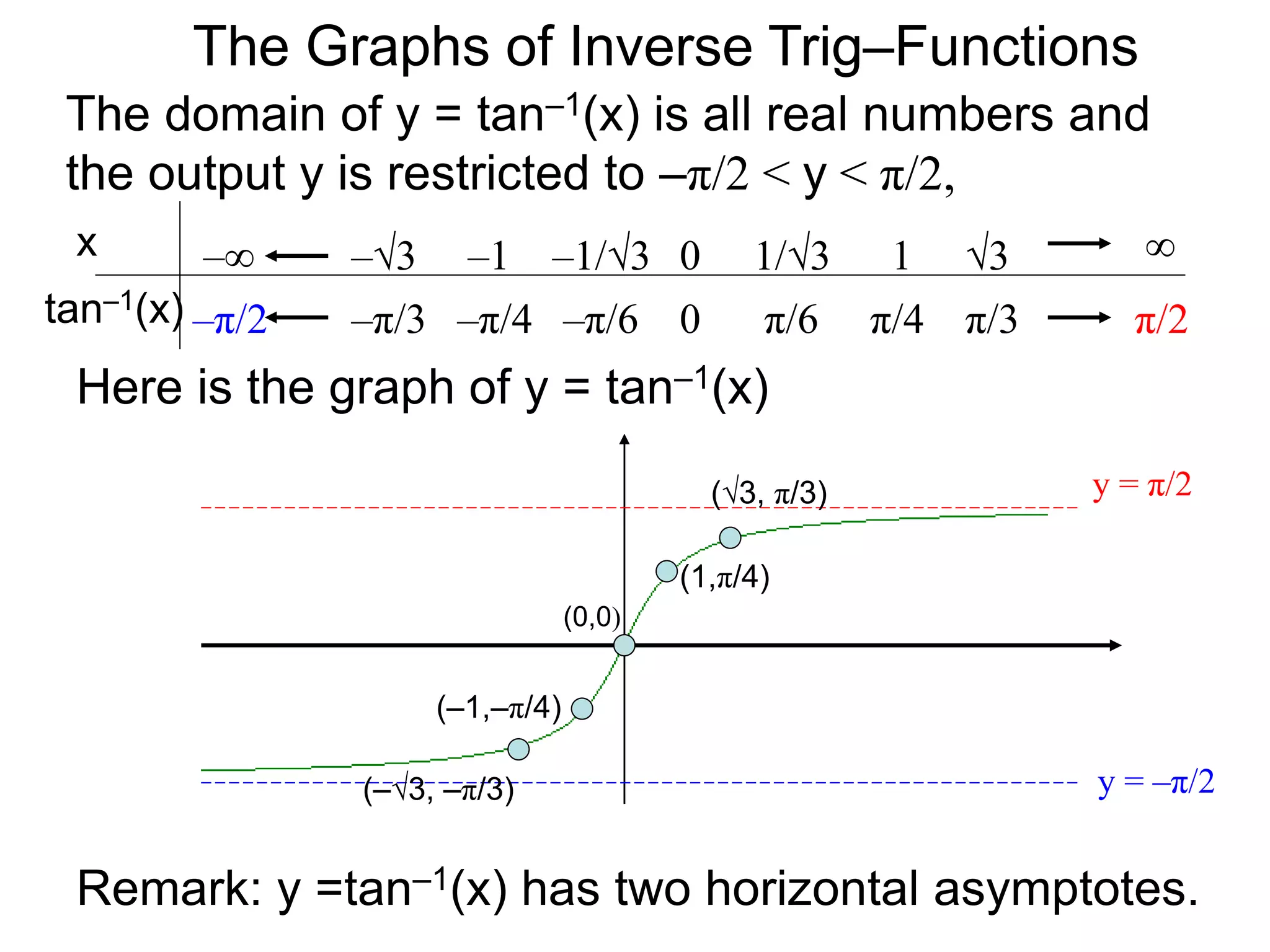
The domain of y = tan–1(x) is all real numbers and
the output y is restricted to –π/2 < y < π/2,
The Graphs of Inverse Trig–Functions
The domain of y = tan–1(x) is all real numbers and
the output y is restricted to –π/2 < y < π/2,
The Graphs of Inverse Trig–Functions
x
tan–1(x)
0 1/3 1 3 ∞–1/3–1–3–∞
The domain of y = tan–1(x) is all real numbers and
the output y is restricted to –π/2 < y < π/2,
The Graphs of Inverse Trig–Functions
x
tan–1(x)
0 1/3 1 3 ∞–1/3–1–3–∞
π/60 π/4 π/3 π/2
The domain of y = tan–1(x) is all real numbers and
the output y is restricted to –π/2 < y < π/2,
The Graphs of Inverse Trig–Functions
x
tan–1(x) π/60 π/4 π/3
0 1/3 1 3 ∞–1/3–1–3
π/2
–∞
y = π/2
(0,0)
(1,π/4)
(√3, π/3)
The domain of y = tan–1(x) is all real numbers and
the output y is restricted to –π/2 < y < π/2,
The Graphs of Inverse Trig–Functions
x
tan–1(x) π/60 π/4 π/3–π/2
0 1/3 1 3 ∞
–π/6
–1/3
–π/4
–1
–π/3
–3
π/2
–∞
y = π/2
(0,0)
(1,π/4)
(√3, π/3)
The domain of y = tan–1(x) is all real numbers and
the output y is restricted to –π/2 < y < π/2,
The Graphs of Inverse Trig–Functions
x
tan–1(x) π/60 π/4 π/3–π/2
0 1/3 1 3 ∞
–π/6
–1/3
–π/4
–1
–π/3
–3
π/2
–∞
y = π/2
y = –π/2
(0,0)
(1,π/4)
(–1,–π/4)
(√3, π/3)
(–√3, –π/3)
The domain of y = tan–1(x) is all real numbers and
the output y is restricted to –π/2 < y < π/2,
The Graphs of Inverse Trig–Functions
Here is the graph of y = tan–1(x)
x
tan–1(x) π/60 π/4 π/3–π/2
0 1/3 1 3 ∞
–π/6
–1/3
–π/4
–1
–π/3
–3
π/2
–∞
y = π/2
y = –π/2
(0,0)
(1,π/4)
(–1,–π/4)
(√3, π/3)
(–√3, –π/3)
The domain of y = tan–1(x) is all real numbers and
the output y is restricted to –π/2 < y < π/2,
The Graphs of Inverse Trig–Functions
Here is the graph of y = tan–1(x)
x
tan–1(x) π/60 π/4 π/3–π/2
0 1/3 1 3 ∞
–π/6
–1/3
–π/4
–1
–π/3
–3
π/2
–∞
y = π/2
y = –π/2
(0,0)
(1,π/4)
Remark: y =tan–1(x) has two horizontal asymptotes.
(–1,–π/4)
(√3, π/3)
(–√3, –π/3)
Inverse Trigonometric Functions
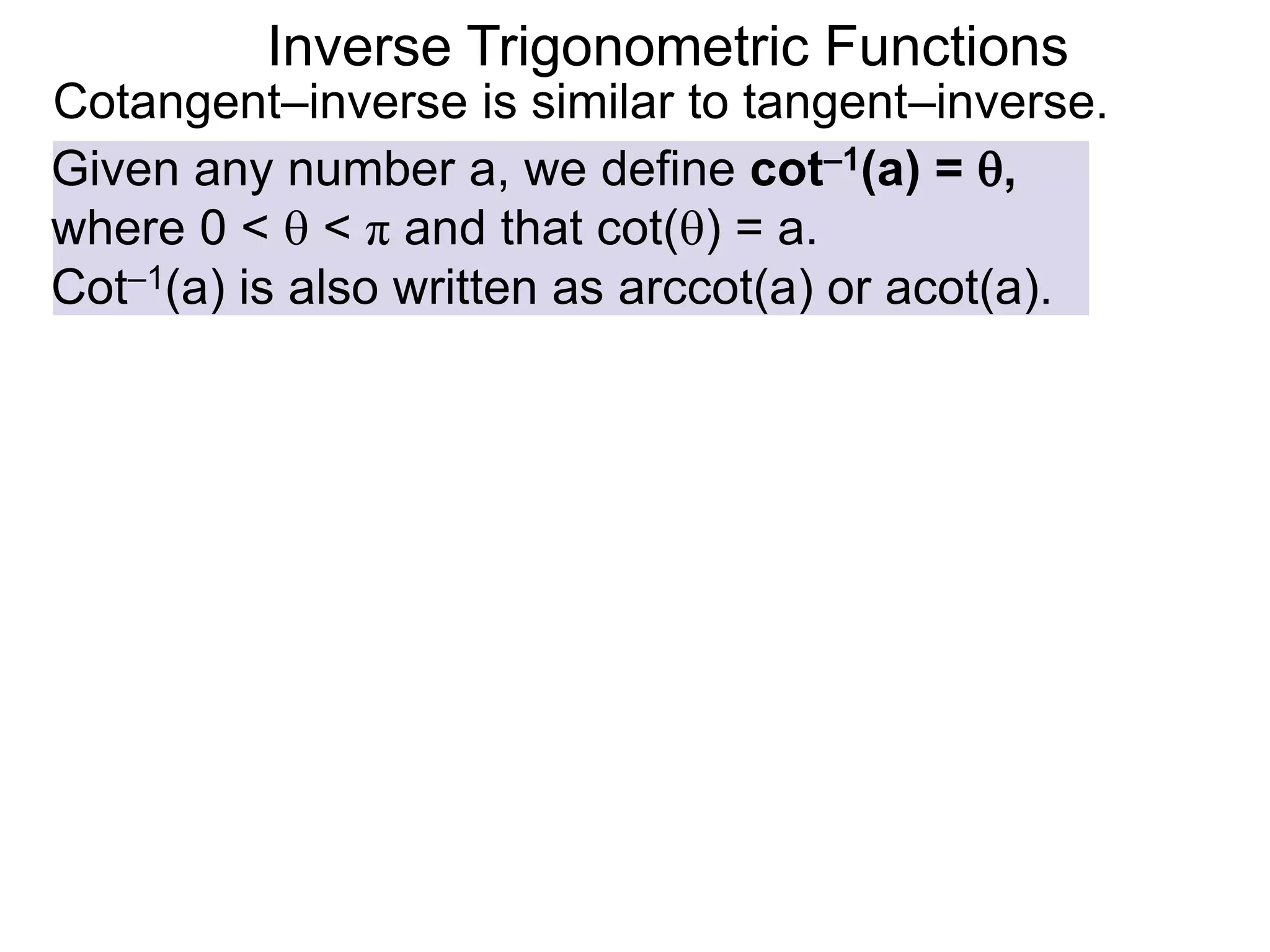
Cotangent–inverse is similar to tangent–inverse.
Given any number a, we define cot–1(a) = ,
where 0 <  < π and that cot() = a.
Cot–1(a) is also written as arccot(a) or acot(a).
Inverse Trigonometric Functions
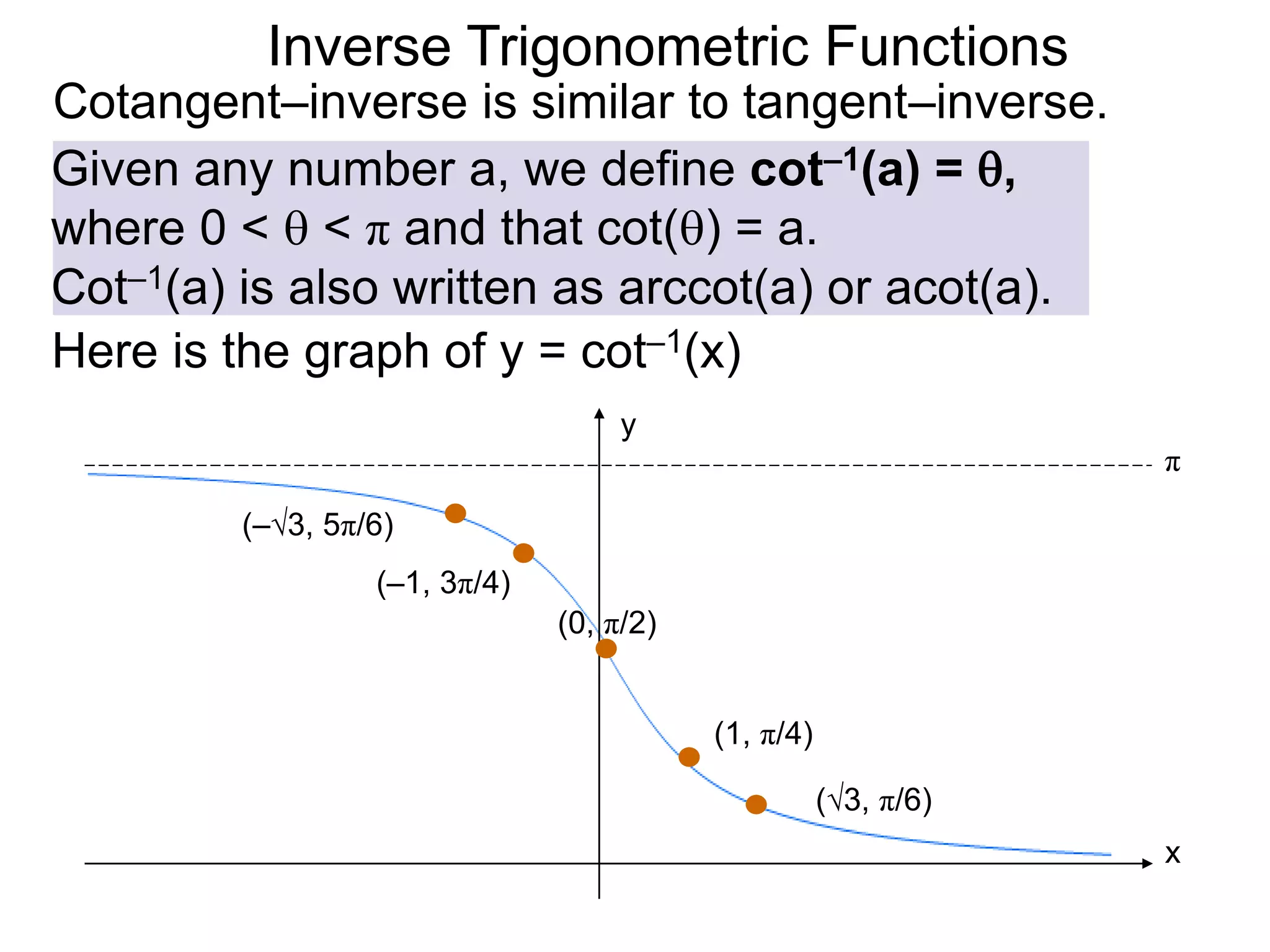
Cotangent–inverse is similar to tangent–inverse.
Given any number a, we define cot–1(a) = ,
where 0 <  < π and that cot() = a.
Cot–1(a) is also written as arccot(a) or acot(a).
Here is the graph of y = cot–1(x)
(0, π/2)
(1, π/4)
x
y
π
(–1, 3π/4)
(√3, π/6)
(–√3, 5π/6)
The Graphs of Inverse Trig–Functions
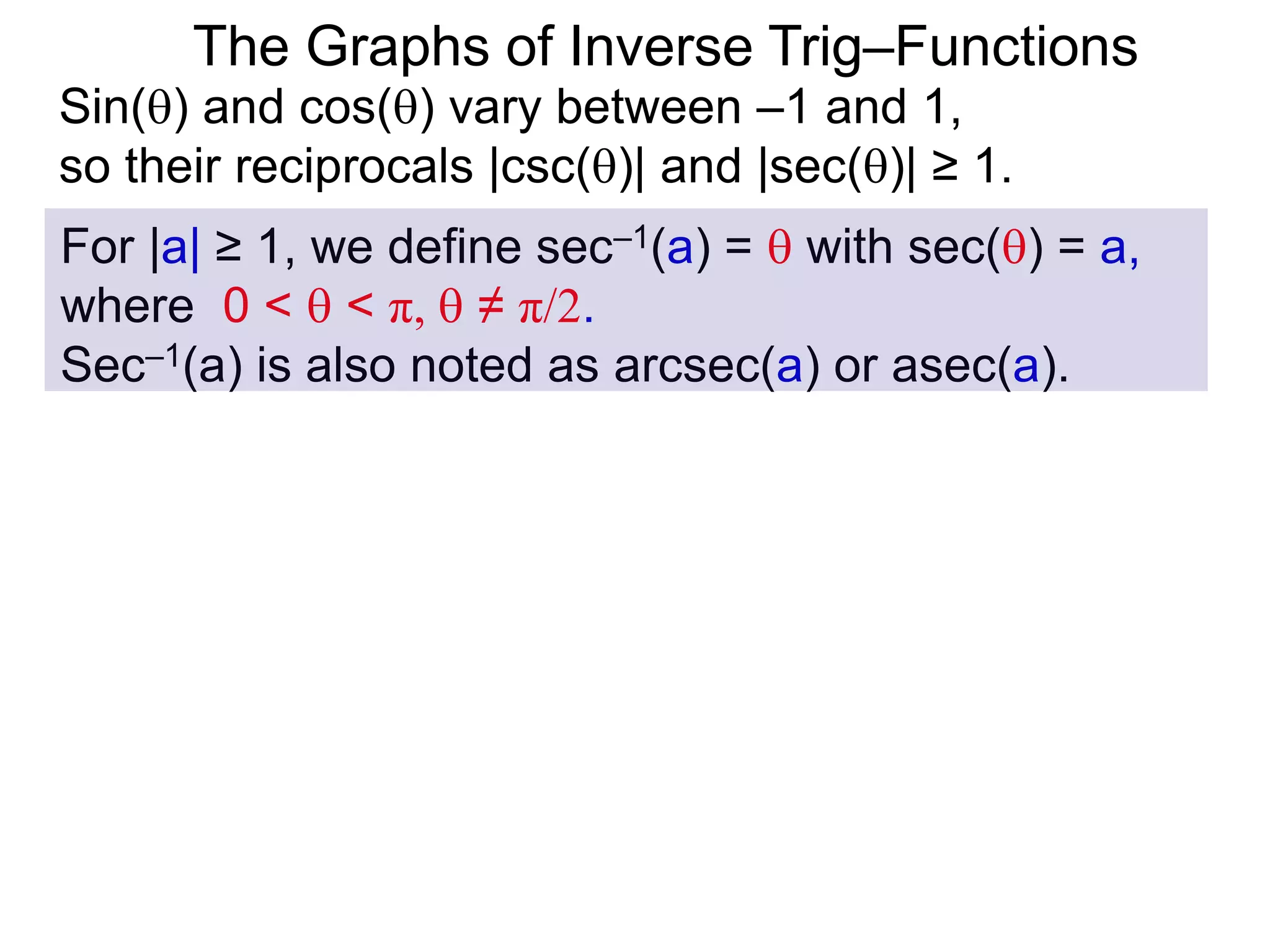
For |a| ≥ 1, we define sec–1(a) =  with sec() = a,
where 0 <  < π,  ≠ π/2.
Sec–1(a) is also noted as arcsec(a) or asec(a).
Sin() and cos() vary between –1 and 1,
so their reciprocals |csc()| and |sec()| ≥ 1.
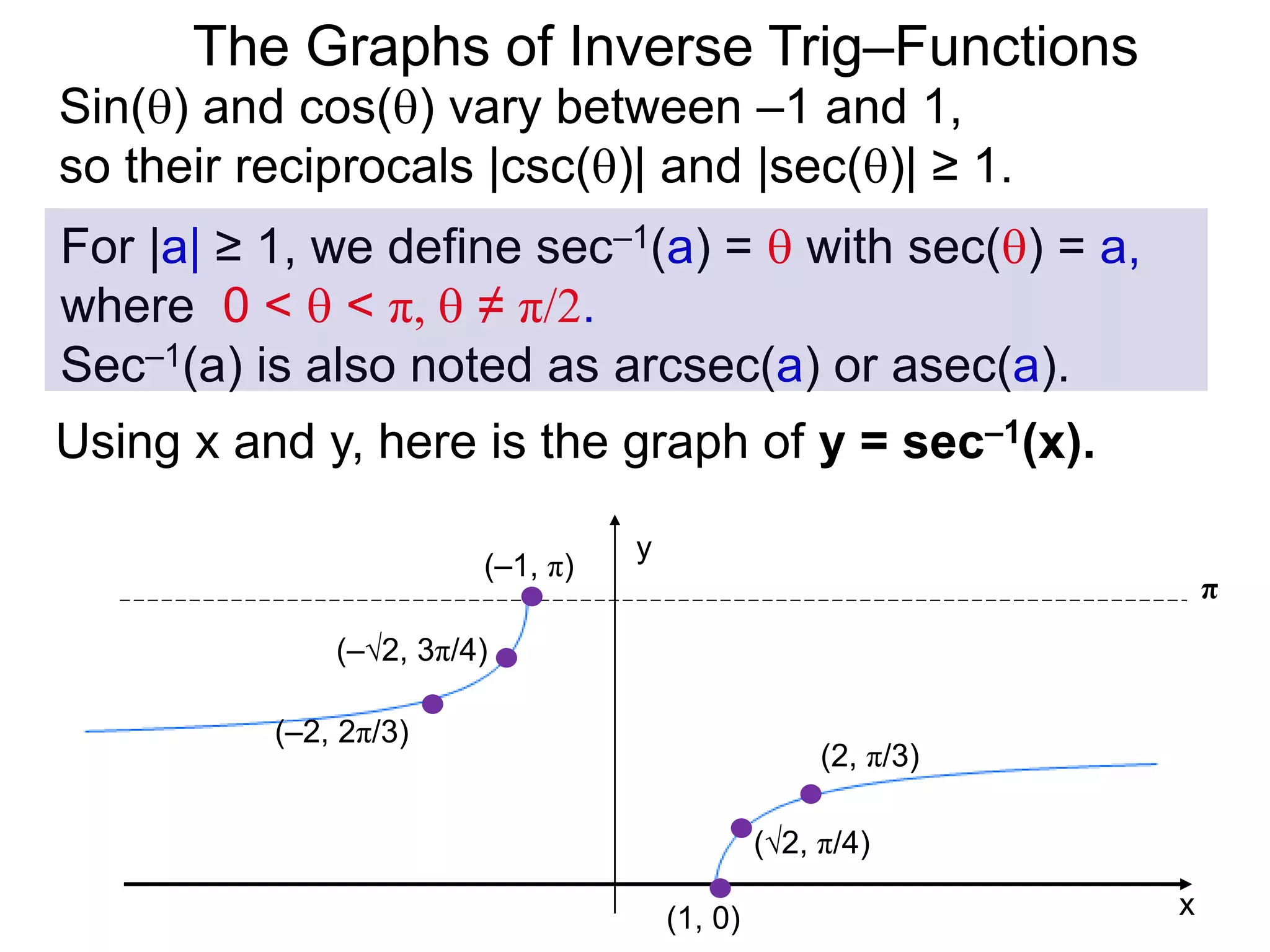
Using x and y, here is the graph of y = sec–1(x).
The Graphs of Inverse Trig–Functions
(1, 0) x
y
(√2, π/4)
(2, π/3)
(–1, π)
(–√2, 3π/4)
(–2, 2π/3)
For |a| ≥ 1, we define sec–1(a) =  with sec() = a,
where 0 <  < π,  ≠ π/2.
Sec–1(a) is also noted as arcsec(a) or asec(a).
Sin() and cos() vary between –1 and 1,
so their reciprocals |csc()| and |sec()| ≥ 1.
π
The Graphs of Inverse Trig–Functions
Given a number a such that |a| ≥ 1,
we define csc–1(a) =  with csc() = a
where –π/2 <  < π/2,  ≠ 0.
Csc–1(a) is also noted as arccsc (a) or acsc (a).
The Graphs of Inverse Trig–Functions
Given a number a such that |a| ≥ 1,
we define csc–1(a) =  with csc() = a
where –π/2 <  < π/2,  ≠ 0.
Csc–1(a) is also noted as arccsc (a) or acsc (a).
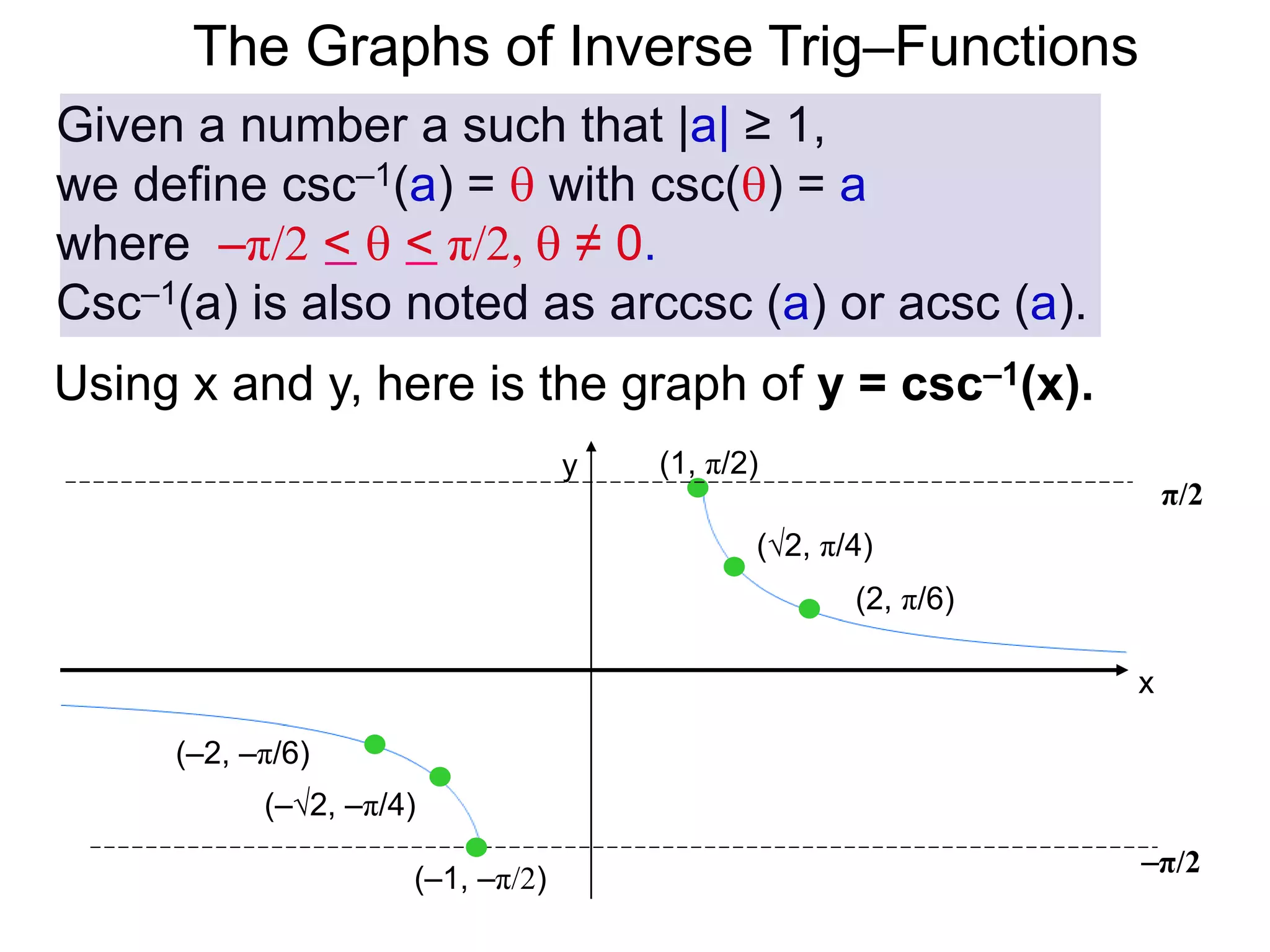
Using x and y, here is the graph of y = csc–1(x).
(1, π/2)
x
y
(–√2, –π/4)
(2, π/6)
(–1, –π/2)
(√2, π/4)
(–2, –π/6)
–π/2
π/2
–π/2
π/2
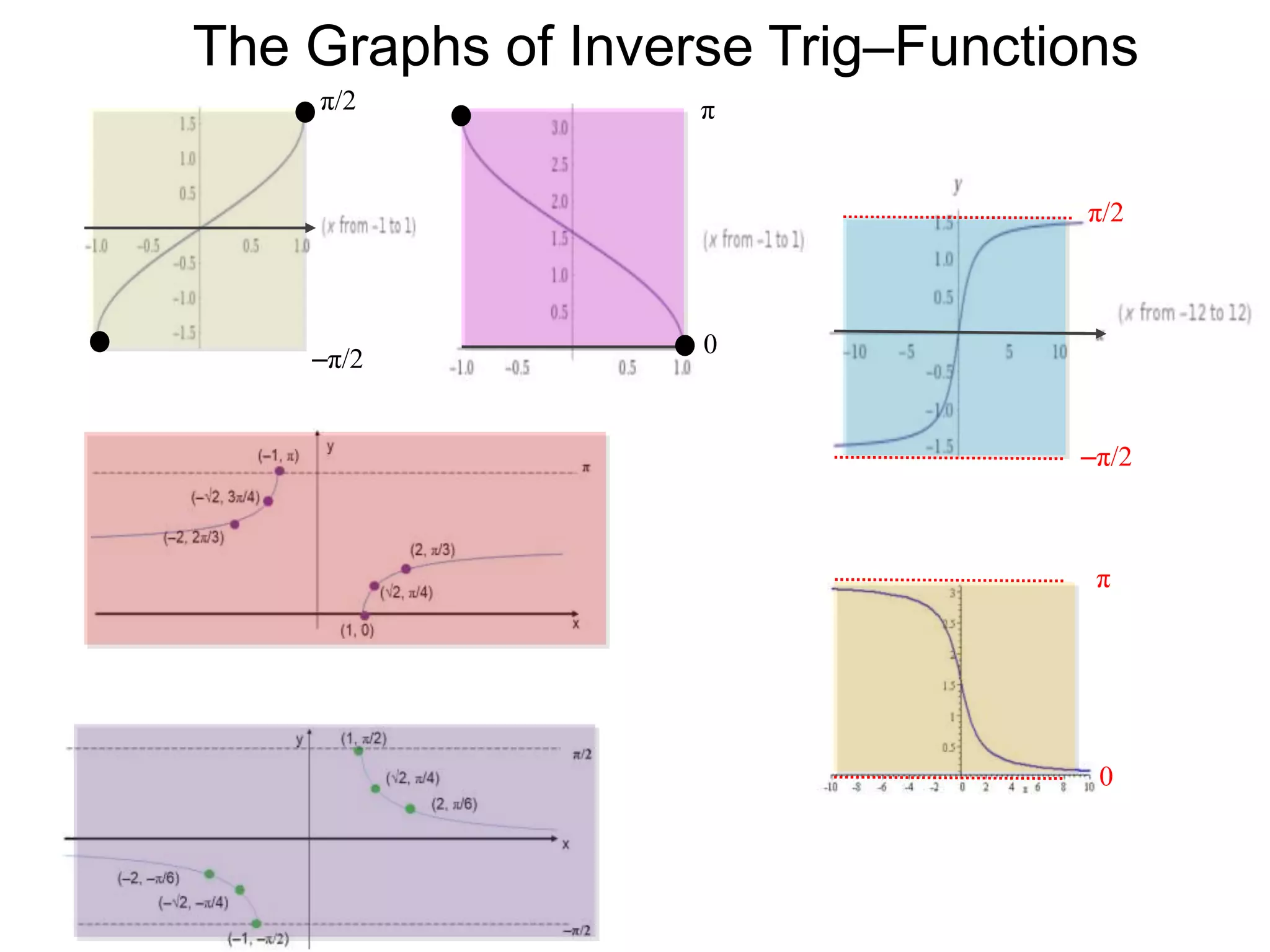
The Graphs of Inverse Trig–Functions
π
0
π/2
–π/2
π
0
One of the reasons for creating inverse functions is
for solving equations.
Linear Trig-Equations
One of the reasons for creating inverse functions is
for solving equations.
Linear Trig-Equations
The function 3x = y is different from x2 or sin(x)
in that if we know the output y = 1/2, then we know
the precise input x, in this case, 3x = ½, so x = 1/6.
One of the reasons for creating inverse functions is
for solving equations.
Linear Trig-Equations
Such is not the case for x2 or sin(x).
The function 3x = y is different from x2 or sin(x)
in that if we know the output y = 1/2, then we know
the precise input x, in this case, 3x = ½, so x = 1/6.
One of the reasons for creating inverse functions is
for solving equations.
Linear Trig-Equations
Such is not the case for x2 or sin(x).
If the output y = ½ so that x2 = ½ or sin(x) = ½,
we won’t be able to determine a precise input,
instead we have multiple or even infinite possibilities.
The function 3x = y is different from x2 or sin(x)
in that if we know the output y = 1/2, then we know
the precise input x, in this case, 3x = ½, so x = 1/6.
One of the reasons for creating inverse functions is
for solving equations.
Linear Trig-Equations
Such is not the case for x2 or sin(x).
If the output y = ½ so that x2 = ½ or sin(x) = ½,
we won’t be able to determine a precise input,
instead we have multiple or even infinite possibilities.
In these situations, we utilize trig-inverse functions to
obtain their solutions.
The function 3x = y is different from x2 or sin(x)
in that if we know the output y = 1/2, then we know
the precise input x, in this case, 3x = ½, so x = 1/6.
One of the reasons for creating inverse functions is
for solving equations.
Linear Trig-Equations
Such is not the case for x2 or sin(x).
If the output y = ½ so that x2 = ½ or sin(x) = ½,
we won’t be able to determine a precise input,
instead we have multiple or even infinite possibilities.
In these situations, we utilize trig-inverse functions to
obtain their solutions.
The function 3x = y is different from x2 or sin(x)
in that if we know the output y = 1/2, then we know
the precise input x, in this case, 3x = ½, so x = 1/6.
Specifically, we will solve linear trig-equations,
that is, equations of the form aX + b = 0
where X is a trig-function.
Important Trigonometric Values
Solving linear trig-equations is to solve for positions
on the unit circle.
Important Trigonometric Values
Solving linear trig-equations is to solve for positions
on the unit circle. From the position-solutions,
we apply the inverse trig-functions to obtain angular-
solutions and the list of all solutions, if necessary.
Important Trigonometric Values
Solving linear trig-equations is to solve for positions
on the unit circle. From the position-solutions,
we apply the inverse trig-functions to obtain angular-
solutions and the list of all solutions, if necessary.
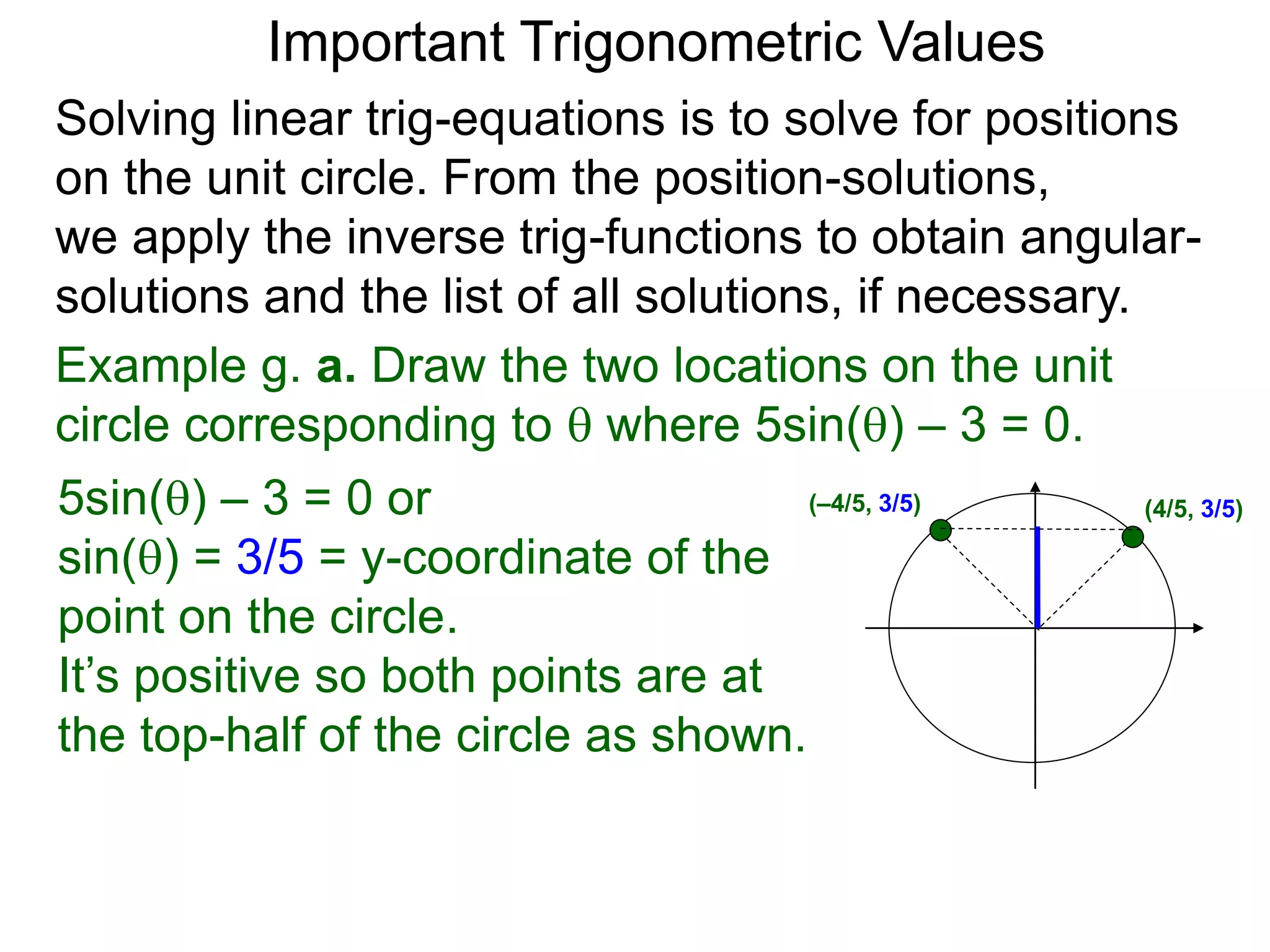
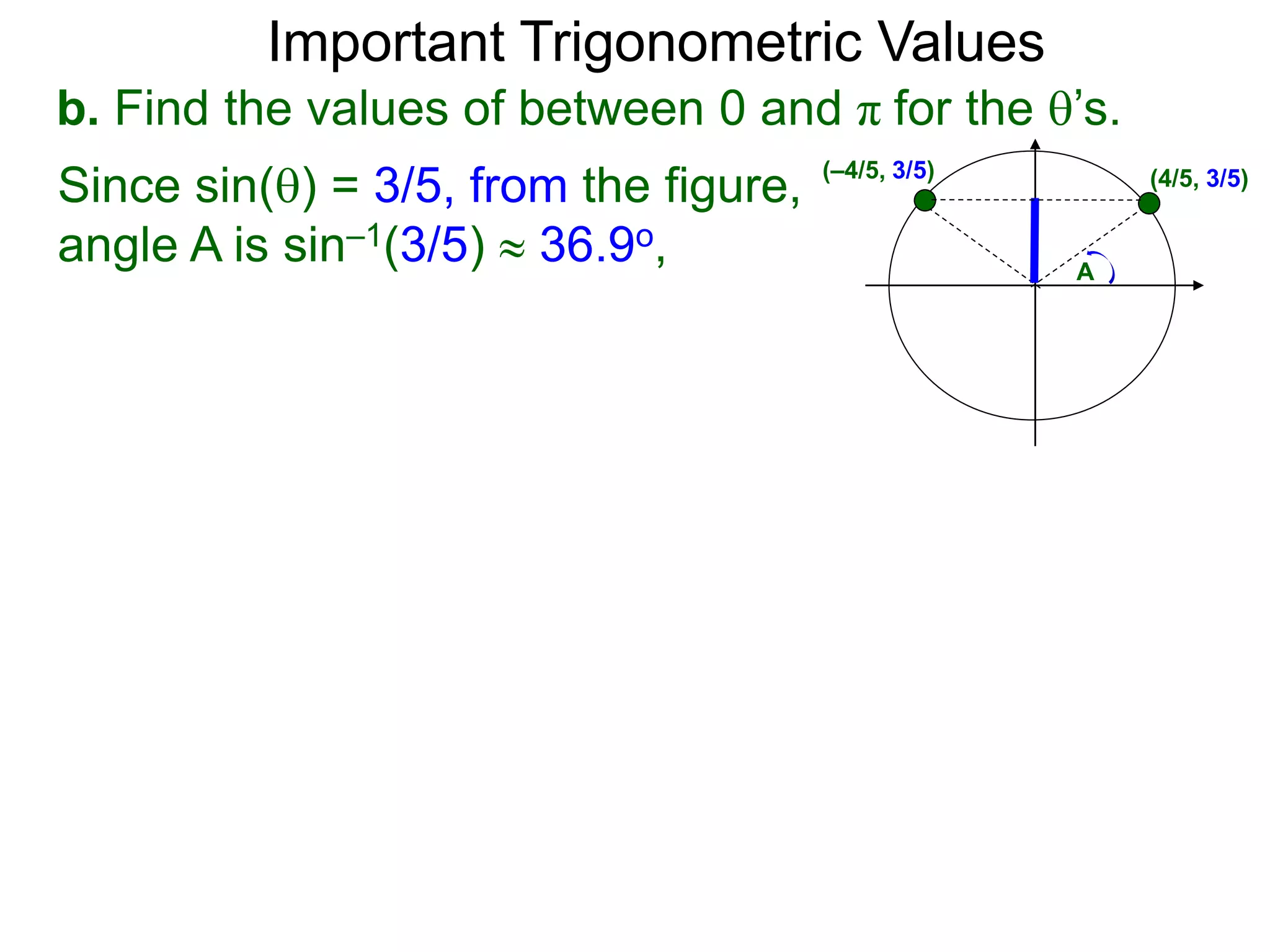
Example g. a. Draw the two locations on the unit
circle corresponding to  where 5sin() – 3 = 0.
Important Trigonometric Values
Solving linear trig-equations is to solve for positions
on the unit circle. From the position-solutions,
we apply the inverse trig-functions to obtain angular-
solutions and the list of all solutions, if necessary.
Example g. a. Draw the two locations on the unit
circle corresponding to  where 5sin() – 3 = 0.
5sin() – 3 = 0 or
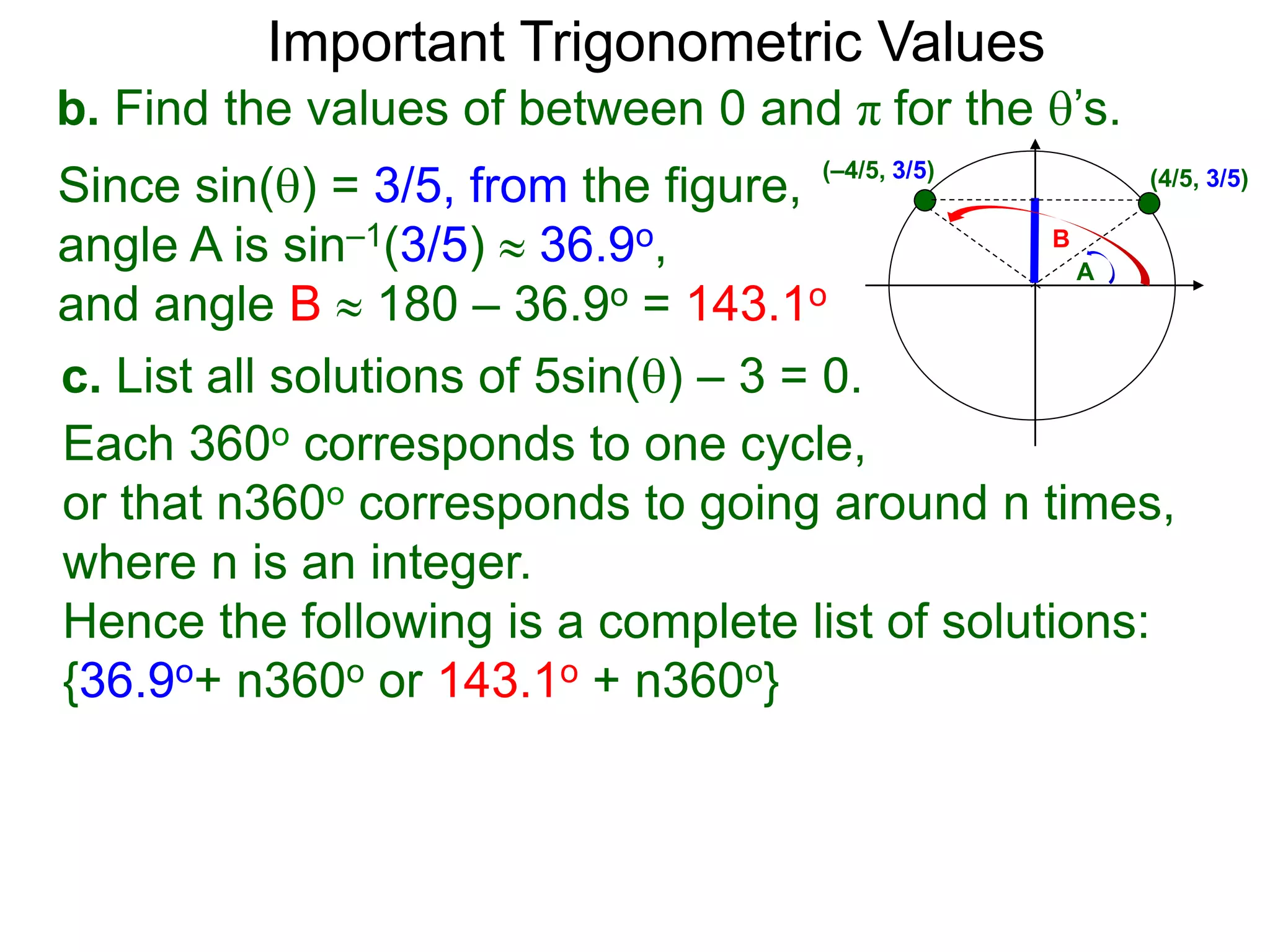
sin() = 3/5 = y-coordinate of the
point on the circle.
Important Trigonometric Values
Solving linear trig-equations is to solve for positions
on the unit circle. From the position-solutions,
we apply the inverse trig-functions to obtain angular-
solutions and the list of all solutions, if necessary.
Example g. a. Draw the two locations on the unit
circle corresponding to  where 5sin() – 3 = 0.
5sin() – 3 = 0 or
sin() = 3/5 = y-coordinate of the
point on the circle.
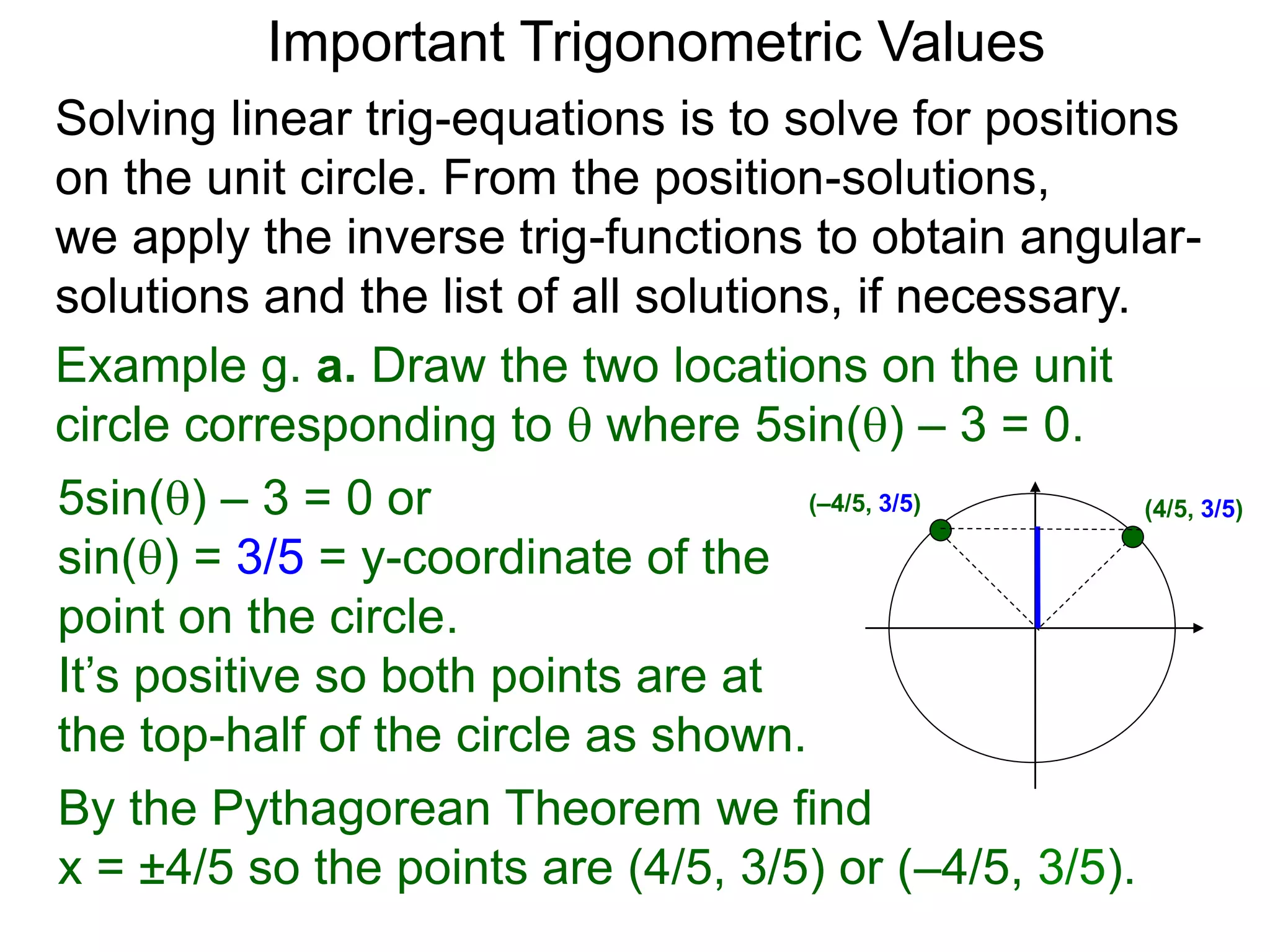
It’s positive so both points are at
the top-half of the circle as shown.
(–4/5, 3/5) (4/5, 3/5)
Important Trigonometric Values
Solving linear trig-equations is to solve for positions
on the unit circle. From the position-solutions,
we apply the inverse trig-functions to obtain angular-
solutions and the list of all solutions, if necessary.
By the Pythagorean Theorem we find
x = ±4/5 so the points are (4/5, 3/5) or (–4/5, 3/5).
Example g. a. Draw the two locations on the unit
circle corresponding to  where 5sin() – 3 = 0.
5sin() – 3 = 0 or
sin() = 3/5 = y-coordinate of the
point on the circle.
It’s positive so both points are at
the top-half of the circle as shown.
(–4/5, 3/5) (4/5, 3/5)
Important Trigonometric Values
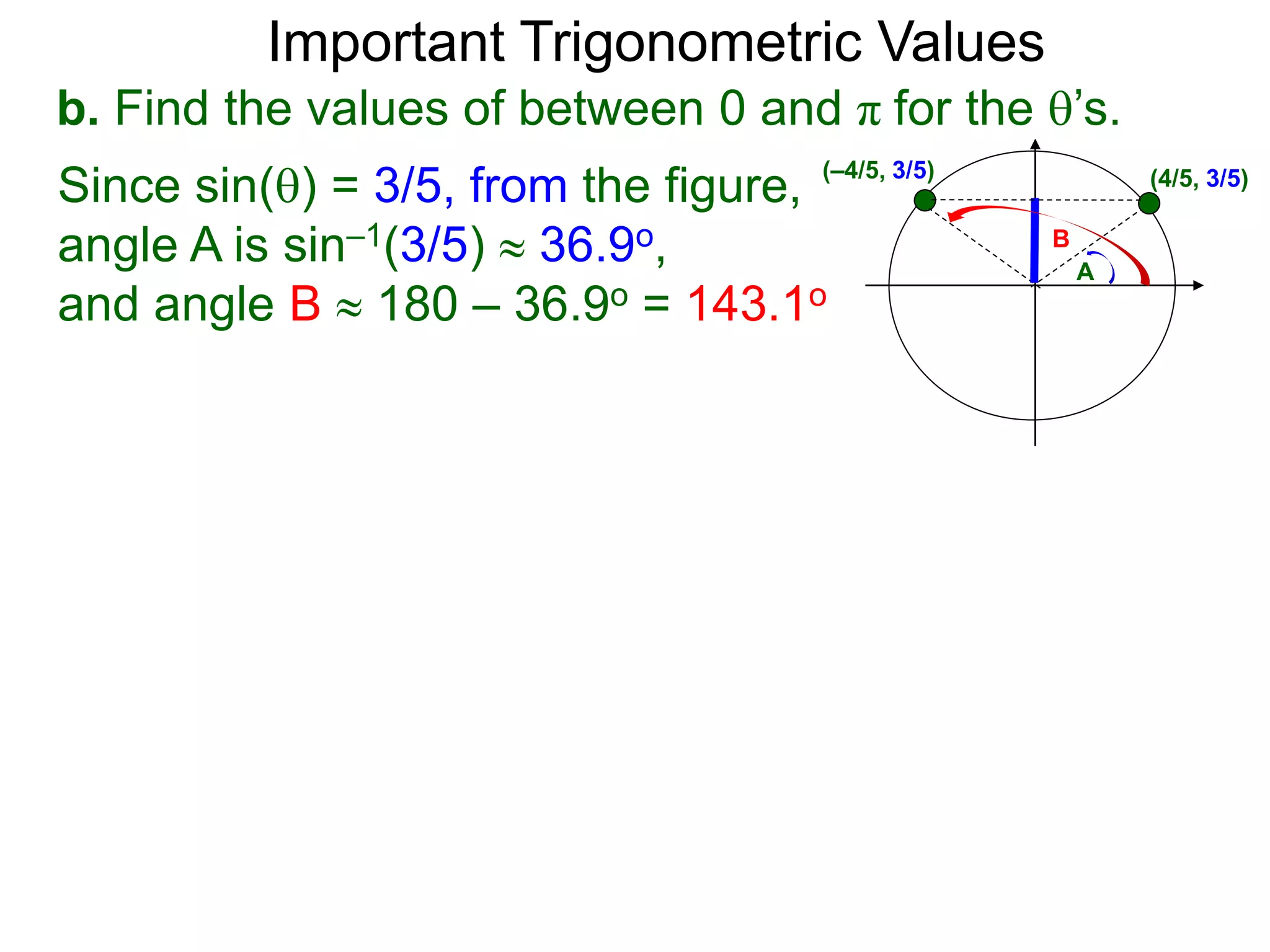
b. Find the values of between 0 and π for the ’s.
(–4/5, 3/5) (4/5, 3/5)
A
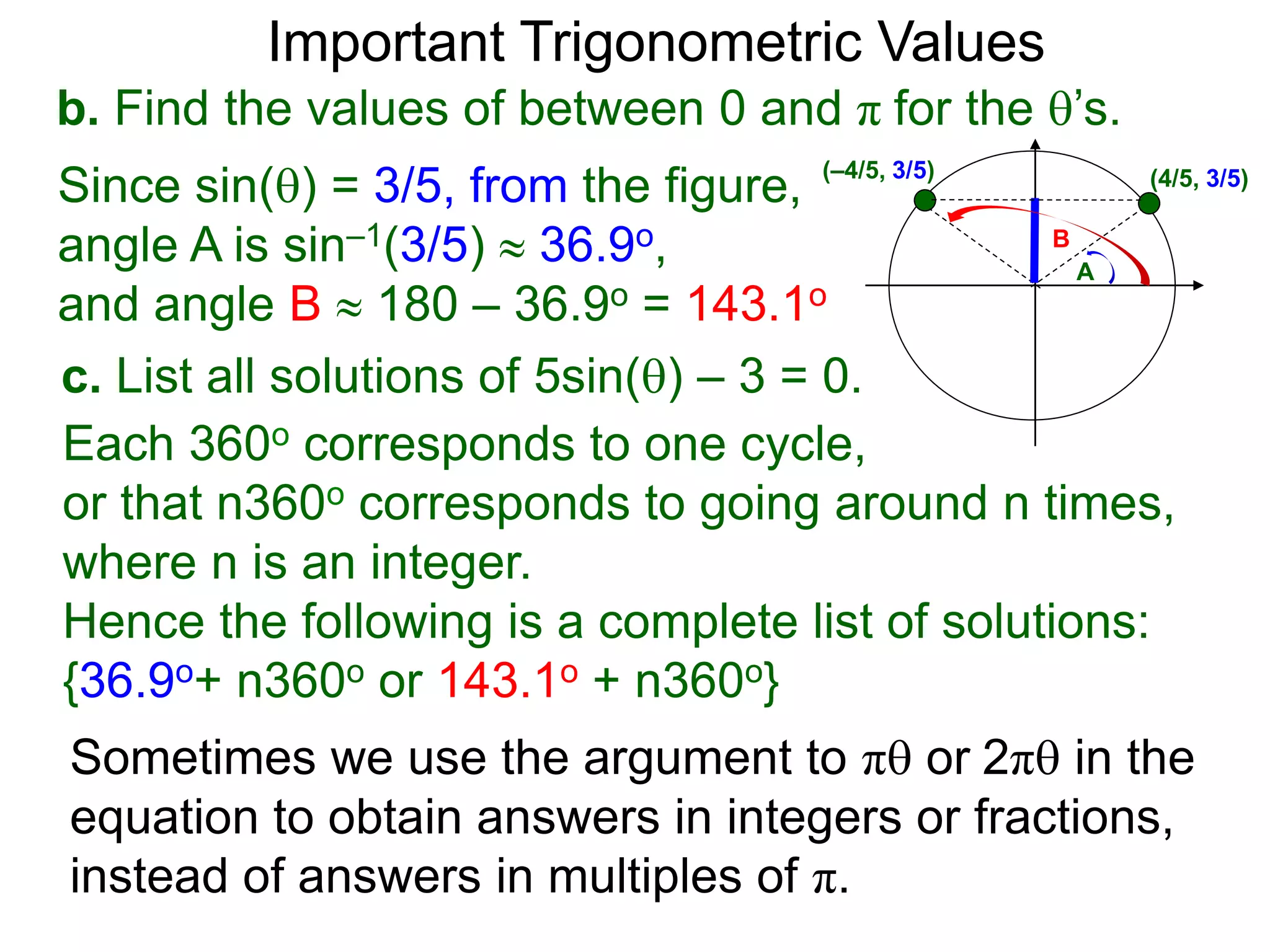
Since sin() = 3/5, from the figure,
angle A is sin–1(3/5)  36.9o,
Important Trigonometric Values
b. Find the values of between 0 and π for the ’s.
Since sin() = 3/5, from the figure,
angle A is sin–1(3/5)  36.9o,
and angle B  180 – 36.9o = 143.1o
(–4/5, 3/5) (4/5, 3/5)
A
B
Important Trigonometric Values
b. Find the values of between 0 and π for the ’s.
Since sin() = 3/5, from the figure,
angle A is sin–1(3/5)  36.9o,
and angle B  180 – 36.9o = 143.1o
(–4/5, 3/5) (4/5, 3/5)
A
B
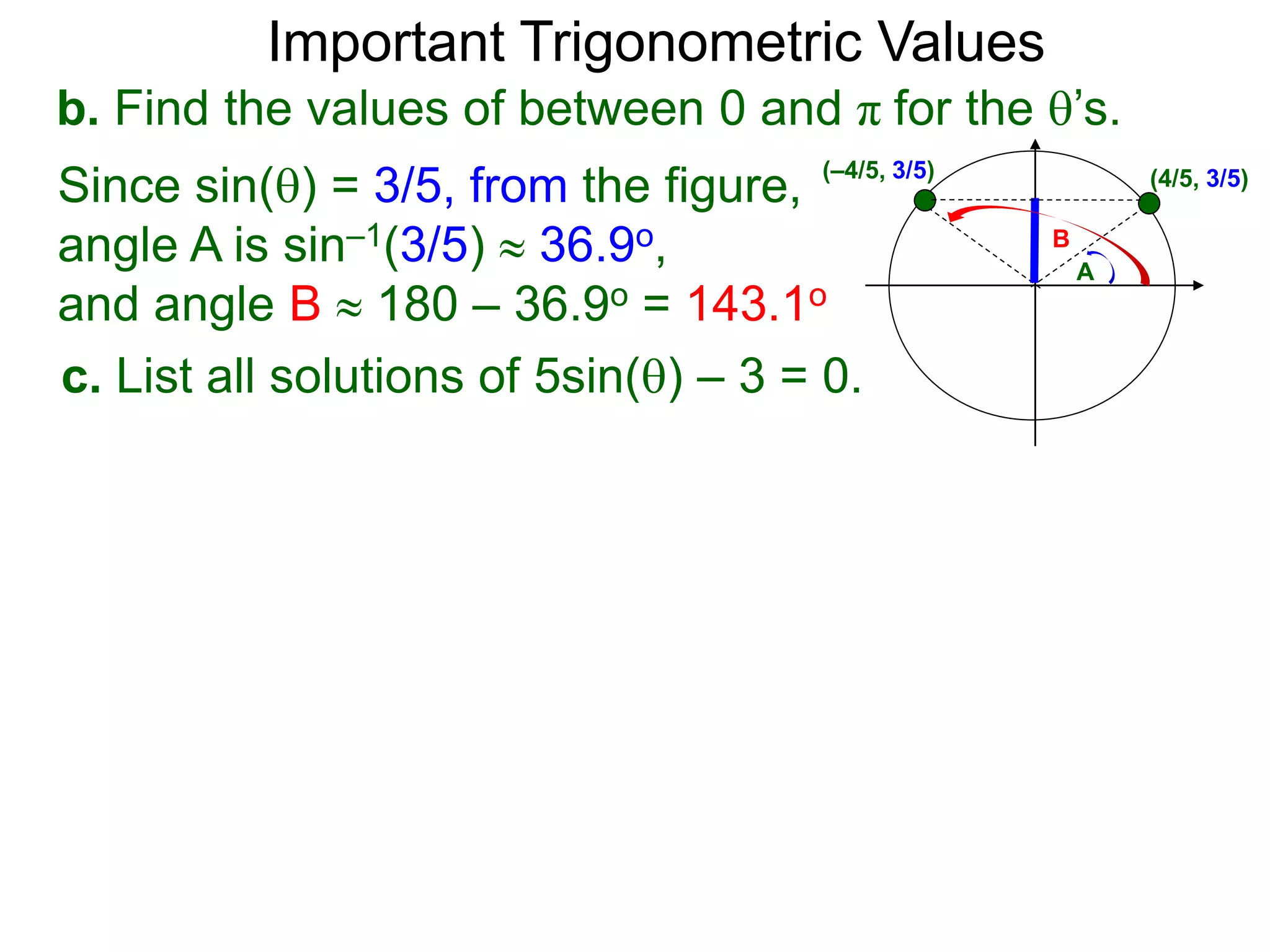
c. List all solutions of 5sin() – 3 = 0.
Important Trigonometric Values
b. Find the values of between 0 and π for the ’s.
Since sin() = 3/5, from the figure,
angle A is sin–1(3/5)  36.9o,
and angle B  180 – 36.9o = 143.1o
(–4/5, 3/5) (4/5, 3/5)
A
B
c. List all solutions of 5sin() – 3 = 0.
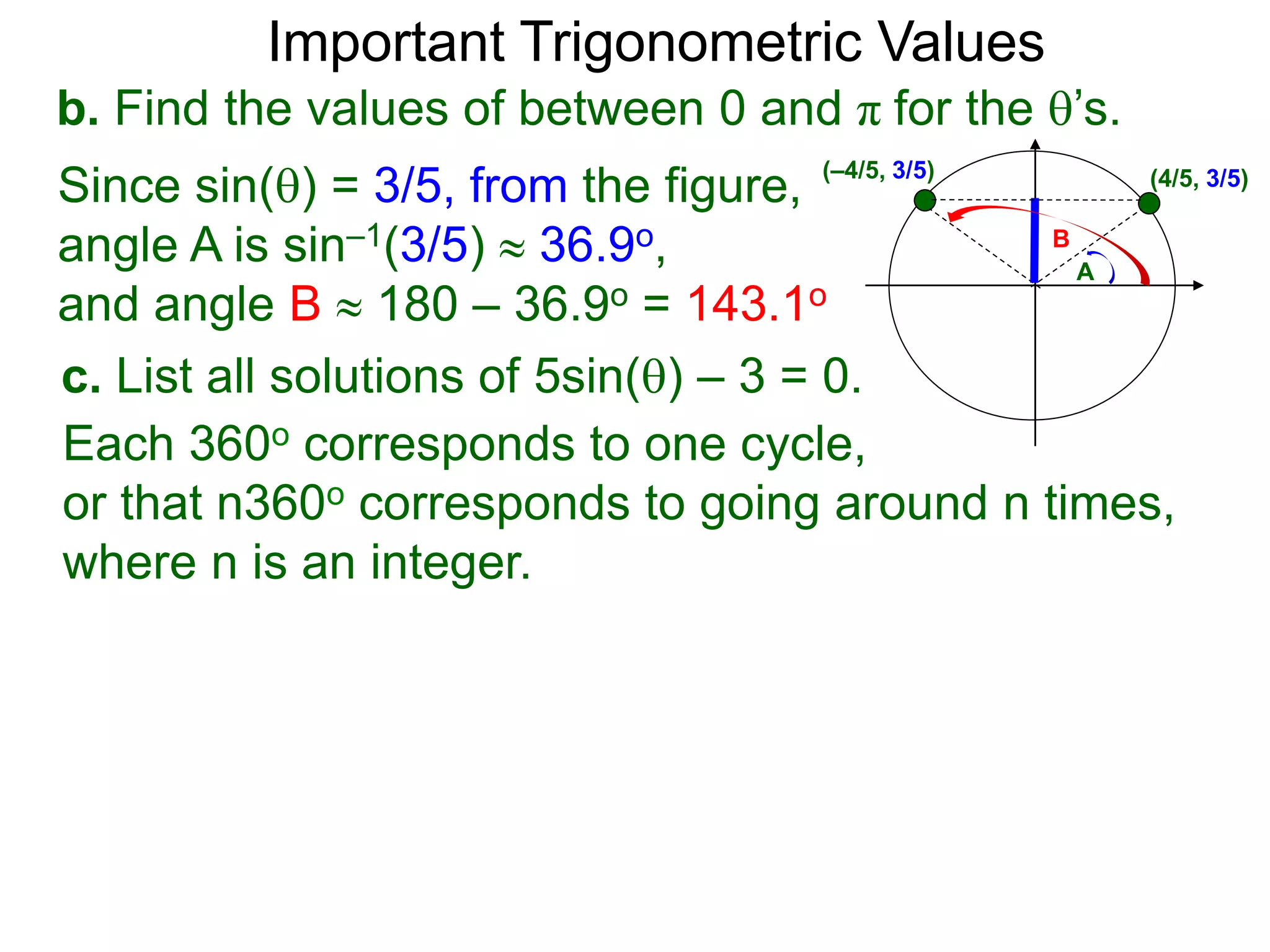
Each 360o corresponds to one cycle,
or that n360o corresponds to going around n times,
where n is an integer.
Important Trigonometric Values
b. Find the values of between 0 and π for the ’s.
Since sin() = 3/5, from the figure,
angle A is sin–1(3/5)  36.9o,
and angle B  180 – 36.9o = 143.1o
(–4/5, 3/5) (4/5, 3/5)
A
B
c. List all solutions of 5sin() – 3 = 0.
Each 360o corresponds to one cycle,
or that n360o corresponds to going around n times,
where n is an integer.
Hence the following is a complete list of solutions:
{36.9o+ n360o or 143.1o + n360o}
Important Trigonometric Values
b. Find the values of between 0 and π for the ’s.
Since sin() = 3/5, from the figure,
angle A is sin–1(3/5)  36.9o,
and angle B  180 – 36.9o = 143.1o
(–4/5, 3/5) (4/5, 3/5)
A
B
c. List all solutions of 5sin() – 3 = 0.
Each 360o corresponds to one cycle,
or that n360o corresponds to going around n times,
where n is an integer.
Hence the following is a complete list of solutions:
{36.9o+ n360o or 143.1o + n360o}
Sometimes we use the argument to π or 2π in the
equation to obtain answers in integers or fractions,
instead of answers in multiples of π.
Important Trigonometric Values
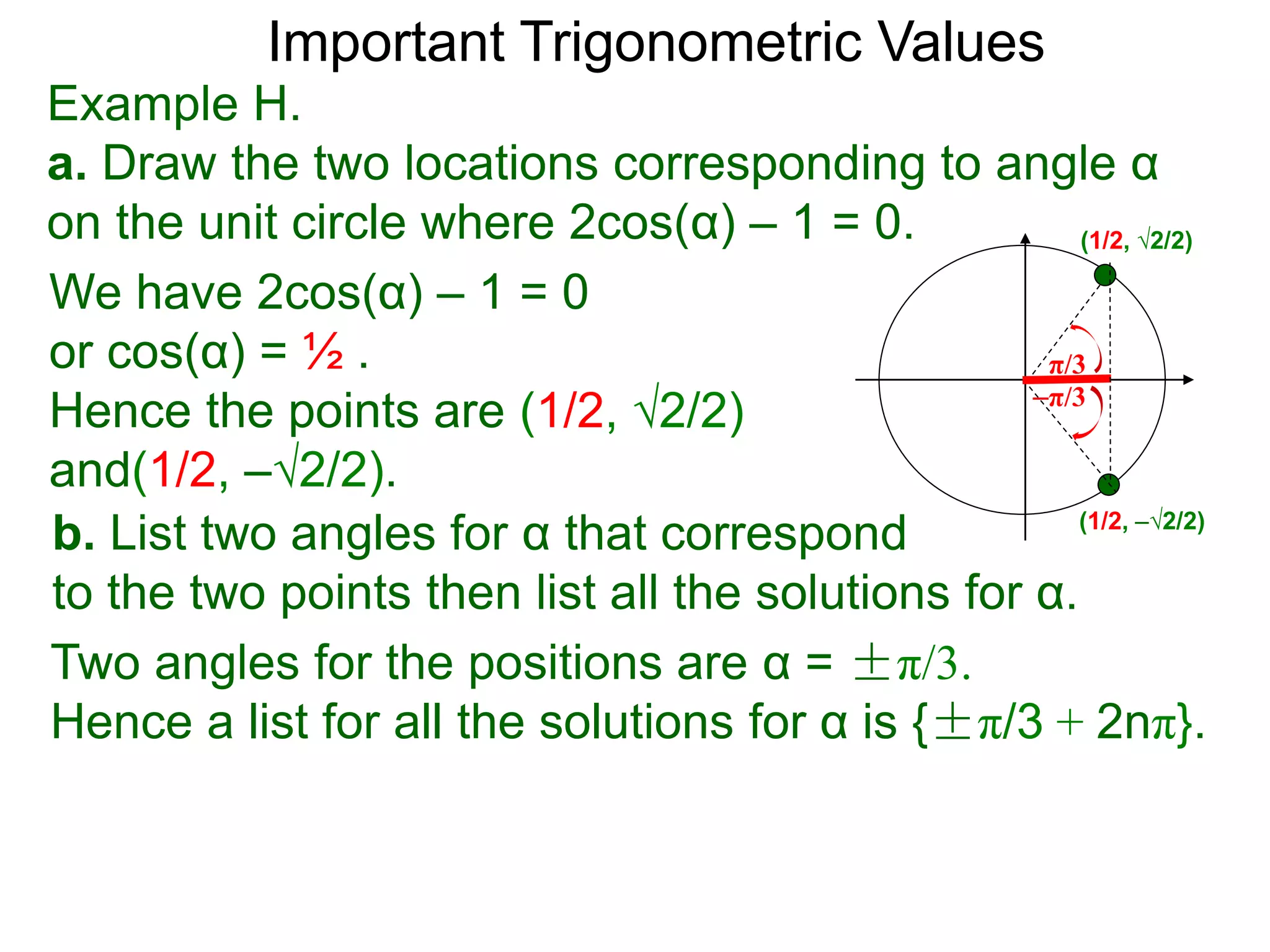
Example H.
a. Draw the two locations corresponding to angle α
on the unit circle where 2cos(α) – 1 = 0.
Important Trigonometric Values
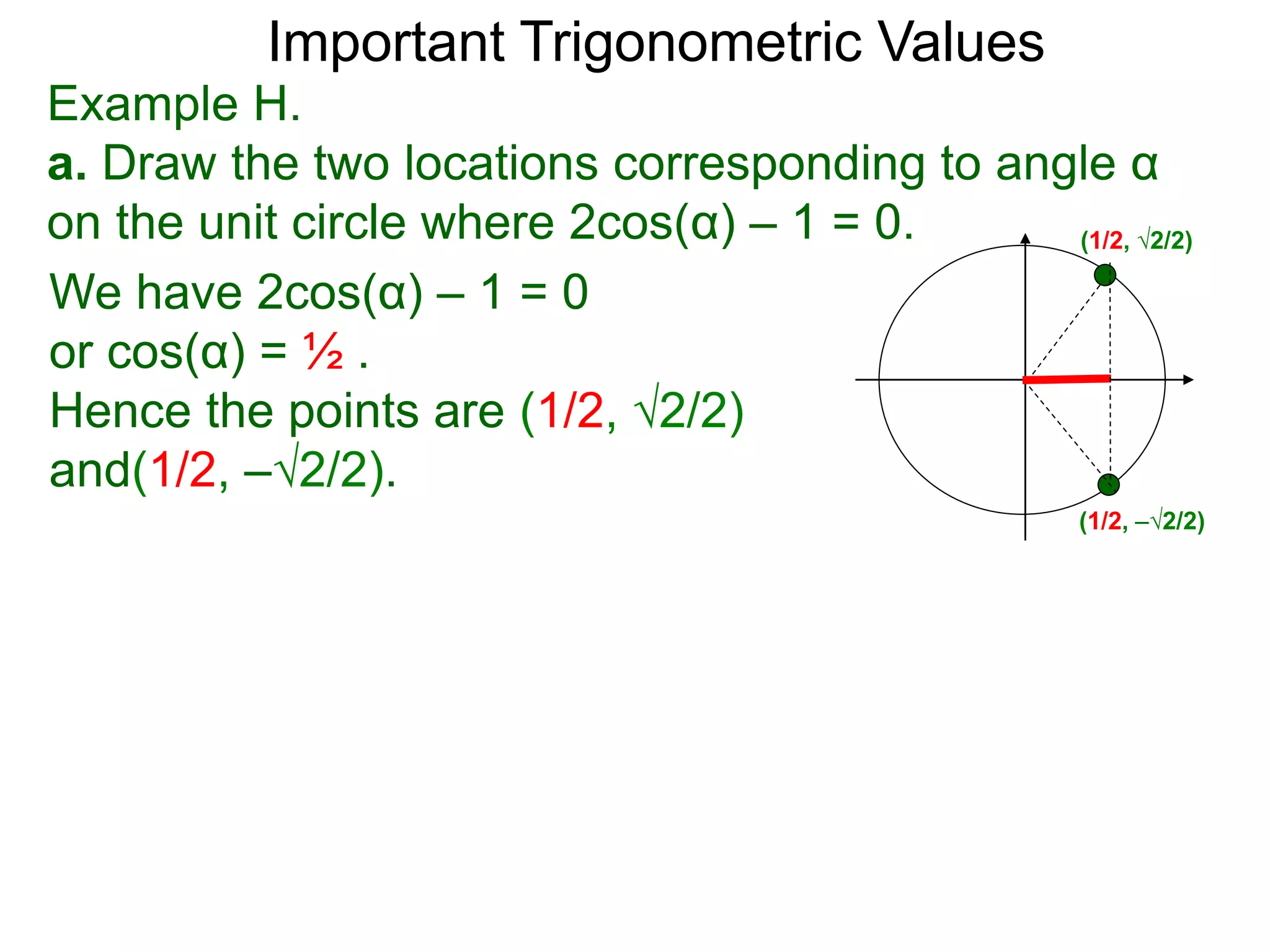
Example H.
a. Draw the two locations corresponding to angle α
on the unit circle where 2cos(α) – 1 = 0.
We have 2cos(α) – 1 = 0
or cos(α) = ½ .
Important Trigonometric Values
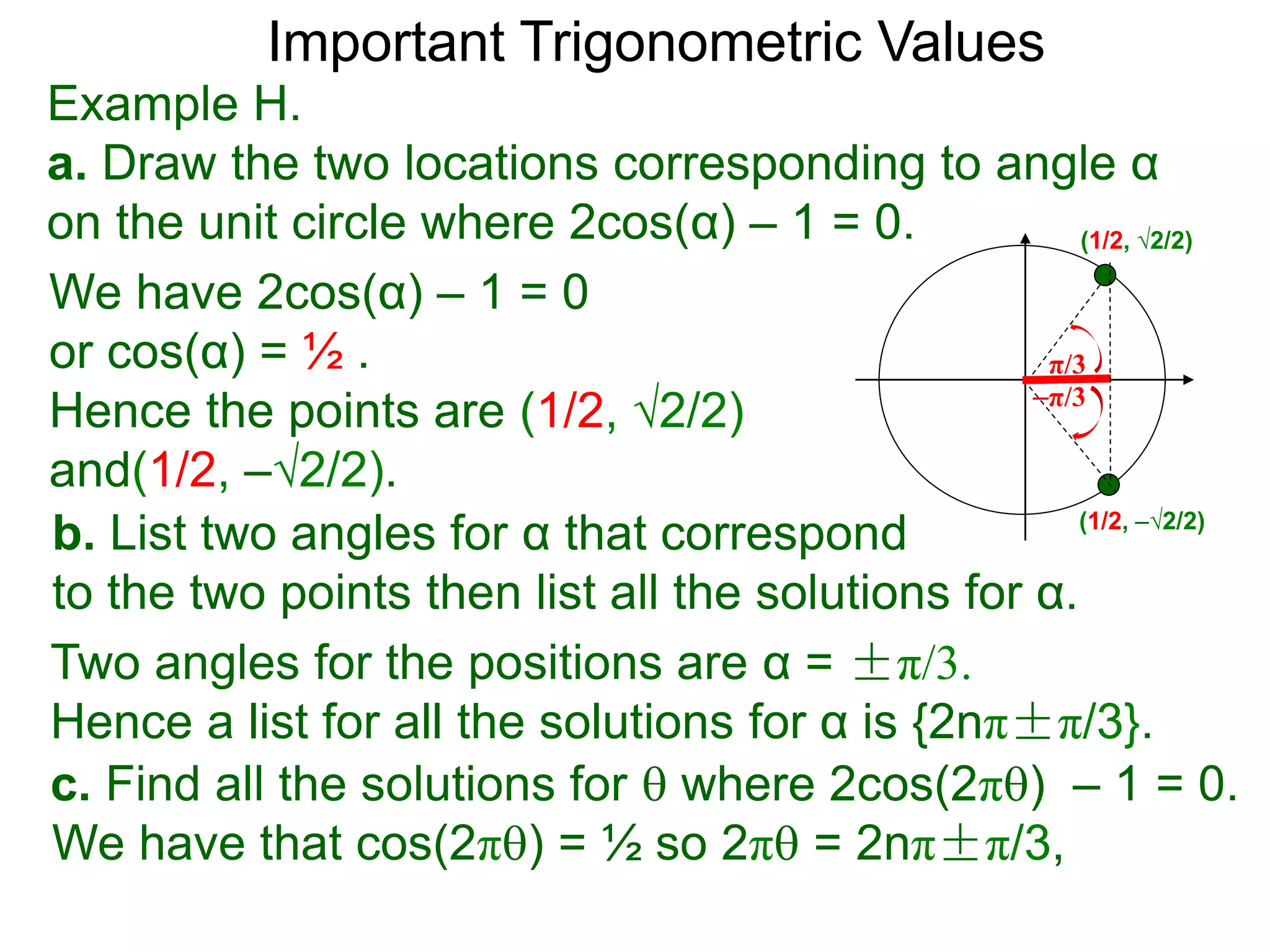
Example H.
a. Draw the two locations corresponding to angle α
on the unit circle where 2cos(α) – 1 = 0. (1/2, √2/2)
(1/2, –√2/2)
We have 2cos(α) – 1 = 0
or cos(α) = ½ .
Hence the points are (1/2, √2/2)
and(1/2, –√2/2).
Important Trigonometric Values
Example H.
a. Draw the two locations corresponding to angle α
on the unit circle where 2cos(α) – 1 = 0.
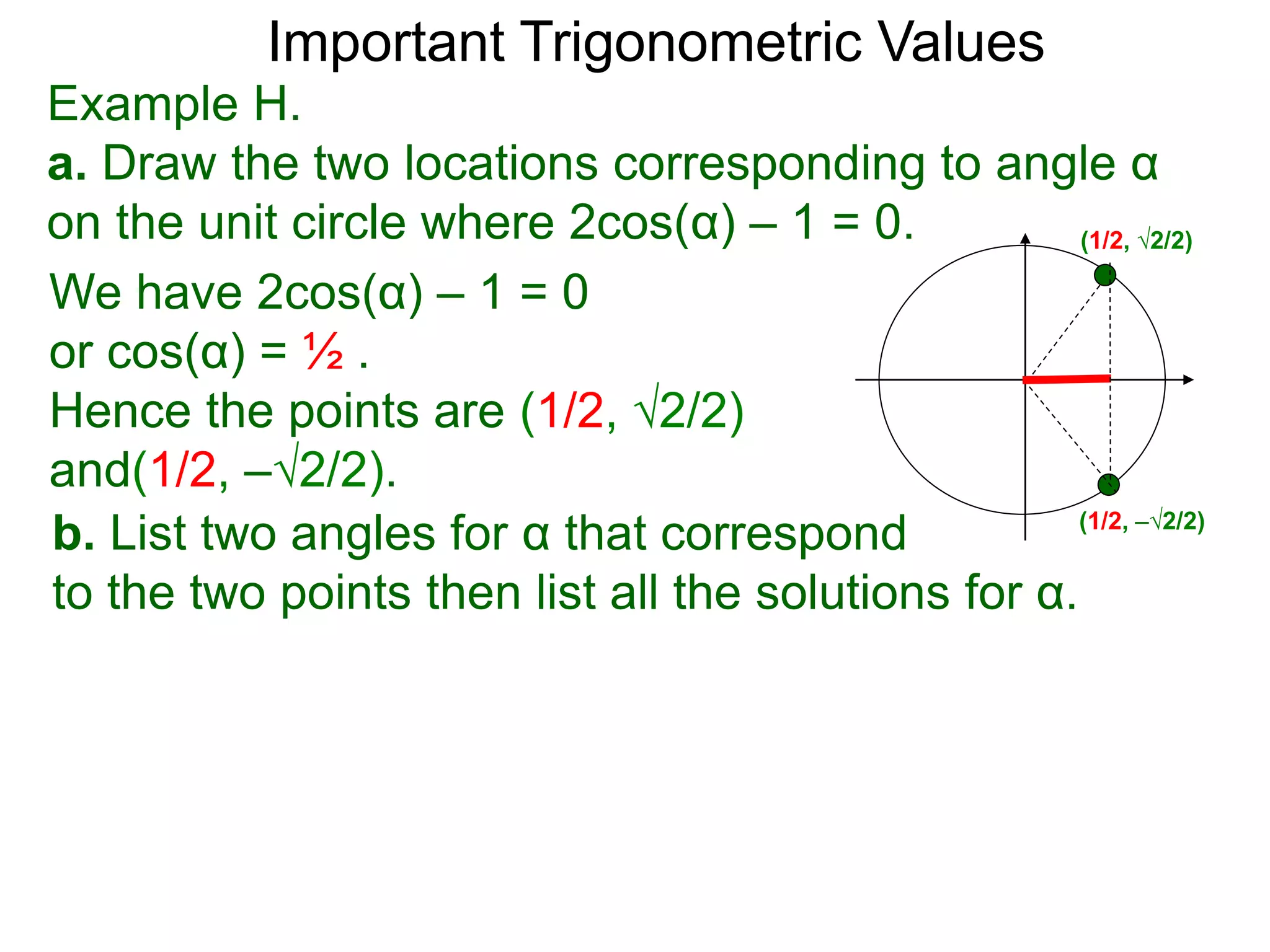
b. List two angles for α that correspond
to the two points then list all the solutions for α.
We have 2cos(α) – 1 = 0
or cos(α) = ½ .
Hence the points are (1/2, √2/2)
and(1/2, –√2/2).
(1/2, √2/2)
(1/2, –√2/2)
Important Trigonometric Values
Example H.
a. Draw the two locations corresponding to angle α
on the unit circle where 2cos(α) – 1 = 0.
b. List two angles for α that correspond
to the two points then list all the solutions for α.
(1/2, √2/2)
(1/2, –√2/2)
We have 2cos(α) – 1 = 0
or cos(α) = ½ .
Hence the points are (1/2, √2/2)
and(1/2, –√2/2).
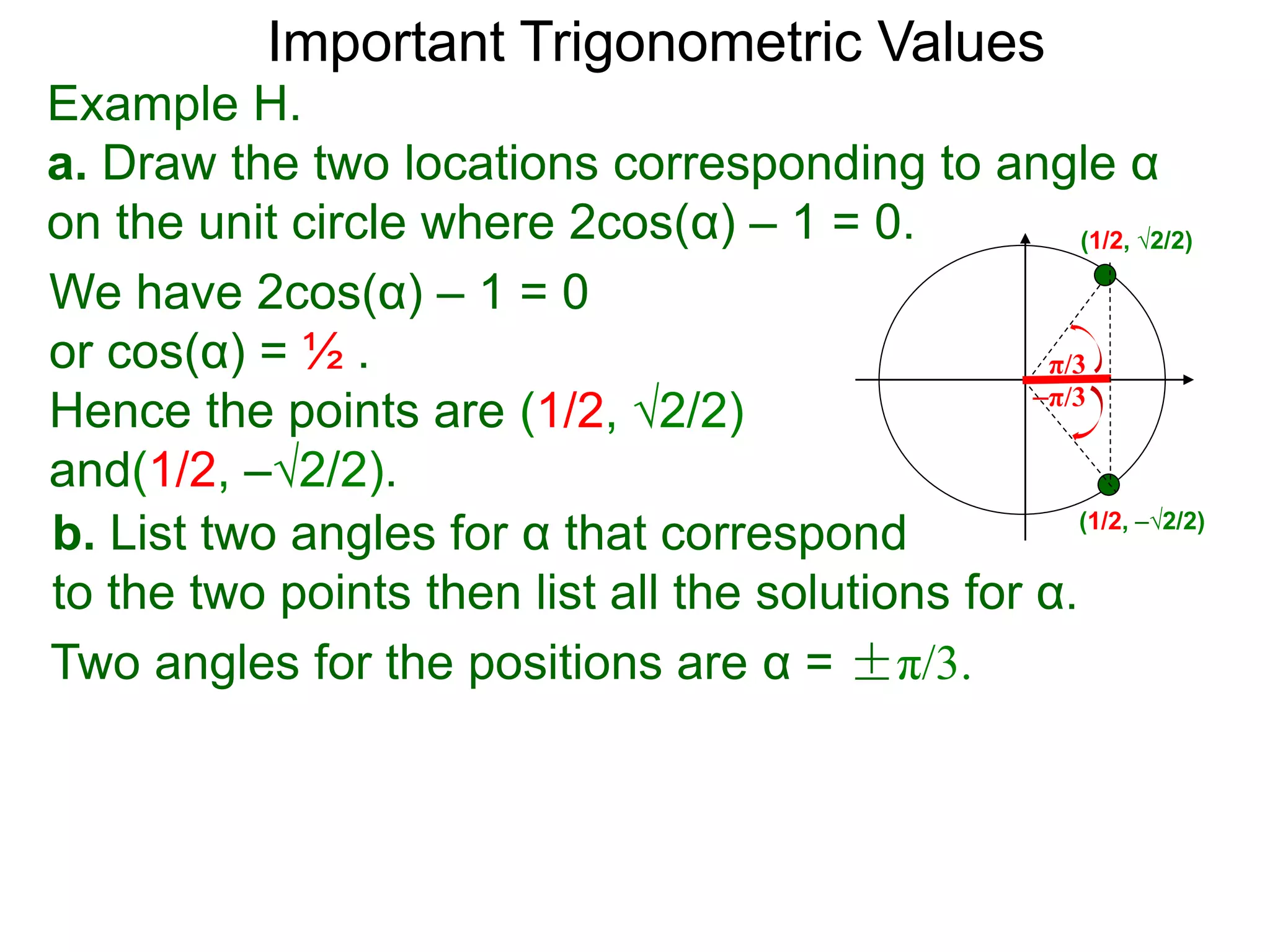
–π/3
π/3
Two angles for the positions are α = ±π/3.
Important Trigonometric Values
Example H.
a. Draw the two locations corresponding to angle α
on the unit circle where 2cos(α) – 1 = 0.
b. List two angles for α that correspond
to the two points then list all the solutions for α.
(1/2, √2/2)
(1/2, –√2/2)
We have 2cos(α) – 1 = 0
or cos(α) = ½ .
Hence the points are (1/2, √2/2)
and(1/2, –√2/2).
Two angles for the positions are α = ±π/3.
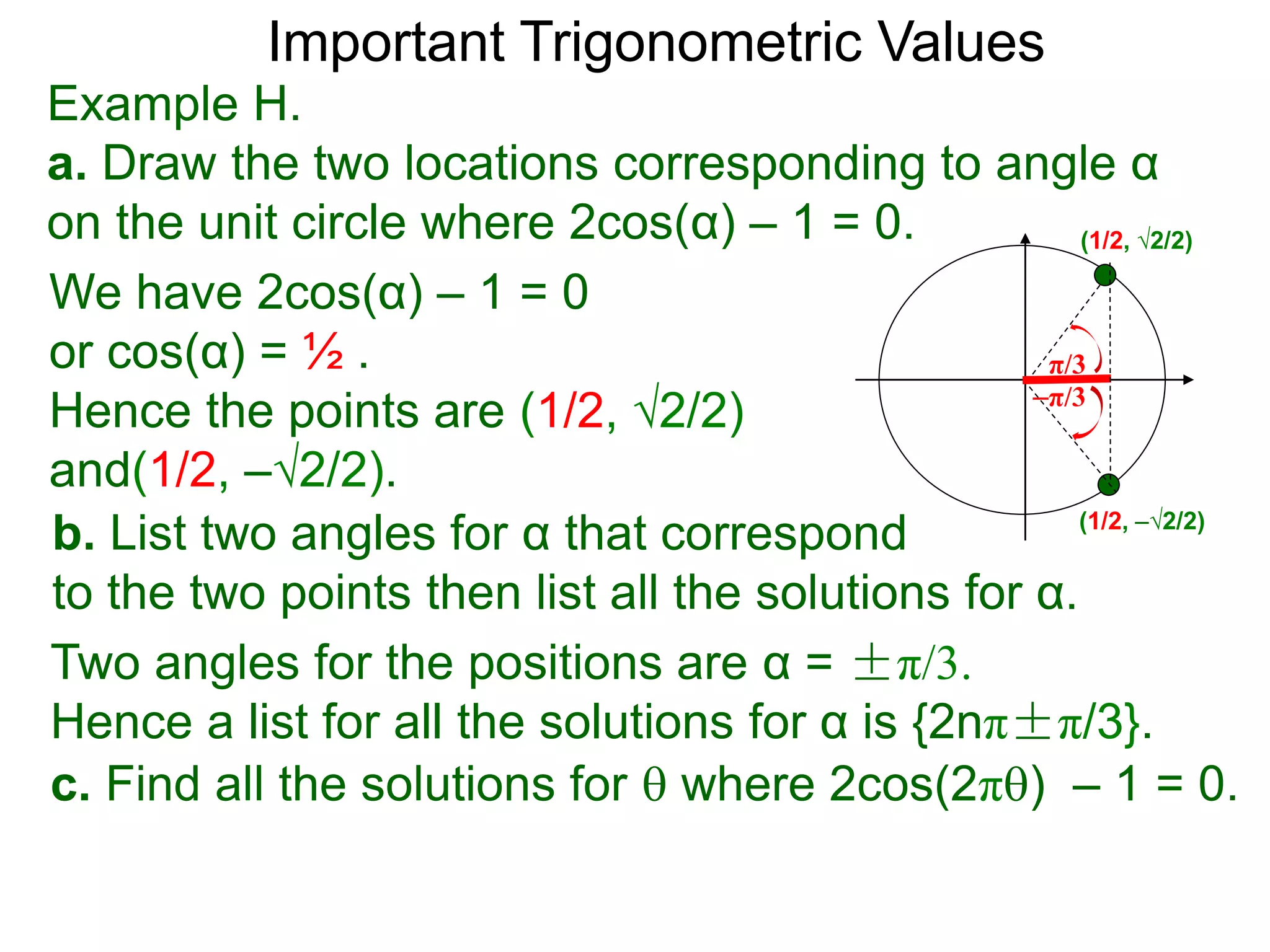
Hence a list for all the solutions for α is {±π/3 + 2nπ}.
–π/3
π/3
Important Trigonometric Values
Example H.
a. Draw the two locations corresponding to angle α
on the unit circle where 2cos(α) – 1 = 0.
b. List two angles for α that correspond
to the two points then list all the solutions for α.
(1/2, √2/2)
(1/2, –√2/2)
We have 2cos(α) – 1 = 0
or cos(α) = ½ .
Hence the points are (1/2, √2/2)
and(1/2, –√2/2).
Two angles for the positions are α = ±π/3.
Hence a list for all the solutions for α is {2nπ±π/3}.
c. Find all the solutions for  where 2cos(2π) – 1 = 0.
–π/3
π/3
Important Trigonometric Values
Example H.
a. Draw the two locations corresponding to angle α
on the unit circle where 2cos(α) – 1 = 0.
b. List two angles for α that correspond
to the two points then list all the solutions for α.
(1/2, √2/2)
(1/2, –√2/2)
We have 2cos(α) – 1 = 0
or cos(α) = ½ .
Hence the points are (1/2, √2/2)
and(1/2, –√2/2).
Two angles for the positions are α = ±π/3.
Hence a list for all the solutions for α is {2nπ±π/3}.
c. Find all the solutions for  where 2cos(2π) – 1 = 0.
We have that cos(2π) = ½ so 2π = 2nπ±π/3,
–π/3
π/3
Important Trigonometric Values
Example H.
a. Draw the two locations corresponding to angle α
on the unit circle where 2cos(α) – 1 = 0.
b. List two angles for α that correspond
to the two points then list all the solutions for α.
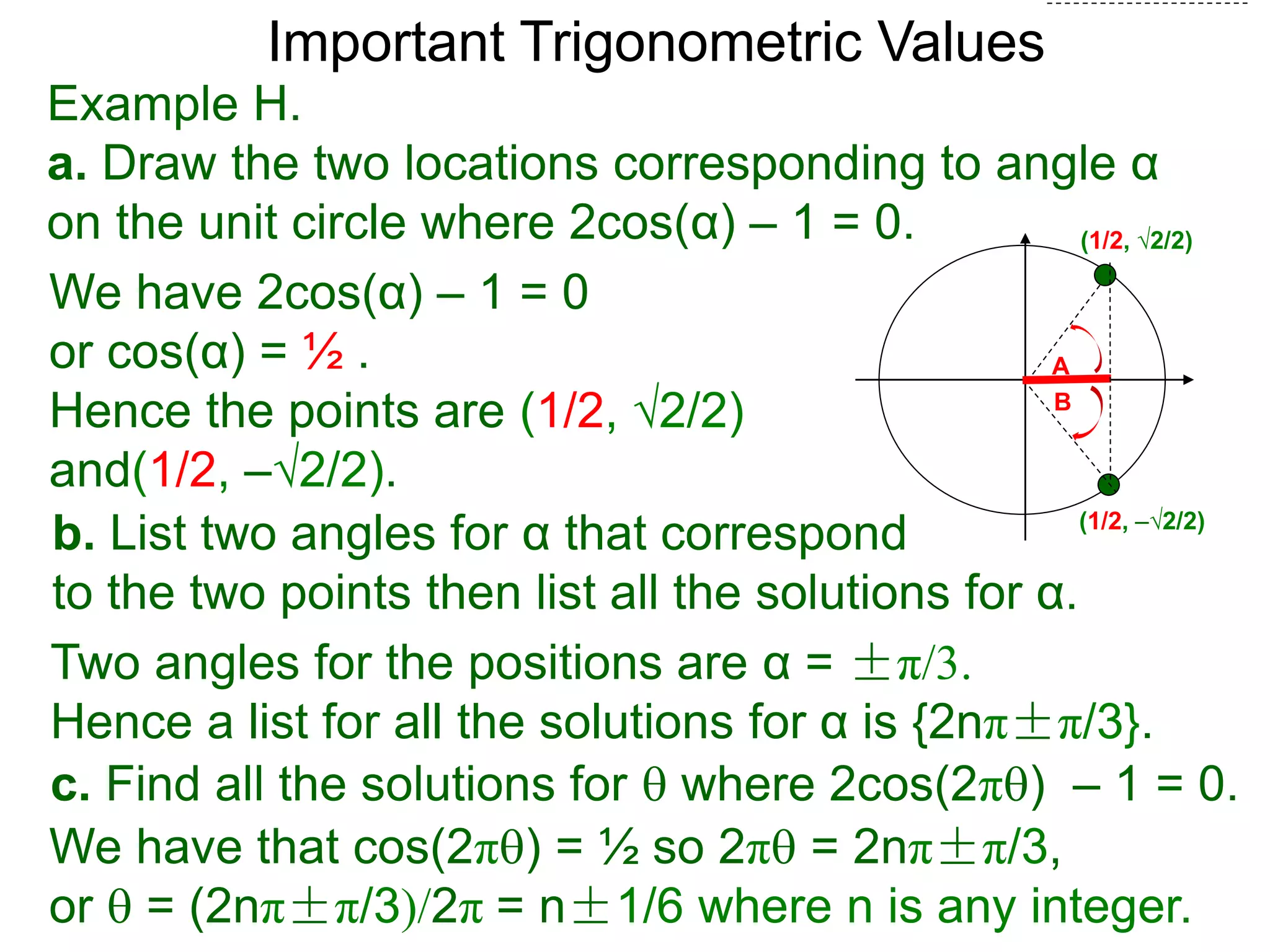
(1/2, √2/2)
A
B
(1/2, –√2/2)
We have 2cos(α) – 1 = 0
or cos(α) = ½ .
Hence the points are (1/2, √2/2)
and(1/2, –√2/2).
Two angles for the positions are α = ±π/3.
Hence a list for all the solutions for α is {2nπ±π/3}.
c. Find all the solutions for  where 2cos(2π) – 1 = 0.
We have that cos(2π) = ½ so 2π = 2nπ±π/3,
or  = (2nπ±π/3)/2π = n±1/6 where n is any integer.

7. inverse trig functions and linear trig equations-x

  • 1.
    –π/2 π/2 The Graphs ofInverse Trig–Functions π 0 π/2 –π/2 π 0
  • 2.
    A function f(x)= y takes an input x and produces one output y. Inverse Functions
  • 3.
  • 4.
    A function f(x)= y takes an input x and produces one output y. Often we represent a function by the following figure. Inverse Functions domian rangex y=f(x) f
  • 5.
    A function f(x)= y takes an input x and produces one output y. Often we represent a function by the following figure. Inverse Functions We like to reverse the operation, i.e., if we know the output y, what was (were) the input x? domian rangex y=f(x) f
  • 6.
    A function f(x)= y takes an input x and produces one output y. Often we represent a function by the following figure. Inverse Functions We like to reverse the operation, i.e., if we know the output y, what was (were) the input x? This procedure of associating the output y to the input x may or may not be a function. domian rangex y=f(x) f
  • 7.
    A function f(x)= y takes an input x and produces one output y. Often we represent a function by the following figure. Inverse Functions We like to reverse the operation, i.e., if we know the output y, what was (were) the input x? This procedure of associating the output y to the input x may or may not be a function. domian rangex y=f(x) f If it is a function, it is called the inverse function of f(x) and it is denoted as f –1(y).
  • 8.
    A function f(x)= y takes an input x and produces one output y. Often we represent a function by the following figure. Inverse Functions We like to reverse the operation, i.e., if we know the output y, what was (were) the input x? This procedure of associating the output y to the input x may or may not be a function. domian rangex y=f(x) f If it is a function, it is called the inverse function of f(x) and it is denoted as f –1(y). x y=f(x) f
  • 9.
    A function f(x)= y takes an input x and produces one output y. Often we represent a function by the following figure. Inverse Functions We like to reverse the operation, i.e., if we know the output y, what was (were) the input x? This procedure of associating the output y to the input x may or may not be a function. domian rangex y=f(x) f If it is a function, it is called the inverse function of f(x) and it is denoted as f –1(y). x=f–1(y) y=f(x) f f –1
  • 10.
    A function f(x)= y takes an input x and produces one output y. Often we represent a function by the following figure. Inverse Functions We like to reverse the operation, i.e., if we know the output y, what was (were) the input x? This procedure of associating the output y to the input x may or may not be a function. domian rangex y=f(x) f If it is a function, it is called the inverse function of f(x) and it is denoted as f –1(y). We say f(x) and f –1(y) are the inverse of each other. x=f–1(y) y=f(x) f f –1
  • 11.
    Example A. a. Thefunction y = f(x) = 2x takes the input x and doubles it to get the output y. Inverse Functions
  • 12.
    Example A. a. Thefunction y = f(x) = 2x takes the input x and doubles it to get the output y. To reverse the operation, take an output y, Inverse Functions
  • 13.
    Example A. a. Thefunction y = f(x) = 2x takes the input x and doubles it to get the output y. To reverse the operation, take an output y, divided it by 2 and we get back to the x. Inverse Functions
  • 14.
    Example A. a. Thefunction y = f(x) = 2x takes the input x and doubles it to get the output y. To reverse the operation, take an output y, divided it by 2 and we get back to the x. In other words f –1(y) = y/2. Inverse Functions
  • 15.
    Example A. a. Thefunction y = f(x) = 2x takes the input x and doubles it to get the output y. To reverse the operation, take an output y, divided it by 2 and we get back to the x. In other words f –1(y) = y/2. So, for example, f –1(6) = 3 because f(3) = 6. Inverse Functions
  • 16.
    Example A. a. Thefunction y = f(x) = 2x takes the input x and doubles it to get the output y. To reverse the operation, take an output y, divided it by 2 and we get back to the x. In other words f –1(y) = y/2. So, for example, f –1(6) = 3 because f(3) = 6. b. Given y = f(x) = x2 and y = 9, Inverse Functions
  • 17.
    Example A. a. Thefunction y = f(x) = 2x takes the input x and doubles it to get the output y. To reverse the operation, take an output y, divided it by 2 and we get back to the x. In other words f –1(y) = y/2. So, for example, f –1(6) = 3 because f(3) = 6. b. Given y = f(x) = x2 and y = 9, there are two inputs namely x = 3 and x = –3 that give the output 9. x=3 y=9 f(x)=x2 x=–3 Inverse Functions
  • 18.
    Example A. a. Thefunction y = f(x) = 2x takes the input x and doubles it to get the output y. To reverse the operation, take an output y, divided it by 2 and we get back to the x. In other words f –1(y) = y/2. So, for example, f –1(6) = 3 because f(3) = 6. b. Given y = f(x) = x2 and y = 9, there are two inputs namely x = 3 and x = –3 that give the output 9. Therefore, the reverse procedure is not a function x=3 y=9 f(x)=x2 x=–3 not a function Inverse Functions
  • 19.
    Example A. a. Thefunction y = f(x) = 2x takes the input x and doubles it to get the output y. To reverse the operation, take an output y, divided it by 2 and we get back to the x. In other words f –1(y) = y/2. So, for example, f –1(6) = 3 because f(3) = 6. b. Given y = f(x) = x2 and y = 9, there are two inputs namely x = 3 and x = –3 that give the output 9. Therefore, the reverse procedure is not a function Inverse Functions x=3 y=9 f(x)=x2 x=–3 not a function Unless we intentionally select an answer, f –1(9) is not well defined Because there are two choices.
  • 20.
    Example A. a. Thefunction y = f(x) = 2x takes the input x and doubles it to get the output y. To reverse the operation, take an output y, divided it by 2 and we get back to the x. In other words f –1(y) = y/2. So, for example, f –1(6) = 3 because f(3) = 6. b. Given y = f(x) = x2 and y = 9, there are two inputs namely x = 3 and x = –3 that give the output 9. Therefore, the reverse procedure is not a function so f –1(y) does not exist. Inverse Functions x=3 y=9 f(x)=x2 x=–3 not a function Unless we intentionally select an answer, f –1(9) is not well defined Because there are two choices.
  • 21.
    Example A. a. Thefunction y = f(x) = 2x takes the input x and doubles it to get the output y. To reverse the operation, take an output y, divided it by 2 and we get back to the x. In other words f –1(y) = y/2. So, for example, f –1(6) = 3 because f(3) = 6. b. Given y = f(x) = x2 and y = 9, there are two inputs namely x = 3 and x = –3 that give the output 9. Therefore, the reverse procedure is not a function so f –1(y) does not exist. Inverse Functions But g –1(y) exists for y = g(x) = x2 with x ≥ 0, and that g –1(9) = 3. In fact g –1(y) = √y. x=3 y=9 f(x)=x2 x=–3 not a function
  • 22.
    Example A. a. Thefunction y = f(x) = 2x takes the input x and doubles it to get the output y. To reverse the operation, take an output y, divided it by 2 and we get back to the x. In other words f –1(y) = y/2. So, for example, f –1(6) = 3 because f(3) = 6. b. Given y = f(x) = x2 and y = 9, there are two inputs namely x = 3 and x = –3 that give the output 9. Therefore, the reverse procedure is not a function so f –1(y) does not exist. Inverse Functions But g –1(y) exists for y = g(x) = x2 with x ≥ 0, and that g –1(9) = 3. In fact g –1(y) = √y. Hence the existence of the inverse depends on the domain. x=3 y=9 f(x)=x2 x=–3 not a function
  • 23.
    Inverse Functions u v u =v a one-to-one function A function is one-to-one if different inputs produce different outputs or that two inputs give two outputs.
  • 24.
    Inverse Functions A functionis one-to-one if different inputs produce different outputs or that two inputs give two outputs. That is, f(x) is said to be one-to-one if for every two inputs u and v such that u  v, then f(u)  f(v).
  • 25.
    Inverse Functions u v u =v a one-to-one function A function is one-to-one if different inputs produce different outputs or that two inputs give two outputs. That is, f(x) is said to be one-to-one if for every two inputs u and v such that u  v, then f(u)  f(v).
  • 26.
    Inverse Functions u f(u) vf(v) u = v f(u) = f(v) a one-to-one function A function is one-to-one if different inputs produce different outputs or that two inputs give two outputs. That is, f(x) is said to be one-to-one if for every two inputs u and v such that u  v, then f(u)  f(v).
  • 27.
    Inverse Functions u f(u) vf(v) u = v f(u) = f(v) a one-to-one function u v u = v not a one-to-one function A function is one-to-one if different inputs produce different outputs or that two inputs give two outputs. That is, f(x) is said to be one-to-one if for every two inputs u and v such that u  v, then f(u)  f(v).
  • 28.
    Inverse Functions u f(u) vf(v) u = v f(u) = f(v) a one-to-one function u f(u)=f(v) v u = v not a one-to-one function A function is one-to-one if different inputs produce different outputs or that two inputs give two outputs. That is, f(x) is said to be one-to-one if for every two inputs u and v such that u  v, then f(u)  f(v).
  • 29.
    Example B. a. g(x)= 2x is one-to-one Inverse Functions u f(u) v f(v) u = v f(u) = f(v) a one-to-one function u f(u)=f(v) v u = v not a one-to-one function A function is one-to-one if different inputs produce different outputs or that two inputs give two outputs. That is, f(x) is said to be one-to-one if for every two inputs u and v such that u  v, then f(u)  f(v).
  • 30.
    Example B. a. g(x)= 2x is one-to-one because if u  v, then 2u  2v. Inverse Functions u f(u) v f(v) u = v f(u) = f(v) a one-to-one function u f(u)=f(v) v u = v not a one-to-one function A function is one-to-one if different inputs produce different outputs or that two inputs give two outputs. That is, f(x) is said to be one-to-one if for every two inputs u and v such that u  v, then f(u)  f(v).
  • 31.
    Example B. a. g(x)= 2x is one-to-one because if u  v, then 2u  2v. b. f(x) = x2 is not one-to-one because 3  –3, but f(3) = f(–3) = 9. Inverse Functions u f(u) v f(v) u = v f(u) = f(v) a one-to-one function u f(u)=f(v) v u = v not a one-to-one function A function is one-to-one if different inputs produce different outputs or that two inputs give two outputs. That is, f(x) is said to be one-to-one if for every two inputs u and v such that u  v, then f(u)  f(v).
  • 32.
    Example B. a. g(x)= 2x is one-to-one because if u  v, then 2u  2v. b. f(x) = x2 is not one-to-one e.g. 3  –3, but f(3) = f(–3) = 9. Inverse Functions u f(u) v f(v) u = v f(u) = f(v) a one-to-one function u f(u)=f(v) v u = v not a one-to-one function Note: To justify a function is 1–1, we have to show that for every pair of u  v that f(u)  f(v). A function is one-to-one if different inputs produce different outputs or that two inputs give two outputs. That is, f(x) is said to be one-to-one if for every two inputs u and v such that u  v, then f(u)  f(v).
  • 33.
    Example B. a. g(x)= 2x is one-to-one because if u  v, then 2u  2v. b. f(x) = x2 is not one-to-one e.g. 3  –3, but f(3) = f(–3) = 9. Inverse Functions u f(u) v f(v) u = v f(u) = f(v) a one-to-one function u f(u)=f(v) v u = v not a one-to-one function Note: To justify a function is 1–1, we have to show that for every pair of u  v that f(u)  f(v). To justify a function is not 1–1, all we need to do is to produce one pair of u  v but f(u) = f(v). A function is one-to-one if different inputs produce different outputs or that two inputs give two outputs. That is, f(x) is said to be one-to-one if for every two inputs u and v such that u  v, then f(u)  f(v).
  • 34.
    Inverse Functions If y= f(x) is one-to-one, then each output y came from one input x so that f –1(y) = x is well defined.
  • 35.
    Inverse Functions Given y= f(x), to find f –1(y), just solve the equation y = f(x) for x in terms of y. If y = f(x) is one-to-one, then each output y came from one input x so that f –1(y) = x is well defined.
  • 36.
    Inverse Functions Example C. Findthe inverse function of y = f(x) = x – 53 4 Given y = f(x), to find f –1(y), just solve the equation y = f(x) for x in terms of y. If y = f(x) is one-to-one, then each output y came from one input x so that f –1(y) = x is well defined.
  • 37.
    Inverse Functions Example C. Findthe inverse function of y = f(x) = x – 5 Given y = x – 5 and solve for x. 3 4 3 4 Given y = f(x), to find f –1(y), just solve the equation y = f(x) for x in terms of y. If y = f(x) is one-to-one, then each output y came from one input x so that f –1(y) = x is well defined.
  • 38.
    Inverse Functions Example C. Findthe inverse function of y = f(x) = x – 5 Given y = x – 5 and solve for x. Clear denominator: 4y = 3x – 20 3 4 3 4 Given y = f(x), to find f –1(y), just solve the equation y = f(x) for x in terms of y. If y = f(x) is one-to-one, then each output y came from one input x so that f –1(y) = x is well defined.
  • 39.
    Inverse Functions Example C. Findthe inverse function of y = f(x) = x – 5 Given y = x – 5 and solve for x. Clear denominator: 4y = 3x – 20 4y + 20 = 3x 3 4 3 4 Given y = f(x), to find f –1(y), just solve the equation y = f(x) for x in terms of y. If y = f(x) is one-to-one, then each output y came from one input x so that f –1(y) = x is well defined.
  • 40.
    Inverse Functions Example C. Findthe inverse function of y = f(x) = x – 5 Given y = x – 5 and solve for x. Clear denominator: 4y = 3x – 20 4y + 20 = 3x x = 3 4 3 4 4y + 20 3 Given y = f(x), to find f –1(y), just solve the equation y = f(x) for x in terms of y. If y = f(x) is one-to-one, then each output y came from one input x so that f –1(y) = x is well defined.
  • 41.
    If y =f(x) is one-to-one, then each output y came from one input x so that f –1(y) = x is well defined. Inverse Functions Example C. Find the inverse function of y = f(x) = x – 5 Given y = x – 5 and solve for x. Clear denominator: 4y = 3x – 20 4y + 20 = 3x x = 3 4 3 4 4y + 20 3 Given y = f(x), to find f –1(y), just solve the equation y = f(x) for x in terms of y. Hence f –1(y) = 4y + 20 3
  • 42.
    Inverse Trigonometric Functions Trig–functionsassign multiple inputs to the same output, e.g. sin(π/6) = sin(5π/6) = sin(–7π/6) = .. = ½.
  • 43.
    Inverse Trigonometric Functions Trig–functionsassign multiple inputs to the same output, e.g. sin(π/6) = sin(5π/6) = sin(–7π/6) = .. = ½. Hence their inverse association are not functions because there are multiple answers to the question such as “which angle has sine value ½?”.
  • 44.
    Inverse Trigonometric Functions Trig–functionsassign multiple inputs to the same output, e.g. sin(π/6) = sin(5π/6) = sin(–7π/6) = .. = ½. Hence their inverse association are not functions because there are multiple answers to the question such as “which angle has sine value ½?”. In such cases, we choose one specific angle as the principal answer to restrict the inverse procedures as functions.
  • 45.
    Inverse Trigonometric Functions Trig–functionsassign multiple inputs to the same output, e.g. sin(π/6) = sin(5π/6) = sin(–7π/6) = .. = ½. Hence their inverse association are not functions because there are multiple answers to the question such as “which angle has sine value ½?”. In such cases, we choose one specific angle as the principal answer to restrict the inverse procedures as functions. For example, if sin() = ½, we select  = π/6 as the sine-inverse of ½, we write that sin–1(½) = π/6.
  • 46.
    Inverse Trigonometric Functions Trig–functionsassign multiple inputs to the same output, e.g. sin(π/6) = sin(5π/6) = sin(–7π/6) = .. = ½. Hence their inverse association are not functions because there are multiple answers to the question such as “which angle has sine value ½?”. In such cases, we choose one specific angle as the principal answer to restrict the inverse procedures as functions. For example, if sin() = ½, we select  = π/6 as the sine-inverse of ½, we write that sin–1(–½) = –π/6. In general, given a number a such that –1 < a <1, π/2 –π/2 a –1 +1
  • 47.
    Inverse Trigonometric Functions Trig–functionsassign multiple inputs to the same output, e.g. sin(π/6) = sin(5π/6) = sin(–7π/6) = .. = ½. Hence their inverse association are not functions because there are multiple answers to the question such as “which angle has sine value ½?”. In such cases, we choose one specific angle as the principal answer to restrict the inverse procedures as functions. For example, if sin() = ½, we select  = π/6 as the sine-inverse of ½, we write that sin–1(–½) = –π/6. In general, given a number a such that –1 < a <1, we define sin–1(a) =  where sin() = a and –π/2 <  < π/2. π/2 –π/2 aa  –1 +1
  • 48.
    Inverse Trigonometric Functions Trig–functionsassign multiple inputs to the same output, e.g. sin(π/6) = sin(5π/6) = sin(–7π/6) = .. = ½. Hence their inverse association are not functions because there are multiple answers to the question such as “which angle has sine value ½?”. In such cases, we choose one specific angle as the principal answer to restrict the inverse procedures as functions. For example, if sin() = ½, we select  = π/6 as the sine-inverse of ½, we write that sin–1(–½) = –π/6. In general, given a number a such that –1 < a <1, we define sin–1(a) =  where sin() = a and –π/2 <  < π/2. Sin–1(a) is also written as arcsin(a) or asin(a). π/2 –π/2 aa  –1 +1
  • 49.
    Inverse Trigonometric Functions Ina similar manner, we define the inverse cosine. Given a number a such that –1 < a <1, cos–1(a) =  where cos() = a and 0 <  < π cos–1(a) is read as "cosine–inverse of a" and it is also written as arccos(a) or acos(a).
  • 50.
    Inverse Trigonometric Functions Ina similar manner, we define the inverse cosine. Given a number a such that –1 < a <1, cos–1(a) =  where cos() = a and 0 <  < π cos–1(a) is read as "cosine–inverse of a" and it is also written as arccos(a) or acos(a). 0π a  –1 +1 cos–1(a) =  with 0 ≤  ≤ π
  • 51.
    Inverse Trigonometric Functions Ina similar manner, we define the inverse cosine. Given a number a such that –1 < a <1, cos–1(a) =  where cos() = a and 0 <  < π cos–1(a) is read as "cosine–inverse of a" and it is also written as arccos(a) or acos(a). 0π a  –1 +1 cos–1(a) =  with 0 ≤  ≤ π
  • 52.
    Inverse Trigonometric Functions Ina similar manner, we define the inverse cosine. Given a number a such that –1 < a <1, cos–1(a) =  where cos() = a and 0 <  < π cos–1(a) is read as "cosine–inverse of a" and it is also written as arccos(a) or acos(a). Tangent outputs all real numbers, so the inverse tangent is defined for all a’s. 0π a  –1 +1 cos–1(a) =  with 0 ≤  ≤ π
  • 53.
    Inverse Trigonometric Functions Ina similar manner, we define the inverse cosine. Given a number a such that –1 < a <1, cos–1(a) =  where cos() = a and 0 <  < π cos–1(a) is read as "cosine–inverse of a" and it is also written as arccos(a) or acos(a). Given any number a, define tan–1(a) = , where –π/2 <  < π/2 and that tan() = a. Tangent outputs all real numbers, so the inverse tangent is defined for all a’s. 0π a  –1 +1 cos–1(a) =  with 0 ≤  ≤ π tan–1(a) =  with –π/2 <  < π/2 π/2 –π/2 a –1 +1
  • 54.
    Inverse Trigonometric Functions Ina similar manner, we define the inverse cosine. Given a number a such that –1 < a <1, cos–1(a) =  where cos() = a and 0 <  < π cos–1(a) is read as "cosine–inverse of a" and it is also written as arccos(a) or acos(a). Given any number a, define tan–1(a) = , where –π/2 <  < π/2 and that tan() = a. Tangent outputs all real numbers, so the inverse tangent is defined for all a’s. tan–1(a) =  with –π/2 <  < π/2 0π a  –1 +1 π/2 –π/2 a  –1 +1 cos–1(a) =  with 0 ≤  ≤ π
  • 55.
    Inverse Trigonometric Functions Ina similar manner, we define the inverse cosine. Given a number a such that –1 < a <1, cos–1(a) =  where cos() = a and 0 <  < π cos–1(a) is read as "cosine–inverse of a" and it is also written as arccos(a) or acos(a). Given any number a, define tan–1(a) = , where –π/2 <  < π/2 and that tan() = a. tan–1(a) is also written as arctan(a) or atan(a). Tangent outputs all real numbers, so the inverse tangent is defined for all a’s. tan–1(a) =  with –π/2 <  < π/2 0π a  –1 +1 π/2 –π/2 a  –1 +1 cos–1(a) =  with 0 ≤  ≤ π
  • 56.
    Inverse Trigonometric Functions ExampleD. a. sin–1(1/2) = π/6 b. cos–1(–1/2) = 2π/3 c. cos–1(–1) = π d. sin–1(2) = UND e. cos–1(0.787)  38.1o f. tan–1(3) = π/3 For –1≤ a ≤1, cos–1(a) = , 0 ≤  ≤ π Here are the inverse trig-functions again. For –1≤ a ≤1, sin–1(a) = , –π/2 ≤  ≤ π/2 All a’s, tan–1(a) =  , –π/2<  < π/2
  • 57.
    Inverse Trigonometric Functions ExampleD. a. sin–1(1/2) = π/6 b. cos–1(–1/2) = 2π/3 c. cos–1(–1) = π d. sin–1(2) = UDF e. cos–1(0.787)  38.1o f. tan–1(3) = π/3 For –1≤ a ≤1, cos–1(a) = , 0 ≤  ≤ π Here are the inverse trig-functions again. For –1≤ a ≤1, sin–1(a) = , –π/2 ≤  ≤ π/2 All a’s, tan–1(a) =  , –π/2<  < π/2
  • 58.
    Example E. Solve thetriangle with a=29, <B=16o, c=74. Inverse Trigonometric Functions
  • 59.
    From the cosinelaw we have that b2 = 742 + 292 – 2ac(cos 16o) or that b  46.8. Example E. Solve the triangle with a=29, <B=16o, c=74. Inverse Trigonometric Functions
  • 60.
    From the cosinelaw we have that b2 = 742 + 292 – 2ac(cos 16o) or that b  46.8. Example E. Solve the triangle with a=29, <B=16o, c=74. We can't solve for C using sine–inverse directly because it’s more than 90o so we solve for A first. Inverse Trigonometric Functions
  • 61.
    From the cosinelaw we have that b2 = 742 + 292 – 2ac(cos 16o) or that b  46.8. Example E. Solve the triangle with a=29, <B=16o, c=74. We can't solve for C using sine–inverse directly because it’s more than 90o so we solve for A first. sin(A) sin(16) 29 46.8 = Inverse Trigonometric Functions
  • 62.
    From the cosinelaw we have that b2 = 742 + 292 – 2ac(cos 16o) or that b  46.8. Example E. Solve the triangle with a=29, <B=16o, c=74. We can't solve for C using sine–inverse directly because it’s more than 90o so we solve for A first. sin(A) sin(16) 29 46.8 = sin(A) 29sin(16) 46.8=  0.171 Inverse Trigonometric Functions
  • 63.
    From the cosinelaw we have that b2 = 742 + 292 – 2ac(cos 16o) or that b  46.8. Example E. Solve the triangle with a=29, <B=16o, c=74. We can't solve for C using sine–inverse directly because it’s more than 90o so we solve for A first. sin(A) sin(16) 29 46.8 = sin(A) 29sin(16) 46.8=  0.171 Hence A = sin–1(0.171)  9.83o Inverse Trigonometric Functions
  • 64.
    From the cosinelaw we have that b2 = 742 + 292 – 2ac(cos 16o) or that b  46.8. Example E. Solve the triangle with a=29, <B=16o, c=74. We can't solve for C using sine–inverse directly because it’s more than 90o so we solve for A first. sin(A) sin(16) 29 46.8 = sin(A) 29sin(16) 46.8=  0.171 Hence A = sin–1(0.171)  9.83o and C = 180 – 16 – 9.83  154.2o Inverse Trigonometric Functions
  • 65.
    Inverse Trigonometric Functions Usingthe SOACAHTOA relations, given an inverse trig–value, we may draw a generic right triangle that reflects the relations between the values.
  • 66.
    Inverse Trigonometric Functions Usingthe SOACAHTOA relations, given an inverse trig–value, we may draw a generic right triangle that reflects the relations between the values. Example F. Draw the angle cos–1(2/a) and find tan(cos–1(2/a) ).
  • 67.
    Inverse Trigonometric Functions Usingthe SOACAHTOA relations, given an inverse trig–value, we may draw a generic right triangle that reflects the relations between the values. Example F. Draw the angle cos–1(2/a) and find tan(cos–1(2/a) ). Let α = cos–1(2/a) so cos(α) = 2/a = Adj/Hyp,
  • 68.
    Inverse Trigonometric Functions Usingthe SOACAHTOA relations, given an inverse trig–value, we may draw a generic right triangle that reflects the relations between the values. Example F. Draw the angle cos–1(2/a) and find tan(cos–1(2/a) ). Let α = cos–1(2/a) so cos(α) = 2/a = Adj/Hyp, then the following triangle represents α.
  • 69.
    Inverse Trigonometric Functions Usingthe SOACAHTOA relations, given an inverse trig–value, we may draw a generic right triangle that reflects the relations between the values. α 2 = Adj. a = Hyp. Example F. Draw the angle cos–1(2/a) and find tan(cos–1(2/a) ). Let α = cos–1(2/a) so cos(α) = 2/a = Adj/Hyp, then the following triangle represents α.
  • 70.
    a2 – 4 InverseTrigonometric Functions Using the SOACAHTOA relations, given an inverse trig–value, we may draw a generic right triangle that reflects the relations between the values. α 2 = Adj. a = Hyp. Example F. Draw the angle cos–1(2/a) and find tan(cos–1(2/a) ). Let α = cos–1(2/a) so cos(α) = 2/a = Adj/Hyp, then the following triangle represents α. By Pythagorean Theorem the third side is a2 – 4.
  • 71.
    a2 – 4 Therefore, tan(cos–1(2/a)) =tan(α) Inverse Trigonometric Functions Using the SOACAHTOA relations, given an inverse trig–value, we may draw a generic right triangle that reflects the relations between the values. α 2 = Adj. a = Hyp. Example F. Draw the angle cos–1(2/a) and find tan(cos–1(2/a) ). Let α = cos–1(2/a) so cos(α) = 2/a = Adj/Hyp, then the following triangle represents α. By Pythagorean Theorem the third side is a2 – 4.
  • 72.
    a2 – 4 Therefore, tan(cos–1(2/a)) =tan(α) = Inverse Trigonometric Functions Using the SOACAHTOA relations, given an inverse trig–value, we may draw a generic right triangle that reflects the relations between the values. α 2 = Adj. a = Hyp. Example F. Draw the angle cos–1(2/a) and find tan(cos–1(2/a) ). Let α = cos–1(2/a) so cos(α) = 2/a = Adj/Hyp, then the following triangle represents α. By Pythagorean Theorem the third side is a2 – 4. a2 – 4 2
  • 73.
    The Graphs ofInverse Trig–Functions
  • 74.
    and the sine–inverse y= sin–1(x) : [–1, 1] [–π/2, π/2]. We will use the variable x and y for the functions y = sin(x): [–π/2, π/2] [–1, 1]. The Graphs of Inverse Trig–Functions
  • 75.
    and the sine–inverse y= sin–1(x) : [–1, 1] [–π/2, π/2]. We will use the variable x and y for the functions y = sin(x): [–π/2, π/2] [–1, 1]. The Graphs of Inverse Trig–Functions As in the case for all inverse pairs of functions, the graph of y = sin–1(x) may be obtained by reflecting y = sin(x) across y = x.
  • 76.
    –1 y = sin–1(x) y= x y = sin(x) and the sine–inverse y = sin–1(x) : [–1, 1] [–π/2, π/2]. We will use the variable x and y for the functions y = sin(x): [–π/2, π/2] [–1, 1]. The Graphs of Inverse Trig–Functions As in the case for all inverse pairs of functions, the graph of y = sin–1(x) may be obtained by reflecting y = sin(x) across y = x. –π/2 π/2 1 –1
  • 77.
    –1 –π/2 y = sin–1(x) 1 –1 π/2 y= x y = sin(x) and the sine–inverse y = sin–1(x) : [–1, 1] [–π/2, π/2]. We will use the variable x and y for the functions y = sin(x): [–π/2, π/2] [–1, 1]. The Graphs of Inverse Trig–Functions As in the case for all inverse pairs of functions, the graph of y = sin–1(x) may be obtained by reflecting y = sin(x) across y = x.
  • 78.
    –1 –π/2 1 –1 –π/2 π/2 1–1 π/2 y =x y = sin(x) and the sine–inverse y = sin–1(x) : [–1, 1] [–π/2, π/2]. We will use the variable x and y for the functions y = sin(x): [–π/2, π/2] [–1, 1]. The Graphs of Inverse Trig–Functions As in the case for all inverse pairs of functions, the graph of y = sin–1(x) may be obtained by reflecting y = sin(x) across y = x. y = sin–1(x)
  • 79.
    –1 –π/2 1 –1 –π/2 π/2 1–1 π/2 y =x y = sin(x) and the sine–inverse y = sin–1(x) : [–1, 1] [–π/2, π/2]. We will use the variable x and y for the functions y = sin(x): [–π/2, π/2] [–1, 1]. (π/6 ½) The Graphs of Inverse Trig–Functions As in the case for all inverse pairs of functions, the graph of y = sin–1(x) may be obtained by reflecting y = sin(x) across y = x. For example, the point (π/6, ½) on y = sin(x) y = sin–1(x)
  • 80.
    –1 –π/2 1 –1 –π/2 π/2 1–1 π/2 y =x y = sin(x) and the sine–inverse y = sin–1(x) : [–1, 1] [–π/2, π/2]. We will use the variable x and y for the functions y = sin(x): [–π/2, π/2] [–1, 1]. (½, π/6) (π/6 ½) The Graphs of Inverse Trig–Functions As in the case for all inverse pairs of functions, the graph of y = sin–1(x) may be obtained by reflecting y = sin(x) across y = x. For example, the point (π/6, ½) on y = sin(x) corresponds to (½, π/6) on y = sin–1(x) since (, a) and (a, ) are the reflection of each other. y = sin–1(x)
  • 81.
    The graph ofy = cos–1(x) is the reflection of the graph of y = cos (x) where y = cos(x): [0, π] [–1, 1] and y = cos–1(x): [–1, 1] [0, π] The Graphs of Inverse Trig–Functions
  • 82.
    The Graphs ofInverse Trig–Functions y = x π 0 1 –1 π y = cos(x) y = cos–1(x) The graph of y = cos–1(x) is the reflection of the graph of y = cos (x) where y = cos(x): [0, π] [–1, 1] and y = cos–1(x): [–1, 1] [0, π]
  • 83.
    The Graphs ofInverse Trig–Functions y = x π 0 1 –1 Here are some specific cosine inverse values: π (1, 0) (–1, π) (0, π/2) cos–1(1) = 0, cos–1(0) = π/2, and cos–1(–1) = π. y = cos(x) y = cos–1(x) The graph of y = cos–1(x) is the reflection of the graph of y = cos (x) where y = cos(x): [0, π] [–1, 1] and y = cos–1(x): [–1, 1] [0, π]
  • 84.
    The Graphs ofInverse Trig–Functions y = cos(x) y = x π 0 1 –1 Here are some specific cosine inverse values: π (1, 0) (–1, π) (0, π/2) cos–1(1) = 0, cos–1(0) = π/2, and cos–1(–1) = π. P  (0.74, 0.74) intersection point P  (0.74, 0.74) in radian. By solving cos(x) = x numerically, we've the .y = cos–1(x) The graph of y = cos–1(x) is the reflection of the graph of y = cos (x) where y = cos(x): [0, π] [–1, 1] and y = cos–1(x): [–1, 1] [0, π]
  • 85.
    The domain ofy = tan–1(x) is all real numbers and the output y is restricted to –π/2 < y < π/2, The Graphs of Inverse Trig–Functions
  • 86.
    The domain ofy = tan–1(x) is all real numbers and the output y is restricted to –π/2 < y < π/2, The Graphs of Inverse Trig–Functions x tan–1(x) 0 1/3 1 3 ∞–1/3–1–3–∞
  • 87.
    The domain ofy = tan–1(x) is all real numbers and the output y is restricted to –π/2 < y < π/2, The Graphs of Inverse Trig–Functions x tan–1(x) 0 1/3 1 3 ∞–1/3–1–3–∞ π/60 π/4 π/3 π/2
  • 88.
    The domain ofy = tan–1(x) is all real numbers and the output y is restricted to –π/2 < y < π/2, The Graphs of Inverse Trig–Functions x tan–1(x) π/60 π/4 π/3 0 1/3 1 3 ∞–1/3–1–3 π/2 –∞ y = π/2 (0,0) (1,π/4) (√3, π/3)
  • 89.
    The domain ofy = tan–1(x) is all real numbers and the output y is restricted to –π/2 < y < π/2, The Graphs of Inverse Trig–Functions x tan–1(x) π/60 π/4 π/3–π/2 0 1/3 1 3 ∞ –π/6 –1/3 –π/4 –1 –π/3 –3 π/2 –∞ y = π/2 (0,0) (1,π/4) (√3, π/3)
  • 90.
    The domain ofy = tan–1(x) is all real numbers and the output y is restricted to –π/2 < y < π/2, The Graphs of Inverse Trig–Functions x tan–1(x) π/60 π/4 π/3–π/2 0 1/3 1 3 ∞ –π/6 –1/3 –π/4 –1 –π/3 –3 π/2 –∞ y = π/2 y = –π/2 (0,0) (1,π/4) (–1,–π/4) (√3, π/3) (–√3, –π/3)
  • 91.
    The domain ofy = tan–1(x) is all real numbers and the output y is restricted to –π/2 < y < π/2, The Graphs of Inverse Trig–Functions Here is the graph of y = tan–1(x) x tan–1(x) π/60 π/4 π/3–π/2 0 1/3 1 3 ∞ –π/6 –1/3 –π/4 –1 –π/3 –3 π/2 –∞ y = π/2 y = –π/2 (0,0) (1,π/4) (–1,–π/4) (√3, π/3) (–√3, –π/3)
  • 92.
    The domain ofy = tan–1(x) is all real numbers and the output y is restricted to –π/2 < y < π/2, The Graphs of Inverse Trig–Functions Here is the graph of y = tan–1(x) x tan–1(x) π/60 π/4 π/3–π/2 0 1/3 1 3 ∞ –π/6 –1/3 –π/4 –1 –π/3 –3 π/2 –∞ y = π/2 y = –π/2 (0,0) (1,π/4) Remark: y =tan–1(x) has two horizontal asymptotes. (–1,–π/4) (√3, π/3) (–√3, –π/3)
  • 93.
    Inverse Trigonometric Functions Cotangent–inverseis similar to tangent–inverse. Given any number a, we define cot–1(a) = , where 0 <  < π and that cot() = a. Cot–1(a) is also written as arccot(a) or acot(a).
  • 94.
    Inverse Trigonometric Functions Cotangent–inverseis similar to tangent–inverse. Given any number a, we define cot–1(a) = , where 0 <  < π and that cot() = a. Cot–1(a) is also written as arccot(a) or acot(a). Here is the graph of y = cot–1(x) (0, π/2) (1, π/4) x y π (–1, 3π/4) (√3, π/6) (–√3, 5π/6)
  • 95.
    The Graphs ofInverse Trig–Functions For |a| ≥ 1, we define sec–1(a) =  with sec() = a, where 0 <  < π,  ≠ π/2. Sec–1(a) is also noted as arcsec(a) or asec(a). Sin() and cos() vary between –1 and 1, so their reciprocals |csc()| and |sec()| ≥ 1.
  • 96.
    Using x andy, here is the graph of y = sec–1(x). The Graphs of Inverse Trig–Functions (1, 0) x y (√2, π/4) (2, π/3) (–1, π) (–√2, 3π/4) (–2, 2π/3) For |a| ≥ 1, we define sec–1(a) =  with sec() = a, where 0 <  < π,  ≠ π/2. Sec–1(a) is also noted as arcsec(a) or asec(a). Sin() and cos() vary between –1 and 1, so their reciprocals |csc()| and |sec()| ≥ 1. π
  • 97.
    The Graphs ofInverse Trig–Functions Given a number a such that |a| ≥ 1, we define csc–1(a) =  with csc() = a where –π/2 <  < π/2,  ≠ 0. Csc–1(a) is also noted as arccsc (a) or acsc (a).
  • 98.
    The Graphs ofInverse Trig–Functions Given a number a such that |a| ≥ 1, we define csc–1(a) =  with csc() = a where –π/2 <  < π/2,  ≠ 0. Csc–1(a) is also noted as arccsc (a) or acsc (a). Using x and y, here is the graph of y = csc–1(x). (1, π/2) x y (–√2, –π/4) (2, π/6) (–1, –π/2) (√2, π/4) (–2, –π/6) –π/2 π/2
  • 99.
    –π/2 π/2 The Graphs ofInverse Trig–Functions π 0 π/2 –π/2 π 0
  • 100.
    One of thereasons for creating inverse functions is for solving equations. Linear Trig-Equations
  • 101.
    One of thereasons for creating inverse functions is for solving equations. Linear Trig-Equations The function 3x = y is different from x2 or sin(x) in that if we know the output y = 1/2, then we know the precise input x, in this case, 3x = ½, so x = 1/6.
  • 102.
    One of thereasons for creating inverse functions is for solving equations. Linear Trig-Equations Such is not the case for x2 or sin(x). The function 3x = y is different from x2 or sin(x) in that if we know the output y = 1/2, then we know the precise input x, in this case, 3x = ½, so x = 1/6.
  • 103.
    One of thereasons for creating inverse functions is for solving equations. Linear Trig-Equations Such is not the case for x2 or sin(x). If the output y = ½ so that x2 = ½ or sin(x) = ½, we won’t be able to determine a precise input, instead we have multiple or even infinite possibilities. The function 3x = y is different from x2 or sin(x) in that if we know the output y = 1/2, then we know the precise input x, in this case, 3x = ½, so x = 1/6.
  • 104.
    One of thereasons for creating inverse functions is for solving equations. Linear Trig-Equations Such is not the case for x2 or sin(x). If the output y = ½ so that x2 = ½ or sin(x) = ½, we won’t be able to determine a precise input, instead we have multiple or even infinite possibilities. In these situations, we utilize trig-inverse functions to obtain their solutions. The function 3x = y is different from x2 or sin(x) in that if we know the output y = 1/2, then we know the precise input x, in this case, 3x = ½, so x = 1/6.
  • 105.
    One of thereasons for creating inverse functions is for solving equations. Linear Trig-Equations Such is not the case for x2 or sin(x). If the output y = ½ so that x2 = ½ or sin(x) = ½, we won’t be able to determine a precise input, instead we have multiple or even infinite possibilities. In these situations, we utilize trig-inverse functions to obtain their solutions. The function 3x = y is different from x2 or sin(x) in that if we know the output y = 1/2, then we know the precise input x, in this case, 3x = ½, so x = 1/6. Specifically, we will solve linear trig-equations, that is, equations of the form aX + b = 0 where X is a trig-function.
  • 106.
    Important Trigonometric Values Solvinglinear trig-equations is to solve for positions on the unit circle.
  • 107.
    Important Trigonometric Values Solvinglinear trig-equations is to solve for positions on the unit circle. From the position-solutions, we apply the inverse trig-functions to obtain angular- solutions and the list of all solutions, if necessary.
  • 108.
    Important Trigonometric Values Solvinglinear trig-equations is to solve for positions on the unit circle. From the position-solutions, we apply the inverse trig-functions to obtain angular- solutions and the list of all solutions, if necessary. Example g. a. Draw the two locations on the unit circle corresponding to  where 5sin() – 3 = 0.
  • 109.
    Important Trigonometric Values Solvinglinear trig-equations is to solve for positions on the unit circle. From the position-solutions, we apply the inverse trig-functions to obtain angular- solutions and the list of all solutions, if necessary. Example g. a. Draw the two locations on the unit circle corresponding to  where 5sin() – 3 = 0. 5sin() – 3 = 0 or sin() = 3/5 = y-coordinate of the point on the circle.
  • 110.
    Important Trigonometric Values Solvinglinear trig-equations is to solve for positions on the unit circle. From the position-solutions, we apply the inverse trig-functions to obtain angular- solutions and the list of all solutions, if necessary. Example g. a. Draw the two locations on the unit circle corresponding to  where 5sin() – 3 = 0. 5sin() – 3 = 0 or sin() = 3/5 = y-coordinate of the point on the circle. It’s positive so both points are at the top-half of the circle as shown. (–4/5, 3/5) (4/5, 3/5)
  • 111.
    Important Trigonometric Values Solvinglinear trig-equations is to solve for positions on the unit circle. From the position-solutions, we apply the inverse trig-functions to obtain angular- solutions and the list of all solutions, if necessary. By the Pythagorean Theorem we find x = ±4/5 so the points are (4/5, 3/5) or (–4/5, 3/5). Example g. a. Draw the two locations on the unit circle corresponding to  where 5sin() – 3 = 0. 5sin() – 3 = 0 or sin() = 3/5 = y-coordinate of the point on the circle. It’s positive so both points are at the top-half of the circle as shown. (–4/5, 3/5) (4/5, 3/5)
  • 112.
    Important Trigonometric Values b.Find the values of between 0 and π for the ’s. (–4/5, 3/5) (4/5, 3/5) A Since sin() = 3/5, from the figure, angle A is sin–1(3/5)  36.9o,
  • 113.
    Important Trigonometric Values b.Find the values of between 0 and π for the ’s. Since sin() = 3/5, from the figure, angle A is sin–1(3/5)  36.9o, and angle B  180 – 36.9o = 143.1o (–4/5, 3/5) (4/5, 3/5) A B
  • 114.
    Important Trigonometric Values b.Find the values of between 0 and π for the ’s. Since sin() = 3/5, from the figure, angle A is sin–1(3/5)  36.9o, and angle B  180 – 36.9o = 143.1o (–4/5, 3/5) (4/5, 3/5) A B c. List all solutions of 5sin() – 3 = 0.
  • 115.
    Important Trigonometric Values b.Find the values of between 0 and π for the ’s. Since sin() = 3/5, from the figure, angle A is sin–1(3/5)  36.9o, and angle B  180 – 36.9o = 143.1o (–4/5, 3/5) (4/5, 3/5) A B c. List all solutions of 5sin() – 3 = 0. Each 360o corresponds to one cycle, or that n360o corresponds to going around n times, where n is an integer.
  • 116.
    Important Trigonometric Values b.Find the values of between 0 and π for the ’s. Since sin() = 3/5, from the figure, angle A is sin–1(3/5)  36.9o, and angle B  180 – 36.9o = 143.1o (–4/5, 3/5) (4/5, 3/5) A B c. List all solutions of 5sin() – 3 = 0. Each 360o corresponds to one cycle, or that n360o corresponds to going around n times, where n is an integer. Hence the following is a complete list of solutions: {36.9o+ n360o or 143.1o + n360o}
  • 117.
    Important Trigonometric Values b.Find the values of between 0 and π for the ’s. Since sin() = 3/5, from the figure, angle A is sin–1(3/5)  36.9o, and angle B  180 – 36.9o = 143.1o (–4/5, 3/5) (4/5, 3/5) A B c. List all solutions of 5sin() – 3 = 0. Each 360o corresponds to one cycle, or that n360o corresponds to going around n times, where n is an integer. Hence the following is a complete list of solutions: {36.9o+ n360o or 143.1o + n360o} Sometimes we use the argument to π or 2π in the equation to obtain answers in integers or fractions, instead of answers in multiples of π.
  • 118.
    Important Trigonometric Values ExampleH. a. Draw the two locations corresponding to angle α on the unit circle where 2cos(α) – 1 = 0.
  • 119.
    Important Trigonometric Values ExampleH. a. Draw the two locations corresponding to angle α on the unit circle where 2cos(α) – 1 = 0. We have 2cos(α) – 1 = 0 or cos(α) = ½ .
  • 120.
    Important Trigonometric Values ExampleH. a. Draw the two locations corresponding to angle α on the unit circle where 2cos(α) – 1 = 0. (1/2, √2/2) (1/2, –√2/2) We have 2cos(α) – 1 = 0 or cos(α) = ½ . Hence the points are (1/2, √2/2) and(1/2, –√2/2).
  • 121.
    Important Trigonometric Values ExampleH. a. Draw the two locations corresponding to angle α on the unit circle where 2cos(α) – 1 = 0. b. List two angles for α that correspond to the two points then list all the solutions for α. We have 2cos(α) – 1 = 0 or cos(α) = ½ . Hence the points are (1/2, √2/2) and(1/2, –√2/2). (1/2, √2/2) (1/2, –√2/2)
  • 122.
    Important Trigonometric Values ExampleH. a. Draw the two locations corresponding to angle α on the unit circle where 2cos(α) – 1 = 0. b. List two angles for α that correspond to the two points then list all the solutions for α. (1/2, √2/2) (1/2, –√2/2) We have 2cos(α) – 1 = 0 or cos(α) = ½ . Hence the points are (1/2, √2/2) and(1/2, –√2/2). –π/3 π/3 Two angles for the positions are α = ±π/3.
  • 123.
    Important Trigonometric Values ExampleH. a. Draw the two locations corresponding to angle α on the unit circle where 2cos(α) – 1 = 0. b. List two angles for α that correspond to the two points then list all the solutions for α. (1/2, √2/2) (1/2, –√2/2) We have 2cos(α) – 1 = 0 or cos(α) = ½ . Hence the points are (1/2, √2/2) and(1/2, –√2/2). Two angles for the positions are α = ±π/3. Hence a list for all the solutions for α is {±π/3 + 2nπ}. –π/3 π/3
  • 124.
    Important Trigonometric Values ExampleH. a. Draw the two locations corresponding to angle α on the unit circle where 2cos(α) – 1 = 0. b. List two angles for α that correspond to the two points then list all the solutions for α. (1/2, √2/2) (1/2, –√2/2) We have 2cos(α) – 1 = 0 or cos(α) = ½ . Hence the points are (1/2, √2/2) and(1/2, –√2/2). Two angles for the positions are α = ±π/3. Hence a list for all the solutions for α is {2nπ±π/3}. c. Find all the solutions for  where 2cos(2π) – 1 = 0. –π/3 π/3
  • 125.
    Important Trigonometric Values ExampleH. a. Draw the two locations corresponding to angle α on the unit circle where 2cos(α) – 1 = 0. b. List two angles for α that correspond to the two points then list all the solutions for α. (1/2, √2/2) (1/2, –√2/2) We have 2cos(α) – 1 = 0 or cos(α) = ½ . Hence the points are (1/2, √2/2) and(1/2, –√2/2). Two angles for the positions are α = ±π/3. Hence a list for all the solutions for α is {2nπ±π/3}. c. Find all the solutions for  where 2cos(2π) – 1 = 0. We have that cos(2π) = ½ so 2π = 2nπ±π/3, –π/3 π/3
  • 126.
    Important Trigonometric Values ExampleH. a. Draw the two locations corresponding to angle α on the unit circle where 2cos(α) – 1 = 0. b. List two angles for α that correspond to the two points then list all the solutions for α. (1/2, √2/2) A B (1/2, –√2/2) We have 2cos(α) – 1 = 0 or cos(α) = ½ . Hence the points are (1/2, √2/2) and(1/2, –√2/2). Two angles for the positions are α = ±π/3. Hence a list for all the solutions for α is {2nπ±π/3}. c. Find all the solutions for  where 2cos(2π) – 1 = 0. We have that cos(2π) = ½ so 2π = 2nπ±π/3, or  = (2nπ±π/3)/2π = n±1/6 where n is any integer.