SIXTH SENSE TECHNOLOGY


                 Presented by :
                 Vishavraj Munjal
                 3610153
CONTENTS

• INTRODUCTION

• COMPONENTS

• WORKING

• APPLICATIONS
INTRODUCTION
• Sixth Sense is a wearable gestural interface that augments the
  physical world around us with digital information and lets us
  use natural hand gestures to interact with that information.
• It was developed by Pranav Mistry, a PhD student in the Fluid
  Interfaces Group at the MIT Media Lab.
• SixthSense bridges the gap by bringing intangible, digital
  information out into the tangible world, and allowing us to
  interact with this information via natural hand.
• SixthSense comprises a pocket projector, a mirror, a camera
  and a smartphone. The hardware components are coupled in a
  pendant like mobile wearable device.
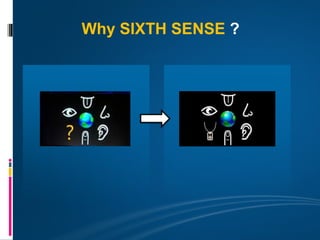
Why SIXTH SENSE ?
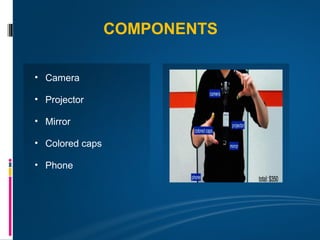
COMPONENTS

• Camera

• Projector

• Mirror

• Colored caps

• Phone
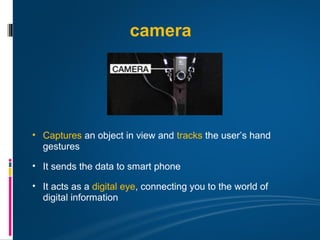
camera


• Captures an object in view and tracks the user’s hand
  gestures

• It sends the data to smart phone

• It acts as a digital eye, connecting you to the world of
  digital information
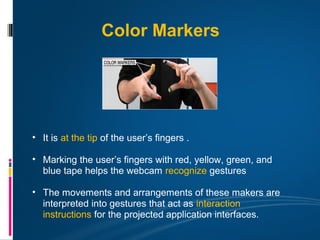
Color Markers


• It is at the tip of the user’s fingers .

• Marking the user’s fingers with red, yellow, green, and
  blue tape helps the webcam recognize gestures

• The movements and arrangements of these makers are
  interpreted into gestures that act as interaction
  instructions for the projected application interfaces.
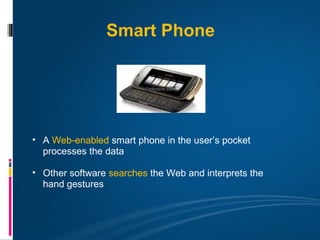
Smart Phone


• A Web-enabled smart phone in the user’s pocket
  processes the data

• Other software searches the Web and interprets the
  hand gestures
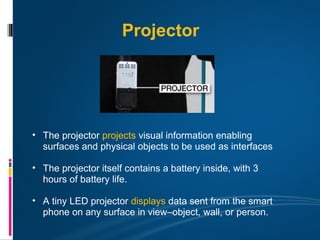
Projector


• The projector projects visual information enabling
  surfaces and physical objects to be used as interfaces

• The projector itself contains a battery inside, with 3
  hours of battery life.

• A tiny LED projector displays data sent from the smart
  phone on any surface in view–object, wall, or person.
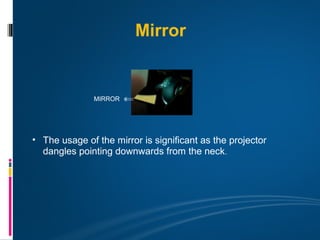
Mirror


               MIRROR


• The usage of the mirror is significant as the projector
  dangles pointing downwards from the neck.
SOFTWARE PART

  It allows the computer of the sixth sense   technology
“device to do what it does.
  Software could be coded in any language like in java, C++
 etc.

  Approx 50,000 lines of code are used.

 Processing is happening in the mobile phone ,and
basically works on computer vision algorithms
“
 .            ”
 .
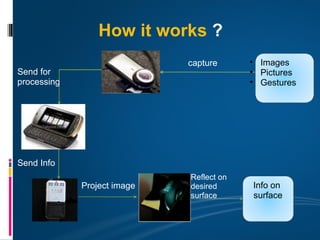
How it works ?
                             capture      • Images
Send for                                  • Pictures
processing                                • Gestures


Send Info
                             Reflect on
             Project image   desired      Info on
                             surface      surface
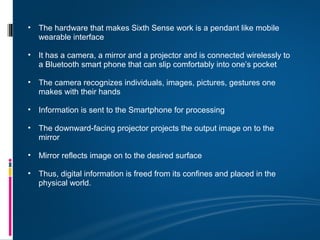
• The hardware that makes Sixth Sense work is a pendant like mobile
  wearable interface

• It has a camera, a mirror and a projector and is connected wirelessly to
  a Bluetooth smart phone that can slip comfortably into one’s pocket

• The camera recognizes individuals, images, pictures, gestures one
  makes with their hands

• Information is sent to the Smartphone for processing

• The downward-facing projector projects the output image on to the
  mirror

• Mirror reflects image on to the desired surface

• Thus, digital information is freed from its confines and placed in the
  physical world.
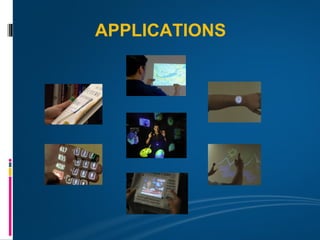
APPLICATIONS
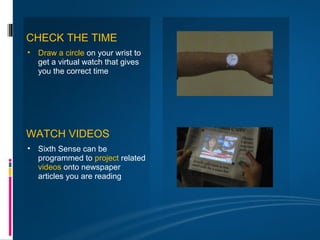
CHECK THE TIME
• Draw a circle on your wrist to
  get a virtual watch that gives
  you the correct time


WATCH VIDEOS
• Sixth Sense can be
  programmed to project related
  videos onto newspaper
  articles you are reading
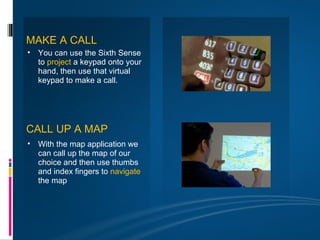
MAKE A CALL
• You can use the Sixth Sense
  to project a keypad onto your
  hand, then use that virtual
  keypad to make a call.


CALL UP A MAP
• With the map application we
  can call up the map of our
  choice and then use thumbs
  and index fingers to navigate
  the map
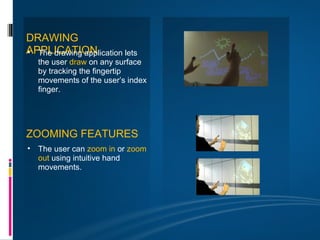
DRAWING
APPLICATION
• The drawing application lets
   the user draw on any surface
   by tracking the fingertip
   movements of the user’s index
   finger.


ZOOMING FEATURES
• The user can zoom in or zoom
  out using intuitive hand
  movements.
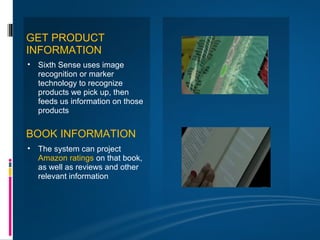
GET PRODUCT
INFORMATION
• Sixth Sense uses image
  recognition or marker
  technology to recognize
  products we pick up, then
  feeds us information on those
  products


BOOK INFORMATION
• The system can project
  Amazon ratings on that book,
  as well as reviews and other
  relevant information
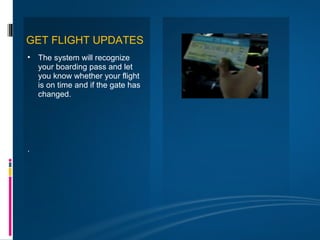
GET FLIGHT UPDATES
• The system will recognize
  your boarding pass and let
  you know whether your flight
  is on time and if the gate has
  changed.


.
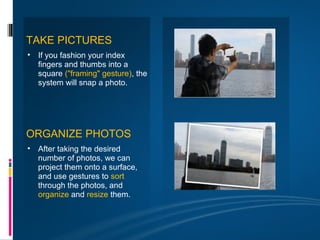
TAKE PICTURES
• If you fashion your index
  fingers and thumbs into a
  square ("framing" gesture), the
  system will snap a photo.


ORGANIZE PHOTOS
• After taking the desired
  number of photos, we can
  project them onto a surface,
  and use gestures to sort
  through the photos, and
  organize and resize them.
ADVANTAGES

• Connectedness between world and information.

• Data access directly from machine in real time.

   Portable.

• Inexpensive.

•   OPEN SOURCE.
CONCLUSION

• Sixth Sense recognizes the objects around us, displaying
  information automatically and letting us to access it in any way we
  need

• The Sixth Sense prototype implements several applications that
  demonstrate the usefulness, viability and flexibility of the system

• Allowing us to interact with this information via natural hand
  gestures
THANK YOU

Sixth sense techno_ppt

  • 1.
    SIXTH SENSE TECHNOLOGY Presented by : Vishavraj Munjal 3610153
  • 2.
  • 3.
    INTRODUCTION • Sixth Senseis a wearable gestural interface that augments the physical world around us with digital information and lets us use natural hand gestures to interact with that information. • It was developed by Pranav Mistry, a PhD student in the Fluid Interfaces Group at the MIT Media Lab. • SixthSense bridges the gap by bringing intangible, digital information out into the tangible world, and allowing us to interact with this information via natural hand. • SixthSense comprises a pocket projector, a mirror, a camera and a smartphone. The hardware components are coupled in a pendant like mobile wearable device.
  • 4.
  • 5.
    COMPONENTS • Camera • Projector •Mirror • Colored caps • Phone
  • 6.
    camera • Captures anobject in view and tracks the user’s hand gestures • It sends the data to smart phone • It acts as a digital eye, connecting you to the world of digital information
  • 7.
    Color Markers • Itis at the tip of the user’s fingers . • Marking the user’s fingers with red, yellow, green, and blue tape helps the webcam recognize gestures • The movements and arrangements of these makers are interpreted into gestures that act as interaction instructions for the projected application interfaces.
  • 8.
    Smart Phone • AWeb-enabled smart phone in the user’s pocket processes the data • Other software searches the Web and interprets the hand gestures
  • 9.
    Projector • The projectorprojects visual information enabling surfaces and physical objects to be used as interfaces • The projector itself contains a battery inside, with 3 hours of battery life. • A tiny LED projector displays data sent from the smart phone on any surface in view–object, wall, or person.
  • 10.
    Mirror MIRROR • The usage of the mirror is significant as the projector dangles pointing downwards from the neck.
  • 11.
    SOFTWARE PART It allows the computer of the sixth sense technology “device to do what it does. Software could be coded in any language like in java, C++ etc.  Approx 50,000 lines of code are used.  Processing is happening in the mobile phone ,and basically works on computer vision algorithms “ . ” .
  • 12.
    How it works? capture • Images Send for • Pictures processing • Gestures Send Info Reflect on Project image desired Info on surface surface
  • 13.
    • The hardwarethat makes Sixth Sense work is a pendant like mobile wearable interface • It has a camera, a mirror and a projector and is connected wirelessly to a Bluetooth smart phone that can slip comfortably into one’s pocket • The camera recognizes individuals, images, pictures, gestures one makes with their hands • Information is sent to the Smartphone for processing • The downward-facing projector projects the output image on to the mirror • Mirror reflects image on to the desired surface • Thus, digital information is freed from its confines and placed in the physical world.
  • 14.
  • 15.
    CHECK THE TIME •Draw a circle on your wrist to get a virtual watch that gives you the correct time WATCH VIDEOS • Sixth Sense can be programmed to project related videos onto newspaper articles you are reading
  • 16.
    MAKE A CALL •You can use the Sixth Sense to project a keypad onto your hand, then use that virtual keypad to make a call. CALL UP A MAP • With the map application we can call up the map of our choice and then use thumbs and index fingers to navigate the map
  • 17.
    DRAWING APPLICATION • The drawingapplication lets the user draw on any surface by tracking the fingertip movements of the user’s index finger. ZOOMING FEATURES • The user can zoom in or zoom out using intuitive hand movements.
  • 18.
    GET PRODUCT INFORMATION • SixthSense uses image recognition or marker technology to recognize products we pick up, then feeds us information on those products BOOK INFORMATION • The system can project Amazon ratings on that book, as well as reviews and other relevant information
  • 19.
    GET FLIGHT UPDATES •The system will recognize your boarding pass and let you know whether your flight is on time and if the gate has changed. .
  • 20.
    TAKE PICTURES • Ifyou fashion your index fingers and thumbs into a square ("framing" gesture), the system will snap a photo. ORGANIZE PHOTOS • After taking the desired number of photos, we can project them onto a surface, and use gestures to sort through the photos, and organize and resize them.
  • 21.
    ADVANTAGES • Connectedness betweenworld and information. • Data access directly from machine in real time.  Portable. • Inexpensive. • OPEN SOURCE.
  • 22.
    CONCLUSION • Sixth Senserecognizes the objects around us, displaying information automatically and letting us to access it in any way we need • The Sixth Sense prototype implements several applications that demonstrate the usefulness, viability and flexibility of the system • Allowing us to interact with this information via natural hand gestures
  • 23.