Chapter Summary

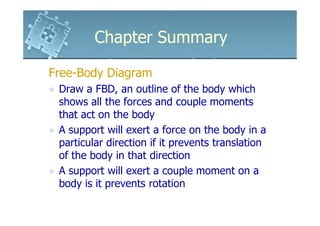
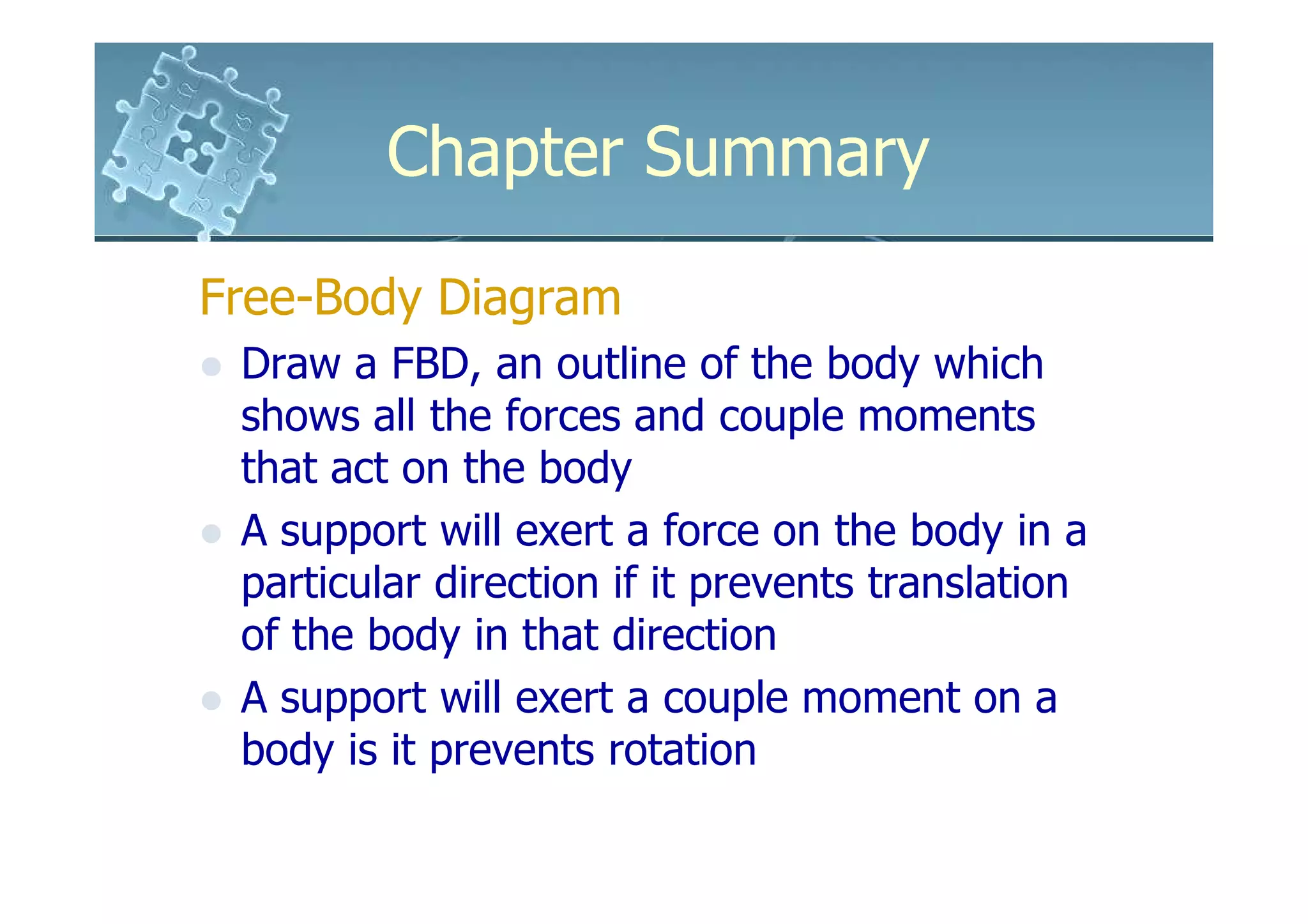
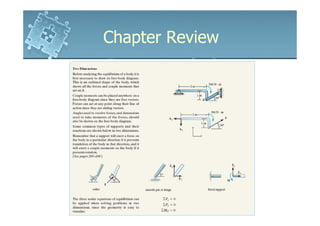
Free-Body Diagram
 Draw a FBD, an outline of the body which
 shows all the forces and couple moments
 that act on the body
 A support will exert a force on the body in a
 particular direction if it prevents translation
 of the body in that direction
 A support will exert a couple moment on a
 body is it prevents rotation
Chapter Summary

Free-Body Diagram
 Angles are used to resolved forces and
 dimensions used to take moments of
 the forces
 Both must be shown on the FBD
Chapter Summary

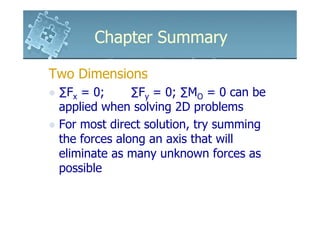
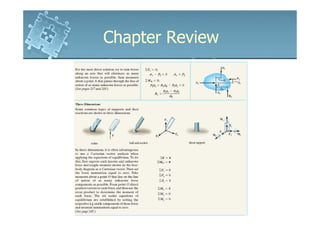
Two Dimensions
 ∑Fx = 0;      ∑Fy = 0; ∑MO = 0 can be
 applied when solving 2D problems
 For most direct solution, try summing
 the forces along an axis that will
 eliminate as many unknown forces as
 possible
Chapter Summary
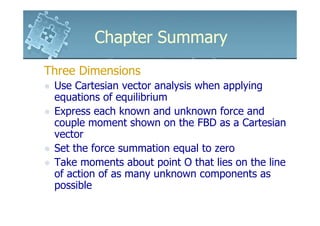
Three Dimensions
 Use Cartesian vector analysis when applying
 equations of equilibrium
 Express each known and unknown force and
 couple moment shown on the FBD as a Cartesian
 vector
 Set the force summation equal to zero
 Take moments about point O that lies on the line
 of action of as many unknown components as
 possible
Chapter Summary

Three Dimensions
 From point O, direct position vectors to each
 force, then use the cross product to
 determine the moment of each force
 The six scalar equations of equilibrium are
 established by setting i, j and k components
 of these force and moment sums equal to
 zero
Chapter Review
Chapter Review
Chapter Review

6161103 5.8 chapter summary and review

  • 1.
    Chapter Summary Free-Body Diagram Draw a FBD, an outline of the body which shows all the forces and couple moments that act on the body A support will exert a force on the body in a particular direction if it prevents translation of the body in that direction A support will exert a couple moment on a body is it prevents rotation
  • 2.
    Chapter Summary Free-Body Diagram Angles are used to resolved forces and dimensions used to take moments of the forces Both must be shown on the FBD
  • 3.
    Chapter Summary Two Dimensions ∑Fx = 0; ∑Fy = 0; ∑MO = 0 can be applied when solving 2D problems For most direct solution, try summing the forces along an axis that will eliminate as many unknown forces as possible
  • 4.
    Chapter Summary Three Dimensions Use Cartesian vector analysis when applying equations of equilibrium Express each known and unknown force and couple moment shown on the FBD as a Cartesian vector Set the force summation equal to zero Take moments about point O that lies on the line of action of as many unknown components as possible
  • 5.
    Chapter Summary Three Dimensions From point O, direct position vectors to each force, then use the cross product to determine the moment of each force The six scalar equations of equilibrium are established by setting i, j and k components of these force and moment sums equal to zero
  • 6.
  • 7.
  • 8.