DEVAPRAKASAM DEIVASAGAYAM
Professor of Mechanical Engineering
Room:11, LW, 2nd Floor
School of Mechanical and Building Sciences
Email: devaprakasam.d@vit.ac.in, dr.devaprakasam@gmail.com
ME202: Engineering Mechanics (3:1:0:4)
Devaprakasam D, Email: devaprakasam.d@vit.ac.in, Ph: +91 9786553933
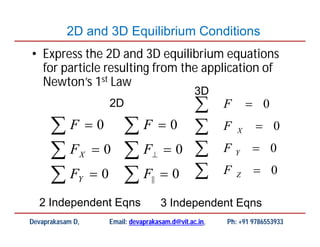
• Express the 2D and 3D equilibrium equations
for particle resulting from the application of
Newton’s 1st Law
0
0
0






Y
X
F
F
F
3D
0
0
0
0








Z
Y
X
F
F
F
F2D
0
0
0
|| 






F
F
F
2 Independent Eqns 3 Independent Eqns
Devaprakasam D, Email: devaprakasam.d@vit.ac.in, Ph: +91 9786553933
2D and 3D Equilibrium Conditions
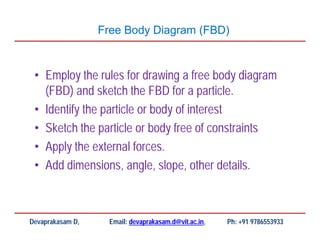
• Employ the rules for drawing a free body diagram
(FBD) and sketch the FBD for a particle.
• Identify the particle or body of interest
• Sketch the particle or body free of constraints
• Apply the external forces.
• Add dimensions, angle, slope, other details.
Devaprakasam D, Email: devaprakasam.d@vit.ac.in, Ph: +91 9786553933
Free Body Diagram (FBD)
Devaprakasam D, Email: devaprakasam.d@vit.ac.in, Ph: +91 9786553933
Free Body Diagram (FBD)
Devaprakasam D, Email: devaprakasam.d@vit.ac.in, Ph: +91 9786553933
Free Body Diagram (FBD)
Coordinate System
Coordinate systems are an important component in the creation of a free body diagram, and are used to designate a
position of the body in space. A coordinate system needs to be established prior to drawing a free body diagram to aid
tracking of the relative direction in which forces are acting and to make it easier to determine the components of forces if
they are acting at angles.
Drawing the Body
The next step in creating a free body diagram is drawing a representation of the object being analyzed.A free body
diagram is drawn as if it were isolated from its environment, creating a “free body” that displays only necessary
information. This makes it clear what forces are acting on the body. The shape of the body is generally simplified, but
represents the overall appearance and behavior of the object that is being analyzed. The body should be drawn at the
origin of the coordinate system in order to distinguish between forces acting in positive and negative directions.
Drawing the Forces
Once an object is isolated from its environment, the forces that were acting on it need to be represented to provide
accurate visualization of existing forces. The external forces and resulting reactions that act directly on the body are the
only forces that should be drawn. These forces are represented by arrows positioned to indicate the point of application,
the angle, and the magnitude.
Solving the Diagram
The final step in creating a free-body diagram is to use Newton’s Laws to solve for any unknown forces. Forces acting in
the same plane are added together, keeping in mind whether they are directed in the positive or negative direction. The
forces in each plane – X, Y, and Z – are summed, providing equations that contain both known and unknown values. For
forces that act at an angle, the magnitude is divided into X, Y, and Z components based on the angle, and these
components are included separately in the X, Y, and Z equations. Depending on whether the body is at constant velocity
or accelerating, the total sum of the forces is equal to either zero or the product of mass and acceleration.
Devaprakasam D, Email: devaprakasam.d@vit.ac.in, Ph: +91 9786553933
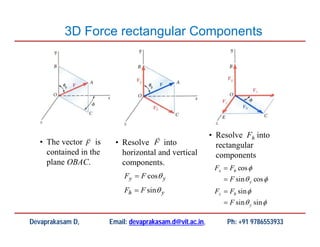
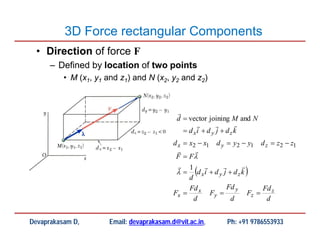
3D Force rectangular Components
Devaprakasam D, Email: devaprakasam.d@vit.ac.in, Ph: +91 9786553933
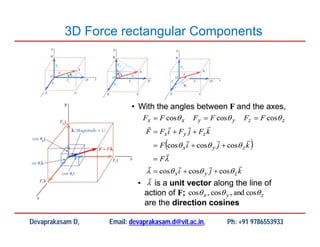
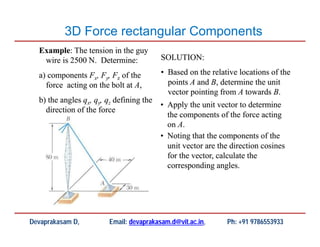
3D Force rectangular Components
Devaprakasam D, Email: devaprakasam.d@vit.ac.in, Ph: +91 9786553933
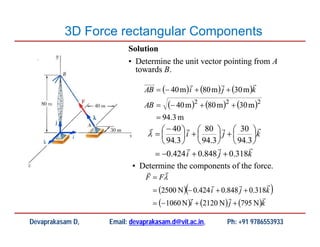
3D Force rectangular Components
Devaprakasam D, Email: devaprakasam.d@vit.ac.in, Ph: +91 9786553933
3D Force rectangular Components
Devaprakasam D, Email: devaprakasam.d@vit.ac.in, Ph: +91 9786553933
3D Force rectangular Components
Devaprakasam D, Email: devaprakasam.d@vit.ac.in, Ph: +91 9786553933
3D Force rectangular Components
Devaprakasam D, Email: devaprakasam.d@vit.ac.in, Ph: +91 9786553933
3D Force rectangular Components
Devaprakasam D, Email: devaprakasam.d@vit.ac.in, Ph: +91 9786553933
3D Force rectangular Components
Devaprakasam D, Email: devaprakasam.d@vit.ac.in, Ph: +91 9786553933
3D Force rectangular Components
Devaprakasam D, Email: devaprakasam.d@vit.ac.in, Ph: +91 9786553933
Examples
Q1
Q2
Q3
Q4
Devaprakasam D, Email: devaprakasam.d@vit.ac.in, Ph: +91 9786553933
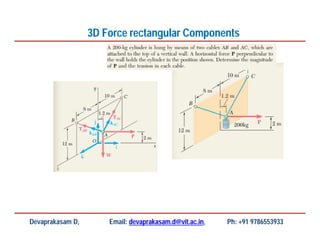
Solution
The forces at A are,
TAB, TAC, TAD and P
P= P j. Express all the forces in unit vectors I, j, k
AB= - 4.2 i- 5.6j ; |AB|= 7.00 m
AC = 2.4 i+ -5.6j+ 4.2k; |AC|=7.4m
AD=-5.6 j - 3.3 k; |AD|= 6.5m
TAB = TAB λAB = [-0.6i-0.8j] TAB
TAC = TAC λAC =[0.3240i-756j+0.567k] TAC
TAD = TAD λAD = [-0.861j-0.5076k] TAD
Equilibrium condition
  0F TAB + TAC + TAD +Pj =0
Substituting the values of TAB ,TAC , TAD
Equating the I, j, k components to zero
We will get TAB =259 (known) , TAC =479.15N , TAB =535.66 N, P=1031N
Devaprakasam D, Email: devaprakasam.d@vit.ac.in, Ph: +91 9786553933
Home Work
Devaprakasam D, Email: devaprakasam.d@vit.ac.in, Ph: +91 9786553933
Moment
Devaprakasam D, Email: devaprakasam.d@vit.ac.in, Ph: +91 9786553933
Moment (M)
Devaprakasam D, Email: devaprakasam.d@vit.ac.in, Ph: +91 9786553933
Moment (M)

Me202 engineering mechanics l3

  • 1.
    DEVAPRAKASAM DEIVASAGAYAM Professor ofMechanical Engineering Room:11, LW, 2nd Floor School of Mechanical and Building Sciences Email: devaprakasam.d@vit.ac.in, dr.devaprakasam@gmail.com ME202: Engineering Mechanics (3:1:0:4) Devaprakasam D, Email: devaprakasam.d@vit.ac.in, Ph: +91 9786553933
  • 2.
    • Express the2D and 3D equilibrium equations for particle resulting from the application of Newton’s 1st Law 0 0 0       Y X F F F 3D 0 0 0 0         Z Y X F F F F2D 0 0 0 ||        F F F 2 Independent Eqns 3 Independent Eqns Devaprakasam D, Email: devaprakasam.d@vit.ac.in, Ph: +91 9786553933 2D and 3D Equilibrium Conditions
  • 3.
    • Employ therules for drawing a free body diagram (FBD) and sketch the FBD for a particle. • Identify the particle or body of interest • Sketch the particle or body free of constraints • Apply the external forces. • Add dimensions, angle, slope, other details. Devaprakasam D, Email: devaprakasam.d@vit.ac.in, Ph: +91 9786553933 Free Body Diagram (FBD)
  • 4.
    Devaprakasam D, Email:devaprakasam.d@vit.ac.in, Ph: +91 9786553933 Free Body Diagram (FBD)
  • 5.
    Devaprakasam D, Email:devaprakasam.d@vit.ac.in, Ph: +91 9786553933 Free Body Diagram (FBD) Coordinate System Coordinate systems are an important component in the creation of a free body diagram, and are used to designate a position of the body in space. A coordinate system needs to be established prior to drawing a free body diagram to aid tracking of the relative direction in which forces are acting and to make it easier to determine the components of forces if they are acting at angles. Drawing the Body The next step in creating a free body diagram is drawing a representation of the object being analyzed.A free body diagram is drawn as if it were isolated from its environment, creating a “free body” that displays only necessary information. This makes it clear what forces are acting on the body. The shape of the body is generally simplified, but represents the overall appearance and behavior of the object that is being analyzed. The body should be drawn at the origin of the coordinate system in order to distinguish between forces acting in positive and negative directions. Drawing the Forces Once an object is isolated from its environment, the forces that were acting on it need to be represented to provide accurate visualization of existing forces. The external forces and resulting reactions that act directly on the body are the only forces that should be drawn. These forces are represented by arrows positioned to indicate the point of application, the angle, and the magnitude. Solving the Diagram The final step in creating a free-body diagram is to use Newton’s Laws to solve for any unknown forces. Forces acting in the same plane are added together, keeping in mind whether they are directed in the positive or negative direction. The forces in each plane – X, Y, and Z – are summed, providing equations that contain both known and unknown values. For forces that act at an angle, the magnitude is divided into X, Y, and Z components based on the angle, and these components are included separately in the X, Y, and Z equations. Depending on whether the body is at constant velocity or accelerating, the total sum of the forces is equal to either zero or the product of mass and acceleration.
  • 6.
    Devaprakasam D, Email:devaprakasam.d@vit.ac.in, Ph: +91 9786553933 3D Force rectangular Components
  • 7.
    Devaprakasam D, Email:devaprakasam.d@vit.ac.in, Ph: +91 9786553933 3D Force rectangular Components
  • 8.
    Devaprakasam D, Email:devaprakasam.d@vit.ac.in, Ph: +91 9786553933 3D Force rectangular Components
  • 9.
    Devaprakasam D, Email:devaprakasam.d@vit.ac.in, Ph: +91 9786553933 3D Force rectangular Components
  • 10.
    Devaprakasam D, Email:devaprakasam.d@vit.ac.in, Ph: +91 9786553933 3D Force rectangular Components
  • 11.
    Devaprakasam D, Email:devaprakasam.d@vit.ac.in, Ph: +91 9786553933 3D Force rectangular Components
  • 12.
    Devaprakasam D, Email:devaprakasam.d@vit.ac.in, Ph: +91 9786553933 3D Force rectangular Components
  • 13.
    Devaprakasam D, Email:devaprakasam.d@vit.ac.in, Ph: +91 9786553933 3D Force rectangular Components
  • 14.
    Devaprakasam D, Email:devaprakasam.d@vit.ac.in, Ph: +91 9786553933 3D Force rectangular Components
  • 15.
    Devaprakasam D, Email:devaprakasam.d@vit.ac.in, Ph: +91 9786553933 Examples Q1 Q2 Q3 Q4
  • 16.
    Devaprakasam D, Email:devaprakasam.d@vit.ac.in, Ph: +91 9786553933 Solution The forces at A are, TAB, TAC, TAD and P P= P j. Express all the forces in unit vectors I, j, k AB= - 4.2 i- 5.6j ; |AB|= 7.00 m AC = 2.4 i+ -5.6j+ 4.2k; |AC|=7.4m AD=-5.6 j - 3.3 k; |AD|= 6.5m TAB = TAB λAB = [-0.6i-0.8j] TAB TAC = TAC λAC =[0.3240i-756j+0.567k] TAC TAD = TAD λAD = [-0.861j-0.5076k] TAD Equilibrium condition   0F TAB + TAC + TAD +Pj =0 Substituting the values of TAB ,TAC , TAD Equating the I, j, k components to zero We will get TAB =259 (known) , TAC =479.15N , TAB =535.66 N, P=1031N
  • 17.
    Devaprakasam D, Email:devaprakasam.d@vit.ac.in, Ph: +91 9786553933 Home Work
  • 18.
    Devaprakasam D, Email:devaprakasam.d@vit.ac.in, Ph: +91 9786553933 Moment
  • 19.
    Devaprakasam D, Email:devaprakasam.d@vit.ac.in, Ph: +91 9786553933 Moment (M)
  • 20.
    Devaprakasam D, Email:devaprakasam.d@vit.ac.in, Ph: +91 9786553933 Moment (M)