 We all see a rigid body on surface of something .this body has
material with special density so at least we study the weight force of
the body on the surface of the beam ;……etc.
 We start our study for the force of weight from :
 1#choosing axis for our problem at lowest height
 2#determining weight force at the beginning and the end of our
body/our axis(at X=0 at X has value)
 3#determining the force density for area
 4#divid the shape of the body into known shapes
 5#determinig centers of mass to all shapes
 6#determining the resultant of force according to the direction of
forces and taking the moment around any point .
 Remember this rule (moment of the resultant =summation of all
forces moments around point
 Notice :this steps to conclusive problem .some
problems does not need all these steps
SIMPLE DIAGRAM
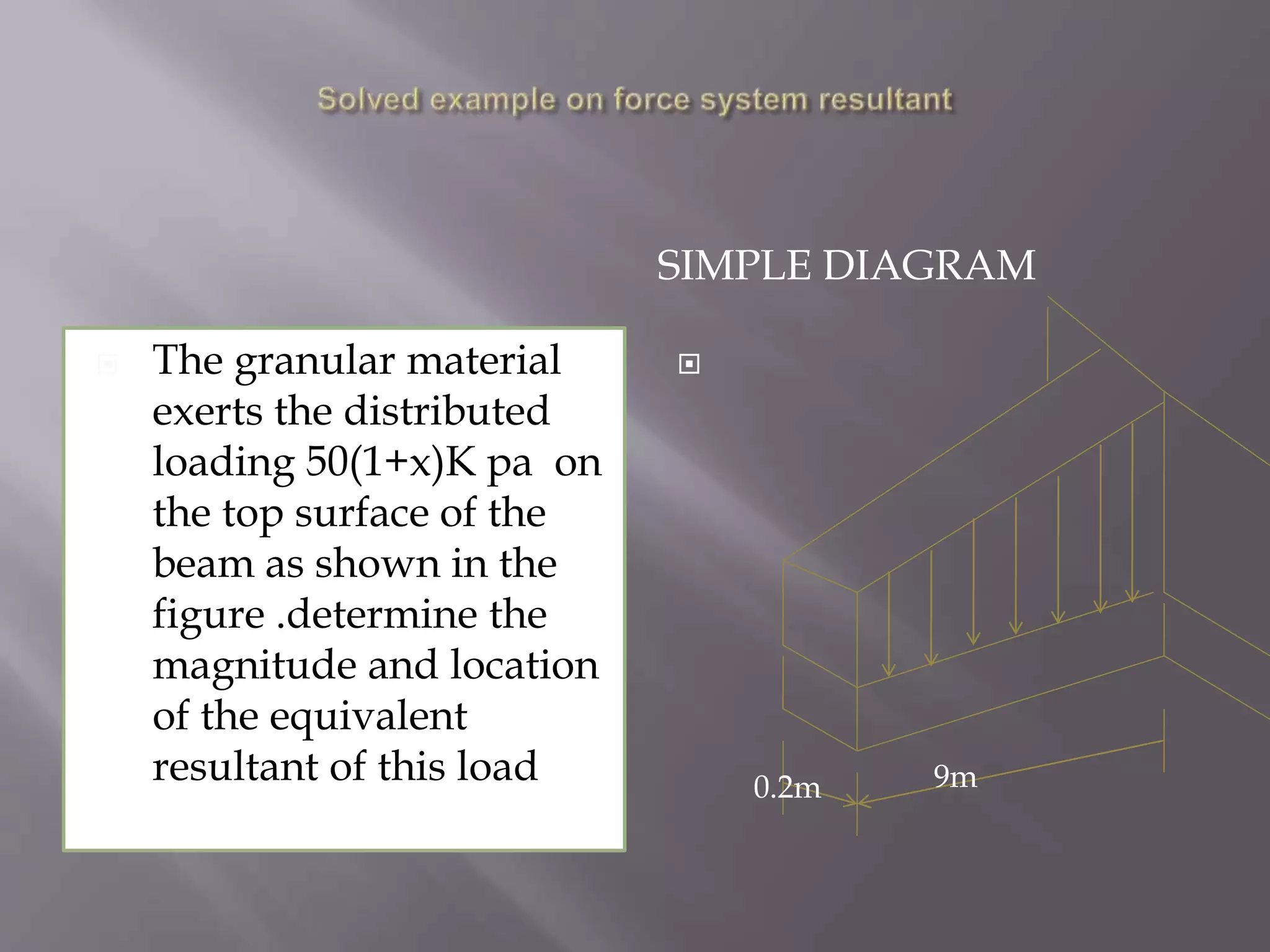
 The granular material
exerts the distributed
loading 50(1+x)K pa on
the top surface of the
beam as shown in the
figure .determine the
magnitude and location
of the equivalent
resultant of this load

9m0.2m
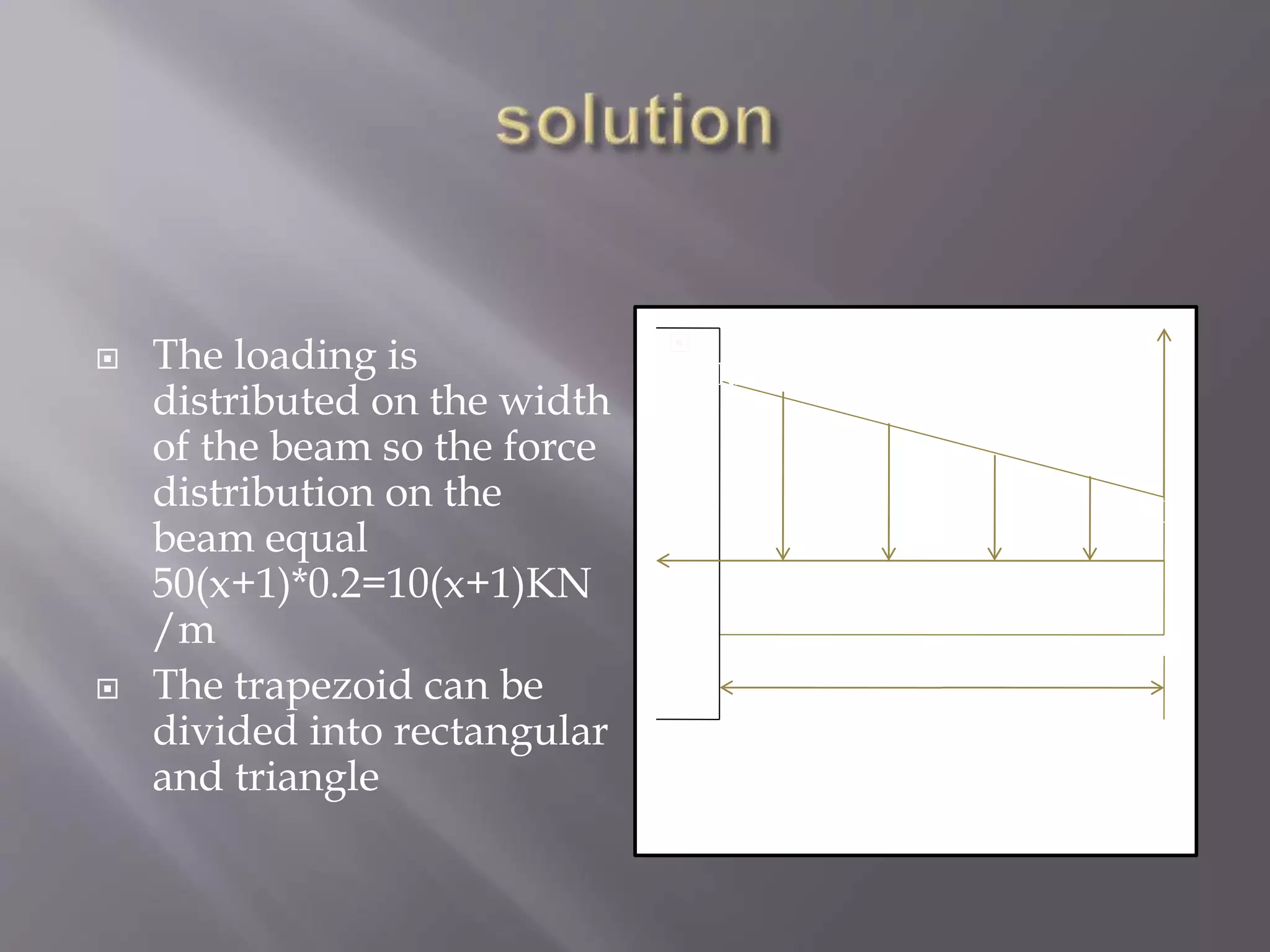
 The loading is
distributed on the width
of the beam so the force
distribution on the
beam equal
50(x+1)*0.2=10(x+1)KN
/m
 The trapezoid can be
divided into rectangular
and triangle

9m
A B5
y
x
10kN
100kN
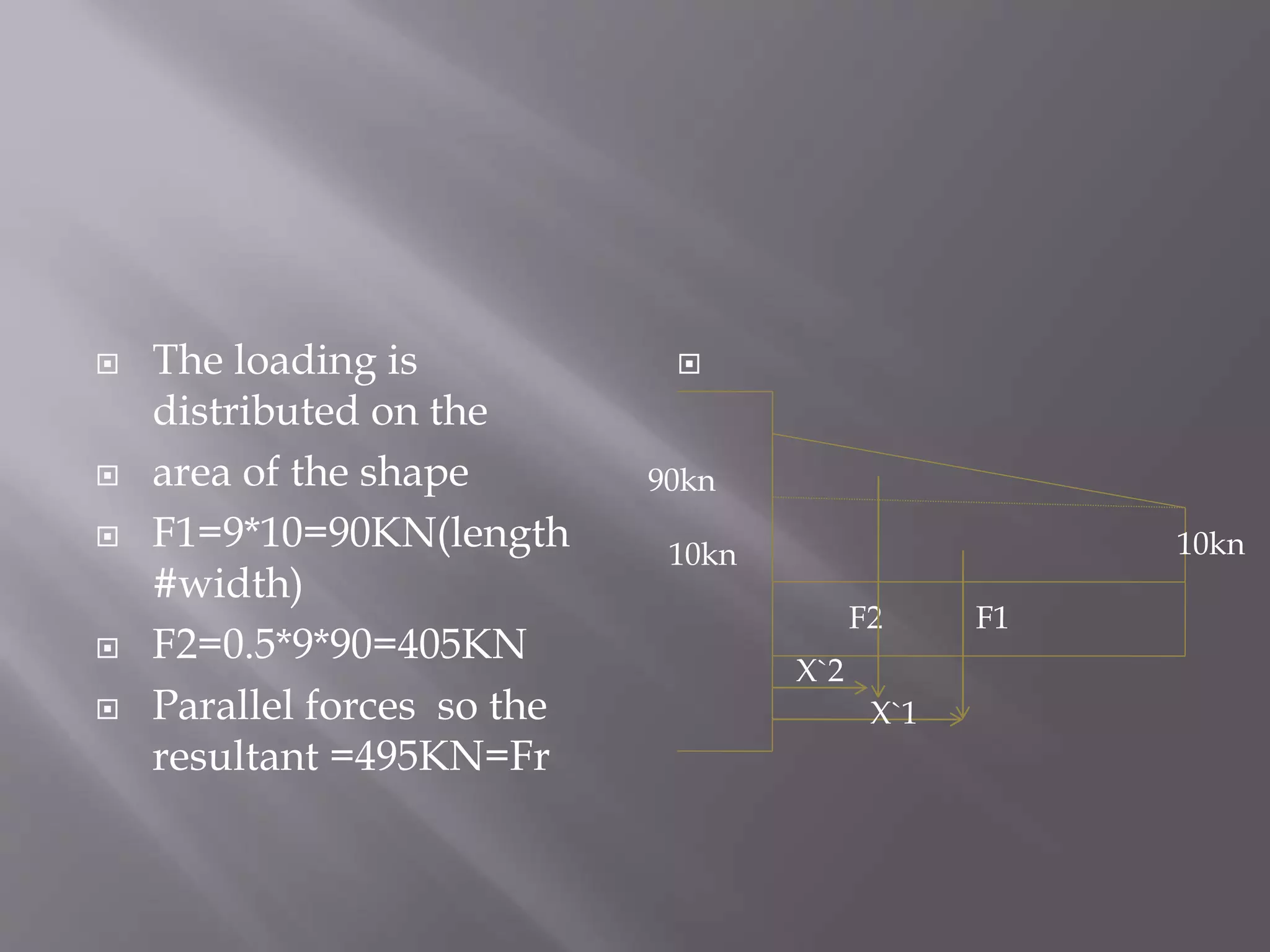
 The loading is
distributed on the
 area of the shape
 F1=9*10=90KN(length
#width)
 F2=0.5*9*90=405KN
 Parallel forces so the
resultant =495KN=Fr

F1F2
X`2
X`1
10kn10kn
90kn
 Note that X`2=3m X`1=4.5 m so he last thing to
know X`r
 MA=Fr*X`r=405*3 +90*4.5
 So the location of resultant force =3.27m
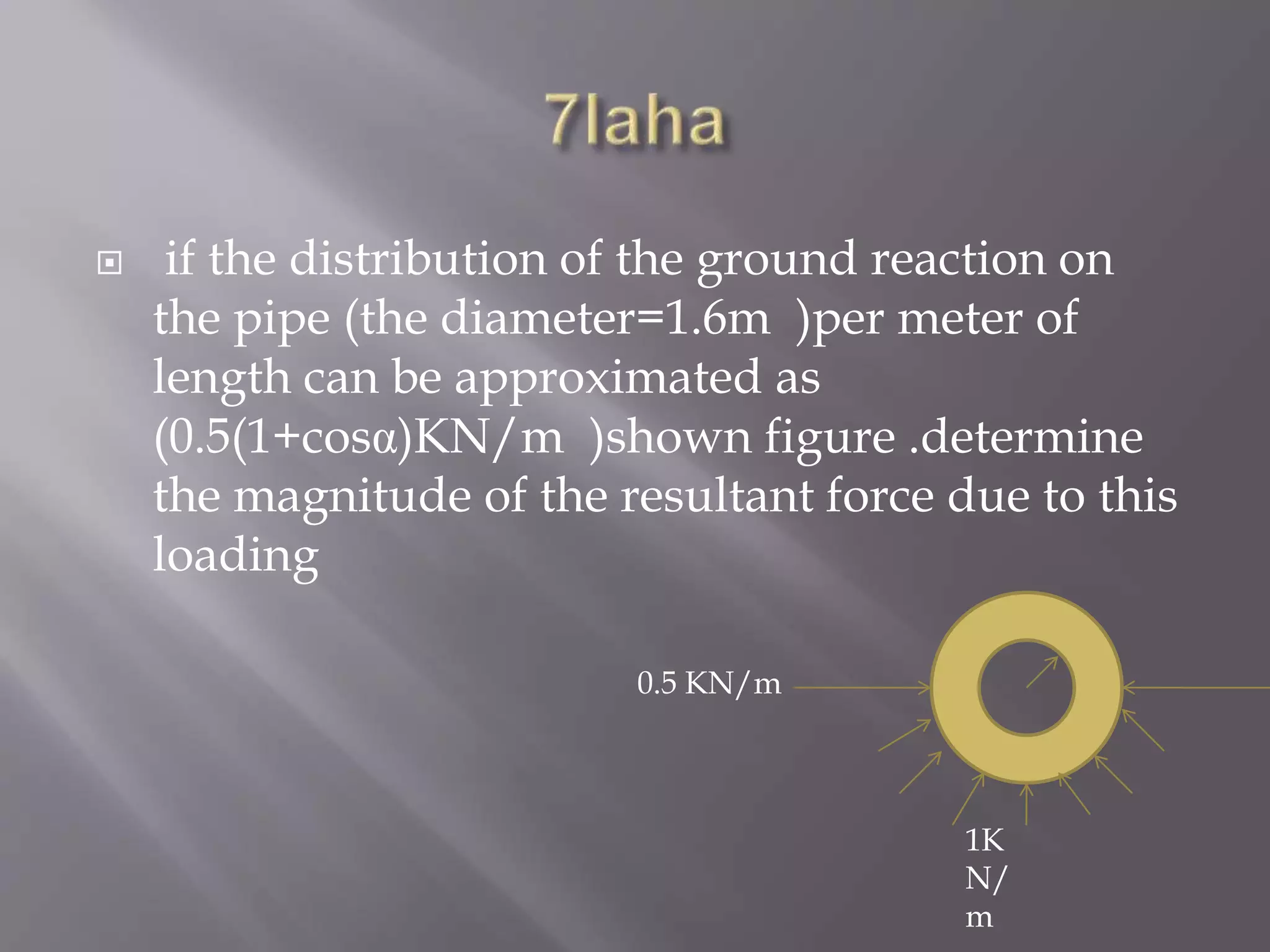
 if the distribution of the ground reaction on
the pipe (the diameter=1.6m )per meter of
length can be approximated as
(0.5(1+cosα)KN/m )shown figure .determine
the magnitude of the resultant force due to this
loading
0.5 KN/m
1K
N/
m

Force system resultant

  • 1.
     We allsee a rigid body on surface of something .this body has material with special density so at least we study the weight force of the body on the surface of the beam ;……etc.  We start our study for the force of weight from :  1#choosing axis for our problem at lowest height  2#determining weight force at the beginning and the end of our body/our axis(at X=0 at X has value)  3#determining the force density for area  4#divid the shape of the body into known shapes  5#determinig centers of mass to all shapes  6#determining the resultant of force according to the direction of forces and taking the moment around any point .  Remember this rule (moment of the resultant =summation of all forces moments around point  Notice :this steps to conclusive problem .some problems does not need all these steps
  • 2.
    SIMPLE DIAGRAM  Thegranular material exerts the distributed loading 50(1+x)K pa on the top surface of the beam as shown in the figure .determine the magnitude and location of the equivalent resultant of this load  9m0.2m
  • 3.
     The loadingis distributed on the width of the beam so the force distribution on the beam equal 50(x+1)*0.2=10(x+1)KN /m  The trapezoid can be divided into rectangular and triangle  9m A B5 y x 10kN 100kN
  • 4.
     The loadingis distributed on the  area of the shape  F1=9*10=90KN(length #width)  F2=0.5*9*90=405KN  Parallel forces so the resultant =495KN=Fr  F1F2 X`2 X`1 10kn10kn 90kn
  • 5.
     Note thatX`2=3m X`1=4.5 m so he last thing to know X`r  MA=Fr*X`r=405*3 +90*4.5  So the location of resultant force =3.27m
  • 6.
     if thedistribution of the ground reaction on the pipe (the diameter=1.6m )per meter of length can be approximated as (0.5(1+cosα)KN/m )shown figure .determine the magnitude of the resultant force due to this loading 0.5 KN/m 1K N/ m