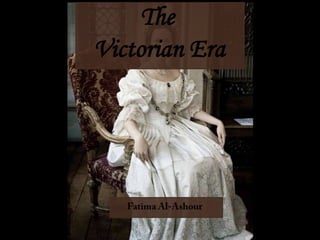
The
Victorian Era
Victoria's reign seem markedly different from earlier
periods in British history. It is often described by
historians and politicians as the time that the world
changed forever and the age that shaped the globe
more then all the previous centuries the world had ever
seen.
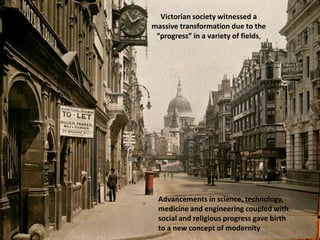
Victorian society witnessed a
massive transformation due to the
 “progress” in a variety of fields,


  Advancements in science, technology,
  medicine and engineering coupled with
  social and religious progress gave birth
  to a new concept of modernity
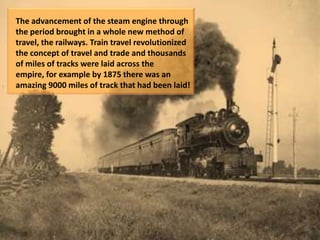
The advancement of the steam engine through
the period brought in a whole new method of
travel, the railways. Train travel revolutionized
the concept of travel and trade and thousands
of miles of tracks were laid across the
empire, for example by 1875 there was an
amazing 9000 miles of track that had been laid!
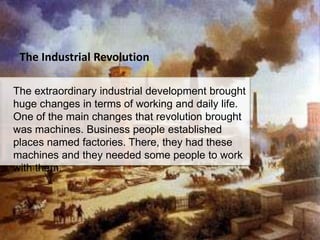
The Industrial Revolution

The extraordinary industrial development brought
huge changes in terms of working and daily life.
One of the main changes that revolution brought
was machines. Business people established
places named factories. There, they had these
machines and they needed some people to work
with them.
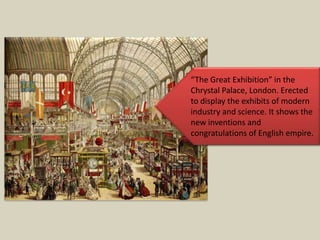
“The Great Exhibition” in the
Chrystal Palace, London. Erected
to display the exhibits of modern
industry and science. It shows the
new inventions and
congratulations of English empire.
The power of the middle class increased with
the expansion of industry and trade


The Reform Bill: it was a response to the
demands of middle classes, who were
taking control of England's economy. It
extended the right to vote to all males
owning property worth £ 10 or more in
annual rent.
The developments of the electrical
telegraph, postal services and the
improvement in ship building and
travel gave way to a new concept of
faster communication.
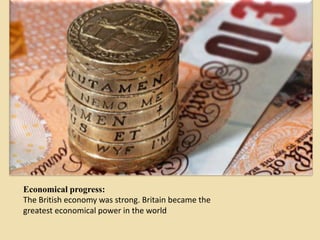
Economical progress:
The British economy was strong. Britain became the
greatest economical power in the world
Colonialism was an important phenomenon

 For better or worse the British Empire had a massive impact on
 the history of the world. It was the largest formal empire that
 the world had ever known. As such, its power and influence
 stretched all over the globe; shaping it in all manner of ways.
Queen’s College for Women was established
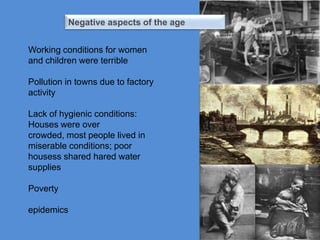
Negative aspects of the age


Working conditions for women
and children were terrible

Pollution in towns due to factory
activity

Lack of hygienic conditions:
Houses were over
crowded, most people lived in
miserable conditions; poor
housess shared hared water
supplies

Poverty

epidemics
The Victorians were great moralisers they
supported: personal duty, hard work, decorum,
respectability, chastity
The leading poets during the Victorian period were:


                             Alfred, Lord Tennyson (1809-1892),

                             Robert Browning (1812–89),

                             Elizabeth Barrett Browning(1806–61),

                             Matthew Arnold (1822–88).
                             and
                             Emily Dickinson (American Romantic)
the poetry of this period was heavily influenced by
the Romantics, but also went off in its own directions.
Particularly notable was the development of
the dramatic monologue, a form used by many poets in
this period, but perfected by Browning.


    Dramatic monologue – the idea of Dramatic
monologue – is creating a lyric poem in the voice of a
speaker ironically distinct from the poet.
GENERAL CHARASTERISTICS OF VICTORIAN LITERATURE


    Poetry: It was considered superior than prose, novel theatre.
    They said that the writing of a genius must be poetry. There
    were two main romantic inheritances in poetry:

    1.- the use of retrospective forms: archaic language. They
    revived many old forms (particularly the mixture of lyric and
    elegy which influenced others forms like epigram).

    2.- experimentation with genres. Some poets continued the
    movement of colloquial diction into poetry (Robert Browning)


  * The Victorians loved the heroic, chivalrous stories of knights and
  they hoped to regain some of that noble, courtly behavior and
  impress it upon the people both at home and in the wider empire.
Themes


Notable poets were absorbed in social issues

     Tennyson’s poetry: problems of religious faith, social
     change and political power.

     Browning’s poetry: intellectually and bracing
     harshness

     Arnold’s poetry: sorrowful, disillusioned pessimism
     over the human plight in rapidly changing times
Victorian poetry is pictorial; poets use detail to construct visual
images that represent the emotion or situation the poem concerns


                    “Throughout this era poetry addressed
                   issues such as patriotism, religious faith,
                   science, sexuality, and social reform that
                    often aroused polemical debate. At the
                  same time, the poets whom we classify as
                  Victorian frequently devised experiments
                     that expanded the possibilities of the
                     genre, creating innovative forms and
                   types of prosody that enabled new kinds
                      of poetic voices to emerge in print.”
                                    (Bristow).
http://www.getaukjob.com/victorian-age.php

http://www.atuttascuola.it/risorse/inglese/the_victorian_age.htm
The end

6. Victorian Era

  • 1.
  • 3.
    Victoria's reign seemmarkedly different from earlier periods in British history. It is often described by historians and politicians as the time that the world changed forever and the age that shaped the globe more then all the previous centuries the world had ever seen.
  • 4.
    Victorian society witnesseda massive transformation due to the “progress” in a variety of fields, Advancements in science, technology, medicine and engineering coupled with social and religious progress gave birth to a new concept of modernity
  • 5.
    The advancement ofthe steam engine through the period brought in a whole new method of travel, the railways. Train travel revolutionized the concept of travel and trade and thousands of miles of tracks were laid across the empire, for example by 1875 there was an amazing 9000 miles of track that had been laid!
  • 6.
    The Industrial Revolution Theextraordinary industrial development brought huge changes in terms of working and daily life. One of the main changes that revolution brought was machines. Business people established places named factories. There, they had these machines and they needed some people to work with them.
  • 7.
    “The Great Exhibition”in the Chrystal Palace, London. Erected to display the exhibits of modern industry and science. It shows the new inventions and congratulations of English empire.
  • 8.
    The power ofthe middle class increased with the expansion of industry and trade The Reform Bill: it was a response to the demands of middle classes, who were taking control of England's economy. It extended the right to vote to all males owning property worth £ 10 or more in annual rent.
  • 9.
    The developments ofthe electrical telegraph, postal services and the improvement in ship building and travel gave way to a new concept of faster communication.
  • 10.
    Economical progress: The Britisheconomy was strong. Britain became the greatest economical power in the world
  • 11.
    Colonialism was animportant phenomenon For better or worse the British Empire had a massive impact on the history of the world. It was the largest formal empire that the world had ever known. As such, its power and influence stretched all over the globe; shaping it in all manner of ways.
  • 12.
    Queen’s College forWomen was established
  • 13.
    Negative aspects ofthe age Working conditions for women and children were terrible Pollution in towns due to factory activity Lack of hygienic conditions: Houses were over crowded, most people lived in miserable conditions; poor housess shared hared water supplies Poverty epidemics
  • 14.
    The Victorians weregreat moralisers they supported: personal duty, hard work, decorum, respectability, chastity
  • 17.
    The leading poetsduring the Victorian period were: Alfred, Lord Tennyson (1809-1892), Robert Browning (1812–89), Elizabeth Barrett Browning(1806–61), Matthew Arnold (1822–88). and Emily Dickinson (American Romantic)
  • 18.
    the poetry ofthis period was heavily influenced by the Romantics, but also went off in its own directions. Particularly notable was the development of the dramatic monologue, a form used by many poets in this period, but perfected by Browning. Dramatic monologue – the idea of Dramatic monologue – is creating a lyric poem in the voice of a speaker ironically distinct from the poet.
  • 19.
    GENERAL CHARASTERISTICS OFVICTORIAN LITERATURE Poetry: It was considered superior than prose, novel theatre. They said that the writing of a genius must be poetry. There were two main romantic inheritances in poetry: 1.- the use of retrospective forms: archaic language. They revived many old forms (particularly the mixture of lyric and elegy which influenced others forms like epigram). 2.- experimentation with genres. Some poets continued the movement of colloquial diction into poetry (Robert Browning) * The Victorians loved the heroic, chivalrous stories of knights and they hoped to regain some of that noble, courtly behavior and impress it upon the people both at home and in the wider empire.
  • 20.
    Themes Notable poets wereabsorbed in social issues Tennyson’s poetry: problems of religious faith, social change and political power. Browning’s poetry: intellectually and bracing harshness Arnold’s poetry: sorrowful, disillusioned pessimism over the human plight in rapidly changing times
  • 21.
    Victorian poetry ispictorial; poets use detail to construct visual images that represent the emotion or situation the poem concerns “Throughout this era poetry addressed issues such as patriotism, religious faith, science, sexuality, and social reform that often aroused polemical debate. At the same time, the poets whom we classify as Victorian frequently devised experiments that expanded the possibilities of the genre, creating innovative forms and types of prosody that enabled new kinds of poetic voices to emerge in print.” (Bristow).
  • 22.
  • 23.