DEVELOPMENT OF A ROBUST 03015 PROCESS
Robert Alexander Gray
ASM Assembly Systems LLC
Suwanee, GA
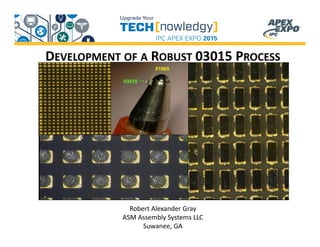
DEVELOPMENT OF A ROBUST 03015 PROCESS
This paper will talk about the 03015 SMT process
In Particular focusing on the print process
It wont provide all the answers!
But hopefully the methodology to develop a “Robust
process” can be useful to all process development whether
“Bleeding edge” like this or just “New to You” applications.
Why start working on the 03015 Process?
I was asked if in three months I could deliver a DEMO process for an in
House Show (I was to focus on printing, but the demo would cover all SMT processes)?
We would run on demand to groups of ten to twenty Engineers several demos per day over
three days.
Each demo had to go flawlessly on demand without any process
priming time.
I had never done any work on this, but luckily I had done a lot of work
on stencil technology and transfer efficiency, so I did some quick math
and based on my results said Yes!
So here are the details of the development work and results from that
challenge.
Miniaturization Continues to be a Driver
Roadmap;
Source: Murata
0201 0603
0402
01005
0805
Component Type Nomenclature
Component Nomenclature
[in ]x [in] English Metric [mm] x [mm]
0,010 in × 0,005 008004 0201** 0,25 x 0,125
0,012 in × 0,006 n.a. 03015* 0,3 x 0,15
0,016 in × 0,0079 01005 0402 0,4 x 0,2
0,024 in × 0,012 0201 0603 0,6 x 0,3
0,039 in × 0,020 0402 1005 1,0 x 0,5
0,063 in × 0,031 0603 1680 1,6 x 0,8
0,079 in × 0,049 0805 2012 2,0 x 1,25
0,098 in × 0,079 1008 2520 2,5 x 2,0
0,13 in × 0,063 1206 3216 3,2 x 1,6
0,13 in × 0,098 1210 3225 3,2 x 2,5
0,18 in × 0,063 1806 4516 4,5 x 1,6
0,18 in × 0,13 1812 4532 4,5 x 3,2
0,20 in × 0,098 2010 5025 5,0 x 2,5
0,25 in × 0,13 in 2512 6332 6,3 x 3,2
* ROHM, Panasonic
** Murata
World's smallest chip size „03015“ (0.3mm×0.15mm)
Anounced in Spring 2012
Source:
http://www.rohm.com/news/111003.html
03015
01005
Some Background on component design;- Rohm Resistor 03015
Bottom-Side Metallization Only
Top
Front
Side
Side
Bottom
Some Background on component design;- Panasonic Resistor 03015
3-Side Metallization
Some Background on component design;- Murata Capacitor 0201
5-Side Metallization
• Appearance
What Manufacturing Problems Can Result ?
Murata C0201
250x125x125µm
Panasonic R03015
300x150x130µm
Rohm R03015
300x150x110µm
This miniaturization step is not only 25%
smaller edges but also means a complete
Component Type specific process
adjustment within a new class of
components !
Manufacturer specific Pad Design
Manufacturer specific Stencil
Apertures
Component Type related nozzles
(Resistor / Capacitor)
Rohm Pana. Murata
Increasing Solder Volume is Required with Increasing Termination Areas !
In the Future the Resistor will Shrink to the
same Length and Width as the Capacitor
250 µm
300 µm
125 µm
150 µm
250 µm
125 µm
Capacitor
Resistor
Today Future
This is important, so the
same nozzle size will fit for both
Component design, which drives pad design, which in its turn will
drive aperture design, leading to area ratio calculations to determine
workable stencil thickness’s.
Try to make it work at
0.08mm thick stencil for
smartphone applications
Show small gap placement
without paste squeeze out
shorting.
Area Ratio (AR) and Transfer Efficiency (TE) define the Aperture Design
L x W
Stencil
2 x (L+W) x T
Basically the paste wants to stick to the pads and the
aperture walls the area of contact is a main factor.
Transfer efficiency is a measure of which of them is winning.
Stencil Transfer Efficiency Testing
A selection of some of the many
Stencil Types and technologies Tested
• Laser cut standard Stainless Steel
• Laser cut fine grain Stainless Steel
• E-Formed Nickel
• Laser Cut Nickel
• 3 types electro polishing
• 3 types of Nano coating treatment
Stencil Material Influence on Transfer Efficiency
Some results using type four paste;-
0.8000.7000.6000.5500.5000.4500.4000.350
18
16
14
12
10
8
6
4
2
0
100
80
60
40
20
0
Area Ratios
StandardDeviationofTEVolume%
MeanVolumeTransferred%
Mean Volume
Standard Deviation
Variable
Mean Volume & Stdev Vs Area ratio
requirements
volume
Traditional Mean
direction
area ratios in this
New technology pushing
process is capable
mean volume above 60% then the
Main aim keep Stdev below 10% and
becomes more unstable.
changes the process
in volume (Slope)
When the rate of change
Stencil Transfer Efficiency Testing (type five paste)
- TE the science behind printing
Important is that a
sufficient mean Volume
is transferred.
( good solder joint)
But at the same time it
is important that the
variation stays within
controlled limits
(Stable Volume
No Tombstoning!)
• Type 4 Type 5
Type Solder Paste Influence on TE-Performance
Comparison of Paste Type 4 and 5
20µm
38µm
> 80 %<10 % <1 %
40µm
0201
25µm
> 80%
<10% <1%
30µm
10µm
0201
0201
01005
01005
Particle Size Distribution
03015
Recommended for 01005 and
a must for 03015
Type 5
5 Solder Ball Rule
Best Performing Stencil From our studies Do your own!
Best Stencil Result : Laser Cut, Fine Grain SS, Electro polish (Carefully controlled),
Nano coated for robust print on demand.
AR above 0.425 should work;a reminder our 03015 Stencil Aperture
Design
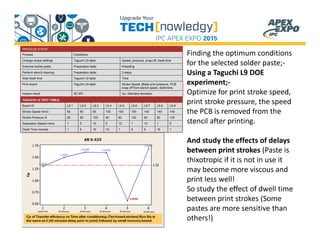
PROCESS STEPS
Process Conditions
Change recipe settings Taguchi L9 table Speed, pressure, snap off, dwell time
Exercise solder paste Preparation table Kneading
Perform stencil cleaning Preparation table 3 steps
Wait dwell time Taguchi L9 table Time
Print board Taguchi L9 table Stroke Speed, Blade print pressure, PCB
snap off from stencil speed, dwell time.
Inspect result 3D SPI Cp, Standard deviation
TAGUCHI L9 TEST TABLE
Board ID L9.1 L9.2 L9.3 L9.4 L9.5 L9.6 L9.7 L9.8 L9.9
Stroke Speed mm/s 60 60 60 100 100 100 140 140 140
Stroke Pressure N 60 80 100 60 80 100 60 80 100
Separation Speed mm/s 1 5 10 5 10 1 10 1 5
Dwell Time minutes 1 5 10 10 1 5 5 10 1
Finding the optimum conditions
for the selected solder paste;-
Using a Taguchi L9 DOE
experiment;-
Optimize for print stroke speed,
print stroke pressure, the speed
the PCB is removed from the
stencil after printing.
And study the effects of delays
between print strokes (Paste is
thixotropic if it is not in use it
may become more viscous and
print less well!
So study the effect of dwell time
between print strokes (Some
pastes are more sensitive than
others!)
Same aperture with
an offset from pad
Possible reasons for mismatch of aperture to pad;-
Manufacturing tolerances in PCB & Stencil cutting, Stretch on Stencil & PCB (Particularly after first
side reflow) Setup accuracy of printer, alignment capability of printer.
Use a safety margin on area ratio, and slight reduction in aperture size makes the process more
tolerant to offset. Put the paste and component where they belong!
Overprinting or off pad
printing does not help!
The need for a safety margin in AR selection!
Actual 03015 Print performance. TE performance curves predict what
AR is printable & print results confirm this
0.100.12
0.120.100.12
0.10
0.15
0.09
0.22
0.11
0.8000.7000.6000.5500.5000.4500.4000.350
3.5
3.0
2.5
2.0
1.5
1.0
0.5
0.0
Area Ratios
Cp
1.33
Cp Volume Transferred LCFGEPNC Squares
Actual 03015 Print performance
100µm
100µm
Conclusion and discussion on future work;-
Is the process capable for production;-
In Modules?
I would say it looks promising our 0.05 and 0.06mm thick stencils and apertures
printed well I would suggest the smaller apertures be used to achieve safe tight
spacing.
In Smart watches?
Maybe? The 0.06mm thick stencil worked well for both apertures, but is this enough
volume for the other components on smartwatches?
Smartphones?
More work required, our initial work with the 0.08mm thick stencil was not as
robust.
During the demo we used the 0.05mm thick stencil and had the 0.06mm stencil as
fall back in case of damage.
Future work;-
Ultrasonic activated blades may help (See next slide) We did not use ultrasonic blades
during the demo but we have done some testing.
Detailed work needs to be done for the other devices to determine if each need
different volume of paste?
1201059075604530
LSL USL
LSL 30
Target *
USL 130
Sample Mean 82.2306
Sample N 448
StDev (Within) 10.7495
StDev (O v erall) 10.7435
Process Data
C p 1.55
C PL 1.62
C PU 1.48
C pk 1.48
Pp 1.55
PPL 1.62
PPU 1.48
Ppk 1.48
C pm *
O v erall C apability
Potential (Within) C apability
PPM < LSL 0.00
PPM > USL 0.00
PPM Total 0.00
O bserv ed Performance
PPM < LSL 0.59
PPM > USL 4.42
PPM Total 5.01
Exp. Within Performance
PPM < LSL 0.58
PPM > USL 4.37
PPM Total 4.95
Exp. O v erall Performance
Within
Overall
Process Capability of VOLUME% 0.08mm Stencil & US 0.15 by 0.12mm aperture
12010080604020
LSL USL
LSL 30
Target *
USL 130
Sample Mean 70.0524
Sample N 448
StDev (Within) 12.4984
StDev (O v erall) 12.4914
Process Data
C p 1.33
C PL 1.07
C PU 1.60
C pk 1.07
Pp 1.33
PPL 1.07
PPU 1.60
Ppk 1.07
C pm *
O v erall C apability
Potential (Within) C apability
PPM < LSL 4464.29
PPM > USL 0.00
PPM Total 4464.29
O bserv ed Performance
PPM < LSL 676.24
PPM > USL 0.81
PPM Total 677.05
Exp. Within Performance
PPM < LSL 672.04
PPM > USL 0.80
PPM Total 672.84
Exp. O v erall Performance
Within
Overall
Process Capability of VOLUME
Using Ultrasonic activated squeegees
the TE test says an AR 0.425 is
possible (Large aperture 0.08mm stencil)
But the TE PCB was designed not to be offset sensitive!
With Ultrasonic blades on the 03015 test PCB as
we know it is offset sensitive The top array was
centered, one below was at the other side of
the panel which had PCB stretch leading to a
slight offset from the stencil
At the moment there just has not been enough
work done to be conclusive !
0.40mm
+-0.02mm
0.10mm
+-0.03mm
0.20
0.15
0.120.100.120.15
0.30+or–
0.01mm
0.08+or–
0.01mm
0.14
0.100.120.10
0.22
0.11
0.30+or–
0.01mm
0.08+or–
0.01mm
0.14
0.25mm
0.09
0.080.08
0.100.070.10
0.17
0.12
0.18
0.16
0.180.16
0.18
0.16
0.180.16
0.12
0.15
In the end with a thicker stencil the risk of paste squeeze out
shorting is high
And if you can not achieve tighter component density what is the
point? More work required!
Over three days and several demo per day we;-
• Ran sixty PCBs, placed 36,000 03015 components with Zero placement defects
and a component pick-up rate of 99.95%.
• Printed 72,000 apertures and had only one print defect found at SPI. This print
defect was a squashed solder ball coined in such a way as to partially block one
aperture
• A 15 DPMO process at printing
• Five Defects Per Million Opportunities DPMO SMT process overall.
Smaller aperture & Pad with a
0.05mm thick stencil showing no
paste squeeze out shorting
THANK YOU
ANY QUESTIONS?
Development of a Robust 03015 Process
Robert Alexander Gray
ASM Assembly Systems LLC
Suwanee, GA
For more information, visit www.siplace.com
or contact me directly via grayrobert@asmpt.com
Robert Gray
Kaizen Team Expert
ASM Assembly Systems

Robust 03015 process RGray apex15

  • 1.
    DEVELOPMENT OF AROBUST 03015 PROCESS Robert Alexander Gray ASM Assembly Systems LLC Suwanee, GA
  • 2.
    DEVELOPMENT OF AROBUST 03015 PROCESS This paper will talk about the 03015 SMT process In Particular focusing on the print process It wont provide all the answers! But hopefully the methodology to develop a “Robust process” can be useful to all process development whether “Bleeding edge” like this or just “New to You” applications.
  • 3.
    Why start workingon the 03015 Process? I was asked if in three months I could deliver a DEMO process for an in House Show (I was to focus on printing, but the demo would cover all SMT processes)? We would run on demand to groups of ten to twenty Engineers several demos per day over three days. Each demo had to go flawlessly on demand without any process priming time. I had never done any work on this, but luckily I had done a lot of work on stencil technology and transfer efficiency, so I did some quick math and based on my results said Yes! So here are the details of the development work and results from that challenge.
  • 4.
    Miniaturization Continues tobe a Driver Roadmap; Source: Murata 0201 0603 0402 01005 0805
  • 5.
    Component Type Nomenclature ComponentNomenclature [in ]x [in] English Metric [mm] x [mm] 0,010 in × 0,005 008004 0201** 0,25 x 0,125 0,012 in × 0,006 n.a. 03015* 0,3 x 0,15 0,016 in × 0,0079 01005 0402 0,4 x 0,2 0,024 in × 0,012 0201 0603 0,6 x 0,3 0,039 in × 0,020 0402 1005 1,0 x 0,5 0,063 in × 0,031 0603 1680 1,6 x 0,8 0,079 in × 0,049 0805 2012 2,0 x 1,25 0,098 in × 0,079 1008 2520 2,5 x 2,0 0,13 in × 0,063 1206 3216 3,2 x 1,6 0,13 in × 0,098 1210 3225 3,2 x 2,5 0,18 in × 0,063 1806 4516 4,5 x 1,6 0,18 in × 0,13 1812 4532 4,5 x 3,2 0,20 in × 0,098 2010 5025 5,0 x 2,5 0,25 in × 0,13 in 2512 6332 6,3 x 3,2 * ROHM, Panasonic ** Murata
  • 6.
    World's smallest chipsize „03015“ (0.3mm×0.15mm) Anounced in Spring 2012 Source: http://www.rohm.com/news/111003.html 03015 01005
  • 7.
    Some Background oncomponent design;- Rohm Resistor 03015 Bottom-Side Metallization Only Top Front Side Side Bottom
  • 8.
    Some Background oncomponent design;- Panasonic Resistor 03015 3-Side Metallization
  • 9.
    Some Background oncomponent design;- Murata Capacitor 0201 5-Side Metallization • Appearance
  • 10.
    What Manufacturing ProblemsCan Result ? Murata C0201 250x125x125µm Panasonic R03015 300x150x130µm Rohm R03015 300x150x110µm This miniaturization step is not only 25% smaller edges but also means a complete Component Type specific process adjustment within a new class of components ! Manufacturer specific Pad Design Manufacturer specific Stencil Apertures Component Type related nozzles (Resistor / Capacitor) Rohm Pana. Murata Increasing Solder Volume is Required with Increasing Termination Areas !
  • 11.
    In the Futurethe Resistor will Shrink to the same Length and Width as the Capacitor 250 µm 300 µm 125 µm 150 µm 250 µm 125 µm Capacitor Resistor Today Future This is important, so the same nozzle size will fit for both
  • 12.
    Component design, whichdrives pad design, which in its turn will drive aperture design, leading to area ratio calculations to determine workable stencil thickness’s. Try to make it work at 0.08mm thick stencil for smartphone applications Show small gap placement without paste squeeze out shorting.
  • 13.
    Area Ratio (AR)and Transfer Efficiency (TE) define the Aperture Design L x W Stencil 2 x (L+W) x T Basically the paste wants to stick to the pads and the aperture walls the area of contact is a main factor. Transfer efficiency is a measure of which of them is winning.
  • 14.
    Stencil Transfer EfficiencyTesting A selection of some of the many Stencil Types and technologies Tested • Laser cut standard Stainless Steel • Laser cut fine grain Stainless Steel • E-Formed Nickel • Laser Cut Nickel • 3 types electro polishing • 3 types of Nano coating treatment
  • 15.
    Stencil Material Influenceon Transfer Efficiency Some results using type four paste;-
  • 16.
    0.8000.7000.6000.5500.5000.4500.4000.350 18 16 14 12 10 8 6 4 2 0 100 80 60 40 20 0 Area Ratios StandardDeviationofTEVolume% MeanVolumeTransferred% Mean Volume StandardDeviation Variable Mean Volume & Stdev Vs Area ratio requirements volume Traditional Mean direction area ratios in this New technology pushing process is capable mean volume above 60% then the Main aim keep Stdev below 10% and becomes more unstable. changes the process in volume (Slope) When the rate of change Stencil Transfer Efficiency Testing (type five paste) - TE the science behind printing Important is that a sufficient mean Volume is transferred. ( good solder joint) But at the same time it is important that the variation stays within controlled limits (Stable Volume No Tombstoning!)
  • 17.
    • Type 4Type 5 Type Solder Paste Influence on TE-Performance Comparison of Paste Type 4 and 5 20µm 38µm > 80 %<10 % <1 % 40µm 0201 25µm > 80% <10% <1% 30µm 10µm 0201 0201 01005 01005 Particle Size Distribution 03015 Recommended for 01005 and a must for 03015 Type 5 5 Solder Ball Rule
  • 18.
    Best Performing StencilFrom our studies Do your own! Best Stencil Result : Laser Cut, Fine Grain SS, Electro polish (Carefully controlled), Nano coated for robust print on demand.
  • 19.
    AR above 0.425should work;a reminder our 03015 Stencil Aperture Design
  • 20.
    PROCESS STEPS Process Conditions Changerecipe settings Taguchi L9 table Speed, pressure, snap off, dwell time Exercise solder paste Preparation table Kneading Perform stencil cleaning Preparation table 3 steps Wait dwell time Taguchi L9 table Time Print board Taguchi L9 table Stroke Speed, Blade print pressure, PCB snap off from stencil speed, dwell time. Inspect result 3D SPI Cp, Standard deviation TAGUCHI L9 TEST TABLE Board ID L9.1 L9.2 L9.3 L9.4 L9.5 L9.6 L9.7 L9.8 L9.9 Stroke Speed mm/s 60 60 60 100 100 100 140 140 140 Stroke Pressure N 60 80 100 60 80 100 60 80 100 Separation Speed mm/s 1 5 10 5 10 1 10 1 5 Dwell Time minutes 1 5 10 10 1 5 5 10 1 Finding the optimum conditions for the selected solder paste;- Using a Taguchi L9 DOE experiment;- Optimize for print stroke speed, print stroke pressure, the speed the PCB is removed from the stencil after printing. And study the effects of delays between print strokes (Paste is thixotropic if it is not in use it may become more viscous and print less well! So study the effect of dwell time between print strokes (Some pastes are more sensitive than others!)
  • 21.
    Same aperture with anoffset from pad Possible reasons for mismatch of aperture to pad;- Manufacturing tolerances in PCB & Stencil cutting, Stretch on Stencil & PCB (Particularly after first side reflow) Setup accuracy of printer, alignment capability of printer. Use a safety margin on area ratio, and slight reduction in aperture size makes the process more tolerant to offset. Put the paste and component where they belong! Overprinting or off pad printing does not help! The need for a safety margin in AR selection!
  • 22.
    Actual 03015 Printperformance. TE performance curves predict what AR is printable & print results confirm this 0.100.12 0.120.100.12 0.10 0.15 0.09 0.22 0.11 0.8000.7000.6000.5500.5000.4500.4000.350 3.5 3.0 2.5 2.0 1.5 1.0 0.5 0.0 Area Ratios Cp 1.33 Cp Volume Transferred LCFGEPNC Squares
  • 23.
    Actual 03015 Printperformance 100µm 100µm
  • 24.
    Conclusion and discussionon future work;- Is the process capable for production;- In Modules? I would say it looks promising our 0.05 and 0.06mm thick stencils and apertures printed well I would suggest the smaller apertures be used to achieve safe tight spacing. In Smart watches? Maybe? The 0.06mm thick stencil worked well for both apertures, but is this enough volume for the other components on smartwatches? Smartphones? More work required, our initial work with the 0.08mm thick stencil was not as robust. During the demo we used the 0.05mm thick stencil and had the 0.06mm stencil as fall back in case of damage. Future work;- Ultrasonic activated blades may help (See next slide) We did not use ultrasonic blades during the demo but we have done some testing. Detailed work needs to be done for the other devices to determine if each need different volume of paste?
  • 25.
    1201059075604530 LSL USL LSL 30 Target* USL 130 Sample Mean 82.2306 Sample N 448 StDev (Within) 10.7495 StDev (O v erall) 10.7435 Process Data C p 1.55 C PL 1.62 C PU 1.48 C pk 1.48 Pp 1.55 PPL 1.62 PPU 1.48 Ppk 1.48 C pm * O v erall C apability Potential (Within) C apability PPM < LSL 0.00 PPM > USL 0.00 PPM Total 0.00 O bserv ed Performance PPM < LSL 0.59 PPM > USL 4.42 PPM Total 5.01 Exp. Within Performance PPM < LSL 0.58 PPM > USL 4.37 PPM Total 4.95 Exp. O v erall Performance Within Overall Process Capability of VOLUME% 0.08mm Stencil & US 0.15 by 0.12mm aperture 12010080604020 LSL USL LSL 30 Target * USL 130 Sample Mean 70.0524 Sample N 448 StDev (Within) 12.4984 StDev (O v erall) 12.4914 Process Data C p 1.33 C PL 1.07 C PU 1.60 C pk 1.07 Pp 1.33 PPL 1.07 PPU 1.60 Ppk 1.07 C pm * O v erall C apability Potential (Within) C apability PPM < LSL 4464.29 PPM > USL 0.00 PPM Total 4464.29 O bserv ed Performance PPM < LSL 676.24 PPM > USL 0.81 PPM Total 677.05 Exp. Within Performance PPM < LSL 672.04 PPM > USL 0.80 PPM Total 672.84 Exp. O v erall Performance Within Overall Process Capability of VOLUME Using Ultrasonic activated squeegees the TE test says an AR 0.425 is possible (Large aperture 0.08mm stencil) But the TE PCB was designed not to be offset sensitive! With Ultrasonic blades on the 03015 test PCB as we know it is offset sensitive The top array was centered, one below was at the other side of the panel which had PCB stretch leading to a slight offset from the stencil At the moment there just has not been enough work done to be conclusive !
  • 26.
  • 27.
    Over three daysand several demo per day we;- • Ran sixty PCBs, placed 36,000 03015 components with Zero placement defects and a component pick-up rate of 99.95%. • Printed 72,000 apertures and had only one print defect found at SPI. This print defect was a squashed solder ball coined in such a way as to partially block one aperture • A 15 DPMO process at printing • Five Defects Per Million Opportunities DPMO SMT process overall. Smaller aperture & Pad with a 0.05mm thick stencil showing no paste squeeze out shorting
  • 28.
    THANK YOU ANY QUESTIONS? Developmentof a Robust 03015 Process Robert Alexander Gray ASM Assembly Systems LLC Suwanee, GA For more information, visit www.siplace.com or contact me directly via grayrobert@asmpt.com Robert Gray Kaizen Team Expert ASM Assembly Systems