Technology Challenges in
Mobile Payments
Dr.V.N.Sastry
Professor, IDRBT &
Executive Secretary, MPFI
Road No.1, Castle Hills, Masab Tank,
Hyderabad 500057
E-Mail : vnsastry@idrbt.ac.in
Ph: 91-40-23534981
Test : 9440803813 (M) & MMID : 9211933
January 30, 2012 at IDRBT for the EDP
March 29, 2012
Outline
• Mobile Payment Technologies
• Technology Challenges
• Some innovative developments
2
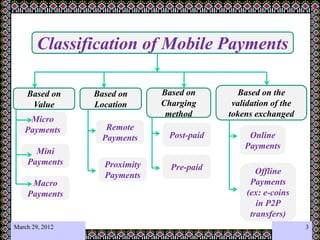
Classification of Mobile Payments
Based on
Value
Micro
Payments
Based on
Charging
method
Based on
Location
Based on the
validation of the
tokens exchanged
Macro
Payments
Mini
Payments Proximity
Payments
Remote
Payments
Pre-paid
Post-paid Online
Payments
Offline
Payments
(ex: e-coins
in P2P
transfers)
March 29, 2012 3
March 29, 2012
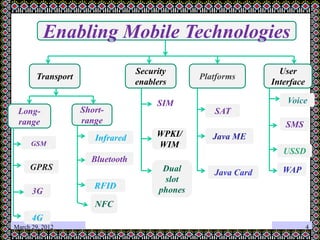
Enabling Mobile Technologies
User
Interface
Platforms
Security
enablers
Transport
Short-
range
Long-
range
GSM
GPRS
RFID
Bluetooth
Infrared
3G
SAT
Java ME
Java Card
Voice
SMS
USSD
WAP
Dual
slot
phones
WPKI/
WIM
SIM
4G
NFC
4
March 29, 2012
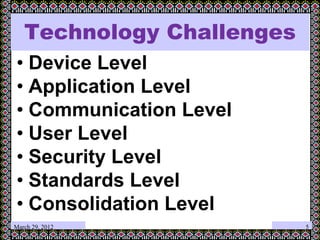
Technology Challenges
• Device Level
• Application Level
• Communication Level
• User Level
• Security Level
• Standards Level
• Consolidation Level
5
March 29, 2012
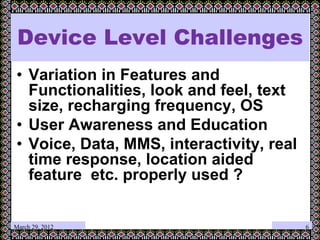
Device Level Challenges
• Variation in Features and
Functionalities, look and feel, text
size, recharging frequency, OS
• User Awareness and Education
• Voice, Data, MMS, interactivity, real
time response, location aided
feature etc. properly used ?
6
March 29, 2012
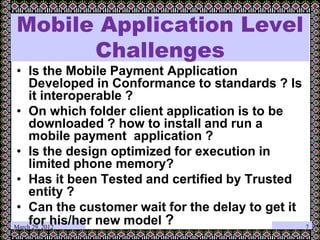
Mobile Application Level
Challenges
• Is the Mobile Payment Application
Developed in Conformance to standards ? Is
it interoperable ?
• On which folder client application is to be
downloaded ? how to install and run a
mobile payment application ?
• Is the design optimized for execution in
limited phone memory?
• Has it been Tested and certified by Trusted
entity ?
• Can the customer wait for the delay to get it
for his/her new model ? 7
March 29, 2012
Communication Level
Challenges
• Which channel to use : SMS, USSD,
GPRS, DTMF ?
• What way mobile banking
convenience is enhanced by 2G,
3G, 4G ?
• When and how to use Wireless
Communication Technologies :
Bluetooth, Zigbee, Wi-max, Wi-fi ,
LTE ?
8
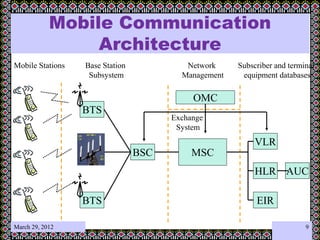
Mobile Communication
Architecture
Mobile Stations Base Station
Subsystem
Exchange
System
Network
Management
Subscriber and terminal
equipment databases
BSC MSC
VLR
HLR
EIR
AUC
OMC
BTS
BTS
March 29, 2012 9
March 29, 2012
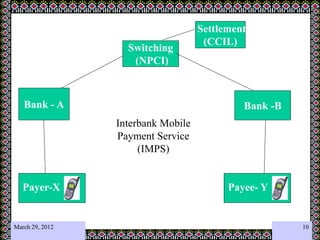
Bank - A Bank -B
Switching
(NPCI)
Settlement
(CCIL)
Interbank Mobile
Payment Service
(IMPS)
Payer-X Payee- Y
10
March 29, 2012
User Level Challenges
• Local language support on Mobiles
• Generation of Transaction report
• Mobile Application on Phone memory or
SIM or memory card ?
• Trace of transaction data or critical
personal data : access by others
• Mobile Wallet : risk of multiple cards in
the device and value offload for cash
exchange in local currency
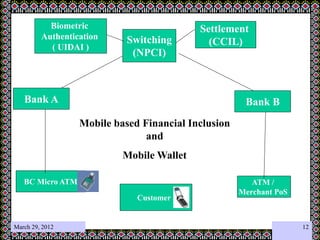
• Mobile based Financial Inclusion services
• Complaint registration and Grievance
resolution
11
BC Micro ATM ATM /
Merchant PoS
Bank A Bank B
Switching
(NPCI)
Biometric
Authentication
( UIDAI )
Settlement
(CCIL)
Customer
Mobile based Financial Inclusion
and
Mobile Wallet
March 29, 2012 12
March 29, 2012
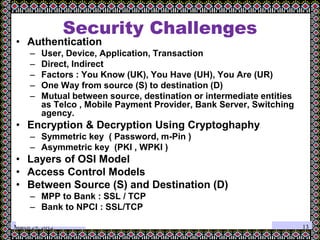
Security Challenges
• Authentication
– User, Device, Application, Transaction
– Direct, Indirect
– Factors : You Know (UK), You Have (UH), You Are (UR)
– One Way from source (S) to destination (D)
– Mutual between source, destination or intermediate entities
as Telco , Mobile Payment Provider, Bank Server, Switching
agency.
• Encryption & Decryption Using Cryptoghaphy
– Symmetric key ( Password, m-Pin )
– Asymmetric key (PKI , WPKI )
• Layers of OSI Model
• Access Control Models
• Between Source (S) and Destination (D)
– MPP to Bank : SSL / TCP
– Bank to NPCI : SSL/TCP
13
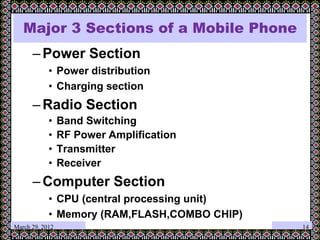
Major 3 Sections of a Mobile Phone
–Power Section
• Power distribution
• Charging section
–Radio Section
• Band Switching
• RF Power Amplification
• Transmitter
• Receiver
–Computer Section
• CPU (central processing unit)
• Memory (RAM,FLASH,COMBO CHIP)
March 29, 2012 14
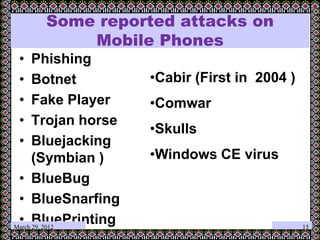
Some reported attacks on
Mobile Phones
• Phishing
• Botnet
• Fake Player
• Trojan horse
• Bluejacking
(Symbian )
• BlueBug
• BlueSnarfing
• BluePrinting
•Cabir (First in 2004 )
•Comwar
•Skulls
•Windows CE virus
March 29, 2012 15
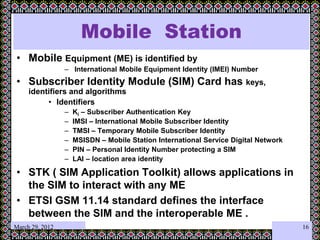
Mobile Station
• Mobile Equipment (ME) is identified by
– International Mobile Equipment Identity (IMEI) Number
• Subscriber Identity Module (SIM) Card has keys,
identifiers and algorithms
• Identifiers
– Ki – Subscriber Authentication Key
– IMSI – International Mobile Subscriber Identity
– TMSI – Temporary Mobile Subscriber Identity
– MSISDN – Mobile Station International Service Digital Network
– PIN – Personal Identity Number protecting a SIM
– LAI – location area identity
• STK ( SIM Application Toolkit) allows applications in
the SIM to interact with any ME
• ETSI GSM 11.14 standard defines the interface
between the SIM and the interoperable ME .
March 29, 2012 16
SIM Card
• Mobile Payment Application can be installed on either ME or
SIM .
• The application burnt on the SIM card gives by far the most
secure application environment. The mobile application can be
stored on its own security domain and hence prevented from
others having access to it.
• Forensic tools and procedures exist that can be used to
bypass built-in security mechanisms and recover the contents
of a device.
• Both software and hardware-based methods are available for
data recovery, including those that exploit existing
vulnerabilities.
• A number of GSM mobile phones allow acquisition with a
forensic tool, if a PIN-enabled (U)SIM is missing or removed
from the device. It is also possible to create substitute (U)SIMs
for certain models of phones that fools them into treating the
(U)SIM as the original, and allowing access.
•
March 29, 2012 17
Security at Mobile Channel Level
• Voice Channel : DTMF for IVRS
• Text Channel : SMS, USSD
• MMS Channel : GPRS
• GSM Security Mechanisms
• Equipment Identity Register (EIR)
– Black list – stolen or non-type mobiles
– White list - valid mobiles
– Gray list – local tracking mobiles
• Central Equipment Identity Register (CEIR)
– Approved mobile type (type approval authorities)
– Consolidated black list (posted by operators)
March 29, 2012 18
Security at Mobile Application level
• Client Application developed by the
Mobile Payment Provider (MPP)
• Server Application of the MPP at the
Bank level
• Security Testing
• Key Generation and storage process
• Check Sum implemented
• Reaching to the destined address only ?
March 29, 2012 19
March 29, 2012
Multiple Standard
Challenges
• ISO Standards
• IEEE Standards
• PCI DSS Standards
• Regulatory Standards
• Global platform Standards
• EMV Standards
• NIST Standards
• SFMS, SWIFT Standards
• NFC Standards 20
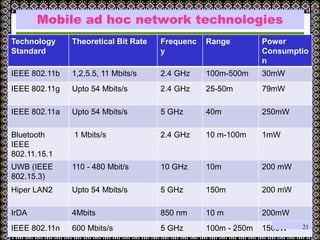
Mobile ad hoc network technologies
March 29, 2012
Technology
Standard
Theoretical Bit Rate Frequenc
y
Range Power
Consumptio
n
IEEE 802.11b 1,2,5.5, 11 Mbits/s 2.4 GHz 100m-500m 30mW
IEEE 802.11g Upto 54 Mbits/s 2.4 GHz 25-50m 79mW
IEEE 802.11a Upto 54 Mbits/s 5 GHz 40m 250mW
Bluetooth
IEEE
802.11.15.1
1 Mbits/s 2.4 GHz 10 m-100m 1mW
UWB (IEEE
802.15.3)
110 - 480 Mbit/s 10 GHz 10m 200 mW
Hiper LAN2 Upto 54 Mbits/s 5 GHz 150m 200 mW
IrDA 4Mbits 850 nm 10 m 200mW
IEEE 802.11n 600 Mbits/s 5 GHz 100m - 250m 1500W 21
March 29, 2012
Consolidation Level
Challenges
• Server capabilities to handle high
volume mobile payment transactions
• Periodic and round the clock clearing
services for mobile payments
• Net and Real time funds settlement
between Banks
• Cash management issues at ATMs on
account of high velocity mobile
payments.
• Offering Mobile Banking Application as
a Cloud Service
22
Some Innovative solutions of
Mobile Payments in India:
• Bringing all stakeholders of Mobile Payments into
one platform by the Mobile Payment Forum of India
(MPFI) in 2006
• Use of Mobile Phone Number and MMID only for
Mobile Payments
• Use of AADHAR number and BIN for Mobile
Payments
• Use of USSD based Mobile Payments
• Development of MANETS for Financial Inclusion by
IDRBT
• And many other solutions reported in the workshop
March 29, 2012 23
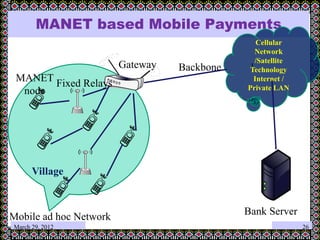
MANET Ecosystem for
Mobile Payments
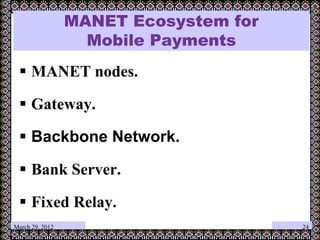
 MANET nodes.
 Gateway.
 Backbone Network.
 Bank Server.
 Fixed Relay.
March 29, 2012 24
Mobile ad-hoc Network (MANET)
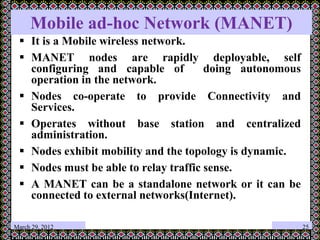
 It is a Mobile wireless network.
 MANET nodes are rapidly deployable, self
configuring and capable of doing autonomous
operation in the network.
 Nodes co-operate to provide Connectivity and
Services.
 Operates without base station and centralized
administration.
 Nodes exhibit mobility and the topology is dynamic.
 Nodes must be able to relay traffic sense.
 A MANET can be a standalone network or it can be
connected to external networks(Internet).
March 29, 2012 25
MANET based Mobile Payments
I
Cellular
Network
/Satellite
Technology
Internet /
Private LAN
Gateway
Fixed Relays
Bank Server
Mobile ad hoc Network
Village
MANET
node
Backbone
March 29, 2012 26
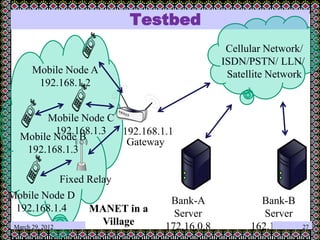
Testbed
Mobile Node C
192.168.1.3
Mobile Node B
192.168.1.3
Mobile Node D
192.168.1.4
Mobile Node A
192.168.1.2
Gateway
192.168.1.1
Fixed Relay
MANET in a
Village
Cellular Network/
ISDN/PSTN/ LLN/
Satellite Network
Bank-A
Server
172.16.0.8
Bank-B
Server
162.16.6.124
March 29, 2012 27
March 29, 2012 28

6. mr. sastry vns idrbt

  • 1.
    Technology Challenges in MobilePayments Dr.V.N.Sastry Professor, IDRBT & Executive Secretary, MPFI Road No.1, Castle Hills, Masab Tank, Hyderabad 500057 E-Mail : vnsastry@idrbt.ac.in Ph: 91-40-23534981 Test : 9440803813 (M) & MMID : 9211933 January 30, 2012 at IDRBT for the EDP
  • 2.
    March 29, 2012 Outline •Mobile Payment Technologies • Technology Challenges • Some innovative developments 2
  • 3.
    Classification of MobilePayments Based on Value Micro Payments Based on Charging method Based on Location Based on the validation of the tokens exchanged Macro Payments Mini Payments Proximity Payments Remote Payments Pre-paid Post-paid Online Payments Offline Payments (ex: e-coins in P2P transfers) March 29, 2012 3
  • 4.
    March 29, 2012 EnablingMobile Technologies User Interface Platforms Security enablers Transport Short- range Long- range GSM GPRS RFID Bluetooth Infrared 3G SAT Java ME Java Card Voice SMS USSD WAP Dual slot phones WPKI/ WIM SIM 4G NFC 4
  • 5.
    March 29, 2012 TechnologyChallenges • Device Level • Application Level • Communication Level • User Level • Security Level • Standards Level • Consolidation Level 5
  • 6.
    March 29, 2012 DeviceLevel Challenges • Variation in Features and Functionalities, look and feel, text size, recharging frequency, OS • User Awareness and Education • Voice, Data, MMS, interactivity, real time response, location aided feature etc. properly used ? 6
  • 7.
    March 29, 2012 MobileApplication Level Challenges • Is the Mobile Payment Application Developed in Conformance to standards ? Is it interoperable ? • On which folder client application is to be downloaded ? how to install and run a mobile payment application ? • Is the design optimized for execution in limited phone memory? • Has it been Tested and certified by Trusted entity ? • Can the customer wait for the delay to get it for his/her new model ? 7
  • 8.
    March 29, 2012 CommunicationLevel Challenges • Which channel to use : SMS, USSD, GPRS, DTMF ? • What way mobile banking convenience is enhanced by 2G, 3G, 4G ? • When and how to use Wireless Communication Technologies : Bluetooth, Zigbee, Wi-max, Wi-fi , LTE ? 8
  • 9.
    Mobile Communication Architecture Mobile StationsBase Station Subsystem Exchange System Network Management Subscriber and terminal equipment databases BSC MSC VLR HLR EIR AUC OMC BTS BTS March 29, 2012 9
  • 10.
    March 29, 2012 Bank- A Bank -B Switching (NPCI) Settlement (CCIL) Interbank Mobile Payment Service (IMPS) Payer-X Payee- Y 10
  • 11.
    March 29, 2012 UserLevel Challenges • Local language support on Mobiles • Generation of Transaction report • Mobile Application on Phone memory or SIM or memory card ? • Trace of transaction data or critical personal data : access by others • Mobile Wallet : risk of multiple cards in the device and value offload for cash exchange in local currency • Mobile based Financial Inclusion services • Complaint registration and Grievance resolution 11
  • 12.
    BC Micro ATMATM / Merchant PoS Bank A Bank B Switching (NPCI) Biometric Authentication ( UIDAI ) Settlement (CCIL) Customer Mobile based Financial Inclusion and Mobile Wallet March 29, 2012 12
  • 13.
    March 29, 2012 SecurityChallenges • Authentication – User, Device, Application, Transaction – Direct, Indirect – Factors : You Know (UK), You Have (UH), You Are (UR) – One Way from source (S) to destination (D) – Mutual between source, destination or intermediate entities as Telco , Mobile Payment Provider, Bank Server, Switching agency. • Encryption & Decryption Using Cryptoghaphy – Symmetric key ( Password, m-Pin ) – Asymmetric key (PKI , WPKI ) • Layers of OSI Model • Access Control Models • Between Source (S) and Destination (D) – MPP to Bank : SSL / TCP – Bank to NPCI : SSL/TCP 13
  • 14.
    Major 3 Sectionsof a Mobile Phone –Power Section • Power distribution • Charging section –Radio Section • Band Switching • RF Power Amplification • Transmitter • Receiver –Computer Section • CPU (central processing unit) • Memory (RAM,FLASH,COMBO CHIP) March 29, 2012 14
  • 15.
    Some reported attackson Mobile Phones • Phishing • Botnet • Fake Player • Trojan horse • Bluejacking (Symbian ) • BlueBug • BlueSnarfing • BluePrinting •Cabir (First in 2004 ) •Comwar •Skulls •Windows CE virus March 29, 2012 15
  • 16.
    Mobile Station • MobileEquipment (ME) is identified by – International Mobile Equipment Identity (IMEI) Number • Subscriber Identity Module (SIM) Card has keys, identifiers and algorithms • Identifiers – Ki – Subscriber Authentication Key – IMSI – International Mobile Subscriber Identity – TMSI – Temporary Mobile Subscriber Identity – MSISDN – Mobile Station International Service Digital Network – PIN – Personal Identity Number protecting a SIM – LAI – location area identity • STK ( SIM Application Toolkit) allows applications in the SIM to interact with any ME • ETSI GSM 11.14 standard defines the interface between the SIM and the interoperable ME . March 29, 2012 16
  • 17.
    SIM Card • MobilePayment Application can be installed on either ME or SIM . • The application burnt on the SIM card gives by far the most secure application environment. The mobile application can be stored on its own security domain and hence prevented from others having access to it. • Forensic tools and procedures exist that can be used to bypass built-in security mechanisms and recover the contents of a device. • Both software and hardware-based methods are available for data recovery, including those that exploit existing vulnerabilities. • A number of GSM mobile phones allow acquisition with a forensic tool, if a PIN-enabled (U)SIM is missing or removed from the device. It is also possible to create substitute (U)SIMs for certain models of phones that fools them into treating the (U)SIM as the original, and allowing access. • March 29, 2012 17
  • 18.
    Security at MobileChannel Level • Voice Channel : DTMF for IVRS • Text Channel : SMS, USSD • MMS Channel : GPRS • GSM Security Mechanisms • Equipment Identity Register (EIR) – Black list – stolen or non-type mobiles – White list - valid mobiles – Gray list – local tracking mobiles • Central Equipment Identity Register (CEIR) – Approved mobile type (type approval authorities) – Consolidated black list (posted by operators) March 29, 2012 18
  • 19.
    Security at MobileApplication level • Client Application developed by the Mobile Payment Provider (MPP) • Server Application of the MPP at the Bank level • Security Testing • Key Generation and storage process • Check Sum implemented • Reaching to the destined address only ? March 29, 2012 19
  • 20.
    March 29, 2012 MultipleStandard Challenges • ISO Standards • IEEE Standards • PCI DSS Standards • Regulatory Standards • Global platform Standards • EMV Standards • NIST Standards • SFMS, SWIFT Standards • NFC Standards 20
  • 21.
    Mobile ad hocnetwork technologies March 29, 2012 Technology Standard Theoretical Bit Rate Frequenc y Range Power Consumptio n IEEE 802.11b 1,2,5.5, 11 Mbits/s 2.4 GHz 100m-500m 30mW IEEE 802.11g Upto 54 Mbits/s 2.4 GHz 25-50m 79mW IEEE 802.11a Upto 54 Mbits/s 5 GHz 40m 250mW Bluetooth IEEE 802.11.15.1 1 Mbits/s 2.4 GHz 10 m-100m 1mW UWB (IEEE 802.15.3) 110 - 480 Mbit/s 10 GHz 10m 200 mW Hiper LAN2 Upto 54 Mbits/s 5 GHz 150m 200 mW IrDA 4Mbits 850 nm 10 m 200mW IEEE 802.11n 600 Mbits/s 5 GHz 100m - 250m 1500W 21
  • 22.
    March 29, 2012 ConsolidationLevel Challenges • Server capabilities to handle high volume mobile payment transactions • Periodic and round the clock clearing services for mobile payments • Net and Real time funds settlement between Banks • Cash management issues at ATMs on account of high velocity mobile payments. • Offering Mobile Banking Application as a Cloud Service 22
  • 23.
    Some Innovative solutionsof Mobile Payments in India: • Bringing all stakeholders of Mobile Payments into one platform by the Mobile Payment Forum of India (MPFI) in 2006 • Use of Mobile Phone Number and MMID only for Mobile Payments • Use of AADHAR number and BIN for Mobile Payments • Use of USSD based Mobile Payments • Development of MANETS for Financial Inclusion by IDRBT • And many other solutions reported in the workshop March 29, 2012 23
  • 24.
    MANET Ecosystem for MobilePayments  MANET nodes.  Gateway.  Backbone Network.  Bank Server.  Fixed Relay. March 29, 2012 24
  • 25.
    Mobile ad-hoc Network(MANET)  It is a Mobile wireless network.  MANET nodes are rapidly deployable, self configuring and capable of doing autonomous operation in the network.  Nodes co-operate to provide Connectivity and Services.  Operates without base station and centralized administration.  Nodes exhibit mobility and the topology is dynamic.  Nodes must be able to relay traffic sense.  A MANET can be a standalone network or it can be connected to external networks(Internet). March 29, 2012 25
  • 26.
    MANET based MobilePayments I Cellular Network /Satellite Technology Internet / Private LAN Gateway Fixed Relays Bank Server Mobile ad hoc Network Village MANET node Backbone March 29, 2012 26
  • 27.
    Testbed Mobile Node C 192.168.1.3 MobileNode B 192.168.1.3 Mobile Node D 192.168.1.4 Mobile Node A 192.168.1.2 Gateway 192.168.1.1 Fixed Relay MANET in a Village Cellular Network/ ISDN/PSTN/ LLN/ Satellite Network Bank-A Server 172.16.0.8 Bank-B Server 162.16.6.124 March 29, 2012 27
  • 28.