Internet
Of
Things
Contents
 What is IOT
 Why IOT
 IOT Technologies
 Applications
 Future of IOT
 Conclusions
 References
 Questions
2
What is IOT ?
3
What is IOT ? (continued)
 The term Internet of Things was first coined by Kevin Ashton in 1999 in the context of
supply chain management .
 However, in the past decade, the definition has been more inclusive covering wide range of
applications like healthcare, utilities, transport, etc. Many organizations and authors have
given different definitions of IOT overtime. And it has kept on becoming more and more
exhaustive with the advancement in technology. So, after so many years of evolution the
definition of IOT can be written as :-
Interconnection of sensing and actuating devices providing the ability to
share information across platforms through a unified framework, developing
a common operating picture for enabling innovative applications. This is
achieved by seamless ubiquitous sensing, data analytics and information
representation with Cloud computing as the unifying framework.
Why IOT ?
ꝋ Dynamic control of industry and daily life
ꝋ Integrating human society and physical systems.
ꝋ Control things in desired manner
ꝋ Universal internetworking of machines
ꝋ Acts as technologies integrator
ꝋ Provides connected health
ꝋ Smart cities
ꝋ Smart grids
ꝋ Smart retail
ꝋ Smart farming are some of the benefits of IOT
IOT Technologies
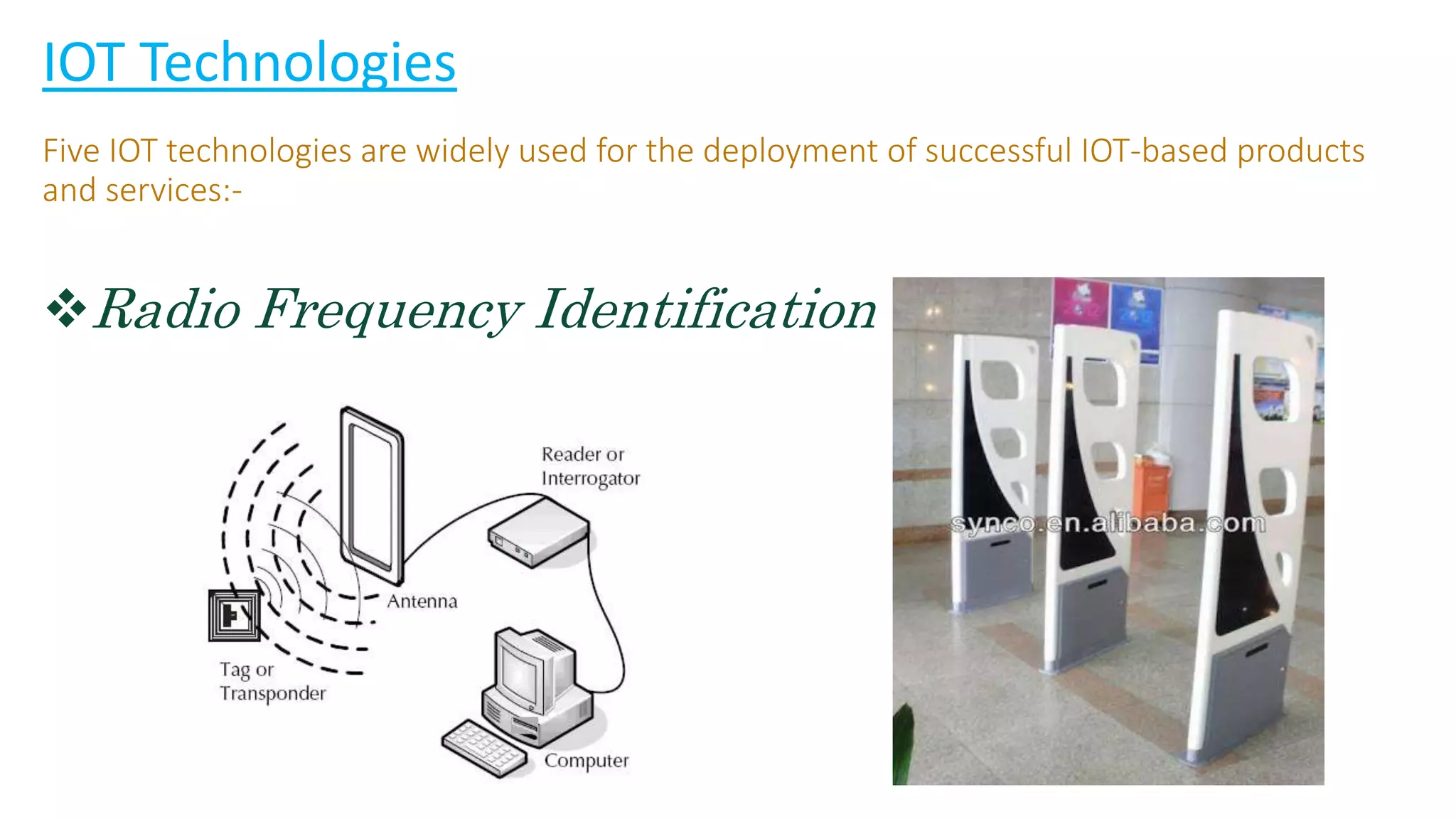
Five IOT technologies are widely used for the deployment of successful IOT-based products
and services:-
Radio Frequency Identification (RFID)
IOT Technologies
Bluetooth and WiFi-Direct
7
IOT Technologies
 Wireless Sensor Networks (WSN)
IOT Technologies
 Middleware
IOT Technologies
 Cloud Computing
IOT Technologies
 IOT Application Software
IOT Applications
Future of IOT
According to analyst firm Gartner, there were 8.4 billion connected devices on earth in 2017
and expected to be 20.4 billion by 2020. more number of devices, more challenges we will be
required to face like:-
∆ Data management challenge
∆ Data mining challenge
∆ Privacy challenge
∆ Security challenge
∆ Chaos challenge
∆ Human health
Conclusions
IOT is among the most recent technological
developments by mankind. Whilst having numerous
advantages, it has also severe demerits and challenges.
More and more research is needed in this field to grow
wisely and sustainably.
Educational institutions, big corporate houses,
governments etc. are required to move together to cope
up with the social, economical and managerial aspects
of IOT.
14
References
 Gubbi, J., Buyya, R., Marusic, S., & Palaniswami, M. (2013). Internet of Things
(IoT): A vision, architectural elements, and future directions. Future
Generation Computer Systems, 29(7), 1645—1660.
 The Internet of Things (IoT): Applications, investments, and challenges for
enterprises In Lee a, Kyoochun Lee b a School of Computer Sciences, Western
Illinois University, Stipes Hall 442F, Macomb, IL 61455-1390, U.S.A. b Olin
Corporation, Clayton, MO, U.S.A.
 Video is taken from GCF Learn Free.org
 Internet of things- a trillion dollar market; vala afshar.
• R. Buyya, C.S. Yeo, S. Venugopal, J. Broberg, I. Brandic, Cloud computing and
emerging IT platforms: vision, hype, and reality for delivering computing as
the 5th utility, Future Generation Computer Systems 25 (2009) 599–616.
15
Internet of things
Internet of things

Internet of things

  • 1.
  • 2.
    Contents  What isIOT  Why IOT  IOT Technologies  Applications  Future of IOT  Conclusions  References  Questions 2
  • 3.
  • 4.
    What is IOT? (continued)  The term Internet of Things was first coined by Kevin Ashton in 1999 in the context of supply chain management .  However, in the past decade, the definition has been more inclusive covering wide range of applications like healthcare, utilities, transport, etc. Many organizations and authors have given different definitions of IOT overtime. And it has kept on becoming more and more exhaustive with the advancement in technology. So, after so many years of evolution the definition of IOT can be written as :- Interconnection of sensing and actuating devices providing the ability to share information across platforms through a unified framework, developing a common operating picture for enabling innovative applications. This is achieved by seamless ubiquitous sensing, data analytics and information representation with Cloud computing as the unifying framework.
  • 5.
    Why IOT ? ꝋDynamic control of industry and daily life ꝋ Integrating human society and physical systems. ꝋ Control things in desired manner ꝋ Universal internetworking of machines ꝋ Acts as technologies integrator ꝋ Provides connected health ꝋ Smart cities ꝋ Smart grids ꝋ Smart retail ꝋ Smart farming are some of the benefits of IOT
  • 6.
    IOT Technologies Five IOTtechnologies are widely used for the deployment of successful IOT-based products and services:- Radio Frequency Identification (RFID)
  • 7.
  • 8.
    IOT Technologies  WirelessSensor Networks (WSN)
  • 9.
  • 10.
  • 11.
    IOT Technologies  IOTApplication Software
  • 12.
  • 13.
    Future of IOT Accordingto analyst firm Gartner, there were 8.4 billion connected devices on earth in 2017 and expected to be 20.4 billion by 2020. more number of devices, more challenges we will be required to face like:- ∆ Data management challenge ∆ Data mining challenge ∆ Privacy challenge ∆ Security challenge ∆ Chaos challenge ∆ Human health
  • 14.
    Conclusions IOT is amongthe most recent technological developments by mankind. Whilst having numerous advantages, it has also severe demerits and challenges. More and more research is needed in this field to grow wisely and sustainably. Educational institutions, big corporate houses, governments etc. are required to move together to cope up with the social, economical and managerial aspects of IOT. 14
  • 15.
    References  Gubbi, J.,Buyya, R., Marusic, S., & Palaniswami, M. (2013). Internet of Things (IoT): A vision, architectural elements, and future directions. Future Generation Computer Systems, 29(7), 1645—1660.  The Internet of Things (IoT): Applications, investments, and challenges for enterprises In Lee a, Kyoochun Lee b a School of Computer Sciences, Western Illinois University, Stipes Hall 442F, Macomb, IL 61455-1390, U.S.A. b Olin Corporation, Clayton, MO, U.S.A.  Video is taken from GCF Learn Free.org  Internet of things- a trillion dollar market; vala afshar. • R. Buyya, C.S. Yeo, S. Venugopal, J. Broberg, I. Brandic, Cloud computing and emerging IT platforms: vision, hype, and reality for delivering computing as the 5th utility, Future Generation Computer Systems 25 (2009) 599–616. 15