Moldova ICT summit
          18-19 May, 2011
            March 2011
Mobile Financial Services
     Evgeny Bondarenko

     Deputy General director
         Intervale, Russia
    Vice–Chairman ITU-D SG2
    Vice-Rapporteur Q17-3/2
 E-mail: bondarenko@intervale.ru
Prerequisites and
factors


                    2
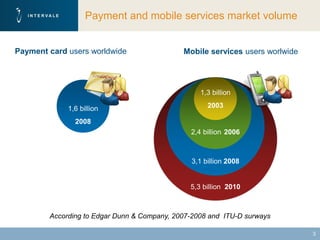
Payment and mobile services market volume


Payment card users worldwide                 Mobile services users worlwide


                                                  1,3 billion

             1,6 billion                            2003

               2008
                                               2,4 billion 2006


                                               3,1 billion 2008


                                               5,3 billion 2010


        According to Edgar Dunn & Company, 2007-2008 and ITU-D surways

                                                                              3
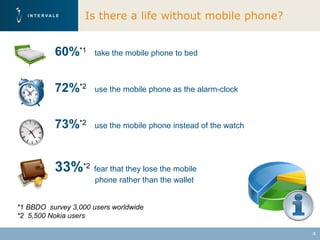
Is there a life without mobile phone?


          60%*1       take the mobile phone to bed


          72%*2       use the mobile phone as the alarm-clock


          73%*2       use the mobile phone instead of the watch


          33%*2 fear that they lose the mobile
                      phone rather than the wallet


*1 BBDO survey 3,000 users worldwide
*2 5,500 Nokia users

                                                                  4
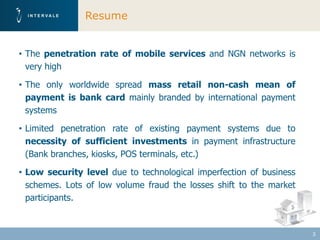
Resume


• The penetration rate of mobile services and NGN networks is
  very high

• The only worldwide spread mass retail non-cash mean of
  payment is bank card mainly branded by international payment
  systems

• Limited penetration rate of existing payment systems due to
  necessity of sufficient investments in payment infrastructure
  (Bank branches, kiosks, POS terminals, etc.)

• Low security level due to technological imperfection of business
  schemes. Lots of low volume fraud the losses shift to the market
  participants.


                                                                     5
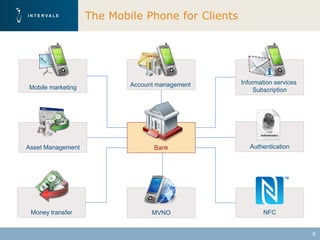
The Mobile Phone for Clients


                           Account management     Information services
Mobile marketing                                      Subscription


Asset Management                  Bank               Authentication


 Money transfer                  MVNO                     NFC


                                                                         6
Mobile information
and financial services


                         7
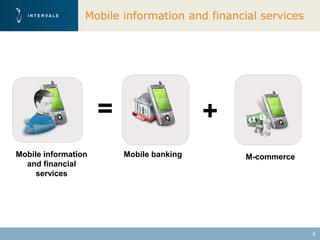
Mobile information and financial services


                     =                    +
Mobile information       Mobile banking        M-commerce
  and financial
     services


                                                             8
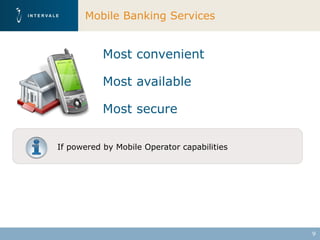
Mobile Banking Services


           Most convenient

           Most available

           Most secure

If powered by Mobile Operator capabilities


                                             9
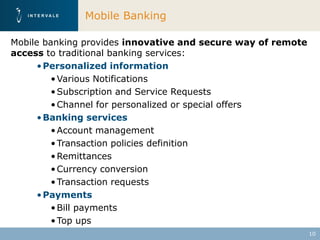
Mobile Banking

Mobile banking provides innovative and secure way of remote
access to traditional banking services:
      • Personalized information
         • Various Notifications
         • Subscription and Service Requests
         • Channel for personalized or special offers
      • Banking services
         • Account management
         • Transaction policies definition
         • Remittances
         • Currency conversion
         • Transaction requests
      • Payments
         • Bill payments
         • Top ups
                                                              10
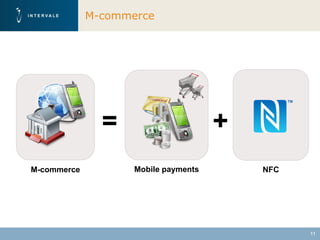
M-commerce


               =                      +
M-commerce          Mobile payments       NFC


                                                11
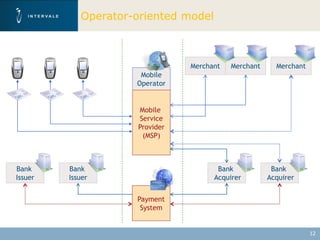
Operator-oriented model

         Users

                                        Merchant   Merchant     Merchant
                              Mobile
                             Operator


                             Mobile
                             Service
                             Provider
                              (MSP)


Bank             Bank                          Bank            Bank
Issuer           Issuer                       Acquirer        Acquirer


                             Payment
                              System


                                                                           12
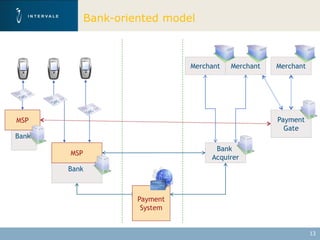
Bank-oriented model

       Users

                                        Merchant   Merchant   Merchant


MSP                                                           Payment
                                                                Gate
Bank
                                              Bank
               MSP
                                             Acquirer
               Bank


                              Payment
                               System


                                                                         13
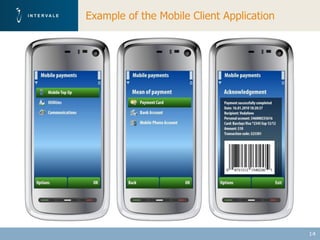
Example of the Mobile Client Application


                                           14
Security
Security


System of user identification and
authentication provides security of
Mobile Payment System transactions. This
solution, consisting of software-hardware
modules and based on communication
security principles, provides synergy of
wireless communication and international
payment systems secure technologies;


                                            16
Security


Confidentiality (encoded messages
 between Agency and Client)
Integrity of data
Impossibility of refusal and
 attributing of authorship of
 transaction
Multifactor authentication
 (establishment of authority)
     – Knows something
     – Owns something

Geneva, 30 March 2011
                                     17
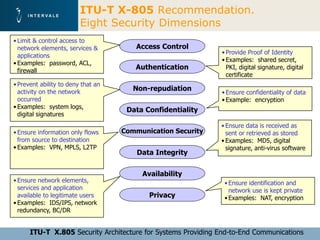
ITU-T X-805 Recommendation.
                         Eight Security Dimensions
• Limit & control access to
  network elements, services &          Access Control
                                                              • Provide Proof of Identity
  applications
                                                              • Examples: shared secret,
• Examples: password, ACL,
  firewall
                                       Authentication           PKI, digital signature, digital
                                                                certificate
• Prevent ability to deny that an
  activity on the network              Non-repudiation
                                                              • Ensure confidentiality of data
  occurred                                                    • Example: encryption
• Examples: system logs,
                                     Data Confidentiality
  digital signatures
                                                              • Ensure data is received as
• Ensure information only flows     Communication Security      sent or retrieved as stored
  from source to destination                                  • Examples: MD5, digital
• Examples: VPN, MPLS, L2TP                                     signature, anti-virus software
                                        Data Integrity


                                         Availability
• Ensure network elements,                                     • Ensure identification and
  services and application                                       network use is kept private
  available to legitimate users            Privacy             • Examples: NAT, encryption
• Examples: IDS/IPS, network
  redundancy, BC/DR


      ITU-T X.805 Security Architecture for Systems Providing End-to-End Communications
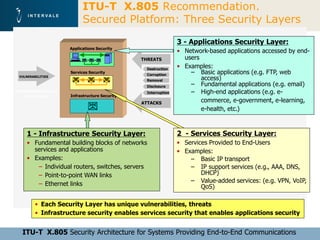
ITU-T X.805 Recommendation.
                                  Secured Platform: Three Security Layers

                                                                       3 - Applications Security Layer:
                            Applications Security
                                                                       • Network-based applications accessed by end-
                                                      THREATS            users
                                                        Destruction
                                                                       • Examples:
                            Services Security
                                                        Corruption         – Basic applications (e.g. FTP, web
  VULNERABILITIES
                                                        Removal                access)
                                                        Disclosure         – Fundamental applications (e.g. email)
Vulnerabilities can exist                               Interruption       – High-end applications (e.g. e-
     in each Layer          Infrastructure Security
                                                      ATTACKS                  commerce, e-government, e-learning,
                                                                               e-health, etc.)


      1 - Infrastructure Security Layer:                               2 - Services Security Layer:
      • Fundamental building blocks of networks                        • Services Provided to End-Users
        services and applications                                      • Examples:
      • Examples:                                                          – Basic IP transport
         – Individual routers, switches, servers                           – IP support services (e.g., AAA, DNS,
         – Point-to-point WAN links                                            DHCP)
                                                                           – Value-added services: (e.g. VPN, VoIP,
         – Ethernet links                                                      QoS)

           • Each Security Layer has unique vulnerabilities, threats
           • Infrastructure security enables services security that enables applications security


    ITU-T X.805 Security Architecture for Systems Providing End-to-End Communications
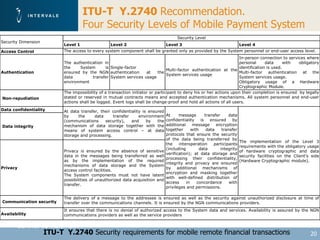
ITU-T Y.2740 Recommendation.
                                     Four Security Levels of Mobile Payment System
                                                                                      Security Level
Security Dimension
                           Level 1                Level 2                       Level 3                                     Level 4
Access Control             The access to every system component shall be granted only as provided by the System personnel or end-user access level.
                                                                                                                     In-person connection to services where
                           The authentication in                                                                     personal      data      with  obligatory
                           the     System       is Single-factor                                                     identification is used.
                                                                                 Multi-factor authentication at the
Authentication             ensured by the NGN authentication          at    the                                      Multi-factor authentication at the
                                                                                 System services usage
                           data           transfer System services usage                                             System services usage.
                           environment                                                                               Obligatory usage of a Hardware
                                                                                                                     Cryptographic Module.
                           The impossibility of a transaction initiator or participant to deny his or her actions upon their completion is ensured by legally
Non-repudiation            stated or reserved in mutual contracts means and accepted authentication mechanisms. All system personnel and end-user
                           actions shall be logged. Event logs shall be change-proof and hold all actions of all users.
Data confidentiality       At data transfer, their confidentiality is ensured
                           by     the     data     transfer      environment    At     message         transfer      data
                           (communications     security),    and     by   the   confidentiality     is    ensured      by
Data integrity             mechanism of data storage together with the          additional     message       encryption
                           means of system access control – at data             together      with      data     transfer
                           storage and processing.                              protocols that ensure the security
                                                                                of the data being transferred by
                                                                                                                            The implementation of the Level 3
                                                                                the    interoperation       participants
                                                                                                                            requirements with the obligatory usage
                                                                                (including         data         integrity
                           Privacy is ensured by the absence of sensitive                                                   of hardware cryptographic and data
                                                                                verification); at data storage and
                           data in the messages being transferred as well                                                   security facilities on the Client’s side
                                                                                processing their confidentiality,
                           as by the implementation of the required                                                         (Hardware Cryptographic module).
                                                                                integrity and privacy are ensured
                           mechanisms of data storage and the System
Privacy                                                                         by additional mechanisms of
                           access control facilities.
                                                                                encryption and masking together
                           The System components must not have latent
                                                                                with well-defined distribution of
                           possibilities of unauthorized data acquisition and
                                                                                access     in    concordance         with
                           transfer.
                                                                                privileges and permissions.

                           The delivery of a message to the addressee is ensured as well as the security against unauthorized disclosure at time of
Communication security     transfer over the communications channels. It is ensured by the NGN communications providers.
                           It ensures that there is no denial of authorized access to the System data and services. Availability is assured by the NGN
Availability               communications providers as well as the service providers

       Geneva, 30 March 2011
                     ITU-T Y.2740 Security requirements for mobile remote financial transactions                                                               20
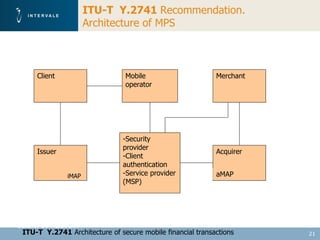
ITU-T Y.2741 Recommendation.
                      Architecture of MPS


      Client                    Mobile                      Merchant
                                operator


                               -Security
                               provider
      Issuer                                                Acquirer
                               -Client
                               authentication
               iMAP            -Service provider            aMAP
                               (MSP)


Geneva, 30 March 2011
 ITU-T Y.2741 Architecture of secure mobile financial transactions     21
Projects


           22
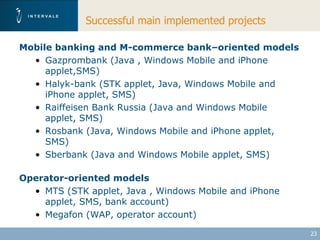
Successful main implemented projects

Mobile banking and M-commerce bank–oriented models
  • Gazprombank (Java , Windows Mobile and iPhone
     applet,SMS)
  • Halyk-bank (STK applet, Java, Windows Mobile and
     iPhone applet, SMS)
  • Raiffeisen Bank Russia (Java and Windows Mobile
     applet, SMS)
  • Rosbank (Java, Windows Mobile and iPhone applet,
     SMS)
  • Sberbank (Java and Windows Mobile applet, SMS)

Operator-oriented models
  • MTS (STK applet, Java , Windows Mobile and iPhone
    applet, SMS, bank account)
  • Megafon (WAP, operator account)

                                                        23
Summary


          24
Summary


• Currently, the penetration rate of mobile services and NGN networks
  development allows to organize new types of services not only directly
  associated with the main purpose of networks.


• NGN networks may become a new infrastructure for convenient and safe
  conduction of financial transactions.


• Information and financial services based on NGN networks include not
  only mobile banking and mobile commerce services and in addition thereto
  may become “infrastructure” basis for providing public services to
  individual customers.


                                                                             25
About the company


                    26
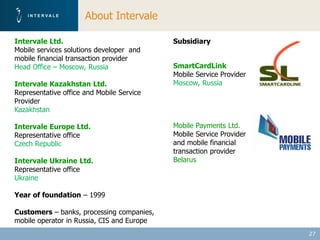
About Intervale

Intervale Ltd.                              Subsidiary
Mobile services solutions developer and
mobile financial transaction provider
Head Office – Moscow, Russia                SmartCardLink
                                            Mobile Service Provider
Intervale Kazakhstan Ltd.                   Moscow, Russia
Representative office and Mobile Service
Provider
Kazakhstan

Intervale Europe Ltd.                       Mobile Payments Ltd.
Representative office                       Mobile Service Provider
Czech Republic                              and mobile financial
                                            transaction provider
Intervale Ukraine Ltd.                      Belarus
Representative office
Ukraine

Year of foundation – 1999

Customers – banks, processing companies,
mobile operator in Russia, CIS and Europe
                                                                      27
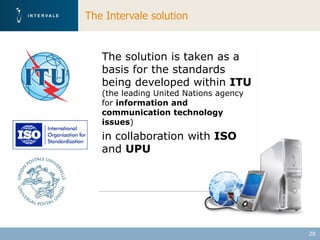
The Intervale solution


   The solution is taken as a
   basis for the standards
   being developed within ITU
   (the leading United Nations agency
   for information and
   communication technology
   issues)
   in collaboration with ISO
   and UPU


                                        28
Thank you!


      127083, Moscow, ul. 8 Marta, 10-Б 3
Tel./Fax: +7 (495) 789-8202, +7 (495) 967-6975
          E-mail: intervale@intervale.ru

                                                 29

Mobile Financial Services

  • 1.
    Moldova ICT summit 18-19 May, 2011 March 2011 Mobile Financial Services Evgeny Bondarenko Deputy General director Intervale, Russia Vice–Chairman ITU-D SG2 Vice-Rapporteur Q17-3/2 E-mail: bondarenko@intervale.ru
  • 2.
  • 3.
    Payment and mobileservices market volume Payment card users worldwide Mobile services users worlwide 1,3 billion 1,6 billion 2003 2008 2,4 billion 2006 3,1 billion 2008 5,3 billion 2010 According to Edgar Dunn & Company, 2007-2008 and ITU-D surways 3
  • 4.
    Is there alife without mobile phone? 60%*1 take the mobile phone to bed 72%*2 use the mobile phone as the alarm-clock 73%*2 use the mobile phone instead of the watch 33%*2 fear that they lose the mobile phone rather than the wallet *1 BBDO survey 3,000 users worldwide *2 5,500 Nokia users 4
  • 5.
    Resume • The penetrationrate of mobile services and NGN networks is very high • The only worldwide spread mass retail non-cash mean of payment is bank card mainly branded by international payment systems • Limited penetration rate of existing payment systems due to necessity of sufficient investments in payment infrastructure (Bank branches, kiosks, POS terminals, etc.) • Low security level due to technological imperfection of business schemes. Lots of low volume fraud the losses shift to the market participants. 5
  • 6.
    The Mobile Phonefor Clients Account management Information services Mobile marketing Subscription Asset Management Bank Authentication Money transfer MVNO NFC 6
  • 7.
  • 8.
    Mobile information andfinancial services = + Mobile information Mobile banking M-commerce and financial services 8
  • 9.
    Mobile Banking Services Most convenient Most available Most secure If powered by Mobile Operator capabilities 9
  • 10.
    Mobile Banking Mobile bankingprovides innovative and secure way of remote access to traditional banking services: • Personalized information • Various Notifications • Subscription and Service Requests • Channel for personalized or special offers • Banking services • Account management • Transaction policies definition • Remittances • Currency conversion • Transaction requests • Payments • Bill payments • Top ups 10
  • 11.
    M-commerce = + M-commerce Mobile payments NFC 11
  • 12.
    Operator-oriented model Users Merchant Merchant Merchant Mobile Operator Mobile Service Provider (MSP) Bank Bank Bank Bank Issuer Issuer Acquirer Acquirer Payment System 12
  • 13.
    Bank-oriented model Users Merchant Merchant Merchant MSP Payment Gate Bank Bank MSP Acquirer Bank Payment System 13
  • 14.
    Example of theMobile Client Application 14
  • 15.
  • 16.
    Security System of useridentification and authentication provides security of Mobile Payment System transactions. This solution, consisting of software-hardware modules and based on communication security principles, provides synergy of wireless communication and international payment systems secure technologies; 16
  • 17.
    Security Confidentiality (encoded messages between Agency and Client) Integrity of data Impossibility of refusal and attributing of authorship of transaction Multifactor authentication (establishment of authority) – Knows something – Owns something Geneva, 30 March 2011 17
  • 18.
    ITU-T X-805 Recommendation. Eight Security Dimensions • Limit & control access to network elements, services & Access Control • Provide Proof of Identity applications • Examples: shared secret, • Examples: password, ACL, firewall Authentication PKI, digital signature, digital certificate • Prevent ability to deny that an activity on the network Non-repudiation • Ensure confidentiality of data occurred • Example: encryption • Examples: system logs, Data Confidentiality digital signatures • Ensure data is received as • Ensure information only flows Communication Security sent or retrieved as stored from source to destination • Examples: MD5, digital • Examples: VPN, MPLS, L2TP signature, anti-virus software Data Integrity Availability • Ensure network elements, • Ensure identification and services and application network use is kept private available to legitimate users Privacy • Examples: NAT, encryption • Examples: IDS/IPS, network redundancy, BC/DR ITU-T X.805 Security Architecture for Systems Providing End-to-End Communications
  • 19.
    ITU-T X.805 Recommendation. Secured Platform: Three Security Layers 3 - Applications Security Layer: Applications Security • Network-based applications accessed by end- THREATS users Destruction • Examples: Services Security Corruption – Basic applications (e.g. FTP, web VULNERABILITIES Removal access) Disclosure – Fundamental applications (e.g. email) Vulnerabilities can exist Interruption – High-end applications (e.g. e- in each Layer Infrastructure Security ATTACKS commerce, e-government, e-learning, e-health, etc.) 1 - Infrastructure Security Layer: 2 - Services Security Layer: • Fundamental building blocks of networks • Services Provided to End-Users services and applications • Examples: • Examples: – Basic IP transport – Individual routers, switches, servers – IP support services (e.g., AAA, DNS, – Point-to-point WAN links DHCP) – Value-added services: (e.g. VPN, VoIP, – Ethernet links QoS) • Each Security Layer has unique vulnerabilities, threats • Infrastructure security enables services security that enables applications security ITU-T X.805 Security Architecture for Systems Providing End-to-End Communications
  • 20.
    ITU-T Y.2740 Recommendation. Four Security Levels of Mobile Payment System Security Level Security Dimension Level 1 Level 2 Level 3 Level 4 Access Control The access to every system component shall be granted only as provided by the System personnel or end-user access level. In-person connection to services where The authentication in personal data with obligatory the System is Single-factor identification is used. Multi-factor authentication at the Authentication ensured by the NGN authentication at the Multi-factor authentication at the System services usage data transfer System services usage System services usage. environment Obligatory usage of a Hardware Cryptographic Module. The impossibility of a transaction initiator or participant to deny his or her actions upon their completion is ensured by legally Non-repudiation stated or reserved in mutual contracts means and accepted authentication mechanisms. All system personnel and end-user actions shall be logged. Event logs shall be change-proof and hold all actions of all users. Data confidentiality At data transfer, their confidentiality is ensured by the data transfer environment At message transfer data (communications security), and by the confidentiality is ensured by Data integrity mechanism of data storage together with the additional message encryption means of system access control – at data together with data transfer storage and processing. protocols that ensure the security of the data being transferred by The implementation of the Level 3 the interoperation participants requirements with the obligatory usage (including data integrity Privacy is ensured by the absence of sensitive of hardware cryptographic and data verification); at data storage and data in the messages being transferred as well security facilities on the Client’s side processing their confidentiality, as by the implementation of the required (Hardware Cryptographic module). integrity and privacy are ensured mechanisms of data storage and the System Privacy by additional mechanisms of access control facilities. encryption and masking together The System components must not have latent with well-defined distribution of possibilities of unauthorized data acquisition and access in concordance with transfer. privileges and permissions. The delivery of a message to the addressee is ensured as well as the security against unauthorized disclosure at time of Communication security transfer over the communications channels. It is ensured by the NGN communications providers. It ensures that there is no denial of authorized access to the System data and services. Availability is assured by the NGN Availability communications providers as well as the service providers Geneva, 30 March 2011 ITU-T Y.2740 Security requirements for mobile remote financial transactions 20
  • 21.
    ITU-T Y.2741 Recommendation. Architecture of MPS Client Mobile Merchant operator -Security provider Issuer Acquirer -Client authentication iMAP -Service provider aMAP (MSP) Geneva, 30 March 2011 ITU-T Y.2741 Architecture of secure mobile financial transactions 21
  • 22.
  • 23.
    Successful main implementedprojects Mobile banking and M-commerce bank–oriented models • Gazprombank (Java , Windows Mobile and iPhone applet,SMS) • Halyk-bank (STK applet, Java, Windows Mobile and iPhone applet, SMS) • Raiffeisen Bank Russia (Java and Windows Mobile applet, SMS) • Rosbank (Java, Windows Mobile and iPhone applet, SMS) • Sberbank (Java and Windows Mobile applet, SMS) Operator-oriented models • MTS (STK applet, Java , Windows Mobile and iPhone applet, SMS, bank account) • Megafon (WAP, operator account) 23
  • 24.
  • 25.
    Summary • Currently, thepenetration rate of mobile services and NGN networks development allows to organize new types of services not only directly associated with the main purpose of networks. • NGN networks may become a new infrastructure for convenient and safe conduction of financial transactions. • Information and financial services based on NGN networks include not only mobile banking and mobile commerce services and in addition thereto may become “infrastructure” basis for providing public services to individual customers. 25
  • 26.
  • 27.
    About Intervale Intervale Ltd. Subsidiary Mobile services solutions developer and mobile financial transaction provider Head Office – Moscow, Russia SmartCardLink Mobile Service Provider Intervale Kazakhstan Ltd. Moscow, Russia Representative office and Mobile Service Provider Kazakhstan Intervale Europe Ltd. Mobile Payments Ltd. Representative office Mobile Service Provider Czech Republic and mobile financial transaction provider Intervale Ukraine Ltd. Belarus Representative office Ukraine Year of foundation – 1999 Customers – banks, processing companies, mobile operator in Russia, CIS and Europe 27
  • 28.
    The Intervale solution The solution is taken as a basis for the standards being developed within ITU (the leading United Nations agency for information and communication technology issues) in collaboration with ISO and UPU 28
  • 29.
    Thank you! 127083, Moscow, ul. 8 Marta, 10-Б 3 Tel./Fax: +7 (495) 789-8202, +7 (495) 967-6975 E-mail: intervale@intervale.ru 29