Spacecraft and Aircraft Dynamics
Matthew M. Peet
Illinois Institute of Technology
Lecture 9: 6DOF Equations of Motion
Aircraft Dynamics
Lecture 9
In this Lecture we will cover:
Newton’s Laws
•
P ~
Mi = d
dt
~
H
•
P ~
Fi = m d
dt~
v
Rotating Frames of Reference
• Equations of Motion in Body-Fixed Frame
• Often Confusing
M. Peet Lecture 9: 2 / 24
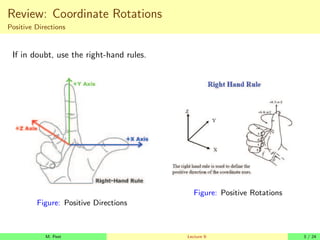
Review: Coordinate Rotations
Positive Directions
If in doubt, use the right-hand rules.
Figure: Positive Directions
Figure: Positive Rotations
M. Peet Lecture 9: 3 / 24
Review: Coordinate Rotations
Roll-Pitch-Yaw
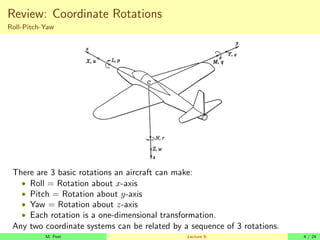
There are 3 basic rotations an aircraft can make:
• Roll = Rotation about x-axis
• Pitch = Rotation about y-axis
• Yaw = Rotation about z-axis
• Each rotation is a one-dimensional transformation.
Any two coordinate systems can be related by a sequence of 3 rotations.
M. Peet Lecture 9: 4 / 24
Review: Forces and Moments
Forces
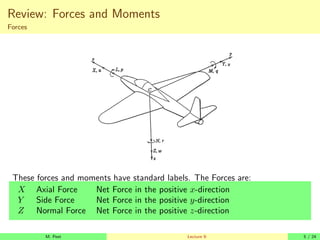
These forces and moments have standard labels. The Forces are:
X Axial Force Net Force in the positive x-direction
Y Side Force Net Force in the positive y-direction
Z Normal Force Net Force in the positive z-direction
M. Peet Lecture 9: 5 / 24
Review: Forces and Moments
Moments
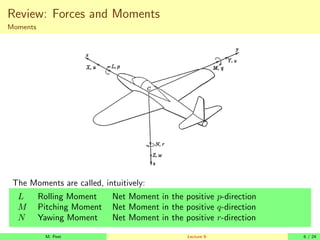
The Moments are called, intuitively:
L Rolling Moment Net Moment in the positive p-direction
M Pitching Moment Net Moment in the positive q-direction
N Yawing Moment Net Moment in the positive r-direction
M. Peet Lecture 9: 6 / 24
6DOF: Newton’s Laws
Forces
Newton’s Second Law tells us that for a particle F = ma. In vector form:
~
F =
X
i
~
Fi = m
d
dt
~
V
That is, if ~
F = [Fx Fy Fz] and ~
V = [u v w], then
Fx = m
du
dt
Fx = m
dv
dt
Fz = m
dw
dt
Definition 1.
~
L = m~
V is referred to as Linear Momentum.
Newton’s Second Law is only valid if ~
F and ~
V are defined in an Inertial
coordinate system.
Definition 2.
A coordinate system is Inertial if it is not accelerating or rotating.
M. Peet Lecture 9: 7 / 24
Newton’s Laws
Moments
Using Calculus, this concept can be extended to rigid bodies by integration over
all particles.
~
M =
X
i
~
Mi =
d
dt
~
H
Definition 3.
Where ~
H =
R
(~
rc × ~
vc)dm is the angular momentum.
Angular momentum of a rigid body can be found as
~
H = I~
ωI
where ~
ωI = [p, q, r]T
is the angular rotation vector of the body about the
center of mass.
• p is rotation about the x-axis.
• q is rotation about the y-axis.
• r is rotation about the z-axis.
• ωI is defined in an Inertial Frame.
The matrix I is the Moment of Inertia Matrix.
M. Peet Lecture 9: 8 / 24
Newton’s Laws
Moment of Inertia
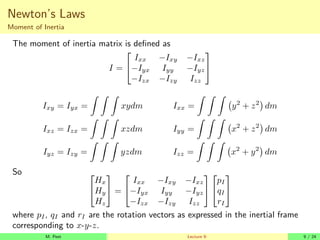
The moment of inertia matrix is defined as
I =


Ixx −Ixy −Ixz
−Iyx Iyy −Iyz
−Izx −Izy Izz


Ixy = Iyx =
Z Z Z
xydm Ixx =
Z Z Z
y2
+ z2

dm
Ixz = Izx =
Z Z Z
xzdm Iyy =
Z Z Z
x2
+ z2

dm
Iyz = Izy =
Z Z Z
yzdm Izz =
Z Z Z
x2
+ y2

dm
So 

Hx
Hy
Hz

 =


Ixx −Ixy −Ixz
−Iyx Iyy −Iyz
−Izx −Izy Izz




pI
qI
rI


where pI, qI and rI are the rotation vectors as expressed in the inertial frame
corresponding to x-y-z.
M. Peet Lecture 9: 9 / 24
Moment of Inertia
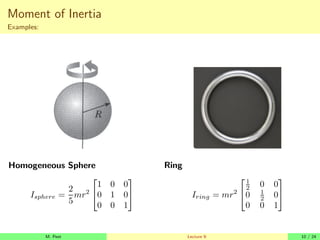
Examples:
Homogeneous Sphere
Isphere =
2
5
mr2


1 0 0
0 1 0
0 0 1


Ring
Iring = mr2


1
2 0 0
0 1
2 0
0 0 1


M. Peet Lecture 9: 10 / 24
Moment of Inertia
Examples:
Homogeneous Disk
Idisk =
1
4
mr2


1 + 1
3
h
r2 0 0
0 1 + 1
3
h
r2 0
0 0 1
2


F/A-18
I =


23 0 2.97
0 15.13 0
2.97 0 16.99

 kslug − ft2
M. Peet Lecture 9: 11 / 24
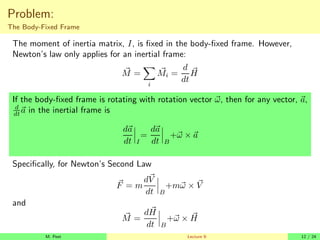
Problem:
The Body-Fixed Frame
The moment of inertia matrix, I, is fixed in the body-fixed frame. However,
Newton’s law only applies for an inertial frame:
~
M =
X
i
~
Mi =
d
dt
~
H
If the body-fixed frame is rotating with rotation vector ~
ω, then for any vector, ~
a,
d
dt~
a in the inertial frame is
d~
a
dt I
=
d~
a
dt B
+~
ω × ~
a
Specifically, for Newton’s Second Law
~
F = m
d~
V
dt B
+m~
ω × ~
V
and
~
M =
d ~
H
dt B
+~
ω × ~
H
M. Peet Lecture 9: 12 / 24
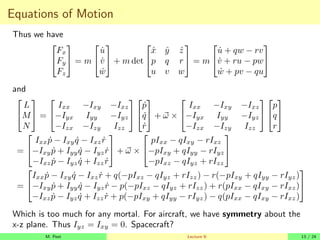
Equations of Motion
Thus we have


Fx
Fy
Fz

 = m


u̇
v̇
ẇ

 + m det


x̂ ŷ ẑ
p q r
u v w

 = m


u̇ + qw − rv
v̇ + ru − pw
ẇ + pv − qu


and


L
M
N

 =


Ixx −Ixy −Ixz
−Iyx Iyy −Iyz
−Izx −Izy Izz




ṗ
q̇
ṙ

 + ~
ω ×


Ixx −Ixy −Ixz
−Iyx Iyy −Iyz
−Izx −Izy Izz




p
q
r


=


Ixxṗ − Ixyq̇ − Ixzṙ
−Ixyṗ + Iyyq̇ − Iyzṙ
−Ixzṗ − Iyzq̇ + Izzṙ

 + ~
ω ×


pIxx − qIxy − rIxz
−pIxy + qIyy − rIyz
−pIxz − qIyz + rIzz


=


Ixxṗ − Ixyq̇ − Ixzṙ + q(−pIxz − qIyz + rIzz) − r(−pIxy + qIyy − rIyz)
−Ixyṗ + Iyyq̇ − Iyzṙ − p(−pIxz − qIyz + rIzz) + r(pIxx − qIxy − rIxz)
−Ixzṗ − Iyzq̇ + Izzṙ + p(−pIxy + qIyy − rIyz) − q(pIxx − qIxy − rIxz)


Which is too much for any mortal. For aircraft, we have symmetry about the
x-z plane. Thus Iyz = Ixy = 0. Spacecraft?
M. Peet Lecture 9: 13 / 24
Equations of Motion
Reduced Equations
With Ixy = Iyz = 0, we have, in summary:


Fx
Fy
Fz

 = m


u̇ + qw − rv
v̇ + ru − pw
ẇ + pv − qu


and


L
M
N

 =


Ixxṗ − Ixzṙ − qpIxz + qrIzz − rqIyy
Iyyq̇ + p2
Ixz − prIzz + rpIxx − r2
Ixz
−Ixzṗ + Izzṙ + pqIyy − qpIxx + qrIxz


Right now,
• Translational variables (u,v,w) depend on rotational variables (p,q,r).
• Rotational variables (p,q,r) do not depend on translational variables
(u,v,w).
I For aircraft, however, Moment forces (L,M,N) depend on rotational and
translational variables.
M. Peet Lecture 9: 14 / 24
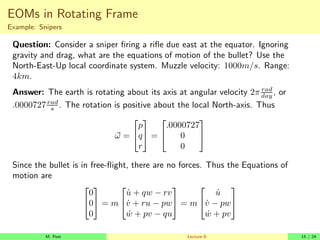
EOMs in Rotating Frame
Example: Snipers
Question: Consider a sniper firing a rifle due east at the equator. Ignoring
gravity and drag, what are the equations of motion of the bullet? Use the
North-East-Up local coordinate system. Muzzle velocity: 1000m/s. Range:
4km.
Answer: The earth is rotating about its axis at angular velocity 2π rad
day , or
.0000727rad
s . The rotation is positive about the local North-axis. Thus
~
ω =


p
q
r

 =


.0000727
0
0


Since the bullet is in free-flight, there are no forces. Thus the Equations of
motion are


0
0
0

 = m


u̇ + qw − rv
v̇ + ru − pw
ẇ + pv − qu

 = m


u̇
v̇ − pw
ẇ + pv


M. Peet Lecture 9: 15 / 24
EOMs in Rotating Frame
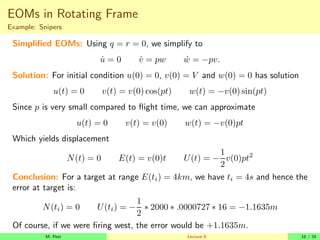
Example: Snipers
Simplified EOMs: Using q = r = 0, we simplify to
u̇ = 0 v̇ = pw ẇ = −pv.
Solution: For initial condition u(0) = 0, v(0) = V and w(0) = 0 has solution
u(t) = 0 v(t) = v(0) cos(pt) w(t) = −v(0) sin(pt)
Since p is very small compared to flight time, we can approximate
u(t) = 0 v(t) = v(0) w(t) = −v(0)pt
Which yields displacement
N(t) = 0 E(t) = v(0)t U(t) = −
1
2
v(0)pt2
Conclusion: For a target at range E(ti) = 4km, we have ti = 4s and hence the
error at target is:
N(ti) = 0 U(ti) = −
1
2
∗ 2000 ∗ .0000727 ∗ 16 = −1.1635m
Of course, if we were firing west, the error would be +1.1635m.
M. Peet Lecture 9: 16 / 24
Euler Angles
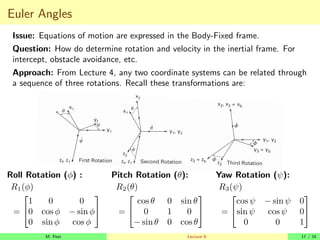
Issue: Equations of motion are expressed in the Body-Fixed frame.
Question: How do determine rotation and velocity in the inertial frame. For
intercept, obstacle avoidance, etc.
Approach: From Lecture 4, any two coordinate systems can be related through
a sequence of three rotations. Recall these transformations are:
Roll Rotation (φ) :
R1(φ)
=


1 0 0
0 cos φ − sin φ
0 sin φ cos φ


Pitch Rotation (θ):
R2(θ)
=


cos θ 0 sin θ
0 1 0
− sin θ 0 cos θ


Yaw Rotation (ψ):
R3(ψ)
=


cos ψ − sin ψ 0
sin ψ cos ψ 0
0 0 1


M. Peet Lecture 9: 17 / 24
Euler Angles
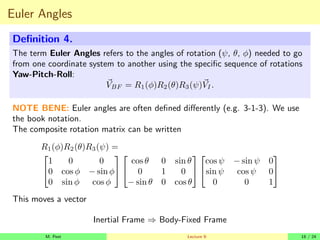
Definition 4.
The term Euler Angles refers to the angles of rotation (ψ, θ, φ) needed to go
from one coordinate system to another using the specific sequence of rotations
Yaw-Pitch-Roll:
~
VBF = R1(φ)R2(θ)R3(ψ)~
VI .
NOTE BENE: Euler angles are often defined differently (e.g. 3-1-3). We use
the book notation.
The composite rotation matrix can be written
R1(φ)R2(θ)R3(ψ) =


1 0 0
0 cos φ − sin φ
0 sin φ cos φ




cos θ 0 sin θ
0 1 0
− sin θ 0 cos θ




cos ψ − sin ψ 0
sin ψ cos ψ 0
0 0 1


This moves a vector
Inertial Frame ⇒ Body-Fixed Frame
M. Peet Lecture 9: 18 / 24
Euler Angles
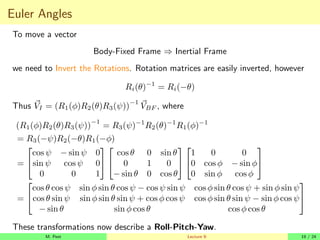
To move a vector
Body-Fixed Frame ⇒ Inertial Frame
we need to Invert the Rotations. Rotation matrices are easily inverted, however
Ri(θ)−1
= Ri(−θ)
Thus ~
VI = (R1(φ)R2(θ)R3(ψ))
−1 ~
VBF , where
(R1(φ)R2(θ)R3(ψ))
−1
= R3(ψ)−1
R2(θ)−1
R1(φ)−1
= R3(−ψ)R2(−θ)R1(−φ)
=


cos ψ − sin ψ 0
sin ψ cos ψ 0
0 0 1




cos θ 0 sin θ
0 1 0
− sin θ 0 cos θ




1 0 0
0 cos φ − sin φ
0 sin φ cos φ


=


cos θ cos ψ sin φ sin θ cos ψ − cos ψ sin ψ cos φ sin θ cos ψ + sin φ sin ψ
cos θ sin ψ sin φ sin θ sin ψ + cos φ cos ψ cos φ sin θ sin ψ − sin φ cos ψ
− sin θ sin φ cos θ cos φ cos θ


These transformations now describe a Roll-Pitch-Yaw.
M. Peet Lecture 9: 19 / 24
Euler Angles
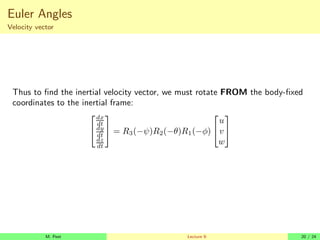
Velocity vector
Thus to find the inertial velocity vector, we must rotate FROM the body-fixed
coordinates to the inertial frame:


dx
dt
dy
dt
dz
dt

 = R3(−ψ)R2(−θ)R1(−φ)


u
v
w


M. Peet Lecture 9: 20 / 24
Euler Angles
The rate of rotation of the Euler Angles can be found by rotating the rotation
vector into the inertial frame


p
q
r

 =


1 0 − sin θ
0 cos φ cos θ sin φ
0 − sin θ cos θ cos φ




φ̇
θ̇
ψ̇


This transformation can also be reversed as


φ̇
θ̇
ψ̇

 =


1 sin φ tan θ cos φ tan θ
0 cos φ − sin φ
0 sin φ sec θ cos φ sec θ




p
q
r


M. Peet Lecture 9: 21 / 24
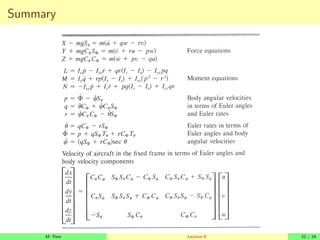
Summary
M. Peet Lecture 9: 22 / 24
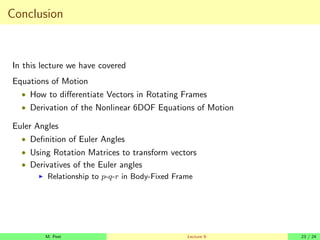
Conclusion
In this lecture we have covered
Equations of Motion
• How to differentiate Vectors in Rotating Frames
• Derivation of the Nonlinear 6DOF Equations of Motion
Euler Angles
• Definition of Euler Angles
• Using Rotation Matrices to transform vectors
• Derivatives of the Euler angles
I Relationship to p-q-r in Body-Fixed Frame
M. Peet Lecture 9: 23 / 24
Next Lecture
In the next lecture we will cover
Linearized Equations of Motion
• How to linearize the nonlinear 6DOF EOM
• How to linearize the force and moment contributions
Force and Moment Contributions
• The gravity and thrust contributions
• The full linearized equations of motion including forces and moments
• How to decouple into Longitudinal and Lateral Dynamics
I Reminder on how to create a state-space representation.
M. Peet Lecture 9: 24 / 24

6 dof.pdf

  • 1.
    Spacecraft and AircraftDynamics Matthew M. Peet Illinois Institute of Technology Lecture 9: 6DOF Equations of Motion
  • 2.
    Aircraft Dynamics Lecture 9 Inthis Lecture we will cover: Newton’s Laws • P ~ Mi = d dt ~ H • P ~ Fi = m d dt~ v Rotating Frames of Reference • Equations of Motion in Body-Fixed Frame • Often Confusing M. Peet Lecture 9: 2 / 24
  • 3.
    Review: Coordinate Rotations PositiveDirections If in doubt, use the right-hand rules. Figure: Positive Directions Figure: Positive Rotations M. Peet Lecture 9: 3 / 24
  • 4.
    Review: Coordinate Rotations Roll-Pitch-Yaw Thereare 3 basic rotations an aircraft can make: • Roll = Rotation about x-axis • Pitch = Rotation about y-axis • Yaw = Rotation about z-axis • Each rotation is a one-dimensional transformation. Any two coordinate systems can be related by a sequence of 3 rotations. M. Peet Lecture 9: 4 / 24
  • 5.
    Review: Forces andMoments Forces These forces and moments have standard labels. The Forces are: X Axial Force Net Force in the positive x-direction Y Side Force Net Force in the positive y-direction Z Normal Force Net Force in the positive z-direction M. Peet Lecture 9: 5 / 24
  • 6.
    Review: Forces andMoments Moments The Moments are called, intuitively: L Rolling Moment Net Moment in the positive p-direction M Pitching Moment Net Moment in the positive q-direction N Yawing Moment Net Moment in the positive r-direction M. Peet Lecture 9: 6 / 24
  • 7.
    6DOF: Newton’s Laws Forces Newton’sSecond Law tells us that for a particle F = ma. In vector form: ~ F = X i ~ Fi = m d dt ~ V That is, if ~ F = [Fx Fy Fz] and ~ V = [u v w], then Fx = m du dt Fx = m dv dt Fz = m dw dt Definition 1. ~ L = m~ V is referred to as Linear Momentum. Newton’s Second Law is only valid if ~ F and ~ V are defined in an Inertial coordinate system. Definition 2. A coordinate system is Inertial if it is not accelerating or rotating. M. Peet Lecture 9: 7 / 24
  • 8.
    Newton’s Laws Moments Using Calculus,this concept can be extended to rigid bodies by integration over all particles. ~ M = X i ~ Mi = d dt ~ H Definition 3. Where ~ H = R (~ rc × ~ vc)dm is the angular momentum. Angular momentum of a rigid body can be found as ~ H = I~ ωI where ~ ωI = [p, q, r]T is the angular rotation vector of the body about the center of mass. • p is rotation about the x-axis. • q is rotation about the y-axis. • r is rotation about the z-axis. • ωI is defined in an Inertial Frame. The matrix I is the Moment of Inertia Matrix. M. Peet Lecture 9: 8 / 24
  • 9.
    Newton’s Laws Moment ofInertia The moment of inertia matrix is defined as I =   Ixx −Ixy −Ixz −Iyx Iyy −Iyz −Izx −Izy Izz   Ixy = Iyx = Z Z Z xydm Ixx = Z Z Z y2 + z2 dm Ixz = Izx = Z Z Z xzdm Iyy = Z Z Z x2 + z2 dm Iyz = Izy = Z Z Z yzdm Izz = Z Z Z x2 + y2 dm So   Hx Hy Hz   =   Ixx −Ixy −Ixz −Iyx Iyy −Iyz −Izx −Izy Izz     pI qI rI   where pI, qI and rI are the rotation vectors as expressed in the inertial frame corresponding to x-y-z. M. Peet Lecture 9: 9 / 24
  • 10.
    Moment of Inertia Examples: HomogeneousSphere Isphere = 2 5 mr2   1 0 0 0 1 0 0 0 1   Ring Iring = mr2   1 2 0 0 0 1 2 0 0 0 1   M. Peet Lecture 9: 10 / 24
  • 11.
    Moment of Inertia Examples: HomogeneousDisk Idisk = 1 4 mr2   1 + 1 3 h r2 0 0 0 1 + 1 3 h r2 0 0 0 1 2   F/A-18 I =   23 0 2.97 0 15.13 0 2.97 0 16.99   kslug − ft2 M. Peet Lecture 9: 11 / 24
  • 12.
    Problem: The Body-Fixed Frame Themoment of inertia matrix, I, is fixed in the body-fixed frame. However, Newton’s law only applies for an inertial frame: ~ M = X i ~ Mi = d dt ~ H If the body-fixed frame is rotating with rotation vector ~ ω, then for any vector, ~ a, d dt~ a in the inertial frame is d~ a dt I = d~ a dt B +~ ω × ~ a Specifically, for Newton’s Second Law ~ F = m d~ V dt B +m~ ω × ~ V and ~ M = d ~ H dt B +~ ω × ~ H M. Peet Lecture 9: 12 / 24
  • 13.
    Equations of Motion Thuswe have   Fx Fy Fz   = m   u̇ v̇ ẇ   + m det   x̂ ŷ ẑ p q r u v w   = m   u̇ + qw − rv v̇ + ru − pw ẇ + pv − qu   and   L M N   =   Ixx −Ixy −Ixz −Iyx Iyy −Iyz −Izx −Izy Izz     ṗ q̇ ṙ   + ~ ω ×   Ixx −Ixy −Ixz −Iyx Iyy −Iyz −Izx −Izy Izz     p q r   =   Ixxṗ − Ixyq̇ − Ixzṙ −Ixyṗ + Iyyq̇ − Iyzṙ −Ixzṗ − Iyzq̇ + Izzṙ   + ~ ω ×   pIxx − qIxy − rIxz −pIxy + qIyy − rIyz −pIxz − qIyz + rIzz   =   Ixxṗ − Ixyq̇ − Ixzṙ + q(−pIxz − qIyz + rIzz) − r(−pIxy + qIyy − rIyz) −Ixyṗ + Iyyq̇ − Iyzṙ − p(−pIxz − qIyz + rIzz) + r(pIxx − qIxy − rIxz) −Ixzṗ − Iyzq̇ + Izzṙ + p(−pIxy + qIyy − rIyz) − q(pIxx − qIxy − rIxz)   Which is too much for any mortal. For aircraft, we have symmetry about the x-z plane. Thus Iyz = Ixy = 0. Spacecraft? M. Peet Lecture 9: 13 / 24
  • 14.
    Equations of Motion ReducedEquations With Ixy = Iyz = 0, we have, in summary:   Fx Fy Fz   = m   u̇ + qw − rv v̇ + ru − pw ẇ + pv − qu   and   L M N   =   Ixxṗ − Ixzṙ − qpIxz + qrIzz − rqIyy Iyyq̇ + p2 Ixz − prIzz + rpIxx − r2 Ixz −Ixzṗ + Izzṙ + pqIyy − qpIxx + qrIxz   Right now, • Translational variables (u,v,w) depend on rotational variables (p,q,r). • Rotational variables (p,q,r) do not depend on translational variables (u,v,w). I For aircraft, however, Moment forces (L,M,N) depend on rotational and translational variables. M. Peet Lecture 9: 14 / 24
  • 15.
    EOMs in RotatingFrame Example: Snipers Question: Consider a sniper firing a rifle due east at the equator. Ignoring gravity and drag, what are the equations of motion of the bullet? Use the North-East-Up local coordinate system. Muzzle velocity: 1000m/s. Range: 4km. Answer: The earth is rotating about its axis at angular velocity 2π rad day , or .0000727rad s . The rotation is positive about the local North-axis. Thus ~ ω =   p q r   =   .0000727 0 0   Since the bullet is in free-flight, there are no forces. Thus the Equations of motion are   0 0 0   = m   u̇ + qw − rv v̇ + ru − pw ẇ + pv − qu   = m   u̇ v̇ − pw ẇ + pv   M. Peet Lecture 9: 15 / 24
  • 16.
    EOMs in RotatingFrame Example: Snipers Simplified EOMs: Using q = r = 0, we simplify to u̇ = 0 v̇ = pw ẇ = −pv. Solution: For initial condition u(0) = 0, v(0) = V and w(0) = 0 has solution u(t) = 0 v(t) = v(0) cos(pt) w(t) = −v(0) sin(pt) Since p is very small compared to flight time, we can approximate u(t) = 0 v(t) = v(0) w(t) = −v(0)pt Which yields displacement N(t) = 0 E(t) = v(0)t U(t) = − 1 2 v(0)pt2 Conclusion: For a target at range E(ti) = 4km, we have ti = 4s and hence the error at target is: N(ti) = 0 U(ti) = − 1 2 ∗ 2000 ∗ .0000727 ∗ 16 = −1.1635m Of course, if we were firing west, the error would be +1.1635m. M. Peet Lecture 9: 16 / 24
  • 17.
    Euler Angles Issue: Equationsof motion are expressed in the Body-Fixed frame. Question: How do determine rotation and velocity in the inertial frame. For intercept, obstacle avoidance, etc. Approach: From Lecture 4, any two coordinate systems can be related through a sequence of three rotations. Recall these transformations are: Roll Rotation (φ) : R1(φ) =   1 0 0 0 cos φ − sin φ 0 sin φ cos φ   Pitch Rotation (θ): R2(θ) =   cos θ 0 sin θ 0 1 0 − sin θ 0 cos θ   Yaw Rotation (ψ): R3(ψ) =   cos ψ − sin ψ 0 sin ψ cos ψ 0 0 0 1   M. Peet Lecture 9: 17 / 24
  • 18.
    Euler Angles Definition 4. Theterm Euler Angles refers to the angles of rotation (ψ, θ, φ) needed to go from one coordinate system to another using the specific sequence of rotations Yaw-Pitch-Roll: ~ VBF = R1(φ)R2(θ)R3(ψ)~ VI . NOTE BENE: Euler angles are often defined differently (e.g. 3-1-3). We use the book notation. The composite rotation matrix can be written R1(φ)R2(θ)R3(ψ) =   1 0 0 0 cos φ − sin φ 0 sin φ cos φ     cos θ 0 sin θ 0 1 0 − sin θ 0 cos θ     cos ψ − sin ψ 0 sin ψ cos ψ 0 0 0 1   This moves a vector Inertial Frame ⇒ Body-Fixed Frame M. Peet Lecture 9: 18 / 24
  • 19.
    Euler Angles To movea vector Body-Fixed Frame ⇒ Inertial Frame we need to Invert the Rotations. Rotation matrices are easily inverted, however Ri(θ)−1 = Ri(−θ) Thus ~ VI = (R1(φ)R2(θ)R3(ψ)) −1 ~ VBF , where (R1(φ)R2(θ)R3(ψ)) −1 = R3(ψ)−1 R2(θ)−1 R1(φ)−1 = R3(−ψ)R2(−θ)R1(−φ) =   cos ψ − sin ψ 0 sin ψ cos ψ 0 0 0 1     cos θ 0 sin θ 0 1 0 − sin θ 0 cos θ     1 0 0 0 cos φ − sin φ 0 sin φ cos φ   =   cos θ cos ψ sin φ sin θ cos ψ − cos ψ sin ψ cos φ sin θ cos ψ + sin φ sin ψ cos θ sin ψ sin φ sin θ sin ψ + cos φ cos ψ cos φ sin θ sin ψ − sin φ cos ψ − sin θ sin φ cos θ cos φ cos θ   These transformations now describe a Roll-Pitch-Yaw. M. Peet Lecture 9: 19 / 24
  • 20.
    Euler Angles Velocity vector Thusto find the inertial velocity vector, we must rotate FROM the body-fixed coordinates to the inertial frame:   dx dt dy dt dz dt   = R3(−ψ)R2(−θ)R1(−φ)   u v w   M. Peet Lecture 9: 20 / 24
  • 21.
    Euler Angles The rateof rotation of the Euler Angles can be found by rotating the rotation vector into the inertial frame   p q r   =   1 0 − sin θ 0 cos φ cos θ sin φ 0 − sin θ cos θ cos φ     φ̇ θ̇ ψ̇   This transformation can also be reversed as   φ̇ θ̇ ψ̇   =   1 sin φ tan θ cos φ tan θ 0 cos φ − sin φ 0 sin φ sec θ cos φ sec θ     p q r   M. Peet Lecture 9: 21 / 24
  • 22.
  • 23.
    Conclusion In this lecturewe have covered Equations of Motion • How to differentiate Vectors in Rotating Frames • Derivation of the Nonlinear 6DOF Equations of Motion Euler Angles • Definition of Euler Angles • Using Rotation Matrices to transform vectors • Derivatives of the Euler angles I Relationship to p-q-r in Body-Fixed Frame M. Peet Lecture 9: 23 / 24
  • 24.
    Next Lecture In thenext lecture we will cover Linearized Equations of Motion • How to linearize the nonlinear 6DOF EOM • How to linearize the force and moment contributions Force and Moment Contributions • The gravity and thrust contributions • The full linearized equations of motion including forces and moments • How to decouple into Longitudinal and Lateral Dynamics I Reminder on how to create a state-space representation. M. Peet Lecture 9: 24 / 24